DOCTORAL PROGRAMME IN PHYSICS
DOCTORAL THESIS:
Free and graphene supported metallic
nanoparticles and their interaction with
hydrogen
Thesis submitted by:
Alejandra Granja del Río
as part of the requirements for the degree of Doctor in Physics
Supervised by:
Julio Alfonso Alonso Martín María José López Santodomingo
PROGRAMA DE DOCTORADO EN FÍSICA
TESIS DOCTORAL:
Nanopartículas metálicas libres y soportadas
en grafeno y su interacción con hidrógeno
Presentada por:
Alejandra Granja del Río
para optar al grado de Doctora en Físicapor la Universidad de
Valladolid
Dirigida por:
Julio Alfonso Alonso Martín María José López Santodomingo
A mis padres, a mis abuelos y a Manchi. Gracias por fomentar la curiosidad
por el mundo que nos rodea, por poner los medios para llegar
Abstract
Contamination is one of the most important environmental problems in the present days. Changing from fossil-based energy sources to renewable energy sources is one of the challenges of this century. Hydrogen is a potential fuel for motive power or for stationary power generation. Hydrogen is the most abundant chemical element in the universe (around 75%). Under normal conditions hydrogen is a diatomic gas, H2, and it is necessary to find an efficient way to store it in a tank to use it in hydrogen fuel-cell powered electric cars. One of the most promising avenues for hydrogen storage is focused on light solid materials, such as nanoporous carbons. They show high hydrogen storage capacities at low temperature (∼77 K), but at room temperature, this capacity drops to values which are below the acceptable threshold. The hydrogen storage capacity of carbon nanoporous materials can be enhanced by doping them with transition metal atoms and nanoparticles, for example with palladium. Therefore, understanding the physical and chemical mechanisms responsible for the Pd contribution to the enhancement of storage capacity is of great importance. Pd atoms and clusters strongly attach to defects on the walls of nanoporous materials. The aim of this thesis is to investigate the mechanisms of interaction and adsorption of hydrogen on Pd-doped nanoporous carbons by means of DFT simulations. Moreover, the spillover mechanism has been proposed to be the explanation for the enhancement of hydrogen storage on nanoporous carbon materials doped with Pd, but this mechanism is not well demonstrated and it is necessary to evaluate it. In particular, this work has focused on the hydrogen adsorption and desorption on Pd6 clusters anchored on a graphene mono-vacancy in order to investigate the steps of the spillover mechanism. To summarize, the main conclusions after this work are:
i) For low hydrogen content, the dissociative adsorption channel is preferred over the molecular channel.
ii) We have found the saturation limits for free and anchored Pd6 clusters. More hydrogen can be adsorbed on free Pd clusters than on the supported clusters.
iii) We have discovered that the supporting surface has two main effects on the adsorption of hydrogen on the Pd clusters: a steric effect which does not allow
iv Abstract
hydrogen to fully surround the anchored Pd cluster and a chemical effect induced by the vacancy that prevents hydrogen to interact with the Pd atom which saturates the vacancy.
iv) We have investigated the reactivity of the vacancy and the competition between hydrogen and palladium to saturate the defect. We have concluded that: 1) palladium is bonded more strongly than hydrogen to graphene vacancies and 2) hydrogen adsorption mechanisms and energies do not depend on whether the vacancy was decorated on one or two sides with Pd atoms and clusters.
v) There is no evidence of transfer of hydrogen atoms from the nanoparticle onto the supporting carbon surface (spillover mechanism).
Therefore, this thesis contributes to unravel the hydrogen storage mechanisms on palladium-doped nanoporous carbon materials. The effects of the palladium nanopar-ticles and of the graphitic substrate on the adsorption of hydrogen are clarified.
Resumen
La contaminación medioambiental es uno de los problemas más importantes a los que se enfrenta la humanidad actualmente. Pasar de fuentes de energía basadas en combustibles fósiles a fuentes de energía renovables es uno de los retos a alcanzar en este siglo. El hidrógeno es un combustible con gran potencial para la generación de potencia motriz o de potencia estacionaria. El hidrógeno es el elemente químico más abundante en el universo (sobre un 75%). Bajo condiciones normales es un gas diatómico (H2) y es necesario encontrar una manera eficiente de almacenarlo en un tanque para usarlo en coches eléctricos basados en la celda de hidrógeno. Una de las vías más prometedoras para el almacenamiento de hidrógeno consiste en usar materiales sólidos ligeros, tales como los carbones nanoporosos. Estos materiales muestran gran capacidad para almacenar hidrógeno a bajas temperaturas (∼77 K), pero a temperatura ambiente, la capacidad de almacenar hidrógeno es más pequeña que el mínimo acordado. Por otro lado, la capacidad de almacenar hidrógeno de los carbones nanoporosos puede ser mejorada al doparlos con átomos y agregados de metales de transición, como por ejemplo, de paladio. Por lo tanto, es de gran importancia comprender los mecanismos físicos y químicos responsables de la contribución del paladio a la mejora de la capacidad de almacenamiento. Los átomos y las nanopartículas de paladio se adhieren fuertemente a los defectos de las paredes de los materiales nanoporosos. El propósito de esta tesis es investigar la interacción y la adsorción de hidrógeno en carbones nanoporosos dopados con paladio empleando simulaciones de DFT. Por otro lado, el mecanismo del “spillover” ha sido propuesto como explicación para la mejora del almacenamiento de hidrógeno en los materiales nanoporosos de carbono dopados con paladio, pero dicho mecanismo no está bien demostrado y es necesario comprobarlo. En particular, este trabajo se ha centrado en la adsorción y desorción de hidrógeno en nanopartículas de seis átomos de paladio (Pd6) ancladas en una monovacante de grafeno con el fin de investigar las etapas del mecanismo de “spillover”. En resumen, las conclusiones más importantes que se obtienen de este trabajo son:
i) Para pequeñas cantidades de hidrógeno, la vía de adsorción preferida es la disociativa sobre la molecular.
ii) Hemos encontrado los límites de saturación por hidrógeno de agregados de
vi Resumen
seis átomos de paladio libres y soportados en grafeno. Se puede adsorber más hidrógeno en las nanopartículas libres que en las soportadas.
iii) Hemos descubierto que la superficie tiene dos efectos principales en la adsorción de hidrógeno en los agregados de paladio: un efecto estérico que no permite al agregado de paladio anclado rodearse completamente de hidrógeno y un efecto químico inducido por la vacante que no permite al hidrógeno interactuar con el átomo de paladio que satura la vacante.
iv) También hemos investigado la reactividad de la vacante y la competición entre el hidrógeno y el paladio para saturar el defecto. Podemos concluir que: 1) el paladio se une más fuertemente a la vacante que el hidrógeno y 2) que los mecanismos y las energías de adsorción de hidrógeno no dependen de si la vacante estaba decorada por uno o por los dos lados con átomos y/o agregados de paladio.
v) Finalmente, no hemos encontrado evidencia de que ningún átomo de hidrógeno se transfiera desde la nanopartícula de paladio a la lámina (mecanismo de “spillover”).
Por lo tanto, esta tesis trata de descifrar los mecanismos del almacenamiento de hidrógeno en carbones nanoporosos dopados con paladio. También trata de clarificar los efectos de las nanopartículas de paladio y del sustrato grafítico en la adsorción de hidrógeno.
Contents
List of Figures xii
List of Tables xiii
Acronyms xv
1 Introduction 1
1.1 Energy sources . . . 1
1.2 Hydrogen-based Economy . . . 2
1.2.1 Hydrogen Production . . . 3
1.2.2 Hydrogen Storage . . . 3
Carbon-based Materials . . . 5
1.2.3 Hydrogen Fuel Cell . . . 6
1.3 Nanomaterials . . . 6
1.4 Hydrogen Storage in Nanoporous Carbons . . . 8
1.4.1 Hydrogen Adsorption . . . 10
1.5 Hydrogen Storage on Graphene-Based Materials . . . 10
1.6 Enhancement of Hydrogen Storage on Graphene-Based Materials . . 12
1.6.1 Spillover Mechanism . . . 12
1.6.2 Palladium to Enhance Hydrogen adsorption on Graphene . . . 13
1.6.3 Anchoring Palladium on Graphene . . . 14
1.7 Purpose and Structure of This Work . . . 17
1.7.1 Structure of This Work . . . 18
2 Methodology 21 2.1 The Many-Body Problem and the Schrödinger equation . . . 21
2.2 The Born-Oppenheimer Approximation . . . 23
2.3 Density Functional Theory (DFT) . . . 25
2.3.1 Thomas-Fermi Model: the Origin of DFT . . . 26
2.3.2 Hohenberg-Kohn Theorems . . . 27
2.3.3 Kohn-Sham Model . . . 30
2.4 Approximations for the Exchange-Correlation Energy . . . 33
viii Contents
2.4.1 Local Density Approximation . . . 34
2.4.2 Generalized Gradient Approximation . . . 35
2.4.3 Meta-Generalized Gradient Approximation . . . 36
2.4.4 Hybrid Funtionals . . . 36
2.5 Dispersion Interactions and DFT . . . 37
3 Implementation of DFT 39 3.1 Periodic Systems . . . 39
3.2 Reciprocal Space . . . 40
3.3 Bloch’s Theorem . . . 41
3.4 Plane-wave (PW) Basis Set Representation . . . 42
3.4.1 K-points . . . 44
3.5 Pseudopotentials Approach . . . 44
3.6 Simulation Techniques . . . 46
3.6.1 Structural Relaxation . . . 47
3.6.2 Dacapo Code . . . 47
Nudged Elastic Bands (NEBs) . . . 49
4 H2 Adsorption on Pd Clusters Supported on a Graphene Vacancy 51 4.1 Theoretical Model . . . 52
4.2 Publication: Competition Between Molecular and Dissociative Ad-sorption of Hydrogen on Palladium Clusters Deposited on Defective Graphene . . . 52
4.3 Updated and Additional Results . . . 62
4.3.1 Molecular Hydrogen Adsorption . . . 62
4.3.2 Competition Between Molecular Adsorption and Dissociative Chemisorption . . . 64
4.3.3 Hydrogen Desorption . . . 65
4.3.4 Energy Barriers . . . 67
4.4 Conclusions . . . 70
5 Steric and Chemical Effects on the Hydrogen Adsorption 73 5.1 Theoretical Model . . . 74
5.2 Publication: Steric and Chemical Effects on the Hydrogen Adsorption and Dissociation on Free and Graphene-supported Palladium Clusters 74 5.3 Additional Results . . . 82
5.3.1 Energy Barriers . . . 82
5.4 Conclusions . . . 86
Contents ix
6.2 Publication: Competition between palladium clusters and hydrogen
to saturate graphene vacancies . . . 90
6.3 Conclusions . . . 99
7 H2 spillover from Pd clusters onto the graphene support 101 7.1 Theoretical model . . . 102
7.2 Results . . . 102
7.2.1 Hydrogen atom spillover in unsaturated and hydrogen satu-rated conditions . . . 103
7.2.2 Hydrogen atom diffusion through graphene layer . . . 106
7.2.3 Dispersion interaction corrections . . . 109
7.3 Future Perspectives . . . 112
Conclusions 113
Appendices 115
A Publications 115
B Short stays and conferences 117
List of Figures
1.1 Schematic representation of a hydrogen fuel cell. . . 6
1.2 Nanoporous material example. . . 8
1.3 Graphene as origin of carbon-based nanomaterials. . . 9
1.4 Structure of graphene. . . 11
1.5 Steps of spillover mechanism. . . 13
1.6 Competition between hydrogen molecule and Pd-H complexes adsorp-tion. . . 15
1.7 Pristine and defective graphene layer. . . 15
1.8 Pd1 supported on a defective graphene layer. . . 16
1.9 Pd6 anchored on a graphene mono-vacancy. . . 17
2.1 Electronic Structure Methods. . . 25
2.2 Scheme of the first Hohenberg-Kohn theorem. . . 28
2.3 Hohengberg-Kohn vs. Kohn-Sham approaches. . . 30
2.4 Flow-chart diagram for solving Khon-Sham equations. . . 33
2.5 Classification of major exchange-correlation functionals. . . 37
3.1 Different implementations for Kohn-Sham equation. . . 40
3.2 Relation between real-cell vectors and reciprocal-cell vectors. . . 41
3.3 Schematic representation of the cut-off energy concept. . . 43
3.4 Pseudopotential and pseudo-wave function. . . 45
3.5 Fermi-Dirac statistics as a function of the temperature. . . 49
4.1 Molecular hydrogen adsorption geometries. . . 63
4.2 Comparation between molecular and dissociative hydrogen adsorption channels. . . 64
4.3 Dissociative hydrogen adsorption geometries. . . 66
4.4 Dissociative hydrogen adsorption geometries. . . 66
4.5 First hydrogen molecule adsorption energy barrier. . . 68
4.6 Structural transition from OCT to ICO structure energy barrier. . . . 69
4.7 Energy barrier of one hydrogen atom diffusion through Pd ICO structure. 70 5.1 Energy barrier to structural interconversion for pure Pd clusters. . . . 83
xii List of Figures
5.2 Energy barrier to the interconversion for free Pd clusters. . . 84
5.3 Diffusion energy barrier of hydrogen atoms on octahedral free Pd cluster. 85 7.1 Defective graphene layer. . . 103
7.2 Hydrogen spillover for unsaturated systems. . . 105
7.3 Hydrogen spillover for saturated systems. . . 106
List of Tables
3.1 Computational approximations and parameters. . . 48
4.1 Molecular adsorption energies. . . 63 4.2 Dissociative channel energies. . . 65
7.1 Hydrogen spillover energy values for saturated and unsaturated systems.107 7.2 Dispersion interaction contribution to the spillover mechanism. . . 110 7.3 Dispersion interaction contribution to hydrogen diffusion. . . 111
Acronyms
AC activated carbon. 9 AE all-electron. 44, 46 AM1 Austin model 1. 25
APW Augmented plane waves. 40
ASE Atomic Simulation Environment. 47
B3LYP Becke’s 3 parameter exchange-correlation functional. 25, 36–38
B88 Becke 1988. 36, 37 B97 Becke 1997. 37
BJ Becke-Johnson. 37, 38, 90, 102, 109–111 BJM Becke-Johnson modified. 38, 90, 102, 109–111 BO Born-Oppenheimer Approximation. 23
CASPT2 complete active space perturbation theory. 25
CDC carbide-derived carbon. 8, 9
CHG Chai-Head-Gordon or zero. 37, 109–111 CNDO complete neglect of differential overlap. 25
DFT Density Functional Theory. iii, v, 1, 18, 21, 24–27, 30, 33, 36–40,
42, 46, 47, 67, 82, 90, 109–111
DOE Department of Energy. 4, 9, 11, 12
EAM embedded-atom method. 25 EHT extended Hückel theory. 25 EMT effective medium theory. 25
FBZ First Brillouin Zone. 41, 42, 44, 48 FD Fermi-Dirac. 48
xvi Acronyms
GGA Generalized Gradient Approximation. 18, 25, 35, 36, 38, 40, 47,
48
GM General Motors. 2
GTO Gaussian’s type orbitals. 40
GW Green’s function G and the screened Coulomb interaction W. 25,
40
HF Hartree-Fock. 25, 36
HK Hohenberg-Kohn. 26, 28–30 HMO Hückel molecular orbital. 25 HSE Heyd-Scuseria-Ernzerhof. 36, 37
iPB incomplete pentagonal bipyramid. Sometimes, also referred as
ICO structure. 73, 74, 82–84, 86, 102, 104–106
KS Kohn-Sham. 30, 32, 34, 37, 46
LDA Local Density Approximation. 25, 33–36, 40, 47 LYP Lee-Yang-Parr. 36, 37
Meta-GGA Meta Generalized Gradient Approximation. 36
MMP Modified Monkhorst-Pack. 44 MOF metal organic framework. 5, 9 MP Monkhorst-Pack method. 44
MPn Møller Plesset perturbation theory nth order. 25
MX M is meta-GGA functional. X is the last two digits of the year. 37
NC norm-conserving. 45
NEB nudged elastic band. 49, 50, 67, 82
OCT octahedral structure. 62, 64, 65, 67–69, 71, 82–87, 113
PBE Perdew-Burke-Ernzerhof. 35–38, 48, 49, 90, 102, 109–111 PP pseudopotentials. 45
PW plane waves. 39, 40, 44
Acronyms xvii
STO Slater’s type orbitals. 40
TF Thomas-Fermi model. 26, 27 TFD Thomas-Fermi-Dirac. 27
TPSS Tao-Perdew-Staroverov-Scuseria. 36, 37
USPP Ultrasoft Pseudopotentials. 45
VS98 Voorhis-Scuseria 1998. 37 VWN Vosko-Wilk-Nusair. 37
Chapter 1
Introduction
If you really want to do something, you will find a way. If you don’t, you will find an
excuse.
Jim Rohn.
Everything is related to energy. Energy is the exchange “coin” for all processes in Nature. Energy sources and the storage of these sources are of vital interest in an energy based world, as well as the achievement of an environmentally sustainable
economy. The storage of energy sources can be studied at macroscopic scale or at nanometric scale. Nano-world is a relatively new field and nanomaterials are regarded as promising materials to solve different issues, such as hydrogen storage, by taking advantage of the new properties that these materials provide.
Hydrogen might be the next promising non-polluting fuel to replace gasoline, but it is crucial to find an efficient material to storage it. Nanoporous carbons have been proposed as a suitable material for hydrogen storage. In this work, we study hydrogen storage process in nanoporous carbons usingsimulation techniques based on the
Density Functional Theory (DFT).
1.1
Energy sources
In our current way of live, energy is needed for everything. Thus, finding efficient non-polluting energy sources is the challenge of this century. Contamination is one of the most important environmental problems since it seriously affects and destroys our planet and it is very dangerous for human health. The principal origins of environmental emissions are: (i) combustion in the production and transformation of energy, (ii) transport, (iii) industry or (iv) farming. About 40% of the total
consumed energy is used for transport and the 60% is used to produce electricity.
2 Chapter 1.Introduction
The world dependence on fossil-fuels is about 81% [1, 2]. Petroleum, coal and natural gas are still the principal energy sources in our planet [1,3–9]. These energy sources cause an important global contamination, global warming, greenhouse effect and, in the case of petroleum, political problems as well.
Despite efforts to reduce de amount of harmful emissions, the current economy based on non-renewable energy sources is not sustainable and generates an important environmental impact. The rapid increase of population (and thus, the energy request) and the limitation of traditional fossil energy sources have led to the urgent need for clean and renewable energy sources and for clean and ecological vehicle industry. Several solutions have been proposed:
• Fuel-efficient vehicles: they use less fuel to travel the same distance than their less efficient counterparts. When we burn less or more efficiently fuel, fewer emissions are generated.
• Cleaner fuels: they produce less emissions when they are burned. Some fuels such as the ones made from cellulosic biofuels can reduce emissions by 80% compared to gasoline.
• Electric cars and trucks: which use electricity as fuel. The energy is typically stored in rechargeable batteries.
• Hydrogen-based cars: they use hydrogen as fuel for motive power. One of the most important parts of these cars is the hydrogen fuel cell.
Transport burns the majority of the petroleum produced in the world. This creates a considerable amount of air pollution. As a consequence, hydrogen is regarded
as a promising candidate to replace gasoline, since it is said to be clean, renewable and efficient. And thus, a hydrogen-based economy would be a non-polluting
long-term solution. However, hybrid-cars, electric cars and fuel-cell cars are still being developed [9,10].
1.2
Hydrogen-based Economy
Hydrogen-based economy is a proposed system for supplying energy using hydrogen [11]. Hydrogen economy term was explained by John Bockris during a talk he gave in 1970 at General Motors (GM) Technical Centre, in Vienna. Advocates of a hydrogen-based economy defend hydrogen as a potential fuel for motive power (cars, boats), for stationary power generation (supplies the energetic requirements of buildings) and for energy storage media (conversion of the excess electric power generated in hydrogen) [12].
1.2. Hydrogen-based Economy 3
very rare in the Earth’s atmosphere because of its light weight which enables it to escape from gravity. However, hydrogen is the third most abundant element on the Earth’s surface since it forms part of chemical compounds, for instance hydrocarbons and water [13,14].
Hydrogen is not a primary energy source like petroleum or coal, but it is considered an energy vector. This is, hydrogen has to be produced in gas form and then, we can extract the energy stored in its molecules to use it later as electric energy, for example. Its entire energy conversion chain when produced from renewable electricity is environmentally and climatically clean. It also would diminish political problems since is more widely distributed than oil. No nation is excluded as hydrogen producer, trader or user. The biggest challenge is to find the best answers to the three principal issues: hydrogen production, hydrogen storage and hydrogen distribution [15].
1.2.1
Hydrogen Production
Hydrogen is considered the “forever fuel” since it can be produced from any primary energy fuel: coal, oil, natural gas, nuclear, all kind of renewable energy producers,
etc. Hydrogen and electricity are interchangeable via electrolyzer and fuel cell. Electrolyzer produces hydrogen from electricity and hydrogen fuel cell produces electricity from hydrogen. At the present, hydrogen is produced from fossil fuels (steam reforming of natural gas and gasification of coal), from biomass and where
the electricity is cheap, through the electrolysis of water.
Obtaining hydrogen from renewable energies is a task for electrochemists, with the goal of not breaking the hydrogen’s inherent character of being clean over the entire of its conversion chain. Thus, renewable hydrogen production is the most interesting way to generate hydrogen. Some examples are the gasification of biomass or using photosynthetic living organisms which produce hydrogen, such as some seaweeds. These hydrogen sources are not developed enough for producing hydrogen cheaply and efficiently. However, we can introduce as “renewable” hydrogen producers solar and wind powers. They produce clean electricity which can be used to produce hydrogen through electrolysis. Solar and wind powers usually generate large peaks of electricity that sometimes are lost because electricity requirements are satisfied in that moment and, in general, electricity can not be stored. Thus, instead of loosing that excess electricity, it could be used to produce hydrogen [16–19].
1.2.2
Hydrogen Storage
4 Chapter 1.Introduction
Hydrogen has one of the highest energy density values per mass unit (142 MJ/kg) and it is three times more energetic than gasoline (46.4 MJ/kg) [20]. However, since in normal conditions hydrogen is gas, the energy content of hydrogen per unit volume (less than 10 MJ/L) is very small. Moreover, its gaseous form creates storage difficulties. Thus, it is required the development of advanced storage methods that have potential to reach higher energy densities by volume and mass of storage system (container plus hydrogen) [5,21–24].
Investigating hydrogen storage is the key to make possible the development of a hydrogen-based economy and hydrogen fuel cell technologies. Hydrogen storage for transport has the inconvenient that the space for the tank in a car is limited. Thus, developing a tank which fits in a car and has the same autonomy than oil-based cars is needed. Moreover, for transport applications, the U.S.A. Department of Energy (DOE) has set three main targets for efficient hydrogen storage by 2020 (a) a gravimetric capacity1 of 4.5% or 0.045 kg(H2)/kg(system), (b) volumetric density2 of 0.03 kg(H2) per litre of storage material and (c) a reversible uptaking and releasing of the gas at ambient conditions [26,27]. These targets are very demanding and none of the current technologies meets the three requirements.
There are two main ways of storing hydrogen:
• Physical-based: physical-based storage is the most well established hydrogen storage technology. It can be subdivided in:
1. Compressed gas: hydrogen is compressed from 300 up to 700 bar of pressure. The principal disadvantages are (i) the large tank volume required, (ii) the high cost of compressing the gas (approximately 500 $/H2kg) and (iii) to develop a tank which would be able to withstand very high pressures.
2. Cold3/Cryo4 compressed: cryo-compressed hydrogen storage technologies have the potential to satisfy all on-board hydrogen storage 2020 DOE targets, including energy density. This method is still being investigated due to the high hydrogen densities that can be achieved at reduced temperatures.
• Material-based or solid materials: the storage of hydrogen in solid materials has the potential to become a safe and efficient way to store energy for both, stationary and mobile applications. These materials might be able to store hydrogen at normal conditions of temperature and pressure. Solid materials are classified in three main groups: metal hydride materials, chemical hydrogen
1The gravimetric storage capacity of a hydrogen-absorbing material is typically calculated from the ratio of the mass of hydrogen stored within the material to the total weight of the system (hydrogen+container) [25].
1.2. Hydrogen-based Economy 5
storage and sorbent or physisorption-based materials such as carbon-based
and other large surface area materials.
The goal is to reach the highest volumetric density possible by using as little material for making the tank as possible. Hydrogen storage implies the reduction of an enormous volume of gas or the increase of mass/volume ratio [26–28]. In order to rise hydrogen density, work must be focused on compressing the gas or on reducing the repulsion interaction of hydrogen with the storage material. Hydrogen storage is the main problem which this thesis is about.
Carbon-based Materials
An efficient material for hydrogen storage must have high volumetric and gravimetric capacities, fast sorption kinetics at room conditions, to be recycled and low cost. Thus, materials with large surface areas and porosities are good candidates for hydrogen storage. Some examples of porous materials are zeolites, metal organic frameworks (MOFs) andcarbon-based materials.
• Zeolites: are complex microporous aluminosilicates used as commercial sorbents, catalysts and for hydrogen storage [29,30].
• Metal organic frameworks (MOFs): are made of metal atoms or clusters linked by organic structures. Their special feature is that they are usually porous and used for gas storage, catalysts, sensors or drug storage [31,32]. A very common example is ZnO structures bridged with benzene rings.
• Carbon-based materials: carbon is one of the most abundant elements in the universe and plays an important role in the biochemical processes in life. They are capable to store high H2 amounts because of its porosity [28,33,34]. Hydrogen also maintains its chemical nature during all the storage process. Hydrogen can be stored in molecular and dissociated (atomic) form. Molecular hydrogen is physisorbed but the adsorbed hydrogen amount it is only significant at cryogenic temperatures. Atomic hydrogen is chemisorbed but it is only liberated at very high temperatures (more than 400◦C). The reason is that atomic hydrogen is very reactive and it is attached to the substrate atoms through covalent bonds. Thus, it is required a new bonding mechanism with energies between physisorption and strong covalent chemisorption. Theoretical studies of H adsorption on carbon surfaces will determine if there is any new C-H bonding mechanism possible and, if so, how to achieve it in practice.
6 Chapter 1.Introduction
1.2.3
Hydrogen Fuel Cell
Hydrogen fuel cell is a device that converts chemical energy (energy stored in molecular bonds) into electrical current to do work. They can be used in industry,
transportand in living places and houses.
There are several kinds of fuel cells, but they all work in a same general way. They have a cathode, an anode and an electrolyte5. Hydrogen molecules enter in the fuel cell at the anode where a catalyst (generally platinum or palladium) oxidizes the hydrogen. The oxidation reaction produced is:
2H2 →4H++ 4e−. (1.1)
Electrons go to the cathode through an external circuit establishing an electric current. The protons go to the cathode as well, but through the electrolyte. At the cathode, protons are bound to the electrons and oxygen to produce energy (heat) and water. The reduction reaction at the cathode is:
4H++ 4e−+O2 →2H2O+ Energy (heat). (1.2) As long as a fuel cell is supplied with hydrogen and oxygen, it will continue generating electricity see Figure 1.1.
Anode Electrolyte Cathode
H+
e− e−
H2
O2
H2O
Hydrogen Oxygen
Water Electron
Flow Load
Figure 1.1: Schematic representation of a hydrogen fuel cell.
1.3
Nanomaterials
The “nano-world” is a very popular and relatively new topic in physics. A material is considered in the nanometric scale (nanomaterial) when any of its dimensions is
the size of nanometers6. Macroscopic solid materials usually have constant physical
5It is a special substance which protons can pass through it but electrons can not. The electrolyte plays a key role. It must permit only the appropriate ions to pass between the anode and cathode. If free electrons or other substances could travel through the electrolyte, they would disrupt the chemical reaction.
1.3. Nanomaterials 7
properties regardless of its size, but at the nano-scale, size-dependent properties are often observed. The properties of nanomaterials strongly depend on the size and number of atoms.
Nanomaterials are applied to different fields in science, for example, they can be appliedto store hydrogen, in electronics, buildings, pharmaceutical industry, new
fuels development, transport, etc. Nanomaterials can be classified as:
• 0D materials or nanoparticles: their three dimensions are in the nano-scale. They are aggregates of atoms made up of a few to tens of millions of atoms with sizes varying from one to a few hundred nanometres [35]. They are generally used to dope other materials, as catalysts, to deliver drugs in biological systems or as storage devices. An example of 0D materials are metal clusters.
• 1D materials: such as nanotubes or nanowires. Two of the three dimensions are of nanometers, namely, the diameter is much smaller than its length.
• 2D materials or thin films: are crystalline materials of one atom of thickness.
Graphene was the first 2D material and plays an important role in this thesis.
It is a single layer of graphite. After graphene, several 2D materials have been discovered. Graphyne, silicene or 2D alloys are other examples of 2D materials.
Nanoparticles are halfway between bulk materials and atomic or molecular structures. There are basically two types of size-dependent effects: (i) smoothly scalable ones which are related to the fraction of atoms at the surface, and (ii) quantum effects which show discontinuous behaviour due to completion of shells in systems with delocalized electrons
• Surface-volume ratio: in a periodic bulk system the properties are repeated along the three dimensions. But the symmetry and properties are broken at the edges. If we consider a sphere of radius r, the surface of the sphere is Ss = 4πr2 and the volume Vs =
4
3πr3. Therefore the surface-volume ratio is ratio = 4πr
2 4 3πr3
= 3
r. This means that the surface-volume ratio increases
when the radius decreases. We can conclude that, as the size of a particle decreases, a greater portion of atoms are at the surface compared to those inside. Thus, nanoparticles have greater surface per unit volume than larger particles. Interestingly, some materials which are inert in their bulk form become reactive when produced in their nano-scale form. As nanomaterials present size-dependent features, we can tune in and tailor the properties of a nanomaterial to specific applications [36].
8 Chapter 1.Introduction
nanomaterials). The size of the materials is small enough (in 1D, 2D or 3D) to be comparable with the order of the excitation wavelength of the electrons of the material. In the bulk form, the energy bands are continuous. But at the nano-scale the quantization of energy appears, namely, the energy spectrum turns to discrete [37,38], leading to different properties.
1.4
Hydrogen Storage in Nanoporous Carbons
One important disadvantage of hydrogen is that it is gaseous under ambient conditions, with a very low density (at ambient temperature and atmospheric pressure, 1 kg of the H2 gas has a volume of 11 m3). This leads to severe storage difficulties. To overcome these problems metallic hydrides and porous materials have been proposed as potential systems to store hydrogen. Metal hydrides store atomic hydrogen dissolved in the crystal lattice of the metal. But the hydrogen atoms are strongly bound to the metal atoms and thus, the process is not reversible at room temperature and high temperatures are required to release the hydrogen [25,28,39].
Figure 1.2: Structure of a carbide-derived carbon (CDC) obtained in a molecular dynamics simulation as a nanoporous material example. The cell has a length of 117.45 Å in each direction, but a depth of only 25 Å is shown for clarity. Image retrieved from [40].
1.4. Hydrogen Storage in Nanoporous Carbons 9
and storage [33, 41–47]. Nanopores of an average width of 5.6 Å can reach DOE
2020 such as satellites in space, activated carbons (ACs), metal organic frameworks (MOFs) or carbide-derived carbons (CDCs) could be promising materials [48–52]. To reach the volumetric target for 300 K and at least 10 MPa, the average width should be 6 Å. Thus, the size of the pore at given conditions, influences in the hydrogen storage [41].
Nanoporous carbons present a very high specific surface area7. The walls of the pores are made of carbon and its width is one atom sized. Thus,graphene is a good
model to study these walls which are going to interact with hydrogen. Graphene is a two-dimensional structure made of carbon atoms which form a hexagonal lattice [53]. It can be considered as the basic unit to form graphite, fullerenes or carbon nanotubes (see Fig.1.3).
Figure 1.3: Graphene as origin of carbon-based nanomaterials. From a graphene layer we can build fullerenes (green), nanotubes (pink) and graphite (blue). Picture retrieved from [54].
Although carbon materials still do not achieve 2020 DOE targets for hydrogen storage, they are considered promising candidates to store this gas [28,48–52] since they have important properties, such as high specific surface area, tunable pore structure, low density, stability for large scale production and fast kinetics.
10 Chapter 1.Introduction
1.4.1
Hydrogen Adsorption
Adsorption is the process in which atoms or molecules are retained on the surface of a material. In this thesis, the gas employed is hydrogen and can be adsorbed in two different ways [25,55]:
• Chemisorption: in this process, hydrogen molecules are dissociated to be adsorbed and bonded to the material. Chemisorption implies breaking bonds (hydrogen molecule dissociation) and making new ones with the substrate. This implies high energetic cost since chemisorption of molecular hydrogen presents high barriers around 1.5 eV. Thus, it is necessary to use catalyzers to dissociate the hydrogen molecule in order to make H2 molecule dissociation favourable. Once the molecule is dissociated, the chemisorption of atomic hydrogen is a favourable process as the adsorption energies are around 0.7 eV and the barriers are about only 0.3 eV [25,56,57].
• Physisorption: physisorption occurs in porous solids, in which hydrogen mole-cules are adsorbed through dispersion forces, namely, through weak interactions of the molecules and the surface. The molecule preserves its identity as the energy is not large enough to break the chemical bond, although the geometry could be distorted. For example, sometimes the H-H distance in the molecule is stretched and the H-H bond weakened but not broken. This is de so-called “activated state”. The H-H distance is greater than the molecule distance, 0.754 Å, but smaller than 0.9 Å. Physisorption depends on the nature of the mate-rial/surface8, on the size of the pores and on the pores accessibility9. Graphite and carbon nanotubes have been investigated for hydrogen storage during more than 30 years. The H2 binding energies are in the range 0.035-0.110 eV [58]. Physisorption of molecular hydrogen is very weak and requires therefore low temperatures and high pressures to ensure reasonable storage stability. It has been shown that for these conditions, H2 can form an uniform compact mono-layer on the graphene sheet with a gravimetric density of 3.3% (doubled if the two sides are considered) [57].
1.5
Hydrogen Storage on Graphene-Based
Mate-rials
Hydrogen adsorption in nanoporous materials (activated carbons, graphene, carbon nanotubes...) has been lower than expected to be used for commercial applications [25,
8The nature of the material defines the number of interactions between the molecule and the surface (hydrogen and graphene in our case).
1.5. Hydrogen Storage on Graphene-Based Materials 11
59,60]. The reason is that hydrogen-carbon interactions are too weak. Nevertheless, in the bibliography very large adsorption values have been reported. This is due to these values are obtained under contamination of the materials or by the error in the measurements [61,62].
Graphene-based materials (see Fig.1.4) shows good potential to be an efficient hydrogen-storage medium [25,63]. Graphene is probably the material with the largest surface to mass ratio. This property is optimal to produce high gravimetric density. Hydrogen can interact with graphene layers by physisorption or chemisorption [63]. Physisorbed hydrogen presents very fast kinetics but is thermodynamically not very stable due to the small binding energies with the graphene layer [64]. The advantages of hydrogen atoms chemisorption rely on much higher stability of the adsorbates which makes the system very suitable for long time storage or transportation. The drawback is related to the chemical nature of the interaction. The chemisorption and the desorption of hydrogen have energetic barriers the order of a few eV. This means that for desorption, temperatures of 650 K need to be reached. It seems that large storage capacity values meeting the DOE targets are only reached under very impractical environmental conditions. However, in contrast to other solid-state systems, graphene offers the possibility of exploring new strategies. For example, sheet deformations, control hydrogen storage with changes of the curvature, corrugated graphene, using graphene oxide, doping with alkali atoms orcatalyzing the hydrogen adsorption
by transition metals. The functionalization of graphene with Pd has been observed
to produce chemisorption of H2 in terms of spillover mechanism [25,64–66].
12 Chapter 1.Introduction
1.6
Enhancement of Hydrogen Storage on
Gra-phene-Based Materials
One approach investigates the chemical decoration of graphene with alkali atoms (Li, Na or K). It was shown that graphene doped with Li adsorbs more hydrogen molecules than clean (without Li) graphene and thus, the gravimetric density is increased [68,69]. A different approach is based on the Kubas interaction10 [70–73] to bind hydrogen on transition metal clusters deposited on graphene surface. Some cases for Sc, V or Ti have been studied as well [74,75].
Experimental results have shown that doping with palladium enhances the hydrogen storage capacity of porous materials [76, 77]. The increase of hydrogen storage was reported and associated with the spillover mechanism (see Section
below) [78,79].
Doping is relevant since atomic hydrogen adsorption/desorption on porous carbon materials can be controlled offering new strategies for hydrogen storage [66].
1.6.1
Spillover Mechanism
Experimental and theoretical studies have revealed that hydrogen can be adsorbed onto graphene either by physisorption or by chemisorption [25,65,80–82]. But the hydrogen amount does not satisfy the 2020 DOE targets.
Other experimental and theoretical results have shown that doping graphene with transition metal enhances considerably the hydrogen uptake. The mechanism proposed for the enhancement of the storage capacity is the so-called spillover [64,65,76,82–84,84–88].
Spillover is defined as the transport of a molecule adsorbed on a first surface onto a second surface which does not adsorb the molecule under the same conditions without the first surface [89]. The first surface is typically a metal which works as catalyst and dissociates the hydrogen molecule. The second surface is usually the metal doped support [90]. The steps of the hydrogen spillover mechanism are: (i) firstly, molecular hydrogen is activated and dissociated on a metal catalyst which is in contact with the substrate, (ii) secondly, H atoms migrate from the catalyst particles to the substrate, (iii) finally, hydrogen atoms are spread through the substrate.
The spillover phenomenon has been considered promising for efficient hydrogen storage on nanoporous carbons [86,91]. The details involved in the different steps
1.6. Enhancement of Hydrogen Storage on Graphene-Based Materials 13
of this process are still not well-known. To exploit spillover for storage, besides the knowledge of each step of the mechanism, there are two important questions: if spillover is reversible at ambient temperature and if the desorption rates at room conditions are fast enough for automotive applications. The important technological and scientific reasons to study hydrogen spillover on Pd clusters supported on carbon surfaces are thus evident.
Catalyst First surface
Substrate Second surface Hydrogen molecule
Hydrogen migration
Hydrogen diffusion Hydrogen
dissociation
Figure 1.5: Steps of spillover mechanism from hydrogen (yellow) molecule through palladium nanoparticles (blue) to graphene (grey). Hydrogen molecule is dissociated on Pd metal cluster, then hydrogen atoms are spilled over onto the graphene layer and finally, hydrogen atoms are spread through graphene layer.
1.6.2
Palladium to Enhance Hydrogen adsorption on
Gra-phene
Pristine graphene does not adsorbs enough hydrogen under environmental conditions to use it for long storage or transport. To overcome this problem several solutions have been proposed, but the one we are interested in is to decorate the graphene layer with metal atoms and clusters, principally palladium [80, 92]. Doping the
porous graphitic materials with metallic atoms is a promising strategy to enhance hydrogen uptake [65,93]. These dopant metals might have the effect of increasing hydrogen adsorption to the pore walls.
14 Chapter 1.Introduction
a considerable reduction in the metal efficiency to enhance the hydrogen storage capacity [96–101]. The effect of the dopant metal to enhance hydrogen adsorption would be larger for maximum dispersion of the metal (adsorption of metal atoms or very small clusters). Thus, it is necessary to find a way to prevent cluster growth as only the cluster surface is relevant in hydrogen storage [95].
Palladium is a special metal since it can form interstitial hydrides at room temperature and low H2 pressures. This means that carbon materials containing palladium have higher H2 capacities at ambient conditions [76, 102]. However, in Pd doped carbon materials, an increase in the hydrogen uptake that exceeds the amount due to hydride formation was reported. This difference was attributed to a cooperative effect between palladium and carbon support initiated by hydrogen spillover [76,93,102].
In our case of interest (the adsorption of hydrogen onto the graphene layer using palladium as a catalyst11 (Fig. 1.6a)), an important problem which can spoil the spillover mechanism and thus hydrogen storage, was discovered. Cabria et al. showed that for different sizes of the palladium nanoparticles (from Pd2 up to Pd6) the desorption of the whole Pdn−H2 complex might compete with the desorption of molecular and dissociated hydrogen. This would reduce the contribution of supported Pdn to the reversible hydrogen storage of nanoporous carbon materials [80]. For example, in the case of Pd1H2 (Fig. 1.6b), the desorption energy of hydrogen molecule is around 0.96 eV and the desorption energy of the Pd-H complex about 0.93 eV. In the case of Pd5-H2 the values for hydrogen molecule and the complex desorption energies are 0.69 eV and 0.60 eV, respectively.
To avoid the desorption of Pd-H complexes, the increase of metal dopant binding energy to the supporting carbon substrate has been proposed. This can be achieved, for example, using graphene oxide [103] or attaching the metal nanoparticles to defects of the graphene layer. These defects can be the replacement of carbon atoms by boron or nitrogen [104–106] or the removal of one or more carbon atoms, the so-calledgraphene vacancies [107,108]. A comparison between pristine and
defective graphene can be found in Figure 1.7.
1.6.3
Anchoring Palladium on Graphene
Two principal difficulties have been found about doping graphitic materials. First one is the migration and aggregation of the dopant metal atoms supported on the pristine graphene surface. The second problem is that in these systems the desorption
11In a general way, a catalyst is a substance which modifies the velocity and the energy in a chemical/physical reaction for the same temperature. They provide a different mechanism which leads to a distinct transition state and a lower activation energy. Some examples of catalysed reactions are the production of amonia or methanol, the purification of car exhaust gases orthe
1.6. Enhancement of Hydrogen Storage on Graphene-Based Materials 15
(a) (b)
Figure 1.6: Competition between hydrogen molecule and Pd-H complexes adsorption.
(a) Adsorption of H2 on Pd6 supported on graphene. (b) Desorption of Pd1-H2
complex.
(a) (b)
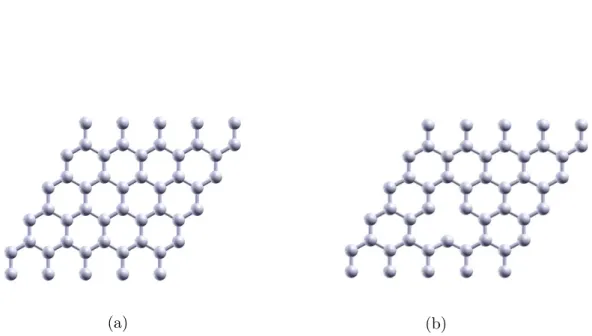
Figure 1.7: (a) Structure of a pristine graphene layer. (b) Defective graphene layer.
16 Chapter 1.Introduction
of metal-hydrogen complexes often also competes with the H2 desorption. Both problems can be reduced by increasing the binding energy of metal atoms or small metal clusters to the supporting carbon material. This can be solved by many ways as described above, but the most interesting for us isanchoring the metal atoms
or small clusters to defects of the carbon pore walls.
It has been shown that defects in graphene such as mono-vacancies increase the adsorption energy of small metal clusters to the graphene layer. The binding energy of Pd atoms and clusters to defects on graphene substrate (see Fig.1.8a) rises up to 5 eV whereas the adsorption energy on a carbon substrate with no defects is below 1.5 eV [81]. For example, a Pd6 octahedron is adsorbed on a graphene mono-vacancy with an energy 5.62 eV which is five times higher than the energy required to adsorb the cluster on pristine graphene, 1.14 eV (see Fig.1.9). Thus, Pd clusters attach strongly to vacancies in graphene, but the interaction with the vacancy does not affect very much the Pd-Pd interaction, for instance, the energy required to remove one Pd atom from Pd6 anchored on a vacancy is 2.77 eV, and the energy required for extracting a Pd atom from free Pd6 cluster is 2.69 eV.
(a) (b)
Figure 1.8: (a) One single atom is anchored on a graphene vacancy with an energy
of 5.13 eV. (b)Hydrogen molecule is adsorbed on a single Pd atom anchored on a
graphene mono-vacancy with an energy of 0.21 eV.
Cabria et al. have shown that the adsorption energy of a molecular hydrogen on a single Pd atom anchored on a graphene mono-vacancy is only 0.21 eV (see Fig.1.8b), which contrasts with the H2 adsorption energy on Pd-doped pristine graphene, 0.96 eV, and also contrasts with the binding energy of H2 on a free Pd atom, 1.12 eV [80,81]. The desorption of the Pd1-H2 complex anchored on a graphene vacancy requires an energy of 4.2 eV and therefore, it does not compete with the desorption of molecular hydrogen. These results show the strong influence of the graphene defects on the molecular hydrogen adsorption. When the Pd atom employs a substantial part of its bonding capacity on interacting with graphene mono-vacancy, the interaction with the hydrogen molecule is weaker than the interaction between H2 and Pd supported on pristine graphene.
1.7. Purpose and Structure of This Work 17
doubles the strength of the Pd-Pd interaction and is about five times larger than the interaction of Pd with pristine graphene. Thus, Pd atoms dispersed on a graphene surface with defects will tend to saturate first all of the vacancies, and then aggregates will grow on the Pd-saturated vacancies. Anchoring Pd metal dopant on a graphene vacancy, prevents (i) the migration of Pd atoms to nucleate and form big aggregates and (ii) the desorption of the Pd-H complexes.
Figure 1.9: Top and side views of the Pd6 octahedral. The metal cluster is anchored on a graphene mono-vacancy with an energy of 5.62 eV. Red arrows indicate the Pd atom which saturates the graphene mono-vacancy.
1.7
Purpose and Structure of This Work
The ability of carbon materials to store large quantities of hydrogen is still under question. This is due to difficulties in the accuracy of the experimental measurements, impurities in the carbon samples, difficulties in obtaining reproducible adsorption capacities from different laboratories and poor understanding of the hydrogen ad-sorption process. Thus, it is imperative to understand how hydrogen adad-sorption takes place in nanoporous carbon materials and specifically, if spillover mechanism describes hydrogen adsorption in these materials. In particular, one may ask if hydrogen is adsorbed and transported in molecular or dissociated form and what is the state and the location of hydrogen are after spilling over into the carbon surface. In addition, spillover depends on the characteristics of the surface, and in our case of interest, spillover might depend on the structure of the carbon support (degree of graphitization, defects, etc.) and the amount of hydrogen present.
18 Chapter 1.Introduction
The principal purpose of this thesis is to contribute to the understanding of hydrogen storage steps (spillover mechanism) which are still not well understood. We also investigate the Pd-doping effects, hydrogen saturation effects and the role of the vacancy on the hydrogen adsorption, by usingab initio calculations based on Density
Functional Theory methods. These simulations are necessary in order to know the behaviour and interactions in graphene-metal-hydrogen systems. Graphene is the simplest carbon surface and graphene doped with a cluster formed by six Pd atoms anchored on a mono-vacancy is a reasonable starting point to model the hydrogen spillover on doped carbon materials. The main objectives are:
1. To provide a detailed description of hydrogen adsorption and saturation on Pd6 cluster anchored on a defective graphene layer. That is, to analyse the preferred hydrogen adsorption channel, molecular physisorption or dissociative chemisorption on the palladium nanoparticle. Pd6 is a representative size for which most interesting properties appear and it is not too expensive for computational simulations. This represents the first step of spillover mechanism which is the hydrogen adsorption on the metallic nanoparticle.
2. To investigate the sterical and chemical effects of the carbonaceous surface in the hydrogen adsorption on the Pd6 cluster and in the hydrogen saturation level of the metal nanoparticle.
3. To explore the competition between hydrogen and palladium atoms and aggre-gates for saturating the graphene vacancy. This will give detailed insights into hydrogen-graphene-palladium interactions, as well as, into the saturation of the vacancy.
4. To study (i) the diffusion of the adsorbed hydrogen from the nanoparticle to the graphene layer depending on the hydrogen saturation level of the Pd nanoparticle and, (ii) the migration of hydrogen atoms through the graphene layer. These are the last steps of the spillover mechanism.
1.7.1
Structure of This Work
The majority of the results are presented as three published articles corresponding to Chapters 4, 5 and 6. The work is structured as follows:
• Chapter 2: we describe the basis and origin of DFT, its fundamental theorems, the exchange and correlation problem and the most important approximations, with special mention for Generalized Gradient Approximation (GGA).
1.7. Purpose and Structure of This Work 19
• Chapter 4: this is the first Chapter of results. We study the competition between molecular and dissociative adsorption ways to saturate a Pd6 cluster anchored in a graphene mono-vacancy. Some additional results to the published article are presented. Moreover, based on the results obtained, we have studied the energy barriers of different processes: the structural interconversion of the Pd6 cluster, the hydrogen molecule adsorption and hydrogen diffusion through the Pd nanoparticle.
• Chapter 5: we study the preferred hydrogen adsorption channel on free Pd6 clusters. We also analyse the effect of the surface on the adsorption and the hydrogen saturation of the free Pd6 clusters. Energy barriers have been also studied for free Pd6 systems. In this case, the processes for which the energy barriers have been calculated are: structural transition and hydrogen diffusion within the Pd nanoparticle.
• Chapter 6: this is the last Chapter for published results. We investigate the competition between hydrogen and palladium atoms and clusters to saturate the graphene vacancy. It is also shown that vacancies decorated with Pd just on one side of the graphene layer are not fully saturated. The other side of the vacancy still remains significantly reactive and therefore Pd atoms and clusters can be attached, simultaneously, to both sides of the vacancy.
• Chapter 7: This is the Chapter of unpublished results. Hydrogen atoms spillover from the Pd cluster onto the graphene surface and the diffusion through the graphene surface are investigated. These results correspond to the last two steps of the spillover mechanism.
Chapter 2
Methodology
There are people so ugly that it does not matter how they are on the outside.
One of the most important scientific advances of the twentieth century was the development of quantum mechanics and the many experimental observations which confirmed this theory [110,111]. The translation of quantum and statistical-mechanics of molecular and solids systems into efficient numerical algorithms have allowed us to accurately study many systems computationally. This enables a deeper understanding of the physics behind experimental observations.
In the last two decades, the Density Functional Theory (DFT) has become one of the most popular and widely used methods to solve the many-body problem in physics and chemistry. The reason is that DFT is able to treat many problems with a sufficiently high accuracy.
In this Chapter, we introduce some concepts related to quantum physics to set the basis to explain briefly the standard time-independent DFT. Several approximations, such as, Born-Oppenheimer, Local Density and Generalized Gradient approximations are described. We only try to make a brief exposition with no attempt to discuss the underlying mathematics.
2.1
The Many-Body Problem and the
Schrödin-ger equation
In general, the majority of the systems and problems in physics and chemistry are “many-body problems”. At the nano-scale, quantum mechanics is usually used to provide an accurate description and solution for these kind of issues. In our field of study, we try to describe the structure, energy and dynamic properties of many-electrons systems, for instance, single atoms, nuclei, molecules, clusters, dimers and solids [112–114].
22 Chapter 2.Methodology
Many properties such as conductivity, structural stability, magnetic moments, real space geometry, bond lengths, atomic arrangement, etc. are determined by electronic structure in crystals/solids. If we know the system’s electronic ground-state, we can calculate all these properties. For dynamic properties such as electronic excitation spectrum, optical properties, ionization or vibrations, we need to study excited stationary states or time-dependent states [114].
In condensed matter physics, the main problem is to know the motion and the energy of electrons in a system where electrons and nuclei interact. In addition, we would like to know how the energy changes if we move atoms around. In quantum mechanics, the operator associated to the energy is the Hamiltonian ( ˆH). When ˆH
is applied to the wave function or eigenstate (Ψ) which has all the information we can obtain from a given system, it is called themany-body Schrödinger equation. In
stationary (time-independent) and non-relativistic terms this is written as:
ˆ
H|Ψi= ( ˆT + ˆV)|Ψi=E|Ψi (2.1)
where E is the eigenvalue corresponding to the eigenstate Ψ when the Hamiltonian
is applied. ˆT and ˆV are the kinetic energy and potential operators, respectively. The
Hamiltonian has to include both the nuclei and the electrons for each system. The principal interaction to be considered is the electrostatic or Coulomb interaction, since gravitational interaction is very weak and we can omit it. The electrons must be described by quantum mechanics, while the more massive nuclei can be treated as classical particles. In general, if only the valence electrons are considered, as they move at speeds much less than the speed of light, we can neglect relativistic effects [113]. In absence of external electromagnetic fields, the Hamiltonian operator can be split into two terms: the electronic and the nuclear terms:
ˆ
Htot = ˆHeN = ˆTe+ ˆVee+ ˆVeN
| {z }
ˆ He
+ ˆTN + ˆVN N
| {z }
ˆ HN
(2.2)
and thus, Schrödinger equation can be written as:
ˆ
HeN|Ψi= ( ˆTe+ ˆTN
| {z }
ˆ T
+ ˆVee+ ˆVeN + ˆVN N
| {z }
ˆ V
)|Ψi=E|Ψi (2.3)
ˆ
Te and ˆTN are the kinetic energy operators of electrons and nuclei, respectively. The other terms are the electrostatic interactions among electrons and nuclei. If we consider a system ofN nuclei each one with massMI,n electrons each one with mass
2.2. The Born-Oppenheimer Approximation 23
(~r1, ...~rn), the terms of the Hamiltonian (2.2) are:
Kinetic energy of electrons1 Tˆ
e=− ~ 2 2me
n
X
i=1
~
∇2
i. (2.4)
Electron-electron interaction2 Vˆ ee= 1 2 n X i=1 n X
i6=j
q2e
4π0|~ri−~rj|
. (2.5)
Electron-nuclei interaction VˆeN =− n X i=1 N X I=1
q2eZI 4π0|~ri−R~I|
. (2.6)
Kinetic energy of nuclei TˆN =− ~ 2 2 N X I=1 1 MI ~
∇2I. (2.7)
Nuclei-nuclei interaction VˆN N =1 2 N X I=1 N X
I6=J
q2 eZIZJ 4π0|R~I−R~J|
. (2.8)
Where i and j are the subscripts for electrons, I and J are the subscripts for nuclei, -qe and Zqe are the charges of electron and nuclei respectively. For a system with
N nuclei and n electrons, there are 3N + 4n degrees of freedom, 3N and 3n for the
spatial coordinates of the nuclei (R~
1, ... ~RN) and the electrons (~r1, ...~rn) respectively, and for electrons also the spin coordinates [115].
The Eq.(2.3) is too complex to be solved exactly in the majority of the cases, except for the hydrogen atom. In this field of study, an important challenge is to find approximate solutions for the time-independent many-body Schödinger equation, to an acceptable degree of accuracy.
2.2
The Born-Oppenheimer Approximation
The first approximation to simplify this problem is the Born-Oppenheimer Approxi-mation (BO) [116]. The principal idea of this approxiApproxi-mation is to decouple electron and nuclear motion. This is possible since the nuclei are significantly more massive than electrons (around 1800 times more massive). According to this, electrons are much faster than nuclei (about 102−103 times faster) for the same kinetic energy [117]. For typical time-scale of nuclear motion, the electrons will follow the nuclei configuration instantaneously. This allows us to set the nuclear kinetic energy
ˆ
TN to zero and to consider the repulsion between nuclei ˆVN N as aconstant3. As a consequence of BO approximation, nuclei are considered as fixed at coordinatesR~.
1This operator is valid for any non relativistic system. For relativistic systems Dirac equation is needed.
2This describes a system of interacting electrons since the 1
|ri−rj| can not be broken into a sum
of terms containing onlyri and onlyrj.
24 Chapter 2.Methodology
Thus, we can rewrite the Hamiltonian (2.2) like this:
ˆ
Htot = ˆTe+ ˆVee+ ˆVeN
| {z }
ˆ He
+ ˆTN + ˆVN N
| {z }
ˆ HN
. (2.9)
So, the time-independent Schrödinger equation we have to solve for the electronic ground-state is:
ˆ
HeΨ(~ri,{R~}) = ( ˆTe+ ˆVee+ ˆVeN)Ψ(~ri,{R~}) = E({R~})Ψ(~ri,{R~}) (2.10)
where~ri =~r1, ..., ~rn are the coordinates of then electrons. Ψ(~ri,{R~}) is the many-electron wave function which describes the motion of the many-electrons at fixed nuclei positions{R~}andE{R~}is the electronic energy for fixed positions of the nuclei. The nuclear coordinates R~ are parameters not variables. Eq.(2.10) should be solved for
each group of nuclear fixed positionsR~. Since the movement of nuclei and electrons
are split, we can write the total wave function Ψ as product of the electronic part Ψe(~ri,{R~}) and the nuclear part ΨN{R~}:
Ψ(~ri,{R~}) = Ψe(~ri,{R~})ΨN({R~}). (2.11)
The solution to Eq. (2.10) is too complex to be found exactly except for hydrogen molecule-ion (H+
2) [117]. For larger systems, further approximations have to be introduced. Two are the fundamental electronic structure methods to study the total energy ground-state (see Fig.2.1):
1. Wave function based methods: the many-body problem is translated into a single particle problem and the Slater determinant is needed to incorporate the antisymmetry of the wave function Ψ(~ri,{R~}). There are semi-empirical methods and ab initio4 methods. Within the latter one, the Hartree-Fock
method is one of the most popular methods, but it becomes computationally expensive as the number if electrons increases.
2. Electronic density based methods: These methods use the density of electrons as a fundamental property instead of dealing directly with wave functions to describe the quantum state. Density Functional Theory (DFT) is the most widely used method in condensed matter physics. We are going to provide a brief introduction to DFT method in the next sections.
2.3. Density Functional Theory (DFT) 25
electronic structure
wave function based
density based
semi-empirical
ab initio first
principles
semi-empirical
Hartree-Fock (HF) DFT
Kohn-Sham
post-HF many-body
corrections
EMT, EAM LDA, GGA,
B3LYP, . . . HMO, EHT,
CNDO, AM1, . . .
Configuration Iteration (CI): CI(S), CI(SD) Many-body
perturba-tion theory: (MPn), MP2, MP4, CASPT2
GW Coupled-Cluster:
CCSD, CCSD(T)
Figure 2.1: Electronic Structure Methods.
2.3
Density Functional Theory (DFT)
The principal problem is to find and calculate the electronic wave function and the electronic energy. Once of those quantities are known, a wide range of chemically and physically important properties can be determined. This is only exactly solvable for the hydrogen atom. Thus, to solve for larger systems other approximations have to be applied.
DFT is based on the concept of electron probability density. The growing
popu-larity of DFT method is due to its lower computational cost with a moderately high accuracy [117–123].
The main idea behind DFT is that the ground-state energy and other properties of a given system can be obtained by the electron density instead of using a wave function, in others words, there exists a one-to-one correspondence between the electron density and the energy [124]. The wave function of an n-electron system
depends on 4n variables, three spatial and one spin coordinates per electron, while the electron density only depends on 3 variables, namely, DFT transforms the 4n variational problem into a 3-dimensional variational problem. The disadvantage is that, except for the simplest systems, the relation (functional) between the density and the energy of the system remains unknown, so we use approximations.
26 Chapter 2.Methodology
in 1928. Though wonderfully simple, this theory fails qualitatively because it is unable to reproduce atomic shell structure5. The theoretical basis for the DFT was established in 1964, when Pierre Hohenberg and Walter Kohn demonstrated that the total electron density completely and exactly determines all the (ground-state) properties of ann-electron system. Moreover, the next year (1965), Walter Kohn and
Lu Sham provided a practical scheme for solving the quantum-mechanical problem based on the Hohenberg-Kohn (HK) theorem. Thus, Hohenberg, Kohn and Sham established the rigorous theory that finally legitimized the intuitive ideas of Thomas, Fermi and Dirac.
The Density Functional Theory began to be very popular in the 1970s for the study of solid-state physics. However, it was not considered accurate enough for quantum chemistry until some approximations were improved. Nowadays, DFT is a fundamental method to calculate the electronic structure. For example, for systems including d-block metals, DFT yields results that very frequently agree more closely with experiments than Hartree-Fock [117].
In the following sections, we will discuss the basic ideas about the standard time-independent Density Functional Theory. Firstly, the Thomas-Fermi model is presented as is the initial attempt to use electronic density. The next point will be the Hohenberg-Kohn theorems. Finally, we will introduce the Kohn-Sham formalism.
2.3.1
Thomas-Fermi Model: the Origin of DFT
The statistical view for the atomic electrons was established by Thomas [125] and Fermi [126] in 1927. The Thomas-Fermi Model is also known as the inhomogeneous
electron-gas model. The original purpose was to study the energy and charge density
for atoms with a large numbernof electrons. The idea is to replace the 3n-dimensional
wave functions Ψ(~r, ~r2, ..., ~rn) and the Schrödinger6 equation associated to the system by an equation involving the densityρ(~r)7 which only depends on the three spatial coordinates [128]. The electron density is a physical observable, thus, it can be calculated and experimentally measured (the wave function can not be measured). For a system with n electrons, the definition of the density is:
ρ(~r) =n
Z
Ψ∗(
~
r, ~r2, ..., ~rn)Ψ(~r, ~r2, ..., ~rn)d~r2...d~rn =n
Z
|Ψ(~r, ~r2, ..., ~rn)|2d~r2...d~rn.
(2.12)
The TF approach is semi-classical. Some ideas come from quantum mechanics and others operate with normal functions instead of quantum mechanics operators; the
5Shell structure is a consequence of the Pauli exclusion principle.
6Schrödinger equation, which would give the exact density and energy, can not be easily handled whennis large.

![Figure 1.4: The structure of graphene is a two-dimensional hexagonal carbon lattice. Image recovered from [67].](https://thumb-us.123doks.com/thumbv2/123dok_es/6256049.189673/33.892.154.737.712.1020/figure-structure-graphene-dimensional-hexagonal-carbon-lattice-recovered.webp)