FACULTAD de FILOSOFÍA Y LETRAS
DEPARTAMENTO de FILOLOGÍA INGLESA
Grado en Estudios Ingleses
TRABAJO DE FIN DE GRADO
Evolution of Translation Techniques in the Harry Potter
Movies: Translation for Children vs. Translation for
Adults
Francisco Javier Perrote Carr
Tutor: Beatriz Méndez Cendón
ABSTRACT
Translation for children has not been studied as profoundly as translation for adults. Furthermore, they have always been studied separately and have not been applied simultaneously to the same work. In this dissertation we will analyze these two previous forms of translation in the same work. Different translation techniques prevail in each form of translation (translation for children or translation for adults). We will use the Harry
Potter movie series to see if it is possible that one work can present an evolution of the
frequency of use of translation techniques, and, therefore, a shift in the intended audience.
Key words: audiovisual translation, translation techniques, translation for adults, translation for children, Harry Potter.
RESUMEN
La traducción infantil no se ha estudiado en tanta profundidad como la traducción para adultos. Además, siempre se han estudiado por separado y no se han aplicado simultáneamente en la misma obra. En este trabajo analizaremos estas dos formas de traducción en una misma obra. Hay diferentes técnicas de traducción predominantes en cada tipo de traducción (traducción infantil y traducción para adultos). Utilizaremos la saga de películas de Harry Potter para comprobar si es posible que una obra presente una
evolución en la frecuencia de uso de las técnicas de traducción, y, por lo tanto, un cambio de audiencia meta.
TABLE OF CONTENTS
1. INTRODUCTION ... 5
2. TRANSLATION THEORY ... 5
2.1. TRANSLATION METHODS AND PROCEDURES ... 6
2.1.1. METHODS ... 6
2.1.2. PROCEDURES ... 7
2.2. TRANSLATION FOR CHILDREN VS. FOR ADULTS ... 8
2.2.1. EVOLUTION OFTHE HARRY POTTER SERIES ... 11
2.3. AUDIOVISUAL TRANSLATION ... 11
3. HARRY POTTER CONTEXT ... 12
3.1. J.K. ROWLING ... 12
3.2. HARRY POTTER BACKGROUND ... 14
3.2.1 SUMMARY ... 14
4. HYPOTHESIS AND METHODOLOGY ... 15
5. RESULTS: TRANSLATION OF THE HARRY POTTER MOVIES ... 16
5.1 IDENTIFICATION OF THE METHOD USED ... 17
5.2 EXAMPLES OF THE TRANSLATION TECHNIQUES USED ... 17
5.3 EVOLUTION OF THE TRANSLATION TECHNIQUES USED IN HARRY POTTER ... 21
6. CONCLUSION ... 25
7. BIBLIOGRAPHICAL REFERENCES ... 27
8. APPENDIX ... 30
x TABLE 1: TRANSLATION TECHNIQUES USED IN HARRY POTTER AND THE PHILOSOPHER´S STONE ... 30
x TABLE 2: TRANSLATION TECHNIQUES USED IN HARRY POTTER AND THE ORDER OF THE PHOENIX ... 34
x TABLE 3: TRANSLATION TECHNIQUES USED IN HARRY POTTER AND THE DEATHLY HALLOWS PART 2 ... 38
x TABLE 4: PERCENTAGES OF FREQUENCY OF USE FOR EACH TRANSLATION TECHNIQUE IN HARRY POTTER AND THE PHILOSOPHER´S STONE ... 41
x TABLE 5: PERCENTAGES OF FREQUENCY OF USE FOR EACH TRANSLATION TECHNIQUE IN HARRY POTTER AND THE ORDER OF THE PHOENIX ... 42
5
1. INTRODUCTION
Audiovisual translation is a relatively new form of translation and it thus presents different types of limitations that did not exist before, while it has also allowed many translators to develop their creativity. Translators have to make decisions taking into account factors such as the intended audience, which could be children, teenagers or adults. The type that has been studied most profoundly has been translation for adults, although in recent years translation for children has become more prominent.
Our study will focus on the difference between translating for children and translating for adults and the variation in the translation techniques used for each intended audience. More specifically, our intention is to learn if there can be a shift in the translation techniques used in the same movie saga. For this study we have selected the Harry Potter movies. Due to
the time it took to release the complete series, ten years to be exact, there is a greater probability that there is some kind of change in the translation techniques that were used to translate it.
This dissertation will be divided into a theoretical section, and a practical section. The theoretical background will consist in providing information about the differences between translating for children and for adults, information concerning audiovisual translation and the translation techniques that we will utilize in the practical section, as well as information that is necessary for a proper understanding of the importance of Harry Potter nowadays.
In the practical part we will state the hypothesis, explain the methodology of the study, describe the results we have obtained, and lastly, draw a final conclusion. After the conclusion, an appendix will be appended detailing all the samples, compiled in different tables, we have obtained for the study.
2. TRANSLATION THEORY
6
and 2.1.2). Section 2.2 will be devoted to the difference between translating for children and translating for adults. Finally, in section 2.3 there will be an introduction to audiovisual translation with some aspects that will be taken into account when analyzing the translations of the Harry Potter movies.
2.1. TRANSLATION METHODS AND PROCEDURES
Newmark (81) distinguishes between translation methods and translation procedures; they are both used for translating, but while translation methods relate to whole texts, translation procedures are used for sentences and smaller units of language.
2.1.1. METHODS
The following classification of translation methods is elaborated by Newmark (45-47):
x Word-for-word translation: the word-order of the SL (Source Language) is not altered and the words are translated individually by their most common meanings, out of context.
x Literal translation: the grammatical constructions of the SL are adapted to the closest equivalent in the TL (Target Language), but the words are translated singly once again, out of context.
x Faithful translation: it tries to reproduce the precise contextual meaning of the original within the constraints of the TL grammatical structures. It attempts to be completely faithful to the intentions and the text-realization of the SL writer.
x Semantic translation: it differs from `Faithful translation´ in that it gives more importance to preservation of the aesthetic value of the SL text (sound of words) rather than the meaning. ´Semantic translation´ also allows more flexibility for the translator since the meaning of the TL text does no need to remain completely faithful to the original.
x Adaptation: it is mainly used for plays and poetry; the themes, characters and plots are usually maintained, but the SL culture is converted to the TL culture and the text is rewritten.
7
x Idiomatic translation: this method reproduces the same message of the original by modifying nuances of meaning by means of colloquialisms and idioms that do not appear in the original.
x Communicative translation: its aim is to translate the exact contextual meaning of the original by ensuring that both content and meaning are acceptable and comprehendible to the readership.
Newmark claims that the methods that best fulfill the two aims of translation, which are accuracy and economy, are the communicative and semantic translation methods. The main difference between them is that a semantic translation is written at the linguistic level of the author, and, on the other hand, a communicative translation is written at the linguistic level of the readership (47).
2.1.2. PROCEDURES
There are several types of translation procedures as well. Molina and Hurtado (12-14) propose the following techniques in their classification:
x Borrowing: taking a word or expression from L1 into L2. It can be either pure, if it is exactly the same term, or naturalized, in order to fit the rules in the TL.
x Calque: it consists on taking a structure or phrase from the original and translating its components. It can be a lexical or structural translation.
x Literal translation: it consists on translating a word or expression word by word. It is not translating one word for another, but to translate making sure that the form coincides with function and meaning.
x Established equivalent: the TL equivalent of a term or expression recognized by dictionaries or language in use.
x Compensation: it consists on introducing a piece of information or stylistic effect in a different place in the TT (Target Text) because it cannot be inserted in the same place as in the ST (Source Text).
8
x Reduction: it is removing information items from the ST and therefore not including them in the TT.
x Particularization: it is modifying the text to make it more precise or specific by using more accurate word than those appearing in the original text.
x Generalization: it is the use of a more general or comprehensive term that includes the meaning of the original word.
x Transposition: switching the grammatical category of some linguistic elements for a different one.
x Description: it consists on replacing a word or expression with a description of its form or/and function.
x Linguistic amplification: it adds linguistic elements. It consists on translating a piece of information with more words than in the original text. It is often used in consecutive interpreting and dubbing.
x Amplification: it consists on adding to the TT some kind of commentary or periphrasis that does not appear in the ST.
x Modulation: it changes the point of view, focus or cognitive category of the message. It can be either lexical or structural.
x Variation: its aim is to change linguistic or paralinguistic elements that can be characteristic of an individual or a group of people. Such as changes of textual tone, social dialect, geographical dialect, etc.
x Substitution: replacing paralinguistic elements for linguistic ones (intonation, gestures, etc.). It is mainly used in interpreting.
x Adaptation: it replaces a cultural element from the ST with one from the target culture.
x Discursive creation: it tries to establish equivalence by changing the whole context completely with the purpose of maintaining the same effect. Useful for the translation of rhyme, proverbs, etc.
2.2. TRANSLATION FOR CHILDREN VS. FOR ADULTS
9
development, and therefore, they cannot comprehend the same vocabulary or grammatical structures as adults can. Thus, different translation techniques are used according to the intended readership – child or adult.
Translation for children has not been studied as much as translation for adults. As Arizpe (134) states, children´s literature is now considered an academic discipline, although the research on its translation has just recently begun. One reason she gives for this is that there is a considerable difference between the small amount of foreign children´s books that are translated into English and the large number of books for children translated from English that exist in foreign markets. This lack of research on translation for children has recently changed:
Issues of multi-culturalism, and recognition of the global influence of children's books (revealed by, for example, the unprecedented success of the Harry Potter series), have led to questions about the principles that should govern such translations, and about their cultural impact. (Arizpe 134)
Translators need to take into account these principles when translating a text for children. As long as the translator considers the principles, they are permitted to manipulate the text freely in diverse ways (Shavit 171). The most usual principles, among others, are: (1) dual readership and (2) cultural context adaptation.
1. Dual readership: according to Alvstad (24), children´s literature is not exclusively for children. It is also intended for editors, translators, librarians and parents due to the fact that they serve as intermediaries between the author and the children. They are the ones who publish and buy the books. Therefore, translators have to consider, not only the tastes of children, but those of adults as well. Dual readership is probably the only exclusive principle of literature for children.
2. Cultural context adaptation: Klingberg states that literature for children “is produced
10
for children also functions as a didactic tool, enhancing the international outlook and understanding of the young readers; and, if the translator decides to adapt all the cultural elements present in a text the children will not receive that new information.
In order to adapt texts for children into the target language, translators can use different techniques. Translators tend to simplify the text since literature for children contains easy-to-understand vocabulary, simplified syntax and direct discourse (Varga 1). Complexity is a characteristic of literature in the adult system, whereas in the case of literature for children simplicity is the predominant characteristic. This simplicity includes the thematic of the text, the characterization, and the main structures (Shavit 175).
One of the most common techniques used to achieve simplicity is the omission of small or large sections of the text. Shavit says that nowadays most texts are translated in their entirely in the adult canonized system and that deletions, if any, are usually incidental (174). On the contrary, although omission is not frequent in modern literary translations, it is typical in the translation of literature for children (Ben-Ari 224). Besides omission, translators follow other strategies when translating for children. The most frequent are explication, adaptation and generalization.
Explication is used for general or ambiguous texts where the translator decides to explain words or expression. Adaptation is employed when the target language does not share a cultural element with the source language. Finally, generalization is used when a term is discarded for a more general one that is easier to understand without affecting the meaning of the sentence (Varga 12).
These previous translation techniques are used in subtitling, but as Varga notices, they coincide with the techniques used in the translation of children literature due to the limitations of audiovisual translation (13).
11
2.2.1. EVOLUTION OF THE HARRY POTTER SERIES
Harry Potter, at first, was intended for children between the ages of 9 and 12, according to
Wyler (6), Brazilian translator of the series. Wyler mentions that it shared the same aspects with other classics in literature for children, with the exception that in Harry Potter there
are no illustrations. The first four books were published in 1997, 1998, 1999 and 2000, respectively. The simple plot and interesting and relatable characters were key to its success, especially among children.
Three years later, in 2003, the fifth book was published and the film adaptation for the first novel had already been released. At this moment, the publisher Bloomsbury released adult editions of the books, only differing from the children editions in the covers; the novel was exactly the same (Reynolds). The plot started to become more complex from the fifth book onwards. The relations between characters were more elaborated and the main storyline became progressively darker with moral and philosophical issues included, which appeal to adult readers. Previously to the release of the seventh and final book of the series in 2007 the purchases of the adult versions were increasing with the release of each of the previous books. The final book was expected to sell more in its adult version than in the version for children, and, according to Winston, it was estimated that more than 60 per cent of the Harry Potter fan base was composed of teenagers and adults (qtd. in Reynolds).
This shows how the Harry Potter series was first aimed at children, especially in the first
four books. However, after the release of the fifth book and therefore, the addition of more elements appealing to adults, these also became target readers of the saga.
2.3. AUDIOVISUAL TRANSLATION
The importance of audiovisual translation has increased in the last few decades due to the mass of foreign movies that are released every year, along with TV series, documentaries and videogames. Ramael (12) states that this growth began in the 1920´s with the need of translating `talking movies´. After testing several forms of translation, dubbing and subtitling were the ones that prevailed. Research on audiovisual translation started in the 1950´s and 60´s but it did not become prominent until the 1990´s (Ramael 12).
12
A translation of verbal component of the video. Its main specific feature is the synchronization of verbal and nonverbal components. While dealing with an audiovisual product translators do not work only with text but also with other aspects of media art which are of polyphonic nature. Thus, they work with dialogues/ comments, sound effects, image and atmosphere of the video. (38)
There are several restrictions concerning the translation of audiovisual content, since the source and target texts cannot be exactly the same. Asensio (qtd. in Dapia) classifies these restrictions by analyzing and developing the concept of synchrony into several possibilities:
x Synchrony of time: every segment of the TT has to coincide with the same time and interval where their corresponding segment of the ST was.
x Spatial synchrony: the text of the TL should not occupy more space than the text of the SL.
x Content synchrony: the visual and auditive channels should not deliver contradictory messages.
x Lip synchrony: synchrony between the words in the TT and the lip movement of the image.
x Kinetic synchrony: agreement between the gestures and movements of the characters and the words and sentences they say.
3. HARRY POTTER CONTEXT
In order to understand more profoundly why the Harry Potter series has been such a success it is important to examine how its author has gone from being a school teacher to having sold more than 500 million copies worldwide according to Pottermore, the official Website of the Harry Potter universe. As well as how and why it became a worldwide phenomenon by influencing millions of people in the past and continuing to do so in the present.
3.1. J.K. ROWLING
13
aircraft engineer, and her mother, Anne, was a science technician in the chemistry department at Wyedean School, the school in which J.K. Rowling received her education.
Rowling began reading many books from an early age. She also started writing when she was very young. At age six she wrote her first book, and at age eleven she wrote her first novel. When Rowling turned eighteen she attended Exeter University, where her passion for reading did not cease. As a consequence, all the knowledge of classics she acquired was extremely convenient and influential for the creation of some of the vocabulary that can be found in Harry Potter, such as proper names or spells which are based on Latin.
After graduating from University she moved to London where she had several jobs, one of them being a researcher for Amnesty International, which, Rowling says, has been one of the most humbling and inspiring experiences of her life.
The idea for Harry Potter came to her mind on a train ride from Manchester to London
King´s Cross station. At first she just wrote on random pieces of paper all that was on her mind, slowly building the foundations of the Harry Potter world. She took all these notes to Portugal with her where she taught English as a foreign language. In Portugal in 1992 she married Jorge Arantes and the following year, in 1993, she had a daughter named Jessica, and that same year Rowling divorced Arantes and moved back to the U.K. taking along with her the first three chapters of Harry Potter and the Philosopher´s Stone. After
finishing the complete first book, she sent the first three chapters to many literary agents, one of whom asked to see the rest of the manuscript. This first book was published by Bloomsbury Children´s Books in June 1997. The book was published under the name of
J.K. Rowling, who added the “k” by demand of her publisher since the name of a female author would not attract the target audience of young male readers.
Since 2001 Rowling has been married to Dr. Neil Murray. They had a son, David, in 2003 and a daughter, Mackenzie, in 2005. Rowling has been prized with many honors and awards throughout the years mainly for her work of Harry Potter, and has been involved in
14
3.2. HARRY POTTER BACKGROUND
Harry Potter is a young adult fantasy series composed of seven novels. Since the
publication of the first book of the series in 1997, Harry Potter has become a worldwide
phenomenon with over 500 million copies sold which have been translated into more than 80 languages. The seventh and final book of the series was published in 2007. It was the most anticipated book of the whole series, which was demonstrated by long lines of people forming outside bookstores waiting for the midnight release. The final novel became the fastest-selling book ever, selling 2.65 million copies in the U.K. in the first 24 hours (Bloomsbury).
Each book was followed by a cinematic adaptation, with the exception of the last one which was divided into two movies. The first movie was released in 2001, and the last movie in 2011, which brought the series to a close. Due to the vast popularity of her series, J.K. Rowling has continued to publish information about the lives of the characters for the fans on the platform she created to post everything that is related to Harry Potter: <Pottermore.com.>. Besides these brief texts the author of Harry Potter has also published
three short books that appear in the story line and has written a sequel about the children of Harry Potter in the form of a play that can only be seen in London. Furthermore, one of the three books that are part of the main plot, Fantastic Beasts and Where to Find Them, is
currently being adapted to the big screen as a prequel. The first movie has already been released in 2016 and another four movies have been confirmed. Contrary to the main series, the plot for these movies is not strictly based upon the book since it does not contain much story; it mainly describes different magical creatures.
In addition to the movies and books that have extended the Harry Potter universe, numerous attractions can be visited. These attractions include Harry Potter theme parks, a world tour exhibition where some props and costumes that were used in the films can be seen, and a permanent museum in the studios where the movies where filmed in London that includes all the sets, costumes and props.
3.2.1 SUMMARY
Harry Potter tells the story of a boy from the age of 11 up until he is 17. Harry Potter is
15
11th birthday he is told that he is a wizard and goes to study at Hogwarts School of Witchcraft and Wizardry. At school he discovers that there is much more to magic than appears at first glance, in both positive and negative respects. He soon learns that a dark wizard called Voldemort, also known as You-Know-Who, was the one who killed his parents in his mission to kill Harry Potter. Voldemort could not kill Harry because a magic unknown to Voldemort protected the boy. The magic that protected him was the love that the mother felt towards him when she tried to prevent his untimely death. With the help of his friends Harry spends the next few years trying to fight Voldemort and his supporters while still being a typical teenager at school. Harry decides not to go to his last year at Hogwarts and search for horrocruxes, which are objects that conceal a part of the soul of someone to prevent death, in order to kill Voldemort. After Harry locates and destroys all the Horrocruxes that contain a part of the soul of Voldemort he confronts him and Harry finally kills Voldemort.
4. HYPOTHESIS AND METHODOLOGY
As we stated in section 2.2, the translation techniques that are most used in movies for children are `omission´, `explication´, `adaptation´ and `generalization´. Taking this into account, my hypothesis is that these techniques will be more frequent at the beginning of the Harry Potter series and will be less used towards the end, since the series was first intended for children, but after the fifth book and, therefore, the fifth movie, it was aimed at adults. We have also considered the opposing translation techniques to `reduction´ and `generalization´, which are `amplification´ and `particularization´. If the techniques for children are supposed to appear less frequently towards the end of the series, then logically, their opposites should appear more often.
The movies we have selected from the Harry Potter series are the first (Harry Potter and
the Philosopher´s Stone), the fifth (Harry Potter and the Order of the Phoenix), and the
eighth and final installment (Harry Potter and the Deathly Hallows Part 2). By opting for
16
In order to prove the hypothesis, we have followed a methodology so as to obtain samples. This methodology is constituted of several steps. The first step of this process consisted in watching each movie in Spanish whilst reading its corresponding script in English with the intention of finding the most salient translations. One downside of this was that there were not any official scripts available and we had to use scripts made by fans which, at times, contained small errors. Therefore, after annotating a translation it was necessary to listen to the original version of the movie to ensure that the script was correct and change the sample if necessary. We obtained 50 samples per movie, making a total of 150, which is a sufficient number of samples to work with. These samples do not include the most literal translations since they were irrelevant for our study. Consequently, techniques such as `Borrowing´, `Calque´, or `Literal translation´ will not appear in the results.
After this first step we created a table for each movie. Each one was divided into four columns. The first column was used to identify the samples. The second column was employed for the fragments of the original movie. The third one comprises the Spanish translations. Finally, the last column compiles the techniques used in those translations. We introduced the samples into the tables and then assigned a technique to each.
Finally, the third step consisted on obtaining the percentages for each translation technique from each table. The percentages were later used to create graphics that showed in a more visual manner how frequently the techniques, which are commonly used in translation for children, appear in the movies.
5. RESULTS: TRANSLATION OF THE HARRY POTTER MOVIES
17
5.1 IDENTIFICATION OF THE METHOD USED
Before analyzing some examples of the translation techniques, we are going to classify the Harry Potter movies as a whole into one of the methods that Newmark (45-47) establishes. Contrary to the procedures or techniques, which are meant for smaller units of language, a method refers to a whole text. Since the main objective of the movies is to make the viewer comprehend as much as possible of their content and meaning, the most suitable method for this text would be Communicative Translation.
5.2 EXAMPLES OF THE TRANSLATION TECHNIQUES USED
Now we will explain one example of each translation technique, which Molina and Hurtado explain in their book as was stated in section 2.1.2, that is present in the samples that were extracted from the three movies we are analyzing. A whole list of the examples can be seen in the first three tables that are in the appendix section of this dissertation (pages 30-41).
`Established equivalent´ example:
Original version Spanish Translation
Hand-me-down robe Túnica de segunda mano
(Example 21, table 1, page 31)
In this example the translator has opted for the dictionary equivalent of “hand-me-down”. It
makes more sense using a term in the translation that is very frequent in Spanish instead of translating the original term literally, which would not sound natural in Spanish.
`Reduction´ example:
Original version Spanish Translation
You do realize, of course, we can´t keep out You-Know-Who indefinitely
No podemos mantener fuera a quien usted sabe indefinidamente
(Example 38, table 3, page 40)
18
Nevertheless, the overall meaning is maintained. The section that has been omitted does not distort or significantly alter the main point of the sentence.
`Particularization´ example:
Original version Spanish Translation
Dumbledore´s Army´s supposed to be about doing something real
El Ejercito de Dumbledore se creó para luchar contra Quien Tu Sabes
(Example 45, table 2, page 37)
“Doing something real” could refer to anything. It could have been translated as “se creó
para hacer algo de verdad”, but the translator decided to specify the purpose of
“Dumbledore´s Army” by explicitly stating that it was created to fight You-Know-Who (Voldemort).
`Generalization´ example:
Original version Spanish Translation
So that´s it for this lesson Bueno, ya está bien por hoy
(Example 32, table 2, page 36)
In this case, “this lesson” has been translated as “por hoy”. The Spanish version is more general considering that “this lesson” refers to a small portion of the day, and “por hoy”
refers to the entire day. In spite of this, it is easy to understand that in both versions the lesson, which is happening in this part of the movie, is finishing in the precise moment the sentence is said.
`Description´ example:
Original version Spanish Translation
Six months she hasn´t seen me and it´s like I´m Frankie first year
Seis meses sin verme y pasa de mí totalmente
19
“Frankie first year” is not a real expression nor is “Frankie” a character from the series. The character that employs this expression uses it when his sister ignores him after not seeing him for six months. It was invented for the movie, so, rather than creating a similar expression for the Spanish version, the translator chose to explain what the original expression meant and what is occurring on screen.
`Amplification´ example:
Original version Spanish Translation --- Que jóvenes estáis todos.
(Example 18, table 2, page 35)
This is an unusual case. The translator added a whole sentence to the Spanish version that is not present in the original. It is said during a conversation between two characters that are discussing a photograph. The sentence is said during a close-up of the photograph when the faces of the characters do not appear on screen.
`Modulation´ example:
Original version Spanish Translation
Just stay away from me! ¡No te acerques a mí!
(Example 20, table 2, page 35)
This translation is a clear example of `modulation´. The Spanish version is expressed from the opposite point of view of the English version, but the message is kept the same.
`Adaptation´ example:
Original version Spanish Translation
We´ve looked a hundred times! Ya hemos buscado mil veces
(Example 37, table 1, page 32)
20
`Discursive creation´ example:
Original version Spanish Translation
Bless my soul, It´s Harry Potter ¿Éste es él? ¡Es Harry Potter!
(Example 9, table 1, page 30)
“Bless my soul” has been translated as “¿Éste es él?”. They both have different contexts. While the original version is an expression referring to the character saying it, the Spanish translation is about Harry Potter. They are two different phrases that do not have a meaning in common, but the effect produced, which is that of surprise, is similar in both of them.
We have added two additional techniques since some samples did not fit into any of the techniques mentioned by Molina and Hurtado (12-14). These techniques are `Ellipsis´ and `Invention´:
x Ellipsis: used when a sentence has been entirely eliminated in the Spanish version.
x Invention: used for cases where the translated version is completely different from the original. It differs from `discursive creation´ in that it does not aim to achieve a similar effect.
`Ellipsis´ example:
Original version Spanish Translation
Perhaps you should see the nurse ---
(Example 48, table 1, page 33)
The characters are shot from far away when this sentence is said. It is not possible to distinghish the lips moving. So it is not clear why the translator eliminated the sentence even though it could have easily been included in the Spanish version.
`Invention´ example:
Original version Spanish Translation
21
(Example 26, table 1, page 31)
It is seen in this sample that the translator opted for a completely new sentence with different meaning. But, unlike `discursive creation´, this translation does not intend to maintain the same effect as the original. They are two sentences that have no relation with each other.
5.3 EVOLUTION OF THE TRANSLATION TECHNIQUES USED IN HARRY POTTER
Now we are going to observe the evolution present in the Harry Potter series of the
individual translation techniques that are predominant in products for children, as well as the opposing techniques, which are less frequent in literature and movies for this same age group. We will conclude the results section by analyzing this evolution by way of an overview in grouping every technique of each category, that is, techniques for children and opposing techniques. The percentages of all the translation techniques that are present in the samples extracted from the movies can be seen in tables 4, 5 and 6 in the appendix of this dissertation (pages 41 and 42).
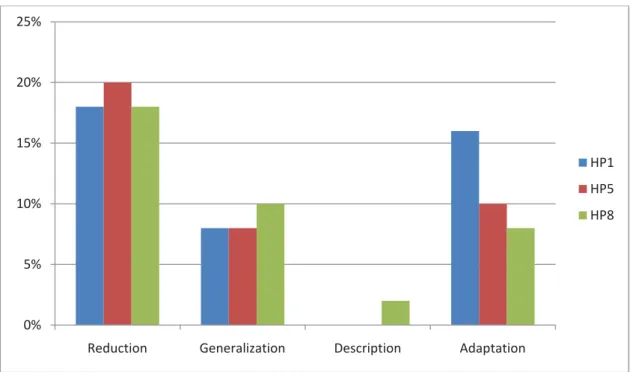
Graphic 1 shows the amount of times in percentages the four translation techniques, that are predominant in translation for children, appear in the movies. These tecnniques are `reduction´, `generalization´, `description´ and `adaptation´. Each technique is directly compared with itself in the first, fifth and eighth Harry Potter movies in order to see the
22
Graphic 1. Translation techniques for children
As we can see in graphic 1, from the four techniques used in translation for children, `adaptation´ is the only technique which presents a clear evolution as the movies advance. It begins having a 16% of frequency in the first movie, it decreases to 10% in the fifth and finalizes with 8% in the last film. `Reduction´ starts by having 18% frequency, it increases to 20 % and then it goes back to 18%. It barely shows any detectable change in the amount of times `reduction´ is used in the movies. Now, continuing with `generalization´; the first two movies share the same frequency of 8%, but the final movie slightly increases to 10% which is just one more instance of `generalization´ than in the other two. Finally, there is a similar occurrence with `description´. The first and the fifth movie do not have any descriptions, but the eighth one has a frequency of 2%, which, again, is just an increase of one `description´.
These techniques are supposed to appear more frequently in the first movies, and less frequently in the last movies, but only the use of `adaptation´ decreases throughout the movies. It is the only technique that behaves as was expected. The other three techniques
0% 5% 10% 15% 20% 25%
Reduction Generalization Description Adaptation
23
do not follow the same pattern, although they do not present much change since they only increase or decrease by 2%, which it is just a variation of one technique.
Graphic 2 shows the frequency of use, in the Harry Potter movies, of the opposing
techniques to `generalization´ and `reduction´, which are `particularization´ and `amplification´ respectively.
Graphic 2. Opposing techniques
The results shown in this graphic for both techniques are what we expected to obtain. The frequency of use rises in each film; however, there is a more drastic change from the first movie to the fifth film than from the fifth movie to the eighth. `Particularization´ increases from 4% in the first movie to 14% and 16% in the fifth and eighth movies respectively. And `amplification´ increases from 0% in the first movie to 6% and 8% in the fifth and eighth movies respectively. This is probably due to the fact that the fifth book, and therefore, the fifth movie was the first one that was not exclusively produced for children. So `particularization´ and `amplification´ are used more similarly in the fifth and eighth movie, which were aimed at adults, than the first one, which was mainly aimed at children.
0% 2% 4% 6% 8% 10% 12% 14% 16% 18%
Particularization Amplification
24
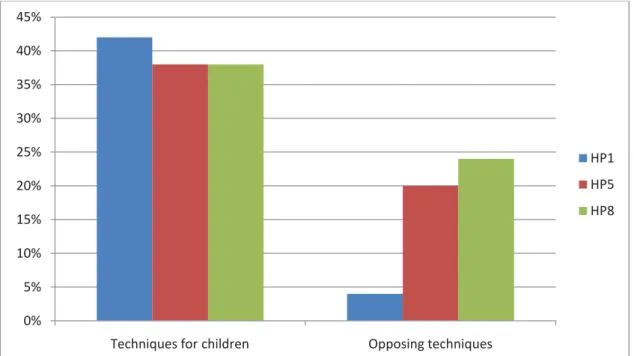
The third and final graphic shows the results of the two previous graphics. On the one hand we have combined together the four translation techniques that are predominant in translations for children, which are `reduction´, `generalization´, `description´ and `adaptation´. And, on the other hand, the two opposing techniques to `generalization´ and `reduction´, which are `particularization´ and `amplification´ respectively.
Graphic 3. Overview of both groups
As we can see, graphic 3 shows that there is a reduction in the frequency of use of the translation techniques for children. Despite the variation being minimal due to the fact that three techniques did not experience a decrease in the frequency of their use, it is possible to observe an overall decrease of 4% from the first movie, which has 42%, to the fifth and eighth movies, which both have 38%. By contrast, the use of the opposing techniques has progressively increased, although the increment is much more drastic between the first and fifth movie, than between the fifth and eighth movie. Both groups behaved as expected, the frequency of use for children decreased and the frequency of use of the opposing techniques increased.
0% 5% 10% 15% 20% 25% 30% 35% 40% 45%
Techniques for children Opposing techniques
25
6. CONCLUSION
This study consisted of analyzing samples of three movies from the Harry Potter series to
see if we could find an evolution of the translation techniques that are normally used in movies for children. Due to the fact that Harry Potter was first introduced as a movie for children, but was later aimed at adults as well, we expected that the number of translation techniques for children would decrease in the later cinematic installments. Given that the intention was to see the evolution of the translation techniques we did not propose any alternative translations or correct any of the mistakes in the samples that we obtained. Only one alternative was given in the examples in order to provide a clearer explanation (see `particularization´example in page 18).
As we saw in the results section above, the translation techniques that appeared the most frequently in the first movie analyzed were the techniques used in movies for children. The frequency of these techniques decreased in the following two movies we analyzed, which shared the same frequency. Although the amount of techniques for children was not too significant in the fifth and eighth movie, it is still lower in comparison to the first. Regarding the opposing techniques the change was most noticeable. There are a larger amount of cases that incremented with each movie. However, the first movie has a much lower amount of cases than the fifth and eight, which have a more similar frequency of the times opposing techniques have been used. The difference of frequency of both categories (techniques for children and techniques for adults) between the first movie and the fifth and eighth can be caused by the intended reader. The first four films were intended for a younger audience, whereas the fifth and onwards was intended for an older audience.
As a conclusion, we can state that there is an evolution of the techniques that are normally used in movies for children. The frequency of these techniques is higher in the first movie than the fifth and eighth. Furthermore, the opposing techniques appear more frequently in the fifth and eight movies than in the first. It is possible to see a difference in the type of techniques that are used for each target audience. The frequency of the techniques for children increases while the frequency of the opposing techniques decreases.
26
the study or by combining both. It would be interesting to learn if the evolution occurs in a staggered manner or if there is an abrupt change between the first four movies and the last four since the intended audience changed after the fifth. Finally, this study could also be done with the Harry Potter books. As we saw, literature for children and movies for
27
7. BIBLIOGRAPHICAL REFERENCES
"500 Million Harry Potter Books Have Now Been Sold Worldwide". Pottermore, 2018,
https://www.pottermore.com/news/500-million-harry-potter-books-have-now-been-sold-worldwide. Accessed 7 May 2018.
Alvstad, Cecilia. "Children´s Literature And Translation." Yves Gambier and Luc Van Doorslaer, pp. 22-27.
Arizpe, Evelyn. "Reviewed Work: Children's Literature In Translation: Challenges And Strategies By Jan Van Coillie, Walter P. Verschueren." Translation And Literature,
vol. 16, no. 1, 2007, pp. 134-139. JSTOR, https://www.jstor.org/stable/40340062.
Accessed 16 May 2018.
Ben-Ari, Nitsa. "Didactic And Pedagogic Tendencies In The Norms Dictating The Translation Of Children's Literature: The Case Of Postwar German-Hebrew Translations." Poetics Today, vol. 13, no. 1, 1992, pp. 221-230. JSTOR,
https://www.jstor.org/stable/1772799. Accessed 17 May 2018.
Díaz Cintas, Jorge and Remael, Aline. Audiovisual translation: Subtitling. St. Jerome,
2009.
Harry Potter y la Orden del Fénix. Directed by David Yates, Warner Bros. Pictures, 2007.
Harry Potter y la Piedra Filosofal. Directed by Chris Columbus, Warner Bros. Pictures,
2001.
Harry Potter y las reliquias de la Muerte Parte 2. Directed by David Yates, Warner Bros.
Pictures, 2011.
"Joanne Rowling – The Girl Who Grew Up To Write Harry Potter." Harrypotter.Bloomsbury,
https://harrypotter.bloomsbury.com/uk/jk-rowling-biography/. Accessed 8 May 2018.
López Guix, Juan Gabriel. Manual de traducción ingles-castellano: teoría y práctica.
28
Matkivska, Nataliia. "Audiovisual Translation: Conception, Types, Characters’ Speech And
Translation Strategies Applied." Studies About Languages, no. 25, 2014, pp. 38-44,
http://kalbos.ktu.lt/index.php/KStud/article/viewFile/8516/4304. Accessed 19 May 2018.
Molina, Lucía, and Amparo Hurtado Albir. "Translation Techniques Revisited: A Dynamic And Functionalist Approach." Meta: Journal Des Traducteurs, vol. 47, no. 4, 2002,
pp. 498-512. Erudit,
https://www.erudit.org/fr/revues/meta/2002-v47-n4-meta688/008033ar.pdf. Accessed 23 Oct. 2018.
Newmark, Peter. A Textbook of Translation. Prentice-Hall International, 1988.
Ramael, Aline. “Audivisual Translation.” Yves Gambier and Luc Van Doorslaer, pp. 12-17.
Reynolds, Nigel. "Adult Fans Taking Over Harry Potter." The Telegraph, 2007,
https://www.telegraph.co.uk/culture/books/3666031/Adult-fans-taking-over-Harry-Potter.html. Accessed 18 May 2018.
Shavit, Zohar. "Translation Of Children's Literature As A Function Of Its Position In The Literary Polysystem." Poetics Today, vol. 2, no. 4, 1981, pp. 171-179. JSTOR,
https://www.jstor.org/stable/1772495, Accessed 17 May 2018.
Varga, Cristina. "Childish Translation Vs Translation For Children. The Subtitling Of Fictional Dialogues In Cartoon Movies." http://www.academia.edu/1965016. Accessed 17 May 2018.
Wyler, Lia. "Harry Potter For Children, Teenagers And Adults." Meta: Journal Des
Traducteurs, vol. 48, no. 1-2, 2003, pp. 5-14. Erudit,
https://www.erudit.org/fr/revues/meta/2003-v48-n1-2-meta550/006954ar.pdf. Accessed 18 May 2018.
Yves Gambier and Luc Van Doorslaer, editors. Handbook Of Translation Studies. John
29
Zaro, Juan Jesús and Truman, Michael. Manual de traducción = A manual of translation : textos españoles e ingleses traducidos y comentados. SGEL, 2008.
30
8. APPENDIX
x TABLE 1: TRANSLATION TECHNIQUES USED IN HARRY POTTER AND THE PHILOSOPHER´S STONE
Original version Spanish Translation Technique used
1 Little Tyke fell asleep just as we were flying over Bristol
(Scene 1)
El cachorrito se durmió mientras
sobrevolábamos Bristol
Adaptation
2 How´s that, pumpkin? (Scene 2)
¿Qué te parece, pichoncito?
Adaptation
3 Ah, Marge is ill. Ate a funny whelk (Scene 3)
Oh, Marge está enferma. Comió algo en mal estado
Generalization
4 Fine day, Sunday. In my opinion, best day of the week
(Scene 3)
Bonito día el domingo. En mi opinión, el mejor día
Reduction
5 Dry up, Dursley, you great prune (Scene 4)
Callaté Dursley, necio majadero
Established equivalent 6 ´Fraid I might have sat on it at
some point (Scene 4)
He tenido que venir sentado sobre el
Reduction
7 A wizard. And a thumping good one at that, I´d wagon
(Scene 4)
Un mago, y uno de los Buenos sin duda
Reduction
8 Oh. And I suppose a great Muggle like yourself´s going to stop him, are you?
(Scene 4)
¿Así que un
insignificante Muggle como tu va a
impedírselo verdad?
Modulation
9 Bless my soul, It´s Harry Potter (Scene 5)
¿Éste es él? ¡Es Harry Potter!
Discursive creation
10 And over there all your bits and bobs for doing your wizardy (Scene 5)
Y allá los artilugios necesarios para hacer magia
Established equivalent
11 Uh, Hagrid, what exactly are those things?
(Scene 6)
Eh, Hagrid, ¿Qué son exactamente estos seres?
Particularization
12 I wondered when I´d be seeing you Mr. Potter
(Scene 7)
Ya estaba esperando que viniera a visitarme Sr. Potter
31
13 Nobody lived once he decided to kill ´em
(Scene 8)
Nadie sobrevivió a su ira
Reduction
14 Codswallop (Scene 8)
Bobadas Established equivalent 15 Stick to it Harry
(Scene 9)
No lo pierdas Modulation
16 Best do it at a bit of a run if you´re nervous
(Scene 9)
Coje carrerilla si estás nervioso
Reduction
17 We´ll take the lot (Scene 10)
Dénoslo todo Modulation
18 Holy cricket (Scene 10)
Cien centellas Adaptation
19 Come on, first years, don´t be shy (Scene 11)
Vamos, los de primer año por aquí
Discursive creation
20 But before you can take your seats (Scene 11)
Pero antes de eso Generalization
21 Hand-me-down robe (Scene 11)
Túnica de segunda mano
Established equivalent
22 I read about it in Hogwarts, a History
(Scene 12)
Lo leí en la historia de Howarts
Adaptation
23 There´s no which or wizard who went bad who wasn´t in Slytherin (Scene 12)
Todos los magos que se han echado a perder fueron de Slytherin
Modulation
24 Let the feast begin (Scene 13)
Que comience la fiesta Generalization
25 Bit of a nasty shock for him when he found out
(Scene 13)
Mi padre casi se desmaya cuando se enteró
Discursive creation
26 Welcome to the Gryffindor common room
(Scene 13)
No os quedéis atrás por favor
Invention
27 There will be no foolish
wand-waving…
(Scene 14)
No permitiré ni aireos
de varitas mágicas…
Reduction
32
(Scene 15) vuelo
29 Stick your right hand over the broom and say up
(Scene 15)
Extended la mano sobre la escoba y decid arriba
Reduction
30 If maybe the fat lump had given this a squeeze he would remember to fall on his fat arse
(Scene 15)
Si ese zoquete hubiera caído sobre esto, lo habría aplastado con su gran culo
Discursive creation
31 Have it your way, then! (Scene 15)
Corre a por ella entonces
Discursive creation
32 I always knew he´d do well (Scene 15)
Siempre supe que sería el
Discursive creation
33 Fully grown mountain troll (Scene 18)
Troll gigante Reduction
34 But, I never get mail (Scene 19)
¿Correo? Pone que es para mi
Discursive creation
35 The seeker who catches the snitch ends the game
(Scene 19)
El buscador que se haga con la snitch gana el partido
Modulation
36 You're meddling in things that ought not to be meddled in (Scene 21)
Os estáis inmiscuyendo en cosas que no os conciernen
Modulation
37 We´ve looked a hundred times! (Scene 21)
Ya hemos buscado mil veces
Adaptation
38 My body is gone! (Scene 21)
¡No veo mi cuerpo! Modulation
39 You can't hide (Scene 22)
Puedo olerte Discursive creation
40 That means there´s a student out of bed
(Scene 22)
Por tanto hay algún alumno despierto
Generalization
41 I don't wish to be rude, but I'm in no fit state to entertain today.
(Scene 24)
Lo siento mucho chicos, pero hoy no tengo cuerpo para diversiones
Modulation
42 Oh bless him, look, he knows his mummy!
Eh fijaos chicos, reconoce a su mami
33
(Scene 24)
43 He'll have to be trained up a bit of course
(Scene 24)
Aún le falta un poco de práctica
Modulation
44 A pity they let the old punishments die
(Scene 25)
Qué lástima que no se castigue como antes
Modulation
45 Oh, for God's sake pull yourself together man
(Scene 25)
Por amor de Dios, pon los pies en la tierra, amigo
Adaptation
46 An inch from death
(Scene 25)
Al borde de la muerte Adaptation
47 He's living off the unicorns
(Scene 26)
Se alimenta de unicornios
Established equivalent
48 Perhaps you should see the nurse (Scene 26)
--- Ellipsis
49 Take Fluffy for example, just play him a bit of music and he falls straight asleep
(Scene 26)
A Fluffy, por ejemplo, con tocarle música se duerme como un tronco
Adaptation
50 What happened down in the dungeons between you and Professor Quirrell is a complete secret
(Scene 32)
El enfrentamiento que ha habido entre tú y el profesor Quirrel es un absoluto secreto
34
x TABLE 2: TRANSLATION TECHNIQUES USED IN HARRY POTTER AND THE ORDER OF THE PHOENIX
Original version Spanish translation Technique used
1 Temperatures up in the mid-30s Celsius...
...that's the mid-90s Fahrenheit, tomorrow, maybe even hitting 100 (Scene 1)
Las temperaturas superaran mañana los 30 grados, tal vez se alcancen los 35
Adaptation
2 Come on guys, time to go home (Scene 1)
Vamos chicos, es hora de irse
Reduction
3 Dementors in Little Whinging, whatever next?
(Scene 2)
Dementores en Little Whinging, lo que nos faltaba por ver
Modulation
4 Whole world's gone topsy-turvy (Scene 2)
Este mundo está patas arriba
Adaptation
5 Now, get inside and stay there (Scene 2)
Ahora, entra y no salgas Modulation
6 I´ve reached my limit, do you hear? (Scene 2)
He llegado a mi limite Reduction
7 Tonks, for God´s sake (Scene 2)
Tonks, no empieces Discursive creation
8 Well, tonight I say is time to take action
(Scene 3)
Pues hoy propongo que tomemos cartas en el asunto
Adaptation
9 Yeah, there´s a lot of that going around at the moment
(Scene 3)
Sí, pero ya estoy acostumbrado a ello
Discursive creation
10 But why would he keep me in the dark?
(Scene 3)
¿Por qué iba a querer ocultarmelo?
Established equivalent
11 Fourteen years ago, he had huge numbers at his command
(Scene 4)
Hace catorce años tenía un gran número de discípulos
Particularization
12 It´s so silly of me, but it sounded
for a moment as though…
(Scene 6
Puede parecer absurdo, pero ha sonado por un
momento como si…
Modulation
13 Has it become practice to hold a full criminal trial to deal with a simple matter of underage magic?
¿Desde cuándo se convoca un juicio penal para tratar un simple
35
(Scene 6) caso de magia en menores?
14 You´ll blow the entire operation (Scene 7)
Te vas a cargar la operación
Reduction
15 I don´t wanna see you get chucked back in Azkaban
(Scene 7)
No quiero verte de Nuevo encerrado en Azkaban
Particularization
16 Voldemort wiped out her entire family
(Scene 7)
Voldemort borró del mapa a toda su familia
Adaptation
17 They suffered a fate worse than death, you ask me
(Scene 7)
Ellos sufrieron un destino peor que la muerte
Reduction
18 --- Que jóvenes estáis todos.
(Scene 7)
Amplification
19 I´m surprised the ministry´s still letting you walk around free, Potter (Scene 8)
Me sorprende que el ministerio te haya dejado suelto, Potter
Modulation
20 Just stay away from me! (Scene 8)
¡No te acerques a mí! Modulation
21 That´s likely (Scene 9)
Sin duda Modulation
22 Progress for the sake of progress must be discouraged
(Scene 9)
No hay que fomentar el progreso por el
progreso
Modulation
23 What a load of whaffle (Scene 9)
Que rollo de discurso Particularization
24 Good holiday? (Scene 9)
¿Qué tal las vacaciones?
Generalization
25 I´ve been busy studying for these stupid OWL exams
(Scene 11)
Es que he estado estudiando para los timos
Reduction
26 Unfortunately, all my shoes have mysteriously disappeared
(Scene 12)
Por desgracia me han desaparecido todos los zapatos
Reduction
27 Can I join you? (Scene 13)
¿Puedo sentarme? Particularization
28 You applied first for the Defense Against the dark arts post, is that
Su primera opción fue la asignatura de
36
correct? (Scene 13)
Defensa Contra las Artes Oscuras, ¿Es eso cierto?
29 Might I ask you to escort Sybil back inside?
(Scene 13
¿Sería usted tan amable de acompañar a Sybil?
Reduction
30 It´s sort of the wizard´s bread and butter
(Scene 15)
Es como el ABC de un mago
Adaptation
31 I´ll go easy on you (Scene)
No seré duro contigo Modulation
32 So that´s it for this lesson (Scene 15)
Bueno, ya está bien por hoy
Generalization
33 Cho spends half her time crying these days
(Scene 16)
Cho se pasa el día llorando últimamente
Generalization
34 …and frightened of failing her
OWL´s because she is so busy worrying about everything else (Scene 16)
…y con miedo de
suspender porque no está estudiando nada
Discursive creation
35 Were you standing next to the victim or looking down at the scene?
(Scene 17)
¿Estabas junto a la víctima o contemplando la escena desde arriba?
Modulation
36 The Dark Lord failed to acquire it (Scene 17)
El Señor tenebroso no consiguió lo que pretendía
Modulation
37 Harry Potter, the boy who stopped the Dark Lord
(Scene 18)
Harry Potter, el chico que paró los pies al señor tenebroso
Amplification
38 And what if, after everything that I´ve been through something´s gone wrong inside me?
(Scene 18)
¿Y si después de lo mal que lo he pasado algo no funciona bien en mi interior?
Particularization
39 Because I don´t want to play anymore
(Scene 21)
Porque ya no quiero luchar más
Particularization
40 You just stay away from her (Scene 21)
37
41 But Umbridge has the chimneys under surveillance
(Scene 24)
Pero Umbridge tiene todas las chimeneas vigiladas
Amplification
42 The time has come for answers, whether he wants to give them to me or not
(Scene 24)
Ha llegado el tiempo de respuestas tanto si él quiere como si no
Reduction
43 Padfoot? What is Padfoot? Where what is hidden? What is he talking about, Snape?
(Scene 24)
¿Canuto? ¿Qué es canuto? ¿Qué es eso? ¿De qué está hablando, Snape?
Invention
44 Has been known to happen (Scene 25)
Eso no es novedad Modulation
45 Dumbledore´s Army´s supposed to be about doing something real (Scene 25)
El Ejercito de Dumbledore se creó para luchar contra Quien Tu Sabes
Particularization
46 All the secrets are there, Potter, in your hand
(Scene 27)
Todas esas respuestas están ahí, Potter
Reduction
47 Department of Mysteries. They got that bit right, didn´t they?
(Scene 28)
Departamento de Misterios. El nombre le viene al pelo
Discursive creation
48 Harry, it´s just an empty archway (Scene 28)
Harry, es solo un arco Reduction
49 Get away from my Godson (Scene 28)
Deja en paz a mi ahijado
Modulation
50 I thought by distancing myself from you, as I have done all year he´d be less tempted
(Scene 30)
Pensé que
distanciándome de ti como he hecho durante todo el curso le sería más difícil
38
x TABLE 3: TRANSLATION TECHNIQUES USED IN HARRY POTTER AND THE DEATHLY HALLOWS PART 2
Original version Spanish translation Technique used
1 That I showed you to your vault the first time you came to Gringotts? (Scene 2)
Que te acompañé a tu cámara la primera vez que fuiste a Gringotts?
Modulation
2 Why did Bellatrix Lestrange think it should be in her vault at
Gringotts? (Scene 2)
¿Por qué Bellatrix Lestrange cree que está en su cámara de
Gringotts?
Reduction
3 I have gold. Lots of it (Scene 2)
Tengo oro. Mucho oro Particularization
4 That. That is my Price (Scene 2)
Eso. Eso es lo que quiero
Generalization
5 I´m still working on that part (Scene 2)
Todavía no lo he decidido
Modulation
6 Would you mind identifying this wand?
(Scene 3)
¿Podría decirme de quien es ésta varita?
Particularization
7 We need to know if its safe to use (Scene 3)
Necesitamos saber si podemos usarla
Generalization
8 Well, perhaps not. If you won it from him
(Scene 3)
Tal vez no, si tu se la has arrebatado
Modulation
9 You talk about wands as if they have feelings…can think
(Scene 3)
Habla como si las varitas tuvieran alma,
y…pudieran pensar
Discursive creation
10 …and the Resurrection Stone to bring back loved ones from the dead
(Scene 3)
…y la Piedra de la
Resurrección, que devuelve la vida a nuestros seres queridos
Modulation
11 You told him about the Elder Wand and where he could go looking for it
(Scene 3)
Le hablo de la Varita de Saúco y de dónde podría encontrarla
Modulation
12 If she gives us away…
(Scene 4)
Si nos descubren… Modulation
39
(Scene 4)
14 What the devil are you all doing down here?
(Scene 5)
¿Qué diablos estáis haciendo aquí?
Particularization
15 When you gave up the keys…
(Scene 5)
Cuando me diste las
llaves…
Reduction
16 That doesn´t sound good (Scene 5)
Eso no puede ser nada bueno
Adaptation
17 It´s been trained to expect pain when it hears the noise
(Scene 5)
Está adiestrado para asociar éste sonido con el dolor
Modulation
18 I reckon he´ll stop at nothing to make sure we don´t find the rest (Scene 7)
Creo que no se detendrá ante nada con tal de evitar que encontremos el resto
Modulation
19 We plan, we get there, all hell breaks loose
(Scene 7)
Siempre que hacemos planes todo se tuerce
Adaptation
20 The Order´s finished (Scene 8)
La Orden es historia Adaptation
21 Dumbledore trusted me to see this through.
(Scene 8)
Dumbledore confió en mí para ésta misión
Particularization
22 That´s a boy´s answer (Scene 8)
Menuda respuesta Discursive creation
23 We need to get into the castle tonight
(Scene 8)
Y hay que entrar en el castillo esta noche
Reduction
24 She died very young, didn´t she? (Scene 8)
Murió muy joven dicen Discursive creation
25 …on his journey to find power
(Scene 8)
…para conseguir poder Reduction
26 They like punishment the Carrows (Scene 9)
No veáis como les gusta castigar
Amplification
27 Not more of Aberforth´s cooking I hope
(Scene 9)
No será más potaje de Aberforth espero
Particularization
28 I realize it´s not much to go on (Scene 9)
Sé que no es mucho Reduction
40
Ravenclaw (Scene 9)
objeto de Ravenclaw
30 Yes, but, Luna, It´s lost, for centuries now
(Scene 9)
Sí, pero luna, dicen que lleva siglos perdida
Amplification
31 Excuse me, can anyone tell me what a bloody diadem is? (Scene 9)
Perdonad, ¿podéis explicarme que es una diadema?
Reduction
32 It´s a sort of crown, you know like a tiara
(Scene 9)
Una especie de corona, parecido a una tiara
Reduction
33 Six months she hasn´t seen me and it´s like I´m Frankie first year (Scene 9)
Seis meses sin verme y pasa de mí totalmente
Description
34 If anyone here has any knowledge of Mr. Potter´s movements this evening I invite them to step forward
(Scene 10)
Si alguien aquí tiene conocimiento de donde ha estado el señor Potter esta tarde, le invito a que se pronuncie
Generalization
35 You still have a Little bit of a security problem, headmaster (Scene 10)
Sigue teniendo un problema de seguridad, director
Reduction
36 How dare you stand where he stood?
(Scene 10)
¿Cómo se atreve a ocupar su lugar?
Adaptation
37 Hermione and I have been thinking (Scene 11)
Herminone y yo hemos pensado una cosa
Particularization
38 You do realize, of course, we can´t keep out You-Know-Who
indefinitely (Scene 11)
No podemos mantener fuera a quien usted sabe indefinidamente
Reduction
39 I´ve always wanted to use that spell (Scene 11)
Que ganas tenía de usar ese conjuro
Modulation
40 Another swore to destroy it many years ago
(Scene 12)
Hubo otro que quiso destruirla hace muchos años
Generalization
41 You and whose army? (Scene 13)
¡Aquí nos tenéis! Invention
42 I think it´s time I told her since we´ll probably both be dead by
Voy a decírselo por si no llegamos a mañana
41
Dawn (Scene 14)
43 I need to keep you safe (Scene 15)
Te buscare un lugar seguro
Modulation
44 Yes, but he thinks it´s her son (Scene 19)
Pero él cree que se refiere al hijo de Lily
Particularization
45 No one can know (Scene 19)
Deme su palabra Discursive creation
46 It will contain the curse to your hand for the time being
(Scene 19)
Contendrá la maldición durante un tiempo
Generalization
47 There will come a time when Harry Potter must be told something (Scene 19)
Llegará el momento en que Harry Potter deba saber algo
Modulation
48 You were right when you told Professor Snape that wand was failing you. It will always fail you (Scene 25)
Tenías razón cuando le dijiste al profesor Snape que la varita no te obedecía. Nunca te obedecerá
Modulation
49 I´ll miss you (Scene 27)
Ven aquí. Te voy a echar de menos
Amplification
50 One of them was a Slytherin and he was the bravest man I´ve known (Scene 27)
Uno de ellos era de Slytherin, seguramente el hombre más valiente que he conocido
Amplification
x TABLE 4: PERCENTAGES OF FREQUENCY OF USE FOR EACH
TRANSLATION TECHNIQUE IN HARRY POTTER AND THE PHILOSOPHER´S
STONE
Reduction: 18% Established equivalent: 10% Generalization: 8% Ellipsis: 2%
Description: 0% Modulation: 22%
Adaptation: 16% Discursive creation: 18% Amplification: 0% Invention: 2%
Particularization: 4%
42
x TABLE 5: PERCENTAGES OF FREQUENCY OF USE FOR EACH
TRANSLATION TECHNIQUE IN HARRY POTTER AND THE ORDER OF THE
PHOENIX
Reduction: 20% Established equivalent: 2% Generalization: 8% Ellipsis: 0%
Description: 0% Modulation: 30% Adaptation: 10% Discursive creation: 8% Amplification: 6% Invention: 2%
Particularization: 14%
Total for children: 38% Total opposites: 20%
x TABLE 6: PERCENTAGES OF FREQUENCY OF USE FOR EACH TRANSLATION TECHNIQUE IN HARRY POTTER AND THE DEATHLY
HALLOWS PART 2
Reduction: 18% Established equivalent: 0% Generalization: 10% Ellipsis: 0%
Description: 2% Modulation: 28% Adaptation: 8% Discursive creation: 8% Amplification: 8% Invention: 2%
Particularization: 16%