Serie documentos de trabajo
Serie documentos de trabajo
LATIN AMERICA CONFRONTING THE ASIAN CRISIS
Gerardo Esquivel and Felipe Larraín
L
ATIN
A
MERICA
C
ONFRONTING
THE
A
SIAN
C
RISIS
Gerardo Esquivel and Felipe Larraín B.
*November 1998
Abstract
This paper evaluates the repercussions of the Asian crisis for Latin America and discusses policy options available to some of the major countries in the region. The paper starts by reviewing the contributions of several theoretical models to our understanding of crises. Next, it discusses the lessons that can be drawn from previous regional crises. Then, it evaluates the current situation of four of the largest Latin American countries and discusses policy options and prospects.
It is shown that the Latin American crisis of the early 1980s was very different in nature from both the Mexican crisis of 1994-95 and the recent Asian crisis. In the early 1980s, the crisis had a clear fiscal root in all the countries analyzed (except Chile) while the problems in Mexico and Asia were unrelated to fiscal problems. In contrast, a private credit boom was present in the earlier episode only in Chile, while it clearly shows up in Mexico and most of the Asian countries that fell in crisis. Large current account deficits and substantial real exchange rate appreciations, however, have been a common feature in all the episodes analyzed.
Looking at the effects of the current crisis among the larger countries of Latin America, Brazil appears as the most vulnerable economy. Brazil needs to take further steps to reduce its twin deficits in the current account and the public budget, to flexibilize its exchange rate policy, and to implement additional structural reforms. Chile, though hit hard by a terms of trade shock, is structurally healthy. It faces, however, a major challenge from its heavy exposure to copper and to the Asian region. Weaker regional demand and the loss of competitiveness associated with the Asian crisis will deteriorate Argentina’s external accounts and provoke a significant slowdown. Because of its heavy dependence on the Brazilian market, Argentina will face severe problems if Brazil falls into a crisis. Mexico benefits from its significant export diversification and its close integration to the healthy U.S. economy but faces severe pressures from lower oil prices and, especially, from its weak banking sector. Capital controls, though popular, are no solution at times of crisis. A correction of the fundamental macroeconomic imbalances, on the other hand, is a necessary but not sufficient condition to prevent currency crises.
JEL Classification: F31, F33
*
1. Introduction
The recent crisis in several Asian countries has raised serious concerns in Latin America about the possibility of a “contagion” effect that could trigger a full-blown crisis in the region. This concern is partly based on a simple extrapolation of the so-called “tequila-effect” of 1995 that negatively affected, at least temporarily, several emerging market economies, including some with presumably strong economic fundamentals. To date, the crisis scenario has not materialized in Latin America, but markets in the region remain unstable. After the collapse of the Russian ruble in late August, some Latin American markets deteriorated even further.
The purpose of this paper is to evaluate the likely implications of the Asian crisis for Latin America and discuss some of the policy options that Latin American countries have in order to successfully confront the repercussions of the crisis. We first review the contributions of several theoretical models to our understanding of what causes a crisis. Next, we discuss some of the lessons that can be drawn from previous experiences of crises. Finally, we evaluate the current situation of four major Latin American countries and discuss their prospects for the immediate future.
2. What do we know about the determinants of currency crises?
First-generation models
reserves to this threshold induces speculators to exhaust the remaining reserves in a short period of time to avoid capital losses.
The Krugman model and its extensions represent what has become known as
first-generation models of balance-of-payments crises.1 The main insight of these models is
that crises arise as a result of an inconsistency between domestic policies (i.e. excessive public spending that becomes monetized) and a fixed exchange rate. In this sense, a crisis is both unavoidable and predictable in an economy with a constant deterioration of its economic fundamentals.
Second-generation models
More recently, a number of authors have focused on the possibility of having currency crises even in the absence of a continuous deterioration in economic fundamentals. Models built along this line are known as second-generation models of balance-of-payments crises. A key aspect of these is the existence of a circular process that leads to the existence of more than one equilibrium (Obstfeld, 1984, 1986). Since pure expectations may lead to one or another equilibrium position, many of the second-generation models implicitly or explicitly accept the possibility of self-fulfilling crises.2 This type of crisis occurs, for example, when the sheer pessimism of a significant group of investors provokes a capital outflow that leads to the eventual collapse of the exchange rate system, thus validating the negative expectations. In this sense, second-generation
1
models tend to emphasize the reinforcing effects of the actions of economic agents in determining the movements from one equilibrium position to another.
In a typical second-generation model there is no obvious and predictable situation leading to the collapse of the exchange rate. Most models assume a government with explicit incentives either to defend or to abandon the exchange rate system. Consequently, many second-generation models underscore the interactions between government policies and the perceptions of economic agents, such as when private agents perceive that the government of a slow-growing economy may pursue expansionary fiscal policies. In this case, economic agents may anticipate such policy and react by attacking the domestic currency, thus accelerating the collapse of the exchange rate system. Since the change in policy does not necessarily occur,3 a crisis in these models tends to have a highly unpredictable component.
Although second-generation models have several features in common, they also differ in crucial respects. In some models, economic fundamentals play a key role in determining when a crisis may occur. In particular, they identify an intermediate range of economic fundamentals for which a crisis may or may not occur. Thus, a country with relatively “good” fundamentals will never experience a currency crisis.4 Although it is not possible to predict when a currency crisis will occur in these models, at least one can infer which countries are more vulnerable.
In other second-generation models, crises are not affected by the position of the fundamentals and may simply be the result of pure speculation against a currency. There
3
Output does not even have to be an objective of the government at all. It suffices that economic agents believe it is.
4
are at least two types of analysis along these lines. Models of herding behavior stress that costs of information may lead foreign investors to take decisions based on limited information and this, in turn, leaves the economy more sensitive to rumors (Calvo and Mendoza, 1997). Contagion effects, on the other hand, emphasize that groups of countries belonging to the same region may be perceived as sharing common policy characteristics or objectives (Drazen, 1998). When one country falls into crisis, investors may perceive a higher risk of a crisis in neighboring countries. Foreign capital would then flee the neighboring countries, thus provoking the collapse of their exchange rate, thereby materializing the pessimistic prediction of investors.
3. Lessons from the past: the Latin American crises of the early 1980s
In this section, we briefly review some crucial aspects of the Latin American crises of the early 1980s, as they provide important lessons and contrasts for the current episode. In another paper we identified a group of economic variables that are key to understanding the conditions that may lead to a currency crisis, and measured econometrically the effects of these variables in explaining the probability of crisis (Esquivel and Larraín, 1998). In this section we focus on some of these key indicators.
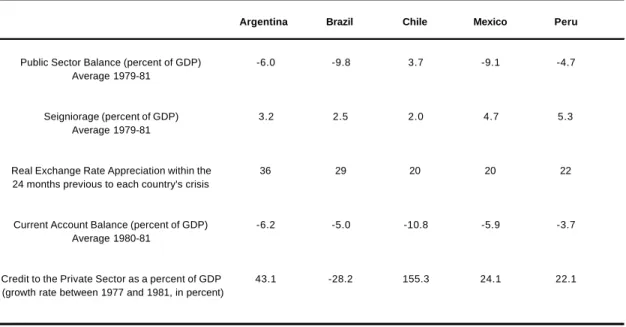
Table 1 shows five key economic indicators for five of the largest Latin American economies affected by currency crises in the early 1980s: Argentina, Brazil, Chile, Mexico and Peru. This data clearly reveals the potentially explosive economic situation in these countries on the eve of the crisis. The first row in Table 1 is the average public sector deficit from 1979 to 1981.5 The situation was dramatic: all countries were running very large fiscal deficits during the pre-crisis years, at an average rate ranging from almost 5 percent in Peru to over 9 percent of GDP in both Brazil and Mexico. The notable exception was Chile, which had a substantial fiscal surplus in the order of 4 percent of GDP over the same period. In spite of this, Chile developed a major balance of payments crisis as well.
The next three variables in Table 1 show the existence of close similarities across these Latin American countries. Seignorage (measured as the increase in the monetary aggregate M1 as a percent of GDP) shows that the governments of these countries, especially Mexico and Peru, were substantially monetizing the deficit. Although Chile had a fiscal surplus, its average annual inflation rate was close to 30 percent between 1979 and 1981; thus, the Chilean public sector was collecting seignorage even if it did not have a clear need for it. The currencies of all five countries experienced a sharp real appreciation during the 24 months previous to their respective crisis. As measured by an index of the multilateral real effective exchange rate, real appreciations ranged from 20 to 36 percent between 1979 and mid-1981. Appreciations of such magnitude normally go together with an aggregate expenditure boom that leads to a sharp drop in the relative
5
price of tradables to non-tradables, encouraging imports and discouraging exports. Such pattern is reflected in the third variable in Table 1 (the current account balance).
The current account balance as a percent of GDP shows that all these countries had large deficits in their external accounts right before the crisis. Chile provides the most extreme example with an average annual deficit of almost 11 percent of GDP between 1979 and 1981. This is all the more striking if we consider that the Chilean government was running a massive fiscal surplus at the time. As documented by Larraín (1991), this pattern is explained by an unsustainable private consumption boom.
Table 1 Selected Macroeconomic Indicators for some Latin American Countries
Argentina Brazil Chile Mexico Peru
Public Sector Balance (percent of GDP) -6.0 -9.8 3.7 -9.1 -4.7 Average 1979-81
Seigniorage (percent of GDP) 3.2 2.5 2.0 4.7 5.3 Average 1979-81
Real Exchange Rate Appreciation within the 36 29 20 20 22 24 months previous to each country's crisis
Current Account Balance (percent of GDP) -6.2 -5.0 -10.8 -5.9 -3.7 Average 1980-81
Credit to the Private Sector as a percent of GDP 43.1 -28.2 155.3 24.1 22.1 (growth rate between 1977 and 1981, in percent)
The last variable in Table 1, the expansion of commercial bank credit to the private sector as a percent of GDP, is one of the most interesting and has usually been overlooked in discussions of currency crises.6 Sharp increases in bank credit indicate the existence of a lending boom. As Table 1 shows, there is clear evidence of a “lending boom” in Chile at the time. The share of commercial bank credit to GDP in Chile increased 155 percent between December 1977 and December 1981. This credit surge in Chile followed the deregulation of its financial sector and the opening of its capital account and helped to finance the private consumption boom. This variable then helps to explain why the Chilean economy was vulnerable to a currency crisis in spite of having a very strong fiscal position. Credit increases were significant but much lower in Argentina, and more modest in Mexico and Peru during this same four-year period, while Brazil alone suffered a credit contraction.
In conclusion, most episodes of crises in Latin America during the 1980s fit well the logic of first-generation models of balance-of-payments crises. Crises in the 1980s were normally the result of excessive government expenditure that continuously eroded the external position of the economies and that eventually broke down the exchange rate regime. The main exception in this respect was Chile, where the crisis came not from a high public sector deficit but as the natural consequence of an unsustainable private consumption boom financed through the banking system.
6
4. The Crises of the 1990s: Mexico 1994 and Asia 1997
On December 19, 1994, the Government of Mexico announced the widening of the peso’s exchange rate band. Two days later, after the Central Bank had lost several billions of dollars in foreign exchange reserves, the Government floated the peso. By then, rumors about the probability of an eventual suspension of payments on dollar-denominated bonds (the infamous Tesobonos) had spread and prompted a run on Mexican bonds. Interest rates soared and the exchange rate collapsed. By the end of December, the Mexican currency was being traded at a rate of 5 pesos per dollar, up from 3.5 in mid-December; by mid-March the exchange rate reached 7.4 pesos per dollar, a depreciation of more than 100 percent over its pre-crisis value.
The period immediately following the Mexican crisis was one of confusion and financial panic. Many other currencies in Latin America came under severe pressure and the stock markets in many emerging economies suffered sharp contractions between January and March of 1995. Most of these effects, however, were short-lived.7 Only Mexico and Argentina endured economic decline in 1995, and both rebounded strongly in 1996-97.
The two crises just sketched, Mexico in 1994 and Asia in 1997, share two particularly intriguing features: First, only a few months before the crises these economies were widely regarded as solid and stable, with very good economic prospects.8 Second, even days before the crises, financial and economic analysts seemed to be completely unaware of what was forthcoming.9 That both economies were among the most closely-watched by the financial community, make these two characteristics even more intriguing.
One possible explanation for these “surprise crises” is that, unlike Latin America in the 1980s, Mexico in 1994 and Thailand in 1997 had demonstrated no evidence of recent fiscal or monetary expansionary policies. Table 2 shows the same five key indicators used in Table 1 to discuss the Latin American crisis of the 1980s, but with data for Mexico, Thailand, Indonesia, Malaysia, the Philippines and Korea.
The first two variables in Table 2, fiscal balance and seigniorage, show a completely different pattern to that observed in Latin America in the 1980s. Mexico, Thailand and Indonesia ran, on average, a fiscal surplus in the years preceding the financial crises. The other countries in Table 2, Malaysia, Korea and the Philippines, were in equilibrium or ran relatively small fiscal deficits. The seigniorage variable also shows a very different pattern to that of Latin American countries in the 1980s: there is
7 It is important to note, though, that 1995 was a year of strong growth for the world economy, and that
terms of trade improved considerably for commodity exporters.
8
In this regard, see Radelet and Sachs (1998) for a summary of the IMF Executive Board discussions on Indonesia, Korea and Thailand that preceded the 1997 crisis.
9
no evidence of a substantial process of monetization before the crisis occurred, with the exception of Malaysia.
The last three variables in Table 2, however, do resemble more the Latin American situation in the 1980s. Table 2 shows that most countries that suffered a crisis in the 1990s had been running large current account deficits in the pre-crisis period. Mexico, Thailand and Malaysia, carried a deficit above 6 percent of GDP per year. Indonesia, Korea and the Philippines carried slightly more moderate deficits, between 3.3 and 4.6 percent. More importantly, in all of the Table 2 countries except Korea, there was a relative large real exchange rate appreciation before the crises. Finally, in three of the six countries, Mexico, Thailand and the Philippines, the crises were preceded by a lending boom.
Table 2 Selected Macroeconomic Indicators for Mexico and some Asian Countries
Mexico Thailand Indonesia Malaysia Philippines South Korea
Fiscal Balance (percent of GDP)
Average 1992-94 0.5
Average 1994-96 2.2 0.7 2.4 -0.2 0.3
Seigniorage (percent of GDP)
Average 1992-94 1.1
Average 1994-96 1.0 1.3 3.8 1.4 1.0
Current Account Balance (percent of GDP)
Average 1993-94 -6.4
Average 1995-96 -7.9 -3.3 -7.4 -4.6 -3.4
Real Exchange Rate Appreciation within the
24 months previous to each country's crisis 13.1 15.5 12.1 12.8 17.7 4.4
Credit to the Private Sector as a percent of GDP
(percentage increase between 1990 and 1994) 103.2
(percentage increase between 1996 and 1992) 37.8 12.1 13.4 104.6 15.6
These variables combined clearly show that, excepting Korea, all countries considered had shown some signs of vulnerability well before the actual crises occurred. These signs, however, were not the typical ones observed in the past; that is, there was no direct evidence of fiscal relaxation or sharp increases in the quantity of money. Instead, the symptoms of the crisis were mainly rooted in the financial sector of the economy. Thus, the crises of the 1990s have more elements in common with the Chilean crisis of 1982 than with the other crises of the 1980s in the region.
In summary, there are two aspects that are common to almost every crisis discussed above: a substantial real exchange rate appreciation and a relatively large current account deficit. Interestingly, most crises have been preceded by large spending booms that lead to significant current account deficit. Whether the cause of the external deficit is the result of an excess of public spending (like in the case of most Latin American countries in the 1980s), an excess of private consumption (like Mexico in the 1990s), or a boom in private investment (like in most Asian countries in the 1990s), it appears to have had second order importance. Therefore, a large current account deficit and an overvalued real exchange rate may be interpreted as summary variables indicating that a crisis is forthcoming. Indeed, in related work we have found econometric evidence that these two variables are highly significant in explaining exchange rate crises in a broad sample of middle and high-income countries (Esquivel and Larraín, 1998).
In the next section we use this conclusion to assess the situation of some Latin American economies in the aftermath of the Asian crisis.
5. Latin America’s Prospects in the Aftermath of the Asian Crisis
With good reason, there is serious concern in the region about the contagion of the Asian crisis. In October 1997, a strong speculative wave negatively affected most stock markets and currencies in Latin America. In this section we address Latin America’s prospects based on our discussion above. We briefly review key macroeconomic and vulnerability indicators in four of the largest economies of the region: Argentina, Brazil, Chile and Mexico. In the following section we evaluate and discuss the policy options that these countries have in order to successfully confront the Asian crisis.
Macroeconomic Indicators
percent in 1997. Chile, affected by a large terms-of-trade deterioration since 1996, exhibits the largest external deficit among the four countries.
Figure 2 shows the fiscal balance as a percent of GDP for the same group of countries, with more heterogeneous results. The fiscal position looks relatively healthy for three of the four countries: Chile had fiscal surpluses throughout the 1990s, though the surplus declined after 1995. Mexico’s fiscal situation has been close to balanced between 1992 and 1997. Argentina’s fiscal balance has deteriorated slightly since 1993, when it ran a surplus, but the magnitude of the deficit is relatively small.
On the other hand, Brazil has been running large fiscal deficits, in excess of 5 percent of GDP per year, during the past three years. Two comments are worth doing
Figure 1.
Current Account Balance
(in percent of GDP, 1992-97)
A r g e n t i n a
1992 1993 1994 1995 1996 1997 -8 -6 -4 -2 0 2 %
B r a z i l
1992 1993 1994 1995 1996 1997 -8 -6 -4 -2 0 2 %
M e x i c o
1992 1993 1994 1995 1996 1997 -8 -6 -4 -2 0 2 %
C h i l e
about the fiscal situation of Brazil. First, although the magnitude of Brazil’s fiscal imbalance seems small when compared to the two-digit deficits of some Latin American countries in the 1980s, it is undoubtedly high when compared to the current fiscal situation of the rest of the region, and to recent international standards. Moreover, Brazil’s fiscal deficit has been increasing during the last three years, and in 1998 will exceed 7 percent of GDP. Second, as Figures 1 and 2 clearly show, Brazil’s current account deficit closely mirrors its fiscal deficit, although it is smaller in magnitude. This combination of twin deficits has proven explosive many times in emerging markets. It is therefore imperative for Brazil to cut its fiscal deficit. This is Brazil’s most important current macroeconomic challenge.
Figure 2.
Fiscal Balance
(in percent of GDP, 1992-97)
A r g e n t i n a
1992 1993 1994 1995 1996 1997 -8 -6 -4 -2 0 2 4 % Brazil 1992 1993 1994 1995 1996 1997 -8 -6 -4 -2 0 2 4 %
C h i l e
1992 1993 1994 1995 1996 1997 -8 -6 -4 -2 0 2 4 %
M e x i c o
Figure 3 charts the pattern of the real exchange rate index in the region from 1992 to April 1998. The data shows that Brazil and Chile have had the sharpest appreciations in the last years, around 20 percent compared to 1990-92. In Brazil, the appreciation accelerated after the Real Plan was implemented in July 1994. In Chile, the domestic currency had accumulated an appreciation of more than 30 percent between 1990 and September 1997. Thus, the depreciation of the Chilean currency in late 1997 and early 1998 took some pressure off the exchange rate, as reflected in the slight rise in the Chilean real exchange rate between September 1997 and April 1998.
In Mexico, the appreciation of its currency in 1996 and 1997 led to a complete loss of the competitiveness gains obtained with the devaluations of 1994 and 1995. This trend, however, has been partially reversed with the nominal exchange rate adjustments of mid-1998. On the other hand, Argentina’s peso also appreciated sharply in the 1990s; even in recent years, when Argentina’s inflation has fallen below international levels, the fixed parity of the peso to the strong U.S. dollar has led to a continuous appreciation of the Argentinean currency. As of April 1998, as Figure 3 shows, Chile was the only country in this group that had experienced a slight currency depreciation since the beginning of the Asian crisis. Recently, however, after the collapse of the Russian ruble and as a result of the increased instability in world markets, Mexico’s currency has also depreciated significantly.
moderate upward trend. Credit expansion has not been significant in these economies in the past several years, and this factor does not seem to be an important destabilizing
factor for the near future.
Figure 3. Real Exchange Rate (1990-92=100)
6 0 8 0 1 0 0 1 2 0 1 4 0
1 9 9 0 - 9 2 1 9 9 3 1 9 9 4 1 9 9 5 1 9 9 6 S e p - 9 7 A p r - 9 8
A r g e n t i n a B r a z i l Chile M e x i c o
0 20 40 60 80 100
Figure 4. Commercial Bank Credit to the Private Sector
External Vulnerability
To assess the prospects of the Latin American economies in an unstable external environment, it is crucial to evaluate the vulnerability of these countries to a reduction in world demand resulting from Asia’s financial and economic turmoil. In this regard, two indicators are important: exports to Asia as a percent of total exports, and the share of primary products in total exports. The former measures the direct trade exposure of Latin American countries to Asia. The latter shows the exposure of Latin American countries to reductions in commodity prices, a phenomenon which is often observed during periods of global recession.
Figure 5 presents these two variables. The figure clearly shows that Argentina, Brazil, and Mexico have relatively low levels of exposure to Asia: 14%, 12% and 3%, respectively. Among the four countries examined, Chile is the most exposed to the Asian crisis, as 32% of Chile’s exports go to Asia.
Regarding primary exports, all four Latin American countries in Figure 5 show relatively large shares of these goods in their total exports. This characteristic leaves all these countries in a highly vulnerable position before sudden changes in world demand. This degree of vulnerability is, however, very differentiated across the countries in our sample. Among these four Latin American countries Mexico has the lowest share of primary exports with 22%, while Brazil and Argentina’s primary exports represent around one third of their total exports. On the other hand, Chile’s primary exports represent 62% of its total exports, the largest share in the group.
dependence levels on both primary product’s exports and the Asian markets. Mexico, with its strong ties to the American market, seems to be relatively safer as long as the U.S. economy continues growing solidly. The main channel, however, through which the Asian crisis has affected Mexico is through its effect on the price of oil.
Latin America’s Prospects: An Assessment
Overall, Brazil appears as the most vulnerable economy among these four Latin American countries. It has large fiscal and current account deficits, and presents the sharpest currency appreciation. Given the economic importance of Brazil in the Southern Cone, however, and its close commercial ties with Argentina (and also, though less significantly, with Chile), the whole region would be affected if Brazil succumbs to a
Figure 5.
External Vulnerability
(percent of total exports)
0 1 0 2 0 3 0 4 0 5 0 6 0 7 0
M e x i c o A r g e n t i n a B r a z i l Chile
Percent of Total Exports
Chile, though more vulnerable in a narrow trade sense, has much stronger fundamentals, as indicated by a solid credit rating. In fact, despite its terms-of trade deterioration and its heavy exports dependence on Asia, Chile’s credit rating is still the best in Latin America.
The occurrence of a crisis in one country, however, may seriously undermine the economic conditions of the other countries in the region. There is clear evidence of the existence of a regional “contagion” effect that may propagate a crisis. A simple exercise may illustrate this point. Using the results from a previous work (Esquivel and Larrain, 1998), we can calculate the probability of a currency crisis in a country with the economic conditions that Chile currently has. We estimate the probability of crisis for Chile to be about 16 percent. If a neighboring country falls into a currency crisis, however, the probability of a crisis in Chile rises to 26 percent. Thus, the pure contagion effect in this case is of about ten percentage points. To illustrate the importance of this effect, consider that out of 111 crises studied in a sample of 30 countries, we found that about half of the countries whose estimated probability was greater than 25 percent experienced a currency crisis the next year. This result may illustrate the importance of the contagion effect as well as the relevance of keeping the economic stability in the region as a whole.
change in the exchange rate policy that allows the Mexican peso to float more freely. The new policy has reduced the risks of an exchange rate crisis, facilitating a rapid and substantial depreciation of the Mexican currency in the second semester of 1998.
A common point of concern for both Chile and Mexico is the deterioration in the price of their main export commodity. Copper prices have plummeted from levels of $1.20 per pound before the Asian crisis, to around 75 cents per pound after the crisis. Copper accounts for more than 40 percent of Chilean exports and the effect on the copper price by itself amounts to an income loss of almost 2 percentage points of GDP for Chile in 1998.
6. Policy options in the face of the Asian crisis
Macroeconomic management and structural reforms
The Asian crisis hit Latin America with a lag of just a few months. Starting in October 1997, stock markets fell substantially and several currencies came under severe attack. In response to this panic and to its aftermath, the Brazilian government decided to counterattack the speculation against the domestic currency by raising short-term interest rates. As a result, overnight interest rates rose from about 22 to over 40 percent at the peak of the crisis. Later, in November 1997, the Brazilian government announced an important package of measures oriented to reduce the fiscal deficit. During 1998, interest rates fell back to the levels of September 1997, around 20 percent, and then climbed back to over 40 percent, remaining highly volatile.
Notwithstanding the efforts of the Brazilian government in late 1997 to attack the problem at its roots, the fiscal adjustment proposed by the government has not been enough to reduce the vulnerability of the economy. The fiscal adjustment will probably have to be strengthened in order to have a lasting effect on the stability of the country. It is clear that keeping the interest rates at 30 or even 20 percent (with inflation at less than 4 percent) cannot be sustained for long without a significant deterioration in the assets of the banking system and, thus, increased risk of financial collapse.
reform are still waiting for Congress approval and their implementation will probably not occur for several months. Additionally, some reports suggest that some of the policy measures announced last year have been postponed or delayed without justification.
It is clear that moving in the direction of deepening structural reforms is the appropriate way for Brazil to regain the initiative and to attain the credibility necessary to reduce interest rates. A related issue is that Brazil needs to increase the flexibility of its exchange rate policy so that it can gradually move away from its current overvaluation.
As a result of the financial shock of late October 1997, the Chilean peso reversed its course of sustained appreciation in the 1990s and suffered significant pressure towards depreciation. The Central Bank drastically raised interest rates and spent about $1.6 billion (or 9 percent of its foreign exchange reserves) intervening to support the peso in the foreign exchange market. In spite of this, the Chilean peso depreciated around 10 percent against the US dollar between October and December 1997. Given the pressures that the economy was experiencing, particularly the collapse of copper prices, and the conditions of instability prevalent in the financial markets, the devaluation of the Chilean peso should be seen as a necessary correction in an otherwise unsustainable appreciating trend. In light of the high dependence of Chilean exports on Asian markets and on primary products, however, a prudent economic policy is strongly desirable. Appropriately, Chile’s government cut fiscal spending twice in 1998, and accepted a modest devaluation of the currency.
arrangement (a currency board) would become subject to severe pressures and its currency could undergo a speculative attack, as in the first months of 1995. The Argentinean authorities will likely stick to the full convertibility policy since exchange rate stability is so much at the heart of the country’s reform process. They can also take heart in the fact that the two most visible countries with currency boards (Argentina and Honk Kong) were successful in defending their currencies when neighboring currencies fell in 1995 and 1997, respectively.
Currency boards, however, have costs and risks. They tie the hands of the policymakers and eliminates the role of the central bank as a lender of last resort. In case of a run on deposits in the financial system, the Central Bank would face a tough dilemma: it could maintain the currency board but only at the cost of a collapse in the financial system, a collapse of much higher dimensions than under alternative monetary regimes. Even if the system does not collapse, the costs of this policy in terms of output and/or employment can be very high, as evidenced by Argentina in 1995 and Hong-Kong in 1998. The best way for Argentina to confront these pressures is to deepen even further its reform program, particularly the liberalization of its labor market. This reform, however, face unusual complications in the current political conditions of a weakened administration.
appreciation pressures accumulated in the real exchange rate between 1995 and 1997. One of the main sources of concern for Mexico now is the uncertainty associated with the political conflict over the bailout of the banking system. Resolving this problem soon will greatly help Mexico to face the Asian crisis. Otherwise, the economic situation could become extremely complex and explosive in the near future.
Dealing with capital flows
The Asian crisis has put the issue of how to deal with capital flows at the forefront of economic discussion. In particular, one of the most debated aspects is the role of capital controls in affecting the magnitude and composition of capital that a country may attract. Many authors have suggested that imposing some form of capital control may help a country avoid unnecessary exchange rate fluctuations and, more generally, may reduce an economy’s vulnerability to external shocks. The stability of Chile after the Mexican crisis has often been quoted as a leading example of the benefits of such policies, and thus we take on this case in some further detail.11
a significant effect on the overall magnitude of the flows, while some overall deterring effect remains in the medium to long term.
Another option that has been widely used to defend the real exchange rate in the presence of large capital inflows is the relaxation of a number of restrictions on capital outflows. These policies, used both in developed and developing countries, include the reduction of restrictions for profit and capital repatriation on foreign investments, and the liberalization of investment options abroad for institutional investors. Nonetheless, as Laban and Larraín (1997) argue, the liberalization of capital outflows is more likely to induce higher capital inflows since it makes the decision to invest in domestic assets less irreversible. Thus, liberalizing outflow controls may be a good measure in itself, but it is likely to provide little relief in reducing the pressures on exchange rate appreciation that arise from capital inflows.
Nonetheless, the role of capital controls is fundamentally different in normal periods, in the presence of large capital inflows (as in Latin America during most of the 1990s) than at times of potential crisis, when inflows turn into outflows (as after October 1997). In periods of crisis, inflow controls turn redundant and by and large mainly increase the cost of capital for domestic companies in international markets; increased outflow controls, on the other hand, are likely to reduce net inflows.
7. Conclusions
Some important lessons emerge when comparing the experiences of Latin America in the 1980s, Mexico in 1994, and Asia in 1997. First, not all currency crises are alike. Most crises in Latin America during the 1980s had a strong fiscal component and, in that sense, tend to fit well with the explanations posited by traditional models of balance-of-payments crises. On the other hand, it is clear that crises in Chile (1982), Mexico (1994) and Asia (1997) did not have a fiscal origin and therefore the roots of the crises are located elsewhere, mainly in the financial sector. Second, contrary to popular assertions, and in spite of their different nature, most crises have been preceded by strong indications of fundamental weakness in the economy. Some of the most important signals are given by the current account deficit, the real exchange rate appreciation, and a rapid expansion of credit to the private sector. In addition to these signals, standard balance-of-payments crises (mainly in the 1980s) were also preceded by large fiscal deficits and high rates of seigniorage.
policy, this is probably the best option for Brazil to prevent a major recession stemming from very high interest rates.
The case of Chile provides an interesting contrast. Widely regarded as the strongest economy of the region prior to the Asian crisis for its performance after the Mexican devaluation of December 1994, Chile has seemed to loose its aura as a safe heaven. Some analysts have gone as far as saying that Chile has become the most vulnerable economy of Latin America. This assertion does not withstand scrutiny. In spite of having been hardly hit by a terms of trade shock, Chile is structurally healthy, with the highest investment and saving rates in Latin America and probably the strongest banking system of the region. It faces, however, a major trade challenge coming from its heavy exposure to copper and Asia, and will certainly face tougher times were Brazil’s problems to intensify.
Argentina has made important progress since 1995, especially in the consolidation of its banking system. Weaker regional demand, however, and the loss of competitiveness associated with the Asian crisis will surely take its toll in terms of higher trade deficits. Perhaps Argentina’s weakest point is its high dependence on Brazil, which after the MERCOSUR agreement has come to absorb some 30 percent of the country’s exports.
weak situation of its banking sector and the economic and political complications of the FOBAPROA program.
How can countries better deal with potential currency crises? Clearly, a correction of the fundamental macroeconomic imbalances of the country, as outlined above is an important part of the story. This is only a necessary condition, however, and may not be sufficient to avoid contagion. For countries that are in the midst of structural reforms, potential crises should be used as an opportunity to deepen the reforms, as Argentina did in 1995 and Brazil should attempt now. There are two main reasons for this. First, legislative approval for reforms is easier to obtain at times of crisis. Second, a further push for reforms is a very good signal that the economic and political authorities can send to the markets. Doing everything right, however, only minimizes the risk of a crisis, but is no sure guarantee against it, as the work on self-fulfilling crisis and some of the other second-generation models make clear.
References
Agenor, Pierre-Richard, Jagdeep S. Bhandari and Robert P. Flood (1992); “Speculative Attacks and Models of Balance of Payments Crises,” IMF Staff Papers, 39, pp. 357-394.
Calvo, Guillermo and Enrique G. Mendoza (1997); “Rational Herd Behavior and the Globalization of Securities Markets,” mimeo, University of Maryland.
Connolly, Michael B. and Dean Taylor (1984); “The Exact Timing of the Collapse of an Exchange Rate Regime and its Impact on the Relative Price of Traded Goods,”
Journal of Money, Credit and Banking, 16, May, pp. 194-207.
Dornbusch, Rudiger and Alejandro M. Werner (1996); “Mexico: Stabilization, Reform and No Growth,” Brookings Papers on Economic Activity, v. 1, pp. 253-315. Drazen, Alan (1998); “Political Contagion in Currency Crises,” mimeo, University of
Maryland, March.
Esquivel, Gerardo and Felipe Larraín (1998); “Explaining Currency Crises,” Faculty Research Working Paper No. R98-07, John F. Kennedy School of Government, Harvard University, June.
Flood, Robert and Peter Garber (1984); “Collapsing Exchange Rate Regimes: Some Linear Examples,” Journal of International Economics, 17, pp. 1-13.
Flood, R., P. Garber and C. Kramer (1984); “Collapsing Exchange Rate Regimes: Another Linear Example,” Journal of International Economics, 41, pp. 223-234. Flood, Robert and Nacy Marion (1998); “Perspectives on the Recent Currency Crisis
Literature,” Cambridge, Mass: NBER Working Paper no. 6380.
Goldfajn, Ilan and Rodrigo Valdes (1998); “Are Currency Crises Predictable?”,
European Economic Review, 42, pp. 873-885.
Krugnam, Paul (1979), “A Model of Balance of Payments Crises,” Journal of Money,
Credit and Banking, 11, pp. 311-325.
Krugman, Paul (1991); ”Speculative Attacks on Target Zones,” in Paul Krugman and Marcus Miller(eds.), Target Zones and Currency Bands, Oxford: Oxford University Press.
Laban, Raul and Felipe Larraín (1998); “The Return of Private Capital to Chile in the 1990s: Causes, Effects and Policy Reactions,” Faculty Research Working Paper No. R98-02, John F. Kennedy School of Government, Harvard University.
Larraín, Felipe (1991); “Public Sector Behavior in a Highly Indebted Country: The Contrasting Chilean Experience,” in F. Larraín and M. Selowsky (eds.), The
Public Sector and the Latin American Crisis, San Francisco: International Center
for Economic Growth.
Larraín, Felipe, Raul Laban and Romulo Chumacero (1997); “What Determines Capital Inflows?: An Empirical Analysis for Chile,” Faculty Research Working Paper Series, John F. Kennedy School of Government, Harvard University, April.
Obstfeld, Maurice (1994); “The Logic of Currency Crises,” Cambridge, Mass: NBER Working Paper 4640.
Obstfeld, Maurice (1996); “Models of Currency Crises with Self-fulfilling Features,”
European Economic Review, 40, pp. 1037-1047.
Radelet, Steve and Jeffrey Sachs (1998); “The Onset of the East Asian Financial Crisis,” mimeo, Harvard Institute for International Development, March.