Investigations into Trust for Collaborative Information
Repositories: A Wikipedia Case Study
Deborah L. McGuinness
1, Honglei Zeng
1, Paulo Pinheiro da Silva
2,
Li Ding
3, Dhyanesh Narayanan
1, Mayukh Bhaowal
11Knowledge Systems, AI Lab, Department of Computer Science
Stanford University, California, USA
{dlm, hlzeng, dhyanesh, mayukhb}@ksl.stanford.edu 2Department of Computer Science
University of Texas at El Paso, Texas, USA [email protected]
3Department of Computer Science
University of Maryland, Baltimore County, Maryland, USA [email protected]
ABSTRACT
As collaborative repositories grow in popularity and use, issues concerning the quality and trustworthiness of information grow. Some current popular repositories contain contributions from a wide variety of users, many of which will be unknown to a potential end user. Additionally the content may change rapidly and informa-tion that was previously contributed by a known user may be up-dated by an unknown user. End users are now faced with more challenges as they evaluate how much they may want to rely on in-formation that was generated and updated in this manner. A trust management layer has become an important requirement for the continued growth and acceptance of collaboratively developed and maintained information resources. In this paper, we will describe our initial investigations into designing and implementing an ex-tensible trust management layer for collaborative and/or aggregated repositories of information. We leverage our work on the Inference Web explanation infrastructure and exploit and expand the Proof Markup Language to handle a simple notion of trust. Our work is designed to support representation, computation, and visualization of trust information. We have grounded our work in the setting of Wikipedia. In this paper, we present our vision, expose motiva-tions, relate work to date on trust representation, and present a trust computation algorithm with experimental results. We also discuss some issues encountered in our work that we found interesting.
Categories and Subject Descriptors
H.3.3 [Information Storage and Retrieval]: Information Search and Retrieval; H.3.5 [Online Information Services]: [Data Shar-ing, Web-based services]; I.2.4 [Artificial Intelligence]: Knowl-edge Representation Formalisms and Methods
General Terms
Design, Languages, Management
Keywords
Trust, Wikipedia, Inference Web, Proof Markup Language, Open Editing
Copyright is held by the author/owner(s).
WWW2006, May 22–26, 2006, Edinburgh, UK. .
1.
INTRODUCTION
One emerging pattern for building large information repositories is to encourage many people to collaborate in a distributed manner to create and maintain a repository of shared content. The notion of open editing has grown in popularity along with the notion of a Wiki, which in its simplest form allows users to freely create and edit web pages1. Wikipedia [1] is one popular Wiki that is a freely available online encyclopedia. Its size and diversity is one aspect of it that makes it an interesting motivating use case for our work. It has more than 900,000 registered authors2and three million ar-ticles. It has become perceived as a valuable resource and many people cite it as a credible information source. While recent studies (e.g. [2]) show that the science articles in Wikipedia are generally trustworthy, there have been some reports of claimed inaccuracies appearing in Wikipedia. For example, there was a widely reported situation where a journalist and a former official in the Kennedy administration, stated that Wikipedia contained an inaccurate bi-ography article about him in 2005 [3]. The media coverage led to discussions about trustworthiness of content sources that have fairly liberal editing policies and also led to changes in Wikipedia’s editing policy of anonymous authors.
One of the strengths of a collaborative information repository is that it may benefit from contributions of a wide diversity of users. Of course some of these users will have expertise levels that are untested and unknown to some end users. Additionally content in these repositories may change rapidly. Thus, trust management has become a critical component of such a system design. With-out some form of trust management, these kinds of collaborative information repositories will have difficulty defending any particu-lar level of authoritativeness and correctness. Additionally, without some notion of accountability in addition to the trust, these systems will only be able to provide end users with information but not with information about where the information came from and how trust-worthy that source might be. The popular large implementations such as Wikipedia are currently addressing some of these issues, although currently not to the level that they will need to in the long run if they are to achieve their true potential.
Our work focuses on designing and building an extensible trust framework. We are investigating representation needs for the en-coding of trust, methods for computing trust, and visualization of
1
http://wiki.org/wiki.cgi?WhatIsWiki 2
information that is informed by trust encodings. In our previous work on Inference Web, we have been designing and implementing an infrastructure for explaining answers from intelligent applica-tions. One information source for these applications may be a col-laboratively generated information repository such as Wikipedia. Our work on explaining answers focused us on where information came from and how it was manipulated to generate an answer. This work has also led us to investigate forms of trust encodings for in-formation.
As we began to look more closely at aggregated information sources and collaborative, evolving information sources such as Wikipedia, we have found even more requirements for trust for-mulation. It is worth noting that an open (or mostly unrestricted) editing environment is quite different from some other social net-works (e.g., eBay and Epinions) that have addressed trust. These social networks may be viewed as focusing on interactions between users while generating growing content but not typically generating changing content. For example, a transaction on eBay or a review on Epinions is typically created once and then remains unchanged. On the other hand, the content of collaborative information repos-itories like Wikis may be quite dynamic as it may be continually reviewed, shared, and updated by many different users. Trust for-mulation and requirements for rapidly changing repositories thus may be quite different from (mostly) monotonically growing repos-itories even though both may be perceived as trust problems.
Some social networks that have trust approaches that rely on ex-plicit assertion of trust in a user resulting from feedback from trans-actions or ratings. Trust in Wikipedia has not been addressed ex-plicitly in this manner. We began exploring the view that trust may be viewed as an implicit feature of the environment and we began looking for ways to make trust levels explicit and inspectable.
Significant research has been done on trust in various contexts (e.g., [4],[5]); however, most of the work assumes homogeneous context. Encryption and authentication (e.g., [6]) help secure trust-worthiness in terms of the integrity and authenticity of information through pre-defined representation and functions. Distributed trust management (e.g., [7]) offers a flexible policy framework for judg-ing if a person is trustworthy enough to perform an action through a common policy ontology and corresponding policy inference en-gine. Reputation systems (e.g., [8], [9]), and trust networks (based on social networks or P2P network) (e.g., [10],[11]) help compute trustworthiness of a person or an entity; again, using a pre-defined trust ontology and a common computation method.
The Web offers easy access to information from various sources and computational services at different locations. Thus, distributed web environments provide diverse and heterogeneous settings for trust researchers. For repositories of information like Wikipedia, trustworthiness information concerning an article or an author could be computed and published by many sources with varying degrees of reliability. When an end user is evaluating how to use (portions of) a Wikipedia article, it may be useful to view an aggregation of the trust information available concerning the article. The end user may thus want to effectively combine trust information from multiple sources using different representation schemes potentially using personalized trust computation methods. Unfortunately, re-search focused on enabling this scenario is sparse. Our investiga-tions have been driven by our desire to work on distributed, hetero-geneous, collaborative environments such as the web in general and collaborative, evolving information repositories in particular. Our goal is to provide an open, interoperable, and extensible framework that can provide a solution framework to the problems of trust we mentioned above.
In the way of background, Inference Web (IW) [12] enables
Se-mantic Web applications to generate portable proofs that contain information required to explain answers. One of challenge for users of any explanation system is evaluating trustworthiness of answers. Presentations of knowledge provenance, sources used and informa-tion manipulainforma-tion steps performed to produce an answer help. It is also important to know how trustworthy any particular piece of in-formation is, how trusted the author is etc. We thus have been mo-tivated to add a trust representation extension to the Proof Markup Language. We will report here on our extension and describe how we are and plan to use it in our case study using Wikipedia.
We view Wikipedia as an example of a collaborative, evolving information repository that has variety in quality and coverage of its subject matter. We were inspired to look at Wikipedia as a case study for our trust extension work for the following reasons: (i) it is a large and growing collaborative repository yet is contained. It can be viewed as large enough to provide challenges of scale and trust. (ii) it stores much rich provenance information in comparison to typical collaborative information repository. (iii) it is in need of a trust solution.
Additionally, we believe that trust relationships can be computed from information contained and maintained by Wikipedia. Further, we believe that a solution infrastructure appropriate for Wikipedia may be widely reusable in other online system settings.
The rest of our paper is structured as follows. In section 2, we provide a vision of how we will use trust values once available to present trust information to users. We do this by describing a customizable trust view of information. In section 3, we show a citation-based approach, the link-ratio algorithm for computing trust. In section 4, we present some experimental results using the link-ratio algorithm in Wikipedia. In section 5, we discuss the im-plications of citation trust in Wikipedia and related work. We con-clude our paper with a discussion of related work and future work. Contributions presented in this paper to trust formulation in open collaborative, evolving settings include: an extension to the Proof Markup Language that creates a proof interlingua capable of en-coding trust, a citation based trust algorithm (Link-ratio trust) de-signed to demonstrate our computational component and explore some characteristics of trust in Wikipedia; and a customizable visu-alization component for presenting Wikipedia content in a manner that has been informed by trust information.
2.
TRUST TAB
In order to extend Wikipedia with a trust management compo-nent, we propose a new “trust” tab associated with each Wikipedia article. This trust tab will appear in addition to the conventional tabs of Wikipedia, i.e., “article”, “edit”, “history” and “discussion”. The motivation is to render Wiki articles in ways that users can vi-sually compare and identify text fragments of an article that are more (or less) credible than other fragments. The trust tab is sup-posed to be a primary tool for helping users to decide how much they should trust a particular article fragment. The rendering of each text fragment is to be based on degrees of trust. These degrees of trust may be between individual authors or they may be aggre-gated and thus may be viewed as a community trust level associated with an author of each fragment of the document.
Our present endeavor is to calculate and display trust information based on information already available in the Wikipedia and with-out the use of any external information sources, e.g., Wikipedia users. In the future, we will extend this approach to include feed-back from external sources so as to inform the trust calculations with a wider set of input.
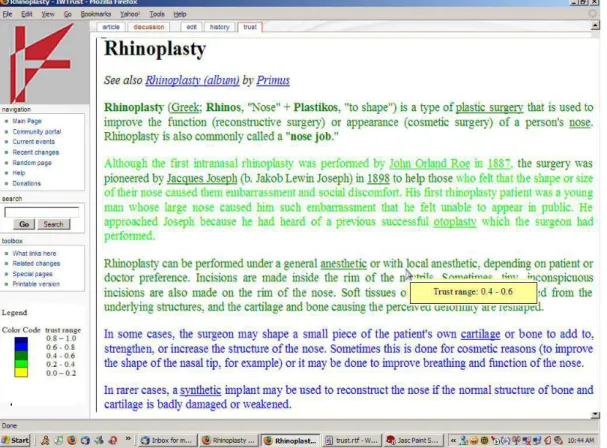
back-Figure 1: A Trust Tab Example in Wikipedia.
ground to text fragments in the article as shown in Figure 1. The new background color conforms to a color scheme which makes the presentation and its inherent meaning in terms of trust obvious and comprehensive.
According to the color code legend in the Figure 1, the degrees of aggregated trust of the fragments in the Rhinoplasty article range from 0.2 to 0.8 in a scale [0,1] where 0.0 is the total absence of trust and 1.0 is the total presence of trust. The exact meaning of this scale of trust is irrelevant for the trust tab that aims to provide a visual mechanism to compare the parts of the page that are more or less credible. The relative differential between the trust values is information that is useful to the end user. For instance, the trust tab says that the last fragment composed of the two last paragraphs of the page has a higher degree of trust than any other fragment in the page. Moreover, the second paragraph has the lowest degree of trust although the fragment “the surgery (...) in 1898 to help those” inside the paragraph have been added by a more credible author.3
The implementation of the trust tab has raised several issues re-lated to Wikipedia. In the rest of this section, we briefly describe an approach to implement the trust tab. We will also present some experimental results of our effort to compute aggregated degrees of trust for the authors of article fragments as required for rendering useful trust tabs when no personalized trust relations are used.
2.1
Fragment Identification
The trust tab relies on the fact that Wikipedia articles can be
seg-3The actual trust values used to render this page are just for expos-itory purposes and are not intended to reflect that actual trust levels for this page; the figure is manually generated for demonstration purposes.
mented into a sequence of text fragments where each fragment has a single author. We assume that several fragments in the article can have a single author. In order to compute a trust level for each frag-ment, the trust tab needs: (i) to identify each individual fragment in the article; (ii) to identify the author (and time stamp) of each fragment; and (iii) to compute a degree of trust for each author.
The Wikipedia database schema does not store individual frag-ments although it archives complete revisions of articles. Thus, one approach to fragment identification is to compare successive article revisions, e.g., using diff, and identify changes. Note, the granular-ity of the difference measure used is something we are exploring. By performing successive comparisons, the trust tab retrieves the individual fragments of an article as required in (i). Simultane-ously, it identifies the time stamps and authors for the fragments as required in (ii). Trust computation associated with authors is discussed below in Section 3.
2.2
Provenance Annotation
the articles they are viewing and help them to decide how much they should trust the articles.
Our trust tab approach depends on a mechanism for storing trust relations between authors as well as aggregated degrees of trust inferred from the Wikipedia content. This new stored content how-ever, may not be enough to capture some important trust aspects of the system since Wikipedia is managed in a centralized manner. For instance, we still need to face two important issues in repre-senting and obtaining knowledge provenance: (iv) how to capture provenance information not originally written by a user, e.g. a user may copy and paste some content from the Web to an Wiki article; and (v) how to make trust computation components independent of data storage.
For (iv), we need a more comprehensive vocabulary for anno-tating the provenance information. We are using the provenance part of Proof Markup Language (PML) [13] to fulfill this job. Be-side person, PML also identifies many other types of information sources including website, organization, team, publication, and on-tology. Upon updating a Wikipedia article, the editor may pro-vide additional justification for his/her modifications. For example, when an editor adds one definition to an article, he/she may also specify that the definition is obtained from an online article and even specify the location of the related span of text.
For (v), we need explicit representation of provenance informa-tion. This is especially helpful when integrating multiple knowl-edge repositories which are managed independently. Our solution is to use the RDF/XML serialization of PML. To implement this idea, our design adds another “provenance” tab and exposes PML provenance information in RDF/XML format to agents (or web ser-vices) which are capable of computing trust using provenance in-formation.
<iw:NodeSet
rdf:about="http://en.wikipedia.org/wiki/Stanford"> <iw:hasConclusion>"Article Fragment"</iw:hasConclusion> <iw:hasLanguage>en</iw:hasLanguage>
<iw:isConsequentOf> <iw:InferenceStep>
<iw:hasRule rdf:resource=
"http://iw.stanford.edu/registry/DPR/Told.owl#Told"/> <iw:hasSourceUsage>
<iw:SourceUsage>
<iw:hasAuthor >Harry</iw:hasAuthor>
<iw:hasTimestamp>20051109</iw:hasTimestamp > <iw:hasParentID>2425693</iw:hasParentID > </iw:SourceUsage>
</iw:hasSourceUsage> </iw:InferenceStep> </iw:isConsequentOf>
</iw:NodeSet> <iw:TrustRelation> <iw:hasTrustingParty rdf:resource=
"http://iw.stanford.edu/registry/ORG/Wikipedia.owl"/> <iw:hasTrustedParty>Harry</iw:hasTrustedParty> <iw:hasTrustValue>0.434</iw:hasTrustValue> </iw:TrustRelation>
Figure 2: PML provenance annotation
The next step is to encode the trust information in PML. Figure 2 shows an example of such an encoding. In this example, Harry is the author of a fragment in the Stanford page and the Wikipedia community has an aggregated degree of trust of 0.434 in Harry. The use of a float for hasTrustValue is a simplification of the PML capabilities for representing trust values. More sophisticated, re-alistic approaches are discussed in [14]. PML encodings can then be used by automated programs for other presentations of trust in-formation, or for use in more complex reasoning and question an-swering applications that may want to use trust input for filtering,
thresholding, etc.
2.3
Provenance Visualization
The trust tab applies conventional rendering techniques used by the article tab for rendering so that the typical style of articles is preserved in the trust tab. In addition to the use of these techniques, the trust tab also compares the content of the article with the PML encoding of the article. The trust tab views the PML encoding to be metadata for the page in the article tab. By comparing the page content with its PML encoding, the trust tab identifies fragments and the fragment authors. It also retrieves a pre-computed aggre-gated degree of trust for each author as stored in the newly created storage for trust in the Wikipedia database. From these degrees of trust and a color schema, the trust tab eventually identifies and sets the appropriate background color for each fragment.
3.
CITATION-BASED TRUST
3.1
Trust issues in Wikipedia
In our work, we begin by considering how citation-based mea-sures may be used to determine trust values. In some settings, an end user may be more inclined to rely on the content in a news story from a reputable newspaper, such as the New York Times, over the content that is published on a personal Blog, especially if the end user has no knowledge of the Blog or its author.
One way of computing trust of an author is to take an aggregated value from trust rankings of all of the articles written by the author. In order to share and visualize such trust information, we formalize trust as a numerical value between0and1and we view it as a mea-sure of trustworthiness. In our setting, a value of1represents com-plete trust and value0represents unknown trustworthiness. Note, this differs from some approaches where a value0is interpreted as complete distrust. Although we have chosen a rather simplistic trust model in this work, we are also evaluating other, more sophis-ticated trust models that we may use to enhance our current model. In this work, citation-based algorithms are a family of algorithms that derive trust based on citation relationships among entities. We refer to such derived trust as citation-based trust, or simply citation trust. We ground our work in Wikipedia and use it as a sandbox for evaluating citation trust.
One distinguishing characteristic of Wikipedia articles in com-parison to general web documents is that Wikipedia articles are meant to be encyclopedia entries. We will refer to the title of a Wikipedia article (e.g. “Gauss’s law”), as an encyclopedia index
term. We note that encyclopedia index terms may occur, with or
without citation, in other articles in Wikipedia. Since Wikipedia is an encyclopedia, one might expect that occurrences of encyclope-dia index terms in other articles would refer back to the encyclo-pedia index term article, and in fact if a term appears but does so without citation, it might be viewed as a negative indicator of the quality of the index term entry. We will explore this notion and compute the number of non-citation occurrences of encyclopedia index terms. Two other useful measures of note in collaborative content settings are the number of citations a term (or article) re-ceives and the citation trust of articles in which it is cited.
Consider the scenario where an article (i.e. its encyclopedia term) has many non-citation occurrences but few actual citations. One interpretation of this scenario is that the article may not be per-ceived to be worthy of a high trust value since few authors choose to cite the article when they mention the term4. In contrast,
citation occurrences of a word or phrase on a typical web page may not mean anything about any associated trust levels since typical web page authors do not necessarily link every phrase that one would typically find in an encyclopedia to a web page describing the phrase.
In our work, we have begun explorations into citation ratios as a potential input to trust algorithms. In this paper, we will report on our investigations concerning link ratios. We define the Link-ratio of an article (i.e., the page with title x) as the ratio between the number of citations and the number of non-citation occurrences of the encyclopedia term x.
We provide the following motivation for exploring Link-ratio:
• Link-ratio is a trust measure unique to collaborative reposito-ries of encyclopedic content. The fact that it is a ratio rather than a raw count of non-citation occurrences helps to min-imize the impact of the difference between the numbers of occurrences of common vs. uncommon terms.
• Link-ratio is in the same family as the well respected PageR-ank [15], citation-based algorithm, which has been success-fully used in many web settings. PageRank has also been studied in the context of Wikipedia. We will cite and dis-cuss the results of this related research from other researchers ([16]).
• Unlike other social networks such as eBay, Wikipedia has no explicit trust assertions among authors and articles. Trust al-gorithms based on the transitivity property of trust cannot be directly applied without an initial set of trust values. Obtain-ing trust values manually for a content repository the size of Wikipedia is a large task. The Link-ratio approach may be used as one way to obtain initial trust values.
3.2
A Simple Wikipedia Model
Wikipedia may be (partially) characterized by the abstract model in Figure 3. Intuitively, Wikipedia consists of a set of articles (i.e. articlesd1, d2, ..., dmin Figure 3). Each article (di) consists of a set of article fragments (fi1, fi2, ..., fini), each of which is writ-ten by an author (aj). An author may write more than one frag-ment in the same article. In addition, a fragfrag-ment could link to other articles as citations. There are three types of links in Fig-ure 3: author-fragment authorship links (solid lines fromaitofjk), fragment-article citation links (dotted lines fromfij todk), and article-fragment membership links.
Figure 3: An Abstract Model of Wikipedia.
Our goal is to infer trustworthiness of authors, fragments and articles based on the above link structures. We also assume most Wikipedia authors have the genuine intention of providing accurate content.
In the following sections, we will show two citation-based trust algorithms, the Link-ratio algorithm and the PageRank algorithm. We will explain the link-ratio algorithm in detail but only briefly mention the well-known PageRank algorithm.
3.3
Link-ratio Algorithm
We first compute article-level trust in Wikipedia based on its rich citation structure. Assumedis an article, then[[d]]refers to the hyperlink citation to this articled. For example, the article
Grape refers to the article Wine by stating that “... used for making
[[wine]]”. When an article is linked to from another one, a certain trust is implied5. In this example, the author of Grape expresses his trust towards the article Wine by creating a citation to it. He be-lieves that a user may benefit from further information on the wine topic by accessing the information contained in the article Wine.
In the link-ratio algorithm, we are interested in non-citation oc-currences of an encyclopedia term. Thus, the algorithm looks for articles that contain a termdbut do not link to articled. For exam-ple, in the article Beer, it is said that “Unfiltered beers may be stored much like wine for further conditioning ...” Both Grape and Beer mention the term “wine”, but only Grape links to the article Wine. There may be many reasonable explanations for the omission of the wine citation in Beer: Beer may have been created before Wine was created; the author of Beer may be unaware that Wine exists; the Beer author may be in a hurry and may be limiting citations; the
Beer author may not believe that the readers of this page need extra
information on wine; or the author believes Wine is untrustworthy. Without further information, we are not able to determine the exact cause of a missing citation; therefore, we assume missing citations decreases the trustworthiness of an article that was not cited. Si-multaneously, if one is keeping measures of how ”known” a page it, the missing citation decreases this measure.
We define Trust doc(d) to be the trust value of an article d. Based on the citation trust we discussed above, the more frequent
[[d]]occurs, the higher Trust doc(d)is; the more non-citation oc-currences ofdare, the lower the trust value is.
Trust doc(d) = occurrences([[d]])
occurrences([[d]]) +occurrences(d) (1)
Occurrences([[d]]) denotes the number of citations to an article
dand occurrences(d) is the non-citation occurrences of termd. The citation trust is thereby defined to be the ratio between the occur-rences of the citations to articledand the total occurrences of term
das a citation and a non-citation.
Wikipedia articles are often under constant revision. We refer to the change that an author commits in one edit session as atomic
change. The latest version of an article can be simply viewed as
the original article followed by a sequence of atomic changes. We define Documents(a)as the set of articles that authorahas ever created and changed. We can calculate the aggregated trust value of an authora, Trust author(a), based on the trustworthiness of Documents(a). Intuitively, the trust value of an author is an ag-gregated value of the trust values of all the articles he has con-tributed to. In Equation (2), we adopt the simple arithmetic mean, but other weighting functions are possible (e.g. weighted mean).
5
|Documents(a)|is the size of Documents(a), i.e., the number of articles that authorahas contributed to.
Trust author(a) = P
d∈Documents(a)Trust doc(d)
|Documents(a)| (2)
One of our primary goals is to help users understand how much they should rely on information in articles. Since articles are com-posed of fragments, this also means that we want to help users compare trustworthiness of article fragments in the same article, each of which may be written by different authors. Since we have established author trust in Equation (2), we use a simple notion that assumes fragment trust is the same as the trust value of its au-thor. Iffis a fragment of an article and Author(f)denotes the author of this fragment, then we can define the trust of this frag-mentT rust f rag(f)as follows.
Trust frag(f) =Trust author(Author(f)) (3)
The notion of fragment trust being identical to author trust is a bit too simplisitic. Fragment trust may also depend on context. For example, Equation (3) would produce the same results for two article fragments from the same author, despite the possibility the author of is an expert on the topic of one fragment and is not an expert on the topic of another fragment.
Fortunately, Wikipedia classifies articles into different categories; for example, the Mathematics category is meant to hold articles about mathematics. If we definec1, c2, ..., ct to be the categories in Wikipedia, such that each ofciis a collection of articles relating to the same topic, we can rewrite Equation (2) and Equation (3) to be topic-dependent.
Trust author(a, ci) = P
d∈Documents(a)Vd∈ciTrust doc(d)
|Documents(a, ci)|
(4) The trust of an authoraon topicci(T rust author(a, ci)) is the ratio between the average trust values of his contributed articles on topicci.
Trust frag(s) =Trust author(Author(s, ci)) (5)
The trust of a fragment is now modified to be the trust of its author on the topicci, which the article of the fragment belongs to. Topic-specific trust may be viewed as a coarse approximation to context-based trust.
3.4
PageRank
We briefly mention the well known PageRank algorithm in this section as another example of citation-based approaches. PageR-ank is an algorithm for rPageR-anking web pages used by Google and other retrieval engines. Web pages that have high PageRank values are typically more highly regarded and trusted and many end users prefer to have them returned first.
According to [15], PageRank of a web page A is defined to be
PR(A) = (1−d) +d(P R(t1) C(t1) +...+
P R(tn)
C(tn) ) (6)
In the Equation (6),t1, t2, ..., tnare pages linking to page A and
C(ti)is the number of outgoing links that a pageTi has. dis a damping factor, empirically set to 0.85.
When calculating the PageRank of articles in Wikipedia, one can take two possible approaches:
a. Consider the presence of Wikipedia (as a collection of web pages) on the Web. This approach would take account into consid-erations the links between Wikipedia articles as well as the links from external websites to Wikipedia articles.
b. Consider Wikipedia as a set of interlinked articles in isolation and calculate the PageRank. This approach would account only for links that exist within Wikipedia. One could view it as an “internal PageRank” that is exclusive to the articles and associated citation structure in Wikipedia.
We are more interested in the second approach, because we in-tend to study the relative trustworthiness of articles within the Wikipedia collection. Consequently, allowing PageRank from external links to flow into this computation might not yield the desired results. Note that accounting for links from external pages would definitely help to account for added value to a Wikipedia article from the per-spective of the entire Internet.
PageRank has been computed and studied in Wikipedia [16]. In section 5, we will cite and discuss the results, putting it in the con-text of citation trust and relating it to the Link-ratio algorithm and the general citation-based approach.
4.
EXPERIMENTS
The main data set used in our experiments was the dump of the Wikipedia database taken in December, 2005. We computed the trustworthiness of Wikipedia articles using the link-ratio algorithm in Equation (1). In order to determine the citation trust of a given article, all the other articles in Wikipedia were parsed searching for the reference of the article under consideration, whether it was a plain occurrence or a linked reference.
The first experiment was to compute the link-ratio values of fea-tured articles, normal articles, and clean-up articles in Wikipedia. Featured articles are expected to be the best articles in Wikipedia; they were reviewed for accuracy, completeness, and style by ex-perts in the same fields. On the contrary, clean-up articles are those articles below the quality standard of Wikipedia and are viewed by editors as being in need of major revisions. Clean-up articles are typically manually marked by Wikipedia administrators or other authors. Normal articles are articles that are neither featured ar-ticles nor clean-up arar-ticles. Intuitively, featured arar-ticles are most trustworthy, clean-up articles are least trustworthy, and normal ar-ticles are somewhere in between.
We randomly chose 50 featured articles, 50 normal articles and 50 clean-up articles from the Geography category. Table 1 shows the average link-ratio values of each type of articles.
Table 1: Average link-ratio values of 50 articles in the Geogra-phy category
Type of the articles Average Link-ratio value Featured articles 0.34
Normal articles 0.26 Clean-up articles 0.21
As we may expect, featured articles have the highest link-ratio values while clean-up articles have the lowest value. The differ-ences between normal articles and clean-up articles are rather small, possibly because normal articles have a wide range of trustworthi-ness and quality. In practice, we have viewed articles with a link-ratio over 0.30 as trustworthy, and articles with a value less than 0.15 as having unknown trustworthiness. For example, the article
Cleveland, Ohio has a link-ratio 0.53, which means that over50%
Our results are limited by the size of the article samples and their categorization. One source of rated articles was the class of fea-tured articles. Unfortunately, currently, only0.1% of Wikipedia articles are featured articles. In particular, there are less than 80 featured articles in the Geography category, which was our chosen topic area for evaluation. Since we are interested in topic-specific trust, lack of featured articles (and clean-up articles to a lesser ex-tent) poses one challenge in evaluating the effectiveness of citation-based approach and other approaches, because there are no other explicit trust assertions in Wikipedia.
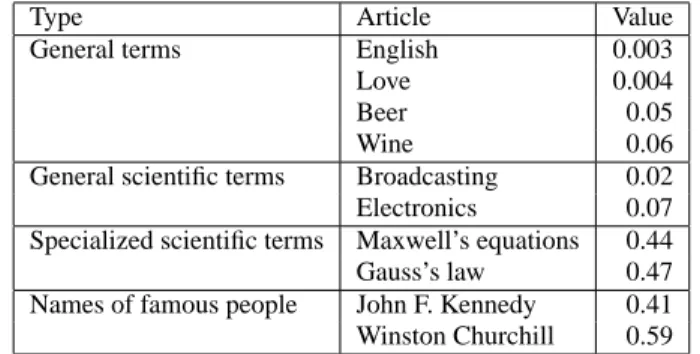
Our second observation is that the link-ratio value depends on not only the trustworthiness of an article but also on how “link-able” the encyclopedic index term is. For example, if one writes an article and it has the word “Love” in it, it is unlikely that the author will consider the linking the occurrence of the term ”Love” to the article love. The author probably expects that readers of the new article know what the definition of love is and there is no need to link it to the encyclopedia entry. On the contrary, if one uses a scientific term such as “Gauss’s law”, it is likely that the author will consider linking to the encyclopedia article gauss’s law, as the author may assume a typical reader may want more information concerning the topic. Thus the link-ratio result can be dependent on how common the term is as well as how likely it is to require supplemental information that is obtainable from an encyclopedic web page entry. In another example, names of famous people will have higher link-ratio values than those of general things like wine or coal. Table 2 shows increasing link-ratio values for terms that are less common and more specialized.
Table 2: Link-ratio values of common and less common cyclo-pedia terms
Type Article Value
General terms English 0.003
Love 0.004
Beer 0.05
Wine 0.06
General scientific terms Broadcasting 0.02
Electronics 0.07
Specialized scientific terms Maxwell’s equations 0.44
Gauss’s law 0.47
Names of famous people John F. Kennedy 0.41 Winston Churchill 0.59
Our third observation is that co-references of a term also plays an important role in determining the link-ratio value. For example, “Massachusetts Institute of Technology” has a much higher link-ratio value than its acronym “MIT”, as shown in the Table 3. If an author writes the entire name as in the title, he likely does so as he specifically wants to link it to that article. After all, “Massachusetts Institute of Technology” is a more precise encoding than “MIT”.
Table 3: Link-ratio values of Universities and their acronyms
Article Link-ratio value
Massachusetts Institute of Technology 0.52
MIT 0.001
California Institute of Technology 0.69
Caltech 0.01
Carnegie Mellon University 0.65
CMU 0.002
University of California, Los Angeles 0.40
UCLA 0.15
5.
DISCUSSION AND RELATED WORK
In general, our experiments support our intuition that the link ratio approach computes high trust values for specialized articles that are trustworthy. For example, we may conclude that the article
Lake Burley Griffin is probably more trustworthy than the article Lingaraj temple since both terms are specialized geography names,
and the former has a link-ratio 0.57 while the latter has only 0.1. This comparison of link ratio values was done between terms of the same type. Nevertheless, it is not informative to compare the link ratio value of Lake Burley Griffin article to the link-ratio value for the article on Love. When the link-ratio of an article is low, we can not determine whether it is because the article is untrust-worthy or if it is low for another reason, such as would be the case for a common term like “love”. Therefore, we interpret low link-ratio values as being of unknown trustworthiness, because we may not have sufficient information to determine its trustworthiness, not that we believe the article is untrustworthy. There are other con-siderations as well such as how new a page is - if the page has just been created, then there may be many non-citation occurrences of the phrase simply because the entry did not exist previously. This is an issue that could be handled with a kind of time stamp filtering though.
We do not expect link-ratio to be an accurate trust measure in isolation. It should either work with other trust measures, or be one component in a solution that utilizes multiple trust computa-tion measures. In seccomputa-tion 2, we proposed using PML for building trust layer solution. Our extension to PML for representing trust is intended to be used for encoding aggregated trust values that may have been computed using multiple approaches.
PageRank is a good candidate for an additional trust compu-tation method since it has been useful in similar settings and it is also based on citation structures. [16] calculated the (internal) PageRank on a subset of Wikipedia articles. Specifically, approx-imately 109K articles from the normal entries of the Wikipedia English database were considered for their experiment. [16] uses the PageRank implementation available in the Java Universal Net-work/Graph Framework (JUNG) [17] open-source library. They noted that a large number of the highly ranked entries are the names of countries or years. The top 5 articles with their associated Page-Rank values are presented below:
Article PageRank value Link-ratio value United States 0.003748 0.13
United Kingdom 0.001840 0.19
France 0.001663 0.19
2004 0.001584 0.06
Centuries 0.001264 0.12
The PageRank score may be viewed as a reflection of the rel-ative popularity of an article in a collection of articles, as inferred from the link-structure within that collection. Obviously, there is no strong correlation between the PageRank scores and the link-ratio values, because PageRank is determined by the number of citations and the citation trust of cited articles, while link-ratio is determined by the number of citations and the number of non-citation occur-rences. Nevertheless, it is useful to combine two approaches to find more evidence supporting accurate trust evaluation. For example, if both methods are used to calculate high trust values for the same article, we have more evidence that the article is trustworthy. Fur-ther, using the inference web approach, we can provide information concerning the trust value and how it was computed.
love as opposed to any of the top 10 pages returned from a search for “love” using Google. Those pages are mostly websites about matching and dating services or love poetry resources. Citation-based algorithms may yield different results in a more general web setting. Popular (and potentially trustworthy) general web pages may be viewed as more interesting to link to than dry encyclope-dic pages so they will return higher page rank scores and possibly higher link-ratio scores as well. We are continuing investigations into complementary methods and also on defining the conditions under which methods are more effective.
Our analysis is somewhat limited by the computational cost of the calculation of Wikipedia trustworthiness measures currently un-der investigation. For each article, we need to navigate all other articles for counting citations and non-citation occurrences. How-ever, automated trust computing is essential in improving the trust-worthiness of Wikipedia. In practice, incremental calculation of citation trust is desired because articles in Wikipedia are under con-stant revisions.
The trustworthiness of a Wikipedia article may be measured in different ways, for example, trust as a measure of accuracy of the article. Lih [18] studied the impact of press citation on the quality of a Wikipedia article in terms of number of editors and number of changes. Stvilia et al. [19] conducted a comprehensive qualitative analysis on various aspects of the information quality of Wikipedia article. While qualitative approaches are important, we are more interested in deriving quantitative metrics which can be automati-cally computed from Wikipedia database.
Link structure analysis on the Web has been extensively studied in the last of several years, e.g. [20] [21]. Social network and p2p network trust are also relevant to our work, e.g. [8] [10] [11] [22] [23]. Social networks usually have explicit trust assertions among the entities, such as user ratings of a movie, or to a transaction. However, Wikipedia lacks such explicit trust assertions. This is one of the reasons we began with the study of citation-based ap-proaches, in which trust is implicit. Nevertheless, a hybrid model of trust propagation and a citation-based approach may be a more effective hybrid solution.
We are also interested in the representation of trust in large-scale and heterogeneous sources. Our markup representation for expla-nation information was designed to interoperate between applica-tions needing to share answers and justificaapplica-tions. Similarly, our extension to this markup representation was designed to encode trust and to share that trust information between applications. This approach makes it possible to aggregate different trust values as calculated by different trust approaches. McGuinness and Pinheiro da Silva [12] present Inference Web, a framework for storing, ex-changing, combining, abstracting, annotating, comparing and ren-dering proofs and proof fragments provided by reasoners embed-ded in Semantic Web applications and facilities. We are currently extending our Inference Web toolkit, including the IWTrust com-ponent, to include more support for encoding and sharing trust in-formation.
6.
CONCLUSION AND FUTURE WORK
Trust is a central issue when dealing with systems and environ-ments that use information coming from multiple, unknown sources. In this paper, we have presented a vision of how one can use trust information to help users view and filter information in collabora-tive and evolving information repositories such as Wikipedia. Our tools enable users to develop their own opinion concerning how much and under what circumstances, they should trust information. We have extended PML to provide an interoperable and extensible encoding useful for capturing trust information including trust
re-lations between users. We have also designed a citation-based trust metric motivated by some characteristics of Wikipedia. We im-plemented the approach and presented some experimental results using Wikipedia data indicating that neither the Link-Ratio algo-rithm nor the PageRank algoalgo-rithm proved to be effective enough alone for computing trustworthiness of assertions in an aggregated knowledge repository such as Wikipedia. Motivated by this ob-servation, we have begun exploring new directions for computing trust in collaborative environments, using citation based trust as one building block. We intend to leverage the PML trust extension that we have proposed in this paper to work in combination with new trust algorithms.
While we implemented a single trust measure that was purely computational, we plan to continue our work along a number of di-mensions. First, we believe that trust measures should include com-putational components yet we also want to allow stated trust values between entities (among users, between users and other sources, etc.) We are expanding our design to include stated trust values in addition to computed values. We are also expanding our design to include learning trust values by user instruction.
We have also begun investigations into more sophisticated mod-els of trust. We extended PML with a very simple notion of trust and we are currently using a simple single value. We are explor-ing more complex measures of trust and we are workexplor-ing on formal descriptions so that different applications may use well defined def-initions and values for trust and share those encodings among them-selves. This would enable trust to be treated as a first-class entity and offer better flexibility in expressing complex trust relationships and multiple attributes that could codify trust.
The citation-based trust measure is intended to work as one com-ponent in a solution that utilizes multiple computational trust mea-sures. We are exploring another approach based on the hypothesis that revision history may be a useful component in a hybrid ap-proach for computing a measure of trustworthiness of articles. For example, one may assume that an article may become more trust-worthy if it revised by a trusttrust-worthy author, and similarly, it may become less trustworthy if revised by an author who is known to be less trustworthy. Given the rich and accessible revision informa-tion in Wikipedia6, we are working on a hybrid model that utilizes both citation-based trust and revision history-based trust. Prelimi-nary experiments indicate that this hybrid approach using these two metrics performs far better than when a single model is used.
7.
ACKNOWLEDGMENTS
This research was largely supported by Stanford’s DARPA con-tract #HR0011-05-1-0019-P00001 and DTO concon-tract #2003*H278-000*000. We would also like to thank Cynthia Chang and Richard Fikes for valuable conversations and implementations.
8.
REFERENCES
[1] : Wikipedia. (http://www.wikipedia.com)
[2] Giles, J.: Internet encyclopaedias go head to head. In: Nature 438, 900-901 (15 Dec 2005) News. (2005)
[3] : John seigenthaler sr. wikipedia biography controversy. (http://en.wikipedia.org/wiki/John Seigenthaler Sr.
Wikipedia biography controversy)
[4] Castelfranchi, C., Tan, Y., eds.: Trust and Deception in Virtual Societies. Kluwer Academic Publishers (2001)
[5] Grandison, T., Sloman, M.: A survey of trust in internet application. IEEE Communications Surveys Tutorials (Fourth Quarter) 3(4) (2000)
[6] Maurer, U.: Modelling a public-key infrastructure. In: ESORICS: European Symposium on Research in Computer Security, LNCS, Springer-Verlag (1996)
[7] Blaze, M., Feigenbaum, J., Lacy, J.: Decentralized trust management. In: Proceedings of the 1996 IEEE Symposium on Security and Privacy. (1996) 164–173
[8] Damiani, E., di Vimercati, S., Paraboschi, S., Samarati, P., Violante, F.: A reputation-based approach for choosing reliable resources in peer-to-peer networks. (2002) In 9th ACM Conf. on Computer and Communications Security. [9] Mui, L.: Computational Models of Trust and Reputation: Agents, Evolutionary Games, and Social Networks. PhD thesis, MIT (2002)
[10] Kamvar, S.D., Schlosser, M.T., Garcia-Molina, H.: The eigentrust algorithm for reputation management in p2p networks. In: Proceedings of the 12th international conference on World Wide Web. (2003)
[11] Guha, R., Kumar, R., Raghavan, P., Tomkins, A.:
Propagation of trust and distrust. In: Proceedings of the 13th international conference on World Wide Web, ACM Press (2004) 403–412
[12] McGuinness, D.L., Pinheiro da Silva, P.: Explaining answers from the semantic web: The inference web approach. In: Journal of Web Semantics. Volume 1. (2004) 397–413 [13] Pinheiro da Silva, P., McGuinness, D.L., Fikes, R.: A proof
markup language for semantic web services. (In: Information Systems. (To appear))
[14] Cock, M.D., Pinheiro da Silva, P.: A many valued representation and propagation of trust and distrust. In: In Proceedings of International Workshop on Fuzzy Logic and Applications (WILF2005). (2005)
[15] Page, L., Brin, S., Motwani, R., Winograd, T.: The pagerank citation ranking: Bringing order to the web. Technical report, Stanford University (1998)
[16] : Pagerank report on the wikipedia.
(http://www.searchmorph.com/wp/2005/01/26/pagerank-report-on-the-wikipedia)
[17] : Java universal network/graph framework (jung). (http://jung.sourceforge.net/)
[18] Lih, A.: Wikipedia as participatory journalism: Reliable sources? metrics for evaluating collaborative media as a news resource. In: Proceedings of the 5th International Symposium on Online Journalism. (2004)
[19] Stvilia, B., Twidale, M.B., Gasser, L., Smith, L.C.:
Information quality discussion in wikipedia. In: Proceedings of the 2005 International Conference on Knowledge Management. (2005) 101–113
[20] Haveliwala, T.H.: Topic-sensitive pagerank. In: Proceedings of the Eleventh International World Wide Web Conference. (2002)
[21] Tomlin, J.A.: A new paradigm for ranking pages on the world wide web. In: Proceedings of the Twelveth International World Wide Web Conference. (2003) [22] Xiong, L., Liu, L.: A reputation-based trust model for
peer-to-peer ecommerce communities. (2003) Proceedings of the 4th ACM conference on Electronic commerce.