309
L.T. Benuto (ed.), Guide to Psychological Assessment with Hispanics,
DOI 10.1007/978-1-4614-4412-1_20, © Springer Science+Business Media New York 2013
20
According to the Etymology Dictionary (2011) , the term Hispanic refers to a group of people who trace their origins back to Spain ( Hispania ). In the USA, however, this word is used more gener-ally to refer to people from Iberian or Latin American backgrounds who share common cultural elements, such as surnames, customs, and the Spanish language, which in most Hispanic coun-tries is the of fi cial one, though some sectors of those populations may also speak a native lan-guage. Thus, it is not uncommon to fi nd signi fi cant bilingual populations, for example, Spanish/ Quechua or Spanish/Aymara in Peru and Bolivia, Spanish/Guaraní in Paraguay, and Spanish/ Nahuatl in Mexico.
The USA is now the second largest Spanish-speaking country in the world, after Mexico (U.S. Census Bureau, State and County Quick Facts, 2011 ) , as it is estimated that 18.7% of the American population is bilingual, and that Hispanics represent approximately 75% of this group (U.S. Census Bureau, 2004 ) . This ethnic group is linguistically diverse, as some members speak Spanish or English almost exclusively (i.e., are virtually monolingual), while the majority speak both languages, though with varying degrees of fl uency . In most cases, especially when children are descendants of fi rst-generation immigrants, the primary household language is Spanish, with exposure to English coming in the school setting. There is an enormous variation in the level of pro fi ciency in the two languages among Hispanic children, such that one of the fi rst problems that researchers involved in clinical assessments of this group face consists in deciding which language to use. On some occasions, English is the preferred, or dominant, language, but in others it is Spanish; while often both are used to a simi-lar extent. If the language selected is Spanish, the evaluator faces the additional dif fi culty of the many idiomatic variations that exist among Spanish speakers in terms of vocabulary, phonology, grammar, and even pragmatics, all of which can deeply affect the ecological validity of their assessments.
and Communication Disorders
in Hispanic Children:
A Neuropsychological Perspective
Mónica Rosselli , Esmeralda Matute , and Alfredo Ardila
M. Rosselli , Ph.D. ()
Department of Psychology, Charles E. Schmidt College of Science , Florida Atlantic University , 3200 College Avenue , Davie , FL 33314 , USA
e-mail: [email protected] E. Matute, Ph.D.
Neuroscience Institute , University of Guadalajara , Francisco de Quevedo 180 , Guadalajara 44130 , Mexico e-mail: [email protected]
A. Ardila , Ph.D.
Department of Communication Sciences and Disorders , Florida International University , 11200 SW 8th Street, AHC3-431B , Miami , FL 33199 , USA
The Hispanic (and Latin American) population in the USA is growing rapidly; indeed, it is estimated that by the year 2050, one-fourth of all North Americans will be Hispanic, while with respect to the younger generations, it is expected that approximately one-third of all people under 19 years of age will be Hispanic by that year (U.S. Census Bureau, 2010 ) .
With the increase in the number of Hispanic children and youths in the USA, schools can predict a corresponding rise in Hispanics with special needs, including individuals who suffer developmental disorders. This, in turn, will require assessment practices that are cross-culturally competent, which entails understanding Hispanic cultures and comprehending the attitudes and beliefs that go hand in hand with such testing. Furthermore, it will become increasingly important to have a broad knowledge of the tests that are available for use with Hispanic children.
Developmental learning and communication disabilities are relatively common disorders during childhood and adolescence. Often, reading, writing, mathematics, and language disorders are included in these two umbrella categories. Perhaps the most widely used classi fi cation system for learning and communication developmental disabilities is the one offered by the American Psychiatric Association in its Diagnostic and Statistical Manual of Mental Disorders ( DSM-IV-TR ) (APA, 2000 ) , as for all cases of developmental disorders, the DSM-IV ’s diagnostic criteria include the failure to perform adequately on “individually standardized measures” of reading accuracy or comprehension, mathematical ability, writing skills, and language related to disorders in reading, mathematics, writ-ing, and communication, respectively. Performance on such tests may well be “substantially below that expected given a person’s chronological age, measured intelligence, and age-appropriate educa-tion.” Also, these criteria give strong weight to academic test scores, but fail to de fi ne more clearly the underlying cognitive dif fi culties. Despite such drawbacks, those disabilities are thought to be related to dysfunctions in the way that children perceive, process, organize, integrate, store, or retrieve information. Signi fi cantly, certain speci fi c cognitive mechanisms underlying these learning disabilities have been identi fi ed. For example, children with reading disorders (dyslexia) frequently present metalinguistic disabilities, low vocabulary size, and defects in their phonological abilities, whereas children with mathematical disorders (dyscalculia) present some combination of primary de fi cits in the appreciation of magnitudes and working memory. These cognitive de fi cits can be identi fi ed through neuropsychological testing; therefore, including neuropsychological data in assessments of children with learning disorders provides supplementary cognitive information that may facilitate cognitive interventions. While the subgroups of learning dif fi culties have been classi fi ed on the basis of neuropsychological assessments, including low linguistic functioning, lim-ited abstract thinking, low sequencers, and poor body awareness and control, most categorizations of these phenomena are still grounded on the presence of verbal vs . nonverbal problems.
This chapter analyzes variables related to the complex assessment of learning and communication disorders in Hispanic children, including characteristics of the Spanish language and the in fl uence of bilingualism. It also reviews the instruments that are available in English and Spanish for carrying out assessments of these children.
Learning Disabilities in Hispanic/Latino Children
Due to the size of the Spanish-speaking population worldwide (approximately 500 million people; etymology dictionary), procedures for assessing developmental language impairments have never been uni fi ed, a re fl ection, at least in part, of the great diversity and heterogeneity that characterize the different Spanish-speaking nations (Ardila, 2009 ) .
Several papers have examined the speci fi c characteristics of oral and reading disorders in Spanish populations (e.g., Aguilar-Mediavilla, Sanz-Torrent, & Serra-Ravento, 2007 ; Anderson & Lockowit, 2009 ; Davies, Cuetos, & Glez-Seijas, 2007 ; Jackson-Maldonado, 2011 ; Jimenez Gonzalez & Hernandez Valle, 2000 ; Jiménez, Rodríguez, & Ramirez, 2009 ; Matute & Leal, 2003 ; Matute, Rosselli, & Ardila, 2010 ; Serrano & De fl or, 2008 ) . As one might well expect, both commonalities and contrasts can be found among the dif fi culties described in oral and written languages between Spanish and other languages.
In children who speak Spanish – or other Latin-based languages – certain problems have been identi fi ed in relation to developmental language disorders (Bortilini, Caselli, Deevy, & Leonard, 2002 ; Jackson-Maldonado, 2011 ; Paradis, 2010 ) . They include an increased use of verbs in the in fi nitive, a reduced frequency in the use of auxiliary verbs, shorter utterance length, and dif fi culties in noun-adjective agreement. Hence, it is likely that such dif fi culties arise from the speci fi c grammatical features of those languages.
The prevalence of dyslexia varies in different languages as a result of the complexity (irregularity) of their respective writing systems (Lindgren, De Renzi, & Richman, 1985 ; Paulesu et al., 2001 ) . Thus, for instance, studies have shown that dyslexia is less prevalent in Spanish than English (Matute et al., 2010 ) , perhaps due to the transparent nature of the former’s writing system. In fact, the transparency/ opacity of writing systems has been proposed as a major variable affecting the level of dif fi culty in learning to read (e.g., Ziegle & Goswami, 2005 ) . A transparent language is one in which there is a straightforward correspondence between phonemes and graphemes; Italian, Spanish, and Russian are examples of transparent languages. It has been estimated that reading skills develop more quickly in Spanish than English due to the differences between the respective orthography systems of these two languages (Goswami, 2002 ; Ziegle & Goswami, 2005 ) .
However, there are reports indicating that the de fi cits in phonological processing that underlie dyslexia may also be observed in Spanish-speaking children, despite this language’s shallow orthog-raphy. Although during the initial school years errors in reading precision and slowness in reading are observed in Spanish-speaking dyslexic children, in older ones, the sole distinguishing characteristic of dyslexia is a decrease in reading speed (Davies et al., 2007 ; De fi or & Serrano, 2011; Goswami et al., 2010 ; Jimenez Gonzalez & Hernandez Valle, 2000 ; Jiménez et al., 2009 ; Matute & Leal, 2003 ; Serrano & De fl or, 2008 ) .
Given that Hispanic children living in the USA are frequently bilingual, it is important to note that in bilinguals, dyslexia can affect reading ability differently in each language (Karanth, 1992 ) . Furthermore, upon taking into account the transparency of the Spanish reading system that contrasts with the opacity of its English counterpart (Spencer, 2000 ) , it is easy to understand that English is usually the language more acutely affected in Spanish/English bilingual children who experience dif fi culties in reading.
Hispanic children. Also, on average, students from low-SES settings have fewer opportunities to practice literacy and mathematics at the preschool level than children from more advantaged conditions (Roberts & Bryant, 2011 ) .
Bilingualism and Learning Disorders
Assessing bilingual children represents a special challenge in neuropsychology. First, it is important to bear in mind that such children are often thought to suffer learning dif fi culties simply because their mastery of both of the languages to which they are exposed may be incomplete (Baker, 2000 ) . Indeed, suspicions of learning impairments are a major reason for referrals to neuropsychological evaluation. Two types of potential misclassi fi cations of bilingual children have been described (Genesee, Paradis, & Crago, 2004 ) : (1) “mistaken identity”: due to their slow progress in learning the second language, normally developing bilingual children may be placed in classrooms with pupils who require special education programs, and (2) “missed identity”: the problems of bilingual, language-impaired children may easily be overlooked because their slow development is seen simply as a natural consequence of the task of learning a second language and the time required to master it. In both cases, diagnostic errors result from such inappropriate assessments of the child’s language and cognitive abilities.
The knowledge of one or both of the languages that a particular bilingual child uses may have be narrower or broader, but insuf fi cient knowledge of either language can result in defective communica-tion, regardless of the speci fi c language selected. Furthermore, comparisons of bilingual children clearly show that there is enormous heterogeneity in their respective degrees of bilingualism, and that speci fi c patterns of bilingualism are dynamic phenomena that can change in accordance with such factors as time, increased schooling, new environmental conditions, etc.
Therefore, selecting the most appropriate language is a major concern when testing bilingual chil-dren. Obviously, testing children in the language in which they have lower pro fi ciency will yield inac-curate measurements of both their language use and their general intellectual ability. An inappropriate selection of the testing language often occurs because there are no bilingual professional/technicians capable of carrying out neuropsychological testing in Spanish/English bilingual children. A second area that can prove problematic is the selection of the testing instruments to be used. In this sense, the relative scarcity of instruments developed speci fi cally for evaluating Spanish/English bilingual chil-dren (e.g., Systematic Analysis of Language Transcripts, or SALT; Bilingual Spanish/English Version) is an unfortunate reality. Some batteries originally developed for monolingual Spanish children have been used with Spanish/English bilingual populations, for instance, the Evaluación Neuropsicológica
Infantil (Matute, Rosselli, Ardila, & Ostrosky, 2007 ; Rosselli, Ardila, Navarrete, & Matute, 2010 ) . The consequences of selecting an inadequate testing language include errors in estimates of partici-pants’ language ability and their wider intellectual level. Ideally, in any neuropsychological evalua-tion, children should be allowed to use their best language and cognitive resources. Bilingual subjects should thus be tested by a bilingual evaluator and should be given every opportunity to express them-selves in both languages. Bilinguals perform signi fi cantly higher when the conditions established leave them free to use both languages than when testing is restricted to the dominant one.
was that bilingualism be avoided at all cost in children with speci fi c language impairments, but this approach is simply inapplicable when dealing with social bilingualism, because in those circum-stances the child is unavoidably exposed to two languages, and so will necessarily achieve some degree of bilingualism. This is the type of situation seen, for instance, in Hispanic children living in Miami. Research carried out over the past decade has demonstrated that this popular belief (i.e., that bilingualism is inconvenient in children with speci fi c language impairments) is, in fact, unfounded (Paradis, 2003 ) . The truth is that those children will present language impairments in both languages, just as they would have presented in only one if they had been exposed to a monolingual environ-ment. Indeed, bilingual children with speci fi c language impairments do not acquire language more slowly than monolingual children with similar impairments. Moreover, despite their language dif fi culties, such bilingual children are capable of using grammatical code-switching (Gutiérrez-Clellen, Simon-Cereijido, & Leone, 2009 ) .
Cognitive Assessment Tools for Hispanic Children
This section describes the tests that have been developed in various Spanish-speaking countries (including the USA) to evaluate cognitive strengths and de fi cits in developmental learning and com-munication disorders in Hispanic children. It begins with a description of tests developed in Spanish based on normative data from Spanish-speaking samples outside the USA, followed by an overview of tests that have been adapted for use in Spanish from earlier English versions using norms obtained from Hispanic children living in the USA and/or children in other Spanish-speaking countries. Table 20.1 lists the tests discussed in this section.
Tests Developed in Spanish and Normed Outside the USA
Neuropsychological Batteries
Evaluación Neuropsicológica Infantil – ENI (Child Neuropsychological Assessment) (Matute et al., 2007 )
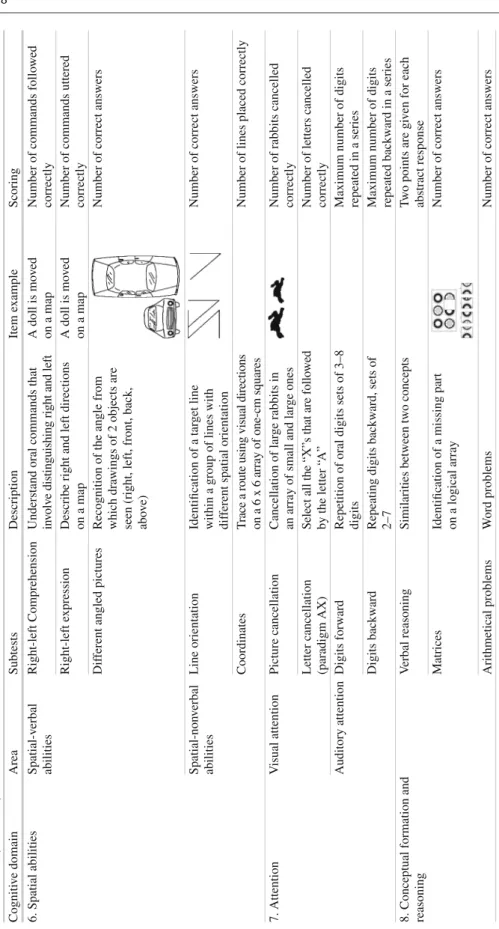
This battery was developed to assess Spanish-speaking children between 5 and 16 years of age. It includes nine neuropsychological domains: constructional abilities, memory (coding and delayed recall), sensory perception (visual, auditory, and tactile), oral language (repetition, expressive lan-guage, receptive language), metalinguistic awareness (awareness of phonemes, words, orthography), spatial abilities, attention, concept formation and reasoning, and executive functions. Descriptions of these tasks and examples of the items included are provided in Table 20.2 .
The ENI also contains items that assess three academic areas, reading, writing, and arithmetic, and includes a self-administered questionnaire designed to be answered by the child’s parents, or care-giver, which gathers personal data and the reasons for consultations. It also contains a structured questionnaire that inquires into the child’s developmental and clinical history. Finally, this battery provides an assessment of soft neurological signs.
Various types of validity and reliability indexes are reported, and inter-rater reliability coef fi cients for those ENI subtests that require a degree of interpretation were calculated. They ranged from 0.858 for written narrative coherence to 0.987 for complex fi gure recovery. These high coef fi cients of inter-rater reliability indicate that the standardized instruction presented in the ENI manual assures a consistent scoring of tests across examiners. Stability coef fi cients were also considered, using a retesting method with an average retest interval of 7.8 months and an average coef fi cient of 0.508.
The External Validity of the ENI was dif fi cult to obtain because there are so few neuropsychologi-cal batteries in Spanish. The Content Validity of some of the ENI subtests was probed using subtests from the WISC Escala de Inteligencia Wechsler para Niños (Wechsler, 1984 ) and the Batería
Woodcock Psicoeducativa en Español (Woodcock, 1982 ) . Correlations with the WISC subtests ranged from 0.54 to 0.69 (see the ENI manual for details). These rather low correlations are not unexpected because, in contrast to the WISC, the ENI is not an intelligence test and was not devel-oped under the g-factor theoretical construct. Higher correlations (range: 0.65–0.72) were found between the memory and perceptual subtests of the ENI and the corresponding tasks in the Batería (Matute et al., 2007 ) .
The ENI has been tested in diverse groups of children with neurodevelopmental disorders, such as dyslexia (De los Reyes Aragón et al., 2008 ) , dyscalculia (Rosselli & Matute, 2005 ; Rosselli, Matute, Pinto, & Ardila, 2006 ) , attention de fi cit hyperactivity disorder (ADHD, Ramos-Loyo, Michel Taracena, Sánchez-Loyo, Matute, & González-Garrido, 2011 ) , 15q overgrowth syndrome (Gutiérrez-Franco et al., 2010 ) , del(3) (p26) syndrome (Rivera, Domínguez, & Matute, 2006 ) ,
Table 20.1 Tests available in Spanish for the assessment of Hispanic children
Test name Original language Type of assessment Country of norms Age range (years) Evaluación
Neuropsicológica Infantil
Spanish Neuropsychological battery: memory; language; perception; attention; constructional, spatial, conceptual, and executive functions
Mexico, Colombia, USA 6–16
NEUROPSI Atencion y Memoria
Spanish Memory and attention battery
Mexico 6–85
CUMANIN Spanish Screening battery Spain 3–6
ECOFÓN Spanish Phonological awareness Mexico 7–11
LEE Spanish Reading and writing skills
Batería-R English Intelligence index,
cognitive abilities, and academic achievement
USA, Mexico, Puerto Rico, Costa Rica, Spain, Argentina, and Peru
2–90
WISC-IV English Intelligence IQ, perceptual reasoning index
USA, Mexico, Spain, and Argentina
6–16 Preschool language
scale
English and Spanish
Comprehension and expression
USA 2–6
Expressive one-word picture vocabulary test – Spanish-bilingual
English and Spanish
Vocabulary USA 4–12
Receptive one-word picture vocabulary test – Spanish-bilingual
English and Spanish
Receptive vocabulary USA 4–12
ROCF French Constructional, visual
perceptual integration, visuomotor
Table
20.2
Subtest description of the
Evaluación Neur opsicológica Infantil (ENI) Cogniti v e domain Area Subtests Description Item example Scoring
1. Constructional abilities
Stick construction
Mak
e 4 designs using toothpicks
T
w
o points for each
fi gure made correctly Graphic abilities Cop ying simple fi gures Cop y 6 simple fi gures T w
o points for each correct design
Dra
wing a human
fi gure Dra w a human fi
gure by command
T
otal body parts (i.e., head + e
yes + hair + …)
Cop
ying a comple
x fi gure Cop y a comple x geometrical fi gure T
otal number of elements dra
wn correctly 2. Memory V erbal coding W ord learning 9–12 w
ord list (animals, fruits, and
body parts) in four consecuti
v
e trials
T
otal number of w
ords in the 4
trials
Story recall
Recall of a story containing 15 story points
Number of story points recalled
V
isual coding
Figure learning
9–12 geometric
fi
gures in four
consecuti v e trials T
otal number of
fi
gures in the 4
trials V erbal 30-min delayed recall Delayed w ord recall Free recall W
ords are recalled
spontaneouly
T
otal number of w
ords
remem-bered for each recall condition
Cue recall
W
ords are recalled by
cate
gories (animals,
fruits, and body parts)
T
otal number of w
ords
remem-bered in the three cate
gories Recognition Recognition from a 18/24 w ord list
Number of w
ords identi
fi
ed
Delayed story recall
Story points recall of the story presented Story points are recalled spontaneously
Number of story points recalled
V isual 30-min delayed recall Delayed fi gure recall Free recall Figures are recalled spontaneouly
Number of designs dra
wn spontaneously Cue recall Recall of fi gures by cate gories (triangles,
squares, and circles)
T
otal of
fi
gures dra
wn in the three
cate gories Recognition Recognition of fi gures
from among 18/24 fi gures
Number
of
fi gures
identi fi ed
Delayed comple x fi gure recall Comple x fi gure dra wn spontaneously
Number of elements dra
Table 20.2
(continued)
3. Perceptual abilities
T
actile perception
Recognition of objects placed in each hand out of child’
s vie
w
Common objects are placed in each hand one by one Number of objects recognized by each hand
V isual perception Superimposed fi gures Recognition of 3 o v erlapping fi gures
Number of objects identi
fi ed in the 3 fi gures Blurry images
Recognition of photographs with increasing de
grees of clarity
T w
o points are gi
v
en when a
picture is recognized at the lo
west
de
gree of clarity
V
isual
closure
Identi fi cation
of incomplete dra wings Number of dra wings
identi fi ed
F
acial e
xpressions
Recognition of f
acial e
xpressions
Number of f
acial e
xpressions
identi fi ed
Object inte
gration
Inte
grate parts to mak
e up an object
Number of correct answers
Auditory perception
Musical notes
Same or dif
ferent decision on
recorded piano notes
8 pairs of notes are presented
Number of pairs identi
fi
ed as
same or dif
ferent
En
vironmental
sounds
Identi fi cation
of
en
vironmental
sounds presented on a tape recording
E.g., rooster
, frog, train,
etc.
Number of sounds identi
fi
ed
correctly
Phonemic perception
Decision on similarities and dif
ferences of pair of w
ords
E.g.,
dado-dedo,
quiso-guiso
Number of pairs correctly identi
fi
ed as same or dif
4. Oral language
Repetition
Repetition
Eight syllables presented orally one by one
E.g., bi, pro, clin
Number of syllables repeated correctly
Eight w
ords presented orally one by
one
E.g., sol, campana
Number of w
ords repeated
correctly
Nonw
ords presented orally
E.g., b
ul, f
ampina
Number of nonw
ords repeated
correctly
Sentences presented orally
Number of w
ords repeated
correctly
Expression
Naming
Name 15 objects that are presented on a card
Narrati v e coherence The e
xaminer reads a story
, and the
child must retell it
T
w
o measures are tak
en:
coherence de
gree and utterance
length
Comprehension
Images pointing
Point on command to 15 images of objects Number of objects pointed out correctly
Oral commands
F
ollo
w oral commands gi
v
en in
increasing order of dif
fi
culty
E.g., señala un a
vión azul
y un cohe v
erde
Discourse comprehension
Eight questions must be answered about a story presented pre
viously
Number of correct answers
5. Metalinguistic a
w
areness
Phonemic aw
areness
Phonemic blending
F
orming w
ords from oral spelling
(using the sound of the letters)
E.g.,/s/a/l/
Number of w
ords formed
correctly
Phoneme counting
Counting the phonemes in w
ords
E.g., brinco
Number of correct answers
Orthographic aw
areness
Spelling
Spelling of w
ords
Number of w
ords spelled correctly W ord a w areness W ord counting
Counting the w
ords in sentences
Number of correct answers
Table 20.2
(continued)
6. Spatial abilities
Spatial-v
erbal
abilities
Right-left Comprehension
Understand oral commands that inv
olv
e distinguishing right and left
A doll is mo
v
ed
on a map
Number of commands follo
wed
correctly
Right-left e
xpression
Describe right and left directions on a map
A doll is mo
v
ed
on a map
Number of commands uttered correctly
Dif
ferent angled pictures
Recognition of the angle from which dra
wings of 2 objects are
seen (right, left, front, back, abo
v
e)
Number of correct answers
Spatial-non v erbal abilities Line orientation Identi fi
cation of a tar
get line
within a group of lines with dif
ferent spatial orientation
Number of correct answers
Coordinates
T
race a route using visual directions
on a 6 x 6 array of one-cm squares
Number of lines placed correctly
7. Attention
V
isual attention
Picture cancellation
Cancellation of lar
ge rabbits in
an array of small and lar
ge ones
Number of rabbits cancelled correctly
Letter
cancellation
(paradigm AX)
Select all the “X”s that are follo
wed
by the letter “
A”
Number of letters cancelled correctly
Auditory attention
Digits forw
ard
Repetition of oral digits sets of 3–8 digits Maximum number of digits repeated in a series
Digits
backw
ard
Repeating digits backw
ard, sets of
2–7
Maximum number of digits repeated backw
ard in a series
8. Conceptual formation and reasoning
V
erbal
reasoning
S
imilarities between tw
o concepts
T
w
o points are gi
v
en for each
abstract response
Matrices
Identi fi cation
of
a
missing
part
on a logical array
Number of correct answers
Arithmetical problems
W
ord problems
Number of correct answers
9. Ex
ecuti
v
e functions
Fluenc
y
V
erbal
fl
uenc
y
Semantic: recall animals and fruits
Number of w
ords correctly uttered
in each cate
gory
Phonemic
fl
uenc
y: identify as man
y
w
ords as possible that be
gin with/m/
Number of correct w
ords
Graphic
fl uenc
y
Graphic
semantic:
dra
w
dif
ferent
meaningful
fi gures
Number of correct designs
Graphic non-semantic: dra
w
geometric
fi
gures with four lines that
connect 5 dots in a square in a 35-square matrix
Number of correct designs
Cogniti
v
e
fl e
xibility
Sorting cards
Cate
gorize sorting cards based on
color
, number
, and form
Number of correct answers, errors, failure to maintain the set, cate
gories completed, perse
v
er
-ance in responding
Planning
and
or
ganizing
Pyramid of Me
xico
The child must use three blocks to reproduce the requested construc- tions as quickly as possible with the minimum number of mo
v
es
T
otal number of correct
construc-tions, constructions performed with the minimum of mo
v
es,
number of mo
v
es in the correct
girls with congenital adrenal hyperplasia (Inozemtseva, Matute, & Juárez, 2008 ) , and children born to mothers with gestational diabetes (Bolaños, Ramírez, & Matute, 2007 ) . Table 20.3 com-pares the performance on seven memory subtests of 20 children with dyslexia, 17 with dyscalculia and dyslexia, 13 with dyscalculia, and 40 controls (adapted from Rosselli, Matute, Pinto, et al., 2006 ; Medrano, Matute, & Zarabozo, 2007 ). In this case, all children involved were monolingual Mexicans.
In typical Spanish-speaking pediatric populations, multivariate analyses of the ENI subtests have been conducted that include examining the interaction between scores and sociodemographic vari-ables (Matute et al., in press ; Pinto-Dussán, Aguilar-Mejía, & Gómez-Rojas, 2010 ; Rosselli, Ardila, Matute, & Inozemtseva, 2009 ) . Developmental age and gender patterns have been described in the general pro fi le of the ENI (Ardila, Rosselli, Matute, & Inozemtseva, 2011 ) and for speci fi c domains, such as memory, language (Inozemtseva et al., 2010 ) , reading (Canet-Juric, Urquijo, Richards, & Burin, 2009 ; González Reyes, Matute, Inozemtseva, Guajardo-Cárdenas, & Rosselli, 2011 ; Matute et al., 2008 ; Rosselli, Matute, & Ardila, 2006 ) , and executive functions (Ardila, Rosselli, Matute, & Guajardo, 2005 ; Matute, Rosselli, Ardila, & Morales, 2004 ) .
More recently, additional normative data for the ENI were collected from 108 bilingual Hispanics living in the states of Florida and Colorado. That sample was divided into fi ve age groups (5–6, 7–8, 9–10, 11–12, and 13–14 years). Analyses of these data showed that language ability scores were lower in the bilingual Hispanic children compared to the Mexican/Colombian children in the standardiza-tion sample, though nonverbal and executive funcstandardiza-tioning abilities were similar in the two groups. More speci fi cally, differences were evident in expressive language measures and in the metalinguistic awareness domain (Rosselli et al., 2010 ) . A post hoc comparison of this group with a monolingual Spanish-speaking group demonstrated differences in writing skills. Table 20.4 compares the means and standard deviations for this bilingual group ( N = 108) with a group of Mexican/Colombian ( N = 217) monolinguals selected from the standardization sample; the two groups were matched by age and educational level. No children in this sample suffered learning disabilities or neurological or psychiatric disorders. As these scores come from normally developed children from Mexico, Colombia, and the USA, they may prove useful in establishing the gold standard for comparisons of tests applied to monolingual Hispanic children with neurodevelopmental disabilities.
NEUROPSI Atención y Memoria (NEUROPSI Attention and Memory) (Ostrosky-Solis et al., 2003 )
This test was designed to assess orientation, attention and concentration, immediate and delayed verbal and visual memory, and executive functions, including working memory. The norms were obtained from 950 individuals in Mexico City, aged 6–85. The sample included 199 typically
Table 20.3 Means and standard deviations for the ENI memory subsets in three groups of atypically developed children and a matched control
Subtest Dyslexia DD DD and RD Control
N = 20 N = 13 N = 17 N = 20
M SD M SD M SD M SD
Digits forward 5.2 .95 5.3 1.2 5.0 1.2 5.7 .8
Digits backward 3.3 .73 3.6 .27 3.4 .3 5.1 .3
Sentence repetition 4.1 .58 4.9 .9 4.6 1.1 5.8 1.1
Word learning 30.5 6.83 32.5 3.7 30.9 5.1 32.5 4.1
Story recall 7.0 1.7 8.3 1.9 7.1 2.6 9.0 2.3
Naming 9.2 2.9 10.3 1.7 8.9 2.7 10.6 1.3
Visual memory 29.2 7.36 31.0 5.7 26.6 6.3 33.0 6.6
Table 20.4 Mean test scores and standard deviations (in parenthesis) in typically developed monolingual (Mono) and bilingual (Bi) groups in the different ENI subtests
Measures
Age groups
5–6 7–8 9–10 11–12 13–14
N = 44/17 N = 39/24 N = 40/25 N = 48/22 N = 46/13 Constructional abilities
Stick construction (8) Mono 2.2 (1.5) 4.1 (1.7) 5.0 (1.3) 5.5 (1.3) 5.4 (1.3) Bi 3.4 (1.8) 5.2 (1.9) 5.8 (1.5) 6.5 (1.4) 7.7 (0.4) Copying simple fi gure (8) Mono 5.4 (1.9) 7.7 (2.2) 8.5 (1.9) 9.4 (1.1) 10.0 (1.3)
Bi 5.8 (2.3) 7.7 (2.3) 9.2 (1.8) 9.7 (2.1) 10.6 (1.9) Drawing a human fi gure (20) Mono 11.2 (1.9) 12.9 (2.9) 13.5 (2.0) 14.1 (2.5) 15.6 (2.5) Bi 11.3 (2.7) 13.5 (3.4) 14.0 (2.5) 15.0 (2.4) 15.8 (1.9) Copying a complex fi gure (12/15) Mono 6.5 (2.6) 10.4 (1.6) 12.4 (2.3) 13.7 (1.5) 14.3 (0.7) Bi 7.2 (2.9) 8.8 (2.1) 12.1 (2.7) 13.6 (1.7) 13.3 (1.8) Verbal memory coding
Word learn (36/48) Mono 20.6 (6.1) 24.4 (4.8) 30.9 (6.7) 32.6 (6.8) 33.9 (6.1) Bi 17.5 (5.2) 20.6 (7.1) 27.5 (6.7) 28.6 (7.5) 31.3 (5.0) Story recall (15) Mono 4.2 (2.0) 7.4 (2.5) 8.4 (2.2) 8.9 (2.4) 9.9 (2.1)
Bi 3.1 (1.9) 5.2 (2.6) 6.2 (2.7) 7.7 (3.1) 9.5 (1.4) Visual memory coding
Visual learn (36/48) Mono 11.9 (5.0) 17.5 (7.5) 28.3 (8.9) 30.5 (10.9) 32.6 (8.3) Bi 11.9 (6.8) 18.2 (5.8) 27.0 (7.6) 29.4 (5.7) 32.5 (6.1) Verbal memory recall
Free recall (12) Mono 4.8 (2.2) 6.6 (1.4) 9.0 (1.9) 9.2 (2.2) 9.7 (2.1) Bi 3.7 (2.1) 5.2 (2.7) 7.9 (2.6) 8.0 (3.0) 8.6 (1.7) Cue recall (12) Mono 4.6 (2.5) 6.5 (1.9) 8.7 (2.1) 9.2 (2.4) 10.0 (2.0)
Bi 3.9 (2.2) 5.3 (1.9) 7.8 (2.6) 8.0 (2.9) 9.0 (1.3) Recognition (18/24) Mono 15.2 (3.0) 16.8 (1.3) 23.1 (1.2) 22.7 (2.0) 23.3 (1.4)
Bi 14.8 (2.4) 16.9 (1.4) 22.0 (1.9) 21.9 (2.7) 22.3 (1.2) Story recall (15) Mono 3.4 (2.2) 6.5 (2.7) 8.3 (2.3) 8.6 (2.3) 9.1 (2.3)
Bi 2.7 (1.7) 4.2 (2.4) 5.8 (2.5) 7.0 (3.7) 9.0 (2.4) Visual memory recall
Free recall (12) Mono 3.3 (2.1) 6.1 (2.0) 9.0 (2.4) 9.4 (2.5) 9.8 (2.3) Bi 4.0 (2.1) 5.7 (1.7) 7.7 (2.3) 8.7 (2.2) 9.7 (2.4) Cue recall (12) Mono 3.8 (2.3) 6.0 (2.2) 9.3 (2.0) 9.6 (2.5) 10.0 (2.2)
Bi 3.8 (2.4) 5.8 (1.9) 8.0 (3.7) 9.2 (1.5) 10.3 (1.8) Recognition (18/24) Mono 15.8 (2.7) 17.2 (1.6) 23.5 (1.4) 23.2 (1.6) 23.5 (1.1) Bi 16.4 (2.0) 18.2 (2.3) 23.0(1.7) 23.7 (0.6) 23.6 (0.6) Complex fi gure (12/15) Mono 3.5 (2.91) 8.1 (2.72) 9.1 (3.24) 10.8 (2.45) 11.7
(1.91) Bi 4.5 (3.40) 6.9 (3.21) 8.7 (2.96) 10.7 (2.65) 12.1
(2.06) Visual perception
Superimposed fi gures (16) Mono 7.2 (2.4) 9.9 (2.7) 12.2 (1.8) 12.6 (1.8) 13.7 (1.9) Bi 7.9 (2.2) 10.0 (2.0) 11.0 (1.9) 12.1 (2.4) 14.0 (1.4) Blurry images (10) Mono 5.4 (1.4) 6.0 (1.3) 6.5 (1.2) 7.2 (1.5) 7.7 (1.5)
Table 20.4 (continued)
Measures
Age groups
5–6 7–8 9–10 11–12 13–14
N = 44/17 N = 39/24 N = 40/25 N = 48/22 N = 46/13 Facial expressions (8) Mono 6.0 (1.3) 6.8 (1.1) 7.3 (0.8) 7.3 (0.9) 7.2 (0.9)
Bi 6.1 (1.2) 6.7 (1.2) 7.0 (1.2) 7.1 (1.0) 7.3 (1.1) Object integration (8) Mono 2.5 (1.4) 3.6 (1.4) 4.1 (1.5) 4.7 (1.6) 4.6 (1.7) Bi 2.2 (1.3) 3.2 (2.0) 3.8 (1.9) 4.7 (1.3) 5.7 (1.4) Auditory perception
Musical notes (8) Mono 4.4 (1.6) 4.3 (1.7) 5.1 (1.8) 5.7 (1.9) 5.9 (1.6) Bi 4.7 (2.3) 4.9 (1.6) 6.3 (1.6) 6.1 (1.8) 5.9 (1.8) Environmental sounds (8) Mono 4.3 (1.4) 5.2 (1.3) 6.0 (1.1) 6.1 (1.2) 6.5 (1.0) Bi 3.7 (1.5) 5.3 (1.2) 5.6 (1.3) 6.3 (0.8) 6.8 (1.1) Phonemic perception (20) Mono 17.3 (3.3) 18.8 (1.6) 19.3 (1.1) 19.3 (0.9) 19.5 (0.7)
Bi 16.5 (4.3) 18.3 (1.5) 18.6 (1.2) 17.9 (4.4) 18.2 (3.7) Oral language
Repetition
Syllables (8) Mono 6.2 (1.6) 6.9 (1.1) 7.5 (0.8) 7.2 (1.0) 7.4 (0.8) Bi 6.4 (1.9) 7.2 (1.2) 7.3 (0.85) 7.5 (0.6) 7.6 (0.4) Words (8) Mono 6.2 (1.2) 6.9 (1.4) 7.3 (0.8) 7.1 (1.2) 7.3 (0.8) Bi 6.9 (0.9) 7.1 (1.0) 7.5 (0.8) 7.3 (1.1) 7.9 (0.2) Nonwords (8) Mono 6.2 (1.2) 6.9 (1.4) 7.3 (0.8) 7.1 (1.2) 7.3 (0.8) Bi 6.9 (0.9) 7.1 (1.0) 7.5 (0.8) 7.3 (1.1) 7.9 (0.2) Sentences (8) Mono 3.8 (1.1) 4.8 (1.2) 5.8 (1.2) 6.1 (1.0) 6.4 (1.2) Bi 3.3 (1.3) 3.6 (0.6) 4.3 (1.1) 4.5 (1.2) 6.5 (1.3) Expression
Naming (15) Mono 7.0 (2.7) 8.8 (3.4) 11.1 (2.8) 11.7 (2.2) 12.3 (1.6) Bi 8.4 (2.4) 9.5 (3.1) 11.1 (2.7) 11.9 (1.7) 13.6 (1.1) Narrative coherence (7) Mono 1.6 (1.0) 3.1 (1.1) 4.2 (1.5) 4.7 (1.3) 5.1 (1.0)
Bi 1.6 (1.3) 3.1 (2.4) 3.3 (1.4) 4.5 (2.0) 6.0 (1.0) Utterance length ++ Mono 27.1 (27.4) 90.7 (76.4) 133.8 (61.6) 141.9 (59.6) 154.8
(2.2) Bi 20.9 (20.4) 57.1 (55.8) 66.2 (48.6) 87.3 (60.5) 116.8 (42.9) Comprehension
Image pointing (15) Mono 13.5 (2.1) 14.5 (1.4) 15.0 (0.0) 14.9 (0.3) 14.9 (0.2) Bi 13.0 (1.8) 13.95 (1.1) 14.5 (0.8) 14.8 (0.4) 14.9 (0.2) Following oral commands (10) Mono 7.7 (1.5) 9.0 (0.9) 9.4 (0.6) 9.5 (0.6) 9.7 (0.4)
Bi 7.9 (1.0) 8.3 (0.8) 9.0 (0.8) 9.5 (0.5) 9.9 (0.1) Discourse comprehension (8) Mono 3.1 (1.2) 4.2 (1.4) 5.3 (1.6) 5.7 (1.4) 6.4 (1.2) Bi 2.5 (1.6) 3.0 (1.5) 4.0 (1.0) 5.0 (2.0) 6.3 (1.1) Metalinguistic awareness+
Phonemic blending (8) Mono 0.8 (1.6) 2.9 (2.5) 3.7 (2.3) 4.7 (2.5) 5.1 (2.3) Bi 2.3 (2.1) 3.3 (2.4) 4.3 (1.8) 4.5 (2.1) 5.7 (2.0) Spelling ++ (8) Mono 1.0 (1.7) 5.0 (1.6) 6.0 (1.5) 6.6 (1.1) 7.3 (0.7) Bi 2.2 (2.1) 3.4 (1.8) 4.5 (1.3) 5.3 (1.6) 6.8 (1.4) Phoneme counting (8) Mono 1.5 (2.3) 5.8 (1.8) 6.6 (1.4) 6.6 (1.6) 7.1(1.0)
Table 20.4 (continued)
Measures
Age groups
5–6 7–8 9–10 11–12 13–14
N = 44/17 N = 39/24 N = 40/25 N = 48/22 N = 46/13 Verbal spatial abilities
Right-left comprehension (8) Mono 4.2 (2.2) 6.1 (1.6) 6.7 (1.2) 6.5 (1.5) 6.7 (1.0) Bi 2.7 (1.6) 3.9 (2.5) 5.2 (1.8) 6.0 (1.9) 7.6 (0.4) Right-left expression (8) Mono 3.3 (2.0) 5.9 (1.8) 6.9 (1.0) 6.8 (1.6) 7.2 (0.6) Bi 2.5 (1.8) 3.9 (2.4) 5.3 (2.6) 6.2 (2.2) 7.9 (0.2) Nonverbal spatial abilities
Different angled pictures (8) Mono 4.6 (2.4) 5.9 (2.1) 6.4 (2.3) 6.8 (1.6) 7.3 (1.6) Bi 4.0 (2.7) 5.0 (2.6) 6.6 (1.9) 6.8 (1.9) 7.6 (1.1) Line orientation (8) Mono 3.4 (2.2) 5.7 (1.4) 7.0 (1.3) 7.3 (0.9) 7.6 (0.6) Bi 2.4 (2.6) 5.8 (2.1) 6.0 (2.5) 7.2 (1.0) 7.9 (0.2) Nonverbal attention
Picture cancellation (44) Mono 10.4 (4.7) 16.6 (5.5) 24.0 (6.5) 28.3 (8.4) 34.0 (6.9) Bi 12.7 (5.6) 17.2 (4.8) 23.2 (7.4) 26.6 (12.6) 32.4
(13.3) Letter cancellation (82) Mono 11.1 (5.6) 17.3 (6.2) 26.3 (7.1) 31.8 (7.0) 40.9 (8.2)
Bi 10.8 (6.9) 19.1 (5.4) 31.4 (19.3) 29.8 (14.8) 38.9 (19.5) Verbal attention
Digits forward (8) Mono 4.1 (1.3) 5.1 (0.9) 5.6 (1.1) 5.8 (0.9) 6.1 (1.1) Bi 3.7 (1.7) 3.8 (1.0) 4.0 (1.8) 4.6 (1.0) 5.0 (2.3) Digits backward (7) Mono 1.8 (1.2) 3.3 (0.9) 3.9 (0.9) 3.9 (0.9) 4.4 (1.3) Bi 2.3 (1.2) 2.8 (0.7) 3.3 (1.6) 3.5 (1.2) 3.7 (2.6) Concept formation
Similarities (16) Mono 3.9 (2.2) 5.7 (2.5) 7.6 (2.1) 8.5 (2.5) 10.3 (2.3) Bi 3.4 (2.5) 5.3 (2.3) 6.6 (3.3) 9.1 (2.6) 12.1 (1.5) Matrices (8) Mono 1.9 (1.7) 3.5 (1.74) 4.6 (2.1) 5.2 (2.3) 5.6 (1.61) Bi 1.91 (1.3) 2.5 (1.9) 4.2 (2.7) 5.4 (2.0) 7.1 (0.8) Arithmetical problems (8) Mono 1.1 (1.0) 3.3 (1.2) 4.6 (1.4) 5.1 (1.3) 5.5 (1.1) Bi 0.8 (0.8) 2.9 (1.2) 4.0 (1.5) 5.0 (1.2) 7.7 (0.9) Executive functioning
Verbal fl uency
Semantic fl uency (fruits) Mono 7.0 (2.7) 9.3 (2.2) 11.4 (3.0) 13.2 (2.7) 14.5 (2.2) Bi 5.8 (2.4) 6.3 (2.8) 8.2 (2.7) 9.4 (2.3) 13.2 (2.9) Semantic fl uency (animals) Mono 9.3 (3.5) 12.8 (4.2) 15.6 (3.9) 16.2 (4.4) 19.4 (3.7) Bi 9.0 (3.6) 10.4 (3.9) 13.0 (3.8) 13.9 (4.4) 17.0 (3.2) Phonemic fl uency Mono 2.5 (2.2) 6.1 (3.1) 7.5 (3.3) 9.5 (2.8) 11.4 (3.0) Bi 3.7 (2.1) 4.8 (2.7) 5.9 (1.8) 8.1 (4.7) 10.0 (3.9) Nonverbal fl uency
Graphic semantic fl uency (35) Mono 9.0 (3.5) 11.4 (4.5) 17.1 (6.2) 17.9 (6.7) 21.7 (5.9) Bi 7.6 (4.3) 10.0 (4.0) 10.2 (3.8) 12.5 (8.3) 15.5 (4.8) Graphic non-semantic (35) Mono 3.3 (2.8) 5.5 (3.9) 10.4 (5.4) 11.4 (5.5) 13.4 (5.8) Bi 3.0 (2.9) 5.6 (3.7) 6.8 (4.7) 10.1 (5.7) 10.8 (5.4) Cognitive fl exibility
Card-sorting errors Mono 25.8 (5.6) 16.9 (8.9) 15.0 (7.8) 11.4 (7.3) 11.0 (6.4) Bi 23.6 (7.2) 16.3 (7.7) 16.3 (10.6) 10.0 (6.3) 8.3 (3.5)
developed children divided into fi ve age groups: 6–7, 8–9, 10–11, 12–13, and 14–15 years (Ostrosky-Solis et al., 2007 ) . The manual includes standard scores for each age group – mean = 100, standard deviation of 15 – for three domains: (1) attention and executive function, (2) memory, and (3) attention and memory. Additionally, scaled scores are provided for each task with a mean of 10 and a standard deviation of 3. The pro fi le that can be generated shows strong and weak areas. Table 20.5 presents the means and standard deviations for the different subtests of the NEUROPSI Attention and Memory battery across three age groups (adapted from Ostrosky-Solis et al., 2007 ) . These data are especially useful when testing monolingual Spanish children.
Factor analysis revealed a total of 6 factors: Factor I included the category formation test, visual search, semantic and phonological verbal fl uency, and design fl uency; Factor II contained the following tasks: logic memory, immediate and delayed recall, immediate and delayed recall of verbal paired associates, and motor functions; Factor III involved word list encoding, word list free recall, word list cue recall, and a word list recognition trial; Factor IV utilized items that assess time orientation, digit detection, mental control, and immediate and delayed faces recall; Factor V employed digit forward span, digit backward span, spatial forward span, and spatial backward span; and, fi nally, Factor VI focused on place and person orientation. With regard to age effects on children, the age ranges at which the highest performance level was reached varied across factors: the fi rst areas to mature were related to memory functions (Factors II and III), at 6–7 or 8–9 years. The highest performance for functions tested in Factors IV and V was attained at 10–11 years. The last area to reach the highest performance level was related to Factor I, at 14–15 years (Ostrosky-Solis et al., 2007 ) .
The validity of the NEUROPSI Attention and Memory in screening for attention problems was tested in 61 6–10-year-old children previously diagnosed with ADHD (Flores, 2009 ) . This atten-tion and memory battery has also been used to assess children/adolescents with cerebral palsy ranging in age from 5 to 18. Signi fi cant variations in attention/memory scores appeared in children with different subtypes of cerebral palsy: those with the athetosis type performed better, followed by the mixed group and, fi nally, the spastic group, which underperformed the other two (Ramírez-Flores & Ostrosky-Solís, 2009 ) .
Cuestionario de Madurez Neuropsicológica Infantil – CUMANIN (Child Neuropsychological Maturity Questionnaire – Portellano Pérez, Mateos Mateos, Martínez Arias, Tapia Pavón, & Granados García-Tenorio, 2000 )
CUMANIN was developed to assess neuropsychological development in children aged 3–6.5 years (36–78 months). Tasks are grouped in 13 scales: gross and fi ne motor skills, repetition, expressive language, receptive language, spatial abilities, visuoperception, visual memory, rhythm, verbal fl uency, attention, laterality (hand, eye, foot), reading, and spelling. The last two are used only with children over 61 months. CUMANIN was developed in Spain and normed on a sample of 803 Spanish children, 51% males and 49% females. Preliminary studies with special populations have been
con-Table 20.4 (continued)
Measures
Age groups
5–6 7–8 9–10 11–12 13–14
N = 44/17 N = 39/24 N = 40/25 N = 48/22 N = 46/13 Card-sorting categories Mono 1.1 (0.7) 2.2 (0.9) 2.2 (0.8) 2.5 (0.7) 2.5 (0.5)
Bi 1.6 (0.8) 2.1 (0.9) 1.9 (0.9) 2.7 (0.5) 2.8 (0.6) Pyramid of Mexico correct Mono 8.2 (2.7) 9.9 (2.3) 10.7 (0.6) 10.7 (0.5) 10.6 (0.6)
Table 20.5 Means and (standard deviations) for the NEUROPSI Attention and Memory subsets in three groups of typically developed Mexican children (Maximum scores are in parenthesis)
6–9 10–13 14–15
n = 68 n = 80 n = 25
Orientation Time (4) 3.2(0.9) 3.2(0.9) 3.9(0.3)
Place (2) 1.8(0.45) 2.0(0.15) 2.0(0.0)
Person (1) 1(0.0) 1.0(0.0) 1.0(0.0)
Attention and concentrations
Digit forward span (9) 4.65(0.85) 5.5(0.9) 5.8(1.0)
Digit detection (10) 5.1(1.6) 8.85(1.15) 9.3(0.9)
Mental control (3) 1.05(1.3) 1.55(1.25) 1.7(1.3)
Spatial forward span (9) 4.8(0.9) 5.5(0.9) 5.8(1.0)
Visual search (24) 11.55(4.4) 15.65(3.85) 18.0(3.2)
Executive functions Category formation test (25) 13.5(4.45) 16.5(4.2) 17.6(5.6) Semantic verbal fl uency 14.6(4.5) 17.5(3.45) 19.7(4.3) Phonological verbal fl uency 8.1(2.5) 11.35(3.25) 15.0(6.0)
Design fl uency (35) 8.0(3.6) 12.35(4.45) 15.7(6.3)
Motor functions (20) 17.4(2.15) 18.65(1.25) 19.1(1.1)
Stroop (time) 67.7(21.7) 47.35(11.95) 36.8(15.0)
Stroop (correct) 32.4(4.15) 34.5(1.6) 35.1(1.6)
Working memory Digit backward span (8) 3.05(0.8) 3.75(0.85) 3.9(0.9)
Spatial backward span (8) 4.05(0.9) 5.0(0.85) 5.4(1.0)
Immediate memory Word list (12) 5.95(1.55) 7.0(1.4) 7.5(1.6)
Verbal paired associates (12) 7.05(2.25) 8.6(2.0) 8.2(1.5)
Logical memory (16) 6.85(2.7) 9.1(2.15) 9.9(2.6)
Rey-Osterreith Complex Figure (36) 27.8(5.0) 31.5(4.15) 34.4(2.8)
Faces (4) 2.61(1.0) 3.45(0.8) 3.6(0.7)
Delayed memory Word list (free recall) (12) 6.35(1.95) 7.85(1.8) 8.1(2.2)
Word list (cued recall) (12) 6.35(1.8) 8.05(1.75) 8.2(1.9) Word list (recognition) (12) 9.7(1.8) 10.65(1.55) 10.2(2.2) Verbal paired associates (12) 8.45(2.45) 10.15(1.95) 10.2(1.8)
Logical memory (16) 6.3(2.6) 8.6(2.1) 9.6(2.5)
Rey-Osterreith Complex Figure (36) 16.9(5.9) 20.2(5.65) 24.6(5.4)
Faces (2) 0.9(1.05) 1.3(1.0) 1.4(0.8)
ducted with low-birth-weight children, youngsters with Down’s syndrome, and learning-disabled children, all in Spain. This instrument was also adapted for use in Chile with a sample of 243 infants aged 36–72 months at private and public educational institutions (Urzua, Ramos, Alday, & Alquinta, 2010 ) and a group of two hundred and sixty-one 43–78-month-old urban children in Lima, Peru (Guerrero Leiva, 2011 ) .
Reading and Writing Tests
Evaluación de la conciencia fonológica (ECOFÓN – Phonological Awareness Assessment)
This metalinguistic awareness test was standardized using a sample of 119 children (50% males) from private and public schools in Guadalajara, Mexico. All children had scores ³ 50 on the Raven Matrices. Reliability was veri fi ed by analyzing test-retest stability. Norms are provided according to age or school grade. ECOFÓN has been shown to be useful in detecting children with reading dif fi culties, as the performances achieved on this battery and in reading tests correlated signi fi cantly (Montiel & Matute, 2007 ) .
LEE. Test de Lectura y Escritura en Español (LEE. Spanish Reading and Writing Test) (De fi or et al., 2006 )
The aim of LEE is to assess reading and writing abilities in relation to expected achievement levels according to school grade. A qualitative analysis makes it possible to detect the error type, attain a precise diagnosis, and develop therapy programs. Nine tests are included: phonemic segmentation, reading letters, reading words, reading pseudowords, word and phrase comprehension, prosody, text comprehension, writing words, and writing pseudowords. Norms were obtained from a representative sample of 400 schoolchildren enrolled in the fi rst to fourth grades of primary school at public and private institutions in Buenos Aires, Argentina, and Granada, Spain. Norms are provided separately for each country. Two types of validity were considered: (1) convergent and (2) discriminating. The test showed appropriate internal consistency according to the split and test-retest stability methods.
Tests Translated to Spanish and Normed Outside the USA
Test Batteries
Batería Woodcock-Muñoz-Revisada (Batería-R) (Woodcock & Munoz, 1998 )
The Batería-R is the Spanish version of the Woodcock-Johnson Psychoeducational Battery-Revised (WJ-R) and is composed of the Batería Woodcock-Munoz pruebas de habilidad cognitiva-revisada (Batería-R COG – cognitive battery) and the Batería Woodcock-Munoz pruebas de
aprovechamiento-revisada (Batería-R APR –achievement battery). The cognitive battery includes 21 memory tests for
names, memory for sentences, visual matching, incomplete words, visual closure, picture vocabulary, analysis-synthesis, visual auditory learning, memory for words, cross out, sound blending, picture recognition, oral vocabulary, concept formation, delayed recall for names, delayed recall-visual-audi-tory learning, numbers reversed, sound patterns, spatial relations, listening comprehension, and verbal analogies. The achievement battery includes eighteen subtests: letter-word identi fi cation, passage comprehension, calculation, applied problems, dictation, writing samples, science, social studies, humanities, word attack, reading vocabulary, quantitative concepts, proofreading, writing fl uency, punctuation, spelling, usage, and handwriting.
The cognitive items are clustered in 4 groups: broad cognitive ability, cognitive factors, scholastic aptitude, and oral language. Cognitive ability represents the Horn–Cattell theory of intelligence (g) and measures different domains of general intelligence, such as fl uid reasoning (Gf), comprehensive knowledge (Gc), visual processing (Gv), auditory processing (Ga), processing speed (Gs), long-term retrieval (Glr), and, fi nally, short-term retrieval (Gsm). The achievement battery is clustered into basic and broad reading, reading comprehension, mathematical abilities (basic and reasoning), writing abil-ities, general knowledge, and skills. Woodcock and Munoz-Sandoval ( 2001 ) suggest that the Batería-R can provide useful information for neuropsychological assessments as it evaluates aspects of different processes, running from basic (i.e., attention) to more complex ones (i.e., reasoning to problem solving).
Peru) and fi ve US states (Arizona, California, Florida, New York, Texas). Norms on the Batería-R were “equated” with the WJ-R through item response theory. Speci fi cally, where subtest items had nonverbal content, norms from the WJ-R were used, whereas when subtests used verbal prompts and required verbal responses, items were translated from English to Spanish by native Spanish speakers from several countries, all of whom adopted an iterative cross-checking process until a consensus was reached. The new items that emerged in Spanish were integrated into the item dif fi culty rankings of the existing English items.
All items (those translated from English plus new items developed in Spanish) were recalibrated with a sample of 2,000 Spanish-speaking individuals. The external validity of the cognitive battery in English has shown a high correlation (0.64) with the WAIS-R Full-Scale IQ, though external validity with the WISC or any one of the Spanish versions of this intelligence test has been reported.
Both strengths and weaknesses have been observed in the Batería-R. The major strength is that it is one of the most comprehensive, adequately validated, and normed intelligence test available for use with Spanish speakers in several Latin America countries and the USA (Schrauf & Navarro, 2005 ) . However, questions have been raised as to just how suitable the Batería-R norms (obtained largely outside the USA) are for Hispanic-American children, many of whom are better characterized as bilingual. The high number of verbal subtests compared to the low number of nonverbal tasks in the Batería-R is another limitation on the cognitive assessment of children with learning disabilities, especially those affected by visuospatial defects. The fi nal weakness of this battery is the lack of vali-dation of its nonverbal tests in the Spanish sample, which was based on the erroneous assumption that visuospatial and nonverbal tests are culturally and educationally fair or at least fairer than verbal tests, a supposition that has since been refuted (see Rosselli & Ardila, 2003 for a review).
Wechsler Intelligence Scale for Children (WISC-IV, Wechsler, 2004 )
This battery aims to assess intellectual abilities in children and adolescents aged 6–16. It provides a full IQ score plus scores on four indexes: verbal comprehension, perceptual reasoning, working mem-ory, and processing speed. Compared to the WISC-III, it places less emphasis on crystallized knowl-edge (Information is now a supplemental test to the full IQ score) by accentuating the contribution of fl uid reasoning (matrix reasoning, picture concepts), working memory (letter-number sequencing), and processing speed (coding and symbol search). Whereas the WISC-IV FSIQ is comprised of sub-tests that encompass these four index scores, the earlier WISC-III FSIQ included only one measure of processing speed and one of working memory. Also, the WISC-IV maintains ten subtests from the WISC-III while adding fi ve additional ones (picture concepts, letters and numbers, symbol search, word reasoning, cancellation). The WISC-FSIQ scores allow the evaluator to assign the child’s scores to intellectual groups that range from very high (gifted) to very low (mentally retarded). Also, pattern analyses have helped clinicians characterize the cognitive pro fi les of children with developmental disorders.
The WISC-IV Spanish edition was translated from English and adapted to Spanish taking into consideration cultural issues. A panel of scholars that included native Spanish speakers worked together to minimize the dialectic and regional differences that exist among the various Hispanic nations that were to be included in the standardization sample. The resulting scores were equated to the WISC-IV norms so that Hispanic children could be measured and compared to English norms.
WISC-IV are available for Mexican (Wechsler, 2007 ) , Argentinean (Wechsler, 2010 ) , and Spanish (Wechsler, 2005 ) children. The Mexican standardization was performed on a sample of 1,234 children and adolescents from urban and rural areas in 11 states. The norms of the Argentinean WISC-IV are from a sample group based in Buenos Aires. Finally, the Spanish standardization (in Spain) was con-ducted with a sample of 1,590 children and adolescents representative of that country’s population.
Few studies have addressed the use of the WISC-IV in learning disabilities. Recently, for example, De Clercq-Quaegebeur et al. ( 2010 ) found that the working memory index of the WISC-IV in French is de fi cient in tests on children with dyslexia compared to the other three indexes (verbal comprehen-sion, perceptual reasoning, and processing speed). Those authors found marked de fi ciencies in the digit span and letter-number sequence tasks and, though to a lesser degree, also in coding. San Miguel Montes, Allen, Puente, and Neblina ( 2010 ) , meanwhile, found that the WISC-IV Spanish letter-number sequencing subtest successfully distinguished 35 Puerto Rican children with neurological dys-function – including nine with different types of learning disabilities – from a normal control group. These results suggest that the inclusion of a WM index in IQ tests has made this assessment tool more suitable for the evaluation of learning disabilities, although additional research is required.
Language
Preschool Language Scale – Fourth Edition Spanish – PLS-4 (Zimmerman, Steiner, & Pond, 2002 )
The Preschool Language Scale – Fourth Edition Spanish – PLS-4 is an individually administered test used to identify monolingual or bilingual Spanish-speaking children who have a language disorder or delay (Zimmerman et al., 2002 ) . It is not a translation of the English version; instead, the test tasks and sub-items of both versions were codeveloped. PLS-4 Spanish is composed of two scales: auditory comprehension and expressive communication, together with a total language score. The test includes three supplemental assessments: a language sample checklist, the articulation screener, and the caregiver questionnaire.
The sample was formed according to the Hispanic population as it is portrayed in the US Census. The PLS-4 Spanish standardization sample included 1,188 children (613 female, 575 male), aged 2 days to 6 years and 11 months. The caregiver’s education level was used as an SES indicator. Four groups based on years of schooling were considered: (1) 0–11 years, (2) 12 years (diploma or GED), (3) 1–3 years of college or technical school, and (4) 4 years or more of college. The sample included children from different countries of origin according to the Spanish dialect spoken in their house-holds; 81.2% were from Mexico. Also, 61 children in the sample reported previously identi fi ed developmental conditions or having received earlier diagnoses. Exposure to Spanish was also con-sidered during sample selection. The reliability of PLS-4 Spanish was estimated using test-retest reliability, internal consistency, and inter-rater reliability.
Expressive One-Word Picture Vocabulary Test – Spanish-Bilingual Edition (Brownell, 2001a)
Receptive One-Word Picture Vocabulary Test – Spanish-Bilingual Edition (Brownell, 2001b )
The Receptive One-Word Picture Vocabulary Test – Spanish-Bilingual Edition (ROWPVT-SBE) is also administered individually. It is intended for use with children who speak Spanish and English at varying levels of pro fi ciency. The ROWPVT-SBE is an adaptation of the Receptive One-Word Picture Vocabulary Test (ROWPVT; Brownell, 2000 ) . The EOWPVT-SBE and ROWPVT-SBE were co-normed. Standard scores, con fi dence intervals, percentile ranks, and age equivalents are all given. Three types of validity were considered: (1) content validity, (2) criterion-related validity, and (3) construct validity. Reliability was analyzed by considering internal consistency and tempo-ral stability. As with the EOWPVT-SBE, the ROWPVT-SBE was also tested on four exceptional groups: (1) mentally retarded, (2) expressive/receptive language disorder, (3) learning disabled, and (4) articulation disorder. Only the latter group showed no differences when compared to a group of typical children.
Nonverbal Test with Norms for Spanish-Speaking Children
Rey-Osterrieth Complex Figure (ROCF)
This test is one of the most common neuropsychology instruments used to assess constructional abilities, visual perceptual organization, and visual memory. The test includes two complex fi gures: the standard complex fi gure with 18 perceptual units and a maximum score of 36 and a simpler complex fi gure that has only nine perceptual units and a maximum score of 18. The standard ROCF is commonly used with adults and children over 8, whereas the second is appropriate for younger children, ages 4–8 (Galindo & Cortes, 2003 ) . Normative data for Spanish-speaking children are available for both types of tests.
Galindo and Cortes ( 2003 ) administered the standard ROCF to 2,250 Mexican children ranging in age from 8 to 15 years (50% females). The administration procedure was of the standard “copy every-thing you see on the card” type, with a 3-min immediate recall: “on this blank paper draw everyevery-thing you can remember from the fi gure you just copied.” Rosselli and Ardila ( 2003 ) followed a similar procedure to obtain norms from a sample of 233 Colombian children aged 5–12. No gender effects were seen. A summary of the results from these two studies appears in Table 20.6 . The results from the Colombia sample are higher than those reported for the Mexican group, a fi nding that may be due to the fact that half of the Colombian sample came from a high SES group, whereas the Mexican sample was probably a more homogeneous mid-SES group. The means and standard deviations by age range and SES group are presented in Ardila and Rosselli ( 2003 ) .
Norms for the Spanish population on the simpler version of ROCF are available in Rey ( 1997 ) . Also, Galindo and Cortes ( 2003 ) provide norms for this ROCF for younger children in a sample of 750 Mexicans aged 4–8 years. The means for copying/memory the fi gure at ages 4, 5, 6, 7, and 8 are 5.8/3.63 (sd = 2.9/2.13), 8.6/6.4 (sd = 2.2/2.3), 9.9/7.2 (sd = 2.2/2.4), 11.3/8.2 (1.9/2.3), and 11.8/8.8 (sd = 1.7/2.2), respectively.
Table 20.6 Comparison of the performance of two groups of Latin American children on the ROCF
Colombian sample (Ardila & Rosselli, 2003 ) Mexican sample (Galindo & Cortes, 2003 ) Age group Copy Immediate recall ratio Age group Copy 3-min recall ratio
5–6 14.5 (7.9) 8.4 (6.2) 57% – – –
Table 20.7 Other tests available in Spanish. Most of them are English translations
Global cognitive assessment
AMPE-F Aptitudes Mentales Primarias Equivalente. Secadas, F. (1989). Madrid: TEA Ediciones BTI Batería TEA Inicial. García, J.E. Arribas, D. Uriel, E. J. (2006). Madrid: TEA Ediciones DAS Escala de Aptitudes Diferenciadas Elliot (1990)
Escala de Alexander. ALEXANDER, W.P. (1978). Madrid: TEA Ediciones
K-ABC Batería de evaluación de Kaufman para niños. Kaufman, A. y Kaufman, N. (1997). Madrid: TEA Ediciones MSCA Escalas McCarthy de Aptitudes y Psicomotricidad para niños. McCarthy, D. (1996). Madrid: TEA Ediciones Intelligence
K-BIT Test breve de inteligencia de Kaufman, 4 a 90 años. Kaufman, A. y Kaufman N. (1990) Madrid: TEA Ediciones TIG Test de inteligencia general (S. dominós) Formas 1 y 2 (10 y 14)C/U. Cordero, A. (1994) Madrid: Estudios TEA Laterality
HPL Test de homogeneidad y preferencia lateral de 4–10 años. Gómez Castro, J. L. y Ortega López, M. J. Madrid: TEA Ediciones
Language
ITPA Test Illinois de aptitudes psicolingüísticas. Kirk S.A., McCarthy J.J., Kirk W.K. (1989) 2da. Edicion. Madrid: TEA Ediciones
BLOC, Batería del Lenguaje Objetivo y Criterial. Puyuelo, M., Wiig, E., Renom, J. y Solanas, A. (1997). Barcelona: Masson, S.A
CDI – Inventarios MacArthur-Bates del Desarrollo de Habilidades Comunicativas. Jackson-Maldonado D., Thal, D. J., Fenson, L., Marchman, V. A., Newton, T. et al., (2005) . México: Manual Moderno
Attention
AGL, Atención Global Local. Blanca, M.J., Zalabardo, C., Rando,B., López-Montiel D., y Luna R. (2005). Madrid: TEA Ediciones
Escala de Connners. Conner, K. (1997) New York: Multi-Health Systems, Inc.
EDAH Evaluación del trastornos por dé fi cit de atención con hiperactividad. Farré-Riba, A. y Narbona, J. (2003) Madrid: TEA Ediciones
Smith, A. (2002). SDMT Test de símbolos y dígitos . Madrid, España, TEA Ediciones S.A. (Spain norms) Reading and writing
EDAF Evaluación de la discriminación auditiva y fonológica. Brancal, M., Ferrer, A., Alcantud, F. y Quiroga, M. (1998) Barcelona: Lebón
ECL Evaluación de la comprensión lectora de 6 a 9 años. Cruz, M. V. (1999) Madrid: TEA Ediciones
PROLEC Batería de Evaluación de los Procesos Lectores de los Niños de Educación Primaria. Cuetos, F., Rodríguez, B., y Ruano, E.(1996). Madrid, Spain: TEA Ediciones
Recommendations
Neuropsychological assessment of Hispanic children with possible learning and communication disorders is complex and requires not just a solid background in the neurometrics of cognitive devel-opmental disorders, but also an understanding of cross-cultural issues of assessment. Tests should be selected on the basis of the children’s cultural background. Tests developed in Spanish are best employed to assess monolingual Hispanic children or those who recently immigrated to the USA but whose preferred language is still Spanish. Bilingual children should be assessed by a bilingual examiner, and responses in both languages should be accepted when calculating verbal scores; also, whenever available, norms determined for bilingual populations should be used. Tests in Spanish that are simple translations of earlier English instruments must be interpreted with great care, since the act of translating by no means rules out cultural bias (Table 20.7 ). Finally, it is important to note that Hispanic children with emerging bilingualism and blended cultural backgrounds are usually not included in norm samples and, therefore, tend not to be represented in most US standardizations.