www.medigraphic.com
O
R
I
G
I
N
A
L
A
R
T
I
C
L
E
Corresponding author: Jorge A. Pinto. E-mail: [email protected] Date of reception: 23-02-2009. Date of acceptation: 24-03-2009.
Quality of life of HIV-infected children in Brazil
Calidad de vida de niños infectados con VIH en Brasil
Lílian O. Diniz, Jorge A. Pinto
Institutional Affiliation: HIV/AIDS Maternal, Adolescent and Infant Group, School of Medicine, Federal University of Minas Gerais, Belo Horizonte, Brazil.
Resumen
Introducción. La calidad de vida (QoL) es una consideración importante en el manejo de enfermedades progresivas crónicas como el síndrome de inmunodeficiencia adquirida (SIDA). Pro-porciona la oportunidad de entender el efecto de la enfermedad y el tratamiento en el impacto del funcionamiento físico, psico-lógico y social. En este estudio se evalúa la QoL de niños infec-tados con virus de inmunodeficiencia humana y la asociación entre QoL y células CD4+, carga viral, estadio clínico y trata-miento antirretroviral (TAR).
Métodos. La QoL fue medida por el instrumento Evaluación de Salud General para Niños (General Health Assessment for Children, GHAC) desarrollada por PACTG 219, el cual examina dominios de percepción de la salud, estatus funcional, función social y el rol en la misma, así como utilización de servicios de salud, síntomas y eventos asociados. Los niños fueron clasificados en grupos de acuer-do a su categoría de SIDA, carga viral, células CD4 y TAR.
Resultados. Se evaluaron 174 niños y adolescentes. Se obtu-vieron buenos puntajes en todos los dominios. No se observaron diferencias en los puntajes de QoL entre pacientes en diferentes categorías de SIDA. Los pacientes con mayor porcentaje de cé-lulas CD4+ tuvieron mejor QoL en los dominios de percepción de la salud y síntomas. No hubo asociación entre TAR y QoL. Los pacientes que recibieron el tratamiento antirretroviral alta-mente activo (TARAA) mostraron similares puntajes de QoL en comparación con aquellos sin TARAA.
Conclusión. Los niños con virus de inmunodeficiencia hu-mana obtuvieron elevados puntajes en todos los dominios de QoL, células CD4 y carga viral, presentando asociación positiva con algunos de los dominios evaluados. El TARAA fue capaz de
Summary
Introduction. Quality of life (QoL) is an important consideration in the management of chronic progressive illnesses such as ac-quired immunodeficiency syndrome (AIDS). It provides the opportunity to understand the effects of disease and treatment to include their impact on physical, psychological and social functioning. We evaluated the QoL of HIV-infected children and established the association between QoL and CD4 cell counts, viral load, clinical status and antiretroviral therapy (ART).
Methods. QoL was assessed by the General Health Assess-ment for Children developed for PACTG 219 and examined domains of health perceptions, functional status, social and role functioning, health care utilization, symptoms and associated events. Children were divided into groups according to their AIDS status, viral load, CD4 and ART.
Results. One hundred seventy four children and adolescents were evaluated. Good scores were obtained in all domains. No difference was found in QoL scores among patients with different AIDS status. Patients with higher CD4 cell percentages had bet-ter QoL in health perceptions and symptoms domains. Low viral load was related to better QoL in social and role functioning. No relationship was found between ART and QoL. Patients receiv-ing highly active antiretroviral therapy (HAART) showed simi-lar QoL scores in comparison with those without HAART.
www.medigraphic.com
Key words. Quality of life; HIV, pediatrics; acquired
immuno-deficiency syndrome. proporcionar similar QoL, comparado a otros grupos de trata-miento, indicando un balance entre beneficios clínicos y even-tos adversos de la terapia.
Palabras clave. Calidad de vida; virus de inmunodeficiencia humana, pediatría; síndrome de inmunodeficiencia adquirida.
Introduction
Acquired immunodeficiency syndrome (AIDS) is a viral disease that leads to immune suppression. When it was first described, the disease was fatal, acute and had limited therapeutic options. After 26 years, researches resulted in discovery of new drugs that associated, could limit viral replication and improve patient’s immune response. Actually it is possible to live better and longer with no man-ifestations of this disease or its associated oppor-tunistic infections. AIDS has turned to be a chro-nic disease with better life expectancy.
Health related quality of life (QoL) has been an important concern between professionals deal-ing with human immunodeficiency virus (HIV) patients. As life expectancy increases, little is known about the real benefits that can occur in patient’s QoL. It has been enthusiastically used by clinicians and researches. It is not a new concept, but in the last years has gained importance be-cause of great medical advances in technology that can influence positively patient’s well being.1
There is no agreement about the better defini-tion of QoL. Some studies describe it as health, environment, financial structure, relationships, time to work and leisure. In medical literature it has been associated to satisfaction, well being, happiness, sense of life, functional status and so-cial adjustment.1,2 Patients living with chronic dis-ease use to associate QoL to good relationships, safety, recreation activities, independency and capability of taking care of their selves.3,4 The World Health Organization defines QoL as men-tal and social well being.1
Disease and treatment impact on health relat-ed QoL must be studirelat-ed better. Highly active an-tiretroviral therapy (HAART) has been
responsi-ble for good results obtained in clinical and labo-ratory exams of patients living with the HIV, but little is known about its influence in QoL. Better life expectancy is sometimes confronted with ad-verse effects of these drugs. In children and ado-lescents it has an important influence because their immune system is still developing.5
Today, viral load and CD4 T lymphocytes count have been used as signals of disease pro-gression but there are feel studies that point to its relation to changes in patient’s QoL. Some stu-dies show that the relationship between these as-pects is not frequently explained.6
We studied the health related QoL of HIV chil-dren followed at a Reference Center for Treatment of Infectious Disease (CTR- Orestes Diniz, Feder-al University of Minas Gerais) in Belo Horizonte, Brazil. The aim of this study was to investigate the relationship between QoL, CD4 T lymphocyte counts, viral loads, AIDS status and antiretrovi-ral therapy (ART) with special emphasis on HAART.
Methods
www.medigraphic.com
obtained every three months. All thisinforma-tion was extracted from patient’s chart at the day of interview. Patients were classified according to the following variables: 1. CDC/94 clinical classification: a) N + A (no symptoms or mild symptoms), b) B (moderate disease), c) C (ad-vanced disease); 2. CD4 lymphocytes percent-ages: a) <15%, b) ³ 15 and <25%, c) ³ 25%; 3. Viral load: a) below or above the median value of viral load for this group of patients; 4. ART: a) none/two drugs, b) HAART with protease in-hibitor (PI), c) HAART without PI.
QoL was assessed by parent, guardian or own children report (if older than eight years) using the General Health Assessment for Children (GHAC); an instrument developed for Pediatric AIDS Clinical Trials Group (PACTG 219), built on previous validated measures.7,8 Questions re-ferred to the last three months. QoL was exam-ined in domains of health perceptions (part 1 and part 2), functional status, social and role function-ing (part 1 and part 2), health care utilization, symptoms and associated events.
In health perception domain (part 1) child’s health was rated in a 10-point scale from the very worst she/he ever felt to the very best she/he ever felt in physical, emotional and overall aspects. Part 2 referred to the presence of limitations on daily life rated as yes, no or sometimes.
The functional status domain addressed basic activities of daily living (eating/sleeping) and be-havior problems (cannot pay attention/demands attention/strong temper/cries too much).
The role functioning domain was used to re-flect specific school (part 1) and social (part 2) limitations. Health care utilization domain evalu-ated the need for health care provider assistance and the need for other drugs during the three months of study. The HIV symptoms scale exam-ined 20 physical symptoms (pain/nausea, vomit-ing/diarrhea/rash/loss of appetite/headache). Care-givers were asked to rate the level of these symptoms in a 4-point scale.
The associated events domain studied the pres-ence of 16 events in child’s life such as hospitali-zation or death of their parents or friends, change of caregiver, financial difficulties, change of school and presence of a sick person at home.
Each domain was scored separately. Each score was transformed into a scale ranging from 0 to 100 points, with higher scores indicating better QoL. Descriptive statistics was used to characterize par-ticipants in the sample as a whole. QoL was ini-tially compared between groups according to clin-ical, laboratorial and therapeutically aspects. Mean differences in QoL scores between groups were initially estimated by univariate followed by mul-tivariate regression. Statistical analysis was pro-cessed by SPSS package v 8.0. P <0.05 was set as the criterion for statistical significance.
Results
From November 2003 to September 2004, 174 children were evaluated. The mean age was 6.8 years (0 to 17 years); 52.2% of participants were female and 77% were students. In most cases, ques-tions were answered by the primary caregiver (124/ 174). Other people who answered were other par-ent (10), grandmother/father (10), brothers /sis-ters (two), friends (nine) and social workers (13). Six children (4%) from 13 to 17 years answered the questionnaire. Only 46 (27%) children were aware of the diagnosis of HIV.
www.medigraphic.com
receive HAART; 14 received double therapy and29 didn’t receive any drug (Table 2).
Health related QoL
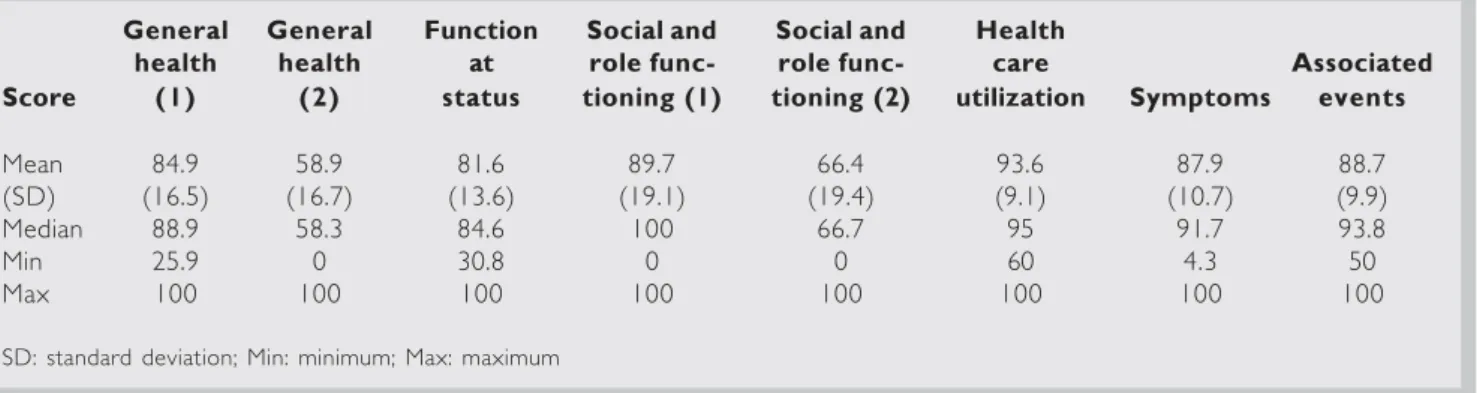
Overall, good scores were obtained in all domains of the questionnaire and reflected good results in health related QoL (Table 3). The better mean score was obtained in “health care utilization” do-main (93.6) showing that the need for medical care outside the Infectious Disease Clinic wasn’t fre-quent. The worst score (58.9) was obtained in “so-cial and role functioning domain (part 2)”. Symp-toms were all infrequent. The most important ones were cough, loss of appetite, skin problems and sneezing. Symptoms related to the gastrointestinal tract were usually present in only 5.7% of children and diarrhea was the most important of them.
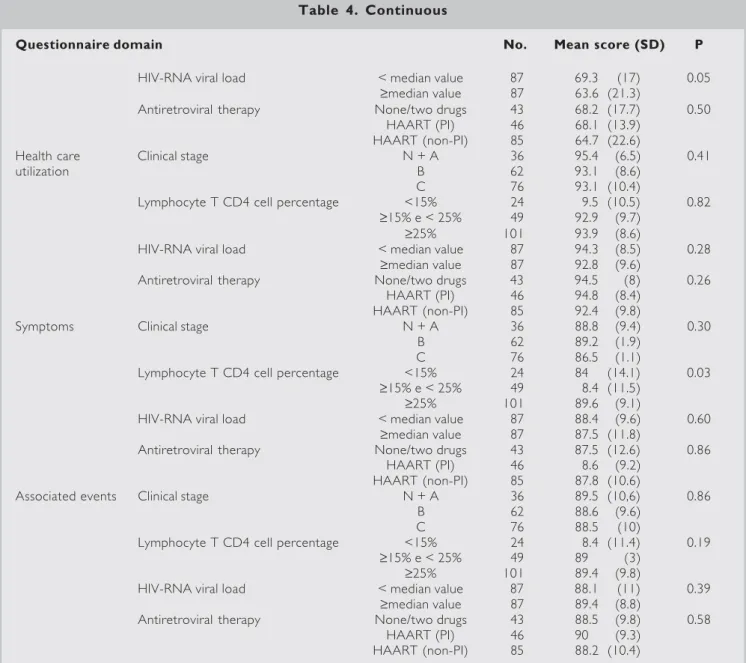
No relation between clinical stage of disease and QoL was observed (P >0.05). Patients clas-sified as AIDS did not show worst QoL when com-pared to other children. Higher percentages of CD4 T cells were related to better QoL in “gen-eral health (part 1 and 2)” and “symptoms” do-mains (P =0.03; 0.05 and 0.03) (Table 4). Pa-tients that had the viral load below median value showed better QoL in “general health (part 2)” and “role and social functioning (part 2)” domains (Table 4). The overall scores of QoL did not dif-fer according to treatment groups. Patients re-porting HAART use did not have better scores compared to those who did not report. PI thera-py also was not associated to changes in QoL (Table 4).
Table 2. Number of patients according to treatment groups
Treatment groups No. %
None/two drugs 43 24.7
HAART (non PI) 46 26.4
HAART (PI) 85 48.9
Total 174 100
HAART No. %
No 43 24.7
Yes 131 75.3
Total 174 100
HAART: highly active antiretroviral therapy; PI: protease inhibitor Table 11111. Laboratory values of HIV
children (CD4 T cell count and HIV-RNA viral load)
CD4 T cell HIV-RNA count (%) viral load (log)
Mean 8 859 (26.7) 38 233 (32) Standard deviation 559.5 106 363 Median 774 (27.5) 8 103 (3.9)
Minimum 47 (1.6) 0 (0)
Maximum 4 832 (53) 1 029 090 (6)
HIV: human immunodeficiency virus
Table 3. Description of quality of life domain scores
General General Function Social and Social and Health
health health at role func- role func- care Associated Score (1) (2) status tioning (1) tioning (2) utilization Symptoms events
Mean 84.9 58.9 81.6 89.7 66.4 93.6 87.9 88.7
(SD) (16.5) (16.7) (13.6) (19.1) (19.4) (9.1) (10.7) (9.9)
Median 88.9 58.3 84.6 100 66.7 95 91.7 93.8
Min 25.9 0 30.8 0 0 60 4.3 50
Max 100 100 100 100 100 100 100 100
www.medigraphic.com
Table 4. QoL domain scores according to the clinical stage of HIV infection (CDC), lymphocyte T CD4 cell percentage, HIV-RNA viral load and antiretroviral therapy
Questionnaire domain No. Mean score (SD) P
General health (1) Clinical stage N + A 36 83.3 (16.9) 0.07
B 62 88.8 (13.4)
C 76 82.6 (18.1)
Lymphocyte T CD4 cell percentage <15% 24 79.3 (2.4) 0.03
³15% e < 25% 49 82.1 (17.3)
³25% 101 87.6 (14.5)
HIV-RNA viral load < median value 87 8.5 (15.8) 0.63
³median value 87 84.3 (1.2)
Antiretroviral therapy None/two drugs 43 85.4 (16.9) 0.38 HAART (PI) 46 87.5 (11.3)
HAART (non-PI) 85 83.3 (18.5)
General health (2) Clinical stage N + A 36 58.7 (16.4) 0.76
B 62 60 (16)
C 76 58 (17.5)
Lymphocyte T CD4 cell percentage <15% 24 57.6 (15.9) 0.05
³15% e < 25% 49 54.4 (19.4)
³25% 101 61.3 (15)
HIV-RNA viral load < median value 87 61.4 (14.4) 0.04
³median value 87 56.3 (18.4)
Antiretroviral therapy None/two drugs 43 56.7 (19) 0.38 HAART (PI) 46 61.5 (15.9)
HAART (non-PI) 85 58.5 (15.8)
Functional status Clinical stage N + A 36 82.4 (12.9) 0.31
B 62 83.3 (11.5)
C 76 79.9 (15.3)
Lymphocyte T CD4 cell percentage <15% 24 7.8 (15.7) 0.17
³15% e < 25% 49 79.2 (15.8)
³25% 101 8.3 (11.6)
HIV-RNA viral load < median value 87 81.6 (14.6) 0.96
³median value 87 81.7 (1.5)
Antiretroviral therapy None/two drugs 43 79.6 (14.7) 0.51 HAART (PI) 46 82.8 (11)
HAART (non-PI) 85 82 (14.2)
Social and role Clinical stage N + A 29 90.3 (16.5) 0.97
functioning (1) B 48 89.3 (20.2)
C 56 89.8 (19.7)
Lymphocyte T CD4 cell percentage <15% 18 87.7 (26.9) 0.66
³15% e < 25% 36 88 (21)
³25% 79 91 (16.1)
HIV-RNA viral load < median value 71 92.6 (13.6) 0.06
³median value 62 86.4 (23.6)
Antiretroviral therapy None/two drugs 33 90.6 (17.4) 0.96 HAART (PI) 40 89.5 (20.1)
HAART (non-PI) 60 89.5 (19.6)
Social and role Clinical stage N + A 36 68.5 (13.6) 0.72
functioning (2) B 62 66.6 (19)
C 76 65.35 (22)
Lymphocyte T CD4 cell percentage <15% 24 65.2 (26.8) 0.31
³15% e < 25% 49 63.2 (19.5)
www.medigraphic.com
Multivariate analysis
Multivariate regressions found an association bet-ween higher CD4 T cells count and better QoL in “general health (part 1)” and “symptoms” domains. No association was observed in “general health (part 2)” as was seen in univariate regression. Pa-tients having lower viral loads had better results in “role and social functioning (part 2)” but not in “general health (part 2)” in multivariate models.
Clinical stage of disease and therapy did not show any association with QoL in multivariate regression, as was observed in univariate analysis (Table 5).
Discussion
Evaluation of health related QoL in children liv-ing with HIV showed favorable results in all ques-tionnaire domains. Mean scores varied between
Table 4. Continuous
Questionnaire domain No. Mean score (SD) P
HIV-RNA viral load < median value 87 69.3 (17) 0.05
³median value 87 63.6 (21.3)
Antiretroviral therapy None/two drugs 43 68.2 (17.7) 0.50 HAART (PI) 46 68.1 (13.9)
HAART (non-PI) 85 64.7 (22.6)
Health care Clinical stage N + A 36 95.4 (6.5) 0.41
utilization B 62 93.1 (8.6)
C 76 93.1 (10.4)
Lymphocyte T CD4 cell percentage <15% 24 9.5 (10.5) 0.82
³15% e < 25% 49 92.9 (9.7)
³25% 101 93.9 (8.6)
HIV-RNA viral load < median value 87 94.3 (8.5) 0.28
³median value 87 92.8 (9.6)
Antiretroviral therapy None/two drugs 43 94.5 (8) 0.26 HAART (PI) 46 94.8 (8.4)
HAART (non-PI) 85 92.4 (9.8)
Symptoms Clinical stage N + A 36 88.8 (9.4) 0.30
B 62 89.2 (1.9)
C 76 86.5 (1.1)
Lymphocyte T CD4 cell percentage <15% 24 84 (14.1) 0.03
³15% e < 25% 49 8.4 (11.5)
³25% 101 89.6 (9.1)
HIV-RNA viral load < median value 87 88.4 (9.6) 0.60
³median value 87 87.5 (11.8)
Antiretroviral therapy None/two drugs 43 87.5 (12.6) 0.86 HAART (PI) 46 8.6 (9.2)
HAART (non-PI) 85 87.8 (10.6)
Associated events Clinical stage N + A 36 89.5 (10,6) 0.86
B 62 88.6 (9.6)
C 76 88.5 (10)
Lymphocyte T CD4 cell percentage <15% 24 8.4 (11.4) 0.19
³15% e < 25% 49 89 (3)
³25% 101 89.4 (9.8)
HIV-RNA viral load < median value 87 88.1 (11) 0.39
³median value 87 89.4 (8.8)
Antiretroviral therapy None/two drugs 43 88.5 (9.8) 0.58
HAART (PI) 46 90 (9.3)
HAART (non-PI) 85 88.2 (10.4)
www.medigraphic.com
58.9 and 93.6 with the highest value (100) beingreached in all domains. The same questionnaire was used in HIV children in the United States of North America by Storm et al.9 and high mean scores were also obtained in the analysis (80.3-91.3). There are few studies about QoL in HIV children and few instruments of analysis. The in-strument “GHAC” was first used by PACTG with similar results being obtained in Brazilian children. We identified it as an important instrument of study of HIV children’s QoL.
The lowest score (66.4 points) was obtained in “social and role functioning (part 2)” domain flecting difficulties in childhood activities and re-lationships present in general social life. It can be held by the stigma of disease and also by physical limitations associated. In the other side, the better scores obtained at “health care utilization” domain showed us that the look for medical care outside the outpatient clinic was not frequent. Patient’s routine visits performed every three months were probably the main reason for the absence of signifi-cant health problems in these children.
Some studies have shown that the prevalence of pain in HIV children is similar to that observed in children living with cancer.7 Our study did not find pain as an important symptom reported by this population. Besides, overall symptoms were not frequent. The most described ones were cough, sneezing, loss of appetite and skin pro-blems. These symptoms can easily be observed in health children too, and probably does not have relation to the HIV infection or adverse events related to drugs prescribed. The most frequent symptoms that are observed in patients receiving PI, like abdominal pain or diarrhea, were not fre-quent in these children. The same happened to neurological symptoms that usually are associated to the non-nucleoside transcriptase inhibitor (NNTRI) intake.
HIV children in Brazil are more frequently found in families living in social and economical difficulties. Besides, parents health is also a pro-blem because they usually are infected with HIV too. Some of these children have already lost their parents and are living with friends, other relatives
Table 5. Multivariate analysis
Questionnaire Questionnaire
domain Groups P domain Groups P
General health (1)
Clinical stage 0.92 Social and role functioning (2) Clinical stage 0.70
CD4 T percentage 0.01 CD4 T percentage 0.63
HIV-RNA viral load 0.91 HIV-RNA viral load 0.05
ART 0.48 ART 0.25
General health (2) Clinical stage 0.71 Health care utilization Clinical Stage 0.53
CD4 T percentage 0.23 CD4 T percentage 0.93
HIV-RNA viral load 0.11 HIV-RNA viral load 0.19
ART 0.83 ART 0.21
Functional status Clinical stage 0.18 Symptoms Clinical stage 0.28
CD4 T percentage 0.11 CD4 T percentage 0.01
HIV-RNA viral load 0.53 HIV-RNA viral load 0.84
ART 0.17 ART 0.28
Social and role Clinical stage 0.96 Associated events Clinical stage 0.92
functioning (1) CD4 T percentage 0.75 CD4 T percentage 0.06
HIV-RNA viral load 0.08 HIV-RNA viral load 0.19
ART 0.66 ART 0.99
www.medigraphic.com
or in primary care institutions. All these factscon-tribute to the presence of stress in children’s daily life and were evaluated in the study questionnaire as “associated events”. Some studies have shown that negative events have been associated to health problems (clinical intercurrences and worst immune response) in patients living with HIV, resulting in a decrease in their QoL.10 Howland et al.,10 observed that 47% of children living with HIV showed some stressful event in their life in the last year. The presence of these events was associated to worst immunity results. Our study found an association between “associated events” and lower CD4 lymphocyte counts (<15%) but it was not significant (P >0.05). Stressful events were not important as determinants of worst laboratory or clinical results in this population.
Evaluation of QoL of children according to the clinical stage of disease was not able to show any difference between these groups. Patient classified as living in advanced stages had the same QoL than those living with no symptoms attributable to the HIV infection. We observed that the pres-ence of symptoms during the exact period des-cribed at the questionnaire can be associated to worst results in QoL, but the same does not hap-pen with the clinical stage of disease because it refers to patient’s whole life. It was already ob-served in other studies and can explain the lack of association found in our study between the HIV clinical classification and quality of life.11 Bing found that patients with HIV living with no symp-toms had more difficulties when facing for the first time the clinical problems related to HIV infec-tion, when compared to those in advanced stages of disease.11
Some studies have shown a positive association between better results in QoL and higher CD4 T cell counts, with special emphasis given to physi-cal aspects of QoL. Gaughan et al.7 found the re-port of pain more frequent in patients with ad-vanced immune-suppression (CD4 <15%) compared to patients with normal levels of CD4 T cell counts. We observed a positive association
between better CD4 T cell counts and the domains of QoL that described “general health (part 2)” and “symptoms”, in multivariate analysis. Storm et al.9 showed a positive association obtained in domains of “general health”, “symptoms” and “so-cial and role functioning” (P =0.04, 0.01 and 0.01) in the United States of North America. Gill et al.12 described the same relation between CD4 T lymphocyte count, “physical function” and “health perceptions” in adults living with HIV. Even studi-es that found a weak association between a better immune response and a better QoL showed that it’s favorable in some items of the questionnaire related to “pain” and “general health”.13 The al-teration that HIV provokes in patients immune system destroying CD4 lymphocytes cells seems to have a negative influence in patient’s physical QoL but no influence in emotional aspects of dai-ly living.
Patients with lower viral loads showed better results in QoL on “general health” and “role and social functioning” domains at initial analysis, but at multivariate analysis this association was not observed in “general health” domain anymore. There are only few studies about the association between viral load and QoL, especially in children. Some found a positive association in physical as-pects of the questionnaire in adults and others showed that a positive influence exists only when undetectable viral loads are reached.12,14 In our study we observed that patients with lower viral loads had better scores in social aspects of life. It is probable that HIV children reaching good res-ponses in viral load take this as an encouragement to improve their social lives.
some-www.medigraphic.com
ESTE DOCUMENTO ES ELABORADO PORMEDIGRA-PHIC
times be obscured by the adverse effects of treat-ment.15 Multiple regimens that are now used in most HIV patients have adverse effects that can take days or years to appear, but when present, can lead to the interruption of treatment and con-tribute to the disruption on QoL.15 Diabetes, hy-perglycemia, dyslipidemia and fat loss have been described in patients taking antiretroviral drugs. HAART was seen as a hope in reaching a better well being for patients with HIV, but the results are not always favorable. The evaluation of QoL is an important field of study due to the complex interaction between the benefits of drugs and the difficulties inherent to multiple regimens.
In the pre-HAART era bad QoL was associat-ed to clinical intercurrences as consequence of immune-suppression. After HAART was intro-duced it has been associated to the adverse ef-fects of drugs. However, it is necessary to remem-ber that only drug effects can not be responsible for the impaired QoL of these patients; other as-pects of their life like the way each patient deals with HIV have an important influence too.14
Gaughan et al.7 observed that patients in use of PI did not have a marked reduction in pain com-plaints after the introduction of HAART. Storm et al.9 evaluated children in the United States of North America and also did not observe changes in QoL between patients living with HIV in dif-ferent ART groups. We did not observe in our study that children taking antiretroviral drugs had worst/better QoL than those that did not take it. We also did not notice that adverse effects relat-ed to drugs were important in “symptoms” domain of the questionnaire, showing that these children had not an impaired QoL due to difficulties relat-ed to treatment.
Good results in QoL were observed in all treat-ment groups; a balance between benefits and dif-ficulties in patients treated leaded to a Qol simi-lar to the one observed in children who did not need to take drugs. Multiple treatments brought benefits to children who really needed it, and they
were able to obtain good results in QoL as chil-dren in less advanced stages of disease. If to these patients were given antiretroviral drugs too, they probably would have shown a worsening in their QoL due to the adverse effects that would not be balanced by the clinical benefits of therapy.
Few studies have shown an increase in QoL of patients living in an advanced stage of disease who were treated with protease inhibitors. The same has not been observed in asymptomatic patients because the difficulties due to therapy reduced their QoL without bringing any benefits in a short period of observation.16 Gill observed that patients that had physical problems at the beginning of therapy could benefit from treatment because the positive influence obtained on clinical and labo-ratory aspects supplanted the adverse effects of drugs.12 Nieuwkerk et al.16 also showed an improv-ing in QoL of symptomatic patients compared to asymptomatic ones after the beginning of treat-ment, and emphasizes that therapy should not be started early in asymptomatic patients.15 It is also described that 70% of patients taking multiple drugs for occupational exposure to HIV have drug intol-erance compared to 11% of infected patients.12
www.medigraphic.com
In our study we found that the analysis ofclin-ical and laboratorial aspects of children living with HIV together with a study of their QoL can lead to a more accurate definition of their health. It also can help health care providers dealing with
HIV children to understand the complexity of this disease and its influence in patient’s lives in phys-ical, emotional and social aspects. Larger numbers of studies in children are necessary to shed more light on this important issue.
References
1. Neto J, Ferreira C. Qualidade de vida como medida de desfecho em saúde. Rev Med Minas Gerais. 2003; 13: 42-6.
2. Cowdery J, Pesa J. Assessing quality of life in women living with HIV infection. AIDS Care. 2002; 14: 235-45. 3. Brady M. Treatment of human immunodeficiency virus and its associated complications in children. J Clin Phar-macol. 1994; 34: 17-29.
4. Warschburger P, Landgraf J, Petermann F, et al. Health-related quality of life in children assessed by their par-ents: Evaluation of the psychometric properties of the CHQ-PF50 in two German clinical samples. Qual Life Res. 2003; 12: 291-301.
5. NICHD, EPI. “Estudo de observações prospectivas de crianças expostas ao HIV e infectadas pelo HIV em unidades clínicas dos países da América Latina e do Caribe”. 2002.
6. Lindsey J, Hughes M, McKinney R, et al. Treatment-me-diated changes in human immunodeficiency virus (HIV) type 1 RNA and CD4 counts as predictors of weight growth failure, cognitive decline, and survival in HIV-in-fected children. J Infect Dis. 2000; 182: 1385-93. 7. Gaughan D, Hughes M, Seage III G, et al. The
preva-lence of pain in pediatric human immunodeficiency virus/ acquired immunodeficiency syndrome as reported by participants in the Pediatric Late Outcomes Study (PACTG 219). Pediatrics. 2002; 109: 1144-52. 8. Gortmaker S, Lenderking W, Clarck C, et al.
“Develop-ment and use of a pediatric quality of life questionnaire in AIDS clinical trials: reliability and validity of the general health assessment for children”. In: Drotar D, editor. Mea-suring health related quality of life in children and adoles-cents; Implications for research and practice. Mahwah, NJ: Laurence Erlbaum Associates; 1998. p. 219-35.
9. Storm D, Boland M, Gortmaker S, et al. Protease inhib-itor combination therapy, severity of illness and quality of life among children with perinatally acquired HIV-1 infection. Pediatrics. 2005; 115: 173-82.
10. Howland L, Gortmaker S, Mofenson L, et al. Effects of negative life events on immune suppression in children and youth infected with human immunodeficiency virus type 1. Am Acad Pediatr. 2000; 106: 540-6.
11. Bing E, Hays R, Jacobson L, et al. Health-related quality of life among people with HIV disease: Results from the Multicenter AIDS Cohort Study. Qual Life Res. 2000; 9: 55-63.
12. Gill C, Griffith J, Jacobson D, et al. Relationship of HIV viral loads, CD4 counts, and HAART use to health-related quality of life. J Acquir Immune Defic Syndr. 2002; 30: 485-92.
13. Arpinelli F, Giovannil V, Rafaelle B, et al. Health-related quality of life in asymptomatic patient with HIV: Evalua-tion of the SF-36 health survey in Italian patients. Phar-macoeconomics. 2000; 18: 63-72.
14. Carrieri P, Spire B, Duran S, et al. Health-related quality of life after 1 year of highly active antiretroviral therapy. J Acquir Immune Defic Syndr. 2003; 32: 38-47. 15. Nieuwkerk P, Gisolf E, Reijers M, et al. Long-term quality
of life outcomes in three antiretroviral treatment strate-gies for HIV-1 infection. AIDS. 2001; 15: 1985-91. 16. Nieuwkerk P, Gisolf E, Colebunders R, et al. Quality of
life in asymptomatic -and symptomatic HIV infected patients in a trial of ritonavir/saquinavir therapy. AIDS. 2000; 14: 181-7.
17. Fumaz C, Tuldrá A, Ferrer J, et al. Quality of life, emotional status and adherence of HIV 1 -infected patients treated with efavirenz versus protease inhibitor- containing regi-mens. J Acquir Immune Defic Syndr. 2002; 29: 244-53. 18. Negredo E, Cruz L, Paredes R, et al. Virological,
immu-nological, and clinical impact of switching from protease inhibitors to nevirapine or to efavirenz in patients with human immunodeficiency virus infection and long-lasting viral suppression. HIV AIDS. 2002; 34: 504-10. 19. Cohen C, Revicki D, Nabulsi A, et al. A randomized trial