ESCUELA DE CIENCIAS DE LA EDUCACIÓN
MENCIÓN INGLÉS
DISTANCE SYSTEM
The use of supplementary materials for teaching children in EFL classes
Research done in order to achieve the Bachelor´s Degree in Teaching English as a Foreign Language
Author:
Jerves Crespo, Carlos Eduardo
Advisor:
Dra. Rosario María Burneo Burneo
UNIVERSITY CENTER CUENCA
CERTIFICATION
Dra. Rosario María Burneo Burneo CERTIFIES THAT:
This research study has been thoroughly revised by the graduation committee. Therefore, it authorizes the presentation of this thesis, which complies with all of the norms and internal requirements of the Universidad Técnica Particular de Loja.
Loja, Mayo del 2012.
……….
CONTRATO DE CESIÓN DE DERECHOS DE TÉSIS DE GRADO
Yo, Carlos Eduardo Jerves Crespo declaro ser autor del presente trabajo y eximo expresamente a la Universidad Técnica Particular de Loja y a sus representantes legales de posibles reclamos o acciones legales.
Adicionalmente declaro conocer y aceptar la disposición del Art. 67 del Estatuto Orgánico de la Universidad Técnica Particular de Loja que en su parte pertinente
textualmente dice: “formar parte del patrimonio de la Universidad la propiedad intelectual de investigaciones, trabajos científicos o técnicos y tesis de grado que se realicen a través, o que el apoyo financiero, académico o instituciones (operativo) de la
Universidad.”
……….
AUTHORSHIP
The thoughts, ideas, opinions and the information obtained through this research are the only responsibility of the author.
Mayo del 2012.
……….
A mis padres, Jaime y María Elena, y a mis hermanas y sobrino, María Elena, María
CONTENTS
CERTIFICATION ... ii
CONTRATO DE CESIÓN DE DERECHOS ... iii
AUTHORSHIP ... iv
DEDICATION ... v
CONTENTS ... vi
ABSTRACT ... 1
INTRODUCTION ... 2
METHODOLOGY ... 5
DISCUSSION ... 12
Literature Review ... 12
Results ... 28
Description, Analysis and Interpretation of Results ... 33
Conclusions ... 88
Recommendations ... 90
REFERENCES ... 91
ABSTRACT
This thesis studies the use of supplementary teaching materials for teaching children in English as a foreign language (EFL) classes. The purpose was to determine the effectiveness of use, pertinence for the topic of class and aim of exercises,
appropriateness regarding age and knowledge of students, variety and quality of the materials.
Data was collected through observation of 30 class sessions in a private
institution with children of 4th, 5th and 6th grade. This data was analyzed qualitatively in terms of pertinence, appropriateness and quality of materials, and it was analyzed quantitatively in frequency of use.
Results indicate that materials like the whiteboard, songs and stories contributed the most for learning and were pertinent to the class’ goals and appropriate to the
students’ level.
INTRODUCTION
This thesis studies the use of supplementary materials for teaching English as a Foreign Language (EFL) for children. This study originates from the necessity to determine if teachers are using supplementary materials appropriately or are not using them at all. The proper use of supplementary teaching materials is an important aspect of the methodological component of teaching English in a foreign country, which in turn contributes to successful classes.
The specific objectives of this work are: to identify and analyze which
supplementary materials are used for teaching children in EFL classes; to describe and analyze each one of the supplementary materials used in EFL classrooms in terms of
pertinence (content), appropriateness (students’ needs) and quality; and to determine the
frequency and variety of the supplementary materials used in the observed classes. For the first objective six materials were identified: posters, songs, stories, the whiteboard, realia and movies. For the second goal, it was determined that most of the observed materials were pertinent and appropriate to the class and that they showed good quality. The pertinence and appropriateness of the materials contributed for the
learning process because it fomented the students’ interest in the language. For the final objective, it was determined that materials such as whiteboard, songs and stories had a high frequency of use while the rest were infrequently used. This suggests that certain types of materials are preferred by the teacher because of aspects such as convenience or availability. Finally, there was acceptable variety of materials considering that the observed institution was private and also considering the list suggested for this investigation.
Ecuadorian classrooms, limitations might be set by a lack of resources, idiosyncrasy or lack of knowledge of the teacher or students in using supplementary materials. In reality, certain types of materials are common place in most Ecuadorian EFL
classrooms with middle to high resources. These are also easy to obtain, but not used properly or at all.
Regarding the topic of this work, previous research has been done to analyze various aspects of using supplementary resources. The first study, by Kelsen (2009), investigated if YouTube could be successfully used as supplementary material. It was concluded that students had positive attitude towards using YouTube and that it could be used as supplementary resource. However, the study was limited because of a small sample population; they were college students and participants from the same
department. A second study, by Lu-Fang (2004), consisted in video-based computer assisted language learning (VBCALL) and its effects on incidental vocabulary acquisition. This work was limited because it did not consider students with lower levels of English proficiency. Another study, by Son (2008), surveyed how using Web-based language learning (WBLL) activities could be applied as a supplementary
resource for English as a Second Language (ESL). This study was limited by the simplicity of the website’s activities and because it didn´t consider using the site in combination with classes.
This work seeks to benefit teachers and students by awaking their interest in the adoption of supplementary EFL materials. This adoption will promote more interesting and motivational courses. This will translate into successful classes from the
This study will provide a starting point for future research in the use
supplementary materials for EFL. For the educational ambit, the present work seeks to provide with an analysis of the current state of the use of supplementary materials in the English curriculums. It also provides with a basis for future investigations about the diverse types of supplementary materials because it represents a source of statistical data which can be used for comparison in a near future.
However, methodology of the current work was limited by time constraints and sample population. Longer time periods are needed for more accurately observing the use of supplementary materials in Ecuadorian classrooms; these should ideally consist of the duration of the entire course or school year and for a period of years. The sample population should also include all age groups from elementary, middle and high school.
Furthermore, it is suggested to compare the differences in the use of
supplementary teaching materials between private and public schools and institutes. In Ecuador, public schools are known for lacking resources if compared to private schools; some public schools even suffer from extreme poverty. In contrast, privileged
educational institutions are known to endorse themselves with reputedly strong
language programs which include more expensive EFL learning materials and language learning facilities.
METHODOLOGY
This section describes the investigation process for this work; it details how the bibliographical information was collected and how the field research was made. Regarding the bibliographical research, it describes the literature and its contents. Concerning the field research, it describes the place, participants, variables, data collection instruments, data tabulation, the process used for analysis and the observations.
The bibliographical background was established by searching literature regarding the following topics: teaching a foreign language; leaner’s age with an emphasis in children and learner’s motivation; learning styles; teaching techniques
focusing on children; different contexts for teaching; definition, importance and role of supplementary material; and literature about visual, audio, audiovisual, realia and online types of supplementary material. At least three sources were consulted for each topic. Additionally, the background also included five studies about the use of supporting material in EFL or English as second language (ESL) classes.
The bibliographical information was collected in index cards and it is explained in the Literature Review section. These references support the analysis of the data collected from the field research.
Once the field data was collected, it was analyzed with qualitative and quantitative approaches. The author observed the classes and collected information through three data collection sheets: an observation sheet for different aspects of class and different supplementary materials used during class; a survey for teachers for collecting the teacher’s opinion about the use of supplementary materials; and a survey for students, to record the student’s perspective in the use of these materials.
The data collected through observation sheets was tabulated in charts. Three types of charts show results for materials which were identified, pertinence and
appropriateness, and frequency of use of these materials respectively. These charts are
organized by “Variables”, which are categories of supplementary materials, and by “Indicators”, which are specific types of materials; further organization depends on the type of chart.
More comprehensive information regarding the methodology for the bibliographical and field research is detailed in the next sections. The Settings and
Participants section details the observed educational institution and sample population.
The Procedures section details about the literature (theoretical background),
investigation methods, data collection for the field research with techniques and instruments, data tabulation process and analysis process.
Setting and Participants
The facilities of this institution consisted of a big house, where the classrooms were midsized rooms with adequate dimensions to comfortably fit small groups.
Additionally, there was a room which served as a multimedia room, other miscellaneous rooms and a grass yard. These facilities were clean and in good condition. All the rooms, including a kitchen and multimedia rooms, had whiteboards and classroom furnishings.
In this institution, each class was limited to a size of seven students or less. The groups were mixed with boys and girls. The students sat around grouped rectangular tables and the teacher sat in front, next to the whiteboard. This configuration allowed people to be next to each other while the teacher could walk around and help students.
Concerning class schedule, classes in this institution took place during the afternoon and each class was 55 minutes long, from Monday through Thursday. Each course level had a total duration of 50 sessions or about 3 months.
Regarding observation schedule, observations for this research were done on Wednesdays and Thursdays during 5 weeks; this totaled 10 different observation dates. Three groups were observed during a same date; this totaled three observations per day. By the end of the research, a total of 30 class sessions were observed.
Finally, 8 out of 10 observations per group were done in a classroom; this totaled 24 observations. The 6 remaining observations took place in a kitchen and in a
multimedia room during special classes.
Procedures
This research started by collecting relevant bibliographical material, mostly book references, regarding the following six topics: teaching a foreign language,
role and types. The UTPL´s digital library and Google were the main search tools. For each of the topics at least three different sources were referenced.
Furthermore, information about previous studies from journals was collected using the same search tools; five journals about the use of supplementary materials in EFL and ESL classrooms were consulted.
All information was recorded in index cards. The following was included for book references: citation, content of interest and page numbers. For journal references, the following was recorded: title, citation, research question, subjects or participants, setting or place, methods, results, author´s conclusions and recommendations, and limitations of the study.
The bibliographical material is fully discussed in the Literature Review section of this work; these references also support the Qualitative Analysis subsection of this
thesis.
The second part of the investigation process was the field research; this consisted of collecting observational data about the use of supplementary materials in an educational institution. Three groups from a private English institute were observed: eight years old, nine years old and ten years old; these corresponded to 4th, 5th and 6th grade respectively. For each group of students, information from ten classes was collected; this totaled thirty class observations.
For collecting data the author attended the classes as audience. The author was a passive observer and he did not inform the teacher about the purpose of the observations or the collection of information until the very last observation.
allowed a journal for situations where supplementary materials were not used during a class; this allowed taking additional notes or cataloguing observations.
The purpose of the observation sheets was to collect quantitative and qualitative data about the thirty class sessions; this data was analyzed for these aspects in the Results section.
The sheets were divided in two main parts. The first part (first page) of the observation sheets collected information about the main topic of the class, objectives of the class, and which supplementary materials were identified. These totaled 30
observations sheets corresponding to the 30 class sessions.
The second part (second page) of the observation sheets collected information for a specific type of supplementary material; one sheet was used for each type of material. The following aspects were recorded in the second part: how a material was used; pertinence of the material in relation to the topic; pertinence in relation to the class’ objectives; appropriateness of the material regarding the age of the group and the perceived knowledge level of the group; elaboration and application of the
supplementary material in terms of creativity and originality; motivation of students; and quality of the material.
There were 57 observation sheets (second page) corresponding to 57 different times that supplementary materials were observed throughout the 30 class sessions.
The information collected in the observation sheets for each class was tabulated in three types of charts (tables). The first kind of table was used to identify which resources were used. The first tabulation corresponds to Chart 1; it was used for
one for each age group. These are used for qualitative analysis and these correspond to Charts 2, 3 and 4 in the Results section. The last type of table was used for quantitative analysis and to calculate frequency of use for each material; it corresponds to Chart 5 in Results.
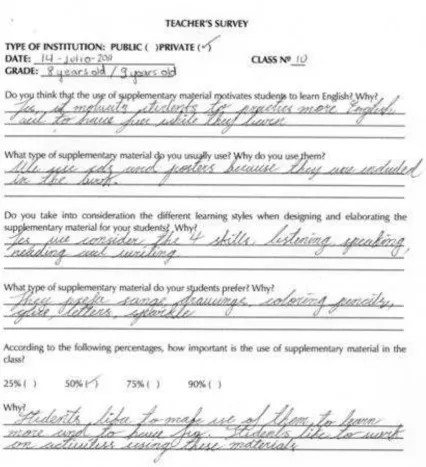
Additionally, gathering of field data included surveys filled by the teacher and students from each group. This study aimed to obtain three different teacher surveys; however, only two teachers were surveyed because one of them gave class to two of the three groups. The study also aimed to obtain 60 different student surveys resulting from inquiring 2 students at the end of each one of the 30 sessions. However, there were only 17 students for all 3 age groups, so the actual number of student’s surveys was only 17.
Regarding surveys for teachers, these collected the opinion of the teacher about the following aspects: if the use of supplementary materials motivated the students and why; what types of materials were used and why; if the students’ learning styles are
considered with the choice of materials; what types of materials are preferred by the students and why; and how often are the materials used and why. For the survey, the list of supplementary materials from Chart 1 was given to the teachers along with the survey.
The student’s survey asked the students to answer simple questions with yes or no answers, to complete a simple check list, to write a list of items, and to check which option they preferred out of two possibilities.
The results of the surveys were not tabulated in charts; however, these were considered by the author for the Description, Analysis and Interpretation of Results and Conclusions and Recommendations sections.
Observation sheet samples and survey samples are included in the annexes. The tabulated results are included as charts in the Results section of this work.
DISCUSSION Literature Review
The use of supplementary materials for educational purposes has become primordial in modern teaching; this includes language teaching. In classrooms worldwide, it is common that lessons include activities which make use of learning materials of different kinds for improving class experience. These resources and new technologies allow for more interesting lessons that further motivate students for learning a new language. Using supplementary materials for teaching children English as a Foreign Language (EFL) opens new possibilities and benefits for both, teachers and students.
This section starts with a discussion about aspects for teaching a foreign language. Afterward, there is an analysis of learners’ age and motivation. After this, learning styles and teaching techniques that focus in children are argued. Also, different contexts for teaching a language are compared. In addition, the use of supplementary material is discussed regarding the following points: its definition, role, importance, and types. Finally, results and highlights of five journals of study about the use of
supplementary materials in EFL are briefly summarized.
Teaching a Foreign Language
provide their children with better EFL education. The purpose of this change, to emphasize foreign language learning from early childhood, is for benefitting learners with additional years of exposure. Due to parents’ request, children are taught EFL from early on, consequently they can exploit their natural learning attributes; thanks to this they are more likely to acquire a language more efficiently than latterly exposed students.
From a teaching perspective, in EFL it is not necessary to have intense training or experiences to be a successful English teacher, but these aspects are beneficial because they provide with target skills that will translate into more effective teaching. A teacher can also make use of skills acquired from other knowledge areas like
Linguistics; these skills may provide better grasp of a language and how to teach it. In addition, using knowledge from derived fields of Linguistics, like Sociolinguistics and Psycholinguistics, is also important; these areas supply tools for dealing with group interaction, culture, roles for teachers and students, memory span, motivation, cognitive development and other contexts.
A successful EFL teacher, trained or untrained, must also work on basic principles, like classroom management, question techniques, lesson planning, and teaching strategies adapted to teacher´s style. This additional knowledge, which separates a trained from an untrained teacher, contribute for better decision making, meaningful practices and better progression in EFL teaching (Brumfit, Pincas, & Broughton, 1978).
proficient into the first language (L1), the local language, would be better suited. This latter case would benefit the teacher because knowledge of the L1 language would allow them to handle more easily certain aspects of foreign language teaching, for example, interference. Additionally, sharing common cultural knowledge in L1 with the students is always beneficial. However, in practice most native L2 teachers lack the knowledge in L1 which might simplify teaching certain topics and they might
experience a cultural shock which could inhibit their performance. On the other end, it is argued that non native speaking teachers for L2, but natives for the L1, have the advantage in sharing a cultural and linguistic background with their students; they might more effectively focus in treating the differences and similarities of the language
(Nizegorodcew, 2007).
Other aspects to consider for teaching a foreign language there are language teaching methodologies. Mercer and Candlin (2000) mention three of them:
Communicative Language Teaching, the Natural Approach and Task Based learning. The first methodology is described as dominant; it covers a wide range of classroom practices which differ from other practices in that the underlying principles of the language are not the main concern. The objective of this methodology is that a learner should acquire communicative competence instead of understanding the underlying principle of how the target language works.
The second methodology deals with the natural acquisition of a language instead of its conscious learning. The acquired part of a language, the first part, is made
available for natural language use, in a similar way to learning a mother tongue. The second, learned part is only used to monitor the output based on the acquired part.
Finally, the third method is task based learning; it consists of a set of
item centered methods. This methodology complements previously mentioned natural learning processes. All these methodologies have the commonality of learner
centeredness. This means that they focus in giving the student more control on what is being taught by allowing more participation in choosing the lesson activities and contents; opposite approaches rely only on the teacher to direct the class.
Learners
Teaching diverse learners in the same groups represents a permanent challenge for ESL teachers. This situation is more common in adult and private English institute classes, but all class groups have diversity to consider when choosing a methodology. It is also common for private and public school teachers to be in charge of more than one class group.
On the topic of age, groups may range from very young to late teenagers. For both scenarios using the same supplementary teaching resources cannot be practical because language knowledge of EFL students, under normal circumstances, usually increases with age. Aspects like student´s motivation are also very important points to consider by a successful English teacher. Once these parameters are accounted for, a teacher is more prepared to choose the right type of supplementary teaching materials.
known as the Critical Period. This hypothesis states that children up to the age of puberty are likely to learn a second language with native like fluency. On contrast, even though older learners might still be very successful in learning a second language, they are not likely to attain native fluency. Instead, their learning will make use of other learning abilities, previously learned and transferred from other areas to language learning; this might benefit older learners in the short run, allowing them to have faster progress. Finally, it is also stated that differences in language acquisition related to age are influenced by other circumstances like the different environments to which older and younger learners are exposed when they are learning or applying the language.
Students of different ages also have different attitudes and motivation. Older learners might perceive a more strict language learning environment, while younger learners might take things more casually and naturally. Younger learners have an advantage in that they are still forming a cultural-linguistic background, and therefore they have less interference from a mother tongue. In contrast, young learners’
motivation is affected because they are not likely to understand or apply the necessary effort for endeavors such as language learning by themselves. However, for all ages perceptions and motivations towards learning English changes over time. For example, while younger learners initially borrow concepts of what learning means from their parents, for example, homework must be perfect and neat; they eventually shape their own view from their classroom experience.
formal structures of language. As mentioned earlier, children are also open to adopting positive attitudes towards language learning because they are new to the learning experience (Garcia & Garcia, 2003).
Learning Styles
A student´s learning style affects the success of learning or acquiring
knowledge; this also holds true for foreign language learning. Learning styles consist of a set of different attributes that vary from person to person. In a class group some people might be better suited for traditional English classes, while others might have styles that inhibit their performance. Under normal circumstances using supplementary materials is common to EFL and ESL teaching and the instructor must choose carefully to minimize the effect of conflicting learning styles amongst students from the same class.
Thus, to understand why some students succeed in certain classroom settings their learning styles must also be understood. Likewise, both the teacher’s and student’s
role in the learning process must be accounted for. It is argued that teacher centered methods and approaches might impose learning styles when the teacher takes a full leading role either because of cultural context or perception from students. In contrast, a better method must also consider students’ participation and it must identify factors which make some students more successful than others.
Learning styles cannot be clearly classified by only observing students, but there have been helpful categorizations which generalize learning styles to identify them easily to some extent. The simplest and most common classification of learners (learning styles) is by relating students to how they rely on their physical senses to learn; these are auditory, verbal, visual and kinesthetic learning styles (Leite, Svinicki, & Shi, 2009).
However, there are even more complex classifications. For example, Piper
(2001) classifies students’ styles into field dependence and independence. Field dependence is explained as a global vision about a topic which allows a student for more awareness. Its opposite, field independence, is perceived as a process of learning by using more individualized units and by concentrating in one task at the time. In addition, field dependence and independence are related to right and left brain
functioning respectively. The right brained, dependant people have more success with learning communicative and social functions of the language, but this advantage does not fare well in the classroom. Left brained, independent people are likely to be more successful with common English learning scenarios and other activities that include analytical skills. However, the field dependant student will thrive more in real English speaking environments. Each person shares both traits with its advantages and
disadvantages, but the teacher should still be able to recognize, by observation, a dominant trait.
styles into extroverted and introverted; the first consists of more participant students, while the second consists of more autonomous students who are also systematic.
Handling possibilities divides learners into two main groups: intuitive random learners, who focus on possibilities, and concrete-sequential learners, who like clear directions.
Approach to tasks classifies students into oriented learners and open learners; the first group is more organized and plans ahead while the second group prefers discovery and it is adept to more unstructured curriculums.
Dealing with ideas classifies in global learners, who are considered holistic and analytic learners, who prefer focusing on details.
In comparison, the second classification of learning styles consists of four
learner groups: analytics, communicative, concrete and authority oriented. The analytic style considers learners who guide themselves autonomously. The communicative style deals with the students whom are more participative and language scenarios which enforce participation. The concrete style deals with working in concrete activities. The final style, authority oriented, deals with students who prefer the authority role of the teacher.
Teaching Techniques
techniques and chose the right materials in order to make most appropriate learning environment. Some of these techniques are mentioned next.
Nikolov (2009) details the immersion method; it states its appropriateness as a language teaching technique for adults, older and younger children. The method is characterized by the following: a target language is the medium of instruction, adopting a curriculum which is parallel to other curriculum for monolingual students, a second language is learned without penalizing learning another, exposure to the language is confined to the classrooms, students entering the program have similar proficiency, the teachers are bilingual, and the classroom’s culture is local. This teaching technique can be used to wrap the student with the target language from an early age; this is known as early immersion. A second version, total immersion, consists of a form of bilingual education with the objective of developing communication skills through bilingual environments. The immersion method is an alternative to a regular curriculum and it shares with this regular curriculum its content based approach. However, a distinction is that the immersion method is concerned with language acquisition, a natural approach for learning, instead of studying the rules of the language, which is a systematic
approach. This method relies in acquisition for students to become functionally bilingual; they effectively should be able to communicate in most everyday situations.
teaching. This method is significant for assessing and recalling what was learned as well as for opening critical thinking by the students. It is recommended that questions are divided into direct, critical and open. The third method, discussion, can involve entire class group discussions or smaller ones. The importance of discussing lies in promoting verbalization by the student, which improves language acquisition. The quality of the discussion is a measure of effective teaching, especially when children are captivated by the theme and motivated to participate. The final method, work activities, consists of appropriate class tasks that involve working in projects relevant to topics. This kind of work foments imagination and language development within the
framework of language learning.
Different Contexts for Teaching
The choice of supplementary materials for English teaching must consider the context for the teaching scenario. This process is influenced by aspects like teacher’s
role, degree of teacher’s authority and direction, assignment of materials and choice of activities. It is also influenced when students change context by participating in the selection or elaboration of contents and material for class. Because EFL class groups have diverse cultural backgrounds, ages and group sizes, the teacher must prepare for the context of the class, specially the aforementioned choice supplementary materials and class procedures.
varying group sizes, the teacher should try to involve all students, especially in large classrooms. Depending in the activity, there are advantages in dividing large classes into smaller groups, because students can participate more and learn from each other. Also, depending in which skills work targets to reinforce, groups can be as small as two to four people. Other considerations are the duration of group work, time lapses in between assignments, and switching back and forth with work that involves an entire class group.
It is also stated that teaching different topics along with their context vary the difficulty for teaching diverse class groups. It is helpful to teach a theme within a context frame in order that students of different cultural backgrounds grasp the concepts. When resources are limited, some simple types of supplementary materials can be useful for setting this context. For most basic lessons, a teacher should have no difficulty in explaining the topic since most introductory lessons will be easy for the audience to understand and absorb. For more advanced topics, readily available supplementary materials can help with visualizing, especially realia and visual
materials. Regarding realia objects, these are helpful in conceptualizing relationships and making connections between objects and actions. Pictures are practical when a teacher needs realia objects that might be difficult or impossible to bring to class.
communicative scenario; these activities can also make better use of supplementary materials like realia.
Supplementary Materials
Supplementary teaching materials for EFL consist of a variety of supplies and objects that are used in complement with a base source material, usually an EFL textbook, to further enhance teaching and learning processes. In language teaching these complement traditional printed materials because they are often used, or even required, for activities from textbooks. For example, most modern EFL learning packages include some form of multimedia accompanying disc, but teachers can also resort to readily available things like movies, tapes or music.
An important aspect of EFL teaching and learning, to which supplementary materials contribute, is immersing students in the culture representative of the language, in most cases, the American culture. This immersion must be dynamic and with clear goals. The role of supplementary material is not only to complement the information of textbooks, but also to maximize learning by waking interest of the students. This helps reaching general and specific learning goals for class.
Additionally, supplementary teaching materials can act as motivators so
students, especially children, do not get bored; avoiding boredom prevents indiscipline and monotony. By gaining attention of the students the teacher can attain better learning and maintain a stable rate of progress. In addition, supplementary materials may also act as time and energy savers for the teacher if they readily prepared.
The most common categories of supplementary teaching materials used in EFL are visual, audio, audiovisual, realia and online. Visual materials consist of resources that let the student learn through observation and visualization. These are very effective for teaching vocabulary when combined with audio resources. They consist mostly of images and pictures that are used in activities where the student reinforces language skills through description related activities. Amongst these there are: white and blackboards, charts, maps, sketches, flannel boards, overhead projectors, filmstrips, slides, films, etc.
Audio materials usually consist of professionally prepared resources such as the accompanying discs in EFL packages. However, they can also include cultural content, such as music or prerecorded dialog. If used appropriately by the teacher, audio
materials are helpful to honing the student’s hearing skills, especially for a specific English accent. For example, the students can listen to recordings, real or acted, of native speakers chatting with other native or non native speakers. Audio materials might also help impart about mannerisms proper of language variations. Audio material can also complement visual materials for better results as well. Some types of audio materials are radio, tape recorder, CDs, etc.
Then there are the audiovisual materials, which are a combination of the previous two types. They consist commonly of movies filmed or dubbed in a target language, but they can be any video clip. They also include more technological
Continuing with the categorization of materials, there is realia. This is a readily available type of teaching aid which consists of real life physical objects, miniature, or fake representations. Realia is commonly used for teaching vocabulary and as items utilized in other activities.
Another type of supplementary resources consists of digital content found in software or the Web. There is a myriad of content that could include all the previously mentioned supplementary material types in digitalized form specially designed for EFL. These resources started as simple web text and have evolved into more interesting and interactive content thanks to technological advances. The most interesting examples can include video games, multimedia, EFL learning sites such as OpenEnglish.com, etc.
Other types of supplementary resources consist of facilities for language learning. Examples of these are language laboratories, computer assisted language learning (CALL) resources, resource centers and language games (Camenson, 2007) (Shastri, 2010).
In recent times, new technologies have gained adoption and can become an important source of supplementary materials; such is the case of online resources. However, a teacher can always make use of the resources at hand, such as realia, in order to improve the class experience.
to make use of these tools outside the classroom in personal time. The results were mostly positive answers because students thought that the tools were helpful for their language learning.
A second study, by Evan Jones (2010), takes a look at the use of less formal reading material, comic books, as a way to improve reading comprehension and
proficiency. The sample population consisted of twenty five female students of college level. For surveying purposes, the participants were asked why they thought it was important to practice reading and how they felt about participating in an extended reading program. Also, a pre-questioner was given to the sample population asking how they felt about reading in their native and foreign tongues. The study itself consisted of meetings that took place once a week for twenty to thirty minutes; it was followed by content discussion. The results showed that the majority of students had a positive attitude towards reading comic book style material and towards participating in reading programs that used this type of material; the study raised their EFL reading interest.
The third study, done by Brent Kelsen (2009), was a survey of students using YouTube as supplementary material and as a source of authentic material. The sample group was EFL students from Taiwan whom watched previously chosen YouTube videos. The videos were related to the main class material, and surveys took place before and after the reading dates. For surveying, the students were asked about: their feelings of using YouTube, their user experience, and their attitude towards use outside the classroom; the surveys were limited to English only.
given the complementary book materials along their baseline textbooks. The results were collected through tests and surveys. The results were positive for using these materials in EFL classes; it was noted that more variety of supplements might yield better results.
The final study, done by Tian Fanping in 2010, investigates about the
Results
Qualitative Results
Chart 1: Types of supplementary material used to teach children
Author: Carlos E. Jerves
Chart 2: Pertinence and Appropriateness of the supplementary material used to teach children
Author: Carlos E. Jerves
Chart 3: Pertinence and Appropriateness of the supplementary material used to teach children
Author: Carlos E. Jerves
Chart 4: Pertinence and Appropriateness of the supplementary material used to teach children
Author: Carlos E. Jerves
Quantitative Tabulation
Chart 5: Frequency of use of supplementary material
Author: Carlos E. Jerves
Description, Analysis and Interpretation of Results
This section discusses the results from the field research observations which were illustrated as charts in the previous subsection Qualitative Results. These five
charts showed the tabulated results from the observations. The method for collecting data was thoroughly described in the Procedure subsection of Methodology.
The charts make use of five “Variables” that represent five categories for supplementary materials: visual, audio, audiovisual, realia and online. There is a suggested list of 18 types of supplementary teaching materials for all categories, the
“Indicators”, but this section only discusses the materials that were identified and used during the observations. In addition to the observations’ results, the author also
considers opinions from teachers and students which were collected through the surveys in order to make comments or further observations in this section.
We start with the Qualitative Analysis, with a subsection for each one of the age
groups: 8 years old (4th grade), 9 years old (5th grade) and 10 years old (6th grade). For each group, there is also a separate subsection for each type of material that was
observed based on Chart 1. In addition, when a type of material was used in more than one class observation there is a separate description for each observation. The
description contains details about: the observed topic for the class and the observed topic for the exercise; the presumed class objective and the presumed exercise objective; the pertinence of the material in relation to these objectives; the appropriateness of the material regarding the age, knowledge and learning style of the group of students; and the quality of the material in terms of its design, elaboration and maintenance.
Additionally, for each age group, there will be an analysis of the learning styles
the use of supplementary materials contributing for the students’ learning and if this perception agrees to the survey.
After the qualitative analysis is completed, the chapter continues with a
Quantitative Analysis section; this contemplates the use of supplementary teaching
materials in terms of variety and frequency of use.
Qualitative Analysis
4th Grade/8 Years Old
Posters
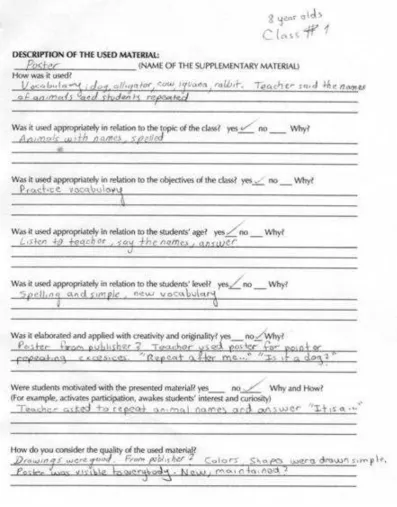
Posters were used during two class sessions to practice vocabulary with the students; the topic for both classes was related to “Animals”. The objective of the first class was to learn and practice vocabulary about animals: dog, alligator, cow, iguana and rabbit. The second class expanded vocabulary to: elephant, tiger, ostrich, lion, monkey and giraffe.
There was pertinence for the topic and objectives for both classes because the posters showed animal drawings with a label, therefore students easily connected an animal illustration with its respective name.
However, the teacher did not use posters creatively. For the exercise, the teacher
asked “What is it?” and the students replied with “It is a/an…” or “It isn’t a/an…”. This did not awake the interest of the students because it did not consist of complex
interactions which may have required more participation of the students. These posters were simple, designed for beginner exercises and these did favor variety of use; this could be the cause why the teacher did not use them for more demanding drills.
Nevertheless, the observed use of posters for simple questions and answers did contribute to learning vocabulary because it effectively reinforced vocabulary
students to familiarize with the format of simple vocabulary exercises witnessed in the observations.
This material was also appropriate to the group’s level because the teacher used posters as visual support for introducing vocabulary and to practice pronunciation. With posters, the students easily identified which animal the teacher war referring to.
Regarding the quality of the posters, these were fixed on the walls, visible to everybody and readily available to use them for an exercise at any time. Also, they were well maintained, had a nice art style to easily grasp the attention of the children and included labels. These materials were from publishers, so they were designed to be visually attractive to children.
White Board
The first class where the whiteboard was used was related to “Animals” as well. The objective of the class was to learn vocabulary of animal names and the objective of the exercises was to practice writing. The teacher used the board to develop the topic and write up word completion and phrase completion exercises; for example, students
wrote “A yellow dog”, “An orange lion”, etc.
The board was used pertinently to the class’ topic and the aim of exercises because students practiced their vocabulary by developing simple phrases and
sentences. Additionally, these drills introduced them to the use of adjectives (colors) and articles (“a” and “an”).
Nonetheless the simple exercises were effective for the students’ learning
because these allowed them to directly practice their writing skills. These direct tasks were a simple approach for students to improve these skills (Brumfit, Pincas & Broughton, 1978).
This material was also used appropriately to the group’s level because using phrases and sentences was suitable as introductory practice of new vocabulary content. It was also used appropriately to the group’s age because it used vocabulary interesting for children, animals and colors.
The second class’ topic was also related to “Animals” and it was a continuation of the previous class. The teacher used the whiteboard for writing content, word completion exercises, scrambled word exercises and more vocabulary.
The material written on the board was pertinent to the class’ topic and exercise’s
aim because it continued with vocabulary introduction. In the same way as the first class, the exercises were appropriate to the group’s knowledge level because these kept the same simple format, writing phrases and sentences. Likewise, to stay appropriate for children, these exercises also involved animals and colors.
Regarding creativity, the same is concluded for this and the previous observation; the teacher should have worked in exercises that involved imagining stories, like fables or tales. Therefore, because exercises were simple, these did not
awake the student’s interest.
Using the board for writing simple phrases and sentences was effective for the
The third class was related to “Numbers” and the objective was to learn about numbers from 1 to 10. The board was used for writing content, exercises, spelling and drawing the shapes of numbers. Additionally, the material was used for practicing spelling along with pronunciation and learning to count from 1 to 10.
The board was not used creatively nor did it seem to awake the interest of the students. This could be attributed to the topic of the lesson, numbers, which is likely not very attractive for children and it does not seem to favor fun lessons. However, using the board for developing exercises still contributed for learning because it allowed the teacher to involve the students into further writing.
Regarding contribution for learning, using the board for imparting content and for working in exercises did help students as they got to practice their skills, focusing in writing and reading. Also, using the board for teaching counting was effective because the teacher easily and dynamically developed the content on the board as it was needed.
The exercises were pertinent to the objective of the class because students learned spelling, pronunciation and counting from 1 to 10 in English. The exercises were also appropriate to the students’ level because these were an introduction to numbers. In addition, the material was appropriately used for their age because these exercises consisted of simple matching of shapes to their names and simple writing; this simplicity is adequate for young learners (Nikolov, 2009).
Continuing with the fourth class, this was related to both “Numbers” and “Colors”. The objective was to expand knowledge about these topics. The board was used for writing content, exercises, drawing numbers and objects. For example, students drew gift items according to a certain color or quantity.
Another reason why it was not interesting is because this class was a continuation of previous lessons. However, the activities did contribute for learning because they helped students practicing the new contents and reinforcing previous knowledge.
The contents written on the board were pertinent to the objective of the class because these successfully combined the new topic with previously introduced colors and objects. The exercises were also appropriate to the group’s level and age because the students worked in simple writing and drawing activities which contributed to learning and relating numbers to their pronunciation.
The fifth class topics were “Vehicles”and “Colors” and the objective was to expand vocabulary for different kinds of vehicles and transportation. The board was used for imparting content, drawing simple vehicle shapes and developing exercises; for example, there was an exercise for finding words embedded between letters and for identifying the colors of objects.
The board was used creatively for the word finding exercise. Students
participated a lot more and they seemed to have found this exercise fun and interesting.
This exercise contributed for students’ learning because it made students use their reasoning skills.
The exercises written on the board were pertinent to the objectives of the class because students learned about the different names for vehicles and they further practiced their knowledge about colors. The exercises were also appropriate to the
group’s knowledge and age because the content remained simple and children enjoyed using the board for drawing and working on the exercises.
exercises about mixing colors, questions regarding whether some colors contained others, and colors of different fruits.
The board was used creatively because the teacher elaborated different and interesting exercises. Students seemed to enjoy working on these exercises. Therefore, this contributed for learning because it awoke their interest and it allowed them to connect different topics from other lessons to the current topic. If students liked the activities, they could repeat them at home, which would contribute for their knowledge even further.
The exercises were pertinent to the topic because they reinforced vocabulary. The exercises on the board were also appropriate to the level and age of the group because these were simple and fun to solve, especially because of the use of colors and drawings.
The eighth class was related to “Farm Animals” and “Quantity” or “Numbers”
and the main objective was to learn names and types of farm animals. The board was used to impart content and for developing exercises based on a farm scene, where each student would draw a determined number of farm animals. There were also written exercises about questions like “What is it?”, “What are they?”, “How many?” and animal sounds.
The board was used creatively for the farm scene exercise. This activity required students to work on the written exercises and to use dialog. This contributed for learning because students seemed interested in the topic and they practiced simple writing and dialog by elaborating about their favorite animals and describing the scene.
The exercises were also appropriate to the group’s knowledge level and age because they maintained simplicity and children appeared to enjoy the topic of animals; this was an attractive topic for children.
The ninth class was also related to “Fruits”and “Colors”. The objective was to expand vocabulary for these topics from the seventh class. The board was used for content and written exercises in two formats: identifying the colors of fruits and writing simple sentences. For example, students developed sentences such as “Watermelons are green and red.” and “Bananas are yellow and white”.
This class was similar to the seventh class; therefore the same conclusions are drawn: it contributed to learning because it expanded on previous material and it was fun and interesting to the children.
The exercises developed on the board were pertinent to the objective of the class because the children added to their knowledge about fruits and colors. These activities kept the same simple format of previous classes; therefore they were also appropriate to the level of the group.
The tenth class was the final class where the board was used. There was not a particular topic or objectives for this class in relation to previous classes. The class was a spare cooking activity. The board was used to write the recipe and the shapes of realia used during this exercise.
It can be considered that the material was used pertinently for developing the activity. It was also used appropriately to the level of the group because the instructions were written with simplicity and these included illustrating objects with their respective labels to help the students understand the recipe.
it was too simple. A better option would have been a theatrical play or game which required more complex interaction by the children.
For classes three through nine, the whiteboard was used effectively as a
supplementary teaching material which allowed the students to learn about the different topics for all classes. The board worked as a visual and kinesthetic resource mainly (Leite, Svinicki, & Shi, 2009); students could visualize and establish a relationship between new and previous content, which made the learning process easier. Drawing exercises, which also made use of colors, were effective for matching concepts to vocabulary. Written exercises were effective for practicing writing directly and other skills like speaking or pronunciation indirectly.
The board was not used effectively for the tenth class. It did not contribute to learning because it was only used to write instructions which remained unchanged throughout the activity. It would have been more appropriate to use the board for writing instructions and other content as the activity developed, which is dynamically.
Regarding the quality of the white board for the 8 years old group, it was big, clean and well maintained. The teacher used different colors of markers to help
clarifying and structuring written content. Additionally, most exercises were elaborated based in contents of each class; these exercises focused in allowing students to use their skills directly.
Songs
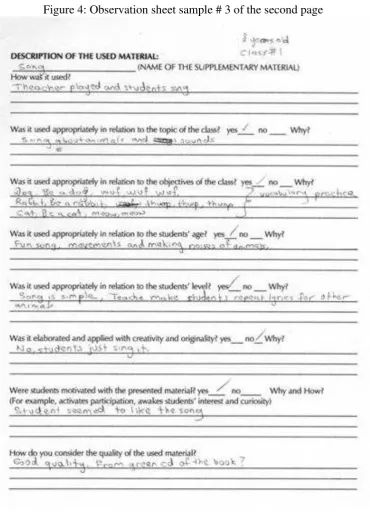
A total of six songs, from the companion CD, were played along with contents from the book. The songs were played during the first, third, fourth, fifth, seventh and ninth class observations.
of new vocabulary. The song told about a dog, a rabbit and a cat and about the sounds they make.
The song was simple, but the teacher developed the activity creatively. Each student was asked to repeat a verse with other animal, for example, a cow. This contributed for a fun activity which also grasped the interest of students. This activity also contributed for learning because, by learning the song, students were effectively adding to their knowledge of English.
In addition, the song was pertinent to the objective of the class because it taught children the pronunciation of animal names and their noises. The song was appropriate to the level of the group because it contained simple lyrics like “Be a dog, a dog says woof”, “Be a cat” and “Be a rabbit”; therefore students could understand and learn easily. In addition, the song was appropriate to the age of the group because it had a
catchy melody, which attracted the children’s attention.
This song was effective for learning because it was clearly written to grasp the interest of the children; it was fun to learn and repeat outside the class. It was also effective because it trained the children’s hearing skills, therefore contributing to
learning (Nikolov, 2009).
The next song was played during the third class; it was about “Numbers”. The
objective of the exercise was to practice counting in English from 1 to 10. The song was about counting from 1 to 10 along with actions like clapping, finger snapping and feet stomping.
participation, by following the actions in the song and by repetition (Mercer& Candlin, 2000).
The song was pertinent to the objectives because it emphasized practicing the pronunciation of numbers and other vocabulary. The song was appropriate to the level of the group because it had simple lyrics, including actions in imperative form. It was appropriate for the age of the group because it was fun and required participation; this made it an attractive and joyful activity for children.
This song was effective for learning by allowing children to practice numbers’
pronunciation and other topics like counting and body movements. Therefore, children learned different things in a single activity. For example, children learned the
relationship between numbers, counting and doing a movement for certain number of repetitions. Students improved their speaking skills by repeating the song and their listening skills by following the actions; this is a natural approach (Brumfit, Pincas & Broughton, 1978).
The next song was played during the fourth class. The objectives for this class were to learn about “Numbers” and “Colors”. The objective of the exercise was to practice the pronunciation of colors. For example, some of the lyrics were “1, 2, 3, 4 red apples” and “1, 2blue balloons”. Some of the colors were: green, yellow, red, orange, pink and blue.
This song was used creatively for practicing numbers and colors. However, it was a less attractive activity for children and it did not seem to awake their interest as the previous song did.
repeated indefinitely for any color. It was fun and it was simple; therefore it was
appropriate as a children’s song.
Although this was simpler than previous songs, it still contributed to learning by requiring the participation of students and by direct practice of simple English (Nikolov, 2009).
The next song was played during the fifth class. The topic of the class was
“Vehicles”. The objective for this class was to learn about vehicles and colors. The objective for the exercise was to practice the new vocabulary and to learn about mixing basic colors to obtain other colors.
This song was interesting and creatively used by the teacher. The students seemed to like the song and they discussed about their favorite vehicles, for example, they talked about bicycles, go-carts and skateboards.
The material was pertinent to the objective of the class because it dealt with vehicles and colors. In addition, even though the author considers that the song was a little more complex than previously observed songs, it was still simple enough for the students’ level and it was a fun children’s song appropriate for their age.
The song was effective for teaching because children enjoyed the activity of singing and discussing about vehicles. By grasping their attention, the song effectively awoke their interest in the topic, which contributed for learning because they made use of their English skills to discuss their interests.
The song was pertinent to the exercise’s objective because the students learned about many farm animals; some of these were: horses, sheep, hens, cows, ducks and pigs. The song was appropriate as a children’s song because it grasped their attention and it was fun. It was also appropriate to the students’ level because it was simple, even though it was noticeable more complex than previous songs because it included more complex lyrics.
In a similar way than previous songs, there was contribution to learning because students practiced new vocabulary directly. The song was also effective for learning because it involved the participation of the students when they started talking about their favorite animals.
The last song observed for this group was played during the ninth class; in the tenth class a cooking activity took place. The topic of the class was “Fruits” and “Colors”. However, the song was about“Shapes”. The song told names of shapes and the number of sides for these shapes.
The song developed on the previous topic of “Numbers” and it was pertinent to
the exercise’s objective because it taught about different shapes and the shapes of objects. The song was also appropriate to the group’s level because it consisted of
simple lyrics.
The teacher did not make use of this material creatively. The song was simple and students did not seem to be interested. A better approach would have been to include realia objects like miniatures or to ask the students to talk about objects that they liked and about their shapes.
However, the song was effective for teaching about shapes because it taught
rectangle”. The song also dealt with numbers, “A square has four sides”. This song was also effective because it allowed the students to reinforce previous content.
The songs played through the class sessions came from the companion CD of the student pack that was used in this institution. They were well recorded, with native speaking actors, nice music and clear quality sound. The teacher played them a few times so that the students could listen and learn. The exercises that made use of the songs mostly involved students singing along.
Stories
Besides the songs, the companion CD also included stories; these were played during two of the class sessions. The first story was played during the third class. The topic and objective of the class were related to “Numbers”. The objective of the exercise was to practice counting along with other actions and vocabulary. The story told about a birthday, where a mother and her children talked about a boy’s party, his age, and the number of candles and gifts.
The story was not used creatively by the teacher. Students should have been asked to participate by talking about their own birthday parties; this would have awakened their interest in the activity.
The story was relevant to the exercise’s objective because it taught about using numbers for different things, for example, by referring to quantities and age. The material was also appropriate for the students’ age because the story used simple sentences for describing the scene.
The second story was played during the seventh class. The topic and objective
of the class were related to “Colors”. The objective of the activity was to practice listening along with reading skills; students read the story from the textbook. There was also additional content in the form of questions with positive and negative answers. The story consisted of two children talking about which fruits they like, their shape, colors and taste.
This story was not used creatively neither. The teacher should have involved the students more by asking them about their favorite fruits or food. However, the material was relevant because the story included practice for questions and answers like “Is the apple red?”, “Do you like apples?”or “Apples are sweet”. As with previous materials, the students practiced new topics along with previous topics. The material was also appropriate because the questions and answers were simple and introductory; this simplicity was adequate for their level.
As with the first story used for this group, this second story also contributed to learning by allowing direct use of the language through reading and speaking (Dean, 1999). For both occasions in which stories were played, the teacher asked the students to listen carefully. Then, the students worked in exercises from the book. By
combining stories with written exercises from the textbook, the students learned more effectively because they made use of their different language skills.
Regarding quality, the stories also came in the companion CD of the student pack; therefore they had the same features as the songs. They were well made, with quality voice acting, background music and clear sound.
Movies
in a computer animated movie for all ages. The teacher had informed the students about this activity previously because different age groups arrived at the same time. The whole movie was played and at some instances the teacher would stop the movie to make remarks about the film.
The movie was not used creatively by the teacher. The students watched and they were asked to work on a short homework based on the movie. The teacher should have included interactivity by asking the students questions throughout the movie or by including activities which related to topics from other class sessions. However, students did enjoy the movie, but it was too much information for effectively learning
vocabulary or other information.
The movie was not pertinent to any perceived topic or objective. Also, the assignment given by the teacher did not directly develop on previous material. In addition, the movie was not appropriate to the knowledge of the students because it contained real dialog in American English, which was too advanced for their level.
This movie did not contribute for learning because, as stated previously, it was too advanced as a source of audiovisual material. Although the movie contained real dialog, which is beneficial for learning, shorter video clips would have been a better option.
The film was shown in a DVD, therefore the quality was excellent. Also, the play took place in the multimedia room, where every student could easily listen and watch.
Objects
These were used during the activity for making a recipe written on the whiteboard. The activity had been coordinated previously and the students brought some of the materials while the teacher brought the rest.
Because the activity was leisure oriented, it did not directly involve developing contents from previous topics. Instead it was purely oriented to following the recipe and the instructions given by the teacher; therefore the activity was not pertinent to any topic. However, the author considers that there was appropriateness for the level of the group and as a children’s activity. This is because the instructions were simple and the socialization was fun for the children.
The activity was well prepared but it was not creative. The teacher made appropriate use of the realia as a supplementary material for the activity. The students also seemed interested and liked the change of pace and environment; they were very participative. However, the topic of the activity limited the variety of realia to food and simple cooking tools, therefore students could not be involved into more creative activities.
In addition, the realia did not contribute to learning because the objects were not used to teach new topics or concepts. The objects were only used as part of the activity, but not for developing interest in the language. For example, a more appropriate use of realia would have been short theatrical plays which made use of realia for role playing.
Learning Styles
The use of posters involved visual and auditory learning styles. The students learned visually by matching the images or labels to their pronunciation. The auditory learning took place when the teacher pronounced the statements for repetition,
instructions or questions while the students listened carefully in order to work on an exercise or for repeating.
Similar to the posters, the use of the whiteboard involved visual and kinesthetic learning styles mainly. During the observations, the teacher used the board to write down exercises or content for class. The students learned visually by observing or analyzing (reading) the text and drawings. Additionally, they applied kinesthetic learning styles by working on the exercises based on written instructions.
The songs and stories involved auditory learning styles mainly. The teacher played songs that students could listen or sing along. Additionally, some songs included actions, such as dancing steps or body movements; this can be considered kinesthetic learning, but it was not emphasized. The exercises for the stories involved listening and subsequently working on a task given by the teacher, for example, a short dialog. Finally, the students also worked with exercises from the book intended for being completed after listening to these audio materials.
The movie involved audiovisual learning. Students learned by carefully
watching, listening to the dialog and sounds while they saw characters’ actions. There was little intervention by the teacher, who would only stop the movie to give the students clarification or to refer to some aspect of the movie.