Comparison of combined spinal and
general anesthesia block and combined epidural and
general anesthesia block in laparoscopic cholecystectomy
Patricia Calvo-Soto,* Benjamín Trujillo-Hernández,** Alicia Martínez-Contreras,** Clemente Vásquez***
** Departamento de Anestesiología y **Unidad de Investigación en Epidemiología Clínica, Instituto Mexicano del Seguro Social, Hospital General de Zona y Medicina Familiar No. 1 de Colima,
***Centro Universitario de Investigaciones Biomédicas, Universidad de Colima. ARTÍCULO ORIGINAL
ABSTRACT
Objective. Combined spinal and general anesthesia block (CSGAB) and combined epidural and general anesthesia block (CEGAB) in laparoscopic cholecystectomy were compared.
Material and methods. Forty patients were randomly se-lected (ASA physical status I-II) to receive sevoflurane plus 10 to 15 mg of bupivacaine weighed at 0.5% and 20 µg of fenta-nyl (CSGAB) or sevoflurane plus 150 mg of ropivacaine and 1 µg/kg of fentanyl (CEGAB). Blood pressure, heart rate, oxy-gen and carbon dioxide saturation, drug doses and sevoflu-rane MAC (minimum alveolar concentration) were evaluated during surgery. Anesthesia recovery time and pain intensity and duration were evaluated during the first two postopera-tive hours. Frequency of incisional or referred pain, dyspnea, headache, cramping, nausea and vomiting were evaluated 24 hours after surgery. Statistical analysis was carried out using the Chi-square test and Student t test. Relative risk, absolute risk reduction and number needed to treat (NNT) for adverse reactions were determined. Results. Systolic and diastolic ar-terial pressures posterior to semi-Fowler’s position were lower in the CSGAB group than in the CEGAB group. (94 ± 16 vs. 110 ± 18 mmHg; p < 0.01 and 59 ± 8 vs. 69 ± 12, mmHg; p < 0.01, respectively). Anesthesia recovery time (32 ± 17 vs. 61 ± 29 minutes; p < 0.01) and pain duration (26 ± 42 vs. 83 ± 46 minutes; p < 0.01) were shorter in the CSGAB group. NNT was 8 for postoperative pain, 8 for nausea, and 95 for vomiting. Conclusions. CSGAB was more efficacious for rapid anesthesia recovery and had a shorter post-operative pain du-ration than CEGAB.
Key words. Cholecystectomy. Laparoscopy. General anes-thesia. Epidural anesanes-thesia. Spinal anesanes-thesia.
Comparación de la combinación de anestesia general y bloqueo espinal con anestesia general y bloqueo epidural en colecistectomía laparoscópica
RESUMEN
Objetivo. Comparar la combinación de anestesia general y bloqueo espinal (CAGBE) con anestesia general y bloqueo epi-dural (CAGBEP) en colecistectomía laparoscópica. Material y métodos. 40 pacientes fueron aleatoriamente selecciona-dos (condición física ASA I-II) para recibir sevoflurano, 10-15 mg de bupivacaina 0.5% y 20 µg de fentanil (CAGBE) o sevoflurano, 150 mg de ropivacaina y 1 µg/kg de fentanil (CAGBEP). Durante la cirugía se evaluaron: presión sanguí-nea, frecuencia cardiaca, saturación de oxígeno y dióxido de carbono, dosis de fármacos y concentración alveolar mínima de sevoflurano. Durante las primeras 2 h postoperatorias se evaluaron: tiempo de recuperación de anestesia e intensidad y duración del dolor. Veinticuatro horas después de la cirugía se evaluaron: frecuencia de dolor referido o incisional, disnea, ce-falea, cólicos, nausea y vómito. Se utilizaron las pruebas de Ji cuadrada y t de Student. Para los efectos adversos se calcula-ron riesgo relativo, reducción absoluta del riesgo y número necesario a tratar (NNT). Resultados. Las presiones sistóli-ca y diastólisistóli-ca después de la posición semi-Fowler fueron más bajas en el grupo CAGBE que en el grupo CAGBEP (94 ± 16 vs. 110 ± 18 mmHg; p < 0.01 y 59 ± 8 vs. 69 ± 12 mmHg; p < 0.01, respectivamente). El tiempo de recuperación de la anestesia (32 ± 17 vs. 61 ± 29 minutos; p < 0.01) y la dura-ción del dolor (26 ± 42 vs. 83 ± 46 minutos; p < 0.01) fueron menores en el grupo CAGBE. El NNT fue 8 para el dolor postoperatorio, 8 para náusea y 95 para vómito. Conclusio-nes. La CAGBE presentó una pronta recuperación de la anestesia y una menor duración del dolor postoperatorio que la CAGBEP.
INTRODUCTION
Previous studies have demonstrated that regional anesthesia (epidural or spinal) reduces surgical stress, morbidity and postoperative mortality.1-3
In 1987 Yeager and colleagues showed there was a better postoperative evolution in patients who had been anesthetized with combined regional anesthesia than in those who had received only general anes-thesia.4 This finding sparked a series of studies in
which diverse anesthetic techniques were compared in different surgical procedures. The majority of these studies have compared regional anesthesia with general anesthesia and very few studies have evaluated regional anesthesia combined with general anesthesia (RACGA). One of these studies was carried out by Davies and colleagues in patients undergoing aortic abdominal surgery. In this study, combined epidural and general anesthesia was com-pared with general anesthesia and postoperative morphine intravenous infusion, and both were found to be efficacious.5 In relation to laparoscopic
surgeries, regional anesthesia (RA) has been compa-red with general anesthesia (GA), specifically com-paring spinal block and intravenous general anesthesia with propofol6 or desflurane.7 The first
technique was found to be an effective alternative method.
These studies, however, were carried out in am-bulatory gynecological laparoscopic procedures. Lu-chetti et al, carried out a study in laparoscopic cholecystectomy which compared the combination of general anesthesia and regional anesthesia with in-travenous anesthesia, and demonstrated that the former procedure was safe and more effective in the control of postoperative pain.8 Another study
compared three anesthetic techniques in laparosopic cholecystectomy:
• Anesthesia with isoflurane.
• Anesthesia with isoflurane plus fentanyl.
• Anesthesia with isoflurane plus epidural anesthe-sia with lidocaine.
This study demonstrated that the hemodynamic changes were better in groups 2 and 3.9 A more
re-cent study evaluated the response to surgical stress comparing three anesthetic techniques:
• General anesthesia with sevoflurane.
• General anesthesia with sevoflurane plus fentanyl. • General anesthesia with fentanyl plus epidural
anesthesia with mepivacaine.
This study showed hormonal levels to be lower in the combined anesthetic techniques.10 Motivated by
demonstrations of the effectiveness of combined anesthesia, the present study was designed to com-pare, for the first time, according to our knowledge, two anesthetic techniques in patients undergoing laparoscopic cholecystectomy: combined spinal and general anesthesia block (CSGAB) and combined epidural and general anesthesia block (CEGAB). The principal objective of this study was to compare these two anesthetic techniques in terms of their transoperative (and immediate postoperative) hemo-dynamic changes, as well as the frequency of their immediate and 24-hour postoperative adverse symptoms.
MATERIAL AND METHODS
A controlled simple-blind clinical trial was ca-rried out in patients programmed for laparascopic cholecystectomy at the General Surgery Service of the Zone General Hospital #1 IMSS, Colima, Coli-ma, Mexico. Forty patients aged 20 to 60 years with ASA physical status I-II were studied. Patients with a history of allergy, coagulopathy, spinal surgery, heart disease and pregnancy were excluded from the study. The project was approved by the local ethics committee and participants gave their informed con-sent in writing. Patients were randomly assigned to one of two treatment groups: Group 1) Combined spinal and general anesthesia block (CSGAB) and Group 2) combined epidural and general anesthesia block (CEGAB).
All patients were infused with 1000-1500 mL Hartmann’s solution warmed to 37 °C through a 16-gauge intravenous cannula over a period of 15 mi-nutes. Diclofenac 75 mg IM, ranitidine 50 mg IV, ondansetron 8 mg IV, midazolam 50 µg/Kg IV and fentanyl 2 µg/kg IV were also administered.
Regional anesthesia
for 5 to 8 minutes and then placed in a supine posi-tion. Sensory block level was determined bilaterally by needle prick. Sensorial block level was considered adequate when at the T4 level.
CEGAB patients were placed lying down on their left side and an epidural block was applied in the L2-L3 space. The lumbar perforation was performed with a 16 caliber Tuohy needle. Epidural solution was made up of the following mixture: 150 mg of 0.5% ropivacaine plus 1 µg/kg of fentanyl. After ne-gative cerebrospinal fluid aspiration, 21-22 mL of the anesthetic solution mixture was administered through the epidural needle in a time frame of 120 to 180 seconds. After the Tuohy needle was remo-ved, a 20 caliber epidural catheter was inserted and secured in place. Sensorial block level was determi-ned by needle prick.
General anesthesia
Anesthesia was induced in both treatment groups with 5 mg/kg of thiopental infused in 60 seconds. Once there was no blink reflex, 70 µg/kg of vecuro-nium was administered to facilitate endotracheal intubation. The patient was intubated and the admi-nistration of sevoflurane mixed with oxygen at 100% was begun. Sevoflurane potency was quantified in each patient by minimum alveolar concentration (MAC).
Surgical procedure
Each patient was placed in a supine position. In order to produce pneumoperitoneum, a Veress nee-dle was introduced in the supraumbilical region. The abdominal cavity was immediately insufflated with 2 to 4 liters of carbon dioxide until obtaining intra-abdominal pressure between 12-15 mmHg. The first umbilical trocar was then put into place and a laparoscopy of the abdominal cavity was performed. After this the patient was placed in the semi-Fowler’s position with a right shoulder elevation of 45°. The rest of the trocars were then put into place and the surgical procedure was begun.
Before surgery (basal figures) and every 5 minu-tes thereafter until extubation, blood pressure, heart rate and oxygen saturation were determined with a monitor (General Electric Medical Systems® Mod
Dash 4000. Milwaukee, WI 53223, USA) in all pa-tients. However, for the present study we were only interested in these variables in the following pe-riods: basal, post- general anesthesia, post- pneumo-peritoneum, semi-Fowler’s position and
post-immediate extubation (first 5 minutes). Arterial hypotension was considered present when mean blood pressure diminished 30% from the base-line fi-gures. Carbon dioxide determination was begun in the post-pneumoperitoneum, and the periods evalua-ted in the two groups were post-pneumoperitoneum and post-semi-Fowler’s position.
Anesthesia recovery time was determined from the moment of extubation and it was quantified in minutes.
Once the patient had recovered from the anesthe-sia, the intensity and duration of pain was determi-ned within the first two postoperative hours. Pain intensity in those first two hours was determined by the visual analogous pain scale on a scale of 0 to 10 (0 = absence of pain and 10 = maximum pain). The presence of adverse reactions such as incision pain, referred pain, nausea, vomiting, headache, dyspnea, odynophagia, tenesmus and abdominal cramping 24 hours after surgery were determined as present or absent.
Statistical analysis
Means, standard deviation and percentages were used. Qualitative variables such as presence or ab-sence of hypotension, degree and intensity of pain, nausea, vomiting, headache, dyspnea, abdominal cramping and sevoflurane MAC (%) were determi-ned in percentages and the comparison between both groups was carried out using the Chi-square test (χ2) with the Yates correction or the Fisher
exact test. The comparison of blood pressure, heart rate and oxygen and carbon dioxide saturation ave-rages between both treatment groups was analyzed using the Student t test (equal variance) or Mann-Whitney U test (different variance). Quantitative va-riables such as amount of anesthetics, anesthesia recovery time and duration of pain were analyzed using the Student t test (equal variance) or Mann-Whitney U test (different variance).
Relative risk (RR), Absolute risk reduction (ARR), Reduced relative risk (RRR) and Number needed to treat (NNT)for each of the reactions were also determined for each of the adverse reactions.
A confidence interval of 95% was used in all sta-tistical tests and significance was considered when P < 0.05.
RESULTS
of 70.2 ± 12.4 kg (41 to 107 kg interval) and height of 1.58 ± 0.05 m were studied. As shown in table 1, pa-tient demographic characteristics were similar in both groups.
In relation to the amount of anesthetics adminis-tered, vecuronium means used in Groups 1 and 2 were similar (5.4 ± 1.2 mg versus 5.3 ± 1.2 mg, P
= 0.7, Student t test). Fentanyl dose was less in Group 1 than in Group 2 (223 ± 40 µg versus 286 ± 55, P < 0.01, Mann-Whitney U test). Minimum alveolar concentration (MAC) for sevoflurane was as follows for both groups, respectively: MAC1, 90% (n = 18) versus 35% (n = 7), χ2 = 10.6, P < 0.01;
MAC 1.5, 10% (n = 2) versus 30% (n = 6), χ2 = 1.4,
Table 1. Demographic characteristics of both treatment groups.
Characteristics CSGAB CEGAB P
n = 20 n = 20
Age in years ± SD 39± 11 39± 12 0.9*
Weight in Kg ± SD 69± 10 70± 14 0.7
Height in meters ± SD 1.3± 0.4 1.4± 0.5 0.4
ASA physical status I% 65 55 0.5**
ASA physical status II% 35 45 0.5**
CSGAB: combined spinal general anesthesia block. CEGAB: combined epidural general anesthesia block. SD: standard deviation. P: statistical significance. * Student ttest . ** Chi-square test.
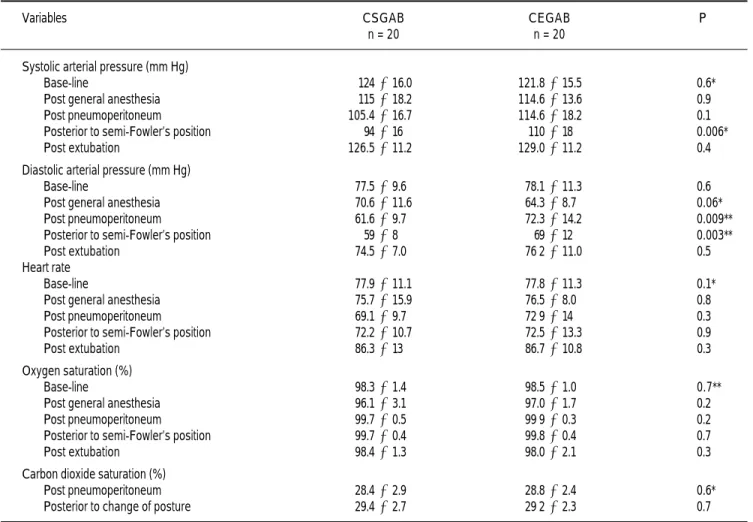
Table 2. Mean and standard deviation, together with statistical significance of difference among groups.
Variables CSGAB CEGAB P
n = 20 n = 20
Systolic arterial pressure (mm Hg)
Base-line 124± 16.0 121.8± 15.5 0.6*
Post general anesthesia 115± 18.2 114.6± 13.6 0.9
Post pneumoperitoneum 105.4± 16.7 114.6± 18.2 0.1
Posterior to semi-Fowler’s position 94± 16 110± 18 0.006*
Post extubation 126.5± 11.2 129.0±11.2 0.4
Diastolic arterial pressure (mm Hg)
Base-line 77.5± 9.6 78.1±11.3 0.6
Post general anesthesia 70.6± 11.6 64.3± 8.7 0.06*
Post pneumoperitoneum 61.6± 9.7 72.3± 14.2 0.009**
Posterior to semi-Fowler’s position 59± 8 69± 12 0.003**
Post extubation 74.5± 7.0 76 2± 11.0 0.5
Heart rate
Base-line 77.9± 11.1 77.8± 11.3 0.1*
Post general anesthesia 75.7± 15.9 76.5± 8.0 0.8
Post pneumoperitoneum 69.1± 9.7 72 9± 14 0.3
Posterior to semi-Fowler’s position 72.2± 10.7 72.5± 13.3 0.9
Post extubation 86.3± 13 86.7± 10.8 0.3
Oxygen saturation (%)
Base-line 98.3± 1.4 98.5± 1.0 0.7**
Post general anesthesia 96.1± 3.1 97.0± 1.7 0.2
Post pneumoperitoneum 99.7± 0.5 99 9± 0.3 0.2
Posterior to semi-Fowler’s position 99.7± 0.4 99.8± 0.4 0.7
Post extubation 98.4± 1.3 98.0± 2.1 0.3
Carbon dioxide saturation (%)
Post pneumoperitoneum 28.4± 2.9 28.8± 2.4 0.6*
Posterior to change of posture 29.4± 2.7 29 2±2.3 0.7
P = 0.2 and MAC 2, 0% versus 35% (n = 7), χ2 = 6.2,
P < 0.01.
As shown in table 2, CSGAB patients had lower figures for systolic and diastolic pressures after change of posture and pneumoperitoneum. There was hypotension in 47.5% (n = 19) of the patients, but percentage comparison between the two groups was not statistically different (CSGAB n = 9 [47.5%] versus CEGAB n = 10; [50%], χ2 = 0.1; P = 0.7).
The remaining parameters, such as oxygen satura-tion and heart rate, were similar in both groups during the basal, post-general anesthesia, post- posi-tion change, post-pneumoperitoneum and post-extu-bation periods (Table 2).
In relation to immediate postoperative pain (2 hours), the pain median was 0.9 (on a scale of 0 to 6). Twenty-two (55%) of the patients did not pre-sent pain and percentage comparison between both procedures showed no significant differences (CS-GAB n = 13 [65%] versus CE(CS-GAB n = 9; [45%],
χ2 = 1.6; P = 0.2). Twelve point five percent (n = 5)
of the patients presented a pain scale evaluation of 2 and there was no significant difference in the
percentage comparison of the two groups (CSGAB n = 2 [10%] versus CEGAB n = 3; [15%], χ2 = 0.2;
P = 0.6). Thirty-two point five percent (n = 13) of the patients presented a pain scale evaluation of 3 or more, and no significant difference in the percen-tage comparison of the two groups (CSGAB n = 5 [25%] versus CEGAB n = 8; [40%], χ2 = 1; P= 0.3)
was found. However, pain duration was shorter in the CSGAB group than in the CEGAB group (26 ± 42 versus 83 ± 46 minutes, P < 0.001, Student ttest). Anesthesia recovery time was statistically shorter in the CSGAB group than in the CEGAB group (32 ± 17
versus 61 ± 29 min, P = 0.002, Mann-Whitney
U test).
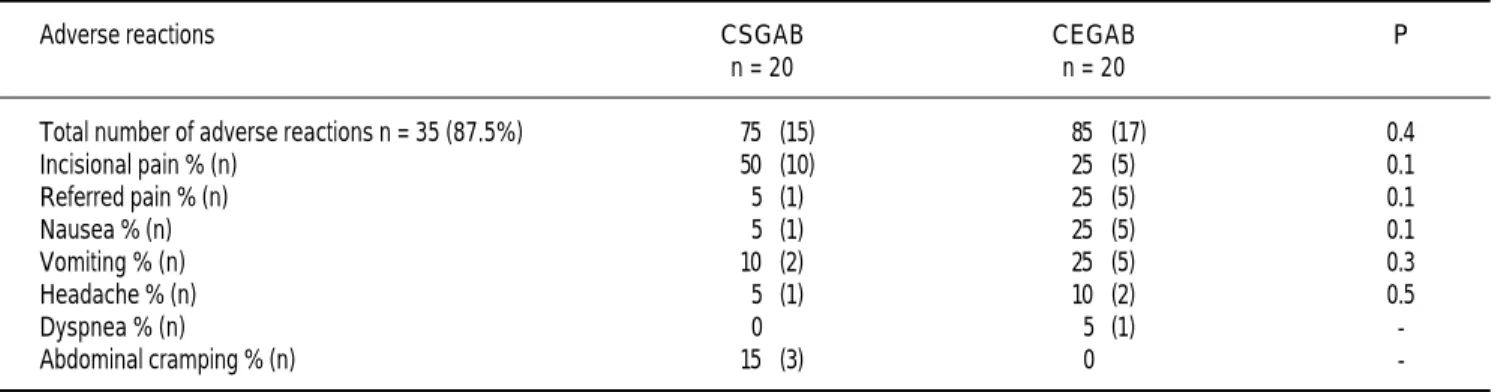
There were adverse reactions in 87.5% (n = 35) of the patients, but there was no statistical differen-ce in the perdifferen-centage comparison of the two groups (CSGAB n = 15 [75%] versus CEGAB n = 17; [85%], χ2 = 0.6; P = 0.4). Incision pain was the
most frequent reaction and was found in 37.5% (n = 15) of the patients. Table 3 shows there was no sig-nificant difference in the reaction percentages of the two treatment groups.
Table 3. Adverse reaction percentage comparison between both treatment groups.
Adverse reactions CSGAB CEGAB P
n = 20 n = 20
Total number of adverse reactions n = 35 (87.5%) 75 (15) 85 (17) 0.4
Incisional pain % (n) 50 (10) 25 (5) 0.1
Referred pain % (n) 5 (1) 25 (5) 0.1
Nausea % (n) 5 (1) 25 (5) 0.1
Vomiting % (n) 10 (2) 25 (5) 0.3
Headache % (n) 5 (1) 10 (2) 0.5
Dyspnea % (n) 0 5 (1)
-Abdominal cramping % (n) 15 (3) 0
-CSGAB: combined general spinal anesthesia block. CEGAB: combined general epidural anesthesia block. P: statistical significance.
Table 4. Postoperative clinical manifestations.
Symptom RR ARR RRR % NNT
95% CI
Pain (during the first hours after surgery) 0.5 (0.14-1.6) –0.12 –0.7 8 Pain (24 hours after surgery) 0.2 (0.0 - 1.7) – 0.1 – 4 9
Hypotension 0.8 (0.2 - 2.7) – 0.03 – 0.1 9
Nausea 0.3 (0.05-1.2) – 0.15 – 2 8
Vomiting 0.6 (0.08 - 3.1) – 0.05 – 0.6 95
Headache 1 (0.01 - 80) – 0.05 – 0.6 9
Dyspnea 0 (0.0 - 39) – 0.02 0 9
Cramping 3 (0.2-170) 0.05 0.06 200
Table 4 shows the absolute risk reduction (ARR), the relative risk (RR) and the number needed to treat (NNT). In accordance with postoperative clini-cal manifestations (at 2 and 24 hours), the NNT for spinal block to avoid pain was 8, while it was neces-sary to treat 200 patients to avoid cramping.
DISCUSSION
Our study showed that patients treated with CS-GAB had a decrease in anesthetic requirements of fentanyl as well as sevoflurane MAC. Systolic and diastolic pressures and heart rate were similar in both groups. These variables have been studied previously in this type of surgery with epidural block and general anesthesia with isoflurane. Ade-quate stability was reported in the group treated with epidural block.9 However, some differences
were noted in our study, especially at key moments such as the change to the semi-Fowler’s position during laparoscopy. At this moment the CSGAB group maintained the lowest systolic and diastolic pressures and greater stability. This could proba-bly be explained by the inability of the epidural anesthesia to completely attenuate the stress res-ponse, especially by the cortisol pathway, due to in-complete block of the phrenic nerves that can transport noxious surgical stimuli to the central nervous system.10
Another controversial adverse effect in using spi-nal block is hypotension. This was found in both groups of the present study and with a frequency si-milar to that reported by other authors.11
A significant difference was found in various as-pects of postoperative conditions, such as anesthesia recovery time, which was significantly shorter in the CSGAB group, in concordance with previous stu-dies.6,7 As is known, any type of anesthesia can be
associated with adverse effects such as nausea and vomiting. In this study, nausea and vomiting were less frequent in the CSGAB group, which probably has to do directly with anesthetic requirements, sin-ce by using a lower dose of narcotics as well as halo-genated agents, consciousness level is recovered more quickly and secondary effects such as nausea and vomiting diminish.
The only difference found in pain was its dura-tion. It was shorter in the spinal block group and these results are similar to those found in previous studies.7,12
Our results were similar to those found in other studies in relation to type of pain. Incision pain was the most frequent.13-15 Referred pain was more
fre-quent in the CEGAB group and has been related to pneumoperitoneum pressure.16
Among the contributions of this work are the comparison of two anesthetic techniques which, ac-cording to our knowledge, had not been reported in laparoscopic cholecystectomy, the utilization of anesthetic medicaments, the evaluation of transope-rative hemodynamic characteristics and postoperati-ve adpostoperati-verse reactions to help the physician decide between one procedure and another.
CONCLUSION
The results of the present study show both combi-ned techniques (CSGAB and CEGAB) to be safe and efficacious, but show CSGAB to have a faster reco-very from anesthesia, less frequent nausea and vomi-ting and a shorter duration of postoperative pain.
ACKNOWLEDGMENTS
To Instituto Mexicano del Seguro Social and CO-NACyT by scholarship provided to Patricia Calvo-Soto.
REFERENCES
1 . Rigg JRA. Does regional block improve outcome after sur-gery? Anaesth Intensive Care 1991; 19: 404-11.
2 . Liu S, Carpenter RL, Neal JM. Epidural anesthesia and analge-sia: their role in postoperative outcome. Anesthesiology 1995; 82: 1474-506.
3 . Rigg JRA, Jamrozik K, Myles PS, Silbert BS, Peyton PJ, Par-sons RW, et al. Epidural anaesthesia and analgesia and outco-me of major surgery: a randomised trial. Lancet 2002; 359: 1 2 7 6 - 8 2 .
4 . Yeager MP, Glass DD, Neff RK, Brinck-Johnsen T. Epidural anesthesia and analgesia in high risk surgical patients.
Anesthe-siology 1987; 66: 729-36.
5 . Davies MJ, Silbert BS, Money PJ, Dysart RH, Meads AC. Com-bined epidural and general anaesthesia for abdominal aortic surgery: a prospective randomised trial. Anaesth Intensive Care 1993; 21: 790-4.
6 . Stewart AV, Vaghadi H, Collins L, Mitchell GW. Small-dose selective spinal anaesthesia for short-duration outpatient gy-naecological laparoscopy: recovery characteristics compared with propofol anaesthesia. Br J Anaesth 2001; 86: 570-2. 7 . Lennox PH, Vaghadia H, Henderson C, Martin L, Mitchell
GW. Small-dose selective spinal anaesthesia for short-duration outpatient laparoscopy:recovery characteristics compared with desfluorane anaesthesia. Anesth Analg 2002; 94: 346-50. 8 . Luchetti M, Palomba R, Sica G, Massa G, Tufano R.
Effective-ness and safety of combined epidural and general anesthesia for laparoscopic cholecystectomy. Reg Anesth 1996; 21: 465-9. 9. Yokoyama M, Ohta Y, Hirakawa M, Tsuge H. Hemodynamic
changes during laparoscopic cholecystectomy under different anesthesia methods. Masui 1996; 45: 160-6.
11. Folsgaard SL, Hemmingsen C, Frey-Larsen SE, Jacobsen E. Complications of spinal anesthesia compared to general anes-thesia. A prospective study of 408 consecutive orthopedic pa-tients. Ugeskt Laeger 1993; 155: 1199-202.
12. Lennox PH, Chilvers C, Vaghadia H. Selective spinal anaesthe-sia versus desflurane anestheanaesthe-sia in short duration outpatient gy-necological laparoscopy: a pharmacoeconomic comparison.
Anesth Analg 2002; 94: 565-8.
13. Bisgaard T, Kehlet H, Rosenberg J. Pain and convalescence after laparoscopic cholecystectomy. Eur J Surg 2001; 167: 84-96. 14. Lee IO, Kim SH , Kong MH, Lee MK, Kim NS, Choi YS, et al.
Pain after laparoscopic cholecistectomy: the effect and timing of incisional and intraperitoneal bupivacaine. Can J Anaesth 2001 ; 48: 545-50.
15. Noma H, Kakiuchi H, Nojiri K, Izumi R, Tashiro C. Evalua-tion of postoperative pain relief by infiltraEvalua-tion of bupivacaine or epidural block after laparoscopic cholecystectomy. Masui 2001; 50: 1201-04.
1 6 . Bisgaard T, Klarskov B, Kristiansen VB, Callesen T, Schulze S, Kehlet H, et al. Multi-regional local anesthetic infiltration
during laparoscopic cholecystectomy in patients receiving prophylactic multi-modal analgesia: a randomized, double-blinded, placebo-controlled study. Anesth Analg 1999; 89: 1 0 1 7 - 2 4 .
Reimpresos:
Dr. Clemente Vásquez
Centro Universitario de Investigaciones Biomédicas Universidad de Colima
Av. 25 de Julio No, 965 Col. Villa de San Sebastián 28040, Colima, Col.
Phone: + 52 (312) 3161129, Ext.: 47457 Fax: + 52 (312) 3161129, Ext.: 47452 Correo electrónico: [email protected] [email protected]