and
Work
BACKGROUND 1
1.1 Introduction 1
1.2 Mental health problems and their prevalence 1 1.3 Factors that affect the prevalence of mental health problems 2 1.4 Association between mental health and physical health 2
1.5 Treatment and outcomes 2
1.6 The impact and cost of mental health problems 3 1.7 Mental healthcare in the 21st Century 6
WORKANDTHESTIGMAOFMENTALILLHEALTH 7
2.1 Mental ill health as a cause of stigma 7 2.2 Stigma and the employment process 7 2.3 Stigma and discrimination in the workplace 9
MENTALHEALTHANDEMPLOYMENT 11
3.1 The impact of mental ill health on performance at work 11 3.2 Common mental disorders and sickness absence 11 3.3 Return to work after sickness absence 14
MENTALHEALTHPROBLEMSANDWORKLESSNESS 15
4.1 The impact of mental illhealth on employment rates 15 4.2 The effect of work and worklessness on mental health 16 4.2.1 Why work is important for mental health 17 4.3 Impact on the benefits system 18
SYSTEMS,SERVICESANDPOLICY 19
5.1 The benefits trap 19
5.2 Support in the workplace 20 5.2.1 Occupational health 20
5.2.2 Primary care 22
5.2.3 Specialist mental healthcare providers 22 5.2.4 Improving access to psychological therapies 23
5.3 Pathways to Work 23
5.4 Specialist provision for workless people with
severe mental illness 24
5.4.1 Policy 24
5.4.2 Support for work and employment for those with
6 THERESEARCHEVIDENCEABOUTWHAT WORKS 29
7
8
9
6.1. Interventions to reduce sickness absence 29 6.2. Specialist work schemes for people with severe mental illness 31
CONCLUSIONS 35
RECOMMENDATIONS 41
REFERENCES 45
APPENDIX 55
Evidence table of randomised controlled trials of work schemes
for people with severe mental illness. 55
Authors:
PaulLelliottandSimonTulloch,TheRoyalCollegeofPsychiatrists’ResearchandTrainingUnit
JedBoardman,TheSainsburyCentreforMentalHealth
SamHarveyandMaxHenderson,DepartmentofPsychologicalMedicine,KingsCollegeLondon,InstituteofPsychiatry
MartinKnapp,LondonSchoolofEconomicsandPoliticalScience
Contributions by:
CaroleFurnivall,FirstStepTrust
BobGrove,TheSainsburyCentreforMentalHealth
MatthewHotopf,DepartmentofPsychologicalMedicine,KingsCollegeLondon,InstituteofPsychiatry
SujithDhanasiri,EricLatimerandDavidMcDaid,LondonSchoolofEconomicsandPoliticalScience
background
1
1.1
Introduction
The Secretary of State for Health and the Secretary of State for Work and Pensions have asked Professor Dame Carol Black, National Director for Health and Work, to lead a review of the healthrelated factors that influence working life in Great Britain, and make recommendations. The review will inform policy and guide action in relation to health and employment.
The Review Team commissioned this supplementary report because mental health problems have a greater impact on people’s ability to work than any other group of disorders. Mental ill health affects the productivity of those in work by impairing their ability to function at full capacity and it causes about 40% of all days lost through sickness absence (Sainsbury Centre for Mental Health, 2007). It also accounts for 40% of those claiming Incapacity Benefit and 23% of new claimants of Disability Living Allowance.
1.2
Mental
health
problems
and
their
prevalence
People with mental health problems can be divided into three broad groups:
1. At any one time, onesixth of the working age population of Great Britain
experience symptoms associated with mental ill health such as sleep problems, fatigue, irritability and worry that do not meet criteria for a diagnosis of a mental disorder but which can affect a person’s ability to function adequately (Office for National Statistics, 2001).
2. A further onesixth of the working age population have symptoms that by virtue of their nature, severity and duration do meet diagnostic criteria (Office for National Statistics, 2001). These common mental disorders would be treated should they come to the attention of a healthcare professional. The commonest of these disorders are depression, anxiety or a mix of the two.
3. The most recent national survey found that about 0.5% of the population has a probable psychotic illness (Office for National Statistics, 2001) and the generally accepted estimate is that between 1% and 2% of the population will have a severe mental illness, such as schizophrenia, bipolar disorder or severe depression, which requires more intensive, and often continuing, treatment and care during their lifetime (Wing, 1994).
Although as a group those with a severe mental illness are more disabled than those with a common mental disorder, there is no clear cut relationship between diagnosis and disability at the individual level. A person with an anxiety disorder can be housebound and require intensive support from a carer whereas a person with schizophrenia can lead a normal life in all respects other than the subjective experience of their symptoms.
There was little change between 1993 and 2000 in the proportion of the population of working age that has mental health problems (Office for National Statistics, 2001). We will not know whether it has increased since then until the results of
1.3
Factors
that
affect
the
prevalence
of
mental
health
problems
Compared with those who do not have a disorder, people aged 16 to 74 with a common mental disorder are more likely to be women (59%) and to be aged between 35 and 54 (45% compared with 38%). They are also more often disadvantaged socially in that they are more likely to be separated or divorced (14% compared with 7%), to live alone (20% compared with 16%) or as a one parent family (9% compared with 4%), to have no formal qualification (31% compared with 27%), to come from Social Class V (7% compared with 5%) and to be a tenant of a local authority or a housing association (26% compared with 15%) (Singleton et al, 2000). Because of these associations, there are more people with mental health problems in areas of the country that have high levels of social and economic deprivation. This is reflected in greatly increased rates of presentation and treatment of mental disorders in both primary and secondary care in socially deprived areas and, in particular, in deprived inner city areas (Moser, 2001; Harrison et al., 1995). In keeping with this, rates of claims for Incapacity Benefits on grounds of mental and behavioural disorders are highest in urban areas (Oxford Economics, 2007)
1.4
Association
between
mental
health
and
physical
health
People with mental health problems are more likely to develop physical health problems and vice versa. Furthermore, people with mental health problems can present to their GP or employer complaining of physical symptoms that have no physical cause. This can sometimes lead to missed or delayed detection of the underlying mental health problem. The interaction between physical and mental health is complex and it is often difficult to determine the direction of causal relationships.
1.5
Treatment
and
outcomes
1.6
The
impact
and
cost
of
mental
health
problems
The World Health Organisation has calculated the number of years of life lost due to early death or disability caused by a range of health problems. It estimates that for the whole world mental health problems account for 13% of all lost years of healthy life (WHO, 2004) and as much as 23% in developed countries (Harnois and Gabriel, 2000).
The economic costs arise from two main sources:
1. The direct economic impacts of the behavioural or other consequences of mental health problems. This includes the effects of mental health symptoms on an individual’s ability to work (impacting on their income and national productivity), the effects on the ability of family members or other carer to work and the other ‘opportunity costs’ of unpaid care.
2. The responses of the care system (broadly defined) to those consequences including the healthcare treatments and services provided to alleviate symptoms and meet needs, services provided by other systems (such as social care, housing, employment support, criminal justice, education, leisure services, transport, and social security), and outofpocket expenses by the individual or family for treatments, services, or travel to services.
Table 1: Estimated annual costs to UK employers of mental ill health (Sainsbury Centre for Mental Health, 2007).
Costperaverage employee(£)
Totalcostto UKemployers (£billion)
Per cent of total
Absenteeism 335 8.4 32.4
Presenteeism 605 15.1 58.4
Turnover1 95 2.4 9.2
Total 1035 25.9 100
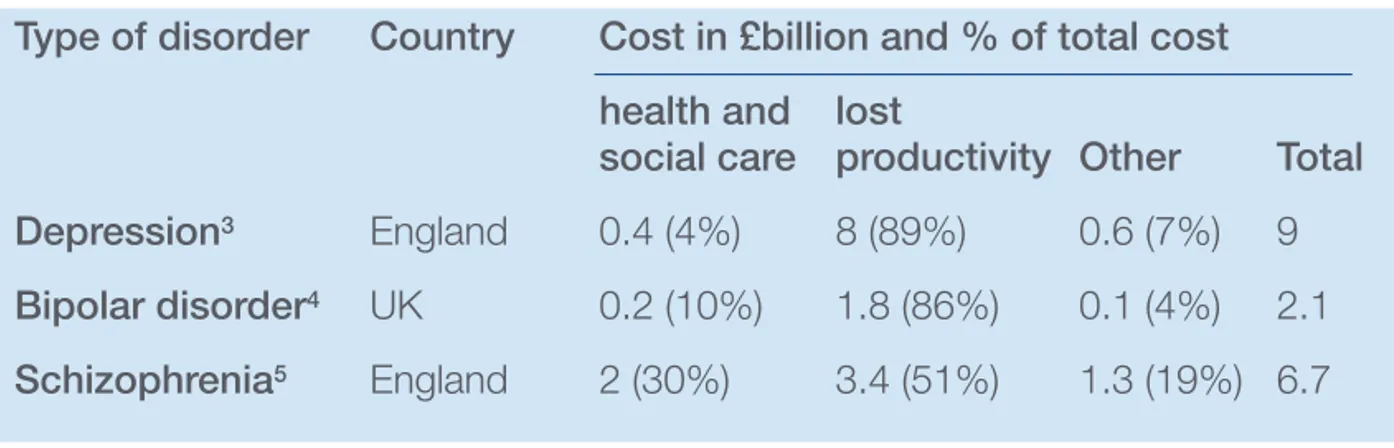
A number of other recent studies have made national cost estimates for particular disorders in both Great Britain and the USA. Although, due to methodological differences, these cannot be compared directly with one another, or with the estimates derived by the Sainsbury Centre, they all reach the same broad conclusions that overall costs are high and that a high proportion of costs are due to disrupted work patterns. None of these studies considered the costs of presenteeism.
Table 2: Estimated annual costs of specific disorders2
Typeof disorder Country Costin£billionand%of totalcost healthand lost
socialcare productivity Other Total Depression3 England 0.4 (4%) 8 (89%) 0.6 (7%) 9
Bipolardisorder4 UK 0.2 (10%) 1.8 (86%) 0.1 (4%) 2.1
Schizophrenia5 England 2 (30%) 3.4 (51%) 1.3 (19%) 6.7
1 The cost of replacing staff who leave their job due to a mental health problem
2 Due to methodological differences and differences in the date conducted, these studies cannot
be compared directly with one another or with the estimates derived by the Sainsbury Centre
The overall cost of depression in England in 2000 was estimated to be £9 billion (Thomas and Morris, 2003). More than £8 billion of this cost was due to lost productivity as a result of work days lost resulting in claims for incapacity benefits. This figure is 23 times larger than the estimated costs falling to the NHS, which were £8 million for primary care consultation, £51 million for secondary health care and £310 million for medication. Lost future lifetime earnings were estimated to be £562 million due to 2615 deaths associated with depression (most of them suicides).
There are few estimates of the overall costs of anxiety disorders globally (Andlin Sobocki and Wittchen, 2005), and none for the UK. However, studies in the USA point to the large employmentrelated impacts that generally outweigh health care expenditures (e.g. Rice and Miller, 1998; Greenberg et al., 1999). Absenteeism related costs exceeded health service costs for people with social phobia in Britain (Patel et al., 2002), and are also high for obsessive compulsive disorder (Knapp et al., 2000).
1.7
Mental
healthcare
in
the
21st
Century
In England, the first National Service Framework developed by the Department of Health was for the mental health needs of working age adults (Department of Health, 1999). Scotland and Wales have also produced policy frameworks (Scottish Executive, 2001; Welsh Assembly, 2002). These and subsequent implementation guidance set out a common set of principles and values that underpin modern mental healthcare. These are relevant to this report:
1. Those providing care should have a sense of therapeutic optimism. The goal of care should be to promote “recovery”6for people whose mental health problems
cause significant disability.
2. Services should promote social inclusion and work actively to counter the stigma and discrimination that people with mental health problems face from society, including in the workplace.
3. The care package should encompass the range of health, social and behavioural issues that affect people with mental health problems. To achieve this, services must work across the interfaces between agencies including healthcare, social care, housing and employment.
4. Treatment and care should be evidencebased and draw on the growing number of national clinical practice guidelines.
5. People should be active agents in their care and be encouraged to express preferences and to exercise choice. This carries with it the assumption that people with mental health problems have responsibilities as well as rights.
6. The healthcare system has a wider responsibility to promote mental health as well as to treat mental illness. This includes influencing the formulation and delivery of social and economic policies including those relating to education, training and employment.
6There are a number of definitions of recovery. One of the clearest is that adapted from the
of
mental
ill
health
2
2.1
Mental
ill
health
as
a
cause
of
stigma
Stigmatisation is the rejection by society of an individual with an attribute viewed by that society as negative and undesirable. Ostracisation and discrimination commonly follow. Although a number of health conditions lead to stigmatisation, mental health problems are second only to HIV/AIDS in this regard (Roeloffs et al., 2003). The World Health Organisation (2001a) and the World Psychiatric Association (Sartorius, 1997) believe that stigma is one of the greatest challenges facing people with mental health problems. The WHO stated its commitment to act against stigma in its Athens Declaration (WHO, 2001b) and, in the UK; the Royal College of Psychiatrists ran a fiveyear campaign to combat the problem (Crisp et al., 2000). Those with mental health problems who are workless are doubly stigmatised. This is because work is central to selfidentity and to the way an individual is perceived by others. Also, it is only through work that the great majority can achieve a level of financial status that permits full participation in society.
2.2
Stigma
and
the
employment
process
(Box
1)
Although the stigma of mental illness affects many aspects of the person’s life it has the greatest impact on work (Roeloffs et al., 2003; Gaebel et al., 2005) and is experienced across all aspects of the employment process.
Box 1: the impact of stigma on getting a job
Onehalf of employers would not knowingly employ a person with a psychiatric diagnosis:
Jo said: “WhenIappliedforajobasacleaneratacarehome,themanagercalled meandwantedtoknowmoreaboutmydisability,whichI’ddeclared.Shepressed mesoIsaid‘I’llbeabsolutelyopenwithyou.I’vegotaschizoaffectivedisorder andIhearthreevoicesofpeopleIknew’.Therewascompletesilenceonthe phone.Shedidn’tsayaword.SoIsaid“Hello,areyoustillthere?”Allshesaid was“I’llbeintouch”.Anyway,afewdayslater,loandbehold,Ireceivedarejection letter.TomehersilencespokevolumesandIfeltverydiscriminatedagainst.” Shaun really wanted to apply for a job as a community warden. He said: “Ireally wantedthe job,but Idecidednottoapply.IknewIwouldn’tgetit.Having a mentalhealthproblemisworsethanhaving acriminalrecordwhenitcomes togettinga job”.
If an appointee reveals a history of mental illness as opposed to a physical disorder, HR managers are more likely to request ‘further information’:
Mandy applied to train as a psychiatric nurse, but because she is treated for depression the hospital’s occupational health nurse had to write to her consultant psychiatrist for a medical reference. Mandy said: “ThiswastakingawhileandIwas toldbythenurse‘Iknowit’sanuisance,butwehavetodothissincethatbusiness withBeverleyAllitt’.IfeltasifbecauseIhaveamentalillnessI’mputintothesame categoryasamurderer.ObviouslyIdidn’tsayanythingasIwantedtobepassed asfitandthoughtifIchallengedheritwouldbeseenaspartofmyillness.”
Given the prevailing attitude among employers, it is perhaps not surprising that many people are reluctant to disclose their psychiatric history at the pre employment assessment fearing the job offer might be withdrawn or that they will be treated differently as a result (Stuart, 2006). Although policies vary, this can put the person at risk of the job offer being withdrawn or of dismissal should information about past mental health difficulties emerge subsequently (Chartered Institute of Personnel and Development, 2007).
2.3
Stigma
and
discrimination
in
the
workplace
(Box
2)
Although some are treated sympathetically by their employers, people with mental health problems frequently report being denied opportunities for training, promotion or transfer (Michalak et al., 2007). Work colleagues tend to view mental illness as personal failure (Herman and Smith, 1989) and many report being uncomfortable working with a person who has mental health problems, particularly if they are currently unwell (Manning and White, 1995; Scheid, 2005). Colleagues react less charitably to psychotic illness, which can cause delusions (false beliefs) and hallucinations (hearing voices), than to other types of mental health problem such as anxiety and depression (Manning and White, 1995).
Given the expectation of discrimination and even dismissal, many people with mental health problems go to great lengths to prevent colleagues and managers knowing they are or have been ill (MacDonaldWilson, 2005). Even if they do disclose, they will often wait until they have ‘made a good impression’ in the hope that this will offset any negative prejudicial views already held. This attempt at concealment can make people reluctant to request time off for hospital or therapy sessions and reduce their chance of obtaining appropriate help from occupational health, counselling services or employees’ assistance programmes. Some people stop taking medication for fear that it will impair their work performance or that its effects might alert colleagues to their illness (Haslam et al., 2005).
Box 2: Discrimination in the workplace
Some report being treated sympathetically by their employer:
James, a City banker, said his employers allowed him to make a gradual return to work, starting back after a few months recovery with a reduced workload. James said: “My colleaguesdeservegreatcreditforhaving supportedmy recovery.Iwasratherdreadingtheir reactionafterbeingoff workfollowinga seriousepisodeofbipolardisorder.Ievendoubted whetheritmadesenseto continueinahighpoweredjob.Butonce Iexplainedthingsto themtheycould seeIwasstillthesame oldJames andthatthere wasnothingtobeafraidof. EconomicallytheirdecisionhaspaiddividendsasIhavebeenoneofthehighest earnersintheyears sincereturningto work.”
However, people with mental health problems frequently report being denied opportunities for training, promotion or transfer:
Diane, company secretary to a multinational business in the city, was due to be the first woman to be appointed to the company’s board of directors when she had her first admission to hospital with mental health problem. Diane said:
“WhenIwalkedbackintotheoffice afterthreemonths inhospitalitwenttotally quiet.Nobodyknewwhattosay.Myjobhadbeensharedoutamongstafew otherpeopleandtheymademe redundantsoonafterwards.Themanaging directorsaid:‘Wecan’thavepeoplelikeyouinyourpositioninthecompany’.”
Employees returning from a period of sick leave are more likely to be demoted or dismissed if they have a mental health problem:
David moved from a managerial job with a city council to what he thought would be an easier lifestyle with a ‘quiet, backwater’ district council. David said: “Iwas working80hoursa week.Afterseven monthsofoverwork Ihada breakdownand wassignedoffsick.Theycameback andsaidto meifyou’re notbackatworkwithinaweekyou’resacked. Therewasnosupportinplace. Itwas horrendous.Therewasnocompassionorsympathy.Theysacked mea weeklater.”
Many people conceal their mental health problems from their colleagues:
Anna has mental ill health problems compounded by problem drinking. Although she found a new job, after having gained confidence from a period of rehabilitation, she said “Istillcan’ttellthepeopleIworkwithaboutmy problems,it’snotthekindofthingyoudo whereIam”.
Onethird of employers would not believe the information on a sicknote from an employee with a mental health problem (Manning and White, 1995) and, compared to those with ‘physical’ disorders, employees returning from a period of ‘psychiatric’ sick leave are likely to be more closely questioned, to be demoted or to be placed under greater supervision. A number have been dismissed (Michalak et al., 2007) and in one study 6.3% of workers with a serious mental illness
and
employment
3
3.1
The
impact
of
mental
ill
health
on
performance
at
work
Mental health problems often cause fatigue and impaired attention, concentration and poor memory (Scheid, 2005; Lerner et al., 2004; Mancoso, 1990). These problems can be compounded by the effects of medication. However, ‘functional impairment’ at work is less common than ‘affective impairment’ such as emotional distress (Mintz et al., 1992) and there is only a weak association between the objective level of severity of a mental health problem and its impact on function at work (Dion et al., 1988; Tohen et al., 2000). Despite this, one large study found that depression has a greater negative impact on time management and productivity than any other health problem and is equivalent to rheumatoid arthritis in its impact on physical tasks (Burton et al., 2004). The problems caused by mental ill health can be a particular barrier to both high status jobs and those where there are high levels of contact with the public (Scheid, 2005).
Mental health problems are a major cause of presenteeism which is where an employee is unwell and remains in work but is less productive. As discussed in section 1.5, as much as 60% of the employment related costs of mental illness are due to presenteeism (Sainsbury Centre for Mental Health, 2007). This might be because people with mental health problems lack obvious outward signs and are reluctant to have to ‘prove’ they are ill because of the resulting stigma.
3.2
Common
mental
disorders
and
sickness
absence
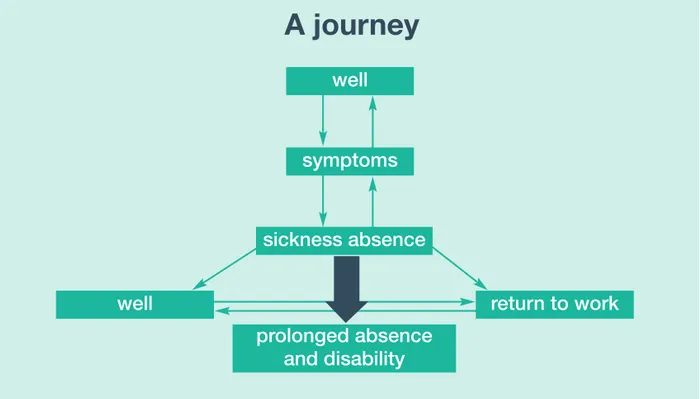
Figure 1 is a simplified representation of the complex path from being well to being long term sick. Many factors, including individual perceptions, beliefs and decisions, contribute to movement up and down the path and each step is not an unavoidable consequence of the preceding one. It is far from clear why certain employees
Figure 1: A simplified representation of the path from being well to being long term sick
well
A
journey
symptoms sickness absence
well return towork prolongedabsence
anddisability
➡
Women are both more likely to develop common mental disorders and to take sick leave for this reason (Stansfeld et al., 2003). However, this simple relationship does not hold for age. People aged under 35 are more likely to take sick leave due to mental ill health than those aged 5059 if the prevalence of common mental disorders in the population is controlled for (Barham and Begum, 2005). These differences have not yet been explained.
Workers in particular jobs are more likely to develop common mental disorders or go off sick. This includes teachers, nurses, social workers, probation officers, police officers, the armed forces and medical practitioners (Seymour and Grove, 2005; Stansfeld et al., 2003). However, there appears to be no common ‘toxic’ thread running through the list of occupations. Within a workplace, people employed in lower status jobs have higher levels of psychological distress (Stansfeld and Marmot, 1992) and take more sick leave than those in higher status jobs (North et al., 1993). This is believed to be partly explained by differences in the psychosocial work environment relating to perceived level of control, reward and sense of
On average each mental healthrelated sickness absence spell lasts 21 days. For this reason, although mental health problems cause just 25% of absences of less than seven days, they account for 47% of longterm absences (Spurgeon et al., 2007; Confederation for British Industry, 2007; Unum Limited IfES, 2001). Compared with many common physical conditions, mental health problems are often gradual in onset and long lasting. Also, as well as trying to conceal the problem from their employer, people with mental health problems may delay seeking help until the problem is severe and so more difficult to treat (Dewa and Lin, 2000; Dewa et al., 2007). Finally, people with a common mental disorder also often have a physical illness. Whilst it might be the mental health problem that has tipped the balance and led to the taking of sick leave (Kessler et al., 2003), this may not be recognised, leading to a delay in receiving effective treatment and thus a delay in returning to work.
3.3
Return
to
work
after
sickness
absence
The longer a person is off sick, the more difficult it becomes for them to return to work and the less likely it is that they will return to work at all (Unum Limited IfES, 2001; Department for Work and Pensions, 2004). In part this is because many people with mental health problems fear that, no matter how good a recovery they have made, their symptoms will be made worse by going back to work. This is especially so for those who believe that work has either caused their health problem or made it worse (Jones et al., 2005).
and
worklessness
4.1
The
impact
of
mental
illhealth
on
employment
rates
(Box
3)
A national household survey in Great Britain conducted in 2000 found that 57% of people who have a common mental disorder are working, compared with 69% of people who do not have a common mental disorder7. Just 9% of people with a
probable psychotic disorder, which includes most people with a severe mental disorder, are working fulltime and a further 19% parttime (Meltzer et al., 2002)8.
An earlier survey reported that 70% of those with a common mental disorder, who are unemployed and seeking work, have been unemployed for a year or more (that is 7% of all people with a common mental disorder) and are unlikely to return to work (Meltzer et al., 1995). Those who have a common mental disorder are four to five times more likely than those who have not to be permanently unable to work and three times more likely to be receiving benefits payments (Meltzer et al., 1995 and 2002).
7 The results of a further survey conducted in 2007 will be published soon.
8 The various figures given in this section for the proportion of people with mental illness who are
working vary because of differences in definitions and in the way in which the data were collected.
Box 3: The impact of mental illhealth on people’s ability to work
Liam, who has suffered from periods of depression for the last few years, said
“Iwas tryingtodeal withitmyself,butitdoesn’treally work.MostdaysIwould stayinbed.Ididn’treallygetout,Iwasalwaysinthe house;Ilostallmyfriends overit.It gotreallybad.Ididn’tthinkIcoulddealwithitbymyself,but Ididn’t liketoseekadvicefromanyone.”
Liam tried to find employment but would experience overwhelming anxiety when calling about job vacancies or attending interviews – “quitea fewtimesI’dget theshakesandputthe phonedownbeforeanyone hadanswered.It wasn’t somethingIliked;itreallydidgetinthe way.WhenIhadinterviews,Ididn’thave anyconfidenceandpeoplecouldsee that.”
Dov has had a number of jobs over the past seven years but, due to his mental ill health, few have lasted long. He said about one job “Iwasn’tillallthetime, butthestressofworkmademe ill.Iwasn’treadyfortheoutsideworld.I couldn’tgettoworkontime,allthetime…thenIgotfired becauseIcame late”.Dovpersisteddespitehisillhealthanditsimpactonhisabilityto function properly–“Istartedacourseinaccountancy,andIwasworkingtwoanda halfdaysaweek… butIcouldn’thandleit,soIquitthejob,butcarriedonthe course.HopingthatIcouldgetajoblateronmaybe, butthenIgotillagain andwenttohospital”.
Between 30% and 50% of people with schizophrenia are capable of work but only between 10% and 20% are in employment (Marwaha and Johnson, 2004; Schneider, 1998). Although some are in managerial or senior official positions, most are in ‘elementary’ jobs, for example cleaning and labouring, or are in skilled trade occupations such as plumbing or metal work. The rate of employment in people with schizophrenia seems to have fallen from before 1990 when surveys reported that between 20% and 30% were in work. Several studies conducted at two time points seem to confirm this reduction (e.g. Rinaldi and Perkins, 2007). The reason for this is unknown but one factor might be a reduction in the number of sheltered employment schemes. For those who present to services for the first time, the likelihood of being in employment falls markedly over the subsequent year or two (Birchwood et al., 1992; Johnstone et al., 1986). For people with Schizophrenia, premorbid social and occupational history are associated with employment and some types of psychotic symptoms and the presence of negative symptoms are associated with unemployment. The desire to have a job is one of the best predictors of future employment (Marwaha and Jonhson, 2004).
Disabled people with enduring mental health problems of all types are much less likely to be economically active than those with physical or sensory impairments. In 2004 just 21% of people considered disabled by a longterm mental illness were in work compared to 47% of disabled people overall (Social Exclusion Task Force, 2006). The employment rate for the UK working age population at that time was 74%.
4.2
The
effect
of
work
and
worklessness
on
mental
health
(Box
4)
It has been estimated that about oneseventh of days lost due to mental health problems are attributed to workrelated mental ill health (Sainsbury Centre for Mental Health, 2007). However, although work can be a stressor for some people in some circumstances, a recent comprehensive review of the research (Waddell and Burton, 2006) concluded that overall:
1. Work is beneficial to health and wellbeing.
2. Lack of work is detrimental to health and well being. The unemployed consult their GPs more often than the general population and those who have been unemployed for more than 12 weeks show between four and ten times the prevalence of depression and anxiety. Unemployment is also associated with increased rates of suicide.
3. For people without work, reemployment leads to improvement in health and wellbeing and further unemployment leads to deterioration.
4. For people who are sick or disabled, placement in work improves health and psychosocial status.
5. The health status of people of all ages who move off welfare benefits improves.
The only caveats are that these conclusions do not apply to some individuals in some circumstances and that the social context and the nature and quality of the work are important factors.
4.2.1 Why work is important for mental health (Box 4)
It has been recognised since ancient times that work plays a central role in all
people’s lives (Thomas, 2001). It provides a monetary reward and is inseparable from economic productivity with its profits for the employer and its material benefits for society. As well as providing the monetary resources essential for material wellbeing, it links the individual to society (Schneider, 1998; Waddell and Burton, 2006).
The right to work is enshrined in Article 23 of the United Nations Declaration of Human Rights, which states that ‘everyone has a right to work, to free choice of employment, to just and favourable conditions of work and to protection against unemployment’.
Work gives the worker a social identity and status; social contacts and support; a means of structuring and occupying time; activity and involvement; and a sense of personal achievement (Warr, 1987). Unemployed people do not exploit the extra time they have available for leisure and social pursuits. Their social networks and social functioning decrease, as do motivation and interest, leading to apathy. People with mental health problems are especially sensitive to these negative effects of
unemployment (Bennett, 1970). The social exclusion that they experience as a result of mental ill health is reduced by work and aggravated by unemployment (Social Exclusion Unit, 2004). Work is therefore central to two of the values that underpin mental healthcare for people with severe mental illness – social inclusion and recovery.
That as many as 90% of workless people who use mental health services wish to work (Grove, 1999; Secker et al., 2001) suggests that people with mental health problems are aware of the benefits of employment.
Box 4: why work is important to people with mental health problems
The benefits of work apply equally to people with severe mental illness:
Heinz, who had been out of work since being discharged from a mental health inpatient unit in 2001, said “Igot myselfajobfor16hoursaweekasacleaner, butIcouldn’thold it;Iwas dismissed.Itwas atoughexperienceandIwasnot sokeentotryagain…Iwas stuckina‘beingill’typeofcondition”.Despitethis difficultexperience,Heinzrecognizedthatworkwas goodforhim–“forthat periodIwasselfreliant.Iwasoffbenefitsbecausethathad beenmy goalat thetime,thatItake advantageofthe programmeatthe JobCentrePlus”.
Brian’s mental health problems started when he was a child. He was sent to prison when he was 19 and there he was diagnosed as having paranoid schizophrenia. He was transferred to hospital. Although 21 years later, he remains an inpatient, he attended a work scheme and then found work supporting other people who experience voices and teaching mental health professionals what it is like to live with the symptoms of severe mental illness –
“Iactuallygotapaidpost, butitonlylastedsixmonths becauseoffunding. Iwasable toactuallyholdajob.Forme, after21yearswithoutbeingable todo anythingreally,itwassofantastic.”
4.3
Impact
on
the
benefits
system
Mental health problems considerably increase the risk of leaving employment compared to other health problems (Burchardt, 2003). Over the past 10 years, the proportion of all claimants of incapacity benefits who are claiming because of mental health problems has risen from 26% to 40% and it has overtaken
musculoskeletal disorders as the commonest cause. This has happened because whilst the total number of new claimants has fallen, the number with mental health problems has stayed the same. The reasons for this are unclear.
In 2005, 15% of all those in receipt of Disability Living Allowance9had mental
health problems as the primary cause. Mental health problems accounted for 23% of all new claims over the preceding year and were the commonest single cause.
Mental health problems are a common cause of early retirement on medical grounds. For example, they account for 20% of all early retirements from the National Health Service (Pattani et al., 2001). The fact that for some occupations, up to onethird of people retired on medical grounds are back in work a year later (Brown et al., 2006) might suggest that better occupational health services could reduce the number of early ill health retirees. However, there has been very little research about early retirement and factors that influence this. Furthermore, what research there has been has focused on narrow professional groups and on the public sector.
5.1
The
benefits
trap
(Box
5)
People with mental health problems who receive incapacity benefits and/or Disability Living Allowance can earn up to £88.50 per week for up to one year as part of the ‘permitted work’ arrangement without it affecting their benefits. They can do so for a longer period under the ‘supported permitted work’ arrangement, if their health or social care worker cosigns the application.
However, many people with severe and enduring mental illness rely on Housing Benefit and Council Tax Benefit to make ends meet. The threshold of earnings for these is just £20 per week. In practice, many people whose earnings exceed this threshold will lose a high proportion of their Housing Benefit or Council Tax Benefit. Also, people whose work histories do not qualify them for incapacity benefits will receive Core Income Support with or without a Disability Premium. Again the limit for earnings for these benefits is £20.
The system places people whose mental illness started at a young age, or who have been ill for a very long time at particular disadvantage.
Box 5: The benefits trap
Thebenefitsofworkapply equallyto peoplewithseverementalillness: John, who has a longstanding severe mental illness, has not had a paid job for more than 20 years. He lives in a privately owned supported living facility with a weekly rent of £450. For the past nine years John has attended a work scheme as a volunteer and, as a result, his work skills and confidence have improved to the point that he feels ready to reenter the labour market. In May 2007, the work scheme helped him to find a work placement at a local shopping centre. This led to him being offered a contract for 12 hours a week for three months at a wage of £5.65 per hour. The expectation was that, if successful, the contract would be renewed and then made permanent.
John was unable to take up the job offer because of the effect that it would have on his benefits. He would have lost a portion of his Housing Benefit and the effect on his rent payments would have been to force him to move out of his supported accommodation. Although John’s ultimate goal is to live independently, and the paid work might have boosted his confidence sufficiently to allow him to take this step, he does not feel ready now. The result is that John feels that he is in a stalemate and that his ability to progress personally or financially has been blocked.
5.2
Support
in
the
workplace
5.2.1 Occupational health
Only 3% of firms have a comprehensive occupational health service although 15% have more basic support. Larger companies are more likely to have higher levels of support (Health and Safety Executive, 2002). The World Health Organization has described occupational mental health as a “Cinderella subject”, particularly in countries like Britain where responsibility for public health and for occupational health and safety is split between two Government departments (Cox et al., 2004, p.180). Many occupational health workers have limited knowledge of the nature, impact and treatment of mental health problems although there are exceptions (see Box 6). As well as high quality training, occupational health workers require support from mental health professionals if they are to identify and manage mental health problems in their workers. However, few mental health workers have direct experience of occupational health practice. Also, the priority for specialist mental healthcare services is people with severe mental illness and not those with the common mental disorders that are most prevalent in the workplace.
Some organisations ask staff to complete regular health screens which include psychological assessments (see Box 6). This identifies people who might be suffering from a mental health problem and allows them to be directed to the appropriate service such as occupational health. Alternatively, if the screen is anonymous, employers can identify teams that appear to be in difficulty and examine the causes and potential solutions.
BT’s mental health framework
MentalHealthFramework Level
of effort
Primary
Promotion/Prevention
Secondary
Protection
Tertiary
Restoration BTPeople
Box 6: Good practice in occupational mental health:
BT’s health & safety strategy is to shift attitudes and behaviours from a dependent state to one of personal responsibility and collaboration. Implementation of their Mental Health Framework has led to improvements in wellbeing, engagement, productivity and reductions in sickness absence, as well as improvements in customer satisfaction.
Promotion of good mental health and wellbeing in ostensibly ‘well’ employees is done through Work Fit which was launched in 2004 as a joint initiative with the unions. Under the strapline ‘Helping you to help yourself’ it promotes small behavioural changes which will have a long term impact on health and wellbeing. These include keeping active, eating well and drinking sensibly, keeping in touch with friends and asking for help. In 2005, the Sainsbury Centre for Mental Health and MIND worked with BT on its fourth Work Fit programme, Positive Mentality.
Prevention of the development of mental health problems or the reduction of known risks is done by working to create good workplaces and good jobs, excellent leaders and supportive/competent managers, and by educating people for the job.
Protection involves early identification of those at risk to prevent escalation, to build resilience and allow early intervention. Employees complete STREAM, a validated, 30 item stress risk assessment questionnaire, online. Responses are categorised into Red, Amber or Green. Red and Amber ratings trigger a onetoone meeting with the line manager to resolve issues. The tool is also used to compare and contrast different divisions and so identify hot spots in terms of the scale and nature of stress.
CounsellingandEmployeeAssistanceProgrammes
Over the past twenty years there has been a great increase in the number of employers who provide or contract for Employee Assistance Programmes many of which provide counselling (Carroll and Walton, 1999; Oher, 1999). In part, this has been driven by legislation and to reduce the likelihood of litigation. The Management of Health and Safety at Work Regulations 1999 requires employers to assess and to act to control the risk of stressrelated ill health arising at work. An Appeal Court ruling in 2002 suggested that the provision of a counselling service was likely to satisfy an employer’s duty of care in this respect, although the basis for this advice has been the topic of considerable debate (McLeod and Henderson, 2003).
5.2.2 Primary care
Threequarters of people with a common mental disorder are receiving no treatment (ONS, 2001). Most people who do receive help are treated by primary care services. However, studies suggest that, on average, GPs detect only about onehalf of the people with a mental disorder who present to them and undertreat depression and anxiety (Davidson and MelzerBrody, 1999; Kessler et al., 1999). Detection rates are even lower for people whose mental health problems present as physical symptoms or for people with physical illness who have coexisting mental health problems (Kessler et al., 1999). Unfortunately attempts to increase the level of detection of common mental illness in primary care do not seem to improve clinical outcomes (Dowrick and Buchan, 1995). Despite these difficulties with early detection, longitudinal studies have demonstrated that general practitioners do tend to recognise mental illness during subsequent consultations (Kessler et al., 2002). General practitioners have a key role in the initial validation, labelling and treatment of any episode of sickness absence. Treatment guidelines for depression and anxiety focus on the important role general practitioners have in the management of common mental illness (NICE, 2004a and 2004b).
5.2.3 Specialist mental healthcare providers
5.2.4 Improving access to psychological therapies
In 2006, the Department of Health established national demonstration sites at Doncaster and Newham to improve access to psychological therapies for people with depression and anxiety disorders. The new services have assessed more than 4,000 people many of whom might not otherwise have received a service and have reduced waiting to as little as 2 weeks. Early results suggest that recovery rates match those expected from trials in a clinical setting. Both sites have established working links with local Job Centre Plus services. In October 2007 the Government announced a £170 million programme to roll similar programmes out across
England. The Department of Health has also commissioned an evaluation of the programme.
5.3
Pathways
to
Work
5.4
Specialist
provision
for
workless
people
with
severe
mental
illness
5.4.1 Policy
Guidance from the Department of Health/Department for Work and Pensions (2006) lists five key elements to a comprehensive range of vocational services for people with severe mental illness:
1. Clinical support leads within secondary services. These are mental health professionals within each team, who take a clinical perspective on vocational rehabilitation. They offer advice and guidance on vocational matters to other team members and provide brief interventions that help clients to achieve their vocational preferences and choice.
2. Employment specialists integrated within clinical teams. These people do not necessarily require a health or social services background. Their role is to identify and assess clients’ vocational needs, help them to gain and retain employment, education and voluntary work and provide continuing support.
3. Public services as exemplar employers (see Box 7).
4. Supported work opportunities. Support may be offered to employees while they are in mainstream employment by a third party provider. For those people who would benefit from a specially constructed workplace, social enterprises and firms may be useful options (see Box 8).
Access to benefit advice, to mainstream education and training and day care services should be part of the spectrum of services (Social Exclusion Unit, 2004; Sainsbury Centre for Mental Health, 2007). Recent guidance for commissioners of mental health services emphasises the need to refocus day care services into a community resource that promotes social inclusion, in which access to work and employment play a part. This is consistent with other recent policy initiatives including the Social Exclusion report (Social Exclusion Unit, 2004), Choosing Health White paper (Department of Health, 2004), the Adult Social Care Green Paper (Department of Health, 2005) and the Health, Work and Wellbeing strategy (HM Government, 2005).
5.4.2 Support for work and employment for those with severe mental illness
Work has always formed an important aspect of the care of the mentally ill and the large asylums provided sheltered employment for their patients. Work schemes became fragmented as community based mental health services developed with the running down of the large mental hospitals during the second half of the 20th century.
Approaches to work and employment for people with severe mental illness are shown in Box 8. The traditional schemes have offered sheltered work, and their more modern equivalents are the social firms. Other schemes have attempted to place people in open employment. The more traditional types of these schemes, often referred as “train and place”, focus on reducing deficits related to the illness and on training in job skills to prepare patients for open employment. In contrast the supported employment schemes, developed in the USA, “place and train” by providing direct job placements, often in simple entry level occupations, and then offering support to the client and employer (Bond et al., 2001).
Box 7: Public services as exemplar employers:
TheUserEmploymentProgrammeatSouthWestLondon&StGeorge’s MentalHealthNHSTrust
In addition, people with mental illness may choose to do voluntary work. Volunteering can sometimes provide the added satisfaction of helping others as “experts by experience” (see Box 4). There are many agencies that act as brokers between disabled people and the many opportunities for volunteering. The volunteer role, and the process needed to enable disabled people to become volunteers, requires the same kinds of support as paid employment. Some
people may accept voluntary placements as part of work preparation.
Box 8: Types of work schemes for people with mental illness in the UK
Shelteredemployment. Traditionally offer low grade, repetitive work often paying hourly rates that are well below the going rate for the job. Do not provide employment in the open market.
TheClubhousemodel. Based on principles of meaningful activity and psychosocial rehabilitation, Clubhouses aim to support people in leading productive and meaningful lives within the community. They offer transitional employment schemes.
Socialfirms. Emphasis on creating a successful business that can support paid employment. Operates entirely as a business but its methods emphasise participation by employees in all aspects of the enterprise. Cooperatives and social enterprises may also be considered as social firms (see Box 9).
Surveys carried out in the late 1990s in England identified 135 organisations, mainly small nonstatutory agencies that offered sheltered employment, 77 that provided open employment and about 50 social firms (Grove and Durie, 1999). A survey in the northwest of England found a fortyfold variation in provision across health authority areas and a poor relationship between the schemes identified and the needs of the areas in which they operated (Crowther and Marshall, 2001). The highest level of provision was in the area with the lowest deprivation and unemployment levels.
Box 9: SMaRT, a small business that provides work for people with mental health problems and supports them into open employment
SMaRT (Socially Minded and Responsible Trading project) is a small business enterprise managed by First Step Trust, a registered charity that has work schemes across the country. It provides work for long term, unemployed people who are not yet ready for open paid employment because of mental health problems or other disadvantages. Based in Salford, SMaRT operates across two sites providing a range of Garage Services (MOT’s repairs and servicing for cars and vans) and an EndofLifeVehicles depollution and recycling facility.
SMaRT provides real work in a demanding commercial environment that challenges the workforce to learn to handle the everyday stresses and pressures of work. It also provides formal workbased training and access to a range of qualifications, including City & Guilds and NVQs.
Although it has only been operating at full capacity for about 18 months, SMaRT has already provided more than 250 work experience places for people of all ages. Sixteen percent of the workforce are women and 30% are Black or from an ethnic minority. More than 80% of those recruited have been unemployed for more than one year (82%) with 45% being unemployed for more than 5 years or having never worked. Twentyseven people have so far moved on to open employment.
Although there have been no recent national surveys, it is highly likely that there are too few work schemes to meet the need and that existing provision is irregularly distributed and does not take account of the recent evidence for effective
approaches. The Sainsbury Centre for Mental Health estimated that the number of staff working in vocational and related day care services in England in 2003 was about onethird of that required to deliver the Government’s mental health policy as summarised in section 5.4.1 (Boardman and Parsonage, 2007). Although some NHS mental healthcare providers employ vocational specialists who work in the IPS model (see Box 10), this is almost certainly an exception rather than the rule.
Box 10: An Individual Placement and Support (IPS) programme in South West London
South West London and St George’s NHS Mental Health Trust has introduced Individual Placement and Support programmes to two boroughs. As part of this an employment specialist worker is integrated into each of the community mental health teams. The IPS programme assists people with a range of mental health problems, including many with psychoses. The IPS service shows
advantages over a neighbouring borough that has prevocational services that are not integrated (Rinaldi and Perkins, 2007; Rinaldi and Perkins, 2007):
• an increase in people in open employment 12 months after the
implementation of the IPS workers from 11% in the neighbouring borough to 32% in the borough with the IPS scheme;
• additional increases in people placed in mainstream education or training (6% to 16%) and voluntary work (715%);
• more people placed in employment, education or voluntary work in the integrated teams compared to the nonintegrated prevocational services;
6.1
Interventions
to
reduce
sickness
absence
Despite their high prevalence in the workplace, there has been relatively little research about the effectiveness of interventions that assist people with common mental disorders to remain in work or return to work after a sickness absence. Most studies have been conducted outside the UK, where the labour market and other contexts are somewhat different, and some by evaluators with a commercial interest in the outcome. Not many have been published in peerreviewed journals. Also, most evidence also comes from large, often multinational corporations, with little relating to small and medium sized enterprises that usually do not have the resources to invest in substantial workplacebased initiatives. Two recent reviews of the research (Hill et al., 2007; Seymour and Grove, 2005) reached broadly similar conclusions which can be summarised as:
1. Stress management techniques may improve people’s ability to cope with stress and to avoid stressful situations at work. Useful techniques are: teaching of problem solving skills, exercise and rehabilitation. However, workplace stress is a complex construct that can have beneficial as well as harmful consequences for an employee. There is no firm evidence that stress management techniques reduce the prevalence of common mental illness or of sickness absence. Also no studies have been conducted of the use of stress management in people who have already developed a common mental disorder.
2. For people who have common mental disorders that are affecting their work, brief individual therapy, mainly cognitive behavioural therapy10, in short courses
of up to eight weeks may be beneficial. Booster sessions may be needed subsequently.
3. Interventions should be comprehensive and address both individual and organisationlevel factors. There is little evidence on organisationlevel interventions alone and what there is shows mixed results.
4. When people are off work due to mental disorders an early return to work is aided by line managers keeping in touch at least once every two weeks.
10Cognitive behavioural therapy is a structured, problem oriented form of psychological intervention
which aims to challenge specific thinking patterns and change behaviour. There is strong evidence of its effectiveness for a range of common mental disorders. Although it is usually delivered by a trained therapist, the National Institute for Health and Clinical Excellence has also recommended the use of CBT delivered by a computer for depression and some forms of anxiety.
What research there is into workplace mental health promotion provides some useful insights and hope that it might have a beneficial effect on the economic consequences of absenteeism, presenteeism, staff turnover and recruitment, and welfare payments. Future work in the UK to evaluate such interventions will probably require partnership between employers, trade unions and the government (Dewa et al., 2007).
Two US studies of workplace screening for depression followed by telephone based care management by mental health professionals, published since the review by the British Occupational Health Research Foundation (Seymour and Grove, 2005) have shown economic benefits (Wang et al., 2006; 2007). An initial modelling study suggested modest gains in healthrelated quality of life at relatively low cost. The costs of the intervention to employers were lower than the savings in reduced absenteeism, presenteeism and employee turnover. In a subsequent randomised controlled trial, workers identified as having a depressionrelated disorder who then received counselling by telephone to encourage them to obtain psychotherapy and/or antidepressants, or telephonebased Cognitive Behavioural Therapy (CBT) had better mental health outcomes, higher rates of job retention and worked more hours, with positive financial benefits to employers.
Other US studies have demonstrated economic advantages. In one study enhanced depression care produced a small net benefit per worker. The impact was greater in companies that relied more on team working, where recruitment costs were high or where there were penalties for output shortfalls (Lo Sasso et al., 2006). A primary care depression management programme following the screening of workers for depression significantly improved productivity (by 6%) and reduced absenteeism (by 11 days over 24 months per individual with depression) (Rost et al., 2004). An earlier primary care study showed higher employment retention and fewer workplace conflicts for workers receiving an enhanced primary care
intervention for depression (Smith et al., 2002).
Few of the many studies that demonstrate the effectiveness of a range of pharmacological and psychological treatments in treating common mental disorders have measured their impact on employment status, work performance or absenteeism (McLeod and Henderson, 2003). The few exceptions, which were mostly conducted in the United States, suggest that the overall gain in labour output is much less marked than the reduction in symptoms (Timbie et al., 2006).
The conclusion of a systematic review, that counselling is effective in alleviating the symptoms of anxiety, stress and depression, and reduces sickness absence rates by 2550% (McLeod, 2001), has been challenged (Henderson et al., 2003; McLeod and Henderson, 2003). Its critics contend that most of the studies reviewed have major methodological limitations and that the only true randomised controlled trial showed no benefit of counselling (Henderson et al., 2003).
There is at best an absence of evidence that workplace counselling improves occupational outcomes.
6.2
Specialist
work
schemes
for
people
with
severe
mental
illness
Studies of work schemes for those with severe mental illness have mainly involved people who have schizophrenia. Appendix 1 summarises the main findings of randomised controlled trials conducted of such schemes.
These schemes are successful in getting about 50% of the people who enter them into employment, usually an entry level job. About onehalf of these people remain in that job for more than six months. The longterm outcomes for these people are unknown because most studies of IPS have lasted for 24 months or less.
The first major randomised controlled study of the effectiveness of IPS outside North America, the EQOLISE trial, has just been published (Burns et al., 2007). This involved 312 people with severe mental illness (80% had schizophrenia) in six European countries, including England. After 18 months, 55% of people receiving IPS had worked for at least one day compared with 28% of those who attended the standard local vocation programmes. This large scale study is supported by the nonrandomised evaluation of the use of IPS in day to day practice (Rinaldi and Perkins, 2007; Rinaldi and Perkins, 2007) (see Box 11).
Box 11: Critical components of the Individual Placement and Support model (after Bond, 2004)
• The goal is to achieve open paid employment.
• The agency providing supported employment is committed to competitive employment as an attainable goal for those with severe mental illness.
• Supported employment programmes use a rapid job search approach to helping clients obtain jobs directly (rather than providing lengthy preemployment assessment, training and counselling).
• Staff and clients find individual job placements according to client preferences, strengths and work experiences.
• Assessment is continuous and based on real work experiences.
• Followon support is continued indefinitely.
• Supported employment programmes are closely integrated with mental health teams.
IPS is not necessarily an expensive model of provision. Unpublished figures
from the EQOLISE trial indicate that it costs £2400 per person (at 2003 prices) over an 18month period, and is lower than the cost of standard vocational rehabilitation. Figures from an earlier US study are similar (Latimer et al., 2004). In the European trial, this expenditure on IPS resulted in reductions in hospitalization (Burns et al., 2007). However, this impact has not been reported in any of the North American trials, perhaps because there is less reliance on inpatient services and lengths of stay are shorter than in most of the European countries included in the trial.
IPS services can be introduced without any net new expenditure if they replace equally costly traditional vocational rehabilitation services. The evidence suggests that the introduction of IPS may reduce hospitalisation and other mental health care costs to a modest extent on average, but to date this cannot be viewed as more than a tentative conclusion. The effect on clients’ work earnings and tax revenue also tends to be small, although completed studies have only followed individuals for relatively short periods. The longerterm economic impacts could be greater given that one successful feature of IPS is that a number of clients ultimately are able to work with some consistency while relying on only minimal support.11
Although IPS offers better outcomes than standard work schemes it would be imprudent to recommend the wider availability of this approach to rehabilitation on the assumption of expenditure savings. Nonetheless, longterm studies
suggest that IPS yields important benefits beyond employment itself to a significant minority of clients (Becker et al., 2007), and the cost of the intervention is modest. Certain steps could be taken to improve costeffectiveness:
1. Ensure that supported employment programmes are implemented with fidelity (Drake et al., 2006).
2. Increase incentives for people who have severe mental illness to return to work, and to work more hours (Becker et al., 2007; Burns et al., 2007).
3. Recognise that some clients are more likely to benefit from IPS than others (Zito et al., 2007) and consider better targeting. This must be done without disadvantaging people with severe mental illness who would benefit from other forms of vocational rehabilitation and who might, with this support, become suitable for IPS in the future.
4. Make cost savings by replacing other forms of vocational support, that do not move people who believe they are ready for paid work directly into employment, with IPS. Again this must not be at the expense of vocational services that support the rehabilitation of people who are not yet ready for IPS or which provide the health benefits of sheltered work to people who might never be ready for paid employment.
7.1
With
regard
to
their
impact
on
work,
mental
health
problems
can
be
grouped
into
three
broad
categories.
1. Symptoms associated with mental ill health such as sleep problems, fatigue, irritability and worry that do not meet criteria for a diagnosis of a mental disorder. These affect onesixth of the working age population of Great Britain at any one time and can impair a person’s ability to function at work.
2. Common mental disorders, particularly anxiety and depression, affect a further onesixth of the working age population. These would be treated should they come to the attention of a healthcare professional. People with a common mental disorder are four to five times more likely both to be permanently unable to work than the rest of the population and three times more likely to be receiving benefits payments.
3. Severe mental illness, such as schizophrenia, bipolar disorder or severe depression affects about 1% of the working age population. People with these conditions usually require continuing and sometimes intensive treatment and care. Best estimates are that between 10% and 20% of this group are in paid employment.
7.2
Mental
health
problems
cost
the
economy
of
Great
Britain
more
than
£40
billion
each
year
(excluding
the
value
of
their
effect
on
the
quality
of
life
of
the
individual).
About
twothirds
of
the
cost
is
due
to
their
impact
on
people’s
ability
to
work.
7.2.1 About 11 million people of working age in Great Britain experience mental health problems and about 5.5 million have a common mental disorder. However, only about 1.3 million of these people are being treated.
7.2.2 Mental health problems affect those who have a job by:
1. adversely affecting work performance due to fatigue, poor concentration and memory problems. The cost of presenteeism in the UK alone is estimated to be £15.1 billion each year;
2. causing people to take time off and accounting for a high proportion of longterm sickness absence. The cost of absenteeism is estimated to be £8.4 billion.
12The cost of replacing staff who leave their job due to a mental health problem
Costperaverage Totalcostto Percent employee(£) employers(£billion) oftotal Absenteeism 335 8.4 32.4
Presenteeism 605 15.1 58.4
Turnover12 95 2.4 9.2
Total 1035 25.9 100