r2010 American Chemical Society and Division of Chemical Education, Inc.
_
pubs.acs.org/jchemeduc_
Vol. 87 No. 11 November 2010_
Journal of Chemical Education 1143 10.1021/ed100407u Published on Web 09/14/2010The Early Development of Electronic pH Meters
Wallis G. HinesDepartment of Chemistry, Aurora College, Aurora, Illinois 60506
Robert de Levie*
Department of Chemistry, Bowdoin College, Brunswick, Maine 04011 *[email protected]
This paper describes the early development of electronic pH meters, starting with the work of Kenneth Goode in the early 1920s, and the subsequent rapid development of electron tube technology and of more efficient pH-measuring circuits, culmi-nating about a decade later in the production of commercially successful electronic pH meters by Cambridge Instruments, Beckman, Radiometer, and others.
These early, commercially successful pH meters were null-balance instruments requiring manual adjustments of potenti-ometers. The subsequent development of stable dc amplifier circuits, first with vacuum tube technology, and then with solid state electronics, led to the present availability of inexpensive yet sufficiently accurate direct-reading pH meters. These modern instruments take after the original designs of Goode, who envisioned, designed, and patented the pH meter as a direct-reading instrument.
Prelude
Aside from the analytical balance, the pH meter is probably the most widely used piece of chemical instrumentation, and as such has contributed much to both the progress and the culture of the hard sciences(1). The modern pH meter is also unique in the sense that the pH is nowadays officially defined in terms of the response of that instrument in a set of designated buffer solutions, rather than in terms of a thermodynamically defined concept such as a proton concentration or a salt activity.
The fundamentals of pH measurements lie with the work of Ostwald and Nernst. Its practical use was greatly stimulated by the work of Cremer(2)and Haber and Klemensiewicz(3), who introduced the glass electrode. Because the glass membrane behaves as a concentration cell rather than as a redox electrode, it is much less prone to interferences by oxidizing or reducing agents, and by adsorbates such as proteins, than the then prevalent hydrogen and quinhydrone electrodes. Another sti-mulus was the development, 100 years ago as of this writing, of a convenient pH scale by Sørensen(4)as pH =-log[Hþ].
For historical perspective, it is useful to set the stage, for which we will use the textbook by W. M. Clark,The Determina-tion of Hydrogen Ions, An Elementary Treatise on the Hydrogen Electrode, Indicator and Supplementary Methods with an Indexed Bibliography on Applications (5), of which the first edition appeared in 1920. A large portrait of Sørensen faced its title page, it clearly explained pH and its relation to acid-base equilibria, contained an extensive, 64 page bibliography that included refs2-4, but did not mention glass electrodes. In a final section, labeled Scientific Supplies, it featured ads for then available tools, such as color indicators and several early pH
meters, including the then most recent, portable Leeds and Northrup model (Figure 1).
Clark's book was so successful that a second edition came out in September 1922, and by the time of its third edition, in August 1928, the book had more than doubled in size, from 317 to 717 pages, and the bibliography had grown to 85 pages. This third edition included a rather detailed description (pp 328-332) of the vacuum tube introduced by Goode into pH measurements in 1922, see below, which made it possible for pH measurements to be recorded continuously, and mentioned some of its early follow-up papers. It also contained a brief account (pp 429-431) of the then rapidly emerging glass electrode.
Direct electrochemical pH measurements require that the cell currentIis sufficiently small to avoid so-called polarization effects, that is, current-driven concentration changes at the electrodes, which are then reflected in the measured potential difference across the cell. (For the sake of brevity, we will from now on use the term“potential” when we mean“potential difference”, because single potentials can-not be measured anyway.) Moreover, the flow of any cell currentI causes an associatedIRvoltage drop, whereRis the cell resistance, another possible source of error in interpreting that cell potential. The resulting need to minimize the cell current led to the use of potentiometric (“Poggendorff”) compensation circuits to balance the cell potential, which at that time required manual adjustment as the cell potential changed, such as illustrated in Figure 1, and were therefore poorly suited for use in, for example, acid-base titrations or automated quality control. The only direct-reading instruments available for pH measurements before 1922 were based on the four-quadrant electrometer developed in 1867 by William Thomson, the later Lord Kelvin. Beautiful pictures of these fragile instruments can be found on the Web(6); unfortunately, these instruments were not only delicate, but required projection of a light beam on a graduated scale in a darkened room.
The First Electronic pH Meter
1144 Journal of Chemical Education
_
Vol. 87 No. 11 November 2010_
pubs.acs.org/jchemeduc_
r2010 American Chemical Society and Division of Chemical Education, Inc.now-defunct Sylvania Electric Co. of Emporium, PA, where he had been hired as chief chemist in the electronics department) that sold them at that time, in the early 1930s. Goode's“Acid-Alkalimeter” was featured in a survey of commercially available“electrical measur-ing instruments for use in teachmeasur-ing electrochemistry”that appeared in the 1930 Journal of Chemical Education (11). It showed the instrument, and described it as“essentially a vacuum tube voltmeter, adapted to H-ion measurements. The connections have been improved considerably since Goode first published a connection diagram, and the operation of the instrument is now entirely practical.” Unfortunately, we do not know how many of these instruments, made at the depth of the Great Depression, were actually sold, nor if any of them have survived. Reader input on this point would be greatly appreciated.
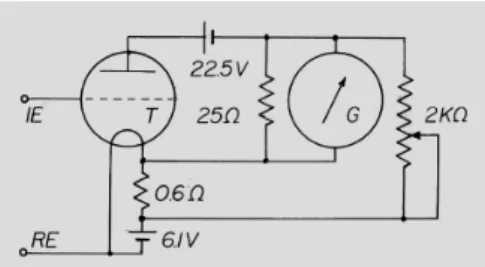
In his first paper(7), Goode used a vacuum triode in which a grid, drawing an often negligibly small grid current, regulates a so-called plate current flowing between a heated filament wire and a current-collecting plate. In the filament, metal electrons are thermally excited and thereby evaporated into the vacuum; in order to draw those vacuum electrons, the plate is kept at a much more positive potential than the filament (Figure 2).
By proper electrical compensation, Goode made the plate current a near-linear function of the grid potential, so that it could drive a sensitive microammeter to display the pH directly. Goode used titrations of HCl and H3PO4with base to illustrate
the applicability of his instrument, with a claimed sensitivity of about 6 mV or about 0.1 pH units.
In a follow-up paper (8), Goode incorporated a two-stage vacuum tube amplifier to drive a sturdier and more compact milliammeter. In the meantime, improved vacuum tubes had become available, so that he could reduce the grid and filament currents. He also made minor additions to the circuit to give his instrument both a pH and a millivolt scale, and applied for a patent, which was issued in
1932(9). The entire instrument, including the milliammeter, was now portable, and was shown as built inside a single box(8).
In his third and final paper on the pH meter(10), which also formed the basis for his Ph.D. thesis, Goode simplified his design by using vacuum tubes with oxide-coated filaments that could handle higher plate currents, and therefore produced greater amplification. In this final form, his pH meter, therefore, had only two vacuum tubes, and included binding posts for attaching a strip chart recorder for long-time measurements. The resulting instrument was again shown as mounted in its portable box, which included its batteries and vacuum tubes, and is reproduced in Figure 3.
In that same paper, Goode also described a second instru-ment, powered by 110 V alternating current, which eliminated the need for power batteries when portability of the pH meter was not required. In this connection, he described how fluctua-tions in power line voltage were sometimes large at some locales, while at others they were already kept to within(1 V. Large power-line fluctuations were counteracted with a ballast lamp.
Figure 2. Goode's 1922 circuit(7), here redrawn to fit subsequently established notational conventions, used a single vacuum triode T. The indicator electrode IE was connected directly to the grid of the Radiotron UV 201 triode, and the reference electrode RE to its filament. The current between filament and plate was indicated with aμA meter, the galvanometer G. The filament current was derived from a 6.1 V storage battery, and the filament current restricted to about 1 A by a series resistor of about 0.6Ω. A 22.5 V radio battery maintained the plate current. A variable resistor with a net resistance of about 1.3 kΩcompensated the component of the plate current (of about 0.45 mA) that was independent of the grid potential. Figure 1. The Leeds and Northrup Portable Hydrogen-Ion
Potenti-ometer, as advertised in the back of W. M. Clark's 1920 book(5). It came in two versions: the high-resolution model 7655 with a reach of 1200 mV and a claimed accuracy of(0.5 mV or(0.01 pH, advertised at $150, and the simpler 7656 which, at $120, featured the same potentiometer, accurate to(0.5%, but lacked the matched precision resistors used in the model 7655 to expand its range. Both contained a Weston standard cell for internal calibration, and a galvanometer as null detector to indicate proper balance of external and reference potentials.
r2010 American Chemical Society and Division of Chemical Education, Inc.
_
pubs.acs.org/jchemeduc_
Vol. 87 No. 11 November 2010_
Journal of Chemical Education 1145Biographical Notes
Little is known about Goode's life. He attended the Uni-versity of Chicago High School and in 1921 obtained his B.S. at that same University, where his father, J. Paul Goode, was professor of geography and the author of Goode's School Atlas and Wall Maps. In 1950, RandMcNally published a 14th “Golden Anniversary”edition of that Atlas, edited by Edward B. Espenschade, Jr. Today, Goode's Atlas is still in print: its latest, 21st edition of 2006 was edited by Howard Veregin.
In his first paper(7), Ken Goode thanked Dr. Gerald L. Wendt, who at that time was teaching at the University of Chicago, and who in 1924 became the successor to W. A. Noyes as the editor ofChemical Reviews. Wendt was its editor for 11 years, after which he was succeeded by W. A. Noyes, Jr.
When Dr. Wendt moved to Caltech for a sabbatical year, Ken Goode also went there, then returned to the University of Chicago to complete the requirements for his M.S. When Dr. Wendt in 1924 joined Penn State University as Dean of its School of Chemistry and Physics and Chairman of the Chemistry Department, Ken Goode again moved with him, and in 1928 was among the first batch of four Ph.D. students to graduate from that Department. Yet, Wendt did not coauthor any of Goode's papers, and is acknowledged in neither Goode's second or third paper. In 1927, Wendt gave a presentation of Ken's work(12) without mentioning Goode, in which he in-correctly described it as using the Wheatstone bridge principle.
After obtaining his Ph.D., Ken Goode became chief chemist in the engineering department of the Sylvania Electric Company, and married Clare Ambler, a graduate of Penn State, with whom he had two daughters. Goode went on to teach chemistry at Colgate College (1930-1931), Bethany College (1931-1937), Northland College (1937-1942), Knox College (1942-1946), and finally Western Illinois University (1946-1967), and apparently did not publish any more on this or any other chemical topic. During WWII, he organized and supervised the Ashland WI signal corps training
school, and also taught physics and chemistry courses at the U.S. Air Corps pre-flight training program at Knox College. Figure 4 shows Ken Goode in the early 1930s.
Ken Goode was an active radio amateur, a hobby he had started in 1914, at age 12. (We have found no publications of Gerald Wendt on electronics, so that the idea of the electronic pH meter almost certainly was entirely Ken Goode's.) While at Western Illinois University, he maintained a licensed, high-powered radio station in his home, with the call letters W9BH. After his death, the station was donated to the Western Illinois University Foundation for use by its radio club, W9YOL. We can only guess at the reasons why Ken Goode stopped his creative chemical work shortly after 1928, but on October 29, 1929, the U.S. stock market crashed, triggering the Great Depression, and destroying many jobs, hopes, and ambitions.
Gerald Wendt (1891-1973) moved on to become director of science and education for the New York World Fair (1938-1940), science editor ofTime Magazine(1942-1945), editorial director of Science Illustrated(1945-1950), head of the UNESCO division of teaching and dissemination of natural science (in Paris, 1950-1954), and editor ofThe Humanist(1959-1962). He became a prolific popularizer of science, and wrote numerous books, among them, for example, Science for the World of Tomorrow(Norton 1939), Chemistry(Chapman & Hall 1942, Wiley 1947),The Atomic Age Opens(World/Forum 1945),Atomic Energy and the Hydrogen Bomb (McBride 1950),Nuclear Energy and Its Uses in Peace(UNESCO 1955),You and the Atom(Morrow, 1956),The Prospects of Nuclear Power and Technology (Van Nostrand, 1957), and 700 Science Experiments for Everyone(Doubleday 1962).
Early Follow-Up
Goode was well aware of the importance of his instrument. In the opening paragraph of his first paper(7)he stated that
The investigation described in this paper has shown that the 3-electrode vacuum valve (“audion”) presents almost the ideal case of a“voltmeter”which draws no current from the source to be measured, and can therefore be employed as a contin-uous-reading instrument for determining the concentration of the hydrogen ion.
Goode's papers were novel in two respects: he was the first to introduce vacuum tube electronics into pH measurements, and also the first to use a direct-reading electronic instrument for such measurements. His papers stimulated a flurry of worldwide activity, culminating in many publications, of which we will here list only those we found that were published between 1925 and 1933 and dealt directly with the measurement of pH. A number of papers that more narrowly focused on the vacuum tube technology itself are not included.
The papers that followed up on Goode's pH meters fell into two broad categories: those that embraced its continuous-reading aspect and described improvements by using newly available tubes and/or alternative circuits(13-36), and those that merely incorpo-rated one or more vacuum tubes with a milliammeter instead of the usual null detector (until then: a more sensitive galvanometer, a capillary electrometer, or a four-quadrant electrometer) in otherwise traditional potentiometer designs(23, 35-74). For example, Tread-well(13)reported that he had reproduced Goode's results with a vacuum triode of different manufacture, and had likewise obtained a wide range of grid voltages for which the output voltage was, to within 1%, a linear function of the grid potential. He applied Goode's
1146 Journal of Chemical Education
_
Vol. 87 No. 11 November 2010_
pubs.acs.org/jchemeduc_
r2010 American Chemical Society and Division of Chemical Education, Inc.method to the precipitation titration of KCl with AgNO3, and
extended the method to conductometric titrations, which he also illustrated.
As early as 1929, de Eds, Rosenthal, and Voegtlin (23) described an instrument that provided two user-selectable op-tions. The first option had the advantage of a fast, direct-reading instrument closely following Goode's original designs, which de Eds et al. used for physiological recordings of muscle contraction. The second had the increased accuracy but much lower speed of manual comparison with a potentiometric reference voltage.
These were the early days of vacuum tube technology, and as improved vacuum tubes became available, the designs of their applications became rapidly outdated and in need of upgrading. Almost all of these subsequent papers acknowledged the earlier work of Goode, or mentioned earlier papers that referred to it.
Goode's work and its aftermath were also recognized by extensive sections devoted to it in several near-contemporaneous electrochemical textbooks and reviews(5, 31, 75-83), in at least one contemporary undergraduate physical chemistry text-book (84), and, more recently, in the 1989 ACS publication Electrochemistry, Past and Present (85). Interestingly, a review of the“Modern Developments in pH Instrumentation”at the 1956
ASTM Symposium on pH Measurement(86)illustrated that by
then the field had barely progressed since its frantic initial development between 1922 and 1933, except for the stabiliza-tion subsequently introduced by choppers or negative feedback. Soon thereafter, vacuum tubes were replaced by solid-state devices, yet Goode's idea of a relatively small, battery-operated or main-power-driven continuous-reading electronic pH meter has outlived all such design changes.
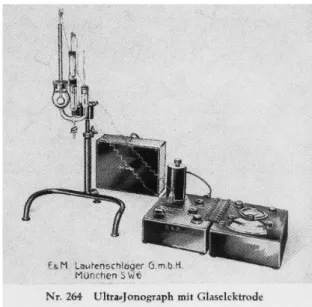
The early papers following Goode reveal several other attempts to produce commercial pH meters. Wulff and Kordatzki(31)report on a quite stable, direct-recording vacuum-tube pH meter, commer-cially available from F. & M. Lautenschlager in Munich under the name Stato-Ionometer. Although much of the documentation of Lautenschlager was destroyed during the second World War, and the company has since relocated to Cologne, a 1938 brochure remains, which shows that, at that time, the firm marketed a full range of pH-measuring instruments, including a colorimeter based on strips of pH-indicator paper, a Cito-Jonometer that used a platinum or chinhydrone indicator electrode, an industrial-style Kontroll-Jonometer for use with an antimony electrode, and an Ultra-Jonometer with glass electrode based on a Kordatzki-Wulff patent (Figure 5). The Ultra-Jonometer, in commercial production for at least 15 years(87), was probably an updated version of the earlier Stato-Ionometer. We do not know if any Lautenschlager Stato-Ionometers or Ultra-Jonometers have survived.
Berl, Herbert, and Wahlig(27, 33)also described and illustrated an inexpensive pH meter with a vacuum tube, a galvanometer, and a compensation potentiometer with a coarse and fine pH control, claiming a measurement accuracy of about 0.02 pH, and produced by Ströhlein & Co., GmbH, Düsseldorf, Germany, a company that apparently is no longer in business. We do not know if the Ströhlein model made it past the prototype stage.
Parallel Developments
As occurs so often with technological innovations, there were at least two other threads that might have led to a similar result, but did not. The first of these came from classical electrochemistry. W. A. Noyes (1857-1941) was the long-term
(1907-1926) chemistry department chairman at the University of Illinois at Urbana-Champaign, editor-in-chief of theJournal
of the American Chemical Society from 1907 to 1910, and
founder and first editor (1924-1926) of Chemical Reviews.
When the United States got involved in World War I, his son W. A. Noyes, Jr. (1898-1980) enrolled in the Signal Corps Reserve, working as a ship radio operator while waiting for his induction. In June 1918, he was finally sent to France, and after the end of hostilities in November of that year, stayed in Paris to earn his Ph.D. at the Sorbonne with Le Chatelier. For his degree, Noyes, Jr. worked on two projects, camphor and metallurgy, the latter a constant theme throughout Le Chatelier's career. Noyes, Jr. would later become a leader in photochemistry, and follow his father as a long-term chemistry department chairman (at the University of Rochester) and journal editor (of Chemical Re-views, theJournal of the American Chemical Society, theJournal of Physical Chemistry, and Advances in Photochemistry). In our context, however, we will focus on his study of electrolytic iron, which at that time was commercially produced only in France. As Noyes described it(88), he used“an ordinary French army type three-element vacuum tube”to measure the deposition potential of iron, defined as that potential at which the current-voltage curve showed a fairly sharp change in slope. For these measure-ments, the grid current was made negligible by making the grid potential negative. His earlier, French publication on the same topic was even more succinct and nonspecific(89).
There have been few if any follow-up papers on this research. But it caught the eyes of Calhane and Cushing who, in 1923, submitted and published a paper on the application of a
r2010 American Chemical Society and Division of Chemical Education, Inc.
_
pubs.acs.org/jchemeduc_
Vol. 87 No. 11 November 2010_
Journal of Chemical Education 1147vacuum triode to monitor the precipitation titration of chloride ions with silver nitrate(90)that apparently was not based on Goode's earlier paper(7). However, we have found no further follow-up papers by either Calhane or Cushing on this topic, and insofar as their paper is mentioned in the subsequent decade, we have only seen it quoted in combination with Goode's. More-over, we have only come across a single reference(39)to Noyes' communication (88) in connection with ref 90. It therefore does not appear to have been an independent source of fur-ther development, perhaps because neifur-ther paper involved pH. But if Goode had not published when he did, the early develop-ment of electronic pH measuredevelop-ments might have been quite different.
Other possible pathways toward the early development of tronic pH meters might have come from the measurement of elec-trolytic conductivity, then a topic of great electrochemical interest, or from electrophysiology, by that time already a discipline quite separate from electrochemistry, even though both had their common origin in the work of Galvani. The advantages of the vacuum triode for the amplification of alternating signals were emphasized in 1919 by Hall and Adams (91), both for making better oscillators as excitation sources, and for improving the detection of bridge balance, which since the days of Kohlrausch had used earphones. Likewise, electro-physiologists had explored the advantages of electronic amplifica-tion(92-96), because they also, until that time, had literally listened to neuronal signaling with earphones, a qualitative method developed in the 1880s by Wedensky in St. Petersburg. But the problems to which the vacuum triode was applied, both by the electrochemists measuring electrolytic conductance and by the electrophysiologists monitoring the nerve response, concerned sinusoidally changing sig-nals, for which the vacuum triode was eminently suitable, rather than the essentially stationary electrochemical voltage measured through a high-resistance glass membrane that was needed for pH measure-ments. The observations of pH by Buytendijk et al.(16, 17, 37), which were explicitly based on Goode's work, appear to have been the first biochemical uses of electronic pH measurements.
Vacuum Tubes and Glass Electrodes
The introduction of the vacuum triode as a meter with a sufficiently high input impedance made it practical to use high-resistance electrodes such as the glass electrode, even though Goode did not report using glass electrodes which, at that time, were still difficult to fabricate, and were not yet commercially available.
The vacuum triode (or Audion tube, as it had been named by Lee de Forest) had been invented in 1906, and quickly became used in radio technology, but its nonlinearity was well known. The 1920 book by Van der Bijl(97), for example, only listed applications for time-varying, mostly sinusoidal (so-called ac) input signals. Perhaps Goode was unaware of this limitation; if so, his was a fortunate ignorance.
Goode used platinum/hydrogen and platinum/quinhydrone electrodes as his pH probes, as was common in those days, but the small input current of his circuit made it eminently suitable for use with a glass electrode. The electrochemical potential generated by the difference between the hydrogen ion concentrations in the cell and that in a comparison solution (such as that inside the bulb of a glass electrode) is fairly large, on the order of 60 mV per 10-fold concen-tration difference at room temperature, and is therefore easy to measure. The main problem of using a glass electrode was its high internal resistance. Glass is a good insulator, and a glass film of
suffi-cient mechanical stability can be neither too thin nor too large, and therefore has an unavoidably large internal resistance.
To measure the resulting potential to, say, 1%, the measur-ing apparatus must have an effective input resistance of at least 100 times that of its source. With practical glass electrode resistances of the order of 100 MΩ, this required input im-pedances of the order of at least 10 GΩ. The vacuum triode (and later variations on that same theme, such as tetrodes and pentodes, and their more recent solid-state incarnations such as field-effect transistors) could solve that problem, because their grids or gates merely direct the flow of current from a different source, the way a traffic cop can control many cars at an intersection by merely moving his hand.
The first papers to apply Goode's direct-reading ap-proach(13-36)offered improvements and extended the meth-od to other types of potentiometric titrations. In those early days, there were problems with the stability of the output voltages of the batteries supplying the rather large filament currents and filament-to-plate voltages then needed in vacuum tubes to generate and drive vacuum electrons, a problem that, some four decades later, was much reduced by the considerably smaller source-to-collector currents in, say, Metal-Oxide-Semiconductor Field-Effect Transistors (MOS-FETs). The early literature, therefore, devoted much effort to solving such practical pro-blems, which were especially pronounced with portable, battery-operated instruments.
The first paper that explicitly combined Goode's design with a glass electrode was that of Buytendijk and Brinkman(37).
It was soon followed by those of Morton (38), Elder and
Wright(39), Voegtlin et al.(41), Aten et al.(42), Stadie(45), Fosbinder,(48)and others. These papers often had telling titles, such as“pH measurement with the glass electrode and vacuum tube potentiometer”(39),“An electron tube potentiometer for the determination of pH with the glass electrode”(45), and“A vacuum tube potentiometer applicable for use with glass electro-des of high resistance”(47).
These papers(13-74)also highlighted some of the diffi-culties with such early applications of vacuum tubes to high-impedance sources. The sockets in which those tubes were mounted sometimes leaked so much electricity (thereby reducing the input resistance of the pH meter) that Elder and Wright found it necessary to remove them, and solder their wires directly to the pins of the vacuum tube. This was before glass could be made water-repellent with silicone, and before Teflon and similar high-resistance materials were available as insulators for sockets, connecting cables, and plugs. Instead, silica rods, Pyrex glass tubing, Bakelite, and sulfur were often used, together with stiff, free-standing electrical wiring, and coating of non-indicating parts of glass electrodes with paraffin. Fortunately, the vacuum tubes often ran hot enough to minimize water films on their glass envelopes. These early developments illustrated the tremendous gains made during these early years. While Goode(7)in his first paper claimed an accuracy of only 6 mV or 0.1 pH, merely 9 years later Greville and Maclagan(54)specified an accuracy of 0.1 mV or about 0.002 pH. There has been no comparable gain in accuracy of pH meters since then, nor (in view of the inherent difficulties with routine pH measurements in terms of asymmetry and liquid junction potentials) was one needed.
1148 Journal of Chemical Education
_
Vol. 87 No. 11 November 2010_
pubs.acs.org/jchemeduc_
r2010 American Chemical Society and Division of Chemical Education, Inc.potentiometer in an otherwise by then conventional circuit, they clearly established that the vacuum tube could be used directly with glass electrodes. Of course, the developments of new insulating materials and solid-state electronics have since made it possible to build much smaller, less power-hungry, and less expensive pH meters, which have greatly contributed to their widespread use. Interestingly, the electrical circuits of modern pH meters have done away with the cumbersome comparison voltage, and now strongly resemble those of Goode, with the first triode replaced by a solid-state voltage follower, plus a subsequent solid-state amplification stage to handle offset (“asymmetry“) and scaling (“temperature”).
References11-74were restricted arbitrarily to those papers that were published between 1925 and 1933, and no complete-ness is claimed for even that short period. There were many subsequent papers based on and referring to these earlier studies, but a cutoff had to be made somewhere. Several papers in these 9 first years not only used and expanded on Goode's experimental method, but also covered a wide variety of applications. Goode had demonstrated the usefulness of his approach for acid-base titrations, and had already outfitted his instrument with terminals so that the progress of a titration could be followed continuously on a strip-chart recorder. This was a clear advantage, because at the time there were no direct-reading titrators available; moreover, the sharp change in electrochemical potential near the equivalence point was relatively tolerant of instrumental drift. Applications to precipitation titra-tions(13), complexometric titrations(51), redox titrations(20), and conductometry (13) soon followed, as well as to derivative titra-tions(38). The method was not only widely introduced in routine pH measurements in analytical and physical chemistry, but was also applied to follow the kinetics of pH-dependent chemical reac-tions(16, 37).
Although glass electrodes had been used before, and their advantages had been explored, their inherently high resistances had severely limited their practical use, until the vacuum triode made their wide application possible. This was perhaps the most important contribution to result directly from Goode's intro-duction of the electronic amplifier tube in pH measurements. Moreover, as will be detailed below, the application of such electronic amplification to follow colorimetric acid-base titra-tions(28, 105, 106)can be seen as leading directly to its later uses in chemical spectrophotometry.
Mass-Produced pH Meters
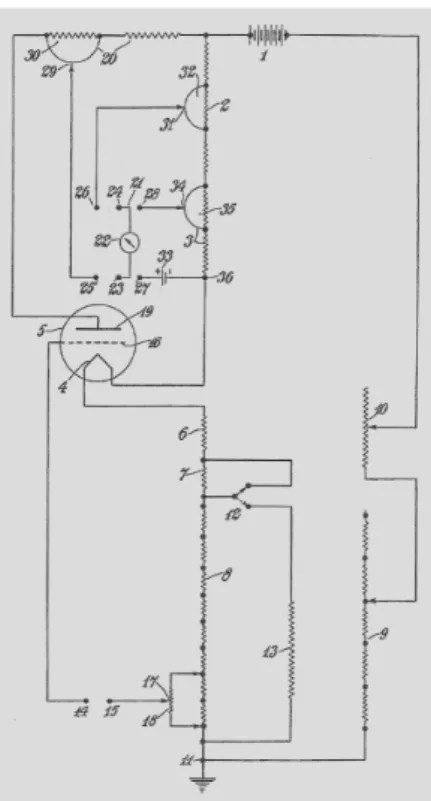
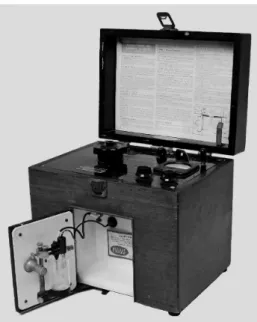
Subsequent to the Goode, Lautenschlager, and Ströhlein instruments, on which we have no information beyond what was mentioned earlier, and of which we have no knowledge of any surviving instruments, the next commercially produced pH meter appears to have been that designed by Morton and Best(73)in conjunction with the Cambridge Scientific Instru-ment Company (1881-1968), which by then was already a well-established and versatile manufacturer of scientific instruments, including pH meters of the type illustrated in Figure 1. The Cambridge design was based on a patent to Charles Morton entitled “Improvements in and relating to thermionic electro-meters”(98), and its circuit diagram is reproduced in Figure 6.
Morton and Best (73) also showed its exterior, with a characteristic“chimney”housing the vacuum triode, an improve-ment over the exposed vacuum tube of Berl et al.(27). The Morton-Best instrument, of the potentiometric compensation type with a
single triode valve, was specified as good to(0.02 pH, with a range from 0 to 14 pH, or to(0.2 mV from 1 to 1.4 V. It used a single power source, and did not use any switch in its noise-sensitive input circuit. The pH scale was adjustable for ambient temperature.
Cattermole(99), describing the history of the Cambridge Scientific Instrument Company, said:“Around 1928, following a suggestion from S.W. Cole of the Sir William Dunn Institute of Biochemistry in Cambridge, the company produced the first direct-reading pH meter, and in 1932 the company marketed the electrometer valve pH meter, which was based on the patented
work of Charles Morton of Chelsea Polytechnic.” For many
years after this, the company was regarded as a world leader in this field, but by the 1950s, it had been overtaken by businesses making greater use of electronic methods.
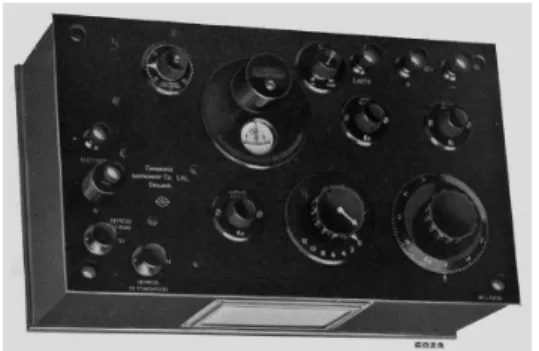
A 1936 Cambridge Instruments brochure (Supplement to List No. 108) shows the improved“Cambridge pH meter (1936 model) British Patent No. 396,817”, model 44236, which featured a tetrode instead of the earlier triode. The description states that“This instrument has recently been redesigned, and is brought more nearly into line with the ordinary potentiometer both in appearance and in method of operation.”Further down the brochure it reads: “The valve, which is now of a more robust type, is effectively protected by mounting it beneath the top board; the“chimney”of the earlier design has thus been eliminated.”Its circuit diagram is shown in Figure 7, and its exterior in Figure 8. The brochure also illustrated an associated “Morton System” glass electrode/calomel electrode assembly, cat. 42527.
r2010 American Chemical Society and Division of Chemical Education, Inc.
_
pubs.acs.org/jchemeduc_
Vol. 87 No. 11 November 2010_
Journal of Chemical Education 1149A 1936 communication by Lauchlan(100)describes the use of the Cambridge pH-measuring equipment for automatic or remote control, including the use of a glass electrode in conjunc-tion with the vacuum-tube pH meter. It also illustrates the use of a strip-chart recorder with set points for the automatic addition of acid or base to a reaction vessel under pH control as well as for documentation purposes, and discusses some associated engi-neering criteria, problems, and solutions.
A 1937 brochure emphasizes the value of using glass electrodes, and lists several glass electrodes as accessories, including a sealed glass electrode and as well as a Morton-designed flow-through cell with both a glass indicator electrode and attached reference electrode. Two different models of this instrument are kept in the Whipple Museum of the History of Science at Cambridge, United Kingdom, but neither instrument shows its manufacturing date. A 1939 brochure illustrates a Cambridge Portable pH Meter with built-in cell and buffer solution compartments. A 28-page 1941 booklet on Cambridge pH Instrumentsshows a number of sealed electrodes (including a glass electrode), as well as an array of ruggedized industrial instruments, including a potentiometer unit with sub-mersible electrodes, a continuous flow-through cell, a pH recorder, and a pH alarm indicator. It also lists an impressive array of scientific uses, and illustrates several large-scale industrial applications.
Interestingly, the development of commercial pH meters in the United States was slower than in Germany and in the United
Kingdom, possibly discouraged by the presence of Goode's U.S. patent. But there certainly was activity, as evidenced by a published discussion following a talk by George Perley of Leeds
and Northrup on“The measurement and control of hydrogen
ion concentration in industrial plants” at the 1933 Chicago meeting of the American Institute of Chemical Engineers(101):
Q: ... we wanted to use the glass electrode but found it could not be very well adapted to automatic control, that is the energy through the electrode was not great enough to actuate the control mechanism that we wanted.
A: I think the situation has changed very much in the last two years, in view of the tremendous amount of work that has been done on vacuum tube applications. I know that in our laboratory we have been automatically controlling, very efficiently, over a range from about one pH to about 13 pH, on recording systems by means of the glass electrode and we got astounding results. ... I have a system over here now which is very analogous to the equipment I am using in my laboratory, operating twenty-four hours a day; it is still operating now and when I go back I will know what has happened during the three days I have been away.
Q: Then the answer to that is that it is the development of the vacuum tube systems, which will step up the power that you want? A: That is correct.
A year later, in 1934, that is, 12 years after Goode's first paper appeared(7), 4 years after the papers by Kordatzki and Wulff and by Berl et al., and 2 years after Morton's design was first produced by Cambridge Instruments, Arnold Beckman started to design and build his first electronic pH meter. By then, there was clearly a large variety of commercially available vacuum tubes and of published designs of pH-measuring circuits using such tubes, as well as a wide demand for such instruments. Goodhue(102)mentioned in 1935 that more than a dozen implementations of the particular instru-ment he described were already in use in the Iowa State College chemistry department and elsewhere.
Like the Morton-designed Cambridge instrument, Beckman's pH meter was a commercial success, and formed the basis for building a prominent chemical instrumentation company (now Beckman-Coulter). In 1936, its first year of sale, Beckman sold 444 pH meters. In 1937, he introduced the venerable model G which, with minor improvements, was produced until 1964.
Shortly after Beckman started working on his pH meter, Sørensen asked Radiometer, then a new Danish maker of vacuum tubes established in 1935 by Børge Aagaard Nielsen and Carl Schrøder, to produce pH meters, and by the end of 1937, Radio-meter brought out its first commercial pH Radio-meter, their PHM1. Like the Lautenschlager, Ströhlein, Cambridge, and Beckman instru-ments and many of their noncommercial predecessors(35-74), it was a potentiometer-based instrument with vacuum tubes as input for its null detector. Like Cambridge and Beckman, Radiometer soon also produced glass electrodes. Despite the German occupation of Denmark from 1940 through 1945 and the subsequent, WWII-related shortages in Europe, Radiometer survived, and is still in business. Much like Beckman's company, it has now moved toward the more lucrative biomedical applications.
Lautenschlager still exists, but returned to its core business (since 1887) of steam sterilizers and related products; Ströhlein did not survive. The pH meter had been a new product for these companies. It was different for Leeds and Northrup, which was well known in the United States for its precision potentiometers
Figure 7. The circuit diagram of the 1936 Cambridge pH meter. The triode has been replaced by a tetrode. Power is supplied by an external 12 V rechargeable battery.
1150 Journal of Chemical Education
_
Vol. 87 No. 11 November 2010_
pubs.acs.org/jchemeduc_
r2010 American Chemical Society and Division of Chemical Education, Inc.and galvanometers, and already was selling pH meters in the early 1920s (Figure 1). As the Perley comments(101)show, in 1933 they had a working electronic pH meter, but were slow to bring one to market. The company, incorporated in 1903, and well known for its high-quality instruments, and for its progressive employee policies during the Depression years, does not exist any more. In 1978, it fended off a hostile take-over bid from Tyco by merging with General Signal Co., and was then sold off piecemeal, with major parts acquired by Honeywell.
Cambridge Scientific Instruments no longer exists as such either. As described by Cattermole and Wolfe(103), in the post-WWII years the emphasis of Cambridge Scientific Instruments on fine machining made them somewhat insensitive to the advantages of electronics. In their in-house journal, theCambridge Bulletin, a 1950 paper on electronics ended with the advice“Use it if you must but never if you need not.”When they finally tried to catch up, and did so in a big way with their Microscan, Geoscan, and Stereoscan microanalyzers, they could ill afford the considerable investment, and even though these instruments were scientifically successful, they had rushed them to market without redesigning them from a one-of-a-kind prototype to efficient commercial production, so that their profit margin remained too small. The company was taken over in 1968 by the Kent Group, which also does not exist any more. Only the fastest-moving, most entrepreneurial young companies such as Beckman and Radiometer have so far survived.
Figure 9 shows the Beckman model G introduced in 1937, and Figure 10 the Radiometer PHM1, also first marketed in 1937. Other pictures of these and other, more recent pH meters can be found on the Web(104).
Returning to the early development, between 1932 and 1937, three major manufacturers, Cambridge, Beckman, and Radiometer, had appeared on the market in short succession. Less than a decade later, on page 41 of his 1941 book on glass
electrodes(82), Dole already listed 11 different U.S. companies manufacturing electronic pH meters that could be used with glass electrodes. Their use increased dramatically because the combination of glass electrodes with high input impedance electronic pH meters made electrometric pH measurements fast, accurate, inexpensive, readily automated, and therefore the method of choice in many industrial and research environments.
An Unexpected Spin-Off
Interestingly, Goode's papers and the subsequent develop-ment of pH meters may also have inspired the use of vacuum
tube technology in spectrophotometry. Partridge (28) and
Müller and Partridge (105, 106) used the same triode valve circuit to monitor the output of a photoelectric cell monitoring the color of a pH indicator dye.
A few years later, Coleman Instruments, which by then had marketed its own pH meter as well as spectrophotometers for the visible part of the spectrum, developed an add-on component that allowed its model 3 pH Electrometer to be used as a read-out stage for its model 10 Ultraviolet Spectrophotometer. Subse-quently, Beckman, likewise using its own pH meter(107, 108), developed its own spectrophotometer and, through successive models A, B, and C, extended its range to the ultraviolet by replacing the glass prism by a quartz one, by including a hydrogen lamp, and by using an improved monochromator, respectively. All these three models in fact used an external pH meter as read-out stage, as Coleman had done. In the Beckman D, the electronics were finally combined with the optics in a single housing, and after incorporation of a new phototube, this instrument became the highly successful Beckman DU that was in production from 1941 until 1976(108).
Further Developments in Electronics
The Cambridge, Beckman, and Radiometer pH meters were all based on a manually adjusted potentiometer, and were not continuous-reading pH-meters, as Goode's designs had been. However, modern pH meters have fully adopted Goode's con-tinuous-reading approach. The Morton patent used one vacuum tube as null detector, and mentioned the possibility of further
Figure 9. The Beckman model G. The sample cell and the electrodes were mounted inside the door. The measurements required that the door be closed, in which case the cell compartment became a Faraday cage. The top had the major controls: the large pH knob to the left (with, behind it, the pH read-out dial), and the galvanometer output to the right, essentially the mirror image of that in Figure 1. The inside of the lid contained the user instructions. Image courtesy Beckman Coulter, Inc.
r2010 American Chemical Society and Division of Chemical Education, Inc.
_
pubs.acs.org/jchemeduc_
Vol. 87 No. 11 November 2010_
Journal of Chemical Education 1151signal amplification; the Beckman patent indeed used a second vacuum tube to amplify the signal to accommodate a milliamp meter, as in Goode's second paper (8). Beyond that, all three successful commercial designs were modeled after refs37-74 and relied on a manually adjusted potentiometer for their read-out, as most pre-1922 pH meters had done.
Why did Goode's effort at commercializing a truly novel and advanced pH meter fail, where Cambridge, Beckman, Radiometer, and many others subsequently succeeded? There can be many reasons: business acumen, good salesmanship, and a host of other circumstances (collectively labeled as luck) can determine the outcome of any commercial venture as much as its originality, quality, and timeliness. As a result, the best design not always wins; this communication is typed on a“qwerty”rather than a Dvorak keyboard.
With the help of hindsight, we can also see some obvious reason. Goode's design was far ahead of its time: a direct-reading pH meter that relied on the linear dc response of a vacuum tube amplifier. But electronics, be they based on vacuum or solid-state technology, are always nonlinear and subject to drift and aging. At the time of Goode's work, those were big hurdles, because vacuum tube technology had not yet developed far enough to make sufficiently stable and accurate direct-reading devices. Lee de Forest's Audion was designed for ac amplification, and required careful modification before it could be adapted to dc signals.
While the output of any electronic amplifier is a nonlinear function of its input(s), such nonlinearity can be reduced by trading it for amplifier gain, that is, the ratio of output to input voltage differences. This is the principle of stabilization by negative feedback, which at that time had not yet been for-mulated. It was invented in 1927 by Harold Black of Western Electric, the later Bell Labs, and first publicized by him in 1934(109). In fact, the idea of negative feedback was so unusual that Black's research director at Bell Labs initially insisted that it would never work, and so did the U.S. Patent Office. In England, Black's patent application was treated as one for a perpetual-motion machine(110). Evidence that 70 amplifiers with nega-tive feedback were working successfully in the Morristown telephone building eventually convinced the U.S. Patent Office, which after 9 years finally granted the patent in 1937(111). A few years after Black built his first negative feedback amplifier, Nyquist developed his general criterion for amplifier stabi-lity(112), and not long thereafter, chopper-stabilized amplifiers became available. Now we take negative feedback for granted, and see its stabilizing effects everywhere: not just in electronics and servomechanisms, but also in chemical and biological systems, including pH buffering.
In retrospect, then, Goode's design wastoofar ahead of its time, while Lautenschlager, Ströhlein, Cambridge, Beckman, and Radiometer used the much more conservative (but at the time also more accurate) approach which, by then, had already been fully developed by Buytendijk, Morton, Elder, Stadie, Greville and Maclagan, Goodhue, to name a few. This approach did not rely on amplifier linearity, but only used a first vacuum tube as a high input impedance null detector suitable for use with the glass electrode, and perhaps one or more subsequent vacuum tubes to amplify the signal.
It should be noted here that, for really accurate work requiring precisions of the order of microvolts, such as for measuring the electrolyte activity coefficients as summarized in
the monographs of Harned and Owen(113)or Robinson and
Stokes(114), neither a glass electrode nor an external reference electrode is useful. This is because both the asymmetry potential (which originates in the mechanical stress of a blown glass membrane) and the liquid junction potential (in the ion-con-ducting connection between the sample solution and the solu-tion in direct contact with the external reference electrode) are poorly understood, of unknown magnitude, and often keep drifting. However, the measurement of pH is nowadays officially defined (through prescribed reference and standard buffer mixtures) as a practical quantity rather than as a fundamental solution property, and is measured to 0.01 or, at most, 0.001 pH units (about 0.06 mV at room temperature). For such a purely metrological unit, the short-term drifts in the asymmetry and liquid junction potentials between calibrations are usually suffi-ciently small to be ignored, at least in aqueous solutions.
An Artifact Yields a Goldmine
A perhaps lesser-known aspect of Beckman's commercial success in the United States was a factor of luck. In 1937, Beckman apparently read or heard about a report from Stanford University (which we have not been able to identify) claiming that the glass electrodes responded to their immersion depths in test solutions. A similar effect had in fact been reported earlier, had been interpreted correctly as the result of a conducting aqueous film on the non-immersed parts of the glass electrode, and had been shown to be avoidable by making part of the
non-immersed glass surface hydrophobic (115). Almost
simulta-neously, MacInnes and Belcher(116)had reported that, with electrodes using Corning type 015 glass fused to standard soft glass tubing,“The potential observed did not change as much as 0.1 millivolt from an immersion of one millimeter to one of eleven centimeters.” Yet Beckman and his technical director, Howard H. Cary, a 1930 graduate engineer from Caltech, verified that this“Stanford”artifact indeed affected their elec-trodes, and after many trials settled on a sealed design; until then, glass electrodes were often left open at the top, so that the internal reference electrode could be replaced easily.
There was already“prior art”describing the sealing of the glass electrode with paraffin(53, 69)and, according to Lauchlan(117), Cambridge Instruments had already started marketing sealed glass electrodes in 1935, but Cary and Baxter carefully analyzed the problem and came up with a patentable combination of remedies including extending the shielding to the level of the glass mem-brane(118)which, as Beckman would later recall it,“really gave us a stranglehold on the glass electrode business” (119). Incidentally, Howard Cary would go on to design the highly successful Beckman DU spectrophotometer, and later built many more spectrophot-ometers under his own name, such as the Cary 14.
Conclusion
1152 Journal of Chemical Education
_
Vol. 87 No. 11 November 2010_
pubs.acs.org/jchemeduc_
r2010 American Chemical Society and Division of Chemical Education, Inc. robust and less sensitive to adsorbates, but as redox electrodeswere also sensitive to the presence of other redox agents, such as disinfectant chlorine in water, or SO2as a preservative in fruit
juice. To avoid polarization effects, that is, current-induced interfacial concentration changes that would affect the measured potentials, all such electrochemical measurements were based on comparison with the potential provided by a Poggendorff potentiometer circuit.
The development of the glass electrode, apparently foresha-dowed by von Humboldt and Kelvin, and implemented by Cremer(2)and Haber and Klemensiewicz(3), circumvented these problems by acting as if it were a selectively proton-permeable membrane. However, its high internal resistance initially made the glass electrode difficult to use. Its practical, widespread application had to wait for the development of electronic pH meters capable of measuring potential differences despite large cell resistances, typically of the order of 100 MΩ. This is where the electronic pH meter has made a huge difference in the practice of chemistry. By greatly facilitating the use of glass electrodes, it stimulated the more general applicability of robust electrometric pH measurements.
It is certainly incorrect to write that Beckman“invented the pH meter - the first of a new breed of commercial instruments that combined electronics with direct chemical measurement in a single, integrated `black box'” (120), although, ironically, this description is applicable word-for-word to Goode. (To our knowledge, Beckman never claimed that he had invented the pH meter, nor that he had been the first to commercialize it, but some of his hagiographers certainly have, and Beckman appar-ently did not contradict them either.) And while Goode gained neither fame nor fortune from his invention, he did set in motion a development that, indeed, led to the current profusion of simple and convenient direct-reading pH meters.
Goode's invention greatly affected the development and current practice of chemistry. Its benefits have permeated many subdisciplines in chemistry and beyond, and almost a century later its impact is still keenly felt.
Acknowledgment
We gratefully acknowledge the kind assistance of Pat Ashton and Gerald Gallwas of Beckman Coulter, Inc., Elizabeth Boynton of Western University of Health Sciences, William Jensen of the University of Cincinnati, Gert Kokholm of Radiometer Medical A/S, Susan Makar of the National Institute of Standards and Technology, Markus Meurer of F. & M. Lautenschlager GmbH, Josh Nall of the Whipple Museum of the History of Science, Kathy Nichols of Western Illinois University, Keith Oldham of Trent University, William Thomas of the American Institute of Physics, and last but not least Sue O'Dell, Jeffrey Cook, Guy Saldanha, and their most helpful interlibrary loan staff at the Bowdoin College Library.
Literature Cited
1. Moore, C. E.; Jaselskis, B.Bull. Hist. Chem.1998,21, 32–36.
2. Cremer, M.Z. Biol.1906,47, 562–608.
3. Haber, F.; Klemensiewicz, Z.Z. Physik. Chem.1909,67, 385–
427.
4. Sørensen, S. P. L.Biochem. Z.1909,21, 131–304.C. R. Trav. Lab. Carlsberg1909,8, 1-168.
5. Clark, W. M.The Determination of Hydrogen Ions; Williams & Wilkins: Baltimore, MD; 1st ed. 1920, 2nd ed. 1922, 3rd ed. 1928.
6. Quadrant Electrometer Hone Page. http://physics.kenyon.edu/ EarlyApparatus/Electrical_Measurements/Quandrant_Electrometer/ Quadrant_Electrometer.html
7. Goode, K. H.J. Am. Chem. Soc.1922,44, 26–29.
8. Goode, K. H.J. Am. Chem. Soc.1925,47, 2483–2488.
9. Goode, K. H., U.S. Patent 1,843,320, applied 1/28/1926; issued 2/2/1932.
10. Goode, K. H.J. Opt. Soc. Am.1928,17, 59–71.
11. Parker, H. C.J. Chem. Educ.1930,7, 69–80.
12. Wendt, G. L.J. Tech. Assoc. Pulp Pap. Ind.1927,10, 180–182.
13. Treadwell, W. D.Helv. Chim. Acta1925,8, 89–96.
14. Treadwell, W. D.; Köhl, A.Helv. Chim. Acta1925,8, 500–507.
15. Bienfait, H.Recl. Trav. Chim. Pays-Bas1926,45, 166–168.
16. Buytendijk, F. J. J.; Brinkman, R.; Mook, H. W.Biochem. J.1927, 21, 576–584.
17. Brinkman, R. Physiologen-Kongress, Frankfurt,1927. 18. Linde, E.Sven. Kem. Tidskr.1927,39, 285–287.
19. Pope, C. G.; Gowlett, F. W.J. Sci. Instrum.1927,4, 380–387.
20. Williams, J. W.; Whitenack, T. A.J. Phys. Chem.1927,31, 519–
524.
21. Gollwitzer-Meier, K.; Steinhausen, W.Pflugers Arch.1928,220, 551–557.
22. Thiele, H.Gas Wasserfach.1928,71, 854–856.
23. de Eds, F.; Rosenthal, S.; Voegtlin, C.Am. J. Physiol.1929,86, 206–214.
24. Ehrhardt, U.,Z. Ver. Detsch. Chem., Teil B1929,2, 443-445, 455-457, 463-465.
25. MacInnes, D. A.; Dole, M.J. Am. Chem. Soc.1929,51, 1119–
1127.
26. Partridge, H. M.J. Am. Chem. Soc.1929,51, 1–7.
27. Berl, E., Herbert, W., Wahlig, W.,Z. Ver. Detsch. Chem., Teil B 1930,3, 445-446, 458-460.
28. Partridge, H. M.,Electronics1930,1, 166-168, 192.
29. Partridge, H. M.Ind. Eng. Chem., Anal. Ed.1930,2, 207–213.
30. Treadwell, W. D.; Bernasconi, E.Helv. Chim. Acta1930,13, 500–
509.
31. Wulff, P., Kordatzki, W.Z. Ver. Detsch. Chem., Teil B1930,3, 329-330; 342-345; 353-355.
32. Hahn, F.Z. Ver. Detsch. Chem., Teil B1931,4, 121.
33. Berl, E., Herbert, W., Wahlig, W.,Z. Ver. Detsch. Chem., Teil B 1931,4, 211-212; 323.
34. Kassner, J. L.; Hunze, R. B.; Chatfield, J. N.J. Am. Chem. Soc. 1932,54, 2278–2284.
35. Vickers, A. E. J., Sugden, J. A., Bell, R. A.,Chem. Ind.1932,51, 545-554; 570-574.
36. Vickers, A. E. J.; Sugden, J. A.; Bell, R. A.Chem. Ind.1932,51, 923.
37. Buytendijk, F. J. J.; Brinkman, R. Proc. R. Dutch Acad. Sci. ( Amsterdam)1926,29, 816–822.
38. Morton, C.Pharm. J.1927,118, 761–763.
39. Elder, L. W.; Wright, W. H.Proc. Natl. Acad. Sci. U.S.A.1928,14, 936–939.
40. Morton, C.Trans. Faraday Soc.1928,24, 14–25.
41. Voegtlin, C.; de Eds, F. C.Public Health Rep.1928,43, 380–392.
42. Aten, A. W. H.; Boerlage, L. M.; Cannegieter, D.Chem. Weekbl. 1929,26, 426–430.
43. Elder, L. W.J. Am. Chem. Soc.1929,51, 3266–3272.
44. Kahler, H.; de Eds, F.; Rosenthal, F.; Voegtlin, C.Am. J. Physiol. 1929,91, 225–237.
45. Stadie, W. C.J. Biol. Chem.1929,83, 477–492.
r2010 American Chemical Society and Division of Chemical Education, Inc.
_
pubs.acs.org/jchemeduc_
Vol. 87 No. 11 November 2010_
Journal of Chemical Education 1153 47. DuBois, D.J. Biol. Chem.1930,88, 729–741.48. Fosbinder, R. J.J. Phys. Chem.1930,34, 1294–1302.
49. Fosbinder, R. J.; Schoonover, J.J. Biol. Chem.1930,88, 605–614.
50. Harrison, G. B.J. Chem. Soc.1930,38, 1528–1534.
51. Schwarzenbach, G.Helv. Chim. Acta1930,13, 865–869.
52. Voegtlin, C.; de Eds, F. C.; Kahler, H.Public Health Rep.1930,45, 2223–2233.
53. Elema, B.Chem. Weekbl.1931,28, 223–229.
54. Greville, G. D.; Maclagan, N. F.Trans. Faraday Soc.1931,27, 210–222.
55. Hill, S. E.Science1931,73, 529–530.
56. Janssen, L. W.Chem. Weekbl.1931,28, 218–222.
57. Morton, C.J. Chem. Soc.1931, 2977–2983.
58. Morton, C.J. Chem. Soc.1931, 2983–2991.
59. Stadie, W. C.; O'Brien, H.; Laug, E. P.J. Biol. Chem.1931,91, 243–269.
60. Compton, K. G.; Haring, H. E. Trans. Am. Electrochem. Soc. 1932,62, 345–357.
61. Fox, J. J.; Groves, L. G.J. Soc. Chem. Ind.1932,51, 7T–10T.
62. Morton, C.Trans. Faraday Soc.1932,28, 84–88.
63. Morton, C.J. Chem. Soc.1932, 2469–2475.
64. Partridge, H. M.; Bowles, J. A. C.Mikrochemie1932,11, 326–
336.
65. Partridge, H. M.Mikrochemie1932,11, 337–352.
66. Rosebury, F.Ind. Eng. Chem., Anal. Ed.1932,4, 398–401.
67. Ellis, S. B.; Kiehl, S. J.Rev. Sci. Instrum.1933,4, 131–137.
68. Gilbert, E. C.; Cobb, A.Ind. Eng. Chem., Anal. Ed.1933,5, 69–
70.
69. Goodhue, D. L.; Schwarte, L. H.; Fulmer, E. I.Iowa State Coll. J. Sci.1933,7, 111–118.
70. Hemingway, A.; Arnow, E. L.Ind. Eng. Chem., Anal. Ed.1933,5, 278.
71. Hiltner, W.Z. Ver. Detsch. Chem., Teil B1933,6, 111–113.
72. McFarlane, A. S.J. Sci. Instrum.1933,10, 142–147.
73. Morton, C.; Best, F. L.J. Soc. Chem. Ind.1933,52, 6T–8T.
74. Rosebury, F.Ind. Eng. Chem., Anal. Ed.1933,5, 3.
75. Kolthoff, I. M., Furman, N. H. Potentiometric Titrations, a Theoretical andPractical Treatise; Wiley: New York, 1926; pp 157-160.
76. Weber, H. C.Trans. Am. Inst. Chem. Eng.1927,19, 107–116.
77. Clark, W. M. The Determination of Hydrogen Ions, 3rd ed.; Williams & Wilkins: Baltimore, MD, 1927; pp 328, 433. 78. Furman, N. H.Ind. Eng. Chem., Anal. Ed.1930,2, 213–224.
79. Grant, J. The Measurement of Hydrogen Ion Concentration; Longmans Green & Co.: London, 1930; pp 56-57.
80. Müller, F.Z. Elektrochem.1930,36, 932–934.
81. Dole, M.Principles of Experimental and Theoretical Electrochem-istry; McGraw-Hill: New York, 1935; pp 219-220.
82. Dole, M.The Glass Electrode: Methods, Applications, and Theory; Wiley: New York, 1941; pp 39-54, 229-237.
83. Britton, H. T. S.Hydrogen Ions, 4th ed..; van Nostrand: New York, 1956; Vol. I, pp 173-185.
84. Crocker, J. C.; Matthews, F.Theoretical and Experimental Physical Chemistry; Churchill: London, 1927 and Macmillan, New York, 1928; pp 411-416.
85. Jaselskis, B., Moore, C. E., von Smolinski, A., in Stock, J. T., Orna, M. V. Electrochemistry, Past and Present; American Chemical Society: Washington DC, 1989; pp 254-271.
86. Clark, W. R., Perley, G. A., Symposium on pH Measurement, Atlantic City, NJ, 1956, ASTM Special Technical Publication
#190, pp 34-52.
87. Kordatzki, W., Taschenbuch der praktischen pH-Messung für wissenschaftlichen Laboratorien und technische Betriebe, 4th ed.; Rudolph Müller & Steinicke: München, 1949; p 79.
88. Noyes, W. A., Jr.Trans. Am. Electrochem. Soc.1921,40, 451–457.
89. Noyes, W. A., Jr.Compt. Rend.1919,168, 1049–1052.
90. Calhane, D. F.; Cushing, R. E.Ind. Eng. Chem.1923,15, 1118–
1120.
91. Hall, R. E.; Adams, L. H.J. Am. Chem. Soc.1919,41, 1515–1525.
92. Höber, R.Pflügers Arch.1919,177, 305–312.
93. de Burgh Daly, I.; Shellshear, K. E.J. Physiol.1920,54, 287–291.
94. Forbes, A.; Thacher, C.Am. J. Physiol.1920,51, 177–178.52, 409-471.
95. Gasser, H. S.; Newcomer, H. S.Am. J. Physiol.1921,57, 1–26.
96. Gasser, H. S.; Erlanger, H. S.Am. J. Physiol.1922,57, 473–474.
97. van der Bijl, J. H.The Thermionic Vacuum Tube and Its Applica-tions; McGraw-Hill: New York, 1920.
98. Morton, C. British Patent # 396,817, applied 2/17/1932, issued 8/17/1933.
99. Cattermole, M. J. G. Papers Presented at the 16th IEE Weekend Meeting on the History of Electrical Engineering, Twickenham, Middlesex, U.K., July 1-3, IEEExplore1988, pp 1-8.
100. Lauchlan, A. D. E.Proc. Soc. Chem. Ind., Chem. Eng. Group1936, 18, 5–11.
101. Perley, G. A.Trans. Am. Inst. Chem. Eng.1933, 257–291.
102. Goodhue, D. L.Iowa State Coll. J. Sci.1935,10, 7–15.
103. Cattermole, M. J. G., Wolfe, A. F.Horace Darwin's Shop: A History of the Cambridge Scientific Instrument Company 1878-1968; Adam Hilger: Bristol, 1987; pp 151-161.
104. Institute of Chemistry, The Hebrew University of Jerusalem Web page. http://chem.ch.huji.ac.il/instruments/electrochemical/ph_ meters.html.
105. Müller, R. H.; Partridge, H. M.Ind. Eng. Chem.1928,20, 423–425.
106. Müller, R. H.; Partridge, H. M.Ind. Eng. Chem., Anal. Ed.1931, 3, 169–171.
107. Thackray, A., Myers, M, Jr.Arnold O. Beckman, One Hundred Years of Excellence; Chemical Heritage Foundation: Philadelphia, PA, 2000; pp 149-155.
108. Simoni, R. D.; Hill, R. L.; Vaughan, M.; Tabor, H.J. Biol. Chem. 2003,278(49), 79–81.
109. Black, H. S.Electr. Eng.1934,53, 114–120.
110. Black, H. S.IEEE Spectrum1977,14, 54–60.
111. Black, H. S. U.S. patent # 2,102, 671, applied 8/8/1928, issued 12/ 21/1937.
112. Nyquist, H.Bell Syst. Tech. J.1932,11, 126–147.
113. Harned, H. S., Owen, B. B.The Physical Chemistry of Electrolytic Solutions: Reinhold: New York, 1944, 1950, 1958.
114. Robinson, R. A., Stokes, R. H.Electrolyte Solutions; Butterworths: London, 1955, 1959.
115. Kahler, H.; de Eds, F.J. Am. Chem. Soc.1931,53, 2998–3012.
116. MacInnes, D. A.; Belcher, D.J. Am. Chem. Soc.1931,53, 3315–3331.
117. Lauchlan, A. D. E.,Chem. Prod.Nov.1959.
118. Cary, H. H.; Baxter, W. P. U.S. patent # 2,256,733, applied 9/20/ 1937, issued 9/23/1941.
119. Ref 107, pp 140-141.