17th St. & Constitution Ave., N.W.
Washington, D.C. 20006 United States of America T. (202) 458-3000
http://www.oas.org
Organization of American States,
Executive Secretariat for Integral Development (SEDI),
Department of Human Development, Education and Culture (DHDEC), Office of Education and Culture (OAS/DEC)
E A R L Y C H I L D H O O D T R A NSI T I O NS: A N IN T E RN A T I O N A L O U T L O O K
Conceptual framework, situation, progress and challenges
This publication was prepared by the Organization of American States, Office of Education and Culture (OAS/SEDI/DHDEC/OEC); and the National Board of Early Childhood Education (JUNJI) of Chile, under the leadership of its Vice-president, Dr. Estela Ortiz. It is one of the SURGXFWVRIWKH³3ROLFLHVDQG6WUDWHJLHVIRUD6XFFHVVIXO7UDQVLWLRQRIWKH&KLOGWR6RFLDOL]DWLRQ DQG 6FKRRO´ SURMHFW RQ WKH VXEMHFW RI WUDQVLWLRQV 3URIHVVRU 0DULEHO &yUPDFN /\QFK DQG Psychologist Erika Dulkenberg contributed with their professionalism in preparing the contents of the texts; Doctors Sara Victoria Alvarado, Héctor Fabio Ospina and Gloria Carvalho, from the Center for Advanced Studies in Children and Youth CINDE oversaw the editing. Translation into English was carried out with contributions from various sources and persons: the Bernard van Leer Foundation²WKURXJK LWV UHODWLRQ DQG FRPPLWPHQW WR WKH ³Tendencies of Transition 3ROLFLHVLQ5XUDO,QGLJHQRXVDQG%RUGHU&RPPXQLWLHV´SURMHFW0V-DFTXHOLQH$UDQHGDKHDGRI the JUNJI International Relations and Strategic Alliances Unit; the Office of Education and Culture (SEDI/DHDEC) Summer 2009 interns, Ms. Michaela Reich and Mr. Joaquim Oliveira; and the OAS Department of Conferences and Meetings Management. Ms. Camila M. Villanueva, Summer 2010 Intern for the Office of Education and Culture, was responsible for the style review in both English and Spanish. Senior Education Specialist, Dr. Gaby Fujimoto, was UHVSRQVLEOHIRUWKHJHQHUDOFRRUGLQDWLRQRIWKHERRN¶VSUHSDUDWLRQ, editing and publishing.
Copyright © 2009 by OAS/OEC All rights reserved.
No part of the material protected by this copyright may be reproduced without permission from the copyright owner.
Table of Contents
Presentation 3
Executive Summary 5
I. Theoretical Conceptual F ramework: Socialization and the T ransition to School 23 1. Transitions as Viewed from Different Disciplines 24 2. The Meaning of Early Childhood Transitions 27
3. Early Childhood Transitions 29
4. Factors Influencing Transitions 31 5. International and Regional Debate on Transitions 34 Conclusions 35 References 36 II. Early Childhood Policy: Laws and Regulations Relating to T ransitions 39
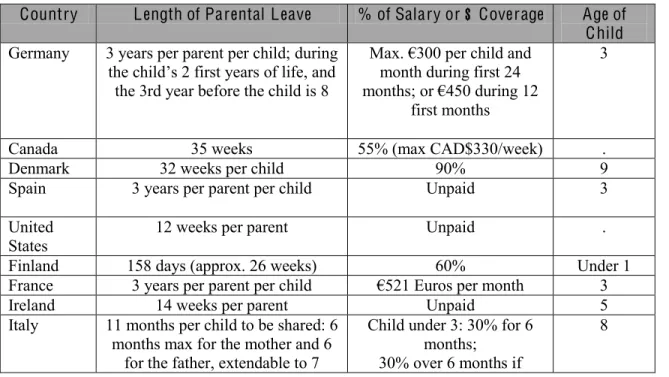
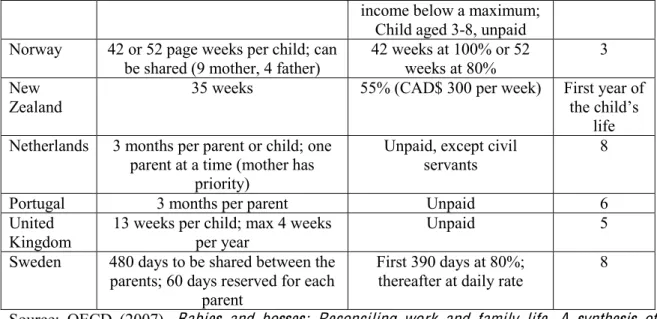
The First Transition 40 Maternity Leave 40 1. Maternity Leave in OECD Countries 40
2. Maternity Leave in Latin America 43 3. Maternity Leave in Caribbean Countries 45 Care Policyfor Children Under Three 47
1. Care Policy for Children in OECD Countries 47
2. Care Policy for Children in Latin America 51 3. Care Policy for Children in the Caribbean 53 The Second Transition 55
Care and Education Policy for Children Ages 3 to 5 55 1. Care and Education Policy for Children in OECD Countries 55
2. Care and Education Policy for Children in Latin America 65 3. Care and Education Policy for Children in the Caribbean 79 Conclusions 82 References 85 II I. T ransitions from the Curriculum Perspective 89 1. Curriculums in OECD countries 90 2. Curriculums in Latin America 101
3. Curriculums in the Caribbean 114
Conclusions 116
References 118
I V. Professional Development of Teachers Working in Early Childhood 122
Professional Development of Teachers to Guarantee Quality Care 123
1. Teacher Training in OECD Countries 124
2. Teacher Training in Latin America 138
3. Teacher Training in the Caribbean 155
Conclusions 157
V. Parental Involvement in Education and Care Services 162
Parental Involvement in the Center or Program 163
1. Parental Involvement in OECD Countries 164
2. Parental Involvement in Latin America 168
3. Parental Involvement in the Caribbean 175
Conclusions 177
References 179
V I. Case Studies: Programs That Incorporate T ransition Strategies 182
1. Head Start Program in the United States 183
2. Preschool Education in Sweden 186
3. Sure Start Program in England 188
4. Centers of Childhood Development (CENDI) in Monterrey, Mexico 189
5. National Wawa Wasi Program (PNWW) in Peru 193
6. JUNJI Programs in Chile 196
7. Roving Caregivers Program in the Caribbean 199
Conclusions 202
References 204
V II. C O N C L USI O NS 207
Presentation
The present study takes on a fairly innovative issue within public policy: the changes children undergo when transitioning from the home to the Day Care Center, and from there, to the educative system. Here, we have compiled and analyzed findings and practices from different geographic areas, and sought to contribute valuable information toward the design and implementation of public policies that promote optimal childhood development.
The study is framed within the ³Policies and Strategies for a Successful Transition of the Child to SociDOL]DWLRQ DQG 6FKRRO´ project, approved by the 2UJDQL]DWLRQ RI $PHULFDQ 6WDWHV¶ (OAS) Inter-American Committee on Education (CIE1) in June, 2006 in response to two priority
issues that were defined by national early childhood and preschool education directors, civil society and international organizations, as a result of a consultation survey carried out in 2005.
The first issue focused on the comprehensive care of children from birth to age three, and aimed at reviewing the scientific, psychological, cultural and pedagogical bases at the core of this stage in child development, in addition to the lessons learned on policies and care modalities. 7KH9HQH]XHODQJRYHUQPHQWFRRUGLQDWHGWKHSURMHFW¶VDFWLRQVDQGLQFRQMXQFWLRQZLWKWKH2$6 Department of Education and Culture (DEC), carried out a survey to analyze the situation of the 34 member countries in relation to this issue. In May of WKH³Int
e
r-Am
e
ri
c
an Symposium:
Und
e
rstanding
th
e
stat
e
of
th
e
art in
HDUO\ FKLOGKRRG HGXFDWLRQDO FDUH´ took place at OAS headquarters; videos, presentations, and documents from the event can be found at: http://www.sedi.oas.org/dec/documentos /simposio/default.htm.The second priority concern was that of transitions. The project suggested analyzing the lessons learned about child comprehensive care from birth through primary education, emphasizing the significance of the transitions from the home to the Day Care Center, and from there to preschool and elementary school, for the child as well as for public policy. It likewise intends to identify the knowledge built up on the basis of successful transition experiences. Thus, in August of &KLOH¶V0LQLVWU\RI(GXFDWLRQWKURXJKWKH1DWLRQDO%RDrd of Early Childhood Education (JUNJI), undertook the responsibility of putting together a new survey to analyze the situation of services, programs and policies in preschool education and the first two grades of elementary school. Together with the OAS/DEC, the Ministry also organized the Int
e
r-Am
e
ri
c
an
Symposium II: Poli
c
i
e
s and Strat
e
gi
e
s
for a Su
cce
ssful Transition of
th
e
Child
to So
c
ialization
and S
c
hool, which took place in May of 2009, in Valparaiso, Chile.
JUNJI, represented by its Executive Vice-president, Ms. Estela Ortiz and Ms. Jacqueline Araneda, in conjunction with the OAS/DEC commissioned the study to Peruvian specialists Maribel Córmack Lynch and Erika Dulkenberg, to whom we are deeply thankful for their professional work. From their contributions we have been able to delve deeper into the issue thanks to the motivation and support by national directors and Early Childhood government specialists, UNICEF, TACRO, OREALC/UNESCO, OEI, the World Bank, IDB and CAF, who participated in the activities and symposiums programmed for this purpose. We are particularly thankful to the Bernard van Leer Foundation that, through its initial publications on transitions, both motivated and illuminated our path for this study.
Following a bibliographical review, the book highlights and compares how transitions are addressed in Latin America and the Caribbean; and in some countries of the Organization for Economic Cooperation and Development (OECD). It analyzes, compares, concludes and
presents reflections on the current situation, conceptual framework, worldwide advances and challenges of policies, curriculums, didactic materials, professional development of teachers, and parental involvement in these transitions. At the end, we have included a specialized annotated bibliography, both in Spanish and English, of interest to the broad public concerned with fostering successful transitions for all boys and girls in the Americas.
Through this study we have sought to contribute to the shared knowledge on early childhood transitions centered around the child and the changes he or she undergoes during the first eight years of life, in relation to his or her access (or lack thereof) to a series of care and educational services.
E X E C U T I V E SU M M A R Y
Introduction
This study was prepared using a documentary analysis methodology, reviewing both primary and secondary sources. The studies and cases analyzed correspond to 26 of the 342
countries that comprise the OAS. Furthermore, cases were selected from 16 OECD countries3
that have proposals and studies on the subject, the material of which is available for consultation. The following is a description of the contents addressed in the six chapters of this study.
The first chapter presents the theoretical-conceptual framework on transitions, and addresses the foundations and scientific bases originating from various disciplines that underscore their importance. The analysis begins with a theoretical review of what the different disciplines understand as transitions, and proposes a definition centered around the child and the changes he or she experiences during the first eight years of life, as a consequence of the access (or lack thereof) he or she has to a series of care and educational services. These changes are experienced differently depending on factors linked to the child and to his or her surrounding environment (resilience, personality, family support, among others), as well as factors associated with care and educational institutions through which he or she transits (the quality of these services, its policies, teacher training, etc.).
The second chapter analyzes early childhood care and education policies, the way in which the care and educational system for children from ages zero to eight is organized, and how this favors (or does not favor) their transitions. The review mainly focuses on the laws and regulations of the educational and social protection sectors, given the importance of their direct effect on the quality of services, their articulation, and the promotion of specific strategies to help the child in the transition from one institution to another.
The third chapWHUUHYLHZVWKHFRXQWULHV¶FXUULFXODUIUDPHZRUNVLQRUGHUWRGRFXPHQWKRZ they incorporate components intended to make transitions easier. It analyzes aspects related to: the existence of a single curriculum for the whole level (0-6 years old) and the foundations, dimensions and areas of the curriculum, among other elements. The aim of this chapter is to check for the existence of contents or elements that facilitate the transitions from one section to another (0-1 to 1-2 years old), from one cycle to another (0-3 to 3-6 years old) or from one educational level to another (preschool to primary education).
The fourth chapter addresses the professional development of teachers. There is a general review of the training programs for teachers responsible for the various early childhood services. Likewise, it includes elements related to the training of primary school teachers. It considers aspects such as training duration, predominant type of training, and graduate profiles, among other elements. The objective is to check if the training of early childhood service staff includes aspects related to transitions; if it prepares them to help the child in his/her passage through the various levels. There is a comparison between the training of staff responsible for early education and care programs, with that of preschool and primary teacher training.
2 Documents from the following countries were reviewed: Argentina, Bolivia, Brazil, Canada, Chile, Colombia, Costa Rica, Ecuador, El Salvador, the Dominican Republic, Guatemala, Honduras, Mexico, Nicaragua, Panama, Paraguay, Peru, the United States of America, Uruguay, Venezuela, Jamaica, Suriname, Trinidad & Tobago, Barbados, St. Lucia and Guyana.
The fifth chapter deals with parental involvement; it analyzes how countries, from the perspective of their care policies, favor parental involvement in their chLOGUHQ¶V OHDUQLQJ DQG development process. As emphasized in the guidelines outlined in the theoretical framework, parental involvement is a key element in policies or programs that favor transitions and seek parental involvement in the FKLOG¶V H[SHULHQFHin the center or program, since the influence of family is essential in early childhood. Early childhood is the stage of the life cycle in which the first social interactions take place, the first behavioral guidelines are learnt, habits are consolidated and the first learning takes place. For this reason, when the child enters the care center or school, it is necessary to include his or her parents in the process that is beginning; to promote communication and exchange between parents and teachers in order to favor the FRQWLQXLW\RIWKHFKLOG¶VSDVVDJHIURPKRPHWRVFKRRO and allow the introduction of WKHSDUHQW¶V social codes into the school (their language, aspirations for the future, expectations, beliefs, YDOXHVHWFZKLFKIRUPSDUWRIWKHFKLOG¶VSersonal history.
The sixth chapter presents study cases of national or state coverage programs carried out in OECD, Latin American and Caribbean countries. They were selected because they share some of the characteristics mentioned in the theoretical conceptual framework, they have abundant bibliographical information, and address one or more previously mentioned aspects that ease transitions (policy, curriculum, WHDFKHU¶V SURIHVVLRQDO GHYHORSPHQW, and parental involvement). The cases from programs sponsored by national governments are from: the National Board of Early Education - JUNJI, Chile; Wawa Wasi, Peru; Roving Car
e
giv
e
rs, from the Caribbean; H
e
ad
Start from the United States; the Preschool Class, in Sweden; and the
6XUH 6WDUW &KLOGUHQ¶VL
e
arning
from the United Kingdom. The case sponsored by a state coverage program cRUUHVSRQGV WR ³&HQWURV GH 'HVDUUROOR ,QIDQWLO ± &(1',´ &KLOG 'HYHORSPHQW &HQWHUV IURP Monterrey, Estado de Nuevo León, Mexico.Chapter I. Theoretical Conceptual F ramework: T ransitions to Socialization and School
The document is based on the premise that every individual, throughout the course of his or her life, experiences the passage through various stages marked by development landmarks and/or socio-cultural rituals. This statement is based on scientific foundations from disciplines such as socio-cultural anthropology, psychology and the neurosciences, which indicate that children go through stages in their development that are marked by landmarks and/or rituals. During these transitions, the child continually adjusts to the demands or opportunities that the new situations or stages present. As established by socio-cultural anthropology, psychology, and the neurosciences, the role of the environment is crucial to facilitating or hindering these adjustments. Each, from its own perspective, indicates the importance of having an environment that provides opportunities and experiences that enables children to develop their potential.
From the perspective of care and education, early childhood transitions are understood as a continuous process²where every action carried out before, during and after is relevant²rather than a as an event. When studying them, not only must the child be involved, but also those who accompany him or her throughout this process: the FKLOG¶Vparents. This is also true for the FRQVWDQW DQG FRQWLQXRXV HIIRUWV PDGH E\ WKH HGXFDWLQJ HQWLW\ WR OLQN WKH FKLOG¶V QDWXUDO environment, i.e., the family, with the care and educational environment. Transitions are processes that do not involve just the child, but also the FKLOG¶Vfamily environment and the educational institutions through which he or she transits.
characteristics (nutritional state, cognitive, social, and emotional development levels, etc.), and his or her family¶V characteristics (socio-economic status, values and attitudes towards childhood, etc.). External factors encompass WKHLQVWLWXWLRQ¶Vcharacteristics (be it a care center, preschool or VFKRRODQGLQFOXGHLWVFXUULFXOXPDQGVWDII¶VSURIHVVLRQDOGHYHORSPHQWDPRQJRWKHUWKLQJV2Q the other hand, early childhood public policy constitutes the framework on which care centers or nurseries, preschools and schools rely to operate. This policy framework may favor positive transitions or contribute to their hindrance, and as such, an overview of all the elements that ease transitions is necessary in order to work from all these levels.
This paper refers mainly to two great transitions: the one from the home to early childhood care and education center, and the transition to the educational system (be it preschool, a non-formal or out-of-school program, or primary school). The former is one that not all children undergo. In Latin America and the Caribbean not all children experience this transition for various reasons, among them, the smaller supply and demand for these services. In OECD countries, however, where there is high access to educational programs and early childhood care, the first great transition is common. It is the second transition, from preschool to primary school, which has been far more studied and researched worldwide. One line of research focuses on what DFKLOG¶V r
e
adin
e
ss or to b
e
pr
e
par
e
d
for primary s
c
hool implies. A wider concept refers both to
the child and to the institution, and how prepared the school is to receive the child. At present, a great majority of children attend preschool centers, and access to primary schooling is universal.Chapter II. Early Childhood Policy: Laws and Regulations Relating to T ransitions
The first transition, to an early care and education center, is related to the legislation concerning maternity leave and the care policy for children under the age of three. In OECD countries, maternity leaves fluctuate between a minimum of 12 weeks in the United States and New Zealand, to up to 52 weeks in the United Kingdom. In many OECD countries the policies for paid extended maternity leave (approximately three months past beyond that established by the ILO), as well as additional parental leaves, have contributed to delay this transition until the end of the FKLOG¶VILUVW\HDURIOLIH In the rest of OECD countries, where there is no paid and extended maternity leave available, this transition to a cHQWHUWDNHVSODFHHDUOLHULQWKHFKLOG¶VOLIH
The transition to early childhood care and education centers is affected by the availability, accessibility and quality of said centers. Countries of the European Community have set forth to guarantee that slightly over one third of children under the age of three have access to these types of services by 2012. But policy regarding care and education for children under the age of three (and therefore services) is not equally developed in all OECD countries. There is less and more expensive access in countries like the United States and the United Kingdom, where the supply is mainly private. Another measure that many OECD countries have taken to guarantee female participation in the labor market is to offer these care programs throughout all working hours, that is to say, to establish them as full-time services.
In most Latin American countries, care for children under the age of three features a diversity of low-coverage programs that often are not likely to be replicated or taken over by the Ministry of Education, given the costs involved in their organization and operation. In general, these services are promoted by enterprises, non-governmental organizations (NGOs), private associations, churches, offices of the First Lady, or some sectors of public administration. Some governments, like that of Chile DQG WKH0LQLVWU\ RI :RPHQ¶V $IIDLUV DQG 6RFLDO 'HYHORSPHQW (MIMDES) in Peru, among others, are implementing actions intended to extend the care coverage for this age group. In the case of children under the age of three, whose mothers do not work outside the home or for various reasons lack access to these benefits, countries offer alternatives through non-formal or out of non-academic programs.
With respect to the transition from care centers to preschools4, a significant element that
has been emphasized in comparative studies refers to the importance of an integrated early childhood policy. In OECD countries such as Sweden, Denmark, Finland, the Netherlands, New Zealand, the United Kingdom and Australia, changes have been made toward the unification of care policy for children under the age of three, and those from three to six years old, under a single administrative entity that guarantees coordination of services at the different levels, as well as quality care. In most of these countries, integration has been implemented under the educational sector, but in others, like Denmark and Finland, integration is under the social protection sector. The preference to integrate the system with the educational sector is due to the following reasons: (i) acknowledging the importance that learning has throughout RQH¶V ZKROH life, and the importance of the learning that children undergo from their very early years, (ii) the better infrastructure available in the educational sector (data collection, training, curriculum, evaluation, research), and (iii) the notion or belief that the educational sector has a better base than the social protection system to provide universal services to all children. Integration policies allow for establishing a minimum standard of quality for all programs (Ireland, Australia, New Zealand, England), and thus the possibility of undertaking common teacher training policies for those who work with children under and over the age of three (as is the case in the United Kingdom), which helps to raise and ensure quality.
In most Latin American countries, education for children ages zero to six, and six to eight, normatively depends on the Ministry of Education. State-promoted centers and programs offer, as part of comprehensive care, complementary health and food services provided by other sectors. $FFRUGLQJ WR 81(6&2 WKLV VLWXDWLRQ PD\ VRPHWLPHV OHDG WR WKH ³fragm
e
ntation of
r
e
sponsibiliti
e
s and thus introdu
ce
in
e
quali
ti
e
s with r
e
sp
ec
t to a
cce
ss and quality
.
´5Because of
this, services need to be incremented following a strategy of programs that, according to Myers (2007), are ³mor
e
int
e
r-s
ec
toral
,
c
ompr
e
h
e
nsiv
e
and r
e
sp
ec
tful of div
e
rsity
,
with
th
e
following
c
hara
c
t
e
risti
c
s:
47KURXJKRXWWKHSDSHUWKHWHUPµSUHVFKRRO¶LVXVHd to refer to all programs aimed at children over 3 years of age in VFKRROVLQFHVSHFLILFWHUPVPD\YDU\E\FRXQWU\VXFKDVµNLQGHUJDUWHQ¶RUµSUH-NLQGHUJDUWHQ¶µLQLWLDO¶DQGRU µGD\FDUH¶DPRQJRWKHUV
³IRFXVRQKXPDQGHYHORSPHQWDQGRIIHUDFRPPRQSRO
i
c
y fram
e
wor
k
with th
e
parti
c
ipation of s
e
v
e
ral s
ec
tors; (2) in
c
orpora
t
e
staff from all s
ec
tors; (3) l
e
ad
int
e
grat
e
d a
c
tions from th
e
e
du
c
a
tional s
ec
tor or from anoth
e
r s
ec
tor; (4)
c
arry
out
c
onv
e
rg
e
n
ce
of programs with a
c
ommon poli
c
y fram
e
wor
k
,
rath
e
r than with
int
e
grat
e
d
s
e
rvi
ce
s; (5) att
e
nd
to and
support
th
e
n
ee
ds and programs
for
c
hildr
e
n
,
family
,
par
e
nts; (6)
FRPELQHFKLOGUHQ¶VHGXFDWLRQDQGc
ar
e
; (7)
e
xt
e
nd
c
ov
e
rag
e
through s
e
v
e
ral strat
e
gi
e
s
that
c
an add up to a national s
c
al
e
,
l
e
aving
asid
e
pilot or s
c
a
tt
e
r
e
d
e
xp
e
ri
e
n
ce
s
.
´6Preschool care policy incorporates specific strategies to promote preschool transitions to primary school, as is the case in various OECD countries. In Finland, the effort to promote positive transitions and provide continuity to the educational process is evident in its policy documents, which explicitly favor learning in their own language, the right to their own culture, cooperation among institutions, and facilitating parental involvement in preschool education. Germany uses stop gap strategies by enrolling children who are not ready for the first grade in primary school classes that are pedagogically oriented in a similar way to preschool. A similar policy is followed by Sweden, Finland and Denmark by locating preschool classes in primary schools, seeking to promote a positive transition by familiarizing the child with the primary education environment, under a program with a preschool pedagogical orientation. Other strategies used by some countries include establishing alliances between those working in the preschool level and those working in primary schools (United Kingdom, New Zealand, Jamaica), among others.
In Latin America, governments and private institutions provide a wide range of educational opportunities for three- to six-year-olds, in attempt to respond to the various social, cultural and geographical contexts in which the children and their families live. Although mandatory ages differ from one country to another, they all develop programs for the various age groups.
In most countries, actions to favor transitions are just now beginning to be incorporated into educational policies, and strategic and developmental plans. In this respect, the first step being taken in some countries consists in articulating curricular designs from preschool to secondary schooling. Meanwhile, in official documents there are proposals for strategies such as: implementing shared actions between preschool teachers and teachers of the first cycle of primary education (Argentina), avoiding a traumatic passage between care centers and preschool education (Brazil), envisioning a continuous process that begins within the family and continues in school (Costa Rica); articulation between preschool and primary education (Colombia, Ecuador, Honduras, Paraguay, Peru), pedagogical continuity (Mexico), curricular continuity, coherence and progression between preschool and primary education (Chile), preparing the child for primary school (El Salvador, the Dominican Republic), and the integration of preschool with primary school (Venezuela).
Chapter III. T ransitions from the Curriculum Perspective
With respect to the curriculum, one way to facilitate transition is to articulate the curricula of the various levels. The idea is to have FHUWDLQ ³
c
ontinuity
´ ³SURJUHVVLRQ´ and³GLIIHUHQWLDWLRQ´ EHWZHHQWKHGLIIHUHQWOHYHOV¶FXUULFXODUIUDPHZRUNQRWjust in terms of content,
6 Myers, R (2007). V Meeting of Ministers of Education. Cartagena, Colombia. Lessons learned and commitments in WKHKHPLVSKHUHWRZDUGV(DUO\(GXFDWLRQ)RXUWK3OHQDU\VHVVLRQ³3XEOLFSROLF\LQWHU-sector collaboration,
but also in teaching and learning methods. OECD countries have coordinated preschool and primary school level curricula with those of primary schools (as in the case of Spain, France, the Netherlands, Italy, Portugal, the United States, Canada), or care and educational center curricula with that of preschool, under a single curricular framework for early childhood (as is the case in New Zealand, Sweden, Norway, Finland, Ireland, the United Kingdom and Australia).
In the first case, preschool curriculum guidelines (ages three to six) are outlined in the same documents that establish the curricular guidelines for primary education. It is important to be alert, in the first case, so that the preschool level is not ³SULPDUL]HG´. In the second case, one must be alert that the early childhood curricular framework, in its pedagogical approach, content, and evaluation mechanisms, among other aspects, be GLIIHUHQW DQG ³GLVWDQW´ IURP WKRVH RI primary education. Countries like the United Kingdom, Sweden and New Zealand, have been considering these elements in their revision of curricular frameworks. The United States and Canada, however, have no national curricular framework, and therefore every state or province is free to develop or purchase it, with most using the Creative Curriculum, by Diane Dodge.
In Latin America, the Ministries of Education of most countries have included in their preschool level curricula: objectives, contents, competencies, abilities and attitudes, for the care and education of children from zero to three years of age, even though the services provided to this age group may be developed by institutions other than the Ministry of Education; this is also valid for children between the ages of three and six. Analysis of educational system curricula in WKHUHJLRQSURYHVWKDWWKHFXUULFXODUGRFXPHQW¶VVWUucture varies between countries with respect to its organization, content, and specificity level. Flexibility varies according to the standards established by each country at the time of preparing the document. This flexibility enables its diversification according to the different contexts in which it is applied.
Some countries present the proposal in a single document that encompasses all Primary Education levels, as in the case of Nicaragua and Peru. Others prepare one document for each educational level, and even one for each Preschool cycle (ages zero to two, and three to six). In many cases Preschool Education and Primary Education share foundations, curricular cores and cross-sectional topics, and present a similar organization in cycles, curricular or development areas, or generating cores, as well as objectives or competencies, abilities and attitudes. This coordination is probably the first approach to achieving FKLOGUHQ¶VVDWLVIDFWRU\WUDQVLWLRQIURPRQH level to another.
With respect to curricular foundation, in OECD countries, the curricula of Nordic countries and New Zealand are influenced by social pedagogy that combines elements of care, childrearing and educational, and IRFXV RQ VXSSRUWLQJ FKLOGUHQ¶V FXUUHQW GHYHORSPHQW DQG interests. On the other hand, in countries such as Germany, France and the United Kingdom, curricula are based on facilitating the preparation for school. In this case, the focus is on the development of cognitive skills, such as reading and writing. This approach is more academic, with a structured program and special attention to the development of language skills from a more individualistic concept of preschool education.
the different levels. Countries where the spoken language differs from the official one rely on Intercultural Bilingual Education programs, which have contributed by encouraging other countries to formulate this type of curricula. Curricular proposals are complemented with other documents that generally express the intent to establish mechanisms to ease the transition from Preschool Education to Primary Education.
A common element to all curricular frameworks in OECD countries is the importance given to playing as a means for learning, and to child-focused learning. OECD countries have a clear notion that young children learn actively and through play strategies. This is an element that facilitates transitions and that curricular frameworks have incorporated in order to foster development and learning on the basis of what the child knows how to do best.
Another element pertinent to transitions is the degree to which the curriculum may be adDSWHG WR FKLOGUHQ¶V QHHGV depending on the contexts. OECD countries evidence a tendency toward curricular frameworks with general guidelines that must be locally developed by educational establishments. There is no pre-established and prescriptive curriculum, although the level of detail varies by country. There are some countries like Sweden, Denmark, Finland, the Netherlands and Portugal, where the curriculum is quite general and each center is responsible for developing its own educational plan and associated curriculum. In other cases, the curricular framework provides a greater level of detail and includes not only objectives and methodological principles, but also the goals to be reached and the dimensions or areas to address. On the other hand, for example in New Zealand, the curricular framework was developed with the participation of minority groups (such as the Maori), which helped bring the curriculum closer to the context of these populations.
Chapter I V. Professional Development of Teachers Working in Early Childhood
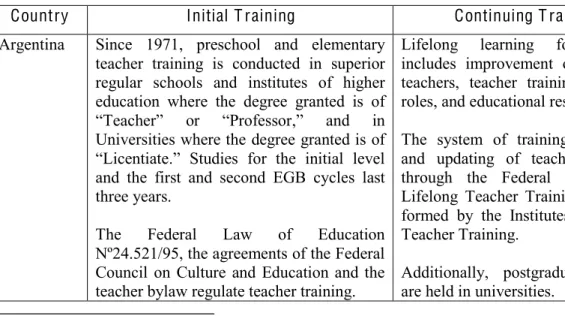
As set forth in this chapter, training of staff working with children is a key element linked to the quality of the service. A well-trained teacher has many theoretical and practical elements to tackle difficult situations, as well as to bring the child and parents closer to the center or program in a positive manner, facilitating transitions. This document, though it does not analyze teacher training program or early childhood staff training curricula, does identify some formal aspects of training and the strategies used by countries, which could help in making transitions easier. For example, a common training program for preschool and primary teachers may have positive elements if the training gives equal importance to both levels and no priority is given to training in primary contents.
education. Likewise, the requirements to work in services aimed at children under the age of three are minimal in most countries.
In most Latin American countries, initial teacher training takes place in higher pedagogical institutes and in universities, where the duration of their studies fluctuates between three and five years. In Bolivia, Guatemala and Nicaragua, preschool and primary teachers used to receive their training regular schools in the diversified cycle of secondary education, which are currently in a transition process to tertiary level institutes. In Honduras, initial teacher training requires a teaching degree for primary school obtained from a diversified secondary school, followed by two more years of study. In rural and marginal urban zones, the education of children from zero to six years old is generally carried out in non-formal or non-academic programs, where the educational agent is a member of the community, preferably having completed secondary schooling, although in very rural areas the educational level is lower. Faced with the lack of a pedagogical degree, these educational agents are trained, advised and supervised by a preschool education professional in order to ensure a better performance in their duties.
Another key element in the professional development of teachers, and not early childhood teachers, is the profile regarding what they must know, do and have adequate knowledge on, in order to practice as such. Countries such as England, New Zealand, and the United States, have developed professional standards for early childhood workers, which are usually brief statements describing what a professional needs to know, be familiar with, and be able to do. They are usually based on level of experience, on a scale, and are part of the process that countries have been developing to implement a system of professional development and competency profiles. The interesting part is that they are similar to the profiles for primary teachers, and as such, without losing its individuality, somehow seeking to homogenize requirements that permit giving continuity to the teaching process.
As for teacher training in Latin America, the organizations responsible for Education Ministries or Secretariats, have also established profiles for preschool teachers upon completion of their careers that are most likely in accordance with the corresponding curriculum. However, it would be wise to review them to ensure that they have been adjusted to meet the demands of 21st century society and, therefore, the duties that teachers must assume as agents of change, as
well as to guarantee quality and equity in education.
Chapter V. Parental Involvement in Education and Care Services
Family influence is central throughout early childhood. Therefore, when the child enters a care center or school, it is necessary to incorporate the parents in the process that is beginning, and to promote communication and exchange between parents and teachers in order to favor the FRQWLQXLW\ RI WKH FKLOG¶V H[SHULHQFHV Orientation toward the family, participation and coordination of actions between the family and educational institution, are concerns that have been present since the beginning of preschool education. The effort and commitment to involve parents in the educational process of their children is a contributing factor to facilitate transitions and is evident in policy documents.
and Coordinating Committees in the preparation of WKH FHQWHU¶Vcurricular plans, as well as in individual plans and activity content (Finland and Norway).
English-speaking countries also promote the inclusion of specific strategies such as the creation of resource centers, or counselor appointments (New Zealand, U.S.A. and the United Kingdom), and parent involvement in the formulating early childhood policies. An OECD study (2007) indicates that this involvement has been limited, considering that early childhood is one of the most adequate levels for it. A significant exception is Sweden, where in the 1960s, civil society as a whole, but mainly parents, advocated for a universal care policy for children under the age of three.
In Latin America, family involvement in the education children under six has been present in every program, formal or non-formal, since the very beginning. Currently, most of the countries have an assortment of programs promoted by the State, civil society, mass media, NGOs and international organizations, among others. These programs can be attended through meetings, household visits, GRFWRUV¶ RIILFHV ZRUNVKRSV DQG SOD\centers, or through the radio, brochures, newspaper inserts, bulletins, or videos. Programs aimed at parents have the purpose of strengthening childrearing practices, as well as offering theoretical and practical information to promote the comprehensive development of their children, both at a cognitive level and in relation to health, nutrition and emotional development.
Another form of participation consists in the formulation of the Institutional Educational Project, which is the medium-term, strategic planning mechanism that guides and leads institutional life. However, parental involvement, particularly in rural and marginal urban zones, is much broader as it includes the construction or assignment of premises, participation as educational agents, in the preparation of food, growing vegetable gardens and raising small animals, and in the preparation of didactic material and construction of furniture, among the most important. On the other hand, in some countries Parent Associations contribute to the maintenance of premises, furniture and educational material of the institutions, while at the same time exercising social monitoring to ensure compliance with the Institutional Educational Project (IEP) and complementary services.
Caribbean countries have extensive experience with pilot programs aimed at parents. These programs focus on providing parents with the necessary support to exercise their parenting or childrearing duties, and place household visits as their priority. One such program is the
Roving Car
e
giv
e
rs, which has been implemented in five Caribbean countries (Jamaica, St. Lucia,
Grenada, Dominica, y St. Vincent and the Grenadines). Based on the research on experiences of household visits in Jamaica, some key elements of these programs have been documented, such as: frequency of the visits, session duration, curriculum and content, as well as the type of training and facilitator needed. At a regional level, countries have even expressed the need to have exclusive policies on work and programs for parents that include aspects on training, and information collection on childrearing patterns.Chapter V I. Case Studies: Programs That Incorporate T ransition Strategies
linked to transitions from the home to socialization and school are addressed, in both targeted and universal cases at a national level.
The Head Start7 program, in its conceptualization and management and implementation
policy, attempts to respond with strategies and initiatives to the difficulties that children generally experience upon moving from the home to an educational and care center, and subsequently from the care center to preschool and then to school. It simultaneously encompasses two programs: Early Head Start (EHS) (for children from zero to three years of age) and Head Start (HS) (for three- to six-ear-olds DV µVLVWHU SURJUDPV¶ ZLWK WKH VDPH SROLFLHV VWUDWHJLHV DQG TXDOLW\ parameters. Likewise, it sets forth a series of strategies to facilitate the transition process from EHS to HS, and later to primary or basic education. It incorporates specifically designed orientation and training guidelines in the process, aimed at teachers and directors. Another key component is its effort in promoting parental involvement in the activities carried out, and providing services for them in the same premises.
The Swedish preschool model approaches transitions from different angles. One is from the curriculum, in which the primary education curriculum has incorporated concepts and methods of the approach used in preschool education, such as an emphasis on playing, exploring and creativity, as well as using teachers as a model for working in teams. Likewise, the preschool curriculum GRHVQRWH[FOXGHOHDUQLQJLQWKHFKLOGUHQ¶s first language, but rather, is facilitated in preschool centers. In this manner, transitions for children from minority populations are eased. Lastly, the creation of preschool classes for six-year-olds within primary schools seeks to familiarize the children with school culture, while at the same time introducing primary school pedagogical approaches in order to minimize the differences. Locating preschool classes in primary schools allows for a more coordinated effort and collaboration between teachers from both levels, while familiarizing the children with the next level. The preschool class was created as a strategy to make transitions easier, and to establish the link between preschool and school experiences.
The Sure Start program, also addressed to young children from the poorest sectors in England, favors successful transitions by providing comprehensive services to the children, as well as providing services for parents in the same premises.
The cases selected in Latin America meet some of the characteristics mentioned in the theoretical conceptual framework developed in this study, and there is a wide range of bibliographical and virtual information about them. Although the application of strategies to DFKLHYH WKH FKLOG¶V VXFFHVVIXO WUDQVLWLRQ WR VRFLDOL]DWLRQ DQG VFKRRO LV VWLOO YHU\ UHFHQW DQG therefore there are no results available in this respect, it should be noted that there are some actions being implemented in relation to the transition process, such as articulation of curricular designs, that build bridges, as it were, between the educational cycles and levels through which the child will transit.
Among the selected centers, WKH (DUWK DQG )UHHGRP 3RSXODU )URQW¶V (DUO\ &KLOGKRRG Development Centers (CENDI) from Monterrey, Nuevo León, Mexico, implements an education and care strategy in which special emphasis is given to accompanying the child and his or her family to guarantee transitions from the home to the educational center and, subsequently, from one section to another. The CENDIs provide care and education services, in marginal zones, from the time the child is 45 days old until his or her entrance to primary school, guaranteeing continuity to the programs and a comprehensive care of the child; for these purposes, a
7 Currently, this program reaches 908,412 children (10% of which are under 3 years old) in 18,275 centers. Further information on the Head Start program may be found on the website:
disciplinary team participates in this work, using evaluation parameters and indicators for the FKLOGUHQ¶VDVVHVVPHQW A follow-up of school graduates is also implemented in order to evaluate their academic performance, as are non-formal programs such as the School for Parents, to treat and guide processes including: adjustment, sphincter control, nourishment and first aid, among others. Health and nutrition workshops are also held, and individual advisory is provided. For children who do not attend the center, non-formal programs are developed, such as ³$SUHQGLHQGR -XQWRV´ (L
e
arning Tog
e
th
e
r); for those needing nutritional support, there is the workshop
³5HVFDWDQGR ,QWHOLJHQFLDV´ 5HVFXLQJ ,QWHOOLJHQW 0LQGV¶,
and ³&RQVWUX\HQGR XQ 0DxDQD 0HMRU´%XLOGLQJD%HWWHU)XWXUH for expectant mothers, a pre-natal program that provides care to women from marginal communities starting in their fourth month of gestation.The NaWLRQDO 3URJUDP :DZD :DVL :: ³&KLOGUHQ¶V +RXVH´ LQ (QJOLVK LQ 3HUX XQGHU WKH 0LQLVWU\ RI :RPHQ¶V Affairs and Social Development (MIMDES), offers direct comprehensive care for children under the age of four, living in conditions of extreme poverty, in urban human settlements in the periphery of cities. The program is jointly managed by the State, the community and municipal voluntary workers, and ORRNV DIWHU WKH FKLOG¶V FRPSUHKHQVLYH development in health, nutrition and early childhood learning on a full-time basis. It offers three food rations per day, and health control in the health center close to the WW. With respect to education, it has instruments available to evaluate child development, to plan actions based on the curricular plan and the articulation matrix. It furthermore applies a monitoring and evaluation VWUDWHJ\ WKDW HQDEOHV LGHQWLI\LQJ WKH SURJUDP¶V DQG WKH FKLOGUHQ¶V DFKLHYHPHQWV WR JXDUDQWHH satisfactory performance in their subsequent schooling. The WW may be managed by families, the municipality, or by an institution (by agreement in labor centers). In rural zones, where parents do not leave their children, a program with the parents is developed, denominated
Qatari
Wawa
(URXJKO\ ³2Q <RXU )HHW .LGV´ in English) and led by a multi-disciplinary team. The 3URJUDP¶VFRPSRQHQWVDre: development of abilities, promotion of communal management and promotion of development.In Chile, the Programs of the National Board of Early Childhood Education (JUNJI) are implemented nation-wide by means of various formal and non-formal strategies. They offer comprehensive care to children under the age of six, which includes food, social assistance, and education. One of the Programs is the Early Childhood Day Care CHQWHU³-DUGtQ,QIDQWLO´WKDW cares for children from 85 days after birth until their entrance to primary education, constituting a significant support for working mothers and their children. The sections are: ³VDOD FXQD´ ³PHQRU´and ³PD\RU\WUDQVLFLyQ´ (pre-kinder and kinder). They are established in urban or semi-urban areas, and have differentiated schedules or hours of operation. They may be managed by JUNJI, by municipalities or by non-profit institutions. Strategies consist in working with children and their families, who participate in meetings, workshops, and educational work in the home.
-81-,¶VDOWHUQDWLYHRUnon-formal programs provide free-of-cost comprehensive care to children from the age of two until they enter primary school, and are also located in urban and semi-urban areas. In them, family involvement is an important factor, since they are involved from the beginning in theLUFKLOG¶V educational process. Non-formal programs are the following:
³-DUGtQ ,QIDQWLO )DPLOLDU´ (Family Pr
e
s
c
hool), where programs for children and parents are
GHYHORSHG³Jardín LaborDO´(Work
ing Pr
e
s
c
hool) for children whose mothers work outside the
home; ³-DUGtQ (VWDFLRQDO´ 6HDVRQDO 3UHVFKRRO, for children whose mothers have temporary jobs in productive areas; ³-DUGtQ ,QWHUFXOWXUDO´ ,QWHUFXOWXUDO 3UHVFKRROfor children from indigenous communities, where an intercultural curriculum is applied and the teacher is indigenous; and the ³Programa d
e
M
e
jorami
e
nto d
e
At
e
n
c
ión para la Infan
c
ia para niños
e
n
Furthermore, JUNJI has specific programs for families that can be implemented in their own homes (³VDODFXQD´at home), in a health care center, and by means of radio programs.
In the Caribbean, the program selected was
Roving Car
e
giv
e
rs. This program is being
implemented in St Lucia, St. Vincent, Grenada, Dominica and Jamaica, and is a good example of a program aimed at children under the age of three that incorporates elements that favor transitions. Among these elements is that of gradually familiarizing parents with the type of services that can be obtained at the care and educational centers, beginning in the home with visits to the house and through activities aimed at both the child and his or her main caregivers.Chapter V II. Conclusions
D
e
finition of Transitions
Early childhood transitions refer to the change processes experienced by children during their first 8 years of life, linked to the access (or lack thereof) to various educational services (early childhood care and education center, preschool and primary school). Transitions are processes that imply adjustments by the child and by the environment, in which what happens in the previous setting and in the one the child is entering both matter. They affect not only the child, but also tKH FKLOG¶V HQYLURQPHQW DQG WKH VHWWLQJ WKURXJK ZKLFKhe or she transits. The home, care and education center, preschool and school constitute sub-systems of passage for the child, and are in turn DIIHFWHG E\ WKH FKLOG¶V SDVVDJH WKURXJK WKHP There is a shared responVLELOLW\EHWZHHQWKHFKLOGDQGWKHFKLOG¶VSHHUV, family, teacher, and community.
A successful transition is described as the FKLOG¶V SDVVDJH IURP RQH HGXFDWLRQDO institution or care facility to another, accompanied by his or her parents and teachers; a step for a child who is ready, and one in which the child experiences proximity and continuity with the new environment, thanks to a curriculum that adapts to the his or her level of development and to qualified teachers that are interested in knowing the child and his or her past experience. In this passage, parents must feel welcome and supported by the new care facility or educational institution, according to policies that promote their involvement. A successful transition in early childhood is more likely to take place if there is a common regulatory and policy framework conducive to the continuity of these experiences. An integrated early childhood care system (for children under the age of seven) under a single institution facilitates the coordination of services, the creation of common standards of care, and competency-based profiles for staff working in these programs.
Th
e
or
e
ti
c
al Foundations a
cc
ording to Various Dis
c
iplin
e
s
According to psychology, we know that as a child grows, basic affection, nourishment, care and education needs must be satisfied in order to develop the potential he or she was born with. It is not the same child with the same capabilities that moves from one educational level to another. It is instead a conceptualization of a child who is not static, but rather in constant growth and development, so that the demands and stimuli from the environment must adjust accordingly.
Fa
c
tors that Influ
e
n
ce
Transitions
In this respect, authors such as Peralta (2008) identify both internal factors, linked to the child and his or her family, and external factors, linked to the institution through which the child transits. ,QWHUQDO IDFWRUV LQFOXGH WKH FKLOG¶V QXWULWLRQDO VWDWHlevel of cognitive and socio-emotional development achieved at the time of transition, as well as factors related to his or her family environment: socio-economic level, the value given to education and early care, among others. External factors include the quality of the educational or care institution through which the child transits and, therefore, all the elements that constitute a quality service (staff training, curriculum used, type of parental involvement promoted, conditions of infrastructure, educational materials, among others). These factors are regulated by early childhood care and education policies, and as such, policy analysis is also relevant.
How Transitions ar
e
Addr
e
ss
e
d in Car
e
Poli
c
i
e
s for Childr
e
n Und
e
r th
e
Ag
e
of Eight
In addressing the issue of transitions, care policy seeks to offer both children and their parents an integrated system of quality care that, as Peralta (2008) LQGLFDWHV KDV ³FRQWLQXLW\´ ³SURJUHVVLRQ´ DQG ³GLIIHUHQWLDWLRQ´ An element that has been considered in many OECD countries is that of integrating the responsibility of early childhood policy under the educational sector. This trend is seen as an effort toward continuity (and positive transitions) in the educational process. Integrating care policy under a single sector facilitates the coordination of education proposals of services for children under the age of three and in primary school, by dealing with a common notion of childhood, care and education, and supervision of the quality of services. Countries that have an integrated system are: New Zealand, Sweden, the United Kingdom, Denmark, Finland, Norway, the Netherlands and Australia.
In Latin America, care and education for children in the first cycle (from birth to age three) is promoted, with other standards, by institutions other than the Ministry of Education. The second cycle (ages three to six) and primary schools, however, do report to the Ministry of Education, hindering continuity between the first and second cycles. Moreover, in the context of comprehensive care, complimentary health and nutrition services are offered to early childhood by other sectors. Such situations can sometimes lead to disparities in the access to and quality of services, as it is possible that they may not be coordinated with the education sector.
In most countries, transitions between the second cycle and primary education are addressed at the level of strategic and development plans, and in some cases, in the legislation of the education sector. However, its incorporation to pedagogic practice is still in the early stages; a first step in this direction is the articulation of curriculum documents and methodological guidelines that, to a certain extent, helps to provide continuity to learning in the different levels of the educational system. Another important element, common to all countries in the region, is parental involvement. Their involvement in education ZLOO FRQWULEXWH WR WKH FKLOG¶V Vuccessful transition from the home to the different care and education services.
Chara
c
t
e
risti
c
s of a Curri
c
ulum Favorabl
e
to Transitions
Based on the information from OECD countries, a curricular framework that can be adapted to local contexts is viewed as an element favorable to transitions. Understanding said adaptation not as a mere diversification of content, but rather as the development of the curriculum itself at the center or program level, allowing it to fit the specific needs, interests and characteristics of children. This is the case in Sweden, where the curriculum is developed by each center or program based on general principles, whereas in Latin America, Peru sets forth the possibility of curricular diversification.
In OECD, Latin American and Caribbean countries, an important element is that curricular framework include not only aspects related to learning and school readiness, but those related WRWKHFKLOG¶VFRPSUHKHQVLYHGHYHORSPHQWFRQVLGHULQJDQGJLYLQJDFHQWUDOUROHWRchild-centered methodologies and the way children learn, through play. An additional element is that the curriculum include specific contents for indigenous or migrant populations (Sweden, Finland), or even that they be developed with the participation of these groups, as was the case in New Zealand, and in most Latin American countries that have different ethnic groups (Chile, Peru, Ecuador, Bolivia, Paraguay, among others).
Another feature is that the preschool curriculum share common elements with the primary school curriculum. There must be coordination not only in the contents of the entire early childhood level and between the last preschool level and first grade (as in the United Kingdom), but also in the methodology, organization of the environments, educational materials, etc. In the operative part, one should opt for a functional organization of the objectives competencies or skills in areas, or spheres, or dimensions, etc., that will enable the continuity of learning from one section to another and from one cycle to another, further coordinating the preschool and primary education curricula.
The foundations supporting the proposal should include updated information from the various disciplines, in order to guide the pedagogical approach, methodology, strategies and evaluation criteria, specifying what is for the first cycle and what is for the second, given the specific features of each age group.
It would be good to include, as is being done in the United Kingdom, the graduate profiles of children, so as to serve as reference for teachers on the achievements the children are expected to have reached at the end of each cycle. Lastly, the curriculum should encourage and enable parents to participate in the educational process of their children, even in the formulation RIWKHLQVWLWXWLRQ¶VFXUULFXOum.
Constraints Fa
ce
d by Countri
e
s in Impl
e
m
e
nting Curri
c
ula Favorabl
e
to Transitions
higher. (v) The lack of bilingual teachers in areas where the spoken language differs from the official one, which prevents children from understanding and contributes to increasing numbers of repetition and dropouts. (vi) The frequent changes made to curriculum documents, the poor training of teachers to handle them, and the lack of adequate infrastructure and materials.
El
e
m
e
nts that Should b
e
In
c
orporat
e
d in T
e
a
c
h
e
r Training to Fa
c
ilitat
e
Transitions
The professional development of teachers working in early childhood should aim to achieve a graduate profile that considers all the functions they will have to perform not only with children, but with the parents and community as well, in the different geographical, socio-economic and cultural contexts of the respective country. It is necessary to have a competency curriculum, accompanied by an evaluation design that will permit validating the curricular proposal. In this way, every so often (three or four years) the necessary changes can be introduced based on the results and the progress of science and technology.
It would be important that the teacher training for early childhood cover the period from birth to age eight, which would enable teachers to accompany the child during the transition to primary school, to the first two grades ± as in the case of OECD countries like France, Denmark, Norway and Sweden; Colombia in Latin America; and Guyana in the Caribbean.
In Latin American countries where several languages or dialects are spoken, it is necessary for the teacher to be proficient in WKH FKLOGUHQ¶V ILUVW ODQJXDJH )XUWKHUPRUH LQLWLDO teacher training requires ongoing training through
diplomados, training courses, specializations,
and 0DVWHU¶V DQGDoctorate degrees that will contribute to the continuous improvement of the teaching staff. Ongoing training must be scheduled by the institutions in charge, taking into consideration the results of the assessments made through monitoring and supervision, in order to: guide the management of new curricular documents or methodological guidelines; analyze recent research on early childhood growth and development; master the application of learning strategies and curriculum planning, and other content requested by the teachers. Courses may be either completed in person or online, with each session lasting no less than one month, using a practical theoretical approach. Learning groups may also be organized, in which teachers meet to exchange experiences, analyze documents, plan activities and do internships, among other things.In the case of staff working in non-formal or non-academic programs, ongoing training is necessary to ensure quality of service. It would also be necessary to develop competency profiles for non-teaching staff working in programs aimed at under the age of three. This would contribute to the implementation of professional development for teaching and non-teaching staff in early childhood. In Latin America, Mexico²through CONAFE²has been implementing a development system for non-teaching staff.
Poli
c
i
e
s Favoring Par
e
ntal Involv
e
m
e
nt in th
e
Edu
c
ation and Car
e
of th
e
ir Childr
e
n
in the preparation of the didactic material and furniture, and furthermore exert social control over the operation of nutritional and educational services.
In OECD and Latin American countries, materials have been designed to inform parents about theLU FKLOGUHQ¶V educational process and encourage them to partake in it, as well as to instruct them in certain specific content. In Latin America, the education and health ministries have prepared guidelines related to care, education and prevention, directed at parents. Most OECD and Latin American countries publish magazines and produce radio, television and video programs aimed at parents with children under the age of six, with greater emphasis on the period from birth to age four.
El
e
m
e
nts that Favor Transitions in th
e
S
e
l
ec
t
e
d Cas
e
s
A number of elements favorable to transitions were found in the OECD experiences reviewed, namely: (i) a coordinated and articulated curriculum, in which there is continuity in the content and methodology, that places the child at the center of the learning process; (ii) parent involvement policies in which parents are invited to participate in program activities and are provided with information; (iii) programs that have continuity and are aimed at children under and over the age of three; (iv) the use of strategies that promote integration with primary schools, such as incorporating preschool classes in primary educational centers as a means of familiarizing children; (v) ongoing teacher training in teams, with staff from the different levels (preschool and primary school); and (vi) providing comprehensive services for children and their parents in a single premise.
Though Latin American programs have only recently begun to implement the focus on transitions in the educational system, selected cases like the CENDIs in Mexico are incorporating criteria for the transition from one section to another for children under the age of three, and preparing six-year-olds for the transition to first grade in addition to following up on institution graduates to obtain information regarding their performance in primary school. Parental involvement in the educational process is also incorporated, as is the ongoing training of staff.
Wawa Wasi and Qatari Wawa in Peru, the CENDI in Mexico, and the programs of the National Board for Preschools and Day Care Centers in Chile share a common element: parental involvement in the education of their children from an early age. This strategy, along with comprehensive care and ongoing assessment of early childhood growth and development, guarantee a good start for subsequent schooling. These programs also have a multidisciplinary team that promotes comprehensive care through monitoring and supervision activities.
OECD Poli
c
y Tr
e
nds on Transitions
According to the reviewed information, the tendency in OECD countries is to address transitions not only from the perspective of legislation and regulation, but rather from the curricular framework, and policies of teacher training and parental involvement. Finland, New Zealand, Spain and the United Kingdom regulate transitions in their documents on early childhood policy, indicating that they must seek and provide continuity to the educational process throughout early childhood and the beginning of primary school. In the remaining countries, while policy documents make no explicit reference to transitions, they do highlight elements that favor them.