HIV/AIDS Among Mexican Migrants and Recent Immigrants
in California and Mexico
Marı´a Teresa Herna´ndez, MPH,* George F. Lemp, DrPH, MPH,* Xo´chitl Castan˜eda, MPH,†
Melissa A. Sanchez, MA,* Bart K. Aoki, PhD,* Roberto Tapia-Conyer, MD, MPH, MSc,‡ and
Michael V. Drake, MD*
T
his special issue contains original review articles by researchers from the University of California and the Secretariat of Health of Mexico. The articles on epidemiology, pre-vention, and health care services review available published data and selected unpublished data on Mexican migrants in California specifically and across the United States. These articles identify research and intervention needs and, where available, document effective methods of outreach and interventions with the Mexican migrant population. An article addressing the issue within Mexico outlines the emerging data on the vulnerability of Mexi-cans migrating to the United States with regard to HIV, sexually transmitted diseases, and associated behaviors. Lastly, a concluding article presents an analysis of policies that serve as barriers or facilitators of prevention and care for Mexican migrants in California. All the articles offer compelling evidence for integrating tailored outreach, prevention, and health care services for the Mexican migrant population into the overall health care infrastructure of communities in California and Mexico.Patterns of transnational movement among Mexican citizens vary widely; therefore, the termmigrantextends to all those groups of persons whose residence, work, and social patterns extend across the United States–Mexico border. This population includes individu-als at different stages of migration, their families, and individuindividu-als who are part of their social and economic networks in California and Mexico. Effective prevention and care strategies for Mexican migrants must focus on these populations as distinct migrant group who con-tribute economically to the communities where they reside.
The California–Mexico AIDS Initiative was created by the University of California, Office of the President, in collaboration with the Secretariat of Health, Mexico, to address the epidemiology, prevention, health care services, and public policy issues with regard to HIV/AIDS, sexually transmitted diseases, and tuberculosis among Mexican migrant com-munities in California and within their originating comcom-munities in Mexico. This transna-tional collaboration is based on the premise that Mexican migrants in the United States are particularly vulnerable to infectious disease epidemics such as HIV, sexually transmitted diseases, and tuberculosis. The body of data presented in these articles supports this hypoth-esis and indicates that without intervention, these epidemics may expand more aggressively in the future, representing an emerging threat to Mexican migrants in California, along the California–Mexico border, and within Mexico.
Received for publication June 2004; accepted September 2004.
From the *Office of Health Affairs, University of California, Office of the President, Oakland, CA; †California–Mexico Health Initiative, University of California, Office of the President, Berkeley, CA; and ‡Secretarı´a de Salud, Mexico City, Mexico.
Reprints: Melissa A. Sanchez, Universitywide AIDS Research Program, University of California, Office of the President, 300 Lakeside Drive, 6th Floor, Oakland, CA 94612 (e-mail: [email protected]).
The Epidemiology of HIV Among Mexican Migrants and
Recent Immigrants in California and Mexico
Melissa A. Sanchez, MA,* George F. Lemp, DrPH, MPH,* Carlos Magis-Rodrı´guez, MD, MPH,†
Enrique Bravo-García, BA,† Susan Carter, JD,* and Juan D. Ruiz, MD, DrPH‡
Summary:For Mexican migrants and recent immigrants, the im-pact of migration from Mexico to California has the potential to lead to an increased risk for HIV infection. Until recently, the prevalence of HIV in Mexico and among Mexican migrants in California ap-peared to be stable and relatively low. Recent studies have raised new concerns, however, that the HIV epidemic may expand more aggres-sively among this population in the coming years. Unfortunately, the insufficient amount of data available within recent years makes it dif-ficult to fully assess the potential for rapid spread of the HIV epidemic among this population. Consequently, there is a critical need for an ongoing binational surveillance system to assess prevalence and trends in HIV/STD/TB disease and related risk behaviors among this population both in Calfornia and within this population’s states of origin in Mexico. This enhanced epidemiologic surveillance system should provide improved data on the subpopulations at the highest risk for HIV/STD/TB, such as men who have sex with men, and should provide the opportunity to evaluate the impact of migration on the transmission dynamics, risk behaviors, and determinants of be-havior on each side of the border. It is essential that this potential threat be assessed and that intervention programs are developed and implemented to combat this possible escalation in the HIV epidemic.
Key Words:Mexican migrant, HIV, AIDS, STD, prevalence, Cali-fornia, Mexico, surveillance system
(J Acquir Immune Defic Syndr2004;37:S204–S214)
A
lthough relatively little is known about the extent of the HIV/AIDS epidemic among the Mexican migrant and re-cent immigrant populations throughout California, there is concern that these populations are at increasing risk for HIV infection. A confluence of migration-related factors has thepotential to increase the likelihood of an AIDS epidemic within these populations. These factors include constant mo-bility; cultural, linguistic, and geographic barriers to health care services; a change in sexual practices; limited education; psychosocial factors; isolation; discrimination; poverty; chronic underemployment; and substandard housing.1For ex-ample, there is a hypothesis suggesting that migrants are more likely to engage in high-risk sexual practices when moving to the United States, which consequently increases their risk of HIV infection. Adoption of new sexual practices has often been attributed to a need to seek companionship to compensate for the alienating aspects of the migration experience, fewer constraints or social controls on behavior, exposure to previ-ously unknown or unacceptable sexual behaviors and prac-tices, or precarious economic circumstances that compel some migrants to exchange sexual services for food, lodging, or money. Furthermore, the mechanisms behind this increased risk of HIV infection include low levels of knowledge relating to the mechanisms of infection and prevention, multiple part-ners, low condom use, and increased alcohol and drug use, including illegal drugs and self-injection of vitamins and anti-biotics.2Additionally, limited access to medical care and HIV testing while in California may delay diagnosis and treatment of HIV-infected Mexican migrants, which creates a higher probability of transmission.3Clearly, understanding the mi-gratory patterns of Mexicans is a formidable challenge and es-sential for developing a better understanding of the infectious disease transmission dynamics and mixing within and between Mexico and California.
MEXICAN MIGRANTS AND IMMIGRANTS
The U.S. Census estimates for 2000 indicate that more than 8.7 million people of Mexican origin currently reside in California.4This represents 26% of the state’s total population. Approximately, 3.8 million (44%) within this Mexican-origin population were born in Mexico, 55% of whom are male and 45% of whom are female.4
Economic and social factors serve as the driving force for migration to California for this population.5Furthermore, more than 880,000 (23.6%) are naturalized, and more than 2.8 million (76.4%) are noncitizens.4In the United States, Califor-Received for publication June 2004; accepted September 2004.
From the *Universitywide AIDS Research Program, University of California, Office of the President, Oakland, CA; †Centro Nacional para la Preven-cio´n y el Control del VIH/SIDA, Secretarı´a de Salud, Mexico City, Mexico; and ‡Office of AIDS, California Department of Health Services, Sacramento, CA.
nia is the principal destination for Mexicans, with approxi-mately 44% of Mexican immigrants residing in California.4
The US Census estimates clearly document the degree of representation of Mexican migrants and recent immigrants in California. There is a high degree of variability among these point estimates throughout the literature, however. Such vari-ability is often a result of the incomplete nature of data on this population, particularly because of seasonal and random mi-gration patterns. Therefore, HIV prevalence estimates are dif-ficult to calculate, given the high uncertainty level associated with estimates of the total Mexican migrant and immigrant population.
Agricultural work is considered the “entry occupation” for a large proportion of Mexicans first arriving in California.5 There are approximately 1.3 million agricultural workers in California.6Estimates indicate that approximately 91% of California’s hired agricultural workers were born in Mexico.7 Although Mexican migrants and immigrants represent a sig-nificant proportion of the farm worker workforce, the majority of Mexican migrants and immigrants reside within the urban areas throughout California and work within the service indus-try.8A study on immigrant day laborers in Southern California
indicated that 77.5% of those sampled were from Mexico.9In addition, this sampled population was predominantly male and undocumented, although 25% reported being in the United States for more than 11 years.9
EPIDEMIOLOGY OF HIV/AIDS AMONG
MEXICANS IN CALIFORNIA
In the past 20 years, there has been a steady increase in the percentage of newly diagnosed AIDS cases who are Lati-no.10Although Latinos accounted for 34.2% of the AIDS cases
diagnosed in 2000, they represented only 30.8% of the Cali-fornia population.10The California Department of Health Ser-vices further reports that the percentage of Latino AIDS cases who are Mexican or Mexican–American has increased from 36.5% in 1995 to 47.7% in 2000.10The cumulative number of AIDS cases among Mexicans in California as of January 1999 was 9424, with men representing 92% of the total.10aAmong these Mexican AIDS cases, 71.9% were born in Mexico.10a Men who have sex with men (MSM) were the leading high-risk group at 66%, with injection drug users (IDUs) following at 8.6%.10aDual MSM and injection drug use behavior was associated with 5.9% of cases.10aBecause of the long incuba-tion period between HIV infecincuba-tion and AIDS diagnosis, it should be noted that these AIDS data alone do not fully reflect the extent of the epidemic among the Latino population throughout California. HIV incidence and prevalence data are essential for establishing a more accurate assessment of the extent of the epidemic among the Mexican migrant and recent immigrant populations as well as a better understanding of the transmission dynamics within these populations. Reported
HIV incidence data for Mexicans in California are currently incomplete and unavailable.
EPIDEMIOLOGY OF HIV/AIDS IN MEXICO
Within the Americas, Mexico ranks third in terms of ac-cumulated AIDS cases after the United States and Brazil, with 72,864 cases reported as of December 2003.12The Mexican
government’s Centro Nacional para la Prevencio´n y el Control del VIH/SIDA (CENSIDA) estimates that there are currently 150,000 people infected with HIV throughout Mexico, which includes 99,000 (66%) MSM, 38,600 (26%) adult hetero-sexuals, 3300 (2.2%) female sex workers (FSWs), 1700 (1.1%) male sex workers (MSWs), 2900 (1.9%) IDUs, and 4500 (3%) incarcerated persons.11
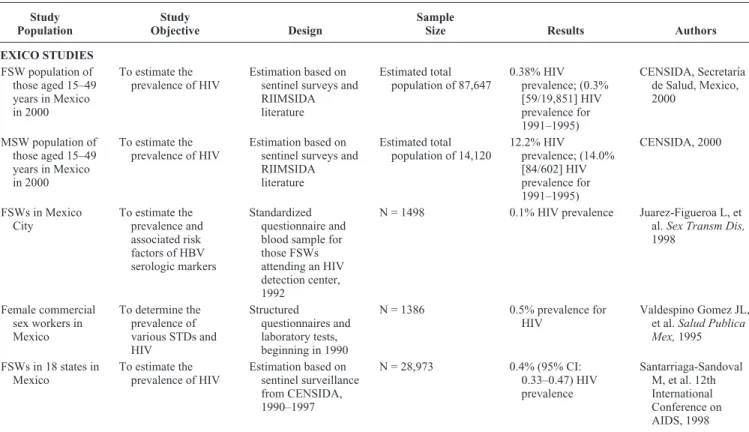
In Mexico, national HIV prevalence estimates for 2000 were generated by CENSIDA for the cohort of persons aged 15 to 49 years.12a HIV prevalence has been highest among the high-risk subpopulations of MSM and IDUs, with a relatively l o w H I V p r e v a l e n c e o f 0 . 2 9 % a m o n g t h e g e n e r a l population.12a The high-risk group with the highest HIV prevalence estimate for this age cohort was MSM, with an es-timate of 15%, with MSWs as the second highest risk group, with an estimate of 12.2%.12aMexican FSWs had an estimated HIV prevalence of 0.38% among this age cohort, IDUs had an estimated HIV prevalence of 6%, and incarcerated persons had an estimated HIV prevalence of 3.7%.12aThe HIV prevalence estimate among the heterosexual population within this age cohort was 0.09%.12a Among those with tuberculosis (TB) throughout Mexico within this age cohort, an HIV prevalence of 1.5% was estimated.12aThese HIV prevalence estimates are based on sentinel surveys and a review of the literature. The methodologic approach for the meta-analysis to determine these prevalence estimates has not been documented in the lit-erature, thus making it imperative to consider confidence in-tervals when evaluating the accuracy of these estimates.
increase in AIDS cases in the rural communities, along with the association between AIDS cases and the leading “sending” states, provides potential evidence of migrants acquiring infec-tion while in the United States and subsequently returning to their community in Mexico.1,15
In Mexico, sexual transmission remains the dominant route of transmission for HIV.11,16In the early stages of the
epidemic, sexual transmission of HIV was more common among men who identified themselves as homosexual or bi-sexual.11By 1988, this subpopulation made up 81% of the total reported AIDS cases.11,17 Heterosexual transmission has gradually increased in importance, however.11In 1995, of the 13,746 men infected in whom the mode of transmission was known, 47.6% of the infections were attributed to heterosexual transmission via HIV-positive women.11,17aRecent data from 2001 attribute 39.8% of reported cases to MSM transmission and 53.6% to heterosexual transmission.11,18Nevertheless, it is important to note that heterosexual transmission is an over-reported risk factor because it is more socially acceptable than reporting same-sex activity. The question remains about the relative contribution that disease transmission as a result of travel and return from the United States versus underreporting of MSM or IDU behavior plays in these high rates of cases attributed to heterosexual transmission. Recent studies clearly indicate that these behaviors are contributing factors.11,15New studies are needed to investigate the prevalence of HIV among women in Mexico and among their male partners in the United States. These studies would further identify the impact that mi-gration has had on the heterosexual transmission of HIV.
HIV PREVALENCE IN MEN WHO HAVE SEX
WITH MEN
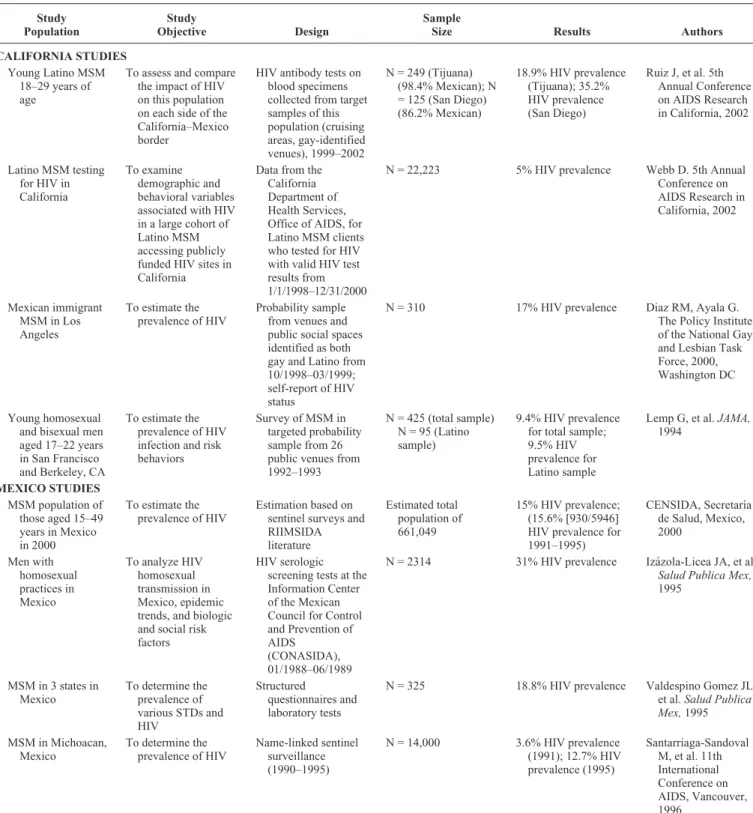
Table 1 lists results from a variety of California- or Mexico-based studies of Latino or Mexican migrant MSM. The studies in California found a prevalence of HIV ranging from 5% to 35%, and the Mexico-based studies reported an HIV prevalence ranging from 3.6% to 31%. Most of these studies were conducted several years in the past, however, and may not reflect the current epidemic among Mexican migrants. Results from a recent sample survey targeting young Latino MSM (aged 18–29 years) in San Diego, California and Ti-juana, Mexico suggest that HIV is substantially affecting the MSM high-risk population on each side of the border.19In this recent study, high-risk venues from each jurisdiction were tar-geted from May 2000 to Spring 2002.19HIV prevalence was 35.2% for Latino MSM in San Diego and 18.9% for a similar population in Tijuana.19Results from this study also indicated that the Tijuana MSM were more likely than MSM in San Diego to report engaging in risky sexual behavior with female partners as well as risky drug-using behaviors.19For both ju-risdictions, however, a significant proportion of MSM were found to engage in risky sexual behaviors with both men and women from the opposite side of the border.19Although these
results suggest that a significant HIV epidemic may be emerg-ing among MSM along the border, issues of samplemerg-ing and sta-tistical power need to be considered when evaluating the re-sults. Nonetheless, these high prevalence estimates warrant further study and intervention, given the high level of migra-tion between California and Mexico.
HIV PREVALENCE AND RISK BEHAVIORS
AMONG MEXICAN MIGRANT FARM WORKERS
Relatively few studies have examined the prevalence of HIV among Mexican migrant farm workers in California (Table 2). Two small serologic studies of migrant farm work-ers in California failed to detect any HIV infection. The studies were conducted 10 or more years ago, however, and the sample sizes, ranging from 50 to 173 persons, did not provide suffi-cient statistical power to generate reliable estimates. The small survey in Orange County (see Table 2) found that the most frequent sexual activity for male migrant farm workers was with prostitutes, many of whom were HIV-infected as a result of intravenous heroin use.20Another study conducted in Northern California in 1994 (see Table 2) found that 38.5% of the male migrant farm worker respondents had paid for sex, although only 30.8% used a condom.20aAlthough HIV was not found within these small surveys, the studies are notable, given the presence of significant precursors to AIDS, including high-risk behaviors and a history of sexually transmitted infections (STIs). A 1996 to 1997 intervention study of male migrant and seasonal farm workers in farm campsites in North San Diego County (see Table 2) found that 70% of sexually active farm workers reported sex with a sex worker before the interven-tion. Only 23% of these men reported using condoms during sex with the sex worker.21After the intervention, 97% of
mi-grants in intervention group 1 and 92% of mimi-grants in inter-vention group 2 subsequently reported using condoms during sex with a sex worker.21
Other studies have found that the injection of illegal drugs is relatively rare among migrant farm workers but that the sharing of needles to inject vitamins and antibiotics is far more common.22In addition, there is a lack of HIV prevalence data on the undocumented population. The association be-tween documentation status and prevalence of disease and risk behaviors is unknown.
HIV PREVALENCE STUDIES AMONG
SEX WORKERS
Mexi-TABLE 1.HIV Prevalence Studies of Latino MSM in California and Mexico Study Population Study Objective Design Sample
Size Results Authors CALIFORNIA STUDIES
Young Latino MSM 18–29 years of age
To assess and compare the impact of HIV on this population on each side of the California–Mexico border
HIV antibody tests on blood specimens collected from target samples of this population (cruising areas, gay-identified venues), 1999–2002
N = 249 (Tijuana) (98.4% Mexican); N = 125 (San Diego) (86.2% Mexican)
18.9% HIV prevalence (Tijuana); 35.2% HIV prevalence (San Diego)
Ruiz J, et al. 5th Annual Conference on AIDS Research in California, 2002
Latino MSM testing for HIV in California
To examine demographic and behavioral variables associated with HIV in a large cohort of Latino MSM accessing publicly funded HIV sites in California
Data from the California Department of Health Services, Office of AIDS, for Latino MSM clients who tested for HIV with valid HIV test results from 1/1/1998–12/31/2000
N = 22,223 5% HIV prevalence Webb D. 5th Annual Conference on AIDS Research in California, 2002
Mexican immigrant MSM in Los Angeles
To estimate the prevalence of HIV
Probability sample from venues and public social spaces identified as both gay and Latino from 10/1998–03/1999; self-report of HIV status
N = 310 17% HIV prevalence Diaz RM, Ayala G. The Policy Institute of the National Gay and Lesbian Task Force, 2000, Washington DC
Young homosexual and bisexual men aged 17–22 years in San Francisco and Berkeley, CA
To estimate the prevalence of HIV infection and risk behaviors
Survey of MSM in targeted probability sample from 26 public venues from 1992–1993
N = 425 (total sample) N = 95 (Latino sample)
9.4% HIV prevalence for total sample; 9.5% HIV prevalence for Latino sample
Lemp G, et al.JAMA, 1994
MEXICO STUDIES
MSM population of those aged 15–49 years in Mexico in 2000
To estimate the prevalence of HIV
Estimation based on sentinel surveys and RIIMSIDA literature
Estimated total population of 661,049
15% HIV prevalence; (15.6% [930/5946] HIV prevalence for 1991–1995)
CENSIDA, Secretarı´a de Salud, Mexico, 2000
Men with homosexual practices in Mexico
To analyze HIV homosexual transmission in Mexico, epidemic trends, and biologic and social risk factors
HIV serologic screening tests at the Information Center of the Mexican Council for Control and Prevention of AIDS
(CONASIDA), 01/1988–06/1989
N = 2314 31% HIV prevalence Iza´zola-Licea JA, et al. Salud Publica Mex, 1995
MSM in 3 states in Mexico
To determine the prevalence of various STDs and HIV
Structured
questionnaires and laboratory tests
N = 325 18.8% HIV prevalence Valdespino Gomez JL, et al.Salud Publica Mex,1995
MSM in Michoacan, Mexico
To determine the prevalence of HIV
Name-linked sentinel surveillance (1990–1995)
N = 14,000 3.6% HIV prevalence (1991); 12.7% HIV prevalence (1995)
Santarriaga-Sandoval M, et al. 11th International Conference on AIDS, Vancouver, 1996
TABLE 3.HIV Prevalence Studies on Sex Workers in Mexico Study Population Study Objective Design Sample
Size Results Authors MEXICO STUDIES
FSW population of those aged 15–49 years in Mexico in 2000
To estimate the prevalence of HIV
Estimation based on sentinel surveys and RIIMSIDA literature
Estimated total population of 87,647
0.38% HIV prevalence; (0.3% [59/19,851] HIV prevalence for 1991–1995) CENSIDA, Secretarı´a de Salud, Mexico, 2000
MSW population of those aged 15–49 years in Mexico in 2000
To estimate the prevalence of HIV
Estimation based on sentinel surveys and RIIMSIDA literature
Estimated total population of 14,120
12.2% HIV prevalence; (14.0% [84/602] HIV prevalence for 1991–1995) CENSIDA, 2000
FSWs in Mexico City
To estimate the prevalence and associated risk factors of HBV serologic markers
Standardized questionnaire and blood sample for those FSWs attending an HIV detection center, 1992
N = 1498 0.1% HIV prevalence Juarez-Figueroa L, et al.Sex Transm Dis, 1998
Female commercial sex workers in Mexico
To determine the prevalence of various STDs and HIV
Structured
questionnaires and laboratory tests, beginning in 1990
N = 1386 0.5% prevalence for HIV
Valdespino Gomez JL, et al.Salud Publica Mex,1995
FSWs in 18 states in Mexico
To estimate the prevalence of HIV
Estimation based on sentinel surveillance from CENSIDA, 1990–1997
N = 28,973 0.4% (95% CI:
0.33–0.47) HIV prevalence
Santarriaga-Sandoval M, et al. 12th International Conference on AIDS, 1998
CI, confidence interval; RIIMSIDA, Mexican AIDS Database of Research and Intervention Programs. TABLE 2.Studies of Mexican Migrant Farm Workers in California
Study Population
Study
Objective Design
Sample
Size Results Authors CALIFORNIA STUDIES
Migrant and seasonal farm workers in 5 rural counties in Northern California (92.5% born in Mexico)
To assess the
seroprevalence of HIV infection and syphilis
Interviewed and tested self-selected volunteers from 41 randomly selected sites from 8/1994–12/1994
N = 173 0.0% HIV prevalence Ruiz JD, et al. California Department of Health Services, Office of AIDS, 1997
Sexually active male Mexican farm workers in Southern California
To determine HIV prevalence
AIDS Community Education Project of Orange County
N = 50 0.0% HIV prevalence Carrier JM and Magana JR.J Sex Res,1991
Male migrant and seasonal farm workers in 27 farm campsites in North San Diego County, California
To evaluate 2 prevention interventions; no serologic testing Randomized controlled intervention study; questionnaires administered before and after intervention
N = 271 70% of sexually active farm workers reported sex with a sex worker before the intervention; 23% used condoms during sex with sex workers before the intervention
can sex workers migrate to California and continue sex work with migrants and other populations while in California.
HIV PREVALENCE STUDIES AMONG
INTRAVENOUS DRUG USERS
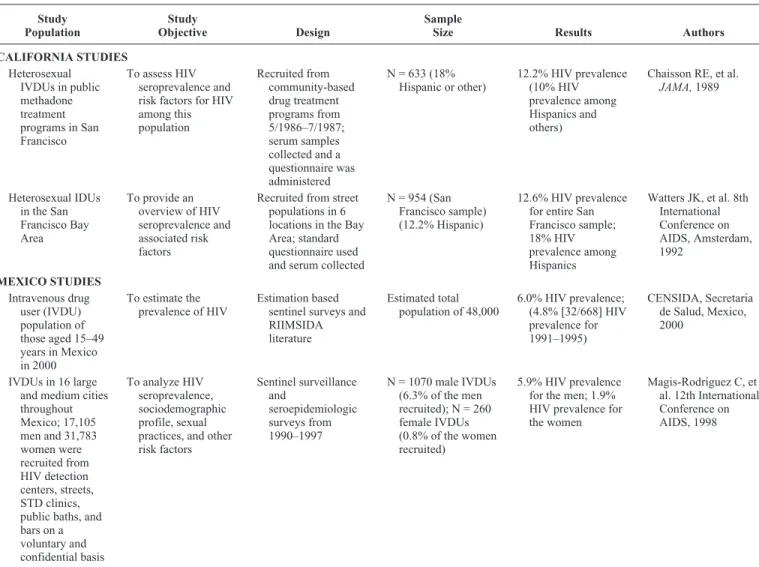
Little is known about the risk behaviors and HIV preva-lence among Mexican migrant intravenous drug users. Table 4 lists a variety of studies or analyses conducted between 1986 and 1997 in California and Mexico. Two studies conducted in the San Francisco Bay Area in the late 1980s found that the HIV prevalence among Latino IDUs ranged from 10% to 18%.23,24These studies did not identify the country of origin among the Latino subpopulation. No data were available on HIV prevalence among Mexican migrant IDUs. Serologic sur-veys conducted in Mexico between 1990 and 1997 found a
5.9% HIV prevalence among male IDUs and a 1.9% HIV prevalence among female IDUs.25The Mexican government estimated in 2000 that 6% of IDUs in Mexico were infected with HIV.12a
HIV PREVALENCE AMONG LOWER-RISK
MEXICAN MIGRANT POPULATIONS,
INCLUDING HETEROSEXUALS, BLOOD
DONORS, AND PREGNANT WOMEN
There have been few, if any, studies that have estimated the prevalence of HIV infection among lower-risk Mexican migrant populations in California, including pregnant women and other heterosexual populations. Table 5 lists HIV preva-lence studies conducted between 1990 and 2003 among lower-risk populations in Mexico. The estimated HIV prevalence among the heterosexual Mexican population ranged from
TABLE 4.HIV Prevalence Studies on Mexican Intravenous Drug Users in California and Mexico
Study Population
Study
Objective Design
Sample
Size Results Authors CALIFORNIA STUDIES
Heterosexual IVDUs in public methadone treatment programs in San Francisco
To assess HIV seroprevalence and risk factors for HIV among this population Recruited from community-based drug treatment programs from 5/1986–7/1987; serum samples collected and a questionnaire was administered
N = 633 (18% Hispanic or other)
12.2% HIV prevalence (10% HIV prevalence among Hispanics and others)
Chaisson RE, et al. JAMA,1989
Heterosexual IDUs in the San Francisco Bay Area
To provide an overview of HIV seroprevalence and associated risk factors
Recruited from street populations in 6 locations in the Bay Area; standard questionnaire used and serum collected
N = 954 (San Francisco sample) (12.2% Hispanic)
12.6% HIV prevalence for entire San Francisco sample; 18% HIV prevalence among Hispanics
Watters JK, et al. 8th International Conference on AIDS, Amsterdam, 1992 MEXICO STUDIES Intravenous drug user (IVDU) population of those aged 15–49 years in Mexico in 2000
To estimate the prevalence of HIV
Estimation based sentinel surveys and RIIMSIDA literature
Estimated total population of 48,000
6.0% HIV prevalence; (4.8% [32/668] HIV prevalence for 1991–1995)
CENSIDA, Secretarı´a de Salud, Mexico, 2000
IVDUs in 16 large and medium cities throughout Mexico; 17,105 men and 31,783 women were recruited from HIV detection centers, streets, STD clinics, public baths, and bars on a voluntary and confidential basis
To analyze HIV seroprevalence, sociodemographic profile, sexual practices, and other risk factors Sentinel surveillance and seroepidemiologic surveys from 1990–1997
N = 1070 male IVDUs (6.3% of the men recruited); N = 260 female IVDUs (0.8% of the women recruited)
5.9% HIV prevalence for the men; 1.9% HIV prevalence for the women
Magis-Rodrı´guez C, et al. 12th International Conference on AIDS, 1998
0.09% for the general population to 3% for those persons re-cruited and surveyed from selected high-risk venues and clin-ics in urban areas.12a The estimated HIV prevalence among blood donors ranged from 0.04% to 0.18%.12a,27Sentinel sur-veillance among pregnant women in 58 cities between 1990 and 1994 yielded an estimated HIV prevalence of 0.03%, a rate
similar to that found in California.28A recent survey of preg-nant women in labor at a hospital in Tijuana found a signifi-cantly higher HIV prevalence of 1.26%, however.29Given that the previous lower estimates were generated in the early to mid-1990s, this recent survey among pregnant women in Ti-juana suggests there may be an emerging problem that might TABLE 5.HIV Prevalence Studies on Lower-Risk Populations (Heterosexuals, Blood Donors, and Pregnant Women) in Mexico
Study Population
Study
Objective Design
Sample
Size Results Authors MEXICO STUDIES
Heterosexual population of those aged 15–49 years in Mexico in 2000
To estimate the prevalence of HIV
Estimation based on sentinel surveys and RIIMSIDA literature
Estimated total population of 42,861,282
0.09% HIV prevalence; (0.04% [1/2747] HIV prevalence among pregnant women for 1991–1995; 0.04% [486/1,104,512] HIV prevalence for blood donors for 1991–1995)
CENSIDA, Secretarı´a de Salud, Mexico, 2000
Blood donors in a hospital in Morelia, Michoacan, Mexico
To establish the prevalence of viral antibodies and luetic reagins
Blood samples collected from healthy volunteer donors from 01/01/1990– 12/31/1996
N = 10,077 0.18% HIV prevalence Pita-Ramirez L and Torres-Ortiz GE. Rev Invest Clin, 1997
Heterosexuals in Michoacan, Mexico
To determine the prevalence of HIV
Name-linked sentinel surveillance from 1990–1995
N = 14,000 0.86% HIV prevalence (1991); 3.4% HIV prevalence (1995)
Santarriaga-Sandoval M, et al. 11th International Conference on AIDS, Vancouver, 1996
Pregnant women in labor at Tijuana General Hospital, Tijuana, Mexico
To estimate the prevalence of HIV
Voluntary screening for HIV among women in labor during a 13-week period in the summer of 2003; 97% consented to testing
N = 947 1.26% HIV prevalence Viani R, et al. National Retrovirus and Opportunistic Infections Conference, San Francisco, 2004
Pregnant women in 58 cities throughout Mexico
To estimate HIV prevalence from sentinel surveillance data
Estimation based on sentinel surveillance from 1990–1994; voluntary, confidential, and linked serologic screening for HIV
N = 3800 0.03% HIV prevalence Loo-Me´ndez E, et al. 11th International Conference on AIDS, Vancouver 1996
Heterosexual men in 16 large and medium cities throughout Mexico recruited from HIV detection centers, streets, STD clinics, public baths, and bars on a voluntary and confidential basis
To analyze HIV seroprevalence, sociodemographic profile, sexual practices, and other risk factors
Sentinel surveillance and
seroepidemiologic surveys from 1990–1997
N = 8815 3.0% HIV prevalence Loo-Me´ndez E, et al. 12th International Conference on AIDS, Geneva 1998
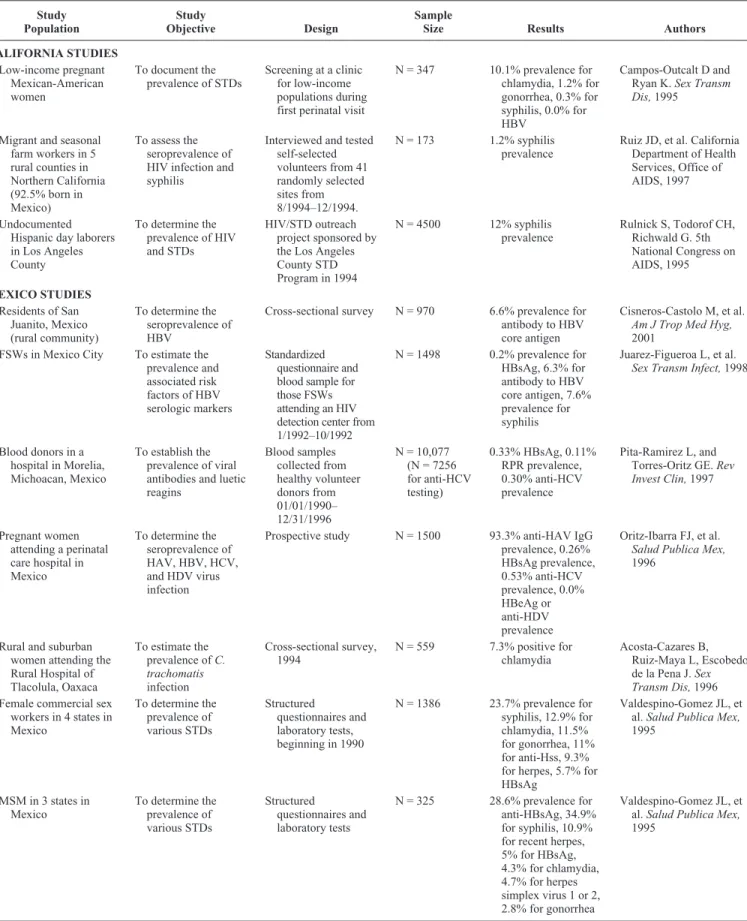
TABLE 6.STD Prevalence Studies Among Mexicans in California and Mexico Study Population Study Objective Design Sample
Size Results Authors CALIFORNIA STUDIES
Low-income pregnant Mexican-American women
To document the prevalence of STDs
Screening at a clinic for low-income populations during first perinatal visit
N = 347 10.1% prevalence for chlamydia, 1.2% for gonorrhea, 0.3% for syphilis, 0.0% for HBV
Campos-Outcalt D and Ryan K.Sex Transm Dis,1995
Migrant and seasonal farm workers in 5 rural counties in Northern California (92.5% born in Mexico)
To assess the seroprevalence of HIV infection and syphilis
Interviewed and tested self-selected volunteers from 41 randomly selected sites from 8/1994–12/1994.
N = 173 1.2% syphilis prevalence
Ruiz JD, et al. California Department of Health Services, Office of AIDS, 1997
Undocumented Hispanic day laborers in Los Angeles County
To determine the prevalence of HIV and STDs
HIV/STD outreach project sponsored by the Los Angeles County STD Program in 1994
N = 4500 12% syphilis prevalence
Rulnick S, Todorof CH, Richwald G. 5th National Congress on AIDS, 1995
MEXICO STUDIES
Residents of San Juanito, Mexico (rural community)
To determine the seroprevalence of HBV
Cross-sectional survey N = 970 6.6% prevalence for antibody to HBV core antigen
Cisneros-Castolo M, et al. Am J Trop Med Hyg, 2001
FSWs in Mexico City To estimate the prevalence and associated risk factors of HBV serologic markers
Standardized questionnaire and blood sample for those FSWs attending an HIV detection center from 1/1992–10/1992
N = 1498 0.2% prevalence for HBsAg, 6.3% for antibody to HBV core antigen, 7.6% prevalence for syphilis
Juarez-Figueroa L, et al. Sex Transm Infect,1998
Blood donors in a hospital in Morelia, Michoacan, Mexico
To establish the prevalence of viral antibodies and luetic reagins Blood samples collected from healthy volunteer donors from 01/01/1990– 12/31/1996
N = 10,077 (N = 7256 for anti-HCV testing)
0.33% HBsAg, 0.11% RPR prevalence, 0.30% anti-HCV prevalence
Pita-Ramirez L, and Torres-Oritz GE.Rev Invest Clin,1997
Pregnant women attending a perinatal care hospital in Mexico
To determine the seroprevalence of HAV, HBV, HCV, and HDV virus infection
Prospective study N = 1500 93.3% anti-HAV IgG prevalence, 0.26% HBsAg prevalence, 0.53% anti-HCV prevalence, 0.0% HBeAg or anti-HDV prevalence
Oritz-Ibarra FJ, et al. Salud Publica Mex, 1996
Rural and suburban women attending the Rural Hospital of Tlacolula, Oaxaca
To estimate the prevalence ofC. trachomatis infection
Cross-sectional survey, 1994
N = 559 7.3% positive for chlamydia
Acosta-Cazares B, Ruiz-Maya L, Escobedo de la Pena J.Sex Transm Dis,1996 Female commercial sex
workers in 4 states in Mexico
To determine the prevalence of various STDs
Structured
questionnaires and laboratory tests, beginning in 1990
N = 1386 23.7% prevalence for syphilis, 12.9% for chlamydia, 11.5% for gonorrhea, 11% for anti-Hss, 9.3% for herpes, 5.7% for HBsAg
Valdespino-Gomez JL, et al.Salud Publica Mex, 1995
MSM in 3 states in Mexico
To determine the prevalence of various STDs
Structured
questionnaires and laboratory tests
N = 325 28.6% prevalence for anti-HBsAg, 34.9% for syphilis, 10.9% for recent herpes, 5% for HBsAg, 4.3% for chlamydia, 4.7% for herpes simplex virus 1 or 2, 2.8% for gonorrhea
substantially increase in the future. In addition, given that a large number of persons from Tijuana regularly commute back and forth across the California–Mexico border, this study sug-gests the potential for further spread of the epidemic.
SEXUALLY TRANSMITTED INFECTIONS
Sexually transmitted diseases (STDs) such as chlamyd-ia, syphilis, gonorrhea, and hepatitis as well as the prevalence of the high-risk behaviors associated with HIV/STD infec-tions, are also significant among the target population (Table 6). STDs are the most common reportable diseases in Califor-nia. In the United States, STDs are the leading cause of pre-ventable infertility, are associated with adverse birth out-comes, can lead to pelvic inflammatory disease (PID) in women, and are associated with increased sexual transmission of HIV.30Studies have demonstrated that being infected with an STD makes it 2 to 23 times easier to transmit HIV, depend-ing on the specific STD.30aMany individuals infected with syphilis are also coinfected with HIV; nationwide, more than 50% of MSM who have been diagnosed with syphilis are HIV-positive.31
TUBERCULOSIS
The spread of the HIV epidemic has significantly af-fected the TB epidemic.32Given that HIV severely weakens
the immune system, individuals dually infected with HIV and Mycobacterium tuberculosis have a 100-fold increase in the risk of developing active TB disease and becoming infectious as compared with those not infected with HIV.32The Centers
for Disease Control and Prevention (CDC) estimates that 10% to 15% of all TB cases and nearly 30% of cases among people aged 25 to 44 years are occurring in HIV-infected individu-als.32 In California, despite the fact that the number of TB cases has declined over the past decade, the percentage of cases in foreign-born individuals has increased significantly.33 In 1992, 61% of California’s TB cases were foreign-born.33In 2001, however, 75% of TB cases in California were foreign-born, of which the largest proportion (31.8%) were from Mexico (Table 7).33
SUMMARY CRITIQUE OF CITED HIV
PREVALENCE STUDIES
Many of the studies cited in this review are based on unpublished research. Thus, there were limited data and meth-odologic detail to evaluate the integrity of the data, sampling, power, biases, and study methodology properly. In addition, the lack of peer-reviewed papers makes it difficult to assess and weigh the quality and reliability of each study. This made it difficult to assign a reliability score or to weigh the contri-bution of the individual studies. Because of these problems, an approach was taken to assess the preponderance of data and TABLE 6.(continued)STD Prevalence Studies Among Mexicans in California and Mexico
Study Population
Study
Objective Design
Sample
Size Results Authors
MSM and FSWs in 3 federal entities in Mexico
To estimate the prevalence of STDs
Structured questionnaires and blood samples
N = 1544 6.9% (MSM) and 5.1% (FSWs) prevalence for genital ulcers, 8.3% (MSM) and 2.5% (FSWs) for genital/anal warts, 23.8% (MSM) and 23.7% (FSWs) for Treponema pallidum,2.9% (MSM) and 11.6% (FSWs) for Neisseria gonorrhoeae,4.1% (MSM) and 12.8% (FSWs) for Chlamydia trachomatis,5.4% (MSM) and 11.1% (FSWs) for anti-HBsAg, 10.1% (MSM) and 9.7% (FSWs) for antiherpes IgM
Valdespino-Gomez JL, et al. 8th International Conference on AIDS, Amsterdam, 1992
trends across all studies with regard to the potential for an ex-panding HIV epidemic. In addition, most of the data were gen-erated 5 to 10 years in the past. Limited data are available on the key target populations in recent years. The paucity of data available within the past few years makes it difficult to assess the potential for rapid spread of the HIV epidemic in Mexican migrant and recent immigrant populations in California.
Another limitation of the studies cited in this review is that they often differed in target study population and specific methodology. Some of the key studies examined Latino popu-lations as a group and did not differentiate the findings for Mexican migrants, recent immigrants, or the Mexican-origin population as a whole. Other studies targeted only one local-ized subpopulation or sampled persons from an undefined mixture of public venues. In addition, some studies used a ran-dom probabilistic sampling approach, whereas others relied on convenience sampling or self-selected volunteers.
POLICY RECOMMENDATIONS
There is an urgent need for an ongoing binational sur-veillance system to assess prevalence and trends in HIV/STD/TB disease and related risk behaviors in the Mexi-can migrant population in California and within the originating “sending” states within Mexico. This enhanced epidemiologic surveillance system should also provide improved data on the subpopulations at the highest risk for HIV/STD/TB and would
provide the opportunity to evaluate the impact of migration on the transmission dynamics, risk behaviors, and determinants of behavior on each side of the border. This surveillance system should use an integrated approach to capture the behav-ioral/social context, determinants of behavior, and prevalence of disease.
To help reduce fragmentation of data, the system should use methods of repeated cross-sectional sampling and should generate data that are comparable across time and place. Sen-tinel sending states in Mexico need to be included in the sur-veillance system.
Data generated by a binational surveillance system should be rapidly disseminated to local prevention and care providers in the United States and Mexico to help foster local efforts to prevent the spread of infection and to care for those already infected. Given the high prevalence of HIV/AIDS among Mexican MSM, this subpopulation should be a focus of surveillance surveys. There is also a need for further studies in rural communities in Mexico to look at women whose partners may be exhibiting MSM behaviors while in California but not identifying themselves as MSM.
Until recently, the prevalence of HIV in Mexico and among Mexican migrants in California appeared to be stable and relatively low, reflecting a mature HIV epidemic simi-lar to that experienced in other developed nations. Recent studies have raised concerns that the HIV epidemic may TABLE 7.TB Prevalence Studies Among Mexican Migrant Farm Workers in California and Households in Mexico
Study Population
Study
Objective Design
Sample
Size Results Authors CALIFORNIA STUDIES
Current and former US farm workers from Zacatecas, Mexico
To investigate farm worker health
Binational Health Survey; quantitative survey and field observations over 18-month period
N = 467 1.1% TB prevalence California Institute for Rural Studies. The Binational Farmworker Health Survey, 2001
Current farm workers First-ever baseline health data collected for farm workers in the state
California Agricultural Worker Health Survey, 1999; statewide interview of farm workers and comprehensive physical examination; random sample of households in 7 communities
N = 968 3% TB prevalence California Institute for Rural Studies. The Binational Farmworker Health Survey, 2001
MEXICO STUDIES
Members of households in areas of high levels of poverty in Chiapas, Mexico >14 years of age
To estimate the prevalence of PTB
Convenience sample of households in 32 communities selected at random, 1998
N = 1894 households
PTB rate of 276.9 per 100,000 population
Sanchez-Perez H, et al. Int J Epidemiol,2001
expand more aggressively among these populations in the future, however, representing an emerging threat to Mexi-can migrants in California, along the California–Mexico bor-der, and within Mexico. It is imperative that this potential threat be assessed and that intervention programs are devel-oped and put into place to thwart this possible surge in the HIV epidemic.
REFERENCES
1. Organista KC, Organista PB. Migrant laborers and AIDS in the United States: a review of the literature.AIDS Educ Prev. 1997;9:83–93. 2. US Department of Health and Human Services, National Commission to
Prevent Infant Mortality. HIV/AIDS: A Growing Crisis among Migrant and Seasonal Farmworker Families. Washington, DC; 1993.
3. HIV Risk Ten Times Higher for Migrant Farmworkers.Public Health Rep. 1994;109:459.
4. US Census Bureau. United States Census 2000 Report. Available at: http://www.census.gov/Press-Release/www/2001/sumfile1.html. Ac-cessed May 10, 2004.
5. National Center for Infant and Adolescent Health, Undersecretary of Health Prevention and Protection, Ministry of Health, Mexico and the California–Mexico Health Initiative, University of California, Office of the President, Berkeley, California. Binational Forum on Health and Mi-gration Activity Report. Morelia, Michoaca´n, Mexico, October 3, 2002. 6. Migrant Health Program. 1990. An Atlas of State Profiles Which Estimate
Number of Migrant and Seasonal Farmworkers and Members of Their Families. Rockville, Maryland: US Department of Health and Human Services, Public Health Service, Health Resources and Services Admin-istration, Bureau of Health Care Delivery and Assistance, Migrant Health Branch.
7. California Institute for Rural Studies, Davies, CA. Suffering in Silence: Who are California’s Agricultural Workers? The California Endowment, Woodland Hills, CA, 2001.
8. El colegio de la Frontera Norte. Secretaria del Trabajo y Prevision Social. Encuesta sobre migracion en la Frontera Norte de Mexico, 1996–1997 [Migration Survey of Mexican North Border]. 1999.
9. Valenzuela A, Jr. Working on the margins: immigrant day labor charac-teristics and prospects for employment. Working Paper No. 22. San Diego: The Center for Comparative Immigration Studies, University of California, San Diego; 2000.
10. HIV/AIDS Epidemiology Branch, California Department of Health Ser-vices, Office of AIDS. 2000 Annual Report. Sacramento, CA. 2001. 10a. HIV/AIDS Epidemiology Branch, California Department of Health
Ser-vices, Offices of AIDS. 1998 Annual Report. Sacramento, CA. 1999. 11. Minichiello SN, Magis-Rodrı´guez C, Uribe P, et al. The Mexican
HIV/AIDS surveillance system: 1986–2001. AIDS. 2002;16(Suppl 3):S13–S17.
12. Epidemiologı´a del VIH/SIDA en Me´xico en el An˜o 2003. Centro Nacio-nal para la Prevencio´n y Control del VIH/SIDA (CENSIDA). Secretaría de Salud, Mexico City, Mexico. Available at: http:/www.salud.gob. mx/conasida. Accessed June 1, 2004.
12a. Centro Nacional para la Prevencio´n y el Control del VIH/SIDA (CEN-SIDA). AIDS in Mexico in the Year 2000. Secretarı´a de Salud, Mexico City, Mexico. 2001.
13. Magis-Rodrı´guez C, Del-Rio-Zolezzi A, Valdespino-Gomez JL, et al. Ca-sos de SIDA en el area rural de Mexico.Salud Publica Mex. 1995;37:615– 623.
14. Magis-Rodrı´guez C, Bravo Garcı´a E, Anaya Lopez L, et al. La situacio´n del SIDA en Mexico a finales de 1998.Enfermedades Infecciosas y Mi-crobiologicas.1998;18:236–244.
15. Valdespino JL, Garcia ML, Magis-Rodrı´guez C, et al. Increase among rural cases in Mexico [abstract PC0037]. Int Conf AIDS, August 1994, Yokohama, Japan. 1994;10:279.
16. Valdespino JL, Sepúlveda J, Izázola J, et al. Patrones y predicciones epi-demiologicas del SIDA en Mexico.Salud Publica Mex. 1988;30: 567–592.
17. Sepúlveda J, Valdespino JL, Garcia ML, et al. Caracterı´sticas epidemio-logicas y cognoscitivas de la transmisión del VIH en Mexico.Salud Pub-lica Mex. 1988;30:513–527.
17a. Valdespino JL, Garcia ML, del Rio A, et al. Epidemiologia del SIDA/VIH en Mexico, de 1983 a marzo de 1995.Salud Publica Mex. 1995;37:556–571.
18. National Center for Epidemiology.Notificacio´n inmediata de caso de SIDA. Mexico City: Direccion General de Epidemiologia; 2001. 19. Ruiz J, Sheppard H, Ginsberg M, et al. California Department of Health
Services, Office of AIDS. HIV prevalence, risks and access to care among young Latino MSM in San Diego, CA, and Tijuana, Mexico. Presented at the Fifth Annual Conference on AIDS Research in Sacramento, CA. Feb-ruary 2002.
20. Magana JR. Sex, drugs and HIV: an ethnographic approach.Soc Sci Med. 1991;33:5–9.
20a. Ruiz JD, Da Valle L, Jungkeit M, et al. Seroprevalence of HIV and syphi-lis, and assessment of risk behaviors among migrant and seasonal farm-workers in five Northern California counties. California Department of Health Services, Office of AIDS. Sacramento, CA. June 1997. 21. Mishra SI, Sanudo F, Connor RF. Collaborative research toward HIV
pre-vention among migrant farm workers. In: Bowser BP, Mishra SI, Reback CJ, Lemp GF, eds. Preventing AIDS: Community-Science Collabora-tions. New York: The Haworth Press; 2004.
22. Lafferty J. Self-injection and needle sharing among migrant farmworkers. Am J Public Health. 1991;81:221.
23. Chaisson RE, Bacchetti P, Osmond D, et al. Cocaine use and HIV infec-tion in intravenous drug users in San Francisco. JAMA. 1989; 261:561–565.
24. Watters JK, Cheng YT, Bluthenthal RN, et al. Drug injectors and HIV-1 infection in the San Francisco Bay Area. Presented at the Eighth Interna-tional Conference on AIDS, Amsterdam, The Netherlands, July 1992. 25. Magis-Rodríguez C, Ruiz-Badillo A, Loo-Mendez E, et al. Sentinel
stud-ies in intravenous drug users in Mexico. Presented at the 12th Interna-tional Conference on AIDS, Geneva, Switzerland, June 28–July 3, 1998. 26. Deleted in press.
27. Pita-Ramirez L, Torres-Ortiz GE. Prevalence of viral antibodies and syphilis serology in blood donors from a hospital.Rev Invest Clin. 1997;49:475–480.
28. Loo-Me´ndez E, Magis-Rodrı´guez C, Santarriaga SM, et al. Sentinel sero-surveys in Mexico: 1990–1994. Presented at the 11th International Con-ference on AIDS, Vancouver, Canada, July 1996.
29. Viani R, Araneta M, Ruiz-Calderon J, et al. Rapid HIV testing of women of unknown HIV status in labor at Tijuana General Hospital, Baja Cali-fornia, Mexico. Presented at the 11th Conference on Retroviruses and Opportunistic Infections, San Francisco, CA, February 2004.
30. National Center for HIV, STD, and TB Prevention. Tracking the hidden epidemics. Trends in STDs in the United States. Centers for Disease Con-trol and Prevention, Atlanta, Georgia, 2001.
30a. Fleming DT, Wasserheit JN. From epidemiological synergy to public health policy and practice: the contribution of other sexually transmitted diseases to sexual transmission of HIV infection.Sex Transm Infect. 1999;75:3–17.
31. Blocker ME, Levine WC, St. Louis ME. HIV prevalence in patients with syphilis, United States.Sex Transm Dis.2000;27:53–59.
32. National Center for HIV, STD and TB Prevention within the Centers for Disease Control and Prevention. Fact sheet. The deadly intersection be-tween TB and HIV. 1999. Available at: http://www.cdc.gov/hiv/ pubs/facts/hivtb.htm. Accessed January 30, 2002.
Migration and AIDS in Mexico
An Overview Based on Recent Evidence
Carlos Magis-Rodrı´guez, MD, MPH,* Cecilia Gayet, MHD, MSS,* Mirka Negroni, MPA,†
Rene Leyva, PhD,† Enrique Bravo-Garcı´a, BD,* Patricia Uribe, MD,* and Mario Bronfman, PhD†
Objectives:Provide an overview of the relation between migration to the United States and AIDS cases in Mexico. Characterize the sex-ual behaviors of Mexican migrants. Describe HIV/AIDS prevention and clinical attention actions developed.
Methods: The following were analyzed: AIDS cases databases, various prevalence studies, the migrants survey, and information of the Ministries of the Interior and of Health. A documental analysis was undertaken of works published between 1992 and 2000 on mi-gration and AIDS.
Results:In terms of their sexual practices, migrants in the past year had more sexual partners, tended to use a condom in their most recent relation in greater proportion, and had greater use of injected medi-cines and drugs. Two bi-national programs undertake epidemiologi-cal surveillance activities, while several initiatives have used innova-tive formats to provide prevention information to migrants. Imminent universal coverage leaves the challenge to assure quality of attention for migrants.
Conclusions:Studies to evaluate the impact of international migra-tion on distribumigra-tion of infected persons will be indispensable to estab-lish priorities in prevention and attention among migrants. More in-formation is needed on bi-national health projects to understand the impact they may have in prevention, while continuity of the preven-tion initiatives must be guaranteed. Attenpreven-tion to migrants in bi-national contexts requires information exchange agreements on mi-grants living with the HIV/AIDS.
Key Words:migration, sexual behavior, Mexico, epidemiology, sur-veillance, AIDS
(J Acquir Immune Defic Syndr2004;37:S215–S226)
I
n Mexico, as in other countries, the AIDS epidemic has transformed into a complex public health problem, with mul-tiple psychologic, social, ethical, economic, and political re-percussions. According to the typology proposed by the Joint United Nations Program on HIV/AIDS (UNAIDS), Mexico can be classified as a country with a concentrated AIDS epi-demic characterized by the prevalence of HIV infection rap-idly disseminated in certain population subgroups but which has not yet reached the general population. Although the epi-demic is moderate at the national level, there are nevertheless various transmission patterns and differentiated subepidemics in each region of the country, depending on the culture, social conditions, sexual dynamics, and other habits of regional resi-dents. Increases in the association of AIDS cases with injected drug use in cities along the border with the United States1and an emerging pattern of increased heterosexual transmission2 illustrate that the scope of the epidemic may be expanding. Given the increasing magnitude of the epidemic, not enough quantitative information is yet available on individual risk of acquiring HIV in distinct subpopulations.Since the origin of the AIDS epidemic in Mexico, vari-ous researchers have associated its development with the phe-nomenon of large-scale migration toward the United States, given evidence of greater prevalence of HIV/AIDS in migra-tion destinamigra-tions, which, in turn, could have repercussions in the places of origin.3Studies have attempted to identify migra-tory flows and sociodemographic characteristics of persons re-ported with AIDS compared with persons without AIDS through quantitative techniques4–6and qualitative studies of sexual behaviors of the migrants7as well as to characterize the risk factors of migrants during their stay in the United States to explain the increasing rural prevalence of the epidemic in Mexico.7aOne consequence of these migration studies was concern regarding increased AIDS prevalence in women, given their vulnerability as a result of the fact that the tradi-tional feminine role in Mexico implies a low degree of power to negotiate sexual practices with their migrant partners.8–11 Studies have also focused on southern Mexican border points through which persons from Central American countries tran-sit in route to the United States.12
Received for publication June 2004; accepted September 2004.
From the *Centro Nacional para la Prevención y Control del VIH/SIDA, Sec-retaria de Salud, Mexico City, Mexico; and †Instituto Nacional de Salud Pública, Cuernavaca, Mexico.
Support provided by the Joint United Nations Program on HIV/AIDS (UNAIDS).
Following the theoretical proposal of Lalou and Pichet12a to understand the forms in which the relation be-tween migration and AIDS has been conceptualized, research results may be divided between those which see the migrant from the optic of vulnerability, or from the perspective of HIV/AIDS dissemination. Vulnerability factors which have stood out may be grouped in two classes: within a macro-social level figure the characteristics of the society of destination of the Mexican migrants compared with the places of origin, and within a micro-social level are presented the migrants’ indi-vidual characteristics (Table 1).
Given concern regarding the possible relation between migration and increasing prevalence of AIDS in Mexico, pre-vention policies emerged early in the epidemic. Execution of these policies has been hindered by challenges related to the scope of the epidemic, however. It is difficult to ensure that prevention messages reach the entire Mexican population, considering the dispersion of migrants among localities with characteristic inaccessibility.13 An even greater challenge is determining methods of reaching this Mexican migrant popu-lation while it is in the United States, particularly because many migrants are undocumented and fear discovery and de-portation.
METHODS
This article presents a current overview of the AIDS epi-demic in Mexico based on the National Registry of AIDS Cases accumulated up to December 31, 2002, as well as
preva-lence studies of specific groups. The AIDS cases database was updated with information on population size obtained from the 1995 Population and Housing Census undertaken by the Na-tional Institute on Geography and Statistics. Also included is a characterization of sexual behaviors of Mexican migrants based on analysis of the Migrants Survey of HIV-Related Be-haviors Surveillance System undertaken in the states of More-los and Puebla in the year 2002.14In addition, a literature
re-view was conducted of 106 works on migration and AIDS pub-lished between 1992 and 2002 and contained in the database known as Mexican AIDS Database of Research and Interven-tion Programs (RIIMSIDA), as classified by the Centro Nacio-nal para la Prevención y Control del SIDA Mexican NatioNacio-nal Center for HIV/AIDS Prevention and Control (CENSIDA). The article then presents an overview of prevention activities that have been developed by the Mexican government as well as by private civic organizations.15 Finally, the article de-scribes the state of HIV/AIDS clinical care in Mexico and identifies obstacles to access to care for Mexican migrants.
RESULTS
Epidemiologic Characteristics and Behavior of
Mexican Migrants
The first AIDS case in Mexico was diagnosed in 1983, and 68,145 accumulated AIDS cases have been registered up to December 31, 2002. Almost 90% of these accumulated cases were transmitted via sexual contact. Transmission by men who have sex with men accounts for little more than 50%
TABLE 1.Summary of the Literature on Vulnerability Factors for Migrants
Characteristics of the Society
Individual Characteristics
Risk Practices Destination
(United States)
Origin (Mexico)
More permissive cultural models in regard to sexuality
Strict community norms on sexuality
Young ages and predominance of men
Involvement in risky sexual practices to survive (sale of sex)
High HIV/AIDS incidence rates
High and low HIV/AIDS incidence rates according to the entity
Single or traveling without their family
Sexual relations with sex workers
More extended use of intravenous drugs
Increased intravenous drug use in border cities
Predominance of agricultural occupations
Heterosexual men having sexual relations with other men because of isolation in work sites
Prevention campaigns in English, without impact on Mexican migrants
Low educational level and lack of knowledge of the English language
Intravenous drug use with infected needles
Loneliness and affective isolation
of the total accumulated cases. The male/female ratio of preva-lence is 6:1.15a
According to estimates of CENSIDA, in Mexico, there are 150,000 HIV-infected adults, of whom 100,000 are men who have sex with other men, 40,000 are heterosexual, more than 4500 are prisoners, 3000 are intravenous drug users, and just more than 2500 are male and female commercial sex workers.16
It is important to point out that the HIV prevalence in adults in the United States (0.6%) is double the estimated prevalence in Mexico (0.3%),17 meaning that Mexican mi-grants living in the United States are at much greater risk of acquiring HIV compared with populations remaining in Mexico. By the end of the year 2001, an accumulated 816,157 HIV/AIDS cases had been reported in the United States,18 sig-nifying an accumulated incidence rate of 285.4 per 100,000 inhabitants. In that same period, Mexico19 had registered 51,914 accumulated cases for an accumulated rate of 51.7 per 100,000 inhabitants. Comparing these 2 rates, the risk in the United States is 5.5 times greater than in Mexico.
Background of Migration to the United States
in Registered HIV/AIDS Cases
In early 2001, a study was undertaken that classified ac-cumulated HIV/AIDS cases from the National Case Registry up to December 31, 2000, according to locality population size as reported by the 1995 Population and Housing Census. As a result of this research, it was established that of the total cases registered up to December 2000 (n = 47,617), 12.7% (6060) involved persons who had previously lived in the United States. This proportion is higher (approximately 14%) in ref-erence to HIV/AIDS-infected persons living in localities with less than 5000 inhabitants and in those living in large cities with more than 500,000 inhabitants (Table 2).
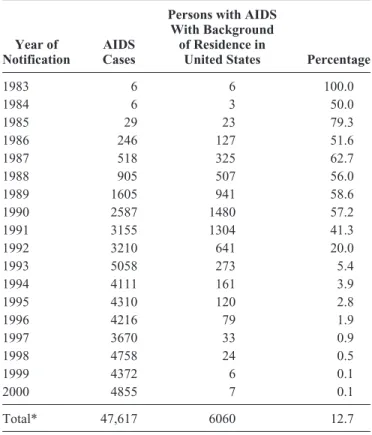
At the beginning of the epidemic, all cases involved per-sons who had previously lived in the United States; that figure declined to 41.3% by 1991. Beginning in 1992, however, the Mexican epidemiologic surveillance system discontinued the systematic registry of variables related to migration history. Presumably, as a result, the percentage dropped abruptly to 20% that year, to 5.4% the following year, and successively until reaching 0.1% in the year 2000 (Table 3).
The 2 states that present the highest proportion of HIV/AIDS cases involving a history of residence in the United States are Michoacan and Jalisco, with figures greater than 20%. They are followed by Nayarit, Nuevo León, Coahuila de Zaragoza, and the Federal District (Mexico City), with propor-tions greater than 15% of the total cases (Table 4). In addition, in Michoacán, Durango, Zacatecas, Nayarit, and Jalisco, more than 20% of AIDS patients registered in rural areas (popula-tions less than 2500 inhabitants according to the census defi-nition) have backgrounds of previous residence in the United States (Table 5).
Behaviors of Mexican Migrants Related to HIV
We know little about the impact of migration on the de-velopment of the HIV/AIDS epidemic in Mexico. Sufficient data are lacking to measure the role of migration in the spread of the epidemic accurately. The lack of serologic surveys of Mexican migrant populations, which would allow establish-ment of relations between sexual and cultural practices and infection, has led to use of indirect inferences of individual risk based on estimations of differences in sexual practices be-tween migrants and nonmigrants.
Progress has been made in identifying certain sexual practices of the mobile populations to reveal paths of transmis-sion. The qualitative study undertaken by Bronfman and Minello7illustrated that changes in sexual habits are produced
TABLE 2.Accumulated AIDS Cases by Locality Size and Background of Residence in the United States: Data Up to December 31, 2000
Locality Size
AIDS Cases
Persons With AIDS With Background
of Residence in United States Percentage
Less than 2500 inhabitants 2089 287 13.7
2500–4999 inhabitants 893 126 14.1
5000–14,999 inhabitants 2031 275 13.5
15,000–49,999 inhabitants 2965 322 10.9
50,000–499,999 inhabitants 10,918 1167 10.7
500,000 or more inhabitants 26,387 3722 14.1
Subtotal 45,283 5899 13.0
Locality size unknown 2334 161 6.9
Total 47,617 6060 12.7
during the migratory process: numbers of sexual partners in-crease among men, and as a consequence of the loneliness, isolation, lack of women, and insertion in a “more open” soci-ety as well as the decline in social and family control, relations increase with male partners and/or with prostitutes who are often intravenous drug users. Learning of new practices was also noted among both men and women, especially different positions for vaginal coitus, oral sex, and anal sex.
Within the framework of the HIV-Related Behaviors Surveillance System,14between August and December 2001, a survey was carried out in 2 states with high migration rates toward the United States (Morelos and Puebla), with the ob-jective of reaching a population with high spatial mobility for labor reasons toward other countries or other localities within Mexico. Men and boys (n = 789) and women and girls (n = 367) older than the age of 14 years were interviewed. The re-sults partially confirm the findings of the previous qualitative research. Of total interviewees, 5% had no migratory experi-ence, 15% had worked outside their locality at some time but not within the past year, and 80% had done so in the past year.
Among the last of these, 15% traveled to another country and the rest traveled to another national locality. The group, com-posed of 125 persons who had left their locality to work in another country during the year before the survey, was consid-TABLE 3.Accumulated AIDS Cases by Year of Notification
and Background of Residence in the United States: Data Up to December 31, 2000
Year of Notification
AIDS Cases
Persons with AIDS With Background
of Residence in
United States Percentage
1983 6 6 100.0
1984 6 3 50.0
1985 29 23 79.3
1986 246 127 51.6
1987 518 325 62.7
1988 905 507 56.0
1989 1605 941 58.6
1990 2587 1480 57.2
1991 3155 1304 41.3
1992 3210 641 20.0
1993 5058 273 5.4
1994 4111 161 3.9
1995 4310 120 2.8
1996 4216 79 1.9
1997 3670 33 0.9
1998 4758 24 0.5
1999 4372 6 0.1
2000 4855 7 0.1
Total* 47,617 6060 12.7
*The total includes 286 cases of foreigners in transit through Mexico. Elaborated by CENSIDA (Research Department) with data from the Na-tional AIDS Case Registry.
TABLE 4.Accumulated AIDS Cases by Residence Entity and Background of Residence in the United States: Data Up to December 31, 2000
Federal Entity or State
AIDS Cases
Persons with AIDS With Background of Residence in
United States Percentage
Michoaca´n 1549 319 20.6
Zacatecas 268 55 20.5
Nayarit 583 101 17.3
Nuevo Leo´n 1321 227 17.2
Coahuila de Zaragoza 763 129 16.9
Mexico City (Federal District)
11,639 1763 15.1
Durango 358 53 14.8
Jalisco 5356 790 14.7
Me´xico 5576 820 14.7
Chihuahua 730 107 14.7
Colima 197 27 13.7
San Luis Potosı´ 497 67 13.5
Tamaulipas 917 108 11.8
Sinaloa 669 77 11.5
Guerrero 1487 166 11.2
Guanajuato 976 107 11.0
Morelos 1172 125 10.7
Yucata´n 1124 108 9.6
Aguascalientes 244 23 9.4
Baja California 1723 158 9.2
Puebla 2951 266 9.0
Quintana Roo 247 21 8.5
Tlaxcala 397 33 8.3
Oaxaca 923 76 8.2
Hidalgo 473 34 7.2
Sonora 664 47 7.1
Chiapas 603 34 5.6
Baja California Sur 275 5 5.5
Quere´taro 390 19 4.9
Tabasco 393 16 4.1
Veracruz 2619 85 3.2
Campeche 247 5 2.0
Extanjeros
Non-nationals 286 79 27.6
Total* 47,617 6060 12.7
ered to represent international migrants for the purposes of this study. All were sexually active, and 75% were men or boys.
The results indicate that the international migrants had more sexual partners in the previous year than those who had not migrated to another country (for practical purposes, those who did not leave their locality and those who traveled to other locations within Mexico are referred to as nonmigrants). On average, the nonmigrant men and boys had 1.8 partners over the past year, whereas the international migrants had 3.3 sexual
partners (P< 0.00). Among these partners, a greater proportion of male international migrants than nonmigrant men and boys reported having had sexual relations in the previous year with sex workers (commercial partners) and nonregular partners (Table 6). Among the women and girls who had sexual rela-tions in the previous year, the study noted that the international migrants had a greater number of partners than nonmigrants. On average, the nonmigrant women and girls had 1.2 partners, whereas the female international migrants had 1.5 sexual part-TABLE 5.Accumulated AIDS Cases in Rural Areas and Background of Residence in the
United States: Data Up to December 31, 2000
Entity
AIDS Cases in Rural Populations
Rural Persons With AIDS With Background of
Residence in United States Percentage
Michoaca´n 189 50 26.5
Durango 38 10 26.3
Zacatecas 61 16 26.2
Nayarit 80 18 22.5
Jalisco 148 31 20.9
Colima 11 2 18.2
Coahuila de Zaragoza 29 5 17.2
Nuevo Leo´n 24 4 16.7
San Luis Potosı´ 67 11 16.4
Tlaxcala 37 6 16.2
Me´xico 153 24 15.7
Puebla 242 35 14.5
Guerrero 114 16 14.0
Morelos 31 4 12.9
Guanajuato 58 7 12.1
Oaxaca 126 15 11.9
Quintana Roo 18 2 11.1
Chihuahua 21 2 9.5
Sonora 32 3 9.4
Hidalgo 124 9 7.3
Chiapas 29 2 6.9
Aguascalientes 15 1 6.7
Tamaulipas 34 2 5.9
Sinaloa 38 2 5.3
Quere´taro 39 2 5.1
Baja California Sur 21 1 4.8
Yucata´n 32 1 3.1
Veracruz 198 6 3.0
Baja California 13 0 0.0
Campeche 16 0 0.0
Mexico City (Federal District) 0 0 0.0
Tabasco 51 0 0.0
National total* 2089 287 13.7
*The total includes 286 cases of foreigners in transit through Mexico.
ners (P < 0.05). The reduced number of cases of migrant women and girls interviewed did not permit comparison of other behaviors such as condom use and types of partners.
As opposed to the qualitative results, no significant re-sults were found between the proportion of migrant men and boys who had declared having ever had sexual relations with another man compared with nonmigrants (3% and 2.6%, re-spectively).
In reference to condom use in the most recent sexual relation, the migrant men and boys tended to use condoms in a higher proportion with all partner types than nonmigrants. Among both groups (migrant and nonmigrant men and boys), there was greater use with commercial partners and with part-ners they had outside their locality or country than with a wife or habitual partner (Table 7). The figures show that an impor-tant number of sexual relations went unprotected.
Another indicator of greater exposure to HIV/AIDS risk among the international migrants compared with the nonmi-grants is greater use of injected drugs for nonmedical purposes.
Affirmative responses were received from 9.8% of the 122 mi-grants of both sexes, compared with 1.2% of nonmimi-grants (P< 0.00), to the question of whether they had used injected drugs that were not medicines in the past year. Interviewees were also asked whether they had ever tried cocaine, and 13.4% of migrants versus 1.7% of nonmigrants (P < 0.00) responded affirmatively. Even though no significant difference was found between international migrants and nonmigrants in the use of injected B complex, consumption was high (14.1% and 12.1%, respectively). Thus, it seems that injected use of vita-min B represents a risk for migrants if this practice is carried out in the United States, given that migrants may have greater difficulties in obtaining access to clean syringes, because of their migrant status and because clean syringes are more readily available without prescription in Mexico than in the United States. Lafferty20has highlighted the importance of the use of injected medicines in a convenience sample of Latino immigrants, in which he found a high frequency of injection of vitamins and antibiotics (20.3%) and 3.5% reporting sharing the syringe.
Prevention Policies and Actions on Migration
and AIDS
This section outlines binational agreements in health es-tablished in the past 2 decades and their possible use in the framework of HIV/AIDS prevention in Mexico and the United States. Given the escalating vulnerability of the mobile trans-border populations, there is an urgent and emerging need to establish international collaboration mechanisms. The Bina-tional Commission was formalized in 1981 with the participa-tion of Mexico and the United States; its aim is to allow for exchange experiences between governmental institutions in both countries. In May 1996, the Nuclear Group on Migrant Health was established as part of the Health Group of the Mexico–United States Binational Commission to investigate the needs and common problems related to health of migrant workers and their families. The Nuclear Group on Migrant TABLE 6.Type of Partners of Men in the Previous Year by
Migration Condition (Percentages)
Type of Sexual Partner in the Previous Year
Men
Nonmigrants (N = 288)
International Migrants
(N = 71)
Wife or habitual partner 77.8 67.6*
Commercial partner 16.7 40.6†
Nonregular and noncommercial 19.6 35.3*
Outside of community or country 14.7 74.3†
*P< 0.01; †P< 0.00.
The percentages of the distinct types of partners total more than 100, be-cause 1 man may have had sexual relations with more than 1 type of partner in the previous year.
TABLE 7.Condom Use in the Most Recent Sexual Relation With Each Type of Partner, by International Migration Condition, Among Men
Type of Partner
Condom Use by Men in Most Recent Sexual Relation
Nonmigrants International Migrants
Percentage
Yes, Did Use N (Total)
Percentage
Yes, Did Use N (Total)
Wife or habitual partner 13.0 254 37.3 59†
Commercial partner 57.6 59 76.9 39*
Nonregular and noncommercial 41.1 56 68.0 25*
Outside of community or country 53.2 47 77.6 49*