Vol. 22, no. 3 (2012) 213–239 | ISSN: 1435-5205 | e-ISSN: 2213-056X
This work is licensed under a Creative Commons Attribution 3.0 Unported license Igitur publishing | http://liber.library.uu.nl/ | URN:NBN:NL:UI:10-1-113941
Liber Quarterly Volume 22 Issue 3 2012 213
Information Literacy Competency Standards for
Higher Education and their Correlation with the
Cycle of Knowledge Generation
1Alejandro Uribe Tirado
Interamerican School of Library and Information Science, the University of Antioquia (Medellín-Colombia),
Wilson Castaño Muñoz
Interamerican School of Library and Information Science, the University of Antioquia (Medellín-Colombia),
Abstract
This article considers the cycle of knowledge generation proposed by Non-aka and Takeuchi and sets out how the different indicators and expected results within the information literacy (IL) standards used in higher educa-tion contribute to this cycle. After analyzing each standard and its interrela-tion with the four opinterrela-tions to generate knowledge of Nonaka’s cycle, it was identified that these standards are more geared to the generation of explicit knowledge, and therefore, it is necessary to work on other activities, and new proposed standards of IL that promote the generation of tacit know l-edge and information processes needed.
Introduction
1.
This article strives to merge two concepts and practices that have been largely developed over recent decades. One of these concepts comes from the infor-mation literacy (IL) field of library and inforinfor-mation science, and the other is related to the knowledge management (KM) field of business, but also known in library and information science.
Unfortunately, as indicated by Ferguson (2009, p. 20), the relationships among KM and IL concepts and practices have not always been perceived because these two concepts come from different fields.
“…the bridge provided by the workplace IL model does draw attention to the fact that there is a gap between the traditional view of IL (however much that may have moved beyond a procedural approach) and the knowl-edge literacy promoted by KM proponents. Some of the skills, attitudes and abilities associated with knowledge literacy do not relate to formal educational environments but to a different type of ‘learning organisation’, one in which knowledge, taken to include explicit forms (information) as well as tacit, embedded, procedural and anecdotal knowledge, is seen as the life-blood of a corporate organism that needs to adapt quickly to its external environment, such as the market, competition, government regu-lation or globalisation. KM’s focus is on the organisational perspective, as a ‘learning organisation’, and hence on ensuring that information is read-ily available and renewable and that individual capacities and knowledge sharing processes support the required levels of organisational learning.
If, indeed, KM’s focus on the organisational perspective, that of an organic, adaptive learning organisation, is a long distance from the largely individual focus of IL, as it is traditionally understood and prac-ticed, might it be worth considering the operational perspective and spe-cifically the scale at which one is operating. Could it be that both IL and KM, in the context discussed here, might well benefit by thinking in sca-lar terms or, in other words, in terms of a total or general knowledge/ information space, global and local, from the micro through the meso to the macro, and vice versa?...”
Alejandro Uribe Tirado and Wilson Castaño Muñoz
Liber Quarterly Volume 22 Issue 3 2012 215
training in information literacy can contribute to the generation of people competent in information, “in terms of a complete or general knowledge/ information space, global and local, from the micro through the meso to the macro, and vice versa”.
Thus, before looking more deeply into specific issues in both fields, it is nec-essary to define the terms information literacy and knowledge management, and to outline the scope of this article and its intended framework.
1.1. Information literacy
Paul G. Zurkowski (1974, p. 6) first used the term information literacy to describe the techniques and skills necessary to be able to utilize “a wide range of information tools as well as primary sources”. Zurkowski’s defi-nition of information literacy also included the ability to measure informa-tion value, to “mold informainforma-tion to [meet] needs” and to create soluinforma-tions to problems.
In the ensuing four decades, the concept of information literacy has devel-oped to include multiple definitions, models, standards, best practices, and declarations (UNESCO/NFIL, 2003; Garner, 2006). Since Zurkowski’s coin-ing of the concept of information literacy, researchers around the world have worked to explore and expand the concept (Saranto & Hovenga, 2004; Lau, 2007; Horton, 2012), resulting in a range of definitions of information literacy and a myriad of standards and guidelines for information literacy teaching and training.
Although literature related to information literacy exists in many languages, for the purposes of this article and referring back to previous research (Uribe-Tirado, 2009a), we considered 20 proposals and pieces of work by different authors and organizations that have defined and described what information literacy is. These can be interrelated, according to the words and the emphasis of their definitions and descriptions (Figures 1 and 2), by using bibliometric and information visualization techniques (clustering, multidimensional scaling, factorial, pathfinder networks), discourse and content analysis.
in Figure 1 make up the proposed definition. The central nodes are: infor-mation access and retrieval (locate-search-access), knowledge generation
(create-generate knowledge) and its impact on organizations and society
(orga-nizations-communities-nations), along with all the fundamental variables that
should be included in the process of the acquisition of information literacy: targets, mediators, teaching strategies and learning environments, competen-cies and multiliteracompeten-cies, etc.
Therefore, this article, will define information literacy, in summary, as:
[image:4.482.71.411.129.336.2]“The teaching-learning process designed for an individual or group of people, under the professional leadership and guidance of an educa-tional or library institution, using different teaching strategies and learn-ing environments (classroom, mixed-blended learnlearn-ing or “virtual”). Its purpose is to achieve competencies (knowledge, skills and attitudes in computing, communications and information) that would enable, after identifying and recognizing their information needs, to locate, select,
Alejandro Uribe Tirado and Wilson Castaño Muñoz
[image:5.482.80.405.126.411.2]Liber Quarterly Volume 22 Issue 3 2012 217
Fig. 2: Interrelationship between the concepts present in the 20 analyzed definitions of the term Information Literacy (Uribe-Tirado, 2009a).
retrieve, organize, evaluate, produce, share and disseminate information in an efficient and effective way...”
Uribe-Tirado, 2009a (Translated from Spanish)
1.2. Knowledge management
and communication technology (ICT), but, in a mutually complementary way, it is a result of the changes generated by the way goods and services are produced, allowing for the generation of wealth.
Close to the previous notions of organizational learning and organizational knowledge is the concept of digital divide (Van Dijk, 2005), existing (and increasing!) among and between information-led countries and/or societ-ies on the one hand, and groups of people (e.g., in developing countrsociet-ies), who are still more dedicated to cultivating the land than to information and knowledge on the other hand.
Within this context, the two previously mentioned trends (organizational learning and organizational knowledge) that frame the developments in this management field are moving from the process perspective to the content- result perspective (i.e., information→learning→knowledge) and from theory to practice. They create what is called “organizational learning” and “the organization that manages its knowledge”, meaning “knowledge manage-ment” (Easterby-Smith & Lyles, 2003).
There are multiple definitions from different authors2 and organizations3
for these correlated concepts, but this study chooses to hold an integrative understanding which is possible within a general framework, such as that set out by Vera and Crossan (2003) in their study “Organizational Learning and Knowledge Management: Toward an Integrative Framework.” Therefore, as an integrated proposal, this study will define knowledge management as:
A process that uses different strategies and tools to facilitate the creation, understanding, structuring, dissemination, acquisition and/or appli-cation of specific knowledge, whether explicit or tacit (content-results), which is held by people who are part of an organization or by an organi-zation itself. It also aims to generate new information, which will interact with individuals-groups’ previous knowledge and experience in order to bring about new learning and therefore augment personal and organiza-tional knowledge (know-how, intellectual capital).
Alejandro Uribe Tirado and Wilson Castaño Muñoz
Liber Quarterly Volume 22 Issue 3 2012 219
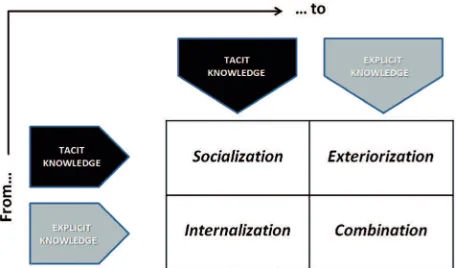
Socialization: is the process through which a person acquires someone
else’s tacit knowledge by observation, imitation, practice and dialog.
Exteriorization: is the process through which a person acquires
some-one else’s tacit knowledge. This person consciously shares his/her tacit knowledge by using metaphors, analogies, concepts, hypotheses and models that make tacit knowledge explicit.
Combination: is the knowledge exchange process in which modes of
interaction and understanding of explicit knowledge are transferred, through the use of printed and digital content (texts, reports, slides, audio, videos, etc.) and the use of different methods of communication (meetings, conversations, intranets, the Internet, etc.).
Internalization: is the process through which a person integrates
knowl-edge acquisition to his/her knowlknowl-edge and experience (learning-tacit mental structures), which enables the socialization, exteriorization and combination processes, and in which the individual becomes aware of the new base of knowledge and shares it with others, creating a new Cycle of Knowledge Generation (Conversion).
Literature review
2.
[image:7.482.72.300.109.243.2]Across the last thirty years of developments in the field of information lit-eracy, different authors have produced a range of proposals using diverse
pedagogical methods and standards, mostly within the ambit of universities. These proposals have had a major influence on the development of the theo-retical framework in this field:
“An information literacy model is a framework that aims at defining which levels of competence a person should master before he/she can acquire the skills that make him/her information literate. The operational development of these models is carried out through standards, made up of lists of categories that describe the nature of these models.” (Cuevas Cerveró, 2007) (Translated from Spanish)
Therefore, considering the relationship between models and standards and their correlation with the different forms of knowledge generation (conver-sion) from tacit to tacit (socialization), from tacit to explicit (exteriorization), from explicit to explicit (combination) and from explicit to tacit (internaliza-tion), a literature review was conducted with the aim of identifying which pedagogical models and standards were most commonly used and best-known among information literacy experts worldwide (Uribe-Tirado, 2008, 2010).
The literature review was carried out using sources of information such as SCIENCE DIRECT, SCOPUS, EBSCO: Academic Search Premier, LISA and E-LIS. The use of these resources along with specific books and articles4
allowed for the identification of the following relevant and well-known Information Literacy standards and models:
2.1. Information Literacy Teaching Models
The most important models for academic institutions include:
Seven Faces of Information Literacy by Christine Bruce (Australia, 1.
1997)
The Seven Pillars of Information Literacy — SCONUL (UK and 2.
Ireland, 1999)
Sauce Model by Bond (New Zealand, 2001) 3.
The Big Blue — Taxonomy of information skills (England, 2002) 4.
The Seven Steps of the Research Process (United States, 2003) 5.
Web-Based Information Searching by Sylvia Edwards (Australia, 6.
Alejandro Uribe Tirado and Wilson Castaño Muñoz
Liber Quarterly Volume 22 Issue 3 2012 221
Six Frames for Information Literacy Education by Christine Bruce 7.
et al. (Australia, 2006)
A Framework by Markless and Streatfield (2007) (England). 8.
In the field of school libraries, and with influence in the university sector, the following models stand out:
Research Steps to Success by Hunges (Canada, 1998) 1.
The 8Ws by Lamb (United States, 1990) 2.
Search Process Model by Kuhlthau (United States, 1985–2008) 3.
The Big Six Skills (United States, 1990, 2000) 4.
Digital Information Fluency-DIF (United States, 2001) 5.
PLUS Model by Herring (Scotland, 2002) 6.
Information Literacy Scope and Sequence (United States, 2003) 7.
2.2. Information Literacy Standards
In terms of standards and models relating directly or indirectly to the aca-demic sphere, the following can be mentioned:
The United States:
“Information Literacy Competency Standards for Higher Education” 1.
(ALA/ACRL, 2000).
“Objectives for Information Literacy Instruction: A Model Statement 2.
for Academic Librarians”; where indicators and standards are inte-grated with more specific objectives to facilitate teaching-learning process for some expected outcomes (ALA/ACRL, 2001).
England:
“Society of College, National and University Libraries”; linked to the 1.
Seven Pillars of Information Literacy model (SCONUL, 1999).5
Australia/New Zealand:
“Council of Australian University Librarians”/The Australian and 1.
Norway:
“The Nordic Council for Scientific Information” (NORDINFO, 2001). 1.
As regards standards for school libraries, the following stand out:
United States: American Association of School Librarians and the 1.
Association for Educational Communications and Technology –AASL/AECT–, 1998
Canada: The Students’ Bill of Information Rights/Students´ 2.
Information literacy Needs in the 21st Century: Competencies for Teacher-Librarians (for school libraries, but influenced by academic libraries) by the Association for Teacher-Librarianship in Canada (ATLC) and the Canadian School Library Association (CSLA), 1997.
It is important to mention that over the last decade some models and stan-dards have been proposed and developed in Latin America, Spain and Portugal, but their impact has so far been local.
These models include Spain’s ALFIN-EEES Standard (Pinto, 2004, Pinto, Sales & Osorio 2007) and Mexico’s Standards on Information Literacy in Higher Education, by the Universidad Autónoma de Ciudad Juárez (Cortés & Lau, 2004).
Methodology
3.
After identifying these models and standards a qualitative analysis (content analysis and discourse analysis) was carried out, in which the different com-ponents put forward by the models as training cycles/sequences for informa-tion literacy were contrasted with the macro and micro skills described in the standards.
This analysis was based on the Guidelines on information literacy for lifelong learning published by IFLA (Lau, 2006) and the Information Literacy Indicators
Alejandr
o Uribe T
irado and W
ilson Castaño Muñoz
Liber Quarterly V
olume 22 Issue 3 2012
[image:11.482.97.598.94.381.2]223
Table 1: Example. Integration of information literacy standards.
IFLA/UNESCO LAU, J.- CATTS, R.
ALA/ACRL, 2000 CAUL, 2001 BIG BLUE, 2002 ANZIIL, 2004
ELEMENTS-ST ANDARD ACCESS Definition and articulation of the information need/Recognize information needs
1. Determines the nature and extent of the information needed
1. Recognizes the need for information and determines the nature and extent of the information needed
1. Recognizes an information need
1. The information literate person recognises the need for information and determines the nature and extent of the information needed
Location of information/
Locate and evaluate the quality of information
2. Accesses needed information effectively and efficiently
2. Accesses needed information effectively and efficiently
2. Addresses the information need
3. Retrieves Information
2. The information literate person finds needed information effectively and efficiently EV ALUA TION Assessment of information/
Locate and evaluate the quality of information
3. Evaluates information and its sources critically and incorporates selected information into his or her knowledge base and value system
3. Evaluates information and its sources critically and incorporates selected information into their knowledge base and value system
4. Evaluates information critically
3. The information literate person critically evaluates information and the information seeking process
Organization of information/
Store and Retrieve information
4. Classifies, stores, manipulates and redrafts information collected or generated
6. Organizes information
Liber Quarterly V
olume 22 Issue 3 2012
LAU, J.- CATTS, R.
USE
Use of information /Make effective and ethical use of information
4. Uses information effectively to accomplish a specific purpose
5. Expands, reframes or creates new knowledge by integrating prior knowledge and new understandings individually or as a member of a group
7. Recognizes that lifelong learning and participative
5. Adapts information
5. The information literate person applies prior and new information to construct new concepts or create new understandings
Communication and ethical use of information/Make effective and ethical use of information
5. Understands many of the economic, legal, and social issues surrounding the use of information and accesses and uses information ethically and legally
6. Understands cultural, economic, legal, and social issues surrounding the use of information and accesses and uses information ethically, legally and respectfully
7. Communicates information
[image:12.482.90.601.85.346.2]Alejandro Uribe Tirado and Wilson Castaño Muñoz
Liber Quarterly Volume 22 Issue 3 2012 225
Based on IFLA’s guidelines and UNESCO’s indicators a content-analysis was then carried out, which allowed for the identification of differences and simi-larities, as shown in Figure 4, between the indicators and expected outcomes for every single macro and micro competency (Uribe-Tirado, 2010).
Based on the indicators and expected outcomes in the standard proposed by the ALA/ACRL, which form the basis of the majority of standards in dif-ferent countries (CAUL, ANZIIL, Universidad Autónoma de Ciudad Juarez, etc.), an analysis of the indicators was carried out from the perspective of the four different components of the cycle of knowledge generation (conversion):
[image:13.482.74.409.336.583.2]tacit to tacit (Socialization), tacit to explicit (Exteriorization), explicit to explicit (Combination) and explicit to tacit (Internalization). A table was created for the analysis, allowing for the identification of indicators and expected outcomes and relating them to knowledge generation (conversion), as socialization, exteriorization, internalization and combination (Table 2):
Liber Quarterly V
olume 22 Issue 3 2012
General Competency
General Indicators Results-Objectives-Examples
SOCIALIZA TION EXTERIORIZA TION COMBINA TION INTERNALIZA TION
Tacit- Tacit Tacit -Explicit Explicit-Explicit Explicit-Tacit
Finds new ways
•
to communicate, present and use information Applies the • retrieved information Learns or • internalizes information as personal knowledge Presents the • information product
a. Uses diverse sources of information to inform decisions (ALA/ACRL Standard) b. Determines whether information satisfies
the research or other information need and whether the information contradicts or verifies information used from other sources (CAUL Standard)
a. Identifies whether there are differing values that underpin new information or whether information has implications for personal values and beliefs (ALA/ACRL Standard) b. Applies reasoning to determine whether
to incorporate or reject viewpoints encountered (ALA/ACRL Standard) c. Maintains an internally coherent set
of values informed by knowledge and experience (ANZIIL Standard)
a. Chooses a communication medium and format that best supports the purposes of
[image:14.482.96.599.104.407.2]Alejandr
o Uribe T
irado and W
ilson Castaño Muñoz
Liber Quarterly V
olume 22 Issue 3 2012
227
General Competency
General Indicators Results-Objectives-Examples
SOCIALIZA TION EXTERIORIZA TION COMBINA TION INTERNALIZA TION
Tacit- Tacit Tacit -Explicit Explicit-Explicit Explicit-Tacit
5. Use of information
the product or performance and the intended audience (ALA/ACRL Standard) b. Uses a range of information technology
applications in creating the product or performance (ALA/ACRL Standard) c. Incorporates principles of design and
communication (ALA/ACRL Standard) d. Communicates clearly and with a style
that supports the purposes of the intended audience (ALA/ACRL Standard)
x
x
x
Understands
•
ethical use of information Respects the legal
•
use of information Communicates • the learning product with acknowledgement of intellectual property
a. Understands many of the ethical, legal and socio-economic issues surrounding information and information technology identifies and discusses issues related to privacy and security in both the print and electronic environments
Identifies and discusses issues related
•
to privacy and security in both the print and electronic environments Identifies and discusses issues
•
related to free vs. fee-based access to information
Identifies and discusses issues related
•
to censorship and freedom of speech
x x
[image:15.482.96.601.84.420.2]Liber Quarterly V
olume 22 Issue 3 2012
General Competency
General Indicators Results-Objectives-Examples TION TION
TION
TION
Tacit- Tacit Tacit -Explicit Explicit-Explicit Explicit-Tacit
6.
Communication and ethical use of information
Uses the relevant
•
acknowledgement style standards
Demonstrates an understanding
•
of intellectual property, copyright, and fair use of copyrighted material (ALA/ACRL Standard)
b. The information literate student follows laws, regulations, institutional policies, and etiquette related to the access and use of information resources.
Participates in electronic discussions
•
following accepted practices (e.g. “Netiquette”)
Uses approved passwords and other
•
forms of ID for access to information resources (ALA/ACRL Standard)
[image:16.482.99.604.86.319.2]Alejandro Uribe Tirado and Wilson Castaño Muñoz
Liber Quarterly Volume 22 Issue 3 2012 229
Findings
4.
The analysis of this integrative table of Information Literacy Indicators that integrate the most important Higher Education Standards, generated the fol-lowing results:
Table 3 shows that if we take each competency and the standards involved and analyze them in terms of information and tacit and explicit knowledge, there are certain standards that imply skills-job training along with a good knowledge of direct and indirect management processes of the combination
type (location of information and assessment of information), and of the
internalization type (assessment of information), as can be seen in the
follow-ing indicators (outcomes):
Identifies keywords, synonyms and related terms for the information
•
needed
Selects controlled vocabulary specific to the discipline or information
•
retrieval source
Uses various classification schemes and other systems (e.g., call number
•
systems or indexes) to locate information resources within the library or to identify specific sites for physical exploration
Restates textual concepts in his/her own words and selects data
•
accurately
Utilizes computer and other technologies (e.g., spreadsheets, databases,
mul-•
timedia, and audio or visual equipment) for studying the interaction of ideas and other phenomena
(Integrated Information Literacy Standards: ALA/ACRL and other)
However, other competencies, standards and their relationships with these four knowledge management processes are needed, the results are low (Figure 5: Socialization and Exteriorization), indicating the need to review the emphasis on information and knowledge more explicit type that tacit, in training in information competencies (information literacy).
Liber Quarterly V
olume 22 Issue 3 2012
General Competencies
General Indicators No. Integrated Results-Objectives Analyzed That relate to processes Socialization (Tacit-Tacit) That relate to processes Exteriorization (Tacit-Explicit) That relate to processes Combination (Explicit-Explicit)
That relate to processes Internalization (Explicit-Tacit)
A. ACCESS.
The Individual/ Collective accesses information effectively and efficiently
1. Definition and articulation of the information need
18 1 5 10 2
2. Location of
information 24 1 1 20 2
B. EVALUATION. The Individual/ Collective evaluates information critically and competently
3. Assessment of
information 27 3 1 18 5
4. Organization of
information 9 0 1 7 1
C. USE.
The Individual/ Collective applies/uses information accurately and creatively
5. Use of
information 9 0 1 5 3
6. Communication and ethical use of information
14 3 0 10 1
D. FEEDBACK. The Individual/ Collective performs a continuous assessment
7. Evaluation/ Self-assessment: process and products
2 0 0 1 1
[image:18.482.96.605.108.402.2]Alejandro Uribe Tirado and Wilson Castaño Muñoz
Liber Quarterly Volume 22 Issue 3 2012 231
Confers with instructors and participates in class discussions, peer
work-•
groups, and electronic discussions to identify a research topic, or other information need
Participates in class-sponsored electronic communication forums designed
•
to encourage discourse on the topic (e.g., email, bulletin boards, chat rooms)
Articulates knowledge and skills transferred from prior experiences to
•
planning and creating the product or performance
Identifies and discusses issues related to censorship and freedom of speech
•
(Integrated Information Literacy Standards: ALA/ACRL and other)
[image:19.482.73.412.120.357.2]It is also necessary to propose and integrate new indicators for different information literacy competency standards for higher education (ACRL/ ALA, CAUL, ANZIIL, SCONUL, Ciudad Juárez), according to the different competencies and standards expected, for example: (We propose some as…)
Identify needs for personal-social or academic-labor information and the
•
implications of differences between these for the searching for, locating, dif-fusing and ethical use of information.
Know the difference between natural language and formal language as well
•
as how to use them correctly in order to obtain good results in information searches, depending on the source, such as other people, twitter, blogs, data-bases or books etc.
Evaluate the reliability of a comment in a classroom or in a social
•
network.
Use different strategies, media and tools for acquiring personal-social or
•
academic-labor information depending on the length, complexity and copy-right status of the information.
Be aware of the implications for and impact on education, society, economics
•
and/or politics of accurate or inaccurate information in social networks.
Information competencies are particularly necessary now that the paradigm of Web 2.0 has changed and is changing, as Web 2.0 involves new sources of information that are mainly created by users’ experiences or tacit to explicit (Exteriorization), and in the light of new and sustained ways in which tacit to tacit (Socialization) information is disseminated by the multiple means of instantaneous and ubiquitous communication offered by current information technology.
Conclusions
5.
Some general conclusions, as well as specific issues identified in the previous section, are:
Alejandro Uribe Tirado and Wilson Castaño Muñoz
Liber Quarterly Volume 22 Issue 3 2012 233
Even though Information Literacy standards in academic institutions are cre-ated based on the proposals put forward by ALA/ACRL (1999), there are additional elements and items in each of the proposals not only of form, but of substance, that it is important to be aware of in order to obtain a more com-plete framework of standards and indicators (objectives and expected out-comes), so that these can be adapted to countries (where national standards have not been established) or to academic institutions that want to imple-ment them.
In academic institutions, current Information Literacy Standards, includ-ing their indicators and expected outcomes, place a major emphasis on the Knowledge Generation (conversion) processes of combination and internali-zation rather than the socialiinternali-zation and exterioriinternali-zation processes, leading to a general emphasis on explicit knowledge. It is therefore necessary to consider implementing different indicators6, expected outcomes and goals,
which will help to balance out this tendency in favor of tacit knowledge, because information behavior models for information searches and use indicated that other people and peers are key factors in influencing beha-vior and aid the clarification of information requirements (Uribe-Tirado, 2009b). Information behavior models can also assist with self-evaluation of processes and pro ducts, therefore re-initiating the cycle of information and knowledge management. It is necessary to consider, measure and evaluate information related to tacit knowledge both in the academic context as well as in other contexts (Lloyd, 2003; Ferguson & Lloyd, 2007; Ferguson, 2009), thus permitting a broader view of information literacy.
References
ALA/ACRL (2000). Information Literacy Competency Standards for Higher Education.
Retrieved September 29, 2012, from http://www.ala.org/acrl/standards/ informationliteracycompetency.
ALA/ACRL (2001). Objectives for Information Literacy Instruction: A Model Statement for
Academic Librarians. Retrieved September 29, 2012, from http://www.ala.org/acrl/
standards/objectivesinformation.
Alavi, M., and Leidner, D.E. (2001). Review: Knowledge management and
Quarterly, 25, 107–136. Retrieved September 4, 2008, from http://mgmt.iisc.ernet. in/~piyer/Knowledge_Management/KM%20and%20KMS%20Conceptual%20 Foundations%20and%20Research%20Issues%20MIS%20Quarterly%2025%201%20 March%20201.pdf.
Andretta, S. (2005). Information literacy: A practitioner’s guide. Oxford: Chandos.
ANZIIL (2004). Australian and New Zealand Information Literacy Framework. Retrieved October 10, 2009, from http://www.caul.edu.au/content/upload/files/info-literacy/InfoLiteracyFramework.pdf.
Basili, C. (2003). Information literacy in Europe: A first insight into the state of the art of
information literacy in the European Union. Roma: Consiglio Nazionale delle Ricerche.
Becerra, M., Lunnan, R., and Huemer, L. (2008). Trustworthiness, risk, and the transfer of tacit and explicit knowledge between alliance partners. Journal of
Management Studies, 45, 691–713.
Behrens, S.J. (1994). A conceptual analysis and historical overview of information literacy. College and Research Libraries 55, 309–322.
Bruce, C.S., and Candy, P. (2000). Information literacy around the world: Advances in
programs and research. Wagga, N.S.W.: Centre for Information Studies, Charles Sturt
University.
Castaño-Muñoz, W., and Uribe-Tirado, A. (2011). Identifying information behavior in information search and retrieval through learning activities using an E-learning platform case: Interamerican school of library and information science at the University of Antioquia. Education Libraries. Special Libraries Association, 34(1), 33–49.
Retrieved September 4, 2012, from http://eprints.rclis.org/handle/10760/15988.
Catts, R., and Lau, J. (2008). Towards information literacy indicators. Paris: UNESCO. Retrieved October 16, 2012, from http://www.ifla.org/files/assets/information-literacy/publications/towards-information-literacy_2008-en.pdf
CAUL (2001). Information literacy standards. Canberra: Council of Australian university librarians. Retrieved October 10, 2009, from http://archive.caul.edu.au/ caul-doc/InfoLitStandards2001.doc.
CILIP (2004). CILIP’s definition on information literacy. Chartered Institute of Library and Information Professionals. Retrieved September 29, 2012 from
http://www.cilip.org.uk/get-involved/advocacy/information-literacy/pages/ definition.aspx.
Choo, C. (1999). La organización inteligente. Oxford: Oxford University Press.
Cortés, J., and Lau, J. (2004). Normas de alfabetización informativa para el aprendizaje.
Alejandro Uribe Tirado and Wilson Castaño Muñoz
Liber Quarterly Volume 22 Issue 3 2012 235
Cuevas Cerveró, A. (2007). Lectura, alfabetización en información y biblioteca escolar. Gijón: Ediciones TREA, S.L.
Davenport, T.H. (2008, February 19). Enterprise 2.0: The new, new knowledge management? Harvard Business Online. Retrieved November 7, 2012, from http:// blogs.hbr.org/davenport/2008/02/enterprise_20_the_new_new_know_1.html.
Davenport, T.H., and Prusak, L. (1998). Working knowledge: How organizations manage
what they know. Boston, MA: Harvard Business School Press.
Dudziak, E.A. (2003). Information literacy: Princípios, filosofia e prática. Ciência
da Informação, 32, 23–35. Retrieved October 10, 2009, from http://eprints.rclis.
org/4727/1/ DUDZIAKCi.Inf-2004-156.pdf.
Easterby-Smith, M., and Lyles, M. (2003). The Blackwell handbook of organizational
learning and knowledge management. Australia: Blackwell Publishing.
Ferguson, S. (2009). Information literacy and its relationship to knowledge
management. Journal of Information Literacy, 3(2), 6–24. Retrieved June 21, 2010, from http://ojs.lboro.ac.uk/ojs/index.php/JIL/ article/view/PRA-V3-I2-2009-1.
Ferguson, S., and Lloyd, A. (2007). Information literacy and the leveraging of
corporate knowledge. In S. Ferguson (ed.), Libraries in the twenty-first century: Mapping
future directions in information services (pp. 221–239). Wagga Wagga, NSW: Centre for
Information Studies.
Garner, S.D. (2006). Alexandria proclamation on information literacy and lifelong learning.
Retrieved October 1, 2007, from http://archive.ifla.org/III/wsis/High-Level-Colloquium.pdf.
Geisler, E., and Wickramasinghe, N. (2009). Principles of knowledge management: Theory,
practice and cases. New York:M. E. Sharpe Incorporated.
Gibson, C. (2008). The history of information literacy. In E. Blakesley Lindsay and C.N. Cox (eds.), Information Literacy Handbook. Chicago: ALA, ACRL.
Grassian, E., and Kaplowitz, J.R. (2009). Information literacy instruction: Theory and
practice (2nd ed.). New York: Neal-Schuman.
Horton, F.W. (Ed.) (2012). Worldwide multi-lingual information literacy resources.
UNESCO (in editing process).
Ichijo, K., and Nonaka, I. (2006). Knowledge creation and management: New challenges for
managers. New York: Oxford University Press.
JISC (2002). The main information literacy discussion list: Lis-infoliteracy. Retrieved October 10, 2009, from http://www.jiscmail.ac.uk/lists/lis-infoliteracy.html.
Lau, J. (2006). Guidelines on information literacy for lifelong learning. Boca del Río, Veracruz, México. Retrieved November 30, 2008, from http://archive.ifla.org/VII/ s42/pub/IL-Guidelines2006.pdf.
Lau, J. (2007), Information Literacy: An international state-of-the-art report. UNESCO-IFLA. Retrieved September 29, 2012 from http://www.jesuslau.com/docs/ publicaciones/doc2/UNESCO_state_of_the_art.pdf.
Lorenzen, M. (2001). A brief history of library information in the United States of America. Illinois Libraries, 83, 8–18.
Lloyd, A. (2003). Information literacy: The meta-competency of the knowledge economy? Journal of Librarianship and Information Science, 35(2), 87–92.
Markless, S., and Streatfield, D.R. (2007). Three decades of information literacy: redefining the parameters. In S. Andretta (ed.), Change and challenge: information
literacy for the twenty-first century (pp. 15–36). Adelaide: Auslib Press.
Moore, P. (2005). An analysis of information literacy education worldwide. School
Libraries Worldwide,11(2), 1–23.
Nonaka, I., and Takeuchi, H. (1995). The knowledge-creating company: How Japanese
companies create the dynamics of innovation. New York: Oxford University Press.
NORDINFO (2001). Information literacy. The Nordic Council for Scientific
Information. Retrieved October 10, 2009, from http://southernlibrarianship.icaap. org/content/v02n01/hannesdottir_s01.html.
Pinto, M. (2004). Alfabetización informativo digital. Granada: Universidad de Granada. Retrieved September 29, 2012, from http://www.mariapinto.es/e-coms/alfa_infor. htm.
Pinto, M., Sales, D., and Osorio, P. (2007). Innovación educativa para el fomento de la alfabetización informacional en la educación superior: Los portales e-COMS, ALFIN-EEES, ALFAMEDIA e IMATEC. I Simposio Internacional de Documentación Educativa
SIDOC 2007. Palma de Mallorca, de 14 al 16 de febrero. Retrieved May 12, 2009, from
http://www.doredin.mec.es/documentos/01220073000108.pdf.
Pinto, M., Uribe-Tirado, A., Gómez, R.D., and Cordon, J.A. (2011). La producción científica internacional sobre competencias informacionales e informáticas:
tendencias e interrelaciones. Información, Cultura y Sociedad. Publicación del Instituto de
Investigaciones Bibliotecológicas (FFyL-UBA), 24, 29–62. Retrieved September 29, 2012,
from http://ppct.caicyt.gov.ar/index.php/ics/article/view/646/824.
Alejandro Uribe Tirado and Wilson Castaño Muñoz
Liber Quarterly Volume 22 Issue 3 2012 237
Rader, H.B. (2003). Information literacy: A global perspective. In A. Martin and H.B. Rader (eds.), Information and IT literacy: Enabling learning in the 21st century
(pp. 24–42). London: Facet Publishing.
Saranto, K., and Hovenga, E. (2004). Information literacy — What’s about? Literature review of the concept and the context international. Journal of Medical Informatics, 73(6), 503–513.
SCONUL — Society of College, National and University Libraries (1999). Information
skills in higher education: a SCONUL position paper. Retrieved March 22, 2009, from
http://www.sconul.ac.uk/groups/information_literacy/papers/Seven_pillars.html.
Spanish Translation: ALFIN: La definición de CILIP (translated by Cristóbal Pasadas Ureña). Boletín de la Asociación Andaluza de Bibliotecarios, 77, 79–84. Retrieved October 10, 2009, from http://www.aab.es/pdfs/baab77/77a4.pdf.
Spender, J.-C., and Scherer, A.G. (2007). The philosophical foundations of knowledge management.Editors’ Introduction. Organization,14, 5–28.
Tsoukas, H. (2005). Complex knowledge: Studies in organizational epistemology. Oxford: Oxford University Press.
UNESCO/NFIL (2003). The Prague declaration: towards an information literate society.
Retrieved October 1, 2007, from http://portal.unesco.org/ci/en/files/19636/1122886 3531PragueDeclaration.pdf/PragueDeclaration.pdf.
Uribe-Tirado, A. (2005). La alfabetización informacional, un prerrequisito y campo de acción para la e-inclusión y la gestión del conocimiento en red en las universidades.
In: XII Congreso Internacional de Educación Electrónica, Virtual y a Distancia TELEDUMED. Retrieved December 15, 2009, from http://eprints.rclis.org/15064/.
Uribe-Tirado, A. (2008). Diseño e implementación y evaluación de una propuesta formativa en alfabetización informacional mediante un ambiente virtual de aprendizaje a nivel
universitario: caso Escuela Interamericana de Bibliotecología, Universidad de Antioquía.
Maestría en Ingeniería, Línea Informática Educativa. Universidad EAFIT (Colombia). Retrieved July 18, 2009, from http://eprints.rclis.org/handle/10760/12606.
Uribe-Tirado, A. (2009a). Interrelaciones entre veinte definiciones-descripciones del concepto
de alfabetización informacional: propuesta de macro-definición. ACIMED. Revista cubana
de los profesionales de la información y de la comunicación en salud, 20, n.
Uribe-Tirado, A. (2009b). El conocimiento y reconocimiento de los modelos de comportamiento informacional. Un aspecto necesario para los servicios de información Web 2.0 y la alfabetización informacional-DHI desde las bibliotecas.
In: Memorias XVI Coloquio Internacional de Bibliotecarios. Guadalajara, México: Feria
Internacional del Libro FIL.
Uribe-Tirado, A. (2010). Lecciones aprendidas en programas de alfabetización informacional
en universidades de Iberoamérica(Avance Tesis Doctoral). Universidad de
Van Dijk, J. (2005). The deepening divide: Inequality in the information society. London: Sage.
Vera, D., and Crossan, M. (2003). Organizational learning and knowledge management: Toward an integrative framework. In M. Easterby-Smith and M.A. Lyles (eds.), The Blackwell handbook of organizational learning and knowledge management.
Australia: Blackwell Publishing.
Virkus, S. (2003). Information literacy in Europe: a literature review. Information
Research, 8,4. Retrieved May 5, 2008, from http://informationr.net/ir/8-4/paper159.
html.
Webber, S., and Johnston, B. (2000). Conceptions of information literacy: new perspectives and implications. Journal of Information Science, 26, 381–397. doi: 10.1177/016555150002600602.
Webber, S., and Johnston, B. (2006). Information literacy: definitions and models.
Retrieved May 5, 2008, from http://dis.shef.ac.uk/literacy/definitions.htm.
Zurkowski, P. G. (1974). The information service environment: Relationships and priorities.
Washington, DC: National Commission on Libraries and Information Science.
Notes
1 This article is the result of PhD research on Information Literacy: “Lesson learned in information literacy programs in Ibero-American universities” University of Granada (Spain).
2 Davenport & Prusak (1998); Choo (1999); Nonaka & Takeuchi (1995); Alavi & Leidner (2001); Tsoukas (2005); Ichijo & Nonaka (2006); Spender & Scherer (2007); Becerra, Lunnan & Huemer (2008); Davenport (2008); Geisler & Wickramasinghe (2009) etc.
3 http://www.gdrc.org/kmgmt/what-is-km.html — http://blog.simslearningcon nections.com/?p=279
4 Behrens (1994); Bruce & Candy (2000); Lorenzen (2001); Rader (2002, 2003); Webber & Johnston (2000, 2006); Basili (2003); Dudziak (2003); Virkus (2003); Andretta (2005); Moore (2005); Gibson (2008); Grassian & Kaplowitz (2009); Pinto, Uribe-Tirado, Gómez-Díaz & Cordón (2011).
Alejandro Uribe Tirado and Wilson Castaño Muñoz
Liber Quarterly Volume 22 Issue 3 2012 239
Since then, the model has been adopted by librarians and teachers around the world as a means of helping them to deliver information skills to their learners. However, in 2011 we live in a very different information world and while the basic principles underpinning the original Seven Pillars model remain valid, it was felt that the model needed to be updated and expanded to reflect more clearly the range of different terminologies and concepts which we now understand as “Information Literacy”. In order for the model to be relevant to different user communities and ages, the new model is presented as a generic “core” model for Higher Education, to which a series of “lenses”, representing the different groups of learners, can be applied”. See: http://www.sconul.ac.uk/groups/information_literacy/seven_pillars.html.