Héctor Gomez-Acevedo, et al.
Arch Neurocien (Mex) Vol 12, No. 2: 71-76; 2007
The architecture and hierarchical pathways in the
subthalamic nucleus using isotropic imaging
Héctor Gómez-Acevedo, Perla Salgado, Mario Alonso-Vanegas, Erik Pasalle
Arch Neurocien (Mex)Vol. 12, No. 2: 71-76; 2007 ©INNN, 2007
Recibido: 2 enero 2007. Aceptado: 19 enero 2007.
Instituto Nacional de Neurología y Neurocirugía. Correspondencia: Héctor Gómez-Acevedo. Instituto Nacional de Neurología y Neurocirugía. Insurgentes Sur 3877, Col. La Fama, 14269 México, D.F.
Artículo original
ABSTRACT
Objective: the subthalamic nucleus (STN) has gained importance as a focus for histological, anatomical and imaging research due to its implications in modulation basal ganglia output and Parkinson’s disease. Little is known about the intrinsic organization of the STN. More information is needed to understand its role in the central nervous system (CNS) and allow more accurate planning in Functional Neurosurgery. We describe a method capable of delineating the boundaries of gray matter that could be used to study the internal architecture of the STN. Methods: eighty-seven patients were randomly selected from a magnetic resonance (MR) diffusion tensor imaging (DTI) data bank. From these cases, we selected forty-four in which DTI showed the STN, but not the substantia nigra (SN) in the same image. After initial scrutiny, we excluded fourteen patients with tumors in the brain stem, mass effect, hydrocephalus or obvious malformations. We developed an algorithm by selecting the region of Interest in the STN as identified by the Isotropic Image instead of the Anisotropic one.
Results: after reviewing these 30 studies, we identified regions of track concurrency (RTC). In all cases reviewed, RTC showed a hierarchical position from medial to lateral according to the longitudinal axis of the STN and the origin of the fibers. This arrangement revealed a more medial position of the fibers with connection to the parietal, frontal posterior and frontal polar cortex (Brodmann´s areas 7, 4 and 11), a central position for the fibers interacting with the corpus
callosum and a lateral position of the fibers interacting with the frontal-medial cortex. Conclusion: the technique described allows fiber tracking in the gray matter, undetectable by other imaging methods. It has helped detail the description of STN architecture, evidencing a constant hierarchical position regarding its interconnections. This information helps elucidate the architectural complexity of this nucleus and may prove of use during implantation and programming procedures employed in Deep Brain Stimulation (DBS).
Key word: subthalamic nuclei imagining, use in stimulation.
ARQUITECTURA Y VÍAS DE LOS NÚCLEOS SUBTÁLAMICOS ESTUDIADAS POR IMAGEN DE
ISÓTOPOS
RESUMEN
Los núcleos subtálamicos son un foco importante de la investigación por que se consideran una estructura importante en la modulación de la actividad de los ganglios basales. Poco se conoce de la organización de estos núcleos (STN). Esta información se necesita para la planeación de la neurocirugía funcional. Con este método con el que se reconocen los límites de la sustancia gris se puede conocer la arquitectura interna de los núcleos subtálamicos. Se seleccionaron 90 pacientes al azar de imagen de resonancia magnetica e imagen de difusión y de ellos se seleccionaron 44 para el estudio donde no se visualiza la sustancia negra, otros 14 fueron excluidos por tener hidrocefalía, tumores o malformaciones. Después de revisar 30 pacientes identificamos regiones de concurrencia de tractos (RTC). En todos los casos revisados se encontró una posición jerárquica de mediano a lateral de acuerdo al
Artemisa
eje longitudinal del núcleo subtalamico y del origen de las fibras. Este arreglo previo a una posición mas medial a las fibras con conexión a las regiones parietal frontal y una posición central a las conexión con el cuerpo calloso y la parte medio frontal. En conclusión se encontró una técnica de localización de fibras no posible anteriormente y esto ayuda a la comprensión de este complejo de núcleos lo cuál ayudará a la mejor implantación de electrodos y en la estimulación profunda (DBS).
Palabras clave: localización de núcleos subtálamicos uso en la estimulación profunda.
t is generally accepted that there is a strong relationship between the microscopic morphology of tissue, which governs the self-diffusion of water, and the macroscopic results of Diffusion weighted imaging (DWI)1. The anatomical
connectivity pattern of a certain brain region determi-nes its function2. Although invasive tracer studies have
produced a large body of evidence concerning connectivity patterns in non-human animals3,4, direct
information of brain connections in humans is very limited. Post mortem injection of fluorescent dyes allows tracking of tracts, but only for distances of tens of millimeters5. Longer distance connections can be
investigated by dissection of major tracts or histological studies of remote degeneration following focal lesions6, but such work is based on a relatively
small number of specimens. A specific, important target for functional and cytoarchitectural correlation research, is the Subthalamic Nucleus, (STN) due to its implications in modulation of basal ganglia output and Parkinson’s disease (PD)7. Regarding the intrinsic
organization of the STN, it is thought that the caudal third of the nucleus and the dorsolateral portion of the rostral two-thirds are related to motor circuits. The ven-tral portion of the rosven-tral two-thirds is considered associative territory. The medial portion of the rostral two-thirds is presumably associated to limbic, and partly, associative territories8,9.
Diffusion imaging characterizes the apparent diffusion properties of water10,11. The diffusion tensor is
an ellipsoidal approximation of directional anisotropy of diffusion, which shows the distance covered in 3D space by molecules in a certain diffusion time12,13. In
tissues with a high degree of directional organization, diffusion of water protons is facilitated in different directions.
In brain’s white matter, the principal diffusion direction aligns well with the orientation of major fibers
in each imaging voxel12. The development of diffusion
Tensor Imaging (DTI) techniques has enabled tracing of large fiber tracts in the living human brain14-22. Not
surprisingly, many clinical applications of anisotropism analysis are evidenced in the literature8,15-19. In contrast,
clinical application of isotropism remains to be fully explored. Although neural fibers, such as axons, are known to show significant anisotropism, the remaining structures, including neural and glial cell bodies, especially their nuclei, are believed to essentially exhibit isotropism22.
By using an isotropic imaging algorithm to target the Regions of Interest (ROI), we were able to infer anatomical connectivity of gray matter providing a comprehensive description of the structural configuration of the STN. An additional result of this approach is the possible finding of what appears to be the anatomic rules of engagement of the different tracts interacting in the STN.
MATERIAL AND METHODS
Eighty seven patients were randomly selected from a MR Diffusion Tensor Imaging (DTI) data bank. From these 87, we selected forty-seven cases in which DTI showed the STN but not the Substantia Nigra (SN) in the same image, since the MRI boundary between the STN and the SN has not been clearly defined23-27.
The DTI study of each case comprised 780 images acquired by a 3T General Electric MR, using the Functool software to perform DTI and Tracking. The parameters were: b value = 1000, T2 images = 2, threshold; noise = 300, Upper = 4095, Fibertrak-Maxsteeps = 160, Fibertrak-Min FA value = 0.18, Fibertrak Max ADC Value 0.01. After scrutiny, we excluded seventeen patients with tumors in the brain stem, mass effect, hydrocephalus or obvious cerebral malformations. Of the remaning thirty, 18 were females and 12 males, with a mean age of 38.7 Std. Dev. 16.81. The clinical diagnosis leading to the MRI study was seizures in 11 patients, tumors in 8 patients and miscellaneous in 4 other patients (Parkinson’s Disease 2, Intra cerebral hemorrhage 2, Multiple Sclerosis 2). Four patients remained undiagnosed at the time of the study with MRI studies reported as normal.
We developed an algorithm to exclude the fibers that do not cross the STN boundaries by selecting the ROI from the geometric center of the STN as identified in the Isotropic Image instead of the Anisotropic one. Besides systematic selection of the ROI on the STN based on anatomical and MRI landmarks as described elsewhere, (24) we used a third
method to ensure the actual correspondence of the ROI with the STN, namely the coherence of fiber tracks with previously studied known pathways of the STN7, 25-27. As mentioned before, we only selected ROIs for
tracking on images where Substantia Nigra (SN) was not present in the Axial Isotropic Images, since the boundaries between the SN and the STN have not been well defined on IRM23,27.
RESULTS
Prior to tracking, we compared the Cartesian location displayed axially by isotropic and T2 images to obtain a stronger evidence of the precise location of the STN geometrical center. We found no statistic difference among them (p= 0.5). In order to conform the DTI and tracking images, a fully automated probabilistic tracktography algorithm was used (see Methods) to produce connectivity distributions from ROI within the STN. Each tracking was repeated five ti-mes on each image. The tracts were reproducible and remained the same under each repeated scrutiny. Track junctions with well defined portions of decreased anisotropism were located where the STN was positioned on the axial reference images within the tracking mode. We interpreted this finding as a new assurance of an accurate STN visualization by DTI. The tracks were closely studied with magnification to deter-mine their connectivity within the STN region, enabling visualization of the interconnections processed in the STN. After reviewing the 30 patients, we identified regions of track concurrency (RTC). A superior or dor-sal RTC and an inferior or ventral RTC met on the lower anisotropic boundaries of the STN (figure 1). When a superior RTC was not present, the fibers coming from the superior bundles of the Central Nervous System (CNS) ended on the inferior RTC, and when the inferior RTC was not visible, the fibers coming from the lower bundles of the CNS ended on the superior RTC. When neither a superior nor an inferior RTC was visible, the tracks continued through the STN with only minimal junctions among fibers. We also found that the presence of RTC seemed to mate the fibers concurring in the STN anterior-dorsally and anterior-medially with the ones concurring in the STN posterio-infero-laterally. The superior RTC, whenever present, was invariably more medial than the inferior RTC. Also, the fibers coming laterally from the inferior RTC remained dorsal and lateral in the STN and the fibers coming medially from the inferior RTC passed through the anterior STN. Besides, in all cases reviewed, the fiber tracks
Figure 1.
followed an architectural protocol according to the trajectory they were coming from (table 1). Regarding the superior RTC, we found a hierarchical position from medial to lateral related to the longitudinal axis of the STN (figure 2, table 2). Such an arrangement evidences a more medial position of the fibers connecting to the parietal, frontal posterior and frontal polar cortex
(Brodmann´s areas 7, 4 and 11), a central position for the fibers interacting with the corpus callosum and a lateral position for the fibers interacting with the fron-tal-medial cortex.
DISCUSSION
As any other visualization method, both, DTI and tracking have limitations that must be acknowledged. Every precaution possible was taken to ensure that the ROIs were accurately targeted in the STN geometrical center. As a consequence, we are confident that the DTI tracking images showed the pathways encountered in the STN. The tracks were present in the final count in different numbers, providing a robust amount of information. However, it is the hierarchically positioning of the tracks within the STN, correlated to their origin and projection, which seems to be the most interesting and promising set of data.
The findings appear to be congruent with the current histological and clinical knowledge of the
1.-The medial fibers from the inferior tracks coming into the STN start their regions of track concurrencies on the anterior - medial STN.
2.-The lateral fibers from the inferior tracks coming into the STN start their regions of track concurrencies on the posterior-lateral STN.
Table 1. Inferior Regions of Track Concurrencies (RTC).
Brodmann´s area #6 in same region of track concurrency as Brodmann´s area #7 Corpus callosum in same region of track concurrency as Brodmann´s area #7 Brodmann´s area #10 in same region of track concurrency as Brodmann´s area #4 Brodmann´s area #6 in same region of track concurrency as Brodmann´s area #4 Brodmann´s area # 8 in same region of track concurrency as Corpus callosum Corpus callosum in same region of track concurrency as Brodmann´s area #6 Brodmann´s area #9 same region of track concurrency as Brodmann´s area #6 Brodmann´s area #8 same region of track concurrency as Brodmann´s area #6
Table 2. Superior Regions of Track Concurrencies (RTC). (Of fibers coming from different areas).
Figure 3. Schematic view of the right STN with the observer located at the cuneiform area in the ipsilateral occipital lobe. Notice that the STN´s axial line over the axial plane usually varies between the dotted line and the red arrow.
internal boundaries that divide the STN functionally, contributing to a better understanding of the physiology of this nucleus, especially within the neurosurgical context. We must be cautious with tracks unexpectedly detected as concurring in the same region, (such as Brodmann´s areas 4-10, 6-9) and not evidenced by other methods, and suggest, at least for now, that those fibers simply interact at the same hierarchical level, without assuming that they are integrated pathways. Further research is necessary to correlate the variability detected by tracking images in the STN with the response to Deep Brain Stimulation (DBS). It is not clear if the detection of RTCs depends on the technology involved in DTI rather than on anatomical or physiologic considerations, and this issue deserves further research. However, we believe that the information obtained helps elucidate the STN´s
complex structure given the constant hierarchical order and trajectory of the pathways observed.
CONCLUSIONS
The method described offers highly defined information of STN architecture, unique among non-invasive imaging techniques, evidencing a constant hierarchical position correlated to their origin and projection interconnections. This information can improve our understanding of functional and anatomi-cal correlations within this complex nucleus and may prove of use during implantation and programming pro-cedures employed in DBS.
REFERENCES
1. Passingham RE, Sthephan KE, Kotter R. The anatomical basis of functional localization in the cortex. Nat Rev Neurosci 2002;3, 606-16.
2. Barbas H, Pandya DN. Architecture and frontal cortical connections of the premotor cortex (area 6) in the rhesus monkey. J Comp. Neurol 256, 211-28.
3. Van Essen DC, Newsome WT, Maunsell JH, Bixby JL. The projections from striate cortex (V1) to areas V2 and V3 in the macaque monkey: asymmetries, areal boundaries, and patchy connections. J Comp Neurol 1986; 244, 451-80.
4. Scannell JW, Burns GA, Hilgetag CC, O’Neil MA, Young MP. The connectional organization of the corticothalamic system in the cat. Cereb Cortex 1999;9, 277-99.
5. Mufson EJ, Brady DR, Kordower JH. Tracing neuronal connections in postmortem human hippocampal complex with the carbocyanine dye Dil. Neurobiol. Aging 1990;11, 649-53. 6. Guillery RW, Sherman SM. Thalamic relay functions and their
role in cortico-cortical communication: generalizations from the visual system. Neuron 2002;33, 163-75.
7. Hamani C, Saint-Cyr J, Fraser J, Kaplitt M, Lozano AM. The subthalamic nucleus in the context of movement disorders. Brain
2004;127, 4-20.
8. Joel D, Weiner I. The connections of the primate subthalamic nucleus: indirect pathways and the open-interconnected scheme of basal ganglia-thalamocortical circuitry. Brain Res Rev 1997;23:62-78.
9. Parent A, HazratiLN. Functional anatomy of the basal ganglia. II. The place of subthalamic nucleus and external pallidum in basal ganglia circuitry. Brain Res Rev 1995; 20: 128-54. 10. Basser PJ, Mattiello J, LeBihan D. MR diffusion tensor
spectroscopy and imaging. Biophys J 1994;66, 259-67. 11. Basser PJ, Mattiello J, LeBihan D. Estimation of the effective self
diffusion tensor from the NMR spin echo. J Magn Reson 1994; B 103, 247-54.
12. Le Bihan D, Mangin JF, Poupon C, Clark C, Pappata S, Molko N, et al. Diffusion tensor imaging: concepts and applications.
JMRI 2001;13:534-46.
13. Shimony JS, McKinstry RC, Akbudak E. Quantitative diffusion-tensor anisotropy brain MR imaging: Normative human data and anatomic analysis. Radiology 1999;212:770-84.
14. Parker GJ. Initial demonstration of in vivo tracing of axonal projections in the macaque brain and comparasion with the human brain using diffusion tensor imaging and fast marching tractography. Neuroimage 2002;15, 797-809.
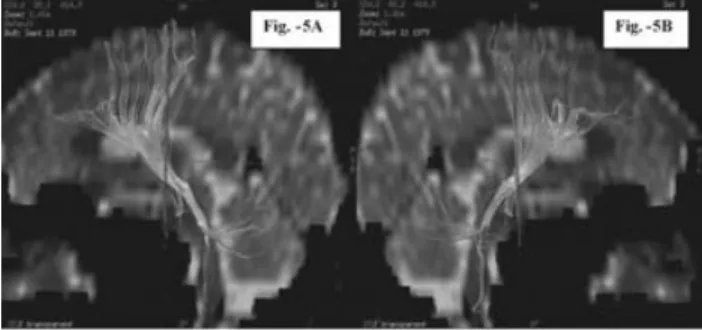
Figure 5A.- Left Sagital view of the Fiber Tracking performed from a ROI over the left STN obtained from Isotropic Imaging. Figure 5B.-Right sagital view of the fiber tracking performed from a ROI over the right STN obtained from isotropic imaging.
15. Ciccarelli O. From diffusion tractography to quantitative tract matter tract measures: a reproducibility study. Neuroimage
2003;18, 348-59.
16. Mori S, Crain BJ, Chacko VP, Van Zijl PC. Three-dimensional tracking of axonal projections in the brain by magnetic resonance imaging. Ann Neurol 199;45,265-9.
17. Poupon C. Regularization of diffusion-direction based maps for the tracking of white matter fascicles. Neuroimage 2000;12,184-95. 18. Jones DK, Simmons A, Williams SC, Horsfield MA. Non-invasive assessment of axonal fiber connectivity in the human brain via diffusion tensor MRI. Magn Reson Med 1999;42,37-41. 19. Conturo TE. Tracking neuronal fiber pathways in the living human
brain. Proc Natl Acad Sci USA 1999;96,10422-7.
20. Nakada T, Matzusawa H. Three-dimensional anisotropy contrast magnetic resonance imaging on the rat nervous system: MR axonography. Neurosci Res 1995;22,389-8.
21. Behrens TEJ. Non-invasive mapping of connections between human thalamus and cortex using diffusion imaging. Nature
2003;6,7.
22. Matsuzawa H, Nakayama N, Isotropic component trace analysis.
J Neuroimaging 2005;15, 233-9.
23. Zhu XL. Magnetic resonance imaging based morphometry and landmarks correlations of the basal ganglia. Acta Neurochir
2002;144, 954-69.
24. Olszewski J. Cytoarchitecture of the human brain stem, 2nd
Edition, Ed. Raven, New York, 1982.
25. Schlesinger B. The upper brain stem in the human: its nuclear configuration and vascular supply. Springer-Verlag Berlin Heildelberg New York 1976; pp 19-73.
26. Affifi A, Bergman RA. Neuroanatomía Funcional, Mc-Graw Hill Interamericana 1989; 189-233.