IL28B polymorphisms predict the
response to chronic hepatitis C virus infection
treatment in a Mexican population
Laura E. Martínez-Gómez,* Norberto C. Chávez-Tapia,** Ana I. Burguete-García,* Nancy Aguilar-Olivos,** Vicente Madrid-Marina,* Margarita Román-Bahena,* Citlalli Orbe-Orihuela,* Uribe Misael,** Nahum Méndez-Sánchez**
* Centro de Enfermedades Infecciosas, Instituto Nacional de Salud Pública, Cuernavaca, Morelos, México. ** Liver Research Unit. Fundación Clínica Médica Sur, Mexico City, Mexico.
ABSTRACT
Introduction. The treatment of hepatitis C virus (HCV) genotype 1 with ribavirin (RBV) and pegylated-inter-feron alpha (peg-IFNα) provides a low-level sustained virological response (SVR). Single nucleotide polymor-phisms (SNPs) in the interleukin 28B (IL28B) gene have been identified as SVR predictors. Our aim was to establish an association between three IL28B SNPs (rs8099917, rs12979860, and rs8103142) and the peg-IFNα/RBV treatment response in a Mexican population cohort with chronic HCV. Material and methods.
A cohort study was performed with 83 chronic HCV patients at the Fundación Clínica Médica Sur in Mexico City. All patients were treated with peg-IFNα and RBV. The data were analyzed by logistic regression, with adjustments for age, gender, and viral genotype, to determine any associations between the SNPs and the treatment response. Results. In the study group of 83 HCV patients, the main genotype was genotype 1 (70%, n = 58) and the overall SVR was 32.53% (n = 27). In the HCV-1 group, SVR was 27%, whereas SVR was 44% in the HCV-2 group. We found an association between rs12979860 CC and SVR in a codominant model (OR = 4.83, 95% CI = 1.12-20.8, P = 0.033). There was no statistically significant association between SVR and rs8099917 or rs8103142. rs12979860 polymorphisms of CC, CT, and TT, were present in 24%, 41%, and 35% of patients, respectively. Conclusion. A Mexican HCV-1-infected population treated with peg-IFNα and RVB had a low SVR rate, which was associated with the SNP rs12979860 (CC). SVR was not associated with the SNPs rs8099917 or rs8103142.
Key words. Genetic. Genetic variation. Interleukins. Therapeutics. Treatment outcome.
Correspondence and reprint request: Nahum Méndez-Sánchez, MD, MSc, PhD, FACG, AGAF.
Liver Research Unit. Fundación Clínica Médica Sur
Puente de Piedra, Núm. 150. Col. Torriello Guerra. Del. Tlalpan. C.P. 01450, Ciudad de México, México.
Tel.: +52 55 5424-7200, Ext. 4215 E-mail: [email protected]
Manuscript received: August 14, 2012. Manuscript accepted: August 30, 2012. INTRODUCTION
Chronic hepatitis C virus (HCV) infection affects over 170 million people worldwide.1 The prevalence of chronic HCV infection in the USA is approximate-ly 1.3%,2 while it is estimated as 1.2-1.5% in Mexi-co.3,4 Cirrhosis develops in 30-40% of individuals with chronic HCV infection unless the virus is era-dicated.5-7 At present, advanced liver disease due to HCV infection is the leading indicator of liver trans-plantation in the USA and Europe.2 HCV infection
is also the most important risk factor for hepatoce-llular carcinoma (HCC) in Western European and North American populations.8
The standard treatment for HCV infection is based on a combination of PEGylated-interferon alpha (PEG-IFNα) and ribavirin (RBV).5 Pharma-cotherapeutic success is evaluated based on viral RNA negativity 24 weeks after completion of the treatment, which is defined as a sustained virolo-gical response (SVR).6 Only 40–50% of patients infected with HCV genotype 1 (HCV-1) had SVR after 48 weeks of treatment, whereas 75% of pa-tients infected with HCV genotypes 2 or 3 (HCV-2/ 3) typically achieved SVR after 24 weeks of thera-py.9 In HCV-1 cases, additional treatment with protease inhibitors (PI) has improved the SVR rate to about 80%.10
patients infected with HCV.11 Three specific SNPs (rs12979860, rs8099917, and rs8103142) were the strongest predictors of HCV clearance and SVR.9 The aim of this study was to determine the associa-tion between the IL28B SNPs, i.e., rs12979860, rs8099917, and rs8103142, and an SVR following treatment based on PEG-IFNa and RBV in a Mexi-can cohort of HCV-1/2 patients.
MATERIAL AND METHODS
Patients were recruited between May 2007 and May 2011 in the Liver Unit of the Fundación Clíni-ca MédiClíni-ca Sur. The protocol was approved by the Institutional Review Boards of the Instituto Nacio-nal de Salud Pública and Fundación Clínica Médica Sur. The cohort provided written consent and they were composed of treatment-naïve patients of both genders who had been diagnosed with HCV-1/2 ge-notypes, before being treated with PEG-IFNα and RBV therapy, according to the standard protocol.5 The participants completed a written questionnaire to collect socioeconomic, demographic, clinical, and laboratory data.
HCV infection was diagnosed based on the detec-tion of anti-HCV antibodies. The viral load was de-termined using the COBAS TaqMan HCV test v2.0 (Roche Molecular Systems, Pleasanton, CA) and it was classified as low grade (< 400,000 IU/mL) or high grade (≥ 400,000 IU/mL).
IL28B was genotyped using DNA and mRNA ex-tracted from blood samples with the Ficoll/Trizol method. The purity of the DNA was evaluated spec-trophotometrically based on the ratio of the absor-bance at 260 nm and 280 nm (A260/280). The DNA integrity was confirmed by agarose gel electrophore-sis 0.8%. IL28B genotyping was performed using TaqMan SNP genotyping assays and the cytokine mRNA levels were quantified using TaqMan gene expression assays with a 7900HT Fast Real-time PCR System (Applied Biosystems, Foster City, CA), according to the manufacturer’s instructions. All of the assays were carried out in duplicate. The genotyping quality control used a call rate of 0.99 (i.e., the number of individuals assigned a ge-notype). All samples with a 0.99 call rate were analyzed by two independent researchers who scored the genotype results using a graphical view (SD 2.4, Applied Biosystems), while all differences were resolved by discussions between the indepen-dent researchers, or by rerunning the samples if necessary. If the concordance was < 99.99%, the result was treated as a missing value.
Statistical analysis
The distributions of individual characteristics were evaluated using descriptive statistics. Differen-ces between the distributions of covariates in groups were evaluated using the nonparametric Kruskal-Wallis test for continuous variables and the χ2 test for categorical variables.
The Hardy-Weinberg equilibrium was evaluated for each variant in the study. Logistic regression models were used to evaluate the effects of specific variants on the treatment response. We determined the odds ratios (OR) with 95% confidence intervals (CI) for the different genotypes in the three main in-heritance models, i.e., codominant, dominant, and recessive, which were adjusted with the covariates. All models were adjusted for age, gender, and viral genotype. Finally, we evaluated the effect of the ba-sal viral load and the IL28B SNPs on the treatment response. The statistical analysis was performed using STATA software (v. 11; Stata Corp LP, Colle-ge Station, TX).
RESULTS
In the study group of 83 HCV-infected pa-tients, the mean age was 57 ± 11 years. The ba-seline viral load was 434,955 ± 387,213 IU/mL, and 53% (n = 44) of patients had a high viral load. Genotype 1 was most frequent (70%, n = 58) and the overall SVR was 32% (n = 27) in our po-pulation. The SVR was 27% in the HCV-1 group and 44% in the HCV-2 group. After classi-fying the patients based on their SVR status, we found that patients with SVRs were significantly younger (53 ± 11 vs. 59 ± 11 years, P = 0.048) and they had a significantly lower frequency of high aspartate aminotransferase (AST) levels (18% vs. 82%, P = 0.001) and alanine aminotrans-ferase (ALT) levels (24% vs. 76%, P = 0.001). Furthermore, the alkaline phosphatase (ALP) and gamma-glutamyltranspeptidase (GGT) levels were increased less in patients with SVRs. A high vi-ral load was more frequent in non-SVR patients (77% vs. 23%, P = 0.04) (Table 1).
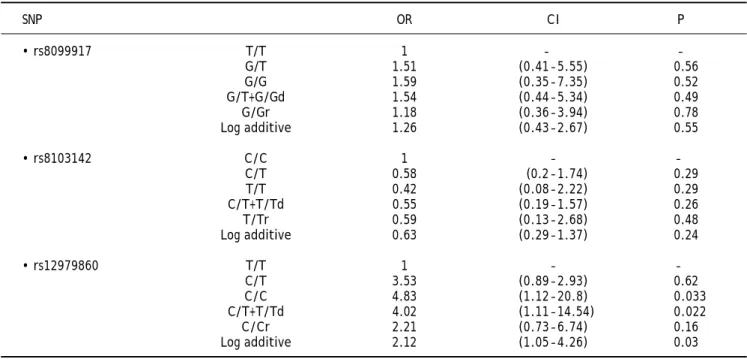
The effects of the IL28B SNPs (rs8099917 G/T, rs12979860 C/T, and rs8103142 T/C) on the treat-ment response were tested using ORs estimated via logistic regression, which were adjusted for age, gender, body mass index (BMI), and viral load. We found that IL28B rs12979860 C/C had a signifi-cant association with the SVR (OR = 4.83, 95% CI = 1.12-20.8, P = 0.033) in the codominant model, while the C/T+T/T genotype had an association in the dominant model (OR = 4.02, 95% CI = 1.11– 14.54, P = 0.022). Finally, we found a positive asso-ciation between the SVR and the log-additive model (OR = 2.12; 95% CI = 1.05-4.26, P = 0.03) (Table 3).
DISCUSSION
The standard HCV infection therapy is a combi-nation of PEG-IFNα and RBV for 24 or 48 weeks, depending on the HCV genotype.5 The SVR depends on the viral genotype and host factors, particularly gender, age, the presence of insulin resistance, hepa-tic fibrosis, and the patient’s genehepa-tic background. The first attempt to determine the importance of the patient genetic background for the SVR was repor-ted by Ge, et al.7 A genome-wide association study (GWAS) was performed using a cohort of HCV geno-type 1-infected patients who were treated with
PEG-Table 2. Genotype and allele frequencies and the Hardy–Weinberg equilibrium.
SNP Genotypes SVR, n (%) Non-SVR, n (%) P-value*
rs8099917** T/T 5 (23) 17 (30.9)
T/G 14 (34) 27 (49.1)
G/G 6 (35) 11 (20)
Alleles*** T 24 (55) 61 (48)
G 26 (52) 49 (45) 0.69
rs8103142 C/C 10 (37) 14 (25)
C/T 14 (51.9) 31 (55.4)
T/T 3 (11.1) 11 (19.6)
Alleles*** C 34 (37) 59 (63)
T 20 (27) 53 (73) 0.59
rs12979860 T/T 5 (19) 24 (43)
T/C 13 (48) 21 (37)
C/C 9 (33) 11 (20)
Alleles*** T 23 (25) 69 (75)
C 31 (42) 43 (58) 0.15
*Hardy–Weinberg equilibrium in the group with a nonsustained virological response. **Genotyping not conducted in all patients. ***Two alleles from each patient. SVR: sustained virological response.
Table 1. Clinical, biochemical, and molecular characteristics.
Sustained Non-sustained P-value
virological response virological response
(n = 27) (n = 56)
Female 28% 72% 0.11
BMI (kg/m2) 25.12 ± 3.0 26.6 ± 5.6 0.21
Age (years) 52.74 ± 10.70 58.59 ± 11.32 0.048
Viral genotype 1 28% 72% 0.14
AST > 48 IU/L 14% 86% 0.0001
ALT > 40 IU/L 15% 85% 0.0001
Total bilirubin > 1.2 mg/dL 30% 70% 0.11
Alkaline phosphatase > 150 IU/L 33% 67% 0.002
g-GTP > 50 UI 11% 89% 0.006
Baseline viral load (copies) 300,377 ± 264,950 499,840 ± 422,538 0.002
IFNα and RBV to determine any genomic variations related to SVR. This study showed that the SVR was linked to SNPs located close to the coding region of the interleukin 28B (IL28B) gene on chromosome 19. IL28B belongs to the type III interferon family of cytokines, which contains IL29, IL28A, and IL28B (also known as IFN-λ1, IFN-λ2, and IFN-λ3, respec-tively).
The effect of the rs12979860 polymorphism on the response to PEG-IFNa and RBV treatment in pa-tients infected with HCV-1 has been demonstrated extensively. Patients who carry the CC phism have SVR rates of > 80%, so this polymor-phism is considered to be favorable. By contrast, patients with the TT polymorphism have SVR rates of <40%, so it is considered unfavorable.11 It is clear that genotyping the rs12979860 polymorphism is a strong predictor of the clinical outcome for HCV-infected patients. rs8099917SNP is located in the in-tergenetic region between IL28A and IL28B and its variations are associated with the PEG-IFNα and RBV therapeutic response, suggesting that the TT genotype is a predictor of a good response whereas the TG/GG genotypes are poor-response indica-tors.12,13 A third causal variant located in the third exon region of IL28B, i.e., rs8103142, was also found to be important in a GWAS. The polymor-phism in this region had a few rare T/C variations,
which were strongly associated with SVR in indivi-duals.9,14
The aim of the current study was to determine the association between three IL28B SNPs and SVR after PEG-IFNα and RBV treatment in a Mexican population infected with HCV-1/2. The main finding was that there was an association between rs12979860 CC and SVR in a codominant model (OR = 4.83, 95% CI = 1.12–20.8, P = 0.033). However, there was no statistically significant association bet-ween rs8099917 or rs8103142 and SVR. In our popu-lation, the overall SVR rate was 32% (n = 27). The SVR rate was 27% in the HCV-1 group and 44% in the HCV-2 group. A previous study of a population from Mexico and Puerto Rico reported an SVR rate of 34% in HCV-1 patients treated with PEG-IFNa and RBV. Thus, these results agreed with those in our study cohort.15
The impact of the rs12979860 polymorphism on SVR has been extensively demonstrated in HCV-1 pa-tients treated with PEG-IFNα and RBV. However, the IL28B genotype is less relevant to PEG-IFNα and RBV treatment of patients with HCV genotypes 2 and 3, in whom the CC variant was correlated with an SVR rate of 87.4%, while the CT and TT genotypes were correlated with SVR rates of 70.7% and 73.1%, respectively.16 A cross-analysis of the rs12979860 CC variant and additional genotyping of the rs8099917
Table 3. Association of IL-28B SNPs with a sustained viral response, after adjustment for age, gender, viral genotype, and body mass index.
SNP OR CI P
• rs8099917 T/T 1 – –
G/T 1.51 (0.41 – 5.55) 0.56
G/G 1.59 (0.35 – 7.35) 0.52
G/T+G/Gd 1.54 (0.44 – 5.34) 0.49
G/Gr 1.18 (0.36 – 3.94) 0.78
Log additive 1.26 (0.43 – 2.67) 0.55
• rs8103142 C/C 1 – –
C/T 0.58 (0.2 – 1.74) 0.29
T/T 0.42 (0.08 – 2.22) 0.29
C/T+T/Td 0.55 (0.19 – 1.57) 0.26
T/Tr 0.59 (0.13 – 2.68) 0.48
Log additive 0.63 (0.29 – 1.37) 0.24
• rs12979860 T/T 1 – –
C/T 3.53 (0.89 – 2.93) 0.62
C/C 4.83 (1.12 – 20.8) 0.033
C/T+T/Td 4.02 (1.11 – 14.54) 0.022
C/Cr 2.21 (0.73 – 6.74) 0.16
Log additive 2.12 (1.05 – 4.26) 0.03
SNP had no effect on the response prediction, whe-reas those with the rs12979860 TT variant had an improved SVR prediction after additional genotyping of rs8099917 SNPs.17
It is known that the prevalence of rs12979860 CC varies greatly among ethnic groups, i.e., 23.1% to 97.9%.18 In this study, the rs12979860 polymorphisms CC, CT, and TT were present in 24%, 41%, and 35% of patients, respectively. The prevalence of the C allele in the Mexican Pima population is 55.5%.18 In another Mexican cohort containing 205 HCV-1-in-fected patients, the frequencies were 18.5%, 19.5%, and 62.0% for the CC, CT, and TT variants, respec-tively.19 The reference SNP cluster report for rs12979860 in the HapMap Project reported a CC prevalence of 28.6%.20
In the present study, we tested the effects of age, the levels of ALT, AST, ALP, and GGT, and the vi-ral load on SVR. Other reported baseline predictors of the SVR with interferon-based therapies include patient body weight, insulin resistance, steatosis, and fibrosis stage.21,22 In previously untreated pa-tients, the SVR predictors include a low baseline vi-ral load (OR = 11.6), IL28B genotype (rs12979860 CC vs. TT or CT; OR = 2.6, OR = 2.1), absence of cirrhosis (OR = 4.3), HCV 1b subtype (OR = 2.0), non-black race (OR = 2.0), and BMI (< 30 vs. > 30; OR = 1.6).23
Understanding the associations between different IL28B polymorphisms and SVR after treatment with PEG-IFNα and RVB is an important issue, because there is a debate over whether all untreated patients should receive triple therapy given the increased costs and possible adverse effects. In countries such as Mexico, an analysis of proposed strategies based on IL28B rs12979860 and SVR could be very useful in terms of cost-effectiveness. This analysis could also provide benefits related to adverse effects, treat-ment tolerance, and the induction of viral drug re-sistance.
At present, the possible effects of IL28B on avai-lable direct-acting antiviral (DAA) therapies, such as PI, are not clear. However, a comparison was made to test the benefits of dual therapy (PEG-IFNα and RVB) relative to the current triple therapy (PEG-IFNα, RVB, and PI) in untreated HCV-1 pa-tients. The treatment strategies were guided by the rapid viral response (RVR) and the IL28B genotype, which made it possible to avoid PI exposure in 25-33% of patients, thereby reducing costs and risks and improving benefits. Based on this, it is recom-mended to use free PI strategies as a first-line thera-py in patients with the IL28B CC genotype or those
with an RVR.24 Patients with rs12979860 CT or TT benefit from the addition of DAAs and their SVR ra-tes increased twofold with boceprevir or telaprevir to 55-70% in the treatment naïve.25
In the Mexican HCV-1-infected population, pa-tients with favorable characteristics such as rs12979860 CC and a low viral load, or younger pa-tients without major disturbances in liver function tests, could benefit from dual therapy with peg-IFNα and RVB. Several factors are associated with the treatment response, but we argue that predicting a failure to respond to therapy is the most useful pa-rameter for clinical management.
CONCLUSION
In conclusion, the frequencies of the rs12979860 alleles CC, CT, and TT in the study population were 24%, 41%, and 35%, respectively. rs12979860 CC was the best positive predictive of SVR, whereas SVR was not associated with the SNPs rs8099917 or rs8103142.
COMPETING INTERESTS
The authors declare no competing interests.
ACKNOWLEDGMENTS
This work was supported by the following grant: CONACyT SALUD-2008-01-87267. We would like to thank all the researchers and all the personnel from Instituto Mexicano de Salud Pública and Dirección de Investigación Biomédica of Fundación Clínica Médica Sur. Special Acknowledgement to the pa-tients who accept participate in this study
REFERENCES
1. Global surveillance and control of hepatitis C. Report of a WHO Consultation organized in collaboration with the Vi-ral Hepatitis Prevention Board, Antwerp, Belgium. J Viral Hepat 1999; 6: 35-47.
2. Yee HS, Chang MF, Pocha C, Lim J, Ross D, Morgan TR, et al. Update on the Management and Treatment of Hepatitis C Virus Infection: Recommendations from the Department of Veterans Affairs Hepatitis C Resource Center Program and the National Hepatitis C Program Office. Am J Gas-troenterol 2012.
3. Mendez-Sanchez N, Motola-Kuba D, Chavez-Tapia NC, Ba-hena J, Correa-Rotter R, Uribe M. Prevalence of hepatitis C virus infection among hemodialysis patients at a tertia-ry-care hospital in Mexico City, Mexico. J Clin Microbiol 2004; 42: 4321-2.
load and viral genotype among primary care clients in Mexico. Salud Publica Mex 2011; 53(Suppl. 1): S7-S12. 5. Negro F, Alberti A. The global health burden of hepatitis C
virus infection. Liver Int 2011; 31(Suppl. 2): 1-3.
6. Ghany MG, Strader DB, Thomas DL, Seeff LB. Diagnosis, management, and treatment of hepatitis C: an update. Hepatology 2009; 49: 1335-74.
7. Ge D, Fellay J, Thompson AJ, Simon JS, Shianna KV, Urban TJ, et al. Genetic variation in IL28B predicts hepatitis C treatment-induced viral clearance. Nature 2009; 461: 399-401.
8. Gomaa AI, Khan SA, Toledano MB, Waked I, Taylor-Robin-son SD. Hepatocellular carcinoma: epidemiology, risk factors and pathogenesis. World J Gastroenterol 2008; 14: 4300-8.
9. de Castellarnau M, Aparicio E, Parera M, Franco S, Tural C, Clotet B, et al. Deciphering the interleukin 28B variants that better predict response to pegylated interferon-al-pha and ribavirin therapy in HCV/HIV-1 coinfected pa-tients. PLoS One 2012; 7: e31016.
10. Welsch C, Jesudian A, Zeuzem S, Jacobson I. New direct-acting antiviral agents for the treatment of hepatitis C virus infection and perspectives. Gut 2012; 61(Suppl. 1): i36-i46.
11. Balagopal A, Thomas DL, Thio CL. IL28B and the control of hepatitis C virus infection. Gastroenterology 2010; 139: 1865-76.
12. Rauch A, Kutalik Z, Descombes P, Cai T, Di Iulio J, Mueller T, et al. Genetic variation in IL28B is associated with chronic hepatitis C and treatment failure: a genome-wide association study. Gastroenterology 2010; 138: 1338-1345, 1338-1345, e1331-1337.
13. Li W, Zeng Y, Wang J, Zhou B, Zhang J, Zhang H, et al. Predicting sustained viral response to hepatitis C using a rapid and simple IL28B rs8099917 genotyping assay. Anti-viral Res 2012; 94: 54-6.
14. Tanaka Y, Nishida N, Sugiyama M, Kurosaki M, Matsuura K, Sakamoto N, et al. Genome-wide association of IL28B with response to pegylated interferon-alpha and ribavi-rin therapy for chronic hepatitis C. Nat Genet 2009; 41: 1105-9.
15. Rodriguez-Torres MJL, Sheikh MY, Rossaro L, Ankoma-Sey V, Hamzeh FM, Martin P; Latino Study Group.
Peginterfe-ron alfa-2a and ribavirin in Latino and non-Latino whites with hepatitis C. N Engl J Med 2009; 360: 257-67. 16. Sarrazin C, Susser S, Doehring A, Lange CM, Muller T,
Schlecker C, et al. Importance of IL28B gene polymorphisms in hepatitis C virus genotype 2 and 3 infected patients. J Hepatol 2011; 54: 415-21.
17. Fischer J, Bohm S, Scholz M, Muller T, Witt H, George J, et al. Combined effects of different interleukin-28B gene va-riants on the outcome of dual combination therapy in chronic hepatitis C virus type 1 infection. Hepatology 2012; 55: 1700-10.
18. Thomas DL, Thio CL, Martin MP, Qi Y, Ge D, O’Huigin C, et al. Genetic variation in IL28B and spontaneous clearance of hepatitis C virus. Nature 2009; 461: 798-801.
19. Sixtos Alonso RAM, Dehesa Violante M, Sandoval Salas R, Chávez Ayala A, García Juárez I, Domínguez López A, Vargas Vorackova F, Sánchez Ávila JF, Uribe M. Polymor-phism (SNP) RS12979860 OF IL28B in Mexican patients with chronic hepatitis C and its Association with virogi-cal response to peg-ifn alpha 2b and ribavirin. J Hepatol 2011; 54: 1342.
20. Entrez NCfBI. Database of single nucleotide polymorphisms (SNPs).
21. Fried MW, Shiffman ML, Reddy KR, Smith C, Marinos G, Goncales FL Jr., et al. Peginterferon alfa-2a plus ribavirin for chronic hepatitis C virus infection. N Engl J Med 2002; 347: 975-82.
22. Manns MP, McHutchison JG, Gordon SC, Rustgi VK, Shiff-man M, Reindollar R, et al. Peginterferon alfa-2b plus riba-virin compared with interferon alfa-2b plus ribariba-virin for initial treatment of chronic hepatitis C: a randomised trial. Lancet 2001; 358: 958-65.
23. Poordad F, Bronowicki JP, Gordon SC, Zeuzem S, Jacobson IM, Sulkowski MS, et al. Factors That Predict Response of Patients With Hepatitis C Virus Infection to Boceprevir. Gastroenterology 2012.
24. Camma C, Petta S, Enea M, Bruno R, Bronte F, Capursi V, et al. Cost-effectiveness of boceprevir or telaprevir for untreated patients with genotype 1 chronic hepatitis C. Hepatology 2012.