MELD score for prediction of survival
after emergent TIPS for acute variceal hemorrhage:
derivation and validation in a 101-patient cohort
Leigh C. Casadaban,* Ahmad Parvinian,* Sean P. Zivin,** Janesh Lakhoo,* Jeet Minocha,**M. Grace Knuttinen,** Charles E. Ray Jr.,** James T. Bui,** Ron C. Gaba**
* University of Illinois College of Medicine.
** University of Illinois Hospital and Health Sciences System, Department of Radiology, Division of Interventional Radiology.
ABSTRACT
Background and rationale for the study. The Model for End Stage Liver Disease (MELD) score has not been derived and validated for the emergent transjugular intrahepatic portosystemic shunt (TIPS) population. We sought to identify predictive factors for survival among emergent TIPS patients, and to substantiate MELD for outcomes prognostication in this population. Results. 101 patients with acute life threatening variceal hemorrhage underwent emergent TIPS (defined by failed endoscopic therapy for active bleeding, acute hemoglobin drop, ≥ 2-unit transfusion requirement, and/or vasopressor need) at between 1998-2013. Demographic, clinical, laboratory, and procedure parameters were analyzed for correlation with mortality using Cox proportional hazards regression to derive the prognostic value of MELD constituents. Area under receiver operator characteristic (AUROC) curves was used to assess the capability of MELD prediction of mortality. TIPS were created 119 ± 167 h after initial bleeding events. Hemodynamic success was achieved in 90%. Median final portosystemic pressure gradient was 8 mmHg. Variceal rebleeding incidence was 21%. The four original MELD components showed significant correlation with mortality on multivariate Cox re-gression: baseline bilirubin (regression coefficient 0.366), creatinine (0.621), international normalized ratio (1.111), and liver disease etiology (0.808), validating the MELD system for emergent cases. No other signifi-cant predictive parameters were identified. MELD was an excellent predictor of 90-day mortality in the emergent TIPS population (AUROC = 0.842, 95% CI 0.755-0.928). Conclusions. Based on independent deriva-tion of prognostic constituents and confirmaderiva-tion of predictive accuracy, MELD is a valid and reliable met-ric for risk stratification and survival projection after emergent TIPS.
Key words. Model for end stage liver disease (MELD) score. Transjugular intrahepatic portosystemic shunt (TIPS). Emergent. Variceal hemorrhage.
Correspondence and reprint request: Ron C. Gaba, M.D.
Department of Radiology, Division of Interventional Radiology. University of Illinois Hospital and Health Sciences System. 1740 West Taylor Street, MC 931. Chicago, IL 60612.
Tel.: 312-996-0242. Fax: 312-355-2857 E-mail: [email protected]
Manuscript received: September 18, 2014. Manuscript received: November 23, 2014. INTRODUCTION
The Model for End Stage Liver Disease (MELD) score was developed in 2000 to predict mortality in patients undergoing transjugular intrahepatic por-tosystemic shunt (TIPS) creation.1 This measure
was conceived from data accrued in patients
under-going elective TIPS, and has since proven to be an accurate and robust prognostic metric for pre-proce-dure patient risk stratification and outcomes esti-mation after planned TIPS procedures.2-6 Although
emergent cases constitute a significant proportion of TIPS procedures performed in contemporary medical practice, the MELD score has not been independent-ly derived and validated for this patient population, and the degree to which this metric is directly trans-latable for prediction of early clinical outcomes in the emergent TIPS population is uncertain. Given the relative paucity of data evaluating the performance of the MELD score in this setting,7 differences in
of the MELD system in the emergent setting is nec-essary to confirm applicability of this metric to emergent TIPS. With this in mind, we undertook the current investigation with the aim of identifying prognostic factors for early survival among patients undergoing emergent TIPS, confirming the predic-tive capacity of MELD components in this scenario, and validating the MELD system for use in emer-gent circumstances, with particular attention to risk assessment.
MATERIAL AND METHODS
This study was performed with approval from our institutional review board. Patients provided con-sent for TIPS procedures.
Patients and variceal bleeding
Two hundred ninety five patients who under-went technically successful TIPS procedures be-tween November 1998 and December 2013 at a single tertiary care, university affiliated hospital were identified through review of our Division of Interventional Radiology (IR) TIPS registry for po-tential retrospective study. Cases of emergent TIPS were selected from the registry, with such cases characterized by active variceal hemorrhage result-ing in immediate threat to life and necessitatresult-ing prompt medical intervention to maintain well-be-ing. These patients were typically initially managed according to clinical practice guidelines of the American Association for the Study of Liver Dis-eases.8 Treatment encompassed intravascular
vol-ume support, blood transfusion, antibiotic prophylaxis, pharmacological therapy with somato-statin or its analogues, and esophagogastroduode-noscopy (EGD) to diagnose varices and treat with endoscopic ligation or sclerotherapy. Non-selective beta-blocker medications were not generally admin-istered in the acute variceal hemorrhage setting. Patients were referred for TIPS in cases where he-morrhage could not be controlled or bleeding re-curred despite medical therapy. Emergent cases were defined by failure of endoscopic therapy, he-moglobin drop with a known variceal source of bleeding, required transfusion of ≥ 2 units of packed red blood cells (PRBCs), or need for vaso-pressor medications to support blood pressure within 24-48 hours prior to TIPS. Cases of elective TIPS (n = 194) were excluded. One hundred one patients who underwent emergent TIPS procedures were thus included in the final study group.
TIPS procedures
TIPS creation was performed according to previ-ously described methods9 using general anesthesia
in the IR suite. Right jugular venous access was gained with placement of a 10 French sheath and systemic venous pressure measurement. The right hepatic vein was selected and free and wedged he-patic venography was performed. Next, a Rösch-Uchida transjugular liver access set (Cook Medical Co., Bloomington IN) was used to access the right portal vein. After catheterization and pressure measurement, tract dilation was performed, fol-lowed by direct portography. Then, 10 or 12 mm Wallstent bare metal Stents (Boston Scientific, Natick MA) (used from 1998-2003) or 10 mm Via-torr covered stent-grafts (W.L. Gore & Associates, Flagstaff AZ) (used from 2004-2013) were deployed followed by balloon dilation. A final portosystemic pressure gradient was measured, followed by shunt venography. Coil embolization of gastroesophageal varices was performed at the discretion of the pri-mary operator. Following TIPS procedures, pa-tients underwent inpatient monitoring with daily acquisition of liver enzymes. Upon hospital dis-charge, patients were followed in an outpatient Hepatology clinic. Following TIPS, patients were monitored for evidence of shunt dysfunction using Doppler ultrasound at 1-month, 3-months, and subsequent 6-month intervals post-procedure. Ab-normalities identified at Doppler ultrasound10 were
further evaluated by TIPS venography. Of note, re-peat venography 24-48 h post-TIPS for measure-ment of the PSG is not routinely performed in the clinical practice of the authors, and no patients un-derwent scheduled repeat measurement at this time frame.
Measured outcomes
The primary objective of this study was determi-nation of prognostic factors for early mortality af-ter emergent TIPS creation and assessment of accuracy of the MELD system for prediction of ear-ly mortality after emergent TIPS. Secondary out-come measures included TIPS hemodynamic success, bleeding control, and procedure-related complications classified according to the Society of Interventional Radiology Standards of Practice Committee classification of complications.11
assessed by post-TIPS rebleeding incidence, and re-current hemorrhage was diagnosed by clinical signs such as hematemesis or coffee ground emesis accompanied by laboratory hemoglobin reduction requiring blood product transfusion, with endo-scopic confirmation when possible.9 Post-TIPS
he-patic encephalopathy (HE) was defined by development of new mental status changes (confu-sion) or alterations in level of consciousness. Pres-ence of HE was determined clinically by the patient’s hepatologist and was graded according to the West Haven classification system.14
Statistical analysis
The statistical methods and approaches utilized herein paralleled those employed in the original MELD manuscript of Malinchoc, et al.1 The
demo-graphic features of the study population, laborato-ry data, and procedure outcomes were reported using descriptive statistics as number (percent) or median (interquartile range). Study patients were followed from the date of TIPS until date of death, liver transplantation, or last documented clinical follow-up. Clinical outcomes were evaluated until May 2014. Transplant free survival was calculated using Kaplan-Meier statistics. Univariate Cox pro-portional hazards regression analysis was used to assess the influence of individual demographic data, laboratory values, and procedure parameters on patient survival outcomes, akin to the factors analyzed by Malinchoc, et al.1 Variables exhibiting
a significance level ≤ 0.05 on univariate analysis were entered into a multivariate Cox proportional hazards regression analysis. For Cox regression analysis, laboratory values were transformed to their natural logarithms in order to lessen the in-fluence of extreme quantities. A risk score equation was generated from the multivariate prognostic pa-rameters and their regression coefficients, and was used to ascertain a risk score associated with a 3-month survival threshold. If comparison to the original MELD risk system showed similar prog-nostic parameters, further analysis would assess the accuracy of the original MELD score in the emergent TIPS population. Area under receiver op-erator characteristic (AUROC) curves or C-statis-tics was used to assess the capability of MELD score prediction of early mortality. Statistical anal-ysis was performed utilizing a commercially availa-ble software package (SPSS version 21; SPSS Inc., Chicago IL). P-values ≤ 0.05 were considered sta-tistically significant.
RESULTS
Baseline patient characteristics
Patient demographic data and liver disease char-acteristics of the study cohort are summarized in ta-ble 1. Within 48 h prior to TIPS procedures, 99/101 (98%) patients had a drop in hemoglobin greater than 1 g/dL, 64/101 (63%) received transfusion of ≥ 2 units of PRBCs, 30/101 (30%) required the use of
Table 1. Patient demographic and liver disease characteris-tics.
Measure Valuea
Age (years) 51 (46-58)
Gender
Male 69 (68%)
Female 32 (32%)
Ethnicity
Caucasian 43 (43%)
African-American 21 (21%)
Hispanic 28 (28%)
Other 9 (9%)
Liver disease etiology
Alcohol 38 (38%)
HBV or HCV 18 (18%)
Alcohol and viral 26 (26%)
Otherb 19 (19%)
Liver volume (mL) 1,635 (1,305-2,398) Prior liver transplantation 1 (1%)
Prior hepatic encephalopathy 25 (25%) Baseline lab values
Bilirubin (mg/dL) 2.8 (1.4-6.1) Creatinine (mg/dL) 1.0 (0.8-1.7)
INR 1.6 (1.4-2.0)
Platelets (103/mL) 89 (57-122)
Sodium (mEq/L) 138 (135-140) Albumin (g/dL) 2.2 (1.8-2.6)
MELD score 18.0 (7-40)
Child-Pugh score c 10.0 (6-15)
Class A 2 (2%)
Class B 46 (46%)
Class C 52 (52%)
HBV: hepatitis B virus. HCV: hepatitis C virus. INR: international normalized ratio. MELD: Model for End Stage Liver Disease. a Values reported as
number (percent) or median (interquartile range). b Includes non-alcoholic
steatohepatitis (NASH), primary biliary cirrhosis, cryptogenic liver disease, au-toimmune liver disease, alpha-one antitrypsin deficiency, congenital hepatic fibrosis, idiopathic adult ductopenia, and unknown causes of cirrhosis. c n = 100
vasopressors, and 53/101 (53%) required mechanical ventilation. Median number of PRBC units trans-fused per patient prior to TIPS was 4 (interquartile range 6). Thirty-five patients (35%) had failed scopic therapy within 24 h. Mean number of endo-scopies per patient prior to TIPS was 1.9 ± 1.6 (median 1, range 1-8). Bleeding origin was found to be esophageal varices in 41/101 (41%) patients, gas-tric varices in 30/101 (30%) patients, both in 7/101 (7%), and rectal varices in 1/101 (1%), while the re-maining had unknown origin.
TIPS procedures and related complications
TIPS procedure results are summarized in table 2. TIPS were created 119 ± 167 (median 48, inter-quartile range 22-100) hours after the initial bleed-ing event. Of 84 patients with definitive data on time from initial bleeding to TIPS, 56 (67%) of TIPS pro-cedure occurred within 72 h of hemorrhage, while 28 (33%) were performed more than 72 h later. Im-mediate post-TIPS hemodynamic success was achieved in 91/101 (90%) patients with median PSG reduction of 13 mmHg; PSG was not measured again at 24-48 h post-TIPS. Of 101 patients, 60 (60%) underwent covered Stent-graft TIPS, and 41 (40%) underwent bare metal Stent TIPS. Variceal embolization was performed in 30/101 (30%) pa-tients. Procedure-related adverse events within 30-days included HE in 33/101 (33%) patients and hepatic decompensation in 3/101 (3%). HE was pre-dominantly minimal (grade 1, n = 10) or mild (grade 2, n = 14).
Bleeding control
At the end of the data collection period, 21/101 (21%) patients experienced recurrent variceal hem-orrhage. Eleven cases (52%) occurred within 2-days, and 16 cases (76%) within 2-weeks. The 30-day, 90-day, 180-90-day, 1-year, and 2-year post-procedure re-bleeding probabilities were 16%, 17%, 18%, 18%, and 18%, respectively. The median time to rebleed-ing event was 2-days (interquartile range 2-49) days. Of 21 patients with recurrent hemorrhage, 14 (67%) initially had esophageal variceal bleeding and 5 (24%) initially had gastric variceal bleeding.
Patient survival and prognostic factors for mortality
At the end of the data collection period, 80/101 (79%) patients had expired. The 30-day, 90-day, 180-day, 1-year, and 2-year post-procedure survival proba-bilities were 69%, 60%, 55%, 44%, and 34%, respectively. The median survival time was 270 (95% CI 112-428) days. Table 3 shows the predictive capaci-ty of various factors for overall mortalicapaci-ty after TIPS creation. On univariate analysis, non-alcoholic liver disease etiology, baseline bilirubin, creatinine, interna-tional normalized ratio (INR), and retrograde portal venous flow direction –as determined angiographically immediately after shunt placement– were found to be significant predictors of overall mortality. On multi-variate analysis, baseline bilirubin, creatinine, INR, and liver disease etiology were confirmed as independ-ent predictors of overall mortality. The idindepend-entification of these MELD components confirmed applicability of the MELD score in the emergent TIPS population. To that end, MELD was also found to be a significant in-dependent predictor of overall mortality on Cox pro-portional hazards regression (P < 0.001).
Based on regression coefficients, INR had the highest correlation with mortality (1.111), followed by cirrhosis etiology (0.808), creatinine (0.621), and bilirubin (0.366), comparable to findings of Malin-choc, et al.,1 who similarly demonstrated highest
correlation with INR and lowest association with bi-lirubin. A TIPS risk score equation for our emer-gent TIPS population was thus defined by the formula (Figure 1).
The generated risk equation bears significant sim-ilarity to the original MELD risk formula generated by Malinchoc, et al.,1 with particularly comparable
regression coefficients for bilirubin (0.378 in origi-nal MELD manuscript) and INR (1.120 in origiorigi-nal MELD manuscript). Based on both the emergent Table 2. TIPS procedure findings and outcomes.
Measure Valuea
Portal venous flow
Antegrade 55 (54%)
Retrograde 21 (21%)
Unspecified or indeterminate 25 (25%)
Stent type
Bare metal 41 (40%)
Covered Stent-graft 60 (60%) Variceal embolization 30 (30%)
Initial PSG (mmHg) 22 (16-26)
Final PSG (mmHg) 8 (6-10)
PSG reduction (mmHg) 13 (10-17)
TIPS: transjugular intrahepatic portosystemic shunt. PSG: portosystemic pressure gradient. a Values reported as number (percent) or median
TIPS risk equation produced herein as well as the original MELD risk equation developed by Malin-choc, et al.,1 the average risk score for an emergent
TIPS patient in the current study was 1.70, higher than the average risk score (1.13) identified by Mal-inchoc, et al.1 for elective TIPS patients.
MELD score predictive capacity and survival thresholds
Based on identification of identical prognostic pa-rameters for survival after emergent TIPS, the
accu-racy of the original MELD score in the emergent TIPS population was assessed in comparison to the risk equation generated herein. Baseline MELD score was highly predictive of 90-day mortality with-in the emergent TIPS study cohort, with an AUROC value of 0.842 (95% CI 0.755-0.928). The risk equa-tion generated herein had statistically similar pre-dictive accuracy (0.845, 95% CI 0.762-0.928). Using AUROC analysis, a MELD cut-off at 18 had a sensi-tivity and specificity of 80.9% and 69.4%, respective-ly, for predicting 90-day post-TIPS mortality; however, the optimal MELD threshold in the
emer-R = 0.366 * loge (bilirubin) + 0.621 * loge (creatinine) + 1.111 * loge (INR) + 0.808 * (cause of cirrhosis)
Figure 1.
Table 3. Predictors of mortality among emergent TIPS patients.
Parameter Univariate Cox regression Multivariate Cox regression
Regression Standard P-value Regression Standard P-value
coefficient error coefficient error
Demographic
Age 0.017 0.012 0.162
Male gender 0.07 0.249 0.778
Ethnicity a
Caucasian 0.169 0.226 0.251
African-American -0.364 0.301 0.226
Hispanic -0.181 0.292 0.535
Other 0.48 0.396 0.226
Clinical
Alcoholic cirrhosis -0.577 0.235 0.014 -0.808 0.305 0.008
Liver volume 0 0 0.479
Hepatic encephalopathy 0.421 0.287 0.143
Biochemical
Bilirubin (loge value) 0.524 0.123 < 0.001 0.366 0.146 0.012
Creatinine (loge value) 0.85 0.165 < 0.001 0.621 0.228 0.006
INR (loge value) 1.704 0.284 < 0.001 1.111 0.379 0.003
Platelets (loge value) -0.247 0.205 0.228
Sodium (loge value) -4.192 3.305 0.205
Albumin (loge value) -0.797 0.504 0.114
Procedure characteristics
Covered stent-graft -0.288 0.227 0.205
Variceal embolization -0.327 0.246 0.183
Hepatic hemodynamics
Portal venous flow 0.63 0.279 0.024 0.561 0.315 0.075
Initial PSG 0.006 0.018 0.758
Final PSG 0.016 0.045 0.719
PSG reduction 0.003 0.02 0.871
Right atrial pressure increase 0.012 0.059 0.842
MELD ≤ 13
MELD ≥ 14
MELD ≤ 18
MELD ≥ 19
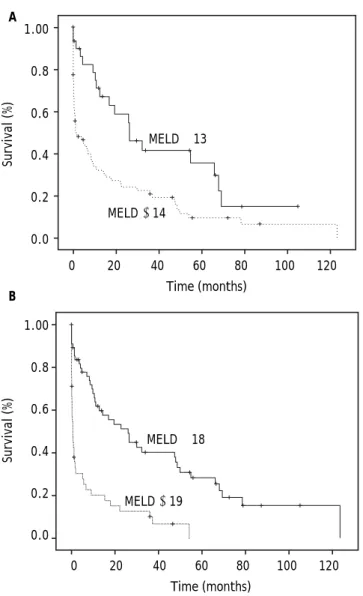
gent population was a score of 20, with sensitivity and specificity of 77.9 and 79.9%, respectively. Us-ing the original MELD risk equation, AUROC anal-ysis showed that a MELD score threshold of 14 corresponded to median survival less than 3-months (Figure 2), while a MELD score threshold of 18 cor-responded to median survival less than 1-month (Figure 2). The 90-day post-TIPS mortality rates for different MELD score ranges are shown in table 4.
DISCUSSION
Although the MELD score is the foremost risk stratification system for prediction of TIPS mortali-ty outcomes,3-5,15,16 its applicability to the emergent
TIPS population is poorly established given its deri-vation from elective procedures, and its usefulness in this scenario has been questioned.17 While Tseng,
et al. demonstrated a high accuracy (AUROCs ex-ceeding 0.7) of the MELD score for prediction of 30-, 60-, and 360-day mortality in a cohort of 107 pa-tients who underwent emergent TIPS,7 their
inves-tigation did not specifically derive a relationship between MELD parameters and survival outcomes. Mukund, et al. likewise found independent prognos-tic capability of MELD in emergent TIPS, but simi-larly did not derive predictive ability of MELD constituents.18 Moreover, other studies exploring
prognostic factors for survival after emergent TIPS procedures have identified a heterogeneous set of im-pactful parameters, including presence of ascites, use of mechanical ventilation, white blood cell count, platelet count, partial thromboplastin time (PTT), creatinine, bilirubin, sepsis occurrence, use of catecholamines for hemodynamic support, need for balloon tamponade, and procedure urgency it-self.19-23 These elements have led to the development
and use of scoring systems such as the prognostic index (PI),19 acute physiology and chronic health
evaluation (APACHE) 2 score,24 Bonn TIPS early
mortality (BOTEM) score,25 and Emory score22 for
risk stratification in the emergent TIPS setting.26
While all of these scoring systems have shown prog-nostic value,6 use of the simple, objective, and
con-sistent MELD score may be more desirable in order to enhance uniformity in risk assessment across both elective and emergent TIPS procedures.
In the current investigation, we independently de-rived the MELD system from a retrospective cohort of 101 patients undergoing emergent TIPS proce-dures. We found that serum bilirubin, creatinine,
Figure 2. Kaplan-Meier transplant free survival curve (a) of patients stratified by baseline MELD score above or below 13, which represents threshold for 3-month median survival. Median survival of patients with baseline MELD score ≤ 13 sig-nificantly greater than those with baseline MELD scores ≥ 14 (26.5 vs. 1.6 months, P = 0.002). Kaplan-Meier transplant free survival curve (b) of patients stratified by baseline MELD score above or below 18. Median survival of patients with baseline MELD score ≤ 18 significantly greater than those with baseline MELD scores ≥ 19 (26.1 vs. 0.57 months, P < 0.001).
A
B
Table 4. MELD score and emergent TIPS mortality.
MELD score range 90-day mortality rate
≤ 10 9% (1/11)
11-18 13% (6/45)
19-25 36% (8/22)
≥ 26 83% (19/23)
MELD: Model for End Stage Liver Disease. TIPS: transjugular intrahepatic portosystemic shunt.
1.00
0.8
0.6
0.4
0.2
0.0
Survival (%)
0 20 40 60 80 100 120
Time (months)
1.00
0.8
0.6
0.4
0.2
0.0
Survival (%)
0 20 40 60 80 100 120
INR, and non-alcoholic liver disease etiology were significant independent predictors of overall mortal-ity, as identified for elective TIPS procedures more than a decade ago. When comparing the current re-sults to the original MELD score proposal by Malin-choc, et al.1 not only were the significant predictive
risk factors the same, but the regression coefficients were also particularly similar as well, despite origi-nation from a cohort of emergent TIPS patients. Most notably, regression coefficients for INR and bi-lirubin identified herein were similar to those in the MELD equation (Figure 3) to within approximately 1 and 3%, respectively. Further analysis of MELD score accuracy using AUROC analysis revealed ex-cellent predictive capacity for 3-month mortality in the emergent population. In all, based on independ-ent derivation of prognostic factors and confirma-tion of predictive accuracy, we believe that the MELD score is a valid and reliable metric for risk stratification and survival projection after emergent TIPS. This is particularly relevant given emerging data substantiating use of early TIPS in the treat-ment algorithm for acute variceal hemorrhage;27,28
the current study supports use of MELD score for patient risk stratification in this setting.
A notable difference in MELD risk threshold was identified between the emergent TIPS population in this study and elective cases in the published litera-ture. We found that the average risk score for an emergent TIPS patient herein was higher than the average risk score identified by Malinchoc, et al.1
for elective TIPS patients (1.70 vs. 1.13). Further-more, a MELD score threshold of 14 corresponded to median survival less than 3-months in the emer-gent setting, in contrast to the risk cutoff found by Malinchoc, et al.,1 in which less than 3-month
sur-vival occurred at a threshold MELD score of 18 (a MELD score threshold of 18 corresponded to median survival less than 1-month in our emergent popula-tion). These findings indicate that emergent TIPS confers generally higher risk than elective TIPS, and reflect a risk disparity between emergent and elective TIPS patient populations. As opposed to elective TIPS, in which MELD score greater than 18 are associated with poorer outcomes, patients with MELD scores ≥ 14 undergoing emergent TIPS should be considered higher risk. We speculate that this increased risk reflects the hazard of variceal
bleeding rather than incrementally greater risk at-tributable to the TIPS procedure in the emergent scenario. Notably, the optimal MELD threshold for early mortality detection in the emergent population identified herein was a score of 20, similar to that determined by Tseng, et al.7
Patients undergoing emergent TIPS are often critically ill and thus at high risk of poor outcome and early mortality.17 Previous reports on emergent
TIPS populations have shown a wide range in clini-cal outcomes, with 30-day mortality incidence rang-ing from 17-60% and rates of variceal rebleedrang-ing between 11-50%.17 The results of the current study
are consistent with these findings, showing 30-day mortality and rebleeding rates of 31% and 16%, re-spectively, following emergent TIPS. Notably, com-parison of such clinical outcomes to historical controls must be in the context of baseline liver dis-ease magnitude, patient comorbid conditions, TIPS timing, and type of medical management. To this end, a recent landmark randomized controlled trial of 32 patients who underwent emergent TIPS re-ported excellent clinical outcomes, with 1-year post-TIPS mortality in only 14%, recurrent hemorrhage in only 3%, and an HE rate of 28%,27 compared with
56%, 18%, and 33% in the current study. However, mean MELD score was markedly lower in the former investigation as compared to the latter (15.5 vs. 19.8), and the incidence of shock was lower than in the current study (22% vs. 30%). Furthermore, TIPS were created earlier during the acute bleeding period in the study of Garcia-Pagan, et al.27 (all
within 72 h vs. only two-thirds within 72 h herein). Another notable difference relates to the long inclu-sion period in the present study, which may have prevented application of optimal contemporary medi-cal therapy with vasoactive drugs and antibiotic prophylaxis in all patients, further negatively im-pacting survival. In all, these outcome disparities corroborate the notion that application of early TIPS combined with up-to-date pharmacological management in properly selected patients may opti-mize clinical outcomes in the emergent TIPS setting. There are limitations to this investigation. First, this study was retrospective and non-randomized nature, represents the experience of a single institu-tion, and includes a limited sample size. A prospec-tive validation study performed at multiple centers
R = 0.378 * loge (bilirubin) + 0.957 * loge (creatinine) + 1.120 * loge (INR) + 0.643 * (cause of cirrhosis)
would be necessary to further substantiate the find-ings herein. Second, the definition of emergent TIPS used here was somewhat subjective. However, there is no formally recognized definition of emergent TIPS, and selected cases were characterized by an immediate threat to life with clinical and/or labora-tory signs of persistent or refraclabora-tory variceal bleed-ing, similar to cases deemed emergent in the original MELD manuscript of Malinchoc, et al.1 and
excluded from their analysis. Third, because pa-tients in this study were accrued over an approxi-mately decade-long period, technical differences in TIPS creation and disparities in medical care during the study period may have contributed to differences in clinical outcomes over time. Fourth, mortality was considered collectively herein rather than spe-cific assessment for liver failure induced death. However, all-cause mortality was also used in the original MELD study of Malinchoc, et al.1 Fifth,
the current study did not attempt to compare the relative accuracy of MELD for emergent versus non-emergent variceal bleeding indications.
CONCLUSION
In conclusion, use of TIPS under emergency con-ditions for bleeding varices is supported by emerging data showing survival benefit,27,28 and simple and
reliable methods to predict prognosis are necessary. Recently, Reverter, et al. tested and validated a MELD-based prognostic model to predict survival of patients after acute variceal bleeding due to portal hypertension.29 With a similar endorsement required
for the predictive capability of MELD in the setting of portal decompressive therapy of variceal bleeding, the current study presented independent derivation of the MELD system in a population of patients un-dergoing emergent TIPS, with subsequent validation of the traditional MELD score for accurate predic-tion of 3-month mortality. These results support use of the MELD system for outcomes prognostication in the emergent TIPS population, although an ex-pectedly lower quantitative threshold is associated with mortality risk similar to elective procedures.
ABBREVIATIONS
• APACHE: acute physiology and chronic health evaluation.
• AUROC: area under receiver operator charac-teristic.
• BOTEM: Bonn TIPS early mortality • HE: hepatic encephalopathy.
• INR: international normalized ratio. • IR: interventional radiology.
• MELD: Model for End Stage Liver Disease. • PI: prognostic index.
• PRBCs: packed red blood cells.
• PSG: portosystemic pressure gradient.
• TIPS: transjugular intrahepatic portosystemic shunt.
FINANCIAL SUPPORT, DISCLOSURES, AND CONFLICTS OF INTEREST
None.
REFERENCES
1. Malinchoc M, Kamath PS, Gordon FD, Peine CJ, Rank J, ter Borg PC. A model to predict poor survival in patients un-dergoing transjugular intrahepatic portosystemic shunts.
Hepatology 2000; 31: 864-71.
2. Angermayr B, Cejna M, Karnel F, Gschwantler M, Koenig F, Pidlich J, Mendel H, et al. Child-Pugh versus MELD score in predicting survival in patients undergoing transjugular in-trahepatic portosystemic shunt. Gut 2003; 52: 879-85. 3. Ferral H, Gamboa P, Postoak DW, Albernaz VS, Young CR,
Speeg KV, McMahan CA. Survival after elective transjugu-lar intrahepatic portosystemic shunt creation: prediction with model for end-stage liver disease score. Radiology 2004; 231: 231-6.
4. Salerno F, Merli M, Cazzaniga M, Valeriano V, Rossi P, Lo-varia A, Meregaglia D, et al. MELD score is better than Child-Pugh score in predicting 3-month survival of pa-tients undergoing transjugular intrahepatic portosystem-ic shunt. J Hepatol 2002; 36: 494-500.
5. Schepke M, Roth F, Fimmers R, Brensing KA, Sudhop T, Schild HH, Sauerbruch T. Comparison of MELD, Child-Pugh, and Emory model for the prediction of survival in patients undergoing transjugular intrahepatic portosystemic shunting. Am J Gastroenterol 2003; 98: 1167-74.
6. Gaba RC, Couture PM, Bui JT, Knuttinen MG, Walzer NM, Kallwitz ER, Berkes JL, et al. Prognostic capability of dif-ferent liver disease scoring systems for prediction of ear-ly mortality after transjugular intrahepatic portosystemic shunt creation. J Vasc Interv Radiol 2013; 24: 411-20, 20 e1-4; quiz 21.
7. Tzeng WS, Wu RH, Lin CY, Chen JJ, Sheu MJ, Koay LB, Lee C. Prediction of mortality after emergent transjugular in-trahepatic portosystemic shunt placement: use of APACHE II, Child-Pugh and MELD scores in Asian patients with re-fractory variceal hemorrhage. Korean J Radiol 2009; 10: 481-9.
8. Garcia-Tsao G, Sanyal AJ, Grace ND, Carey W. Prevention and management of gastroesophageal varices and variceal hemorrhage in cirrhosis. Hepatology 2007; 46: 922-38. 9. Gaba RC, Omene BO, Podczerwinski ES, Knuttinen MG,
Cot-ler SJ, Kallwitz ER, Berkes JL, et al. TIPS for treatment of variceal hemorrhage: clinical outcomes in 128 patients at a single institution over a 12-year period. J Vasc Interv
Radiol 2012; 23: 227-35.
11. Brown DB, Cardella JF, Sacks D, Goldberg SN, Gervais DA, Rajan D, Vedantham S, et al. Quality improvement guide-lines for transhepatic arterial chemoembolization, emboli-zation, and chemotherapeutic infusion for hepatic malignancy. J Vasc Interv Radiol 2006; 17: 225-32. 12. Haskal ZJ, Martin L, Cardella JF, Cole PE, Drooz A, Grassi
CJ, McCowan TC, et al. Quality improvement guidelines for transjugular intrahepatic portosystemic shunts. J Vasc
In-terv Radiol 2003; 14: S265-S270.
13. Boyer TD, Haskal ZJ. The role of transjugular intrahepatic portosystemic shunt in the management of portal hyper-tension. Hepatology 2005; 41: 386-400.
14. Blei AT, Cordoba J. Hepatic Encephalopathy. Am J
Gastro-enterol 2001; 96: 1968-76.
15. Kamath PS, Wiesner RH, Malinchoc M, Kremers W, Therneau TM, Kosberg CL, D’Amico G, et al. A model to predict survival in patients with end-stage liver disease.
Hepatology 2001; 33: 464-70.
16. Gaba RC, Couture PM, Bui JT, Knuttinen MG, Walzer NM, Kallwitz ER, Berkes JL, et al. Prognostic capability of dif-ferent liver disease scoring systems for prediction of ear-ly mortality after transjugular intrahepatic portosystemic shunt creation. J Vasc Interv Radiol 2012. In press. 17. Lopera JE. Role of emergency transjugular intrahepatic
portosystemic shunts. Semin Intervent Radiol 2005; 22: 253-65.
18. Mukund A, Patidar Y, Rajesh S, Arora A, Garg HK, Sarin SK. Survival and Mid-Term Outcomes Following Emergent Tran-sjugular Intrahepatic Portosystemic Shunt for Refractory Variceal Bleeding in advanced cirrhotic patients: Results in 39 Patients. Hepatology 2013; 58: 1001A.
19. Patch D, Nikolopoulou V, McCormick A, Dick R, Armonis A, Wannamethee G, Burroughs A. Factors related to early mortality after transjugular intrahepatic portosystemic shunt for failed endoscopic therapy in acute variceal bleeding. J Hepatol 1998; 28: 454-60.
20. Encarnacion CE, Palmaz JC, Rivera FJ, Alvarez OA, Chinta-palli KN, Lutz JD, Reuter SR. Transjugular intrahepatic portosystemic shunt placement for variceal bleeding: pre-dictors of mortality. J Vasc Interv Radiol 1995; 6: 687-94.
21. Azoulay D, Castaing D, Majno P, Saliba F, Ichai P, Smail A, Delvart V, et al. Salvage transjugular intrahepatic porto-systemic shunt for uncontrolled variceal bleeding in pa-tients with decompensated cirrhosis. J Hepatol 2001; 35: 590-7.
22. Chalasani N, Clark WS, Martin LG, Kamean J, Khan MA, Pa-tel NH, Boyer TD. Determinants of mortality in patients with advanced cirrhosis after transjugular intrahepatic portosystemic shunting. Gastroenterology 2000; 118: 138-44.
23. Yoon CJ, Chung JW, Park JH. Transjugular intrahepatic portosystemic shunt for acute variceal bleeding in pa-tients with viral liver cirrhosis: predictors of early mortal-ity. AJR Am J Roentgenol 2005; 185: 885-9.
24. Rubin RA, Haskal ZJ, O’Brien CB, Cope C, Brass CA. Tran-sjugular intrahepatic portosystemic shunting: decreased survival for patients with high APACHE II scores. Am J
Gastroenterol 1995; 90: 556-63.
25. Brensing KA, Raab P, Textor J, Gorich J, Schiedermaier P, Strunk H, Paar D, et al. Prospective evaluation of a clinical score for 60-day mortality after transjugular intrahepat-ic portosystemintrahepat-ic stent-shunt: Bonn TIPSS early mortality analysis. Eur J Gastroenterol Hepatol 2002; 14: 723-31. 26. Ferral H, Patel NH. Selection criteria for patients
under-going transjugular intrahepatic portosystemic shunt pro-cedures: current status. J Vasc Interv Radiol 2005; 16: 449-55.
27. Garcia-Pagan JC, Caca K, Bureau C, Laleman W, Appen-rodt B, Luca A, Abraldes JG, et al. Early use of TIPS in pa-tients with cirrhosis and variceal bleeding. N Engl J Med 2010; 362: 2370-9.
28. Garcia-Pagan JC, Di Pascoli M, Caca K, Laleman W, Bureau C, Appenrodt B, Luca A, et al. Use of early-TIPS for high-risk variceal bleeding: results of a post-RCT surveillance study. J Hepatol 2013; 58: 45-50.