UNIVERSIDAD TÉCNICA PARTICULAR DE LOJA
La Universidad Católica de Loj
aESCUELA DE CIENCIAS DE LA EDUCACIÓN MENCIÓN INGLÉS
MODALIDAD ABIERTA Y A DISTANCIA
A DESCRIPTIVE ANALYSIS OF ANGLICISMS
USED IN ECUADORIAN MAGAZINES
Research done in order to achieve the
Bachelor’s Degree in Teaching
English as a Foreign Language
AUTHORS:
JARAMILLO PONTÓN MAYRA FERNANDA MOROCHO PINTADO CRISTINA KATHALINA
ADVISOR:
Mgs. CAMACHO MINUCHE GINA KARINA
Certification
Magister Gina Camacho, thesis advisor
CERTIFIES THAT:
This research work has been thoroughly revised by the graduation
committee. Therefore, authorizes the presentation of this thesis,
which complies with all the norms and internal requirements of the
Universidad Técnica Particular de Loja.
Loja, February 2011
_________________________________
Mgs. Gina Camacho
Contrato de Cesión de Derechos de Tesis de Grado
“Nosotras, Mayra Jaramillo Pontón y Cristina Morocho Pintado
declaramos ser autoras del presente trabajo y eximimos
expresamente a la Universidad Técnica Particular de Loja y a sus
representantes legales de posibles reclamos o acciones legales.
Adicionalmente declaramos conocer y aceptar la disposición del Art.
67 del Estatuto Orgánico de la Universidad Técnica Particular de Loja
que en su parte pertinente textualmente dice: “formar parte del
patrimonio de la Universidad la propiedad intelectual de
investigaciones, trabajos científicos o técnicos y tesis de grado que se
realicen a través, o que el apoyo financiero, académico o institucional
(operativo) de la Universidad”.
_____________________________ __________________________
Mayra Jaramillo Pontón Cristina Morocho Pintado
Authorship
The thoughts, ideas, opinions and the information obtained through
this research are the only responsibility of the authors.
Loja, February 2011
_____________________ ____________________
Mayra Jaramillo P. Cristina Morocho P.
Dedication
This thesis is especially dedicated to my God for
blessing me with my dear husband Julio and my
children Camila and Julito Rafael, who fill my life
with their unbroken and unconditional love and
patience; also, special thanks to my precious
parents who always have supported me. I am sure
that without their understanding and
encouragement during these years of study, this
research would have not been achieved.
I love you,
Mayra Fernanda
I want to dedicate this thesis to God for the life He
gave me. To my beloved family who encouraged me
to obtain this degree; especially, to my parents for all
their unconditional love, support and guidance
throughout my life and for putting up with me
during my major. Also, this thesis is dedicated to my
good friends who made the difficult moments easier
and the easier ones more enjoyable.
Acknowledgement
We owe our most sincere gratitude to the Universidad Técnica
Particular de Loja, to all its authorities and educational staff in
general, whose encouragement, guidance and support from the initial
to the final level enabled us to develop an understanding of the
subject and to increase our spiritual and moral knowledge.
Our warm thanks go to Mgs. Gina Camacho, for her patience,
motivation, enthusiasm, and immense knowledge. Her guidance
helped us in all the time of research and writing of this investigation
work.
Contents
Certification ... i
Contrato de Cesión de Derechos de Tesis de Grado ... ii
Authorship ... iii
Dedication ... iv
Acknowledgement ... v
Abstract ... 1
Introduction ... 2
Method ... 5
Discussion ... 9
Literature Review ... 9
Results ... 28
Description, Interpretation and Analysis of Results ... 74
Conclusions ... 95
References ... 97
Abstract
The theme of the present research work refers to A Descriptive
Analysis of Anglicisms in Ecuadorian Magazines, which main objective
is to research on the linguistic phenomenon of anglicisms used in
Ecuadorian magazines. Actually, this research was done in the city of
Loja by reading and searching the anglicisms in three types of
magazines: in the first place, Pa‟labrar and Suridea which belong to
the cultural group; also, Gestión Economía y Sociedad and Clinicasa
for the scholarly one; lastly, two magazines of general interest, La
Onda and Vistazo.
In general, the Bibliographical, Analytic and Descriptive
methods were used to develop the main contents that are included in
the present investigation. Additionally, we also used the qualitative
and quantitative methods in order to analyze the anglicisms found
during the research process.
As a result of the study, the linguistic analysis pointed out that
the anglicisms found in the three types of magazines suffered some
modifications in order to be adapted to the Spanish language. On the
other hand; based on the findings, in the qualitative analysis, general
interest magazines had the highest number of anglicisms due to the
variety of topics that these magazines contain, they include a lot of
Introduction
The language is the main communicative tool that the human
being has to express his or her ideas, thoughts and feelings. The way
to use it represents the identity, the popular wealth, and the culture
of each person; this makes it unique, and it distinguishes it from the
rest of inhabitants in the world.
Focusing on writing, which is an important skill of the
language, we elaborated an investigation that centers the attention in
A Descriptive Analysis of Anglicisms in Ecuadorian Magazines which
main purpose is to do a descriptive and linguistic analysis of lexical
terms regarded as anglicisms on the Ecuadorian magazines writing.
And, highlighting the specific objectives followed in this investigation,
we can mention:
To identify the syntactic and lexical anglicisms more commonly
used in Ecuadorian magazines.
To make a deep analysis of the anglicisms found on the
Ecuadorian magazines regarding syntactic, semantic, and
morphological aspects.
To establish which variable (cultural, scholarly, and general
interest magazines) contains the highest number of anglicisms.
To determine which anglicisms are mostly used.
This research was done in the city of Loja by reading and
searching the anglicisms in three types of magazines: cultural,
methods, the bibliographical, analytic and descriptive methods were
used to develop the main contents that are included in the present
investigation; additionally, we used the qualitative and quantitative
methods in order to analyze the anglicisms found during the research
process.
It is important to mention that the present project was done in
order to get information about the big influence that the English
language has on our mother tongue in terms of anglicisms, becoming
it in relevant data for further investigations; also, if the influence of
these anglicisms in our language is positive or not. And moreover,
this research helps us to master a second language, to use the
Spanish language appropriately, to complete our study program and
to obtain our Bachelor‟s Degree as teachers of English as a Foreign
Language.
In order to include more information, we found out some
studies about anglicisms in other languages which determined how
people of different social class, age and cultural level use their native
language, mixing it with words from the English language to give
them a meaning which many times do not correspond to their mother
tongue, but it is the trend that imposes them to use those words in
their daily activities. Although, around the world, there are lot of
people who do not agree with this trend and try to maintain the
It is essential to know that the principal beneficiaries of this
project are the Universidad Técnica Particular de Loja and its
distance students, who are carrying out a linguistic investigation in
order to get a Degree in English.
Fortunately, we do not have such big problems during the
research process, due to our residence in the city of Loja, where we
found enough information and all the needed tools to do our best
performance to this investigation project. However, it is important to
mention that some diction vices such as discapacitado, auditar, at
first sight, do not seem to be part of a foreign language that is why we
found difficult the task of searching them. Finally, to improve this
study, we may suggest that there must be a more representative
corpus of the variables which are being examined to obtain more real
results in order to be the basis of future researches in the linguistic
Methodology
In order to obtain the accurate data that the general objective
of this thesis required, a research process was carried out with the
purpose of acquiring a scientific character of our investigation; for
this reason, it was needed a correct usage of the methods, techniques
and auxiliary sources, as determinant factors for the success of this
project. Hence, the research process to obtain the required
information is described in the following paragraphs.
During this project, the epistemological information was
obtained through different sources such as the Internet, books,
magazines, previous studies, among others; and subsequently, the
topics requested in the Literature Review such as Linguistics,
Language vice, Anglicisms, etc, and some significant previous studies
related to the investigated subject, were compiled in the provided
charts after being correctly summarized, paraphrased and
documented. These charts contain clear and complete information
which helped us to have a better understanding about the theme of
this thesis and what we would do in order to get the most precise
results. Afterwards, this information was used to write the Literature
Review in an essay way, giving it coherence and cohesion;
additionally, a list of all the authors and their studies were properly
cited according to the American Psychological Association (APA) style
Pursuing this further, with the enough epistemological
orientation in mind, we continued with the third part of this relevant
project, the field investigation. We did a careful selection of the six
magazines that were the corpus of this investigation, taking into
account the next characteristics: they had to be edited and published
in Ecuador between the years 2009 and 2010, two magazines per
variable which are: cultural, scholarly and general interest
magazines.
To complete the information about the stated variables for this
thesis; in the first place, the cultural magazines were obtained from
La Casa de la Cultura Núcleo de Loja, one of them is named Pa‟labrar
from June 2009, which is published annually and deals with topics
about philosophy, poetry, and literature; the other magazine for this
variable is Suridea from April 2010, which is randomly free published
informing all of the done activities by this institution. Just in the
same way, the chosen scholarly magazines were: Gestión, Economía y
Sociedad from May 2010 published by DINEDICIONES, which main
objective is to inform monthly about the currently events from an
economic view; and Clinicasa from April 2010, which is the second
chosen magazine for this variable, is free published by the Dr.
Humberto Tapia Escalante every two months, and it is related to a
variety of health orientations. Finally, Vistazo from May 2010 is one
of the general interest magazines, that is published every month and
among others; finally, the other magazine for this variable is La Onda
from July 2010, which is available for selling monthly and published
by Editorial UMINASA del Ecuador S.A., and it has a variety of
interesting topics, addressed mainly for young people.
The next step was to structure the Results section by reading
carefully and trying to identify all the anglicisms in the magazines
that then were tabulated into the provided tables, with its
corresponding context, lexical category, frequency and the place
where they were found. It is necessary to indicate that the used
techniques which facilitated the performance of this section and the
whole thesis project were: reading (skimming and scanning) and
note-taking. Then, as soon as the recollection of data ended, the
found anglicisms of all the variables were added to estimate the
frequency of each one in a hierarchical manner into the given table;
and, it was also calculated the percentages of the usage of the
anglicisms among the three variables into another table.
In general, the methods we used to develop the later analysis,
description and comparison of the collected data were the Qualitative
and Quantitative; the first one consisted of choosing thirty anglicisms
in order to do a syntactic-semantic analysis, detailing the
grammatical function of the anglicism and its meaning into the found
context; and, a morphological examination if it was necessary,
pointing the changes or adaptations that the anglicism had suffered
method comprised a comparative analysis between the found
anglicisms to know which were the ten most frequent of them, to
determine which variable had the highest number of anglicisms, and
to establish the possible causes of the results.
In final consideration, after all the investigated contents, the
results, the respective analyses, we could draw some concise and
relevant conclusions focusing on the accomplishment of the
objectives for this research work, hoping that they will be the basis
Discussion
Literature Review
To a better comprehension of our research proposal, we have
investigated linguistic contents which helped us to determine the role
of the anglicisms into the Spanish language. This way, we can define
anglicisms as words that come from the English language; some of
them have been inserted and others have been adapted to our
language. These alterations of the language and their importance in
daily speech are increasing because English influence in our
language is significant. In addition, we have found out some previous
studies about the usage of anglicisms and its influence in other
languages in different contexts. Based on these studies, we will
obtain empiric information and patterns which facilitates us the
development of the present research.
Linguistics
To know a little about linguistics, we will mention Burneo
(2005) who defines it as the study of human language. This author
mentions to De Saussure who states that linguistics also studies the
manifestations of language and the social and cultural influences
shaping its development. In addition, Numberg (2003, pg. 6)who is
also named by the author, argues that “Linguistics deals with the
study of all aspects of human language especially the way in which
speakers use their languages and what they must know in order to
Branches of Linguistics
To know the different branches that exist inside sociolinguistics
we will mention Burneo (2005), who previously mentions that
linguistics covers different aspects of the language, such as: sounds,
word formation, structures, meaning and the relation between
language and social context. Also, according to the author these
aspects are studied by the main branches of linguistics: phonology,
morphology, syntax, semantics and pragmatics.
To a better comprehension about what each one of these
branches are, Burneo (2005) details them as following:
Phonology is the study of the speech sounds according to their
production, composition, distribution and function within a language.
Morphology is the study of the word formation and structure. It
is in charge of the identification, analysis, combination and
description of the smallest units of meaning, which are the
components of a word form, called morphemes by using a set of
word-formation rules.
Semantics is the study of the sings, symbols and structures of
meaning in words and sentences within a language.
Pragmatics is the study of the language use in communication.
It analyses the relationship between utterances and the social context
in which they are produced. In addition, it is concerned with the
such as social awareness, culture and behavior which elements affect
communication.
Syntax of a language can be regarded as the core of the
language because it links meaning with sounds and written symbols
to form words. It is the set of constitutive rules which English
speakers follow to combine words into sentences. Burneo (2005, p. 7)
also mentions that:
Syntax is the study of the grammatical relations
between words and other units within a
sentence (Concise Oxford Dictionary of
Linguistics). These relations are governed by a
set of grammatical principles. These set of
principles enable speakers to combine words
into phrases, clauses and sentences in a
language in order to be able to communicate.
Syntax: Lexical categories
Burneo (2008) distinguishes two types of categories: lexical
categories and phrasal categories.
We focus our study on lexical categories, also known as parts of
speech. Baker (1997) mentions that parts of speech play a central
role in the organization of traditional grammar, we can distinguish
the following:
Nouns are words used as the name of living beings (proper nouns)
of noun phrases, or a noun phrase by themselves (Burneo, 2008;
Huddleston, 1988).
Verbs express an action or state. Also they predicate, assist in
predications, ask a question, or express a command (Huddleston,
1988).
Pronouns are a group of small words that constitutes the simplest
noun phrase in English. There are three main kinds of pronouns:
personal, reflexive and indefinite (Burneo, 2008).
Adjectives are known as words or phrases that modify or describe
nouns (Baker, 1997).
Adverbs are defined as structures that modify adjectives, verbs
and other adverbs (Burneo, 2008).
Conjunction provides information by joining clauses, sentences or
words (Baker, 1997).
Contact languages
A contact language is any language which is created through
contact between two or more existing languages. This may occur
when people who share a different language from their mother tongue
need to communicate, or just when a language of one group becomes
used for wider communication with other groups (Citizendium, 2010).
Generally, the reasons why people want to associate with each
other are the status or prestige of one or the other of the groups of
people. According to SIL International (2010), speech differences
people. Also, economic and political power reflects differences in the
speech; probably, a dominant group use that power in order to
eliminate the speakers of another language, or, as is more often the
case, to eliminate their speech variety.
Language vice
Carreño (n.d.) exposes that language vices are the factors that
alter the normal flow of the verbal fluency experience. According to
their nature, the language vices are divided in three main groups:
Pragmatic vices only happen for the made of using some
linguistic form outside of the convention, for impermanence. The
grammatical form can be correct and the meaning precise, but the
syntactic and semantic levels are substituted by the use of old or
invented forms that interrupts the communication. They are of two
types: archaisms and neologisms.
Syntactic vices are the ones that more affect the linguistic
communication, in the measure in that it breaks the grammatical
structure directly. This is, independently that the used words are
pragmatically appropriate and semantically useful, the
accommodation or positioning that adopt in those statements
complicate the time, the space, the rhythm and/or the harmony of
the group.
Semantic vices are those that, even without altering the
attack it directly by means of the inclusion of strange words with
equivalence in the natural language.
Barbarisms
The Wikipedia Encyclopedia affirms that “Barbarism refers to a
non-standard word, expression or pronunciation in a language,
particularly an error of morphology. The term is used prescriptively in
writing”. According to this encyclopedia, the term is little used by
descriptive scientists who argue that barbarisms specifically indicate
a misuse of language, but also a culturally lacking in refinement or
distinction. As additional information, the Wikipedia shows us how
the word barbarism was originally used by the Greeks for foreign
terms used in their language; and, how the Germanisms,
Hispanisms, Americanisms and so forth in English can also be
construed as examples of barbarisms.
To include more information about barbarism we will mention
Hyman (2002) who in his article ” Bad Grammar in Context” names
Barbarism as any error in the language use within a single word,
such as a mispronunciation.
Anglicisms
According to The Wikipedia Encyclopedia, an anglicism is a
borrowed word from English into another language. It also describes
English syntax, grammar, meaning, and structure used in other
languages with degrees of corruption. This encyclopedia explains
upon by purists, the hispanisation of English words is also fairly
common in the United States. Besides, the Wikipedia also defines an
anglicism as a uniquely English expression used when speaking or
writing Interlingua; on the other hand, novice speakers assume that
an English expression is correct Interlingua when it is not sufficiently
international.
Similarly to the Wikipedia Encyclopedia, for Babylon
Dictionary, anglicisms might be considered as words in languages
other than English which were borrowed from English but are used
in a way that native English speakers would not readily recognize or
understand. The dictionary also explains that anglicisms often take
the form of portmanteaux, combining elements of multiple English
words to create a new word that appears to be English but is
unrecognizable to a native speaker. And furthermore, it is also
common for a genuine English word to be used to mean something
completely different from its original meaning.
Borrowings and loans
Borrowings are words adopted by the speakers of one language
from a different language. A loanword can also be called a borrowing;
referring to the adoption of words from a source language into the
native language of the speaker. Borrowing is a consequence of
cultural contact between two language communities, but often there
is an asymmetry, such that more words go from one side to the other.
power, prestige and wealth that makes people find more desirable
and useful to the borrowing language community (Kemmer, 2009).
Borrowings commonly involve single words (nouns) and it is
motivated by lexical need. These words are usually modified to the
speaker‟s native language; they are pronounced and used
grammatically as if they were part of the speaker‟s first language
(Holmes, 2008).
Magazines
Magazines are publications that contain a variety of articles
from different topics. They are published on a regular schedule, for
example weekly, monthly, annual, etc. We can get magazines
through the mail; through sales by newsstands, bookstores or other
vendors; or through free distribution at selected pick up locations.
Most magazines are produced on a commercial scale (Wikipedia,
2010).
We can distinguish the consumer magazine that covers a broad
or narrow interest and is directed to the general public, that differs
from a trade magazine (professional magazine), which is adapted
toward the interests of a specific industry or occupation
(AllBusiness.com, 2010).
To say more about the usage of anglicisms into the different
languages, we had researched ten studies about this topic, being the
first one of them Barbarisms in the Language of Radio and Television
carried out in Piñas city, El Oro Province; and, it was obtained by
listening and watching news, sports programs, and talk shows;
broadcasted by three radio stations, a local television channel and
another from the Guayaquil City. The researcher did an analysis in
order to determine how speakers, TV reporters, newsreaders,
panelists and Talk Show hosts from different social class, age and
cultural level use correctly and incorrectly the Spanish language,
mixing it with words from other languages to give them a meaning
which many times do not correspond to the mother tongue. That is
by observing and listening to barbarisms and anglicisms as social
aspects of our culture.
The author used the bibliographical, analytic and descriptive
methods in order to realize that the media has a great influence on
the local society, especially in young people who are forming their
personality and do not have a university degree; this media is forcing
them on using words or phrases which are broadcasted and repeated
by the radio and television speakers and then set in the head of
people who are the listeners of these programs. So the main result
obtained by Romero (2007, p.1) was: “an exaggerated use of
barbarisms and Anglicisms on both, radio and television, without age
or cultural level exception”. Finally, the author‟s recommendation is
to improve the quality of the language that speakers and reporters
and TV stations to be aware of the correct use of the language in the
different programs.
The primary aim of the following research, named On the
Integration of Anglicisms into Present-day German, was to explore the
impact of English in Germany today. For this, Kovács (2008)
investigates a previous survey conducted by Erkenbrecher (2006)
who, considering more than 3500 anglicisms published into a
three-volume dictionary called Anglizismen-Wörterbuch in 1993, 1994 and
1996, found out which were the ten most commonly used anglicisms
out of this great number? The author of the survey took 100
Germans, mainly university students as the universe of the research.
They were asked to name 10 anglicisms they most frequently use;
and after that, Erkenbrecher (2006) did a deeply analysis of these
language vices to choose the top ten English words in German which
were included into the three-volume dictionary. Kovács (2008) used
the bibliographical, analytic and descriptive methods in order to be
able to analyze and take conclusions about this research. In
conclusion and previously argued, this investigator stated that the
compiled few words clearly show that anglicisms are integrated into
the vocabulary of the German language in a special way, representing
a multifaceted phenomenon which is into the system of present-day
German at different levels, with various degrees of assimilation and
with special emphasis on the people‟s attitudes associated with this
contact is the main reason for the appearance of anglicisms in
German; that is what it happens with other languages and that is
what it happens nowadays when we can find anglicisms in different
fields of life due to globalization. In the majority of cases the
appearance of loan words is a necessity as languages need new words
for new things; but, in some cases, the usage of the anglicisms seems
to be a matter of fashion (Kovács, 2008).
To investigate the current situation Anglicisms in German
Computing terminology, also which are the most used within it, and to
clarify some of the misperceptions regarding anglicisms in German,
Corr (2003) located six different German computing magazines and
identified a suitable text from each one, which consisted of two short
articles in their entirety, and sections from longer articles for both the
two medium and two lengthier texts; consequently, the corpus
amounted to 5167 tokens altogether. The next step was to identify
from this corpus, eliminating those ones which are not frequently
used or have particular significance in the area of computer
terminology. After that, the researcher hosted the survey on college
web pages and a link was e-mailed to prospective respondents. For
this study, the author used the bibliographical, analytical and
descriptive methods in order to determine the most used anglicisms
in the corpus. As a result, there was a great amount of the found
barbarisms and anglicisms (one third of the entire corpus) within the
people who thought that there were many anglicisms in the article. In
conclusion, throughout this research, it was evident for Corr (2003)
that German is currently borrowing substantially from English and
that these anglicisms are a multifaceted phenomenon more used by
the younger generation because they associate a certain degree of
prestige with using them.
Gonzalez (2003) did a significant research, Anglicismos
innecesarios en el habla culta de las Palmas de Gran Canaria, trying
to measure the lexical aptitude of a selected group of unnecessary
anglicisms, which was taken as the corpus of the investigation, had
into the language of a representative informers group, specifically
twelve representatives from both sexes, three generational groups,
who belongs to a cultural class and whose most important
requirements are to have superior or university Degree courses and
to be born in The Gran Canarias, Las Palmas City. The researcher
used the bibliographical, analytical and descriptive methods, in order
to find out concrete facts about an exhaustive analysis of the real
usage from fifty selected anglicisms which Rodriguez Gonzalez & Lillo
Buades (1997) compiled from their new Dictionary of Anglicisms,
attending to their unnecessary nature because there are another
alternative, equivalent and adequate terms in the Spanish Tongue
which the informers could use instead of the anglicisms corpus
The main results obtained by this research were: first, there
in each of the informers. Second, the two terms which represent a
great lexical availability by their usage frequency were: airbag and
bacon; they obtained an usage frequency of 91,6%. And third, there
was a 50 % of anglicisms with a great lexical availability. There were
few cases in which Spanish terms exceeded the usage frequency of
the anglicism form. With the obtained results, Gonzalez (2003) could
realize and conclude that the research has shown that women tend to
be more conscious of the correct usage of the language than men who
tend to know and use more anglicisms. Furthermore, the sex and age
seems to be important factors in the linguistics behavior and level of
knowledge and usage of anglicisms from the informers. As a pattern
and similar to Corr (2003) conclusions in the above study, Gonzalez
(2003) also concluded that younger speakers tend to know and use
more anglicisms than the rest of the people.
The following study, Anglicism in German: How many prominent
Anglicisms are actually Pseudo-Anglicisms?, was developed in order to
determine how many prominent anglicisms and pseudo-anglicisms
are currently in use in spoken German. This question was asked to
students from University of Bayreuth and some foreign people of
Bayreuth and Cobourg; in all, one hundred people were interviewed.
The author used bibliographical and analytic methods to complete
this research. Based on the answers, the “Top 10” of anglicisms was:
band, dissent, fasfood, link, live, star, trend, manager, show, and
word evolves in the German language that is not existent in English
unless a change in meaning is applied, it is a Pseudo-Anglicism. To
get comparable meaningful results, the scale of the study should
have been much greater in respect to the number of interviewees.
Furthermore, no age limit must be integrated in order to get a
cross-section of society. However, the size of the sample and the relations
among interviewees (friends, neighbors, workmates, etc) limited this
study (Erkenbrecher, 2006).
We consider that Los Anglicismos en la prensa escrita
costarricense is another important study because it tried to find out
which the most frequent anglicisms used on the written press were in
the year of 2005. The information was recollected from the Costa
Rican newspaper „La Nación‟. Delgado (2005) used the descriptive and
analytic method; he did not use the bibliographical method because
he paid special attention to the real use of anglicisms, rather than on
the description of concepts or theories. Some of the most common
anglicisms were e-mail, videos, shock, fútbol, country, rap,
computadores, offshore, aplicar, round, supercross, set, minimizar,
Internet. In addition, the author recommends that people may be
more conscious about the big influence of the English language. The
Spanglish, constantly, appears in the cultures and communities; as a
result, affects the native language in a huge way. Although, there are
adopts and uses the other language like a common terminology in
Spanish.
The research topic of this study is Anglo-Americanisms in the
German Language after the Year 1945. In order to develop this
research, Nettman (1990) used the three main methods: the
bibliographical to complete the scientific information, the descriptive
and the analytical methods to analyze the results obtained from the
interviewed people who were from the German Democratic Republic
and the Federal Republic of Germany. After some tests and
observations from the author, he determined that the factors that
influence the use of Anglicism in German are the fascination with
American culture, internationalization, prestige, simplicity, brevity,
precision, among others are.
The author concluded his research pointing out two facts. First,
English contribution was more significant in the postwar period; and
second, the media is the main entrance of the biggest numbers of
postwar English transfers to the German language.
In the next study Knospe (2006) works on the creative
exploitation of Anglicisms and code-mixing in press language, following
these hypotheses:
-There are different qualities of linguistic contact
with English through which diverse discursive
effects may be accomplished. Especially
occurrences other than lexicalized Anglicisms
could allow for more creative usage by providing
-The trend towards a greater linguistic
entrenchment of English is especially promoted
by the growing number of gradually bilingual
speakers and that it also reflects itself in the
diction of written press language.
Knospe evaluated the German press language in the context of
the FIFA World Cup 2006. Additionally, he used the bibliographical,
analytical and descriptive methods as tools to build up his research.
As a result, the author determined that the most common words were
Futball „football‟, but also simple or compound lexical adoptions such
as Fan, Trainer, Teammanager, Coach, Keeper, Ticket, Dribbling or
Fitness; this tendency may also be broken through remaining to the
high communicative values attributed to present English. Based on
the results, Knospe found out that the Englishisation is growing and
this phenomenon shows up a strong influence in European
languages like German.
This study refers to the impact of lexical anglicisms from
Spanish film magazines on the variety spoken in Spain from 1981 to
2001. The research was done at the University of León in Spain,
specifically in six Spain magazines, which are aimed at the general
public interested in films and cinema, called: Fotogramas, Dirigido
Por, Papeles de Cine Casablanca, Contracampo, Cinemanía and
Interfilms.
For this study, Guzman (2003) starts doing a deeply research
about what is generally known as “lexical anglicisms”; that way, he is
research was carried out in two phases: the first in the early 1980s,
the results of this first phase have been reported in Guzman (1984,
1986). The second phase was begun nearly twenty years later. The
author was able to carry out a real-time study of the influx of English
loanwords into Spanish despite what in retrospect seem unfortunate
shortcomings in the original study.
The most common anglicisms were technical words (trailer,
zoom, spot, voz en off), film genre (ciencia ficción, musical, suspenso),
related to awards and publicity. Finally, the author concludes that
there are some apocalyptic voices raising a clamor against the
deterioration of Spanish by unnecessary anglicisms entering the
language. These clamor voices tend to overlook the difference between
isolated usages, temporary fashions, and permanent additions; but,
as a rule such people do not have a more detached perception of what
is going on; that is, they are not linguists. The results certainly
suggest less "flooding" than what is currently assumed. Besides,
Snobbery as a source of barbarisms in any language should in the
opinion of the author never be advanced as a criterion of objection
against them.
Gentsch (2004) examined three online German newspapers
with a range of target audiences in order to find the English
borrowings in the language: motivations behind their usage, frequency
and types (any patterns that arise with respect to the choice of
Muenchner Merkur, and Bild. It is essential to refer to the main
questions that the research data of Gentsch (2004) focused on. They
were as follows:
How does the research data support the stylistic
motivations for the borrowing of English words
put forward by Galinsky and Pfitzner? How does
the frequency of English borrowings vary in
different newspapers and genres of news? Using
Carstensen‟s categories of vocabulary borrowings,
what types of English words are borrowed? What
grammatical types do the borrowed English words
belong to? Among the English borrowings, which
words occur the most frequently? How do the
results compare to the previous studies above?
(p.1)
In addition, to get a better knowledge about the topic of the
project; with the bibliographical method, the researcher first
examines possible types of borrowings from English, historical
reasons for the borrowing from English, and stylistic aspects to the
usage of English in press language. Next, the research method
consists of counting the number of English borrowings as a
percentage of total words in the corpus of the investigation; this
corpus was chosen this way, within each newspaper, Gentsch (2004)
Economy, People, Soccer, Computer, Health/Wellness) and counted
six articles per genre, totaling thirty-six articles per newspaper and
108 articles in the entire study. Moreover, with the obtained results
the researcher could answer the main questions above which this
entire project was focused on.
As this research conclusion, in the introductory section of the
study of Gentsch (2004), it was established that English words enter
the German language in two different ways: on the one hand, English
terms are borrowed into German through certain fields, in which
there is contact between the United States or Great Britain and
Germany. On the other hand, English terms are borrowed into
German for stylistic reasons. And, of course the data in this study
provided support for both methods of English borrowings. In
addition, examples of field-specific borrowings were for obvious
reasons found to a high degree in the Computer, Economics and
Soccer sections. Moreover, the frequency of English words in the
three newspapers was related to the objectives of the newspapers; for
instance, at the Bild were found more of these English borrowings
due to it was very focused on using eye-catching language. And
finally, compared to previous studies of similar nature, the extent of
Results
Table One
Variable: Cultural magazine
Magazine
and Date Anglicism Examples
Lexical categ.
Word repetit. number
Heading Pag
Suridea: Revista de la Casa de la Cultura Ecuatoria na Benjamín Carrión Núcleo de Loja N° 12 April 2010
liderazgo … Ha mantenido
su liderazgo
cultural…
noun 1 Ante todo, el compromiso
3
… liderazgo
ideológico y político de los héroes
epónimos…
noun 1 Aguilar y su expresionis-mo
neofigurati-vo
30
… Manuel Carrión
Pinzano ejerció su
liderazgo indiscutible…
noun 1 Un ensayo de obligada lectura
38
… y ejerció un liderazgo nacional incontestable
noun 1 Nuevo aporte a la
sociología lojana
54 líderes … la reforma
protestante
encabezada por Lutero y Calvino, entre otros
líderes…
noun 1
Protagonis- ta guardián de una tradición
29
… eco que de sus
tesis y propósitos tienen en líderes
políticos del acontecer
regional…
noun 2
Aguilar y su expresionis-mo
neofigurati-vo
30
…, entre muchos
mandatarios y
líderes de países
desarrollados…
noun 2
Calentamien-to global y cambio de conducta
45 Con la esperanza
de que los líderes
del mundo lleguen a acuerdos
válidos…
slogan … <<capital musical del Ecuador>>, no es solamente un
slogan turístico…
noun 1 Letras y canciones en el Memorial de la Música
20 turístico … <<capital
musical del Ecuador>>, no es solamente un slogan turístico…
adj. 1 Letras y canciones en el Memorial de la Música
festival En los festivales
de nuestras
escuelas…
noun 1 Estereotipos Musicales
22 stickers … facilitando a sus
seguidores todo referente que los acerque al ídolo: discos, posters, camisetas,
stickers…
noun 1 Estereotipos musicales
22 video … primera
presentación del
video documental La tribu perdida de
Loja …
noun 3
La tribu perdida de Loja
24 El contenido del
video tiene su origen en el inusitado revuelo
que causó, …
…, haya
conseguido
financiamiento y decidido la producción del
video
documental…
sándwich Los orígenes del
sándwich
noun 2 Los orígenes
del sándwich 44
… así fue como
nació el emparedado o
sándwich…
fútbol …, cada segundo se tala la superficie equivalente a una cancha de fútbol de bosque…
noun 1 Calentamien-to global y cambio de conducta
46 chance … la última
chance para
detener el Cambio
Climático…
noun 1 Calentamien-to global y cambio de conducta
46 CD …, recopiladas en
el CD grabado en
los estudios…
noun 1 Trotsky Guerrero y sus
canciones
51 rol …, en procura de
reivindicar el rol
de la universidad
lojana…
noun 1 Nuevo aporte a la
sociología lojana
PA‟LABR AR: Revista del Taller de Literatu-ra de la CCE-Loja N° 9 June, 2009
turismo A quien le guste el
turismo
ecológico…
noun 1 Cerro de Arcos: monumento natural
6 turistas … y los turistas
pasan por debajo
de ellos…
noun 3
Cerro de Arcos: monumento natural
6, 7
… y los refugios en
donde los turistas
hacen su
descanso…
…, y ahora es muy
visitado por los
turistas…
lipstick … y el lipstick de
tus índigos años… noun 1 Febrero de Chocolate
13 moteles …, un niño
flechaba destinos en losmoteles…
noun 1 Febrero de Chocolate
13 jacuzzi … Llegamos al
jacuzzi, había
pétalos de rosas…
noun 1 Febrero de Chocolate
13 robot … esta oxidada
lata de robot insensible, …
noun 1 Fauno Iracundo
14 liderazgo …; así mantenía el
liderazgo del
curso…
noun 1 El loco Horacio
15 cómics … son los
discursos
provenientes del periodismo, la
prensa escrita, […],
los cómics, …
noun 1 Expresión humana: Plan de lectura de Luis Antonio Quishpe 20 internet … son los
discursos
provenientes del periodismo, la
prensa escrita, […],
el Internet, …
noun 1 Expresión humana: Plan de lectura de Luis Antonio Quishpe 20 El Internet no
tiene utilidad si no se sabe leer con
criterio…
noun 1 Refugio de arcilla y soledad
50 estándar …, un estándar
básico de la
educación…
noun 2
Refugio de arcilla y soledad
49
…, para que un
estándar
pre-básico educativo,
sea la lectura…
Table Two
Variable: Schorlarly magazines
Magazine
and Date Anglicism Examples
Lexical Categ.
Word Repetit. Number
Heading Pag
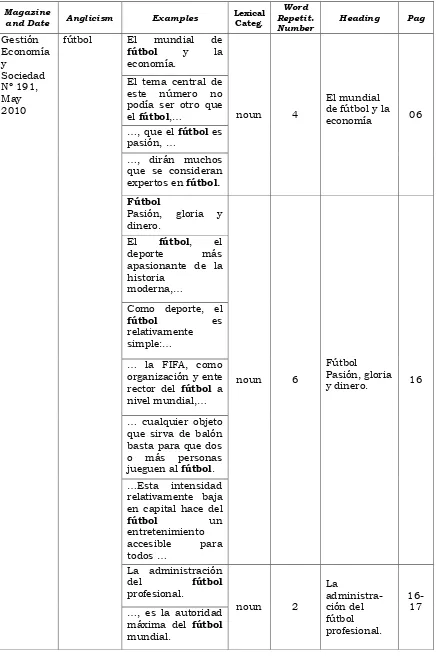
Gestión Economía y Sociedad Nº 191, May 2010
fútbol El mundial de
fútbol y la
economía.
noun 4
El mundial de fútbol y la economía 06 El tema central de
este número no podía ser otro que el fútbol,…
…, que el fútbol es
pasión, …
…, dirán muchos
que se consideran expertos en fútbol. Fútbol
Pasión, gloria y dinero.
noun 6
Fútbol
Pasión, gloria y dinero. 16 El fútbol, el
deporte más apasionante de la historia
moderna,…
Como deporte, el
fútbol es
relativamente
simple:…
… la FIFA, como
organización y ente rector del fútbol a
nivel mundial,… … cualquier objeto
que sirva de balón basta para que dos o más personas jueguen al fútbol.
…Esta intensidad
relativamente baja en capital hace del
fútbol un
entretenimiento accesible para
todos …
La administración
del fútbol
profesional.
noun 2
La administra-ción del fútbol profesional. 16-17
…, es la autoridad
máxima del fútbol
...En materia de
fútbol, sus
estatutos y reglamento están por encima de las
leyes internas …
noun 3 La administra-ción del fútbol profesional. 16- 17
…, la FIFA trabaja
en coordinación con las confederaciones de
fútbol de Asia,
África, …
…, pero el fútbol
surge fuerza en las
otras regiones…
Las dimensiones económicas y geográficas que el
fútbol ha
alcanzado son
inimaginables… noun 2
Derechos de televisión, el rubro más grande.
17
…, las inversiones
en torno al fútbol
se multiplican año
tras año…
Derechos de TV del
fútbol ecuatoriano están sobrevalora-dos.
noun 6
Derechos de TV del fútbol ecuatoriano están sobrevalo-rados
17
…, el espectáculo
del fútbol todavía se vive en la televisión abierta... En otros países donde el mercado del fútbol es más grande, como
Europa o …
…, derechos de
transmisión de los equipos de fútbol ecuatorianos… …, el fútbol en la pantalla tiene
mucho rédito… …, en Teleamazo -nas la inversión más importante en programación son los derechos de transmisión de
…, el costo total de
transmisión del
fútbol nacional equivale a 8% de las ventas netas
por publicidad… noun 2
Derechos de TV del fútbol ecuatoriano están sobrevalo-rados
17
…, las cifras reales
que el mercado de transmisión del
fútbol levanta, …
El torneo de fútbol
más importante a nivel
internacional…
noun 3
Copa Mundial, la gran
expectativa.
18 ... millones de
fanáticos del
fútbol siguen el campeonato de
inicio a fin,…
… el mundial de
fútbol se convierte en el espectáculo deportivo de mayor audiencia…
Fútbol europeo, el más caro de la historia.
noun 5
Fútbol europeo, el más caro de la historia
18-19 David Beckham es
actualmente el jugador de fútbol
que más gana al
año…
Participó en los últimos tres mundiales de
fútbol,…
La adquisición más costosa en la historia del fútbol
la realizó el Real
Madrid,…
…, 15 equipos de fútbol y 83 para
otros deportes…
.... Esta selección tenía dos medallas de oro ganadas en
fútbol…
noun 1 Notas curiosas de la Copa Mundial de la FIFA.
18
…El crecimiento de
la industria del
fútbol al parecer
no tiene límites,…
noun 2
Presión financiera sobre los clubes más grandes. 19
…mayor regulación por parte de las autoridades del
…, resalta el
trabajo sistemático que se ha requerido para lograr asociar el
fútbol,…
noun 2
El
rendimiento comercial va de la mano del
rendimiento deportivo.
20
… “porque en el
fútbol todo es
incierto”…
Un monumento vivo del fútbol.
noun 8
Un
monumento vivo del fútbol.
20
…, jugador
ecuatoriano de
fútbol profesional…
Ulises de la Cruz es un profesional del fútbol desde que tiene 16
años…
…Este titán del fútbol ecuatoriano
sostiene,…
… un monumento
es a la pelota de
fútbol por todas las satisfacciones que brinda…
… a los réditos
económicos que le ha proporcionado
el fútbol
profesional,… …“El fútbol nos da esa herramienta para beneficio no
personal,…
…las estrellas de fútbol de ese continente solo emplean el dinero en su propio y exclusivo
beneficio…
…El fútbol fue la herramienta con la que Ulises pudo cambiar las condiciones de
Piquiucho,…
noun 1 Un
monumento vivo del fútbol.
20 futbolistas …, medios de
comunicación,
futbolistas y sobre todo fanáticos de
todas las edades …
noun 1 Fútbol
Pasión, gloria y dinero
…, futbolistas
motivados y bien
remunerados,…
noun 1 Presión financiera sobre los clubes más grandes.
19 futbolista ...A pesar de no
estar en el apogeo de su carrera profesional como
futbolista,…
noun 2
Fútbol europeo, el más caro de la historia
18- 19 ... Su fama como
futbolista y su físico le han permitido vender
su imagen …
cruciales ...la visión sobre estas relaciones bilaterales,
cruciales, desde cualquier punto
que se mire,…
adj. 1 El mundial de fútbol y la economía
06 crucial …El punto crucial
fue la concesión a
Interagua,…
adj. 1 3. Y a cambio
de… 70
whiskies …, sabor de al menos 40 de los mejores whiskies
de malta y grano
de Escocia…
noun 1 100 años de Johnnie Walker.
14 malta …, pues tiene el
sabor de al menos 40 de los mejores whiskies de malta
y grano de
Escocia…
noun 1 100 años de Johnnie Walker.
14 gasolina ...Se encuentra
disponible en dos versiones de motores a
gasolina,…
noun 1 Nuevo Hyundai Tucson ix.
14
estánda-res
…, la unidad
cuenta con los
estándares de
calidad requerida…
noun 1 Radioterapia en el Hospital Metropolita-no.
14 ... Ahora Geely
tendrá que cumplir esos estándares…
noun 1 Taxi
Londinense con sello chino.
30
…la población
china equiparará los estándares de vida
norteameri-canos,…
noun 1 Cuando las fallas de la globalización se convierten en lo in.
49
estandari-zados
…propiciaba el
desarrollo de productos
estandarizados…
adj. 1 Globalización y evolución de mercados.
interfaz … Y cuenta con
una interfaz
amigable que permite configurar
fácilmente…
noun 1 Nuevo correo Movistar Nokia.
15 e-mail … con una interfaz
amigable que permite configurar fácilmente las cuentas de e-mail:…
noun 1 Nuevo correo Movistar Nokia.
15 e-mails …, al igual que
adjuntar archivos a los e-mails que se quieren enviar
directamente…
noun 1 Nuevo correo Movistar Nokia.
15 clubes …, en los que
patrocinadores,
clubes deportivos, medios de
comunicación,… noun 2
Fútbol
Pasión, gloria y dinero.
16
…Las inversiones
de los clubes
deportivos asumen
grandes riesgos,… …, elaborado por
los mismos dirigentes de los
clubes deportivos
nacionales,…
noun 1 La
administra-ción del fútbol
profesional.
17
… el secreto para
mantener el contrato con los
clubes deportivos está en cumplir
con el pago…
noun 1 Derechos de TV del fútbol ecuatoriano están sobrevalora-dos 17 …Presión
financiera sobre los clubes más grandes...
noun 5
Presión financiera sobre los clubes más grandes. 19
…, los mejores clubes a nivel mundial son los
más endeudados… … La presión que
los clubes reciben para estar entre los mejores ...
…, y está entre los
mejores clubes del mundo ...
club …El club
Barcelona F. C. de España,
noun 3
Fútbol europeo, el más caro de
la historia. 19
…Fue elegido en
marzo del 2010 el mejor club a nivel
mundial …
…, tiene el mejor
entrenador de club de 2009,…
…El buen
desempeño de un equipo profesional tiene efectos financieros
positivos para el
club, …
noun 4
Presión financiera sobre los clubes más grandes. 19
… depende a su vez de las contrataciones técnicas que haga el club,…
... la deuda bancaria que contrajo la multimillonaria familia Glazers de EEUU para comprar el club en 2005.
…, el club todavía debe hacer frente a
una deuda …
turismo … depende a su vez de las contrataciones técnicas que haga el club,…
noun 1 En el país. 42 turísticos …, los cosméticos,
los textiles y los servicios
turísticos…
adj. 1 El Comercio Justo en el Ecuador.
48 goles …, dos arcos y el
objetivo es anotar más goles que tu
contrincante…
noun 1 Fútbol
Pasión, gloria y dinero.
16
…, se habían
anotado 2.063
goles,…
noun 2
Notas curiosas de la Copa Mundial de la FIFA. 18
…, un promedio de
casi tres goles por
partido…
porcentaje …, porcentaje
demasiado alto en
su opinión…
noun 1 Derechos de TV del fútbol ecuatoriano
…siempre que los
productos tuvieran un porcentaje de
valor agregado…
noun 1 El mercado se inclina hacia pocos productores.
25
…, el porcentaje
de materiales nacionales
utilizados por la industria es
mayor…
noun 1 El Convenio fue Positivo.
26
…la cual produce
actualmente el mismo porcentaje del PIB,…
noun 1 Auge, caída y ¿reencarna-ción? Del comunismo.
61
porcen-tuales
…, en términos porcentuales, hubo una reducción de 3 %
en la venta de…
adj. 1 ¿Suntuarios o necesarios?
28
…una disminución
de la ocupación plena de 1,2 puntos
porcentuales al pasar de 38,8%…
adj. 1 Otra vez el desempleo a 9,1%.
72
…, 3,8 puntos porcentuales por encima de la cobertura de 2008…
adj. 1 La Telefonía Móvil llega a 73,7% de los Hogares en el Ecuador.
73 logística …$2000 millones
en infraestructura,
logística,
comunicación y
seguridad …
noun 1 Copa
Mundial, la gran
expectativa.
18 liderazgo Liderazgo. noun 1 Liderazgo. 22
…, dice que el más
famoso experto del mundo en
liderazgo,…
noun 2
Descubrir el poder de la confianza.
22 ... Vi los patrones
de los principios básicos de
liderazgo...
…, accedió al
liderazgo del
Partido Comunista
en 1922,…
noun 1 Toma del poder por los bolcheviques.
64 ...o desempeñaba
un papel de
“liderazgo” en el
Estado y la
sociedad…
noun 1 Característi-cas de un sistema comunista.
65
…, bajo el liderazgo de Ho Chi Min y tras una cruenta guerra…
noun 1 Los “frentes de liberación
nacional”.
…Las 21 Leyes
Irrefutables del
Liderazgo…
noun 5
Las Leyes Irrefutables del Liderazgo. John Maxwell. 68
…La capacidad de liderazgo
determina el nivel de eficacia de una
persona…
... La verdadera medida del
liderazgo es la
influencia…
... La confianza es el fundamento del
liderazgo…
…los principios
que sustentan las leyes del liderazgo
que plantea
Maxwell…
… y los
productores de televisión
latinoamericanos contra el liderazgo de Hollywood,…
noun 1 “La
globalización ya no significa la
estadouniza-ción”
77
…la posición
internacional de su país y desafiar el
liderazgo de
EEUU,…
noun 1 “ La era de la política de las grandes potencias ha
regresado”
78 líder ...una experiencia
con un líder que moldeo profunda-mente el resto de
mi vida…
noun 1 Descubrir el poder de la confianza.
22
…se constituyo en
la empresa líder de
la industria, …
noun 1 La última década.
27
…España es el país líder mundial en número de donaciones y
trasplantes…
noun 2 En la región. 40-41
…, España como
líder en
trasplantes muestra
34,2pmp,…
…, pero la líder de aquella época murió y ahora
somos 100 las…
noun 1 Trabajadoras domésticas en pie de lucha.
57 ... (y, en última
instancia, del
“máximo líder”)…
noun 1 Característi-cas de un sistema comunista.
…, un culto a la
personalidad del máximo líder, …
noun 1 Los “frentes de liberación
nacional”.
66
…, pero se necesita
que un líder
planee la ruta…
noun 4
Las Leyes Irrefutables del Liderazgo. John Maxwell. 68
… la gente apoya al líder, luego a la
visión…
…Un líder debe
ceder para subir… …El valor duradero
del líder se mide por la sucesión.
…Nikita Kruschev, líder soviético (1953-64), prefería
no…
noun 1 Datos curiosos.
66 líderes …viaje por todo el
país y capacite a
los líderes
locales”…
noun 3
Descubrir el poder de la confianza
22
…¿Quién era yo
para formar a
líderes que me doblaban y triplicaban la edad?...
...para enseñar a estos líderes y para ayudarles a
que compartan…
...de todos los demás líderes que pudiesen poner en
riesgo su control…
noun 2
Toma del poder por los bolcheviques.
64, 65
…, se estima que
60 % de los líderes
del Partido Comunista
Alemán…
.… Los líderes
añaden valor por medio de servicio a
los demás…
noun 4
Las Leyes Irrefutables del Liderazgo. John Maxwell. 68
…Los líderes
tocan el corazón antes de pedir la
mano…
... Solo los líderes
seguros otorgan poder a otros...
…; para