COMPARISON OF COMMUNITY RESPONSES TO RAILWAY AND ROAD
TRAFFIC NOISES IN KYUSHU, A WARMER AREA OF JAPAN, AND
HOKKAIDO, A COLDER AREA
PACS:43.50.Qp
Yano Takashi [1], Morihara Takashi [1] and Sato Tetsumi [2] [1] Kumamoto University
Kurokami 2-39-1
860-8555 Kumamoto, Japan Tel: +81-96-342-3560 Fax: +81-96-342-3569
E-mail: [email protected] [2] Hokkai Gakuen University
Chuo-ku Minami 26 Nishi 11-1-1 064-0926 Hokkaido, Japan Tel: +81-11-841-1161 Fax: +81-11-551-2951
E-mail: [email protected]
ABSTRACT
Socio-acoustic surveys on community responses to railway and road traffic noises were conducted in Kyushu, a warmer area of Japan, and Hokkaido, which had a colder climate similar to northern Europe, using the same method. It was found that railway noise annoyance appeared to be a little greater than road traffic noise both in Kyushu and Hokkaido and that there was no difference in dose-response relationships for both noises between both areas. The former finding is quite different from the European that railway noise is less annoying than road traffic noise. Such a difference may be due to socio-cultural differences such as lifestyle and attitude to noise sources.
INTRODUCTION
A number of social surveys on community response to environmental noises have so far been carried out in Euro-American countries. Schultz [1] compared these data, and showed that one synthesis curve could be fitted to explain the relationship between noise exposure and reaction regardless of the noise source. On the other hand, Fields et al. [2], Moehler et al. [3] and Miedema et al. [4] compared dose-response relationships from social surveys on environmental noises in the countries and reported that annoyance caused by railway noise was lower than road traffic noise. This finding is reflected as the “railway bonus” in noise regulations in some European countries. However, Kaku et al. [5] and Yano et al. [6] showed that there was no significant difference in dose-response relationships between railway and road traffic noises in Japan. It is very important for the establishment of environmental regulations in Japan to investigate whether a railway bonus can be observed in Japan or not.
The purpose of the present study is to compare the dose-response relationships between railway and road traffic noises in Kyushu and Hokkaido and to discuss why the community response to railway noise relative to road traffic noise is different between Europe and Japan, if a difference exists.
SOCIAL SURVEYS
Social surveys on community responses to road traffic and railway noises were carried out in Hokkaido and Kyushu using the self-administered method from 1994 to 2001. Table 1 shows the outline of the surveys. Respondents, 20 to 75 years of age, were randomly selected on a one-person per family basis from detached houses facing roads or railways. The sample sizes were from about 400 to 500, and response rates were from about 64 to 80%. To compare community responses precisely in all surveys, we used the same rating scale (very, rather, a little, notice but is not annoyed, and don’t notice).
Long-term noise measurements were made at reference points near the railways and roads and short-term noise measurements were also made at the reference points and several other points for the estimations of distance reduction. The amount of noise exposure (LAeq,24h) was
worked out from the measurements and the estimations. Road traffic noise was about 50-76 dB and railway noise was about 30-80 dB.
[image:2.596.81.507.109.430.2]FREQUENCY DISTRIBUTION
Table 1 Outline of surveys
Noise source Road traffic noise Railway noise
Area Hokkaido (Sapporo) Hokkaido
Housing type Detached house Detached house
Survey site 11 sites in Sapporo Residential area along four railway
lines around Sapporo
Method Self-administered Self-administered
Survey date 1997.10-1998.1 2001.8-9
Measurement date 1998.7-10 2001.9-10
Sample size 411 497
Response rate (%) 63.5 69.9
Traffic volume/day 2491-48219 87-344
LAeq,24h(dB) 53-76 30-78
Area Kyushu (Kumamoto) Kyushu
Housing type Detached house Detached house
Survey site 15 sites in Kumamoto Residential area along three railway
lines from Kumamoto to Fukuoka
Method Self-administered Self-administered
Survey date 1996.5-7 1994.5-6,9-10,1995.5
Measurement date 1996.9-11 1994,10
Sample size 378 464
Response rate (%) 76 79.7
Traffic volume/day 3936-44787 72-414
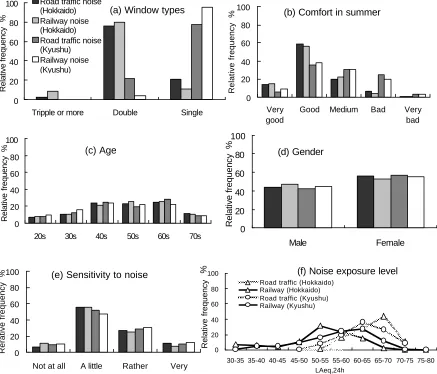
in Fig. 1. It is shown that the window types in Kyushu are mainly single panes, while they are mainly double pane windows in Hokkaido (Fig. 1(a)). Subjects were asked how comfortable they found the four seasons to be. No differences were found between Hokkaido and Kyushu regarding the comfort of spring and autumn. However, respondents in Hokkaido were more likely than Kyushu respondents to indicate that summer was comfortable and, conversely, more respondents in Kyushu found winter to be comfortable than did Hokkaido respondents (Fig. 1(b)).
[image:3.596.80.517.105.479.2]All the surveys showed almost the same frequency distributions of age and about 70% of the subjects were between 40 to 69 (Fig. 1(c)). They also showed the same distribution for gender, and there were slightly more female subjects (Fig. 1(d)). In the case of sensitivities to noise, no significant differences were seen between different noise sources and between different climates (Fig. 1(e)). Since there is no difference in these factors between the surveys, community responses may be precisely compared between the surveys. Road traffic noise levels were larger than railway noise levels in these surveys. This is because there were many houses that were considerably far from the railway in the surveys on railway noise.
Fig. 1 Relative frequency of demographic, personal, housing, environmental factors, and noise exposure level 0 20 40 60 80 100
20s 30s 40s 50s 60s 70s
Relative frequency % 0 20 40 60 80 100 Male Female Relative frequency % 0 20 40 60 80 100
Tripple or more Double Single
Relative frequency
%
Road traffic noise (Hokkaido) Railway noise (Hokkaido) Road traffic noise (Kyushu) Railway noise (Kyushu) 0 20 40 60 80 100 Very good
Good Medium Bad Very bad
Relative frequency
%
(c) Age (d) Gender
(b) Comfort in summer (a) Window types
0 20 40 60 80 100
Not at all A little Rather Very
Rerative frequency % 0 20 40 60 80 100
30-35 35-4040-45 45-5050-55 55-6060-65 65-70 70-75 75-80
LAeq,24h
Relative frequency
%
Road traffic (Hokkaido) Railway (Hokkaido) Road traffic (Kyushu) Railway (Kyushu)
DOSE-RESPONSE RELATIONSHIPS
Dose-response relationships are usually described as the relation between noise exposure level
(LAeq,24h or Ldn) and “% highly annoyed.” This study defined the % highly annoyed as the
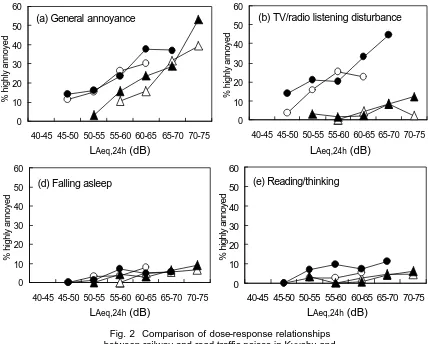
percentage of the respondents who evaluated "very annoyed" (1/5 of the annoyance scale in this study) to the total respondents in an LAeq,24h range. Figure 2 shows comparisons of
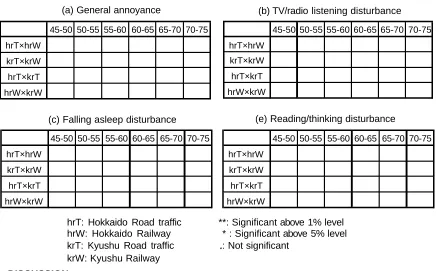
dose-response relationships and Table 2 shows the results of a Chi-square test.
No significant difference in “General annoyance” and “TV/radio listening disturbance” was found between Hokkaido and Kyushu. No effect of sound insulation of window on annoyance and listening disturbance may attribute to survey date. Windows of living rooms were usually open in evenings of summer in Hokkaido. However, annoyance caused by railway noise was systematically higher than road traffic noise in both areas, although the differences were significant at 5 % level only in 55-65 LAeq,24h range in Hokkaido and 60-65 LAeq,24h range in
Kyushu. The trend for “TV/radio listening disturbance” was more prominent than for “general annoyance.” There was no systematic difference in disturbance to sleep between both noise sources in either area. Disturbance to reading and thinking by railway noise was more than that for road traffic noise at above the 5% level of significance during 55-65dB in Kyushu.
0 10 20 30 40 50 60
40-45 45-50 50-55 55-60 60-65 65-70 70-75
% highly annoyed
0 10 20 30 40 50 60
40-45 45-50 50-55 55-60 60-65 65-70 70-75
% highly annoyed
0 10 20 30 40 50 60
40-45 45-50 50-55 55-60 60-65 65-70 70-75
% highly annoyed
0 10 20 30 40 50 60
40-45 45-50 50-55 55-60 60-65 65-70 70-75
% highly annoyed
[image:4.596.74.504.99.443.2]L
Aeq,24h(dB)
Fig. 2 Comparison of dose-response relationships between railway and road traffic noises in Kyushu and
Hokkaido
(b) TV/radio listening disturbance
(e) Reading/thinking disturbance
(a) General annoyance
(d) Falling asleep disturbance
Road traffic noise (Hokkaido) Railway noise (Hokkaido)
L
Aeq,24h(dB)
L
Aeq,24h(dB)
L
Aeq,24h(dB)
DISCUSSION
The above finding in Fig. 2(a) is quite different from European findings that railway noise is less annoying than road traffic noise. If this is confirmed in the other areas of Japan, the regulation for railway noise in Japan may be different from European regulations. Furthermore, elucidating the cause of difference between Europe and Japan is important to developing more effective noise counter-measures in areas along railways in Japan. The following reasons for the railway bonus and the difference between European and Japanese are hypothesized.
Difference in Acoustic Characteristics between Road Traffic and Railway Noises: Fastl et al. [7] showed the railway bonus in German and Japanese judgments with a psycho-acoustic experiment. The cause of the railway bonus was explained by the objective underestimation of low frequency components of road traffic noise in the measurement with A-weighting and the subjective overestimation of road traffic noise. That is, road traffic noise contains more low frequency components than railway noise. Accordingly, A-weighting may underestimate the low frequency components of road traffic noise and relatively overestimate road traffic noise. Fields et al. [2] pointed out that railway noise occurred more regularly and predictably than road traffic noise and hence less annoying. However, since the same basic difference in acoustic characteristics between road traffic and railway noises must also exist in Japan one would expect the effect of that acoustic difference to be greater in Japan than Europe because less sound insulation is used in Japan.
[image:5.596.77.516.114.385.2]Difference in Attitude to Both Noises: Fields et al. [2] argued that railways are more socially accepted than the other forms of transportation. Because railways are associated with romantic and nostalgic images related to the important role they played in the industrial revolution, the popularity of the orient express, and their safety and environment-friendliness, this might contribute to the lower annoyance. Japanese also have the same attitude to railways as Europeans. For example, old steam locomotion is revived for a highlight of sightseeing and activating a community. However, the level of the attitude, particularly the consciousness of environment prevention, may be different between Europeans and Japanese.
Table 2 Chi-square test
(a) General annoyance (b) TV/radio listening disturbance
(e) Reading/thinking disturbance (c) Falling asleep disturbance
hrT: Hokkaido Road traffic **: Significant above 1% level hrW: Hokkaido Railway * : Significant above 5% level krT: Kyushu Road traffic : Not significant
krW: Kyushu Railway
45-50 50-55 55-60 60-65 65-70 70-75
hrT×hrW
krT×krW
hrT×krT
hrW×krW
45-50 50-55 55-60 60-65 65-70 70-75
hrT×hrW
krT×krW
hrT×krT
hrW×krW
45-50 50-55 55-60 60-65 65-70 70-75
hrT×hrW
krT×krW
hrT×krT
hrW×krW
45-50 50-55 55-60 60-65 65-70 70-75
hrT×hrW
krT×krW
hrT×krT
Difference in Housing Factors Such as Window Insulation and Mass of Houses: Yano et al. [6] showed in surveys on community response to road traffic and railway noises conducted in Kyushu that the effect of listening disturbance on general annoyance was greater for railway noise than road traffic. The same trend has also been reported in Europe [3]. High sound insulation of houses in colder areas may decrease the listening disturbance and the general annoyance. Though there was no significant difference in TV/radio disturbance between Kyushu and Hokkaido, people in Hokkaido might open the windows, as the survey was conducted in summer, and be as disturbed as people in Kyushu.
Vibration by transportation is an important factor to increase noise annoyance and the effect of vibration on noise annoyance is larger for railways than for road traffic [6]. The greater the mass of house, the lower the level of house vibration is. The mass of European houses is generally larger than Japanese. This may contribute to lower annoyance by railway noise in Europe.
Difference in Socio-Cultural Factors Such as Customs and Lifestyles: European people appear to enjoy outdoor activity in gardens or on balconies more than Japanese. Since road traffic emits not only noise but also exhaust, they may feel road traffic more annoying than railways. Yano et al. [8] showed that Swedish people were more annoyed by road traffic noise than Japanese because of the effect exhaust on outdoor activities.
Difference in Operation between Europe and Japan: Moehler et al. [3] pointed out that there was almost no traffic volume during nighttime in our railway surveys while there was some in Europe. This may cause some difference in noise indexes like Ldn. Though other causes of bias
in noise exposure values should be considered, such bias may not explain the difference in response between European and Japanese in the present study.
CONCLUSION
The present study indicated no systematic difference in dose-response relationships between railway noise and road traffic noise. Railway noise appears to be a little more annoying than road traffic noise. This is different from the finding that road traffic noise is consistently more annoying than railway noise in Europe. Listening disturbance caused by railway noise in Kyushu and Hokkaido is significantly more than road traffic noise. Responses caused by each noise were not different between Kyushu and Hokkaido on the whole, although the sound insulation by window type was different.
The reasons why railway noise annoyance relative to road traffic is higher in Japan than Europe were discussed. Though no clear reason was identified here, it must be exist. In order to elucidate the rationale for the difference, it may be necessary to conduct a structural analysis of the present data such as multivariate analysis, to exchange our data with European researchers for direct comparison and/or to conduct surveys with the same method.
REFRENCES
[1] T. S. Schultz, J. Acoust. Soc. Am. 64, 377-405, 1978. [2] J. M. Fields et al., J. Sound Vib.81, 51-80, 1982. [3] U. Moehler et al, J. Sound Vib.231, 853-864, 2000.
[4] H. M. E. Miedema et al, J. Acoust. Soc. Am. 104, 3432-3445, 1998 [5] J. Kaku et al., J. Sound Vib.193, 505-511, 1997.