J neurosurg Pediatr 17:278–284, 2016
I
ntraventrIcular hemorrhage (IVH) in the premature neonate remains a major complication of prematurity. Although its etiology is multifactorial, IVH is usually preceded by a hypoxic-ischemic insult followed by de-struction of neuronal and glial precursors in the germinal matrix, with a varying degree of parenchymal destruction and the possible development of hydrocephalus.13 Initial management of IVH is aimed at preventing further dam-age to the neonatal brain and is primarily achieved by maintaining adequate cerebral perfusion. The reportedin-cidence of IVH in preterm very-low-birth-weight infants (< 1500 g) has decreased from 50% in the early 1980s to around 20% in 2005.8 However, the incidence of posthem-orrhagic hydrocephalus (PHH) requiring treatment has remained stable across the country and is reported to be 25%–50% in patients with IVH.5
PHH is a complicated condition for which there is no consensus regarding optimal timing or type of surgical in-tervention, and the sequelae of chronic neurological deficits persist despite appropriate intervention. Often the initial
abbreviations IVH = intraventricular hemorrhage; LP = lumbar puncture; NEC = necrotizing enterocolitis; PHH = posthemorrhagic hydrocephalus; VA = ventriculoatrial; VP = ventriculoperitoneal; VR = ventricular reservoir; VSG = ventriculosubgaleal.
submitted March 4, 2015. accePted June 18, 2015.
include when citing Published online November 13, 2015; DOI: 10.3171/2015.6.PEDS15132.
Surgical management of hydrocephalus secondary to
intraventricular hemorrhage in the preterm infant
eisha a. christian, md,1 edward F. melamed, ba,2 edwin Peck, md,1 mark d. Krieger, md,1,2 and
J. gordon mccomb, md1,2
1Department of Neurosurgery, Keck School of Medicine, University of Southern California; and 2Division of Neurosurgery, Children’s Hospital, Los Angeles, California
obJective Posthemorrhagic hydrocephalus (PHH) in the preterm infant remains a major neurological complication of prematurity. The authors first described insertion of a specially designed low-profile subcutaneous ventricular catheter reservoir for temporary management of hydrocephalus in 1983. This report presents the follow-up experience with the surgical management of PHH in this population and describes outcomes both in infants who were stable for permanent shunt insertion and those initially temporized with a ventricular reservoir (VR) prior to permanent ventriculoperitoneal (VP)/ventriculoatrial (VA) shunt placement.
methods A retrospective review was undertaken of the medical records of all premature infants surgically treated for posthemorrhagic hydrocephalus (PHH) between 1997 and 2012 at Children’s Hospital Los Angeles.
results Over 14 years, 91 preterm infants with PHH were identified. Fifty neonates received temporizing measures via a VR that was serially tapped for varying time periods. For the remaining 41 premature infants, VP/VA shunt place-ment was the first procedure. Patients with a temporizing measure as their initial procedure had undergone CSF diver-sion significantly earlier in life than those who had permanent shunting as the initial procedure (29 vs 56 days after birth, p < 0.01). Of the infants with a VR as their initial procedure, 5/50 (10%) did not undergo subsequent VP/VA shunt place-ment. The number of shunt revisions and the rates of loculated hydrocephalus and shunt infection did not statistically differ between the 2 groups.
conclusions Patients with initial VR insertion as a temporizing measure received a CSF diversion procedure signifi-cantly earlier than those who received a permanent shunt as their initial procedure. Otherwise, the outcomes with regard to shunt revisions, loculated hydrocephalus, and shunt infection were not different for the 2 groups.
http://thejns.org/doi/abs/10.3171/2015.6.PEDS15132
method of treating progressive PHH is with serial lum-bar punctures (LPs). This method can be successful with Grades 1 and 2 bleeds but frequently fails in those neonates with Grades 3 and 4 hemorrhages, because the blood and debris obstruct CSF flow from the ventricles to the lumbar subarachnoid space. If this occurs, sometimes serial ven-tricular punctures are used; however, this can lead to ad-ditional parenchymal damage and possible porencephaly at the aspiration site.6,9 For this reason, it is believed bet-ter to insert a ventricular access device that only traverses the cortical mantle on a single occasion. A consideration in using a temporary means of CSF drainage is that a given number of these preterm infants develop necrotizing en-terocolitis (NEC) that leads to bowel perforation. If a peri-toneal catheter is present when this occurs, it can lead to gram-negative ventriculitis with devastating effects on the brain. For this reason, a ventriculoperitoneal (VP) shunt is not inserted until the infant is feeding well and is past the stage when NEC can develop. This usually occurs when the infant reaches a weight of 1500 g, and as a result, we usu-ally do not insert a VP shunt until this milestone is reached. The insertion of a ventricular reservoir (VR) to inter-mittently remove CSF was described as a treatment for preterm infants with PHH at our institution in 19836 and is often the temporizing measure of choice for treatment of PHH.8 More recently, the placement of a ventriculosub-galeal (VSG) shunt as another temporizing neurosurgical procedure to control progressive hydrocephalus after IVH has been developed as an alternate to a VR. A recent ret-rospective review showed no difference in complication rates or requirements for subsequent shunt placement in infants treated with VSG shunts compared with those re-ceiving VRs.5
In 1983, we reported that early implementation of a VR reduced the rate of apnea and bradycardia in infants with progressive PHH.6 In a 1997 follow-up study at our institu-tion, Levy et al.4 showed that despite treatment, grade of hemorrhage was the best predictor of long-term cognitive and motor outcome and did not appear to be noticeably improved with aggressive treatment of the resulting hy-drocephalus.
It has also been speculated that removal of the resulting debris from the hemorrhage and necrotic brain via a VR may reduce the need for permanent CSF diversion, and if one is needed, it may diminish the need for subsequent shunt revisions or reduce the inflammatory response that can lead to loculated hydrocephalus. We report the experi-ence of our institution and the outcomes of our patients with PHH over the course of 14 years with a focus on the impact of temporizing CSF drainage measures on shunt infection, revision, and loculation rates.
methods
Patient Population
Approval by the Children’s Hospital of Los Angeles In-stitutional Review Board was obtained prior to initiation of this study. A retrospective review of our records identi-fied 91 preterm, low-birth-weight infants with PHH who received either temporary (VR) or permanent (VP/VA) CSF diversionary procedures between January 1997 and
December 2012. Cranial ultrasonography, CT, and MRI were used for grading infants’ hemorrhages and to follow ventricular size.7
All patients had been transferred from outside hospi-tals. Infants with progressive and marked ventriculomeg-aly and symptomatic hydrocephalus (clinically significant apneas and bradycardias) received a VR if they weighed less than 1500 g; we have previously described placement and management of these catheter reservoirs.6 If these in-fants weighed more than 1500 g, tolerated feedings, were past the point of possibly developing NEC, and were oth-erwise stable, a VP shunt was inserted. Vancomycin (15 mg/kg every 12 hours for 24 hours) remained our peri-operative antibiotic of choice. All attending surgeons at the Children’s Hospital of Los Angeles followed the same protocol during this study interval.
outcome measures and data analysis
Primary outcome measures for this study included the development of shunt infection, malfunction, and locu-lated hydrocephalus. We focused on infections occurring within 6 months from insertion of a permanent shunt. Loculated hydrocephalus was defined by the presence of additional CSF compartments requiring either fenestra-tion or shunt inserfenestra-tion. Patients with a minimum 1-month follow-up were included in the analysis of revisions and loculated hydrocephalus. The analysis of infections occur-ring within the first 6 months included all patients.
Additional parameters included gestational age, sex, birth weight, IVH grade, initial procedure, days to tem-porary and permanent CSF diversion, and months to revi-sion. Statistical tools included the chi-square contingency table, Student t-test, univariate ANOVA, Mann-Whitney test, bivariate correlation, binomial regression, and Kap-lan-Meier survival curve, with p ≤ 0.05 considered
sig-nificant. SPSS (version 21, IBM) and SPSS SamplePower were used to conduct all statistical tests.
results
Patient demographics
Ninety-one preterm infants with PHH were identified from our records (Table 1). There were 58 males and 33 females. Birth weight ranged from 385 g to 3285 g (mean 1123 ± 576 g). Gestational age ranged from 22 weeks to 36 weeks (mean 27 ± 4 weeks). IVH was graded accord-ing to the Papile classification.7 The distribution was as follows: Grade 1 (1/91), Grade 2 (4/91), Grade 3 (36/91), and Grade 4 (48/91); 2/91 patients had no grade specified in their records.
Admissions per year were highest in 1997 with 17 pa-tients and have since plateaued to 5–6 neonates per year from 2006 to 2012 (Fig. 1). The mean follow-up duration was 7 years (76 patients) with 9 deaths and 6 patients lost to follow-up. Seventy-five of 76 patients had a minimum follow-up of 6 months.
initial Procedure
facil-ity; 4 patients received VP shunts. Fifty patients received a temporary CSF drainage measure (VR) as their first CSF diversion procedure at our hospital between 10 days and 51 days of life (mean 29 ± 9 days). Forty-one patients weighed more than 1500 g on admission and received a VP or VA shunt at an average of 56 days after birth (range 8–211 days).
Patients with VR as their initial procedure received a CSF diversion procedure significantly earlier than patients with initial VPS/VAS insertion did (29 days vs 56 days, p < 0.01). Initial procedure (temporary vs permanent shunt) did not significantly impact the subsequent development of shunt malfunction (p = 0.6), loculated hydrocephalus (p = 0.6), infections within 6 months (p = 0.2), revisions without infections (p = 0.3), and number of revisions (p = 0.5) per patient.
shunt independence
Five patients (10%) with temporary CSF diversion did not require the insertion of a VP/VA shunt at any time thereafter (Table 2). Of this group, 1 of the 5 patients had Grade 3 IVH and 4 of 5 had Grade 4 IVH.
mortality rate
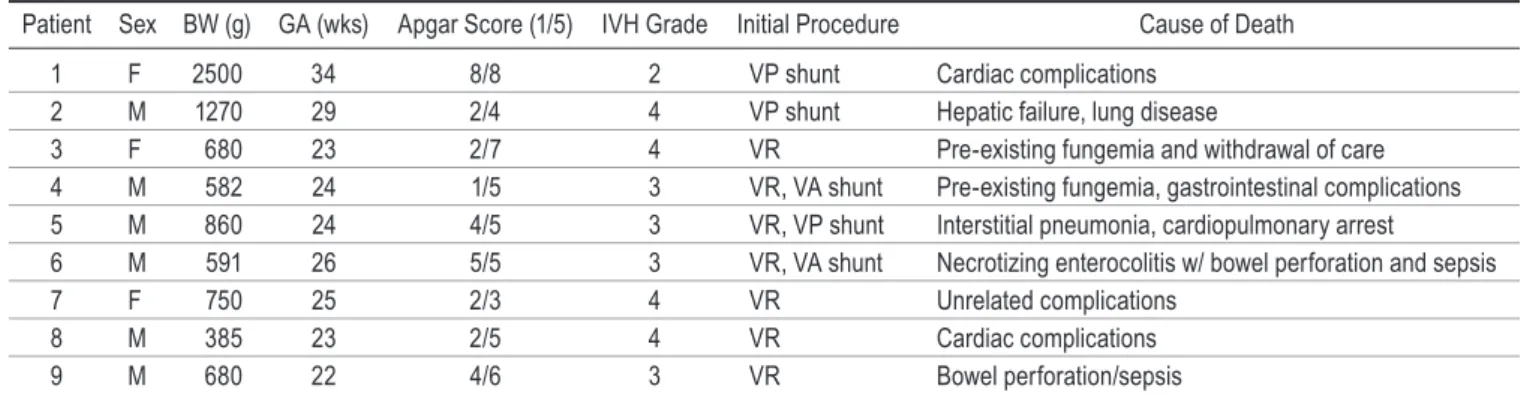
Nine patients (10%) died during their initial
hospital-ization (Table 3); no deaths were related to hydrocepha-lus or shunt insertion. Eight of these 9 patients (89%) had a birth weight less than 1500 g; the only patient with a higher birth weight died due to congenital cardiac defects. Two patients had small bowel perforations; neither patient had a VP shunt.
shunt infection
We reviewed shunt infection rates within 6 months of initial implantation. Ten patients, including both the VR group and VP/VA shunt group, presented with CSF in-fection (133 procedures). Three patients with a permanent shunt as the initial procedure (39 procedures, 8%), and 7 patients with temporary CSF diversion (94 procedures, 7%) developed infections within 6 months. Two patients with a VR developed infections during the period of se-rial taps: 1 patient had a gastric perforation with treated sepsis prior to VR insertion, and the second patient had NEC prior to VR insertion. Organisms included
Staphy-lococcus aureus (1/10), Enterobacter (2/10), Escherichia coli (2/10), and Group B Streptococcus (1/10), and for 5
patients, this information was not documented. There was no statistically significant difference between rates of in -fection in patients who received a permanent shunt versus a temporizing measure (p = 0.2). However, at 80% power, more than 10,000 patients would be required to power this analysis. Gestational age (p = 0.4), sex (p = 0.5), birth weight (p = 0.95), and IVH grade (p = 0.8) did not signifi -cantly impact infection rates (Table 4).
development of loculated hydrocephalus
Eleven patients developed loculated hydrocephalus as
table 1. Patient demographics*
Initial Procedure Drainage (%)Temporary Permanent Shunt (%)
Total 50 (100) 41 (100)
Sex
Female 19 (38) 14 (34)
Male 31 (62) 27 (66)
Gestational age (wks)
Extremely preterm (<28) 41 (82) 16 (39)
Very preterm (28–31) 8 (16) 13 (32)
Moderately preterm (32–33) 0 2 (5)
Late preterm (34–37) 1 (2) 10 (24)
Mean birth weight ± SD (g) 905 ± 412 1448 ± 622
Birth weight (g)
<1000 36 (72) 8 (20)
1001–1250 8 (16) 6 (14)
1251–1500 3 (6) 8 (20)
>1500 2 (4) 11 (26)
Missing 1 (2) 8 (20)
IVH Grade
1 1 (2) 0
2 0 4 (10)
3 23 (46) 13 (32)
4 26 (52) 22 (53)
Missing 0 2 (5)
Mean time from birth to CSF diversion
± SD (days) 29 ± 9 56 ± 46
* Values are presented as the number of patients (%) unless otherwise speci-fied.
Fig. 1. Graph of annual admission of preterm infants with PHH requiring intervention. Figure is available in color online only.
table 2. characteristics of patients who were able to absorb enough csF and not require a permanent shunt
Patient Sex BW (g) (wks)GA ProcedureInitial GradeIVH DOL at Reservoir Insertion
1 F 987 27 VR 4 10
2 F 642 24 VR 4 17
3 F 902 27 VR 3 19
4 M 1569 28 LP, VR 4 25
5 M 1040 27 VR 4 26
defined by the need for an additional procedure, including fenestration or shunt to address the loculated compartment (Table 5); 5 patients had documented and treated ventricu-litis prior to development of these loculations. Of the 6 remaining patients, 4 had VR as their initial procedure and 2 had VP shunt insertions. These 11 patients had an average of 2.5 procedures after diagnosis of compartmen-talized hydrocephalus. The mean time to development of loculated hydrocephalus was 2.5 years. Gestational age (p = 0.3), sex (p = 0.2), birth weight (p = 0.7), IVH grade (p = 0.7), initial procedure (p = 0.6), days to CSF diversion (both temporary and permanent, p = 0.9), and days to per-manent shunt (p = 0.4) after temporary CSF drainage did not significantly impact rates of loculated hydrocephalus (Table 5).
vP shunt revision rates
Of our 76 patients with an average of 7 years of follow-up, 34 patients (45%) required 1 or more revisions. Patients who died (n = 9) and patients lost to follow-up (n = 6) were excluded. There was no difference in revisions between patients with temporary CSF drainage prior to shunt sertion and those with initial permanent VP/VA shunt in-sertion (44% vs 39%, p = 0.6). However, at 80% power, 1500 patients are required to power this analysis. Revi-sions per month were also analyzed: patients with initial VP shunt insertion had a rate of 0.02 revisions per month versus 0.03 revisions per month in the VR subgroup (p = 0.26). Gestational age (p = 0.06), sex (p = 0.10), birth weight (p = 0.08), IVH grade (p = 0.1), days to CSF
diver-sion (p = 0.3), and permanent shunt insertion (p = 0.6) did not impact the overall revision rate. A subgroup analysis of the 28 patients who had shunt malfunction without a preceding infection also showed no significant impact of these factors except for IVH grade (p = 0.04). Additional subgroup analysis using dichotomized birth weight cate-gories of less than or greater than 1500 g showed that only 1 infant weighing more than 1500 g had a revision without a preceding infection.
We also looked at VA shunt revision rates (Table 6): 5 patients received VA shunts due to gastrointestinal com-plications (NEC/perforated bowel). Two patients died dur-ing the same admission from sepsis. The 3 survivdur-ing pa-tients required revision to a VP shunt within 1 year.
discussion
We described the management of PHH in the preterm infant with a subcutaneous ventricular catheter reservoir in 1983.6 The reservoir was serially accessed for as long as 7 weeks, and our first series of 20 patients admitted between 1977 and 1979 had no VR- or VP shunt–related infections or skin breakdowns. Of note, we had a 65% mortality rate (unrelated to hydrocephalus) in this se-ries. A follow-up study published in 1997 documented a 7% infection rate per patient of either the reservoir or VP shunt and a mortality rate of 41%.4 In this series, 2 reservoirs became infected, 1 neonate who had septice-mia with the same organism and the second after adja-cent scalp necrosis following infiltration of a calcium-containing solution that led to exposure of the reservoir.
table 3. Patients who died during their initial hospitalization
Patient Sex BW (g) GA (wks) Apgar Score (1/5) IVH Grade Initial Procedure Cause of Death
1 F 2500 34 8/8 2 VP shunt Cardiac complications
2 M 1270 29 2/4 4 VP shunt Hepatic failure, lung disease
3 F 680 23 2/7 4 VR Pre-existing fungemia and withdrawal of care
4 M 582 24 1/5 3 VR, VA shunt Pre-existing fungemia, gastrointestinal complications
5 M 860 24 4/5 3 VR, VP shunt Interstitial pneumonia, cardiopulmonary arrest
6 M 591 26 5/5 3 VR, VA shunt Necrotizing enterocolitis w/ bowel perforation and sepsis
7 F 750 25 2/3 4 VR Unrelated complications
8 M 385 23 2/5 4 VR Cardiac complications
9 M 680 22 4/6 3 VR Bowel perforation/sepsis
table 4. revision, infection, and loculation risk analysis
Variable Overall Revision Rate Preceding InfectionRevision w/o Infection Rate HydrocephalusLoculated
Gestational age NS NS NS NS
Sex NS NS NS NS
Birth weight NS NS NS NS
IVH grade NS p = 0.04 NS NS
Days to CSF diversion NS NS NS NS
Initial procedure: temporary vs permanent NS NS NS NS
No reservoir infection appeared to be related to the serial tapping procedure.
Our current study reviews preterm infants with PHH from 1997 to 2012 who received either temporary (VR) or permanent (VP/VA shunt) CSF diversionary procedures. Unlike our previous work, this study included patients who were stable and weighed enough for permanent shunt insertion; our overall mortality rate was 10% (the VR sub-group had a mortality rate of 14%). In addition to a declin-ing mortality rate, the rate of admission for PHH at our institution has decreased from 17 patients in 1997 to 5–6 admissions per year since 2006. National admissions ap-pear to vary by region and hospital: St. Louis Children’s Hospital reported increasing numbers,5 while Rainbow Babies and Children’s Hospital in Cleveland reported a 3-fold drop over the last decade.8
csF absorption
Five patients (10%) with temporary CSF drainage did not require permanent shunt insertion. There have been multiple studies assessing the need for a permanent shunt in patients with a VR, and the rates of shunt dependence range from 69% to 93%.3–5,14,15 Given that 1 of 10 patients in our series did not require a shunt after temporary drain-age, a trial of CSF drainage in selective cases may be war-ranted before the insertion of a permanent VP/VA shunt. In our cohort, 1 asymptomatic 4-year-old patient with sta-ble ventricular size who received a shunt was incidentally discovered on routine follow-up to have peritoneal tubing broken just distal to the valve, with migration of the
re-mainder of the catheter to the abdominal cavity, rendering the shunt nonfunctional. It is suspected that a given per-centage of these patients slowly obstruct their shunt and thus become independent of its presence. As the ability to reliably assess this in the VP/VA shunt population is dif-ficult and invasive, we have not tried to do so.
shunt infections
There has been a concern that tapping the reservoir may lead to infection. Within our cohort, we found no statistically significant difference in the rate of infection between a VR and a VP/VA shunt as the initial procedure. However, more than 10,000 patients would be required to conclusively determine if there was a difference between the 2 groups. Additional analysis did not find an associa -tion between dura-tion of the tapping period and infec-tion rate. Kormanik et al.2 previously demonstrated no associa-tion between frequent tapping of a VR and CSF infecassocia-tion. However, Spader et al.11 recently reported on their series of 105 patients with VRs: they reported an overall infec-tion rate of 10.5%, with gestainfec-tional age at procedure and preexisting meningitis being significant risk factors for VR infections. VRs and VSG shunts also demonstrated no difference in device infection between the 2 groups1,3,14 even though VSG shunts are accessed much less frequent-ly than VRs. A recent review of infections following tap-ping of the reservoir found the incidence to be either very low or negligible.12 We are therefore not concerned about causing an infection when the reservoir tapping is prop-erly performed.
table 5. characteristics of patients with loculated hydrocephalus
Patient Sex BW (g) GA (wks) Prior Infection IVH Grade Procedure Days to CSF Diversion Days to Shunt
1 M NR 26 Yes 4 VP shunt 33
2 F 655 25 Yes 1 VR, VP shunt 18 54
3 F 645 26 No 4 VR, VP shunt 33 31
4 F 1184 27 No 3 VR, VP shunt 15 47
5 M 794 26 No 4 VP shunt 67
6 M 1170 28 Yes 3 VP shunt 34
7 F NR 23 Yes 4 VP shunt 146
8 F NR 25 No 4 VR, VP shunt 18 72
9 M 2500 33 No 3 VP shunt 8
10 F 1020 27 Yes 4 VP shunt 48
11 M 648 25 No 3 VR, VP shunt 28 67
NR = not recorded.
table 6. characteristics of patients with va shunts
Patient Sex BW (g) GA (wks) IVH Grade Initial Procedure Outcome
1 M 582 24 3 VR, VA shunt Deceased, pre-existing fungemia, gastrointestinal complications
2 M 591 26 3 VR, VA shunt Deceased, necrotizing enterocolitis w/ bowel perforation and sepsis
3 M 660 23 3 VR, VA shunt VA shunt, VP shunt, ventriculocholecystic shunt in 1 yr
4 M 902 25 4 VR, VA shunt VA shunt, VP shunt in 1 yr
loculated hydrocephalus
Multiloculated hydrocephalus has most commonly been associated with CNS infection and IVH.10 Eleven of 76 of our patients with long-term follow-up developed loculated hydrocephalus and 5 (45%) of these patients had a CNS infection prior to development of their loculations. Of the remaining 6 patients, 4 had a VR as their initial procedure and 2 had a VP shunt; this finding implies that VRs do not necessarily decrease risk of loculated com-partments. However, our small subset of 6 patients in this sample precludes a definitive conclusion. This patient pop -ulation, however, deserves closer attention given that they are at higher risk for multiple subsequent procedures.
revision rates
Willis et al.16 report a lower shunt revision rate for the VR group than the VP shunt group in their series of 32 pa-tients. In contrast, we found no statistically significant dif -ference between these groups in our series of 91 patients (Table 4). Again, more than 1500 neonates with PHH are needed to adequately power this analysis. Furthermore, the duration of temporary CSF diversion (i.e., the number of days prior to shunt insertion) was not different between patients with and without revisions. We also performed a subgroup analysis on patients who underwent a revision procedure without a preceding infection to focus on revi-sions related to the primary procedure and not to those potentially related to infection; IVH grade was the only factor that had a significant impact on this outcome even though the results showed that patients with Grade 3 IVH had a higher rate of revisions (50%) versus those with Grade 4 IVH (23%; Table 4).
An additional subgroup analysis was conducted on pa-tients who, due to preexisting gastrointestinal complica-tions such as NEC with perforated bowel, received a VA shunt. Of note, 2 of 5 patients died during the same admis-sion for sepsis related to their bowel perforation. The re-maining 3 patients required revision to a VP shunt within 1 year of insertion of their VA shunt.
limitations of the study
This study has limitations that are inherent to any sin-gle-center retrospective study and is not powered to make a conclusive statement on the difference between neonates who receive permanent shunting versus those who receive a temporizing measure prior to the insertion of a perma-nent shunt. This study reviews the outcomes of a large single-center institution with a standardized protocol, thereby reducing clinical variability. However, to show a statistically significant difference (p < 0.05, power = 80%) between revision rate and infections, 1500 and 10,000 pa-tients, respectively, would be required and emphasizes the importance of multicenter collaborative studies.
conclusions
Treatment of preterm infants with IVH and hydro-cephalus continues to be complicated with no consensus on optimal surgical management. We have shown that the VR continues to be a safe method of temporary drainage with 10% of our patient population remaining shunt
in-dependent. Patients with a temporizing measure of CSF drainage received a CSF diversion procedure significantly earlier in life than those who received a permanent shunt as their initial procedure. We found no difference in out-comes of infection, revisions, and loculated hydrocephalus between patients who received temporary CSF drainage versus patients who received a permanent shunt as their initial procedure, but large multicenter studies are needed to further validate these results.
references
1. Brouwer AJ, Groenendaal F, van den Hoogen A, Verboon-Maciolek M, Hanlo P, Rademaker KJ, et al: Incidence of infections of ventricular reservoirs in the treatment of post-haemorrhagic ventricular dilatation: a retrospective study (1992-2003). Arch Dis Child Fetal Neonatal Ed 92:F41– F43, 2007
2. Kormanik K, Praca J, Garton HJ, Sarkar S: Repeated tapping of ventricular reservoir in preterm infants with post-hemorrhagic ventricular dilatation does not increase the risk of reservoir infection. J Perinatol 30:218–221, 2010
3. Lam HP, Heilman CB: Ventricular access device versus ven-triculosubgaleal shunt in post hemorrhagic hydrocephalus associated with prematurity. J Matern Fetal Neonatal Med
22:1097–1101, 2009
4. Levy ML, Masri LS, McComb JG: Outcome for preterm infants with germinal matrix hemorrhage and progressive hydrocephalus. Neurosurgery 41:1111–1118, 1997
5. Limbrick DD Jr, Mathur A, Johnston JM, Munro R, Sagar J, Inder T, et al: Neurosurgical treatment of progressive post-hemorrhagic ventricular dilation in preterm infants: a 10-year single-institution study. J Neurosurg Pediatr 6:224–230, 2010
6. McComb JG, Ramos AD, Platzker AC, Henderson DJ, Segall HD: Management of hydrocephalus secondary to intraven-tricular hemorrhage in the preterm infant with a subcutane-ous ventricular catheter reservoir. Neurosurgery 13:295– 300, 1983
7. Papile LA, Burstein J, Burstein R, Koffler H: Incidence and evolution of subependymal and intraventricular hemorrhage: a study of infants with birth weights less than 1,500 gm. J
Pediatr 92:529–534, 1978
8. Robinson S: Neonatal posthemorrhagic hydrocephalus from prematurity: pathophysiology and current treatment concepts.
J Neurosurg Pediatr 9:242–258, 2012
9. Salmon JH: Puncture porencephaly. Pathogenesis and pre-vention. Am J Dis Child 114:72–79, 1967
10. Sandberg DI, McComb JG, Krieger MD: Craniotomy for fenestration of multiloculated hydrocephalus in pediatric patients. Neurosurgery 57 (1 Suppl):100–106, 2005 11. Spader HS, Hertzler DA, Kestle JR, Riva-Cambrin J: Risk
factors for infection and the effect of an institutional shunt protocol on the incidence of ventricular access device infec-tions in preterm infants. J Neurosurg Pediatr 15:156–160, 2015
12. Spiegelman L, Asija R, Da Silva SL, Krieger MD, McComb JG: What is the risk of infecting a cerebrospinal fluid-divert-ing shunt with percutaneous tappfluid-divert-ing? J Neurosurg Pediatr
14:336–339, 2014
13. Strahle J, Garton HJ, Maher CO, Muraszko KM, Keep RF, Xi G: Mechanisms of hydrocephalus after neonatal and adult intraventricular hemorrhage. Transl Stroke Res 3 (Suppl
1):25–38, 2012
ventriculoperitoneal shunt rate. J Neurosurg Pediatr 14:447– 454, 2014
15. Wellons JC, Shannon CN, Kulkarni AV, Simon TD, Riva-Cambrin J, Whitehead WE, et al: A multicenter retrospective comparison of conversion from temporary to permanent cerebrospinal fluid diversion in very low birth weight infants with posthemorrhagic hydrocephalus. J Neurosurg Pediatr
4:50–55, 2009
16. Willis B, Javalkar V, Vannemreddy P, Caldito G, Matsuyama J, Guthikonda B, et al: Ventricular reservoirs and ventriculo-peritoneal shunts for premature infants with posthemorrhagic hydrocephalus: an institutional experience. J Neurosurg
Pe-diatr 3:94–100, 2009
disclosures
The authors report no conflict of interest concerning the
materi-als or methods used in this study or the findings specified in this paper.
author contributions
Conception and design: Christian, McComb. Acquisition of data: Christian. Analysis and interpretation of data: Christian, Melamed. Drafting the article: Christian, Melamed, Peck. Critically revising the article: Christian, Melamed, McComb. Reviewed submitted version of manuscript: Christian, Krieger, McComb. Approved the final version of the manuscript on behalf of all authors: Christian. Statistical analysis: Christian, Melamed. Administrative/technical/material support: Melamed. Study super-vision: Christian, Krieger, McComb.
correspondence