Impact assessment
Handbooks
4
thedition
The Convention on Wetlands (Ramsar, Iran, 1971) is an
intergovernmental treaty whose mission is “the conservation and wise use of all wetlands through local, regional and national actions and international cooperation, as a contribution towards achieving sustainable development throughout the world”. As of October 2010, 160 nations have joined the Convention as Contracting Parties, and more than 1900 wetlands around the world, covering over 186 million hectares, have been designated for inclusion in the Ramsar List of Wetlands of International Importance.
What are wetlands?
As defined by the Convention, wetlands include a wide variety of habitats such as marshes, peatlands, floodplains, rivers and lakes, and coastal areas such as saltmarshes, mangroves, and seagrass beds, but also coral reefs and other marine areas no deeper than six metres at low tide, as well as human-made wetlands such as waste-water treatment ponds and reservoirs.
About this series of handbooks
This series has been prepared by the Secretariat of the Convention following the 7th, 8th 9th, and 10th meetings of the Conference of
the Contracting Parties (COP7, COP8, COP9 and COP10) held, respectively, in San José, Costa Rica, in May 1999, Valencia, Spain, in November 2002, Kampala, Uganda, in November 2005, and Changwon, Republic of Korea, October-November 2008. The guidelines on various matters adopted by the Parties at those and earlier COPs have been prepared as a series of handbooks to assist those with an interest in, or directly involved with, implementation of the Convention at the international, regional, national, subnational or local levels. Each handbook brings together, subject by subject, the various relevant guidances adopted by Parties, supplemented by additional material from COP information papers, case studies and other relevant publications so as to illustrate key aspects of the guidelines. The handbooks are available in the three working languages of the Convention (English, French, and Spanish). The table on the inside back cover lists the full scope of the subjects covered by this handbook series at present. Additional handbooks will be prepared to include any further guidance adopted by future meetings of the Conference of the Contracting Parties. The Ramsar Convention promotes an integrated package of actions to ensure the conservation and wise use of wetlands. In recognition of these integrated approaches, the reader will find that within each handbook there are numerous cross-references to others in the series.
Copyright © 2010, Ramsar Convention Secretariat Citation: Ramsar Convention Secretariat, 2010. Impact assessment: Guidelines on biodiversity-inclusive environmental impact assessment and strategic environmental assessment. Ramsar handbooks for the wise use of wetlands, 4th edition, vol.
16. Ramsar Convention Secretariat, Gland, Switzerland.
Reproduction of material from this publication for educational and other non-commercial purposes is authorized without prior permission from the Ramsar Secretariat, providing full acknowledgement is given.
Series Editor: Dave Pritchard Series Supervisor: Nick Davidson Design and layout: Dwight Peck
Handbook 16
4
edition, 2010
Impact assessment
Guidelines on
biodiversity-inclusive
environmental
impact assessment
and strategic
environmental
assessment
This 4th edition of the Ramsar Handbooks replaces the series published in 2007. It includes
relevant guidance adopted by several meetings of the Conference of the Parties, in particular COP7 (1999), COP8 (2002), COP9 (2005), and COP10 (2008), as well as selected background
Acknowledgements
Review of the Convention on Biological Diversity’s Guidelines for incorporating biodiversity-related issues into environmental impact assessment legislation and/or processes and in strategic environmental assessment was undertaken by the Scientific and Technical Review Panel’s (STRP) 1999-2002 Expert Working Group on Impact Assessment, with valuable input from Andrea Athanas (IUCN) and Jo Treweek (International Association for Impact Assessment). Annotations to the CBD guidelines to place them into the Ramsar Convention context were prepared by impact assessment expert Dave Pritchard (then of BirdLife International). When the CBD’s Guidelines were updated and expanded in 2006, further work by the STRP to relate them to the Ramsar context (the version which now appears in this Handbook) was again undertaken by Dave Pritchard, with assistance from Helen Byron (Royal Society for the Protection of Birds/IAIA).
All Resolutions of the Ramsar COPs are available from the Convention’s Web site at www. ramsar.org/resolutions. Background documents referred to in these handbooks are available at www.ramsar.org/cop7-docs, www.ramsar.org/cop8-docs, www.ramsar.org/cop9-docs, and
www.ramsar.org/cop10-docs.
Table of Contents
Acknowledgements
Getting the most out of this Handbook Foreword
Section I
Introduction: Impact assessment and the Ramsar Convention Section II
CBD voluntary guidelines on biodiversity-inclusive environmental impact assessment & draft CBD guidance on biodiversity-inclusive strategic environmental assessment
Introduction to the 2008 Ramsar-annotated version of the 2006 CBD guidance Part 1: CBD voluntary guidelines on biodiversity-inclusive environmental impact
assessment
A. Stages in the process
B. Biodiversity issues at different stages of environmental impact assessment Appendix 1. Indicative set of screening criteria to be further elaborated at national
level
Appendix 2. Indicative list of ecosystem services
Appendix 3. Aspects of biodiversity: composition, structure and key processes Part 2: Draft Guidance on biodiversity-inclusive strategic environmental assessment
A. Strategic environmental assessment applies a multitude of tools B. Why give special attention to biodiversity in SEA and decision making? C. What biodiversity issues are relevant to SEA?
D. How to address biodiversity in SEA
Appendix: Summary Overview of when and how to address biodiversity in strategic environmental assessment
Section III
Further information on Strategic Environmental Assessment Relevant Resolutions and Recommendations
Recommendation 6.2: Environmental Impact Assessment
Resolution VII.16: The Ramsar Convention and impact assessment: strategic, environmental and social
Resolution X.17: Environmental Impact Assessment and Strategic Environmental Assessment: updated scientific and technical guidance
2 4 6
7
10
11 13
14 15 35
36 37 39 40 44 47 52 58
60
63 63
Getting the most out of this Handbook
The Handbooks in general
The purpose of the Ramsar Handbooks is to organize guidance material from relevant decisions adopted by the Contracting Parties over the years, according to subject themes. This helps practitioners to implement the internationally-agreed best practice in a way that is convenient to handle and more naturally matches their own everyday working environment.
The intended readership includes national and local staff of the government departments, ministries and agencies that act as Administrative Authorities for the Ramsar Convention in each country. Equally important users in many cases are managers of individual wetland areas, as some aspects of the guidance relate specifically to site management.
The Ramsar guidance has been adopted by member governments as a whole, and increasingly it addresses itself to the crucial roles of other sectors beyond the “environment” or “water” sectors. It is thus very important that these Handbooks should be used by all whose actions may benefit from or impact upon the wise use of wetlands.
A vital first step in each country therefore is to ensure adequate dissemination of these Handbooks to all who need or can benefit from them. Copies are freely available in PDF format from the Ramsar Secretariat in three languages on CD-ROM or by download from the Convention website (www.ramsar.org).
Other early steps would be, in each particular context, to clarify lines of responsibility and actively check how to align the terms used and approaches described with the reader’s own jurisdiction, operating circumstances, and organizational structures.
Much of the text can be used in a proactive sense, as a basis for framing policies, plans and activities, sometimes by simply importing relevant sections into national and local materials. It can also be used in a reactive sense as a source of help and ideas for responding to problems and opportunities, navigating subjects by the need of the user.
Cross-references, original sources, and further reading are liberally cited: the Handbooks will often not be the “last word”, but they provide a helpful “route-map” to further sources of information and support.
Strategic direction in the Ramsar Convention is provided by the Strategic Plan, the latest version of which was adopted by COP10 in 2008 for the period 2009-2015. All thematic implementation frameworks, including the Handbooks, sit within the context of the goals and strategies of this Plan and the priorities it highlights for the period covered.
This Handbook (Impact assessment)
Strategy 1.1 of the Strategic Plan, concerning Wetland inventory and assessment, is to “Describe, assess and monitor the extent and condition of all types of wetlands as defined by the Ramsar Convention and wetland resources at relevant scales, in order to inform and underpin
implementation of the Convention, in particular in the application of its provisions concerning the wise use of all wetlands”.
Specifically in relation to the strategic level, Key Result Area 1.3.ii (to be achieved by 2015) of Strategy 1.3 on Policy, legislation and institutions, states: “Parties to have Strategic Environmental Assessment in place for policies, programmes and plans impacting on wetlands”.
The text in this Handbook is drawn mainly from Resolution X.17 and its Annex, with an introductory section prepared by the Ramsar Secretariat, and the substance of it thus reflects formal decisions adopted by the Conference of Contracting Parties. The Handbook also brings together additional information relevant to this issue. The views expressed in this additional material do not necessarily reflect the views of the Ramsar Secretariat or the Contracting Parties, and such materials have not been endorsed by the Conference of the Contracting Parties.
Foreword
The Ramsar Convention has long recognized the importance of applying impact assessment techniques to situations where the ecological character of Ramsar sites and other wetlands may be threatened by developments or broader policies and strategies. The Convention has adopted several Recommendations and Resolutions (notably Recommendation 6.2 in 1996 and Resolution VII.16 in 1999) which call upon Parties to incorporate impact assessment into legislative frameworks and ensure that impact assessments are undertaken where appropriate.
To support Parties with access to advice and expertise, the Ramsar Secretariat has established a Memorandum of Cooperation with the International Association for Impact Assessment (IAIA), which has observer organization status on the Convention’s Scientific and Technical Review Panel (STRP).
The Convention on Biological Diversity’s COP6 endorsed Guidelines for incorporating biodiversity-related issues into environmental impact assessment legislation and/or processes and in strategic
environmental assessment (Decision VI/7) in April 2002. In line with the CBD/Ramsar Joint Work Plan, through which the Ramsar Convention carries out its role as the lead implementation partner of the CBD for wetlands, the Scientific and Technical Review Panel (STRP) reviewed the CBD Guidelines and determined that they could be fully applied to wetland issues, and therefore the Standing Committee proposed to Ramsar COP8 that the use of those Guidelines be endorsed by the Ramsar Convention, with the addition of explanatory notes to set the guidelines into the Ramsar context. The endorsement of the Guidelines by CBD, Ramsar and also the Convention on Migratory Species (CMS) marked a significant step forward in ensuring that consistent guidance is made available to Parties for their harmonized national implementation of both conventions on issues of common ground.
The main focus of those initial Guidelines was on the important stages of scoping and screening for project-based environmental impact assessment (EIA). Both CBD and Ramsar Parties recognized a need to develop further guidance on other aspects of impact assessment, including the linkage between cultural, social and environmental impact assessment.
Subsequently, and with input from the Ramsar Convention as part of the implementation of the CBD/Ramsar 3rd Joint Work Plan, further impact assessment guidance was endorsed by CBD COP8 in March 2006. These “Voluntary guidelines on biodiversity-inclusive impact assessment” provide an elaboration and refinement of the previous CBD/Ramsar guidelines and cover whether, when and how to consider biodiversity in both project-level and strategic-level impact assessments. As it had done previously, the STRP reviewed these new guidelines for their relevance to
Ramsar implementation, and the results were incorporated into the adoption by Ramsar Parties of Resolution X.17 at COP10 (Changwon, Republic of Korea, 2008), which reproduced the CBD Guidelines together with additional observations on their applicability to implementation of the Ramsar Convention.
Section I
Introduction
Impact assessment and the Ramsar Convention
In recent years, the concepts of environmental impact assessment (EIA) and strategic
environmental assessment (SEA) have increasingly come to be seen as necessary components of international environmental policy and law. Two important milestones in this process were Agenda 21 and the Rio Summit Declaration from the UN Conference on Environment and Development in 1992, both of which contained provisions calling for EIAs to be undertaken for activities likely to impact adversely on the environment. The successor World Summit on Sustainable Development in Johannesburg in 2002 produced a Plan of Implementation which calls for using EIA procedures “at all levels”.
Article 14 of the Convention on Biological Diversity (CBD) requires its Contracting Parties to introduce appropriate procedures for EIA of proposals that might have effects on biological diversity, and to provide mechanisms for taking the biodiversity impacts of programmes and policies into account. Some other parts of the Convention may be read as implying a requirement for impact assessment, such as Article 3, which seeks to ensure that activities within one country’s jurisdiction do not cause damage to another.
Such “implied” EIA requirements can be found in other international treaties. Article 3.2 of the Ramsar Convention, for example, requires its Contracting Parties to “arrange to be informed at the earliest possible time if the ecological character of any wetland in its territory and included in the List has changed, is changing or is likely to change as the result of technological developments, pollution or other human interference”. This implies a need to have the ability to anticipate and predict the effects of actions on wetland ecosystems, and, arguably, a need to go through a process of the kind typically embodied by EIA.
Despite a clear role for impact assessment being spelt out in several convention texts or otherwise encouraged among their Parties, for the greater part of the history of both the conventions and EIA, there has been little overlap between these two worlds in terms of their processes and the people involved. Many individuals engaged internationally in biodiversity conservation have been aware that EIA has value for them, and many in the international community of EIA professionals have known that biodiversity conservation is one of the fields which can benefit from what they do. But only relatively recently have there been real institutional or policy linkages between them.
Non-governmental organizations have been instrumental in building that bridge, and BirdLife International and IUCN-the World Conservation Union were responsible for some of the first initiatives. In March 1996, Dave Pritchard of BirdLife International presented a groundbreaking paper to a Technical Session of the 6th Meeting of the Conference of the Contracting Parties to the
important paper by Andrea Athanas and Frank Vorhies (then of IUCN’s Economics Service Unit), entitled “The Ramsar Convention and Impact Assessment” (www.ramsar.org/cda/en/ramsar-documents-cops-cop7-ramsar-cop7-doc-19-1/main/ramsar/1-31-58-83%5E18715_4000_0__) was presented to a Technical Session at Ramsar’s COP7 in Costa Rica, 1999 – a section dealing with Strategic Environmental Assessment (SEA) is reprinted in this Handbook – and the conclusion and priorities of this presentation were embodied by the Parties in their Resolution VII.16, The Ramsar Convention and impact assessment: strategic, environmental and social.
Resolution VII.16 calls upon the Contracting Parties to strengthen their efforts to ensure that any projects, plans, programmes and policies with the potential to alter the ecological character of wetlands in the Ramsar List, or impact negatively on other wetlands within their territories, will be subjected to rigorous impact assessment procedures, and it urges them to formalize such procedures with policy, legal, institutional and organizational arrangements. Moreover, the Resolution asks the Parties to ensure that impact assessment procedures seek to identify the true values of wetland ecosystems in terms of the many functions, values and benefits they provide and to include these environmental, economic and broader social values in decision-making and management processes. In this Resolution, the Parties also requested the STRP members to work with their counterparts from the CBD and other relevant conventions and organizations to review existing information on environmental impact assessment and economic valuation of wetlands. The Convention’s first Strategic Plan, for 1997-2002 (adopted in 1996), devoted Operational Objective 2.5 to increasing the visibility of EIA issues in the Convention’s processes and,
accordingly, the subsequent Strategic Plan 2003-2008 urged the Parties to “develop and implement Environmental Impact Assessment (EIA) legislation so as to ensure that an EIA is carried out, as appropriate, in wetlands, including Ramsar sites, where adverse impacts may occur due to a proposed development, change in land/water use, invasive species, etc.”
This increasing attention to EIA and SEA within the Ramsar Convention over the years continues to be accompanied by the rapid growth of synergies between Ramsar work and the work of other conventions and organizations. The IAIA is a formally invited permanent observer to the STRP (Resolution VIII.28) and has been contributing to its work since the establishment of an STRP Working Group on impact assessment in 1999. A Memorandum of Understanding was signed between the IAIA and the Ramsar Secretariat in June 2001 (www.ramsar.org/cda/en/ramsar-documents-mous-international-21272/main/ramsar/1-31-115%5E21272_4000_0__).
Through the Ramsar Convention’s Joint Work Plans with the CBD, the members of both the secretariats and the subsidiary scientific bodies, STRP and SBSTTA, have contributed to each other’s progress, in particular in Ramsar’s input, as well as the IAIA’s, to SBSTTA’s development of guidelines on the screening and scoping stages of EIA which the CBD Parties adopted in Decision VI/7 at their 6th COP, April 2002. In May 2002, the Ramsar Standing Committee determined to
recommend that the Conference of the Parties adopt a Resolution urging the Ramsar Parties to make use of the CBD’s Guidelines, with the addition of wetland-specific annotations provided by the STRP Working Group, and in November 2002 this became Resolution VIII.9.
Subsequent STRP work made further progress in preparing advice for the Ramsar Contracting Parties on applying impact assessment to the conservation and wise use of wetlands. The IAIA took the lead on a three-year project on biodiversity and impact assessment, partially funded by the Government of the Netherlands, supporting implementation of the CBD and Ramsar Convention principally through capacity building in the developing world. This project, which had representatives of Ramsar and the CBD on its Steering Committee, engaged in in-country training and the development of training materials.
with the previous guidelines in 2002) reviewed the material and provided some supplementary perspectives of particular relevance to the Ramsar Convention, and these have been duly incorporated in the Annex to COP Resolution X.17.
Flowchart of key steps in the environmental impact assessment procedure
(From UNEP/CBD/SBSTTA/7/13, November 2001)
Initiation or submis-sion of proposal
Screening
Impact assessment
required Initial environmental examination No impact assess-ment required
Scoping
Assessing
(impact analysis / predictions; impact
significance)
Mitigation
(Redesign; planning for impact
manage-ment)
Reviewing
(document quality; stakeholders’ input;
proposal accountability)
Reporting or the environmental impact statement Resubmit
Redesign
Public involvement *
* Public involvement should ideally occur at all stages of the impact assessment
Not approved
Public involvement *
Decision-making Approved
Monitoring
Section II
CBD voluntary guidelines on biodiversity-inclusive environmental
impact assessment
&
draft* CBD guidance on biodiversity-inclusive strategic environmental
assessment
With additional annotations prepared by the Ramsar Scientific and Technical Review Panel on specific aspects relating to wetlands and the Ramsar Convention
(adopted as the Annex to Resolution X.17 by the 10th Conference of the Contracting Parties, Changwon, Republic of Korea,, 2008)
(*Although the SEA guidance was termed by the Convention on Biological Diversity “draft”, in the expectation of further work in future, it represents the approach currently endorsed by the
Contracting Parties to the CBD).
Relevant implementation commitments made by Contracting Parties in COP Recommendations and Resolutions
Recommendation 6.2: Environmental impact assessment
THE CONFERENCE OF THE CONTRACTING PARTIES
5. CALLS ON the Contracting Parties to integrate environmental considerations in relation to wetlands into planning decisions in a clear and publicly transparent manner.
Resolution VII.16: The Ramsar Convention and impact assessment: strategic, environmental and social
6. REAFFIRMING the role of impact assessment and economic valuation as key tools for assisting the Contracting Parties in their efforts to achieve the objectives of the Convention (…);
THE CONFERENCE OF THE CONTRACTING PARTIES
10. CALLS UPON Contracting Parties to reinforce and strengthen their efforts to ensure that any projects, plans, programmes and policies with the potential to alter the ecological character of wetlands in the Ramsar List, or impact negatively on other wetlands within their territories, are subjected to rigorous impact assessment procedures and to formalise such procedures under policy, legal, institutional and organizational arrangements;
11. ENCOURAGES Contracting Parties to ensure that impact assessment procedures seek to identify the true values of wetland ecosystems in terms of the many functions, values and benefits they provide, to allow these environmental, economic and broader social values to be included in decision-making and management processes;
12. FURTHER ENCOURAGES Contracting Parties to ensure that impact assessment processes relating to wetlands are undertaken in a transparent and participatory manner which includes local stakeholders (…);
14. ALSO CALLS UPON Contracting Parties with shared wetlands and river basins to seek cooperative approaches to impact assessment with neighbouring countries (…).
Introduction to the 2008 Ramsar-annotated version of the 2006 CBD guidance
1. In 2002 the CBD’s Conference of the Contracting Parties (COP) at its 6th meeting (The Hague, The Netherlands, April 2002) endorsed draft guidelines for incorporating biodiversity-related issues into environmental impact assessment legislation and/or processes and in strategic environmental assessment (Decision VI/7-A).
2. These 2002 CBD guidelines were adopted by the Ramsar COP at its 8th meeting (Valencia, Spain, November 2002) with annotations describing their relevance to the Ramsar Convention (Resolution VIII.9). The Convention on Conservation of Migratory Species of Wild Animals (CMS) at its 7th COP (Bonn, Germany, September 2002) welcomed the CBD guidelines and urged its Parties to make use of them as appropriate (Resolution 7.2).
3. CBD Decision VI/7-A also requested the CBD Executive Secretary to prepare proposals for further development and refinement of the guidelines, in collaboration with relevant organizations, incorporating all stages of environmental impact assessment and strategic environmental assessment processes taking into account the ecosystem approach. In 2004, the CBD Secretariat invited the Netherlands Commission for Environmental
Assessment to take the lead in producing revised guidelines on biodiversity-inclusive environmental impact assessment and strategic environmental
environmental assessment’ adopted by the Convention on Biological Diversity (CBD), and their relevance to the Ramsar Convention
8. EMPHASIZING the importance of impact assessment in key processes of the Ramsar Convention, including water allocations and management, management planning, and cases of boundary change and compensation for sites on the List of Wetlands of International Importance, (…);
THE CONFERENCE OF THE CONTRACTING PARTIES
17. URGES Contracting Parties to establish contact with the relevant national contact points from within the networks of the IAIA with a view to identifying sources of expertise and advice for assisting with wetland-related impact assessment;;
19. CALLS ON RECOMMENDS that Contracting Parties and impact assessment practitioners seek to use impact assessments, particularly where they are related to mitigation projects, as opportunities to stimulate the adoption of, and to contribute to, strategically-determined targets for wetland conservation, management, enhancement, rehabilitation and restoration.
Resolution X.17: Environmental Impact Assessment and Strategic Environmental Assessment: updated scientific and technical guidance
THE CONFERENCE OF THE CONTRACTING PARTIES
8. WELCOMES the guidelines on Biodiversity-Inclusive Environmental Impact Assessment and Strategic Impact Assessment provided in the annex to this Resolution, and INVITES Contracting Parties to make good use of them as appropriate (…);
assessment. The production of the new guidelines involved significant consultation and drew on case study material obtained through the
network of the International Association for Impact Assessment. During the production process, the decision was taken to produce separate documents on EIA and SEA. The EIA document contains a refinement of the earlier guidelines and does not substantially deviate from the earlier COP Decision VI/7-A. The SEA guidelines, however, were conceived as a separate new guidance document recognizing the differences in procedure and content between EIA and SEA. During the production process, the EIA guidelines and SEA guidance were peer reviewed by members of the Biodiversity and SEA Sections of IAIA.
4. The new guidelines, which comprise “Voluntary guidelines on biodiversity-inclusive environmental impact assessment” and “Draft guidance on biodiversity-inclusive strategic environmental assessment” and which replace the 2002 version of the CBD guidelines, were endorsed by CBD’s COP at its 8th meeting (Decision VIII/28, Curitiba, Brazil, March 2006).
Although the SEA guidance is termed “draft”, in the expectation of further work in future, it represents the currently-endorsed approach. Decision VIII/28 noted that the new guidelines should be used in conjunction with the ‘Akwe: Kon voluntary guidelines for the conduct of cultural, environmental and social impact assessments regarding developments proposed to take place on, or which are likely to impact on, sacred sites and lands and waters traditionally occupied or used by indigenous and local communities’1
produced by the Ad Hoc Open-ended Inter-Sessional Working Group on Article 8(j) and related provisions and adopted (Decision VII/16 Part F) by CBD’s COP at its 7th meeting (Kuala Lumpur, Malaysia, February 2004). A
workshop on the Akwe: Kon voluntary guidelines attended by 189 experts was held in Japan in 20052 and Parties report on implementation of the
Akwe: Kon guidelines in national reports3.
5. Decision VIII/28 also encouraged other multilateral environmental agreements that have endorsed the 2002 Guidelines, particularly Ramsar and CMS, to take note of, and if appropriate endorse, the 2006 voluntary CBD guidelines. A background document4, which includes additional
explanations of the 2006 CBD guidelines and the case study material on which the production of the guidelines drew, is available5. Capacity building
work on biodiversity in impact assessment, including the provision of practical guidance to support the implementation of the CBD guidelines, has been undertaken, in particular by the International Association for Impact Assessment6.
1 See http://www.cbd.int/decisions/?dec=VII/16 and http://www.cbd.int/doc/publications/akwe-brochure-en.pdf
2 http://www.cbd.int/doc/meetings/cop/cop-08/official/cop-08-07-en.doc
3 For example, see http://www.cbd.int/doc/meetings/tk/wg8j-05/official/wg8j-05-02-en.doc para 32 onwards.
4 In English from http://www.cbd.int/doc/publications/cbd-ts-26-en.pdf, French from http://www. cbd.int/doc/publications/cbd-ts-26-fr.pdf, and Spanish from http://www.cbd.int/doc/publica-tions/cbd-ts-26-es.pdf
5 From http://www.cbd.int/impact/case-studies/
6. As it did in 2002, the Ramsar Scientific & Technical Review Panel has prepared supplementary annotations on wetland-specific aspects to assist Ramsar Parties in their application, as appropriate, of the 2006 CBD guidelines to impact assessment on wetlands. This supplementary material is provided as boxed text in the relevant parts of the CBD EIA guidelines (Part I) and CBD Draft SEA guidance (Part II) below.
Part 1
CBD voluntary guidelines on biodiversity-inclusive environmental
impact assessment
Contents
A. Stages in the process
B. Biodiversity issues at different stages of environmental impact assessment 1. Screening
2. Scoping
3. Assessment and evaluation of impacts, and development of alternatives 4. Reporting: the environmental impact statement (EIS)
5. Review of the environmental impact statement 6. Decision-making
7. Monitoring, compliance, enforcement and environmental auditing
Appendices
1. Indicative set of screening criteria to be further elaborated at national level 2. Indicative list of ecosystem services
3. Aspects of biodiversity: composition, structure and key processes
Voluntary guidelines on biodiversity-inclusive environmental impact
assessment
1. The guidelines are structured in accordance with the internationally accepted sequence of procedural steps characterizing good-practice
environmental impact assessment (EIA). 7 They aim at a better integration of
biodiversity-related considerations into the EIA process.
2. National EIA systems are regularly being evaluated and revised. These guidelines are intended to assist national authorities, regional authorities or international agencies as appropriate in better incorporating biodiversity-related considerations during such a revision, at which a significant enhancement of the EIA system can be made. This also implies that further elaboration of practical guidelines is needed to reflect the ecological,
socio-7 See, for example, the International Association for Impact Assessment’s principles of
economic, cultural and institutional conditions for which the EIA system is designed.
3. The guidelines focus on how to promote and facilitate a biodiversity-inclusive EIA process. They do not provide a technical manual on how to conduct a biodiversity-inclusive assessment study.
4. Screening and scoping are considered critical stages in the EIA process and consequently receive particular attention. Screening provides the trigger to start an EIA process. During scoping relevant impacts are identified resulting in the terms of reference for the actual impact study. The scoping stage is considered critical in the process as it defines the issues to be studied and it provides the reference information on which the review of the study results will be based. Scoping and review usually are linked to some form of public information, consultation or participation. During scoping promising alternatives can be identified that may significantly reduce or entirely prevent adverse impacts on biodiversity.
A. Stages in the process
5. Environmental impact assessment (EIA) is a process of evaluating the likely environmental impacts of a proposed project or development,8 taking
into account inter-related socio-economic, cultural and human-health impacts, both beneficial and adverse. The effective participation of relevant stakeholders, including indigenous and local communities, is a precondition for a successful EIA. Although legislation and practice vary around the world, the fundamental components of an EIA would necessarily involve the following stages:
a) Screening to determine which projects or developments require a full or partial impact assessment study;
b) Scoping to identify which potential impacts are relevant to assess (based on legislative requirements, international conventions, expert knowledge and public involvement), to identify alternative solutions that avoid, mitigate or compensate adverse impacts on biodiversity (including the option of not proceeding with the development, finding alternative designs or sites which avoid the impacts, incorporating safeguards in the design of the project, or providing compensation for adverse impacts), and finally to derive terms of reference for the impact assessment;
c) Assessment and evaluation of impacts and development of alternatives, to predict and identify the likely environmental impacts of a proposed project or development, including the detailed elaboration of alternatives;
d) Reporting: the environmental impact statement (EIS) or EIA report, including an environmental management plan (EMP), and a non-technical summary for the general audience;
e) Review of the environmental impact statement, based on the terms of reference (scoping) and public (including authority) participation; f) Decision-making on whether to approve the project or not, and under
what conditions; and
g) Monitoring, compliance, enforcement and environmental auditing. Monitor whether the predicted impacts and proposed mitigation measures occur as defined in the EMP. Verify the compliance of proponent with the EMP, to ensure that unpredicted impacts or failed mitigation measures are identified and addressed in a timely fashion.
B. Biodiversity issues at different stages of environmental impact assessment
1. Screening
6. Screening is used to determine which proposals should be subject to EIA, to exclude those unlikely to have harmful environmental impacts and to indicate the level of assessment required. Screening criteria have to include biodiversity measures, or else there is a risk that proposals with potentially significant impacts on biodiversity will be screened out. The outcome of the screening process is a screening decision.
7. Since legal requirements for EIA may not guarantee that biodiversity will be taken into account, consideration should be given to incorporating biodiversity criteria into existing, or the development of new, screening criteria. Important information for developing screening criteria can be found in national biodiversity strategies and action plans (NBSAPs) or equivalent documents. These strategies provide detailed information on conservation priorities and on types and conservation status of ecosystems. Furthermore they describe trends and threats at ecosystem as well as species level and provide an overview of planned conservation activities.
8. Pertinent questions from a biodiversity perspective. Taking into account the three objectives of the Convention, fundamental questions which need to be answered in an EIA study include:
a) Would the intended activity affect the biophysical environment directly or indirectly in such a manner or cause such biological changes that it will increase risks of extinction of genotypes, cultivars, varieties, populations of species, or the chance of loss of habitats or ecosystems? b) Would the intended activity surpass the maximum sustainable yield,
the carrying capacity of a habitat/ecosystem or the maximum allowable disturbance level of a resource, population, or ecosystem, taking into
See also Handbook 2, National Wetland Policies
Ramsar: Particular emphasis should be given to the development of alternatives and decision-making in the impact assessment process.
account the full spectrum of values of that resource, population or ecosystem?
c) Would the intended activity result in changes to the access to, and/or rights over biological resources?
9. To facilitate the development of screening criteria, the questions above have been reformulated for the three levels of diversity, reproduced in table 1 below.
Table 1. Questions pertinent to screening on biodiversity impacts
Level of diversity Conservation of biodiversity Sustainable use of biodiversity
Ecosystem
diversity * Would the intended activity lead, either directly or indirectly, to serious damage or total loss of (an) ecosystem(s), or land-use type(s), thus leading to a loss of ecosystem services of scientific/ecological value, or of cultural value?
Does the intended activity affect the sustainable human exploitation of (an) ecosystem(s) or land-use type(s) in such manner that the exploitation becomes destructive or non-sustainable (i.e. the loss of ecosystem services of social and/or economic value)? Species diversity * Would the intended activity
cause a direct or indirect loss of a population of a species?
Would the intended activity affect sustainable use of a population of a species?
Genetic diversity Would the intended activity result in extinction of a population of a localized endemic species of scientific, ecological, or cultural value?
Does the intended activity cause a local loss of varieties/cultivars/breeds of cultivated plants and/or domesticated animals and their relatives, genes or genomes of social, scientific and economic importance?
(* The scale at which ecosystems are defined depends on the definition of criteria in a country, and should take into account the principles of the ecosystem approach. Similarly, the level at which “population” is to be defined depends on the screening criteria used by a country. For example, the conservation status of species can be assessed within the boundaries of a country (for legal protection), or can be assessed globally (IUCN Red Lists).)
10. Types of existing screening mechanisms include:
Ramsar:
Objectives - the objectives of the Ramsar Convention should be considered in the same way, i.e. promoting the conservation of wetlands, promoting the wise use of wetlands, and maintaining the ecological character of Ramsar sites.
The questions in Table 1 remain relevant, but at the ecosystem level two additional questions should also be asked concerning wetlands:
• Would the intended activity lead, either directly or indirectly, to an adverse alteration of any ecosystem component, process, and/or ecosystem benefit/service of a wetland? (i.e. would it lead to a change in ecological character as defined under the Convention), and • Would the intended activity constitute a use which would be ‘unwise’ in the sense of
a) Positive lists identifying projects requiring EIA (inclusion lists). A disadvantage of this approach is that the significance of impacts of projects varies substantially depending on the nature of the receiving environment, which is not taken into account. A few countries use (or have used) negative lists, identifying those projects not subject to EIA (exclusion lists). Both types of lists should be reassessed to evaluate their inclusion of biodiversity aspects;
b) Lists identifying those geographical areas where important biodiversity is found, in which projects would require EIA. The advantage of this approach is that the emphasis is on the sensitivity of the receiving environment rather than on the type of project;
c) Expert judgement (with or without a limited study, sometimes referred to as initial environmental examination or preliminary environmental assessment). Biodiversity expertise should be included in expert teams; and
d) A combination of a list plus expert judgement to determine the need for an EIA.
11. A screening decision defines the appropriate level of assessment. The result of a screening decision can be that:
a) The proposed project is “fatally flawed” in that it would be inconsistent with international or national conventions, policies or laws. It is
advisable not to pursue the proposed project. Should the proponent wish to proceed at his/her risk, an EIA would be required;
b) An EIA is required (often referred to as category A projects); In a Ramsar context, the appropriate spatial scale at which to think about impacts may sometimes be a particularly broad-scale interpretation of “ecosystem”. In particular, the river basin (water catchment) is an important scale at which to address aspects of wetland-related impacts. Also, where impacts on particularly important species such as migratory fish or birds, are at stake, assessment at the scale of the migratory range (flyway) of the relevant populations will be very relevant. This may involve a chain of ecosystems (perhaps disjunct ones), and therefore may need to take a broader perspective than would normally be the case under the ecosystem approach.
At the species diversity level - references to ‘a population of a species’ should include wetland species and migratory species. As a reference for populations, for waterbirds appropriate biogeographical populations are established in Wetlands International’s periodically published Waterbird Population Estimates. For other taxa, population information regularly updated by IUCN’s Specialist Groups though the IUCN Species Information Service (SIS) and published in the Ramsar Technical Report series should be used. Where a site regularly supports >1% of one or more populations of waterbirds or other wetland-dependent animal species, an additional question could be: would the intended activity threaten to cause a direct or indirect loss of the international importance of these interests at the site?
c) A limited environmental study is sufficient because only limited environmental impacts are expected; the screening decision is based on a set of criteria with quantitative benchmarks or threshold values (often referred to as category B projects);
d) There is still uncertainty whether an EIA is required and an initial environmental examination has to be conducted to determine whether a project requires EIA or not; or
e) The project does not require an EIA.
12. Biodiversity-inclusive screening criteria set out circumstances in which EIA is justified on the basis of biodiversity considerations. They may relate to: a) Categories of activities known to cause biodiversity impacts, including
thresholds referring to size of the intervention area and/or magnitude, duration and frequency of the activity;
b) The magnitude of biophysical change that is caused by the activity; or c) Maps indicating areas important for biodiversity, often with their legal
status.
13. A suggested approach to the development of biodiversity-inclusive screening criteria, combining the above types of criteria, includes the following steps: (i) design a biodiversity screening map indicating areas in which EIA is required; (ii) define activities for which EIA is required; (iii) define threshold values to distinguish between full, limited/undecided or no EIA (see appendix 1 for a generic set of screening criteria). The suggested approach takes account of biodiversity values (including valued ecosystem services) and activities that might impact drivers of change of biodiversity. 14. If possible, biodiversity-inclusive screening criteria should be integrated
with the development (or revision) of a national biodiversity strategy and action plan. This process can generate valuable information such as a national spatial biodiversity assessment, including conservation priorities and targets, which can guide the further development of EIA screening criteria.
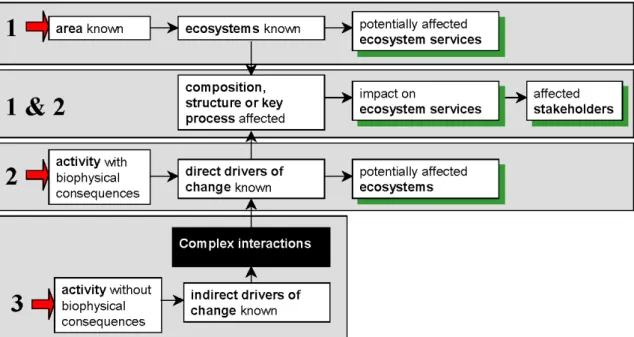
15. Step 1: According to the principles of the ecosystem approach, a biodiversity screening map is designed, indicating important ecosystem services
(replacing the concept of sensitive areas – see appendix 2 below). The map is based on expert judgement and has to be formally approved.
16. Suggested categories of geographically defined areas, related to important ecosystem services, are:
a) Areas with important regulating services in terms of maintaining biodiversity:
Protected areas: depending on the legal provisions in a country these may be defined as areas in which no human intervention is allowed,
or as areas where impact assessment at an appropriate level of detail is always required;
Areas containing threatened ecosystems outside of formally protected areas, where certain classes of activities (see step 2) would always require an impact assessment at an appropriate level of detail;
Areas identified as being important for the maintenance of key ecological or evolutionary processes, where certain classes of activities (see step 2) would always require an impact assessment at an appropriate level of detail;
Areas known to be habitat for threatened species, which would always require an impact assessment at an appropriate level of detail. b) Areas with important regulating services for maintaining natural
processes with regard to soil, water, or air, where impact assessment at an appropriate level of detail is always required. Examples can be wetlands, highly erodable or mobile soils protected by vegetation (e.g. steep slopes, dune fields), forested areas, coastal or offshore buffer areas; etc.
c) Areas with important provisioning services, where impact assessment at an appropriate level of detail is always required. Examples can be extractive reserves, lands and waters traditionally occupied or used by indigenous and local communities, fish breeding grounds; etc.
d) Areas with important cultural services, where impact assessment at an appropriate level of detail is always required. Examples can be scenic landscapes, heritage sites, sacred sites; etc.
e) Areas with other relevant ecosystem services (such as flood storage areas, groundwater recharge areas, catchment areas, areas with valued landscape quality, etc.); the need for impact assessment and/or the level of assessment is to be determined (depending on the screening system in place);
f) All other areas: no impact assessment required from a biodiversity perspective (an EIA may still be required for other reasons).
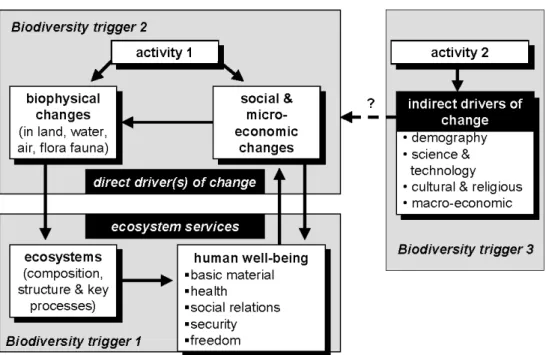
17. Step 2: Define activities for which impact assessment may be required from a biodiversity perspective. The activities are characterized by the following direct drivers of change:
a) Change of land-use or land cover, and underground extraction: above a defined area affected, EIA always required, regardless of the location of the activity - define thresholds for level of assessment in terms of surface (or underground) area affected;
See also Handbook 19, Addressing change in wetland ecological character
b) Change in the use of marine and/or coastal ecosystems, and extraction of seabed resources: above a defined area affected, EIA always
required, regardless of the location of the activity - define thresholds for level of assessment in terms of surface (or underground) area affected; c) Fragmentation, usually related to linear infrastructure. Above a defined
length, EIA always required, regardless of the location of the activity – define thresholds for level of assessment in terms of the length of the proposed infrastructural works;
d) Emissions, effluents or other chemical, thermal, radiation or noise emissions - relate level of assessment to the ecosystem services map; e) Introduction or removal of species, changes to ecosystem composition,
ecosystem structure, or key ecosystem processes responsible for the maintenance of ecosystems and ecosystem services (see appendix 2 below for an indicative listing) - relate level of assessment to ecosystem services map.
18. It should be noted that these criteria only relate to biodiversity and serve as an add-on in situations where biodiversity has not been fully covered by the existing screening criteria.
19. Determining norms or threshold values for screening is partly a technical and partly a political process the outcome of which may vary between countries and ecosystems. The technical process should at least provide a description of:
a) Categories of activities that create direct drivers of change (extraction, harvest or removal of species, change in land-use or cover,
fragmentation and isolation, external inputs such as emissions, effluents, or other chemical, radiation, thermal or noise emissions, introduction of invasive alien species or genetically modified organizms, or change in ecosystem composition, structure or key processes), taking into account characteristics such as: type or nature of activity, magnitude, extent/location, timing, duration, reversibility/ irreversibility, irreplaceability, likelihood, and significance; possibility of interaction with other activities or impacts;
b) Where and when: the area of influence of these direct drivers of change can be modelled or predicted; the timing and duration of influence can be similarly defined;
c) A map of valued ecosystem services (including maintenance of biodiversity itself) on the basis of which decision makers can define levels of
protection or conservation measures for each defined area. This map is the experts’ input into the definition of categories on the biodiversity screening map referred to above under step 1.
Ramsar: In addressing the likelihood of effects and their relevance and significance for Ramsar-related values, reference should be made to Ramsar guidance on ecological character and on risk assessment (see, e.g., Resolutions VIII.8, IX.1 Annex E, [X.16] and Ramsar
2. Scoping
20. Scoping is used to define the focus of the impact assessment study and to identify key issues, which should be studied in more detail. It is used to derive terms of reference (sometimes referred to as guidelines) for the EIA study and to set out the proposed approach and methodology. Scoping also enables the competent authority (or EIA professionals in countries where scoping is voluntary) to:
a) Guide study teams on significant issues and alternatives to be assessed, clarify how they should be examined (methods of prediction and analysis, depth of analysis), and according to which guidelines and criteria;
b) Provide an opportunity for stakeholders to have their interests taken into account in the EIA;
c) Ensure that the resulting Environmental Impact Statement is useful to the decision maker and is understandable to the public.
21. During the scoping phase, promising alternatives can be identified for in-depth consideration during the EIA study.
22. Consideration of mitigation and/or enhancement measures: The purpose of mitigation in EIA is to look for ways to achieve the project objectives while avoiding negative impacts or reducing them to acceptable levels. The purpose of enhancement is to look for ways of optimizing environmental benefits. Both mitigation and enhancement of impacts should strive to ensure that the public or individuals do not bear costs, which are greater than the benefits that accrue to them.
23. Remedial action can take several forms, i.e., avoidance (or prevention),
mitigation (by considering changes to the scale, design, location, siting, process, sequencing, phasing, management and/or monitoring of the proposed activity, as well as restoration or rehabilitation of sites), and
compensation (often associated with residual impacts after prevention and mitigation). A ‘positive planning approach’ should be used, where avoidance has priority and compensation is used as a last resort measure. One should acknowledge that compensation will not always be possible: there are cases where it is appropriate to reject a development proposal on grounds of irreversible damage to, or irreplaceable loss of, biodiversity.
24. Practical evidence with respect to mitigation suggests that:
a) Timely and ample attention to mitigation and compensation, as well as the interaction with society, will largely reduce the risk of negative
Ramsar: In the Ramsar context, particular attention should be given to the ‘positive planning approach’ and the recognition that in some cases it will be appropriate to reject a proposal, as many Parties have done, on the grounds of damage to/loss of Ramsar related values.
Additional information
The International Association for Impact Assessment (IAIA)
The IAIA is a forum for advancing innovation, development, and communication of best practice in impact assessment. It was established in 1980 to bring together researchers, practitioners, and users of various types of impact assessment from all parts of the world, and its members include corporate planners
and managers, public interest advocates, government planners and administrators, private consultants and policy analysts, university and college teachers and their students.
A key feature of IAIA is the mix of professions represented, which provides outstanding opportunities for interchange in order to:
• advance the state of the art and science of impact assessment in applications ranging from local to global,
• develop international and local capability,
• anticipate, plan and manage the consequences of development, and • enhance the quality of life for all.
IAIA’s first Branch (a group comprised entirely of IAIA-International members), the
Washington (DC) Area Branch, was organized in September 2001 and the Ireland-UK Branch was formalized in June 2008.
IAIA members now number more than 1,600 and represent more than 120 countries. As of July 2009, IAIA Affiliates were active in Eastern Africa, Ghana, Italy, Korea, New Zealand, Ontario (Canada), Portugal, Quebec (Canada), South Africa, Spain, and Western and
Northern Canada. . Twelve topic-based “Sections” , including one on Biodiversity & Ecology, provide opportunities for IAIA members with mutual interests to share experiences and discuss ideas in an informal setting. Sections provide a forum for active topical debate and for development and promotion of good practice.
International conferences are held annually. Regional conferences are organized to make information exchange and networking opportunities available to those who might not be able to attend the international conferences, as well as to focus attention to specific issues. Training programmes, ranging from one day to one week in duration and dealing with a variety of impact assessment issues, are held regularly in conjunction with IAIA international conferences.
IAIA activities seek to:
• develop approaches and practices for comprehensive and integrated impact assessment; • improve assessment procedures and methods for practical application;
publicity, public opposition and delays, including associated costs. Specialist input on biodiversity can take place prior to initiating the legally required EIA process, as a component of the project proposal. This approach improves and streamlines the formal EIA process by identifying and avoiding, preventing or mitigating biodiversity impacts at the earliest possible stage of planning;
b) Mitigation requires a joint effort of the proponent, planners, engineers, ecologists and other specialists, to arrive at the best practicable
environmental option;
c) Potential mitigation or compensation measures have to be included in an impact study in order to assess their feasibility; consequently they are best identified during the scoping stage;
d) In project planning, it has to be kept in mind that it may take time for effects to become apparent.
25. The following sequence of questions provides an example of the kind of information that should be requested in the terms of reference of an impact study if the project screening suggests that the proposed activity is likely to have adverse impacts on biodiversity. It should be noted that this list of steps represents an iterative process. Scoping and impact study are two formal rounds of iteration; during the study further iterative rounds may be needed, for example when alternatives to the proposed project design have to be defined and assessed.
of the IAIA’s Biodiversity & Ecology Section contributed to the preparation of the CBD Guidelines in 2002 and 2006 which now feature in the Ramsar guidance incorporated in this handbook.
In 2003 the IAIA initiated a project, with funding from the government of the Netherlands, on “Capacity building in Biodiversity and Impact Assessment in Developing Countries”. This is designed to support countries in their implementation of CBD and Ramsar through the establishment of networks of trained impact assessment professionals, capacity-building, and the provision of training materials for integrating biodiversity into impact assessment processes.
For information about membership or answers to questions about IAIA, contact the International Headquarters, [email protected], or visit http://www.iaia.org/.
Ramsar: There is evidence* that human influences on wetland ecosystems are increasing the likelihood of nonlinear and potentially abrupt changes. These can be large in magnitude and difficult, expensive or impossible to reverse, for example when nutrient-loading thresholds are crossed and mass animal die-offs occur, or sediment disturbance unlocks toxins.
The role of mitigation and compensation in a Ramsar context is described in [Resolution X.16 (Detecting, reporting and responding to change in ecological character of wetlands)] and further guidance on these issues is planned for the future.
a) Describe the type of project, and define each project activity in terms of its nature, magnitude, location, timing, duration and frequency; b) Define possible alternatives, including “no net biodiversity loss” or
“biodiversity restoration” alternatives (such alternatives may not be readily identifiable at the outset of impact study, and one would need to go through the impact study to determine such alternatives). Alternatives include location alternatives, scale alternatives, siting or layout alternatives, and/or technology alternatives;
c) Describe expected biophysical changes (in soil, water, air, flora, fauna) resulting from proposed activities or induced by any socio-economic changes caused by the activity;
d) Determine the spatial and temporal scale of influence of each biophysical change, identifying effects on connectivity between ecosystems, and potential cumulative effects;
e) Describe ecosystems and land-use types lying within the range of influence of biophysical changes;
f) Determine, for each of these ecosystems or land-use types, if
biophysical changes are likely to have adverse impacts on biodiversity in terms of composition, structure (spatial and temporal), and key processes. Give indication of the level certainty of predictions, and take into account mitigation measures. Highlight any irreversible impacts and any irreplaceable loss;
g) For the affected areas, collect available information on baseline conditions and any anticipated trends in biodiversity in the absence of the proposal;
(h) Identify, in consultation with stakeholders, the current and potential ecosystem services provided by the affected ecosystems or land-use types and determine the values these functions represent for society
See also Handbook 15, Wetland inventory
Ramsar: In a Ramsar context, the appropriate spatial scale at which to think about impacts may sometimes be a particularly broad-scale interpretation of “ecosystem”. In particular, the river basin (water catchment) is an important scale at which to address aspects of wetland-related impacts. Also, where impacts on particularly important species such as migratory fish or birds are at stake, assessment at the scale of the migratory range (flyway) of the relevant populations will be very relevant. This may involve a chain of ecosystems (perhaps disjunct ones), and therefore may need to take a broader perspective than would normally be the case under the ecosystem approach.
Ramsar: In the case of Ramsar sites, the ‘baseline’ should relate to the site’s ecological
(see box 1). Give an indication of the main beneficiaries and those adversely affected from an ecosystem services perspective, focusing on vulnerable stakeholders;
i) Determine which of these services will be significantly affected by the proposed project, giving confidence levels in predictions, and taking into account mitigation measures. Highlight any irreversible impacts and any irreplaceable loss;
j) Define possible measures to avoid, minimize or compensate for significant damage to, or loss of, biodiversity and/or ecosystem
services; define possibilities to enhance biodiversity. Make reference to any legal requirements;
k) Evaluate the significance of residual impacts, i.e. in consultation with stakeholders define the importance of expected impacts for the alternatives considered. Relate the importance of expected impacts to a reference situation, which may be the existing situation, a historical situation, a probable future situation (e.g., the ‘without project’ or ‘autonomous development’ situation), or an external reference situation. When determining importance (weight), consider geographic importance of each residual impact (e.g., impact of local/regional/ national/continental/global importance) and indicate its temporal dimension.
l) Identify necessary surveys to gather information required to support decision making. Identify important gaps in knowledge;
m) Provide details on required methodology and timescale.
26. One should bear in mind that not implementing a project may in some cases also have adverse effects on biodiversity. In rare cases the adverse effects may be more significant than the impacts of a proposed activity (e.g. projects counteracting degradation processes).
Ramsar: For guidance on public involvement, refer to the Guidelines for establishing and strengthening local communities’ and indigenous people’s participation in the management of wetlands
(Resolution VII.8), the New Guidelines for management planning for Ramsar sites and other wetlands
(Resolution VIII.14) and Ramsar Handbooks [7 and 18 (4th edition)].
Ramsar: In evaluating the significance of residual impacts for Ramsar-related values,
reference should be made to Ramsar guidelines on ecological character and on risk assessment (see e.g., Resolutions VIII.8, IX.1 Annex E, [X.16] and Ramsar Technical Report Methodologies for assessing the vulnerability of wetlands to change in their ecological character, in preparation).
27. An analysis of current impact assessment practice9 has provided a number
of practical recommendations when addressing biodiversity-related issues: a) Beyond the focus on protected species and protected areas, further
attention needs to be given to (i) sustainable use of ecosystem services; (ii) ecosystem level diversity; (iii) non-protected biodiversity; and (iv) ecological processes and their spatial scale;
b) The terms of reference should be unambiguous, specific and compatible with the ecosystem approach; too often the terms of reference are too general and impractical;
c) In order to provide a sound basis for assessing the significance of impacts, baseline conditions must be defined and understood and quantified where possible. Baseline conditions are dynamic, implying that present and expected future developments if the proposed project is not implemented (autonomous development) need to be included; d) Field surveys, quantitative data, meaningful analyses, and a broad,
long-term perspective enabling cause-effect chains to be tracked in time and space are important elements when assessing biodiversity impacts. Potential indirect and cumulative impacts should be better assessed; e) Alternatives and/or mitigation measures must be identified and
described in detail, including an analysis of their likely success and realistic potential to offset adverse project impacts;
f) Guidance for scoping on biodiversity issues in EIA needs to be developed at country-level, but should, where appropriate, also consider regional aspects to prevent transboundary impacts;
g) Guidance for determining levels of acceptable change to biodiversity needs to be developed at country level to facilitate decision-making; h) Guidance on assessing and evaluating impacts on ecosystem processes,
rather than on composition or structure, need to be developed at country level. The conservation of ecosystem processes, which support composition and structure, requires a significantly larger proportion of the landscape than is required to represent biodiversity composition and structure;
i) Capacity development is needed to effectively represent biodiversity issues in the scoping stage; this will result in better guidelines for the EIA study.
9 See document UNEP/CBD/SBSTTA/9/INF/18.
See also Handbook 20, International cooperation
Box 1: Stakeholders and participation
Impact assessment is concerned with (i) information, (ii) participation and (iii) transparency of decision-making. Public involvement consequently is a prerequisite for effective EIA and can take place at different levels: informing (one-way flow of information), consulting (two-way flow of information), or “real” participation (shared analysis and assessment). In all stages of EIA public participation is relevant. The legal requirements for and the level of participation differ among countries, but it is generally accepted that public consultation at the scoping and review stage are essential; participation during the assessment study is generally acknowledged to enhance the quality of the process.
With respect to biodiversity, relevant stakeholders in the process are:
• Beneficiaries of the project - target groups making use of, or putting a value to, known ecosystem services which are purposefully enhanced by the project; • Affected people – i.e. those people that experience, as a result of the project,
intended or unintended changes in ecosystem services that they value;
• General stakeholders – i.e. formal or informal institutions and groups representing either affected people or biodiversity itself.
• Future generations – “absent stakeholders”, i.e. those stakeholders of future generations, who may rely on biodiversity around which decisions are presently taken.
There is a number of potential constraints to effective public participation. These include:
• Deficient identification of relevant stakeholders may make public involvement ineffective;
• Poverty: involvement requires time spent away from income-producing tasks;
• Rural settings: increasing distance makes communication more difficult and expensive;
• Illiteracy: or lack of command of non-local languages, can inhibit representative involvement if print media are used;
• Local values/culture: behavioural norms or cultural practice can inhibit involvement of some groups, who may not feel free to disagree publicly with dominant groups;
• Languages: in some areas a number of different languages or dialects may be spoken, making communication difficult;
• Legal systems: may be in conflict with traditional systems, and cause confusion about rights and responsibilities for resources;
• Interest groups: may have conflicting or divergent views, and vested interests;
• Confidentiality: can be important for the proponent, who may be against early involvement and consideration of alternatives.