ACOUSTIC QUALITY EVALUATION OF YOUNG CHILDREN'S
(0-6 YEARS) SPACES
43.55.Hy
Christophe LOUWERSE ; Aline BARLET ; Catherine SEMIDOR, GRECO-Bordeaux, Ecole d'architecture et de paysage de Bordeaux, Domaine de RABA – F 33400 TALENCE,
33.05.57.35.11.59 33.05.56.37.03.23
ABSTRACT This paper deals with the establishment of a method that allows to evaluate the acoustic quality of day care centres and nursery schools. These premises are rarely considered in terms of environment, particularly in acoustic terms. Nevertheless, during their stay, the young users could be confronted with auditory "aggressions" on which they can not react by their verbal incapacity. In order to know more about the relation between the children's comportment and the environment it seems essential, after measurements of its acoustic characteristics, to analyse by the way of examples, the relation between their reactions and the different sound messages, the architecture involved and the activities that take place in the particular spaces.
THE TODDLER’S SENSITIVITY TO THE NOISE ENVIRONMENT
In order to ensure the toddler’s harmonious development, the crèches and nursery schools must offer a good quality environment in terms of thermics, light and acoustics. In spite of this, the programming, design and implementation of such facilities rarely show a particular reflection on the encountered ambiences in these kind of spaces and their importance for the users well-being.
The research presented here is in keeping with the wish to provide prime contractors and contracting authorities the means to approach these aspects of the design.
Being conscious of the permanent interaction between the different physical environmental features [1] but not being able to tackle the totality of the parameters, we turn our interest to the acoustic quality of these premises.
In fact the background noise of these premises have to meet two requirements :
- ensure an appropriate acoustical comfort inside the different rooms where all the daily activities take place,
Therefore, different studies show that from their birth, young children are perceptive and sensitive to their noise environment. They are even capable to locate sounds and recognise familiar tones during the prenatal period. A few weeks old, the child shows the ability to distinguish different melodic themes, like foreign languages. [2] [3]
We also know that the prattling sound production and the different ways of vocalisation up to the verbalisation expressing social ties, expectations and need satisfaction, is related to the diversity of sound stimulations to which the child would have been submitted. [4]
So it seems clear that it is necessary to offer children outside the family context which is not of our concern her, spaces where their interaction with the noise environment is not polluted with unusable acoustical interferences.
Not only do we have to eliminate the disturbing noises, but we also have to conceive spaces that permit the children to listen to the noises which are significative and contribute to their personality development. [5]
The design of these kind of spaces requires in the first place some information of the way the toddlers perceive and react on noises and in a second place the necessary know-how in order to translate and materialise these demands in constructive terms.
Already from the very beginning of the project initiative we have to provide the architect with all possible information on forms, volumes, materials that allow him to design spaces, each with their appropriate acoustical quality [6]. Moreover, the large diversity of spaces and activities within the institution, generates and requires specific background noises : muffled for the resting rooms, calmness for the "awakening" rooms, more lively for the play and self-expression rooms.
Thus, the aim of this research is to help the designers to think acoustical comfort, which supposes a conceptual reflection integrating the nature of the background noise, on the organisation and distribution of the space. This reflection has to be based on the analysis of the existing activities and the development possibilities these spaces intend to provide to the child, as well as sound "producer" as sound "receptor".
FOR A GLOBAL APPROACH
In order to value the acoustical quality of no matter which space, and to approach the users needs as near as possible we developed a methodology that takes into account objective (measured) and subjective (sensitive) data.
This allows us to approach in a most exhaustive possible way, the acoustic comfort within the nursery schools and crèches. It concerns as well the used tools as the nature of the collected data or the diversity of the concerned users and retained architectural types. The entire methodology is standardised, can be relevant for any other establishment and can be split into three successive stages corresponding respectively to the choice of the site and it’s ambience characterisation before and after the modifications of the considered spaces.
Case Study
After we drew up a list of selection criteria we made a choice for those establishments which correspond partially or entirely to the existing diversity of this type of construction.
Also the accommodation facilities are interesting, notably if we look at the relation between the real and the estimated effective. For instance what is happening with the small and large structures and establishments with an overcapacity.
The third criteria is interested in the functional origins of the premises, whether they were designed and built for being crèches or nursery schools or have been transformed and adjusted in this purpose.
One of the objectives of this study is to disturb as less as possible the children’s behaviour and the general functioning of the premises. So it is important to pay attention to the practices on the spot. The researchers presence, the different interventions have to pass, as much as possible, unnoticed.
In the case of premises with repetitive identical volumes and forms, we wish to study spaces with simple and complex forms and volumes, at simple and double level.
In other respects, the premises should be relatively bare in order to be able to intervene on materials and as such to modify the acoustic environment.
Lastly we have to take into account the environmental features which are related to the presence and infiltration of the outside world and its influence on the inside and outside spaces of the establishment.
To carry out this study we worked out a more or less simple analysis chart based on architectural criteria and used this in the different visited establishments.
So, besides the standard elements of information as the year of construction, the level number or still the number of welcomed children, a big interest concerns the nature of the outside environment and the remarks made on the qualities or the acoustic defects of the site.
For every visited premises, information about the dimensions of spaces, the nature of the implemented materials, the nature and the number of openings towards the outside and the inside is raised.
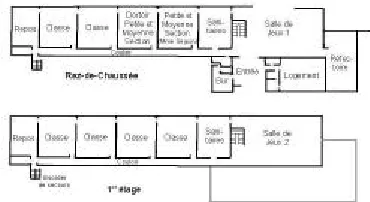
[image:3.596.316.501.462.563.2]After these first visits and the analysis of the establishments according to the criteria of selection, we retained at present five nursery schools, named A, B, C, D, E. We present in figure 1 and 2 two examples of establishments having very different configurations. These two schools, but also the other establishments, distinguish themselves by the accommodation facilities, the level number, the regularity of the forms …
Figure 1 : Plan of the nursery school A Figure 2 : Plan of the nursery school E
Methodological Developments
Phase diagnosis
The acoustic measures are made with:
- a laptop of type Pentium II, 400 MHz;
- a Symphony system allowing the acquisition of a signal on one or two ways;
- a microphone with condensers and the belonging preamplifier PRE12.
The measures were taken with the software dBBATI32, developed by the company 01dB-Stell, in all the premises of every establishment (classrooms, dining halls, rooms of activity, circulation, sanitary facilities).
They allow to approach by classic procedures :
- the isolation between the premises and with regard to the exterior,
- the background noise,
- the criteria of inside acoustic comfort (reverberation, light, intelligibility…).
At the same time, in the presence of the children, sound recordings are realised in premises in order to create a corpus of sound messages but also to proceed to measures in posteriori. These recordings are realised on the one hand by means of a part of an omnidirectionnel microphone of type MK24 of Cirrus and on the other hand by a stereophonic microphone, type MKE on 2000 of Sennheiser, based on the so called dummy head recording principle. It is made of a pair of miniature electret capsules, placed near the ears of the sound engineer in order to use these as acoustic reflectors. Two digital tape recorders of type coupled DAT either in the dummy head or in the omnidirectionnel microphone allows us to realise high-quality sound recordings.
For every establishment, the recordings are made on a day. They consist of sequences concerning the sound environment at the different moments of the day, the various places and strategic moments of the school life (arrival of the children, when the school comes out, the recreation, the meals, the classrooms) but also sound walks in and around premises. We paid particular attention to the rooms of activity with their multifunctional aspect in order to record representative periods of the variety of the possible activities (motor action, song, reading). The constitution of the corpus of sound message proceeds of the selection of significant sounds among all the registered (recorded) sequences, which means the striking sounds in the space-time identification of the children.
The acoustic data are completed by a fine architectural analysis carried out on site and on plan [8]. Shots of photographic clichés, description of the implemented materials, the architectural surveys, the sketches, and study of the contractual documents (plans, elevation sections) compose this analysis.
During this phase, the study of the subjective aspects is also realised with the users. In the case of day-nurseries and nursery schools, we meet two types of population to know the children and the adults whose criteria and stakes concerning the acoustic quality could be different.
For the adults, it concerns first their workroom and then the place of expertise. As working space, the physical parameters, which characterise it, can have an influence on their representation of the work conditions and even on their "efficiency". As place of expertise, the adults are a source of information as for the qualities indispensable to the good development of the children.
For the children, it concerns the central places for the construction of their relations with their environment, that one considers the composing physical elements and/or the social elements.
So, the collection of data with the adults uses the method of inquiry by questionnaire because this technique seems to be the most adapted to study attitudes, preferences and opinions on a big number of parameters. This questionnaire tends to estimate, both from the point of view of the user and of the expert :
- the general characteristics of the physical and social environment,
- the degree of satisfaction towards the environmental conditions,
- the needs and desires concerning the environment,
- the place of the acoustics in the evaluation of the quality of places,
- the evaluation of the acoustic characteristics.
As a matter of fact, it is here a question of defining the lived comfort and the comfort wished by the adults users of the studied spaces.
On the other hand, because of the young age of the children, the use of this method seems inappropriate. The observation method seems more appropriate in order to allow to look at a situation without modifying it too much. With this method indeed, the intention is often very general and acts at the level of the choice of the situation and not at the level of what is to be observed in the situation, the purpose being the collection of data concerned to the situation. In that case, the intervention of the researcher tries to be minimal.
This technique allows us to grasp the function of the various spaces and the various typical behaviour of the children according to the considered space and the activities that take place there. (Speeches, laughter, tears, behaviour of isolation).
Involving observations of the group of children, the use of audio-visual material allows more complete and complex data analyses, without risk of neglect, on a big number of children.
These observations are realised according to two procedures: in an "classic" acoustic environment and during the restoration of the sound messages where the striking sounds are mixed in non-significant sounds and diffused at the different moments in different places and at the different sound levels.
At the same time, but only in the nursery schools, certain children (the oldest and/or those having a big linguistic mastery) will participate in interviews in the classes during which the relevance of sounds will be studied.
Phase "modified space"
In this second phase, after the manufacture of mobile architectural elements tested in reverberate room and susceptible to modify the internal acoustics of the various premises, a similar campaign of measures is foreseen in order to put in evidence a new sound configuration.
In a second time, after a period of adaptation of the children to this new configuration, a new series of observations and interviews are carried out to estimate the changes of behaviour which can occur in the modified rooms.
FIRST RESULTS
At present, the first phase is in progress. The acoustic measures, the architectural statements and the sound recordings were made and analysed in a isolated way, for the five nursery schools.
Figure 3: Graph of the time of reverberation in the rooms of activity of nursery schools
To show the correlation of these measures with the architectural parameters completes the data bank multicriteria which we want to use in our methodology. Remain to collect elements in relation with the subjective aspect, which for reasons of constancy of the populations, should be to apprehended on a single school year.
All the expected results should allow us to elaborate methods of project behaviour of this type of establishment from recommendation to assure the harmonious development and the awakening of the young child.
REFERENCES
[1] BARLET A. – Le confort dans le milieu scolaire. Psychologie Française, n°42.2 spécial "Psychologie de l'environnement", 1997.
[2] DELORME A. – Psychologie de la perception. Editions Etudes vivantes, Paris, 1982. [3] ZENATTI A. – L'enfant et son environnement sonore. Editions EAP, 1981.
[4] CEMESTE B., DELALANDE F., DUMAURIER E. – L'enfant, du sonore au musical. Editions Buchet-Chastel, Coll. I.N.A.-G.R.M., 1982.
[5] Collectif – Guide d'accompagnement des pratiques d'éveil culturel et artistique dans les lieux d'accueil de la petite enfance. Editions Eveil culturel et petite enfance, 3 volumes, 1995.
[6] HAMAYON L. – Réussir l'acoustique d'un bâtiment. Editions Le moniteur, 1996.
[7] JOUENNE Ph. – Caractérisation de la qualité acoustique des lieux d'écoute. Thèse de Doctorat de l'Université Pierre et marie Curie (Paris VI), décembre 1992.
[8] SEMIDOR C. – Relations entre architecture et qualité acoustique : contribution à la caractérisation acoustique d'un lieu d'écoute. Thèse d'état de l'Université Paul Sabatier de Toulouse, sous la direction de C. Azaïs, 1999.
Activity rooms
0 0,2 0,4 0,6 0,8 1 1,2 1,4 1,6 1,8 2
100 1000 10000
Fréquency (Hz)
Reverberation time (s)
School A School B Room 1 School B Room 2 School C Room 1