
Cognitive conflict resolution during psychotherapy: Its impact on depressive symptoms and psychological distress
35
0
0
Texto completo
(2) Running head: COGNITIVE CONFLICT RESOLUTION. 2. Abstract Objective: The aim of this study was to assess the resolution of cognitive conflicts (CC) within a randomized controlled trial (Feixas et al., 2016) testing the differential efficacy of group cognitive behavioral therapy (CBT) plus an individually tailored intervention module focused on CCs versus group plus individual CBT, and to determine whether CC resolution was related to improvement in symptoms and psychological distress. Methods: The data come from 104 adults meeting criteria for major depressive disorder and/or dysthymia. Change in scores on the Beck Depression Inventory II and Clinical Outcomes in Routine Evaluation-Outcome Measure was assessed at the end of treatment and at three-month follow-up. Outcomes were compared between those participants who resolved their CCs and those who maintained them using threelevel multilevel growth models. Results: CC resolution did not depend on treatment allocation. Participants who resolved their CCs acquired greater benefits with regards to reduction of depressive symptoms and psychological distress than those who maintained their conflicts. Conclusions: CC seems to be a relevant notion to take into consideration to understand symptom improvement. Further research on CC might lead to the advancement of treatments which involve conflict resolution as a change mechanism. Keywords: cognitive conflicts; Dilemma-Focused Intervention; depression; Cognitive Behavioral Therapy; outcome research.
(3) Running head: COGNITIVE CONFLICT RESOLUTION. 3. Cognitive conflict resolution during psychotherapy: Its impact on depressive symptoms and psychological distress Depression is one of the leading causes of disability worldwide (Ferrari et al., 2013). For this reason, great efforts have been made to find accurate explanations of the disorder and to develop effective treatments. Despite these efforts, recurrences and relapses still occur in a high number of treated patients (Steinert, Hofmann, Kruse, & Leichsenring, 2014). Therefore, the improvement of explicative models and treatments is a crucial challenge for psychotherapy. The objective of psychotherapy is to generate a change which might be reflected in the reduction of symptoms and in a more positive view of the self (Binder, Holgersen, & Nielsen, 2010). Although individuals who come to therapy express a desire to change those characteristics that cause distress for them, they do not want to change those features that are central to their identity and sense of continuity in the world. The relationship between the need for change and the need for continuity might have crucial influence on the psychotherapeutic process, even more if these two needs pull in opposite directions, creating internal conflicts. For example, therapists might encourage a person to be active, to go out and to attend to one’s needs; but for a person who identifies him/herself as selfsacrificing, protective or selfless, these attained characteristics might be incompatible with their view of the self, causing the self to be seen as selfish. As a consequence, change during the course of therapy might be hampered by the need to maintain those personal characteristics which are valued as positive and which define the personal identity. Furthermore, even for a successful treatment process, this need might contribute to the occurrence of relapses. Similarly, Mahoney (2003) explains that changes might be experienced as threatening, because the self is paradoxical: at one and the same time it is changeable, and it is permanent..
(4) Running head: COGNITIVE CONFLICT RESOLUTION. 4. The idea that the presence of internal conflicts impedes change in psychotherapy is not new in psychotherapy. Starting from psychoanalysis (Freud, 1927/1936; Horney, 1992/1945), some psychotherapeutic approaches have considered the resolution of internal conflicts as being central to the process of psychotherapy, such as experiential or humanistic (Greenberg, 2004), cognitive (Epstein, 1982), behavioral (Wolpe, 1968), motivational (Grawe, 2004) and constructivist (Hinkle, 1965/2010; Kelly,1955/1991; Mahoney, 2003) approaches. Each of these approaches uses different conceptualization of conflict and a specific procedure to deal with it. From a cognitive perspective, two methods have been used for investigating the role of internal conflict in psychotherapy process: computerized intrapersonal conflict assessment (CICA) and repertory grid technique (RGT). CICA (Lauterbach, 1996; Lauterbach & Newman, 1999) is a method based on Heider’s (1946) balance theory. In fact, this theory also led to the development of one of the repertory grid methods of assessing conflict (Slade & Sheehan,1979). CICA is specifically designed to identify conflicts, which are defined as inconsistencies within a cognitive network formed by beliefs and attitudes about personally relevant concepts (e.g. “independence”, “leisure time”, “school success”). Inconsistencies are assessed using triads, which are structures of three cognitive concepts and their relationships. A triad is balanced if none or two relations between concepts are negative; whereas it is imbalanced if one or three relations are negative. An imbalanced triad indicates the presence of conflict. Studies using CICA to assess change in conflicts in psychotherapy (Hoyer, Fecht, Lauterbach & Schneider, 2001; Michalak, 2000; Renner & Platz, 1999 ) had indicated that psychological treatment reduces intrapersonal conflicts, symptoms and psychological distress. However, the reduction of conflicts is not specific to a type of.
(5) Running head: COGNITIVE CONFLICT RESOLUTION. 5. intervention; even cognitive behavioral therapy (CBT) reduced conflicts, although this is not an explicit target for this approach. RGT (Feixas & Saúl, 2004; Fransella, Bell, & Bannister, 2004), the instrument used in this study to measure intrapersonal conflicts, emerged from personal construct theory (Kelly, 1955/1991). This theory considers that humans actively construe themselves and their reality by means of an evolving repertory of bipolar discriminations known as personal constructs (e.g., “happy” vs “unhappy”, “sensitive” vs “rude”), which are organized into a complex interconnected system and reflect the idiosyncratic meanings and values that each individual develops in their life. The way in which the individual applies constructs to their “self now” and “ideal self” may be particularly significant as it may involve internal incompatibilities, resulting in different kinds of cognitive conflicts (CC). The RGT is a semi-structured interview which allows the assessment of the self-concept and provides several cognitive indices through the elicitation of personal constructs by the comparison of the “self now,” the “ideal self,” and significant others (see Methods section for more details). With the RGT, two forms of CCs can be identified: implicative dilemmas and dilemmatic constructs. The notion of implicative dilemma refers to a conflict that emerges when the person has to reconcile a construction that aims for change with a construction that looks for continuity. In terms of personal construct theory, an implicative dilemma arises whenever there is an association of a desired change in one construct with an undesired change in another construct, which might be relevant to describe the person’s identity. Three components (Feixas & Saúl, 2004) are considered to operationalize ID with the RGT (see Figure 1):.
(6) Running head: COGNITIVE CONFLICT RESOLUTION. 6. 1) Congruent constructs. These personal constructs reflect congruency between the “self now” and the “ideal self,” which means that the person has a specific characteristic that he or she does not want to change. Often, these constructs express core values, attitudes or beliefs that define the person’s sense of identity (Montesano et al., 2014). In the example, the “self now” is considered as “generous” (in her own terms) and the person wants to maintain this feature because the “ideal self” is also described as “generous”. The opposing pole of the construct, “selfish”, is the undesired pole of the construct for the self. 2) Discrepant constructs. They describe an inconsistency between how a person defines a specific personal feature of their present self (“self now”) and how he or she would like this feature to be (“ideal self”). Generally, people come to therapy to change from the undesired pole of the construct to the desired pole of the construct with the objective to have a more positive view of the self. In the example (see Figure 1), the undesired pole of the construct is “sad”, which is a characteristic observed in the “self now;” however, the person would like to be “content,” which is the desired pole of the construct. But discrepant constructs do not indicate a CC per se; rather, they have to be linked to congruent constructs in a way that blocks the natural progress from the undesired to the desired pole (see the third component, as follows). 3) An association between a congruent construct and a discrepant construct within the personal construct system. Specifically, the desired change, to move from the undesired pole of the discrepant construct (“sad”) to the desired pole of this construct (“content”) implies also –by virtue of the correlation found between these two constructs— to change from the desired pole of the congruent construct (“generous”).
(7) Running head: COGNITIVE CONFLICT RESOLUTION. 7. to the undesired pole of this construct (“selfish”). In other words, becoming more “content” implies for this person—according to the relationships between her or his constructs— a relatively strong tendency (or peril) to become “selfish.” [Figure 1 near here] The second form of CC detected by the RGT is dilemmatic construct. This type of CC refers to constructs in which neither pole of the construct is desirable. Therefore, these are constructions which do not offer a clear action plan, because both poles imply advantages as well as disadvantages. For example, a person might have the personal construct “friendly” vs. “distant,” and allocate his or her ideal self at the midpoint (not “friendly,” nor “distant”) because, for this person both poles are desirable and undesirable at the same time. For instance, the person from the example (see Figure 1) might construe being “friendly” as being able to connect with others, but also as being shallow. On the other hand, being “distant” might be construed as being isolated and unable to get closer to others, but it might also mean to be reflective and wise. So, neither of the poles are desirable, which could paralyze the person in achieving their desired changes and objectives when this construct is at stake. Note that CCs, identified by means of the RGT, are specific to each individual’s personal meanings. Thus, the content of the discrepant, congruent and dilemmatic constructs is not defined by the researcher, but by the participants themselves. Michalak, Heidenrich and Hoyer (2011), after reviewing different theoretical perspectives about internal conflicts in psychotherapy, identified two general assumptions. The first assumption indicates that internal conflicts are related to the presence of symptoms. Several studies, using the RGT to identify CC, have indicated that CCs are not specific to depression (Feixas & Saúl, 2004; Montesano, López-González, Saúl, & Feixas, 2015). However, a series of.
(8) Running head: COGNITIVE CONFLICT RESOLUTION. 8. studies have shown several indicators of the relevance of CCs for depression. Specifically, it has been found that: (a) there is an elevated prevalence of depressive patients presenting with CCs compared to non-clinical samples (Feixas et al., 2014), (b) there are moderate to high associations between number of CCs and level of depressive symptoms (Montesano et al., 2014), (c) there is a significant association of CC with clinical aspects (e.g., suicidal attempts, global functioning) of the severity of the disorder (Feixas et al., 2014), and (d) CCs are relevant in the construction of the patients’ personal identity (Montesano, Feixas, Caspar, & Winter, 2017) The second assumption explains that the conflict is a motivational factor that might influence the course of the psychotherapeutic process, causing inhibition and difficulties to attain the proposed objectives. In this sense, internal conflicts can be considered as implicit schemes that can unwittingly affect symptom persistence and limited readiness to change. Only a few studies have measured the change of CCs during the psychotherapeutic process and its relationship with change in symptoms and psychological distress. These studies have been conducted in naturalistic settings during outpatient treatment for non-severe mental disorders (Feixas, Saúl, Winter, & Watson, 2008; Paz, Pucurull, & Feixas, 2015; Pucurull, 2015), indicating that psychological treatment reduces internal conflicts. This change is accompanied by improvement in symptoms and psychological distress and it is not distinctive of a specific type of psychological treatment. Despite these promising results, none of these studies have been conducted in a controlled setting, nor have they applied a specific intervention to reduce internal conflicts. Considering the relevance of internal conflicts and how their change might lead to a significant improvement in symptoms, Feixas and Compañ (2016) developed an intervention for depression focused on the resolution of dilemma(s) specifically detected for each patient—.
(9) Running head: COGNITIVE CONFLICT RESOLUTION. 9. dilemma-focused intervention (DFI). This intervention was conceived as an additional component to a broader treatment with the objective of enhancing its efficacy. It targets the specific conflicts detected for each patient and its objective is to attain the resolution of CCs. The efficacy of DFI has been tested in a randomized controlled trial (RCT; Feixas et al., 2013, 2016) which compared group cognitive behavioral therapy (CBT) plus individual DFI with group CBT plus individual CBT. The intervention in that study included eight sessions of group CBT for all participants plus eight sessions of individual therapy in which participants were randomly allocated to either CBT or DFI. As previously reported (Feixas et al., 2016), both types of treatments led to a significant reduction in symptoms and psychological distress with large effect sizes (Cohen’s d > 0.80). However, differential efficacy was not found between treatments according to outcome measures of depressive symptoms and psychological distress. CC resolution and its relationship with symptoms improvement was not considered in the mentioned study. This is, therefore, the focus of the present study, to conduct a reanalysis of that previous data set (Feixas, et al, 2016). Here, we did not focus on comparing evolution of symptoms and psychological distress on individuals allocated to different treatments, as in the previous study, but on comparing those participants who resolved their conflicts with those who maintained them after treatment. Therefore, the aim of the present study was to assess the resolution of CCs and to determine whether it is related to reduction in symptoms and psychological distress after therapy and at three-month follow-up. Three hypotheses were tested: 1. In regard to treatment allocation, we expected that participants allocated to the intervention CBTgroup + DFIindividual would resolve their CCs to a greater extent than those allocated to CBTgroup + CBTindividual..
(10) Running head: COGNITIVE CONFLICT RESOLUTION 2.. 10. In regard to depressive symptoms, it was expected that those participants who resolved their conflicts would show a greater improvement compared to those participants who maintained their CCs after the treatment.. 3.. In regard to psychological distress, we anticipated that those participants who resolve their conflicts during therapy would evince a greater improvement than those who maintained the CCs. Methods. Participants An extensive description of the participants and the procedures can be found elsewhere (Feixas et al., 2013, 2016). Participants were recruited by advertisements and by referrals from several mental health centers and primary care health institutions in Barcelona, Spain. Eligibility criteria for the clinical trial were: (a) aged between 18 and 70 years; (b) scoring 20 or above on the Beck Depression Inventory II (BDI-II; Beck, Steer, & Brown, 1996); (c) having a diagnosis of major depressive disorder or dysthymia according to the Diagnostic and Statistical Manual of Mental Disorders (DSM-IV-TR; American Psychiatric Association, 2000); (d) having at least one CC detected by means of the RGT; (e) having sufficient knowledge and competence to communicate in Spanish or Catalan. Participants were excluded if they (a) presented psychotic symptoms, manic or hypomanic episodes in the past, substance abuse, organic brain dysfunction, acute suicidal ideation or mental retardation; (b) were receiving psychological treatment; or (c) had substantial visual, hearing or cognitive deficits. All the participants were informed of the implications of the study and signed an informed consent document before enrolling in the trial. A total of 315 participants were assessed for eligibility, 26 participants (8%) were excluded for not presenting any kind of CC, 82 for not meeting other inclusion criteria and 10.
(11) Running head: COGNITIVE CONFLICT RESOLUTION. 11. declined to participate from the outset. Of the 197 participants who were considered as eligible, 56 left the study for various reasons (see supplemental material, S2, for a detailed flow chart of the clinical trial). In all, 141 participants started the psychotherapeutic intervention. Of these, 128 completed the group CBT and they were randomly allocated to one of the two individual interventions: DFI (n = 65) or CBT (n = 63). The analyzed sample in the present study was formed of 104 participants (CBTgroup + DFIindividual, n = 51 and CBTgroup + CBTindividual, n = 53), those who completed the allocated treatment (group plus individual therapy) and the posttreatment assessment. Only completers were included in the reanalysis, given that it is only at post-treatment when conflict resolution can be established. The three-month follow-up assessment was completed by 95 participants (CBTgroup + DFIindividual, n = 50; and CBTgroup + CBTindividual, n = 45). The average age of the participants at baseline was 49.82 years (SD = 11.18). Most of them were female (78.8%) and the majority (77%) with secondary or higher education level. At baseline, the mean score on the BDI-II was 37.02(SD = 9.41), indicating the presence of severe symptoms, and on the Clinical Outcomes in Routine Evaluation-Outcome Measure (CORE-OM) it was 2.13(SD = 0.54), representing acute psychological distress (see supplemental material, S1, for a details of the demographic and diagnostic characteristics of the participants of the study at intake) Interventions Treatment consisted of a brief psychotherapy intervention (16 sessions) combining group and individual treatments: eight two-hour sessions of CBT group therapy, plus eight one-hour sessions of individual therapy based on either CBT or the DFI manuals, according to random treatment allocation. In total 22 groups were conducted, the size of these groups ranging from.
(12) Running head: COGNITIVE CONFLICT RESOLUTION. 12. three to nine participants, with an average of six participants per group. In all, 43 novice therapists conducted the treatment, 29 females and 14 males. Therapists were students from a Master’s program that offers training in psychotherapy. All of them were closely supervised by senior therapists, who ensured therapists’ adherence to the respective protocols. Group cognitive behavioral therapy. This stage of the treatment was conducted following a detailed manual with regard to the tasks for each of the eight sessions (Bados & Garcia-Grau, 2012) based on Beck’s cognitive therapy manual (Beck, Rush, Shaw, & Emery, 1979) and other publications explaining CBT procedures (Fennell, 1989). Each group was conducted by two therapists. Each condition of the individual part of the treatment was conducted by one of the therapists who conducted the group intervention. Individual cognitive behavioral therapy. Individual CBT was delivered following the guidelines described in a complementary manual (Bados & García-Grau, 2012). The foci were distorted cognitive and behavioral patterns, and the aim was to unlearn or relearn these patterns. Interventions such as cognitive restructuring, behavioral experiments and role playing were used to achieve the therapeutic goals. In total 21 therapists conducted this condition of the treatment Individual dilemma focused-intervention. This intervention is based on personal construct theory (Kelly, 1955/1991) and it was applied following a specific manual created by Feixas and Compañ (2016). The aim of this intervention is CC resolution. The intervention begins with a dialogue about the relationship between the CC(s) detected by means of the RGT and participants’ motives for consultation. Therefore, the purpose is to reframe the problematic situation or symptoms in terms of one or more internal dilemmas. Then, the implications of the dilemma are explored across a range of present and past interpersonal relationships. The exploration and integration of this information allows the patient to seek their own solutions for.
(13) Running head: COGNITIVE CONFLICT RESOLUTION. 13. their conflicts. The final sessions are centered on the formulation of future prospects of a life without the dilemma. A total of 22 therapists conducted this part of the treatment. To assess treatment adherence in the individual intervention a 36-item scale (with 18 items for each modality) was created specifically for the trial. The scale was applied to 10 DFI session and 10 CBT session by two trained students who were blind to treatment conditions. Ratings of the adherence scale indicated that therapists adhered closely to the respective treatments. More details can be found in the trial efficacy report (Feixas, et al., 2016). Measures Depressive symptoms. The Beck Depression Inventory-II (BDI-II; Beck et al., 1996) was used to assess the severity of depressive symptoms in the last two weeks, including the day of the assessment. It is a 21-item self-report questionnaire that has shown excellent internal consistency and convergent validity (Dozois, Dobson, & Ahnberg, 1998) and it has been translated and validated for the Spanish population (Sanz & Vázquez, 2011). As the primary outcome measure of this study, it was used to determine the attainment of recovery after therapy. The method of Jacobson and Truax (1991) was used to identify recovered participants. According to this method, for recovery, change should be reliable and the patient’s score should change from the dysfunctional to the functional population range after treatment. Therefore, the calculation of both reliable change index (RCI) and the cut-off score is necessary to identify recovered patients, i.e. those who end up within the range of the functional population. RCI refers to the minimum change expected for a patient when this is unlikely to be the product of instrument measurement error. RCI = 7.76 and cut-off score = 17.53 were calculated using normative data for a Spanish population (Sanz & Vázquez, 2011). The BDI-II was applied before, after treatment and at a three-month follow-up. In the present study, Cronbach’s alphas.
(14) Running head: COGNITIVE CONFLICT RESOLUTION. 14. indicated good internal consistency at the three assessment points respectively (.83, .94, and .95) Average inter-item correlation for the three assessment points (.19, .44, and .48) indicated acceptable inter-item homogeneity as suggested by Briggs & Cheek (1986). Psychological distress. The Clinical Outcomes in Routine Evaluation-Outcome Measure (CORE-OM; Evans et al., 2000) was used for the assessment of subjective well-being, symptoms or problems, life functioning and risk. It is a 34-item self-report questionnaire. It has good psychometric properties and it has been validated for the Spanish population (Trujillo et al., 2016). It was considered as a secondary outcome measure. The classification of recovered participants was conducted using the criteria of Jacobson and Truax (1991) and was stated using the values suggested by Trujillo et al. (2016), RCI = 0.33 and cut-off score = 1.11. The COREOM was applied at the same assessment points as the BDI-II. Cronbach’s alphas for this study indicated good internal consistency for the three assessment points, respectively (.88, .96, and .95). Average inter-item correlation for the three assessment points (.19,.43,.40) indicated acceptable inter-item homogeneity. Cognitive conflicts. The repertory grid technique (RGT; Feixas & Saúl, 2004; Fransella, Bell, & Bannister, 2004) was used to assess the presence of CCs. This is a semi-structured interview designed to elicit personal constructs and to apply them to a set of elements that include participants’ significant others (see supplemental material, S3, for an example of a completed repertory grid). The administration process consisted of three different stages. In the first stage, the following elements were elicited: “self now” (how I describe myself right now); “ideal self” (how I would like to be); and a set of representative figures from the participants’ interpersonal context (e.g. parents, siblings, partner, friends, etc.). In the second stage, the constructs, bipolar discriminations (e.g., “responsible” vs. “irresponsible”, “altruistic”.
(15) Running head: COGNITIVE CONFLICT RESOLUTION. 15. vs.“selfish”, “happy” vs.“sad”, etc.), were elicited. For the present study, constructs were elicited ideographically through the interview by comparing the above-mentioned elements in dyads. Construct elicitation continued until the person was unable to generate additional dimensions. The final stage involved the rating of each element’s personal characteristics in terms of each construct using a 7-point Likert scale, in which 4 represents the midpoint and 3 indicates a little, 2 quite a lot, and 1very much so of the left pole of the construct; while 5 indicates a little, 6 quite a lot, and 7 very much of the right pole of the construct. The result of this process is a matrix of numbers that can be analyzed with specialized software. For the present study two grids were administered to each participant. The first RG was administered before the treatment and the second after the treatment in order to assess the resolution of the CC(s) detected in the first assessment. The second grid included the same constructs and elements as the first grid. Data analysis All collected repertory grids were analyzed using GRIDCOR v.4.0. (Feixas & Cornejo, 2002) in order to identify the presence of CCs. Two types of CCs were considered: Implicative dilemmas (ID): This is a conflictual association between a congruent construct and a discrepant construct. Congruent constructs are those constructs for which the difference in ratings between the “self now” and the “ideal self” is up to one point. In contrast, discrepant constructs refer to those constructs in which the rating of the “self now” is different from that of the “ideal self” by at least four points. An implicative dilemma appears when there is a considerable correlation (established as equal or greater than .35 by Feixas & Saúl, 2004) between the ratings given to all the elements on a discrepant construct and on ratings of all the.
(16) Running head: COGNITIVE CONFLICT RESOLUTION. 16. elements on a congruent construct indicating an association between the desired pole of the discrepant construct and the undesirable pole of the congruent construct (see Figure 1). Dilemmatic constructs (DC): This type of CC refers to ambivalence reflected in the fact that neither pole of the construct is viewed as desirable, the “ideal self” being rated at the midpoint (4) on the construct. (see Figure 1). As an inclusion criterion in the study by Feixas et al. (2016), all participants presented CCs at intake. Resolution of CCs was defined as the total absence of conflicts at the end of the therapy. Therefore, whenever a participant presented with any conflict after therapy, he or she was assigned to the conflict maintenance group. Data analysis was performed with “R” software (R Core Team, 2014). The significance level for all the statistical tests was set at p < .05 (one-tailed). The change in depressive symptoms (BDI-II) and psychological distress (CORE-OM) with regard to the two groups of participants (those who resolve the CC in contrast to those who maintain it after therapy) was tested using multilevel models (MLMs). MLMs were used because they account for dependence in hierarchically nested data, which could inflate Type I error. In the present study, pre-, posttreatment and three-month follow-up measures were nested within participants, and participants were nested within therapists (n = 43) or within groups (n = 22). Each group had different therapists. CC resolution (those who resolved their CCs in contrast to those who maintained them after therapy) was the fixed effect. Outcome measures (CORE-OM and BDI-II) administered at the three assessment points were considered as dependent variables. The analysis was conducted following the recommendations of Tasca et al. (2009) for three-level multilevel growth models: (a) log transformation for time metric was used: 1, 2, and 3 (representing pre-, post-, and follow-up assessment) were transformed into .00, 0.30, and .48 considering the.
(17) Running head: COGNITIVE CONFLICT RESOLUTION. 17. assumption that change occurs more rapidly from pre- to post-treatment than from post-treatment to follow-up; (b) pretreatment scores were controlled; and (c) models were developed from simplest to complex: base model, an unconditional growth model and a conditional growth model that includes CC resolution. The analyses were conducted separately for each outcome measure using the “lme4” package (Bates, Maechler, Bolker & Wlaker, 2015) of R software (R Core Team, 2014). Intra-class correlation coefficient was calculated to assess dependence in nested data and to decide whether data must be modeled as nested groups, and “pseudo R2” was calculated to determine the amount of within-person variance explained by including time in the model (Tasca et al., 2009). The effect size of the change in the outcome measures after therapy and during the follow-up for each group (maintenance and resolution of CC) was calculated using Cohen’s d (1988). It is defined as the difference between two means divided by the pooled standard deviation of the data. We have considered the interpretation of Cohen (1988) to define when an effect size is small (0.2 ≤ d ≥ 0.49), medium (0.5 ≤ d ≥ 0.79), or large (d ≥ 0.8). A chi-square test of independence was applied to determine whether clinical recovery was associated with CC resolution. CC resolution was considered as the independent variable and clinical recovery as the dependent variable. The calculation of the reliable change index (RCI) and the cut-off points were based on normative data of Spanish populations for BDI-II and CORE-OM (see details on measures in the Methods section). Participants were classified as recovered if they met the mentioned criteria and unrecovered if they did not attain these criteria. Results Before performing the proposed analyses, the presence of differences in demographic and diagnostic characteristics between those participants who resolved their CC(s) and those who.
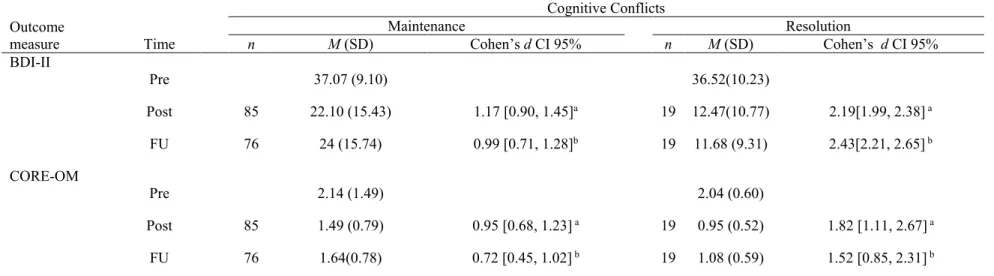
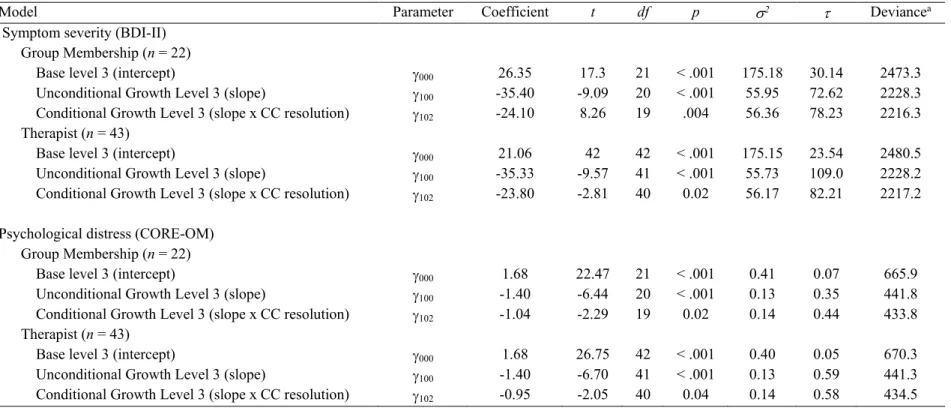
(18) Running head: COGNITIVE CONFLICT RESOLUTION. 18. maintained their CC(s) was explored. There were no statistically significant differences between the two groups at baseline (see supplemental material, S1, for details of demographic, clinical and RGT characteristics of the two groups of participants). The results are presented according to the three proposed hypotheses of the study. Change in cognitive conflicts in relation to allocated treatment Chi-square test was applied to test the hypothesis that the treatment which includes individual DFI would lead to a greater number of participants resolving their CC(s). Treatment allocation was considered as the independent variable and CC resolution the dependent variable. Results indicated that there was not enough evidence to indicate that CC resolution depended on the allocated treatment χ 2 (1, N = 104) = 0.45, p = .17 OR = 0.71, CI 95% [0.26, 1.94]. Eight participants (15.7%) of those allocated to the intervention that included DFI attained CC resolution, while 11 participants (20.8%) resolved it from those allocated to the intervention that followed the CBT therapeutic model. Means, standard deviations, effect sizes, and 95% confidence intervals for the effect sizes (pre-, post-treatment, and three-month follow-up) are displayed in Table 1 for each group of participants (CC resolution and CC maintenance). [Table 1 near here] Resolution of cognitive conflicts and symptom severity MLM was used to test, while controlling by baseline scores and accounting for dependence in nested data, whether change of severity of symptoms and psychological distress with respect to the resolution vs. maintenance of CC is significant different. Two different forms of nested data were tested: group membership and therapist allocation [Table 2 near here].
(19) Running head: COGNITIVE CONFLICT RESOLUTION. 19. For change in symptom severity, group membership accounted for 10% of the variance, which means that Type I error is between 0.11 and 0.28 according to the table provided by Kreft and de Leeuw (1998/2002). Thus, MLM is appropriate to analyze the data, because there was dependence in the change of the participants within groups. The unconditional growth model indicated that group slope parameter was significantly different from zero (γ100 = -35.40, p <.001), which means that BDI-II scores decrease from pre- to post-treatment and this decrease is maintained at follow-up. The unconditional model accounts for 68% of the within person variance, but there was variance remaining to be accounted for the inclusion of a predictor, χ2 (20, N=104). = 244.90, p < .001. CC resolution was added as predictor for the conditional model, this. model indicated that there was a significant difference in the decrease of depressive symptoms according to the CC resolution condition (γ102 = -24.10, p < .001). The difference in deviance statistics of the unconditional model and the conditional model was assessed with a chi-square test, χ2 (2, N=104) = 12 , p = .002. The conditional model that includes CC resolution as predictor fitted better to the data than the unconditional model. Therapist nesting accounted for 11% of the variance, which means that there was dependence in the change of participants treated by the same therapist. The unconditional growth model indicated that symptom severity decreased along the three assessment points (γ100 = 35.33, p < .001),. The unconditional model accounted for 68% of the within person variance, but there was variance remaining to be modeled, χ2 (41, N=104) = 252.37, p < .001. The conditional model showed a significant difference in the decrease of depressive symptoms between those who resolved their conflicts and those who maintained them (γ102 = -23.80, p = 0.02). The conditional model fitted better the data than the unconditional model, χ2 (2, N=104) = 11 , p = .0004..
(20) Running head: COGNITIVE CONFLICT RESOLUTION. 20. Clinical significance of the resolution of CC was assessed applying a chi-square test (2 x 2) to verify the relationship between the resolution of CCs and the recovery of depressive symptoms. At the end of therapy, the results indicated that recovery of depressive symptoms is related to CC resolution, χ 2 (1, N = 104) = 4.80, p = .01, V = .21, OR = 3.30, CI 95% [1.09, 9.98]. Of those who resolved the conflict (n = 19), 73.3% (n = 14) were classified as recovered; while of those who maintained the CC(s) (n = 85) only 45.9% (n = 39) attained recovery. These results were consistent at follow-up χ 2 (1, N = 95) = 7.15, p = .003, V = .27, OR = 4.29, CI 95% [1.40, 13.15]; of those who resolved the conflict (n = 19), 73.3% (n =14) achieved recovery, while only 39.5% (n = 30) reached that classification in those who maintained the conflict (n = 76). Resolution of cognitive conflicts and psychological distress MLM procedures were also applied for analyzing the change in psychological distress. Group membership accounted for 19% of the variance. The unconditional growth model indicated that psychological distress decreased over time(γ100 = -1.40, p < .001), this model accounted for 68% of the within person variance, but there was variance remaining to be modeled, χ2 (20, N = 104) = 244.09, p < .001. The addition of CC resolution as a predictor evinced a significant difference in the decrease of psychological distress between those who resolved and those who maintained their conflicts (γ102 = -1.04, p = 0.02). The conditional model significantly fitted better to the data than the unconditional modelχ2 (2, N = 104) = 7.98 , p = .02. Therapist nesting accounted for 25% of the variance. The unconditional growth model indicated that psychological distress significantly decreased along the three assessment points (γ100 = -1.4, p < .001),. The unconditional model accounted for 68% of the within person variance and for this model there was still variance to be modeled, χ2 (41, N = 104) = 228.94, p < .001. CC resolution significantly predicted the change in psychological distress indicated by the.
(21) Running head: COGNITIVE CONFLICT RESOLUTION. 21. conditional model (γ102 = -0.95, p = 0.04). The inclusion of CC resolution as a predictor to the model fitted better the data than the unconditional model , χ2 (2, N = 104) = 6.78 , p = .03. The dependence of clinical significance on CC resolution was assessed using a chi-square (2 x 2) test. At the end of therapy, recovery of psychological distress was associated to CC resolution, χ 2 (1, N = 104) = 2.96, p = .03 V = .08, OR = 2.39, CI 95% [0.87, 6.59]. Of those who resolved their CC(s) (n = 19), 57.9% (n = 11) were classified as recovered, and of those who maintained the CC(s) (n = 85); 36.5% (n = 31) achieved that classification. At follow-up, recovery of psychological distress did not depend on CC resolution χ 2 (1, N = 95) = 1.82, p = .12, V = 1.39, OR = 2.03, IC 95% [0.77, 5.78], 42.1% (n =8) participants achieved recovery of those who resolved the conflict (n = 19), and 26.3% (n = 20) reached that classification of those who maintained the conflict (n = 76). Discussion The purpose of this study was to contribute to the knowledge of the resolution of CCs in psychotherapy. Within the framework of a RCT, we compared the change of these conflicts in two types of treatments: one standard CBT and the other a mixture of CBT plus an individually tailored DFI intervention to resolve CCs. Moreover, we tested the hypotheses that the resolution of CCs would lead to greater symptom improvement, as well as to lower psychological distress. Main results did not support the superiority of DFI given that number of participants showing CC resolution did not differ between the two treatment conditions. In fact, results showed that only a few participants (18.3%) achieved the goal of total conflict resolution and the best results were obtained with the non-specific treatment condition. Thus, the first hypothesis that a DFI would improve the resolution of CCs, was not confirmed. Several explanations should be considered to understand these unexpected results. First, the DFI was not set up as an entire.
(22) Running head: COGNITIVE CONFLICT RESOLUTION. 22. therapy but applied just in half of the sessions. Perhaps an extended version of the DFI would achieve greater levels of conflict resolution, but this should be tested out in future studies. Second, the way in which conflict resolution was measured can be masking participants who resolved some of their main CCs but still presented some minor conflicts. This type of measurement might have generated false negatives and, thus, precluded finer-grained analyses of differential effects in conflict resolution between the two conditions. This explanation is not petty given that previous studies have indicated that CCs can be found in 33% of the non-clinical population (Feixas & Saúl, 2004) and, therefore, a certain degree of conflict is expected to be found within the functional population. Presumably, the data could be re-examined to indicate whether this is the case. In other words, futures studies should include not only a binary measure (presence/absence) of conflict resolution but also an improved measure taking into account level of conflict resolution and relevance of conflict. A third scenario that should be considered is that resolution of conflicts might be a common process that occurs equally regardless of the therapy model being applied. This is consistent with the study conducted by Hoyer et al. (2001) using the CICA indicating that even though CBT does not explicitly seek a reduction in internal conflict(s), the cognitive changes and behavioral activation that CBT promotes might confront patients with the dilemmatic situation and result, to some extent, in conflict resolution. In our opinion, these results can be understood as supporting the notion of the contextual model (Frank & Frank, 1991; Wampold, 2001) that common factors are major components of psychotherapy more relevant than specific ingredients. Thus, the variance attributable to specific factors such as CCs might be quite limited. Nevertheless, in the contextual model the purpose of specific ingredients is to construct a coherent treatment that therapists believe in and in which therapist and client feel comfortable (Messer & Wampold, 2002). In this sense, DFI extends the choices of.
(23) Running head: COGNITIVE CONFLICT RESOLUTION. 23. techniques to better fit client attitudes and preferences as well as those of the therapist, for a more fluid process. Thus, DFI can be regarded as an intervention which can be added to the variety of evidence-based therapeutic options. In any case, the limited success of DFI in resolving CCs suggested the need of: (a) revising the way conflict resolution is measured, and (b) improving the intervention protocol since it was limited in achieving its intended goal. In relation to the association of CC resolution to change after therapy and at follow-up, the results indicated a significant difference in symptoms and psychological distress between those who resolved their conflicts and those who remained with one or more conflicts after therapy. Furthermore, the proportion of patients who recovered from depressive symptoms was greater when conflict resolution was achieved. This effect supports the evidence of the relevance of internal conflict(s) to the maintenance of symptoms and psychological distress (Feixas et al., 2014; Montesano, Gonçalves, & Feixas, 2017; Pueschel, Schulte, & Michalak, 2011; Stangier, Ukrow, Schermelleh-Engel, Grabe, & Lauterbach, 2007). However, our study does not prove a causal relationship between resolution of CCs and reduction of depressive symptoms and psychological distress. Alternative explanations should be considered. It could be the case that the reduction of depressive symptoms would result in the resolution of CCs. Arguably, reduction of depressive symptoms could lead to a reduction of the self-ideal discrepancy and hence to dissolution of associated CCs (Montesano, Gonçalvez & Feixas, 2017). Nevertheless, previous studies have already suggested that CCs are not an epiphenomenon of the self-ideal discrepancy but rather a particular type of self-schema which plays a noticeable role in the cognitive system of depressive people (Feixas et al., 2014; Montesano et al, 2017). Furthermore, a study focused on how depressive patients resolve CCs showed that reduction of self-ideal discrepancy was just as frequent as lessening the strength of the correlation between the constructs forming the.
(24) Running head: COGNITIVE CONFLICT RESOLUTION. 24. conflict (Montesano et al, 2017). Although the question of whether CC resolution might be an epiphenomenon of depression improvement remains, results are promising and more processoutcome studies tracking conflict resolution session by session are needed. Although the current study increases the understanding of CCs in psychotherapy, several limitations might be acknowledged regarding the use of the RGT and the RCT design. The use of RGT to assess CC(s) may be quite challenging and time consuming. Moreover, for this research the same elements and constructs from pre-treatment assessment were scored at post-treatment assessment. This allows the preservation of internal validity, but clinical impressions of the therapists involved in this study suggest that the change in how participants construe their reality is notable after therapy and it might be that at least some of the constructs elicited at the first assessment are not particularly useful after therapy. CC resolution has only been assessed by comparing pre and post-treatment repertory grids, and future research might consider how the content of CCs evolves during therapy using case studies and mixed methods designs. The inclusion of qualitative measures might help to understand the process of CC resolution and patients’ perceptions about the relevance of working on it. Moreover, improvement in symptoms might be compared between patients who resolve CCs involving core values of the self with those who only resolve CCs that involve superficial features of the self (peripheral constructs). Despite its limitations, RGT is a technique that allows the capturing of the implicit conflicts detected specifically for each patient in a systematic form. Until the development of a more efficient tool it remains a very valuable instrument to be used in clinical research (Winter, 2003). However, future studies might also include different methods to assess internal conflicts, and explore the level of concordance between measures..
(25) Running head: COGNITIVE CONFLICT RESOLUTION. 25. In relation to the RCT design, from which data was reanalyzed, there were several limitations regarding the presence of complicated nested data structure (individuals within therapists and therapists within groups). In fact, the intra-class correlation coefficient for all the measures indicated that group membership and therapist effects explain from 10 to 25% of the variance of change of the individuals. This means that the common environment homogenizes, somehow, the response to treatment or condition. Thus, we have opted to analyze data using three-level growth models, as they allow the investigation of relationships within each level of the nested structure and across levels. Future studies might consider more simple hierarchical designs. Also, it is highly recommended, whenever possible, to randomize therapist and group allocation to reduce selection bias. Despite the above limitations, the present study has several strengths. The research presented in this paper is a valuable source of information about change in symptoms and in personal construction of meanings during psychotherapy. This is the first study assessing, in a controlled setting, the resolution of CCs (operationalized as implicative dilemmas and dilemmatic constructs) and its implications for change in depressive symptoms and psychological distress. Although the study was conducted within a randomized controlled trial— in which external validity is a limiting condition for the generalization of the results—its application in a public (universal access) health system and with minimal exclusion criteria ensured sample diversity and the likelihood of generalization. Likewise, these features support the current study as a relevant contribution for the literature about depression and its treatment. The study of CCs in psychotherapy is a developing field of research. The increase of empirical studies about this topic might lead to a deeper understanding of the complexities of the process of change and to improved treatment protocols..
(26) Running head: COGNITIVE CONFLICT RESOLUTION. 26. References American Psychiatric Association. (2000). The Diagnostic and Statistical Manual of Mental Disorders (DSM-IV-TR) (4ta ed.). Washington, DC: Author. Bados, A., & Garcia-Grau, E. (2012). Terapia cognitivo-conductual de la depresión: Manual de tratamiento grupal [Cognitive behavioral therapy for depression: A manual for group intervention]. Unpublished manuscript, Department of Clinical Psychology and Psychobiology, Universitat de Barcelona, Barcelona. Bados, A., & García-Grau, E. (2012). Terapia cognitivo-conductual de la depresión: Manual de tratamiento individual [Cognitive behavioral therapy for depression: A manual for individual intervention]. Unpublished manuscript, Department of Clinical Psychology and Psychobiology, Universitat de Barcelona, Barcelona. Bates, D., Maechler, M., Bolker, B., Walker, S. (2015). Fitting Linear Mixed-Effects Models Using lme4. Journal of Statistical Software, 67(1), 1-48.doi:10.18637/jss.v067.i0 Beck, A., Rush, A., Shaw, B., & Emery, G. (1979). Cognitive therapy of depression. New York: Guilford. Beck, A., Steer, R., & Brown, G. (1996). Manual for the Beck Depression Inventory- Second edition (BDI-II). San Antonio, TX: Psychological Corporation. Binder, P. E., Holgersen, H., & Nielsen, G. H. (2010). What is a “good outcome” in psychotherapy? A qualitative exploration of former patients’ point of view. Psychotherapy Research, 20(3), 285–294. doi:10.1080/10503300903376338 Briggs, S. R. & Cheek, J. M. (1986). The role of factor analysis in the development and evaluation of personality scales. Journal of Personality, 54, 106-148. Cohen, J. (1988). Statistical power analysis for the behavioral sciences (2nd ed.). Hillsdale, NJ:.
(27) Running head: COGNITIVE CONFLICT RESOLUTION. 27. Lawrence Erlbaum Associates. Dozois, D., Dobson, K., & Ahnberg, J. (1998). A psychometric evaluation of the Beck Depression Inventory–II. Psychological Assessment, 10(2), 83–89. doi: 10.1037/10403590.10.2.83 Epstein, S. (1982). Conflict and stress. Handbook of stress. New York: Free Press. Evans, C., Mellor-Clark, J., Margison, F., Barkham, M., Audin, K., Connell, J., & McGrath, G. (2000). CORE: Clinical Outcomes in Routine Evaluation. Journal of Mental Health, 9(3), 247–255. doi:10.1080/713680250 Feixas, G., Bados, A., García-Grau, E., Montesano, A., Dada, G., Compañ, V., … Winter, D. (2013). Efficacy of a dilemma-focused intervention for unipolar depression: study protocol for a multicenter randomized controlled trial. Trials, 14(1), 144. doi: 10.1186/1745-621514-144 Feixas, G., Bados, A., García-Grau, E., Paz, C., Montesano, A., Compañ, V., … Lana, F. (2016). A dilemma-focused intervention for depression: a multicenter, randomized controlled trial with a 3-month follow-up. Depression and Anxiety, 33(1), 862-869. doi: 10.1002/da.22510 Feixas, G., & Compañ, V. (2016). Dilemma-focused intervention for unipolar depression: a treatment manual. BMC Psychiatry, 16(1), 235. doi:10.1186/s12888-016-0947-x Feixas, G., & Cornejo, J. M. (2002). GRIDCOR: Correspondence analysis for grid data v.4.0 [Computer software and repertory gridmanual]. Retrieved from www.terapiacognitiva.net/record Feixas, G., Montesano, A., Compañ, V., Salla, M., Dada, G., Pucurull, O., … Guàrdia, J. (2014). Cognitive conflicts in major depression: Between desired change and personal coherence. British Journal of Clinical Psychology, 53(1), 369–385. doi: 10.1111/bjc.12050.
(28) Running head: COGNITIVE CONFLICT RESOLUTION. 28. Feixas, G., & Saúl, L. A. (2004). The Multi-Center Dilemma Project: an investigation on the role of cognitive conflicts in health. The Spanish Journal of Psychology, 7(1), 69–78. doi:10.1017/S1138741600004765 Feixas, G., Saúl, L. A., & Avila, A. (2009). Viewing cognitive conflicts as dilemmas: Implications for mental health. Journal of Constructivist Psychology, 22, 141–169. doi:10.1080/1072053080 2675755 Feixas, G., Saúl, L. Á., Winter, D., & Watson, S. (2008). Un estudio naturalista sobre el cambio de los conflictos cognitivos durante la psicoterapia [A naturalistic study about the change of cognitive conflicts during psychotherapy]. Apuntes de Psicología, 26(2), 243–255. Retrieved from http://campus.usal.es/~tcp/articulos/un_estudio_nat.pdf Fennell, M. J. (1989). Depression. In K. Hawton, P. M. Salkovskis, J. Kirk, & D. M. Clark (Eds.), Cognitive behaviour therapy for psychiatric problems: A practical guide (pp. 169– 234). Oxford: Oxford University Press. Ferrari, A. J., Charlson, F. J., Norman, R. E., Patten, S. B., Freedman, G., Murray, C. J. L., … Whiteford, H. A. (2013). Burden of Depressive Disorders by Country, Sex, Age, and Year: Findings from the Global Burden of Disease Study 2010. PLoS Medicine, 10(11), e1001547. doi:10.1371/journal.pmed.1001547 Frank, J. D., & Frank, J. B. (1991). Persuasion and healing: A comparative study of psychotherapy (3rd ed.). Baltimore, MD: Johns Hopkins University Press. Fransella, F., Bell, R., & Bannister, D. (2004). A manual for repertory and technique. Chichester: John Wiley & Sons, Ltd. Freud, S. (1936). Inhibitions, symtoms and anxiety. In J. Strachey (Ed. and Trans.), The standard edition of the complete works of Sigmund Freud (Vol.20pp. 75–175). London: Hogarth.
(29) Running head: COGNITIVE CONFLICT RESOLUTION. 29. Press. (Original work published 1926). Grawe, K. (2004). Psychological therapy. Cambridge, MA: Hogrefe & Huber Publishers. Greenberg, L. (2004). Emotion–focused therapy. Clinical Psychology & Psychotherapy, 11(1), 3–16. doi:10.1002/cpp.388 Hinkle, D. (2010). The change of personal constructs from the viewpoint of a theory of construct implications. Personal Construct Theory & Practice, 7, Supplement 1 (Original work presented 1965 (Doctoral dissertation). Ohio State University, Columbus,OH. Retrieved from http://www.pcp-net.org/journal/pctp10/hinkle1965.pdf Heider, F. (1946). Attitude and cognitive organization. Journal of Psychology, 2, 107-112. Horney, K. (1992). Our inner conflicts. A Constructive Theory of Neurosis New York: Norton. Oxon: Routledge 2001. (Original work published 1945). Horowitz, M. (1988). Introduction to psychodynamics: A new synthesis. New York: Basic Books. Hoyer, J., Fecht, J., Lauterbach, W., & Schneider, R. (2001). Changes in conflict, symptoms, and well-being during psychodynamic and cognitive-behavioral alcohol inpatient treatment. Psychotherapy and Psychosomatics, 70(4), 209–215. doi: 10.1159/000056255 Jacobson, N., & Truax, P. (1991). Clinical significance: a statistical approach to defining meaningful change in psychotherapy research. Journal of Consulting and Clinical Psychology, 59(1), 12–19. doi: 10.1037/0022-006X.59.1.12 Kelly, G. A. (1991). The psychology of personal constructs . New York, NY: Norton. (Original work published 1955). Kreft, I., & de Leeuw, J. (2002). Introducing multilevel modeling. Thousand Oaks, CA: Sage. (Original work published 1998).
(30) Running head: COGNITIVE CONFLICT RESOLUTION. 30. Lauterbach, W. (1996a). The measurement of personal conflict. Psychotherapy Research, 6, 213225. Lauterbach, W., & Newman, C. F. (1999). Computerized intrapersonal conflict assessment in cognitive therapy. Clinical Psychology and Psychotherapy, 6, 1-18 Mahoney, M. J. (2003). Constructive Psychotherapy. New York: The Guilford Press. Messer, S. B., & Wampold, B. E. (2002). Let’s Face Facts: Common Factors Are More Potent Than Specific Therapy Ingredients. Clinical Psychology Science & Practice, 9(1), 21–25. https://doi.org/10.1093/clipsy.9.1.21 Michalak, J. (2000). Zielkonflikte im therapeutischen Prozess [Conflicts in the therapeutic process]. Wiesbaden: Deutscher Universitätsverlag. Michalak, J., Heidenreich, T., & Hoyer, J. (2011). Goal Conflicts and Goal Integration: Theory, Assessment, and Clinical Implications. In W. M. Cox & E. Klinger (Eds.), Handbook of Motivational Counseling (2nd ed., pp. 89–107). Chichester, UK: John Wiley & Sons, Ltd. Montesano, A., Feixas, G., Caspar, F., & Winter, D. (2017). Depression and Identity: Are SelfConstructions Negative or Conflictual? Frontiers in Psychology, 8, 877. doi: 10.3389/fpsyg.2017.00877 Montesano, A., Feixas, G., Saúl, L. A., Caicedo, M. I. E., Dada, G., & Winter, D. (2014). Cognitive conflicts and symptom severity in dysthymia : “I'd rather be good than happy.” Salud Mental, 37(1), 41–48. Retrieved from http://www.scielo.org.mx/scielo.php?pid=S0185-33252014000100006&script=sci_arttext Montesano, A., Gonçalves, M. M., & Feixas, G. (2017). Self-narrative reconstruction after dilemma-focused therapy for depression: A comparison of good and poor outcome cases. Psychotherapy Research, 27(1), 112–126. doi: 10.1080/10503307.2015.1080874.
(31) Running head: COGNITIVE CONFLICT RESOLUTION. 31. Montesano, A., López-González, M. A., Saúl, L. Á., & Feixas, G. (2015). A review of cognitive conflicts research: A meta-analytic study of prevalence and relation to symptoms. Neuropsychiatric Disease and Treatment, 12, 2997–3006. doi: 10.2147/NDT.S91861 Paz, C., Pucurull, O., & Feixas, G. (2016). Change in symptoms and personal construct structure in anxiety disorders: a preliminary study on the effects of constructivist therapy. Journal of Constructivist Psychology, 29(3), 231–247. doi: 10.1080/10720537.2014.943914 Pucurull, O. (2015). Psicoterapia breve con un enfoque cognitivo constructivista en la atención primaria: Cambios sintomáticos y cognitivos [Brief psychotherapy with congnitiveconstructivist approach in promary care: cognitive and symptoms change](Unpublished docoral dissetation). Universitat de Barcelona, Barcelona. Pueschel, O., Schulte, D., & Michalak, J. (2011). Be careful what you strive for: the significance of motive-goal congruence for depressivity. Clinical Psychology & Psychotherapy, 18(1), 23–33. doi: 10.1002/cpp.697 R Core Team. (2014). R: A language and environment for statistical computing. Vienna: R Foundation for Statistical Computing. Retrieved from http://www.r-project.org/ Renner, W. y Platz, T. (1999). Kognitive und symptombezogene Effekte standardisierter Verhaltenstherapie: Evaluation eines ambulanten Gruppenprogramms [Cognitive and symptom-related effects of standardized behavioral therapy: Evaluation of outpatient group programs]. Zeitschrift Für Klinische Psychologie, Psychiatrie Und Psychotherapie, 47(3), 271–291. doi: 1999-11424-001 Sanz, J., & Vázquez, C. (2011). Adaptación española del Inventario para la Depresión de BeckII (BDI-II) [Spanish adaptation of the Beck Depression Inventory-II (BDI-II)]. Madrid: Pearson Education..
(32) Running head: COGNITIVE CONFLICT RESOLUTION. 32. Slade, P. D., & Sheehan, M. J. (1979). The measurement of “conflict” in repertory grids. British Journal of Psychology, 70(4), 519–524. doi: 10.1111/j.2044-8295.1979.tb01726.x Stangier, U., Ukrow, U., Schermelleh-Engel, K., Grabe, M., & Lauterbach, W. (2007). Intrapersonal conflict in goals and values of patients with unipolar depression. Psychotherapy and Psychosomatics, 76(3), 162–170. doi: 10.1159/000099843 Steinert, C., Hofmann, M., Kruse, J., & Leichsenring, F. (2014). Relapse rates after psychotherapy for depression – stable long-term effects? A meta-analysis. Journal of Affective Disorders, 168(1), 107–118. doi: 10.1016/j.jad.2014.06.043 Tasca, G. A., Illing, V., Joyce, A. S., & Ogrodniczuk, J. S. (2009). Three-level multilevel growthmodels for nested change data: A guide for group treatment researchers. Psychotherapy Research, 19(4-5), 453–461. https://doi.org/10.1080/10503300902933188 Trujillo, A., Feixas, G., Bados, A., García-Grau, E., Salla, M., Medina, J. C., … Evans, C. (2016). Psychometric properties of the Spanish version of the Clinical Outcomes in Routine Evaluation - Outcome Measure. Neuropsychiatric Disease and Treatment, 12, 1457–66. doi: 10.2147/NDT.S103079 Wampold, B. E. (2001). The great psychotherapy debate: Models, methods and findings. Mahwah, NJ: Erlbaum. Winter, D. A. (2003). Repertory grid technique as a psychotherapy research measure. Psychotherapy Research : Journal of the Society for Psychotherapy Research, 13(1), 25–42. doi: 10.1093/ptr/kpg005 Wolpe, J. (1968). Psychotherapy by reciprocal inhibition. Conditional Reflex: A Pavlovian Journal of Research & Therapy, 3(4), 234–240. doi:10.1007/BF03000093.
(33) Running head: COGNITIVE CONFLICT RESOLUTION. 33. Table 1. Means, standard deviations and effect size of the outcome measure with respect of the resolution and maintenance of cognitive conflict(s) Outcome measure BDI-II. CORE-OM. Time. n. Pre. M (SD). Maintenance. Cognitive Conflicts Cohen’s d CI 95%. n. 37.07 (9.10). M (SD). Resolution Cohen’s d CI 95%. 36.52(10.23). Post. 85. 22.10 (15.43). 1.17 [0.90, 1.45]a. 19. 12.47(10.77). 2.19[1.99, 2.38] a. FU. 76. 24 (15.74). 0.99 [0.71, 1.28]b. 19. 11.68 (9.31). 2.43[2.21, 2.65] b. Pre. 2.14 (1.49). 2.04 (0.60). Post. 85. 1.49 (0.79). 0.95 [0.68, 1.23] a. 19. 0.95 (0.52). 1.82 [1.11, 2.67] a. FU. 76. 1.64(0.78). 0.72 [0.45, 1.02] b. 19. 1.08 (0.59). 1.52 [0.85, 2.31] b. Note. a Effect size calculated from pre-treatment score and post-treatment score; b Effect size calculated form pre-treatment score and 3-mont follow-up score; SD = standard deviation; BDI-II = Beck Depression Inventory-II; CORE-OM = Clinical Outcomes in Routine Evaluation-Outcome Measure; CI = confidence interval; CBT = Cognitive Behavioral Therapy; FU = 3-month follow-up.
(34) Running head: COGNITIVE CONFLICT RESOLUTION. 34. Table 2. Selected Fixed and Random Effects Results from Three Multilevel Models for symptom severity and psychological distress Model Symptom severity (BDI-II) Group Membership (n = 22) Base level 3 (intercept) Unconditional Growth Level 3 (slope) Conditional Growth Level 3 (slope x CC resolution) Therapist (n = 43) Base level 3 (intercept) Unconditional Growth Level 3 (slope) Conditional Growth Level 3 (slope x CC resolution) Psychological distress (CORE-OM) Group Membership (n = 22) Base level 3 (intercept) Unconditional Growth Level 3 (slope) Conditional Growth Level 3 (slope x CC resolution) Therapist (n = 43) Base level 3 (intercept) Unconditional Growth Level 3 (slope) Conditional Growth Level 3 (slope x CC resolution). Parameter. Coefficient. t. df. p. σ2. τ. Deviancea. γ000 γ100 γ102. 26.35 -35.40 -24.10. 17.3 -9.09 8.26. 21 20 19. < .001 < .001 .004. 175.18 55.95 56.36. 30.14 72.62 78.23. 2473.3 2228.3 2216.3. γ000 γ100 γ102. 21.06 -35.33 -23.80. 42 -9.57 -2.81. 42 41 40. < .001 < .001 0.02. 175.15 55.73 56.17. 23.54 109.0 82.21. 2480.5 2228.2 2217.2. γ000 γ100 γ102. 1.68 -1.40 -1.04. 22.47 -6.44 -2.29. 21 20 19. < .001 < .001 0.02. 0.41 0.13 0.14. 0.07 0.35 0.44. 665.9 441.8 433.8. γ000 γ100 γ102. 1.68 -1.40 -0.95. 26.75 -6.70 -2.05. 42 41 40. < .001 < .001 0.04. 0.40 0.13 0.14. 0.05 0.59 0.58. 670.3 441.3 434.5. Note. Individual N = 104; group membership N = 22; therapist N = 43. Parameters and variance components were derived from the following models: (1) Base model: Level 1: Ytij = π0ij + etij, Level 2: π0ij = β00j + r0ij, Level 3: β00j = γ000 + u00j. (2) Unconditional growth model: Level 1: Ytij = π0ij + π1ij(LOGTIMEtij)+ etij, Level 2: π0ij = β00j +β01j(individual prescore) + r1ij, π1ij = β10j +β11j(individual prescore) + r0ij, Level 3: β00j = γ000 + γ001 (group prescore) + u00j, β01j = γ010 + u01j, β00j = γ100 + γ101 (group prescore) + u10j, β11j = γ101 + u11j. (3) Conditional growth model: Level 1: Ytij = π0ij + π1ij(LOGTIMEtij)+ etij, Level 2: π0ij = β00j +β01j(individual prescore) + r0ij, π1ij = β10j +β11j(individual prescore) + r1ij, Level 3: β00j = γ000 + γ001 (group prescore) + γ002 (CC resolution) + u00j, β01j = γ010 + u01j, β10j = γ100 + γ101 (group prescore) + γ102 (CC resolution) u10j, β11j = γ110 + u11j. BDI-II = Beck Depression Inventory-II; CORE-OM = Clinical Outcomes in Routine Evaluation-Outcome Measure; CC resolution = Cognitive Conflict resolution a Number of parameters: base model = 4, unconditional growth model = 10, conditional growth model = 12..
(35) Running head: COGNITIVE CONFLICT RESOLUTION. 35. Figure 1. Examples of the two type of cognitive conflicts: implicative dilemma and dilemmatic construct.
(36)
Figure
Documento similar
