
Effect of shortest path multiplicity on congestion of multiplex networks
10
0
0
Texto completo
(2) New J. Phys. 21 (2019) 035003. https://doi.org/10.1088/1367-2630/ab023e. PAPER. OPEN ACCESS. Effect of shortest path multiplicity on congestion of multiplex networks. RECEIVED. 30 October 2018 REVISED. 20 January 2019. Albert Solé-Ribalta1,3,4 , Alex Arenas2,4 1 2. ACCEPTED FOR PUBLICATION. 3. 28 January 2019. 4. PUBLISHED. 15 March 2019. and Sergio Gómez2,4. Internet Interdisciplinary Institute, Universitat Oberta de Catalunya, E-08018 Barcelona, Catalonia, Spain Departament d’Enginyeria Informàtica i Matemàtiques, Universitat Rovira i Virgili, E-43007 Tarragona, Catalonia, Spain URPP Social Networks, University of Zurich, CH-8050 Zurich, Switzerland Authors to whom any correspondence should be addressed.. E-mail: [email protected], [email protected] and [email protected] Keywords: multiplex networks, congestion, shortest paths. Original content from this work may be used under the terms of the Creative Commons Attribution 3.0 licence. Any further distribution of this work must maintain attribution to the author(s) and the title of the work, journal citation and DOI.. Abstract Shortest paths are representative of discrete geodesic distances in graphs, and many descriptors of networks depend on their counting. In multiplex networks, this counting is radically important to quantify the switch between layers and it has crucial implications in the transportation efficiency and congestion processes. Here we present a mathematical approach to the computation of the joint distribution of distance and multiplicity (degeneration) of shortest paths in multiplex networks, and exploit its relation to congestion processes. The results allow us to approximate semi-analytically the onset of congestion in multiplex networks as a function of the congestion of its layers.. 1. Introduction Shortest paths in graphs are defined as paths between two nodes such that the sum of the weights of the links composing the path is minimized [1]. The computation of shortest paths is of utmost importance to determine the efficiency of the network to exchange information [2], to compute the load of nodes (defined as the number of shortest path traversing it) [3–6], to predict and alleviate congestion [7–10] or to classify networks [11], to mention some. The main applications of the finding of shortest paths are routing strategies [12, 13], analysis of road networks [14], epidemic spreading [15], or analysis of brain activity [16], among others. The development of efficient numerical algorithms for both the exact and approximate calculation of shortest paths is a problem by itself that still attracts the attention of computer scientists [17]. The exact numerical calculation of all the shortest paths from a single node is commonly addressed using the well-known Dijkstraʼs algorithm whose running time is O (M + N log N ), where N is the number of nodes and M is the number of edges of the graph. Given that, the numerical calculation of shortest paths in large networks is still computationally expensive. In particular, the computation of shortest paths is essential for the determination of a fundamental measure of centrality: edge and node betweenness. The node (or link) betweenness is normally defined as the fraction of shortest paths between node pairs that pass through the node (or link) of interest. The ranking according to betweenness [18] is informative about the bottlenecks of a certain network structure, and can be used to determine the most critical node or link with respect to any process traversing the network using shortest paths. In particular, the node with the largest betweenness in a network defines the onset of congestion [7, 19]. The extension of centrality descriptors to multiplex networks [20–22] prompts for the quantification of the distribution of shortest paths in this new scenario [23, 24]. Multiplex networks are defined as a set of interconnected layers of networks, where every node has its own replica through all layers, and is connected with them [25–28]. Shortest paths in multiplex networks are essentially governed by the shortest paths at each layer, but also by those emerging from partial paths at different layers and the switch between layers. Here, we present a method to analytically determine the distribution of shortest paths in multiplex networks, with special emphasis. © 2019 The Author(s). Published by IOP Publishing Ltd on behalf of the Institute of Physics and Deutsche Physikalische Gesellschaft.
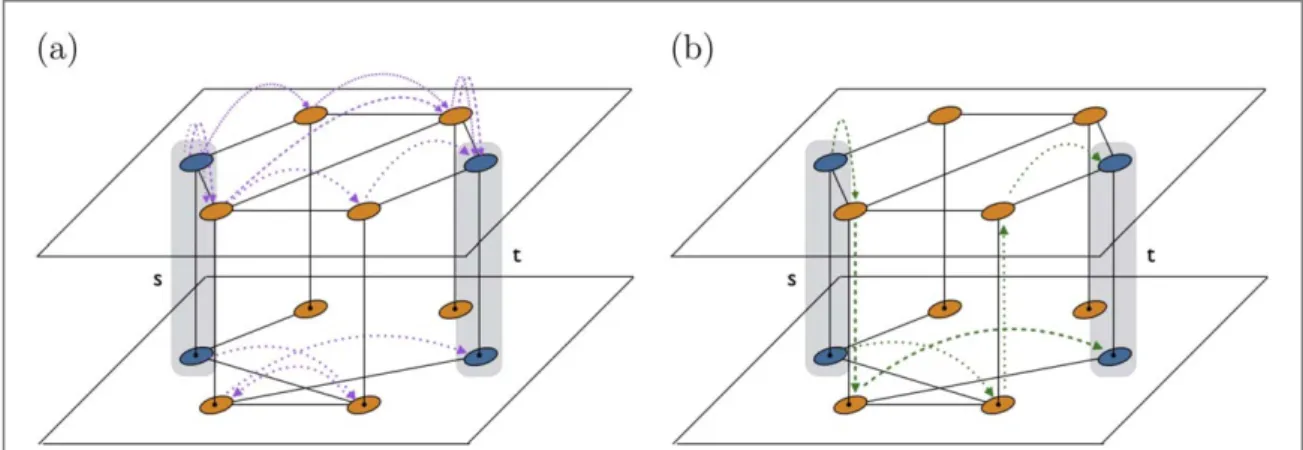
(3) New J. Phys. 21 (2019) 035003. A Solé-Ribalta et al. Figure 1. Shortest paths in multiplex networks. An element traveling between locations s and t on the multiplex structure has to choose a path among the possible ones shown in the figure. There are 6shortest paths betweens andt, all of them of length3. Purple lines in panel (a) show classical single layer shortest paths, laying within a unique layer. Green lines in panel (b) show multiplex shortest paths, which make use of interlayer links to jump between layers.. on the multiplicity of shortest paths occurring in the mentioned set up. This computation allows us to determine semi-analytically the feasible region of congestion induced by the multiplex structure [29]. The paper is structured as follows. First, we present the definition of shortest paths in multiplex networks. Next, we show how to compute the distribution of shortest paths in two-layer multiplex networks. Once we provide a way to compute the joint distribution of shortest paths and their multiplicities in sigle layer Erdős– Rényi networks, we extend the method to multiplex network, and evaluate the accuracy of our analytical predictions. Finally, we apply our results to the analysis of congestion in multiplex networks, being able to predict the region of parameters in which the multiplex structure may induce congestion.. 2. Shortest paths in multiplex networks Multiplex networks may, at first sight, seem equivalent to single layer networks, just with the difference of having two kinds of edges: intralayer links between nodes in the same layer, and interlayer links connecting the replicas of each node in the different layers (see figure 1). However, the fact that the replicas of each node refer exactly to the same entity, has important consequences on the structural and dynamical properties of multiplex networks. Suppose, for example, we have the transportation network of a city, formed by metro and bus connections. Nodes represent the locations of the metro stations and bus stops, and interlayer links allow the transfer from metro to bus and vice versa. There exists a cost associated with each link, which accounts for the time needed to travel from one location to another (intralayer links), and the time spent to make a transfer (interlayer links). A path in this network must take into account both types of cost, thus we could use any of the standard methods to find the shortest paths in graphs. Now, consider that we want to go from a source locationA to a destination locationB taking the shortest route, and that we may start the trip either with bus (A1) or metro (A2).The algorithm provides us with four different types of paths: two in which the origin and destination are both in the same layer, A1 B1 and A2 B 2; and two where the endpoints belong to different layers, A1 B 2 and A2 B1. Note that neither of the paths are necessary contained within a single layer, e.g. a shortest path between A1 and B1 could change layer twice. Since we are only interested in going fromA toB, and it is irrelevant if we start or end the trip in the bus or metro, some of these shortest paths should be discarded.For example, if the length of the shortest paths A1 B1 is larger than that for A1 B 2, we should discard ending our traversal at layer1. These means that, in two-layer multiplex networks, shortest paths between two nodes may exist in just one layer, in the other layer, in a path with transfers (what we call multiplex paths), or in a combination of them (see figure 1). Consequently, any property depending on paths in multiplex networks must consider the concept of source and destination as being intrinsically different to that of nodes, such as in the calculation of centrality measures [22–24], the analysis of interdependence [30], the analysis of random walks [21], or the study of congestion [29]. The former definition of shortest paths in multiplex networks imposes the necessity of correctly computing their distribution and multiplicity.. 3. Distribution of shortest paths in two-layer multiplex networks The problem we are going to address is how the distribution of shortest paths changes when we take two different networks (the layers), and connect them to build a multiplex network. The prescription we propose can 2.
(4) New J. Phys. 21 (2019) 035003. A Solé-Ribalta et al. be easily extended to more layers, however its combinatorics makes the mathematical analysis more involved. In particular, we are interested in two important parameters [29]: λ, the fraction of all shortest paths fully contained in one layer (i.e. paths which do not make use of the multiplex option of changing layer using interlayer links); and μα, the fraction of non-multiplex shortest paths using only layerα. Thus, åa ma = 1, and 1−λ amounts for the fraction of multiplex shortest paths. It is important to remark that shortest paths are usually degenerated, i.e. there are many shortest paths with the same length, with some of them being multiplex paths; we will refer to this degeneration as the multiplicity of the shortest paths. Previous works have provided methods to estimate the complementary cumulative probability F(d) that two randomly selected nodes are separated by a distance larger thand, for certain classes of monoplex (single layer) random networks [31–35]. Thus, the probability distribution f (d) of two nodes being exactly at distanced can be expressed in terms of the complementary cumulative probability as f (d ) = F (d - 1) - F (d ).. (1). We denote by f1(d), f2(d) and fM(d) the respective distributions of shortest paths fully contained in layer1, in layer2, or using the full multiplex structure. Assuming an unweighted and undirected multiplex network with two layers and no degree correlations, we may use this relation to obtain the fraction of multiplex shortest paths: 1-l=. ¥. å fM (d )[F1 (d ) F2 (d ) + qM1 (d ) f1 (d ) F2 (d ) + qM 2 (d ) F1 (d ) f2 (d ). d= 3. + qM12 (d ) f1 (d ) f2 (d )].. (2). The sum starts with d=3, since the minimum length of a multiplex path is 3, i.e. at least one hop in the first layer, another in the second layer, and one to perform the change of layer. Equation (2) expresses the four possible ways in which shortest paths can appear in the multiplex: only multiplex paths; multiplex paths mixed with paths in layer1; multiplex paths mixed with paths in layer2; and multiplex paths mixed with paths in layers1 and2. Consider for example the case of multiplex shortest paths mixed with shortest paths in layer1. This correspond to the paths that have exactly distance d in layer1, f1(d), and in the multiplex, fM(d), and distance larger than d in layer2, F2(d). For the terms with mixed contributions, the θ(d) factors capture the fraction of shortest paths that correspond to multiplex paths. This means we cannot calculate λ just with the knowledge of the shortest paths distributions f (d) and F(d), we also need to estimate the multiplicity of the paths of each type. Let us denote by P1(d, f), P2(d, f) and PM(d, f) the probabilities that randomly chosen source and destination (discarding layer, i.e. locations in our example) are exactly at distanced with multiplicityf, for paths in first layer, second layer, and in the multiplex, respectively. The average multiplicities áfñ1 (d ), áfñ2 (d ) and áfñM (d ) for each kind of path can be expressed as: ¥. áfña (d ) =. åf= 1f Pa (d, f) , ¥ åf= 1Pa (d, f). a Î {1, 2},. (3a). ¥. áfñM (d ) =. åf= 1f PM (d, f) . ¥ åf= 1PM (d, f). (3b). Therefore, qMa (d ) =. áfñM (d ) , áfñM (d ) + áfña (d ). qM12 (d ) =. a Î {1, 2},. áfñM (d ) . áfñM (d ) + áfñ1 (d ) + áfñ2 (d ). (4a) (4b). Additionally, the distributions f (d) can be recovered as marginals of P(d, f): fa (d ) =. ¥. å Pa (d, f) ,. a Î {1, 2},. (5a). f=1. f M (d ) =. ¥. å PM (d, f).. (5b). f= 1. Similarly to (2), we may use the distributions F(d) and f (d), and the multiplicity factors θ(d), to calculate how the non-multiplex shortest paths are distributed among the layers. The expression for the first layer reads: m1 =. ¥. å f1 (d )[F2 (d ) + q1 (d ) f2 (d )] ,. d= 1. 3. (6).
(5) New J. Phys. 21 (2019) 035003. A Solé-Ribalta et al. where q1 (d ) =. áfñ1 (d ) . áfñ1 (d ) + áfñ2 (d ). (7). Equivalent expressions hold for μ2, and μ1+μ2=1. Summarizing, we have set all the necessary ingredients to analyze the use of the multiplex structure and of the layers in terms of the joint distributions P1(d, f), P2(d, f) and PM(d, f). In the next sections we develop expressions for each of these probabilities.. 4. Multiplicity of shortest paths in Erdős–Rényi networks The analytical calculation of the joint probability that two nodes are exactly at distance d with multiplicity f, P(d, f), for any type of monoplex networks, is quite involved, thus we are going to restrict our analysis to Erdős– Rényi networks. However, it would be possible to try with other types of uncorrelated random networks making use of hidden variables as in [31]. An Erdős–Rényi network is characterized by two parameters, the number of nodes N, and the probability p that an edge exists between any pair of nodes. Thus, we will use the notation Pp, N(d, f) to refer to the joint distance and multiplicity distribution for these networks. Clearly, at d=1, Pp, N (1, 1) = p , Pp, N (1, f) = 0,. " f > 1,. (8a) (8b). since we do not allow multiple edges between pairs of nodes. The case d=2 can be obtained as the probability of not having a shortest path of length1 times the probability of having exactly f different shortest paths of length2. Since paths of length2 have just one intermediate node, we have to choose f nodes among the N−2 available to build the f shortest paths. Formally ⎛N Pp, N (2, f) = (1 - p ) ⎜ ⎝ f. 2 ⎞ 2f ⎟ p (1 - p 2 )(N - 2) - f . ⎠. (9). Note that the existence of paths of length2 has probability p2, thus p2 f expresses the probability of having f paths of length2, and (1 - p2 )(N - 2) - f the probability that the rest of the (N−2)−f nodes are not used to build shortest paths of length2. Using the same procedure, the generalization to larger distances becomes d- 1 ⎡ ⎤ Pp, N (d , f) = ⎢(1 - p ) (1 - p k )h (k) ⎥ B (f ; h (d ) , p d ) , ⎣ ⎦ k=2. (10). where h (k ) =. k-2. . (N - 2 - i ). (11). i=0. stands for the amount of possible paths of length k 2, and ⎛ h (d ) ⎞ B (f ; h (d ) , p d ) = ⎜ ⎟ p df (1 - p d )h (d ) - f ⎝ f ⎠. (12). is the probability density function of the binomial distribution with probability p d. The term within square brackets in (10) computes the probability of not having any path at distance lower thand. Although (9) is exact, (10) is an approximation because it does not consider that some shortest paths may share some (but not all) of their links.. 5. Multiplicity in multiplex networks with Erdős–Rényi layers We now address the computation of the joint distribution PM(d, f) for a multiplex network composed of two Erdős–Rényi layers, with Nnodes each, edge probabilitiesp1 andp2, and without interlayer degree correlations; we will refer to it as Pp1, p2 , N (d, f ), to emphasize the dependence on these structural parameters. Multiplex shortest paths are characterized by the number of interlayer links they contain, i.e. how many times the path changes from one layer to the other, see figure 2. We restrict our analysis to shortest paths that change layer only once, since the number of shortest paths with multiple jumps between layers is usually very small, thus making their contribution negligible, and the generalization of the mathematical formulation for two or more jumps is not difficult but generates very long expressions. 4.
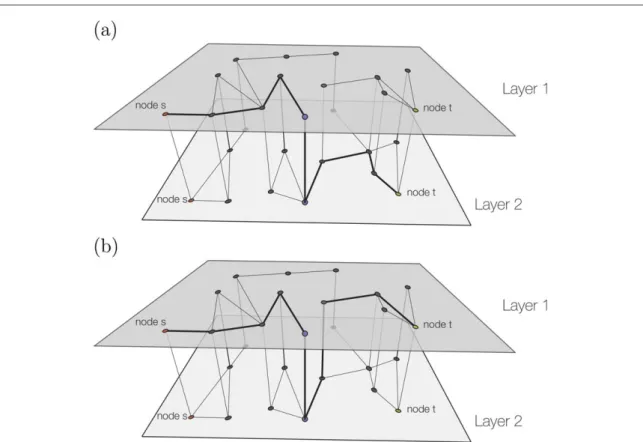
(6) New J. Phys. 21 (2019) 035003. A Solé-Ribalta et al. Figure 2. (a) Shortest path in the multiplex network containing a single interlayer link. (b) Shortest path in the multiplex network including two interlayer links.. For each multiplex shortest path which has just one change of layer, as in figure 2(a), once we have selected the origin and destination, we may choose the intermediate switch node among the remaining N−2. Since we are considering a multiplicity f of multiplex shortest paths between these origin and destination nodes, the paths may be distributed in many different ways. For example, if f=10, we could select7 shortest paths to use one intermediate switch node, and the remaining3 to choose another one. The set of all structurally different distributions of one-jump multiplex shortest paths is given by the partition set of the given integer multiplicity f. The finding and counting of the number of partitions of an integer number constitutes a classical problem in number theory [36], e.g. they can be enumerated using Young diagrams [37]. We may express the set of available partitions as: f. (f) = {F Î ⋃ {1,¼,f} r : r=1. ∣F∣. å fi = f , i=1. f1 f∣ F ∣, ∣F∣ N - 2}.. (13). For example, f=4 can be partitioned in five different ways: (4) = {(4), (3, 1), (2, 2), (2, 1, 1), (1, 1, 1, 1)}. If N=5, we would have only 3possible intermediate nodes, and partition (1, 1, 1, 1) should be discarded, hence the ∣F∣ N - 2 condition added to (13). Once a partition Φ is selected, we need to consider the different ways in which we can choose the intermediate nodes, and the different ways in which the multiplicities fi are assigned to the selected set of intermediate nodes. Gathering together all these contributions, we may write the joint distribution of multiplex shortest paths as: Pp1, p2 , N (d , f) =. ∣F∣ ⎤ ⎡ ⎛ N - 2⎞ ⎜ ⎟ C (F) ⎢R p1, p2 , N (d ) N - 2- ∣ F ∣ Q p1, p2 , N (d , Fi ) ⎥ , ⎦ ⎣ F Î (f) ⎝ ∣F∣ ⎠ i=1. å. (14). where the combinatorial number accounts for the selection of intermediate switch nodes, C (F) for the assignment of individual multiplicities, R p1, p2 , N (d ) stands for the probability of not having multiplex paths of length lower or equal thand, and Q p1, p2 , N (d, Fi ) stands for the joint probability of having one-switch multiplex shortest paths with known intermediate jump node. Factor C(Φ) is just the multinomial coefficient corresponding to the frequencies of the components of Φ. For example, if Φ=(14, 3, 3), there are three components, the14 with frequency1 and the3 with frequency2, leading to C(Φ)=3!/(1! 2!)=3, which corresponds to the 3ways in which we can sort the components of Φ, i.e. (14, 3, 3), (3, 14, 3) and (3, 3, 14). 5.
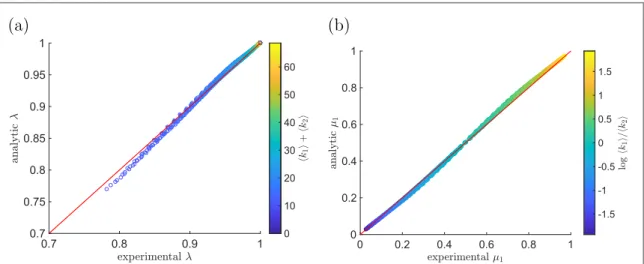
(7) New J. Phys. 21 (2019) 035003. A Solé-Ribalta et al. Probability R p1, p2 , N (d ) admits a simple expression: R p1, p2 , N (d ) = 1 -. d. ¥. å å Q p , p , N (s , f ) , s=1 f=1. 1. 2. (15). However, Q p1, p2 , N (d, f ) still requires further decompositions. Although we know the origen, destination and intermediate nodes, the total lengthd of the paths, and the total multiplicityf, it remains to establish: the layerα at which the path starts; the lengthℓcovered in layer1 (the rest of the path in layer2 will have length d−ℓ−1); the distribution of the multiplicities between the two layers. Moreover, whenf>1, we may have a combination of paths starting at different layers, with different lengths in each layer, and with different distribution of the multiplicities per layer. Denoting by ψα,ℓ, β the multiplicity of paths in layerβ, when they start in layerα and have lengthℓin layer1, the set of possible decompositions of the multiplicity can be written as: (d, f) = {Y Î {0, ¼, f} 2 ´ (d - 2) ´ 2:. 2. d- 2. å å ya,ℓ,1ya,ℓ,2 = f}.. (16). a = 1 ℓ= 1. Note that apaths arriving to the switching node in one layer, and bpaths departing from it in the other layer, generate ab different paths in the multiplex, hence the products inside the sums in (16). An example of a decomposition Ψ of (5, 10) could be: 2paths of length2 starting in layer1, followed by 3paths of length2 in layer2 (amounting 6paths), plus 1path of length1 starting in layer2, followed by 4paths of length3 in layer1 (amounting 4paths), which correspond to ψ1,2,1=2, ψ1,2,2=3, ψ2,3,2=1 and ψ2,3,1=4 (the rest of the components are zero). In practical terms, the calculation of (d, f ) involves: finding the partitions of f; factorizing the parts as products of two integers, by calculating all their divisors; choosing initial layer; and dividing the total length as the sum of the lengths in each layer plus one. Using the decomposition set in (16), we may finally calculate the remaining probabilities in (14) and (15): Q p1, p2 , N (d , f) =. å. 2. d- 2. . YÎ (d , f) a = 1 ℓ = 1 ya, ℓ ,1ya, ℓ ,2¹ 0. Pp1, N (ℓ , ya, ℓ,1) Pp2 , N (d - ℓ - 1, ya, ℓ,2).. (17). Note the presence of the joint probabilities (10) for single layer Erdős–Rényi networks, which account for the subpaths of the multiplex shortest paths fully contained in each of the layers.. 6. Evaluation of analytical predictions To check the validity of our calculations of the distribution of paths in multiplex networks, we have generated a large set of two-layer multiplex networks with uncorrelated Erdős–Rényi layers, and compared the predicted values with the experimental ones. In particular, we have analyzed multiplex networks with 500nodes in each layer, for a total of 502 different configurations. These configurations correspond to 50logarithmically spaced values of the average degree ákñ of each layer, with values ranging between5 and35. For each configuration, we generate 100different multiplex networks, calculate their experimental values of λ and μ1, and take averages. These averages are then compared with the predicted values using (2) and (6), respectively. The analytical values only consider multiplex shortest paths with just one change of layer (as discussed above), and contributions from multiplicities larger than100 have been discarded. The results are presented in figure 3, which shows an excellent agreement between theory and experiments. When the average degree of an Erdős–Rényi network is large, its average shortest path length is small [31], thus it is difficult to find multiplex shortest paths since the overhead of changing layer has to be compensated with very short paths in the layers. As a consequence, the fractionλ of shortest paths fully included in one of the layers tends to1, as shown in figure 3(a). If we reduce these average degrees, the shortest paths of the layers become larger, and the opportunities to find multiplex shortest paths increases, yielding lower values ofλ. In the extreme cases in which the average degrees are very small, multiplex shortest paths become more common, and it is even possible to find shortest paths with two or more changes of layer; this is the reason for the small deviations between the experimental and predicted values ofλ for small ák1ñ + ák2ñ. Figure 3(b) shows also that non-multiplex shortest paths tend to be concentrated in the layer with largest average degree, i.e. with smaller average shortest path length. Thus, parameterμ1 approaches value1 when ák1ñ ák2ñ, and0 when ák1ñ ák2ñ. 6.
(8) New J. Phys. 21 (2019) 035003. A Solé-Ribalta et al. Figure 3. (a) Evaluation of the accuracy of (2) on predictingλ, the fraction of non-multiplex shortest paths. (b) Evaluation of the accuracy of (6) on predictingμ1, the fraction of non-multiplex shortest paths contained in the first layer. Each experimental point is the average of 100two-layer multiplex networks with Erdős–Rényi layers.. 7. Congestion in multiplex networks Shortest paths play an important role in congestion phenomena in complex networks. When elements (packages, vehicles, etc.) travel a network using shortest paths, the load of the nodes is directly related to the number of shortest paths that make use of them. If the capacity of some nodes to process these elements is lower than their incoming rate, congestion emerges [7]. In the general case of multiplex networks [29], it was shown that congestion appears when the injection rate per node, ρ, reaches a critical value ρc: rc = tL-1. N-1 , *. (18). where τ is the processing capacity of the nodes, and * is the maximum betweenness of all nodes in all layers of the multiplex network. Additionaly, as it is shown in [29], the maximum betweenness found in the multiplex can be approximated in terms of the betweenness of the most efficient layer, ℓ, as * » lmℓ *ℓ . Specifically, ℓis the layer for which the onset of congestion is larger than for the rest of the layers, when layers are considered as independent networks. Thus, the onset of congestion ρc becomes rc ». 1 (ℓ) r , Llmℓ c. (19). where r(cℓ) is the critical injection rate of layer ℓ, given by (see [7]) rc(ℓ) = t. N-1 . *ℓ. (20). For example, if layer one is the most efficient, ℓ=1, and we have two layers, L=2, the first layer of the multiplex accepts much more load than the second layer before congestion appears, thus r(c1) > r(c2). When we connect these two layers to form a multiplex, there exists a migration of shortest paths from the second to the first layer, which increases its load, eventually becoming responsible for the onset of congestion of the multiplex. This increases the congestion of the most efficient layer, as shown in (19). An important consequence of this redistribution of shortest paths in the multiplex, and the appearance of multiplex shortest paths, is that the multiplex may attain congestion with lower load than for any of its separated layers, the so-called congestion induced by the multiplex structure [29]. In our example, this happens when rc < r(c2). By combining this inequality with (19) and (20), we obtain the condition for having congestion induced by the multiplex: Llm1 . *2 . 1*. (21). We have shown above how to analytically estimate the values of λ and μ1, by using (2) and (6), respectively. However, the estimation of *a in terms of the structural properties of the network is not straightforward.We have experimentally observed that the relationship between the maximum betweenness (excluding endpoints) and ákañ follows a power law with exponent −1, with a constant proportional to N−1 and to the average multiplicity found in Erdős–Rényi networks of the same size, áfñ*. Thus, we may express the maximum betweenness as 7.
(9) New J. Phys. 21 (2019) 035003. A Solé-Ribalta et al. Figure 4. Estimation of the congestion induced by the multiplex structure. Light grey region corresponds to configurations where the multiplex induces congestion, and dark grey to regions where the multiplex structure does not induce congestion. Red line represents our semi-analytical estimation of the frontier between these two regions, using (21) and (22).. *a » (N - 1) áfñ* ákañ-1 + 2(N - 1) ,. (22). where áfñ* = max. 2 ákñ N. 1 dákñ. dákñ. å áfñákñ (d ).. (23). d= 1. The term dákñ corresponds to the maximum expected distance in an Erdős–Rényi network with average degree ákñ, and áfñákñ (d ) to the average multiplicity in (3a) for that network. We show in figure 4 the estimated region of the parameters space in which congestion is predicted to be induced by the multiplex structure, for multiplex networks composed of Erdős–Rényi layers, in good agreement with the experimental results.. 8. Conclusions We have presented a method to compute the multiplicity and distribution of shortest paths in multiplex networks. Using the method, we have analytically determined the distribution and multiplicity of shortest paths in duplex of Erdős–Rényi networks. This results are essential to determine the onset of congestion on multiplex structures, as for example in many multimodal transportation networks. We can use the analytical findings to determine the area of the phase diagram where the multiplex can induce congestion. This work is relevant for any dynamical process that uses shortest path as a routing strategy in multilayer networks.. Acknowledgments This work has been supported by Ministerio de Economía y Competitividad (grant FIS2015-71582-C2-1), Generalitat de Catalunya (grant 2017SGR-896), and Universitat Rovira i Virgili (grant 2017PFR-URV-B2-41). AA acknowledges partial financial support from ICREA Academia and the James S McDonnell Foundation.. ORCID iDs Albert Solé-Ribalta https://orcid.org/0000-0002-2953-5338 Alex Arenas https://orcid.org/0000-0003-0937-0334 Sergio Gómez https://orcid.org/0000-0003-1820-0062. References [1] Noh J D and Rieger H 2002 Phys. Rev. E 66 066127 [2] Latora V and Marchiori M 2001 Phys. Rev. Lett. 87 198701. 8.
(10) New J. Phys. 21 (2019) 035003. [3] [4] [5] [6] [7] [8] [9] [10] [11] [12] [13] [14] [15] [16] [17] [18] [19] [20] [21] [22] [23] [24] [25] [26] [27] [28] [29] [30] [31] [32] [33] [34] [35] [36] [37]. A Solé-Ribalta et al. Newman M E J 2001 Phys. Rev. E 64 016132 Goh K I, Kahng B and Kim D 2001 Phys. Rev. Lett. 87 278701 Holme P and Kim B J 2002 Phys. Rev. E 65 066109 Motter A E and Lai Y C 2002 Phys. Rev. E 66 065102 Guimerà R, Diaz-Guilera A, Vega-Redondo F, Cabrales A and Arenas A 2002 Phys. Rev. Lett. 89 248701 Guimera R, Arenas A, Díaz-Guilera A and Giralt F 2002 Phys. Rev. E 66 026704 Solé-Ribalta A, Gómez S and Arenas A 2016 R. Soc. Open Sci. 3 160098 Solé-Ribalta A, Gómez S and Arenas A 2018 Netw. Spat. Econ. 18 33–50 Goh K I, Oh E, Jeong H, Kahng B and Kim D 2002 Proc. Natl Acad. Sci. USA 99 12583–8 Zhang H, Liu Z, Tang M and Hui P M 2007 Phys. Lett. A 364 177–82 Yan G, Zhou T, Hu B, Fu Z Q and Wang B H 2006 Phys. Rev. E 73 046108 Zhan F B and Noon C E 1998 Transport. Sci. 32 65–73 Brockmann D and Helbing D 2013 Science 342 1337–42 Rubinov M and Sporns O 2010 Neuroimage 52 1059–69 Agarwal U, Ramachandran V, King V and Pontecorvi M 2018 A deterministic distributed algorithm for exact weighted all-pairs shortest paths in Õ(n 3/2 ) rounds Proc. 2018 ACM Symp. on Principles of Distributed Computing, PODC ’18 (New York: ACM) pp 199–205 Freeman L C 1977 Sociometry 40 35–41 Zhao L, Lai Y C, Park K and Ye N 2005 Phys. Rev. E 71 026125 De Domenico M, Solé-Ribalta A, Cozzo E, Kivelä M, Moreno Y, Porter M A, Gómez S and Arenas A 2013 Phys. Rev. X 3 041022 De Domenico M, Solé-Ribalta A, Gómez S and Arenas A 2014 Proc. Natl Acad. Sci. USA 111 8351–6 De Domenico M, Solé-Ribalta A, Omodei E, Gómez S and Arenas A 2015 Nat. Commun. 6 6868 Solé-Ribalta A, De Domenico M, Gómez S and Arenas A 2014 Centrality rankings in multiplex networks Proc. 2014 ACM Conference on Web science (New York: ACM) pp 149–55 Solé-Ribalta A, De Domenico M, Gómez S and Arenas A 2016 Physica D 323 73–9 Kivelä M, Arenas A, Barthelemy M, Gleeson J P, Moreno Y and Porter M A 2014 J. Complex Netw. 2 203–71 Boccaletti S, Bianconi G, Criado R, Del Genio C I, Gómez-Gardenes J, Romance M, Sendina-Nadal I, Wang Z and Zanin M 2014 Phys. Rep. 544 1–122 De Domenico M, Granell C, Porter M A and Arenas A 2016 Nat. Phys. 12 901 Bianconi G 2018 Multilayer Networks: Structure and Function (Oxford: Oxford University Press) Solé-Ribalta A, Gómez S and Arenas A 2016 Phys. Rev. Lett. 116 108701 Battiston F, Nicosia V and Latora V 2014 Phys. Rev. E 89 032804 Fronczak A, Fronczak P and Hołyst J A 2004 Phys. Rev. E 70 056110 Blondel V D, Guillaume J L, Hendrickx J M and Jungers R M 2007 Phys. Rev. E 76 066101 Bauckhage C, Kersting K and Rastegarpanah B 2013 The weibull as a model of shortest path distributions in random networks Proc. Int. Workshop on Mining and Learning with Graphs (Chicago, IL: CiteSeer) Steinbock C, Biham O and Katzav E 2017 Phys. Rev. E 96 032301 Melnik S and Gleeson J P 2016 arXiv: 1604.05521 Andrews G E and Eriksson K 2004 Integer Partitions (Cambridge: Cambridge University Press) Young A 1900 Proc. London Math. Soc. s1–33 97–145. 9.
(11)
Figure

Documento similar
