
Analysis and study of data security in the Internet of Things paradigm from a Blockchain technology approach
107
0
0
Texto completo
(2) Aquesta obra està subjecta a una llicència de Reconeixement-NoComercial NoComercialSenseObraDerivada 3.0 Espanya de Creative Commons.
(3) a. i. Déu.
(4) FITXA DEL TREBALL FINAL Analysis and study of data security in the Títol del Treball: Internet of Things paradigm from a Blockchain technology approach Nom de l’autor: David Rull Aixa Nom del consultor/a: Raúl Parada Medina Nom del PRA: Carlos Monzo Sánchez Data de lliurament (mm/aaaa): 01/2018 Titulació o programa:. Màster Universitari en Enginyeria de Telecomunicació UOC-URL. Àrea del Treball Final: Sistemes de Comunicació Idioma del Treball: Anglès Blockchain technology, IoT paradigm, Paraules clau security and data privacy, smart contracts, IoT vulnerabilities Resum del Treball (màxim 250 paraules): Amb la finalitat, context d’aplicació, metodologia, resultats i conclusions del treball La tecnologia Blockchain ha guanyat interès en els últims anys d'ençà que es va presentar el seu concepte per primera vegada l'any 1991 per Stuart Haber i W.Scott Stornetta, gràcies a la seva capacitat de millorar la integritat de les transaccions a través de la xarxa entre qualsevol entitat. L'aplicació d'aquesta tecnologia en el camp de la IoT (Internet of Things) busca garantir la seguretat i privacitat de les dades de la interconnexió digital de dispositius físics via Internet. En aquest projecte s'analitzen les vulnerabilitats de les tecnologies i escenaris més importants de la IoT i les millors contramesures per combatre aquestes vulnerabilitats. També es fa un estudi de les contribucions i solucions més importants d'alguns investigadors per protegir les dades. Després es fa una anàlisi de la tecnologia Blockchain i els beneficis de la combinació d' aquesta amb la IoT a través de l' estudi dels projectes i contribucions d' articles i publicacions més importants.. ii.
(5) Finalment, proposo alguns escenaris innovadors en els quals es podria treure benefici de la convergència de la IoT amb la Blockchain. En conclusió, aquest projecte és un espai d' informació i coneixement del paradigma IoT i la tecnologia Blockchain amb l' anàlisi d' articles de recerca més rellevants i l' estudi de les amenaces més importants de les tecnologies i escenaris del IoT. Tanmateix, s'ofereix una visió general de l'estat actual del paradigma des de la perspectiva de la seguretat i les oportunitats que la seva combinació amb la tecnologia Blockchain pot aportar a la societat.. Abstract (in English, 250 words or less): Blockchain technology has gained interest in recent years since its concept was first introduced in 1991 by Stuart Haber and W.Scott Stornetta, thanks to its ability to improve the integrity of transactions through the network between any entity. The application of this technology in the field of IoT (Internet of Things) seeks to guarantee the security and privacy of the data of the digital interconnection of physical devices via the Internet. This project analyzes the vulnerabilities of the most important technologies and scenarios of the IoT and the best countermeasures to combat these vulnerabilities. Besides, I expose the most important projects and contributions of some researchers and their solutions to protect data. Then, an analysis of the Blockchain technology is done, and the benefits that the combination of this technology with the IoT can provide. Finally, I propose some innovative scenarios that could benefit from the convergence of IoT with Blockchain.. iii.
(6) In conclusion, this project is a space for information and knowledge of the IoT paradigm and the Blockchain technology with the analysis of the most relevant research articles and the study of the threats of the main technologies and scenarios within IoT. Besides, I expose a general overview of the current state of the paradigm from the perspective of security and the opportunity that its combination with the Blockchain technology can bring to our society.. iv.
(7) Índex 1. Introduction................................................................................................................7 1.1 Context and justification of the project.................................................................7 1.2 Aims of the project................................................................................................9 1.3 Approach and method followed............................................................................9 1.4 Plan of the project...............................................................................................10 1.5 Summary of the products obtained.....................................................................10 1.6 Description of the other sections of the memory.................................................12 2. Internet of Things...................................................................................................13 2.1 IoT (Internet of Things)...........................................................................................13 2.2 IoT paradigm..........................................................................................................13 2.3 IoT protocols...........................................................................................................18 2.4 IoT architectures ....................................................................................................20 2.4.1 Perception Layer......................................................................................23 2.4.2 Network Layer..........................................................................................25 2.4.3 Application Layer......................................................................................27 2.5 IoT Applications.......................................................................................................29 3. Blockchain technology...........................................................................................31 3.1 Blockchain concept......................................................................................31 3.2 How Blockchain works.................................................................................32 3.3 Advantages of Blockchain technology.........................................................36 3.4 Blockchain applications................................................................................37 4. IoT Technologies and vulnerabilities....................................................................39 4.1 RFID.............................................................................................................41 4.2 WSN.............................................................................................................43 4.3 NFC..............................................................................................................44 4.4 Bluetooth......................................................................................................45 4.5 BLE (Bluetooth Low Energy) .......................................................................47 4.6 Wi-Fi.............................................................................................................48 4.7 WiMAX.........................................................................................................48 4.8 ZigBee..........................................................................................................49 4.9 Z-Wave........................................................................................................50 4.10 LoRa..........................................................................................................51 4.11 Cloud Computing paradigm.......................................................................52 5. IoT scenarios...........................................................................................................54. v.
(8) 5.1 Smart Home................................................................................................54 5.2 Smart Grids.................................................................................................56 5.3 Connected Industry.....................................................................................57 5.4 Connected Health........................................................................................59 5.5 Connected car.............................................................................................60 5.6 Supply chain................................................................................................61 6. IoT security solutions.............................................................................................63 7. IoT and Blockchain convergence..........................................................................67 7.1 Concept.......................................................................................................67 7.2 Internet of Things applications using Blockchain.........................................69 7.3 IoT solutions using Blockchain technology..................................................70 8. Proposed scenarios................................................................................................77 9. Conclusions.............................................................................................................81 10. Glossary.................................................................................................................83 11. Bibliography..........................................................................................................86. vi.
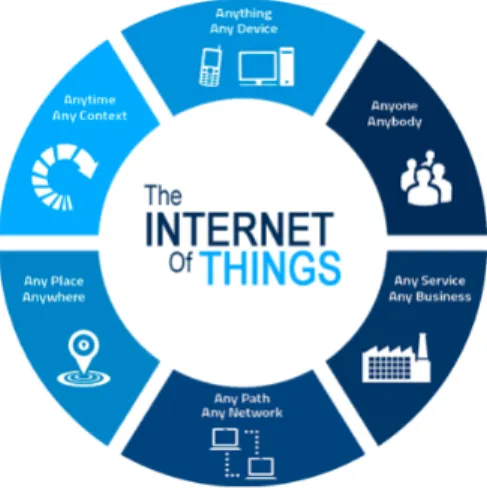
(9) 1. Introduction During the last decade the IoT (Internet of Things) has been gradually introduced into our lives thanks to the availability of wireless communication systems. IoT paradigm embraces many concepts; intelligent devices that collect data from the environment, many different technologies to allow their connection, services and standards, and all the elements that take part.. 1.1 Context and justification of the project IoT can bring many benefits to society in many different ways, but it is very important to be mindful so the best solution can be found to protect data privacy. The great challenge of the IoT is to find a reliable communication environment that guarantees the security of the data transmitted between all the connected devices. One of the possible solutions could be the convergence between IoT and Blockchain technology, and it is analyzed in this project. There are three core elements referenced in a IoT architecture: 1.Things. Devices that have a means of connecting to a wider network. 2.Network. Connect the multiple devices to the cloud. 3.Cloud. Remote servers in a data centre which function is to consolidate and store the data in a safe way.. Figure 1. IoT paradigm illustrated Source. http://mozitech.com/internet-of-things-beyond-our-current-imagination/. Blockchain technology has the potential to secure this environment thanks to cryptography, which seeks that all consumers have a secret and unique key through which access your data.. 7.
(10) Open protocols based on Blockchain can standardize the use of RFID, GPS, all types of common sensors in the assembly lines of the industrial sector to automate data safely. Many sectors would be beneficiaries of this technology such as Healthcare or the transport and logistics sectors, which will also be able to obtain great benefits from using it to integrate the advantages of the IoT. The advantages it offers include decentralization and transparency of information, everyone is at the same hierarchical level, preventing a main organizer from incorrectly using the data. Although currently it cannot ensure the desired environment in a completely safe way, many companies and organizations work to improve this Internet coverage of things more and more. It does not make impossible to avoid attacks, but it does make them much more difficult to produce. Many studies are currently focused on using homomorphic encryption. In the past, it has already been shown that this encryption was feasible, but requires much more time than conventional processes, and still works to improve it. At the moment there is not a robust plan to maintain the desired security in this environment and attacks on devices are the main danger to address. This project focuses on the need to analyze all the information through several studies and research carried out in the field of IoT, Blockchain and its convergence, and expose what are the best solutions to fight against the vulnerabilities of the main technologies that take part of Internet of Things. The expected result is to gather the key information of IoT paradigm related to security and the best mechanisms to guarantee the integrity and privacy of data within IoT. Another goal is to allow other people interested in this field to access easily to information and knowledge collected in this project and also the information from many research articles that are organized by topics. Besides, I propose some scenarios where could converge IoT and Blockchain technology in the future.. 8.
(11) 1.2 Aims of the project -Expose the concepts of IoT (Internet of Things) and Blockchain in detail, make a study of their current impact on society, and their future perspectives as potential applications. -Make a study with research articles and publications that relate these concepts, highlighting the most important contributions. -Analyze the data privacy in the exchange of data between the main IoT technologies and what are the best countermeasures to avoid the possible threats. -Analyze the challenges and opportunities of the convergence between IoT and Blockchain technology. -Propose some possible scenarios of Internet of Things using Blockchain technology, which could be applied in the future.. 1.3 Approach and method followed The strategy to carry out this project is to look for information and study the most important measures that have been presented until nowadays of the IoT paradigm and also of its convergence with Blockchain technology through articles about research and publications. Then, expose the most important information that is related to the study of the privacy and security of the data, as well as the best mechanisms and protocols that can address the vulnerability issues and promote trusted environments that can prevent attacks. The chosen strategy is the result of having access to valuable information due to the fact that many projects related to IoT and Blockchain technology are still undergoing experimentation and they bring different interesting approaches and concepts. It is important to consider what is called the IoT system, that represents not only the IoT device, but the whole ecosystem that makes it work, such as web interfaces, related applications, cloud services, and the other devices that interact with it. It also represents the connection that is created between organizations, suppliers and competitors.. 9.
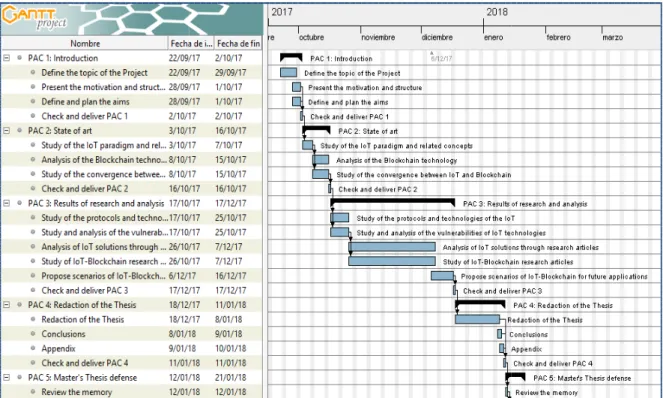
(12) The detection and correction of attacks on IoT systems will become an increasingly important part of business security and the privacy of consumers' data that uses technology devices for almost all sectors of society.. 1.4 Plan of the project The realization of this project is divided into different tasks. Here I list these tasks that have to be done, related to different PACS with the start and end dates. Below, figure 2 shows the Gantt Chart.. Tasks. Start. End. PAC 1: Introduction Define the topic of the Project Present the motivation and structure Define and plan the aims Check and deliver PAC 1. 22/09/2017 02/10/2017 22/09/2017 29/09/2017. PAC 2: State of art Study of the IoT paradigm and related concepts Analysis of the Blockchain technology Study of the convergence between IoT and Blockchain Check and deliver PAC 2. 03/10/2017 03/10/2017 08/10/2017 08/10/2017 16/10/2017. 16/10/2017 07/10/2017 15/10/2017 15/10/2017 16/10/2017. PAC 3: Results of research and analysis Study of the protocols and technologies of the IoT Study and analysis of the vulnerabilities of IoT technologies Analysis of IoT solutions through research articles Study of IoT-Blockchain research articles Propose scenarios IoT-Blockchain for future applications Check and deliver PAC 3. 17/10/2017 17/10/2017 17/10/2001 26/10/2017 26/10/2017 06/12/2017 17/12/2017. 17/12/2017 25/10/2017 25/10/2017 07/12/2017 07/12/2017 16/12/2017 17/12/2017. PAC 4: Redaction of the Thesis Redaction of the Thesis Conclusions Appendix Check and deliver PAC 4. 18/12/2017 18/12/2017 08/01/2017 09/01/2018 11/01/2018. 11/01/2018 08/01/2017 09/01/2018 10/01/2018 11/01/2018. PAC 5: Master's Thesis defense Review the memory Plan and assemble the presentation Check and deliver PAC 5. 12/01/2018 21/01/2018 12/01/2018 12/01/2018. 28/09/2017 01/10/2017 28/09/2017 01/10/2017 02/10/2017 02/10/2017. 13/01/2018 20/01/2018 21/01/2018 21/01/2018. 10.
(13) Figure 2. Gantt Chart with the project schedule. 1.5 Summary of products obtained I have detailed the most important attacks that can be done with the different differen IoT technologies and possible countermeasures to mitigate them. them It has been explained which are the most important threats in the most commonly common IoT environments and how to avoid these threats. On the other hand, I have summarized the most important contributions of research articles in two subjects: -Articles rticles that provide security solutions and present mechanisms and tools to protect data within the IoT paradigm. -Articles rticles that provide solutions based on the convergence convergence of the IoT with Blockchain B technology. Finally, some ome scenarios have been proposed where where the convergence between the IoT Io and the Blockchain technology echnology could be applied in the future, explaining the key concepts and general features.. 11.
(14) 1.6 Description of the other sections of the memory In section 2 I present the IoT paradigm with its most important protocols and architectures introducing the most important IoT technologies: RFID (Radio Frequency Identification), WSN (Wireless Sensor Networks), NFC (Near Field Communication), Bluetooth, BLE (Bluetooth Blow Energy), Wi-Fi, WiMAX (Worldwide Interoperability for Microwave Access), Z-Wave, LoRa and the Cloud Computing paradigm. In section 3 I introduce and explain Blockchain technology with its most important features and the related concepts. In section 4 I explain the vulnerabilities of IoT technologies (that are presented in Section 2) and I propose mechanisms to fight against them. In section 5 I expose the vulnerabilities of the most common scenarios, and the countermeasures that mitigate them. These scenarios are: Smart Home, Smart Grids, Connected Industry, Connected Health, Connected car and Supply Chain. In section 6 I summarize important proposals of several articles that seek solutions to guarantee the data security and privacy within the IoT. In section 7 I explain the advantages of the convergence between the IoT and Blockchain technology and the most important solutions that have been done taking the opportunities of their combination. In section 8 I propose scenarios and ideas where the combination of IoT with Blockchain could be applied in the future.. 12.
(15) 2. Internet of Things The term the Internet of Things it is about to connect daily elements to the Internet to take advantage of the possibilities provided by the almost immediate communication between different elements and systems. This is possible, above all, thanks to the improvement of communication networks and storage and processing systems, as well as the enormous evolution of the technology that allows to provide the necessary connectivity to any device.. 2.1 IoT The concept of IoT was established by Kevin Ashton in 1999, a British technology pioneer who founded the Auto-ID Center, Massachusetts [1] at MIT (Massachusetts Institute of Technology), a private university in Cambridge, which is often ranked as one of the world's most prestigious universities. Internet of Things brings promising challenges and opportunities. Research on IoT has important economic and social value for the development of the next generation of information, network, and communication technologies.. 2.2 IoT paradigm There is no universally accepted definition of IoT, because this paradigm not only describes a new type of technical architecture but also a new concept that defines how we interact with the physical world. Here I expose two definitions of the concept that I have chosen from IEEE (Institute of Electrical and Electronics Engineers) and ITU (International Telecommunications Union) [2]: -IEEE defines IoT as "a network of items (each embedded with sensors) which are connected to Internet". (Special report on Internet of Things in March 2014). -ITU defines IoT as "ubiquitous network in which the concept of ubiquitous is founded upon the all inclusive us of network and network devices". (2005 IoT report, ITU series Y,20). If I had to define the Internet of Things with my words, I would say that it is the connection of all kinds of objects with each other through Internet to achieve a digitally communicated environment. An important concept related to the Internet of Things is M2M (Machine-to-Machine). Represents a set of technologies that enable the machines to communicate with each. 13.
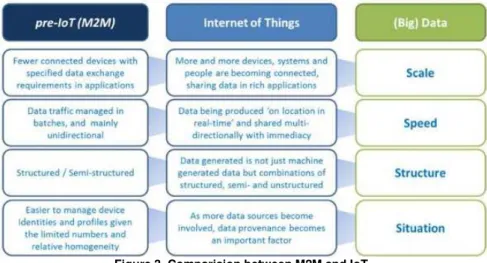
(16) other and drive action. M2M uses wireless networks to connect Internet and devices to each other with minimal direct human intervention, to deliver services on the needs of a wide range of industries. On the other hand, IoT represents the coordination of devices, appliances, machines connected to the Internet through multiple networks with human interaction as a key factor.. Figure 3. Comparision between M2M and IoT Source. Machina Research report "Why NoSQL Databases are needed for the IoT. Figure 3 illustrates different aspects related to M2M and IoT. Generally, both concepts are similar. The main differences are the scalability, the structure and the speed. IoT has more connected devices than M2M and it is more used in the consumer space while M2M has a stronger industrial connotation. The concept of M2M was used during World War II for identifying friend or foe to prevent pilots from hitting friendly targets. Nowadays is used in several applications such as machine maintenance, measuring, security, chain supplying, asset tracking or remote monitoring [2]-[4].. Table 2 Objectives of the most important organizations focusing on IoTand M2M Source. The Internet of Things vision: Key features, applications and open issues [4]. Table 2 shows some objectives of the main organizations working on IoT as a whole.. 14.
(17) There are different organizations working in the IoT and M2M standardization process that focus on the different aspects, protocols, and other important parts of the Internet of Things. At the international level, ITU-T work on IoT including network aspects of identification of things, and ubiquitous sensor network. In North America many standard organizations work in promoting IoT standards: -IEEE works in M2M applications. It investigates efficient ways to support lower power consumption of the device, a significant large number of devices at the base stations, small burst transmissions, and improved device authentication. -ATIS (Alliance for Telecommunications Industry Solutions) aim to define a common service layer for multiple M2M applications and the corresponding interfaces between the application and the transport layers. -TIA (Telecommunications Industry Association) is interested in specifying ubiquitous protocols for communicating with smart devices used in industries and releasing its Smart Device Communications Reference Architecture standard (TIA-4940). -OMA (Open Mobile Alliance) is interested in extending the device management protocol for M2M communications and works on location services for mobile M2M applications. At the European level CEN focus on identification technologies, data gathering protocols and communication protocols. ETSI is more focused on M2M standardization activities. In Asia, the IoT standardization is done by different organizations. In China, by CCSA Technical Committee 10, which works mainly in the area of e-health monitoring and vehicle communication systems. In Korea, TTA founded M2M PG (PG708) working on service requirements, data structure and identification scheme, and in Japan the standardization is done through ARIB which focus on smart grid, smart cities and smart homes [4]. To understand more in detail how IoT operates it is important to know some other key concepts; sensors, connectivity, middleware, addressing and scalability, data storage and visualization. Sensors convert a non-electrical input into an electrical signal that can be sent to an electronic circuit. They are responsible of creating information for the IoT network through the collection of data from the environment for different purposes. They must be small, versatile and energy efficient. All IoT applications have one or more sensors, have a low cost and consume less power [5].. 15.
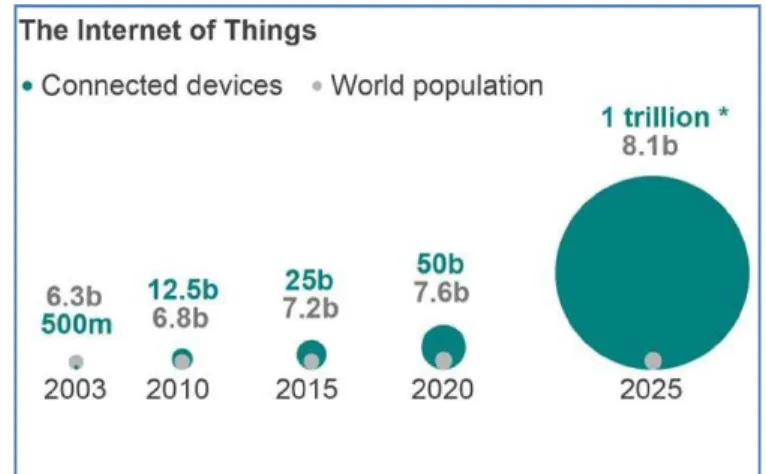
(18) Connectivity allows devices to communicate with each other and also with services and applications that works in the Cloud. Network design is very important in the IoT paradigm because of the huge volume of interconnected elements and also to the impact that the design can have to the global performance of the system. Middleware interconnects and integrates all the elements that make the Internet of Things possible. It is part of the architecture enabling connectivity for huge numbers of divers things by providing a connectivity layer for sensors and also for the application layers that provide services that ensure effective communications between software [2],[6]. It acts as an interface enabling the various applications on heterogeneous systems to easily communicate with each other.. Figure 3. Comparision between connecte devices and World population Source. Cisco IBSG. Figure 3 illustrates the comparison between connected devices and world population by years and their expected evolution. We can observe the enormous growth potential of connected devices. While in 2003, the world population was 6.3 billion and connected devices 500 million, in 2025 is expected to have around 1 trillion devices connected and 8.1 billion people in the world. Addressing and Scalability are very important, because all the objects included in the IoT network must have a unique identifier. IoT embraces a very large number of devices, therefore addressing schemes is essential to distinguish all the elements, their functionalities, their locations and also to control these elements through the Internet. As we know, an IP address is like a phone number or street address and when you connect to the Internet, every device is assigned to an IP address, as well as every site you visit has an IP address. Everything that is connected and other elements that are going to be connected, must be identified by their unique identification, location and. 16.
(19) functionalities. The features to be considered of creating a unique address are: reliability, uniqueness, persistence and scalability. IoT needs an architecture that allows scalability, which means the capacity to connect one day one hundred devices, and the following day one million. The addressing system that has been used since the birth of the Internet is called IPv4, and the new addressing system is called IPv6. The reason the IPv4 system has to be replaced with IPv6 is because the Internet is running out of IPv4 address space, and IPv6 provides an exponentially large number of IP addresses; 340,282,366,920,938,463,463,374,607,431,768,211,456. The IPv6 is used for the IoT due to the fact IPv4 inability to meet the quick growth of addressing space requirements. It has introduced supported,scalable addressing schemes to provide secure access to the resources uniquely and remotely [3]. Data storage and analytics. The extremely large amount of data within IoT must be intelligently gathered, analyzed, processed and stored for more efficient and smart monitoring, actuation and real time decision making. Developing intelligent algorithms is a requirement to make sense of an efficient data management. Cloud computing, cloud-based storage and cloud based analytics provide a great solution for handling, storing and real time processing the data from an unpredictable number of devices. Through different IoT devices the data is collected and can be shared with other data using cloud-based services. These services provide valuable information for users. Besides, it may be used for better automatic actuation and remote control [3]. Visualization is the most important aspect in the IoT global design because all the things and devices need interaction with the users. In this age of technology and communication, smart phones and tablet devices have become very popular in part because their ease of use and the capacity to access data information in a fast way. The 2D and 3D screens have provided users with large amount of useful information in several ways. The use of smart tablets and phones has become very important to allow this interaction. The systems are able to model the obtained data, consider how to detect events, and provide different ways to visualize the data, but always trying to show the representation of the information following the requirements of the consumers [7,8]. The IoT runs over the TCP/IP networking model and uses 4-layers and connect all the devices through the Internet. These levels are: data link level, networking level, transport level and application level [9].. 17.
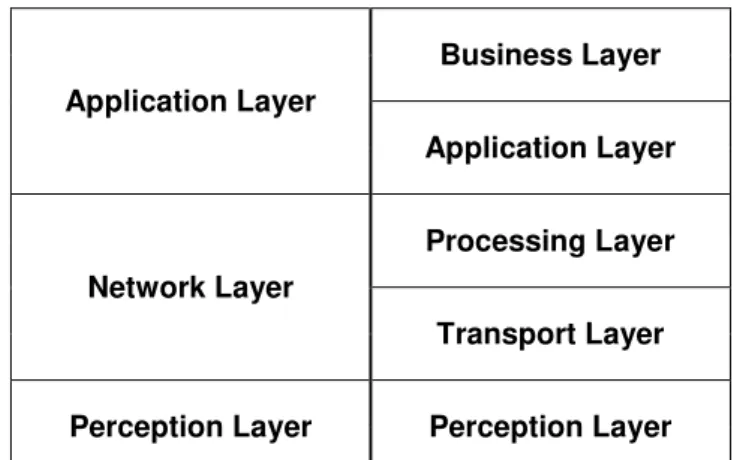
(20) -Data Link Level. At this layer you will have a requirement to connect devices that are nearby, and those that are more distant with appropriate networks. -Networking Level. The protocol that is set to dominate at the networking level is IPv6. -Transport Level. At this level, TCP (Transmission Control Protocol) has dominated and is used by HTTP and many other protocols such as SMTP, POP3 and IMAP4. TCP is a transport layer protocol used by applications that require guaranteed delivery. UDP (User Datagram Protocol) is one of the core members of the Internet protocol suite. TCP and UDP are the protocols more used on IP protocol [10]. -Application Level is responsible for data presentation. HTTP is probably the best known protocol at this level that powers the Web, but is not suitable in resource constrained environments because it requires complex headers with a minimum of nine TCP packets. Besides, HTTP does not guarantee message delivery. The IoT environment requires very small interactions with small devices and with very little power consumption [9].. 2.3 IoT Protocols Many protocols have been developed specifically for IoT environments. Here I explain the main protocols which are CoAP, MQTT, AMQP, XMPP and Rest [6],[11]-[16]. CoAP (Constrained Application Protocol) was designed by IETF Constrained RESTful Environment, and is a specialized web transfer protocol that was created for constrained device connectivity in the IoT and for M2M applications such as smart energy and building automation. It works with UDP only and is very fast in device to device communication. CoAP architecture is divided into two main sub layers: messaging and request/response. The messaging sub layer is responsible for the reliability and duplication of messages while the request/response is responsible for communication. There are four types of messages in CoAP: no confirmable, confirmable, reset and acknowledgement. For reliable transmission over UDP, confirmable messages are used. Besides, it uses the Efficient XML Interchange data format, which is a binary data format and is more efficient in terms of space compared to plain text HTML/XML. Because UDP allows broadcast and multicast, you can transmit to multiple hosts using less bandwidth. This makes it good for local network environments where devices need to speak with each other quickly, which is traditional for some M2M settings.. 18.
(21) It is intended to be used in lower power and constrained networks such as 6LoWPAN and LLN/IoT that requires remote monitoring and manipulating [3],[6],[13],[16]. MQTT (Message Queue Telemetry Transport) is a publish protocol that runs over TCP. It was developed by IBM as a client/server protocol to meet device to gateway messaging requirements. It is a protocol that makes it suitable for IoT applications. Due to the fact that it runs over TCP, it cannot be used with all types of IoT applications. Supports the major IoT message patterns: publish/subscribe and request/reply. This protocol implements QoS and secure communication. MQTT-SN (Message Queue Telemetry Transport-Sensor Network) is an extension of MQTT which is designed for low power and low cost devices. It is based on MQTT but has some optimizations for WSN. Some wireless protocols are supported by MQTT-SN such as Bluetooth, ZigBee and UDP [13],[14]. AMQP (Advanced Message Queue Protocol) is a protocol maintained by OASIS, and also an open standard to exchange messages between applications (M2M). It supports both TCP and UDP and it is the only protocol viable for end-to-end use for selected IoT use cases. The key factors of AMQP are open, security, interoperability, reliability [15]. XMPP (Extensible Messaging and Presence Protocol) is an open standard for presence and messaging. This protocol operates through XML messages. This protocol enables users to send real-time messages and handles the user presence. The IoT XMPP version enables users to send and receive messages from machines. The key features are extensible, flexible and open standard [15]. Rest (Representational state transfer) is used as IoT protocol to exchange data between applications and to integrate applications that belongs to different domains. Besides, it uses HTTP as based protocol and uses client/server paradigm [12]. There are other protocols that are used specifically for security, QUIC and DTLS [17]. QUIC (Quick UDP Internet Connections) is a protocol that uses User Datagram Protocol and support a group of composite connections that are present between two endpoints. QUIC have the ability to provide security protection like Secure Sockets Layer or Transport Layer Security and minimize transport latency. QUIC can estimate the bandwidth in either direction so that congestion problem should be avoided. DTLS (Datagram Transport Layer) is the protocol responsible for providing the communication privacy for UDP. With the use of DTLS many threats can be prevented such as eavesdropping, message tampering and message forgery. The base of DTLS is TLS, which is used for providing security.. 19.
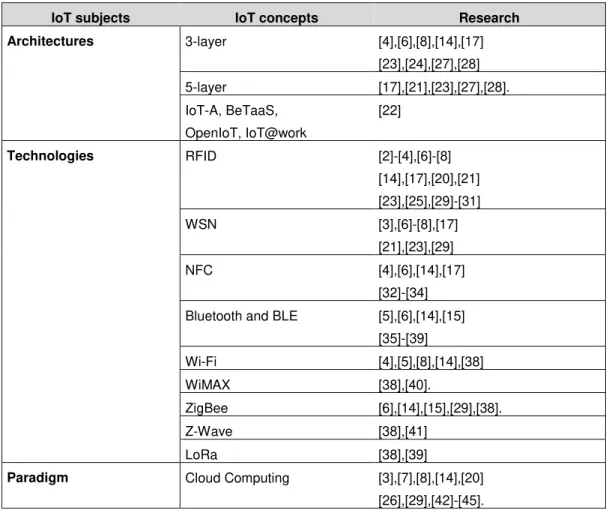
(22) Within IoT there are four different kinds of connections across which data moves [12], [18]: -Device to device means the connection between two or more devices with each other. Different types of networks can communicate them and the main protocols used are Bluetooth, Z-Wave and ZigBee. This model is used in different scenarios, for example in smart home environments where it requires a low data rate. It can be used also in connected cars environments to share information in order to enhance many issues such as safety and traffic flow. -Device to cloud represents a device connecting to an Internet cloud service in order to exchange data and control message traffic. In this model, Ethernet or Wi-Fi can be used. -Device to gateway involves application software, operating on a local gateway device that acts as an intermediary between an IoT device and a cloud service. This gateway could provide security and other functionality such as data or protocol translation. -Back-End data sharing. With this model, users can export and analyze smart object data from a cloud service in combination with data from other sources, and send it to other services for aggregation and analysis. An example of this model is a connected car that updates the navigation system with new route data.. 2.4 IoT architectures The. Internet. of. Things. can. be. capable. of. interconnecting. various. heterogeneous objects through the Internet, so there is a need for a flexible layered architecture. It represents vast range technologies and for this reason is not possible to consider only one IoT architecture as a reference model that can be used for all IoT operations. There is no standard architecture for IoT and depending on the context of these architectures are used based upon the requirements desired. The key factors that should be considered when a new architecture is developed are security, reliability, privacy, QoS, interoperability. The most used architectures are the 3-layer architecture and the 5-layer architecture [4],[6],[8],[14],[17],[19],[20]-[28]. The 3-layer architecture was the first IoT architecture proposed. It is composed of the perception layer, the network layer and the application layer.. 20.
(23) The objective of the perception layer is to acquire the data from the environment through sensors and actuators, which perform several functionalities such as location, humidity, acceleration, identifying temperature, vibration, weight, etc. The proper functioning of an IoT system will depend on the capacities in the management of the data and the intelligent use that is made of them. For this reason the system must be able to collect information from these sensors, then store and analyze them. There are several types of sensors used in the different available applications. This layer is divided in two parts: the perception node (controllers, sensors..) responsible of data acquisition, and perception network that communicates with transportation network and sends collected data to the gateway or control instruction to the controller. The common well known sensor today is the Smartphone. It is armed with different type of embedded sensors; light, movement, proximity, camera and microphone. There are other sensors used in different sectors and with other goals. They can be laptops, mobile devices, embedded chips, ships, vehicles, and every device. Each of these objects is considered a data source for the IoT network. Before transmitting, the data is preprocessed by the units of perception layer, then filtered and send it to the network. Such units normally have little room for temporary storage, a small processing unit and security features. RFID, NFC and WSN are technologies used in this layer. The network layer is the most important layer, the core of the IoT, and transmits the information gathered by the perception layer. It comprises of convergence network, intelligent processing, management of network and information centers. IPv6 is considered the key protocol for this layer and 3G, Wi-Fi, FTTX, Bluetooth Low Energy, ZigBee are some of the technologies used on this layer. The application layer allows the convergence between the IoT social needs and industrial technology. The objective of this layer is to give informational service consisting of three parts that are IoT client side, data storage and data inquiry module. It involves Cloud Computing, ubiquitous computing, intelligent processing and mega databases. Some examples of IoT applications are identity authentication, logistics management, intelligent transportation. Due to the IoT development, the 3-layer architecture was not sufficient to cover all the demands within IoT paradigm. For this reason, other architectures were proposed [4],[6],[8],[14],[17],[23],[24],[27],[28]. The 5-layer architecture contains the perception layer, transport layer, processing layer, application layer and business layer.. 21.
(24) The perception layer corresponds with the perception layer of the 3-layer architecture, and the transport layer corresponds with the network layer of the 3-layer architecture. In the processing layer all the data transmit from the transport layer is stored, processed and analyzed. The key elements of this layer are Cloud Computing, ubiquitous computing, database, intelligent processing. The application layer creates the distinct IoT applications and provide applications to industrial usage. Acquiring, storing, analyzing and processing of data received from the transport layer is done through this layer. The business layer is responsible about all related to IoT applications and user privacy [17],[21],[23],[27],[28].. Business Layer Application Layer Application Layer Processing Layer Network Layer Transport Layer Perception Layer. Perception Layer. Table 3. The 3-layer architecture on the left, and 5-layer architecture on the right. Table 3 shows the 3-layer and 5-layer architectures. On the left, 3-layer architecture composed of Perception Layer, Network Layer and Application Layer. On the right, 5layer architecture composed of Perception Layer, Transport Layer, Processing Layer, Application Layer and Business Layer. There are some other architecture models which are used for special purposes, but they cannot be treated as standard architectures. These architectures are [22]: -IoT-A is a business driven architecture that generates different reference architectures depending on domain specific requirements. -BeTaaS is an architecture to provide communication between machine to machine. In BeTaaS there are four layers; physical layer, adaptation layer, TaaS layer and the service layer. -OpenIoT is an architecture constructed from the reference model defined in IoT-A. The main objective is to provide the infrastructure that is cloud-based middleware.. 22.
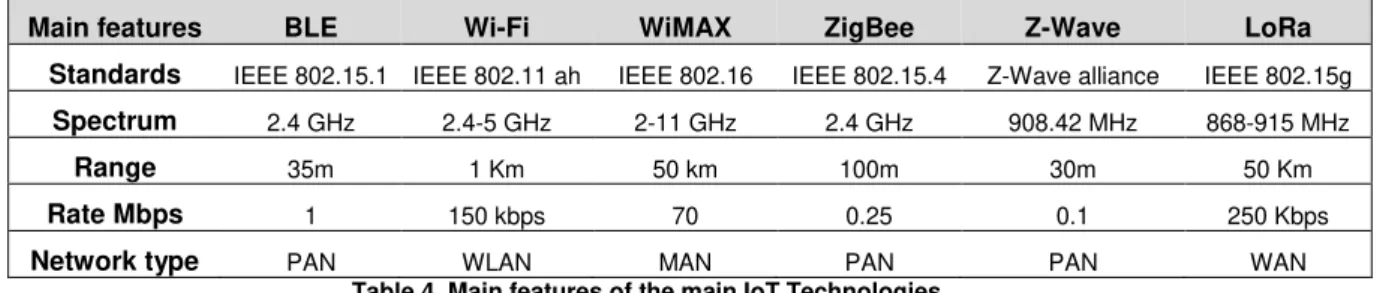
(25) -IoT@work is a European Commission project. The main purpose of this architecture model is to create the industrial automation domain. The layers in this architecture depend on its area of deployment. Vasilomanolakis et al. [22] survey these four IoT architectures. They devised a list to establish a standard set of security requirements for the IoT technologies. These requirements are Network security, Identity management, Privacy, Trust and Resilience.. 2.4.1 Perception Layer As I remarked before, the most common technologies used in the perception layer which now I explain in more detail are; Radio Frequency Identification (RFID), Wireless Sensor Networks (WSN), Near Field Communication (NFC).. RFID (Radio Frequency Identification) is a non-contact technology used for automated identification of people and objects. Is one of the main technologies that made possible the IoT paradigm. The RFID system is composed of signal transmitter, signal receiver and transmitter receiver. It is a small microchip designed for wireless data transmission. Data is transferred between a data sender and the data receiver device through radio waves. The sender data piece is known as a tag, and recipient information piece is known as a reader. These tags are placed on the objects. There are three types of RFID tags, active, passive. The active tags have their own transmitter and power source which is a battery the most times. Active RFID operates in the UHF (Ultra-High Frequency) (860 MHz to 960 MHz) band and offer a range of up to 100m. These active tags broadcast their own signal to send the information stored on their microchips. In the passive tags, the reader sends energy to antenna, and then uses the transmitted signal and converted into a Radio Frequency wave (frequencies that are located in the range extending from around 3 KHz to 300 GHz), and it is sent into the read zone Passive tags can function in the LF (Low Frequency) (125 KHz to 134.2 KHz), HF (High Frequency) (13.56 MHz) or UHF. The last type of RFID tags is a BAP (Battery-Assisted Passive), which use an integrated power source to power on the chip.. 23.
(26) The RFID is able to apply in many areas such as access control systems, inventory tracking, personnel tracking, animal tracking, asset tracking and collection system [2]-[4],[6]-[8],[14],[17],[20],[21],[23],[25],[29]-[31].. WSN (Wireless sensor networks) are networks of thousand of sensor nodes that sense and control the environmental conditions such as temperature, sound, pressure, etc. using wireless technologies and reporting sensible changes on a field to a specific server. It allows the interaction with different persons or computers. A WSN consists of a centralize base station that controls a multi-hub relay system that connects the source nodes. One of the applications of WSN is large area monitoring, where sensor nodes are placed in far fields with limited power sources. The popular network topologies used in a WSN are a star, a mesh and a hybrid network. Most of the communication in WSN is based on the IEEE 802.15.4 standard. WSN can cooperate with RFID systems. In fact, both systems play a crucial role in the IoT. These networks consume low power, have good efficiency and are cost effective. The development of wireless sensor networks was motivated by military applications, but today such networks are used in several industrial and consumer applications such as machine health monitoring and industrial process monitoring and control [3],[6][8],[17],[21],[23],[29].. NFC (Near Field Communication) is a wireless communication technology and the core technology of IoT, which was introduced when was a need to allow the communication with a few centimeters (typically a distance of 10 cm or less) and with low power and data rate required. This technology is based on RFID, so it uses variations in the magnetic field to communicate data between two NFC enabled devices. There are two modes of operation: active and passive. In the active, both devices generate magnetic fields, while in the passive mode, only one device generated the field and the other uses load modulation to transfer the data. The passive mode is useful in battery powered devices to optimize energy use. It works within the globally available and unlicensed radio frequency ISM band of 13.56 MHz on ISO/IEC 18000-3 air interface and at rates ranging from 106 Kbit/s to 424 Kbit/s. It works in the 13.56 MHz band, which means that no restrictions are applied and it does not require any license for its use. NFC tag can be modified by potential attackers who can replace the original tag with a fraudulent one with the intention to steal valuable user information. An advantage of close proximity between devices is that it is useful for secure transaction such as payments.. 24.
(27) The difference between NFC and RFID is that the first one can be used for two-way communication, and for this reason many smart phones in the market are NFC enabled. Near Field Communication can be used for a wide range of services in IoT systems such as authentication, data exchange, payments, etc. It is useful for many services such as access control, transport, smart cards [4],[6],[14],[17],[32]-[34].. 2.4.2 Network Layer There are many technologies that operates mainly in the network layer. Here I explain some of the most important, which are Bluetooth and Bluetooth Low Energy, Wi-Fi, WiMAX, ZigBee, Z-Wave and LoRa. Later, I expose their vulnerabilities.. Bluetooth is a short-range communications technology that has become important in computing and many consumer product markets. It has been considered as a cheap, reliable and power efficient replacement of cables for connecting electronic devices. Bluetooth has become a smart technology for the flexible wireless communication system. It operates in a license-free Industrial, Scientific and Medical (ISM) band ranging using 2.45 GHz. The technology is useful when transferring information between two or more devices that are near each other in low-bandwidth situations and it is very used to transfer sound data.. BLE (Bluetooth Low Energy) is a wireless personal area network technology designed by the Bluetooth Special Interest Group aimed at novel applications in the healthcare, security, home, and fitness entertainment industries. BLE uses multiple network topologies, including P2P. Compared to Classic Bluetooth, BLE is intended to provide considerably reduced power consumption (10mW) and cost while maintaining a similar communication range. The range is approximately 35 meters and the data rate is 1Mbps [5],[6],[14],[15],[35]-[39].. Wi-Fi is for many developers an obvious choice due to the fact that can offer fast data transfer, handle high quantities of data and there is a wide existing infrastructure. The most common Wi-Fi standard used in many businesses and homes is 802.11n, which offers a range of hundreds of megabits per second, and it is fine for file transfers, but perhaps too power-consuming for several IoT applications. Wi-Fi wireless network connections use radio signals in either 2.4 GHz or 5 GHz.. 25.
(28) The typical data rates work from 150 to 200 Mbps, and maximum are 600Mbps depending on the channel used and number of antennas. The range covers approximately 50m [4],[5],[8],[14],[38].. WiMAX is a family of wireless communication standards based on the IEEE 802.16 and WMAN (Wireless Metropolitan Area Network). WiMAX would operate similar to Wi-Fi, but at higher speeds over greater distances and for a greater number of users. WiMAX provides service in area that are difficult for wired infrastructure to reach and has the ability to overcome the physical limitations of traditional wired infrastructure. The IEEE 802.16 is standard operating from 2 to 11 GHz and it is expected to offer initially up to about 40 Mbps capacity per wireless channel for both fixed and portable applications, depending on the technical configuration selected. It provides speeds of approximately 70 Mbps over a range of 50 kilometers [38],[40].. ZigBee is a wireless networking standard, especially designed for wireless low-power devices. It is used for PANs (Personal Area Networks) and it is suitable for operation in isolated locations and hard radio environments. ZigBee builds on IEEE standard 802.15.4. ZigBee was developed to achieve reliable, low energy and cheap communication. The distances that can be achieved by a Zigbee device is about 10 to 100 meters. The main purpose of this technology is home automation, including actuators and sensors. It operates at 2.4 GHz supporting data rate of 250 KB/s, at 915 MHz supporting data rates of 40 KB/s and 250 KB/s, and 868 MHz supports data rates of 20 KB/s, 100 KB/s and 250 KB/s. Sensors, lighting controls, security and many more applications are all candidates for the new technology [6],[14],[15],[29],[38].. Z-Wave is an implementation of a complete Internet of Things substrate, containing communication, networking and application layer protocols. Z-Wave is designed to provide reliable, low-latency transmission of small data packets at data rates up to 100kbit/s. The throughput is 40kbit/s and suitable for control and sensor applications. Communication distance between two nodes is about 30 meters. A Z-Wave network can consist of up to 232 devices with the option of bridging networks if more devices are required. It uses a source-routed mesh network topology and has one primary controller [38],[41].. 26.
(29) LoRa is a proprietary radio modulation technology licensed by SemtechCorporation [14]. It is designed to be a low power protocol and data rates can vary from 0.3 kbps to 250 kbps, and it can be used within a suburban or urban environment (from 2 to 50 km range in a crowded urban area). LoRa operates at 868-900 MHZ ISM bands and provides long-range connectivity by using the chirp spread spectrum technique. LoraWAN is the standard of LoRa, and provide low-power WANs with features specifically needed to support low-cost mobile secure bi-directional communication in IoT, M2M and industrial applications [38]-[39].. Main features Standards. BLE. Wi-Fi. IEEE 802.15.1 IEEE 802.11 ah. WiMAX. ZigBee. Z-Wave. LoRa. IEEE 802.16. IEEE 802.15.4. Z-Wave alliance. IEEE 802.15g. Spectrum. 2.4 GHz. 2.4-5 GHz. 2-11 GHz. 2.4 GHz. 908.42 MHz. 868-915 MHz. Range. 35m. 1 Km. 50 km. 100m. 30m. 50 Km. Rate Mbps. 1. 150 kbps. 70. 0.25. 0.1. 250 Kbps. Network type. PAN. PAN. WAN. WLAN MAN PAN Table 4. Main features of the main IoT Technologies. 2.4.3 Application Layer The application layer provides services for an application program to ensure that effective communication with another application program in a network is possible. Cloud Computing is an Information technology, which operates in this layer. Cloud Computing is the delivery of computing services such as servers, storage, databases, networking, analytics and more through the Internet. It distributes the computation task into a resource pool composed by great amounts of computing resources and allow users to obtain storage space and information service. It is large a amount of virtual computing resources which have abilities to maintain and manage themselves in the system. The integration of IoT and Cloud Computing can enable the creation of smart environments. In the development of the mobile Internet, the Cloud Computing services based on mobile devices such as tablet, mobile phones, etc.. have. emerged and. been. used. for. information. sharing. environments.. [3],[7],[8],[14],[20],[26],[29],[42]-[45]. Cloud Computing can be used in multiple contexts and there are three fundamental classes: -SaaS (Software as a Service). In this model a company serves the. 27.
(30) maintenance, support and operation that the clients will use during the time they have contracted the service. An example of SaaS is Salesforce. -IaaS (Infrastructure as a Service). In this model of distribution, the service is provided through a virtualization platform. Instead of acquiring servers, network equipment or space in the data center, customers buy all these resources from an external service provider. The provisioning of these services is done through the web. One example is Amazon Web Services EC2. -PaaS (Platform as a Service). PasS offers multiple services provisioned as an integral solution on the web. Google App Engine is an example of this model.. IoT subjects Architectures. IoT concepts 3-layer. Research [4],[6],[8],[14],[17] [23],[24],[27],[28]. 5-layer. [17],[21],[23],[27],[28].. IoT-A, BeTaaS,. [22]. OpenIoT, IoT@work Technologies. RFID. [2]-[4],[6]-[8] [14],[17],[20],[21] [23],[25],[29]-[31]. WSN. [3],[6]-[8],[17] [21],[23],[29]. NFC. [4],[6],[14],[17] [32]-[34]. Bluetooth and BLE. [5],[6],[14],[15] [35]-[39]. Paradigm. Wi-Fi. [4],[5],[8],[14],[38]. WiMAX. [38],[40].. ZigBee. [6],[14],[15],[29],[38].. Z-Wave. [38],[41]. LoRa. [38],[39]. Cloud Computing. [3],[7],[8],[14],[20] [26],[29],[42]-[45].. Table 5. Articles classified by subjects: Architectures, technologies and paradigm. 28.
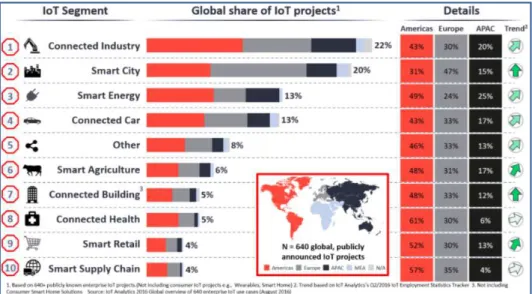
(31) 2.5 IoT applications IoT has the potential to transform all major segments and develop new applications in every field. The IoT main applications are: -Smart Home. Refers to the connectivity through smart devices inside homes. It includes windows, door locks, smoke detectors, thermostats and entertainment systems. -Smart City. Include a wide variety of use cases, for example, urban security, traffic management, water distribution, environment monitoring, or waste management. The goal of Smart City is to enhance the lives of the citizens through solving traffic congestion problems, noise and pollution issues. -Smart grids. It uses IoT to use information about the behaviors of electricity suppliers and consumers in order to improve the reliability, efficiency and economics of electricity. -Smart Farming emphasizes the use of information and communication technology in the cyber-physical farm management cycle. Internet of Things and Cloud Computing are expected to enhance this development and introduce more tools and artificial intelligence in farming. -Connected Industry. In this field many market researches see the IoT concept with the highest overall potential. Applications among others include connected industrial equipment or smart factories. -Connected car is about to use technology to enhance driver comfort, whether it is driver-assisted or self driving: mapping services, connectivity with other cars, or traffic control. Also remote monitoring and the concept of next generation in-car entertainment systems will be an important part of IoT applied to cars. -Connected Health is one of the most valuable applications of IoT paradigm, due to will to improve well-being of people through connecting the health care systems and smart medical devices. Some of these benefits are improved medical decision-making based on large sets of patient data or new kinds of real-time health monitoring. -Smart retail is based on intelligent payment solutions, in-store shopping behavior, and proximity-based advertising as the most important IoT projects in this area.. 29.
(32) -Smart supply chain tries to enhance the tracking of products while they are on the road, and also to allow the suppliers to exchange inventory information as a big part of IoT in this field.. Figure 4. Global share of IoT projects by continents Source. IoT analytics 2016 Global overview of 640 enterprise IoT use cases, August 2016. Figure 4 illustrates The main IoT projects by segment and by continents. The leading projects involve Connected Industry, followed by Smart city and Smart energy. [46]. 30.
(33) 3. Blockchain technology The technology behind Bitcoin and other cryptocurrencies is a distributed ledger database for recording transactions, usually known as blocks. Blockchain technology enables users to share their ledger of transactions. The first concept of Blockchain was applied in 2009 as a part of Bitcoin which was created by an unknown person using the alias Satohi Nakamoto [47].. 3.1 Blockchain concept Blockchain is a distributed database that registers an ordered list of records of transactions which are immutable linked together through a chain, on blocks. The blocks form a linear sequence where each block references the hash of the previous block, forming a chain of blocks. Blockchain is maintained by a network of nodes and each one of them executes and records the same transactions. Any node in the network can read the transactions [48]-[57].. Figure 5. From left to right centralized, descentralized and distributed (Blockchain) networks Source. http://cyberfrat.com/wp-content/uploads/2016/10/1.jpg. Figure 5 shows the different network topologies; centralized, decentralized and distributed (which is the Blockchain technology network type). The main advantages of Blockchain networks are:. -It is public. This is the most important advantage. Everyone participating can see the blocks and the transactions stored in them. This does not mean that everyone can see the actual content of your transaction, however; that's protected by your private key. -It is decentralized, so there is no single authority that can approve the transactions or set specific rules to have transactions accepted. That means there is a huge amount of trust involved since all the participants in the network have to reach a consensus to accept transactions.. 31.
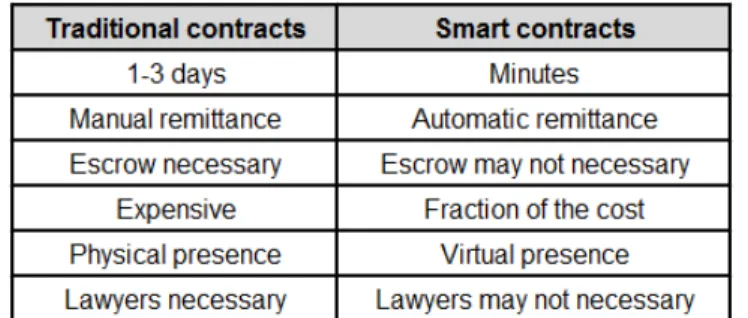
(34) -It is secure. The database can only be extended and previous records cannot be changed (at least, there's a very high cost if someone wants to alter previous records).. 3.2 How Blockchain works In this section I explain the main concepts related to Blockchain technology and how it operates. These concepts are; transactions, blocks, peer to peer (P2P), DLT (Distributed Ledger Technology), smart contract, Ethereum, ether, Dapp, hash, mining, PoW and gas. A transaction is a transfer of Bitcoin value that broadcasts to the network and collected into blocks. Transactions are not encrypted, so it is possible to view every transaction collected into a block and they are bundled into blocks and executed on all the participating nodes. A block contains a transaction list, the most recent state, a block number and a difficulty value. If there are conflicting transactions on the network (for example, transactions that do double spending), only one of them is selected to become a part of the block. The blocks are added to the Blockchain at regular intervals. P2P (Peer to Peer) is a network in which their computers act as a node for sharing files within the group. The devices or computers that participate in this network are called peers and each peer are equal to others, so there is no central administrator device in the center of the network and there are no privileged peers. DLT (Distributed Ledger Technology) is a type of database that is consensual shared, replicated and synchronized across the members of a network and the main characteristic of this database is that the transactions and their details are recorded in multiple places at the same time. DLT has no central data store. A Smart contract is a piece of code that resides on a Blockchain, it is identified by a unique address and includes a set of executable functions and state variables. These functions are executed when transactions are made to these functions. Input parameters are included in the transactions and are required by the functions in the contract. The most popular language used to write a smart contract is Solidity. This language is quite simple and only allows to perform basic operations of its basic type. The goal is to reduce transaction costs associated with hiring and to ensure security of the contract traditional law.. 32.
(35) Table 6. Comparision chart between traditional contracts and smart contracts Source. https://www.linkedin.com/pulse/smart-contracts-its-applications-sudip-nair. Table 6 shows the benefits of smart contracts compared to traditional contracts. The smart contracts can be executed very fast and there is no requirement of physical presence. Ethereum is an open and programmable Blockchain platform that is powered by the peers who run the Ethereum nodes. Everybody can sign up for the platform and create an Ethereum account and create smart contracts, and also build decentralized applications. In the Ethereum network decentralized applications allow anybody to create cryptocurrencies but also anything else that is programmable. Ether is the currency which is used in the Ethereum network. Unlike bitcoin, ethers were not created to become a decentralized global digital currency and their aspirations go beyond the sending or transfer of money. Dapp (Decentralized Application) is an application that provides an interface to Smart Contracts. One example of Dapp could be a crypto currency application. Hash. It is equivalent to the fingerprint concept, it is the unique identifier of a person. When two objects are sent to the Blockchain they will have different hashes. Moreover, if you have the object it is very easy to create the hash, but it is almost impossible to perform the opposite operation. To ensure that the reverse does not exist, the output is shorter than the inputs, and there are more than two inputs that give the same output. This way of operation makes it impossible to calculate the inverse one. Mining. Refers to the distributed computational review process performed on each "block" of data in a Blockchain. This allows for achievement of consensus in an environment where nobody knows each other. PoW (Proof of work) is a piece of data which is moderately difficult to produce (costly) but is very easy to verify, and it is used to avoid unwanted behaviour, for example, denial of service attacks or spam. It is a small mathematical problem every miner has to solve before sending a block back to the node. Gas is the name of the crypto fuel, which is consumed in performing the operations on a Blockchain network. The gas quote paid is proportional to the amount of work that is required to execute the transaction.. 33.
(36) Figure 6 Blockchain structure Source http://tech.eu/features/808/bitcoin-part-one/. Figure 6 shows the steps of the mining process and the PoW mechanism which takes on average approximately 10 minutes to complete. There are three types of Blockchain [58]-[60] according to the way of operating: -Public Blockchain. Everyone can read or write data and the only requirement is to have a computer and Internet connection. Some of this type of network restricts the access only to read or write. Ethreum and Bitcoin are examples that use approach where everyone can write. -Private Blockchain. Is not open to the public, but can only be accessed by invitation and all the members who are participating know each other and are trusted. This is very useful when the Blockchain is used between companies that are part of the same branch. Some of the most famous are Hyperledger (from the Linux Foundation) and Ripple (protocol to allow international money transfers). -Permissioned Blockchain. Also known as Consortium Blockchain, is an hybrid between public and private Blockchain. In this type, only a few selected nodes are predetermined and the participating nodes are invited, but all transactions are public. That means that the nodes participate in the maintenance and security of this network, but that all transactions are visible to users around the world. The right to read may be public, or restricted to the participants. Consortium Blockchains maintain data privacy like Private Blockchains. BigchainDB is an example of consortium Blockchain. The connection steps to join Blockchain network are: -The user enters the system through their mobile app or web platform.. 34.
(37) -In In order to make a transaction to some, you need a digital signature. The user can obtain the public key of the receiver by scanning a QR code from another person's mobile or their payment address. -Any Any person with a public key can send money to one address, but only one signature generated with a private key can take money from it. -The The app warns the miners of the pending transaction network and they verify that the customer has enough money to pay and initiate a process to group pending transaction data in the Blockchain as welll as a nonce (number) and apply a hash that produces a unique fingerprint that converts the transaction into verified. In the case of Etherum, a transaction is verified when 12 confirmations are received. -The The encrypted block must have a certain number of zeros at the beginning. It is unpredictable to know which nonce will generate a hash with the correct number of zeros, so the miner needs to prove different nuances to find the correct value. -When When you discover it, it is advertised on the rest of the the network. Other miners accept the operation and look for the next block. -The The miner gets an economic compensation (25 bitcoins in the Bitcoin network) and the transaction is published in the Blockchain. Blockchain. Figure 7. The steps in the Blockchain network Source http://notibytes.blogspot.com.es/2017/08/blockchain-el-futuro-de-la-seguridad.html http://notibytes.blogspot.com.es/2017/08/blockchain seguridad.html. Figure 7 illustrates the operation mechanism of transactions in the Blockchain lockchain network [61],[62]. The steps of this mechanism are: -Someone Someone requests a transaction. transactio -The transaction ransaction is broadcasted to a public P2P network (Blockchain network) consisting of multiple nodes. -The The network of nodes validates the transaction using known algorithms.. 35.
(38) -Once verified, the transaction is combined with other transactions to create a new block of data for the ledger. -The new block is added to the existing Blockchain, in a form that is unalterable permanent. -Finally the transaction is successfully done.. 3.3 Advantages of Blockchain tecnhology Blockchains can increase security mainly on three aspects: blocking identity theft, preventing data manipulation, and stopping DoS (Denial of Service) attacks [63]. -Blocking identity theft. Blockchain's structure of network miner proof of work and its distributed ledger of data transactions reduce the possibility of data theft and data corruption. -Preventing data manipulation and fraud. In the Blockchain technology the combination of cryptography, hashing and a decentralized structure, make it virtually impossible for any member to alter data on the ledger. This prevents and detects any form of manipulation and allows organizations to maintain the protection of the information. An important solution that has been developed to avoid fraud and manipulation is KSI (Keyless Signature Infrastructure), which ensures the protection of the networks and the security and privacy of the data. With KSI, nobody can manipulate the data, and the authenticity of electronic data can be mathematically proven. KSI stores the digital signatures of the original files in a Blockchain and then verifies the copies through re-checking the signatures of the copies against those stored in the Blockchain. If any manipulation is done, it is very quick detected, cause the hashes stored in the Blockchain reside in thousands of nodes. KSI Technology is being used actively in the Aerospace and Defense Industry, and also in the Health sector to provide better control over the patient's medical record. -Preventing Distributed Denial of Service attacks. There are a large number of critical infrastructures to protect. Blockchain can help with DNS (Domain Name System) which provides access to websites using domain names rather than IP addresses. The DNS system is dangerously centralized in a few root servers under control of ICANN (Internet Corporation for Assigned Names and. 36.
(39) Numbers), which is responsible of the IP protocol addresses, protocol identifiers, domain system management functions and root server system management. Blockchain could build a distributed and much more transparent DNS to make it virtually impossible for a single entity to manipulate records. There are some differences between Blockchain networks and Cloud Computing paradigm. In the cloud model, IoT devices are identified, authenticated and connected through cloud servers, where processing and storage are often carried out. IoT networks that have high costs are concerned in the centralized cloud model. IoT devices are vulnerable to DDoS attacks, data theft, hacking and remote hijacking. If an IoT device connected to a server is breached, everyone connected to the server could be affected. Besides, the centralized cloud model is susceptible to manipulation. The data collected does not ensure that the information is put to an appropriate use. Blockchain can eliminate these issues of Cloud Computing. In Blockchain, message exchanges between devices can be treated in the same ways as financial transactions in a bitcoin network. Devices rely on smart contracts which guarantees more security. The fact that Blockchain verifies cryptographically signs transactions eliminate the possibility of man-in-the-middle attack, replay or other attacks [52],[64].. 3.4 Blockchain applications In this section I present some of the potential applications of the Blockchain technology [65]-[68]. These applications are; Supply chain, digital identity, voting, healthcare and government. -Supply chain. The supply chain is very complex segment and having a transparent visibility across the whole supply chain has become more difficult. It became more difficult to track the flow of material and the distribution channels, and consequently it has led to various unethical businesses behaviours ranging from illegal trade, counterfeit products or environment damage. At the very end of the supply chain, consumers do not have the information where a final product has gone through across the supply chain. Nowadays you can lose your parcels in the post. Taking advantage of the convergence of IoT paradigm and Smart Contracts you will be able to record the location in every moment of your parcels through the connection of sensors in every step of the way.. 37.
(40) The smart contract brings reliability all the way along the line, allowing with security where to find the package. -Digital identity. This application could allow consumers to have an identity recorded on a shared ledger and can add devices to their identity. Digital Identity ensures a more secure way to verify the authenticity of someone and avoid and reduce the possible fraud. -Voting. Blockchain can transform the traditional paper-based voting system to a digitized one and can provide a secure voting platform serving as the medium for all the process; casting, tracking and counting votes and avoid issues such as lost records and voter-fraud. Voters could count the votes themselves and verify that no votes were removed, manipulated or changed. -Healthcare. Healthcare institutions have to deal with security and privacy issues when they share data across platforms. Enhancing data collaboration between providers means the improvement of many parts of the health field such as accuracy of diagnoses, effectiveness of treatments. Blockchain can create this secure environment to allow healthcare institutions, payers and other parties in this field to share access to their network with data integrity guarantees. -Government. Blockchain could be used to assure the public that the politicians are acting correctly with the money, and it also can fight against financial crime. With the technology, every transaction can be recorded without manipulation, making the ultimate destination transparent to the public.. 38.
(41) 4. IoT technologies and vulnerabilities In this section I present the vulnerabilities of the main technologies involved in IoT that I have presented before classified by layer. I also analyze the most common IoT scenarios and what are their concerns to become secure and reliable environments for data privacy. Then I review important security solutions that have been proposed by some researchers in order to address some of these issues. Finally, I expose Blockchain technology as an important technology to protect data within IoT. I explain all these concepts through four main themes: IoT technologies and vulnerabilities, IoT scenarios and security issues, IoT security solutions, IoT with Blockchain technology [6],[21],[23],[24],[69]. Every day millions of new devices are connected, and the number of attacks has increased exponentially. Secure the data privacy in the IoT is important also in the control of our physical integrity because if many devices are controlled electronically, for example the lock and security system of a smart house, they can be hacked by someone and enter the house. No matter how secure a network is, when two or more devices are connected through wireless networks it will exist vulnerabilities. Another problem of this environment of sensors and connected devices, is the fact that exist too many protocols and interfaces in the same ecosystem to control them. If we have several devices connected, it is common for each to be controlled by a different application. These issues include a web interface, cloud interface and mobile interface. The easiest way to attack a device is by physical access. Many people can use the same devices and it is important to have conscience of this fact and activate all the possible mechanisms that any device has to. Internet of Things devices is vulnerable to many potential cyber attacks. To ensure the deployment of a secure IoT some requirements must be considered: -Authentication is the process to validate if someone is who is declared to be. Is one of the biggest concerns due to the number of devices in IoT. The process of determining whether someone or something is, in fact, who or what it. Many entities are involved in the IoT (services, devices, people, service providers and processing units) and it is important to authenticate entities for these interactions. Authenticating all devices is not easy and is critical to prevent compromised enterprise networks.. 39.
Figure
+7

Documento similar