
Ultimate attainment of Spanish rhotics by native English speaking immigrants to Spain
24
0
0
Texto completo
(2) Ultimate Attainment of Spanish Rhotics by Native English-Speaking Immigrants to Spain. hablantes nativos del español, aunque alcanzan un nivel superior a los visto en los hablantes de estudios previos. Aunque un hablante sí aproxima a la pronunciación de los hablantes nativos, la pronunciación de la mayoría está muy por debajo de este nivel. Palabras claves: español, vibrantes, adquisición de segundas lenguas, estado final de adquisición, fonología, pronunciación, inmigrantes.. 1. Introduction. 58. Spanish is one of a fairly small number of languages to have more than one rhotic among its consonant inventory: /r/ and /ɾ/. In all varieties of Spanish there is a phonemic contrast between the two, though there is considerable variation in the specific natures of the sounds produced. Yet this phonemic contrast is limited with respect to context, occurring only in word-internal, intervocalic position, as in the minimal pairs caro ‘expensive’ / carro ‘cart’ and pero ‘but’ / perro ‘dog’. In all other contexts the contrast is neutralized, with each consonant occurring in certain contexts. While there is some variation, typically neutralization favors [r] word-initially (e.g., ratón ‘mouse’) and syllable-initially following a consonant within words (e.g., honra ‘honor’) and [ɾ] in all other context (e.g., tres ‘three’, puerta ‘door’). As noted above, there is considerable variation in the nature of the rhotic sounds produced across Spanish (e.g., Canfield 1981; Hammond 1999; Lipski 1994), but they are generally described as a voiced apico-alveolar trill [r] and a voiced apico-alveolar tap [ɾ]. Variation in production is especially common with respect to the purported trill, though it also sometimes occurs with the tap. Even in varieties of Spanish where the typical descriptions of voiced apico-alveolar trill [r] and apico-alveolar tap [ɾ] are accurate descriptors of the sounds produced, there is often variation, most commonly in the production of /r/ (e.g., Blecua 2001; Hammond 1999). This is true of Castilian Spanish –which is the object of the present study – where the trill and tap are the most common pronunciations of the two rhotics, but other pronunciations also exist (e.g., Blecua 2001). For speakers of American English learning Spanish as a second language, acquiring the Spanish rhotics poses multiple challenges. With respect to the trill [r], this sound is unlike any sound that exists in American English, and therefore requires American English speakers to learn a new sound that is not similar to any they have in their native language. Lack of similarity can make sounds easier to acquire in a second language since there is no need to re-categorize a sound that exists in the Lengua y migración / Language and Migration 10:2 (2018), 57-80 ISSN : 1889-5425. © Universidad de Alcalá.
(3) Timothy L. Face. first language or to recognize a small and not very salient distinction between a sound in the first language and a similar sound in the second language (e.g., Flege 1995). However, while the lack of similarity of the Spanish alveolar trill to any sound in American English might seem to favor its rapid acquisition, the alveolar trill is articulatorily difficult, requiring very precise control of aperture and airflow with minimal deviation (e.g., Ladefoged & Maddieson 1996; Recasens 1991; Solé 2002). The articulatory precision required to produce the alveolar trill leads not only to difficulty for the second language learner in acquiring this sound, but also to it being acquired quite late, and from six months to two years later than the tap depending on the criterion used in determining acquisition, by children acquiring Spanish as their first language (e.g., Goldstein 2000). The tap [ɾ] also poses challenges for American English speakers learning Spanish as a second language, though they are different from those posed by the trill [r]. The Spanish alveolar tap [ɾ] is nearly identical to the American English alveolar tap produced as an allophone of /t/ and /d/ in post-tonic position (e.g., later, ladder). But while native speakers of American English have an alveolar tap in their first language, they do not associate this tap with a rhotic, and this could provide some difficulty of re-categorization of this sound in acquiring Spanish. Furthermore, in American English the alveolar tap only occurs intervocalically in post-tonic position, while in Spanish it occurs intervocalically in both pre-tonic and post-tonic positions, and it also occurs word-finally, syllable-finally, and as the second member of a complex syllable onset. Therefore, while American English speaking learners of Spanish should be able to produce the alveolar tap with no difficulty given its existence in their native language, they must learn to both produce this sound in contexts in which it does not occur in their first language and also associate the sound with a rhotic rather than view it as an allophone of /t/ and /d/ as in American English. Several studies have examined the second language acquisition of Spanish rhotics by native speakers of American English. However, these studies tend to focus on acquisition by university students studying Spanish, and therefore on learners who are relatively early on in their acquisition. As is the case with many other studies of Spanish second language acquisition –both in phonology and other fields of linguistics– in most cases even those learners considered to be “advanced” are only advanced in terms of their academic coursework in Spanish. They are still young learners who have been learning Spanish for a relatively short amount of time. As a result, nothing is known about ultimate attainment –or the end state of acquisition– of Spanish rhotics by native speakers of American English. Do learners who have been immersed in Lengua y migración / Language and Migration 10:2 (2018), 57-80 ISSN : 1889-5425. © Universidad de Alcalá. 59.
(4) Ultimate Attainment of Spanish Rhotics by Native English-Speaking Immigrants to Spain. the language and culture for larger portions of their lives produce rhotics differently from those learners typically included in studies of second language acquisition? Does their pronunciation match, or closely approximate, that of native speakers of Spanish? If their pronunciation differs from that of native speakers, is this true across the board, or only in specific contexts? These and other questions must be addressed in order to understand the second language acquisition of Spanish rhotics by native speakers of American English, yet no study has set out to address them. The present study takes a first step in addressing the issue of ultimate attainment by considering the pronunciation of Spanish rhotics by U.S.-born native speakers of American English who are immigrants to Spain and who have lived there full time for more than a decade, and in most cases much longer.. 2. Previous studies. 60. While there are studies that have examined Spanish rhotics from a perceptual standpoint (Daidone and Darcy 2014; Rose 2010a), given the focus of the present study, this section will present an overview of previous research on the production of Spanish rhotics by native speakers of American English. The research presented in previous studies can be divided into two primary categories: development of rhotic production over time and factors affecting rhotic production. Each of these categories of research will be considered here. The vast majority of studies to look at the development of rhotic production over time do so by looking at learners cross-sectionally (and thus look at apparent time rather than actual time), given the tremendous time it would take to collect longitudinal data that spans a significant length of time. Only Major’s (1986) study is longitudinal in nature, examining the same group of students throughout an intensive 8-week beginning Spanish course. These studies have consistently shown that target-like productions of both the tap and the trill increase over time (Face 2006; Major 1986; Reeder 1988; Rose 2010b). Studies have generally shown that the tap is produced with a much higher degree of accuracy than is the trill. For example, Face’s (2006) most advanced group (i.e., Spanish majors enrolled in an upper division Spanish course) produced taps in a target-like fashion 78.7% of the time, but produced target-like trills only 26.6% of the time.2 A notable methodological feature of Face (2006) and Rose (2010b) is that they do not only consider accuracy in achieving target-like productions, but also consider the phonetic nature of the non-target-like productions. In both studies, the most frequent non-target-like sound produced by lower level learners Lengua y migración / Language and Migration 10:2 (2018), 57-80 ISSN : 1889-5425. © Universidad de Alcalá.
(5) Timothy L. Face. for both the target trill and the target tap was an English-like alveolar approximant. As learner level increased, not only did accuracy increase, but there was also a shift in the non-target sounds produced, with the percentage of English-like approximants dropping and other sounds being produced instead. This demonstrates learning as there is a shift away from substituting a sound from the first language, even if the target second language sound is not achieved (cf., Major 2001). Studies have also shown that several factors affect second language rhotic production. The first of these is the segmental context, where the nature of the surrounding segments affects the production of a rhotic (Hurtado and Estrada 2010; Waltmunson 2005). Hurtado and Estrada (2010) found that an accurate Spanish pronunciation of both the tap and the trill is favored in contexts where the tongue tip or predorsum is not used in articulating the preceding sound (i.e., in cases of a preceding vowel, bilabial consonant or velar consonant), while Waltmunson (2005) found that vowel height had a significant effect on the production of the trill. Another factor affecting the production of the rhotics is their position within a syllable or word (Hurtado and Estrada 2010; Waltmunson 2005). Hurtado and Estrada (2010) found that word-internal, syllable-initial position favored the Spanish-like production of the rhotics, while other positions do not. It is noteworthy that this syllable-initial position will most often be intervocalic, which is the one context in which articulation of the rhotic has a communicative burden due to the phonemic contrast existing only in this context. Looking more specifically at the influence of English on rhotic production, Olsen (2012) showed that beginning learners are more accurate in producing the Spanish tap in contexts in which the American English tap also occurs than in contexts in which the tap does not occur in American English. In addition, he found that the manner in which speakers produce the American English rhotic (i.e., with bunched or retroflex articulation) has a significant effect on their accuracy in producing the Spanish tap and trill. In a follow-up study with intermediate learners, Olsen (2016) found that while the articulation of the American English rhotic ceases to have an influence on the accuracy of Spanish rhotic production, the influence of phonological context persists. While little attention has been paid to extralinguistic factors in studies of the second language acquisition of Spanish rhotics, Hurtado and Estrada (2010) did include several extralinguistic factors. Most notably, they found an effect of explicit pronunciation instruction on the production of the Spanish rhotics. Other factors considered include the effect of study abroad, classroom task type, and speech style, and the reader is referred to their study for discussion of the results. In studies of ultimate attainment, it has been observed that there are “exceptional” learners (e.g., Abrahamsson and Hyltenstam 2009; Lengua y migración / Language and Migration 10:2 (2018), 57-80 ISSN : 1889-5425. © Universidad de Alcalá. 61.
(6) Ultimate Attainment of Spanish Rhotics by Native English-Speaking Immigrants to Spain. Kinsella and Singleton 2014; Stölten, Abrahamsson and Hyltenstam 2015). While it is generally accepted that most L2 learners do not attain native-like levels of proficiency in the L2, especially with respect to phonology, exceptional cases are well attested in the literature (e.g., Bongaerts, Planken, and Schils 1995; Ioup, Boustagui, El Tigi and Moselle 1994; Kinsella and Singleton 2014; Moyer 1999). A minimum length of residence of eight years has been reported for exceptional learners (e.g., Ioup, Boustagui, El Tigi and Moselle 1994; Moyer 1999). While length of residence has an impact on ultimate attainment, Moyer (2014: 434) points out that “exposure alone is never enough to reach a native-like or near-native level.” Rather, length of residence is one of a “constellation of factors” to impact exceptional outcomes in L2 phonology (Moyer 2014; Kinsella and Singleton 2014). Kinsella & Singleton (2014: 457) suggest than an exceptional L2 learner must have “worked professionally and successfully within the target language for a significant period of their lives” but even this is not necessarily sufficient to guarantee native-like pronunciation. Moyer (2014: 435) concludes that the “constellation of factors” that contribute to exceptional outcomes in some learners include “cognitive, psychological, social, and experiential” factors, and Bylund, Abrahamsson and Hyltenstam (2012) note that language aptitude is also a factor.. 3. Methods. 62. The participants in this study are eight native speakers of American English who speak Spanish as a second language and live in central Spain. They were recruited for this study through personal contacts and an American club in the region.3 All were born and raised in the United States and immigrated to Spain as adults. While all began learning Spanish before moving to Spain, none of them began learning Spanish prior to adolescence. The age range of participants is 48-84 years old, with a mean age of 67.6 years old. Length of full-time residency in Spain ranges from 11 to 60 years, with a mean of 36 years.4 All participants speak both Spanish and English in their daily lives, and self-reported estimates for Spanish are 5090%, with a mean of 68.75%.5 A comparison group of five native Spanish speakers born, raised and living in central Spain was also included.6 These speakers have an age range of 52-71 years old, with a mean age of 59.8 years old. One has advanced proficiency in English and intermediate proficiency in German, while the others are monolingual.7 Participants completed a background questionnaire inquiring as to their language background and use. Following the questionnaire, they were recorded having a 10-15 minute conversation with the researcher and reading a short story. The short story is the source of the data for Lengua y migración / Language and Migration 10:2 (2018), 57-80 ISSN : 1889-5425. © Universidad de Alcalá.
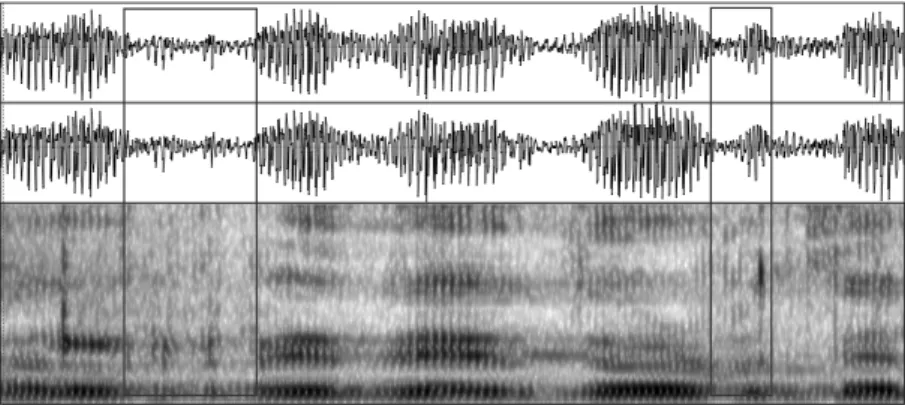
(7) Timothy L. Face. this study. The story was Aniversario, by Luis Romero, with slight modifications (e.g., changing names) in order to elicit additional tokens of certain sounds, and contained 1343 words. Recordings were made with a Zoom H2n digital recorder. For each participant, 101 total rhotic tokens, including 75 target taps and 26 target trills, were selected for acoustic analysis. Target trills occurred in three contexts: word-initial position, word-internal intervocalic position, and word-internal following /l/. Target taps likewise occurred in three contexts: intervocalic position, in a syllable coda, and as the second consonant of a complex onset. In addition to these contexts, word position, phrase position and stress were also taken into account in the analysis. For a variety of reasons, such as mispronunciations that changed the context of the target sound, 30 tokens were eliminated, leaving a total of 1283 tokens to be analyzed.8 Manner of articulation was determined for each token by examining the spectrogram and waveform in Praat v.5.4 (Boersma and Weenink 2014). A token was categorized as a trill when there were multiple closures resulting from the tip of the tongue contacting the alveolar ridge. A token was categorized as a tap when there was a single closure due to the tongue tip contacting the alveolar ridge.9 When preceded or followed by a consonant, a tap also included the svarabhakti vowel – the vowel-like portion between the tap closure and neighboring consonant necessary to create the tap gesture. The svarabhakti vowel was included since it affects duration, which was also measured for this study. Examples of a trill and a tap (including the svarabhakti vowel) can be seen in Figure 1, which presents the waveform and spectrogram from a portion of the phrase alrededor de ‘around’.. Figure 1. Waveform and spectrogram of a portion of the phras alrededor de ‘around’ showing a trill (in the rectangle to the left) and a tap with svarabhakti vowel (in the rectangle to the right) Lengua y migración / Language and Migration 10:2 (2018), 57-80 ISSN : 1889-5425. © Universidad de Alcalá. 63.
(8) Ultimate Attainment of Spanish Rhotics by Native English-Speaking Immigrants to Spain. In addition to the trill and tap, four additional manners of articulation were found in the data and categorized. A token was categorized as assibilated when there was frication, seen as aperiodic energy at higher frequencies, without the closures expected of the Spanish rhotics. A token was categorized as aspirated when there was free airflow with no constriction. Aspirated tokens were almost exclusively limited to target taps in syllable codas. A token was categorized as an approximant when it was a continuant, with enough constriction so as to clearly be consonantal in nature (as opposed to the airflow without constriction in the aspirated tokens) but not enough of a constriction to create frication as in the assibilated tokens. In some cases of approximants, learners produced them with the typical American English r-coloring, while in other cases they did not. In other words, in some cases the approximants were English-like while in other cases they were not. Finally, a token was categorized as tap+ when it involved an initial tap closure followed by either an approximant or assibilated phase. Tap+ tokens were infrequent and always corresponded to a target trill. Duration of each token was also measured. In the case of taps, the duration included the svarabhakti vowel when it was present, as this is a characteristic of the tap and not of the neighboring consonant. For trills, in addition to duration, the number of closures was also recorded. Following coding of the data, statistical analysis was carried out using SPSS v.22.. 4. Results 4.1. Target trills. 64. The results for manner of articulation of target trills are presented for each context in Tables 1-3. Table 1 shows the results for intervocalic position. As seen in the results of the Chi-square test, the L1 of the speakers does not have a significant effect on the production of target trills in this context. While the table shows that L1 English speakers produce considerably fewer trills than do the L1 Spanish speakers, even this latter group demonstrates variability in terms of manner of articulation. Table 2 presents the results for word-initial position, and the Chisquare test shows that in this context L1 does have a significant effect on target trill production. While both groups show considerable variation, L1 English speakers produce approximants more often than any other manner of articulation. L1 Spanish speakers, on the other hand, produce trills most often, followed by taps and then approximants. Lengua y migración / Language and Migration 10:2 (2018), 57-80 ISSN : 1889-5425. © Universidad de Alcalá.
(9) Timothy L. Face. Table 3 presents the results for the context of a preceding /l/. While the number of tokens is too small for a reliable statistical analysis (with only one case of this context occurring in the story), it is notable that L1 English speakers produce approximants half of the time while the trill is produced most often by the L1 Spanish speakers. L1 English Spanish. Trill 43 (54.4%) 36 (72%). Tap 8 (10.1%) 3 (6%). Tap+ 3 (3.8%) 3 (6%). Approx. 16 (20.3%) 7 (14%). Assib. 9 (11.4%) 1 (2%). Total 79 50. Χ2 (4, N=129) = 6.63, p = 0.157 Table 1. Manner of articulation of target trills by L1 in intervocalic position. L1 English. Trill Tap Tap+ Approx. Assib. Aspir. Total 35 (29.2%) 22 (18.3%) 4 (3.3%) 48 (40%) 10 (8.3%) 1 (0.8%) 120. Spanish. 44 (58.7%) 15 (20%). 1 (1.3%) 9 (12%). 6 (8%). 0 (0%). 75. Χ (5, N=195) = 23.71, p < 0.001 2. Table 2. Manner of articulation of target trills by L1 in word-initial position. L1 English Spanish. Trill 3 (37.5%) 3 (60%). Tap+ 1 (12.5%) 0 (0%). Approx. 4 (50%) 1 (20%). Assib. 0 (0%) 1 (20%). 8 5. Total. Table 3. Manner of articulation of target trills by L1 when preceded by /l/. When the data from the three contexts are pooled, 2-way ANOVAs considering the effects of context and stress show that context has a significant effect on production of target trills for L1 English speakers (F (2,202) = 8.64, p < 0.001), but not for L1 Spanish speakers (F (2,125) = 0.23, p = 0.798). Stress does not have a significant effect on the production of target trills for either group of participants (L1 English: F (1,202) = 3.18, p = 0.076; L1 Spanish: F (1,125) = 0.92, p = 0.34). For target trills produced as trills (i.e., excluding tokens with other manners of articulation), Table 4 presents the results for the number of closures in the trills while Table 5 presents the results for the duration of the trills (in milliseconds). Clearly there is a relationship between these two measures, as producing more closures takes more time. Results of ANOVAs for both sets of data show that L1 has a significant effect, with L1 English speakers producing more closures and longer Lengua y migración / Language and Migration 10:2 (2018), 57-80 ISSN : 1889-5425. © Universidad de Alcalá. 65.
(10) Ultimate Attainment of Spanish Rhotics by Native English-Speaking Immigrants to Spain. duration than L1 Spanish speakers, though on both measures L1 English speakers also show greater variability. 2-way ANOVAs show that neither context (L1 English: F (1,73) = 0.61, p = 0.437; L1 Spanish: F (1,74) = 0.00, p = 0.993) nor stress (L1 English: F (1,73) = 0.01, p = 0.932; L1 Spanish: F (1,74) = 1.83, p = 0.18) has a significant effect on the duration of trills for either group of participants.10. L1 N English 81 Spanish 83 F (1,162) = 16.81, p < 0.001. 2.65 2.24. Mean. 0.74 0.53. Std. Deviation. Table 4. Number of closures in produced trills by L1. L1 English Spanish. 81 83. N. Mean (ms) 91.99 72.58. 28.47 18.38. Std. Deviation. F (1,162) = 27.04, p < 0.001 Table 5. Duration (in milliseconds) of produced trills by L1Duration (in milliseconds) of produced trills by L1. 4.2. Target taps. 66. The results for manner of articulation of target taps are presented for each context in Tables 6-8. Table 6 shows the results for intervocalic position. The Chi-square test shows that the L1 of the speakers does not have a significant effect on tap production in this context. L1 Spanish speakers are categorical in their production of taps, while L1 English speakers are close to categorical. For L1 English speakers, who did show a little bit of variation, secondary context was also examined. Of the nine non-taps produced by this group, eight of them occurred in word-final intervocalic position, with only one occurring in word-internal intervocalic position. The L1 English speakers then produce taps in word-internal intervocalic position 98.8% of the time and in word-final intervocalic position 89.3% of the time, with this difference being significant (Χ2 (2, N=155) = 6.33, p = 0.042). Table 7 presents the results for target taps in syllable codas. In this context, L1 has a significant effect on the production of target taps. L1 English speakers produce far fewer taps and far more approximants than do the L1 Spanish speakers. Secondary context was examined to consider the effects Lengua y migración / Language and Migration 10:2 (2018), 57-80 ISSN : 1889-5425. © Universidad de Alcalá.
(11) Timothy L. Face. of word-internal, word-final and phrase-final position on the production of target taps in syllable codas. Secondary context had a significant effect on the production of target taps in syllable codas for both groups (L1 English: Χ2 (8, N=159) = 48.73, p < 0.001; L1 Spanish: Χ2 (8, N=98) = 23.5, p = 0.003). Both groups produce the most taps word internally. The vast majority of non-tap productions are approximants for both groups in word-internal and word-final position. In phrase-final position, however, aspirated productions are the most common non-tap production for both groups. While for each context the two groups produced the same manner of articulation most often, the distribution of tokens across manners of articulation is different. The difference between groups was significant in word-internal (Χ2 (2, N=130) = 11.92, p = 0.003) and word-final position (Χ2 (3, N=63) = 10.45, p = 0.033), but not in phrase-final position (Χ2 (3, N=64) = 5.35, p = 0.253). In word-internal position, while L1 Spanish speakers produce taps 82% of the time, L1 English speakers only produce taps 52.5% of the time, with approximants occurring 45% of the time. In word-final position, L1 Spanish speakers produce taps 70.8% of the time, while L1 English speakers only produce taps 35.9% of the time, with approximants occurring in 56.4% of productions. Table 8 presents the results for target taps as the second consonant of a complex syllable onset. The Chi-square test shows that L1 has a significant effect on target tap production in this context. L1 English speakers produce far more approximants than do L1 Spanish speakers. Secondary contexts of voicing of the preceding consonant and place of articulation of the preceding consonant were examined. Neither factor had a significant effect for L1 Spanish speakers (Voicing: Χ2 (2, N=172) = 1.65, p = 0.438; Place: Χ2 (6, N=172) = 4.91, p = 0.555), while for L1 English speakers place of articulation of the preceding consonant had a significant effect (Χ2 (6, N=275) = 15.85, p = 0.015) but voicing of that consonant did not (Χ2 (2, N=275) = 4.73, p = 0.094). The significant effect of place of articulation of the preceding consonant appears to be due largely to approximants being produced 24.1% of the time following a bilabial consonant, whereas approximants are produced roughly half as often following consonants with all other places of articulation. L1 English Spanish. Tap 146 (94.2%) 87 (100%). Approx. 8 (5.2%) 0 (0%). Assib. 1 (0.6%) 0 (0%). Total 155 87. Χ2 (2, N=242) = 5.25, p = 0.073 Table 6. Manner of articulation of target taps by L1 in intervocalic position Lengua y migración / Language and Migration 10:2 (2018), 57-80 ISSN : 1889-5425. © Universidad de Alcalá. 67.
(12) Ultimate Attainment of Spanish Rhotics by Native English-Speaking Immigrants to Spain. L1 English Spanish. Tap 73 (45.9%) 73 (74.5%). Trill 4 (2.5%) 1 (1%). Approx. 64 (40.3%) 18 (18.4%). Assib. 2 (1.3%) 2 (2%). Aspir. Total 16 (10.1%) 159 4 (4.1%) 98. Χ2 (4, N=257) = 21.54, p < 0.001 Table 7. Manner of articulation of target taps by L1 in syllable coda position. L1 English Spanish. Tap 227 (82.5%) 162 (94.2%). Approx. 42 (15.3%) 8 (4.7%). Assib. 6 (2.2%) 2 (1.2%). Total 275 172. Χ2 (2, N=447) = 12.93, p = 0.002 Table 8. Manner of articulation of target taps by L1 in complex syllable onsets. 68. When data from the three contexts are pooled, 2-way ANOVAs examining the effects of context and stress show that context has a significant effect on the production of target taps for both groups (L1 English: F (2,583) = 46.31, p < 0.001; L1 Spanish: F (2,351) = 11.02, p < 0.001). Stress, on the other hand, does not have a significant effect for either group (L1 English: F (1,583) = 2.77, p = 0.096; L1 Spanish: F (1,351) = 2.71, p = 0.1). For target taps produced as taps (i.e., excluding tokens with other manners of articulation), Table 9 presents the results for the duration of the taps (in milliseconds). The ANOVA shows that L1 does not have a significant effect on the duration of the taps. In fact, the mean duration is nearly identical between the two groups. 2-way ANOVAs show that context has a significant effect on the duration of produced taps for both groups (L1 English: F (2,440) = 107.8, p < 0.001; L1 Spanish: F (2,316) = 68.22, p < 0.001). Taps in coda position are longest, followed by those in complex onsets, and finally those in intervocalic position, and post-hoc Tukey tests show that all pairwise comparisons between contexts are significant for both participant groups (p < 0.001 for all comparisons). Taps in intervocalic position are shortest because this is the only position in which svarabhakti vowels are not produced. In addition to context, stress has a significant effect on the duration of produced taps for the L1 Spanish speakers (F (1,316) = 7.02, p = 0.008) but not for the L1 English speakers (F (1,440) = 1.61, p = 0.206). In addition, the interaction of context and stress is also significant for the L1 Spanish speakers (F (2,316) = 3.42, p = 0.034). The significant interaction appears to be due to the role of stress on the duration of taps in syllable codas. In this context, taps in stressed syllables have a mean duration that is 11.75ms Lengua y migración / Language and Migration 10:2 (2018), 57-80 ISSN : 1889-5425. © Universidad de Alcalá.
(13) Timothy L. Face. longer than taps in unstressed syllables. In the other contexts the mean durations are within 2ms of each other. L1 English Spanish. 446 322. N. Mean (ms) 43.90 43.45. 14.98 17.82. Std. Deviation. F (1,766) = 0.146, p = 0.702 Table 9. Duration (in milliseconds) of produced taps by L1. 4.3. Individual learners Having looked at the L1 English-speaking learners of Spanish as a group and how they compare to the L1 Spanish group, we will now consider the learners individually to see whether some of the learners are able to achieve native-like production of the Spanish rhotics. In order to do so, the native speaker range for rate of target-like production was calculated for each of the two target rhotics (i.e., trills and taps) for each context in which they occur, and each learner’s rates of target rhotic production (calculated separately for trills and taps) were compared to the native speaker ranges. In addition, for target rhotics that were produced, duration was considered. For both trills and taps, statistical outliers were identified for each speaker in each context and removed from consideration. Then the native speaker range for duration was calculated for each context, and the percentage of each speaker’s approximant productions that fell within that range for intensity difference was determined for both trills and taps. Table 10 presents each learner’s rate of trill production in comparison with the native speaker range for rate of trill production in each of the two contexts (i.e., word-internal intervocalic and word-initial).11 No more than five of the learners fall within the native speaker range for rate of target trills produced for any context, and only three learners are within the native speaker range in both contexts.. 69 Lengua y migración / Language and Migration 10:2 (2018), 57-80 ISSN : 1889-5425. © Universidad de Alcalá.
(14) Ultimate Attainment of Spanish Rhotics by Native English-Speaking Immigrants to Spain. Speaker NS Range L1 L2 L3 L4 L5 L6 L7 L8 TOTAL. 40-100 33 20 40 70 100 90 20 60 54.4. V_V. % Trill 26.7-86.7 33 13.3 0 40 80 60 6.7 0 29.2. Word-initial. Table 10. Individual L1 English speakers compared to L1 Spanish speaker ranges for rate of target trill production by context (shading indicates the learner is within the native speaker range for rate of trills produced for that context) For the target trills produced by each L1 English speaker, Table 11 presents the percentage that fall within the native speaker range for duration. In each context, four of the learners have all of their tokens within the native speaker range.12 Notably, only one learner (L4) is native-like in rate of trill production in both contexts (Table 10) and has all trills within the native speaker range for duration in both contexts (Table 11).. Speaker L1 L2 L3 L4 L5 L6 L7 L8 TOTAL. 100 100 75 100 40 88.9 50 100 79.1. V_V. % in Native Speaker Range Word-initial 100 100 n/a 100 91.2 88.9 100 n/a 94.1. Table 11. Percent of trills for individual L1 English speakers that fall within L1 Spanish speaker ranges for duration by context (shading indicates the learner produced all trills within the native speaker range for duration for that context) 70 Lengua y migración / Language and Migration 10:2 (2018), 57-80 ISSN : 1889-5425. © Universidad de Alcalá.
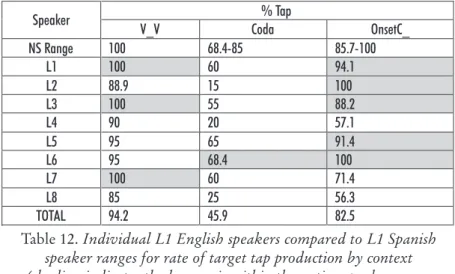
(15) Timothy L. Face. Table 12 presents each learner’s rate of tap production in comparison with the native speaker range for rate of tap production in each of the three contexts (i.e., intervocalic, in a syllable coda and as the second consonant in a complex syllable onset). While five learners fall within the native speaker range for taps produced in a complex syllable onset, only three fall within the native speaker range in intervocalic position, and only one in syllable coda position. The learners perform best overall in intervocalic position, producing taps 94.2% of the time, but native speakers are categorical. Therefore any token produced as something other than a tap drops the learner out of the native speaker range, explaining why only three are in the native speaker range since this requires categorical tap production. Speaker L4, who was in the native speaker range for rate of trill production in both contexts (Table 10) and also had all produced trills in the native speaker range for duration (Table 11) –the only learner to do so– does not achieve a native-like rate of tap production for any of the three contexts.. Speaker NS Range L1 L2 L3 L4 L5 L6 L7 L8 TOTAL. 100 100 88.9 100 90 95 95 100 85 94.2. V_V. 68.4-85 60 15 55 20 65 68.4 60 25 45.9. % Tap Coda. OnsetC_ 85.7-100 94.1 100 88.2 57.1 91.4 100 71.4 56.3 82.5. Table 12. Individual L1 English speakers compared to L1 Spanish speaker ranges for rate of target tap production by context (shading indicates the learner is within the native speaker range for rate of taps produced for that context) For the target taps produced by each L1 English speaker, Table 13 presents the percentage that fall within the native speaker range for duration. As the table shows, the learners almost always produce their taps within the native speaker range.. 71 Lengua y migración / Language and Migration 10:2 (2018), 57-80 ISSN : 1889-5425. © Universidad de Alcalá.
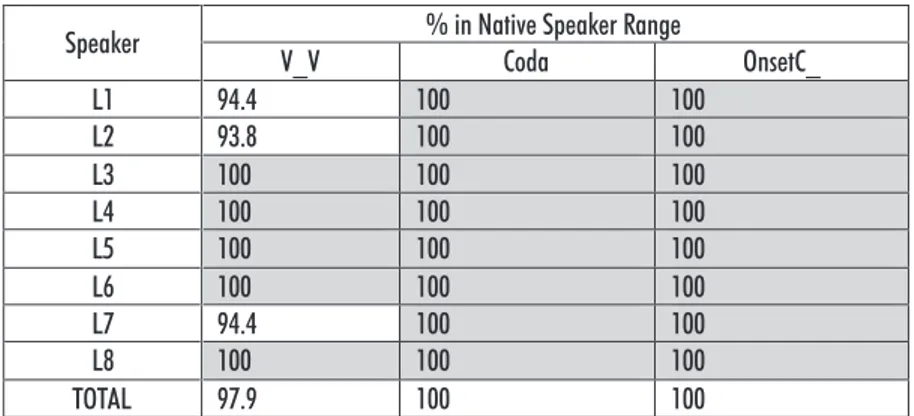
(16) Ultimate Attainment of Spanish Rhotics by Native English-Speaking Immigrants to Spain. Speaker L1 L2 L3 L4 L5 L6 L7 L8 TOTAL. 94.4 93.8 100 100 100 100 94.4 100 97.9. V_V. % in Native Speaker Range Coda 100 100 100 100 100 100 100 100 100 100 100 100 100 100 100 100 100 100. OnsetC_. Table 13. Percent of taps for individual L1 English speakers that fall within L1 Spanish speaker ranges for duration by context (shading indicates the learner produced all taps within the native speaker range for duration for that context). 5. Discussion. 72. As a group, the L1 English speakers do not differ considerably from the L1 Spanish speakers in the production of either Spanish rhotic in intervocalic position, and produce the most target rhotics in this context. In other contexts, the groups do differ significantly. Learners, then, produce the greatest amount of target rhotics and are closest to native-like performance in the one context in which there is a phonemic contrast between the trill and the tap. In the intervocalic context it is most important from the perspective of accurate communication that learners are target-like, and indeed they perform similarly to native speakers. Given that the contrast does not exist in other contexts, a non-target-like pronunciation of a rhotic will not cause a change in meaning, and therefore will generally not hinder communication. While one would hope that learners would approach native-speaker performance in these contexts, there is less riding on their ability to do so, at least from a linguistic perspective.13 Of course, native speaker pronunciation of the rhotics is quite variable, especially for the trill, so we would not expect learners to always produce the trill or the tap, but we would hope that their performance would approximate that of the native speakers. This native speaker variability also has implications for what instructors should expect from learners. Specifically, they should not expect learners to produce only trills and taps, as this would be holding learners to a standard that even native speakers do not achieve. Lengua y migración / Language and Migration 10:2 (2018), 57-80 ISSN : 1889-5425. © Universidad de Alcalá.
(17) Timothy L. Face. The L1 English speakers produce significantly longer trills than do the L1 Spanish speakers, while there is no significant difference in the duration of taps between the groups. However, while the difference in trill duration is statistically significant, this is due to L1 English speakers producing trills with an average of about 0.4 closures more than do the L1 Spanish speakers (see Table 4). This small difference may lead to a significant difference in duration, but it does not result in a large difference (for both groups the mean is between two and three closures per trill) and certainly keeps the mean duration of trills within the native speaker range. In spite of this significant difference in duration of the trills, it seems clear that duration is not a problematic aspect of rhotic production for the learners in this study. Individual learners vary in achieving a native-like production of Spanish rhotics. For target trills, only three learners are in the nativespeaker range for rate of trill production in both contexts, and only one of those is consistently native-like in the duration of trills. For target taps, none of the learners is in the native-speaker range for rate of tap production in all three contexts, and only three achieve this for two of the three contexts. Five learners are consistently native-like with tap duration, and the other three come very close. When combining the two target rhotics, only one learner is native-like in producing the target in four of the five contexts. Even this learner, however, is not consistently native-like in the duration of trills, though a high percentage of productions do fall within the native speaker range. Furthermore, half of the learners (i.e., four of the eight) are only native-like in their rate of target rhotic production in one or two of the five contexts (combining the two trill contexts and the three tap contexts). Overall, even for these very advance second language speakers of Spanish who have lived as immigrants in central Spain for an average of 36 years, not a single one is truly native-like in rhotic production, and many of them do not even come close. As indicated in Section 1, studies on the second language acquisition of Spanish rhotics by native speakers of American English tend to focus on university students, and thus on second language learners who are relatively early in the language acquisition process. No existing studies consider ultimate attainment, and this is a motivating factor for the present study. Of course, ultimate attainment may look very different in different contexts, as the situations of different second language learners of Spanish can vary greatly. Learners who use Spanish in the United States, for example as Spanish language teachers, will have many years of Spanish use, but it will be in limited contexts and they will be surrounded on a daily basis by English, which they themselves will also use outside of the limited contexts in which they use Spanish. Learners Lengua y migración / Language and Migration 10:2 (2018), 57-80 ISSN : 1889-5425. © Universidad de Alcalá. 73.
(18) Ultimate Attainment of Spanish Rhotics by Native English-Speaking Immigrants to Spain. 74. who are immersed in a Spanish-speaking culture for a large portion of their lives, such as the immigrants in the present study, will use Spanish in a wide-range of contexts, be surrounded with it on a daily basis at all hours of the day, and, while having certain situations in which they use English, will have to conduct their lives primarily in Spanish. While both groups will reach an end state in their acquisition, we would certainly expect the latter group’s Spanish to be much more advanced than that of the former. In other words, ultimate attainment will be conditioned by the contexts –and especially the linguistic and cultural contexts– in which learners find themselves. While the ultimate attainment of the former group would be of interest for some purposes, it would not give us an indication of the possible achievement of learners with second language Spanish. The latter group, made up of immigrants who have dedicated much of their lives to living in a culture in which Spanish is the primary language of communication, will likely come as close as we can reasonably expect to demonstrating the maximum potential of ultimate attainment. It is for this reason that the immigrant group in the present study is of so much interest. Moyer (2013), who defines ultimate attainment as the purported “end state” of second language learning (p. 18), notes that many factors enter into ultimate attainment. She points out that ultimate attainment is likely a function of both the quantity and the quality of the language experience. Moyer (2014) points out that “exposure alone is never enough to reach a native-like or near-native level” (p. 434). Therefore, while the length of residence in the country, and thus the time being exposed to the language, is certainly important, there needs to be more than just exposure to the language. Moyer (2014) and Kinsella and Singleton (2014) both point out that length of residence is just one of a constellation of factors to impact exceptional outcomes in second language phonology. Kinsella and Singleton suggest that an exceptional second language learner must have “worked professionally and successfully within the target language for a significant period of their lives” (p. 457). The immigrants in the present study seem to fit this description and have invested much of their lives, both personally and professionally, in the Spanish language and culture. Given the long term, high level investment they have made to the Spanish language and culture, what do the data from the immigrants in the present study imply for our understanding of the ultimate attainment of rhotic pronunciation in second language Spanish? As a group, these immigrants fall well short of native-like performance. Only in two of the five contexts (i.e., the two target trill contexts and the three target tap contexts considered) do more than half of learners achieve a native-like rate of producing the target (and, in both cases, only one more than half Lengua y migración / Language and Migration 10:2 (2018), 57-80 ISSN : 1889-5425. © Universidad de Alcalá.
(19) Timothy L. Face. accomplishes this). The most successful individual is native-like in four of the five contexts (and has a high rate of target production in the fifth), but even this individual is not consistent in producing trills with a target-like duration (though, again, a high percentage of them are native-like). As close as this learner comes to native-like production of the Spanish rhotics, the other learners lag far behind, with three of them having a native-like rate of production of target rhotics in only one of the five contexts, and another achieving this in only two of the five contexts. Ultimate attainment of Spanish rhotics, then, even by this exceptional group of learners who have immigrated to Spain and spent a large portion of their lives immersed in the Spanish language and culture, differs greatly from native speaker performance. A comment is warranted here about the comparison of the learners’ pronunciation to that of native speakers. Some would question –and likely object to– the comparison, as second language learners cannot be expected to perform identically to (monolingual) native speakers who did not have another language interfering with their acquisition of Spanish, who learned the language from birth rather than in adolescence, etc.14 Clearly, the situations in which the native Spanish speakers and the immigrant second language learners of Spanish in the present study learned the language are very different. This must be taken into account in certain contexts, such as in teaching a second language where it might not be realistic to expect second language learners to perform in a native-like fashion with certain elements of the linguistic system. Nonetheless, as a point of reference, the comparison of learners to native speakers is valuable. As Moyer (2013) puts it, “While calls for the demise of the native-non-native construct are common… the intent here is to understand the nature of phonological skill, thus the native speaker construct is a necessary point of comparison” (Moyer 2013: 50). Without a native speaker comparison, it would be impossible to define where on the language production spectrum second language learners’ performance falls, or in what ways they are the same or different from native speakers. One need not take the native speaker norm as a goal for second language learners, but as a point of comparison it is a useful tool. While the native speakers are one point of comparison, so are other second language learners, and the participants in this study fare extremely well in comparison to learners in previous studies. For example, in Face (2006), the most advanced group of learners accurately produced target trills 26.6% of the time and target taps 78.7% of the time in intervocalic position. The learners in the present study accurately produce target trills 54.4% of the time and target taps 94.2% of the time in intervocalic position, showing impressive gains over the advanced university students in Face (2006). Also, both Face (2006) and Rose Lengua y migración / Language and Migration 10:2 (2018), 57-80 ISSN : 1889-5425. © Universidad de Alcalá. 75.
(20) Ultimate Attainment of Spanish Rhotics by Native English-Speaking Immigrants to Spain. (2010b) report that when the target rhotics were not produced, the most common sound produced was an English-like alveolar approximant. In the present study, while approximants are still common non-target productions, they tend not to be English-like (i.e., they generally do not have the typical American English r-coloring) and the distribution of non-target sounds shows some approximation of the distribution used by native speakers. For example, while the learners produce specific non-target sounds more or less often than do native speakers, in several of the contexts they do not differ from native speakers in terms of which non-target sounds are produced with greater or lesser frequency. This demonstrates much more development in their second language production of Spanish rhotics – both in terms of accuracy in achieving the target sounds and in the distribution of non-target sounds – than is seen in learners in previous studies.. 6. Conclusion. 76. The focus throughout this paper has been comparing the production of Spanish rhotics by L1 English speaking, second language learners of Spanish who are long term immigrants to central Spain to the rhotics of native Spanish speakers in the same region. We have seen that none of the second language learners achieves native-like performance with the rhotics, although one comes very close. As a group not only do the learners not achieve native-like production of rhotics, they do not even approximate it. Yet, this fact should not be discouraging. As discussed in the previous section, the native speaker comparison is a useful tool, but should not be taken to imply that second language learners should –or even can– perform identically to native speakers. In comparison with learners in previous studies, the participants in the present study fare extremely well, having much higher rates of achieving the target pronunciations and, when this is not the case, in producing non-target sounds that do not result from L1 English influence and that approximate the distribution of sounds employed by native speakers. It can be concluded, then, that the tremendous exposure to Spanish and immersion in the language and culture of central Spain has led to the immigrant learners in the present study demonstrating a level of Spanish rhotic development that has not been demonstrated by participants in previous studies. While the present study is a first step in investigating the ultimate attainment of Spanish rhotics by native speakers of American English, there is much more work to be done in the area of ultimate attainment in second language Spanish phonology, both with rhotics and more Lengua y migración / Language and Migration 10:2 (2018), 57-80 ISSN : 1889-5425. © Universidad de Alcalá.
(21) Timothy L. Face. broadly. Two directions for future study emerge from the present study. First, given the large degree of individual variation among the immigrant learners in this study, future studies need to consider what speaker variables correlate with differences in performance. The limited number of participants and the nature of the information collected through the questionnaire did not permit a variationist study of the factors affecting rhotic pronunciation in this study, and this leaves questions unanswered with respect to the factors that correlate with more native-like pronunciation. Are there certain personal, experiential or other characteristics that correlate to higher level performance? This knowledge would allow for determining which of the correlating factors could be manipulated by learners in order to facilitate advancement in their second language phonological development. Second, future studies should investigate the degree to which the differences found between learners and native speakers matter in the perception of foreign accent. That is, how close to native-like must a learner get in producing rhotics for the difference to be inconsequential in contributing to a foreign accent? At what point does the difference become imperceptible? If the differences contribute to the perception of a foreign accent, this would have implications for the identity of the learner interacting with those in the culture. If, however, the differences do not contribute to the learner being perceived as having a foreign accent, then these differences may be interesting to linguistics scholars but have no consequence to the learner from a practical perspective. Teasing apart the effects of different aspects of learner pronunciation on foreign accent will be a challenging task, but it is an important area for future studies to consider. Timothy L. Face Department of Spanish and Portuguese Studies University of Minnesota 55455 – Minneapolis, MN – USA [email protected] ORCID: 0000-0003-1534-6568 Recepción: 09/08/2017; Aceptación: 31/03/2018. Notas 1. 2. I am extremely grateful to Mandy Menke for hours of helpful discussions on this and other parts of a larger project on ultimate attainment of Spanish phonology. I would also like to thank two anonymous reviewers for their comments on an earlier version of this paper that have led to a much improved final product. Rose’s (2010b) results differ slightly, as her most advanced group (Level 4 in her classification) is 67% accurate with trills and only 50% accurate with taps. However, her next most advanced group (Level 3), which is comparable to that of Face’s (2006) Lengua y migración / Language and Migration 10:2 (2018), 57-80 ISSN : 1889-5425. © Universidad de Alcalá. 77.
(22) Ultimate Attainment of Spanish Rhotics by Native English-Speaking Immigrants to Spain. 3. 4. 5. 6. 7. 8. 9. 10. 11. 12. 78. advanced group, was 66% accurate with the tap and only 2% accurate with the trill. The large differences and inconsistent patterns are likely due to individual differences having a large effect on the group numbers given the small number of participants (N=5) in each of these two groups in Rose’s study. While it would be ideal to have more than eight participants, and recruitment is ongoing for further studies, subjects meeting the criteria of the study are not common and thus numbers are necessarily low. These numbers are the amount of time the participants have lived in central Spain full time. Many spent a period of time going back and forth between the United States and Spain before making Spain their full-time home. An extreme case of this is the participant with the shortest full-time residency (11 years), who had also spent 29 summers and two full years in Spain prior to moving to Spain permanently upon retiring from his job in the United States. Several participants commented that while they use Spanish at least as much or more than they use English, their Spanish use is somewhat less than what it was at times in the past. Reasons for this include retirement from a job where only Spanish was used, technological advances that permit greater degrees of communication with family in the United States, and increased access to television in English. An anonymous reviewer raised the question of why there is a different number of participants in this native-speaker group than in the immigrant group. While there is variation between individuals, the pronunciation is much more homogenous between members of the native-speaker group, and therefore it was considered that five participants in the comparison group was sufficient. This is consistent with the use of control groups in other studies, which are often smaller than the group that is the primary focus of the study. An anonymous reviewer raised the question of why the speaker with some proficiency in English and German was included in the comparison group. This speaker was included because because of her prototypical Castilian accent and the fact that many speakers in this region have some degree of proficiency in one or more languages other than Spanish. The most common mispronunciation that changed the context and led to elimination of a token was pausing after a word where the target rhotic was in word-final position and intended to be intervocalic since the following word began with a vowel. An example is the sequence ser el, where the word-final rhotic of ser was intended as a target tap in intervocalic position but a pause removed it from this context. As has been shown in studies of L1 Spanish (e.g., Blecua 2001), in both the tap and the trill, at times the tongue tip approaches, but does not contact, the alveolar ridge, leading to an incomplete closure. This is especially true in the later closures of a trill, when airflow is diminishing. The gesture is clearly made and these articulations are perceived as natural productions of the Spanish rhotics. As such, in the present study such articulations are also counted as taps or trills, as the case may be. Due to there only being one occurrence of a target trill after /l/ in the story, there are not sufficient tokens to include this context in the statistical analysis, and therefore the 2-way ANOVAs for duration only include the intervocalic and word-initial contexts. Given the low number of tokens of target trills following /l/ (i.e., one per speaker), this type of comparison is unreliable for this context and therefore the context is not included in this analysis. In word-initial position, it is worth noting that three of the four learners who produce all of their trills within the native speaker range for duration are the three who produce the fewest trills (L1 produced 5 trills in this position, L2 produced 2 and L7 produced 1). Whether they would be so consistent when producing a greater number of trills is, of course, unknowable.. Lengua y migración / Language and Migration 10:2 (2018), 57-80 ISSN : 1889-5425. © Universidad de Alcalá.
(23) Timothy L. Face 13. 14. There is certainly the possibility that there are social implications of having non-native pronunciation, but this is beyond the scope of this paper to consider. An anonymous reviewer notes that it is unknown what dialects of Spanish the immigrants were in contact with in the United States before moving to Spain and that it is conceivable that exposure to other dialects could explain non-target-like productions in this study, since not all dialects have the same targets as the Castilian Spanish that is the target in this study. While this possibility cannot be dismissed, it is notable that each immigrant’s pronunciation was clearly characterized by Castilian dialectal features.. References Abrahamsson, Niclas and Keneth Hyltenstam. 2009. “Age of onset and nativelikeness in a second language: Listener perception versus linguistic scrutiny”. Language Learning, 59. 249-306. Blecua, Beatriz. 2001. Las vibrantes del español: manifestaciones acústicas y procesos fonéticos. Barcelona: Universitat Autònoma de Barcelona doctoral dissertation. Boersma, Paul and David Weenink. 2014. Praat: Doing phonetics by computer, v.5.4.04. Available at <www.praat.org>. Bongaerts, Theo, Brigitte Planken and Erik Schils. 1995. “Can late starters attain a native accent in a foreign language? A test of the critical period hypothesis”. In The age factor in second language acquisition, David Singleton and Zsolt Lengyel (eds.), 30-50. Clevedon, UK: Multilingual Matters. Bylund, Emanuel, Niclas Abrahamsson and Kenneth Hyltenstam. 2012. “Does first language maintenance hamper nativelikeness in a second language? A study of ultimate attainment in early bilinguals”. Studies in Second Language Acquisition, 34. 215-241. Canfield, D. Lincoln. 1981. Spanish pronunciation in the Americas. Chicago: University of Chicago Press. Daidone, Danielle and Isabelle Darcy. 2014. “Quierro comprar una guitar: Lexical encoding of the tap and trill by L2 learners of Spanish”. In: Selected proceedings of the 2012 Second Language Research Forum, Ryan T. Miller, Katherine I. Martin, Chelsea M. Eddington, Ashlie Henery, Nausica Marcos Miguel, Alison M. Tseng, Abla Tuninetti, and Daniel Walter (eds.), 39-50. Somerville, MA: Cascadilla Proceedings Project. Face, Timothy L. 2006. “Intervocalic rhotic pronunciation by adult learners of Spanish as a second language”. In: Selected proceedings of the 7th Conference on the Acquisition of Spanish and Portuguese as First and Second Languages, Carol A. Klee and Timothy L. Face (eds.), 47-58. Somerville, MA: Cascadilla Proceedings Project. Flege, James E. 1995. “Second language speech learning: Theory, findings, and problems”. In: Speech perception and linguistic experience: Issues in cross-language research, Winifred Strange (ed.), 233-277. Timonium, MD: York Press. Goldstein, Brian. 2000. Cultural and linguistic diversity resource guide for speech-language pathology. San Diego: Singular Publishing Group. Hammond, Robert M. 1999. “On the non-occurrence of the phone [r ]̃ in the Spanish sound system”. In: Advances in Hispanic linguistics, Fernando Martínez-Gil and Javier Gutiérrez-Rexach (eds.), 135-151. Somerville, MA: Cascadilla Press. Hurtado, Luz M. and Chelsea Estrada. 2010. “Factors influencing the second language acquisition of Spanish vibrants”. Modern Language Journal, 94. 74-86. Ioup, Georgette, Elizabeth Boustagui, Manal El Tigi and Martha Moselle. 1994. “Reexamining the critical period hypothesis: A case study in a naturalistic environment”. Studies in Second Language Acquisition, 16. 73-98. Kinsella, Ciara and David Singleton. 2014. “Much more than age”. Applied Linguistics, 35. 441-462. Lengua y migración / Language and Migration 10:2 (2018), 57-80 ISSN : 1889-5425. © Universidad de Alcalá. 79.
(24) Ultimate Attainment of Spanish Rhotics by Native English-Speaking Immigrants to Spain. Ladefoged, Peter and Ian Maddieson. 1996. The sounds of the world’s languages. Oxford: Blackwell. Lipski, John M. 1994. Latin American Spanish. London: Longman. Major, Roy C. 1986. “The ontogeny model: Evidence from L2 acquisition of Spanish r”. Language Learning, 36. 453-504. Major, Roy C. 2001. Foreign accent: The ontogeny and phylogeny of second language phonology. Mahawh, NJ: Lawrence Erlbaum. Moyer, Alene. 1999. “Ultimate attainment in L2 phonology: The critical factors of age, motivation, and instruction”. Studies in Second Language Acquisition, 21. 81-103. Moyer, Alene. 2013. Foreign accent: The phenomenon of non-native speech. Cambridge: Cambridge University Press. Moyer, Alene. 2014. “Exceptional outcomes in L2 phonology: The critical factors of learner engagement and self-regulation”. Applied Linguistics, 35. 418-440. Olsen, Michael K. 2012. “The L2 acquisition of Spanish rhotics by L1 English speakers: The effect of L1 articulatory routines and phonetic context for allophonic variation”. Hispania, 95. 65-82. Olsen, Michael K. 2016. “Limitations of the influence of English phonetics and phonology on L2 Spanish rhotics”. Borealis: An International Journal of Hispanic Linguistics, 5. 313-331. Recasens, Daniel. 1991. “On the production characteristics of apicoalveolar taps and trills”. Journal of Phonetics, 19. 267-280. Reeder, Jeffrey T. 1988. “English speakers’ acquisition of voiceless stops and trills in L2 Spanish”. Texas Papers in Foreign Language Education, 3. 101-118. Rose, Marda. 2010a. “Differences in discriminating L2 consonants: A comparison of Spanish taps and trills”. In: Selected proceedings of the 2008 Second Language Research Forum, Matthew T. Prior, Yukiko Watanabe, and Sang-Ki Lee (eds.), 181196. Somerville, MA: Cascadilla Proceedings Project. Rose, Marda. 2010b. “Intervocalic tap and trill production in the acquisition of Spanish as a second language”. Studies in Hispanic and Lusophone Linguistics, 3. 379-419. Solé, Maria-Josep. 2002. “Aerodynamic characteristics of trills and phonological patterning”. Journal of Phonetics, 30. 655-688. Stölten, Katrin, Niclas Abrahamsson, and Kenneth Hyltenstam. 2015. “Effects of age and speaking rate on voice onset time”. Studies in Second Language Acquisition, 37. 71100. Waltmunson, Jeremy C. 2005. The relative degree of difficulty of L2 Spanish /d, t/, trill, and tap by L1 English speakers: Auditory and acoustic methods of defining proununciation accuracy. Seattle: University of Washington doctoral dissertation.. 80 Lengua y migración / Language and Migration 10:2 (2018), 57-80 ISSN : 1889-5425. © Universidad de Alcalá.
(25)
Figure



+5


Documento similar
