hesitant fuzzy sets
Jos´e Carlos R. Alcantud1†, Roc´ıo de Andr´es Calle1§
1BORDA Research Unit and Multidisciplinary Institute of Enterprise (IME),
Universidad de Salamanca, E-37007 Salamanca, Spain †E-mail: [email protected]
§E-mail: [email protected]
Abstract
We provide a methodology to perform an extensive and systematized analysis of problems where experts voice their opinions on the attributes of projects through a hesitant fuzzy decision matrix. This provides the decision-maker with ample information on which he or she can rely in order to make the final decision, in the form of segments instead of numbers. These segments derive from weighted average of new parametricexpressions for two tenable indices of satisfaction, the distance to an ideal or the similarity to an anti-ideal, and permit to give a profuse unified picture of the relative performance of the projects. When the parameter grows, these indices tend to replicate the evaluation by respective simplistic expressions that only depend on the least, resp., the largest, evaluation and the number of evaluations in each cell.
Keywords:Hesitant fuzzy set; Group decision making; Project evaluation; Segment-based evaluation.
1. Introduction
The classical group decision making problem con-cerns the context where a group of experts have to make a decision on a set of alternatives, attending to either one or multiple criteria. The experts’ opinions about the alternatives are usually characterized by their knowledge or subjective ideas, which produces a rich environment of models in order to capture the setting and reach a final decision. The literature abounds with references about the decision making process under different positions8,9,13,24,31,36,49,53.
It has long been recognized that fuzzy sets (FS) and fuzzy logic provide useful tools for the management of human subjectivity in decision-making contexts12,21,18,37. However in some practi-cal problems, imprecise human knowledge (and
hes-itant fuzzy multi-criteria decision making problems and propose further applications of HFSs to decision making.
1.1. Our assumptions and research objectives
We focus on the following common situation in multi-criteria decision analysis. We need to com-pare some alternatives or projects, and some experts evaluate their performance with respect to a set of at-tributes or characteristics. In this context the group knowledge on each project must be naturally rep-resented by set-valued memberships, instead of just membership degrees as in fuzzy sets. Henceforth not only we permit imprecision or vagueness, but also a touch of uncertainty since we do not attach more value to a voiced opinion than to another one. Then the question arises: How do we analyze the problem of prioritizing these projects?
The formal statement of this question refers to hesitant fuzzy decision matrices (HFDMs), i.e., ma-trices whose cells contain hesitant fuzzy elements (HFEs). These HFEs collect the opinions voiced by the experts on each attribute of the succesive projects. In our description rows are associated with projects and can be assimilated with HFSs. Thus we want to compare rows in these matrices on the ba-sis of their relative performance (as alternatives or projects).
The problem posed above, i.e., ranking HFSs or HFEs, has received attention from various authors recently. Xia and Xu44 and Farhadinia15 propose to use aggregating operators in order to associate a single HFE with each project. Then score func-tions give rankings of the aggregate HFEs. Xu and Xia47 rank the projects according to a direct ap-peal to distances. Finally, Zhou and Li54 design a lexicographic ranking that refines the Xia and Xu proposal44. A summary of these studies related to HFSs/HFEs ranking is given in Table 1.
In order to make a broader analysis of these decision-making situations we draw inspiration from two sources. In the first place, we observe that the relative inadequacy of the projects (i.e., of their associated HFSs) can be estimated either by the ‘dis-tance’ to an ideal HFS or the ‘similarity’ to an anti-ideal HFS, in the sense that the higher these
eval-uations the worse the project’s performance. Here we suggest respective novel parametric indicators for such proxies that incorporate the relative impor-tance of the attributes throughex-anteallocations of weights. Their asymptotic behavior, i.e., the role of the parameter, is disclosed: when the parameter goes to infinity these indicators tend to provide an evaluation by respective simplistic expressions that only depend on the least, resp., the largest, eval-uation and the number of evaleval-uations on each at-tribute. In the second place, we draw inspiration from the Hurwicz approach to decision making un-der uncertainty26, which advocates for the combined use of ‘best and worst outcomes’ to assess the value of uncertain decisions. Thus the Hurwicz approach permits us to combine our two plausible parametric indices by their weighted sums, which includes both indices as extreme cases5. Their limit behavior repli-cates the case of the original indicators. Now for each project we obtain a segment instead of a single number, which can provide a richer analysis of the decision problem. Obviously, for any choice of the averaging aggregator a concrete ranking of projects arises.
Table 1. Summary table of studies related to ranking of HFSs or HFEs
Author(s) Tool(s)/method(s)
Xia and Xu44 Aggregating operators and score functions
Farhadinia15
Xu and Xia47 Distances and similarities
Zhou and Li54 Lexicographic procedure
1.2. Literature review: Project evaluation problems
Multi-criteria decision making methods (MCDM) focus on the implementation ofDecision Theoryin real-life problems. One of the the most complex real situations is the evaluation of projects because it includes various factors and criteria. There exist different MCDM techniques to provide solutions to this problem. The appropriateness of the method de-pends on the specific decision situation39. Some ex-amples of such decision contexts are: new product development projects10, energy projects19, informa-tion technology projects3, investment projects2, etc.
Other contributions include some simple exam-ples of different MCDM methodologies about project evaluation20,23,35. When the projects can be-gin on different time moments, the research on this problem is limited6,25,29.
From another point of view, Fuzzy Set Theo-ryhas been extensively used to model uncertainty and vagueness associated with project information sources. And it has been gradually gaining im-portance as a tool in project selection4,7,17,27. Two milestones in this regard are Wang and Hwang41 (who develop a fuzzy integer programming model to gain an optimal investment portfolio), Chiu et al.11 and Wang et al.42 (who apply the fuzzy concept to the project selection process with the fuzzy multi-criteria decision-making model (FMCDM) to select the optimal alternative).
Within the extended field ofHesitant Fuzzy Sets, which allows for cases with several degrees of mem-bership, there are many application papers that con-tribute to Multicriteria Decision Making Theory 1,22,44,48,52,51,54. Multiexpert multicriteria decision
making under this requirement has been explored by Xia et al.45.
A summary of these studies related to the eva-luation problem is given in Table A.5.
1.3. Organization of the paper
The remaining of this paper is organized as follows. Section 2 establishes some basic definitions. Sec-tion 3 introduces our proposals for ranking hesitant fuzzy sets, as well as results concerning the
asymp-totic behavior of our indices. In Section 4 we put in practice the methodology that permits to study the hierarchization of projects characterized by hesitant fuzzy sets. We visualize the asymptotic behavior of our indexes in a fully developed example, and then our results are confronted with the evaluations in ex-isting approaches. We conclude in Section 5.
2. Notation and definitions
For any (possibly infinite) setA,P∗(A)denotes the set of non-empty subsets ofA, andF∗(A) denotes the set of non-empty finite subsets ofA.
Definition 1.44A hesitant fuzzy element (HFE) is a non-empty, finite subset of[0,1]. The set of HFEs is denoted byF∗([0,1]).
Henceforth we refer toX, a fixed set of alterna-tives.
Definition 2.38 Ahesitant fuzzy set (HFS) onX is a function fromX toP∗([0,1]). Atypical hesitant fuzzy set on X is a function fromX to F∗([0,1]). HFS(X) means the set of HFSs onX, and the set of typical HFSs onX is denoted by HFS(X).
Unless otherwise stated, HFSs are assumed to be typical.
Formally speaking, a (typical) HFS is a subset
M⊆X×F∗([0,1])such that for eachx∈X, there is exactly one elementhM(x)∈F∗([0,1])such that (x,hM(x))∈M.
Each HFS onX defines a set of membership va-lues for each element ofX, and in the case that the HFS is typical such set is always finite. HFEs re-present the set of possible membership values of a typical hesitant fuzzy set at an alternative.
By restricting ourselves to either F∗([0,1]) or P∗([0,1]), i.e., non-empty HFEs, we disregard ‘nonsense elements’ in each HFS: on each alterna-tive, at least one assessment must be made.
From a practical point of view, Xia and Xu44 show that the hesitant fuzzy setMcan be represented asM={(x,hM(x))|x∈X}. For example, following Torra38we define
M∗={(x,1)|x∈X}
as theidealorfullHFS onX, and
as theanti-idealoremptyHFS onX.
Clearly, when all HFEs involved in the definition of an HFS onX are singletons we can identify such HFS with a fuzzy set (FS) onX. That is to say, HFEs of the form
M={(x,hM(x))|x∈X,hM(x) ={Mx}}
can be identified with the FS onX whose member-ship function is
µM:X −→ [0,1]
x µM(x) =Mx
For each typical hesitant fuzzy set Mon X, we denote
hM(x) ={h1M(x), ...,hlM(x)
M (x)}
where indexes are chosen so that
h1M(x)< . . . <hlM(x)
M (x).
In particular, the cardinality of the HFE hM(x) is
lM(x) =|hM(x)|. Observe that if the set of mem-bership values at an element is not finite (i.e., if we refer to a non-typical HFS) then such arrangement in increasing order cannot be made in general. In any case, becausehM(x)is a set, repetitions are excluded by definition.
Now we proceed to formalize the general con-cepts of distance and similarity between HFSs.
Definition 3. [Xu and Xia 47] A distance measure between HFSs on X is a function d : HFS(X)×
HFS(X)−→[0,1]that satisfies the following prop-erties: for everyM,N∈HFS(X),
1. 06d(M,N)61;
2. d(M,N) =0 if and only ifM=N;
3. d(M,N) =d(N,M).
Definition 4.47A similarity measure between HFSs onX is a function s:HFS(X)×HFS(X)−→[0,1] that satisfies the following properties: for every
M,N∈HFS(X),
1. 06s(M,N)61;
2. s(M,N) =1 if and only ifM=N;
3. s(M,N) =s(N,M).
There are similitudes between the latter con-cepts. Whendis a distance measure between HFSs on X, the expression s=1−d defines a similarity measure between HFSs onX. Conversely, whens
is a similarity measure between HFSs onX, the ex-pression d=1−s defines a distance measure be-tween HFSs onX. Besides Xu and Xia47, Xu46 col-lects many other examples of distance functions be-tween HFSs in the literature.
3. Ranking typical HFSs: the segment approach
In this Section we consider the analysis of the following problem. There are m alternatives or projects whose performance with regard ton crite-ria or attributes is evaluated by a team of experts (in a range from 0 to 1). Each expert can be hesitant on the performance of the projects, therefore he or she can emit anyfinitenumber of evaluations to express his or her doubts. For each project, all evaluations by the experts on each criteria are collected into a set of values. This presumes anonymity of the experts: all opinions are equally considered in this process. Formally, this produces an HFS associated with the project: for each attribute, a finite set of values in [0,1]is given. We face a problem under complete uncertainty: the importance of each particular ap-praisal is totally unknown.
The opinions of the experts can be captured by a hesitant fuzzy decision matrix (HFDM), i.e., an
m×n matrix whose cells contain HFEs, in such way that its rows trivially define HFSs (one for each project). Columns correspond to respective evalua-tions of the projects by fixed criteria.
3.1. Analysis of the problem: the segment approach
Several contributions have dealt with the problem posed above. Xia and Xu44 start by using aggre-gating operators in order to associate an HFE with each project, and then use a score function to rank them. Farhadinia15 proposes a variation with a di-fferent score function. Xu and Xia47 proceed in a more direct way: they rank the projects according to their distance to the ideal HFS. Finally, Zhou and Li54do not produce evaluations of projects but give a lexicographic ranking that refines the proposal44.
Our proposal intends to make a richer analysis by segments instead of points: with each project we associate a segment rather than a position or a num-ber. It has two sources of inspiration.
Firstly, we draw inspiration from the approach in Xu and Xia47. In order to analyze the relative performance of the projects (or of the HFSs that characterize them) we build on two relevant indica-tors, namely the ‘distance’ to the ideal HFS and the ‘similarity’ to the anti-ideal HFS. Both seem tena-ble indices of fitness for an HFS although of course, many distance and similarity indices can be used in analogy with the many proposals of distances be-tween HFSs in the literature. In order to avoid fusions here we develop the model with a single con-crete specification, namely, Definition 5 below that slightly echoes the use of the generalized hesitant weighted distance47. We leave the details of possi-ble variations to the interested reader, i.e., specifica-tions that replace our indicators in Definition 5 by expressions inspired on (i) the generalized hesitant weighted Hausdorff distance or the generalized hy-brid hesitant weighted distance47–among other dis-tances between HFSs– or (ii) the ideas of the clos-edly related paper Xu and Xia48.
We assume that each of the attributes has associ-ated a weightwisuch thatw1+. . .+wn=1. Weights are indicative of the relative importance of the attri-butes, hence a zero weight would mean a dispen-sable criteria that can be omitted in the analysis. This means that we do not lose generality if we assu-mewi>0 for eachihenceforth.
Definition 5.Givenλ>0 andw= (w1, . . . ,wn)with wi >0 for each i and w1+. . .+wn = 1, the λ
-adjusted hesitant weighted distance to the ideal HFS
is defined as
∆λahw,w(M) = n
∑
i=1wi
lM(xi) lM(xi)
∑
j=1(1−hMj (xi))λ !λ1
(1)
for each M∈HFS(M) and theλ-generalized
hesi-tant weighted similarity to the anti-ideal HFSis de-fined as
Σλahw,w(M) =1−
n
∑
i=1wi
lM(xi) lM(xi)
∑
j=1(hMj (xi))λ !λ1
(2)
for eachM∈HFS(M).
Observe∆λahw,w(M) =0 if and only ifM=M∗, and Σλahw,w(M) =0 if and only ifM=M∗. Therefore both
indicators share the characteristic that the higher the evaluation of a project, the worse its performance. In the case of Xia and Xu47, only the analogue of the first indicator is used∗. In fact a direct inspec-tion shows that whenλ =1, our Definition 5 coin-cides with Xu and Xia’s general hesitant weighted distance47 between M and M∗ and therefore with their hesitant weighted Hamming distance between
MandM∗:
Lemma 1. If λ = 1 and w = (w1, . . . ,wn) veri-fieswi >0 for each iand w1+. . .+wn=1, then
∆ahwλ,w(M) =Σahwλ,w(M)for everyM∈HFS(X). Proof. For everyM∈HFS(M),
∆1ahw,w(M) = n
∑
i=1wi
lM(xi) lM(xi)
∑
j=1(1−hMj (xi)) =
= n
∑
i=1wi
lM(xi) lM(xi)− lM(xi)
∑
j=1hMj (xi) !
=
= n
∑
i=1wi− n
∑
i=1wi
lM(xi) lM(xi)
∑
j=1hMj (xi) !
=
=1−
n
∑
i=1wi
lM(xi) lM(xi)
∑
j=1hMj (xi) !
Secondly, we draw inspiration from the Hur-wicz approach to decision making under uncertainty, which is very popular in Economics since its intro-duction in 1950 (cf., e.g., Luce and Raiffa26). In spirit it postulates the use of weighted sums of best and worst outcomes to assess the value of decisions. We can adapt it to the structure of our problem. In order to evaluate the acceptability of an HFS, both the ‘distance’ to the ideal HFS and the ‘similarity’ to the anti-ideal HFS are potentially useful. Instead of discarding one indicator in the benefit of the other, the segment approach permits us to combine both plausible indices. To be precise, in order to evaluate the hesitant fuzzy setMwe define a value
Λλα,w(M) =α∆ λ,w
ahw(M) + (1−α)Σ λ,w
ahw(M) (3)
which is a weighted sum of the distance to the ideal HFS and the similarity to the anti-ideal HFS. The weightα ∈[0,1]can be conceived of as an index of ‘enviness’ because when α =1, the indicator coincides with∆λahw,w, i.e., with the selected distance
to the ideal HFS. Whenα =0, the indicator coin-cides withΣλahw,w, i.e., with the selected similarity to
the anti-ideal HFS. Intermediate values permit to use the information in both indicators, and values close to 1, resp. 0, bias the indicator towards∆λahw,w,
resp.Σλahw,w.
The higher the evaluation of an HFS byΛλα,w, the worse its suitability. Therefore for each HFS we ob-tain a segment (as a function ofα) instead of a single number, which can provide a more extensive analy-sis of the decision situation to the decision-maker. Obviously, for any fixedαa ranking of HFSs arises, although in general this ranking is dependent on the choice of the parameter. The decision maker can ob-serve from a single drawing for which values of the parameter a given alternative is ranked first.
Remark 1. As a consequence of Lemma 1, when λ =1 a unique ranking is obtained independently of the value of the parameter α because when w = (w1, . . . ,wn) verifies wi > 0 for each i and
w1+. . .+wn=1, then
Λ1α,w(M) =∆ahw1,w(M) =Σ1ahw,w(M)
for everyM∈HFS(M).
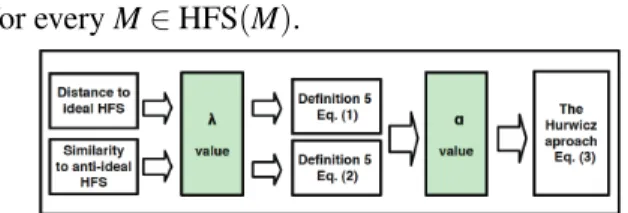
Fig. 1. The segment approach to the analysis of project eval-uation problems. The use of theαandλ parameters gives flexibility to our approach.
Figure 1 graphically displays the structure and the flexibility of our approach. Besides the afore-mentioned intuition for theα parameter, subsection 3.2 below intends to help us understand the role of theλ parameter.
3.2. Asymptotic behavior of the indicators: interpretations
We proceed to check that using our indicators with ‘large’ values of theλ parameter produces evalua-tions that are increasingly similar to those that de-rive from very simple indicators. Such indicators are crude evaluations that only rely on the number of different evaluations for each attribute and either the maximum or the minimum of such respective va-lues. To this purpose let us define
A(M) = ∑ni=1 wi
lM(xi)maxj=1,...,lM(xi)(1−h
j
M(xi)) =
= ∑ni=1 wi
lM(xi)(1−minj=1,...,lM(xi)h
j M(xi))
for eachM∈HFS(M)and
B(M) =1−
n
∑
i=1wi
lM(xi)j=1max,...,lM(xi)
hMj (xi)
for eachM∈HFS(M). Then our claim boils down to the following statement:
Proposition 2. For every M∈HFS(X),
lim
λ→∞
∆λahw,w(M) =A(M)
and also
lim
λ→∞
Σλahw,w(M) =B(M)
Therefore,
lim
λ→∞
for every M∈HFS(X ) andα∈[0,1].
Proof. We appeal to some basic properties of thelp norms on anyRt, defined as
||(x1,· · ·,xt)||p= t
∑
j=1|xj|p !1p
for everyp>1.†
We first observe that whenM∈HFS(M),
∆λahw,w(M) =
n
∑
i=1 wi
lM(xi)
||(1,...,lM(xi) 1)−(h1
M(xi),· · ·,hlM
(xi)
M (xi))||λ
Now it is easy to deduce the consequence limλ→∞∆λahw,w(M) =A(M): for each i=, ...,n, when λ
ap-proaches infinity the lλ norm on RlM(xi) approaches the l
∞
or maximum norm defined as14
||(x1,· · ·,xt)||∞=max(|x1|,· · ·,|xt|).
The proof of the second claim is almost identical to the one above. The final statement can be trivially derived from the for-mer ones.
An intuitive interpretation is in order. ∆λahw,w(M) refers to similarity to an ideal HFS, and a proxy of that idea is given by the worst evaluation on each attribute, which is the informa-tion from whichA(M)is designed. Similarly,Σλahw,w(M)refers to similarity to an anti-ideal HFS, and a proxy of that idea is given by the best evaluation on each attribute, which is the informa-tion on whichB(M)is designed.
4. Experimental study
In this section we give an experimental example to illustrate our proposal for the analysis of the hierarchization of projects respectively defined by hesitant fuzzy sets (HFSs). We also carry out a sensitivity analysis of the final outcomes in order to demonstrate the adaptability of the proposed model. Finally, we compare our conclusions with the evaluation methods pro-posed by Xu46, which provides experimental arguments sup-porting our approach.
4.1. Evaluation framework
Our example builds on the discussion in Xu and Xia47 which is adapted from Kahraman and Kaya19. Accordingly, let us
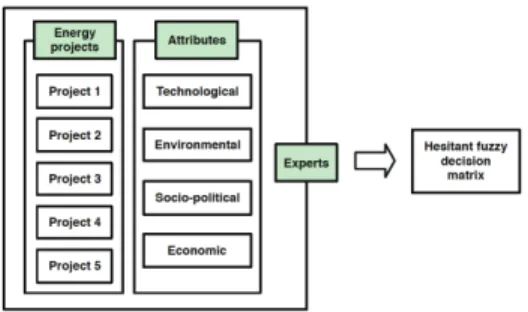
suppose a society which has to compare five energy projects, denoted by alternativesAi(i=1, . . . ,5). Four energy experts
evaluate the performance of the five alternatives with respect to four main attributes or criteria (the example only collects all of the different possible values for each alternative and each attri-bute)‡:
• P1: Technological. In this criterion aspects like
techni-cal feasibility, technitechni-cal risk, access to technology by local agents, maturity of projects, readiness of the local agents to implement the project, multiplicative effects on the local technology basis are taken into account.
• P2: Environmental. Based on the project environmental
impact.
• P3: Socio-political. Included features like the
consis-tency of the project with the society energy policy ob-jectives, the political acceptance of the project, the so-cial acceptance of the project, the scope of the project vs needs to be satisfied-urgency, the appropriateness of the implementing organization, etc.
• P4: Economic. Estimated full cost of the project.
The criteria significance fixed by the society is 15% for tech-nological, 30% for environmental, 20% for socio-political and 35% for economic. Consequently the attribute weight vector used along the example isw= (0.15,0.3,0.2,0.35).
The evaluations of the experts on the energy projects, which are based on the aforementioned criteria, are contained in a HFDM (see Figure 2 and Table 2).
Fig. 2. Experimental study evaluation framework
† When 0<p<1 such expression does not define a norm, although||(x1,· · ·,xt)||p=∑tj=1|xj|pdoes (Maddox28).
Table 2. Hesitant fuzzy decision matrix
P1 P2
A1 {0.5,0.4,0.3} {0.9,0.8,0.7,0.1} A2 {0.5,0.3} {0.9,0.7,0.6,0.5,0.2} A3 {0.7,0.6} {0.9,0.6}
A4 {0.8,0.7,0.4,0.3} {0.7,0.4,0.2} A5 {0.9,0.7,0.6,0.3,0.1} {0.8,0.7,0.6,0.4}
P3 P4
A1 {0.5,0.4,0.2} {0.9,0.6,0.5,0.3} A2 {0.8,0.6,0.5,0.1} {0.7,0.4,0.3} A3 {0.7,0.5,0.3} {0.6,0.4} A4 {0.8,0.1} {0.9,0.8,0.6} A5 {0.9,0.8,0.7} {0.9,0.7,0.6,0.3}
4.2. Analysis of the hierarchization of projects: The segment approach
In order to analyze the relative performance of the projects by means of the segment approach, we first need to produce the ‘distance’ to the ideal HFS and the ‘similarity’ to the anti-ideal HFS of each project, as measured by concrete realizations ofλ
in Definition 5. To be precise, we specify the outcomes when
λ=1,λ =2 andλ=20. Finally, we illustrate the asymptotic
behavior of the indicators whenλis large enough by comparing these outcomes with the much simpler indicators in subsection 3.2.
• Caseλ=1. Table 3 shows the results of the computations for∆λahw,w,Σahwλ,wandΛλα,w. As proven in Lemma 1, the eval-uations when λ =1 are coincident hence the conclusion
A5A3A4A1A2irrespective of which compromise
index and value ofαwe use. This consequence is shown in Figure 3 too.
Table 3. Elements for the analysis whenλ=1
Alternatives ∆λahw,w=Σahwλ,w=Λλα,w
A1 0.477
A2 0.502
A3 0.402
A4 0.429
A5 0.355
Fig. 3. A graphical display of the indicators ∆1,ahww=Σ1,ahww=Λ1,αw
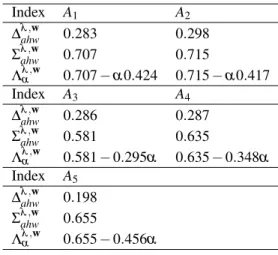
• Casesλ=2,λ=20. Tables 4 and 5 show the results of the respective computations for these values.
In order to compare the projects under a given choice ofλ, the corresponding five segmentsΛλα,wcan be drawn. This graphical analysis for the casesλ=2,λ=20 is performed in the respective Figures 4 and 5.
Table 4. Elements for the analysis whenλ=2
Index A1 A2
∆λahw,w 0.283 0.298 Σλahw,w 0.707 0.715
Λλα,w 0.707−α0.424 0.715−α0.417
Index A3 A4
∆λahw,w 0.286 0.287 Σλahw,w 0.581 0.635
Λλα,w 0.581−0.295α 0.635−0.348α Index A5
∆λahw,w 0.198 Σλahw,w 0.655
Λλα,w 0.655−0.456α
Table 5. Elements for the analysis whenλ=20
Index A1 A2
∆λahw,w 0.217 0.227 Σλahw,w 0.795 0.786
Λλα,w 0.795−0.577α 0.786−0.559α
Index A3 A4
∆λahw,w 0.241 0.242 Σλahw,w 0.660 0.714
Λλα,w 0.660−0.419α 0.714−0.471α Index A5
∆λahw,w 0.153 Σλahw,w 0.773
Λλα,w 0.773−0.620α
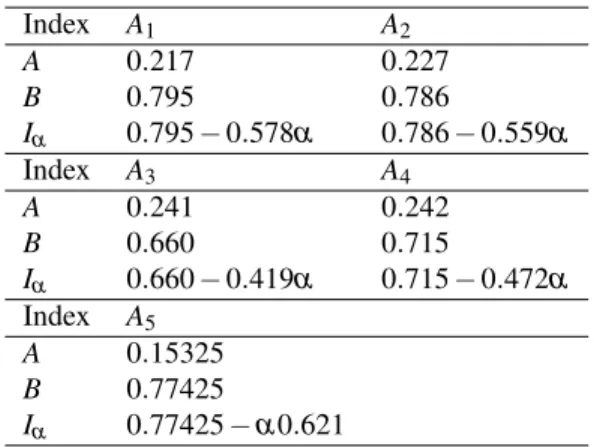
• Caseλ→∞. Table 6 shows the results of the computations
forAandBand also the respective values ofIαas a function ofα∈[0,1].
Iα(Ai) =αA(Ai) + (1−α)B(Ai).
the largest evaluation and the number of evaluations in each cell.
With respect to the asymptotic behavior it can be checked that the evaluations of the projects by the∆λahw,windicator are identical to the respective evaluations byAwhenλ =55,
and the evaluations of the projects by theΣλahw,windicator are identical to the respective evaluations byBwhenλ =75 (with a 10−6precision).
Table 6. Limit values of the indicators. Iα denotes
αA+ (1−α)B.
Index A1 A2
A 0.217 0.227
B 0.795 0.786
Iα 0.795−0.578α 0.786−0.559α
Index A3 A4
A 0.241 0.242
B 0.660 0.715
Iα 0.660−0.419α 0.715−0.472α Index A5
A 0.15325 B 0.77425
Iα 0.77425−α0.621
A possible criticism to this approach is that it is fairly com-plex and certain factors (theλandαparameters) must be fixed. This seems to introduce ambiguity in the process of decision-making. Nevertheless we must point out that (i) this apparent inconvenience is common to many approaches in exactly the same setting, as subsection 4.3 below recaps; and (ii) the usual role of the analyst is to provide the decision-maker with as much information as possible, rather than making decisions. In this regard, note that our analysis provides visual information in the form of a two-dimensional graph for each choice ofλ. The asymptotic behavior of these graphs (or the corresponding in-dexes) reveals that with only a few properly selected graphs, a complete assessment can be made.
Fig. 4. A graphical display of the indicatorΛ2,αw.
Fig. 5. A graphical display of the indicatorΛ20,α w.
Fig. 6. A graphical display of the indicator
Iα=αA+ (1−α)B.
4.3. Discussion of the experimental study
With the results of our experimental example set out, we now proceed to compare them with the rankings obtained from diffe-rent methodologies that rank HFSs.
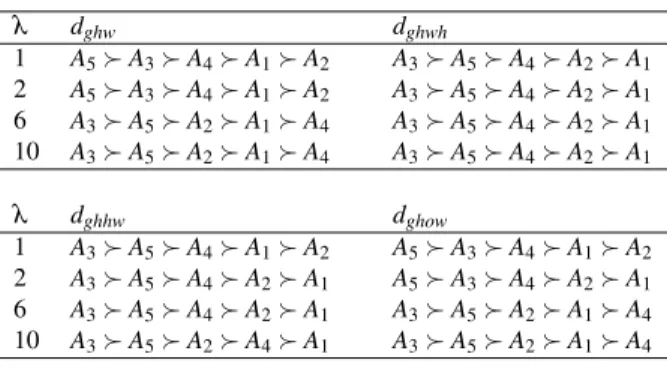
We begin with the procedure in Xu and Xia47. Table A.1 contains rankings proposed by the generalized hesitant weighted distance (dghw), the generalized hesitant weighted Hausdorff distance (dghnh), the generalized hybrid hesitant weighted distance (dghhw) and the generalized hesitant ordered weighted distance (dghow). The authors give rankings for sev-eral choices of theλ parameter that we adopt for comparison.
In Xia and Xu44, Section 4, the authors proposed to use a GHFWAλ operator (generalized hesitant fuzzy weighted ave-raging operator, which requires to fix a weight vector and de-pends on aλ factor) in order to aggregate HFEs, and then rank the resulting HFEs according to theirS1score
S1(h) =
h1+. . .+hlh lh
.
Rodr´ıguez et al.34, Section 4, reported on many other alterna-tive aggregators on HFEs, like GHFWGλ, GHFOWA or GH-FOWG44or QHFOWA, HFMOWA and HFMOWG45. Further-more, Farhadinia’s S2score or any other score on HFEs can
be employed as an altermative toS1. Recall that Farhadinia15
proposed to start with a monotone non-decreasing sequence {δ(1), . . . ,δ(n), . . .}of positive numbers and then use the score
S2(h) =
δ(1)h1+. . .+δ(lh)hlh
δ(1) +. . .+δ(lh) .
Xu’s score. In Table A.3 we have computed the prioritizations with the same aggregators, coupled with Farhadinia’s score.
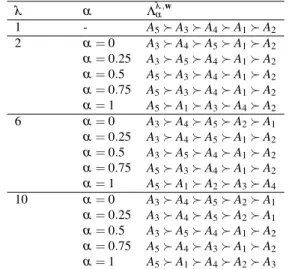
In contrast, and for the current values ofλ, Table A.4 shows rankings backed up by our methodology for five values of theα
parameter.
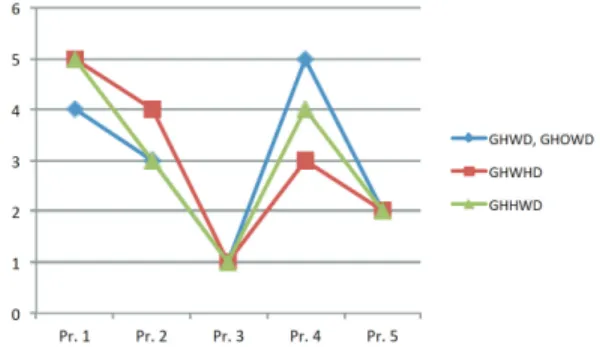
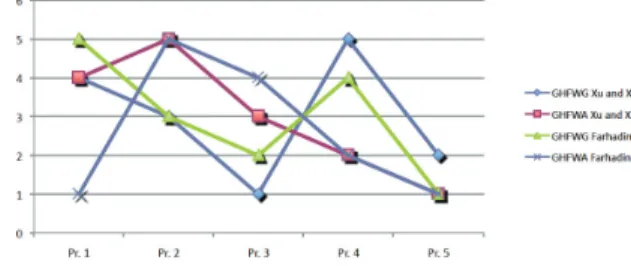
It seems difficult to reach clear-cut conclusions from any comparison, since already the previous analyses in Tables A.1, A.2 and A.3 show disparities among the rankings of the projects without a precise knowledge of their expected behavior. To check these differences Figures 7 to 10 (which illustrate the conclusions of Table A.1) and then Figures 11 to 14 (which illustrate the conclusions of Tables A.2 and A.3) are helpful and indicative. However by comparing Tables A.1 and A.4 we can note the following fact that supports the use of our seg-ment approach with anα parameter. Averaging the∆λα,wand Σλα,windexes (withα=0.5 or similar values) gives conclusions that are coincident with Xu and Xia’s aforementioned verdict. However using them alone (i.e., withα=0 orα=1) produces remarkable differences.§Therefore we conclude that averaging
distances to the ideal with similarities to the anti-ideal performs better than using any of these two approaches separately due to the fact that a segment is obtained instead of a single number for each project, which provides a richer analysis of the decision problem.
Let us also stress that our graphical illustrations prove that usingboththe∆λα,wandΣ
λ,w
α indexes is not redundant.
Fig. 7. A graphical display of the ranking of the five projects: application of four distances withλ=1.
Fig. 8. A graphical display of the ranking of the five projects: application of four distances withλ=2.
Fig. 9. A graphical display of the ranking of the five projects: application of four distances withλ=6.
Fig. 10. A graphical display of the ranking of the five projects: application of four distances withλ=10.
Fig. 11. A graphical display of the ranking of the five projects: application of aggregation operators withλ =1
followed byS1andS2scores.
§ Figure 6 (see Table 6 instead) shows that the same is true whenλ=20. In this case projectA5is strictly better thanA3which is better
than the other projects, under the choiceα=0.5. This coincides with Xu and Xia’s recommendation. HoweverA1is better thanA3
Fig. 12. A graphical display of the ranking of the five projects: application of aggregation operators withλ =2 followed byS1andS2scores.
Fig. 13. A graphical display of the ranking of the five projects: application of aggregation operators withλ =6 followed byS1andS2scores.
Fig. 14. A graphical display of the ranking of the five projects: application of aggregation operators withλ=10 followed byS1andS2scores.
5. Conclusion
We have provided a novel methodology that permits to perform an extensive and systematized analysis of problems with a pre-cise specification: experts voice their opinions on the attributes of projects through a hesitant fuzzy decision matrix, that is, an
m×nmatrix whose cells contain HFEs. Under a specific para-metricexpression for two reasonable indices of satisfaction, a weighted average permits to give a profuse picture of the rel-ative performance of the projects. A distinctive novel feature of our indicators is that the role of the parameter has been dis-closed: when it grows the two indices tend to replicate the eval-uation by respective simplistic expressions that only depend on the least, resp., the largest, evaluation and the number of evalu-ations in each cell. All these elements permit the analyst to pro-vide the decision-maker with ample information on which he or
she can rely in order to make the final decision. Moreover, an extensive graphical and numerical analysis of an example from Kahraman and Kaya19 is confronted with the corresponding analysis in Xu and Xia47.
With respect to related future lines of research, we already mentioned that replacing our indicators with other potentially useful expressions gives direct variations of our proposal. Par-ticularly, the ideas in Xu and Xia48 could be adapted to this purpose. Furthermore, the analysis of the analog problem un-der hesitant fuzzy linguistic information comes to mind as an-other natural possibility (cf., e.g., hesitant fuzzy linguistic term sets introduced by Rodr´ıguez, Mart´ınez and Herrera33, see also Zhu and Xu55).
Acknowledgment
The authors thank the Editors of the International Journal of Computational Intelligence Systems, two anonymous referees, Francisco Herrera and Luis Mart´ınez for their valuable com-ments and suggestions. Financial support by the Spanish Min-isterio de Ciencia e Innovaci´on under Projects ECO2012–31933 and ECO2015–66797–P (J. C. R. Alcantud), ECO2012–32178, CGL2008–06003–C03–03/CLI and ECO2015–66797–P (R. de Andr´es Calle), is gratefully acknowledged.
References
1. J. C. R. Alcantud, R. de Andr´es Calle, and M. J. Torre-cillas. Hesitant fuzzy worth: an innovative ranking methodology for hesitant fuzzy subsets. Applied Soft Computing, Forthcoming.
2. S. Altuntas and T. Dereli. A novel approach based on DEMATEL method and patent citation analysis for prioritizing a portfolio of investment projects. Expert Systems with Applications, 42(3):1003 – 1012, 2015. 3. A. Asosheh, S. Nalchigar, and M. Jamporazmey.
In-formation technology project evaluation: An inte-grated data envelopment analysis and balanced score-card approach. Expert Systems with Applications, 37(8):5931 – 5938, 2010.
4. G. Buyukozkan and O. Feyzioglu. A fuzzy-logic-based decision-making approach for new product de-velopment. International Journal of Production Eco-nomics, 90(1):27 – 45, 2004.
5. T. Calvo, A. Koles´arov´a, M. Komorn´ıkov´a, and R. Mesiar. Aggregation operators: Basic concepts, is-sues and properties. In Tomasa Calvo, Gaspar Mayor, and Radko Mesiar, editors, Aggregation Operators: New Trends and Applications, volume 97 ofStudies in Fuzziness and Soft Computing, pages 3–104. Springer Berlin Heidelberg, 2002.
comprehensive model for multiobjective project port-folio selection. Computers& Operations Research, 37(4):630 – 639, 2010.
7. H. H. Chen, A. H. I. Lee, and Y. Tong. Prioritization and operations NPD mix in a network with strategic partners under uncertainty. Expert Systems with Ap-plications, 33(2):337 – 346, 2007.
8. S. Chen, J. Liu, H. Wang, and J. C. Augusto. Ordering based decision making - a survey.Information Fusion, 14(4):521 – 531, 2013.
9. S. Chen, J. Liu, H. Wang, and J. C. Augusto. A group decision making model for partially ordered prefer-ence under uncertainty. Information Fusion, (forth-coming), 2015.
10. T-A. Chiang and Z. H. Che. A fuzzy robust evalu-ation model for selecting and ranking NPD projects using bayesian belief network and weight-restricted DEA. Expert Systems with Applications, 37(11):7408 – 7418, 2010.
11. Y-C. Chiu, B. Chen, J. Z. Shyu, and G-H. Tzeng. An evaluation model of new product launch strategy. Technovation, 26(11):1244 – 1252, 2006.
12. T. Da and Y. Xu. Evaluation on functions of urban wa-terfront redevelopment based on proportional 2-tuple linguistic.International Journal of Computational In-telligence Systems, 7(4):796–808, 2014.
13. M. Espinilla, R de Andr´es Calle, F. J. Mart´ınez Mim-brera, and L. Mart´ınez. A 360-degree performance appraisal model dealing with heterogeneous informa-tion and dependent criteria. Information Sciences, 222:459–471, 2013.
14. M. Fabala et al. Functional analysis and infinite-dimensional geometry. Springer, 2001.
15. B. Farhadinia. A novel method of ranking hesitant fuzzy values for multiple attribute decision-making problems. International Journal of Intelligent Sys-tems, 28:752–767, 2013.
16. I. Grattan-Guinness. Fuzzy membership mapped onto intervals and many-valued quantities. Mathematical Logic Quarterly, 22:149–160, 1976.
17. C-C. Huang, P-Y. Chu, and Y-H. Chiang. A fuzzy AHP application in government-sponsored R&D project selection.Omega, 36(6):1038 – 1052, 2008. 18. J. Kacprzyk and H. Nurmi. Group decision making
under fuzziness. In R. Slowinski, editor,Fuzzy sets in Decision Analysis, Operations research and Statistics, pages 103–136. Springer, 1998.
19. C. Kahraman and I. Kaya. A fuzzy multicrite-ria methodology for selection among energy alterna-tives. Expert Systems with Applications, 37:6270– 6281, 2010.
20. C. P. Lawson, P. J. Longhurst, and P. C. Ivey. The ap-plication of a new research and development project selection model in SMEs. Technovation, 26(2):242 – 250, 2006.
21. C. Li and Y. Dong. Multi-attribute group decision making methods with proportional 2-tuple linguis-tic assessments and weights. International Journal of Computational Intelligence Systems, 7(4):758–770, 2014.
22. H. Liao and Z. Xu. Satisfaction degree based inter-active decision making under hesitant fuzzy environ-ment with incomplete weights. International Journal of Uncertainty, Fuzziness and Knowledge-Based Sys-tems, 22(04):553–572, 2014.
23. M. J. Liberatore. An expert support system for R&D project selection. Mathematical and Computer Mod-elling, 11(0):260 – 265, 1988.
24. J. Lin and Y. Jiang. Some hybrid weighted averaging operators and their application to decision making. In-formation Fusion, 16:18 – 28, 2014.
25. S-S. Liu and C-J. Wang. Optimizing project selec-tion and scheduling problems with time-dependent resource constraints. Automation in Construction, 20(8):1110 – 1119, 2011.
26. R.D. Luce and H. Raiffa. Games and Decisions: In-troduction and Critical Survey. Dover Publications, 1989.
27. L.L. Machacha and P. Bhattacharya. A fuzzy-logic-based approach to project selection. Engineering Management, IEEE Transactions on, 47(1):65–73, Feb 2000.
28. I.J. Maddox. Elements of functional analysis. Cam-bridge University Press, 1970.
29. A. L. Medaglia, D. Hueth, J. C. Mendieta, and J. A. Sefair. A multiobjective model for the selection and timing of public enterprise projects. Socio-Economic Planning Sciences, 42(1):31 – 45, 2008.
30. S. C. Onar, B. Oztaysi, and C. Kahraman. Strategic decision selection using hesitant fuzzy TOPSIS and interval type-2 fuzzy AHP: A case study. Interna-tional Journal of ComputaInterna-tional Intelligence Systems, 7(5):1002–1021, 2014.
31. I. Palomares, F. J. Estrella, L. Mart´ınez, and F. Her-rera. Consensus under a fuzzy context: Taxonomy, analysis framework AFRYCA and experimental case of study.Information Fusion, 20:252 –271, 2014. 32. R. M. Rodr´ıguez, B. Bedregal, H. Bustince, Y.C.
Dong, B. Farhadinia, C. Kahraman, L. Mart´ınez, V. Torra, Y.J. Xu, Z.S. Xu, and F. Herrera. A posi-tion and perspective analysis of hesitant fuzzy sets on information fusion in decision making. towards high quality progress. Information Fusion, 29:89 – 97, 2016.
Systems, 29:495–524, 2014.
35. R. Santhanam and G. J. Kyparisis. A decision model for interdependent information system project selec-tion. European Journal of Operational Research, 89(2):380 – 399, 1996.
36. K. Suzumura. Rational Choice, Collective Decisions and Social Welfare. Cambridge University Press, Cambridge, 1983.
37. T. Tanino. Fuzzy preference orderings in group deci-sion making.Fuzzy Sets and Systems, 12(2):117–131, 1984.
38. V. Torra. Hesitant fuzzy sets.International Journal of Intelligent Systems, 25(6):529–539, 2010.
39. D. A. Tsamboulas. A tool for prioritizing multina-tional transport infrastructure investments. Transport Policy, 14(1):11–26, 2007.
40. H. Wang. Extended hesitant fuzzy linguistic term sets and their aggregation in group decision making. Inter-national Journal of Computational Intelligence Sys-tems, 8(1):14–33, 2015.
41. J. Wang and W-L. Hwang. A fuzzy set approach for R&D portfolio selection using a real options valuation model.Omega, 35(3):247 – 257, 2007.
42. J-J. Wang, Y-Y. Jing, C-F. Zhang, G-H.Shi, and X-T. Zhang. A fuzzy multi-criteria decision-making model for trigeneration system. Energy Policy, 36(10):3823 – 3832, 2008.
43. C. Wei, Z. Ren, and R. M. Rodr´ıguez. A hesitant fuzzy linguistic TODIM method based on a score function. International Journal of Computational Intelligence Systems, 8(4):701–712, 2015.
44. M. Xia and Z. Xu. Hesitant fuzzy information aggre-gation in decision making. International Journal of Approximate Reasoning, 52:395–407, 2011.
45. M. Xia, Z. Xu, and N. Chen. Some hesitant fuzzy aggregation operators with their application in group decision making. Group Decision and Negotiation, 22:259–279, 2013.
46. Z. Xu. Hesitant Fuzzy Sets Theory, volume 314 of Studies in Fuzziness and Soft Computing. Springer International Publishing, 2014.
47. Z. Xu and M. Xia. Distance and similarity mea-sures for hesitant fuzzy sets. Information Sciences, 181:2128–2138, 2011.
48. Z. Xu and M. Xia. On distance and correlation mea-sures of hesitant fuzzy information. International Journal of Intelligent Systems, 26:410–425, 2011. 49. Z. Yue. Group decision making with multi-attribute
interval data. Information Fusion, 14(4):551–561, 2013.
50. L. Zadeh. Outline of a new approach to analysis of complex systems and decision processes.IEEE Trans-actions on Systems, Man, and Cybernetics, 3:28–44, 1973.
51. X. Zhang and Z. Xu. The TODIM analysis
ap-proach based on novel measured functions under hes-itant fuzzy environment. Knowledge-Based Systems, 61(0):48 – 58, 2014.
52. X. Zhang and Z. Xu. Hesitant fuzzy QUALIFLEX approach with a signed distance-based comparison method for multiple criteria decision analysis. Expert Systems with Applications, 42(2):873 – 884, 2015. 53. X. Zhang, Z. Xu, and H. Wang. Heterogeneous
mul-tiple criteria group decision making with incomplete weight information: A deviation modeling approach. Information Fusion, (forthcoming), 2015.
54. X. Zhou and Q. Li. Multiple attribute decision mak-ing based on hesitant fuzzy Einstein geometric aggre-gation operators. Journal of Applied Mathematics, 52:Article ID 745617, 2014.
55. B. Zhu and Z. Xu. Consistency measures for hesitant fuzzy linguistic preference relations. IEEE Transac-tions on Fuzzy Systems, 22(1):35–45, 2014.
56. Z.Pei and L. Yi. A note on operations of hesitant fuzzy sets. International Journal of Computational Intelli-gence Systems, 8(2):226–239, 2015.
Appendix A
Table A.1. Rankings obtained by the Xu and Xia’s distances47
λ dghw dghwh
1 A5A3A4A1A2 A3A5A4A2A1
2 A5A3A4A1A2 A3A5A4A2A1
6 A3A5A2A1A4 A3A5A4A2A1
10 A3A5A2A1A4 A3A5A4A2A1
λ dghhw dghow
1 A3A5A4A1A2 A5A3A4A1A2
2 A3A5A4A2A1 A5A3A4A2A1
6 A3A5A4A2A1 A3A5A2A1A4
10 A3A5A2A4A1 A3A5A2A1A4
Table A.2. Rankings obtained by different HFSs aggregation operators and Xu and Xia score44
λ GFW Gλ GFWAλ
1 A5A3A4A1A2 A5A4A3A1A2
2 A5A3A4A1A2 A5A4A3A1A2
6 A3A5A2A1A4 A5A4A3A1A2
10 A3A5A2A1A4 A5A4A3A1A2
Table A.3. Rankings obtained by different HFSs aggregation operators and Farhadinia score15
λ GFW Gλ GFWAλ
1 A5A3A4A1A2 A5A4A3A1A2
2 A5A3A4A1A2 A5A4A3A1A2
6 A5A3A2A4A1 A5A4A1A3A2
Table A.4. Rankings obtained by the segment approachΛλα,w
λ α Λλα,w
1 - A5A3A4A1A2
2 α=0 A3A4A5A1A2
α=0.25 A3A5A4A1A2
α=0.5 A5A3A4A1A2
α=0.75 A5A3A4A1A2
α=1 A5A1A3A4A2
6 α=0 A3A4A5A2A1
α=0.25 A3A4A5A1A2
α=0.5 A3A5A4A1A2
α=0.75 A5A3A4A1A2
α=1 A5A1A2A3A4
10 α=0 A3A4A5A2A1
α=0.25 A3A4A5A2A1
α=0.5 A3A5A4A1A2
α=0.75 A5A4A3A1A2
Table A.5. Summary table of studies related to evaluation projects
Author(s) Tool(s)/method(s)
Multi criteria decision making-based studies
Carazo et al.6, Lawson et al.20, POMETHEE, TOPSIS, Data envelop analysis (DEA), Liberatore23, Liu and Wang25, Analytic hierarchy process (AHP),
Medaglia et al.29, Santhanam and Kyparisis35 Analytic network process (ANP)
Fuzzy logic-based studies
Buyukozkan and Feyzioglu4, Chen et al.7, Fuzzy POMETHEE, Fuzzy TOPSIS, Chiu et al.11, Huang et al.17,
Machacha and Bhattacharya27, Wang and Hwang41 Fuzzy DEA, Fuzzy AHP, Fuzzy ANP
Alcantud, de Andr´es Calle and Torrecillas1,
Hesitant fuzzy logic-based studies Farhadinia15, Liao and Xu22, Xia and Xu44,