Original article
The emotional and behavioral problems
of children exposed to poverty and/or collective
violence in communities at the Mexico-United
States border: A comparative study
Marie Leiner,
1,3María Theresa Villanos,
1Héctor Puertas,
2Jesús Peinado,
1Carmen Ávila,
3Alok Dwivedi
4AbSTrAcT
background
Collective violence attributed to organized crime has shown to be responsible for a considerable burden of physical and mental health morbidity among youth.
Objective
To compare the emotional and behavioral problems of children ex-posed to early childhood poverty and/or collective violence in com-munities at the Mexico-United States border to children exposed to other social and health risks.
Method
A cross-sectional study was carried out with individuals living in pov-erty at two sites at the Mexico-United States border. Individuals who responded once to the Pictorial Child Behavior Checklist (P+CBCL) in Spanish were selected randomly from clinics in a metropolitan area of El Paso, Texas, United States (poverty alone group), and Ciudad Juarez, Chihuahua, Mexico (poverty plus collective violence group). In addition, emotional and behavioral problems present in these groups were compared with available published emotional and behavioral CBCL scales of children exposed to other social and health risks.
results
Children exposed to both poverty and collective violence had higher emotional and behavioral problem scores as measured by the P+CBCL than those exposed to poverty alone. In addition, compared with chil-dren who were brain-injured, hearing impaired, or whose parents were exposed to drugs or alcohol, the poverty and collective violence group had higher levels of emotional and behavioral problems.
Discussion and conclusion
Systematic detection and treatment of children as young as 18 months exposed to trauma are necessary to diminish the mental health prob-lems caused by the collective violence attributed to organized crime.
Key words: Health communication, children, collective violence, men-tal health, poverty, violence, organized crime.
reSUMen
Antecedentes
La violencia colectiva atribuida al crimen organizado ha mostrado causar considerables daños en la salud mental de jóvenes.
Objetivo
Comparar los problemas emocionales y de comportamiento de niños expuestos a la pobreza y/o violencia colectiva en comunidades lo-calizadas en la frontera México-Estados Unidos, así como con niños expuestos a otros riesgos.
Método
Estudio transversal con participantes viven en la pobreza en ambos la-dos de la frontera de México y Estala-dos Unila-dos. Los participantes res-pondieron a la versión con pictogramas en español del Cuestionario de Comportamientos de Niños (P+CBCL) en clínicas localizadas en El Paso, Texas (grupo expuesto a la pobreza), y en Ciudad Juárez, Chi-huahua, México (grupo expuesto a la pobreza + violencia colectiva). De forma adicional se compararon los problemas emocionales y de comportamiento de estos grupos con resultados históricos obtenidos a partir de la evidencia científica.
resultados
Los niños expuestos a la pobreza/violencia colectiva registraron resulta-dos más altos en las escalas de problemas emocionales y de comporta-miento al medirlos con el P+CBCL cuando se compararon con el grupo expuesto solamente a la pobreza. De forma adicional, al comparar los grupos con niños con problemas cerebrales, de audición, o con padres expuestos a drogas y alcohol, el grupo expuesto a la pobreza y a la vio-lencia registró mayores problemas emocionales y de comportamiento.
Discusión y conclusión
La detección sistemática y el tratamiento de niños desde los 18 meses expuestos a trauma son necesarios para disminuir los problemas menta-les causados por la violencia colectiva atribuida al crimen organizado.
Palabras clave: Comunicación en salud, niños, violencia colectiva, salud mental, pobreza, violencia, crimen organizado.
1 Department of Pediatrics, Texas Tech University Health Sciences Center, El Paso, Texas. 2 Jurisdicción Sanitaria de la Secretaría de Salud I, Ciudad Juárez, Chihuahua. 3 El Colegio de Chihuahua, Ciudad Juárez, Chihuahua.
4 Division of Biostatistics and Epidemiology. Texas Tech University Health Sciences Center.
bAcKGrOUnD
Direct (as victims) and indirect (as witnesses) youth expo-sure to violence has undoubtedly played a role in creating the conditions for the development of many emotional and behavioral problems.1-4 Individuals facing these types of
vic-timization experience short- and long-term effects that of-ten have an immediate and sustained impact on their lives. Aggression, depression, anxiety, academic failure, isolation, suicide, running away from home, dropping out of high school, and coming into contact with the criminal justice system during adolescence and adulthood are some of the most prevalent outcomes.5-10
A sub-type of direct and indirect violence, known as collective violence, has also been shown to be responsible for a considerable burden of physical and mental health morbidity among youth and adults.11-14 According to the
World Health Organization, “collective violence” includes the instrumental use of violence by people that identify themselves as members of a group, which could be tran-sitory or with a more permanent identity, against another group of individuals in order to achieve political, economic, or social gain.15 Most studies regarding children’s exposure
to collective violence include the psychosocial effects as a re-sult of violence within the community,16-19 war, or guerrilla or military conflicts.20-25 The effects of direct and indirect
vic-timization related to environmental disasters, acts of terror, genocide, or extreme violence have also been studied.26-32
Lately, collective violence attributed to organized crime has received a high degree of public attention in Mexico with intense media coverage. News about mass murders of men, women, and children, including activists and bystanders, mutilations, and numerous acts of terror, including bomb-ings, kidnappbomb-ings, torture, and decapitations were broadcast and rebroadcast for days or months by media outlets during the most active years of the drug war (2008-2012).33,34 This
ex-traordinary occurrence of stressful events can have a profound effect on children’s sense of security, inducing strong feelings of vulnerability and resulting in emotional and psychological trauma, even if these events are only experienced through the media.35-37 The threatening, intrusive images of extreme acts
of violence presented by the media include frightening im-ages that are usually very intense, portray actual events with acute suffering, and are often presented unedited.38,39
Second-hand victimization via exposure to these events via the media represents a form of indirect trauma and has been shown to affect children’s psychosocial, behav-ioral, and emotional responses even months to years after the exposure took place.40 Moreover, viewing media
foot-age of geographically remote events led to posttraumatic symptoms in those children who interpreted the footage as threatening to themselves.38
Likewise, poverty has a devastating effect on mental health and is perpetuated through a cycle in which poverty
cultivates mental illness, while mental illness reinforces pov-erty.41 Inequalities due to poverty and low socioeconomic
status affect different areas of a child’s social life, including their access to education and health care, as well as health sta-tus.42 As a result, early detection of emotional and behavioral
problems may be impeded due to a reduced opportunity to access early intervention efforts. Mental health services, in-cluding detection, referral, and treatment are often described as inadequate in those confronted by poverty. Several com-munication barriers such as culture, linguistic elements, and literacy levels contribute to these disparities.43-46
Exposure to poverty alone is a risk to the mental health of children,47-49 and poverty with exposure to community
vi-olence also has an effect on the mental health of children and adolescents.50,51 However, the possible effect of indirect
vic-timization due to collective violence attributed to organized
crime has not been extensively studied due to the difficulty
of locating an area where one group has been exposed while the other has not. Most studies describe the generalized ef-fects on all children living in an area without a comparison group. In addition, data obtained by standardized measure-ments are not available.
In this study, a sample of children living in Ciudad Juarez, Chihuahua, Mexico, exposed to both indirect victim-ization (collective violence attributed to organized crime) and poverty, were compared with children living in El Paso, Texas, United States, exposed to poverty alone. A standard-ized instrument, the Pictorial Child Behavioral Checklist (P+CBCL), was used to measure emotional and behavioral problems to compare these two groups. When the study was conducted, Ciudad Juarez was considered one of the most violent cities in the world,33 whereas El Paso had the
lowest crime rate in a city with a population of >500 000
residents in the United States.52 The number of
drug-relat-ed killings in the two cities in 2010 was as follows: Ciudad Juarez, 2101 organized crime homicides,53 and El Paso, 0 per
100 000 people.
MeTHOD
Type of study
This is a cross-sectional study with data collected in 2010 in two border cities in the United States and Mexico.
Participants
Database information characteristics
United States electronic information: A large electronic da-tabase containing approximately 3000 pediatric patients 18 months to 5 years old whose parents responded to a psycho-social and behavioral assessment known as the Pictorial Child Behavior Checklist (P+CBCL) during non-emergency visits.
Mexican electronic information: Parents/caretakers of children 18 months to 5 years of age responded to the self-response P+CBCL during non-emergency visits, when the children were receiving regular care in these clinics.
Information available in the two databases included date of assessment, gender, age, and total scores of the P+CBCL.
Inclusion criteria
The clinics in El Paso and Ciudad Juarez served mainly low-income Hispanic children. Only children of parents who reported Hispanic ethnicity responded to the P+CBCL ques-tionnaire in Spanish, and those who had a family income be-low the poverty level were sampled in the United States. The United States site excluded <5% of the patients, with approxi-mately 79% of families enrolled in Medicaid, 16% in the State Children’s Health Insurance Program, and 5% without insur-ance. At the Mexico site, all children were covered by “Seguro
Popular”, an insurance program provided by the government
to those with the lowest income.54 Electronic data from the Mexico clinics containing records without identifiers were
provided for analysis with authorization from the Secretaria de Salud-Jurisdiccion Sanitaria II ethics committee. The study was also approved by the Institutional Review Board at Texas Tech University Health Sciences Center.
Measurements
The P+CBCL is an adaptation of the original 18 months to 5 years of age CBCL,55 which was developed56 to support
parents with limited literacy. The P+CBCL for ages 1.5 to 5 years is a well-validated questionnaire including items to determine the frequency of behavioral and psychosocial problems in young children. Both externalizing (attention
deficit and aggressive behavior) and internalizing (with -drawn, somatic complaints, anxious and depressed, and emotionally reactive) syndromes are obtained as a result of the responses of the parents to the questionnaire. The
P+CBCL has been validated with Mexican children.57-59
Ad-ditionally, it has demonstrated remarkable consistency in
its psychometric properties across more than 30 countries.60
For this study, we used society Group 1 for children in the
United States and Group 3 for children in Mexico.61
Different norms are established for children when raw scores from the P+CBCL are converted to T scores. A T score <60 is “normal”, and a T score ≥64 is “abnormal”. This sug-gested cut-off point dichotomized “normal” and “clinical”
groups and is able to discriminate between nonreferred and referred children for mental health services.
Additionally, the emotional and behavioral scales ob-tained for each group were compared with available evi-dence for children exposed to traumatic conditions or social and health risks.
The data from the El Paso site represent the poverty ex-posure group while data from the Ciudad Juarez site repre-sent the poverty and violence exposure group. We refer to this exposure variable as a group (United States and Mexico) variable in the study.
Statistical methods
Continuous variables were described using mean and stan-dard deviation (SD), while categorical variables were de-scribed using frequency and proportion. The prevalence of behavioral and psychosocial problems obtained using the P+CBCL was also determined and reported. Continuous variables were compared using an unpaired t-test according to the group, while categorical variables were compared us-ing Fisher’s exact test. The various scores obtained from the P+CBCL for different components of behavioral and psy-chosocial problems were compared between groups using an unpaired t-test. The overall group effect was examined using multivariate linear regression analysis after adjusting for gender and age followed by multiple linear regression analyses for each of the outcome scores, separately after ad-justing for multiple outcome comparisons. The group effect on each score was presented using adjusted regression
coef-ficient (ARC) with their 95% confidence interval (CI). The
scores were non-normally distributed; thus the above analy-ses were carried out on log transformed scores. Results were consistent; therefore, we only reported results for untrans-formed scores. All the statistical analyses were peruntrans-formed using SAS 9.3.
reSULTS
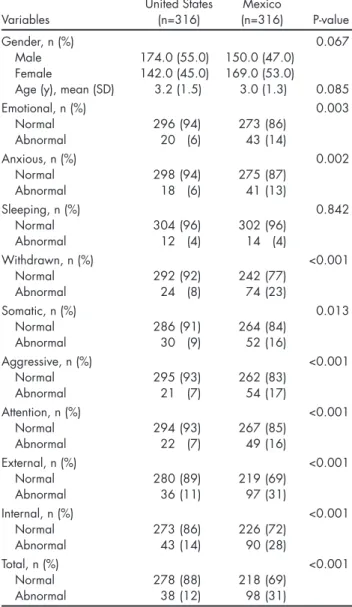
The demographic profile and prevalence of psychosocial
and behavioral problems according to groups is presented in table 1. There were no apparent differences regarding age and gender between the two groups. The prevalence of borderline and clinical external and internal problems was higher in the Mexico group, but there were statistical differ-ences for all emotional/behavioral problems reported, with the exception of sleeping problems.
Raw P+CBCL scores among the two groups indicate that the Mexico group had higher scores in all problem scales (table 2). When comparing the unadjusted mean raw scores between the United States and Mexico, there were
Multivariate regression analysis revealed that the overall Mexico group had higher scores as compared with the United States group after adjusting for gender and age (table 3).
In-dividual scores analyses also demonstrated significant effects
of group of the problem scales (emotionally reactive, anxious and depressed, somatic complaints, withdrawn, sleep prob-lems, attention probprob-lems, and aggressive behavior).
In addition, significant effects of the group were found
in the total scales (internalizing and externalizing problems scales), with higher scores in the Mexico group (table 4).
There were significant effects in all the Diagnostic and Statisti-cal Manual of Mental Disorders (DSM) sStatisti-cales, including DSM
affective, DSM anxiety, DSM pervasive, DSM attention-defi -cit/hyperactivity disorder (ADHD), and DSM oppositional
defiant, with higher scores in the Mexico group (table 5). Age was significantly associated with sleep problems, attention
problems, and aggressive behavior, while gender was as-sociated with attention and aggressive behavior problems.
These scores significantly decreased per unit increase in age. Females had significantly lower scores of aggressive behav -ior and external problems compared to males. Increase in age
significantly reduced the external scores in multiple linear
regression analysis, and in the DSM scale, age was only
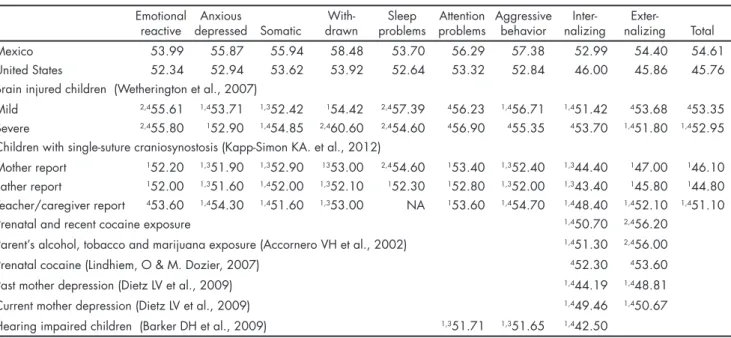
as-sociated with ADHD problems, whereas gender was signifi -cantly associated with both pervasive problems and ADHD. The compiled T scores of children confronting health risks measured using the CBCL scale from several available studies are presented in table 6. Comparison of these avail-able results with the United States and Mexico groups in-dicates that the Mexico group had equal or higher T scores for most of the scales, with few exceptions (e.g., sleep prob-lems). When compared to children with mild/severe brain injury,62 single-suture craniosynostosis,63 parental history of
cocaine, alcohol, tobacco, and marijuana exposure,64 prenatal
cocaine exposure,65 maternal current and past depression,66 Table 2. Unadjusted comparison of P+CBCL and DSM scale scores between groups
United States Mexico
Variables, mean (SD) (n=316) (n=316) P-value Emotionally reactive 1.46 (2.05) 2.20 (2.50) <.001 Anxious depressed 2.22 (2.29) 3.56 (2.63) <.001 Somatic complaints 1.65 (1.89) 2.47 (2.42) <.001 Withdrawn 1.39 (1.88) 2.73 (2.69) <.001 Sleep problems 1.93 (2.28) 2.63 (2.34) <.001 Attention problems 2.22 (1.83) 3.39 (1.98) <.001 Aggressive behavior 7.74 (6.89) 13.09 (8.06) <.001 Internalizing 6.72 (6.54) 10.96 (8.42) <.001 Externalizing 9.96 (8.22) 16.47 (9.54) <.001 DSM affective 1.95 (2.22) 3.45 (2.86) <.001 DSM anxiety 2.89 (2.80) 4.33 (2.82) <.001 DSM pervasive 2.59 (2.88) 4.28 (3.59) <.001 DSM ADH 3.88 (2.90) 5.71 (2.97) <.001 DSM Oppositional defiant 2.54 (2.46) 4.23 (2.77) <.001
P+CBCL, Pictorial Child Behavior Checklist; DSM, Diagnostic and Statistical Manual of Mental Disorders; SD, standard deviation; ADHD, attention-deficit/ hyperactivity disorder.
Table 1. Demographic characteristics and prevalence of borderline and clinical emotional and behavioral problems according to group
United States Mexico
Variables (n=316) (n=316) P-value
Gender, n (%) 0.067
Male 174.0 (55.0) 150.0 (47.0)
Female 142.0 (45.0) 169.0 (53.0)
Age (y), mean (SD) 3.2 (1.5) 3.0 (1.3) 0.085
Emotional, n (%) 0.003
Normal 296(94) 273(86)
Abnormal 20 (6) 43(14)
Anxious, n (%) 0.002
Normal 298(94) 275(87)
Abnormal 18 (6) 41(13)
Sleeping, n (%) 0.842
Normal 304(96) 302(96)
Abnormal 12 (4) 14 (4)
Withdrawn, n (%) <0.001
Normal 292(92) 242(77)
Abnormal 24 (8) 74(23)
Somatic, n (%) 0.013
Normal 286(91) 264(84)
Abnormal 30 (9) 52(16)
Aggressive, n (%) <0.001
Normal 295(93) 262(83)
Abnormal 21 (7) 54(17)
Attention, n (%) <0.001
Normal 294(93) 267(85)
Abnormal 22 (7) 49(16)
External, n (%) <0.001
Normal 280(89) 219(69)
Abnormal 36(11) 97(31)
Internal, n (%) <0.001
Normal 273(86) 226(72)
Abnormal 43(14) 90(28)
Total, n (%) <0.001
Normal 278(88) 218(69)
Abnormal 38(12) 98(31)
SD, standard deviation.
Table 3. Association between the group and P+CBCL scores after adjusting for age and gender
Variables group effect*Overall coefficient (95% CI) P-valueRegression Emotionally reactive <.001 0.78 (0.43, 1.14) <.001 Anxious depressed 1.35 (0.97, 1.74) <.001 Somatic complaints 0.81 (0.47, 1.15) <.001
Withdrawn 1.38 (1.02, 1.75) <.001
Sleep problems 0.67 (0.31, 1.03) <.001 Attention problems 1.17 (0.88, 1.47) <.001 Aggressive behavior 5.35 (4.19, 6.52) <.001
and hearing impairment,67 children in the Mexico group had significantly higher scores for most scales. A smaller num
-ber of scales were similar and non-significant when com -pared with the Mexico group, with a reduced number of
higher scales and significant differences in the same group. There were also significantly higher scores in the United
States group for some scales, including emotional reactive, anxious depressed, and somatic problems.
DIScUSSIOn AnD cOncLUSIOn
Crime victimization has been shown to be a major and public problem that increases the risks to victims of suffering from trauma-related disorders, including PTSD, suicide, substance abuse, future criminal behavior, health and social problems, and future poly-victimization.68 It has been found that trauma
history, including direct victimization, is often not evaluated or treated appropriately. This implies that victims of indirect victimization have even less opportunity for rehabilitation or support services. In addition, studies of the effects of crime victimization, which is considered direct exposure to vio-lence, generally focus on adults, leaving an important gap in the effects of indirect victimization on children.69 Some
stud-ies have found that indirect victimization does not predict ag-gressive behaviors,70 and others indicate systematically that
aggression is present at short or long term.71-73
There are also key gaps in mental health research re-lated to children from birth to age 5 years, particularly low-income children.74 Here, we presented the emotional and
behavioral problems confronted by children living in pov-erty in two different geographic areas at the Mexico-United States border. Children at the Mexican site, in addition to poverty, were subject to collective violence attributed to organized crime and reported higher emotional and be-havioral scores than those at the United States site. When compared with other children of the same ages exposed to social and health risks, most of the Mexico group scores surpassed the internalizing or/and externalizing scales. In a previous study examining the same exposure and groups, except with individuals 6-16 years of age, we found that the Mexico site externalizing scale scores were higher than the United States site scores.75 However, in the present study,
emotional and behavioral scales scores were higher in the
Table 4. Association between the group and two domains of the P+CBCL scale after adjusting for age and gender
Variables group effect Overall coefficient (95% CI)Regression P-value Internalizing <.001 4.33 (3.14, 5.52) <.001 Externalizing 6.53 (5.15, 7.91) <.001
P+CBCL, Pictorial Child Behavior Checklist; CI, confidence interval.
Table 5. Association between the group and DSM scores after ad-justing for age and gender
Variables group effect Overall coefficient (95% CI) P-valueRegression DSM affective <.001 1.52 (1.12, 1.92) <.001
DSM anxiety 1.46 (1.02, 1.90) <.001
DSM pervasive 1.74 (1.23, 2.25) <.001
DSM ADH 1.84 (1.39, 2.30) <.001
DSM Oppositional defiant 1.70 (1.29, 3.11) <.001
DSM, Diagnostic and Statistical Manual of Mental Disorders; CI, confidence interval; ADHD, attention-deficit/hyperactivity disorder.
Table 6. Comparison of Mexico and United States T scores with available data in children confronted with social and health risks Emotional
reactive depressed SomaticAnxious drawnWith- problemsSleep problemsAttention Aggressivebehavior nalizingInter- nalizingExter- Total
Mexico 53.99 55.87 55.94 58.48 53.70 56.29 57.38 52.99 54.40 54.61
United States 52.34 52.94 53.62 53.92 52.64 53.32 52.84 46.00 45.86 45.76
Brain injured children (Wetherington et al., 2007)
Mild 2,455.61 1,453.71 1,352.42 154.42 2,457.39 456.23 1,456.71 1,451.42 453.68 453.35 Severe 2,455.80 152.90 1,454.85 2,460.60 2,454.60 456.90 455.35 453.70 1,451.80 1,452.95 Children with single-suture craniosynostosis (Kapp-Simon KA. et al., 2012)
Mother report 152.20 1,351.90 1,352.90 1353.00 2,454.60 153.40 1,352.40 1,344.40 147.00 146.10 Father report 152.00 1,351.60 1,452.00 1,352.10 152.30 152.80 1,352.00 1,343.40 145.80 144.80 Teacher/caregiver report 453.60 1,454.30 1,451.60 1,353.00 NA 153.60 1,454.70 1,448.40 1,452.10 1,451.10
Prenatal and recent cocaine exposure 1,450.70 2,456.20
Parent’s alcohol, tobacco and marijuana exposure (Accornero VH et al., 2002) 1,451.30 2,456.00
Prenatal cocaine (Lindhiem, O & M. Dozier, 2007) 452.30 453.60
Past mother depression (Dietz LV et al., 2009) 1,444.19 1,448.81
Current mother depression (Dietz LV et al., 2009) 1,449.46 1,450.67
Hearing impaired children (Barker DH et al., 2009) 1,351.71 1,351.65 1,442.50
Mexico group than those in the United States site and also than those in the historical data groups. While poverty was shown to be a risk factor for emotional and behavioral prob-lems for both groups, collective violence exposure may be the cause for the higher risk among the Mexico group.
The amount of published research about the effects of exposure to collective violence is minimal and lacking in
longitudinal studies that would allow drawing firm conclu -sions. This study has limitations, including its retrospective, rather than prospective, character. In addition, due to the na-ture, frequency, and dissemination of news about the gener-alized violence in the city, for this study it was assumed that
families were indirectly victimized, and specific questions
regarding possible individual victimization were not posed. These questions were not included due to the inability
of the researchers to provide specific health care services to
the families. This was considered ethical practice despite the possibility of confounding the results. Another limitation includes the possibility that poverty exposure could differ between Mexico and the United States, resulting in different adversity. Many families victimized in Ciudad Juarez had moved to El Paso seeking safety, and there is a remote pos-sibility that these individuals were included in the United States group. Despite these limitations, this study allowed us to compare data using a well-recognized screening as-sessment with demonstrated consistency in more than 30 countries.60 In addition, in an attempt to compare similar
populations, data collection included the same time periods in the United States and Mexico with equivalent poverty levels and the largest possible sample size.
Responses of children to indirect exposure to collective violence are determined by individual level risks factors that include socioeconomic status, family context (including pa-rental distress), appropriate child care, personal characteris-tics, and the severity and amount of exposure.76 This article
provides information indicating that behavioral problems are displayed with higher frequency among children exposed to poverty and collective violence when compared to children exposed only to poverty. Supportive parenting practices have been found to moderate the risks of exposure to collective
violence caused by military conflicts and aggression.77 In
ad-dition, detection and treatment can have an important impact on the outcome.78 Effective systematic detection and
treat-ment of children as young as 18 months exposed to trauma are necessary to diminish the mental health problems caused by the collective violence attributed to organized crime.
Funding
None.conflict of interest
No author of this paper has a conflict of interest, including specific financial interests, relationships, and/or affiliations relevant to the subject matter included in this manuscript.
Acknowledgements
Special thanks to doctor Laura Carrillo for her contribution in find -ing available articles related to emotional and social risks.
reFerenceS
1. Gilbert R et al. Burden and consequences of child maltreatment in high-income countries. Lancet 2009;373(9657):68-81.
2. Turner HA et al. Family context, victimization, and child trauma symptoms: variations in safe, stable, and nurturing relationships during early and middle childhood. Am J Orthopsychiatry 2012; 82(2):209-219.
3. Turner HA et al. Disability and victimization in a national sample of children and youth. Child Maltreat 2011;16(4):275-286.
4. Finkelhor D, Ormrod RK, Turner HA. Lifetime assessment of poly-victimization in a national sample of children and youth. Child Abuse Negl 2009;33(7):403-411.
5. Cuevas CA et al. Psychological distress as a risk factor for re-victimi-zation in children. Child Abuse Negl 2010;34(4):235-243.
6. Turner HA, Finkelhor D, Ormrod R. The effects of adolescent victi-mization on self-concept and depressive symptoms. Child Maltreat 2010;15(1):76-90.
7. Turner HA, Finkelhor D, Ormrod R. Child mental health problems as risk factors for victimization. Child Maltreat 2010; 15(2):132-143. 8. Cuevas CA et al. Psychiatric diagnosis as a risk marker for victimization
in a national sample of children. J Interpers Violence 2009;24(4):636-652. 9. Turner HA, Finkelhor D, Ormrod R. The effect of lifetime victimiza-tion on the mental health of children and adolescents. Soc Sci Med 2006;62(1):13-27.
10. Haynie DL et al. Exposure to violence in adolescence and precocious role exits. J Youth Adolesc 2009;38(3):269-286.
11. Turner HA et al. Recent victimization exposure and suicidal ideation in adolescents. Arch Pediatr Adolesc Med 2012. Published Online: p. 1-6. 12. Turner HA, Finkelhor D. Ormrod R. Family structure variations in
patterns and predictors of child victimization. Am J Orthopsychiatry 2007;77(2):282-295.
13. Elbedour S et al. The scope of sexual, physical, and psychological abu-se in a Bedouin-Arab community of female adolescents: The interplay of racism, urbanization, polygamy, family honor, and the social mar-ginalization of women. Child Abuse Negl 2006;30(3):215-229. 14. Boney-McCoy S, Finkelhor D. Prior victimization: a risk factor for
child sexual abuse and for PTSD-related symptomatology among sexually abused youth. Child Abuse Negl 1995;19(12):1401-421. 15. Global consultation on violence and health violence: a public health
priority 1996, WHO Geneva.
16. Kelly SE, Anderson DG. Adolescents, gangs, and perceptions of safe-ty, parental engagement, and peer pressure. J Psychosoc Nurs Ment Health Serv 2012;50(10):20-28.
17. Sareen J et al. Adverse childhood experiences in relation to mood and anxiety disorders in a population-based sample of active military per-sonnel. Psychol Med 2013;43(1):73-84.
18. Fuller-Thomson E, Baker TM, Brennenstuhl S. Evidence supporting an independent association between childhood physical abuse and li-fetime suicidal ideation. Suicide Life Threat Behav 2012;42(3):279-291. 19. Liu J, Chen X, Lewis G. Childhood internalizing behaviour: analysis
and implications. J Psychiatr Ment Health Nurs 2011;18(10):884-894. 20. Harder VS et al. Multiple traumas, postelection violence, and
post-traumatic stress among impoverished Kenyan youth. J Trauma Stress 2012;25(1):64-70.
22. Betancourt TS et al. Sierra Leone’s former child soldiers: a longitu-dinal study of risk, protective factors, and mental health. J Am Acad Child Adolesc Psychiatry 2010;49(6):606-615.
23. Panter-Brick C et al. Violence, suffering, and mental health in Afgha-nistan: a school-based survey. Lancet 2009;374(9692):807-816. 24. De Haene, Grietens LH, Verschueren K. Adult attachment in the
con-text of refugee traumatisation: the impact of organized violence and forced separation on parental states of mind regarding attachment. Attach Hum Dev 2010;12(3):249-264.
25. Warf C, Eisenstein E, Stahl C. Children, adolescents, and war: the sys-tematic engagement of youth in collective violence. Adolesc Med State Art Rev 2009;20(3):961-80, xi.
26. Garrett AL et al. Children and megadisasters: lessons learned in the new millennium. Adv Pediatr 2007;54:189-214.
27. Saraiya A, Garakani A. Billick S.B. Mental health approaches to child victims of acts of terrorism. Psychiatr Q 2013;84(1):115-124.
28. Perlman SE et al. Short-term and medium-term health effects of 9/11. Lancet 2011;378(9794):925-934.
29. Jordan HT et al. Mortality among survivors of the Sept 11, 2001, World Trade Center disaster: results from the World Trade Center Health Re-gistry cohort. Lancet 2011;378(9794):879-887.
30. Gershoff ET et al. Exposure to 9/11 among youth and their mothers in New York City: enduring associations with mental health and socio-political attitudes. Child Dev 2010;81(4):1142-1160.
31. Pandya A et al. Services provided by volunteer psychiatrists after 9/11 at the New York City family assistance center: September 12-Novem-ber 20, 2001. J Psychiatr Pract 2010;16(3):193-199.
32. Mijanovich T, Weitzman BC. Disaster in context: the effects of 9/11 on youth distant from the attacks. Community Ment Health J 2010;46(6):601-611.
33. Hernandez AA, Grineski SE. Disrupted by violence: children’s well-being and families’ economic, social, and cultural capital in Ciudad Juarez, Mexico. Rev Panam Salud Publica 2012;31(5): 373-379. 34. Gutierrez LA et al. Using evidence on violence and injury prevention
for policy development and decision making in Ciudad Juarez, Mexi-co. Rev Panam Salud Publica 2012;31(5):365-372.
35. Ahern J et al. Television images and psychological symptoms after the September 11 terrorist attacks. Psychiatry 2002;65(4):289-300. 36. Fairbrother G et al. Posttraumatic stress reactions in New York City
children after the September 11, 2001, terrorist attacks. Ambul Pediatr 2003;3(6):304-411.
37. Otto MW et al. Posttraumatic stress disorder symptoms following me-dia exposure to tragic events: impact of 9/11 on children at risk for anxiety disorders. J Anxiety Disord 2007;21(7):888-902.
38. Pfefferbaum B et al. Television exposure in children after a terrorist incident. Psychiatry 2001;64(3):202-211.
39. Pfefferbaum B. The impact of the Oklahoma City bombing on chil-dren in the community. Mil Med 2001;166(12 Suppl):49-50.
40. Holmes EA, Creswell C, O’Connor TG. Posttraumatic stress symptoms in London school children following September 11, 2001: an explora-tory investigation of peri-traumatic reactions and intrusive imagery. J Behav Ther Exp Psychiatry 2007;38(4):474-490.
41. Anakwenze U, Zuberi D. Mental health and poverty in the inner city. Health Soc Work 2013;38(3):147-157.
42. Reiss F. Socioeconomic inequalities and mental health lems in children and adolescents: a systematic review. Soc Sci Med
2013;90:24-31.
43. Baker DW et al. Health literacy and performance on the Mini-Mental State Examination. Aging Ment Health 2002;6(1):22-29.
44. Baker DW et al. Functional health literacy and the risk of hospital ad-mission among Medicare managed care enrollees. Am J Public Health 2002;92(8):1278-1283.
45. Leiner M et al. The Pictorial Child Behavior Checklist: An assessment tool for parents with low literacy levels. Baltimore, MD: Pediatric Aca-demy Societies; 2009.
46. Leyva M, Sharif I, Ozuah PO. Health literacy among Spanish-spea-king Latino parents with limited English proficiency. Ambul Pediatr 2005;5(1):56-59.
47. Hurd NM, Stoddard SA, Zimmerman MA. Neighborhoods, social su-pport, and african american adolescents’ mental health outcomes: a multilevel path analysis. Child Dev 2013;84(3):858-874.
48. Marie-Mitchell A, O’Connor TG. Adverse childhood experiences: translating knowledge into identification of children at risk for poor outcomes. Acad Pediatr 2013;13(1):14-19.
49. Pearce A, Lewis H, Law C. The role of poverty in explaining health variations in 7-year-old children from different family structures: fin-dings from the UK Millennium Cohort Study. J Epidemiol Communi-ty Health 2013;67(2):181-189.
50. Finkelhor D, Ormrod RK, Turner HA. Re-victimization patterns in a national longitudinal sample of children and youth. Child Abuse Negl 2007;31(5):479-502.
51. Finkelhor D, Ormrod RK, Turner HA. Poly-victimization: a neglected component in child victimization. Child Abuse Negl 2007;31(1):7-26. 52. Morgan KOL, Morgan S, Boba R. City Crime Rankings 2011-2012.
Flo-rida: Florida Atlantic University; 2011; p. 408.
53. Molzahn C, Ríos V, Shirk DA. Drug violence in Mexico: Data and analysis through 2011, in trans-border Institute-Joan B. Kroc School of Peace Studies. San Diego, Ca: University of San Diego; 2012. 54. King G et al. Politically Robust’ Experimental Design for Public
Poli-cy Evaluation, with Application to the Mexican Universal Health In-surance Program. J Policy Analysis Management 2007;26(3):479-506. 55. Achenbach TM, Rescorla LA. Manual for the ASEBA preschool and
school-age forms and profiles. Burlington, VT: University of Vermont, Department of Psychiatry; 2001.
56. Leiner M et al. Psychometric comparisons of the Pictorial Child Beha-vior Checklist with the standard version of the instrument. Psychol Assess 2010;22(3):618-627.
57. Albores-Gallo L et al. Validity and reability of the CBCL/6-18. Inclu-des DSM scales. Actas Esp Psiquiatr 2007;35(6):393-399.
58. Albores-Gallo L et al. Bullying and its association with psychia-tric disorders in a Mexican students sample. Salud Publica Mex 2010;53(3):220-227.
59. Leiner MA et al. Screening Mexicans for psychosocial and behavioral problems during pediatric consultation. Rev Invest Clin 2007;59(2): 116-123.
60. Ivanova MY et al. Testing the 8-syndrome structure of the child beha-vior checklist in 30 societies. J Clin Child Adolesc Psychol 2007;36(3): 405-417.
61. Rescorla LA et al. International comparisons of behavioral and emo-tional problems in preschool children: parents’ reports from 24 socie-ties. J Clin Child Adolesc Psychol 2011;40(3):456-467.
62. Wetherington CE et al. Parent ratings of behavioral functioning af-ter traumatic brain injury in very young children. J Pediatr Psychol 2010;35(6):662-671.
63. Kapp-Simon KA et al. Behavioral adjustment of toddler and pres-chool-aged children with single-suture craniosynostosis. Plast Re-constr Surg 2012;130(3):635-647.
64. Accornero VH et al. Behavioral outcome of preschoolers exposed pre-natally to cocaine: role of maternal behavioral health. J Pediatr Psy-chol 2002;27(3):259-269.
65. Lindhiem O, Dozier M. Caregiver commitment to foster children: the role of child behavior. Child Abuse Negl 2007;31(4):361-374.
66. Dietz LJ et al. Maternal depression, paternal psychopathology, and toddlers’ behavior problems. J Clin Child Adolesc Psychol 2009;38(1):48-61.
67. Barker DH et al. Predicting behavior problems in deaf and hearing children: the influences of language, attention, and parent-child com-munication. Dev Psychopathol 2009;21(2):373-392.
69. McCart MR, Smith DW, Sawyer GK. Help seeking among victims of cri-me: a review of the empirical literature. J Trauma Stress 2010;23(2):198-206.
70. Orue I, Calvete E. [Justification of violence as a mediator between ex-posure to violence and aggressive behavior in children]. Psicothema 2012;24(1):42-47.
71. Siyahhan S, Aricak OT, Cayirdag-Acar N. The relation between bu-llying, victimization, and adolescents’ level of hopelessness. J Adolesc 2012;35(4):1053-1059.
72. Arnocky S, Vaillancourt T. A multi-informant longitudinal study on the relationship between aggression, peer victimization, and dating status in adolescence. Evol Psychol 2012;10(2):253-270.
73. Poteat VP et al. The effects of general and homophobic victimization on adolescents’ psychosocial and educational concerns: the impor-tance of intersecting identities and parent support. J Couns Psychol 2011;58(4):597-609.
74. Fantuzzo J, McWayne C, Bulotsky R. Forging strategic partnerships to advance mental health science and practice for vulnerable children. School Psychology Review 2003;32(1):31-37.
75. Leiner M et al. Children’s mental health and collective violence: a bi-national study on the United States-Mexico border. Rev Panam Salud Publica 2012;31(5):411-416.
76. Friedman MJ et al. Fighting the psychological war on terrorism. Psychiatry 2004;67(2):123-136.
77. Qouta S et al. Does war beget child aggression? Military violence, gen-der, age and aggressive behavior in two Palestinian samples. Aggress Behav 2008;34(3):231-244.