Influence of parental perception of school
safety and gender on children’s physical
activity in Mexico: A cross sectional study
Amy Hutchens, MS,(1) Erica G Soltero, BA,(2) Simón Barquera, MD, PhD,(3) Lucie Lévesque, PhD,(4)
Edtna Jauregui, PhD,(5,6) Juan Lopez y Taylor, MD,(5) Rebecca E Lee, PhD.(7)
(1) College of Nursing and Health Innovation, Arizona State University. Phoenix, Arizona, USA.
(2) Texas Obesity Research Center, Department of Health and Human Performance, University of Houston. USA. (3) Centro de Investigación en Nutrición y Salud, Instituto Nacional de Salud Pública. Mexico.
(4) School of Kinesiology & Health Studies, Queen’s University. Ontario, Canada.
(5) Instituto de Ciencias Aplicadas a la Actividad Física y Deporte, Universidad de Guadalajara. Mexico. (6) Departamento Medicina Preventiva, Secretaría de Salud. Mexico.
(7) Center of Health Promotion and Disease Prevention, College of Nursing and Health Innovation, Arizona State University. Phoenix, Arizona, USA.
Received on: June 18, 2015 • Accepted on: November 17, 2015
Corresponding author: MS. Amy Hutchens. College of Nursing and Health Innovation, Arizona State University. 500 N 3rd Street, Phoenix, Az 85004-0698, USA.
E-mail: [email protected]
Hutchens A, Soltero EG, Barquera S, Lévesque L, Jauregui E, Lopez y Taylor J, Lee RE. Influence of parental perception of school safety and gender on children’s physical activity in Mexico: A cross sectional study. Salud Publica Mex 2016;58:7-15.
Abstract
Objective. This cross sectional study aims to determine the effects of gender and parental perception of safety at school on children’s physical activity (PA) levels. Materials and methods. Parents of school aged Mexican children residing in Guadalajara, Mexico City, and Puerto Vallarta, completed surveys about their children’s PA measures. The physical activity indicators were evaluated using linear and logistical regression models. Results. Analysis did not indicate that gender moderated the relationship between parental perception of safety and PA measures, but significant gender issues exist with girls participating less than boys in the three measures of PA in this study (p<0.001). Conclu-sion. Results suggest the need for additional interventions promoting physical activity in girls in Mexico.
Keywords: physical activity; parenteral perception; children; gender; safety; environment; schools; health behavior
Hutchens A, Soltero EG, Barquera S,
Lévesque L, Jauregui E, Lopez y Taylor J, Lee RE. Influencia de la percepción de los padres
sobre seguridad escolar y del género en la actividad física de niños en México: un estudio transversal. Salud Publica Mex 2016;58:7-15.
Resumen
Objetivo. Determinar los efectos de género y percepción paternal de la seguridad en escuelas, en niveles de actividad física (AF) en los niños. Material y métodos. Padres con hijos escolares residentes en Guadalajara, Ciudad de México, y Puerto Vallarta, completaron encuestas sobre los niveles de AF de sus hijos. Se evaluaron los indicadores de AF usando modelos de regresión lineal y logística. Resultados. El análisis no indica que el género modere la relación entre percepción de seguridad y medidas de AF, pero hay indica-dores significativos de que las niñas participan menos que los varones en las medidas de AF de este estudio (p<0.001). Conclusión. Los resultados sugieren la necesidad de intervenciones adicionales que promuevan la AF en niñas mexicanas.
A
pproximately 3.2 million people die worldwide each year from a lack of physical activity.1 Physicalinactivity in children is a challenging issue in Mexico as data on physical activity (PA) levels of all children in Mexico are sparse. The 2014 Mexican Report Card on Physical Activity for Mexican Children and Youth recently reported improvements in children’s PA with physical inactivity in children (aged 10-18 years) declin-ing from 40.4 % to 11.9%.2 More knowledge is needed
concerning younger children. The same survey found that 58.6% of children aged 10-14 had not been active in any organized sports activities in the past year. Ad-ditional data are needed to evaluate children’s levels of active play in the Mexican population.3
Neighborhoods perceived as unsafe impact physi-cal activity levels of residents residing in these areas.4
Lower neighborhood safety was significantly associ-ated with less PA in children.4 Perception of safety is
particularly important in Mexico given the high rate of crime.5 Interpersonal violence is the 4th leading cause of
death in Mexico.6 Parental perception of safety has been
linked to children’s physical activity levels, but further research is necessary to investigate the nature of that relationship particularly in Mexico and in specific set-tings, like schools, which most children visit five days a week. School facilities serve as an outlet for commu-nity physical activity. Opening after hours supervised schoolyards to inner city children may increase PA by as much as 84%.7 Youth who walk to school are leaner and
have more minutes of moderate to vigorous physical activity (MVPA).8 Conflicting evidence exists regarding
the impact of parental perception of safety on children’s PA levels, and little evidence exists examining this topic in Mexico. Parental perception of street safety was iden-tified as a barrier to preschool Mexican children’s PA.9
Previous research has found that parental perceptions of safety from crime correlated positively with children’s activity in public recreation facilities.10
Some studies have not found a significant rela-tionship between parental perception of neighborhood safety and children’s physical activity levels.11 In a study
of adults in Cuernavaca, Mexico, neighborhood safety perception was not associated with PA despite high crime rates.12 More research is needed to examine the
impact of perception of safety on children’s physical activity levels.
Gender plays a role in children’s levels of PA. Jau-regui13 found that Mexican boys participated an average
of 143 minutes per day in MVPA while Mexican girls participated in an average of 98 minutes per day. Girls living in neighborhoods that are perceived as unsafe have been found to have higher levels of overweight and obesity. 14 Carver and colleagues found that parental
restriction of children’s active transport and physical activity due to safety concerns resulted in lower levels of MVPA and active transport in adolescent girls.15 Further
investigation is necessary to determine whether these relationships are related to parental restriction of PA based on gender.
It is important to understand the nature of parental perception of school safety and child gender in Mexico on physical activity so that evidence-based interventions may be developed to promote physical activity in this country. The primary objective of this cross sectional study was to investigate the association of parent’s perception of school safety and gender on children’s physical activity levels. Additionally the authors aimed to determine if gender moderated the relationship between parental perception of school safety and chil-dren’s physical activity levels.
Materials and methods
ParticipantsThis study focused on schools aged Mexican children because of their high risk for physical inactivity and underrepresentation in research. Data were collected on site in 20 schools in Mexico City, 12 schools in Gua-dalajara, and 8 schools in Puerto Vallarta. Jalisco State’s Ministry of Education provided a referral of public schools or schools that were chosen by having partici-pated in another study.16 School were located using the
Mexican Schools directory.17
Parents of school aged Mexican children in grades 3rd to 5th residing in Guadalajara, Puerto Vallarta, and
Mexico City completed paper and pencil surveys. Parental consent was obtained, and children provided assent. Approval for this study was obtained from the University of Houston Committee for the Protection of Human Subjects as well as the ethics institutional review boards of Queen’s University, the Mexican National Institute of Public Health (Instituto Nacional de Salud Pública), and the University of Guadalajara. Paper and pencil surveys were sent home with children for parents to complete, and the children returned the completed surveys to the school. See table I for descrip-tive statistics. The survey included data on 817 boys and 924 girls.
Measures
Analysis was based on questions drawn from the SPAN instrument, a parent survey that measured physical activity and demographic variables.18 Similar
variables included child age, child gender, child grade level, number of people residing in the household, city of residence, and parental perception of child safety at school. Parental perception of safety at school was used to measure safety because of the likelihood that children attended school near their home. In Mexico, 66.4% of 10-14 year olds walk to school.2 Perception of safety
at school serves as a proxy measure of neighborhood safety. Parents responded to the question “How safe does your child feel at school?” with “not safe”, “a little safe”, “somewhat safe”, “mostly safe” and “very safe”. Three measures of physical activity were used for the dependent variables. Parents completed three questions on a self-reported questionnaire, which were scored according to established protocols.* The first in-dicator of PA asked parents how many days of the week the child played outside for 30 minutes or more. The number of days was summed for each respondent and recorded as a continuous variable. The second question asked how many sports teams the child had played on during the past 12 months. Responses included 0, 1, 2 or 3 or more sports teams. This variable was recoded as a binary variable. If the child had participated in one or more sports teams, it was coded as a yes, and as a
no if the child had participated in 0 sports teams. The last question asked if the child currently participated in other organized physical activities or lessons in things like martial arts, dance, gymnastics, soccer, baseball, or tennis. Responses for this question were “yes” or “no”.
Analysis
Means and standard deviations were calculated for descriptive characteristics including the age of the chil-dren, grade of the chilchil-dren, number of people residing in the household, and parental perception of safety at school. T tests, chi square and one way analyses of vari-ance (ANOVA) with a Bonferoni correction were used to investigate descriptive associations among variables. Hierarchical linear and logistic regression analyses were conducted to test whether gender moderated the rela-tionship between parental perception of child safety at school and the three PA outcomes. A p value threshold of <0.05 was used for a statistical tests. For all models, the control variables child age, child grade level, number of people living in the household, and city, were entered at step one. The independent variable gender was entered at step two. Parental perception of safety at school was entered at step three, and the interaction term between gender and parental perception of safety at school was entered at step four. To aid in interpretation of multivari-ate models, parental perception of safety at school was centered. A major aim of the study was to examine gen-der influences on measures of PA, for this reason cases with missing gender data (n=255) were dropped from the regression analysis. Cases without gender specified were compared to cases with gender specified for differences on the three indicators of PA. IBM SPSS statistics version 20 was used to run all statistical analyses.
Results
Descriptive characteristics. Parents of school aged Mexi-can children (M=9.63 years, SD=1.052) in grades 3rd
to 5th residing in Guadalajara (n=904), Puerto Vallarta
(n=225), and Mexico City (n=867) completed paper and pencil surveys. The average number of people living in the household was five (M=5.09, SD=1.974). Parents reported perception of safety at school included 2.4% as “not safe” (n=41), 10.3% as “a little safe” (n=173), 12.4% as “somewhat safe” (n=202), 22.8% as “mostly safe”(n=382), and 52% as “very safe”(n=871).
Eighty-two percent of respondents (n=1 591) re-ported that their child played for 30 minutes or more outside for one or more days of the week. Data indicated that 45.5% (n=704) of the respondents’ children partici-pated in sports teams. Thirty-nine percent (n=645) of
* Lee RE, Soltero EG, Jáuregui A, Mama SK, Barquera S, Jáuregui E, et al. Disentangling associations of neighborhood street scale elements with physical activity in Mexican school children. Environment & Behavior 2015 (in press).
Table I
SampledeScriptiveStatiSticS
Variable GuadalajaraM (SD) Puerto VallartaM (SD) Mexico CityM (SD)
Age 9.65 (1.09) 9.66 (1.11) 9.59 (0.99) Number of people in household 5.33 (2.12) 4.62 (1.42) 4.95 (1.91) Days per week of outside play 2.79 (2.31) 2.54 (2.33) 2.12 (1.73) Sports team participation 1.83 (0.98) 1.43 (0.67) 1.56 (0.77) Parental perception of safety at
school 4.03 (1.22) 4.18 (1.02) 4.2 (1.04)
respondents reported that their children participated in other organized PA such as dance lessons, martial arts, soccer, or gymnastics. See table II for frequencies.
Bivariable analysis. Participation in outdoor play (girls
M=2.28, SD=2.00 vs boys M=2.70, SD=2.21); t (1,727)=-4.15, p<.001), sports teams (girls M=1.53, SD=.80 vs. boys M=1.82, SD=.93; t(1,547)=-6.64, p<.001) and other organized physical activities (boys, yes=345, no=426; girls, yes=300, no=583; X² (1, N=1,654) =20.08, p=<.001) differed significantly by gender.
Anova was used to examine differences in outdoor play be-tween cities. Participation in outside play was significant-ly greater for residents of Guadalajara (M=2.79, SD=2.3) than residents of Puerto Vallarta (M=2.54, SD=2.3) and Mexico City (M=2.11, SD=1.73; F(2, 1726) = 19.81,
p<.001). Participation in sports teams was significantly higher for residents of Guadalajara (M=1.83, SD=.98) than residents of Puerto Vallarta (M=1.42, SD=.67) and Mexico City (M=1.56, SD=.77; F(2, 1,546) =23.81,
p<.001). Residents of Mexico City reported higher av-erage perceptions of safety at school (M=4.2, SD=1.04) than residents of Puerto Vallarta (M=4.18, SD=1.02) and Guadalajara (M=4.03, SD=1.22; F(2, 1,673) = 4.75, p<.01). Cases with missing gender data were examined for differences in the three indicators of PA. A one way anova showed significant differences in outside play between children in which gender was not specified and in children for which gender was specified (F=9.7, df=2,
p<.001). Post hoc analysis using the Bonferroni criterion revealed a significant difference between children with gender not specified (M=2.8, SD=2.2) and girls (M=2.3,
SD=2) p<.05 on the indicator of outdoor play. This rela-tionship was not significant for boys (p=1.0). Results of a chi² analysis showed significant association between gender (boys, girls, gender unspecified) and participa-tion in sports, X²(2, N=1,642) =44.6, p<.001. A chi² test
was performed and a significant relationship was found between gender (boys, girls, gender unspecified) and participation in other organized physical activities X²(2,
N=1, 764) =21.8, p<.001.
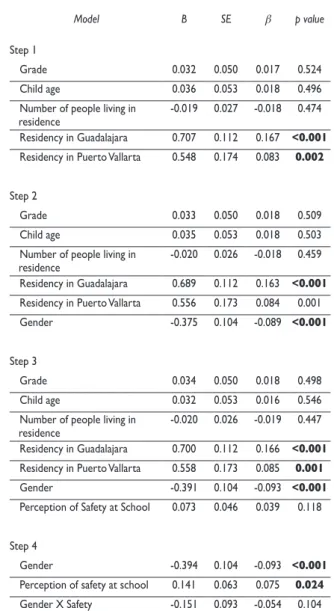
Regression models. Hierarchical linear regression analyses were conducted to assess the association of gender and parental perception of safety at school with the children’s PA measure of outdoor play. The results displayed in table III show that gender significantly contributed to outdoor play (t=-3.78, p<0.001). Boys were more likely to partici-pate in outdoor play than girls. In this model, residency in Guadalajara (t=6.28, p=<0.001) and residency in Puerto Vallarta (t=3.21, p=0.001) explained a significant propor-tion of the variance in outdoor play when compared to Mexico City. Children residing in Guadalajara were more likely than children residing in Puerto Vallarta and
Mexico City to participate in outdoor play. Child gender did not moderate the relationship between parental per-ception of safety at school and PA as the interaction term, gender x parental perception of safety, was not significant (t=-1.63, p=.104). The model accounted for 3.8% of the variance in outdoor play.
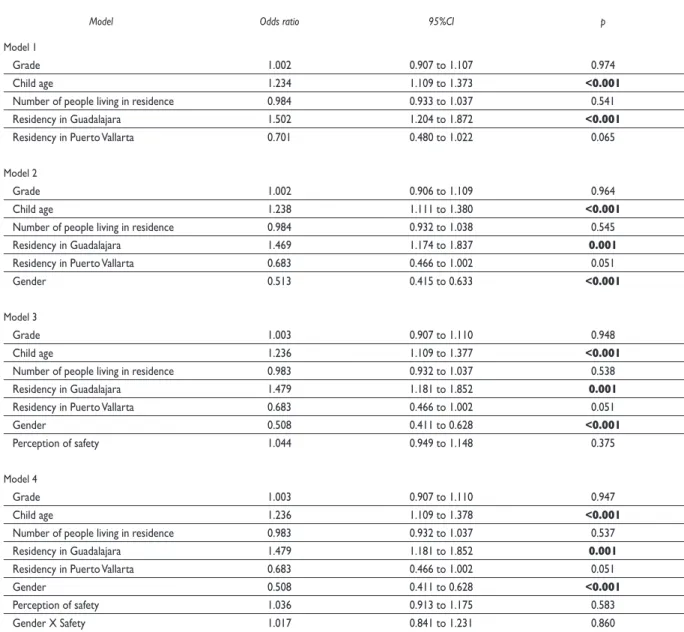
Hierarchical logistic regression results revealed residency in Guadalajara (Wald (1)=11.7, p<.01), child age (Wald
(1)=14.6, p<.001) and child gender (Wald (1), =39.8, p<.001) as significant in participation in sports teams. Older children were more likely to participate in sports than younger children. Residents of Guadalajara were more likely than residents of Puerto Vallarta and Mexico City to participate in sports teams. Girls were less likely than boys to participate in sports teams. The results of the logistic regression are presented in table IV.
Logistic regression results revealed two factors as significant variables in participation in other orga-nized physical activities. Results of this regression are presented in table V. These factors were residency in Guadalajara (Wald (1) =7.91, p=0.008, Puerto Vallarta (Wald (1) =4.07, p=0.044), and gender (Wald (1) =7.09,
p<.001). These results indicated that boys were more likely to participate in other organized physical activities such as martial arts, dance, gymnastics or soccer lessons. Residents of Guadalajara were more likely to participate in other organized physical activities compared to resi-dents of Puerto Vallarta and Mexico City. The overall model was significant (chi² (8) =40.78, p<.001). The lo-gistic regression did not support gender as a significant moderator of parental perception of safety at school and child participation in other organized physical activities (Wald (1) =1.63, p=0.201).
Discussion
The study sought to examine the relationship between parental perception of safety at school and child gender on physical activity. An additional aim was to determine if child gender moderated the relationship between parental perception of safety at school and child PA. While the hypotheses that parental perception of safety would influence children’s physical activity levels was not supported, it was found that girls participated less than boys in all three measures of PA.
The results indicated that girls were less likely to participate in outside play than boys. Most of the data collected in Mexico on children’s physical activity demonstrates that boys are more active than girls.2 This
Table II
childandfamilycharacteriSticS
aSapercentageoftheSample
Variable Boys (n) % Girls (n) %
Child gender 817 924
Child grade level
3rd grade 230 28.2 251 27.2
4th grade 275 33.7 332 35.9
5th grade 279 34.1 300 32.5
Resident of Guadalajara 402 49.2 402 43.5
Resident of Puerto Vallarta 86 10.5 121 13.1
Resident of Mexico City 329 40.3 401 43.4
Participation in sports teams
0 teams 336 45.8 509 62.5
1 team 251 34.2 215 26.4
2 teams 88 12 56 6.9
3 or more teams 59 8 35 4.3
Participation in other organized PA
Yes 345 44.7 300 34
No 426 55.3 583 66
Perception of safety at school
Not safe 32 4.1 9 1
A little safe 96 12.2 77 8.6
Somewhat safe 104 13.3 104 11.7
Mostly safe 176 22.4 206 23.1
Very safe 376 48 495 55.5
The SPAN instrument was used to collect all data. Data was reported by parents. All data was collected from April to May 2012 in Guadalajara, Mexico City, and Puerto Vallarta, Mexico
Table III
regreSSionofoutSideplayonchildage,
childgradelevel, numberofpeoplereSiding
inthehouSehold, cityofreSidence, gender,
parentalperceptionofSafety, andinteraction
ofgenderandperceptionofSafety
Model B SE β p value
Step 1
Grade 0.032 0.050 0.017 0.524
Child age 0.036 0.053 0.018 0.496
Number of people living in
residence -0.019 0.027 -0.018 0.474
Residency in Guadalajara 0.707 0.112 0.167 <0.001
Residency in Puerto Vallarta 0.548 0.174 0.083 0.002
Step 2
Grade 0.033 0.050 0.018 0.509
Child age 0.035 0.053 0.018 0.503
Number of people living in
residence -0.020 0.026 -0.018 0.459
Residency in Guadalajara 0.689 0.112 0.163 <0.001
Residency in Puerto Vallarta 0.556 0.173 0.084 0.001
Gender -0.375 0.104 -0.089 <0.001
Step 3
Grade 0.034 0.050 0.018 0.498
Child age 0.032 0.053 0.016 0.546
Number of people living in
residence -0.020 0.026 -0.019 0.447
Residency in Guadalajara 0.700 0.112 0.166 <0.001
Residency in Puerto Vallarta 0.558 0.173 0.085 0.001
Gender -0.391 0.104 -0.093 <0.001
Perception of Safety at School 0.073 0.046 0.039 0.118
Step 4
Gender -0.394 0.104 -0.093 <0.001
Perception of safety at school 0.141 0.063 0.075 0.024
Gender X Safety -0.151 0.093 -0.054 0.104
Significance values in bold text p<0.05 for all variables including interaction term. The SPAN instrument was used to collect all data. All data was repor-ted by the parent. Days per week of outside play=number of days that the child played outside for greater than 30 minutes. Responses were summed. Sports team participation 0=did not participate in sports, 1=participated in one or more sports teams. Parental perception of safety at school 1=“not safe”, 2=“a little safe”, 3=“somewhat safe”, 4=“mostly safe” and 5=“very safe”. All data was collected from April to May 2012 in Guadalajara, Mexico City, and Puerto Vallarta, Mexico
the underlying causes for those variations in outdoor play would provide a valuable contribution to the sci-ence particularly in this population.
Table IV
regreSSionofparticipationinSportSonchildage, childgradelevel, numberofpeoplereSiding
inthehouSehold, cityofreSidence, gender, parentalperceptionofSafety,
andinteractionofgenderandperceptionofSafety
Model Odds ratio 95%CI p
Model 1
Grade 1.002 0.907 to 1.107 0.974
Child age 1.234 1.109 to 1.373 <0.001
Number of people living in residence 0.984 0.933 to 1.037 0.541
Residency in Guadalajara 1.502 1.204 to 1.872 <0.001
Residency in Puerto Vallarta 0.701 0.480 to 1.022 0.065
Model 2
Grade 1.002 0.906 to 1.109 0.964
Child age 1.238 1.111 to 1.380 <0.001
Number of people living in residence 0.984 0.932 to 1.038 0.545
Residency in Guadalajara 1.469 1.174 to 1.837 0.001
Residency in Puerto Vallarta 0.683 0.466 to 1.002 0.051
Gender 0.513 0.415 to 0.633 <0.001
Model 3
Grade 1.003 0.907 to 1.110 0.948
Child age 1.236 1.109 to 1.377 <0.001
Number of people living in residence 0.983 0.932 to 1.037 0.538
Residency in Guadalajara 1.479 1.181 to 1.852 0.001
Residency in Puerto Vallarta 0.683 0.466 to 1.002 0.051
Gender 0.508 0.411 to 0.628 <0.001
Perception of safety 1.044 0.949 to 1.148 0.375
Model 4
Grade 1.003 0.907 to 1.110 0.947
Child age 1.236 1.109 to 1.378 <0.001
Number of people living in residence 0.983 0.932 to 1.037 0.537
Residency in Guadalajara 1.479 1.181 to 1.852 0.001
Residency in Puerto Vallarta 0.683 0.466 to 1.002 0.051
Gender 0.508 0.411 to 0.628 <0.001
Perception of safety 1.036 0.913 to 1.175 0.583
Gender X Safety 1.017 0.841 to 1.231 0.860
Significance values in bold text p<0.05 for all variables including interaction term. The SPAN instrument was used to collect all data. All data was reported by the parent. Days per week of outside play=number of days that the child played outside for greater than 30 minutes. Responses were summed. Sports team participation 0=did not participate in sports, 1=participated in one or more sports teams. Parental perception of safety at school 1=“not safe”, 2=“a little safe”, 3=“somewhat safe”, 4=“mostly safe” and 5=“very safe”. All data was collected from April to May 2012 in Guadalajara, Mexico City, and Puerto Vallarta, Mexico
likelihood of youth achieving appropriate levels of physical activity.20 Although the statistical analysis did
not indicate that gender moderated the relationship between parental perception of safety at school and PA measures, previous studies have found that parent’s per-ceived risk of their children being harmed significantly
mediated the relationship between perceived safety and avoidance of physical activity among girls only.21
Table V
regreSSionofparticipationinotherorganizedphySicalactivityonchildage, childgradelevel,
numberofpeoplereSidinginthehouSehold, cityofreSidence, gender, parentalperception
ofSafety, andinteractionofgenderandperceptionofSafety
Model Odds ratio 95%CI p
Model 1
Grade 0.966 0.876 to 1.065 0.487
Child age 1.063 .0958 to 1.180 0.252
Number of people living in residence 0.961 0.912 to 1.013 0.141
Residency in Guadalajara 1.362 1.094 to 1.695 0.006
Residency in Puerto Vallarta 0.685 0.475 to 0.988 0.043
Model 2
Grade 0.966 0.875 to 1.066 0.491
Child age 1.063 0.957 to 1.181 0.254
Number of people living in residence 0.960 0.910 to 1.012 0.131
Residency in Guadalajara 1.341 1.075 to 1.671 0.009
Residency in Puerto Vallarta 0.686 0.474 to 0.991 0.045
Gender 0.636 0.518 to 0.781 <0.001
Model 3
Grade 0.966 0.876 to 1.067 0.497
Child age 1.061 0.955 to 1.179 0.267
Number of people living in residence 0.960 0.910 to 1.012 0.128
Residency in Guadalajara 1.349 1.081 to 1.682 0.008
Residency in Puerto Vallarta 0.686 0.474 to 0.992 0.045
Gender 0.630 0.512 to 0.774 <0.001
Perception of safety 1.040 0.948 to 1.140 0.408
Model 4
Grade 0.966 0.875 to 1.066 0.492
Child age 1.061 0.955 to 1.179 0.271
Number of people living in residence 0.959 0.910 to 1.012 0.126
Residency in Guadalajara 1.350 1.083 to 1.685 0.008
Residency in Puerto Vallarta 0.684 0.473 to 0.989 0.044
Gender 0.630 0.512 to 0.774 <0.001
Perception of safety 1.095 0.969 to 1.238 0.145
Gender X Safety 0.886 0.737 to 1.066 0.201
Significance values in bold text p<0.05 for all variables including the interaction term. The SPAN instrument was used to collect all data. All data was reported by the parent. Days per week of outside play=number of days that the child played outside for greater than 30 minutes. Responses were summed. Sports team participation 0=did not participate in sports, 1=participated in one or more sports teams. Parental perception of safety at school 1=“not safe”, 2=“a little safe”, 3=“somewhat safe”, 4=“mostly safe” and 5=“very safe”. All data was collected from April to May 2012 in Guadalajara, Mexico City, and Puerto Vallarta, Mexico
Our finding that girls were less likely than boys to participate in sports teams and other organized physical activity is consistent with one longitudinal study that also found boys were more likely than girls to participate in organized sports.22 While it is unclear
why this gender gap exists in Mexico, research in the
United States has indicated issues with less access to participation in sports for girls and a continued pres-ence of social stigma against girls in sports.23 Future
Sports participation among children in Mexico itself is limited with a reported 59% of Mexican children not participating in organized sports in the past 12 months.24 This was supported by the finding in the
cur-rent study that 54.6% of children did not participate in sports teams. While there are many possible reasons for this, the structure of the schools operating in shifts has been suggested as a reason for the low numbers with the rationale that this school structure makes extracur-ricular PA not possible.25 The Mexican Report Card on
Physical Activity for Mexican children and youth has identified creating larger numbers of extracurricular programs, building public spaces apt for safe sports, and encouraging participation in organized sports as recommendations for action.2 Additional research
examining the cause for the lack of participation in organized sports is necessary.
Although it was not an aim of the study, varia-tions in children’s physical activity among cities were discovered. When compared to Guadalajara and Puerto Vallarta, Mexico City had lower measures outside play, however perception of safety at school was reported as higher in Mexico City. Guadalajara reported the highest levels of all three measures of physical activity. Future studies should examine environmental influences on physical activity in these areas to determine potential causes for variations, if any exist. Both Mexico City and Guadalajara participate in Ciclovia, an effort to reclaim public spaces for physical activity.26 It is important to
note when considering perception of safety, that the Mexican government makes great efforts to protect visi-tors to tourist destinations in Mexico, and since Puerto Vallarta is widely considered a vacation destination for foreigners, this area may exhibit lower crime levels when compared to Mexico City and Guadalajara.27
Strengths of this study include a large sample size across multiple cities in Mexico. A limitation of the study was the measure of safety. Parental perception of safety was a question on the survey about safety at school. Perhaps if the question had examined another indicator of safety, perception of safety would have been a signifi-cant variable in more of the physical activity measures. An additional limitation of the study is the subjective measurement of physical activity with a questionnaire. PA levels could have been more objectively measured with accelerometers; however, they were beyond the scope of the resources available for this study.
Conclusion
These results are consistent with those of others sug-gesting that gender gaps exist in physical activity in Mexican children. We have established that gender is
a significant contributor to children’s PA levels, but it is important to understand the nature of that relation-ship so that interventions may be designed accordingly. Further research investigating the elements of safety and gender is necessary to increase physical activity levels in the understudied Mexican population.
Authors’ contributions
AH, ES, and RL participated in the study design, per-formed statistical analysis, and drafted the manuscript. SB provided critical revisions of manuscript and feed-back on statistical analysis. ES, LL and EJ participated in recruitment of study participants and data collection. JT participated in recruitment of study participants. All authors reviewed and approved a final draft of the manuscript.
Acknowledgements
This work made possible by a Fulbright-García Robles Core Scholar Fellowship awarded to Dr. Lee, the Ca-nadian Institutes for Health Research and the Public Health Agency of Canada. This research was supported by funding from the National Institutes of Health/ National Institute on Nursing Research (NIH/NINR), award T32 1T32NR012718-01 Transdisciplinary Train-ing in Health Disparities Science (C. Keller, P.I.). The content is solely the responsibility of the authors and does not necessarily represent the official views of the NIH or the NINR.
Declaration of conflict of interests. The authors declare that they have no conflict of interests.
References
1. World Health Organization Geneva Switzerland: Health topics: Physical activity. [Internet] [consulted 2015 January 5]. Available in: http://www. who.int/topics/physical_activity/en/
2. Tremblay M, Gray C, Cowie-Bonne J, Janssen I, Lopez Y, Taylor J, et al. The Mexican report card on physical activity for Mexican children and youth [Internet]. Tlaquepaque, Jalisco, México, 2014 [consulted 2015 June 18]. Available from: http://www.academia.edu/7750007/The_mexican_re-port_card_of_physical_activity_in_children
6. World Health Organization. Geneva Switzerland: Mexico: WHO statisti-cal profile. [Internet][consulted 2015 June 18]. Available from http://www. who.int/gho/countries/mex.pdf?ua=1
7. Farley TA, Meriwether RA, Baker ET, Watkins LT, Johnson CC, Webber LS. Safe play spaces to promote physical activity in inner-city children: results from a pilot study of an environmental intervention. Am J Public Health 2007;97:1625-1631.
8. Mendoza JA, Watson K, Nguyen N, Cerin E, Baranowski T, Nicklas TA. Active commuting to school and association with physical activity and adiposity among US youth. J Phys Act Health 2011;8:488-495.
9. Rodriguez-Oliveros G, Haines J, Ortega-Altamirano D, Power E, Taveras EM, Gonzalez-Unzaga MA, Reyes-Moralez H. Obesity determinants in preschool children: Parental perceptions and practices related to feeding and physical activity. Arch Med Res 2011;42:532-539.
10. Tappe K, Glanz K, Sallis J, Zhou C, Saelens B. Children’s physical activity and parents’ perception of the neighborhood environment. Neighborhood impact on kids study. Int J Behav Nutr Phys Act 2013;10:39.
11. Carson V, Kuhle S, Spence JC, Veugelers PJ. Parent’s perception of neighbourhood environment as a determinant of screen time, physical activity and active transport. Can J Public Health 2010;101:124-127. 12. Salvo D, Reis RS, Rivera JA, Martorell R, Pratt M. Characteristics of the built environment in relation to objectively measured physical activity among Mexican adults. Prev Chronic Dis 2014;11:1-16.
13. Jauregui, A, Villalpando S, Rangel-Baltazar E, Lara-Zamudio YA, Castillo-Garcia MM. Physical activity and fat mass gain in Mexican school-age children: A cohort study. BMC Pediatrics 2012; 12:109.
14. Jennings-Aburto N, Nava F, Bonvecchio A, Safdie M, Gonzalez-Casa-nova I, Gust T, Rivera J. Physical activity during the school day in public primary schools in Mexico City. Salud Publica Mex 2009;51:141-147. 15. Carver A, Timperio A, Hesketh K, Crawford D. Are children and ado-lescents less active if parents restrict their physical activity and transport due to perceived risk? Soc Sci Med 2010; 70;1799-1805.
16. Gharib H, Galaviz K, Lee R, Safdie M, Tolentino L, Barquera S, Levesque L. The influence of physical education lesson context and teacher behavior on student physical activity in Mexico. Retos 2015;28:160-164.
17. Secretaría de Educación Pública. Directorio de escuelas. [Inter-net];2010 [consulted 2015 June 18]. Available in: http://www.sep.gob.mx/ es/sep1/directorio_de_escuelas#.VYL8bkaguv9
18. Thiagarajah K, Hoelscher D, Bai Y, Leone A, Shertzer J, et al. Validiting the food behavior questions from the School Physical Activity and Nutri-tion QuesNutri-tionnaire. J Nutr Educ Behav 2008;4:305-310.
19. Sallis J, Strikmiller P, Harsha D, Feldman H, Ehlinger S, Stone E, et al. Validation of interviewer- and self-administered physical activity checklists for fifth grade students. Med Sci Sports Exerc 1996;28:840-851. 20. Bacha JM, Appugliese D, Coleman S, Kaciroti N, Bradley RH, Corwyn, RF, Lumeng JC. Maternal perception of safety as a predictor of weight status: the moderating effect of gender and assessment of potential mediators. Int J Pediatr Obes 2010;5:72-79.
21. Carver A, Timperio A, Crawford D. Perceptions of neighborhood safety and physical activity among youth: The CLAN study. J Phys Act Health 2008;5:430-444.
22. Vella SA, Cliff DP, Okely AD. Socio-ecological predictors of participa-tion and dropout in organized sports during childhood. Int J Nutr Phys Act 2014;11:62.
23. Women in Sports Foundation. Factors influencing girl’s participation in sports. [Internet] [consulted 2015 June 18]. Available in: http://www. womenssportsfoundation.org/home/support-us/do-you-know-the-factors-influencing-girls-participation-in-sports
24. Gutierrez JP, Rivera-Dommarco J, Shamah-Levy T, Villalpando-Hernan-dez S, Franco A, Cuevas-Nasu L. Encuesta Nacional de Salud y Nutrición 2012. Resultados Nacionales. Cuernavaca: Instituto Nacional de Salud Pública, 2012.
25. Oria M, Sawyer K. The National Academies Press, Joint US Mexico workshop on preventing obesity in children and youth of Mexican origin. [Internet] [consulted 2015 June 18]. Available in: http://sites.nationalacad- emies.org/cs/groups/internationalsite/documents/webpage/internation-al_053819.pdf
26. Ciclovias Recreativas de las Americas. Mexico City’s Ciclovia: a very including and democratic exercise. [Internet] [consulted 2015 June 18]. Available in: http://www.cicloviasrecreativas.org/en/news/ciclovias2/4687-muevete-en-bici-a-very-including-and-democratic-exercise