Prognostic ability of BCLC-B Subclassification in
Patients with Hepatocellular Carcinoma
Undergoing Transarterial Chemoembolization
Marco Biolato,* Giulia Gallusi,† Massimo Iavarone,‡ Giuseppe Cabibbo,§ Simona Racco,* Adriano De Santis,† Cristina della Corte,‡ Marcello Maida,§ Adolfo Francesco Attili,† Angelo Sangiovanni,‡ Calogero Cammà,§ Giuseppe La Torre,|| Antonio Gasbarrini,* Antonio Grieco*
* Department of Internal Medicine, Fondazione Policlinico Gemelli Catholic University of the Sacred Heart, Rome, Italy. † Division of Gastroenterology, Department of Clinical Medicine, La Sapienza University of Rome, Rome, Italy. ‡ UO Gastroenterologia ed Epatologia, Fondazione IRCCS Ca Granda Ospedale Maggiore Policlinico, Milan, Italy. § Section of Gastroenterology, DIBIMIS, University of Palermo, Palermo, Italy. || Department of Public Health and Infectious Diseases, Sapienza University, Rome, Italy.
January-February, Vol. 17 No. 1, 2018: 110-118
INTRODUCTION
Globally, hepatocellular carcinoma (HCC) is the sec-ond most frequent cause of cancer mortality in men and the leading cause of death among patients with liver
cir-rhosis.1,2 The prognosis of HCC and treatment allocation
are influenced not only by tumour burden, but also by the
degree of liver function impairment.3 Currently, the
Bar-celona Clinic Liver Cancer (BCLC) staging system is the standard recommended by the American Association for the Study of Liver Diseases (AASLD) and the European Association for the Study of the Liver (EASL)
guide-lines.4,5 The BCLC staging system defines the
intermedi-ate stage as multinodular tumour with relatively preserved liver function and absence of vascular invasion or cancer-related symptoms and proposed transarterial
chemoem-bolization (TACE) as first-line treatment.6,7 In the real
world, patients with HCC treated with TACE represent a prognostically heterogeneous population: median survival has been reported to range from 14 months to 48 months
according to our own experience and that of others.8-11
Many studies have reported patient-, tumour- and treat-ment-related characteristics associated with better survival after TACE, but results from individual studies are
some-The Official Journal of the Mexican Association of Hepatology, the Latin-American Association for Study of the Liver and
the Canadian Association for the Study of the Liver
Manuscript received: Manuscript received: Manuscript received: Manuscript received:
Manuscript received: January 03, 2017. Manuscript accepted:Manuscript accepted:Manuscript accepted:Manuscript accepted:Manuscript accepted: January 13, 2017.
DOI:10.5604/01.3001.0010.7542
A B S T R A C T A B S T R A C T A B S T R A C T A B S T R A C T A B S T R A C T
Background and aims.
Background and aims.Background and aims.
Background and aims.
Background and aims. A subclassification system for intermediate hepatocellular carcinoma (HCC) was recently proposed to
optimize treatment allocation. The aim of this study was to assess the prognostic ability of that substaging proposal. Patients andPatients andPatients andPatients andPatients and
methods.
methods.methods.
methods.
methods. This is a retrospective multicenter cohort study including patients with intermediate HCC treated with transarterial
chem-oembolization (TACE). Predictors of survival were identified using the Cox proportional regression model. Results. Results. Results. Results. Results. 289 Barcelona
Clinic Liver Cancer (BCLC) B patients were included. Median overall survival of the whole cohort was 23 months (C.I. 95% 20.2-25.8). Child A status (H.R. 1.35, C.I. 95% 1.02-1.78) and tumour burden beyond the up-to-seven criterion (H.R. 1.39, C.I. 95% 1.07-1.80) were independent prognostic factors for overall survival on multivariate analysis. Analysis of the substages showed that median survival was 33.0 months for B1 stage (n = 81), 20.8 months for B2 stage (n = 106), 16.1 months for B3 stage (n = 24), 22.2 months for B4 stage (n = 42) and 15.0 months for quasi-C stage (n = 36). Regarding the discriminatory ability of the substaging proposal, the log rank test showed a significant survival difference for B1vs. B4 (p = 0.003) and B1 vs. Quasi-C (p = 0.039) and a
trend for B1 vs. B2 (p = 0.05) and B1 vs. B3 (p = 0.05). Conclusions. Conclusions. Conclusions. Conclusions. Conclusions. Apart from substage B1, BCLC-B subclassification does
not discriminate perfectly patients treated with TACE. Also some patients in substage B4 can benefit from TACE.
Key words
Key wordsKey words
Key words
times conflicting.12 An important focus of research is the
ability to distinguish patients who will benefit from TACE compared to other treatment options such as
radi-oembolization, transplantation and sorafenib.13 In 2012, a
panel of experts proposed a subclassification system for intermediate HCC in order to optimize treatment
alloca-tion.14 The proposed subclassification has been applied to
Asian and European cohorts of treated patients with no de-finitive validation.15-17 Giannini, et al. confirmed the
prog-nostic efficacy of this subclassification in untreated
patients enrolled in the ITA.LI.CA. cohort.18 The aim of
the current study was to assess the prognostic ability of BCLC-B subclassification in intermediate HCC patients from different tertiary centres who were treated with TACE.
PATIENTS AND METHODS
This is a retrospective multicenter cohort study per-formed in four teaching hospitals in Italy (Rome Gemelli, Rome Sapienza, Milan, Palermo). Recruiting period is in-cluded between January 1, 1997, and December 31, 2012. Follow-up ended on December 31, 2013. Eligibility crite-ria include patients with HCC in the intermediate stage treated with their first TACE procedure. HCC was diag-nosed by pathology or by non-invasive criteria according
to Barcelona criteria until 200519 and subsequently
accord-ing to AASLD guidelines.20 Intermediate stage was defined
as multinodular tumour with Child-Pugh score A or B21
and absence of vascular invasion or cancer-related
symp-toms according to BCLC staging system.4,5
Clinical charts were retrospectively reviewed in order to collected pre-treatment data. Follow up was carried out by telephone interview to determine date of death if more than 3 months had elapsed since the last follow-up visit and death did not occur in our hospitals or was not report-ed by the family.
The endpoint of the study is overall survival; according
to Panel Experts in HCC,22 cancer-specific survival is
considered a more subjective endpoint than overall surviv-al, because it can be difficult to accurately assign the cause of death in HCC to tumor progression rather than liver failure or treatment-related toxicity.
Variables collected include demographic details, per-formance status (PS) according to Eastern Cooperative
Oncology Group (ECOG),23 aetiology of liver disease,
bi-ochemical data, haematological data, assessment of hepatic function based on Child-Pugh score, Model for End-stage
Liver Disease (MELD) score,24 and possible previous
treatment. Hepatitis C and B were diagnosed by detecting antibodies to hepatitis C virus (HCV) and serum hepatitis B surface antigen (HbsAg) respectively, through standard-ized tests. Alcoholic liver disease was defined by alcohol
consumption of more than 80 g/d in men and 60 g/d in women for > 10 years. The presence of underlying cir-rhosis was assessed histologically or based on clinical and blood chemistry findings indicative of chronic liver dis-ease together with evidence of portal hypertension (de-fined by the presence of at least one of the following:
thrombocytopenia < 100,000/mm3, gastro-oesophageal
varices at endoscopy or spleen diameter > 12 cm on ultra-sound). Ascites was classified according to the European Association for the Study of the Liver (EASL)
classifica-tion.25 Extra-hepatic disease was assessed using abdominal
multiphasic Computed Tomography (CT) or Magnetic Resonance Imaging (MRI) and chest radiography. Portal vein thrombosis was classified as non-tumour on the basis of the lack of contrast enhancement in the arterial phase. Bone metastases were sought using scintigraphy, if clini-cally suspected. Patients were either not candidates for re-section or ablation, or had failed/recurred after rere-section/ ablation, and were receiving conventional TACE or TACE with drug eluting beads (DEB) at the discretion of the clinical centre. Details of the TACE procedure for each
centre are described elsewhere.9,26-28 About one month
af-ter TACE, patients underwent a multiphasic CT scan. TACE was repeated on demand, at least 2 months after the first procedure, in patients with evidence of viable tumour
persistence, as defined by the amended RECIST criteria.19
TACE was discontinued whenever vascular contraindica-tions, poor hepatic function, severe adverse effects, pro-gressive disease with vascular involvement or extrahepatic metastases developed. None of this cohort was treated with sorafenib. Patients who underwent Orthotopic Liver Transplantation (OLT) after TACE were excluded from the analysis.
Patients were classified according to the BCLC-B
sub-classification proposal14 on the basis of the Child-Pugh
score, tumour burden according to the up-to-seven
crite-rion,29 ECOG PS and presence of portal vein thrombosis.
B1 stage includes patients with tumor burdens within up-to-7 criterion and Child-Pugh A and B7. B2 stage includes patients with tumor burded exceeding up-to-7 criterion and Child-Pugh A only. B3 stage includes patients with tumor burdens exceeding up-to-7 criterion and Child-Pugh B7. B4 stage comprises patients with decompensated liver cirrhosis (Child Pugh B8-9) or symptomatic disease. Quasi-C stage includes patients with Child Pugh A and segmentary or subsegmentary portal vein thrombosis (Ta-ble 1).
This subclassification proposal includes in the inter-mediate stage some patients classified in other stages in
the original BCLC staging system30 such as patients with
Table 1. BCLC-B subclassification proposal.
B1 B2 B3 B4 Quasi-C
Child-Pugh score 5-6-7 5-6 7 8-9* 5-6 Up-to-seven criterion In Out Out Any Any Performance status 0 0 0 0-1 0 Portal vein thrombosis No No No No Yes**
* With severe/Refractory ascites and/or jaundice. ** Segmentary or subsegmentary.
We reanalysed the whole cohort after excluding these cases of controversial allocation.
The sample size calculations were based on the fol-lowing assumptions: sensitivity: 95%; power: 80%; over-all survival: 40%; estimated Hazard Ratio for BCLC-B1 compared to BCLC-quasi C: 1.5. Based on these as-sumptions we estimated that we needed to enroll at least 275 patients.
The Kolmogorov Smirnov test was used to assess the distribution of all the continuous variables. Continuous data were expressed as the median [interquartile range (IQR)]. Overall survival was calculated using the Kap-lan-Meier function and expressed as median and 95% Confidence Interval. Survival curves for each substage were calculated using the Kaplan-Meier method and compared using the log rank test. A univariate analysis using the Kaplan-Meier method of survival function was performed to identify baseline demographic, clinical, bi-ochemical and radiological predictors of survival at the time of the first TACE procedure. For the multivariate analysis a Cox proportional regression model was used. We used the empirical rule of thumb that Cox models should be used with a minimum of 10 events per
predic-tor variable (EPV), the so called Peduzzi Method.31,32
Continuous variables were transformed into
dichoto-mous ones using median values as the cut-off values. Var-iables with an alpha less than 0.25 at the univariate analy-sis were included in a backward regression model to identify independent predictors of survival. The results of this regression analysis are presented as Hazard Ratio (HR) and 95% Confidence Intervals (95% CI). The pro-portional hazard assumption was checked graphically us-ing -ln-ln curves. All statistical analyses were performed using SPSS version 19.0 (SPSS Inc., Chicago, IL).
RESULTS
Patient characteristics
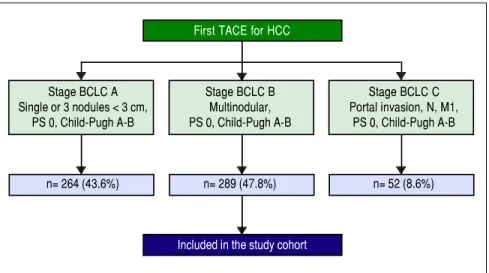
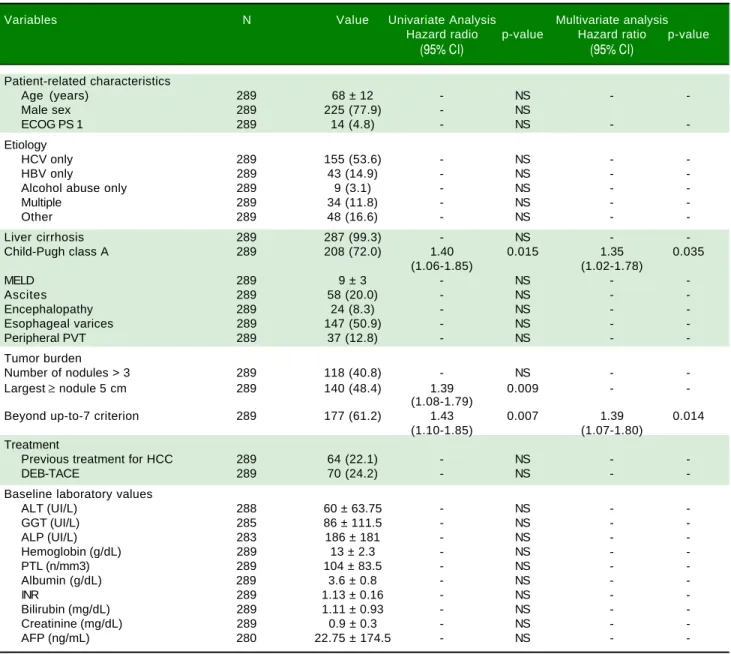
A total of 605 patients with HCC were treated with the first TACE procedure during the abovementioned period. 43.6% (n = 264) presented in BCLC stage A, 47.8% (n = 289) in stage BCLC-B (whole cohort) and 8.6% (n = 52) in BCLC-C (Figure 1). Two hundred and twenty-eight fit the restricted criteria for BCLC-B subclassification (re-strict BCLC-B cohort). Table 2 shows the demographic, clinical, and tumour information for all patients. The con-tinuous variables were not normally distributed. The ma-jority of the patients were men (78%); the median age was 68 ± 12 years and only 14 (5%) showed cancer-related symptoms. Almost all of them (99%) had cirrhosis, the most common cause being hepatitis C virus (54%). Two hundred and eight (72%) patients were Child-Pugh class A; the median MELD score was 9 ± 3. Thirty-seven (13%) had non-tumour segmental portal vein thrombosis. One hundred and seventy-seven (61%) patients had a tumour burden beyond the up-to-seven criterion. Two hundred and twenty-five (78%) patients had never been treated with any other treatment for HCC; 70 (24%) patients had re-ceived DEB-TACE. Median Alpha-Fetoprotein (AFP) level was 22 ± 174.5 ng/mL.
Figure 1.
Figure 1. Figure 1.
Figure 1.
Figure 1. Flow chart of the study cohort. TACE: Transarterial chemoembolization. HCC: Hepatocellular carcinoma. BCLC: Barcelona clinic liver cancer. PS: Performance status.
First TACE for HCC
Stage BCLC A Stage BCLC B Stage BCLC C
Single or 3 nodules < 3 cm, Multinodular, Portal invasion, N, M1, PS 0, Child-Pugh A-B PS 0, Child-Pugh A-B PS 0, Child-Pugh A-B
n= 264 (43.6%) n= 289 (47.8%) n= 52 (8.6%)
Table 2. Baseline predictors of survival in 289 patients with BCLC-B hepatocellular carcinoma at time of first TACE.
Variables N Value Univariate Analysis Multivariate analysis
Hazard radio p-value Hazard ratio p-value
(95% CI) (95% CI)
Patient-related characteristics
Age (years) 289 68 ± 12 - NS -
-Male sex 289 225 (77.9) - NS
ECOG PS 1 289 14 (4.8) - NS -
-Etiology
HCV only 289 155 (53.6) - NS -
-HBV only 289 43 (14.9) - NS -
-Alcohol abuse only 289 9 (3.1) - NS -
-Multiple 289 34 (11.8) - NS -
-Other 289 48 (16.6) - NS -
-Liver cirrhosis 289 287 (99.3) - NS -
-Child-Pugh class A 289 208 (72.0) 1.40 0.015 1.35 0.035 (1.06-1.85) (1.02-1.78)
MELD 289 9 ± 3 - NS -
-Ascites 289 58 (20.0) - NS -
-Encephalopathy 289 24 (8.3) - NS -
-Esophageal varices 289 147 (50.9) - NS -
-Peripheral PVT 289 37 (12.8) - NS -
-Tumor burden
Number of nodules > 3 289 118 (40.8) - NS -
-Largest≥ nodule5 cm 289 140 (48.4) 1.39 0.009 -
-(1.08-1.79)
Beyond up-to-7 criterion 289 177 (61.2) 1.43 0.007 1.39 0.014 (1.10-1.85) (1.07-1.80)
Treatment
Previous treatment for HCC 289 64 (22.1) - NS -
-DEB-TACE 289 70 (24.2) - NS -
-Baseline laboratory values
ALT (UI/L) 288 60 ± 63.75 - NS -
-GGT (UI/L) 285 86 ± 111.5 - NS -
-ALP (UI/L) 283 186 ± 181 - NS -
-Hemoglobin (g/dL) 289 13 ± 2.3 - NS -
-PTL (n/mm3) 289 104 ± 83.5 - NS -
-Albumin (g/dL) 289 3.6 ± 0.8 - NS -
-INR 289 1.13 ± 0.16 - NS -
-Bilirubin (mg/dL) 289 1.11 ± 0.93 - NS -
-Creatinine (mg/dL) 289 0.9 ± 0.3 - NS -
-AFP (ng/mL) 280 22.75 ± 174.5 - NS -
-Data expressed as patients number (%) or median ± IQR. Univariate analysis by Kaplan-Meier method of survival function. Multivariate analysis by backward stepwise cox regression. For continuous variables, median values were used to determine the cut-off. HCC: Hepatocellular carcinoma. TACE: Transarterial chemoembolization. DEB: Drug-eluting beads. MELD: Model for End-Stage Liver Disease. ECOG: Eastern Cooperative Oncology Group. PS: Performace Status. PTV: Portal Vein Thrombosis. HCV: Hepatitis C Virus. HBV: Hepatitis B Virus. ALT: Alanine Aminotrasferase. GGT: Gamma-Glutamyltrasferase. ALP: Alkaline Phosphatase. PTL: Platelet count. INR: International Normalized Ratio. AFP: Alpha-fetoprotein.
Survival
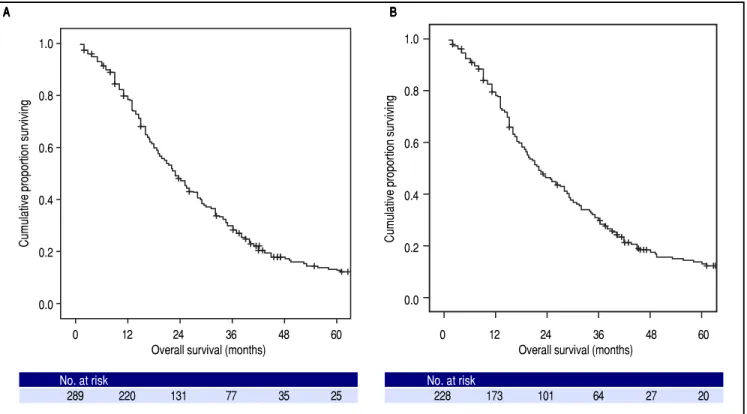
At the time of the present analysis, 247 (85%) patients had died. The overall median survival of the whole cohort was 23.0 months (95% CI: 20.2-25.8, Figure 2A) and the 1-, 2- and 3-year survival probability was 76%, 45% and 27% respectively. The Cox Proportional Hazard hypothesis was considered valid, since the curves look parallel.
The overall median survival of the restricted BCLC-B cohort was 22.0 months (95% CI: 18.2-25.8, Figure 2B)
and the 1-, 2- and 3-year survival probability was 76%, 44% and 28% respectively.
Baseline predictors of survival
up-to-sev-Figure 2. Figure 2. Figure 2. Figure 2.
Figure 2. Kaplan-Meier analysis of overall survival. A. A. A. A. A. Among whole cohort (289 patients), the median overall survival was 23.0 months (95%CI: 20.2-25.8).
B. B. B. B.
B. Among restrict BCLC-B cohort (228 patients), the median overall survival was 22.0 months (95%CI: 18.2-25.8); in this cohort patients with single nodule > 5 cm or performance status = 1, classified as BCLC A or C respectively according to original BCLC proposal, were excluded.
en criterion (p = 0.014) as independent baseline predic-tors of survival for the entire cohort of HCC patients treated with TACE (Table 2). In the restricted cohort, the same variables were significantly associated with survival in univariate and multivariate analyses.
BCLC-B substage survival
Survival curves according to the BCLC-B subclassifi-cation proposal are presented in table 3 and figure 3A for the whole cohort. Median survival was 33.0 months for B1 stage, 20.8 months for B2 stage, 16.1 months for B3 stage, 22.2 months for B4 stage and 15.0 months for quasi-C stage. Regarding the discriminatory ability of the substag-ing proposal, the log rank test showed a significant survival difference for B1 vs. B4 (p = 0.003) and B1 vs. quasi-C (p = 0.039) and a trend for B1 vs. B2 (p = 0.05) and B1 vs. B3 (p = 0.05).
Survival curves for the restricted BCLC-B cohort are presented in table 3 and figure 3B. Median survival was 34.5 months for B1 stage, 20.8 months for B2 stage, 19.3 months for B3 stage, 19.8 months for B4 stage and 15.0 months for quasi-C stage. Regarding the discriminatory ability of the substaging proposal, the log rank test showed
a significant survival difference for B1 vs. B4 (p = 0.007)
and a trend for B1 vs. B2 (p = 0.05), B1 vs. B3 (p = 0.08) and B1 vs. quasi-C (p = 0.05).
DISCUSSION
The purpose of this study was to analyze the prognostic
ability of proposed BCLC-B subclassification14 in a
multi-center Italian cohort of intermediate HCC patients treated with TACE. The main result of the present study was that the substage B1 showed significantly better survival than other substages, while when differences between stages from B2 to Quasi-C were analyzed, the prognostic power of the proposed B subclassification was lost. Three other studies have tried to validate the prognostic capacity of the BCLC-B subclassification proposal in HCC treated pa-tients: two eastern cohorts (from Taiwan and Korea) that included only patients treated with TACE, like ours,15,16 and
a German cohort that included all patients with intermedi-ate HCC managed in the centre, regardless of the therapeu-tic allocation.17 All three studies confirmed the best survival
for patients classified in substage B1 but failed to confirm the ability of the proposed subclassification14 to
discrimi-nate prognosis when other substages were considered. So while the Taiwan group suggested the addition of
alpha-fe-toprotein,15 the Korean study proposed to merge of B3 and
1.0
0.8
0.6
0.4
0.2
0.0
0 12 24 36 48 60
Overall survival (months)
No. at risk
289 220 131 77 35 25
Cumulative proportion surviving
1.0
0.8
0.6
0.4
0.2
0.0
0 12 24 36 48 60
Overall survival (months)
No. at risk
228 173 101 64 27 20
Cumulative proportion surviving
A A A A
Figure 3.
Figure 3. Figure 3.
Figure 3. Figure 3. Survival probability according to BCLC-B subclassification. A. A. A. A. A. Among whole cohort (289 patients), results from log-rank test showed significant
dif-ferences of B1 vs. B4 (p = 0.003) and B1 vs. Quasi-C (p = 0.039). B. B. B. B. Among restrict BCLC-B cohort (228 patients), results from log-rank test retained the sig-B.
nificance only for B1 vs. B4 (p = 0.007); in this cohort patients with single nodule > 5 cm or performance status =1, classified as BCLC A or C respectively
according to original BCLC proposal, were excluded.
Table 3. Median survival times and survival rates of patients with BCLC intermediate hepatocellular carcinoma stratified in proposed substages.
BCLC-B n Overall Survival (months) 1-year 2-year 3-year
Sub-Stage Median (95% CI) survival probability survival probability survival probability
B1 81 33.0 (27.5-38.5) 87.7% 61.7% 37.0%
57* 34.5 (28.3-40.7) 89.5% 64.9% 40.4%
B2 106 20.8 (16.3-25.3) 75.5% 42.5% 25.5%
90* 20.8 (16.8-24.8) 77.8% 42.2% 25.6%
B3 24 16.1 (8.9-23.3) 75.0% 33.3% 20.8%
21* 19.3 (10.3-28.3) 71.4% 33.3% 23.8%
B4 42 22.2 (17.6-26.7) 71.4% 38.1% 16.7%
24* 19.8 (13.3-26.3) 66.7% 33.3% 20.8%
Quasi-C 36 15.0 (10.6-19.4) 58.3% 30.6% 22.2%
36* 15.0 (10.6-19.4) 58.3% 30.6% 22.2%
Overall 289 23.0 (20.2-25.8) 76.1% 45.0% 26.6%
228* 22.0 (18.2-25.8) 75.9% 44.3% 28.1%
* In this restrict cohort patients with single nodule > 5 cm or performance status = 1, classified as BCLC A or C respectively according to original BCLC proposal, were excluded.
1.0
0.8
0.6
0.4
0.2
0.0
0 12 24 36 48 60
Overall survival (months)
No. at risk
B1 81 71 51 30 13 7
B2 106 80 45 27 13 11
B3 24 18 8 5 1 1
B4 42 30 16 7 3 2
Quasi-C 36 21 11 8 5 4
Cumulative proportion surviving
1.0
0.8
0.6
0.4
0.2
0.0
0 12 24 36 48 60
Overall survival (months)
No. at risk
B1 57 51 37 23 9 5
B2 90 70 38 23 11 9
B3 21 15 7 5 1 1
B4 24 16 8 5 1 1
Quasi-C 36 21 11 8 5 4
Cumulative proportion surviving
B1 vs. B2, p = 0.05 B1 vs. B3, p = 0.05 B1 vs. B4, p = 0.003 B1 vs. Quasi-C, p = 0.039 Other comparisons, p = NS
B1 33.0 months B2 20.8 months B3 16.1 months B4 22.2 months Quasi-C 15.0 months
B1 34.5 months B2 20.8 months B3 19.3 months B4 19.8 months Quasi-C 15.0 months
B1 vs. B2, p = 0.05 B1 vs. B3, p = 0.08 B1 vs. B4, p = 0.007 B1 vs. Quasi-C, p = 0.05 Other comparisons, p = NS A
A A A
B4 to get a better prognostic predicition.16 The german
study and the italian study on untreated patients also under-line the need for a more refined assessment of liver function
impairment through inclusion of MELD score.17,18
An interesting observation of our study is derived from the result of the surprising survival time of B4 subpopula-tion (22.2 and 19.8 months in the whole and restrict cohort respectively). Even in the above cited studies15-17 it can be
observed that the B4 survival was quite better of the B3, but while in these studies the B4 subgroup size was small, in our study the B4 subgroup is large enough to allowing some considerations. According to the expert panel B4 pa-tients should have been received only best supportive
care.14 But in the real world we encounter relatively
fre-quently patients with a Child-Pugh score B8-9 or PS = 1 that are sufficiently well compensated and may also bear a small tumour burden; not allocating them to a TACE pro-gramme (or possibly to a percutaneous treatment) would result in a severe under treatment, even outside the per-spective of transplantation. In effect, the Bolondi subclas-sification for patients with intermediate HCC was created primarily with the aim of optimising treatment allocation
and only secondarily has a prognostic classification.14
Re-cently, Kudo, et al. have proposed and validated Kinki
cri-teria, a simplification of the BCLC-B subclassification in only three substages: B1 (Child-Pugh score 5-7 and within up-to-7), B2 (Child-Pugh score 5-7 and beyond up-to-7) and B3 (Child-Pugh score B8,9 and any tumor status).33,34
Child-Pugh class and the up-to-seven criterion are the cornerstones on which the proposed subclassification of
in-termediate HCC, also known as BCLC-B, was built.14 In
our population, Child-Pugh class, a measure of liver func-tion, and the up-to seven criterion, were independent base-line predictors of survival. Conversely, the presence of portal vein thrombosis and the performance status, that are also constructive elements of BCLC-B subclassification, were not independent baseline predictors of survival in our cohort. The quasi-C substage includes patients with undefined pe-ripheral portal vein thrombosis, which were included in the advanced stage in the original classification.30 In our cohort,
these patients have a survival comparable or even better than those treated with TACE in study of Luo, et al.35 and those
treated with sorafenib in the SHARP study.36
Forner3 observed that the proposed subclassification
includes in the intermediate stage either patients classified as early (patients with single nodule > 5 cm; candidates for surgery) either patients classified as advanced (patients with PS = 1; candidates, if possible, for oral therapy with
sorafenib) in the original BCLC classification.30 To
over-come this limitation, we conducted a separate analysis on a restricted cohort that excluded these cases of controversial allocation; the results of the restricted cohort reflected quite well the results obtained for the whole cohort.
Limitations of our study include its retrospective na-ture, the homogeneous treatment modality (meaning that all patients received TACE as treatment) and incomplete knowledge of the clinical history of patients from the time of TACE to death, especially with regard to time to pro-gression, the onset of hepatic decompensation, and number of treatments performed after first TACE. More-over, the external validity could be influenced by the fact we used the median of the continuous variables as a cut-off value for the univariate and multivariate analysis. The multicenter design and the high number of cases (85%) for which data on patient survival is available strengthens the findings of our analysis.
In conclusion, apart from substage B1, BCLC-B sub-classification does not discriminate perfectly patients treated with TACE. Since also some patients in substage B4 can benefit from TACE, we believe that a multidisci-plinary approach is advisable based on the single patient clinical, laboratory and radiological conditions.
ABBREVIATIONS
• AASLD: Association for the Study of Liver Diseases. • AFP: alpha-fetoprotein.
• BCLC: Barcelona Clinic Liver Cancer.
• CT: computed tomography.
• DEB: drug eluting beads.
• EASL: European Association for the Study of the Liv-er.
• ECOG: Eastern Cooperative Oncology Group. • HbsAg: hepatitis B surface antigen.
• HCC: hepatocellular carcinoma.
• HCV: hepatitis C virus.
• IQR: interquartile range.
• MELD: Model for End-stage Liver Disease. • MRI: magnetic resonance imaging.
• OLT: orthotopic liver transplantation.
• PS: performance status.
• TACE: transarterial chemoembolization.
FINANCIAL SUPPORT
Nothing to declare.
CONFLICT OF INTEREST STATEMENT
Nothing to declare.
AUTHORSHIP STATEMENT
M. and Grieco A. designed the research study, Racco S., Gallusi G., Iavarone M., Della Corte C., Cabibbo G., Ma-ida M., collected the data, Biolato M. and La Torre G. ana-lysed the data, Biolato M. and Grieco A. wrote the paper,
and Gasbarrini A., Attili A.F., Cammá C. and Sangiovanni
A. critically revised the manuscript for important intellec-tual content.
All authors approved the final version of the manu-script.
REFERENCES
1. Jemal A, Bray F, Center MM, Ferlay J, Ward E, Forman D. Global cancer statistics. CA Cancer J Clin 2011; 61: 69-90.
2. Alazawi W, Cunningham M, Dearden J, Foster GR. System-atic review: outcome of compensated cirrhosis due to chronic hepatitis C infection. Aliment Pharmacol Ther 2010; 32: 344-55.
3. Forner A, Gilabert M, Bruix J, Raoul JL. Treatment of interme-diate-stage hepatocellular carcinoma. Nat Rev Clin Oncol
2014; 11: 525-35.
4. Bruix J, Sherman M; AASLD Practice Guidelines Committee, American Association for the Study of Liver Diseases. Man-agement of hepatocellular carcinoma: an update. Hepatology
2011; 3: 1020-2.
5. European Association for the Study of the Liver; European Organization for Research and Treatment of Cancer. Clinical practice guidelines: management of hepatocellular
carcino-ma. J Hepatol 2012; 56: 908-43.
6. Biolato M, Marrone G, Racco S, Di Stasi C, Miele L, Gasbar-rini G, Landolfi R, et al. Transarterial chemoembolization (TACE) for unresectable HCC: a new life begins? Eur Rev
Med Pharmacol Sci 2010; 14: 356-62.
7. Grieco A, Pompili M, Caminiti G, Miele L, Covino M, Alfei B, Rapaccini GL, et al. Prognostic factors for survival in pa-tients with early-intermediate hepatocellular carcinoma un-dergoing non-surgical therapy: comparison of Okuda, CLIP, and BCLC staging systems in a single Italian centre. Gut
2005; 54: 411-8.
8. Doffoël M, Bonnetain F, Bouché O, Vetter D, Abergel A, Fratté S, Grangé JD et al; Fédération Francophone de Can-cérologie Digestive. Multicentre randomised phase III trial comparing Tamoxifen alone or with Transarterial Lipiodol Chemoembolisation for unresectable hepatocellular carcino-ma in cirrhotic patients. Eur J Cancer 2008; 44: 528-38. 9. Biolato M, Miele L, Vero V, Racco S, Di Stasi C, Iezzi R,
Zanché A, et al. Hepatocellular carcinoma treated by con-ventional transarterial chemoembolization in field-practice: serum sodium predicts survival. World J Gastroenterol
2014; 20: 8158-65.
10. Takayasu K, Arii S, Ikai I, Omata M, Okita K, Ichida T, Mat-suyama Y, et al; Liver Cancer Study Group of Japan. Pro-spective cohort study of transarterial chemoembolization for unresectable hepatocellular carcinoma in 8510 patients.
Gastroenterology 2006; 131: 461-9.
11. Burrel M, Reig M, Forner A, Barrufet M, de Lope CR, Trem-osini S, Ayuso C, et al. Survival of patients with hepatocellu-lar carcinoma treated by transarterial chemoembolisation (TACE) using drug eluting beads. Implications for clinical practice and trial design. J Hepatol 2012; 56: 1330-5. 12. Raoul JL, Sangro B, Forner A, Mazzaferro V, Piscaglia F,
Bolondi L, Lencioni R. Evolving strategies for the
manage-ment of intermediate-stage hepatocellular carcinoma: availa-ble evidence and expert opinion on the use of transarterial chemoembolization. Cancer Treat Rev 2011; 37: 212-20. 13. Farinati F, Giacomin A, Vanin V, Giannini E, Trevisani F.
TACE treatment in hepatocellular carcinoma: what should we do now? J Hepatol 2012; 57: 221-2.
14. Bolondi L, Burroughs A, Dufour JF, Galle PR, Mazzaferro V, Piscaglia F, Raoul JL, et al. Heterogeneity of patients with in-termediate (BCLC B) hepatocellular carcinoma: proposal for a subclassification to facilitate treatment decisions. Semin
Liver Dis 2012; 32: 348-59.
15. Wang JH, Kee KM, Lin CY, Hung CH, Chen CH, Lee CM, Lu SN. Validation and modification of a proposed substaging system for patients with intermediate hepatocellular
carcino-ma. J Gastroenterol Hepatol 2015; 30: 358-63.
16. Ha Y, Shim JH, Kim SO, Kim KM, Lim YS, Lee HC. Clinical ap-praisal of the recently proposed Barcelona Clinic Liver Can-cer stage B subclassification by survival analysis. J
Gastroenterol Hepatol 2014; 29: 787-93.
17. Weinmann A, Koch S, Sprinzl M, Kloeckner R, Schulze-Berg-kamen H, Düber C, Lang H et al. Survival analysis of pro-posed BCLC-B subgroups in hepatocellular carcinoma patients. Liver Int 2015; 35: 591-600.
18. Giannini EG, Moscatelli A, Pellegatta G, Vitale A, Farinati F, Ciccarese F, Piscaglia F, et al. Italian Liver Cancer (ITA.LI.CA) Group; Application of the Intermediate-Stage Subclassification to Patients With Untreated Hepatocellular Carcinoma. Am J Gastroenterol 2016; 111: 70-7.
19. Bruix J, Sherman M, Llovet JM, Beaugrand M, Lencioni R, Burroughs AK, Christensen E, et al. Clinical management of hepatocellular carcinoma. Conclusions of the Barcelona-2000 EASL Conference. J Hepatol 2001; 35: 421-30. 20. Bruix J, Sherman M; AASLD Practice Guidelines Committee,
American Association for the Study of Liver Diseases. Man-agement of hepatocellular carcinoma. Hepatology 2005; 5: 1208-36.
21. Pugh RN, Murray-Lyon IM, Dawson JL, Pietroni MC, Williams R. Transection of the oesophagus for bleeding oesophageal varices. Br J Surg 1973; 60: 646-9.
22. Llovet JM, Di Bisceglie AM, Bruix J, Kramer BS, Lencioni R, Zhu AX, Sherman M, et al.; Panel of Experts in HCC-Design Clinical Trials. Design and endpoints of clinical trials in hepa-tocellular carcinoma. J Natl Cancer Inst 2008; 100: 698-711. 23. Sorensen JB, Klee M, Palshof T, Hansen HH. Performance status assessment in cancer patients. An inter-observer variability study. Br J Cancer 1993; 67: 773-5.
24. Kamath PS, Wiesner RH, Malinchoc M, Kremers W, Therneau TM, Kosberg CL, D'Amico G, et al. A model to predict survival in patients with end-stage liver disease. Hepatology 2001; 33: 464-70.
25. European Association for the Study of the Liver. Clinical practice guidelines on the management of ascites, sponta-neous bacterial peritonitis, and hepatorenal syndrome in cir-rhosis. J Hepatol 2010; 53: 397-417.
26. Manini MA, Sangiovanni A, Martinetti L, Viganò D, La Mura V, Aghemo A, Iavarone M, et al. TACE with drug-eluting beads is effective for the maintenance of the Milan-in status in pa-tients with a small hepatocellular carcinoma. Liver Transpl
2015; 21: 1259-69.
27. Cabibbo G, Genco C, Di Marco V, Barbara M, Enea M, Parisi P, Brancatelli G, et al. Predicting survival in patients with hepatocellular carcinoma treated by transarterial chemoem-bolisation. Aliment Pharmacol Ther 2011; 34: 196-204. 28. Golfieri R, Giampalma E, Renzulli M, Cioni R, Bargellini I,
conventional chemoembolisation for hepatocellular
carcino-ma. Br J Cancer 2014; 111: 255-64.
29. Mazzaferro V, Llovet JM, Miceli R, Bhoori S, Schiavo M, Mar-iani L, Camerini T, et al. Predicting survival after liver trans-plantation in patients with hepatocellular carcinoma beyond the Milan criteria: a retrospective, exploratory analysis.
Lan-cet Oncol 2009; 10: 35-43.
30. Llovet JM, Bruix J. Prognosis of hepatocellular carcinoma: the BCLC staging classification. Semin Liver Dis 1999; 9: 329-38.
31. Concato J, Peduzzi P, Holfold TR, Feinstein AR. Importance of events per independent variable in proportional hazards analysis. I. Background, goals, and general strategy. J Clin
Epidemiol 1995; 48: 1495-501.
32. Peduzzi P, Concato J, Feinstein AR, Holford TR. Importance of events per independent variable in proportional hazards regression analysis. II. Accuracy and precision of regres-sion estimates. J Clin Epidemiol 1995; 48: 1503-10. 33. Kudo M, Arizumi T, Ueshima K, Sakurai T, Kitano M, Nishida
N. Subclassification of BCLC B Stage Hepatocellular Carci-noma and Treatment Strategies: Proposal of Modified Bolon-di's Subclassification (Kinki Criteria). Dig Dis 2015; 33: 751-8.
34. Arizumi T, Ueshima K, Iwanishi M, Minami T, Chishina H, Kono M, Takita M, et al. Validation of Kinki Criteria, a Modified Substaging System, in Patients with Intermediate Stage Hepatocellular Carcinoma. Dig Dis 2016; 34: 671-8.
35. Luo J, Guo RP, Lai EC, Zhang YJ, Lau WY, Chen MS, Shi M. Transarterial chemoembolization for unresectable hepatocel-lular carcinoma with portal vein tumor thrombosis: a pro-spective comparative study. Ann Surg Oncol 2011; 18: 413-20.
36. Bruix J, Raoul JL, Sherman M, Mazzaferro V, Bolondi L, Craxi A, Galle PR, et al. Efficacy and safety of sorafenib in patients with advanced hepatocellular carcinoma: suba-nalyses of a phase III trial. J Hepatol 2012; 57: 821-9.
Correspondence and reprint request:
Antonio Grieco, M.D.
Professor of Medicine, Hepatology Unit. Fondazione Policlinico Gemelli. Catholic University of Sacred Heart. Largo Agostino Gemelli n 8, 00168 Rome, Italy.