FACULTAD de FILOSOFÍA Y LETRAS
DEPARTAMENTO de FILOLOGÍA INGLESA
Grado en Estudios Ingleses
TRABAJO DE FIN DE GRADO
Contrastive study and translation of a legal sentence
from English into Spanish. Oscar Pistorius' case.
Ana Nozal Fernández
Tutor: Belén López Arroyo
ABSTRACT
The purpose of this research is to translate into Spanish an extract of Oscar Pistorius’ legal
sentence, and to provide an accurate analysis of the lexical and grammatical characteristics found in the same. By using specialized dictionaries, parallel texts, as well as glossaries the problems found during the process of translation will be studied. Besides, solutions addopted to these problems will be provided. The research shows that thanks to the use of translation techniques such as transpositions, the translator is able to provide a target text that sounds natural and balanced in the target language This research focuses only on a concrete extract of a legal sentence. It would be interesting for further studies to continue analyzing if these features and problems appear in other legal sentences.
Key words: Legal translation, legal sentence, criminal law, law language, translation problems.
ABSTRACT
El principal objetivo de este estudio es la realización de una traducción de un extracto de la sentencia legal de Oscar Pistorius. A su vez, se realizará un análsis de las características léxicas y gramaticales encontradas en dicha sentencia. Los problemas que se han encontrado a lo largo del proceso de tradución serán analizados, así como las soluciones adoptadas. Este estudio demuestra que el traductor es capaz de crear una traducción natural y equilibrado gracias al uso de distintas técnicas de traducción como son las transposiciones.
Es importante tener en cuenta que este estudios se centra unicamente en el extracto seleccionado de la sentencia judicial. Por ello, sería interesante realizar nuevos para seguir investigando si estas características y problemas se repiten en otras sentencias juridicas.
CONTEXT TABLE
1. INTRODUCTION ... 1
2. THEORETICAL BACKGROUND ... 2
2.1 Legal language ... 2
2.2 Lexical characteristics of legal language ... 2
2.2.1 Terms derived from French and Latin words due to Normand and Roman Invasions. ... 3
2.2.2 Terminology in legal language ... 5
2.2.3 Use of abbreviations ... 6
2.3 Syntactical characteristics of Legal language ... 7
2.3.1 The use of non-finite clauses ... 7
2.3.2 The placement of dependent clauses ... 8
2.3.3 Complex sentences ... 8
2.3.4 Wordiness and redundancy ... 10
a) Prepositional and adverbial expressions ... 10
b) Binomial Expressions ... 11
c) Redundancy ... 12
2.3.5 Impersonal vs Personal Constructions ... 12
2.3.6 Modal verbs, the use of shall ... 13
2.3.7 Passives and Nominalizations ... 14
2.3.8 Negation ... 14
3. MATERIALS. THE SOURCE TEXT ... 15
3.1 Presentation of the text ... 15
4. TRANSLATION OF THE SOURCE TEXT FORM ENGLISH INTO SPANISH .. 16
5. ANALYSIS AND TRANSLATION PROBLEMS ... 23
5.1 Terminological problems and solutions ... 24
5.1.1 Multiple word technical expressions ... 24
5.1.2 Semi-technical vocabulary ... 24
5.1.4 Collocations ... 27
5.1.5 Lexical repetition ... 30
5.1.6 Abbreviations ... 31
5.2 Grammatical problems. The use of transpositions as a solution ... 32
5.2.1 Transpositions ... 32
5.2.2 The complex noun phrase ... 33
6 CONCLUSION ... 34
7 BIBLIOGRAPHY ... 35
7.1 Primary sources ... 35
7.2 Secondary sources ... 36
7.2.1 Parallel texts ... 37
8 APPENDIX ... 51
1 1. INTRODUCTION
The research consists of the translation and analysis of an extract of a legal sentence.
In concrete, Oscar Pistorius’ legal sentence. Legal sentences are specialized texts that belong
to the field of legal translation.
We decided to translate a legal sentence because it belongs to a field of knowledge in which further studies are needed. Many researchers have focused their attention on the study of specific genres such as contracts or wills, as these are the most demanded documents. Nevertheless, we considered interesting to analyze the features and problems that can be found during the translation of a legal sentence. Oscar Pistorius is a well-known paralympic
athlete. He was accused of murdering her girlfriend in Saint Valentin’s day. We decided to translate and analyze an extract of his legal sentence as it is a good example to achieve the aims of the research.
We have three main aims. The first one is to select and translate an extract of Oscar
Pistorius’ legal sentence. Its translation from English into Spanish consist of 943 words. Besides, we compiled a list of terms that appeared in the source text. To ensure that our translation was right, we asked an expert to check specific terminological problems we encountered in order to continue with our second aim. This second aim consists of the explanation of the lexical and syntactical characteristics found in the source text. Finally, the last aim deals with the problems encountered in the process of translating, and the solutions adopted for the same.
According to the methodology followed, the first thing done was to acquire a deeper knowledge in the field of legal translation. Authors such as Alcaraz (2002), Tiersma (2000) or Hughes (2002) were essential for the investigation process. They helped us not only to understand better the lexical and syntactic characteristics of our source text, but also to
analyze the problems it conveys. The next step was to select an extract of Oscar Pistorius’
legal sentence in order to use it with two main aims. Firstly, to study its lexical and syntactic characteristics; and secondly, as a text to translate and to analyze.
2
were used to find the Spanish equivalents of the terms that appear in the glossary. The use of monolingual and bilingual dictionaries such as Diccionario de términos jurídicos. A
dictionary of Legal Terms (2012), or Diccionario Espasa jurídico (2001), both in English
and in Spanish, as well as the use of parallel texts selected from journals such as El Mundo
and the database CENDOJ. And last but not least, the help of an expert in the field.
This research is structured into four main sections which are: the theoretical background, the materials used, the translation of the source text and the analysis and translation problems. First, the theoretical background consists of the explanation of lexical characteristics and syntactical features. Then, in the materials section, we describe the main features of the source text taking into account its genre, communicative function, and the discourse community. Together with this, a translation of the source text made by myself follows. In the analysis and problems section, we analyze the problems found during the translation process, as well as the solutions adopted. Finally, the appendix includes the glossary made during the translation.
2. THEORETICAL BACKGROUND
2.1 Legal language
In 1726, Jonathan Swift (1826: 139) defined the language of law as “A peculiar cant
and jargon of their own that no other natural mortal can understood.” The most important tool for lawyers are words as they need them to advise clients, to argue at the court or jury or to question witnesses. (Tiersma, 2000: 1). Thus, lawyers do not only use legal language orally; but they also use it in contracts, legal sentences, deeds or wills. Tiersma (2000: 2), as Swift, defines the legal language as a complex “and virtually incomprehensible to those most affected by it.” This differs from what we understand by general language, the language we use in our daily life.
2.2 Lexical characteristics of legal language
3
2.2.1 Terms derived from French and Latin words due to Normand and Roman Invasions.
According to the Collins dictionary a latinism is “a word, idiom, or phrase borrowed from Latin.” Due to the Roman Invasion, Latin contributed to the development of European languages. With their conquest, Latin became the “language of government and administration, legislation and the judiciary, trade and army operations” (Ristikivi, 2005: 199).
However, the most powerful factor for the influence of Latin in legal language was the creation of the Corpus Iuris Civilis (Ristikivi, 2005: 200). Apart from this, it is necessary to take into consideration that many important jurisprudence and political works were written in this language.
On the other hand, with the Norman invasion in 1066, French became one of the three official languages in England together with Old English and Latin. In the courts, French was the language used to communicate orally, and Latin was the language used in written records (Williman, 2007). Normans not only influenced the English language with their language, but also with their legal system. It is in this moment when the Common Law appeared.
According to Williman (2007), Spanish colonization, together with Napoleon’s
conquest of Quebec and Louisiana, supposed a clearly decisive boost to the influence of Latin and French law systems and lexicon in America. Blackstone, thanks to his book
Commentaries of the laws of England (1763), was one of the most important figures to
influence the Americans with their law tradition (Williman, 2007). During the revolutionary period, Americans decided to imbue themselves with English law books as this one.
Due to these facts, many terms of legal language have French and Latin origins. Nevertheless, it may be interesting to focus on how English received words from these two languages.
There are “three levels of reception of foreign words into a language: borrowing,
4
TERM ORIGIN DEFINITION SOURCE
Court First from the Latin cohort
which developed into the French word cour to the
present court.
It makes reference to the place where juridical
businesses take places.
(American
association journal, 1939: 1026)
Defendant From the Latin defendens.
It developed into the French word defendant to
the present defendant.
It makes reference to the person or company sued in a court.
(Dictionary.com, 2016)
Deterrence From Latin deterrere to
the present deterrence.
It makes reference to the that ensures a fair punishment to the criminal defendant.
(Etymonline, 2016)
Imprisonment From Latin prehensio to
the French word imprision
to the present
imprisonment.
To be in prison. (Etymonline, 2016)
Crime From Latin crimen to the
French word crimne to
nowadays crime.
It is the violation of law.
(Hill, 2016, p. 107)
Homicide From Latin homo +
cidium.
It means man +
the act of killing.
(Etymonline, 2016)
Accused From Latin ad causa. It is the person
accused for a crime.
(Etymonline, 2016 Hill, 2016: 7)
Sentence From Latin sentencia. It is the
punishment
5
applied to the person accused for a crime.
Judge From French juger to
nowadays judge.
To create an opinion about something.
(Etymonline, 2016)
Procedure From the Latin procedure
to the French procedure to
nowadays procedure.
“The proceedings in a given cause.”
(American bar
association
journal,1939: 1023)
Table 1: Word of Latin Origin. Source: Compiled by the aothor.
Many of these terms are common words easy to understand such as judge. However,
there are other terms such as deterrence or defendant, which are more complex as they
acquire a new meaning whithin legal language. In the following section, we differenciate between technical, sub-technical and general language terms.
2.2.2 Terminology in legal language
Legal vocabulary has something in common with the general language, the differentiation between symbolic vocabulary and functional vocabulary (Alcaraz et al., 2002: 93).
On the one hand, the functional language is the language used to establish relationships between words and linguistic units (Ariel, 2002: 94). For instance, fixed legal expressions such as:
(1) mine and mine alone [1 12]
(2) In the matter between. [6]
On the other hand, Alcaraz, Campos and Miguélez (2002: 94 - 95) classify the symbolic
language into “technical terms, subtechnical terms and general language terms.”
Technical terms: These are words with just one meaning that belong to a
specialized subject field. In order to be able to understand them, and to use them,
6
it is necessary to know their meaning. They are better known as terms of art. For
instance: (3) High court [ 1]
(4) Negligence [42]
(5) Case Number [1]
Sub-technical terms: These are words from general language that have a specific meaning in a specialized field. In contrast with the previous one, these words are polysemic. For instance:
(6) Act [10]: Defined by Web-Merriam Dictionary as: something that is done.
a law made by a group of legislators.
one of the main divisions of a play or opera.
Words from general language: These are sub-technical words as they still retain their general meaning. Some examples found in the source text are:
(7) Paragraph [23]
(8) Date [1]
(9) Society [13]
2.2.3 Use of abbreviations
In legal language, the use of abbreviations is common (Bhatia, 2010: 274). According to Merriam-Webster dictionary an abbreviation is “a shortened form of a word or name that is
used in place of the full word or name”. Within this, it is necessary to differentiate between acronyms, which are abbreviated words that are spelt as words themselves, and initials, which are abbreviations that cannot be pronounced as words themselves. These are some examples with their respective meanings found in the legal sentence:
(10) In S v RO and Another 2000 (2) SACR 248 (SCA), Heher JA [16] v = versus
2000 (2) SACR 248 = year and volume number of South African Criminal Reports
7 JA = Judge of Appeal
(11) S v Martín 1996 (2) SACR 378 (W) at 380 A-B [25]
(w) = Watermeyer’s Reports of the Supreme Court, Cape of Good Hope
(S Afr) 1857// Witwatersrand Local Division Reports (S Afr) 1910-1946 (12) S v Vries 1996 (2) SACR 638 (Nm) at 643 F-G: [28]
(Nm) = High Court of Namibia
(13) See S v Mhlongo 1994 (1) SACR 584 (A) at 588J-589B [40] SACR: South African Criminal Law Reports (14) See S v V 1972 (3) SA 611 (A) at 614: [40]
SA: South African Law Reports
2.3 Syntactical characteristics of Legal language
Legal syntax may be both simple and complex depending on the canal. On the one hand, simple syntax is used in the narrative discourse of legal sentences called “facts as found” (Alcaraz et al., 2002: 95). This type of writings tries to be as objective as possible using understandable grammatical structures. On the other hand, the complex one is found in contracts, trusts, wills and other legal documents. We are going to focus on the first one as the source text is a legal sentence.
2.3.1 The use of non-finite clauses
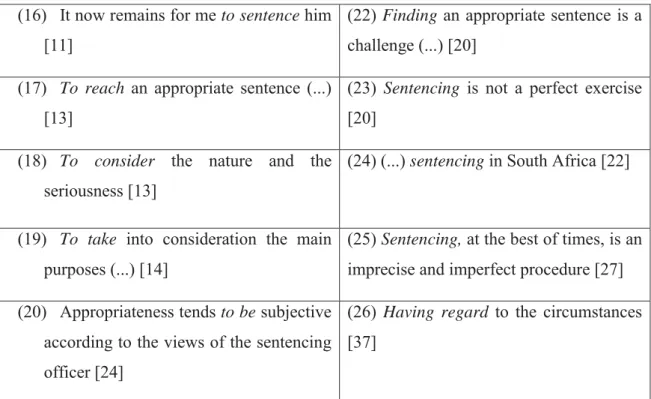
The use of non-finite clauses is a common syntactic characteristic of legal writings (Tiersma, 2000: 65). Thanks to the inflectional form of non-finite verbs, we can distinguish them from finite ones. (Huddleston & Pullum, 2002: 1173).We can find two different types of non-finite clauses in the source text. In the following table, we present on the one hand the infinitival sentences, and on the other hand the gerund-participal sentences found in the source text.
INFINITIVAL GERUND-PARTICIPAL
(15) To arrive at different conclusions [19] (21) Sentencing is about achieving the
8
(16) It now remains for me to sentence him
[11]
(22) Finding an appropriate sentence is a
challenge (...) [20]
(17) To reach an appropriate sentence (...)
[13]
(23) Sentencing is not a perfect exercise
[20]
(18) To consider the nature and the
seriousness [13]
(24) (...) sentencing in South Africa [22]
(19) To take into consideration the main
purposes (...) [14]
(25) Sentencing, at the best of times, is an
imprecise and imperfect procedure [27]
(20) Appropriateness tends to be subjective
according to the views of the sentencing officer [24]
(26) Having regard to the circumstances
[37]
Table 2: Non-Finite clauses of the ST. Source: Compiled by the author. 2.3.2 The placement of dependent clauses
As Tiersma states (2000: 66), dependent clauses are usually placed “next to the words
they modify or between the auxiliary and noun verb.” This type of clauses decreases ambiguity, nevertheless, they reduce comprehension. In the ST we have found the following examples:
(27) “Sentencing, at the best of times, is an imprecise (...) [27]
(28) To give him an opportunity, where possible, the possibility to become a
useful member of society. [32]
(29) I am mindful, however, of the fact that true mercy has (...) [40]
Apart from this type of clause, in the source text we have also found embedded clauses. In the following section we will study the complexity of sentences in this field.
2.3.3 Complex sentences
9
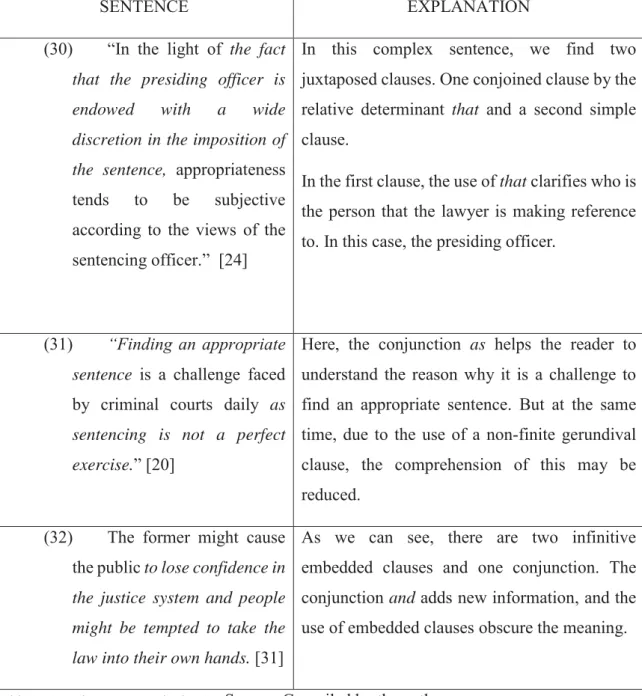
use this feature as a way to avoid ambiguity in their writings. Due to the use of these long sentences, the information that the lawyer wants to express is clear enough to avoid different meanings of a concrete message (Tiersma, 2000: 57). These sentences are distinguished not only by the use of embedded clauses, but also by the use of conjoined ones. We have elaborated a table with some complex sentences selected from the source text, in order to explain them.
SENTENCE EXPLANATION
(30) “In the light of the fact
that the presiding officer is
endowed with a wide
discretion in the imposition of
the sentence, appropriateness
tends to be subjective according to the views of the
sentencing officer.” [24]
In this complex sentence, we find two juxtaposed clauses. One conjoined clause by the relative determinant that and a second simple
clause.
In the first clause, the use of that clarifies who is
the person that the lawyer is making reference to. In this case, the presiding officer.
(31) “Finding an appropriate
sentence is a challenge faced
by criminal courts daily as
sentencing is not a perfect exercise.” [20]
Here, the conjunction as helps the reader to
understand the reason why it is a challenge to find an appropriate sentence. But at the same time, due to the use of a non-finite gerundival clause, the comprehension of this may be reduced.
(32) The former might cause the public to lose confidence in
the justice system and people
might be tempted to take the
law into their own hands. [31]
As we can see, there are two infinitive embedded clauses and one conjunction. The conjunction and adds new information, and the
use of embedded clauses obscure the meaning.
10 2.3.4 Wordiness and redundancy
Lawyers usually use long sentences as well as the repetition of different terms as a way to avoid ambiguities and to be as precise as possible. The way they achieve this, is by the use of prepositional and adverbial expressions, the use of binomial expressions, and the use of redundancy. (Tiersma, 2000: 59-61).
a) Prepositional and adverbial expressions
“The law is a profession of words.” (Mellinkoff, 2004: 7). Verbosity and wordiness are very frequent both in legal speech, and in written discourse as lawyers tend to be as explicit and clear as possible. It is characterized by the use of prepositional and adverbial sentences or expressions, instead of the use of simple prepositions or adverbs respectively (Tiersma, 2000: 59). We have elaborated a table in which we provide the complex structures found in the ST, and the possible simple structures that could substituted each of them. Besides, we have classified the type of sentence we are studying.
COMPLEX TERMINOLOGY SIMPLE TERMINOLOGY TYPE OF
SENTENCE.
(33)At the outset it needs to be emphasized (…) [12]
Initially it needs to be
emphasized (...)
Prepositional clause to adverb
(34)The accused has been found guilty of the personal circumstances of the accused
as well as the interest of
society [13]
The accused has been found guilty of, the personal circumstances of the accused
and the interest of society
Adverbial
expression to simple adverb
(35)All these must be accorded
due weight in any sentence. [15]
All must be accorded due
weight in any sentence.
Adverbial
expression to simple adverb.
(36)“In the light of the fact that the presiding officer is
“As the presiding officer is endowed (...)
11
Table 4: Prepositional and Adverbial Expressions. Source: Compiled by the author. b) Binomial Expressions
According to Tiersma (2000), Binomial expressions are characteristic of wordiness language in legal writings. A binomial expression is “a technical linguistic term of two
parallel words joined by a conjunction like any and all.” (Tiersma, 2000: 61). As mentioned in the previous section (vid supra 2.2.1), there was a moment in history when Latin, French
and English coexisted. How could law members determine which terms were more precise in a multilingual lexicon, where most of the terms were synonyms or near-synonyms? This is a question Crystal (2005: 74) made and answered in his book: “The solution in many cases,
was: don’t choose; use both.” Therefore, as Crystal said, lawyers in the fifteen century started to join terms belonging to different languages and with similar meanings. According to Cristal (2005), they did this as a way to be as precise as possible. In the source text we have found only two example.
(37)“Sentencing, at the best of times, is an imprecise and imperfect procedure (…)”
[27]
(38)“The following is what I consider to be a sentence that is fair and just(…)” [43]
According to Merriam Webster dictionary, imprecise is and adjective firstly used in
1805. It comes from the word precise, a Middle English word which came from Middle
French precis, and this from Latin praecius. The suffix im- has its origin in the suffix
in-which suffered an assimilation into im. This word was also spelt as the Old English word
unprecise in 1756. On the other hand, the term imperfect, according to Merriam Webster
dictionary, is a word firstly used in the 14th century. It is an alteration of Middle English
imparfit which derives from Latin imperfectus. These words could be considered as nearly
synonyms conjoined by the conjunction and. For this reason, they were considered binomial
expressions.
In the second example the same happens. Fair is a term that has its origin in the Old
English word fæger, while just has a French (juste) and a Latin (justus) origin. (Merriam
Webster Dictionary). Both have similar meanings and are conjoined by the conjunction and.
12 c) Redundancy
Redundancy is the last characteristic mentioned by Tiersma (2000) according to wordiness and redundancy. It is defined by the Encyclopedia Britannica as “the repetition of
elements within a message that prevents the failure of communication of information”.
Therefore, apart from couplets, the repetition of grammatical constructions may add some redundancy to the text as a way to clarify the message. In this case, the author would be the judge in the following statement selected from the ST:
(39) “I have considered (...)[33] I have also taken into account (...)[35] I have taken
the particular circumstances (...) into account.[36]”
In this example, the judge clears up that she is the only one who takes into consideration all the elements before given a sentence. She achieves this by using the pronoun
I instead of using other connectors such as well as. Besides, expressions like (40) mine and
mine alone [12], which are very frequent in legal sentences, highlight verbosity and
redundancy.
In the following section, study the use of the pronoun I in legal sentences which could
be observed along the source text as it is a characteristic proper of legal sentences (Freeman & Smith, 2013: 542)
2.3.5 Impersonal vs Personal Constructions
As Tiersma explains in detail in his book Legal Language (2000), the use of personal
or impersonal constructions depends on who is the juridical entity writing or using the language. On the one hand, the use of impersonal constructions is more frequent in documents such as wills or contracts. On the other hand, judges use the first person more frequently in documents such as legal sentences. Sometimes, judges prefer to use personal constructions as a way to ensure that the meaning of the message is not ambiguous.
The use of the first person pronoun stresses that it is “just” the opinion of the deciding
judge and not a commonly agreed decision upon legal statement” (Freeman & Smith, 2003: 545). This can be clearly seen in one of the utterances found in the source text:
13
In this example, the judge is already informing the reader that the following is a decision of her own and no one else. At the same time, the use of the first person singular adds authority to the voice of the judge. In other words, the I expresses the judge’s “inclinations, hesitations and other personal attitudes” (Freeman & Smith, 2003: 551). Along the source text, we have found the following examples:
(41) I now deal with the evidence in mitigation and aggravation (...) [29]
(42) I have considered all the evidences placed before me (...) [33]
(43) I have weighted all the relevant factors (...) [34]
(44) I am of the view that (...) [37]
(45) The following is what I consider to be a sentence that is fair and just (...) [43]
Hitherto, we have mentioned some of the elements that make legal language less ambiguous and clearer. For instance, the use of conjunctions in complex sentences, redundancy, and the use of the first personal pronoun. However, there is another syntactic feature that needs to be analyzed, this is the use of modal verbs.
2.3.6 Modal verbs, the use of shall
The main aim of modal verbs in legal writings is to make the message clearer (Tiersma, 2000: 207). Along the ST there are many modal verbs such as must, may, need not,
should or shall. In legal writings, the modal shall is used to express obligation. According to
Tiersma (2000: 106), “shall indicates that the verb and phrase that follow are part of what is
being enacted, promised, and so forth.” In other words, shall may be used to say that something is bound by law.
There is just one structure in the translation that uses the modal shall, and it is used
to express legal obligation:
(46) The sentence in count one and the sentence in count 3 shall run concurrently.
[47]
14 2.3.7 Passives and Nominalizations
As Tiersma explains in detail in his book Legal language (2000), passives may have
two different functions in legal writing. The first one is to obscure the message. This happens when the passive is not in the main clause, but in the subordinate clause as in the example:
(47) SS Terremblanche Guide to Sentencing in South Africa (…) states that an
appropriate sentence as determined by a trial judge (…) [22]
On the other hand, judges or lawyers may use passives as a way to be more precise, highlighting who is the author of the action (Tiersma, 2000: 76). For example:
(48) Finding and appropriate sentence is a challenge faced by criminal courts.
[20]
In this example, it is clear that the judge is highlighting who is the responsible to achieve an appropriate sentence, in this case the criminal courts. Besides, it adds objectivity
and authority to judge’s decisions; or as Tiersma said “to give them the greatest possible rhetorical force” (Tiersma, 2000: 76).
Nominalizations, as well as passives, are quite frequent in legal writings. They are
“abstract nouns derived from verbs, usually by adding suffixes like –ing, -ion, -ure” (Tiersma,
2000: 78). Apart from these, other suffixes were found in the ST such as –al or –ment. Here
are some examples:
(49) Contravention: To contravene (v) –tion [45]
(50) Sentencing: To sentence (v) –ing [17]
(51) Trial: To try (v) –al [22]
(52) Punishment: To punish (v) –ment [32]
To end up with these syntactic characteristics, we are going to analyze one last feature. This is the use of negation particles or negative words in legal texts.
2.3.8 Negation
Negation is another characteristic that is present along the ST. There are three ways in which negation appears in the ST. The first one is with particles that express negation such as not:
15
The second is by adding a suffix with a negative connotation, for instance:
(54) Unscientific [19]
(55) Imprecise [27]
(56) Imperfect [27]
And the third is by the use of negative expressions such as: (57) Neither be too light, nor too severe. [30]
(58) Non-custodial sentence. [37]
Besides, it is frequent the use of multiple negations in this kind of writings, an example found in the ST would be:
(59) On the other hand, a long sentence would also not be appropriate either as it
would lack the element of mercy. [38]
According to Tiersma “Judges also tend to favor injunctions that are negative in form
rather than positive” (Tiersma, 2000: 66). There is one sentence in the ST that shows this characteristic:
(60) A sentence cannot be said to be appropriate without the feelings of mercy.
[39]
Up to here, we have provided a theoretical background of the lexical and syntactical characteristics found in the ST. In the next section, we present the translated text, as well as an explanation of the main problems and solutions adopted during the process of translation.
3. MATERIALS. THE SOURCE TEXT
3.1 Presentation of the text
The source text is an extract selected from Oscar Pistorius’ legal sentence. Its
translation consists of 943 words from English into Spanish. According to Swales,
16
The discourse community of the ST is law experts, and it is classified into the genre of criminal law, more specifically in the subgenre of legal sentences. Even though we have
just translated an extract of Oscar Pistorious’ legal sentence, we would like to analyze the whole structure of the text. The first part introduces main information about place, case number, date and the accused and judge who take part in the legal sentence. The second part consists of the counts for which the accused was found guilty. The third one deals with the mitigation of sentence and the aggravating circumstances. Then, the personal circumstances of the accused, the seriousness of the offences and the interests of society follow. And finally, the conclusion of the legal sentence appears.
According to the content, we can say that the ST is written in a nonobjective tone as it is a personal decision taken by the judge. However, we must remark that the judge uses an objective tone in the presentation of the facts. Besides, we could make a classification of the text according to its communicative and linguistic function (Méndez, Cendón, 2016). On the one hand, the ST has an expressive function as “it is used to express the sender’s/ author’s
attitude or feelings towards the objects and phenomena dealt within the text.”(Méndez, Cendón, 2016). In order to be more precise, the ST linguistic function is instructive as the
source text’s focus “is on the formation or planning of future behavior.”(Méndez, Cendón, 2016). Furthermore, we can classify the ST according to Göpferich (1995) and Pearson’s
(1998) classifications. (Méndez, Cendón, 2016). On the one hand, Göpferich (1995) classifies texts into primary and secondary texts. Our source text would be a primary juridical-normative text. And on the other hand, according to Pearson (1998), texts can be classified depending on the level of expertise of the reader and writer. In this case, the source text is addressed to an expert to expert communication. These kinds of texts are characterized by their complex terminology and grammatical structures, the avoidance of legal term definitions, as well as by the non-explanation of abbreviations (Méndez, Cendón, 2016).
4. TRANSLATION OF THE SOURCE TEXT FORM ENGLISH INTO SPANISH
17
glossaries were used. For example: Diccionario Espasa Jurídico (2001), The Longman
dictionary of law (2007), Cardiff Index to Legal Abbreviations (2016). Moreover, experts
were consulted when specific terminology problems appeared.
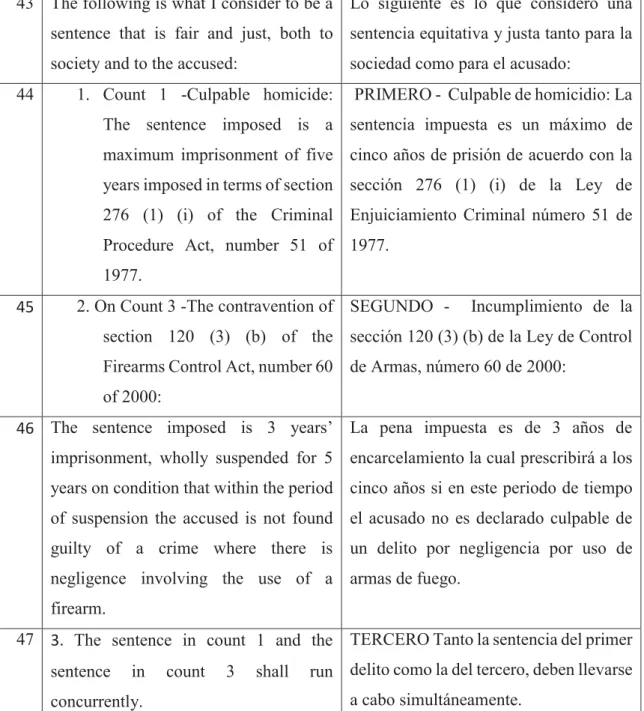
ST TT
1
IN THE HIGH COURT OF SOUTH AFFRICA GAUTENG DIVISION, PRETORIA.
CASE NO: CC113/2013 DATE: 2014-10-21
EN EL TRIIBUNAL SUPERIOR DE
SUDÁFRICA, GAUTENG,
PRETORIA.
RESOLUCIÓN: CC113/2013 FECHA: 21-10-2014
2 DELETE WHICHEVER IS NOT
APPLICABLE
TÁCHESE LO QUE NO PROCEDA
3 (1) REPORTABLE: YES/NO
(2) OF INTEREST TO OTHER JUDGES: YES/NO
(3) REVISED
(1): INFORME SÍ/NO
(2) DE INTERÉS PARA OTROS JUECES: SÍ/NO
(3) REVISADO
4 DATE FECHA
5 SIGNATURE FIRMA
6 In the matter between STATE and
OSCAR LEONARD CARL
PISTORIUS.
En relación con el caso entre el ESTADO y OSCAR LEONARD CARL PISTORIUS.
7 Accused Acusado
18
9 MASIPA J: The accused in this matter
has been found guilty of the following counts:
Juez MASIPA: En este caso, al acusado es culpable de los siguientes delitos:
10 1. One count of culpable homicide.
2. One count of contravention of section 120 (3)(b) of the Firearms Control Act 60 of 2000.
1. Delito de homicidio.
2. Delito por contravención del artículo 120 (3)(apartado b) de la Ley 60 de Control de Armas de Fuego del año 2000.
11 It now remains for me to sentence him. Ahora solo queda dictar sentencia.
12 At the outset it needs to be emphasized
that although I am sitting with two assessors in this matter, the decision on sentence is mine and mine alone.
Para comenzar, es necesario enfatizar que a pesar de actuar de forma colegiada en este caso, la decisión de la sentencia es mía y solo mía.
13 To reach an appropriate sentence, this
court is duty-bound to consider the nature and the seriousness of the offences that the accused has been found guilty of, the personal circumstances of the accused as well as the interests of society.
Para dictar una sentencia apropiada, este tribunal se ve obligado a tener en cuenta el carácter y la gravedad de los hechos por los que se ha declarado culpable al acusado, sus circunstancias personales, así como los intereses de la sociedad.
14 I am also duty-bound to take into
consideration the main purposes of punishment; namely retribution,
deterrence, prevention and
rehabilitation.
También estoy obligada a tener en cuenta los objetivos principales de la condena: la retribución, disuasión, prevención y la rehabilitación.
15 All these must be accorded due weight in
any sentence.
19
16 In S v RO and Another 2000 (2) SACR
248 (SCA), Heher JA said the following at paragraph 30:
En S contra RO y Otros 2000 (2) SACR 248 (SCA), la juez Heher afirmó lo siguiente en el párrafo 30:
17 “Sentencing is about achieving the right
balance or in more high-flown terms, proportionality.”
“Dictar sentencia es conseguir el equilibrio adecuado, o en términos más
formales, el principio de
proporcionalidad.”
18 The elements at play are the crime, the
offender, the interests of society with different nuance, prevention, retribution, reformation and deterrence.
Los elementos que intervienen son el delito, el agresor, los intereses de la sociedad matizados, la prevención, retribución, la reforma y disuasión.
19 Invariably these are overlaps that render
the process unscientific, even a proper exercise of the judicial function allows reasonable people to arrive at different conclusions.
Con frecuencia estos son coincidencias que hacen que el proceso de sentencia no sea exacto. Incluso un ejercicio acertado de la función judicial permite que distintas personas razonables lleguen a conclusiones diferentes.
20 Finding an appropriate sentence is a
challenge faced by criminal courts daily as sentencing is not a perfect exercise.
Dictar una sentencia apropiada es un reto que afrontan a diario los Tribunales de lo Penal ya que este es un ejercicio imperfecto.
21 What complicates this even more is that
there may be more than one appropriate sentence in a particular case.
Lo que complica incluso más este ejercicio, es la posibilidad de dictar más de una sentencia adecuada en un determinado juicio.
22 SS Terremblanche Guide to Sentencing
in South Africa, second edition, states
that an appropriate sentence as
La segunda edición del Manual de SS Terremblanche Guide to Sentencing in
20
determined by a trial judge need not be the only appropriate sentence.
que dicta un tribunal no es necesariamente la única.
23 On page 146, paragraph 3.1, line 5, the
learned author states the following:
En la página 146, parrafo 3.1, línea 5, el autor establece lo siguiente:
24 “In the light of the fact that the presiding
officer is endowed with a wide discretion in the imposition of the sentence, appropriateness tends to be subjective according to the views of the sentencing officer”
“A luz del hecho de que al oficial del juzgado se le otorga gran discreción al imponer la sentencia, lo que es apropiado tiende a ser subjetivo de acuerdo a la opinión del juez.”
25 In footnote 110 the author cites S v
Martin 1996 (2) SACR 378 (W) at 380 A-B in this regard.
En la nota a pie de página 110 el autor cita a S contra Martin 1996 (2) SACR 378 (W) en 380 A-B en referencia a este tema.
26 Also cited in the footnote is Smith v
Queen 1987 (34) CCC (3d) 97 at 109.
También cita en la nota a pie de página a
Smith contra Queen 1987 (34) CCC (3d)
97 en la 109.
27 “Sentencing, at the best of times, is an
imprecise and imperfect procedure and there will always be a substantial range of appropriate sentences.”
“Dictar sentencia, en la mejor de las ocasiones, es un proceso impreciso e imperfecto y siempre habrá una serie considerable de sentencias apropiadas.”
28 This was cited in S v Vries 1996 (2)
SACR 638 (Nm) at 643 F-G.
Esto se cita en S contra Vries 1996 (2) SACR 638 (Nm) en 643 F-G.
29 I now deal with the evidence in
mitigation and aggravation.
Ahora, procedo a analizar las pruebas de mitigación y agravación.
30 For a very good reason an appropriate
sentence should neither be too light, nor too severe.
21
31 The former may cause the public to lose
confidence in the justice system and people might be tempted to take the law into their own hands.
Lo primero podría provocar que la sociedad perdiese la confianza en el sistema judicial, y esto podría incitarla a tomarse la justicia por su mano.
32 On the other hand, the latter may break
the accused and the result may be just the opposite of what the punishment set out to do, which ultimately is to rehabilitate the accused and to give him an opportunity, where possible, to become a useful member of society once more.
Por otro lado, lo segundo podría dañar al acusado y el resultado podría ser opuesto a lo que se pretende conseguir con la pena, que a la larga es rehabilitar al acusado y darle la oportunidad, si es posible, de llegar a ser un miembro útil para la sociedad una vez más.
33 I have considered all the evidence placed
before me and all the submissions and argument by counsel.
He tenido en cuenta todas las pruebas presentadas ante mi, así como cada exposición de las posiciones y argumentos de hecho presentados por los abogados.
34 I have weighted all the relevant factors,
the purposes of punishment and all forms of punishment, including restorative justice principles.
He sopesado todas las circunstancias relevantes, tanto la finalidad como todos los tipos de condena posibles, incluyendo los valores de la justicia restaurativa.
35 I have also taken into account the
seriousness of the offence which led to the death of the deceased, the personal circumstances of the accused and the interests of society.
A su vez, he valorado la gravedad de los hechos que implican la muerte de la fallecida, las circunstancias personales del acusado y los intereses de la sociedad.
36 I have taken the particular circumstances
of the accused at the time of the offence into account.
22
37 Having regard to the circumstances in
matter, I am of the view that a non-custodial sentence would send a wrong message to the community.
Tras considerar las circunstancias del caso, opino que una pena restrictiva de la libertad podría enviar un mensaje equivocado a la sociedad.
38 On the other hand, a long sentence would
also not be appropriate either as it would lack the element of mercy.
Por otra parte, una pena de larga duración tampoco podría ser apropiada ya que carecería del principio de perdón.
39 A sentence cannot be said to be
appropriate without the feelings of mercy for the accused and hope for his reformation.
Una sentencia no se puede considerar adecuada sin expresar clemencia por el acusado y confiar en su rehabilitación.
40 (See S v Mhlongo 1994 (1) SACR 584
(A) at 588J- 589 B) I am mindful, however, of the fact that true mercy has nothing to do with weakness or maudling sympathy for the criminal, but is an element of justice. (See S v V 1972 (3) SA 611 (A) at 614)
(Véase S contra Mhlongo 1994 (1) SACR 584 (A) at 588J- 589 B). Sin embargo, soy consciente del hecho de que la clemencia real no tiene nada que ver con la debilidad o con la simpatía por el acusado, sino que es un elemento de la justicia. (Véase S contra V 1972 (3) SA 611 (A) at 614)
41 In respect of the conviction in count 3, I
have taken into account that no one was hurt, though the offence is a serious one, especially in the setting of a restaurant.
Respecto a la condena del tercer delito, he tenido en cuenta que nadie resultó herido a pesar de ser un delito grave, especialmente siendo el escenario un restaurante.
42 I do not believe that the degree of negligence in respect of this count, that is count 3, justifies a sentence of direct imprisonment.
23
43 The following is what I consider to be a sentence that is fair and just, both to society and to the accused:
Lo siguiente es lo que considero una sentencia equitativa y justa tanto para la sociedad como para el acusado:
44 1. Count 1 -Culpable homicide: The sentence imposed is a maximum imprisonment of five years imposed in terms of section 276 (1) (i) of the Criminal Procedure Act, number 51 of 1977.
PRIMERO - Culpable de homicidio: La sentencia impuesta es un máximo de cinco años de prisión de acuerdo con la sección 276 (1) (i) de la Ley de Enjuiciamiento Criminal número 51 de 1977.
45 2. On Count 3 -The contravention of
section 120 (3) (b) of the Firearms Control Act, number 60 of 2000:
SEGUNDO - Incumplimiento de la sección 120 (3) (b) de la Ley de Control de Armas, número 60 de 2000:
46 The sentence imposed is 3 years’
imprisonment, wholly suspended for 5 years on condition that within the period of suspension the accused is not found guilty of a crime where there is negligence involving the use of a firearm.
La pena impuesta es de 3 años de encarcelamiento la cual prescribirá a los cinco años si en este periodo de tiempo el acusado no es declarado culpable de un delito por negligencia por uso de armas de fuego.
47 3. The sentence in count 1 and the
sentence in count 3 shall run concurrently.
TERCERO Tanto la sentencia del primer delito como la del tercero, deben llevarse a cabo simultáneamente.
Table 5: ST translation into the TL (Spanish) Source: Compiled by the author. 5. ANALYSIS AND TRANSLATION PROBLEMS
24 5.1 Terminological problems and solutions
5.1.1 Multiple word technical expressions
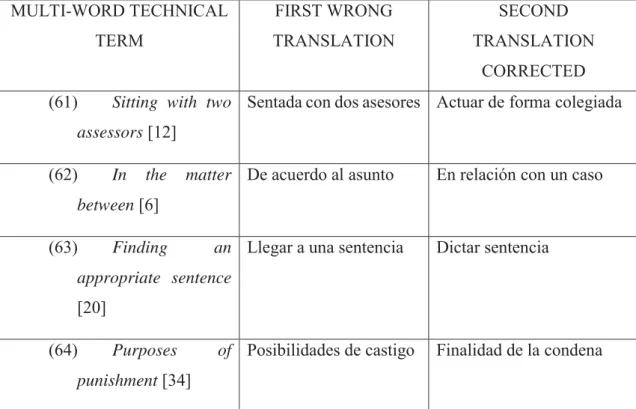
Along the source text, we observe different multi-word technical terms. One of the difficulties encountered, when we translated the source text, was to find the equivalents to these types of terms. For instance, we had to decide whether to translate in a literal way or not. In the first draft of our translation, we made some mistakes according to this point. Nevertheless, we solved them using the specialized glossaries and dictionaries listed above. In the following table we present multi-word technical terms with the first translations and their corrections after consulting an expert.
MULTI-WORD TECHNICAL TERM
FIRST WRONG TRANSLATION
SECOND TRANSLATION
CORRECTED
(61) Sitting with two
assessors [12]
Sentada con dos asesores Actuar de forma colegiada
(62) In the matter
between [6]
De acuerdo al asunto En relación con un caso
(63) Finding an
appropriate sentence
[20]
Llegar a una sentencia Dictar sentencia
(64) Purposes of
punishment [34]
Posibilidades de castigo Finalidad de la condena
Table 6: Multiword technical terms translation. Source: Compiled by the author. 5.1.2 Semi-technical vocabulary
Semi-technical terms are those terms with different meanings which are used not only in everyday life, but also in the field of law (vid supra 2.2.3). Due to this, the translator has
25
translators will be able to acquire the precision they are looking for. In the source text, there are some semi-technical terms of this nature. For instance, the term case has different
meanings in a legal context. Cuzon’s Longman Dictionary of Law (2007, 80) defines it as “a
legal action or trial”, andas the “argument put forward in legal proceedings.” In the source text, the term appears in the following context:
(65) What complicates this even more is that there may be more than one appropriate sentence in a particular case. [21]
The different translations for the term “case” are: caso; pleito; acción; defense; juicio
and causa (Bodoutchain-Sáiz, 2000: 223). At the beginning, we had some doubts about if we
should translate it as caso oras juicio, because these were the terms we considered more
appropriate for the translation. At the end, due to the context in which the term was used, we decided to translate it as juicio.
Another example would be the term act. If we look up this term in any of the specialized
dictionaries, we will find many definitions for it. Therefore, we decided to study the context in which it appeared in order to choose the right option. The context was:
(66) “Firearms Control Act 60 of 2000.” [45]
Here the term act is functioning as a noun. The semi-specialized term act has different
meanings therefore, the translator should pay special attention to the context. According to Cambridge Dictionary (2016), act as a noun in the general language means “something that
you do.” Nevertheless, if we look for the technical definition, the one provided by the same
dictionary is: “a law or formal decision made by a parliament or other group of people who make the laws for their country”. This second definition is going to be the one used in the translation. Therefore, the term act is not going to be translated as actuación, but as ley.
The last instance we would like to provide is the term count. This term meant for
us some difficulties. On the one hand, in the first draft of the translation, we translated it as
cargo. However, after looking for different parallel texts using CENDOJ database, we
realized that the most precise equivalent into Spanish would be the term delitos.
26
general meanings when they are used as technical words of a specialized subject field. This is what we are going to demonstrate along the following section.
5.1.3 Everyday vocabulary
These types of terms are quite frequent in criminal English (Alcaraz and Hughes, 2002: 161). Even though they may sound familiar to us, sometimes it is difficult to translate them due to the context. The main solution to this problem was the use of different parallel texts in order to see how these terms are used in the target language (vid infra 7.2.1).
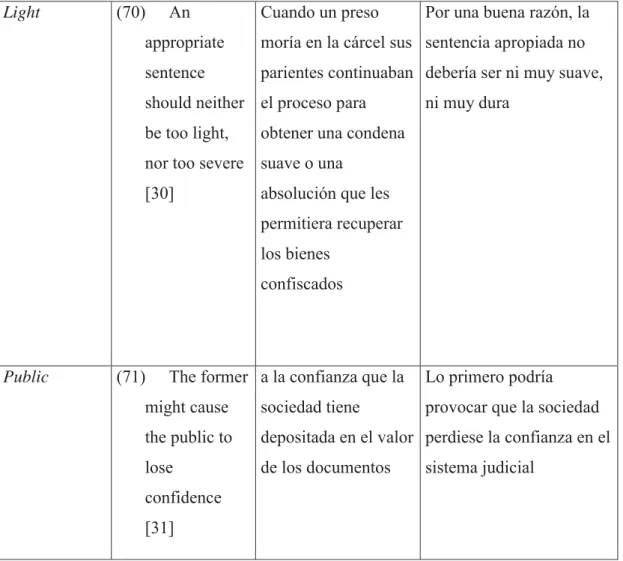
In the following table, we provide a list of 5 terms selected from the ST. Each of them is used in the general language, but they acquire a new meaning as sub-terms within legal language.
TERM ST PARALLEL TEXT TT
Delete (67) Delete
whichever is not applicable [2]
[(*) táchese lo que no proceda]
Táchese lo que no proceda.
Found
(68) The
accused in this matter has been found guilty of the following counts:
le sirvió de base para declarar culpables a los acusados
Al acusado en este caso se le declara culpable de los siguientes delitos:
Severe (69) An
appropriate sentence should neither be too light, nor too severe [30]
Sentencia clara y dura
27
Light (70) An
appropriate sentence should neither be too light, nor too severe [30]
Cuando un preso moría en la cárcel sus parientes continuaban el proceso para obtener una condena suave o una
absolución que les permitiera recuperar los bienes
confiscados
Por una buena razón, la sentencia apropiada no debería ser ni muy suave, ni muy dura
Public (71) The former
might cause the public to lose
confidence [31]
a la confianza que la sociedad tiene
depositada en el valor de los documentos
Lo primero podría provocar que la sociedad perdiese la confianza en el sistema judicial
Table 7: Everyday vocabulary translation. Source: Compiled by the author.
As we can observe in these examples, words used in daily life namely delete (borrar),
find (encontrar), severe (severo), light (luz, suave) or public (público) have different
meanings in the legal context.
5.1.4 Collocations
Collocations are “particular lexical combinations found with some regularity in lexical texts” (Alcaraz and Hughes, 2002: 167). Lexical collocations may be useful or a barrier for translators. Translators have to pay attention to the context in which a term appears. One of the instances found in the text is the word sentence. The tool TermoStat Web was used in
28
Sentence
Grammatical Category
ST TT
As a verb (72) It now remains for me
to sentence him [11]
Sólo queda dictar sentencia
(73) Sentencing is
about…[17]
Dictar sentencia es…
(74) Guide to sentencing
[22]
Manual para dictar sentencia2
As a noun (75) The decision on
sentence [12]
(76) To reach an
appropriate sentence [13]
(77) Due weight in any
sentence [15]
La decisión de la sentencia
Para dictar una sentencia apropriada3
El debido peso en cualquier sentencia
As an adjective (78) Sentencing officer [24] Secretario del Tribunal
Table 8: Collocations of the word sentence. Source: Compiled by the author.
False friends are one of the main sources of translator’s pitfalls. False friends are also known as false cognates. Hayward and Moulin (1984) state the following definition according to Saussure terminology:
“In the learner’s mother tongue a particular significant is associated with a particular signifie. Once the significant appears, even in a foreign language context, the above mentioned association is so strong that the user automatically thinks of his mother-tongue signifié (in its totally)” (Hayward and Moulin, 1984: 190).
2 In the translation this structure would not be translated as there is not a translation of the title in our language. Nevertheless, we wanted to show its possible translation according to the collocation.
29
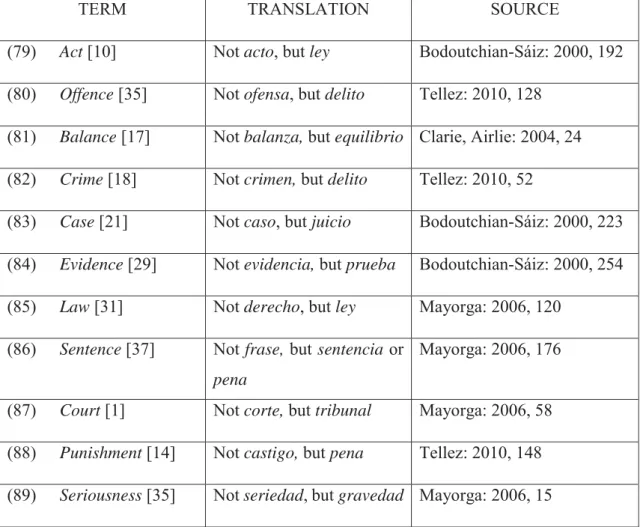
How can the translator avoid making this mistake defined by Hayward and Moulin? During the process of translation, we realized that the best solution for this was the use of specialized written dictionaries and glossaries in the field. In the following table, we provide a list of eleven false friends found in the source text with their equivalents into Spanish.
TERM TRANSLATION SOURCE
(79) Act [10] Not acto, but ley Bodoutchian-Sáiz: 2000, 192
(80) Offence [35] Not ofensa, but delito Tellez: 2010, 128
(81) Balance [17] Not balanza, but equilibrio Clarie, Airlie: 2004, 24
(82) Crime [18] Not crimen, but delito Tellez: 2010, 52
(83) Case [21] Not caso, but juicio Bodoutchian-Sáiz: 2000, 223
(84) Evidence [29] Not evidencia, but prueba Bodoutchian-Sáiz: 2000, 254
(85) Law [31] Not derecho, but ley Mayorga: 2006, 120
(86) Sentence [37] Not frase, but sentencia or
pena
Mayorga: 2006, 176
(87) Court [1] Not corte, but tribunal Mayorga: 2006, 58
(88) Punishment [14] Not castigo, but pena Tellez: 2010, 148
(89) Seriousness [35] Not seriedad, but gravedad Mayorga: 2006, 15
Table 8: False friends. Source: Compiled by the author.
Even though there are terms that cannot be considered false friends, their equivalents into Spanish are usually different from the one the reader expects. Some examples are
reformation (rehabilitación), balance (equilibrio), public (sociedad) or severe (duro). To
30 5.1.5 Lexical repetition
Lexical repetition may be a problem for translators as sometimes it is difficult to decide whether to use the same equivalent of a term or a synonym. The use of synonyms could imply the loss of meaning or precision in some contexts. In the source text, the word
appropriate is repeated ten times. Therefore, in order to make the language sound as natural
as possible, we used some synonyms such as adecuada,apropiada, and justa.
It has to be noted that English has a grammatical structure in which the subject cannot disappear, but Spanish grammatical structures allow its omission. One of the main translator’s aims is to keep the harmony of the text. For this reason, we have tried to maintain the Spanish grammatical style in order to make the target text sound as natural as possible. For instance:
(90) It now remains for me to sentence him [11]
Our translation was “Ahora solo queda dictar sentencia”. Here we decided not to specify the subjects involved in the action as we thought it was more adequate to the level of formalism of the text.
(91) Although I am sitting with two assessors in this matter, the decision on sentence is
mine and mine alone [12]
In this example the same happens: “A pesar de actuar de forma colegiada, la
decisión de la sentencia es mía y solo mía”. We decided to omit the first person singular pronoun in the target language as it would make the text to sound unnatural.
(92) Finding an appropriate sentence is a challenge faced by criminal courts dialy as
sentencing is not a perfect exercise: [20]
In this example, as a way to avoid a cacophony, we considered that it was necessary to substitute the second sentencing for a determinant: “Dictar una
sentencia apropiada es un reto que afrontan a diario los Tribunales de lo Penal ya
que este es un ejercicio imperfecto”
(93) What complicates this even more is that there may be more than one appropriate
31
In this last example, we made a transposition from the passive voice to the active. Besides, we realized that the best thing to do was to omit the translation of the term appropriate as its meaning was compensated by the translation of the term
only. Therefore, the translation would be “La sentencia que dicta un tribunal no
es necesariamente la única”.
Connectors are another element used in the translation process to avoid the repetition of structures. During the process of translation, we realized that its use is useful in order to introduce them in order to create a better translation. In Spanish, the use of connectors makes the language sound balanced and natural. Here is an example:
ST TT
(94) I have considered (…) [33]I have
weighted (…)[34] I have also (…) I have
taken [35]
He tenido en cuenta (…). He sopesado (…) A su vez, he valorado (…) Así
como (…)
Table 9: Use of connectors. Source: Compiled by the author. 5.1.6 Abbreviations
In a previous section (vid supra 2.2.3), we analyzed the use of abbreviations in the ST. Nevertheless, we did not focus on the problems the translator could encounter during the process of translation. When we translated the source text, we realized that the translation of abbreviations was a difficult task to do as many of them did not have an equivalent into the target language. Due to this problem, we became aware of the important role documentation plays in order to achieve the perfect translation. For instance, we realized that the numbers that appeared between brackets along the source text were articles of a law. We decided to translate them in order for the reader to understand their meaning. Therefore, the sentence (95) one count of contravention of section 120 (3)(b) [10] was translated as delito por
contravención del artículo 120 (3) (apartado b). On the other hand, terminological glossaries
32
5.2 Grammatical problems. The use of transpositions as a solution
According to Hughes and Alcaraz, lexical decisions about how to translate a term will depend, in a way, on syntax. Thus, the translator has to find a natural equivalence into the target language without losing meaning (2002: 178). Sometimes the problem may be that the translator needs to change the grammatical category of the source text. This problem may be solved by the use of transpositions.
5.2.1 Transpositions
“By transposition is meant the substitution of one grammatical category for another,
on the basis that both may be fairly said to process the same semantic weigh or equivalent
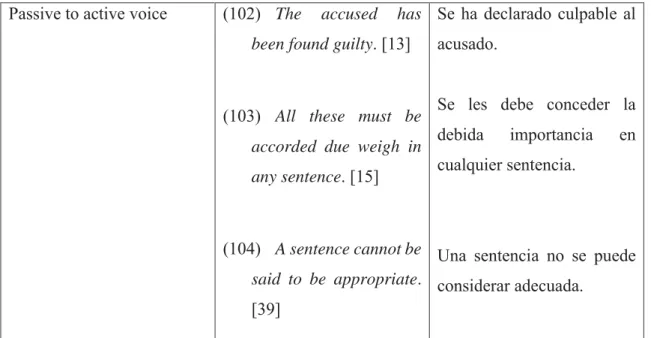
semantic density” (Alcaraz and Hughes: 2002, 181). The following examples are six transpositions processes followed along the translation:
TRANSPOSITION SL TL
Adjective to noun (96) Criminal courts.
[20]
Tribunales de lo Penal
Verb to adjective (97) It needs to be. [12] Es necesario
Noun to verb (98) Without the feelings
of mercy for the accused
and hope for his
reformation. [39]
Sin expresar perdón al acusado y confiar en su rehabilitación
Adverb to preposition (99) Invariably. [19]
(100) Concurrently. [47]
Con frecuencia. Al mismo tiempo.
Indefinite to definite article (101) To give him an
opportunity. [32]
33
Passive to active voice (102) The accused has
been found guilty. [13]
(103) All these must be
accorded due weigh in
any sentence. [15]
(104) A sentence cannot be
said to be appropriate.
[39]
Se ha declarado culpable al acusado.
Se les debe conceder la debida importancia en cualquier sentencia.
Una sentencia no se puede considerar adecuada.
Table 10: Transpositions Source: Compiled by the author. 5.2.2 The complex noun phrase
Alcaraz and Huges state that “the long noun phrase that is a feature of English and
other Germanic languages presents some problems to the translator of technical text in
particular” (Alcaraz and Hughes, 2002: 186). These long noun phrases make the translator doubt about the order of the pre-modifiers and post-modifiers of the complex noun phrases in the target language. The solution provided by Alcaraz and Hughes is to adapt them by terms of transposition (2002: 186), and to adapt them according to the syntactic order of the target language. Therefore, we solve this problem by adapting them to the syntactical order of the Spanish language using different transpositions. These are examples selected from the ST.
(105) Useful member of society: Un miembro útil para la sociedad [32]
(106) Restorative justice principle: los valores de la justicia restaurativa [34]
(107) One count of contravention of section: Delito por contravención de la sección [10]
34 6 CONCLUSION
35 7 BIBLIOGRAPHY
7.1 Primary sources
Alcaraz Varó, Enrique, Miguel Angel Campos Pardillos, and Cynthia Miguélez. El inglés jurídico norteamericano. Barcelona: Ariel, 2002. Print
Alcaraz Varó, Enrique, and Brian Hughes. Legal translation explained. Manchester: St.
Jerome, 2002. Print
Cao, Deborah. Translating law. Great Britain: MEPG Books, 2007. Print
Crystal, David. The stories of English. London: Penguin Books, 2005. Print
Dahl Henry. Spanish and English legal dictionary. Diccionario jurídico inglés-español. New
York: Mc Graw Hill, 2004. Print
Freeman, Michael, and Fiona Smith. First- person perspectives in legal decisions. Law and language: Current legal issues. Great Britain: Oxford University Press, 2013. Print
Hayward, Timithy, and André Moulin. "False friends invigorated." http://www.euralex.org/elx_proceedings/Euralex1983/029_Timothy%20Hayward%20
&%20Andre%20Moulin%20%20(Liege)%20-%20False%20friends%20invigorated.pdf .Web. (date of access: 18/05/2016)
Huddleston, Rodney, and Geoffrey K. Pullum. The Cambridge grammar of the English language. Cambridge: Cambridge University Press, 2002. Print
Masipa, Thokozile. Oscar Leonard Carl Pistorius legal sentence. Gauteng division, Pretoria:
High Court of South Africa, 2014. Print
Mauranen, Ana, and Elina Ranta. English as a lingua franca: Studies and findings.
Newcastle: Cambridge Scholars Publishing, 2009. Print
Mellinkoff, David. The language of the law. Oregon: Resource Publications, 2004. Print
Méndez, Cendón, Beatriz. Traducción de leguajes especializados II (Inglés/Español): Ciencia y técnica. Class Notes. Valladolid: University of Valladolid, 2016. Print
Wyness, Robert. “The Lineage of Some Procedural Words.” American Bar Association Journal. December .1939: 1023-1029. Web
Searle, John. "How performatives works." University of Calofornia.
36
Ristikivi, Merike. "Latin: The Common Legal Language of Europe?" University of Tartu.
2005. http://www.juridicainternational.eu/public/pdf/ji_2005_1_199.pdf .Web. (date of access: 02/05/2016).
Tiersma, Peter M. Legal language. Chicago: The University of Chicago Press, 2000. Print
Williman, Daniel. Legal terminology. An historical introduction to the technical language of law. 2007. http://www.corsanoandwilliman.org/latin/work/legalterminology.htm#ch
.Web. (date of access: 02/05/2016)
7.2 Secondary sources
Alcaraz Varó, Enrique, and Hughes, Brian. Diccionario de términos jurídicos. A dictionary of legal terms: Inglés-español, Spanish-English. Barcelona: Ariel, 2012. Print
Curzon, Leslie, and Paul Richards. The longman dictionary of law. England: Pearson
Education, 2007. Print
Bodoutchian-Sáiz, Veronique. Bilingual dictionary of legal and business terms. Madrid:
Fundación Confemental, 2000. Print
Clinch, Peter, Duncan Montgomery, and Jackson Cathie. “Cardiff Index to Legal Abbreviations.” http://www.legalabbrevs.cardiff.ac.uk/. Web. (date of access: 15/05/2016)
“Collins Dictionary”. HarperCollins Publishers. http://www.collinsdictionary.com/.Web. (date of access: 02/04/2016)
CENDOJ: Buscador del sistema de jurisprudencia.
http://www.poderjudicial.es/search/indexAN.jsp. Web. (date of access: 07/03/2016)
Dabelstein, Niels. Glossary of key terms in evaluation and results based management.
http://www.oecd.org/development/peer-reviews/2754804.pdf. Web. (date of access: 08/05/2016)
Dictionary.com. http://content.dictionary.com/. Web. (date of access: 28/005/1993)
Douglas, Harper. Diccionario etimológico. http://www.etymonline.com/. Web. (date of
access17/04/2016)
Drouin, Patrick. TermoStat Web http://termostat.ling.umontreal.ca/index.php?lang=en_CA.
37
Merriam Webster Dictionary. http://www.merriam-webster.com/. Web. (date of access:
1/06/2016)
Villar, Celia. Diccionario Espasa jurídico. Madrid: Espasa, 2001. Print
7.2.1 Parallel texts
1.
CENDOJ: Buscador del sistema de jurisprudencia.
http://www.poderjudicial.es/search/doAction?action=contentpdf&databasematch=AN&refe rence=7713997&links=agravacion&optimize=20160620&publicinterface=true. Web. (date of access: 07/03/2016)
38
CENDOJ: Buscador del sistema de jurisprudencia.
http://www.poderjudicial.es/search/doAction?action=contentpdf&databasematch=AN&refe rence=6544416&links=%22tachese%20lo%20que%20no%20proceda%22&optimize=2012 1122&publicinterface=true
Web. (date of access: 07/03/2016)
3.
CENDOJ: Buscador del sistema de jurisprudencia.
http://www.poderjudicial.es/search/doAction?action=contentpdf&databasematch=TS&refe
rence=7712956&links=%22ni%20por%20el%20juez%20de%20instancia%22&optimize=
20160617&publicinterface=true. Web. (date of access: 07/03/2016)
4.
CENDOJ: Buscador del sistema de jurisprudencia.