FACULTAD de FILOSOFÍA Y LETRAS
DEPARTAMENTO de FILOLOGÍA INGLESA
Grado en Estudios Ingleses
TRABAJO DE FIN DE GRADO
ENGLISH PHRASAL VERBS IN THE PRODUCTION OF L2
LEARNERS: ARE PHRASAL VERBS THAT DIFFICULT FOR
Irene García Cristóbal
17 de junio de 2014
Tutora: Raquel Fernández Fuertes
ABSTRACT
English phrasal verbs are widely known as one the most difficult aspects for second language (L2) students. This study investigates some of the reasons for that difficulty through the analysis of data collected from a group of L1 Spanish speakers studying English as an L2. The analysis of the data shows (1) that these participants have a clear preference for one-word lexical verbs thus avoiding phrasal verbs when they use English and (2) that they lack general grammatical knowledge of this verb type. The study points to a combination of factors that are responsible for this difficulty for English learners and these include the following: specific grammatical properties of phrasal verbs, teaching methodology and cross linguistic influence from the native language.
Phrasal verbs, avoidance, English learners, Spanish natives, cross linguistic influence
Los verbos frasales son considerados uno de los aspectos mas difíciles de la gramática inglesa para los estudiantes de lenguas segundas. Este trabajo investiga algunas de las razones que subyacen a esta dificultad a través del análisis de datos obtenidos de un grupo de nativos de español que estudian inglés como segunda lengua. El análisis de datos revela que (1) estos participantes muestran una preferencia clara por evitar el uso de verbos frasales y los sustituyen por verbos léxicos sin partícula y que (2) el conocimiento gramatical de este tipo de verbos es en general muy reducido. El estudio apunta a la combinación de factores responsables de esta dificultad entre los que están los siguientes: las propiedades gramaticales de los verbos frasales, la metodología usada en la enseñanza y la influencia interlingüística de la lengua nativa.
Index
Foreword: Contextualization of the dissertation 1-2
Introduction 3
1. Theoretical description and previous works: Phrasal verbs 4-7
2. Objectives and research questions 7-9
3. Empirical study on phrasal verbs
3.1. Participants 9
3.2. Data elicitation process: the tasks 9-12
3.3. Data classification, description and analysis 12-13
3.3.1. Multiple choice task 13-15
3.3.2. Translation task 16-19
3.3.3. Comparison across tests 19-22
4. Conclusions 22-23
1
Foreword: Contextualization of the dissertation
The undergraduate dissertation that follows constitutes the final formal requirement to complete the degree in English Studies at the University of Valladolid. The topic of this dissertation is framed in the A2 subject “Scientific description of the English Language”
as reflected in the teaching guide 2014.
More specifically, this dissertation is on phrasal verbs. I have chosen this particular aspect of the English grammar because I think it is problematic for students of English as a second language (L2). This means that the analysis of phrasal verbs and of how Spanish speakers learning English produce this type of structure could provide me with very useful information at least in three respects. First, as a non-native speaker, doing research on this specific area will help me master it; second, as a researcher, I will be familiar with the research procedure of analyzing previous works, deciding on my own research questions, designing my own test and codifying and interpreting the data I have elicited, all this with respect to this problematic area of grammar; and third, as a future English teacher, knowing where some grammar difficulties lie and know they could be overcome will make me aware of them and worth considering as part of my teaching methodology.
This dissertation has offered me the opportunity to undertake independent research on a specific grammar property (i.e. phrasal verbs) and has enabled me both to explore this topic in more depth than in an assignment essay and to point to how the teaching of English as a foreign language could be benefited from a grammatical analysis. Because of my own interest on research as well as on teaching, two of the most common professional activities related to my degree, I have established a link between them and this has helped me orient my future professional career.
2
While working on phrasal verbs, I have initially carried out a bibliographical search using the resources available in the faculty library, both on-line and off-line, as well as internet resources such as articles, books and web sites. This has strengthened both general and specific competences like the following:
Capacity to analyze and systematize conceptualization and abstraction. Ability to manage technological means and resources.
Research skills: investigation techniques and documentation. Skills on managing information.
Ability to identify, manage and synthesis bibliography.
Ability to manage specific technological means and resources related to the main professional possibilities of the degree.
Although I have been working under the supervision of my tutor, I have been able to develop my own research work by eliciting new linguistic data whose analysis is presented in this dissertation. This way of working reflects general competences such as the following:
Autonomous learning.
Ethic, critic and constructive spirit. Creativity.
Ability to solve problems.
Given that the focus of my work is not only on grammatical description but on accounting for the type of structures that L2 learners produce in a given teaching context, my dissertation also covers specific competences like the ones below:
Capacity to write and speak in the English language.
Capacity to understand and produce in the English language texts related to the main professional possibilities of the degree.
3
Introduction
English phrasal verbs are widely believed to be particularly difficult to master for learners of English as a second language (L2). In this respect, Kurtyka (2001) points out that reasons for the difficulty in the learning of phrasal verbs, common to many learners irrespective of their mother tongue, include the ones that follow:
The existence of more than one meaning attached to an individual phrasal verb (e.g. put down = take notes or slaughter)
The complexity of grammar (e.g. word-order issues, the transitive/intransitive dichotomy)
Collocational association of the same verbal head with different particles (e.g. put down, put up, put forward)
Although English phrasal verbs are very common in everyday language, they are one of the most difficult parts to learn for Spanish learners of L2 English. This study investigates possible reasons for that difficulty by analyzing data obtained from a group of high school students of English as an L2. Learners of English sometimes avoid using phrasal verbs so this study also investigates if Spanish learners avoid using phrasal verbs when they use English as their language of communication. If it is the case, some possible reasons for this avoidance will be proposed.
4
1.
Theoretical description and previous works: Phrasal verbs
Phrasal verbs are one of the most relevant features of the English language. This is evident in that they are always a topic of discussion both in text-books (e.g. Wheeldon
and Campbell 2008) and grammars (e.g. Huddleston and Pullum 2002). The term
“phrasal verb” makes reference to its most important and defining features: the idea that they are “phrases” which refers to the minimum unit of analysis in syntax and the fact
that functionally they are verbs although they differ from other verbs in precisely the first feature, i.e. that they are constituted by two or three elements instead of just one. They have been considered as a problematic structure for learners of English for many centuries. In this respect, Thim (2012, 1) quoting Johnson’s (1775) preface to A Dictionary of the English Languagestates the following:
There is another kind of composition more frequent in our language than perhaps in any other,
from which arises to foreigners the greatest difficulty. We modify the signification of many
verbs by a particle subjoined; to break off, to stop abruptly, to fall on, to attack…
A phrasal verb, as stated above, incorporates more than one element and, more specifically, it consists of a lexical verb and one o more particles. The particle may be an adverb (as in 1a), a preposition (as in 1b), or acombination of the two (as in 1c).
(1) a.The babysitter looks after my little baby. [tend] b.When I was in school, I got up at seven. [rise] c.I amlooking forward toyour return. [awaiting]
As suggested by the correlations in (1), another important characteristic of phrasal verbs is that, normally, they can be replaced by a one-word lexical verb. However, and except for some few cases (e.g. carry on = continue) there is not a total correspondence between them, neither in terms of meaning nor in terms of use.
In terms of their usage, phrasal verbs appear most commonly in fiction and conversation while they are relatively rare in academic prose. In fiction and conversation, phrasal verbs occur almost 2,000 times per million words, as shown by Biber et al. (1999).
5
1. Prepositional verbs which are also called non-separable verbs. They are formed by a verb + preposition. (e.g. to believe in, to talk about).
2. Phrasal verbs which are also called separable verbs and which include a verb + a particle adverb (e.g. put off, turn down). In this group two subtypes can be distinguished:
2.1. Separable transitive phrasal verbs that take a direct object: with most transitive phrasal verbs, the particle can either precede or follow the direct object (e.g. turn on the light, turn the light on) although this word-order difference depends on the nature of the direct object (i.e. a full DP or a pronoun) and on the length of the DP direct object (i.e. short or long).
2.2. Separable intransitive phrasal verbs that do not take a direct object: most of the particles are place adjuncts or can function as such. Normally the particle cannot be separated from its verb (e.g. drink up quickly, *drink quickly up).
3. Prepositional phrasal verbs which are also called phrasal prepositional verbs, or three-word verbs. They are formed by a verb + a preposition+ anadverb (e.g. get on with, look forward to).
The traditional classification given above focuses its attention on the nature of the particle (whether the particle is a preposition, an adverb, or both). However, there are other types of classifications and the one that has been followed in this study focuses rather on the semantic relationship between the verb and the particle which make up the phrasal verb.
It is clear that the meaning of the particle is related to the degree of idiomaticity of phrasal verbs and, if we focus our attention in this aspect, phrasal verbs can be classified into three different types, as pointed out by Dagut and Laufer(1985):
1. Literal or transparent phrasal verbs whose meaning equals the meaning of their individual components (e.g. go up = go + up).
6
completion meaning, the meaning of the phrasal verb will coincide with the actual meaning of the verbal head (e.g. cut off= cut something completely).
3. Figurative phrasal verbs whose meaning cannot be deduced even if you know the meaning of its components. The new meaning is the result of a metaphorical shift of the individual components (e.g. carry off = win a prize).
Using the classification of phrasal verbs just presented, Liao and Fukuya (2004) offer a study on the production of phrasal verbs by L2 English speakers. Their participants are divided into three different groups:
1. 30 Native speakers of Chinese with an advanced level of English. 2. 40 Native speakers of Chinese with an intermediate level of English. 3. 15 Native speakers of English who were undergraduate students at the
University of Hawai.
These participants took three different tasks (i.e. a multiple choice task, a translation task and a recall task) but not all of them took all the tasks. The fifteen native speakers of English took the multiple choice task. Of the 30 advanced learners, 10 took the multiple choice, 10 the translation task and 10 the recall task. Of the 40 intermediate learners, 15 took the multiple choice, 15 the translation task and 10 the recall task.In these tasks they had to either use or produce a phrasal verb or a one-word lexical verb, depending on the task.
7
intermediate learners’ production of figurative phrasal verbs was lower than that of
transparent or literal phrasal verbs.
Finally, given the results, the authors speculated that the advanced Chinese learners’ exposure to the L2 environment might have been an important factor in their non-avoidance of phrasal verbs in contrast with the intermediate learners’ non-avoidance. They provide evidences for three factors that affect Chinese learners’ avoidance of phrasal verbs which are the following:
1. Proficiency levels 2. Phrasal verb types 3. Test types
The present study focuses on the classification of phrasal verbs proposed by Dagut and Laufer (1985) and takes as a point of departure the empirical work by Liao and Fukuya (2004). However, there are other classifications of phrasal verbs that take the particle as the point of analysis. In this way phrasal verbs are classified in terms of the particle used (e.g. up, down, in, out, back, …). In the Collins Cobuild Dictionary of Phrasal verbs, the most common phrasal verb particles are said to be up, out, off, in and down in descending order of frequency. Although all of them have literal uses related to positions in space, most of them have figurative uses such as up or down which are often equated metaphorically with quantities and with power. For example if an amount goes up it becomes larger, if it goes down it becomes smaller (Rundell 2005).In order to reflect representativeness not only on phrasal verb type but also on phrasal verb particles this study focuses on two of the most productive phrasal verb particles which are up and off.
2.
Objectives and research questions
8
possibilities may appear when analyzing the data: first that students make a correct use of phrasal verbs, second that they try to avoid the use of this specific structure and third that students make an incorrect use of phrasal verbs.
If the use of phrasal verbs is avoided, the study will investigate the possible reason for this avoidance. In particular, the following research questions arise in this respect:
1. Avoidance and phrasal verb type: is avoidance equally reflected in the different type of phrasal verbs? And so, are transparent phrasal verbs avoided at a higher rate if compared to figurative ones?
2. Avoidance and the participants’ mother tongue (L1): does the fact that phrasal verbs do not exist in Spanish affect the avoidance of the experimental structures?
3. Avoidance and the teaching methodology: in what degree does the way in which phrasal verbs are explained in Spanish text books affect the way in which L2 learners actually produce phrasal verbs?
Having as a point of departure Liao and Fukuya’s (2004) study as well as Dagut and Laufer’s (1985) semantic classification of phrasal verbs, four hypotheses can be proposed in order to provide an answer to the questions above.
1. The type of phrasal verb: since the meaning of transparent phrasal verbs can be deduced from the meaning of its components, participants would have a higher percentage of expected answers in transparent phrasal verbs rather than in figurative phrasal verbs, in line with Liao and Fukuya’s (2004) results.
2. The role of the L1: given that no phrasal verbs appear in the participants’ L1, avoidance is expected as well as a higher preference for single-word verbs instead of their phrasal correlates.
3. The teaching methodology: students are supposed to have a higher rate of expected answers in those phrasal verbs they have already studied.
9
have to select the most suitable one, and a translation task in which the participants have to produce the experimental structures by translating from Spanish into English. So, regarding the two types of tests, and given that the translation task is more demanding than the multiple choice one, a lower degree of accuracy is expected in the translation task.
Different correlations can also be established by combining the hypotheses just presented. For instance, it would be expected that the avoidance strategy (hypothesis 2) is used in the translation task in a higher degree than in the multiple choice one (hypothesis 4). Besides, transparent phrasal verbs (hypothesis 1), and in particular the transparent phrasal verbs that these participants have studied previously in class (hypothesis 3), are the ones that are expected to be produced/chosen more accurately.
3.
Empirical study on phrasal verbs
In order to test these hypotheses, the empirical study presented in this section has been carried out. This includes a description of the participants that took part in the experiment, the tasks I have designed to elicit data from these participants and the data classification and analysis I have carried out.
3.1
Participants
Twenty-two high school students participated in this study. They are Spanish L1 speakers who are learning English as an L2. They are supposed to have an intermediate level of proficiency in the English language, given that they are all in the same year group. They have studied English for 8 years (3 years in primary school and 5 years in high school including post-compulsory education.)
3.2
Data elicitation process: the tasks
10
Before each task is described, I will present some initial considerations that have guided the design of both tasks.
In the design of the tasks, I have focused on two particles, up and off, because they are two of the most productive particles in order to form phrasal verbs in English (Sánchez Benedito1994). Thus, all phrasal verbs selected for these tasks consist of a lexical verb + the particles up or off. Furthermore these phrasal verbs have been divided into three different types, following Dagut and Laufer’s (1985) classification and as it was presented in section 1 above.
In this respect, examples of the phrasal verbs used appear in (2) where (2a) corresponds to literal or transparent phrasal verbs, (2b) to completive phrasal verbs and (2c) to figurative phrasal verbs:
(2) a. They go up the stairs in the park. b. Kate cut off the meat.
c. I would like to take up a secretary course.
Furthermore, in the design of the two tasks two issues were taken into consideration: in the case of transitive verbs, all direct objects were DPs and not pronouns so that word-order issues did not interfere with the task; the vocabulary included in the structures was simple so that this would not interfere with the comprehension of the experimental sentences.
Regarding the phrasal verbs type division, it is important to say that the three-type division of phrasal verbs contains a sub-division since transparent phrasal verbs were divided into two subtypes: transparent phrasal verbs which appear in student’s text book (transparent [+ instruction]) and those that do not appear in the book (transparent [ – instruction]).
11
verbs. An example of each of these structures appears in (3) for experimental structures and in (4) for distractors.
(3) The people at the back can't hear you, speak up [Transparent] Kate will finish up her thesis by March [Completive]
The thief and his gang hold up a grocery store. [Figurative]
(4) Doctors say that it is very healthy to run twenty minutes every day
The participants were asked to fill in the blank with one of the four verbs presented below the sentence, as example (5) illustrates: the correct phrasal verb (5c in this case), an equivalent one-word lexical verb (5a), an incorrect phrasal verb (5b) and a non-equivalent one-word lexical verb (5d).
(5) Michael is ________ money to buy Eliza a beautiful bunch of roses. a. Saving
b. Splitting up
c. Saving up
d. Earning
Because each sentence actually contained two correct answers (i.e. save up and save, 5c and 5a respectively in the example above), the participants received special instructions so that, if they thought two options were possible, they had to choose the one that they considered most suitable to complete the sentences.
The translation task consisted of 12 short sentences in Spanish which participants had to translate into English; these Spanish structures were supposed to trigger phrasal verbs in English and so there were 4 cases of each of the 3 types of phrasal verbs included in this study, that is, transparent, completive and figurative phrasal verbs. An example of each of these structures appears in (6).
(6) Spanish sentence Targeted sentence
Transparent phrasal verbs
a. Si aceleras aquí, el policía te pondrá una multa.
If you speed up here the policeman
12
The participants were asked to translate each sentence into English using the words they thought to be most suitable to each Spanish sentence. They were specifically instructed not to use dictionaries.
3.3
Data classification, description and analysis
The same process has been followed for the classification of the data in this study,irrespectively of whether data come from the multiple choice task or from the translation task.
First of all, data have been classified in terms of the dichotomy expected answers /non-expected answers. The reason why /non-expected and non-/non-expected answers are used in favor of correct or incorrect answers is that in the multiple choice test there were 4 possible answers. In the expected answers there was only one possible option which was to select the grammatical phrasal verb, and in the non-expected answers there were 3 different possibilities:(1) one-word lexical verb equivalent to the grammatical phrasal verb, (2) ungrammatical lexical verb and (3) ungrammatical phrasal verb. So, if students select (1) it cannot be said that their answer is ungrammaticalbut rather non-expected. Something similar could happen in the translation task if the one-word lexical equivalent verb is used.
In both tasks data regarding the 4 distractors used have been excluded. So, a total of 12 experimental structures per task are going to be analyzed. Moreover, questions that have been left in blank by students have been excluded in the analysis.
Completive phrasal verbs
b. No irás con Peter hasta que no te comas todo el almuerzo.
You won’t go with Peter until you
eat up your lunch.
Figurative phrasal verbs
c. Los ladrones se fueron
rápidamente cuando entré en el jardín.
The thieves made off quickly when I
13
In the classification of the data from the translation task, only the targeted phrasal verbs have been considered. Spelling mistakes or grammatical mistakes associated to other elements in the sentence and that were not related to phrasal verbs or their equivalent constructions have been excluded from the analysis.
The description and analysis of the data appears in the following sub-sections. I will first focus on the data from the multiple choice task, then on data from the translation task and finally on a comparative account of data across the two tasks. In each of these three analyses, I will start with an overview of expected versus non-expected answers; then I will focus on the different semantic types of phrasal verbs; and finally I will analyze more in depth the non-expected answers in each of the tasks pointing to the possible reasons why they are produced. These possible reasons can be the following:
The participants select the one-word lexical verb equivalent to the expected phrasal verb. If it is the case, I would be talking about the avoidance phenomenon.
The participants select one of the two ungrammatical structures. If it is the case, it could mean that students do not detect grammaticality within phrasal verbs.
3.3.1
Multiple choice task
Table 1 deals with the expected and non-expected answers provided by the participants in the multiple choice task and classified in terms of the three types of phrasal verbs under study.
Table 1.Multiple choice task: Expected and non-expected answers perphrasal verb type.
Expected Non-expected Transparent 42 (48%) 45 (52%)
Completive 31(36%) 55 (64%) Figurative 22(26%) 63 (74%)
14
The data in table 1 show that non-expected answers outnumber expected ones in the three types of phrasal verbs. If we compare among the three types there seems to be a gradation so that transparent phrasal verbs have more expected answers than completive ones and finally figurative phrasal verbs seem to be the most difficult ones for this group of learners.
Table 2 deals with the expected and non-expected answers provided by the participants in the multiple choice tasks and classified in terms of the two subtypes of transparent phrasal verbs previously described.
Table 2. Multiple choice task: expected and non-expected answers per transparent phrasal verbs subtypes.
The data in table 2 show that there is a big difference between the transparent phrasal verbs which appear in the students’text book (take off) and the ones that do not appear in the text book (save up). Expected answers rate in transparent [+ instruction] phrasal verbs is similar to the non-expected answers rate in transparent [– instruction] phrasal verbs. So, for this group of students it seems to be easier to identify phrasal verbs that they have previously studied which also shows that they have actually internalized the learning of these phrasal verbs.
If we focus on the non-expected answers provided by the students in the multiple choice task, the classification is as in table 3 where the non-expected answers are classified in terms of the three types of phrasal verbs under analysis.
Table 3. Multiple choice task: Non-expected answers per phrasal verb type.
Transparent [+ instruction] Transparent [- instruction]
Expected Non-expected Expected Non- expected
28 (64%) 16 (36%) 14 (33%) 29 (67%)
Vlex Vlex* PhrV*
15
The data in table 3 show that there is a clear avoidance phenomenon in the three types of phrasal verbs seen in the overall preference for single-word similar verbs (lexical verbs, Vlex). Furthermore if we compare among the three types, there seems to be a gradation so that, transparent phrasal verbs have less Vlex answers than completive ones and finally figurative phrasal verbs seem to be the most difficult for this group of students since they mostly avoid using them.
One thing that draws the attention in table 3 is that in the case of transparent and completive phrasal verbs there was an important number of answers in the option ungrammatical phrasal verb (PhrV*). So, in this case these students do not avoid using phrasal verbs but it seems that they do not detect grammaticality within the structure of phrasal verbs; that is, they are familiar with phrasal verbs as a structure but have problems with their distribution and meaning.
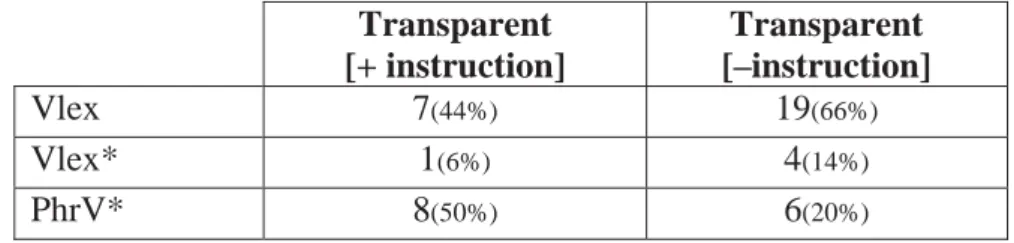
Table 4 represents a classification of non-expected answers focusing on the two sub-types of transparent phrasal verbs.
Table 4.Multiple choice task: Non-expected answers per transparent phrasal verb sub-types.
The data in table 4 show that in the case of transparent [- instruction] phrasal verbs there was a clear preference for avoidance. The reason for this avoidance could be that these students do not study the phrasal verbs they are asked for because they prefer to use a lexical verb rather than a phrasal verb that they do not understand. Again, as well as in table 3, it is remarkable that in both cases, transparent phrasal verbs [+ and – instruction], the number of answers in the ungrammatical phrasal verb (PhrV*) is higher than the one in ungrammatical lexical verb (Vlex*). This reflects that, this group of
Totals 108 22 33
Transparent [+ instruction]
Transparent [–instruction]
Vlex 7(44%) 19(66%)
Vlex* 1(6%) 4(14%)
16
learners does not detect whether a phrasal verb is appropriate or not in the context that is given.
3.3.2
Translation task
In order to analyze the translation task, the same procedure used in the multiple choice task is used.
Table 5 deals with the expected and non-expected answers provided by the participants in the translation task and classified in terms of the three types of phrasal verbs under study.
Table 5: Translation task: Expected and non-expected answers per phrasal verb type.
Expected Non-expected Totals Transparent 13(15%) 60(68%) 73(88)(83%)
Completive 16(18%) 60(68%) 76(88)(86%)
Figurative 2(2%) 74(84%) 76(88)(86%)
Totals 31 194
In table 5 the total column has been added to include information regarding the structures analyzed since there is a difference between the expected number of responses (88 indicated in parentheses) and the actual number of responses provided. This means that, in the case of transparent phrasal verbs, data from 15 questions were discarded because participants did not answer them. Regarding completive and figurative phrasal verbs, data from 12 questions on each type were also discarded because of the same reason.
17
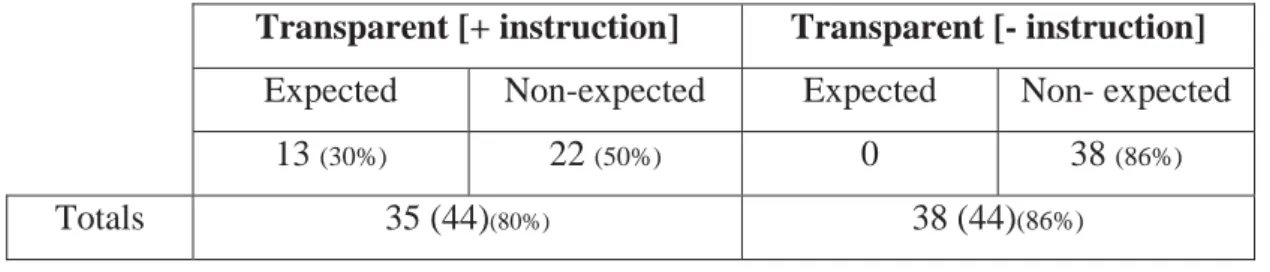
Table 6 deals with the expected and non-expected answers provided by this group of learners in the translation task and classified in terms of the two transparent phrasal verbs subtypes.
Table 6: Translation task: expected and non-expected answers per transparent phrasal verbs subtypes.
In the totals raw the number of expected responses appears between brackets.There were 22 participants and each participant had to translate two structures for each of the transparent sub-types. So, total of 44 answers was expected. However, as in table 5, this is not the case because data from 9 transparent [+ instruction] and from 6 transparent [– instruction] were discarded because participants did not provide any translation for these.
The data in table 6 show that, as well as in the multiple choice task, the expected answers in transparent [+ instruction] phrasal verbs outnumber the ones in transparent [ – instruction] phrasal verbs. But it is remarkable that there were no expected answers in the transparent [– instruction] subtype. We are dealing with transparent phrasal verbs which seem to be the easiest ones for this group of students as it was reflected in table 1. So, it is surprising that in this case they do not provided any expected answer.
Once an overall view of expected and non-expected answers given by participants in the translation task has been shown, a more detailed analysis of the non-expected answers provided by this group of students follows.
Table 7 deals with the non-expected answers provided by the participants in the translation task and classified in term of the three types of phrasal verbs under study.
Transparent [+ instruction] Transparent [- instruction]
Expected Non-expected Expected Non- expected
13 (30%) 22 (50%) 0 38 (86%)
18
Table 7. Translation task: Non-expected answers per phrasal verb type.
The data in table 7 show that Vlex answers clearly outnumber Vlex* and PhrV* answers in the three types of phrasal verbs. So, it can be said that this group of students avoid using phrasal verbs and they prefer the use of a lexical verb. The avoidance phenomenon can be the result of two processes:
1. Crosslinguistic influence from their L1, Spanish: the Spanish language does not have any equivalent structure to the English phrasal verbs, so because of this reason this group of learners avoids using phrasal verbs. 2. Lack of proficiency: the participants do not master phrasal verbs and
because of that they prefer to select a lexical verb with which they are more familiarized.
Data in table 7 also reflect that although the majority of the answers are located in the Vlex column (interpreted as avoidance), there was a remarkable number of answers in the Vlex* column, so participants continue selecting a lexical verb rather a phrasal one but sometimes they do not detect ungrammaticality.
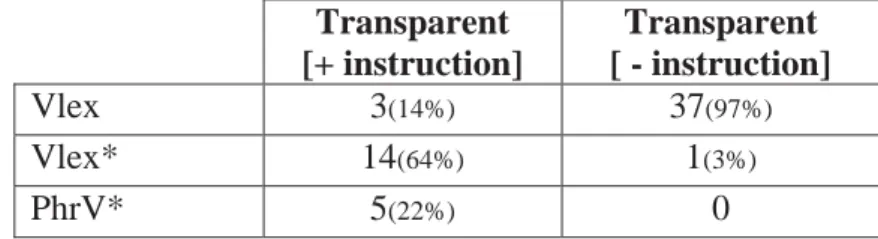
Table 8 deals with the non-expected answers provided by the participants in the transparent phrasal verbs sub-type and classified in the three possible answers they had, (1) one-word lexical verb equivalent to the grammatical phrasal verb, (2) ungrammatical one-wordlexical verb and (3) ungrammatical phrasal verb.
Table 8: Translation task: Non-expected answers transparent sub-types.
Vlex Vlex* PhrV* Totals
Transparent 40(45%) 15(17%) 5(6%) 60(88)(68%) Completive 36(41%) 21(24%) 3(3%) 60(88)(68%) Figurative 44(50%) 24(27%) 8(9%) 76(88)(86%)
Transparent [+ instruction]
Transparent [ - instruction]
Vlex 3(14%) 37(97%)
Vlex* 14(64%) 1(3%)
19
The data in table 8 show a clear contrast between the transparent phrasal verbs that appear in the students’ text book and the ones that do not appear. Regarding transparent [– instruction] phrasal verbs almost a 100% of the non-expected answers are located in the Vlex column which means that this group of students avoids again the use of phrasal verbs. By contrast, only a 14% of the non-expected answers in transparent [+instruction] phrasal verbs are placed in the Vlex column. Also, it is remarkable that in transparent [+ instruction] phrasal verbs the highest number of answers is concentrated in the Vlex* column. So again, it seems that this group of participants has a preference for using a lexical verb rather than a phrasal verb but sometimes they do not select the correct lexical verb that would correspond to the phrasal one.
3.3.3Comparison across tests
After having analyzed and discussed data obtain from the multiple choice task and the translation task, a comparison between the data obtained in both tasks follows.
Table 9 deals with expected and non-expected answers provided by the participants in both multiple choice and translation task and classified in terms on the three types of phrasal verbs under study.
Table 9. Expected and non-expected answers cross tasks.
The data in table 9 show that in both the multiple choice and the translation tasks the non-expected answers outnumber the expected ones in the three types of phrasal verbs. While in the multiple choice task there seems to be a gradation in the expected answers in the translation task this gradation is not so clear although in both tasks the figurative phrasal verbs seem to be the most difficult for this group of students. If we focus our attention on the total number of expected answers, a significant difference can be
MULTIPLE CHOICE TRANSLATION
Expected Non-expected Expected Non-expected
Transparent 42 (48%) 45 (52%) 13 (15%) 60(68%) Completive 31(36%) 55 (64%) 16 (18%) 60 (68%)
Figurative 22(26%) 63 (74%) 2 (2%) 74 (84%)
20
appreciated in that the expected answers in the multiple choice triple the ones in the translation task. A possible reason for this significant difference is that in the multiple choice task the participants have to select one of the given options while in the translation task they have to produce their own answers. So, it can be said that this group of learners are able to detect phrasal verbs but they have more difficulties when producing this structure. That is, the translation task is more demanding for these learners because they have to produce language instead of choosing one of the options provided.
Table 10 deals with the expected and non-expected answers provided by the participants in both tasks and classified in terms of the two transparent phrasal verb sub-types.
Table 10.Expected and non-expected answers per transparent phrasal verbs sub-types across tasks.
MULTIPLE CHOICE TRANSLATION
Transparent [+ instruction]
Transparent [ - instruction]
Transparent [+ instruction]
Transparent [- instruction] Expected Non-expected Expected Non-expected Expected Non-expected Expected Non-expected
28 (64%) 16 (36%) 14 (33%) 29 (67%) 13 (30%) 22 (50%) 0 (0%) 38 (86%)
The data in table 10 show that in transparent [+ instruction] phrasal verbs expected answers in the multiple choice task outnumber the non-expected ones but in the case of the translation task non-expected answers outnumber the expected ones. So, as table 9 reflects these students are able to detect phrasal verbs but for them it is more difficult to produce them. Regarding transparent [– instruction] in both tasks non-expected answers outnumber the expected ones but it is remarkable that in the translation task the participants did not produce any expected answer.
Table 11 deals with the non-expected answers provided by the students in the multiple choice and translation tasks and classified in terms of the three types of phrasal verbs under analysis.
Table 11.Non-expected answers per phrasal verb type and across tasks.
MULTIPLE CHOICE TRANSLATION
Vlex Vlex* PhrV* Vlex Vlex* PhrV*
21
Completive 33(60%) 9(16%) 13 (24%) 36(41%) 21(24%) 3(3%) Figurative 49(78%) 8(12%) 6 (10%) 44(50%) 24(27%) 8(9%)
Totals 108 22 32 120 60 16
The data in table 11 show that in both tasks this group of students avoids the use of phrasal verbs since most responses are concentrated in the Vlex column which means that they have selected a lexical verb which equals the expected phrasal verb. Moreover, in the multiple choice task there is a relevant number of answers in the PhrV* group which means that they do not avoid using phrasal verbs but they have selected a phrasal verb which is ungrammatical in the context provided. So, it seems that sometimes these learners do not detect ungrammaticality or do not select the appropriate phrasal verb. On the contrary, in the translation task there are a high number of responses placed in the Vlex* column which means that they not only avoid using phrasal verbs but they also produce an ungrammatical lexical verb. So, as it was discussed in table 9, these participants have more difficulties in producing phrasal verbs than in recognizing them.
Table 12 represents the non-expected answers provided by the participants in both tasks and classified in terms of the two transparent sub-types.
Table 12: Non-expected answers per transparent phrasal verbs sub-types across tasks.
MULTIPLE CHOICE TRANSLATION
Transparent [+ instruction]
Transparent [- instruction]
Transparent [+ instruction]
Transparent [- instruction] Vlex Vlex* PhrV* Vlex Vlex* PhrV* Vlex Vlex* PhrV* Vlex Vlex* PhrV*
7(44%) 1(6%) 8(50%) 19(66%) 4(14%) 6(20%) 3(14%) 14(64%) 5(22%) 37(97%) 1(3%) 0
22
the translation task the higher number of answers is concentrated on the Vlex* column so they avoid the phrasal verb but they select an inappropriate lexical verb.
4.
Conclusions
The present dissertation has offered a study on English phrasal verbs in the production of L1 Spanish English learners. The data analysis has allowed me to either confirm of reject the initial hypotheses I set to study.
In particular, and as it was proposed in hypothesis 1 there was a higher number of expected answers in transparent phrasal verbs than in figurative ones because in transparent phrasal verbs, if you know the meaning of their components, you can deduce the meaning of the phrasal verb while figurative phrasal verbs’ meaning is the
result of a metaphorical shift between their components. However, though this is so across tasks, it is remarkable that the number of expected answers in both phrasal verb types (i.e. transparent and figutative) is more than doubled in the multiple choice task if compared to the translation task. So, it can be said that hypothesis 4 receives confirmation in that, due to the increased difficulty and higher requirement of the translation task, the participants have less expected answers in this task.
When analyzing the non-expected answers provided by the participants, it is evident that this group of students avoid the use of phrasal verbs in both tasks (i.e. multiple choice and translation) and for the three types of phrasal verbs (i.e. transparent, completive and figurative). It can be inferred that L1-L2 differences might be a reason for phrasal verb avoidance and so hypothesis 2 has been confirmed: there is crosslinguistic influence from L1 Spanish into L2 English.
23
remarkable that although there are more expected answers in the transparent [+ instruction] than in the transparent [- instruction] phrasal verbs, there is a higher number of non-expected answers if compared to the expected ones in the case of transparent [+ instruction] phrasal verbs. This finding makes it important to analyze in more depth non-expected answers with transparent [+ instruction] phrasal verbs in the translation task. It is surprising that more than half of the responses are concentrated in the Vlex* group which means that they have not only avoided the phrasal verb but they have also selected an ungrammatical lexical verb. Two different aspects could be behind this result:
1. Students do not have sufficient knowledge of the phrasal verbs they have studied either because of the type of instruction or because they did not have enough input, which ties with the second aspect.
2. The teaching methodology used to explain phrasal verbs is not efficient enough since students do not actually use the phrasal verbs they are supposed to know. In this respect, a different approach to the study of phrasal verbs could render different results. A methodology that acknowledges the productivity of this structure and that makes the student adopt an active and participative role could be beneficial. For instance, activities such as the elaboration of a wiki or a blog about the topic in which students are the ones contributing information could help.
These results provide, therefore, a clear confirmation for four hypotheses and point to a combination of factors to explain the difficulty Spanish speakers have with English phrasal verbs: the grammatical properties of English phrasal verbs, the lack of phrasal verbs in Spanish, the actual use they make of phrasal verbs and the type of instruction students receive on phrasal verbs.
25
Afterword: Objectives reached in the dissertation
With this study I believe I have reached two of the most important objectives as in the official description of the English degree (2009, page 14) which are (1) a complete learning process in linguistics, [culture and literature]of the English language and (2) a solid instrumental competence in English in a general environment but also in a professional one.
With respect to the first objective, this study has given me the opportunity to put into practice a series ofaspects that I have learned in different courses throughout the four year degree. These involve mainly the following:
Grammatical background: English grammar I, II, and III (1st and 2nd year)
Comparative grammatical background: English/Spanish comparative
grammar (3rd year)
Organization of the data and presentation of the information:Information and Communication Technology (4th year)
26
Works cited
Huddleston, Rodney and Pullum, Geoffrey K. The Cambridge Grammar of the English Language. Cambridge: Cambridge University Press, 2002. Print. Wheeldon, Sylvia and Campbell, Colin. Get it Right (Student’s book 2). Madrid
Oxford University Press España, 2012, Print.
Sánchez Benedito, Francisco, Dawson, A S and Moreno Ortiz, A. Verbos frasales. Madrid: Alhambra Longman, 1994. Print.
Douglas, Biber. et al. Longman Grammar of Spoken and Written English. Essex Pearson Educated Limited, 1999. Print.
Oxford etc. Oxford Phrasal Verbs Dictionary: for Learners of English. Oxford: Oxford University Press, 2003. Print.
Liao, Yan. and Fukuya, J.Yoshinori.Avoidance of phrasal verbs: the case of Chinese learners of English. LanguageLearning 54.2, (2004): 193-226. Universidad de Valladolid. Grado Adaptación a Bolonia: Graduado/a en
Estudios Ingleses. Valladolid: Universidad de Valladolid, 2009. Print.
Thim, Stefan. “Phrasal Verbs: the English verb-particle construction and its
history” Diss. Friedrich-Alexander – Universität Erlangen-Nürnberg, 2012.
Printed in Germany.
Kurtyka, Andrzej. Teaching English phrasal verbs: a cognitive approach. In
“Applied cognitive linguistics II: Language Pedagogy” Berlin: Mouton de
Gruyter, 2001. Printed in Germany
Furfine, Matthew. Introduzioneai phrasal verbs. Palermo: Sellerio di Giorgianni, 2006. Print
Rundell, Michael. “Understanding phrasal verbs: is there a system?”. MED Mag. 30 May 2005. Web. 10 Jun 2014