UNIVERSIDAD AUTÓNOMA DE NUEVO LEÓN
FACULTAD DE CIENCIAS QU
SYNTHESIS
OF LUMINESCENT PROPERTIES OF
ORGANOBORON COMPOUNDS
TRIDENTATE LIGANDS
RODRIGO ALONSO CHAN NAVARRO
In partial fulfillment of the requirements for the Degree of Doctor of Science with Orientation in
UNIVERSIDAD AUTÓNOMA DE NUEVO LEÓN
FACULTAD DE CIENCIAS QUÍMICAS
SYNTHESIS, CHARACTERIZATION, DETERMINATION
OF LUMINESCENT PROPERTIES OF TETRACOORDINATE
ORGANOBORON COMPOUNDS DERIVATIVES FROM ORGANIC
TRIDENTATE LIGANDS, AND THEIR POTENTIAL
APPLICATION IN OLEDs.
By
RODRIGO ALONSO CHAN NAVARRO
In partial fulfillment of the requirements for the Degree of Doctor of Science with Orientation in Materials Chemistry
AUGUST 2014
UNIVERSIDAD AUTÓNOMA DE NUEVO LEÓN
ÍMICAS
DETERMINATION
DINATE
DERIVATIVES FROM ORGANIC
POTENTIAL
SUMMARY
M. en C. Rodrigo Alonso Chan Navarro Graduation Date: August 2014
Universidad Autónoma de Nuevo León
Facultad de Ciencias Químicas
Study Title: Synthesis, characterization, determination of luminescent properties of tetracoordinate organoboron compounds derivatives from organic tridentate ligands, and their potential application in OLEDs.
Page numbers: 120
Candidate for the degree of Doctorate of Sciences with Orientation in Materials Chemistry.
Study area: Materials Chemistry
Purpose and study method:
Coordination complexes with main group elements offer an interesting alternative for the preparation of molecular materials with luminescent properties. These materials compared with their inorganic analogues, and organic polymers offer the versatility and reproducibility of the synthetic process. It is important to notice that have been reported organic compounds boron mostly derivatives of bidentate ligands with interesting photo, and electroluminescent properties. However studies of boron compounds derived from tridentate ligands have been scarcely explored. Based on the above this work research were synthesized six new compounds derived from tridentate ligands with potential application as emitter material, and an electron transport layer in the assembly of electroluminescent devices type OLED.
Conclusions and contributions:
In this work research was reported five new structures of tridentate ligands and boron compounds, which were characterized by spectroscopic and spectrometric techniques and x-ray diffraction. The same way the photophysical parameters, thermal and non linear properties of all materials were studied. In some cases it was possible to carry out theoretical studies in order to analyze in depth the luminescent response. Electroluminescent devices type OLED were fabricated with the boron compounds 9a and 10a obtained as a results current-voltage curves, indicating that these materials have capable a poor electroluminescent performance.
ASSESOR SIGNATURE
i
This thesis was realized at laboratory of materials III into the postgraduate area of Facultad de Ciencias Químicas from Universidad Autónoma de Nuevo León under
the management of Ph.D. Víctor M. Jiménez Pérez.
ii
DIVULGATION PROYECT AND STAYS PERFORMED
The study realized in this thesis has been divulged in a national and international meetings and it has been generated two publications:
Rodrigo A. Chan, Blanca M. Muñoz Flores, Victor M. Jiménez Pérez. Síntesis por multicomponentes de compuestos de boro derivados de salicilidenbenzoilhidrazonas. Una aproximación verde. Congreso Internacional de Química e Ingenieria Verde, Monterrey, Nuevo León, México, realizada los días 24-26 de Octubre de 2012.
Rodrigo Chan-Navarro, Víctor M. Jiménez-Pérez, Blanca M. Muñoz-Flores,aH. V. Rasika Dias, Ivana Moggio, Eduardo Arias, Gabriel Ramos-Ortíz, Rosa Santillan,
ConcepciónGarcía, Maria Eugenia Ochoa, Muhammed Yousufuddin, and
NoemiWaksman. Luminescent organoboron compounds derived from
salicylidenebenzohydrazide: Synthesis, charaterization, structure, and Photophysical
properties. 247th American Chemical Society National Meeting, Dallas, Texas, USA,
realized on March 16-20, 2014.
Rodrigo Chan-Navarro, Víctor M. Jiménez-Pérez, Blanca M. Muñoz-Flores,aH. V. Rasika Dias, Ivana Moggio, Eduardo Arias, Gabriel Ramos-Ortíz, Rosa Santillan,
ConcepciónGarcía, Maria Eugenia Ochoa, Muhammed Yousufuddin, and
NoemiWaksman. Luminescent organoboron compounds derived from
salicylidenebenzohydrazide: Synthesis, characterization, structure, and photophysical properties. Dyes and Pigm. 99 (2013) 1036-1043.
Rodrigo Chan-Navarro, Blanca M. Muñoz-Flores, Víctor M. Jiménez-Pérez. Gabriel
Ramos-Ortíz,Ivana Moggio, Eduardo Arias, María. C. García-López, Víctor Rosas,and
Mario Rodríguez. Multicomponent Microwave-assisted Synthesis of Boronates derived from Schiff Bases: Nonlinear Optical Properties, Thermal Analyses, Cyclic
iii In addition, two short stays were performed:
March 1st to August 30th, 2013. Stay in the laboratory of materials of Centro de
investigación en Óptica (CIO) León, Guanajuato, México under the management of Ph.D. Gabriel Ramos-Ortíz.
Octuber 1st to November 31th, 2014. Stay in the laboratory of advanced materials
iv
ACKNOWLEDGEMENTS
I am indebted to Ph.D. Victor M. Jimenez-Perez for the opportunity to take part
of his research group as well as shared knowledge but most of all for their trust and
friendship but most of all for their trust and friendship with which you have
distinguished me over the last three years.
I am also grateful to Ph.D. Blanca M. Muñoz-Flores for their trust and friendship
awarded, as well as Ph.D.s Rasika Díaz, Gabriel Ramos-Ortiz, Rosa Santillan, Ivanna
Moggio and Eduardo Arias for their supported and collaboration in this project.
I also thank at thesis committee, Ph.D.s Boris IIdusovich Kharisov, Sylvain
Bernes Flouriot, and Perla Elizondo de Cota, for their corrections, suggestions and
interest, in the review of these research work.
Finally, I greatly appreciate the support of my classmates from the laboratory of
materials III, especially María C. Garcia-López, my present and future, by their patience
v
CONTENTS
Page
Title page ………... 0
Thesis approval sheet ………. 0
Summary ……… 0
Development project …………..……… i
Divulgation project and stays performed ………... ii Acknowledgments ………... iv List of figures ………... v List of schemes ……….. vi List of tables……….... vii List of abbreviations……… viii List of organic compounds synthesized ……..………... x 1. Introduction………. 1 2. Background………. 4 2.1 General aspect of boron……… 4
2.2 Luminescent organoboron compounds: photo- and electroluminescent properties………... 6
3. Hypothesis………... 18
3.1 General objective………... 18
3.2 Specific objectives………. 19
4. Materials and methods……… 21
4.1 Material and equipment……….... 21
vi
4.3 Absorbance, emission and luminescence quantum yields……….. 23
4.4 Fabrication of electroluminescent devices……… 23
4.5 Third-harmonic generation experiment………. 25
4.6 Theoretical study………... 26
4.7 Synthesis procedure of compounds 1a-12a……….. 27
4.7.1 (E)-N’-(4-(diethylamino)-2-hydroxysalicylidine) benzohydrazide (1a)……….. 27
4.7.2 (E)-N’-(4-(methoxy)-2-hydroxysalicylidine) benzohydrazide (2a)………. 28
4.7.3 (E)-N’-(4-(diethylamino)-2-hydroxysalicylidine)- 4-nitrobenzohydrazide (3a)………... 29
4.7.4 (E)-N’-(4-(methoxy)-2-hydroxysalicylidine)- 4-nitrobenzohydrazide (4a)………. 29
4.7.5 (E)-(2-hydroxy-1-naphthalidene) benzohydrazide (5a)…….. 30
4.7.6 (E)-(2-hydroxy-1-naphthalidene)- 4-nitrobenzohydrazide (6a)………... 31
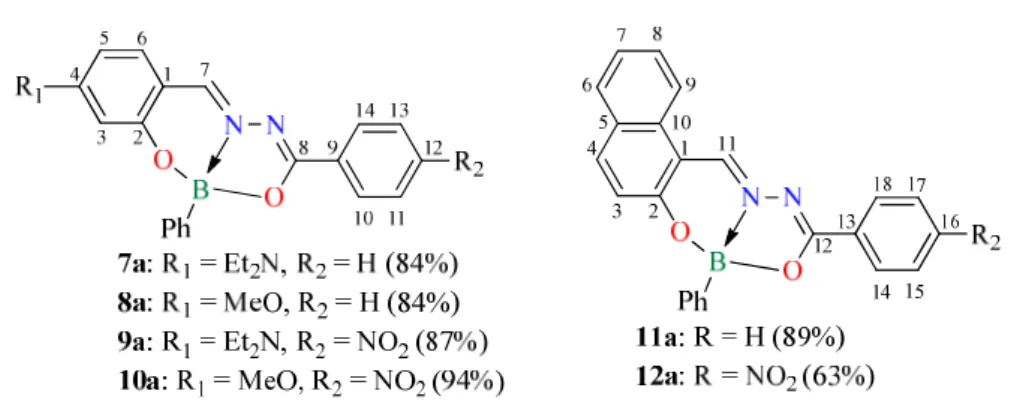
4.7.7 (E)-N’-(4-(diethylamino)-2-hydroxysalicylidine) benzohydrazidato-phenyl-boron (7a)... 4.7.8 (E)-N’-(4-(methoxy)-2-hydroxysalicylidine) benzohydrazidato-phenyl-boron (8a)... 32 33 4.7.9 (E)-N’-(4-(diethylamino)-2-hydroxysalicylidine)- 4-nitrobenzohydrazidato-phenyl boron (9a)... 34
4.7.10 (E)-N’-(4-(methoxy)-2-hydroxysalicylidine)- 4-nitrobenzohydrazidato-phenyl boron (10a)... 35
4.7.11 (E)-(2-hydroxy-1-naphthalidene)benzohydrazidato- phenyl-boron (11a)... 36
4.7.12 (E)-(2-hydroxy-1-naphthalidene)4-nitro- benzohydrazidato-phenyl-boron (12a)... 38
4.8 Synthesis under microwave irradiation... 39
vii
4.8.2 Disposal of hazardous waste………. 40
5. Results and discussion………. 41
5.1 Synthesis………... 41
5.2 Chemical structure elucidation... 43
5.3 X-ray analysis... 48
5.4 Optical properties... 55
5.5 Optical nonlinear properties... 61
5.6 Thermal analysis... 64
5.7 Computational study... 66
5.8 Fabrication of electroluminescent devices type OLED derived from 9a-10a... 68
6. Conclusion... 70
6.1 Perspectives 73 7. References... 74
8. Appendix... 83
viii
LIST OF FIGURES
Figure Page
1 Electronic structure of boron compounds:
electrophilic (red) and nucleophilic (blue) behaviour………... 5
2 Structural feature of tetracoordinate organoboron compounds………. 5
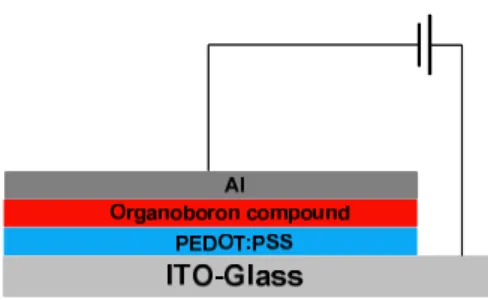
3 Schematic configuration of the device of double organic layer……… 24
4 1H NMR spectrum of free ligand 1a in dimethyl sulfoxide-d6………. 44
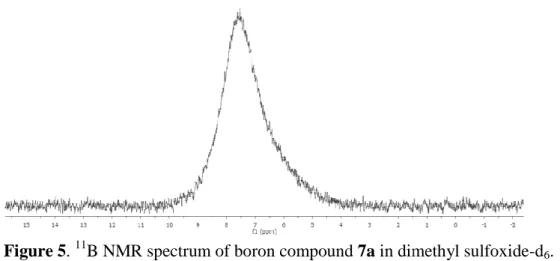
5 11B NMR spectrum of boron compound 7a in DMSO-d6………. 45
6 X-ray molecular structures of 1a and 2a……….. 50
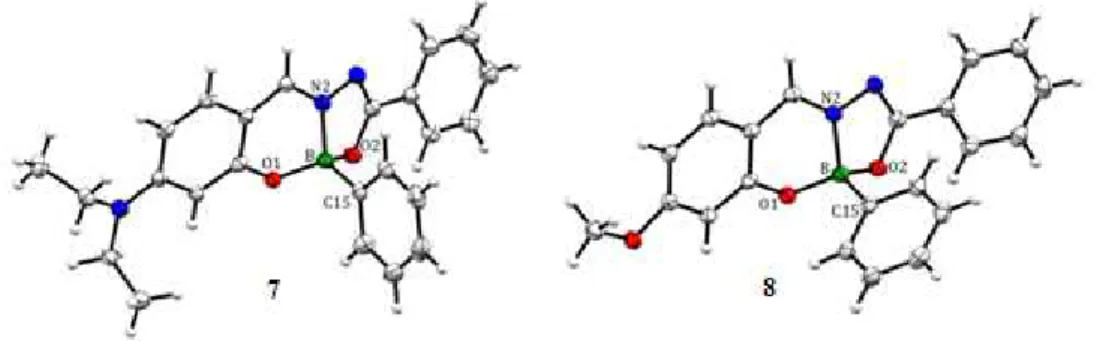
7 X-ray molecular structures of 7a and 8a………... 50
8 Molecular structure of 12a……… 50
9 UV-Vis spectra in THF of compounds 1-4a and 7-10a……… 56
10 Emission spectra of compounds 1a, 3a, and 7-10a in THF……….. 58
11 Excitation spectra of compounds 1a, 3a, 7-10a in THF……….. 59
12 UV-Vis spectra in chloroform of compounds 1a, 11-12a………. 60
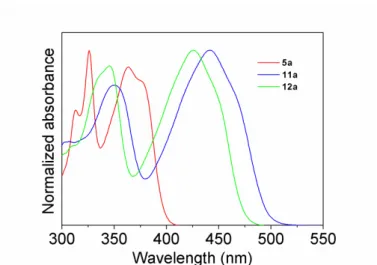
13 Fluorescence spectra of Schiff base 5a and their boro compound 12a……. 61
14 THG Maker-fringe patterns for thin solid films doped with 30 wt% of compounds 1a, 7a, 9-10a……… 62
15 TGA thermogram of Schiff bases 1-6a……… 65
16 TGA thermograms of boron compounds 7-12a……… 66
17 Occupied orbitals (HOMO, yellow) and virtual orbitals (LUMO, blue) for the π-π* transition in compound 7a (top) and 9a-NO2 (bottom)……… 68 18 Occupied orbitals (HOMO, yellow) and virtual orbitals (LUMO, blue) for the π-π* transition in compound 8a (top) and 10a-NO2 (bottom)………… 68
ix
LIST OF SCHEMES
Scheme Page
1 Photoluminescent organoboron compound 1-2……… 6
2 Organoboron compounds 3-6 used as emitter materials in OLEDs……. 8
3 Fluorescent organoboron compounds 7-9
derived from pyrazolate ligand………. 8
4 Organoboron compounds 10-12
derived from 2-pyridyl pyrrolide ligand……….. 9
5 Electroluminescent organoboron compound 13
derived from 8-hydroxylquinolato ligand……… 10
6 Organoboron compound 14-15
derived from bidentate (N,N) ligand……… 10
7 Organoboron compounds 16-19
derived from phenol-pirydyl ligands……… 11
8 Luminescent organoboron compounds 20-22
derived from quinolate ligand……….. 12
9 Organoboron compound 23 derived from pyridine-phenol ligand…….. 12
10 Dinuclear organoboron 24-27
derived from ladder type conjugated π system………. 13
11 Organoboron compounds 28-30
derived from oxazolylphenolate ligand……… 14
12 Organoboron compounds 31-32
derived from phenol-pyridyl ligand………... 14
13 Four-coordinate binuclear organoboron compounds 33-35
derived from 2-(N-aryl) formiminopyrrolyl ligand………. 15
14 Organoboron compounds 36-39
x
15 Synthesis under microwave irradiation of compounds 7-10……… 39
16 Synthesis of Schiff bases 1a-6a……… 41
17 Synthesis of organic compounds derived from Schiff bases 7a-12a…... 42
18 Proposed fragmentation of boron compounds 7a-10a………. 46
19 Proposed fragmentation of compound 11a
according to its mass spectrum………. 47
20 Deviation (θ) of the boron atom from the
salicylideneimino/or naphthalidenimino-plane
in compounds 7a, 8a and 12a………. 50
xi
LIST OF TABLES
Table Pag
1 Comparison of the time reaction and yields from different
methods of compounds 7a-10a………. 42
2 Selected 1H, 11B, 13C NMR (ppm) and IR (cm-1) data
for compounds 1a-6a and 7-12a……… 44
3 Elemental analysis of compounds of free ligands
1a, 2a, 6a and boron compounds 7a-12a………. 48
4 Crystal data for compounds 1a, 2a, 7a, and 8a……….. 51
5 Crystal data for compound 12a……….. 52
6 Selected bond distances (o) and angles (deg)
for 1a-2a and 7a-8a……… 53
7 Selected bond distances (o) and angles (deg) for 12a…………. 54
8 Photophysical data of Schiff bases 1a-4a
and boron compounds 7a-10a……… 56
9 Optical nonlinear response and thermal properties
of compounds 1a-12a………... 63
10 Calculated values of maximum absorption wavelength
using TDDFT at the level
xii
LIST OF ABBREVIATIONS
OLED organic light emitting diode Td5 decomposition temperature at 5%
Alq3 tris-(8-hydroxyquinolate)
aluminum
Tm melting transition process
Φ quantum yields MHz megahertz
UV ultraviolet region PS polystyrene
nm nanometers mm milimeter
cd/m2 unit of luminance AFM atomic force microscopy
mA/cm2 unit of current density χ(3) third order nonlinear
susceptibility
S1, LE locally excited state OPO optical parametric oscillator
S1, CT charge transfer state THG third harmonic generation
HOMO highest occupied molecular
orbital
PCM polarizable continuum model
LUMO lowest unoccuppied molecular
orbital
TD-DFT time dependent density functional
theory
[BF3O(Et)2] boron trifluoride etherate DMF N,N-dimethyl formamide
ETL electron transport layer DMSO dimethyl sulfoxide
1
H proton NMR IR infrared
11
B boron NMR eV unit of energy
13
C carbon NMR AIE aggregation-induced emission
DEPT distortionless enhancement by
polarization transfer
∆ν difference frecuency
HETCOR 2-D heteroclorrelation ITO indium tin oxide
HMBC heteronuclear multiple bond
correlation
EML emissive materials layer
ETL electronic transport layer
COSY correlation spectroscopy HTL hole transport layer
Eg optical band gap APCI atmospheric pressure chemical
ionization
THF Tetrahydrofuran HR-MS high resolution mass
spectrometry
M-1cm-1 unit of molar extinction
coefficient
Φ fluorescent quantum yield
NMR nuclear magnetic resonance PEDOT:PSS poly(3,4ethylenedioxythiophene)
h Planck constant AIE aggregation-induced emission
ppm parts per million π-π* Electronic transition
δ Chemical shift λmax maximum absorption peak
u.m.a unit of molar mass –C=N- azomethine group
Å length measurement unit
DTA differential thermal analysis
xiii
LIST OF ORGANIC COMPOUNDS SYNTHESIZED
Figure 1. Salicyliden- 1a-4a and naphthalidenebenzohydrazides 5a-6a.
Figure 2. Boron compounds derivatives from salicylidenbenzohydrazides 7a-10a and
1
INTRODUCTION
Luminescence is a spontaneous emission of electromagnetic radiation from an
electronically excited material, which is not in thermal equilibrium with the
environment. Depending of the way that energy is applied, it is going to give different
types of luminescent process such as fluorescence, phosphorescence,
thermoluminescence, chemiluminescence, triboluminescence, radioluminescence,
sonoluminescence, and electroluminescence. This concept was introduced by Eilhard
Wiedemann in 1888 and it was defined as all phenomenon of light, which is not
conditioned for an increase of the temperature.1 In this context, organic luminescent
materials have received considerable attention due to their potential use in optoelectronic
applications such as emitter materials, electron-transport materials, host/hole-blocking
materials for organic light emitting diodes (OLEDs), biological imaging materials, and
photo-responsive materials.2 Luminescent main-group coordination compounds
particularly have demonstrated to be an important group of emitter materials for the
assembly of OLEDs. In fact, tris-(8-hydroxyquinolate)aluminum (Alq3), reported by
2
assembly of OLEDs.3 However, it has a few shortcomings such as green emission and a
poor long-term stability in electroluminescent devices.4
On the other hand, considerable effort has been invested in the design and
synthesis of new boron compounds, which has improved the chemical and optical
properties in comparison to aluminum derivatives such as good solubility in organic
solvents, high fluorescent quantum yields (Φ), air-stable, low cost, and easy deposition
on substrate surfaces by means of direct thermal evaporation.5 In this regard, much
attention has been paid to transition metal complexes due to their interesting
electroluminescent properties such as highly emission and good thermal stability.6
However, heavy metals such as Ir,7 Pt,8 and Cu9 are extremely moisture- and/or
oxygen-sensitive.
Organoboron compounds are also attractive functional materials due to their
applications in areas such as supramolecular chemistry;10 medicinal chemistry:
anticancer agents in boron neutron capture therapy,11 and materials chemistry as
fluorescents probes12 and imaging material,13 laser dyes,14 fluoride ion sensor,15
OLEDs,16 organic field-effect transistors,17 photo-responsive materials18 and nonlinear
optics.19 In particular, the interest has increased to those organoboron compounds
derived from Schiff bases, due to they provide an interesting and wide variety of
molecular structural conformations and in addition the electron withdrawing –C=N-
group interacts with metal ions giving push-pull complexes with different optoelectronic
3
This research describes in detail a new study into a serie of organoboron
compounds derived from Schiff bases, which has showed interesting properties that
make of them potentially useful in the assembly of electroluminescent devices. This
document is separated into seven chapters, which describes the design, synthesis,
chemical-optical characterization, and rationalization of the photophysical properties of
those new materials as well as the assembly of an electroluminescent device type OLED
using an organoboron compound as emitter and electron transport material. Third order
non linear optical properties of organoboron compounds derived from
salicylidenbenzoylhidrazide and their free ligands were tested. In addition, the thermal
properties and computational studies for someone of them are also reported.
A brief summary about of the purpose and importance into this research work is
described in the first chapter. The background provides an overview of the luminescent
boron compounds that have been used in the developing of electroluminescent devices
type OLED. The problem approach, hypothesis and objective of this research work are
exposed in the third section. All the materials, laboratory equipment, synthetic
procedure, and the experimental methodology used into of this document are described
in the fourth section. The fifth section offers an analysis and discussion of the most
outstanding results obtained into this project. The sixth section describes the major
contributions made in this research work. Finally, the last section collects the references
4
BACKGROUND
2.1 General aspect of boron
The electronic structure of boron atom and its position on the periodic table,
makes those boron compounds behave as electrophilic molecules (Lewis Acid) with a
trigonal planar molecular geometry and an isoelectronic behaviour to carbocations.
Moreover, the boron atom has the ability for to form an additional bond and to generate
an anionic tetravalent boron compound with a tetrahedral structure and a nucleophilic
behavior (Lewis base).22 This double behavior allow that those materials can be stable
while retaining significant reactivity, which defines their unique, versatile,
interconvertible, and tunable chemical properties. The organoboron compounds are
considered a viable alternative for the development of luminescent materials, due to its
electrophilic character, that allows the formation of stable dative covalent bond with
Figure 1. Electronic structure of boron
(blue) behavio
Thus, a great diversity of
coordination with boron compounds
allows to tune the electronic and optical properties
bond and the strategic substitution of
π- system (Figure 2).
Figure 2. Structural feature of
5
Electronic structure of boron compounds: electrophilic
behaviour.
a great diversity of multidentate ligands have the possibility of
coordination with boron compounds giving tetracoordinate organoboron
the electronic and optical properties through of the
the strategic substitution of specific functional groups into
).
Structural feature of tetracoordinate organoboron
(red) and nucleophilic
have the possibility of
organoboron compounds that
formation of the dative
specific functional groups into a rigid conjugated
6
2.2 Luminescent organoboron compounds: photo- and electroluminescent
properties.
The first luminescent organoboron compound 1 was synthesized by Hassan et al.
(Scheme 1), where and it was observed blue emission which was attributed to the
formation of the N→B dative covalent bond via the donation of lone-pairs of the
nitrogen atom to the boron atom changing the emission wavelength from UV to blue
region.23 One year later, Wu et al. reported the synthesis of a 7-azaindole adduct of
boroxine 2, which was obtained of the reaction between PhB(OH)2 with 7-azaindole.24
This molecule showed an interesting difference in the emission maximum of the solution
(368 nm) and solid spectra (400 nm). This behaviour in solution was attributed an
intermolecular dissociation-association process in 7-azaindole ligand (Scheme 1).
7
Preliminary results on electroluminescence properties of the organoboron
compounds 5-7 derived from bidentate ligands were reported by Anderson et al. The
authors showed that is possible a subtle tuning of the absorption and emission
characteristics in solution and in solid state, due to the systematic substitution with
methyl groups around of the periphery of the 8-hydroxyquinoline ligand in the boron
compounds (Scheme 2).25 The electroluminescent device containing the compound 5 as
emitter material showed a luminance of 4000 cd/m2 at a current density of 150 mA/cm2
and a voltage over 15 V.
On the other hand, Min Kim et al. reported the photo and electroluminescent
properties of an organoboron compound coordinated with an analogous molecule to the
naphthalene, which shows maximum emission peak at 480 nm in the photoluminescence
spectra (Scheme 2). The electroluminescent device containing 6 as the emitting layer
showed a blue luminescence with maximum emission peak at 498 nm with a luminance
of 0.80 cd/m2 and a quantum efficiency of 4.89 %.26 The authors suggested that some
interaction occurs in the devices due to the existent displacement of 18 nm between the
8
Scheme 2. Organoboron compounds 3-6 used as emitter materials in OLEDs.
Meanwhile, Cheng et al. reported the dual fluorescent behaviour of a series of
organoboron compounds derived from 5-(2-pyridyl)pyrazolate ligand (Scheme 3). The
boron compounds 7-9 showed in solution, two emission peaks at 382 (505), 360 (488)
and 370 (512) nm, respectively, due to the photoinduced electro transfer process from
the phenyl moiety to the pyrazolate ligand.27 The author suggests that an ideal
boron-ligand system for devices could exhibit both a locally excited state (S1, LE) and a charge
transfer state (S1, CT) emissions.
9
The rational color tuning and the luminescent properties of a series of
organoboron compounds derived from 2-pyridyl pyrrolide ligand were reported by Chi
et al. The organoboron compounds 10-12 were thermally stable and showed a strong
photoluminescence with emission bands at 490, 510 and 575 nm, respectively (Scheme
4).28 The electroluminescent devices using 12 as the host-emitter produced a saturated
red-orange electroluminescence with maximum emission peak at 580 nm and a
luminance of 5000 cd/m2 at a voltage of 15 V with an external quantum efficiency of 0.5
%.
Scheme 4. Organoboron compounds 10-12 derived from 2-pyridyl pyrrolide ligand.
Other electroluminescent devices were fabricated by Cui et al. using
organoboron compound 13 derived from 8-hydroxylquinolato ligand as an emitter layer
(Scheme 5). These authors found that the substituent group at C-5 or C-2 of the ligand
has a significant effect on the emission band and Φ of the boron compound.29 The
device using 13 as an emitter and electron transport layer produced a broad bluish-green
10
Scheme 5. Electroluminescent organoboron compound 13 derived from
8-hydroxylquinolato ligand.
This same group research reported later, the successful assembly of blue and red
electroluminescent devices using the compounds 14-15 derived from bidentate (N,N)
ligand.30 These materials showed to be able to function both as emitter and electron
transport materials in electroluminescent devices (Scheme 6). The device using 14
produced a yellowish orange emission band at 501 nm with a luminance of 429 cd/m2 at
24 V.
Scheme 6. Organoboron compound 14-15 derived from bidentate (N,N) ligand.
Zhang et al. reported the synthesis of the organoboron compounds 16-19
obtaining by the reaction between boronic acid derivatives with phenol-pyridyl
11
461 (16), 478 (17), 459 (18) and 479 (19) due to the intraligand π→π* electron
transition of phenol-pyridyl system (Scheme 7). Among these materials, the compound
16 had Φ of 30% higher than those of 17 (21%), 18 (16%), and 19 (14%). The authors
attributed the low yield of 18 and 19 due to the thermal motion of the conformationally
mobile methoxy group, which results in energy loss via nonradiative decay. The
electroluminescent device using 16 as an emitter layer showed a white emission band
with a maximum luminance of 1016 cd/m2 at a current density of 202 mA/cm2 to 14 V.
Scheme 7. Organoboron compounds 16-19 derived from phenol-pirydyl ligands.
The tuning of the optical properties of a serie of organoboron compounds 20-22
derived from quinolate ligand were reported by Qin et al. (Scheme 8) The authors
demonstrated that the modification of the 5-substituent with electro-withdrawing and
electron-donating groups from quinolate ligand allows a displacement of the emission
band from blue to red region due to the effect of 5-substituents on the HOMO and
12
Scheme 8. Luminescent organoboron compounds 20-22 derived from quinolate ligand.
Taking that in consideration, Wang et al. reported the synthesis of a
multifunctional organoboron compound 23 derived from pyridine-phenol ligand
(Scheme 9). The authors demonstrated that this material is able of functioning as a
hole-transporting layer, an electron hole-transporting layer and emitting layer in a one molecule
due to the incorporation of electron-rich and electron-deficient groups.33 The
electroluminescent device using 23 as emitting layer produced a yellow light emission
band at 575 nm with a maximum luminance of 2654 cd/m2 and a maximum efficiency of
5.2 cd/A.
13
An interesting kind of electroluminescent dinuclear organoboron compounds
24-27 were reported by Zhan et al. This molecules containing two boron atoms into ladder
type conjugated π- system exhibited a high thermal stability and strong electron affinity
due to the effect of the extended π-conjugation (Scheme 10). The electroluminescent
device using 24 as emitting layer produced an orange emission band at 580 nm with a
maximum luminance of 9754 cd/m2 and a maximum efficiency of 4.02 cd/A with a
voltage of 2.5 V.34
Scheme 10. Dinuclear organoboron 24-27 derived from ladder type conjugated π
system.
An innovative strategy was reported by Ko et al. The photophycal properties of
organoboron compounds 28-30 derived from oxazolylphenolate ligand were tuned from
blue to green region by substitution with electron-withdrawing and donating groups at
the 4-position of the phenoxide (Scheme 11). The organoboron compound 29 showed a
bipolar character due to intramolecular charge transfer in the complex with an emission
band at 422 nm and a high photoluminescence quantum yield in toluene of 34 %.35 The
electroluminescent device using 30 as emitter showed an emission band at 527 nm with
a maximum luminance of 2905 cd/m2 at a current density of 6 mA/cm2 and a voltage of
14
Scheme 11.Organoboron compounds 28-30 derived from oxazolylphenolate ligand.
In this regard, the photo and electroluminescent properties of organoboron
compounds 31-32 (Scheme 12) derived from phenol pyridyl ligand were reported by
Zhang et al. The electroluminescent device using 31 as emitter showed a
yellowish-white emission band at 527 nm with a maximum luminance of 2383 cd/m2 at a current
efficiency of 1.40 cd/A and a voltage of 13 V.36 The authors attributed that the high
luminance obtained may could be related to the higher value of Φ in solid state (12%).
15
A recent study found that four-coordinate binuclear organoboron complexes
33-35 derived from 2-(N-aryl) formiminopyrrolyl ligand demonstrated to be moisture and
air sensitive (Scheme 13). Non-doped devices prepared by spin coating using the
compounds 33-34 showed maximum luminances in the order of 103 cd/m2 and
maximum efficiencies of 0.3/A.37 The electroluminescence spectra for 33-34 showed a
displacement of 20 nm with respect to photoluminescence spectra in solution. The
authors attributed this behaviour to intermolecular interactions in solid state, stabilizing
the excited state.
N N B R1 R1 BPh3 N N B R1 R1 N N B R1 R1 N N B R1 R1 n
33: n = 1, R1= Ph (81 %)
34: n = 2, R1= Ph (86 %)
35: R1= Ph (80 %)
N N B R1 R1 N N B R1 R1 n
Scheme 13. Four-coordinate binuclear organoboron compounds 33-35 derived from
2-(N-aryl) formiminopyrrolyl ligand.
Recently this same group reported the synthesis and characterized by multiple
spectroscopic methods of different tetracoordinate mononuclear organoboron
compounds 36-39 containing 2-(N-arylformimino)pyrrolyl ligands with N-aryl ring
substituents of different electronic and steric natures (Scheme 14). The best
16
band at 492 nm with a maximum luminance of 614 cd/cm2 at a current efficiency of 0.2
cd/A and an external quantum efficiency of 7.9 %.38 The author found that the electronic
properties of these compounds could be varied by changing the electron-donating or
electron-withdrawing character of the aniline substituents.
Scheme 14. Organoboron compounds 36-39 derived from 2- (N-arylformimino)pyrrolyl
ligand.
The literature showed that in the last two decades of the organoboron compounds
derived from bidentate ligant have been widely studied. However, with tridentate ligands
has been scarce investigated. In addition, it has only been studied the optical non linear
properties of a small group of them with transition metals and some main group
elements. Therefore, the investigation on the luminescence properties have not been
studied deeply. The anylisis of the literature shows that the tuning of luminescent
properties of these materials have been performed from boron trifluoride etherate
17
Due to that boron compounds derived from bidentate ligands have been widely
used as emitting layers in the assembly of electroluminescent devices, we asking the
next question. Organoboron compounds derivatives from tridentate ligands could also
act as emitting materials? We propose the following hypothesis as well as a serie of
18
HYPOTHESIS
Tetracoordinate organoboron compounds derived from organic tridentate ligands
exhibited luminescent properties and act as an electron transport layer (ETL), and as an
emitting layer in the assembly of electroluminescent devices type OLED.
GENERAL OBJECTIVE
Synthesize, characterize, determinationof luminescent properties of new
organoboron compounds derived from Schiff bases and the potencial fabrication of an
19
SPECIFIC OBJECTIVES
• To synthesize the Schiff bases 1a-6a from a condensation reaction.
• To synthesize the organoboron compounds 7a-12a using the free Schiff bases
20
• To characterize the organoboron compounds by different spectroscopic and
spectrometric techniques such as multinuclear magnetic resonance (1H, 11B,
13
C, DEPT, HETCOR, HMBC, COSY). Complementary techniques such as
infrared, and ultraviolet-visible spectroscopy, elemental analysis, and hight mass
spectrometry are going to use too.
• To obtain the crystal structural by single crystal X-ray difracction the
organoboron compounds and Schiff bases.
• To determine the photo- and electro- luminescent properties of organic
molecules synthesize previously.
• To assemble electroluminescent devices type OLED using the organoboron
compounds derived from Schiff bases with those organic materials that shows
21
MATERIALS AND METHODS
4.1. Material and equipment
All starting materials were purchased from Aldrich Chemical Company. Solvents
were used without further purification. Melting points were determinated on an
Electrothermal Mel-Temp apparatus and are uncorrected. Infrared spectra were recorded
using a Bruker Tensor 27 FT-IR spectrophotometer equipped with a Pike Miracle ™
ATR accessory with a single reflection ZnSe ATR crystal. UV spectra were obtained
with a Shimadzu 2401PC UV/VIS spectrophotometer and emission measurements were
performed on a Perkin-Elmer LS-50B luminescence spectrometer. Multinuclear
magnetic resonance experiments as 1H, 13C, and 11B-NMR spectra were recorded on a
Bruker advance DPX 400. Chemical shifts (ppm) are relative to (CH3)4Si for 1H and 13C.
11
B NMR spectra were referenced externally to BF3⋅OEt2. Mass spectra were recorded
on an AB Sciex API 2000TM LC/MS/MS System. Elemental analyses were carried out
on a Thermo Finngan Flash EA 1112 elemental microanalyzer. High resolution mass
22
APCI as ionization source. Simultaneous thermal analysis (TGA-DTA) were carried out
in the temperature range 25 to 600 °C under nitrogen atmosphere at a heating rate of 10
°C min-1 using a TA instruments-SDT 2960 thermal analyzer.
The photophysical measurements were carried out in spectrophometric grade
solvents (tetrahydrofuran and chloroform) freshly distilled and the solutions were
studied just as prepared.40
4.2. X-ray data collection and structure determination
The data for 1, 2, 7, 8, and 12 were covered with a layer of hydrocarbon oil that
was selected and mounted with paratone-N oil on a cryo-loop, and immediately placed
in the low-temperature nitrogen stream at 100(2) K. The data for 1, 2, 7, 8, and 12 were
recorded on a Bruker SMART APEX CCD area detector system equipped with a Oxford
Cryosystems 700 Series Cryostream cooler, a graphite monochromator, and a Mo Kα
fine-focus sealed tube (λ = 0.71073 Å). The structures were solved by direct methods
using SHELXS-9741and refined against F2 on all data by full-matrix least-squares with
SHELXL-97.42 Absorption corrections were applied by using SADABS. The CCDC
files 944174-944177 contain the supplementary crystallographic data for 1-2, 7, and 8.
These data can be obtained free of charge via or from the Cambridge Crystallographic
Data Centre (CCDC), 12 Union Road, Cambridge, CB2 1EZ, UK.
23
4.3. Absorbance, emission and luminescence quantum yields
UV-Vis absorption spectra were measured on a Shimadzu 2401PC
spectrophotometer. Optical band gap (Eg) was determined from the intercept with the X
axis of the tangent of the absorption spectrum drawn at absorbance of 0.1. The emission
spectra have been recorded with a Perkin-Elmer LS 50B spectrofluorometer, by exciting
10 nm below the longer wavelength absorption band. Fluorescence quantum yields in
solution (φ) were determined according to the procedure reported in literature43 and
using quinine sulphate in H2SO4 0.1 M (φ = 0.54 at 310 nm) as the standard.
Temperature was regulated at 25.0±0.5 °C with a water circulating bath. Three solutions
with absorbance at the excitation wavelength lower than 0.1 were analysed for each
sample and the quantum yield was averaged. Stokes’ shift values were calculated from
the excitation and fluorescence maximums. Fluorescence lifetimes were obtained at
room temperature by the time correlated single photon counting (TCSPC) technique on a
Horiba Jobin Yvon TemPro instrument with a nanoLED laser of 370 nm excitation (1
MHz repetition rate) and by using a 0.01% ultrapure water dispersion of Ludox AS40
(Aldrich) for the prompt signal. Fits were performed on the DAS6 software of the
24
4.4. Fabrication of electroluminescent devices
Diodes were prepared in typical configuration of ITO/PEDOT:PSS/10a/Al
(Figure 3). ITO substrates (Spi. Inc, 8-10 Ω/cm2) were first cleaned in ultrasonic bath
(Branson 200) in dichloromethane for 10’, hexane for 10’ and methanol for 60’, and
then dried in an oven. Lithography was carried out in order to obtain active areas of 6
mm2. PEDOT:PSS (Clevios P by Clevios) was filtered and then deposited on the ITO
slides by spin coating at 5000 rpm to give a 20 nm layer. The active layer of 10 was
deposited by spin coating technique on the ITO-glass substrate. The aluminium was
vacuum evaporated at a rate of 1.5 to 3 Å/s at a typical pressure of 10-6 torr in an
Intercovamex TE18P vacuum chamber; the thickness was controlled by the quartz
balance monitor ~100 nm. The electrical and luminescent characteristics of the devices
were measured by using a source measurement unit (Keithley 2420) and an optical
powermeter (Newport 1930-C).
25
4.5. Third-harmonic generation experiment
It is important to notice that due to structural design of the Schiff base 1-4a, and
their organoboron compounds 7-10a were carried out the determination of the optical
non linear properties with the purpose enriches the study of the photophysical properties.
The organic materials 1-4a, and 7-10a were studied in solid films using the guest
(molecule)-host (polymer) ratios approach 70:30 wt. % of polystyrene (PS), and
compounds under test were dissolved in tetrahydrofurane. The solid films were
deposited on glass substrates of a 1 mm of thick by using the spin coating technique. The
solid films had typical thickness between 400 and 480 nm with good optical quality. The
film thickness was measured by a Nanosurf Easyscan 2 AFM at a scanning of 50 µm/s
and an applied dynamic force of 2 mg. Third-order nonlinear susceptibility in solid film
χ(3)
(-3ω, ω, ω, ω) were determinate according to the procedure reported in literature44
by the Maker-fringes technique at the IR wavelength of 1300 nm. It consisted of
Nd-YAG laser- pumped optical parametric oscillator (OPO) that delivered pulses of 7 ns at a
repetition rate of 10 Hz. The idler beam of the OPO system tuned at 1300 nm was
focused into the polystyrene films doped with the molecule of interest. Typical pump
irradiance at sample position was about 0.5 GW/cm2. The third harmonic beam
emerging from films was separated from the pump beam by using a color filter and
detected with a PMT and a lock-in amplifier. The third harmonic generation (THG)
measurements were performed for incidents angles in the range from -40° to 40° with
26
technique compares the third harmonic peak intensity I3ωfrom the substrate-film with
that produced from the glass substrate alone. The nonlinear susceptibility χ(3) in a film of
thickness Lf is determinate from equation (1):
=
π , ωω
ω
ω (1)
Where χ( ) and Lc,s are the nonlinear susceptibility and coherence length,
respectively, for the glass substrate at the fundamental wavelength. In our calculation,
we consider χ( )= 3.1 x 10⁻¹⁴ esu and Lc,s = 11 µm for the glass substrate. In any case,
our samples satisfied the condition Lf << Lc,s , in which the equation (1) is valid.
4.6 Computacional study
All calculations were done with GAMESS-US version 1 MAY 2013 (R1).45 All
the structures were optimized at the B3LYP46/6-31G* level of theory, both in the gas
phase and with the PCM solvent model. The solvents specified by the PCM solvent
model47 were acetone (EPS=20.70 D), THF (EPS=7.58 D), chloroform (EPS=4.90 D)
and toluene (EPS=2.38 D). The optimized structures were subjected to vibrational
analysis to ensure they were stationary points on the energy hypersurface, yielding only
real vibrational frequencies. The excitation energies were calculated using TDDFT
single points at the B3LYP/6-311++G** level on the previously optimized geometries,
27
calculated in all cases. Convolution of the resulting excited energies to simulated
UV-Vis spectra was done with Gabedit v. 2.4.8.48
4.7. Synthesis procedure of compounds 1-12a.
4.7.1. (E)-N’-(4-(diethylamino)-2-hydroxysalicylidine) benzohydrazide (1a)
A solution of 4-diethyaminosalicylaldehyde 0.193 g
(1.0 mmol) and benzoylhydrazide 0.136 g (1.0
mmol) in DMF were hot boiling for 5 min and then
the mixture was cooled to room temperature and poured into 200 mL of crushed ice and
1 mL of concentrated sulfuric acid. The reaction mixture was slowly cooled to room
temperature. The precipitated was filtrated and washed with hexane, followed by
recrystallization in an ethyl acetate/hexane (1:1) mixture to give 0.26 g (0.85 mmol, 85
% yield) of 1a as a green crystalline solid. M.P.: 219 °C. IRυmax (ATR): 3032, 3174,
1625, 1587, 1517 cm-1. UV/Vis (THF): λabs/max, εmax*104: 362 nm, 6.5 M-1cm-1.
Fluorescence (THF): λfluor: 452 nm. 1H NMR (400 MHz, DMSO-d6) δ: 1.09 (6H, t, J =
6.8 Hz, H-16), 3.34 (4H, s, H-15), 6.14 (1H, s, H-3), 6.28 (1H, d, J = 8.8 Hz, H-5), 7.19
(1H, d, J = 8.8 Hz, H-6), 7.54 (2H, m, H-11,13), 7.58 (1H, m, H-12), 7.93 (2H, d, J = 8.8
Hz, H-10,14), 8.44 (1H, s, H-7), 11.52 (1H, s, NH), 12.83 (1H, s, OH) ppm. 13C{1H}
NMR (100 MHz, DMSO-d6) δ: 12.5 (C-16), 43.8 (C-15), 97.5 (C-3), 103.6 (C-5), 106.4
(C-1), 127.4 (C-10,1), 128.4 (C-11,13,12), 131.6 (C-6), 133.2 (C-9), 150.0 (C-7), 150.1
(C-4), 159.8 (C-2), 162.2 (C-8) ppm. Anal. Calc. for C18H21N3O2: C; 69.43. H; 6.80. N;
13.49, Found: C; 69.44. H; 7.06. N; 13.57.
Et2N
OH
N NH
28
4.7.2. (E)-N’-(4-(methoxy)-2-hydroxysalicylidine) benzohydrazide (2a)
Preparation of 2a was accomplished like that of 1a
from 4-methoxysalicylaldehyde (0.152 g, 1.0 mmol)
and benzoylhydrazide (0.136 g, 1.0 mmol). Yield:
0.25 g (91 %). White solid, M.P.: 181 °C. IRυmax (ATR): 3527, 3050, 3180, 1624, 1601,
1506, 1284 cm-1. UV/Vis (THF): λabs/max, εmax*104: 330 nm, 4.2 M-1cm-1. 1H NMR (400
MHz, DMSO-d6) δ: 3.77 (3H, s, H-15), 6.53 (1H, s, H-3), 6.54 (1H, s, H-5), 7.43 (1H, d,
J = 8 Hz, 6), 7.54 (2H, st, 11,13), 7.60 (1H, st, 12), 7.93 (2H, d, J = 8 Hz,
H-10,14), 8.55 (1H, s, H-7), 11.65 (1H, s, NH), 12.02 (1H, s, OH) ppm. 13C{1H} NMR
(100 MHz, DMSO-d6) δ: 55.3 15), 101.2 3), 106.5 5), 111.7 1), 127.6
10,14), 128.5 11,13), 131.2 6), 131.9 12), 132.9 9), 148.8 7), 159.4
(C-4), 162.1 (C-2), 162.6 (C-8) ppm. HETCOR correlation [δH/δC]: 3.77/55.3 (H-15/C-5),
6.53/101.2 (H-3/C-3), 6.54/106.5 (H-5/C-5), 7.54/128.5 (H-11,13/C-11,13), 7.60/131.9
(H-12/C-12), 7.93/127.6 (H-10,14/C-10,14), 8.55/148.8 (H-7/C-7). COSY correlation
[δH/δH]: 7.43/6.53 (H-6/H-3), 7.43/6.54 (H-6/H-5), 7.93 (H-10,14/H-11,13). APCI-MS
m/z (%): 270.80 (M+ 1), 77.00 (73), 105.00 (63), 150.00 (50), 95.00 (44), 135.00 (21),
107.00(13). Anal. Calc. for C15H14N2O3 ⋅ H2O: C; 62.49. H; 5.59. N; 9.72, Found: C;
62.69. H; 5.82. N; 9.51.
MeO
OH
N NH
29
4.7.3. (E)-N’-(4-(diethylamino)-2-hydroxysalicylidine)-4-nitrobenzohydrazide (3a)
Preparation of 3a was accomplished like that
of 1a from 4-diethyaminosalicylaldehyde
(0.193 g, 1.0 mmol) and
4-nitrobenzoylhydrazide (0.181 g, 1.0 mmol). Yield: 0.35 g (98 %), red solid. M.P.: 225
°C (lit. 230 ºC).49 IRυmax (ATR): 3358, 3176, 2979, 1629, 1590, 1516 cm-1. UV/Vis
(THF): λabs/max, εmax*104: 343 nm, 5.70 M-1cm-1. Fluorescence (THF): λfluor: 411 nm. 1H
NMR (400 MHz, DMSO-d6) δ: 1.10 (6H, t, J = 6.8 Hz, H-16), 3.35 (4H, s, H-15), 6.12
(1H, s, H-3), 6.28 (1H, d, J = 8.8 Hz, H-5), 7.24 (1H, d, J = 8.8 Hz, H-6), 8.37 (2H, m,
H-11,13), 8.14 (2H, d, J = 8.8 Hz, H-10,14), 8.45 (1H, s, H-7), 11.30 (1H, s, NH), 12.09
(1H, s, OH) ppm. 13C{1H} NMR (100 MHz, DMSO-d6) δ: 12.5 (C-16), 43.8 (C-15),
97.4 (C-3), 103.8 (C-5), 106.3 (C-1), 123.7 (C-10,14), 129.0 (C-11,13), 131.6 (C-6),
138.9 (C-12), 149.2 (C-9), 150.4 (C-4), 150.7 (C-7) 159.8 (C-2), 160.5 (C-8) ppm.
4.7.4. (E)-N’-(4-(methoxy)-2-hydroxysalicylidine)-4-nitrobenzohydrazide (4a)
Preparation of 4a was accomplished like that
of 1a from 4-methoxysalicylaldehyde (0.152
g, 1.0 mmol) and 4-nitrobenzoylhydrazide
(0.181 g, 1.0 mmol). Yield: 0.30 g (95%). Yellow solid. M.P.: 219 °C (lit. 228 ºC).50
IRυmax (ATR): 3331, 3198, 2976, 1624, 1598, 1599, 1281 cm-1. UV UV/Vis (THF):
λabs/max, εmax*104: 345 nm, 1.80 M-1cm-1. 1H NMR (400 MHz, DMSO-d6) δ: 3.78 (3H, s, Et2N
OH
N NH
O
NO2
Et2N
OH
N NH
O
30
15), 6.51 (1H, s, 3), 6.54 (1H, s, 5), 7.48 (1H, d, J = 8 Hz, 6), 8.38 (2H, d,
H-11,13), 8.16 (2H, d, J = 8 Hz, H-10,14), 8.58 (1H, s, H-7), 11.45 (1H, s, NH), 12.27 (1H,
s, OH) ppm. 13C{1H} NMR (100 MHz, DMSO-d6) δ: 55.3 (C-15), 101.1 (C-3), 106.2
(C-5), 111.7 (C-1), 123.7 (C-10,14), 129.1 (C-11,13), 131.0 (C-6), 149.3 (C-7), 149.5
(C-9), 159.4 (C-4), 160.9 (C-2), 162.3 (C-8) ppm.
4.7.5. (E)-(2-hydroxy-1-naphthalidene) benzohydrazide (5a)
A solution of 2-hydroxy-1-naphthaldehyde (0.172 g, 1.0
mmol) and benzoylhydrazide (0.136 g, 1.0 mmol) in
benzene under reflux for 24 h, using a Dean-Stark
apparatus for eliminate of water by azeotropic distillation.
The reaction mixture was slowly cooled to room temperature. The precipitated was
filtrated, and washed with hexane, giving 0.26 g (87% yield) of 5a as a yellow light
solid. M.P.: 214 °C (lit. 260ºC).51. IRυmax (ATR): 3163, 1640, 1575 1468 cm-1. UV
UV/Vis (CHCl3): λabs/max, εmax*104: 364 nm, 1.30 M-1cm-1. Fluorescence (CHCl3):
λfluor/max: 406 nm. 1H NMR (400 MHz, DMSO-d6) δ: 7.25 (1H, d, J=9.2 Hz, H-3), 7.42
(1H, t, J=7.2 Hz, H-7), 7.60 (2H, d, J = 7.6 Hz, H-15,17), 7.64 (1H, m, H-16), 7.67 (1H,
m, H-8), 7.91 (1H, d, J = 8.0 Hz, H-6), 7.94 (1H, d, J = 9.2 Hz, H-4), 7.99 (2H, d, J =
7.2 Hz, H-14, 18), 8.23 (1H, d, J = 8.8 Hz, H-9), 9.49 (1H, s, H-11), 12.23 (1H, s, NH),
12.79 (1H, s, OH) ppm. 13C{1H} NMR (100 MHz, DMSO-d6) δ: 108.45 (C-1), 118.87
(C-3), 120.55 (C-9), 123.51 (C-7), 127.53 (C-14,18), 127.75 (C-16), 128.61 (C-15,17),
128.94 (C-6), 130.82 (C-5), 131.55 (C-10), 132.06 (C-8), 132.59 (C-13), 132.71 (C-4),
OH
N NH
31
146.79 (C-11), 157.97 (C-2), 162.48 (C-12) ppm. HETCOR correlation [δH/δC]:
7.25/118.87 (H-3/C-3), 7.42/123.51 (H-7/C-7), 7.64/127.75 (H-16/C-16), 7.60/128.61
(H-15,17/C-15,17), 7.67/132.06 /(H-8/C-8), 7.91/128.94 (H-6/C-6), 7.94/132.71
(H-4/C-4), 7.99/127.53 (H-14,18/C-14,18), 8.23/120.55 (H-9/C-9), 9.49/146.79 (H-11/C-11)
ppm. COSY correlation [δH/δH]: 7.25/7.94 (H-3/H-4), 7.91/7.42 (H-6/H-7), 7.67/8.23
(H-8/H-9), 7.99/7.60 (H-14,18/H-15,17), 7.60/7.64(H-15,17/H-16) ppm.
4.7.6. (E)-(2-hydroxy-1-naphthalidene)-4-nitrobenzohydrazide (6a)
Preparation of 6a was accomplished like that of 5a
from 2-hydroxy-1-naphthaldehyde (0.172 g, 1.0
mmol) and 4-nitrobenzoylhydrazide (0.181 g, 1.0
mmol). Yield: 0.22 g (65%). Yellow solid. M.P.:
223 °C. IRυmax (ATR): 3321, 3216, 1644, 1579, 1522, 1340 cm-1. UV UV/Vis (CHCl3):
λabs/max, εmax*104: 379 nm, 0.74 M-1cm-1. 1H NMR (400 MHz, DMSO-d6) δ: 7.25 (1H, d,
J = 8.8 Hz, H-3), 7.42 (1H, t, J = 7.6 Hz, H-7), 7.62 (1H, t, J = 7.6 Hz, H-8), 7.90 (1H,
d, J = 8.0 Hz, H-6), 7.95 (1H, d, J = 9.2 Hz, H-4), 8.04 (2H, d, J = 8.8 Hz, H-15,17),
8.29 (2H, d, J = 8.4 Hz, H-14,18), 8.33 (1H, sa, H-9), 9.48 (1H, s, H-11), 12.48 (1H, s,
NH), 12.57 (1H, s, OH) ppm. 13C{1H} NMR (100 MHz, DMSO-d6) δ: 108.48 (C-1),
118.79 (C-3), 120.89 (C-9), 123.50 (C-14,18), 123.60 (C-7), 127.81 (C-5), 127.87 (C-8),
128.39 15,17), 128.96 6), 130.84 10), 131.55 13), 133.10 4), 147.86
(C-11), 148.86 (C-16), 158.14 (C-2), 160.88 (C-12) ppm. HETCOR correlation [δH/δC]:
7.25/118.79 3/C-3), 7.42/123.60 7/C-7), 7.62/,127.87 8/C-8), 7.90/128.96
(H-OH
N NH
O
32
6/C-6), 7.95/133.10 (H-4/C-4), 8.04/128.39 (H-15,17/C-15,17), 8.29/123.50
(H-14,18/C-14,18), 9.48/147.86 (H-11/C-11) ppm. COSY correlation [δH/δH]: 7.95/7.25 (H-4/H-3),
7.90/7.42 (H-6/H-7), 7.62/7.42 (H-8/H-7). 7.62/8.33 (H-8/H-9), 8.04/8.29
(H-15,17/H-14,18) ppm. Anal. Calc. for C18H13N3O4.: C; 64.50. H; 3.90. N; 12.50, Found: C; 55.34.
H; 4.04 . N; 17.47.
4.7.7.
(E)-N’-(4-(diethylamino)-2-hydroxysalicylidine)benzohydrazidato-phenyl-boron (7a)
A solution of 1a (1.0 mmol) and phenylboronic acid (1.0
mmol) in benzene were heated under reflux for 48 h, using
a Dean-Stark apparatus for the removal of water by
azeotropic distillation. The reaction mixture was slowly warmed to room temperature.
The precipitated was filtrated and washed with hexane, followed by recrystallization in
an ethyl acetate/hexane (1:1) mixture to give 0.33 g (84 %) of 7a as a yellow solid. M. P.
153 °C. IRυmax (ATR): 3036, 1608, 1528, 1183, 1136, 697, 613 cm-1. UV/Vis (THF):
λabs/max, εmax*104: 394 nm, 3.80 M-1cm-1. Fluorescence (THF): λfluor/max: 452 nm. 1H
NMR (400 MHz, CDCl3) δ: 1.23 (6H, t, J = 7.2 Hz, H-16), 3.43 (4H, m, H-15), 6.40
(1H, dd, J = 2.4, 8.8 Hz, H-5), 6.29 (1H, d, H-3), 7.15 (1H, d, J = 8.8 Hz, H-6), 7.19
(1H, da, H-12), 7.20 (1H, sa, H-m), 7.43 (2H, m, H-11,13), 7.46 (2H, m, H-o), 7.52 (1H,
st, H-p), 8.11 (1H, s, H-7), 8.15 (2H, d, J = 8.8 Hz, H-10,14) ppm. 13C{1H} NMR (100
MHz,CDCl3) δ: 12.6 (C-16), 44.8 (C-15), 99.2 (C-3), 105.8 (C-5), 107.8 (C-1), 127.6
(C-12), 127.3 (C-m), 132.4 (C-i), 128.2 (C-10,14), 128.4 (C-o), 131.1 (C-11,13), 132.0
Et2N
O
N N
O
B
33
(C-p), 154.6 (C-9), 132.5 (C-6), 144.9 (C-7), 158.4 (C-4),167.7 (C-2), 169.9 (C-8) ppm.
HETCOR correlation [δH/δC]: 1.23/12.6 (H-16/C-16), 3.43/44.8 (H-15/C-15), 6.40/105.8
(H-5/C-5), 6.29/99.2 (H-3/C-3), 7.15/132.5 (H-6/C-6), 7.19/127.6 (H-12/C-12),
7.20/127.3 (H-m/C-m), 7.43/131.1 (H-11,13/C-11,13), 7.46/128.4 (H-o/C-o), 7.52/132.0
(H-p/C-p), 8.15/128.2 (H-10,14/C-10,14), 8.11/144.9 (H-7/C-7). COSY correlation
[δH/δH]: 6.29/6.40 3/H-5), 7.15/6.40 6/H-5), 7.46/7.20 o/H-m), 8.15/7.43
(H-10,14/H-11,13). 11B NMR (128 MHz, CDCl3) δ: 7.5 ppm. APCI-MS: m/z (%): 397.90
(30) [M+1], 320.00 (5) [M+-C6H5], 292.30 (100) [M+-C6H5N2], 173.00 (33), 145.10 (16),
118.40 (17), 91.20 (15), 77.00 (11), 62.70 (6). Anal. Calc. for C24H24BN3O2: C; 72.56.
H; 6.09. N; 10.58, Found: C; 72.57. H; 6.34. N; 10.53.
4.7.8. (E)-N’-(4-(methoxy)-2-hydroxysalicylidine)benzohydrazidato-phenyl-boron
(8a)
Preparation of 8a was accomplished like that of 7a from
compound 2a (1.0 mmol) and phenylboronic acid (1.0
mmol). Yield: 0.30 g (84%). Green solid. M.P.:151°C.
IRυmax (ATR): 3055, 3005, 2939, 2837, 1615, 1553, 1360, 1289, 1137, 1121, 915 cm-1.
UV/Vis (THF): λabs/max, εmax*104: 363 nm, 9.90 M-1cm-1. Fluorescence (THF): λfluor/max:
439 nm. 1H NMR (400 MHz, CDCl3) δ: 3.88 (3H, s, H-15), 6.55 (1H, dd, J = 2.4, 8 Hz,
H-5), 6.73 (1H, d, J = 2 Hz, H-3), 7.19 (1H, d, J = 2 Hz H-12), 8.17 (2H, m, H-10,14),
7.29 (1H, d, J = 8.8 Hz, H-6), 7.21 (2H, m, H-11,13), 7.49 (2H, m, H-m), 7.56 (1H, m,
34
CDCl3) δ: 55.7 15), 102.9 15), 109.5 5), 112.0 1), 158.6 9), 128.5
10,14), 127.5 11,13), 128.5 m), 132.7 p) 131.1 o), 128.0 12), 133.5
(C-i), 132.1 (C-6), 145.2 (C-7), 158.9 (C-4), 166.9 (C-2), 171.7 (C-8) ppm. HETCOR
correlation [δH/δC]: 3.88/55.7 (H-15/C-15), 6.55/109.5 (H-5/C-5), 6.73/102.9 (H-3/C-3),
7.19/128.0 (H-12/C-12), 8.17/128.5 (H-10,14/C-10,14), 7.29/132.1 (H-6/C-6),
7.21/127.5 (H-11,13/C-11,13), 7.49/128.5 (H-m/C-m), 7.56/132.7 (H-p/C-p), 7.39/131.1
(H-o/C-o), 8.23/145.2 (H-7/C-7). COSY correlation [δH/δH]: 6.73/6.55 (H-3/H-5),
7.49/7.56 3/H-5), 7.48/7.57 m/H-p), 7.21/8.17 11,13/H-10,14), 7.49/7.39
(H-m/H-o). 11B NMR (128 MHz, CDCl3) δ: 7.7 ppm. APCI-MS: m/z (%): 357.20 (100)
[M+1], 279.20 (60) [M+1-C6H5], 254.20 (12), 239.10 (12), 210.00 (6), 180.30 (16),
150.50 (11), 117.20 (18), 105.30 (24), 77.20 (44). Anal. Calc. for C21H17BN2O3: C;
70.81. H; 4.81. N; 7.86, Found: C; 70.05. H; 5.10. N; 8.05.
4.7.9
(E)-N’-(4-(diethylamino)-2-hydroxysalicylidine)-4-nitrobenzohydrazidato-phenyl boron (9a)
Preparation of 9a was accomplished like that of 7a
from compound 3a (1.0 mmol) and phenylboronic
acid (1.0 mmol). Yield: 0.38 g (87%). Orange solid.
M.P.: 278 °C. IRυmax (ATR): 3028, 2972, 1610, 1593, 1342, 1245, 1185, 1144, 821, 670
cm-1. UV/Vis (THF): λabs/max, εmax*104: 458 nm, 2.60 M-1cm-1. Fluorescence (THF):
λfluor/max: 598 nm. 1H NMR (400 MHz, CDCl3) δ: 1.24 (6H, t, J = 7.2 Hz, H-16), 3.46
(4H, m, H-15), 6.32 (1H, dd, J = 2.4, 8.8 Hz, H-5), 6.39 (1H, d, J = 2.4 Hz, H-3), 7.17
Et2N
O
N N
O
B Ph
35
(1H, d, J = 8.8 Hz, H-6), 7.21 (1H, m, H-p), 7.22 (2H, m, H-m), 7.41 ( 2H, m, H-o), 7.54
(1H, d, J = 5.6 Hz, H-10,14), 7.71 (2H, d, J = 5.6 Hz , H-11,13), 8.15 (1H, s, H-7) ppm.
13
C{1H} NMR (100 MHz,CDCl3) δ: 12.6 (C-16), 44.9 (C-15), 99.1 (C-3), 106.3 (C-5),
107.8 (C-1), 149.7 (C-9), 131.0 (C-10,14), 128.9 (C-11,13), 127.5 (C-m), 127.9 (C-p),
130.8 o), 134.0 12), 131.3 i), 132.9 6), 146.1 7), 155.2 4), 158.9
(C-2), 167.5 (C-8) ppm. 1H/13C HETCOR correlation [δH/δC]: 1.24/12.6 (H-16/C-16),
3.46/44.9 (H-15/C-15), 6.39/99.1 (H-3/C-3), 6.32/106.3 (H-5/C-5), 7.22/127.5
(H-m/C-m), 7.21/127.9 (H-p/C-p), 7.41/130.8 (H-o/C-o), 7.54/131.0 (H-10,14/C-10,14),
7.71/128.9 (H-11,13/C-11,13), 7.17/132.9 (H-6/C-6), 8.15/146.1 (H-7/C-7). COSY
correlation [δH/δH]: 1.24/3.46 (H-16/H-15), 6.32/7.17 (H-5/H-6), 6.39/6.32 (H-3/H-5),
7.22/7.41 (H-m/H-o), 7.54/7.71(H-10,14/H-11,13). 11B NMR (128 MHz, CDCl3) δ: 7.6
ppm. APCI-MS m/z (%): 443.00 (100) [M+1], 365.00 (8) [M+1-C6H5], 337.50 (78)
[M+1-C6H5N2], 319.20 (7), 291.00 (41) [M+1-C6H5N2NO2], 173.30 (12), 91.30 (6). Anal.
Calc. for C24H23BN4O4: C; 65.18. H; 5.24. N; 12.67, Found: C; 67.22. H; 5.70. N; 11.62.
4.7.10. (E)-N’-(4-(methoxy)-2-hydroxysalicylidine)-4-nitrobenzohydrazidato-phenyl
boron (10a)
Preparation of 10a was accomplished like that of 7a
from compound 4a and phenylboronic acid. Yield:
0.38 g (94%). Yellow solid. M.P.: 242°C. IRυmax
(ATR): 3019, 3056, 1612, 1536, 1342 ,1228, 1176,1025,701 cm-1. UV/Vis (THF):
λabs/max, εmax*104: 412 nm, 2.90 M-1cm-1. Fluorescence (THF): λfluor/max: 502 nm. 1H MeO
O
N N
O
B Ph
36
NMR (400 MHz, DMSO-d6) δ: 3.88 (3H, s, H-15), 6.70 (1H, sa, H-3), 6.79 (1H, dd, J =
2.4, 8.0 Hz, H-5), 7.24 (2H, st, J = 8.0 Hz, H-p), 7.18 (1H, m, H-m), 7.60 (1H, d, J =
8.0 Hz, H-6), 8.32 (2H, d, J = 8.0 Hz, H-10,14), 7.78 (2H, d, J = 8.0 Hz , H-o), 8.38 (2H,
d, J = 8.0 Hz, H-11,13), 9.01 (1H, s, H-7) ppm. 13C{1H} NMR (100 MHz, DMSO-d6) δ:
56.0 (C-15), 102.8 (C-3), 109.4 (C-5), 111.1 (C-1), 149.9 (C-9), 124.2 (C-10,14), 129.3
11,13), 127.6 m), 130.6 p), 134.0 o), 138.6 12), 132.5 i), 133.7
(C-6), 149.4 (C-7), 158.0 (C-4), 162.3 (C-2), 168.5 (C-8) ppm. HETCOR correlation
[δH/δC]: 3.88/56.0 15/C-15), 6.70/102.8 3/C-3), 6.79/109.4 (C-5), 7.18/127.6
(H-m/C-m), 7.24/130.6 (H-p/C-p), 7.60/133.7 (H-6/C-6), 8.32/124.2 (H-10,14/C-10,14),
7.78/134.0 (C-o), 8.38/129.3 (H-11,13/C-11,13), 9.01/149.4 (H-7/C-7). 1H/1H). COSY
correlation [δH/δH]: 6.70/6.79 (H-3/H-5), 6.79/7.60 (H-5/H-6), 7.18/7.24 (H-m/H-p). 11B
NMR (128 MHz, CDCl3) δ: 7.9 ppm. APCI-MS m/z (%): 402.50 (100) [M+1], 324.10
(53) [M+1-C6H5], 283.40 (33) [M+1-C6H5CHN2], 277.80 (47) [M+1-C6H5CHN2NO2],
238.60 (13), 235.00 (13), 160.20 (20), 117.30 (16), 95.20 (16), 77.20 (22). Anal. Calc.
for C21H16BN3O5: C; 62.87. H; 4.02. N; 10.47, Found: C; 62.60. H; 4.14. N; 10.02.
4.7.11. (E)-(2-hydroxy-1-naphthalidene)benzohydrazidato-phenyl-boron (11a)
Preparation of 11a was accomplished like that of 7a from
compound 5a and phenylboronic acid. Yield: 0.33 g (89%).
Yellow solid. M.P.: 302 °C. UV/Vis (CHCl3): λabs/max,
εmax*104: 426 [345] nm, 3.47 [3.11] M-1cm-1. 1H NMR (400
MHz, DMSO-d6) δ: 7.20 (1H, sa, 3), 7.21 (2H, sa, 15,17), 7.41 (1H, st, J=8 Hz,
H-O
N N
O
37
7), 7.43 (1H, sa, H-m), 7.45 (1H, d, J = 1.6 Hz, H-p), 7.52 (2H, t, J = 7.6 Hz, H-14, 18),
7.57 (1H, st, J = 7.5 Hz, H-8), 7.59 (1H, m, H-16), 7.80 (1H, d, J = 8.4 Hz, H-6), 7.84
(1H, d, J = 8.4 Hz, H-4), 8.03 (1H, d, J = 8.8 Hz, H-9), 8.25 (2H, d, J = 7.2 Hz, H-o),
8.85 (1H, s, H-11) ppm. 13C{1H} NMR (100 MHz, DMSO-d6) δ: 112.04 (C-1), 120.62
(C-p), 121.03 (C-4), 124.91 (C-7), 127.40 (C-5), 127.68 (C-15,17), 128.32 (C-3), 128.42
(C-10), 128.76 (C-o,14,18), 128.84 (C-i), 128.97 (C-8), 129.27 (C-6), 131.45 (C-m),
131.53 (C-13), 132.98 (C-16), 138.33 (C-9), 142.71 (C-11), 156.79 (C-2), 171.85 (C-12)
ppm. HETCOR correlation [δH/δC]: 7.20/128.32 (H-3/C-3), 7.21/127.68
(H-15,17/C-15,17), 7.41/124.91 (H-7/C-7), 7.43/131.45 (H-m/C-m), 7.45/120.64 (H-p/C-p),
7.52/128.76 (H-14,18/C-14,18), 7.57/128.97 (H-8/C-8), 7.59/132.98 (H-16/C-16),
7.80/129.27 6/C-6), 7.84/121.03 4/C-4), 8.03/138.33 9/C-9), 8.25/128.76
(H-o/C-o), 8.85/142.11 (H-11/C-11), ppm. COSY correlation [δH/δH]: 7.20/7.84 (H-3/H-4),
7.80/7.41 (H-6/H-7), 7.57/8.03 (H-8/H-9), 7.52/7.21 (H-14,18/H-15,17),
7.21/7.59(H-15,17/H-16) ppm. 11B NMR (128 MHz, CDCl3) δ: 7.6 ppm. . Anal. Calc. for
C24H17BN2O2: C; 76.62. H; 4.55. N; 7.45, Found: C; 76.66. H; 4.83. N; 7.61; TOF-MS
calc. for [(C24H17N2O2B+H)+]: 376.1400 u.m.a; Exp.: 377.1467 u.m.a (Error = 1.25
38
4.7.12. (E)-(2-hydroxy-1-naphthalidene)4-nitro-benzohydrazidato-phenyl-boron
(12a)
Preparation of 12a was accomplished like that of 7a from
compound 6a and phenylboronic acid. Yield: 0.38 g (90 %).
Orange solid. M.P.: 326 °C. UV/Vis (CHCl3): λabs/max,
εmax*104: 441 [350] nm, 1.89 [1.51] M-1cm-1. Fluorescence
(THF): λfluor/max:, 407 nm. 1H NMR (400 MHz, DMSO-d6) δ: 7.20 (2H, m, H-m), 7.22
(1H, m, H-p), 7.39 (1H, m, H-o), 7.43 (1H, d, J = 9.2 Hz, H-3), 7.47 (1H, st, J = 7.6 Hz,
H-7), 7.62 (1H, t, J = 7.6 Hz, H-8), 7.83 (1H, d, J = 8.0 Hz, H-6), 7.89 (1H, d, J = 8.4
Hz, H-4), 8.08 (1H, d, J = 9.2 Hz, H-9), 8.34 (2H, d, J = 8.8 Hz, H-15,17), 8.38 (2H, d,
J = 8.4 Hz, H-14,18), 8.92 (1H, s, H-11) ppm. 13C{1H} NMR (100 MHz, DMSO-d6) δ:
112.12 1), 120.61 3), 121.13 4), 123.94 15,17), 125.29 7), 127.81
(C-m), 128.55 (C-5), 128.60 (C-p), 129.37 (C-8), 129.49 (C-6), 129.67 (C-14,18), 131.34
(C-o), 131.40 (C-i), 131.59 (C-10), 133.34 (C-13), 139.37 (C-9), 144.27 (C-11), 150.41
(C-16), 157.20 (C-2), 169.55 (C-12) ppm. HETCOR correlation [δH/δC]: 7.20/127.81
(H-m/C-m), 7.22/128.60 (H-p/C-p), 7.39/131.34 (H-o/C-o), 7.43/120.61 (H-3/C-3),
7.47/125.29 7/C-7), 7.62/129.37 8/C-8), 7.83/129.49 6/C-6), 7.89/121.13
(H-4/C-4), 8.08/139.37 (H-9/C-9), 8.34/123.94 (H-15,17/C-15,17), 8.38/129.67
(H-14,18/C-14,18), 8.92/144.27 (H-11/C-11) ppm. COSY correlation [δH/δH]: 7.43/7.89 (H-3/H-4),
7.83/7.47 (H-6/H-7), 7.62/8.08 (H-8/H-9), 8.38/8.34 (H-14,18/H-15,17) ppm.
O
N N
O
B Ph


![Table 8. Photophysical data of Schiff bases 1a-4a and boron compounds 7a-10a. Comp. λ abs [nm] ε *10 4 [M -1 cm -1 ] Eg [eV] λ em [nm] ∆ν[cm -1 ] Φ [%] τ [ns] Krad x10 9 [s-1] Knr x10 9 [s-1] 1a 362 6.5 3.03 453 5549 0.32 0.01 0.32 99](https://thumb-us.123doks.com/thumbv2/123dok_es/6159565.182144/71.892.162.786.168.748/table-photophysical-schiff-bases-boron-compounds-comp-krad.webp)