Sodium Requirements for the First
Seven Days in Broiler Chicks
S. L. Vieira,
1A. M. Penz, Jr., S. Pophal, and J. Godoy de Almeida
Departamento de Zootecnia, Universidade Federal do Rio Grande do Sul, Av. Bento
Gonc¸alves, 7712, Porto Alegre, RS 91540-000, Brazil
Primary Audience:
Nutritionists, Poultry Producers, Veterinarians
SUMMARY
A study was carried out to investigate the sodium requirements of broiler chicks in the first week post-hatching using diets with two dietary electrolyte balances (DEB). During the first week, birds were given feeds with four levels of total sodium (0.12, 0.24, 0.36, and 0.48%) and two DEB (Na++K+−Cl−=160 or 240 mEq/kg). Feeds given thereafter to 42 d had common formulation. Both sodium and DEB affected live performance of chicks. Increasing sodium in the feed led to improvements in BW and feed conversion through the first week. Birds fed increased sodium had up to 25% increased water consumption and had corresponding reductions of 12 and 13% in carcass and excreta DM in the seventh day of age. Water consumed remained 6% higher in birds fed increased sodium through the second week of age. Regression analysis were run for BW gain and feed conversion, which estimated sodium requirements between 0.38 and 0.40% in the first week post-hatching. Since responses to increased sodium did not remain with broilers marketed at 6 wk of age, the use of this study’s estimated requirements will depend on the need to improve the performance immediately after hatching. There was an increased mortality at 4 d of age when the levels of sodium were maximized (0.48%). Increasing DEB from 160 to 240 mEq/kg demonstrated benefits on weight gain and feed conversion, but only limited to the first 4 d of age.
Key words: acid-base balance, broiler chick, chloride, electrolyte, potassium, sodium
2003 J. Appl. Poult. Res. 12:362–370
DESCRIPTION OF PROBLEM
Sodium is an essential nutrient known to influence several aspects of normal animal growth. Sodium deficiency leads to reduced growth and feed consumption and impairs feed conversion [1, 2]. Sodium also affects water in-take [3], acid-base balance [4], and basal metab-olism [5].
Despite its well-known essentiality, several studies have demonstrated a wide range of varia-tion for the sodium requirements of chickens. This is especially the case with chicks to 21 d
1To whom correspondence should be addressed: [email protected].
of age [6, 7, 8, 9, 10, 11]. NRC [12, 13] has increased its recommendations for sodium dur-ing this period, from 0.15 to 0.20%, in its last two editions. However, some changes in feeding programs have been occurring with commercial integrators adopting pre-starter feeds to be fed from placement until 7 to 10 d of age. These have ingredient differences and higher concen-trations of several nutrients when compared with standard starter diets to 21 d. Evaluations of sodium requirements in the first week post-hatching are lacking in the literature.
another essential element. Both nutrients, along with potassium, are the electrolytes required in greater amounts for birds. They are also closely related with the acid-base balance because cat-ions are alkalogenic and ancat-ions acidogenic [14]. Therefore, cation-to-anion balance in feeds should influence investigations on the require-ments for these minerals, and interactions be-tween them have to be taken into account when formulating feeds for poultry. Mongin and Sauveur [15] proposed that the simplest way of expressing cation-to-anion interrelationships in feeds is to use the proportion of Na+, K+, and Cl−in mEq/kg of feed, which they called dietary electrolyte balance (DEB). Mongin [14] con-ducted several studies, clearly demonstrating that overall bird performance is improved when DEB is increased to a level of 250 mEq/kg. However, other studies have shown optimization of bird performance in a wider electrolyte bal-ance range [11, 16].
Excess water consumption contributes to in-creases in litter moisture and leg problems in poultry and could be affected by the sodium concentration in the feed. Therefore, nutrition-ists in general are very cautious on the use of high levels of sodium in feeds. This argument, however, may be of low relevance for a pre-starter feed used during the first week, consider-ing the small amount of excreta produced in this period.
A considerable amount of time usually pas-ses from the time the chick hatches until its placement in the broiler house, so dehydration is a common problem in commercial operations. An estimation of sodium requirements in this period should consider that higher levels of elec-trolytes, especially sodium, than those usually accepted as requirements from 1 to 21 d of age would benefit the chick by inducing greater wa-ter intake. This study was designed to investigate the effects of altering sodium allowances in the first week post-hatching in feeds having diverse DEB on the live performance of broiler chicks, but also on the responses related to water intake, carcass, and excreta moisture.
MATERIALS AND METHODS
One-day-old male broiler chicks, Ross × Ross 308, obtained from a commercial hatchery, were placed in experimental units consisting of
1-m2 steel batteries located in a temperature-controlled room automatically regulated to maintain bird comfort. Experimental treatments consisted of feeds formulated with corn and soy-bean meal to meet or exceed NRC [13] recom-mendations, provided from placement to 7 d of age with four sodium concentrations (0.12, 0.24, 0.36, and 0.48%) and two DEB (Na++K+−Cl−
= 160 or 240 mEq/kg).
Prior to preparing the experimental feeds, each ingredient was analyzed for total Na+, K+, and Cl−and their analyzed values used for feed formulation. Sodium chloride, calcium chloride, and potassium carbonate added to the feeds were based on manufacturer analyses and, therefore, their guaranteed concentrations were used (39.34% Na+ and 60.66% Cl− in sodium chlo-ride; 63.89% Cl− in calcium chloride; and 56.58% K+in potassium carbonate). Kaolim, an inert ground rock without nutritional value, was used to complete the diets. Analysis of the drink-ing water indicated that Na+, K+, and Cl− concen-trations were 14.0, 4.5, and 19.0 mg/L, respec-tively.
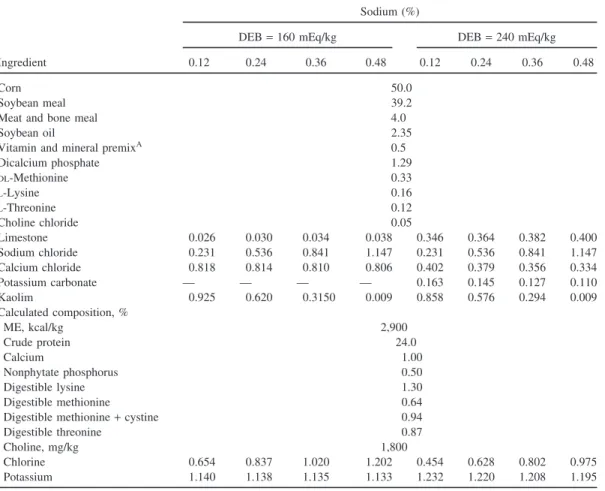
Feeds were prepared in batches of 50 kg. First, 490 kg of a basal corn-soybean meal feed was mixed. Then, amounts of limestone, sodium chloride, calcium chloride, potassium carbonate, and kaolim were included to produce each indi-vidual treatment, as shown in Table 1. Feeds were not pelleted.
Fifteen birds were placed in each experimen-tal unit and supplied with water and feed ad libitum in a completely randomized design of eight treatments of five replicates each in a facto-rial arrangement with four Na+levels and two DEB. Therefore, 40 units having 600 birds at the beginning were used. Light was continuous throughout the experiment.
TABLE 1. Composition of experimental feeds (%)
Sodium (%)
DEB=160 mEq/kg DEB=240 mEq/kg Ingredient 0.12 0.24 0.36 0.48 0.12 0.24 0.36 0.48
Corn 50.0
Soybean meal 39.2 Meat and bone meal 4.0
Soybean oil 2.35
Vitamin and mineral premixA 0.5
Dicalcium phosphate 1.29
DL-Methionine 0.33
L-Lysine 0.16
L-Threonine 0.12
Choline chloride 0.05
Limestone 0.026 0.030 0.034 0.038 0.346 0.364 0.382 0.400 Sodium chloride 0.231 0.536 0.841 1.147 0.231 0.536 0.841 1.147 Calcium chloride 0.818 0.814 0.810 0.806 0.402 0.379 0.356 0.334 Potassium carbonate — — — — 0.163 0.145 0.127 0.110 Kaolim 0.925 0.620 0.3150 0.009 0.858 0.576 0.294 0.009 Calculated composition, %
ME, kcal/kg 2,900 Crude protein 24.0
Calcium 1.00
Nonphytate phosphorus 0.50 Digestible lysine 1.30 Digestible methionine 0.64 Digestible methionine+cystine 0.94 Digestible threonine 0.87 Choline, mg/kg 1,800
Chlorine 0.654 0.837 1.020 1.202 0.454 0.628 0.802 0.975 Potassium 1.140 1.138 1.135 1.133 1.232 1.220 1.208 1.195
ASupplied per kilogram of feed: vitamin A, 5,000 IU; vitamin D3, 500 ICU; vitamin E, 15 IU; vitamin K
3, 2 mg; vitamin
B12, 15 mcg; biotin, 0.15 mg; folic acid, 1 mg; niacin, 50 mg; pantothenic acid, 25 mg; pyridoxine, 5 mg; riboflavin, 5 mg;
thiamin, 3 mg; copper, 8 mg; iodine, 0.5 mg; iron, 100 mg; manganese, 80 mg; selenium, 0.15 mg; and zinc, 70 mg.
Water consumption was recorded daily to 14 d of age by checking the volume of water left in the drinkers at the end of each day and subtracting this from all water allocated to each drinker in the preceding 24-h period.
Two chicks from each replication at 4 and 7 d of age were killed by cervical dislocation. They were ground and oven-dried for 24 h at 105°C for determination of body carcass mois-ture. Total excreta produced in each battery were collected daily. A sample of each daily compos-ite averaging 100 g was dried for moisture deter-mination using the same methodology employed on the carcasses.
Data were analyzed using the GLM dure of SAS [17] and Tukey’s studentized proce-dure was used for mean separation when the main effect F-test was considered significant (P
<0.05). Results are presented in tables as con-trasts of the main factors, which are footnoted to provide expanded information when interactions between main factors were significant (P<0.05). Linear regression analysis was conducted for the increasing levels of sodium with the objective of estimating sodium requirements [18].
RESULTS AND DISCUSSION
FIGURE 1. Body weight gains and feed conversions of broiler chicks 1 to 7 d of age and sodium levels in their feeds.
for that is the high availability and low cost of sodium chloride. In this study, overall perfor-mance of birds given the 0.12% sodium in the feed was clearly impaired (P<0.05) when com-pared with those fed the diets having sodium at 0.24% and higher. Improvements obtained in BW gain, feed consumption, and feed conversion with different sodium levels were limited to the period the birds were being fed the experimental diets and disappeared afterwards (Tables 2 and 3). However, regression analysis showed plateaus for BW gain and feed conversion from 1 to 7 d with
TABLE 4. Mortality of broilers as influenced by sodium level and dietary electrolyte balance (DEB) in the first
week’s feed, %A
Days
1–4 4–7 1–7 7–14 14–21 21–42 1–42 Dietary Na+, %
P 0.001 0.499 0.001 0.546 NS 0.999 0.102 0.12 0.0c 0.0 0.0c 0.7 0.0 2.7 3.4
0.24 1.2b 0.8 2.0b 0.0 0.0 2.7 4.7
0.36 0.0c 0.0 0.0c 0.7 0.0 2.7 3.4
0.48 5.0a 0.0 5.0a 0.0 0.0 2.5 7.5
DEB, mEq/kg
P 0.001 0.376 0.001 0.157 NS 0.740 0.044 160 2.8 0.3 3.1 0.0 0.0 2.4 5.5 240 0.0 0.0 0.0 0.7 0.0 2.8 3.5 CV, % 314.9 383.1 283.7 406.0 0 127.1 110.8
a–cMeans within a column with no common superscript differ significantly (P<0.05, by Tukey’s test). AMeans of five replicates with 15 birds each at the beginning of the experiment.
0.38 and 0.40% Na+, respectively [19], which are observable in Figure 1. Feed consumption was also dependent on Na+in the feeds, but its maxi-mum response was attained with Na+at 0.34% [19]. Birds receiving diets having DEB of 240 mEq/kg showed greater BW gain from 1 to 4 d (P
<0.002). Sodium requirements of chicks seemed dependent on the DEB from hatching to 4 d of age, when there was a significant interaction, but not to 7 d.
TABLE 7. Broiler carcass DM as influenced by sodium level and dietary electrolyte balance (DEB) in the first
week’s feed (%)A
Item 4 d 7 d Dietary Na+, %
P 0.001 0.025 0.12 24.2a 25.7a 0.24 21.5b 24.4ab 0.36 21.2b 24.6ab 0.48 21.3b 24.3b DEB, mEq/kg
P 0.009 0.315 160 22.6 24.6 240 21.6 24.9 CV, % 7.6 4.6
a,bMeans within a column with no common superscript differ
significantly (P<0.05, by Tukey’s test).
AMeans of two birds per replicate at 4 and 7 d.
at 0.12% in the end of the first week (P<0.001). On the other hand, increasing the DEB from 160 to 240 mEq/kg lowered the number of deaths in that same period (Table 4). Both effects were independent and only remained while the birds were receiving the experimental feeds.
Daily water intake increased with correspond-ing Na+concentration in the feeds. Analyses of
FIGURE 2. Total water intake and average excreta and carcass dry matter from broiler chicks from 1 to 7 d of age. regression indicated that there was an increase in the amount of water individually consumed to the level of 0.45% Na+before reaching a plateau [19]. This response remained after the end of the first week and allocation to common feeds (0.20% Na+, 0.78% K+, 0.38% Cl−). Birds fed diets with DEB of 240 mEq/kg showed a slightly higher water intake. However, this effect was not consis-tent—only occurring on d 4 and 10 (Table 5). Responses to Na+and to DEB were independent. Increasing the concentration of sodium in the feed led to a reduction in the excreta DM. This effect was observed only after 4 d and remained until the day after removal of experimental feeds. Excreta DM, expressed as an average for the first 7 d, seemed not to reach a maximum response to inclusions of Na+ [19]. Birds fed diets with the highest DEB showed an increase in the ex-creta DM. This, however, was an untimely re-sponse and only occurred on d 1, 3, and 6 (Ta-ble 6).
ex-pressed (Table 7), but regressions estimated a plateau after 0.35% Na+[19]. Increasing the DEB to 240 mEq/kg also produced a reduction in the carcass DM (P< 0.009), but as opposed to the Na+effects, this was seen only at 4 d of age.
Most requirements currently used for feed formulations are based on optimizations for BW gain and feed conversion. In the current study, Na+inclusion, which optimizes those responses, is, respectively, 0.38 and 0.40%. These are much higher than the current 0.20% Na+suggested by NRC [13] for feeds from 1 to 21 d of age, but they are in agreement with some previous results, suggesting that 0.20% Na+may be low for maxi-mum performance [8, 11]. In general, recommen-dations for minerals follow the logic of higher requirements for younger birds. Therefore, it seems logical that requirements for Na+ in the first week are higher than what is accepted as an average requirement from placement to 21 d of age.
Mortality, expressed as a percentage, is usu-ally a response with high variability. For this reason, significant differences of treatment effects for mortality are more difficult to obtain than for other performance responses, or are viewed skeptically when obtained. In this study, mortality was increased in birds fed the 0.48% Na+in feeds (P<0.001), but a significant reduction was found (P< 0.001) when birds received the 240 mEq/ kg feed during the first 4 d of age. Reduction in mortality has been related to low Na+intake [20].
CONCLUSIONS AND APPLICATIONS
1. Sodium requirements of broiler chicks in the first week post-hatching were higher than current NRC [13] recommendations for feeds from 1 to 21 d of age. Estimations of requirements obtained in this study, based on BW gain and feed conversion were between 0.38 and 0.40%. 2. Water consumption increased as a response to corresponding higher Na+in feeds reaching a
maximum at 0.46% Na+.
3. Water consumption was highly correlated with increased feed intake, which represents a benefit for chick adaptation at placement.
4. DEB of 240 mEq/kg improved overall performance of chicks when compared with that of 160 mEq/kg. Effects were more prominent at 4 d of age.
5. Mortality of broilers was increased when very high Na+was provided in the first week’s feed; however, this was reduced when DEB of 240 mEq/kg were used.
Conversely, high concentrations of sodium chlo-ride in feeds have been implicated with high blood pressure and mortality caused by sudden death syndrome [21].
Increased water intakes were correlated with corresponding water retention in carcasses and higher moisture in the excreta. These are all ex-pected physiological compensations for high in-takes of Na+and frequently occur with a reduction in the rate of glomerular filtration [22]. The cur-rent data showed water intake continuing to in-crease with corresponding increments in Na+. The same trend was seen with the moisture of excreta (especially on d 5 through 7) and with the whole carcass evaluation. However, each one of these measurements showed different levels of sodium to corresponding plateaus. Birds continued to in-crease water intake to 0.46% Na+in the feeds from 1 to 7 d of age. However, whereas maximi-zation of water retained in their carcasses at 7 d of age occurred with 0.35% Na+, elimination of moisture in excreta increased linearly and did not reach a limit within the range of Na+used in this experiment, as illustrated in Figure 2.
REFERENCES AND NOTES
1. Burns, C. H., W. W. Cravens, and P. H. Phillips. 1953. The sodium and potassium requirements of the chick and their interrela-tionships. J. Nutr. 50:317–329.
2. Ross, E. 1977. Apparent inadequacy of sodium requirement in broiler chickens. Poult. Sci. 56:1153–1157.
3. Mongin, P. 1980. Role of sodium, potassium and chloride in eggshell quality. Pages 213–223 in Proc. Nutr. Conf. Florida. Univ. Florida, Gainesville, FL.
4. Ruiz-Lo´pez, B., M. Rangel-Lugo, and R. R. Austic. 1993. Effects of selected minerals on acid-base balance and tibial dyschon-droplasia in broiler chickens. Poult. Sci. 72:1693–1704.
5. Elzbieta, W., R. Rys, J. Koreleski, and M. Pietras. 1979. Effect of sodium chloride deficiency on basal metabolism in broiler chickens. Br. J. Nutr. 42:547–552.
6. Nott, H., and G. F. Combs. 1969. Sodium requirement of the chick. Poult. Sci. 48:660–665.
7. Edwards, H. M., Jr. 1984. Studies on the etiology of tibial dischondroplasia in chickens. J. Nutr. 114:1001–1013.
8. Britton, W. M. 1992. Effect of dietary salt intake on water and feed consumption of chicks. Pages 48-53 in Georgia Nutr. Conf. Proc., Atlanta, GA. Univ. Georgia, Athens, GA.
9. Murakami, A. E., S. E. Watkins, E. A. Saleh, J. A. England, and P. W. Waldroup. 1997. Estimation of the sodium and chloride requirements for the young broiler chick. J. Appl. Poult. Res. 6:155–162.
10. Barros, J. M. S., P. C. Gomes, L. F. T. Albino, and A. H. Nascimento. 1998. Sodium levels over performance parameters of broiler chickens from 1 to 21 days of age. Page 14 in Anais da Confereˆncia APINCO ’98 de Cieˆncia e Tecnologia Avı´colas. FACTA, Campinas, SP, Brazil.
11. Oviedo-Rondo´n, E. O., A. E. Murakami, A. C. Furlan, I. Moreira, and M. Macari. 2001. Sodium and chloride requirements of young broiler chickens fed corn-soybean diets (one to twenty-one days of age). Poult. Sci. 80:592–598.
12. National Research Council. 1984. Nutrient Requirements of Poultry. 8th ed. Natl. Acad. Press, Washington, DC.
13. National Research Council. 1994. Nutrient Requirements of Poultry. 9th ed. Natl. Acad. Press, Washington, DC.
14. Mongin, P. 1981. Recent advances in dietary anion-cation balance in poultry. Pages 109–119 in Recent Advances in Animal Nutrition. W. Haresign, ed. Butterworths, London, United Kingdom. 15. Mongin, P., and B. Sauveur. 1977. Interrelationships be-tween mineral nutrition, acid-base balance, growth and cartilage abnormalities. Pages 235–247 in Growth and Poultry Meat Produc-tion. K. N. Boorman and B. J.Wilson, ed. British Poultry Science, Edinburgh, United Kingdom.
16. Hulan, H. W., P. C. M. Simons, P. J. W. Van Schagen, K. B. McRae, and F. G. Proudfoot. 1987. Effect of dietary cation-anion balance and calcium content on general performance and incidence of leg abnormalities of broiler chickens. Can. J. Anim. Sci. 67:165–177. 17. SAS Institute. 1998. SAS User’s Guide: Statistics. Version 7.0 Edition. SAS Institute Inc., Cary, NC.
18. Steel, R. G. D., J. H. Torrie, and D. A. Dickey. 1997. Principles and Procedures of Statistics: A Biometrical Approach. 3rd ed. McGraw-Hill, New York, NY.
19. Feed conversion=1.9583 X2−1.6151 X+1.4822; R2= 0.7079. BW gain= −320.87 X2+241.23 X+83.521; R2=0.7808. Feed consumption= −182.53 X2+122.44 X+130.43; R2=0.3226. Water consumption= −663.82 X2+598.39 X+242.09; R2=0.6257. Excreta DM (average from 1 to 7 d)= −28.635 X+30.993; R2= 0.6798. Carcass DM at 7 d=26.153 X2−18.653 X+27.691; R2
=0.2255.
20. Manning, B., C. W. Nam, D. Zaviezo, M. B. Patel, and J. McGinnis. 1978. Dietary sodium levels and their influence on chick growth and feed conversion. Poult. Sci. 57:1153 (Abstr.).
21. Proudfoot, F. G., H. W. Hulan, and D. M. Nash. 1985. Effects of a wide range of dietary salt levels on the performance of broiler chickens. Can. J. Anim. Sci. 65:773–775.
22. Freeman, B. M. 1983. Physiology and biochemistry of the domestic fowl. Academic Press Inc., London, UK.