Daniel Liviano Solís
ESSAYS ON INDUSTRIAL
DYNAMICS: SPATIAL AND
TEMPORAL DIMENSIONS OF FIRM
ENTRY
Ph.D. Dissertation
Directors:
Dr. Josep Maria Arauzo Carod
Dra. Elisabet Viladecans Marsal
Department of Economics
Contents
Contents 3
List of Figures 7
List of Tables 9
Preface 11
R´esum´e 12
1 Conceptual and Theoretical Framework 19
1.1 Motivation of the Thesis . . . 19
1.2 How Space and Time Changed the Economy . . . 24
1.2.1 The Origins . . . 24
1.2.2 Industrial Location: from Geometric Models to New Eco-nomic Geography . . . 26
1.2.2.1 Economics and Geography: a Journey through the Dark . . . 26
1.2.2.2 The German School . . . 26
1.2.2.3 The Development of the Economic Geography . . . 28
1.2.3 Industrial Organisation: from the Static Analysis to Firm De-mography . . . 30
1.2.3.1 First Contributions . . . 30
1.2.3.2 Introducing Dynamic Markets and Heterogeneous Firms . . . 31
1.2.3.3 Different Views of Firm Entry and Exit . . . 32
1.3 Determinants of Firm Location . . . 36
1.3.1 Theoretical Approaches . . . 36
1.3.2 Location Determinants . . . 37
1.3.2.1 Agglomeration Economies . . . 37
1.3.2.2 Public Infrastructures . . . 42
1.3.2.3 Human Capital . . . 42
1.3.2.4 Public Policies . . . 43
1.3.2.5 Technological Factors . . . 45
1.3.2.6 Factors Interal to the Firm . . . 45
1.4 Effects of New Firms on the Economy . . . 46
1.4.1 How New Firms Change the Economy and Make it Evolve . . 46
1.4.2 Theoretical Framework . . . 48
1.4.3 Economic Growth . . . 49
1.4.4 Competition . . . 53
1.4.5 Innovation . . . 54
1.4.6 Productivity . . . 57
2 Firm Location: an Empirical Analysis focusing on Distributional Issues, Spatial Effects and Nonlinearities 61 2.1 Motivation . . . 61
2.2 Methodological Issues . . . 65
2.2.1 Empirical Analysis of Firm Location . . . 65
2.2.2 Count Data Models . . . 66
2.2.2.1 Motivation . . . 66
2.2.2.2 Basic Assumptions . . . 67
2.2.2.3 Overdispersion and Excess of Zero Counts . . . 69
2.2.3 Problems to be Solved . . . 72
2.2.3.1 Spatial Effects . . . 72
2.2.3.2 Measurement of Nonlinearities . . . 73
2.2.3.3 Treatment and Interpretation of Zeros . . . 76
2.3 Data and Variables . . . 77
2.3.1 Data . . . 77
2.3.2 Variables . . . 79
2.3.2.1 Description . . . 79
2.3.2.2 Descriptive Statistics . . . 84
2.4 Exploratory Analysis . . . 89
2.4.2 Spatial Distribution of the Dependent Variable . . . 89
2.5 Firm Location Empirical Analysis . . . 101
2.5.1 Motivation . . . 101
2.5.2 Specification . . . 103
2.5.3 Estimation and Results . . . 104
2.6 Summary . . . 111
3 The Effects of Firm Entry on Factors’ Demand: a Dynamic Analysis for Regions and Sectors 123 3.1 Motivation . . . 123
3.2 Firm Entry, Labour Demand and Technology . . . 127
3.2.1 Specifics and Importance of Factor Demand . . . 127
3.2.2 Evidence on Firm Entry and Labour Demand . . . 128
3.2.3 Technological Change vs. Employment Creation . . . 136
3.2.3.1 What is Economic Development? . . . 136
3.2.3.2 Concepts about Technology and Labour Demand . . 137
3.2.3.3 Historical Perspective . . . 141
3.2.3.4 The Role of New Firms . . . 145
3.3 Data and Variables . . . 147
3.3.1 Data . . . 147
3.3.2 Variables . . . 148
3.3.3 Description . . . 149
3.4 Descriptive Analysis . . . 150
3.4.1 Motivation . . . 150
3.4.2 Short Overview over the last 20 Years . . . 151
3.4.3 Correspondence Analysis . . . 156
3.4.4 Analysis of Variance (ANOVA) . . . 157
3.4.5 Growth Rate Components . . . 159
3.5 New Firm Entry and Labour Demand: a Dynamic Approach . . . 163
3.5.1 Motivation . . . 163
3.5.2 Empirical Model . . . 164
3.5.3 Estimation and Results . . . 165
3.6 Firm Entry and Dynamic Factor Demand and Substitution . . . 169
3.6.1 Motivation . . . 169
3.6.3 Empirical Framework . . . 174
3.6.4 Model Specification and Estimation . . . 175
3.6.5 Results . . . 177
3.7 Summary . . . 193
4 Summary and Conclusions 197 4.1 Summary of the Main Results . . . 197
4.2 Discussion . . . 200
4.3 Future Research Directions . . . 201
A Methodological Appendix 203 A.1 Industrial Demography Main Indices . . . 203
A.1.1 Gross Rate of Entry (GRE) . . . 203
A.1.2 Gross Rate of Exit (GRX) . . . 203
A.1.3 Turnover Rate (TR) . . . 204
A.1.4 Net Rate of Entry (NRE) . . . 204
A.1.5 Volatility Rate (VR) . . . 204
A.2 Count Data Methodology . . . 205
A.2.1 Generalised Linear Models (GLM) . . . 205
A.2.2 Basic Poisson Regression Model . . . 206
A.2.3 Mixture Models . . . 207
A.2.3.1 Definitions . . . 207
A.2.3.2 Mixture Poisson Models . . . 208
A.2.3.3 Finite Mixture Models . . . 210
A.2.3.4 Zero Inflated Poisson (ZIP) and Zero Inflated Nega-tive Binomial (ZINB) Models . . . 212
A.2.4 Generalized Additive Models for Location, Scale and Shape (GAMLSS) . . . 213
A.3 Spatial Analysis Methodology . . . 214
A.3.1 Generalized Weights Matrices . . . 214
A.3.2 Moran’s I Statistic . . . 216
A.4 Sectoral Adjustment of the Rate of Entry . . . 217
List of Figures
1.1 General research framework of the thesis . . . 20
2.1 Parametric nonlinear relationship between location and agglomeration. 74 2.2 Establishment entries 2002 - 2004: histogram (left) and kernel density estimation (right). . . 93
2.3 Establishment entries 2002 - 2004: map representation municipalities where no entries took place appear in black. . . 94
2.4 Establishment entries 2002 - 2004: map representation with entries in intervals. . . 94
2.5 Establishment entries in natural resources intensive sectors (2002 -2004): brighter areas show a higher number of entries. . . 95
2.6 Establishment entries in intensive in labour sectors (2002 - 2004): brighter areas show a higher number of entries. . . 95
2.7 Establishment entries in intensive in scale economies sectors (2002 -2004): brighter areas show a higher number of entries. . . 95
2.8 Establishment entries in sectors with differentiated products (2002 -2004): brighter areas show a higher number of entries. . . 95
2.9 Establishment entries in the intensive in R&D sectors (2002 - 2004): brighter areas show a higher number of entries. . . 95
2.10 Residuals of a Poisson regression . . . 99
2.11 Residuals of a Negative Binomial type I regression. . . 99
2.12 Residuals of a Negative Binomial type II regression. . . 100
2.13 Residuals of a Zero Inflated Poisson type I regression. . . 100
2.14 Residuals of a Zero Inflated Poisson type II regression. . . 102
2.15 Residuals of a Zero Augmented Inverse Gaussian regression. . . 110
2.16 Nonparametric estimation of the Model II: Penalized Spline partial functions of the regressors from theν-parameter equation.95%
point-wise confidence intervals are shown in dashed lines. . . 120 2.17 Nonparametric estimation of the Model II: Penalized Spline partial
functions of the regressors from theμ-parameter equation. 95% point-wise confidence intervals are shown in dashed lines. . . 121
3.1 Dynamic effect of entries on labour demand change . . . 132 3.2 Entries, innovation and labour demand changes . . . 146 3.3 Evolution of GRE and the growth rates of employment, value added
and number of establishments . . . 154 3.4 Kernel density estimation oflog(K/L)in the years 1980 and 1992. . . 155 3.5 Lag structure of the impact of new business formation on regional
employment growth resulting from the joint estimation (left) and from separate estimations (right). . . 166 3.6 Lag structures of the impact of new business formation on regional
employment growth resulting from the Almon lag model estimations. 170 3.7 Kernel density estimation oflog(K/L)ijtover time: variable in levels. 172 3.8 Kernel density estimation oflog(K/L)ijtover time: variable including
fixed sectoral and regional effects. . . 172 3.9 Kernel density estimation oflog(K/L)andΔLt/Lt−1. . . 173
List of Tables
2.1 NACE-93 Classification . . . 78
2.2 NACE-93 Classification . . . 79
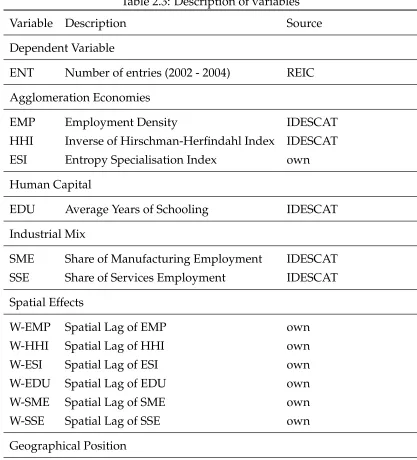
2.3 Description of variables . . . 80
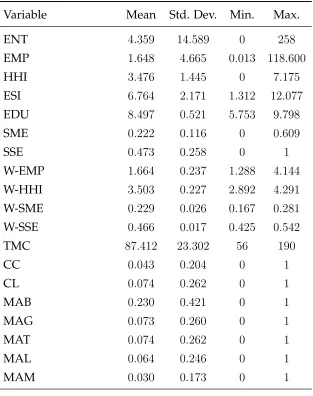
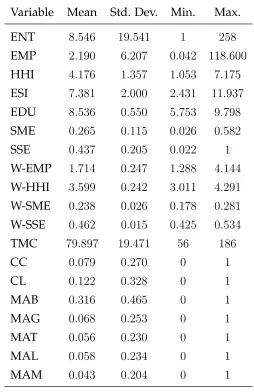
2.4 Descriptive statistics of the variables . . . 85
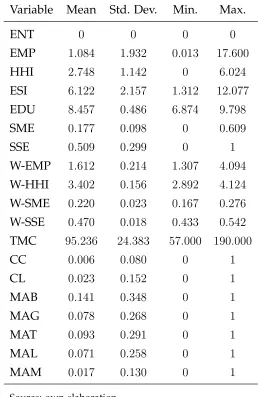
2.5 Descriptive statistics of the variables for the case of the 461 munici-palities without entries between 2002 - 2004 . . . 86
2.6 Descriptive statistics of the variables for the case of the 480 munici-palities with at least one entry between 2002 - 2004 . . . 87
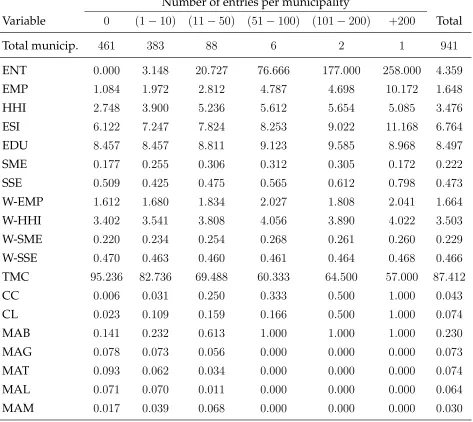
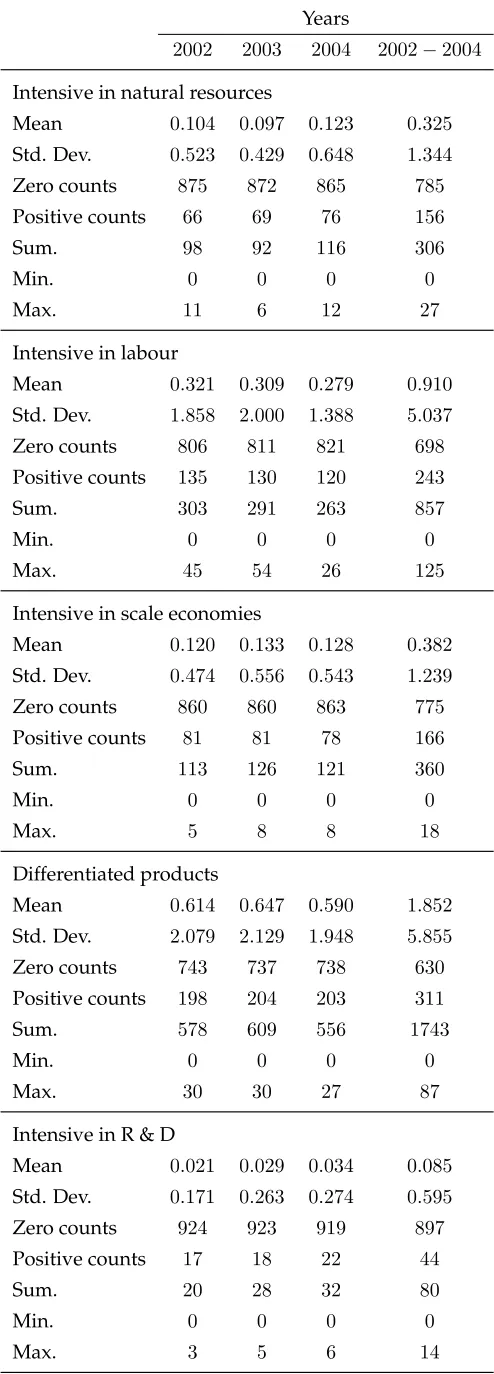
2.7 Mean value of the variables per number of entries in municipalities . 88 2.8 Descriptive statistics of establishment entries 2002 - 2004 . . . 90
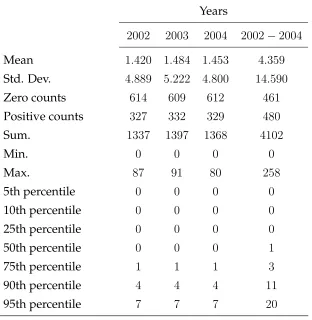
2.9 Establishment entries per aggregate sector 2002 - 2004 . . . 91
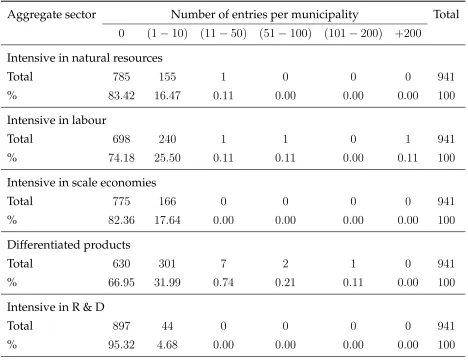
2.10 Establishment entries per number of entries in municipalities and ag-gregate sector 2002 - 2004 . . . 91
2.11 Descriptive statistics of establishment entries per aggregate sector 2002 - 2004 . . . 92
2.12 Spatial correlation of establishment entries 2002 - 2004 . . . 97
2.13 Spatial correlation of several model’s residuals . . . 101
2.14 Model I: ZAIG estimation for the aggregated sectors . . . 114
2.15 Model II: ZAIG estimation for the aggregated sectors . . . 115
2.16 Model III: ZAIG estimation for sectors intensive in natural resources 116 2.17 Model IV: ZAIG estimation for sectors intensive in labour . . . 117
2.18 Model V: ZAIG estimation for sectors intensive in scale economies . 118 2.19 Model VI: ZAIG estimation for sectors with differentiated products . 119 3.1 Different terminology in the literature . . . 137
3.2 NACE-25 Classification . . . 148
3.3 Regional (NUTS-2) Classification . . . 149
3.4 Data structure . . . 150
3.5 Description of variables . . . 150
3.6 Annual Gross Rate of Entries (GRE) . . . 151
3.7 Contingency table’s basic structure . . . 156
3.8 Contingency analysis of GRE . . . 158
3.9 ANOVA analysis of the main variables . . . 159
3.10 Sectoral and regional components of growth rates . . . 161
3.11 VCM estimation of the growth model with regional components . . . 162
3.12 VCM estimation of the growth model with sectoral components . . . 163
3.13 Fixed Effects Estimation . . . 167
3.14 Polynomial Distributed Lag Estimation . . . 169
3.15 Dynamic factor demand estimation: all manufacturing sectors . . . . 181
3.16 Dynamic factor demand estimation: mineral products . . . 182
3.17 Dynamic factor demand estimation: chemical products . . . 183
3.18 Dynamic factor demand estimation: metal products . . . 184
3.19 Dynamic factor demand estimation: agricultural and industrial ma-chinery . . . 185
3.20 Dynamic factor demand estimation: electrical goods . . . 186
3.21 Dynamic factor demand estimation: transport equipment . . . 187
3.22 Dynamic factor demand estimation: food, beverage and tobacco . . . 188
3.23 Dynamic factor demand estimation: textiles . . . 189
3.24 Dynamic factor demand estimation: paper and printing . . . 190
3.25 Dynamic factor demand estimation: rubber and plastic . . . 191
Preface
When I finished the degree in business administration and I began to wonder what to do with my life, Prof. Agust´ı Segarra came to me and offered me a doctoral scholarship at the Economics Department of the Universitat Rovira i Virgili in Reus. I have always liked the academia, and the idea of becoming a professor was for me no passing fancy. This was in 2003, and was the beginning of one of the most exciting periods of my life, both personally and professionally. In the first year of my PhD dtudies I took lessons at the University of Barcelona, where prof. Enrique L ´opez-Bazo and prof. Rosina Moreno taught me the essential of econometrics and computational statistics. I remember as well the numerous train trips from Reus to Barcelona, during which I enjoyed the estimable company of my dear colleagues Rosa Vidal and Jordi Andreu.
During the second year I started to grow interest in the topics analysed in this thesis. Responsible for such interest were Josep Maria Arauzo and Elisabet Viladecans, whose lessons I had the privilege to attend and enjoy. They enlightened me with their knowledge and understanding, and they transmitted to me the passion for research. At the end, they kindly accepted to be the directors of this thesis, for which I will never be grateful enough. They have devoted a lot of time and effort to this project, and their advice and guide have been crucial to the thesis’ success. During the second year I also enjoyed the fruitful pieces of advise from Christian Dur´an and Miquel Manj ´on, and to them I am also very grateful, since whenever I had a question or comment they were there for me.
In 2005 and 2006 I had the chance to be at Max Planck Institute of Economics in Jena (Germany), and it was due to Prof. David Audretsch’s kind invitation. The atmosphere I enjoyed there was indescribable, and I could work in an intellectual and motivational environment. I thank my colleagues over there for those countless
shared moments and talks: Raquel Ortega, Andrea Conte, Christina Schneider, J ¨org Zimmermann, Werner B ¨onte, Erik Monsen, Andr´e Van Stel, Torsten Weiland and the personnel at the institute. I also acknowledge the insightful comments by Marco Vivarelli, Michael Fritsch, Rui Baptista, Georgios Fotopoulos, Zoltan Acs and Simon Parker.
Back in Reus, I would like to mention my colleagues Mercedes Teruel, Daniel Miravet, Maite Fibla, Sebasti´an Cano, Jaume Abadia, Javier Guti´errez, Laia Pi´e, Raquel Laguado, Mabel Ficosecco, V´ıctor Garro, Olga Slivko, Vero Gombau, Aleix Gregori, Xiaoni Li, Eleni Papaikonomu, Carmen Cincunegui, Bel´en Guercio, Tatiana Gorjub, Andr´es Pazzi, Claudia Pezoa and Fabiola Baltar. PhD studies might be very demanding sometimes, and being together was very important for us. A special mention is to Marc S´aez from the University of Girona, who gave me key insights into bayesian statistics and kindly answered my questions. I would not like to forget Magda Lleix`a, an efficient and friendly research assistant from the Economics Department, because her help with the edition of this thesis has been fundamental and worth being acknowledged. Moreover, I would like to express my deep and eternal gratitude to my parents and to my brother, they know why.
R´esum´e
If this thesis had to be defined just by using just few terms, one of them would surely be entrepreneurship. Many contributions coming from different disciplines have shown to what extent entrepreneurial initiatives are an important source of economic development. Such initiatives can have many forms and come from many sources, and an important vehicle through which such initiatives have an effect in the economy is the entry of new economic business ventures. In this respect, several streams of the literature have focused on the characteristics, determinants and effects of such entries. This is the general framework of this work, which focuses on two fundamental and relevant questions: (a) the territorial determinants of new economic ventures’ location and (b) the effects of such entries in terms of dynamic factor demand. Although such questions can be analysed separately, they belong to the same economic phenomenon, that is, the causes and consequences of new economic ventures, and the results obtained in each analysis can be interpreted in a broader and more general context. The work presented in this thesis is grouped into three main blocks, corresponding to the three first chapters, the fourth chapter being devoted to the general summary, a discussion and insights for further research.
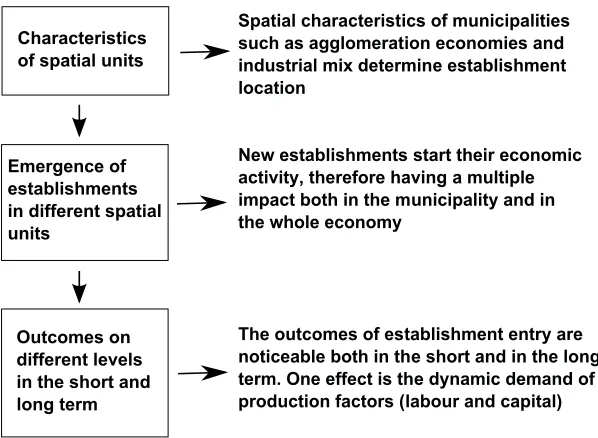
Chapter one serves as the introduction, and it starts with a broad and detailed overview of the motivation and relevance of the research, specifically linking the two main research questions proposed here. Such link works like this: there are certain characteristics of spatial units (such as agglomeration economies) that determine the location of new establishments. Once such establishments start their productive activity, they exert a multiple impact on the geographic place where they are located, on their sector of activity and on the whole economy as well. Such effect is multiple and is related to output growth, changes in factor demand, increased competition and efficiency and productivity growth, to name some of them. Besides, the effect is not restricted to the moment when the entry takes place,
but lasts over time, which points out the importance of distinguishing between short term and long term effects. Next, the chapter gives a broad overview of the seminal contributions to the topics studied in this thesis. In an attempt to classify such contributions in a clear way, they are related to the dimensions space and time. Although the space dimension has been related to the study of economics for a longer period of time, it was Alfred Marshall at the beginning of the XXth century with the concept of external economies one of the first and most crucial contributions, which lay the basis for a wide array of literature streams taking into account the role of space in the economy. In this respect, the contributions of Walter Isard in mid-XXth century are also worth mentioning, since he brought the first locational theories into the mainstream economics and gave birth, along with other scholars, to the regional economics discipline. The other dimension, time, was gradually introduced in the industrial organisation field during the XXth century. Specifically, the initially static concept of firm entry considered by the first contributions in the field, which rendered firm entry just as an error correction mechanism, was being gradually rendered obsolete as new evidence revealed the dynamic nature of industry through its evolution over time. Such new evidence was very heterogeneous and covered aspects such as determinants of firm entry, exit and survival, effect of new firms on economic performance, equilibrium prices and incumbent’s behaviour over time, to name some of them. Despite such heterogeneity, these contributions are often referred to as belonging to the field of industrial dynamics or firm demography. The rest of the chapter is devoted to a broad, albeit essential, review of the literature. The first part of such review covers the main spatial determinants of industrial location both from a theoretical and empirical point of view, which are agglomeration economies, public infrastructures, human capital, public policies, technological factors and internal factors of the firm. The second part of this review focuses on the theoretical and empirical contributions dealing with the short term and long term effect of new firms upon the economy. Since this literature is very broad and heterogeneous, it has been decomposed into the following categories: economic growth, competition, innovation and productivity. A brief summary closes this chapter.
The third chapter aims at the study of the relationship between the entry of new establishments and factor demand for the Spanish manufacturing sectors. The motivation behind this research is to study the short term and long term effects of establishment entries upon the dynamic demand and substitution of labour and capital productive factors. The chapter begins with a discussion about the relationship between new firms and labour demand, highlighting the relevance of this topic of research and then reviewing the different approaches that many different contributions have adopted to empirically tackle this issue as well as the results obtained up to now. However, the effect of entries on labour demand is only a part of the whole story, since the capital factor is demanded as well. Because the demand and substitution of both factors and technological change are closely related phenomena, the next part of the chapter is devoted to the relationship between these concepts, which reviews the different types of innovation that can take place, under which circumstances technological change is to raise or lower labour demand in the short-term and the long term, and moreover the role that new firms can play in this complex process. Next, an empirical research for the Spanish regions is undertaken first by presenting the data at a regional, industrial and tem-poral level and the variables to be used in such analysis. Then, a broad descriptive analysis consisting of a correspondence analysis, an analysis of variance (ANOVA) and a decomposition of growth rate components is presented. These methodologies are intended to pierce the thick three-dimensional wall of the variables, and to give insights into the variables’ heterogeneity and evolution over time. The empirical research consists mainly of two blocks. The first one deals with the dynamic effect of new firm entry on labour demand changes, and it consists of the estimation of dynamic panel models, which are intended to unveil the short term and long term effect of establishment entry gross rates upon changes in labour demand. Such anal-ysis is performed both for the aggregated manufacturing sectors and for different sectoral groups, in order to assess the specific dynamic effects for different sectors. The second analysis extends the analysis to the dynamic demand and substitution of labour and capital factors, and by means of the estimation of dynamic models the effect of entry gross rates on the demand and substitution of labour and capital is studied. Finally, the results and findings are summarised at the end of the chapter.
Chapter 1
Conceptual and Theoretical
Framework
1.1
Motivation of the Thesis
During the last decades new contributions and thus new evidence on the nature and the impact on the economy of new firms has arisen. Factors such as the increasing availability of new data bases, the development of new econometric models and estimation procedures and also a deeper understanding of the firm creation process have allowed the development of an emerging and also heterogeneous literature stream over the last half century. Many of these contributions can be directly or indirectly linked to the concept of entrepreneurship. Although there exist many definitions of such concept, since it is a multidisciplinary field1, the basic underlying
idea behind it is that entrepreneurs constitute an engine of economic and social development all over the world. AUDRETSCH (1995), ACS AND AUDRETSCH
(2003) and DAVIDSSON (2004) review many definitions given to entrepreneurship
throughout many years of research, the main ones being the following: new entry, creation of new firms and organisations, novel combination of resources having an impact on the market, the act of pursuing opportunities, the process of creating something different with value and the willingness to take risks.
1Nowadays, entrepreneurship and its implications in the economy and society are the subject
of a growing body of research, primarily in the disciplines of economics, geography, management, finance, strategy, psychology and sociology, being entrepreneurship a subfield in most of the above
mentioned disciplines (ACS ANDAUDRETSCH2003).
One of the fields to which this thesis can be related is the interdisciplinary field of entrepreneurship, and the definition adopted and studied here is the creation of new industrial establishments2. One basic assumption made in this thesis is that these new establishments are likely to play a role in the economy, and this role is going to be studied by using quantitative methods, that is, statistic and econometric tools. The basic questions to be answered in this work can be grouped into two different but strongly interrelated aspects, i.e. (a) the determinants of new establishments’ location and (b) the outcomes and effects of these new establishments in terms of factor demand. This approach is suggested by DAVIDSSON (2004) when outlying
and analysing the ”entrepreneurship research as the study of processes of emergence of new ventures”. This author states that, after matching data on new ventures with a level of analysis, i.e. individual, firm, industry, region, nation, etc., research should pay attention to antecedents and outcomes as well. This structure is adopted in this thesis and the resulting research framework is shown in Figure 1.1.
[image:19.595.126.425.359.578.2]
Figure 1.1: General research framework of the thesis
As it can be seen in Figure 1.1, this framework puts the creation of establish-ments into perspective, analysing both the creation and location processes and the
2The empirical analysis carried out in this thesis uses data on manufacturing establishments.
Be-cause a single firm can have several establishments, and in order to avoid confusion over these terms,
outcomes that result from their entry. With respect to the creation of establishments, there are many factors leading to their creation, such as the entrepreneurial culture of the economy, sectoral characteristics and phase of the economic cycle (ACS AND
AUDRETSCH 2003). In this thesis the focus is on those territorial characteristics
that determine the number of new establishments that will locate in different municipalities. In fact, this is a ceteris paribus hypothesis, since we assume that all other factors determining establishment creation remain the same, focusing exclusively on those factors linked to the spatial unit where the location takes place, that is, the municipality. This framework also shows that new establishments are the key, the connector and the vehicle that links territorial characteristics to certain outcomes such as economic growth, increases in employment, technological change, etc. Because the effects of entries on the economy are very complex and multidimensional, they are not restricted to the specific spatial unit and sector where they take place, but to the whole economy, that is, territories and sectors. Besides, not only do new entries have an influence in the right moment when they enter the market, but also in the long term, specifically in terms of technological change and efficiency improvements. In this thesis the focus is on the effects on the labour and capital markets, that is, how new establishments demand productive factors (labour and capital) and how the stock of those factors vary over time.
Specifically, the main contributions of this work can be summarised in the fol-lowing points:
a) Present some empirical evidence for the Spanish and Catalan economy.
b) Adopt new methods and models suitable for this area of research.
c) Propose new directions and insights for further research in the framework given by Figure 1.1.
With respect to the first part of the framework, this thesis deals with the location of new industrial establishments in Catalonia. The chosen geographical level is the municipality3, and thus the effect of territorial characteristics on the emergence of
3The question about which territorial unit is to be considered when studying industrial location
is not clear. So far, several studies using different territorial units have found different results. In this thesis the chosen agglomeration level has been the municipality because it allows to estimate more efficiently spatial effects among different spatial units. For a discussion about this topic, see ARAUZO
new establishments is analysed4. The main questions to be answered are:
a) How do territorial characteristics determine the number of located establish-ments in each municipality?
b) Which are the main variables behind the location of new establishments?
c) How do municipalities’ variables influence the location in other municipali-ties? In other words, how do interactions among municipalities in the form of spatial correlation work?
d) Is the effect of municipaities’ characteristics different for several manufactur-ing sectors?
e) In comparison with the common methodology used so far in the literature, are there any econometric tools more suitable for dealing with spatial effects and other problems related to spatial data?
The second link of the framework analysed in this thesis deals with the outcomes resulting from establishment entries. As it is reviewed in the next section, the en-try of new capacities has multiple effects over the economy, both of a static and a dynamic nature. New capacities have been proven to promote competition in the markets, an increased efficiency and productivity and, in the long term, a stimulus of technological change and economic growth5. Specifically, this part of the
analy-sis deals with the demand of productive factors, that is, the demand for labour and capital. Thus, the main questions that this part intends to answer are:
a) What is the dynamic impact of new establishments over labour demand changes?
b) Are labour demand changes mainly driven by the expansion/contraction of existing establishments or by the entry/exit of establishments?
c) Apart from the labour factor, is there any relationship between new establish-ments and the dynamic demand for capital?
4The stream of the literature dealing with this relationship specifically names these new
establish-mentsindustrial location. In Chapter 2 this name is therefore used.
d) What is the role of new establishments in the capitalisation process that the Spanish industry has undergone in recent years?
e) In the long term, what is the relationship between the dynamic demand and substitution for labour and capital? Is there a dynamic complementarity or substitution between their demands?
At the end, both parts of the analysis shed light on a complete and dynamic process, that is, how different regions and territories are capable of attracting new establishments, which in turn demand productive factors and create added value. There exist two dimensions which are fundamental in this framework whose importance should not be dismissed: spaceand time. On the one hand, the creation of new establishments is a phenomenon closely linked to the physical spacewhere it is located. The specific location that a new firm/establishment might choose has a direct effect on its future performance and survival. During the nineties there was a wave of contributions highlighting the fact that entry rates were unevenly distributed across regions (ASHCROFT ET AL. 1991; DAVIDSSON ET AL. 1994;
AUDRETSCH AND FRITSCH 1994)6. In this context, an enormously influential
contribution was KRUGMAN (1991), which, by means of a rather simple model
considering scale economies, transportation costs and demand, determined the location of manufacturing firms and the emergence of core-periphery patterns. Yet another stream of the literature studied which geographic variables determined the entry and exit of firms7. These contributions highlighted the role that
geograph-ical variables, that is, variables at different levels such as region, labour market area, municipality, city, metropolitan area, etc., play in determining the entry of new capacities8. Among these determinants there are variables such as sectoral
composition, size of markets, population, taxes, human capital, transportation infrastructures, employment levels and external economies9. The role of space,
6See the special issue ofRegional Studies(1994) entitledCross-national Comparisons of the Variation
in New Firm Formation Rates.
7See ARAUZO ET AL. (2010) for a review of these contributions.
8There is a semantic aspect that should be considered when dealing with spatial variables
deter-mining entries, since in the literature analysing those factors entries are namedlocationsrather than
entries, although the underlying phenomenon might be the same.
9The contributions by GLAESER ET AL. (1992) and HENDERSON ET AL. (1995), in which external
however, is broader and deeper, since new establishments may consider not only the characteristics of particular geographical sites they want to settle in, but also the characteristics of a the areas nearby. This spatial interaction between geographical areas causes spatial effects, i.e. spatial dependence and spatial heterogeneity, which are important both from a conceptual and a methodological point of view. In this sense, the effects that new establishments cause on the economy are not only confined to the precise geographic spot where they are located, because they might contribute to the demand of labour and capital in a broader geographical area and also might stimulate the economic activity in different sectors, for example, via suppliers and distributors of inputs and outputs. The other fundamental dimension is time, because one basic feature of industrial markets is their dynamic nature10.
Focusing strictly on the dynamic demand for productive factors, the effects of establishment entries are multiple and take place both in the short and the long term. At the moment of the entry, new establishments demand a certain amount of factors in order to start their economic activity. On average, this amount is not high, since the average size of new establishments when entering the market is small (GEROSKI1995). However, those establishments that survive grow in size as
time goes by and thus the demand for productive factors increases. However, as new establishments keep coming on, some establishments (both recent newcomers and incumbents) exit the market, which has a negative effect on the stock of factors. All in all, as time goes by some establishments enter the markets while some others exit out of it, some others expanding and shrinking continuously in size, being one of the results a countinuous effect on the demand for labour and capital factors.
As stated earlier, the aim of this thesis is to analyse the framework depicted in Figure 1.1 for the Spanish and Catalan economy. First, the effect of territorial characteristics on establishment locations is analysed for the Catalan manufactur-ing sectors at the municipality level. At such desaggregated level, the spatial ef-fects between municipalities can be studied precisely and accurately11. In order to
study this relationship taking into account the spatial dimension, new methodolog-ical proposals are made and used in this thesis. Second, with respect to the effects of establishment entries on the demand for labour and capital, they are analysed for
10See next Section 1.2 for a detailed review on industry dyamics.
11For a discussion about the effects of differents levels of aggregation on industrial location, see
the Spanish manufacturing sectors at the regional and sectoral levels. By estimating dynamic models the short-term and long-term effects of establishment entries upon (a) the demand of labour and (b) the joint demand for labour and capital are studied. Finally, conclusions are drawn and several proposals for further research are made.
1.2
How Space and Time Changed the Economy
1.2.1
The Origins
It is clear that space and time are two fundamental dimensions in many natural sci-ences, such as physics, geology, etc. One could think that these dimensions are only restricted to natural sciences, having social sciences nothing to do with such dimen-sions. However, considering the economy as the branch of social anthropology that studies the allocation of limited resources with alternative uses among economic agents with illimited needs, it is clear that this allocation process takes place in a physical space and evolves as time goes by. Despite how clear this fact might be, the economic analysis has neglected these two fundamental dimensions for a long time, focusing on static equilibriums applied to a whole economy, no matter how the eco-nomic activity might be distributed over space. Fortunately, the last decades have witnessed different and heterogeneous waves of contributions which incorporated, in different and alternative ways, space and time into economic analysis. If one is to look for the original seed of such contributions to economic science, it dates back to the end of the XIXth century, to the insightful work MARSHALL (1890), named
Principles of Economics12. This extense work contained many ideas, and with respect
to time and space his contributions can be summarised as follows:
a) Space: apart from those economies that are internal to the firm, that is, economies of scale of production, Marshall defined and developed the con-cept of external economies, that is, positive externalities external to the firm stemming from being located next to other producers and economic activity in general. The author named these concentrations of activityindustrial districts, and classified these external economies into three types, i.e. (1) economies re-sulting from access to a common labor market and shared public goods, such
12Despite the consequences and importance of Marshall’s contributions, the German location
as infrastructure or educational institutions; (2) economies from saved trans-portation and transaction costs due to the regional proximity of firms along the supply chain, this is, suppliers and customers; and (3) economies from spillovers that result from industry knowledge being readily discerned due to physical proximity. Later on, the idea of external economies was devel-oped, widened, updated and sophisticated by many authors (HOOVER 1936;
BECATTINI 1979; KRUGMAN 1991; GLAESER ET AL. 1992), but Marshall’s
contributions remain as the pioneering work on the topic.
b) Time: Marshall stressed the importance of the dynamic nature of industrial activities in his contributionPrinciples of Economics. Following his arguments, modern economies are characterised by different sectors, each of which fol-lowing different paths, that is, some sectors being more successful than oth-ers in terms of expansion and growth. Some years later, PETER SCHUM
-PETER (1939,1942) highlighted throughout his contributions the role of
en-trepreneurs in the dynamic process of technological change. This author coined and poularised the termcreative destruction, used to describe the process of transformation caused by the entry of entrepreneurs that led to sustained long-term economic growth by destroying the value of established companies that enjoyed some degree of monopoly power.
1.2.2
Industrial Location: from Geometric Models to New
Eco-nomic Geography
1.2.2.1 Economics and Geography: a Journey through the Dark
As stated earlier, the matter of the location of economic activity has been neglected by the mainstream economics for a long time. Many of the main contributors to the general equilibrium theory (HICKS 1939; MOSAK 1944; SAMUELSON 1947, to
name a few) neglected the role of space in the economy, assuming that the economy was formed by factors, producers, commodities and consumers that were congre-gated at one abstract point in space. Even MARSHALL (1890), when discussing the
role of time and space in economics, argued that the influence of time was more fundamental than that of space. However, CHAMBERLAIN (1933) treated the space
choice, and also their connection to prices, coining the termproduct differentiationto describe how a supplier may be able to charge a greater amount for a product than perfect competition would allow. From his analysis emerges explicitly the need for applying the techniques of monopolistic competition in order to handle with the spatial dimension of the economy. In fact, his theory was later to be used by some developers of economic geography theory, such as KRUGMAN(1991).
1.2.2.2 The German School
Apart from the mainstream economic theories being developed at the beginning of the XXth century13, there were many attempts to construct location theories,
com-ing mainly from German authors who have been named The German School some years later. The first contribution wasVON THUNEN¨ (1826), which is an analytical developement of a model for agricultural location and stands for the first serious treatment of spatial economics, connecting it with the theory of the rent. This study is far ahead of its time, and von Th ¨unen is considered to be the father of location the-orists. Later on, LAUNHARDT(1882) contributed to the location theory by studying
industrial location and market areas with a mathematical formalisation. However, it was Alfred Weber the first scholar who tried to develop a general location theory (WEBER 1909). Adopting an evolutionary approach, he tried to develop a theory of the transformation of locational structures. Specifically, he developed the Least Cost Theory, which tried to explain and predict the locational pattern of the indus-try at an aggregated level, being input and output transportation costs as well as labour costs the main location determinants14. CHRISTALLER (1933) went a step
further and proposed the Central Place Theory, which explains the number, size and location of human settlements in an urban system. According to this theory, settle-ments would tend to form in a triangular/hexagonal lattice surrounding the central places, and then these could serve smaller settlements efficiently without any
over-13ISARD(1956) names this stream of contributions the ”Anglo-Saxon tradition”. Besides, he
de-fined the ”Anglo-Saxon bias” as the rejection of the space in their analysis, compressing everything within the economy to a point, so that all spatial resistance disappears.
14The fact that Weber wanted to study industrial location from a general economic perspective can
lap. Another monumental contribution was due to L ¨OSCH (1940), which, going
beyond simple partial analyses considering spatial interrelations, developed a sim-plified static model of a space-economy operating under conditions of monopolistic competition. His model predicts the division of space into hexagons and the spa-tial concentration of spaspa-tial activities. The contributions of the German School were overlooked by those economists belonging to the so-called Anglo-saxon tradition15
for a long time, until ISARD (1956) translated, made known and popularised the main contributions from the German School, thus settling the grounds of regional science16. This discipline then grew and gained supporters, who were dissatisfied
with the low level of regional economic analysis in the mainstream research in eco-nomics. However, the discipline was thought of as an interdisciplinary field which went beyond the scope of economists, thus incorporating natural scientists, psy-chologists, anthropologists, lawyers, sociologists, political scientists, planners and geographers.
1.2.2.3 The Development of the Economic Geography
The second half of the XXth century has been characterised by the emergence of a variety of contributions on the relationship between economics and geography. These contributions have been, and still are, so heterogeneous that it is impossible to label them under a common definition. Usually, economic geography is regarded as a subfield of the discipline of geography, although some economists have claimed that economic geography is a field on its own17. The evolution of the discipline in
the second half of the XXth century is very diverse and heterogeneous, and some of the main developments can be grouped into these categories:
a) Quantitative revolution: this revolution occurred during the 1950s and 1960s and was intended to overcome the simplistic descriptive nature of geography.
15It has been argued that one reason why the contributions of German scholars were mainly
ig-nored by the mainstream of English-speaking economists was the disdain with which they regarded texts written in other languages.
16The efforts by Walter Isard and other economists to promote a scientific analysis of industrial
location and urban development translated into the creation of the Regional Science Association, which was founded in 1954.
17This discussion is related to the crisis that geography as an academic field suffered during the
Many scholars had then the aim of bringing the scientific methodology into geography, so that this would become a nomothetic discipline18. This
rev-olution consisted mainly of the introduction of mathematical, statistical and econometric techniques which tried to improve the simple descriptive meth-ods being used so far. Then, apart from borrowing quantitative methodologies being used so far in other disciplines, there was a wave of new methodologi-cal developements for the treatment and analysis of georeferenced data19. This
revolution was parallel to the development of computers and software, thus allowing researchers to assess more and more complex models with the help of GIS techniques20.
b) Critical geography: this denomination includes several schools of thought that emerged in the 1970s as a response of the quantitative revolution, crit-icising its methods. The first school of thought is the behavioural geography, whose followers argued that quantitative methods are a limited tool to anal-yse the perception that people have of places and how location decisions are made, thus being an alternative approach for studying the behavioural scope of location decisions. Another school of thought is theradicalormarxist
geog-raphy, which emerged in the 1970s with the seminal contribution of HARVEY
(1973). This school of thought argued that purely quantitative research was positivist instead of normative21, so that it did not deal with problems such as
social justice or poverty caused by capitalism and therefore did not propose any solution to these problems. Radical geographers used theories and phi-losophy of Marxism to examine the spatial relations of human geography, and with their research they intended to alleviate poverty and exploitation in cap-italist societies. The third school of thought is thehumanistic geography, which frontally refuses the use of quantitative methods. Its followers argue that the
18That is, a discipline where the researcher can make laws from empirical observations and
evi-dence.
19CRESSIE(1993) stands for a complete methodological textbook on statistics for spatial data, and
ANSELIN(1988) is a seminal contribution on the introduction of spatial effects in econometrics, thus giving birth to spatial econometrics.
20GIS stands forGeographic Information System, describing those information systems devoted to
the analysis of geographical information.
21A positive statement deals with what is and not is and contains no indication of approval or
focus of humanistic geography is on people and their condition, and therefore research should be carried out by using qualitative analyses and literature to get into the mind of the subjects.
c) New economic geography: this discipline can be defined as the study of eco-nomic geography, i.e. the study of where ecoeco-nomic activity occurs and why, in a general theoretical framework that includes recent developments in the fields of industrial organisation, international trade, technological change and economic growth22. Specifically, the defining issue of the new economic
ge-ography is to explain the formation of a large variety and typology of eco-nomic agglomeration patterns at different geographical levels, such as indus-trial districs, shopping centers and cities. The starting point of this discipline was the seminal contribution by KRUGMAN(1991), which started a stream of contributions sharing several key features, i.e. the general equilibrium mod-elling of an entire spatial economy, increasing returns and indivisibilities at the level of individual producers which lead to market structures characterised by imperfect competition, transportation costs and locational movement of pro-ductive factors and consumers23.
1.2.3
Industrial Organisation: from the Static Analysis to Firm
De-mography
1.2.3.1 First Contributions
The first contributions to the field of industrial economics were mainly static. These were aiming at the study of entry barriers and their effect on firm turnover,
22To name a few insighful contributions, DIXIT ANDSTIGLITZ(1977) introduced in the field of
in-dustrial economics an analytical model of an economy with monopolistic competition and increasing returns to scale, which had power in explaining the concentration of economic activity; HELPMAN AND KRUGMAN(1985) revised the theory of trade, assessing that countries with similar levels of income have been shown to trade more because they trade in differentiated goods due their
simi-larities, and GROSSMAN ANDHELPMAN(1991) contributed to the endogenous theory of economic
growth with a model in which innovation is viewed as a deliberate outgrowth of investments in industrial research by forward-looking, profit-seeking agents, these innovations generating external-ities which are introduced in the final goods sector and ultimately causing increases in productivity and economic growth.
23A broad discussion of these topics and the current state of the new economic geography can be
that is, the entry and exit of firms. A seminal study that analysed barriers to entry in industrial markets was BAIN (1956), which studied to what extent entry
barriers are important factors shaping the structure of industries24. Following his
analysis, those markets with high entry barriers would be characterised by having a reduced number of incumbents, which are likely to have a large market share and to establish a mark-up so that prices are above the competitive equilibrium. One common feature of the first contributions in this field, besides its static nature, was the notion of average firm, thus dismissing to some extent the effect of firm’s heterogeneity in the markets25.
1.2.3.2 Introducing Dynamic Markets and Heterogeneous Firms
In the 1970s a new wave of contributions to the field of industrial economics emerged. One basic difference with the previous wave was its mainly theoretical nature, introducing developments from the noncooperative game theory. Further-more, it made serious progress in two crucial areas: dynamics and assymmetric information (TIROLE 1988). Yet there remained several questions to be answered.
What is the effect of new firms on the market’s structure? Which factors determine the individual growth of firms? Why do so heterogeneous firms coexist in the markets? A pioneering study aiming at answering such questions was MANSFIELD
(1962), which tried to answer some of these. The author presented a simple model of entry and exit determinants, and then studied the post-entry behaviour and performance of firms. Among the main results are the facts that (a) contrary to Gibrat’s law, smaller firms have relatively higher death rates and more variable growth rates than larger firms, (b) successful and innovative firms grow twice as much as other firms and (c) the amount of mobility in an industry depends significantly on its market structure. This contribution was relevant in the sense
24BAIN(1956) defined an entry barrier as the set of technology or product conditions that allow
incumbent firms to earn economic profits in the long term. Bain identified three sets of conditions: economies of scale, product differentiation, and absolute cost advantages of established firms. Later on, STIGLER (1968) criticised this approach, especially the idea of scale economies as a barrier to entry. Instead, he defined entry barriers as the cost of producing which must be borne by an entrant but not by an incumbent.
25This first wave of empirical contributions, associated with the names of Joe Bain and Edward
that, while earlier studies just focused on available technologies, costs and demand changes as factors determining firms’ behaviour, this contribution and the wave of studies on market dynamics highlighted the role of entry and exit of firms as the main engine driving to the evolution of markets and technological change. With respect to firm heterogeneity, the paradigm of the representative/average firm was being left behind in favour of a more realistic vision according to which firms are essentially different from each other. Evidence shows that firms are different in many aspects, that is, they have different characteristics, behaviour and results, apart from having different age, size, growth rate, productivity, innovative rate, etc.
From a theoretical point of view, some studies aimed at studying the evolution of industries under the assumption that such evolution was driven by heteroge-neous firms. A pioneering work was JOVANOVIC (1982), which assumed that the industry was composed by heterogeneous firms, each of which had an unknown learning path, only to be discovered by the firm only once it has entered the mar-ket and checked out its efficiency level. This passive view of the learning process is changed by ERICSON AND PAKES (1995), which assume an active learning process
by linking gains in efficiency to investments in research and development. These theoretical contributions found an empirical confirmation, since several empirical evidence showed a clear path dependence in firms’ behaviour which determined their path and evolution in the market. This way, DOSI ET AL. (1997) analysed
from an evolutionary perspective the persistence of firm heterogeneity over time, and KLEPPER(1997) related firm heterogeneity to the product life cycle.
1.2.3.3 Different Views of Firm Entry and Exit
Going back to the first contributions in the field of industrial economics, firm entry was then understood just as a correction mechanism, in the sense that an excessive level of profitability in the long-term equilibrium induces new firms to enter the industry. This way, entries are conceived as a mechanism through which markets return to equilibrium levels of prices and profits. In the words of GEROSKI(1991,P.
65):
hypothesis, observations of actual entry rates and current (or expected post-entry) profits can be used to make inferences about the unobservable of interest— long-run profits. In particular, entry in an industry is hypothesized to occur whenever expected post-entry profits exceed the level of profits protected in the long term”.
Such conception of entry has a theoretical origin in BAIN (1956) and was
first empirically tested by ORR (1974), who found only a weak effect of industry
profitability on entries. However, KHEMANI AND SHAPIRO (1986) and GEROSKI
AND SCHWALBACH(1991) found a positive link between industry profitability and
entry26.
However, as new empirical contributions on firm entry emerged, it was pro-gressively clear that the static simple model used to capture the phenomenon of entries was not suitable for the empirical evidence. NEUMANN (1993) pointed
out that the fundamental problem lied in the fact that a simple static model was intended to capture a dynamic process. According to his opinion, adopting a static framework was misleading, since the slight effect that entry had on the performance of incumbents and the high rates of exit associated with entry was nor explained nor predicted by a static model. In fact, the idea that new entrepreneurs entering the markets might have a role other than a simple error-correction mechanism dates back to SCHUMPETER (1934) and his idea ofcreative destruction. This dynamic conception of entering firms met with an increasing availability of new data sets and the development of new econometric tools, which favoured an increase in the number of contributions that relate market entry and a large number of economic variables, such as dynamic of prices and margins, barriers to entry, technical progress and industry evolution. Although the empirical literature on firm entry is vast and very heterogeneous, many contributions have measured them by constructing entry and exit rates, that is, the number of entering and exiting firms divided by a denominator which can be the number of existing firms, the workforce or the population27.
26AUDRETSCH(1995) reviews comprehensively the different views and conceptions of entry both
from a theoretical and empirical point of view.
Over the last decades, the empirical evidence on the nature and the effect of firm entry upon the economy has shown that it depends on many factors and can be very diverse, and thus it is not easy to make a statement regarding the effect of new firms upon variables such as productivity, labour demand, output growth, etc. One first reason is that new firms or establishments are very heterogeneous. Some of them can be innovative, in the sense that they bring new products or processes to the market, while other firms may just use the same standard technology common in the sector they are entering. VIVARELLI(2007) puts it the following way:
”(...) far from being solely the entrepreneurial creative destruction proposed by Schumpeterian advocates, the entry of new firms is a rather heterogeneous aggregate where innovative entrepreneurs are to be found together with passive followers, over-optimist gamblers and even escapers from unemployment.”
Even in the event that firms have such characteristics their importance should not be dismissed, since they can play a valuable role in creating incentives to innovate and behave efficiently. In this respect, GEROSKI (1989A) finds that
industries which experience rapid changes in technology and have a high rate of turbulence (entries and exits) are likely to be those in which incumbents are under pressure to perform well, thus playing competition a significant role in stimulating productivity. In another study, CAMPBELL(1998) found that new entries which do
not produce innovations themselves but just buy and use it might be the vehicle through which new innovations enter the markets.
However diverse and heterogeneous the empirical evidence might be, several contributions have gathered the main empirical regularities and stylised facts found in several studies. In this regard, GEROSKI (1995) reviewed the empirical evidence on firm entry, summarising both stylised facts and results whit a basis of support in the empirical literature. His analysis highlighted the fact that firm entry and exit are common in most markets, being penetration and survival rates low. This fact points out that there exists a process by which a large part of the entrants exit the market in the short term, and only the most efficient firms survive and grow, exerting a displacement effect on the less efficient firms (both incumbents and new firms)28. Besides, evidence was found to contradict the early
developments in industrial economics, since entry rates were hard to explain using conventional measures of profitability and entry barriers, thus reacting slowly to high profits. A relationship between industry dynamics and dynamic changes was also emphasised, since high rates of entry were found to be associated with high rates of innovation and increases in efficiency, entries playing also a role in shaping industry structure in certain phases of the product life cycle. In a similar work, CAVES(1998) reported new findings on the turnover and mobility of firms, finding that mean growth rates of firms decrease with their initial sizes, gross entry is much larger than net entry, and successful entrants grow rapidly. Besides, the study finds that industry concentration levels depend on cumulative effects of past mobility rates, and that traditional structural entry barriers affect both the number of entries and the entrant’s survival rate. Regarding the analysis of markets’ efficiency, the study concludes that productivity growth for an industry as a whole depends on the redistribution of shares toward the more productive units and not just on the growth of the unit’s individual productivity. This latter result is confirmed by a survey study on empirical contributions using micro data (AHN2001), which finds
that firm dynamics contribute to constantly reallocate inputs and outputs from less efficient productive units to those which are more productive. Besides, this survey shows that firm dynamics represent a important factor driving industry aggregate productivity growth, and this influence is more pronounced for total productivity growth than for labour productivity growth. Another relevant result stemming from this survey study shows that, while within-firm productivity growth drives overall fluctuations in aggregate productivity growth, during cyclical downturns the exit of low-productivity units gains importance.
AUDRETSCH(1995) brought up the concept ofconical revolving door effect, which
implies that the turnover of entries and exits is much higher for smaller firms than for larger ones. In fact, most of the research on the survival of firms shows that the revolving door effect prevails over the displacement effect (CALLEJON AND´
SEGARRA 1999). This means that the size of entering firms is smaller than the
industry average, that many of these firms exit during the first few years, and that those that survive can grow faster than the incumbent firms. Several contributions have analysed the relationship between the initial size of the firm and the likelihood of survival (AUDRETSCH 1995; AUDRETSCH AND MAHMOOD 1995; DUNNE AND
ET AL. (2000) found that, for small and medium enterprises (SMEs), exporting
firms face a lower probability of failure than non-exporters. Lastly, the empirical evidence shows that there is a positive relationship between size at start-up and the likelihood of survival. SEGARRA AND CALLEJON´ (2002) show that the survival
patterns of new Spanish manufacturing firms are similar to those of other countries. However, there are some empirical studies suggesting that, if the firm is to survive, smaller firms should grow at a higher rate than their larger counterparts. Thus,
AUDRETSCH ET AL. (1999) point out that post-entry growth rates of surviving firms
are observed to be negatively related to firm size. AGARWAL AND AUDRETSCH
(2001) also find a negative relationship for the mature life-cycle stage.
1.3
Determinants of Firm Location
1.3.1
Theoretical Approaches
One of the crucial questions that arise when a new economic activity is created is where to locate it. The decision can be made considering two points of view, i.e. the characteristics of the economic activity and the characteristics of the sites where it might locate. On the one hand, firm characteristics as size or industry clearly matter and, therefore, location decisions will vary according to those characteristics, since not all possible sites are equally suitable for bigger or smaller activities or for capital or service oriented activities. On the other hand, site characteristics29 are
also a key part of the analysis, since they are thoroughly taken into account by new production units when they are choosing a location, as plenty of empirical evidence shows.
Location decisions of manufacturing firms have been analysed by a wide range of scholars departing from different theoretical approaches. Nevertheless, and fol-lowing HAYTER(1997), most of those contributions can be grouped into three main
approaches: a neoclassical approach, a behavioural approach and an institutional approach.
29There is a wide range of site types, from functional ones (travel to work areas, etc.) to
a) Neoclassical approach: this approach is mainly related to classical location the-ory and considers that the economic agents that choose the final location are ra-tional and have perfect information, and therefore they choose the optimal lo-cation guided by profit maximisation and cost-minimising strategies. Follow-ing the reasonFollow-ing behind this approach, neoclassical location determinants are quantitative profit- or cost-driving factors such as agglomeration economies, transport infrastructures, technology and human capital. This approach has the advantage that location determinants are quantifiable variables that can often be obtained for empirical analysis.
b) Behavioural approach: this approach extends the neoclassical framework by in-cluding situations of imperfect information and uncertainty, and by empha-sising the role that individual preferences have on location decisions. Unlike neoclassical location determinants, behavioural factors are internal to the firm: size, age, residence, previous experience, social and familiar environment of the entrepreneur, his/her locational preferences, etc. The main drawback of this approach is that it needs detailed entrepreneur’s information that is not usually available to researchers.
c) Institutional approach: this approach explicitly considers the network of eco-nomic agents that interact with the entrepreneur as a location factor. Some of these factors are the characteristics of suppliers and customers, firm networks, public policies and trade union’s strategies. This approach also needs a huge amount of information that is not easy to obtain and is qualitative, so that they need to be transformed into categorical variables in order to be included in the analysis.
1.3.2
Location Determinants
The empirical literature on industrial location is wide and diverse. So far, many methodologies have been used, and also a wide array of variables and their effect on location have been analysed. In order to summarise and review the main variables and results considered in the literature in a clear way, this subsection presents them grouped into six wide groups, i.e. agglomeration economies, public infrastructures, human capital, public policies, technological factors and factors internal to the firm.
1.3.2.1 Agglomeration Economies
Agglomeration economies are regarded as one of the main determinants of indus-trial location. The origin of this concept goes back to MARSHALL (1890), who has
been acknowledged as the first scholar to establish their existence in the form of ex-ternal economies (as opposed to those economies which are inex-ternal to the firm), that is to say, benefits derived from the concentration of jobs and firms in an area. Specif-ically, Alfred Marshall classified those external economies as a specialised labour market, supplier’s availability and knowledge spillovers. Later, HOOVER (1936)
and OHLIN(1933) made attempts to develop a taxonomy of the motivation and the
different forces that explain the spatial concentration of economic activity. Under the concept ofagglomeration economies, two categories were proposed:
a) Localisation economies: they are economies external to the firm but internal to the industry, that is, they arise from the size of the local industry or, in other words, the concentration of similar economic activities. These economies take place when firms belonging to a certain industry take advantage of being lo-cated near firms of the same industry. Basically, the local proximity allows the direct communication and the interchange of knowledge as well as the sharing of a specialised pool of labour.
After this classification has been done, it has become very popular among schol-ars, and many authors have proposed both theoretical and empirical contributions based on such classification. However, external economies have been given alter-native definitions in the literature. On the one hand, localisation economies have been defined as Marshall-Arrow-Romer (MAR) externalities or external economies. MAR externalities were put forward by MARSHALL (1890), ARROW (1962), and ROMER (1986), to be later formalised by GLAESER ET AL. (1992) and HENDERSON
ET AL. (1995), and they intended to extend the concept of Marshallian externalities
to a dynamic context. Specifically, these authors tested whether these dynamic externalities are more important, and thus whether local sectoral growth is higher the higher the concentration of the sector in the city, an effect they called MAR externalities. They found that dynamic local externalities induce spatial agglomer-ation of firms and employment, thus favouring localised growth in the long term, especially of cities. On crucial explanation of why such MAR externalities foster growth is that regions with production structures specialised towards a particular industry tend to be more innovative in that particular industry, as it allows for knowledge to spill over among similar firms. On the other hand, urbanisation economies have been defined as Jacobian externalities due to the contribution of
JACOBS (1969). She argued that knowledge may spill over between
complemen-tary rather than similar industries, thus favouring the emergence of increasing returns when the productive structure is diversified. Therefore, a diversified local production structure causes urbanisation economies to emerge. With respect to the competition of firms, both concepts of externality have different assumptions. On the one side, MAR externalitiesassume that local monopoly is more favourable to innovation and growth than local competition because intensive competition reduces the appropriability of returns on investment. On the other side, Jacobian externalities assume that local competition favours innovation and therefore local growth, since competition acts as an incentive to engage in innovation. However,
JACOBS (1969) understood local competition as competition for new ideas instead
of the common definition of competition within product markets.
A stream of the literature has focused on the empirical identification and measurement of agglomeration economies30. In a pioneering study, HENDERSON
30An extensive review of several classifications regarding agglomeration economies can be found