
UNIVERSIDAD TÉCNICA PARTICULAR DE LOJA
L a Universidad Católica de L oja
ÁREA SOCIO HUMANÍSTICA
TITULACIÓN DE LICENCIADO EN CIENCIAS DE LA EDUCACIÓN
MENCIÓN INGLÉS
Teachers and students´ perceptions of teaching English in small classes in
Ecuador
TRABAJO DE FIN DE TITULACIÓN
AUTOR: Peralta Gallegos, Carlos Alberto
DIRECTOR: Ulehlova Eva, Mgs.
CENTRO UNIVERSITARIO QUITO
APROBACIÓN DEL DIRECTOR DEL TRABAJO DE FIN DE TITULACIÓN
Magister. Eva Ulehlova.
DOCENTE DE LA TITULACIÓN
De mi consideración:
El presente trabajo de fin de titulación: Teachers and students’ perceptions of teaching English in small clases in Ecuador realizado por Peralta Gallegos Carlos Alberto, ha sido orientado y revisado durante su ejecución, por cuanto se aprueba la presentación del mismo.
Loja, febrero de 2014
DECLARACIÓN DE AUTORÍA Y CESIÓN DE DERECHOS
“ Yo Peralta Gallegos Carlos Alberto declaro ser autor del presente trabajo de fin de Titulación: Teacher and students’ perceptions of teaching English in small clases in Ecuador de la Titulación de Ciencias de la Educación mención Inglés, siendo la Mgs. Eva Ulehlova directora del presente trabajo; y eximo expresamente a la Universidad Técnica Particular de Loja y a sus representantes legales de posibles reclamos o acciones legales. Además certifico que las ideas, conceptos, procedimientos y resultados vertidos en el presente trabajo investigativo, son de mi exclusiva responsabilidad.
Adicionalmente, declaro conocer y aceptar la disposición del Art. 67 del Estatuto Orgánico de la Universidad Técnica Particular de Loja que en su parte pertinente textualmente dice: “Forman parte del patrimonio de la Universidad la propiedad intelectual de investigaciones, trabajos científicos o técnicos y tesis de grado que se realicen a través, o con el apoyo financiero, académico o institucional (operativo) de la Universidad”
__________________________
Peralta Gallegos Carlos Alberto
DEDICATION
I dedicate this thesis work to my wonderful wife for all her unconditional support and continuous encouragement in moments of weaknesses and doubts during this academic journey, as she inspired me to believe that I was capable to accomplish my objectives; this research is also dedicated to my sister who has taught me about hard work, perseverance and courage.
ACKNOWLEDGM ENT
I would like to express my sincere gratitude to my thesis tutor, Mgs. Eva Ulehlova for her guidance, valuable feedback and advice throughout the duration of this Project.
CONTENTS
COVER.………...i
APROBACIÓN DEL DIRECTOR DEL TRABAJO DE FIN DE TITULACIÓN.……...…....ii
DECLARACIÓN DE AUTORÍA Y CESIÓN DE DERECHOS.………...……..iii
DEDICATION………...iv
ACKNOWLEDGMENT………...v
CONTENTS………...vi
ABSTRACT………....1
RESUMEN………..2
INTRODUCTION...…....3
METHOD………6
DISCUSSION……….8
Literature Review………..8
Description, Analysis and Interpretation of results……….………21
Conclusions……….42
Recommendations………...43
REFERENCES………..44
ABSTRACT
This study investigated the teachers’ and students’ perceptions of teaching English in small classes in Ecuador. To reach the aim of this research, a survey questionnaire was developed based on four research questions in order to obtain answers about whether small classes benefit the teaching and learning process of English from a variety of angles.
The sample consisted of 75 students (ages 8 to 18) and 3 teachers in charge of five English classes, who attend a private co-educational school located in Quito-Ecuador. In order to collect data, a quantitative approach was used through 21 and 22 closed-ended questions for teachers and students respectively in a form of multiple choices. The questionnaire was administered to teachers and students. The results were examined according to the presence of frequency and its relation to each proposed question.
This research concludes that, overall, small class size provides numerous benefits for the teaching of EFL in Ecuador despite the particular characteristics of students and the teaching style used by the teacher. But still, the authorities have to aim for well-trained educators, with access to current pedagogical strategies and technological resources.
RESUMEN
Este estudio investigó las percepciones de profesores y estudiantes respecto a la enseñanza del inglés en clases con pocos estudiantes en el Ecuador, para lo cual se realizó una encuesta basada en cuatro preguntas propuestas para la investigación y así determinar si las clases con pocos estudiantes benefician el proceso de enseñanza y aprendizaje.
La muestra consistió en 75 estudiantes (de 8 a 18 años) y 3 profesores de Inglés pertenecientes a una institución educativa mixta en Quito. La recolección de la información tuvo un enfoque cuantitativo, utilizando cuestionarios compuestos de 21 y 22 preguntas de selección múltiple para profesores y estudiantes respectivamente. Los resultados fueron analizados conforme a la presencia de frecuencia y su relación con cada una de las preguntas de investigación.
Los resultados muestran que, las clases con pocos estudiantes ofrecen numerosos beneficios para la enseñanza del inglés en el Ecuador independientemente de las características particulares de los estudiantes y estilo de enseñanza del profesor. Aun así, las autoridades tienen que enfocarse en capacitar a los educadores con acceso a las estrategias pedagógicas y recursos tecnológicos actuales.
INTRODUCTION
In the context of a global economy where knowledge of the English language is increasingly indispensable, the Ecuadorian government has taken steps to improve the teaching of English in Ecuador. This strategy begins with analyzing teachers of EFL (English as a Foreign Language) themselves and assessing their competence as English speakers and teachers inside the classroom. From this proposal, the Ecuadorian government plans to create a teacher-training program for teachers of EFL, to prepare them to teach at the highest level
possible.
On the surface, teacher training appears to be an excellent concept, and one that will provide many benefits to teachers and students alike. However, there are other important issues to be considered. First, among these issues is class size. As it is well known, large classes are common throughout Ecuador at all age levels and may present a number of problems for both teachers and students. How might these large classes affect the teaching and learning of English? Harmer (2007, p. 125) states “large classes present challenges that smaller classes do not." This statement signifies that working with small groups benefits the teaching-learning process.
This study was focused on investigating the teachers’ and students’ perceptions in teaching English in small class size in Ecuador from a variety of angles, along with a substantial review of available literature. The results of this research are presented in tables, then analyzed in relation to the research questions under consideration such as: 1) What are the benefits of teaching English in small classes? 2) What teaching strategies and resources benefit the teaching of English in small classes? 3) How do students feel about learning English in small classes? 4) Are there any limitations when teaching English in small classes?
and on students’ performance as well. According to Bassett, Blatchford, and Goldstein (2003), their study aimed to establish the relationship between class size and the effect on pupils’ academic achievement. They observed that small classes are more manageable and controllable in groups or as a whole class, which clearly is linked to class size differences and its effects on teacher and students. However, much of the influence that teachers can make on students’ achievement will mainly depend on how teachers adapt their teaching to different class sizes.
A different study carried out by Heejong (2008) showed that small classes have significant impact on students’ communicative skills in the early stage of the CSR (class size reduction) program. For instance, the listening and reading skills were highly increased at the end of the CSR program. The author claimed that his study was limited by the number of participants per class (5 to 6 students), which is clearly much smaller than regular educational institutions can afford.
Fidler (2001) declares that his study was focused on CSR, which analyzes the effect on students’ performance in early stages. The variable was the time students had participated in CSR. The result of his study favors the theory that extensive exposure to CSR increases the reading and writing outcomes. These results were particularly obvious for English learners. But, third grade pupils that had more CSR exposure demonstrated improvements in math, but this was not valid for English learners.
areas of the English language field, as this study was conducted to identify the benefits (in general) of teaching and learning English in small classes.
METHOD Setting and Participants
For the purpose of this study, five English classes from a private co-educational school located in Quito-Ecuador were chosen; 3rd grade, ages 8-9; 6th grade, ages 11-12; 7th grade, ages 12-13; 10th grade, ages 15-16; and 11th grade, ages 17-18. The socio-economic status of students was marked as low to middle according to the principal’s perception. A total of 75 students and 3 teachers were asked to fill out the questionnaires. One teacher was in charge of the 3rd and 6th grades, the other one of the 7th grade and last one of the 11th grade. The teachers each claimed to have experience in teaching English for more than 10 years. This school was appropriate for the study as it had a mean of 15 students per classroom, in which English as a second language was considered important to teachers, parents and students. Procedures
In order to compile the best literature available to support the theme of this study, it was crucial to find reports of previous investigations that sought to answer the proposed research questions, those that were similar or at least related to the topic. The searching was done, in part through an online bibliographic database and relevant books.
Once the reports were located from prior researches, the literature review had to
include studies that used similar methods. In addition to searching relevant information, the settings and participants had to be considered for the purpose of collecting consistent literature. At first, reading titles and abstracts, as a preliminary process was useful to decide,
which articles or study report will be included in this paper and at the same time get familiarized with the topic.
teachers and 22 closed-ended questions for students in a form of multiple choices as: totally agree, agree, partially agree, and disagree. The participants were asked to mark the choice they believed to be appropriate to their perceptions about the effect of teaching and learning English in small classes. Also, a qualitative approach was utilized, through an observational sheet, which consisted of 22 closed-ended questions; responses were gathered in natural settings through non-participant observation by the observer. These questions were structured to be marked to be marked as “yes” or “no”. Additionally to the close-ended questions, the observational sheet had a note-taking section in case supplementary information was considered relevant to the study.
The collected data was transferred to a computer-based calculation sheet for analysis. The spreadsheet has four columns to help in evaluating responses from teachers and students. Each mark was counted as one number and assessed, to obtain a numeric score to each choice for each question. These are later presented in tables for easy analysis and interpretation. The methods used for this research were quantitative and qualitative.
DISCUSSION Literature Review
There are many different topics that will be considered in this review of literature which might be relevant to teachers and students by offering important information about teaching and learning English in small classes despite the different characteristics of each class or among individuals. Certainly, by giving detailed instructions, students can develop all the class activities with less difficulty. Expressing feedback guarantees students comprehension of the topic being developed in the class. Timing controls the activities to be realized in and out of the classroom. Also class interaction plays an important role as to share concepts, ideas and interpretations among participants while teaching/learning English. On the other hand, several studies have been conducted to determine the impact of class size and its environment on students’ achievement which could lead to encounter the effectiveness of teaching and learning English. Of course, this can be accomplished successfully using well-designed strategies and methods. Indeed, the findings indicate favorable qualitative and/or quantitative results when teaching English in small classes.
Managing Learning
want to perform well in school, and also meet the behavior standards. To do that, they must understand more than what the standards are; they must be taught how to meet them. They have to be exposed to an exemplary model of behavior to be followed and also receive feedback on their performance.
One important part of class management is to give understandable instructions. For instance, when the class activity is designed to be accomplished by stages, and clear directions are required, it is best to provide simplified directions in parts and monitor comprehension once at the time, as oppose all directions at once. At times, as an alternative of providing all the instructions to the entire class when it is not necessary to every student, each student could be requested to develop a specific activity (Gower et al., 2005). On the other hand, and according to Gower et al., (2005), the teacher must ensure that every student is paying attention to the lesson. Also, it is better to keep student’s attention, not to provide any assistance to them unless needed, because it might disturb them.
appropriateness of feedback is crucial for effective results. Usually feedback is provided after an assessment; for example, feedback should be given to the lower students’ scores. Nevertheless, feedback ought to be designed by a specific objective, which should allow students to notice if they are focused on academic objectives instead of on their tutors. In fact, students should be able to give corrections to themselves by continuous self-evaluation on their own progress (Flynn & Hill, 2006).
Additionally, time management is also essential for teachers and students’ performance as it will influence their lives and the way they behave in the professional as well as in the academic field.
Fisher, Hoover and Mc Leod (2003, p. 33) declares:
Effective time management is one of the skills necessary for success in school as well as in everyday life and in the work world. Students need time to practice, rehearse, review, apply, and connect new learning and relate it to their everyday lives. Teachers who effectively manage time give their students the best opportunity to learn and to develop personal habits that lead to wise use of time.
Fisher et al., (2003) suggest that using time efficiently is significant and helps students to accomplish their objectives, which in turn might make the classroom a more enjoyable environment for teaching and learning. Nevertheless, it is important to note that authorities, whether they are from the government or from the school, are usually the ones who regulate how time is used. Planning strategies to meet time regulation is a must, but still students should be allowed to have more time (when needed) to finish their assessments and also be aware of the timing where a lesson initiates or ends.
recommends that the time invested by the students on an activity must justify the time that is required to design it. Most of the times, designing group-work activities requires more time to develop those activities than those for pair-work, which is more appropriate for small class activities. In this case, the whole class remains busy for the majority of the time so that the other pairs or groups do not have to wait for the others to finish; different activities can be assigned to pairs or groups. For the average students, these activities may take more time to be developed, whereas, for the more skilled groups it may take less time.
Overall, the activity should not be too extensive, otherwise it may become too discouraging. On the other hand, if the activity is not large enough, students might feel unsatisfied. It is also essential to understand that some students can begin working on tasks immediately, while others may need more time. Additional related activities can be given to groups finishing earlier, or it might make sense to offer students a brake. Often it is achieved a superior result to recess an activity (rather than let it die out) when it is being accomplished easily, because it might be an indicator that the task has reached its objective. If the objective is specific - like composing a story - then students could be asked to complete the task later (Gower et al., 2005).
Teacher-student, and student-student interaction
lesson. Also, students should be able to see the teacher’s facial movements and gesticulations as reinforcement of what is being taught. In this way, students would be able to see how words are elicited correctly by looking at the teacher’s mouth.
In addition, Mackay (2006) states that, teacher-student interaction is important to shape behavior (as well as discipline) in the classroom and it also stands on five fundamentals: a) Prevention of misbehavior difficulties among students is considered as the core of these fundaments. b) Correction must be assertive to lead student to good behavior. The instructor has to handle the situation dynamically. c) Supporting means that the student is allowed to control his/her conduct along with the instructor reinforcement. d) It is important for the teacher to focus on correcting students behavior when it has turned difficult to manage. The instructor has to teach students to amend his/her behavior. e) Ratification to create a self-respect sense to develop motivation, partnership and commitment due to minor accomplishments. Furthermore, instructors can understand better how their interactions influence students´ behavior by applying any of above fundaments.
Class Size
It is believed that smaller classes are usually beneficial (Ballantine & Spade, 2008; Byram, 2004). Also, working with small classes can be advantageous, because the teacher might not have to worry about giving instructions to large classes. Instead, the teacher can monitor students´ performance one by one. According to Woodward (2001), some words used to instruct large classes may not be appropriate anymore. In this context, it would be best for both teachers and students to make use of authentic conversations.
Small classes can be considered a true luxury, as the teacher has more time to focus on keeping the students interested in the lesson without making it sound interminable. On the other hand, working with large classes can be more challenging as the teacher could face several issues such as: noisy students, lack of didactic materials, not enough time to respond to each student’s necessity, the absence of target language practice due to common language speaking among students. Thus, preparing the class can be more difficult than teaching this type of classes (Woodward, 2001).
Teaching techniques, strategies or activities for teaching English to small classes
Since it is very difficult to define precisely what a small class is, the number of students will still be the center of study. However, there are several techniques that can be used for teaching small and large classes alike. For example, group work can be suitable for both class sizes. Fisher et al., (2003) state that at times asking students to work in groups can be more helpful. It can be more beneficial for the group to achieve their assignment but at the same time it may be more laborious to develop it. Good skills for classroom management are required; it also involves committed participation of each member. In spite of that, small-group work can enable students to have better chances to interact with other members and increase their learning.
small groups, such as: the encounters between teacher and students should not be unequal -for instance, the teacher can encourage the student significantly by doing the task himself previously or after the student does it, or by staying close to the student, or by allowing the student to use at any time the equipment. Furthermore, the teacher can ask students to show their work and ask them to discuss what they have been working on and what they are planning to work on. Also, the teacher should introduce new elements like images of other people, letters, and stories, so that nobody feels solitary. The teacher can make use of other areas out of the classroom, this way nobody feels caged in.
Learning environment in small classes
Small classes can present issues when it comes to creating the most enjoyable environment for teaching and learning. For instance, it is very difficult to get people to work together, especially when they come from different cultural and social contexts. It can take some time until they can adapt to each other. At that point, signs of uncertainty may be presented. Depending on the level of confidence, students might feel comfortable interacting with others or not (Dennick & Exley, 2004). A good teacher must have the ability to handle small groups using different strategies like ice-break and warm-up activities to improve the learning environment (Dennick & Exley, 2004).
essential, especially when the class includes students with incapacities like reduced vision, hearing deficiency, or students that require wheelchairs or others devices. In any case, a teacher should take classroom arrangement into account beforehand. Some tips that a teacher may consider in this regard include: recognizing which activities and instruction will be used most often, allowing students to set up furniture if the activity requires that, and leaving enough space for movement among students (Fisher et al., 2003). Additionally, Fisher et., (2003) suggest that creating special areas as part of the classroom environment will help teacher to transmit what he/she wants to, not only to the students but also transmit his/her message to the administrators. Similarly, the position of the teacher in the class shows the importance of the lesson. If the teacher stays only with a frontal position, the class will feel dominated by the teacher, and thus the class will decrease to merely a receptive mode. On the other hand, if a teacher becomes part of the group by sitting with them, it will encourage students for class discussion and improve class interaction (Dennick & Exley, 2004).
There exists valuable information demonstrating the benefits of small class size teaching. In the next studies, researchers have developed their investigations under different circumstances, places, situations, and conditions, which at the end confirm the fact that small class size offers a wide range of benefits for both, students and teachers.
This first study shows the results from the most complete UK analysis to date of the educational consequences of class size differences. Despite the evidence from a previous study carried on in the USA, which states that children in small classes of less than 20 do better academically, there is still a vociferous debate about the effects of class size differences in schools, and considerable gaps in our understanding of the effects of class size differences.
classroom processes, which might explain any differences found”
This study used an ‘observational’ approach, rather than an interventionist one, in order to capture the nature of the relationship between class size and achievement across the full range of observed classes, and it employed a longitudinal design with baseline assessment to adjust for possible non-random selection of children into classes. The study followed a large sample of over 10,000 children from school entry through the infant stage, i.e. children aged 4–7 years. It used multilevel statistical procedures to model effects of class size differences while controlling for sources of variation that might affect the relationship with academic achievement, and a multi-method research approach integrating teachers’ judgments and experiences with case studies, and also carefully designed time allocation and systematic observation data. The program was categorized to measure behaviorism under three social contexts: interacting with teachers, between children and no interacting. These three were subcategorized to cover performance, practical, social and off-task activities. Results showed that there was a clear effect of class size differences on children's academic attainment over the (first) Reception year.
Connections between class size and classroom processes were examined and a summary model of relationships was presented. Effects were multiple, not singular: in smaller classes there was more individual teacher contact with pupils and more support for learning.
The findings support the hypothesis that children in smaller classes have better interaction with the teacher and are exposed to more teaching time compared to those in larger classes. The greater the teaching time, the more students were supported.
The second study, in certain aspects is contrary to the study mentioned above. It shows that there is the possibility that small class size teaching can benefit speaking production but not the other language skills. Heejong (2008) states that there are not conclusive findings regarding the impact of class size reduction (CSR) on learners. However, previous studies about CSR indicate that CSR increase learners´ skills academically speaking. The study was conducted in one institution where languages from different countries like Arabia, China and Korea were taught. The comparison was realized between a classroom with fewer students (5-6 pupils) and a classroom with more students (9-10 pupils) in that institution.
Several groups were selected in order to develop an oral proficiency test which took students 10 minutes to be completed. Several questions were translated into the target language by teachers. These questions were formulated according to the language level of students, and were structured to give short and clear answers.
The samples were taken in their beginning level, around 22 to 32 weeks of training. Speaking skills were considered such as pronunciation, accuracy and fluency. Regarding fluency, raters analyzed comprehension, hesitancy and correct use of pause. For pronunciation, raters examined articulation, stress and intonation. For accuracy, raters analyzed the appropriate use of vocabulary, grammar and its complexity.
The study indicates that in CSR program, students are more exposed to target language and have more chances to improve their speaking abilities and production. It might be also the result of a better classroom management by the teacher which showed more chances to motivate shy students to produce target language. Additionally, CSR students were more benefited by the quality of target language input, and also more perceptive in listening, resulting in an improved pronunciation of CSR students.
This result allows for the hypothesis that the effects of CSR are limited to certain aspects of language acquisition – specifically, those that depend on enriched, but implicit, input – rather than language acquisition in general. This hypothesis is supported by the difference in turn-taking in the CSR classroom relative to the regular classroom.
In the third study, Fidler (2001) says that the objective of his study, which was focused on CSR (class size reduction), is to analyze the effect on students’ performance in third, fourth and fifth grade. The variable considered for this study was the time students had participated in CSR. In one single year the results gave signs of progress.
The design used for this study was quasi-experimental longitudinal design which permitted comparisons between three cohorts (3rd, 4th and 5th grades). Each cohort was divided into two groups, which were selected according to the years of CSR attendance from 0 to 3 years.
The findings favor the theory that extensive exposure to CSR increases the reading and writing outcomes. These results were particularly obvious for English learners.
This research supports that CSR favors the achievement of student in most subjects, but it could take a while to appreciate the results of this CSR initiative among LAUSD (Los Angeles Unified School District) students. Finally, Fidler (2001, p. 28) states, “It can be concluded from the results of this study that CSR does help to increase language achievement gains, especially for ELL students.”
The fourth study aims to analyze the connection between class size and teaching strategies by focusing on teachers who work in large and small classes. Harfitt (2013) states that his research sets out to identify teaching practices which may contribute to understand better what could be the effective pedagogical strategies for small classes.
all institutions were co-educational. Four English teacher participated as volunteers, allowing the researcher to observe their class lessons and have them video-taped for post-analysis.
The findings of this study indicate variation on the teachers’ teaching style from one class to another. The results also show greater teacher-student interaction, better classroom organization, more appropriate setting up of classroom rules, and use of humor from the part of the teacher.
This study revealed that the teachers observed in this project made use of different methods when teaching small classes as compare to those methods used for large classes. In small classes, the teachers had more chances to have students work in groups and pairs as well, different patterns of interaction were developed in the class, the teachers were able to use more open questions, more personalized activities for students, and greater use of instant feedback to increase students’ progress.
The fifth study reviewed in this paper was conducted by Cakmak (2009) who states that the most important objective of his study was to determine the point of view of both teacher and students about the influence that class size may have on students´ achievements.
In order to obtain data, open-ended questions to trainee teachers were asked, which covered topics such as: a) Class size and its connection with motivation, teaching procedures, classroom management, assessments; b) Influence of class size on student accomplishment in teaching procedures; c) Influence of class size on the behavior of teachers and students.
displaying the information in this study, not all the participants’ observations had been considered; just the most noteworthy perspectives were highlighted by the researcher.
According to the answers given by participants, few trainee teachers did not state any comments regarding the relationship between class size and motivation, most of them recognized the relationship between them, and only one trainee teacher had a completely different point of view, who stated that it was conceivable to work on students’ motivation despite of the class size.
Furthermore, the majority of educators coincided that the most significant trouble they had while teaching in large classes is motivation, while in small classes was much easier to incentive students to participate in class. Another participant also said that for a teacher, it is very important to get to know the student’s characteristics and their distinctive personal qualities.
Additionally, most of the trainee teachers emphasized that there was an influence of the class size in the type of teaching method used by the teachers. Some participants did not provide an answer to this question and few others suggested that there is no relationship between class size and teaching methods used in class. The remaining trainee teachers declared that there is a relationship between class size and teaching methods.
Description, Analysis and Interpretation of Results
To complement this study, it is important to analyze the data collected in form of both descriptive and numerical forms in order to respond to the proposed research questions. Each research question will be placed as subtitle before the analysis and interpretation of data collected from teachers and students.
Qualitative and Quantitative Analysis
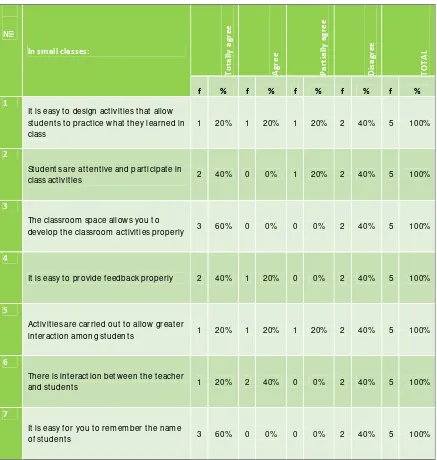
[image:28.612.109.546.195.655.2]What are the benefits of teaching and learning English in small classes?
Table 1 Teachers’ Perceptions
N
In small classes:
T o ta ll y a g re e A g re e P a rt ia ll y a g re e D is a g re e T O T A L
f % f % f % f % f %
1
It is easy t o design act ivit ies t hat allow st udent s t o pract ice w hat t hey learned in class
1 20% 1 20% 1 20% 2 40% 5 100%
2
St udent s are at t ent ive and part icipat e in
class act ivit ies 2 40% 0 0% 1 20% 2 40% 5 100%
3
The classroom space allow s you t o
develop t he classroom act ivit ies properly 3 60% 0 0% 0 0% 2 40% 5 100%
4
It is easy t o provide f eedback properly 2 40% 1 20% 0 0% 2 40% 5 100%
5
Act ivit ies are carried out t o allow great er
int eract ion among st udent s 1 20% 1 20% 1 20% 2 40% 5 100%
6
There is int eract ion bet w een t he t eacher
and st udent s 1 20% 2 40% 0 0% 2 40% 5 100%
7
It is easy for you t o remember t he name
of st udent s 3 60% 0 0% 0 0% 2 40% 5 100%
Author: Carlos Peralta
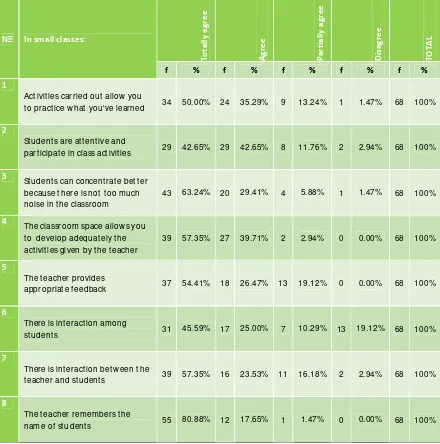
Table 2 Students’ Perceptions
Author: Carlos Peralta
Source: Students’ questionnaire
Regarding the first survey question, which states that in small classes it is easy to design activities that allow students to practice what they have learned in class, two out of five N In small classes:
T o ta ll y a g re e A g re e P a rt ia ll y a g re e D is a g re e T O T A L
f % f % f % f % f %
1
Act ivit ies carried out allow you
t o pract ice w hat you've learned 34 50.00% 24 35.29% 9 13.24% 1 1.47% 68 100%
2
St udent s are at t ent ive and
part icipat e in class act ivit ies 29 42.65% 29 42.65% 8 11.76% 2 2.94% 68 100%
3
St udent s can concent rat e bet t er because t here is not t oo much noise in t he classroom
43 63.24% 20 29.41% 4 5.88% 1 1.47% 68 100%
4
The classroom space allow s you t o develop adequat ely t he act ivit ies given by t he t eacher
39 57.35% 27 39.71% 2 2.94% 0 0.00% 68 100%
5
The t eacher provides
appropriat e feedback 37 54.41% 18 26.47% 13 19.12% 0 0.00% 68 100%
6
There is int eract ion among
st udent s 31 45.59% 17 25.00% 7 10.29% 13 19.12% 68 100%
7
There is int eract ion bet w een t he
t eacher and st udent s 39 57.35% 16 23.53% 11 16.18% 2 2.94% 68 100%
8
The t eacher remembers t he
small classes is not necessarily an easy task.
The other 3 teachers surveyed have chosen partially agree, agree and totally agree respectively, which demonstrates that they do not find it too difficult to design activities for small classes. In fact, in the five classes observed, it was evident that small classes allowed teachers to manage the day’s lesson with many different class activities.
Similarly, students had a mixed response to this question, though the large majority (50%) felt that their class activities were created in a way that allowed them to practice their newly acquired language skills. The other 35.29% just agreed with the statement. Their responses indicate that even when the class activities allow them to practice what they have learned, there might be a certain degree of dissatisfaction, or at least that they do not find the activities easy to engage with. The students that responded negatively, which is represented by the 13.24% and 1.47%, show a total dissatisfaction with the class activities carried in the classroom. This could happen because students may not find the activities interesting or because the teacher is not designing the activities effectively.
Based on the five class observations, it seemed as if the use of repetition to build vocabulary is a successful approach, for instance, the teachers asked students to create stories with the new vocabulary learned in the day’s lesson. This was common to all the five classes. Also, the teacher asked students to make use of a dictionary when needed. The new vocabulary was written on the board and translated into Spanish; in this way students were able to see the new words and at the same time to know the meaning of each word, which helped them to memorize the new words easily. However, it also seemed to generate a slow pace when composing, as they have been taught to translate before they start writing in English. Furthermore, at the end of the day’s lesson, three teachers allowed their students for discussion time where they were able to review their composition and exchange ideas.
Nevertheless, this study shows that teachers’ answers were very mixed concerning this statement, with an even number (40%) strongly agreeing and disagreeing. These two opposite responses may be the result of the grade differences. The younger students are more likely to get distracted easily than the older ones. The teachers of elementary levels spend more time catching students’ attention, instead of motivating them to participate in the class activities.
According the participants’ answers, students appear to be more engaged than their teachers believe them to be, with a large majority (85.30%) totally agreeing or agreeing with the statement above. These responses suggest that even when the teacher is making his/her best effort to attract students’ attention, students may not notice or care about the teacher’s effort in this regard. It is possible that students may think they are collaborating in the classroom in any case. The minority (11.76% and 2.94%) represents the students who were not very enthusiastic about participating in class, whether they did not feel confident or they just felt ignored by the teacher.
In the class observation, the majority of the students participated when the teacher asked to develop the class activity. This very simple exercise was effective and kept the class moving. This was true in all five classes, regardless of age level or ability.
Student’s responses agree (in some way) that in small classes there is more individual teacher contact with pupils and more support for learning (Bassett, Blatchford, & Goldstein, 2003).
From the students’ point of view, classrooms with a small number of students help them to remain concentrated in the lesson. They were nearly unanimous in agreeing with this statement (63.24% and 29.41%), and this seems to be an obvious result of smaller class size. Less students = less noise, at least in theory. This result is consistent with the view of Finn and Achilles (1999) who state that one of the relevant effects of class size is on children’s attentiveness in the classroom.
that were indifferent to this statement and found no benefit in learning in small classes. However, the results confirm that working with small class is not that challenging compared to large classes, where teachers may face noisy students, among other issues (Woodward 2001).
It was common in the five observed classes that students got noisy at times, but still I was not too loud because there were not too many students in the classroom.
Even when small classes could allow teachers and students to develop the class activities adequately, their responses (60% totally agree and 40% disagree) indicate that teachers were not in agreement with this statement. This result demonstrates that classroom space can benefit the class, but it could depend on the type of activity or the teacher teaching style. In any case, (Fisher, Hoover & Mc Leod, 2003) suggest that a teacher should recognize which activities and instruction will be used most often, in order to allow students to set up furniture if the activity requires that, and leaving enough space for movement among students.
Students shared a more positive view of the situation, with 0% disagreeing and 2.94% partially agreeing. 57.35% totally agreeing and 39.71% agreeing represent the positive responses toward this statement, which confirms that small classes offer more flexibility to adapt the class activities despite the number of students or knowledge level.
According to the class observation, the younger students benefited greatly from the classroom space. The form to sit the students can be advantageous in small classes, as the teacher can move things around to have better access to conduct the lesson (Harmer, 1998; Gower & Walters, 1983).
perhaps because they considered it as a waste of time.
Teachers were much more critical than students in responding to the question about the appropriate feedback given in the class with 40% disagreeing. This percentage can be analyzed in the following manner: teachers’ strategies are not always the most appropriate ones to provide students with corrections on time. Those teachers that totally agreed (40%) and agreed (20%) indicated that teaching in classes of no more than 20 students facilitates the appropriate feedback to reinforce students’ knowledge. Even so, this may have something to do with teachers’ inherent desire for optimum conditions. However, providing feedback continuously is the teacher’s obligation (Gower et al., 2005).
On the contrary to teachers’ responses, 54.41% of students totally agree with the fact that the teacher gives feedback to them properly because there are not too many students in the class. A small number of students, represented by the 26.47% agree. This might indicate that feedback from the part of the teacher is just acceptable. The remaining 19.12% partially agree. These responses represent that feedback is not always appropriate, even in small classes.
The five classes observed showed that smaller class size absolutely allowed feedback given in a timely and appropriate manner. Teachers were able to provide with feedback instantly more often. In this sense, setting specific aims and giving feedback, instructor should direct student for proper learning and provide information so they can notice their performance on specific learning objectives (Flynn & Hill 2006).
distracted easily. Only 1 teacher (who teaches 3rd grade) totally agrees with the statement, perhaps because it is best for younger students to be involved in interaction activities. The remaining 60% (divided in 20% totally agree, 20% agree, and 20% partially agree) represents the teachers who believe that small class size allows them to develop activities that require interaction among the students. However, it is difficult to judge whether this is a positive or negative, because teachers perform their teaching in different styles. For example, one teacher may design a pedagogical method that involves much student interaction, whereas another might not feel comfortable with a more ‘relaxing’ classroom style. In other words, class size inevitably influences teaching styles (Capel, Leask, & Turner, 1995).
In the class observation, teachers were much more likely to use interaction activities successfully (or even to attempt these activities) with younger students. Nevertheless, a more specific method should be used to generate student-student interaction such as ¨cooperative learning techniques¨ so they can work in groups to improve their learning (Flynn & Hill, 2006). On the contrary, older students quickly became loud and out of control once they began to interact, making it impossible for the teacher to teach.
the question, which shows that their interaction experience with the teacher is quite acceptable. A lower percentage with 16.18% partially agrees, which indicates that they are not fully satisfied with the teachers’ interaction in the class. Only 2.94% disagree.
The classes observed allowed to notice interaction among the participants, as the teachers formulated questions, students answered them, and then students responded with any questions or concerns that they may had had. In this way, students seemed satisfied with the role of the teacher. In my observation, this was true from the youngest students (3rd grade) all the way up to the oldest students (11th grade). So it can be said that children in smaller classes are exposed to more interaction with the teacher and also exposed to more teaching time compare to those in larger classes. (Bassett, P., Blatchford, P., & Goldstein, H., 2003).
In small classes the teacher remembers the name of students. Though this seems like a basic element of classroom management, 40% of teachers disagreed with the statement proposed in the questionnaire. Even so, the 60% of teacher’s responses somehow were in favor to the statement. Similarly, students’ responses agreed with the statement by 80.88% totally agree and 17.65% agree. So it can be said that in small classes the teacher is more able and likely to remember each student’s name. Only 1.47% of student’s responses partially agreed with the statement, which is not too significant for the purpose of this study.
In any case, it was clear from my observation that students felt better and more confident when the teachers called them by their names. This was true at all age levels, in my observation and analysis.
teachers know who they are. Also, it was found greater interaction between teachers and students, and more time for appropriate feedback from the part of the teachers.
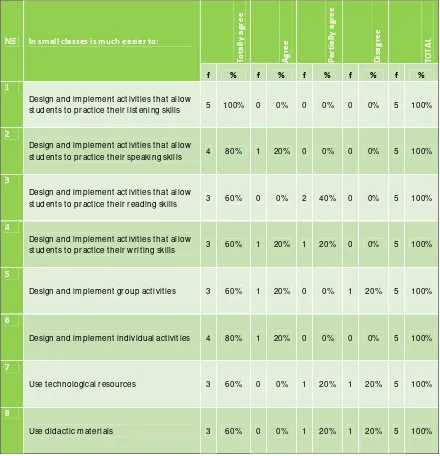
[image:36.612.101.541.204.660.2]What teaching strategies and resources benefit the teaching of English in small classes?
Table 3 Teachers’ Perceptions
Author: Carlos Peralta
Source: Teachers’ questionnaire N In small classes is much easier to:
T o ta ll y a g re e A g re e P a rt ia ll y a g re e D is a g re e T O T A L
f % f % f % f % f %
1
Design and implement act ivit ies t hat allow
st udent s t o pract ice t heir list ening skills 5 100% 0 0% 0 0% 0 0% 5 100%
2
Design and implement act ivit ies t hat allow
st udent s t o pract ice t heir speaking skills 4 80% 1 20% 0 0% 0 0% 5 100%
3
Design and implement act ivit ies t hat allow
st udent s t o pract ice t heir reading skills 3 60% 0 0% 2 40% 0 0% 5 100%
4
Design and implement act ivit ies t hat allow
st udent s t o pract ice t heir w rit ing skills 3 60% 1 20% 1 20% 0 0% 5 100%
5
Design and implement group act ivit ies 3 60% 1 20% 0 0% 1 20% 5 100%
6
Design and implement individual act ivit ies 4 80% 1 20% 0 0% 0 0% 5 100%
7
Use t echnological resources 3 60% 0 0% 1 20% 1 20% 5 100%
8
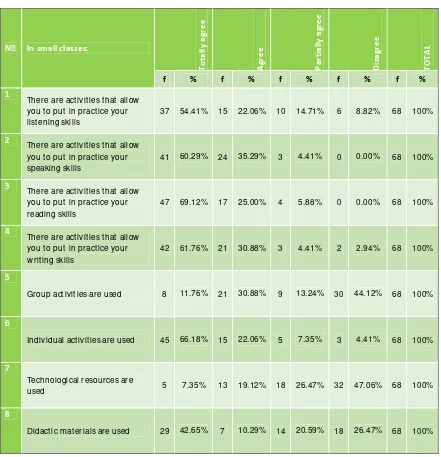
Table 4 Students’ Perceptions
Author: Carlos Peralta
Source: Students’ questionnaire
According to teacher’s responses, 100% (totally agreed) believed that implementing listening activities in small classes is much easier than it could be in large classes. This finding agrees with the idea that small classes allow improvement in the skills of listening, N In small classes:
T o ta ll y a g re e A g re e P a rt ia ll y a g re e D is a g re e T O T A L
f % f % f % f % f %
1
There are act ivit ies t hat allow you t o put in pract ice your list ening skills
37 54.41% 15 22.06% 10 14.71% 6 8.82% 68 100%
2
There are act ivit ies t hat allow you t o put in pract ice your speaking skills
41 60.29% 24 35.29% 3 4.41% 0 0.00% 68 100%
3
There are act ivit ies t hat allow you t o put in pract ice your reading skills
47 69.12% 17 25.00% 4 5.88% 0 0.00% 68 100%
4
There are act ivit ies t hat allow you t o put in pract ice your w rit ing skills
42 61.76% 21 30.88% 3 4.41% 2 2.94% 68 100%
5
Group act ivit ies are used 8 11.76% 21 30.88% 9 13.24% 30 44.12% 68 100%
6
Individual act ivit ies are used 45 66.18% 15 22.06% 5 7.35% 3 4.41% 68 100%
7
Technological resources are
used 5 7.35% 13 19.12% 18 26.47% 32 47.06% 68 100%
8
agree with 54.41% and agree with 22.06%, their responses are clearly more mixed than the teachers. The positive responses in favor to the statement confirm that in small classes, students are provided with listening activities that help them enhance listening abilities. The 14.71% partially agreeing might suggest that the teacher should emphasize his/her effort in developing more listening activities. 8.82% of students disagreed, which indicates that the teacher perhaps should bring more activities into the classroom.
In the five classes observed, it was common for the teachers to read a book or a passage and then ask students to briefly summarize in writing what they heard. This activity allowed students to have a great listening input. Heejong (2008) suggests that as more speech is directed, the students may become more perceptive listeners.
Both teachers and students generally agreed that their classes contained activities designed to allow students to practice their speaking. These responses support the idea that it is crucial for second language learning to perform classroom activities that encourage students to speak, mainly by interaction. These results agree with the hypothesis that in small classes, students are more exposed to target language and have more chances to improve their speaking abilities and production (Heejong, 2008).
In the class observation, several teachers used the technique of asking students to produce English words and sound patterns. To do this, the teacher read a short text from a book and asked students to compose one paragraph. Then, students were required to make a short presentation in front of the class. This seemed to be an effective method of reinforcing the day’s lessons, and also served the purpose of having students practice their speaking skills. In this case, the teachers are able to model correct pronunciation and to highlight any difficult words or concepts while speaking.
Thus, it confirms that teachers are conscious of the importance of encouraging students to read through various didactic material or activities developed for the class. Similarly, students strongly agreed: 69.12% totally agree and 25% agree with the statement. These responses clearly show that students were satisfied with the reading activities brought into the class by the teacher. The ones that partially agreed, 5.88% may not feel that their reading skills are not being reinforced properly by reading activities. Again, as this is a basic element of learning a language, it is rather obvious that teachers should make time in class for students to practice reading.
However, in the observation, the 7th and 10thgrade classes did not practice this sort of activity. This may have been an oversight on the part of the teacher, or perhaps it is a difficult age level. Students at this age are notoriously hard to handle. It is surprising that the 3rdgrade teacher had no difficulty in having students to practice reading through making use of funny activities that included the practice of intonation, along with the introduction of new vocabulary, at least 10 new words each day.
Also, teachers agreed with the idea that in small classes the implementation of writing activities is better, although not as strongly as when they were asked about the listening or speaking skills. Perhaps writing is seen as the last skill to develop in learning a language, or perhaps students are more often given writing as homework. Students, however, agree with the statement in similar terms to reading, listening and speaking, so it appears that writing skills are being practiced one way or the other. The findings favor the theory that extensive exposure to CSR increases the reading and writing outcomes. These results were particularly obvious for English learners (Fidler, 2001).
self-conscious act for many new language learners. This was true at all age levels but the oldest (11thgrade) in the observation.
Teachers and students were asked if small classes make possible the use of group activities. Here teachers were split between totally agreeing 60% and partially agreeing 20%, with 20% disagreeing. 4 out of 5 teachers believe that designing group activities for small classes is not challenging, but from my point of view, it does not mean that they are necessary implementing these activities in the class. However, teachers’ responses agree with the hypothesis that at times having students working in groups can be more helpful but at the same time it may be more laborious to develop it (Fisher, Hoover, & Mc Leod, 2003).
Students were less likely to feel that these sorts of activities were actually put into place in the classroom, with 44.12% disagreeing. Only 11.76% of the students totally agree, and 30.88% agree, which indicates that students’ responses are divided in their perceptions. According to the class observation, it is understandable that teachers would not choose to teach group activities, because students often seem to get distracted by other students. It becomes more of a social situation than a learning situation. However, group activities were not used at all age levels but the 3rdgraders.
Not surprisingly, teachers used individual activities as a major part of their teaching strategy. Their responses are consistent in favor of the statement with 80% totally agreeing and 20% agreeing. From the students’ point of view, these activities played an important part of their classroom experience, with 88.24% either totally agreeing or agreeing. Only 7.35% and 4.41% of the students’ responses are partially agreeing and disagreeing respectively, which is not significant to consider. The positive responses might show evidence that in small classes teachers are able to provide with individualized assistance to students (Din, 1999).
the teachers asked the less skilled students to prepare dialogues relevant to the topic of lesson. Then the teacher went over their work, each playing a part and then switching roles.
Teachers’ perceptions were quite mixed on their use of technological resources in the classroom, with three out of five totally agreeing. Interestingly, students were much less likely to notice the use of these resources in their own learning experience, with 47.06% disagreeing and only 7.35% totally agreeing. This may be due to the fact that “technological resources” may mean different things to different people. The younger generation is so used to computer technology (personal computers, phones, etc.) but for some teachers, it may not be as much a part of everyday life. Another important reason may be funding. During the class observation I noticed very little implementation of technology, in all grade levels. These responses may confirm that the school’s budget in this sense is short. Administrators may prefer to invest in other areas rather than in technological resources.
Referring to the question about the use of didactic material, both students and teachers are split in response to this question. Only 60% of teachers agree, while 20% partially agree and the other 20% disagreed. There may be a strong tendency in teachers to believe that books are the most important didactic material to be used in class. 42.65% of students totally agree, but over a quarter of them disagree.
It could be noticed through the class observation that posters and flash cards were used. This kind of materials seemed to be very helpful to reinforce learning; nevertheless, most teachers preferred working with the textbook. This was true of all grade levels.
been. Individual activities were important in any case.
[image:42.612.97.545.186.380.2]How do students feel about learning English in small classes?
Table 5
Teachers’ Perceptions
Author: Carlos Peralta
[image:42.612.92.547.466.696.2]Source: Teachers’ questionnaire Table 6 Students’ Perceptions
Author: Carlos Peralta N In small classes students feel:
T o ta ll y a g re e A g re e P a rt ia ll y a g re e D is a g re e T O T A L
f % f % f % f % f %
1
Relaxed w hen t hey have t o speak in front of
t he class 5 100% 0 0% 0 0% 0 0% 5 100%
2
Import ant because t hey have more
opport unit y t o part icipat e in class 4 80% 1 20% 0 0% 0 0% 5 100%
4
M ot ivat ed t o part icipat e because t here are
not t oo many st udent s in t he class 5 100% 0 0% 0 0% 0 0% 5 100%
5
Confident t o compet e nat urally w it h ot her
classmat es 2 40% 3 60% 0 0% 0 0% 5 100%
N In small classes I feel:
T o ta ll y a g re e A g re e P a rt ia ll y a g re e D is a g re e T O T A L
f % f % f % f % f %
1 Relaxed w hen t hey have t o speak in front of t he class
36 52.94% 19 27.94% 10 14.71% 3 4.41% 68 100%
2 Import ant because I have more opport unit y t o part icipat e in t he class
34 50.00% 26 38.24% 6 8.82% 2 2.94% 68 100%
3 M ot ivat ed t o part icipat e because w e are not t oo many st udent s in t he class
28 41.18% 27 39.71% 10 14.71% 3 4.41% 68 100%
4 Confident t o compet e nat urally w it h ot her classmat es
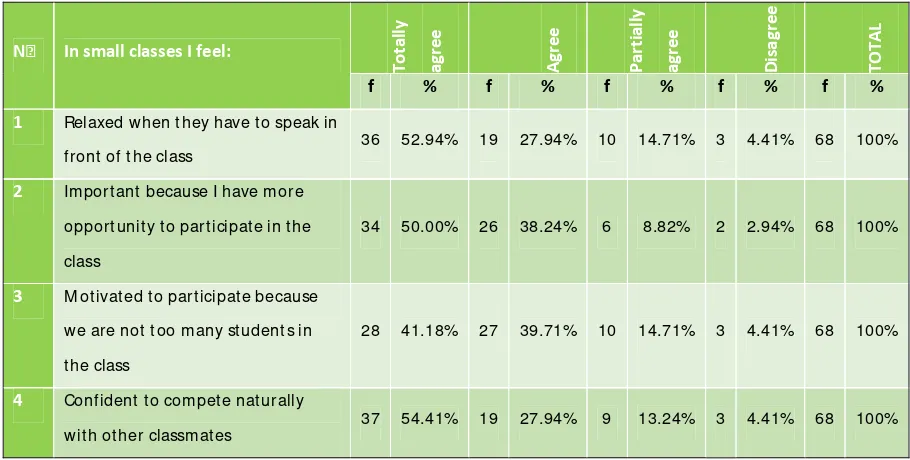
Understanding how students feel about speaking in front of the class is possibly one of the most interesting questions of the entire research project, because of notable difference between teachers and students in terms of response. Teachers, perhaps out of pride in their own abilities to make their class feel comfortable, responded 100% unanimously that they totally agree that their students feel relaxed. Students’ responses were much more mixed in their feelings about the statement. While only 4.41% disagreed, more than half of them totally agreed, which suggests that for students, speaking in front of class has many issues involved.
The class observation allowed to notice that some students were shy and did not necessarily want to speak in front of the class, and that they did not enjoy it so much when they did. However, all students did in fact speak in front of the class despite whatever fears they may have had. This was true at all ages, and it is perhaps due to the expertise of those particular teachers.
As it is important to make feel students special in the class, the proposed question intended to provide some information about this statement. Here again teachers either totally agree 80% or agree 20%; students were slightly less enthusiastic with 50% and 38.24% correspondingly, but there was little disagreement. Teachers might not have clear what is the difference between forcing someone to participate in something and making someone feel important. During the class observation, students generally seemed to have an easy time participating and feeling confident formulating questions at any time due to the class size.
However, the majority of students perceived that in small classes they have better chances for participation. The other 14.71% of partially agreeing and 4.41% of disagreeing might reveal that classes with small number of students are not necessary to motivate some students participating in class. The results suggest that students and teachers believe that it is easier to motivate smaller classes (Cakmak, 2009). In the context of motivation, the teacher always has to be focused on designing activities to keep students’ desire to participate in class, in this way, they will be interested in accomplishing their tasks.
The observed classes showed variation in terms of age level. For example, older kids (11thgraders) seemed not to be motivated to participate in the class due to a particular activity brought into the class by the teacher, where they felt, it was more suitable for younger students, and not for them. It is possible that a teacher could structure a participatory activity with a more mature theme, and in that way older kids might be more likely to take part in.
Students’ confidence in competing friendly with other classmates in the class was also proposed to be asked in the questionnaire. In this regard, both teachers and students agreed in general, although the strength of the agreement varied but not significantly. It was observed that most students seemed comfortable to be engaged in this sort of ‘friendly competition’. The quieter students appeared to have lower level of proficiency in English. So, naturally, they were less confident. This was true of all age levels, except the 11th grade students. Students of lower grades showed a positive attitude towards competing with their classmates. However, there was less competition in this regard due to the small class size.
friendly in the classroom.
[image:45.612.102.540.180.380.2]Are there any limitations when teaching English in small classes?
Table 7 Teachers’ Perceptions
N In small classes:
T o ta ll y a g re e A g re e P a rt ia ll y a g re e D is a g re e T O T A L
f % f % f % f % f %
1
There is anxiet y among st udent s due t o t he fact t hat t here is great er cont rol by t he t eacher
0 0% 1 20% 3 60% 1 20% 5 100%
2
It is difficult t o pract ice t he speaking and
list ening skills 0 0% 1 20% 3 60% 1 20% 5 100%
Author: Carlos Peralta
Source: Teachers’ questionnaire
Table 8 Students’ Perceptions
Author: Carlos Peralta
Source: Students’ questionnaire
Teachers’ perceptions were quite mixed when responding to the question about N In small classes:
T o ta ll y a g re e A g re e P a rt ia ll y a g re e D is a g re e T O T A L
f % f % f % f % f %
1
There is anxiet y among st udent s due t o t he fact t hat t here is great er cont rol by t he t eacher
24 35.29% 24 35.29% 12 17.65% 8 11.76% 68 100%
2
It is difficult t o pract ice t he
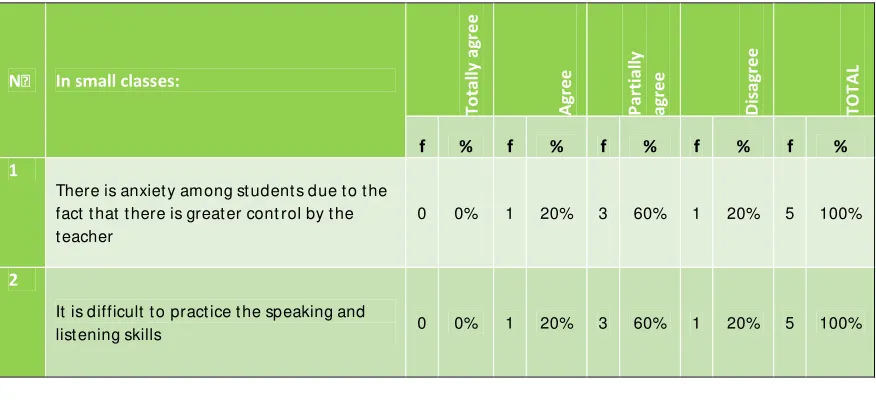
[image:45.612.102.540.480.668.2]whether students feel more control from the part of the teacher in small classes, with the majority 60% partially agreeing. In other words, from the teachers’ point of view, students did not feel excessively controlled in the classroom despite the fact that they could monitor each individual to control the class behavior due to the class size. This interpretation is in agreement with this statement made by Blatchford and Mortimore (1994), who stated that classroom management of behavior is easier in smaller classes.
Students, on the other hand, were very strong in their agreement with this statement, with only 11.76% of disagreeing.
It was found interesting that older students were more stressed or anxious than the younger students. Some of the older students were self-conscious but a bit shy because they felt as if the teacher was watching them at every moment. Younger students were more likely to appreciate the attention that the smaller class allows, maybe to show self-confidence or just to please the teacher. This attitude is normal at these ages.
The last statement intended to collect information about the difficulty that teachers and students may experience to put into practice speaking and listening skills in small classes. As in the previous question, teachers’ responses were varied as well, with 60% partially agreeing. It might be due to the fact that teachers did not conduct the class in the target language, which is crucial for language exposure, no matter what the class size may be. Students’ responses were also very mixed, although a large majority agreed at least on a partial level, 25%, 38.24%, 20.59% correspondingly. The 16.18% of disagreeing does not show a significant value against the statement, but it indicates that 11 out of 68 students believe that in small classes is not difficult to practice the above mentioned skills.
first two language skills. However, the teachers that I observed made their best effort and tried to use appropriate strategies to encourage students to listen and speak in English.
![, ],amongwhich Inadditiontotraditionallearningenvironments,di ff erentstudiesspecifytheinfluenceofinformationandcommunicationtechnologiesontheappearanceofnewPLE[ toothersappear,andtheacquisitionofinformationisnotlimitedtoaspecifictimeandspace[ , ]. oftrainin](data:image/gif;base64,R0lGODlhAQABAIAAAP///wAAACH5BAEAAAAALAAAAAABAAEAAAICRAEAOw==)