1
Description of Careless English Mistakes (CEMIs) made by EFL students at Gimnasio Colombo
Británico in Bogotá, Colombia.
Leonardo de Waal
Universidad Santo Tomas
B.Ed. in Teaching of English as a Foreign Language
The Faculty of Education
Bogota, Colombia
April, 2017
Note of Acceptance
Tutor: _____________________________________________
Jury: _______________________________________________
Jury: _______________________________________________
ACKNOWLEDGMENTS
I’d like to dedicate this study to my beloved mother and supportive sister without whom
this would not have been possible.
I’d like to thank the following people for their support and understanding: Mrs Sandra
Melo, Mr Juan Manuel Galindo, Mr Francisco Dulcey and Mr Water Avendaño.
Finally, I would like to thank Mr Mauricio Martinez for his valuable feedback in the
ABSTRACT
A phenomenon too familiar in English language learning, mistakes are deemed necessary in the
process of second language acquisition, SLA and second language learning, SLL and not a mere
indication of a student’s learning deficiency. While language learning cannot be achieved
without making mistakes, the repetition of the same type of ‘avoidable’ mistakes delays learning.
As evidenced from written texts, these mistakes are prevalent among teenagers in a bilingual
school in Colombia where most eighth graders, when prompted, can correct the mistakes
themselves. One of the causes for these mistakes can be found in one of the various dimensions
of Crosslinguistic Influence (Jarvis & Pavlenko, 2008), where the production of the target
language (TL) is sometimes ‘influenced’ by the speaker’s mother tongue, MT; the outcome of
which is referred to as Interlanguage (IL) Selinker (1972, 1992).
This study will delve into the nature of these most common non-developmental mistakes
made through IL and explain how they have become fossilised (Selinker, 1972). These mistakes
have been collected and systematically complied into a corpus, and are referred to in this study
as Careless English Mistakes (CEMIs).
The objectives of this study are to investigate the reasons why students make CEMIs,
categorise the mistakes, and provide certain strategies to improve students’ accuracy.
TABLE OF CONTENTS
ACKNOWLEDGMENTS ... 3
ABSTRACT ... 4
INTRODUCTION ... 7
CHAPTER 1: PROBLEM STATEMENT ... 10
Objectives ... 13
CHAPTER 2: JUSTIFICATION ... 15
CHAPTER 3: THEORETICAL FRAMEWORK ... 20
Contrastive Analysis ... 24
Error Analysis ... 24
Crosslinguistic Interference ... 25
Negative Transfer ... 26
Phonological Transfer ... 26
Syntactical Transfer ... 27
Morphological Transfer ... 28
Orthographic Transfer ... 28
Fossilisation ... 29
Phonetic Fossilization ... 31
Morphological fossilization ... 31
Characteristics of CEMIs ... 33
CHAPTER 4: RESEARCH DESIGN ... 37
CHAPTER 5: DATA COLLECTION AND ANALYSIS ... 39
Identification of errors ... 41
Description of errors ... 42
DATA ANALYSIS ... 44
EXPLANATION OF ERRORS ... 45
Errors of Phonetic Fossilization ... 45
Negative Phonetic transfer ... 45
Orthographical Transfer ... 49
Errors of Morphological Fossilization ... 51
Negative Syntactic transfer ... 51
Errors of ‘Punctuational Fossilization’ ... 52
Negative punctuational transfer ... 52
CHAPTER 6: CONCLUSIONS AND PEDAGOGICAL IMPLICATONS ... 56
Strategies ... 57
Prevention ... 58
Correction ... 59
REFERENCES ... 62
APPENDIX A: IGCSE WRITING PAPER ASSESSMENT CRITERIA ... 64
APPENDIX A2: TOEFL WRITING PAPER ASSESSMENT CRITERIA ... 65
APPENDIX A3: CAMBRIDGE CAE WRITING PAPER ASSESSMENT CRITERIA ... 66
APPENDIX B: RESULTS FROM THE SURVEY OF THE ALUMNI ... 67
APPENDIX C: EXAMPLES OF CEMIS ... 69
INTRODUCTION
In the facets of human learning, whether it be learning to ride a bicycle, learning to walk
or even the simplest action we take for granted: learning to communicate, learning requires trial
an error. The same goes for learning a language, only this process would be called ‘making
educated guesses and mistakes’. Probably the only difference between learning to ride a bicycle
and learning a language is that in the latter, mistakes are not only expected but ‘desired’. What is
not desirable is the “cessation of development” (Elder, 2001) due to the frequent reoccurrence of
the same mistake. This is the case for English language learning in Colombia, where bilingual
schools are having their fair share of difficulties in this matter.
To help improve language competence, some schools, mainly private schools that can
afford it, implement strategies to try to address this issue (and others) by recruiting native
teachers and an incorporating intensive English-language curriculum for other subjects whose
language of instruction is English, i.e. maths, history, and science. This type of instruction is
known as Content-based Instruction (CBI). Most bilingual schools in Colombia have adopted
this strategy, including the Gimnasio Colombo Británico school (GCB) in Bogotá, Colombia.
However, not until recently, this school would lower the intensity of CBI-driven classes after 5th grade. Before 2015, from 6th grade and up, the number of CBI classes had dropped to a less than
a quarter. This disparity, including other factors that will be discussed later, may have and may
have had a negative influence on written texts produced by the students.
While ‘expected mistakes’ are being made, some are ongoing and repetitive and like a
scratched record, stalls progress. This study proposes to name, analyse and classify this type of
mistake which has frustrated both teachers and students alike. Due to the basic-level language
the student (based on a study where students who made these specific mistakes were asked to
reflect upon them), I have referred to them as Careless English Mistakes, CEMIs.
Among other reasons, the frustration of CEMIs lies on the notion that students are aware
of elementary grammar, spelling and punctuation rules from earlier grades, yet they still make
basic-level mistakes in higher grades of secondary. At GCB, these mistakes that have
transcended through time as they have been deemed to cause no concern. That is, these errors are
global errors (Burt and Kiparsky in James, 1998 p. 93) which prevent understanding at sentence
level. Instead Error Analysis (EA), and Contrastive Analysis (CA), will be done on the local
errors.
The present study is divided into six chapters:
Chapter 1: Problem Statement. In this chapter, I will discuss not only the various
problems that arise from CEMIs, but also the need for accuracy in language production for the
teenagers in a bilingual school. Frequent questions regarding mistakes in L2 language learning
will be asked like if all mistakes should be corrected, or why they are problematic in language
learning and teaching in the context of bilingual schools. There will also be a discussion about
other issues that result from the making of CEMIs. This includes the reason for dealing
specifically with CEMIs as opposed to any type of mistake.
The need for academic precision in language production will also be discussed including
reference from English-language rubrics and assessment criteria, where CEMIs could be
responsible for the loss or possible awarded marks. Finally, since language learning takes place
in a bilingual environment, I will provide a summary of earlier studies in this matter from a
Chapter 2: Justification, will discuss the importance of the research of errors in the
Colombian context and how this contributes to English language classes. This includes a look at
the need to look at mistakes from the perspective of the teacher.
Chapter 3: Theoretical Framework will provide a succinct overview of the linguistic
phenomena of errors and mistakes. A taxonomy behind how CEMIs are made is explained, citing
various authentic examples of transfer-related issues like morphology and phonology. The
theoretical framework goes over the way in which the research was conducted and how existing
literature related to the topic helped to discuss the nature of making this type of mistakes. This
included rationale behind the occurrence of the most common type of CEMI, referred to in this
study as the Faulty Interchange of Triple I’s (FITI) where students use the words is, its, and it’s
incorrectly as they suppose they can be used interchangeably. Though there are more mistakes of
this nature, only the most common will be explained in the study.
Chapter 4: Research Design will explain how exploratory research was carried out as a
means to determining the nature of the problem and the methods used to collect the data.
Chapter 5: Data Collection and Analysis will discuss the way the data was collected and
take an in-depth look at the taxonomy of the various linguistic interferences from which CEMIs
derive.
Chapter 6: Conclusions and Pedagogical Implications will draw conclusions on the
research including some strategies that could be implemented to curb the number of CEMIs
CHAPTER 1: PROBLEM STATEMENT
Throughout my teaching career, I have never been so taken aback by a simple question a
student asked me: “If people understand me, why should I worry about ‘silly’ mistakes?” It was
only after days of reflection that I managed to come up with an appropriate answer, “Because
you are how you speak. Do you want to be known for your language mistakes?” The answer was
‘no’.
These ‘silly’ mistakes require attention. They have perplexed me throughout my teaching
career. Actually, very little has been done to identify this type of mistakes and draw plausible
conclusions as to why they are made and how to assist students in avoiding them. While there is
literature on this type of EFL mistake, there is very little that deals with this phenomenon in a
Colombian bilingual-school context; hence the initiative of ‘filling in the void’ of this matter.
Providing strategies that help students steer clear of these Careless Mistakes before they become
fossilised, will allow teachers to focus on other language aspects.
As an English language teacher, I strive for ways to improve teaching methods and
strategies. This may entail considering innovative ways or approaches of teaching a certain topic
or ways to help students improve language performance. Both initiatives involve reflecting on
the students’ abilities, their needs, and their weaknesses.
For me, the common denominator of the three is something inevitable but necessary:
mistakes. It is something that is par for the course in language teaching; however, I have come
across the same type of ‘basic’ mistakes - repeatedly. These specific mistakes are the misspelling
of ‘basic’ high-frequency words and avoidable mistakes in punctuation. It has become
perplexing not only due to their systematic reappearance in students writing, but also due to the
unseen topics. Examples of the type of mistakes, CEMIs, they tend to make are confusions of
were for where, its for it’s, and life for live, among others.
Frustrated by the frequency, and ease at which these mistakes occur, I became further
intrigued. Though these mistakes are also made in higher grades (10th and 11th), I decided to work with eighth grade students to locate the most common. As Colombian students attending
Gimnasio Colombo Británico, these students are English as a Foreign Language (EFL) students.
That is, language learning that “takes place in a setting where the language plays no major role in
the community and is primarily learnt only in the classroom” (Ellis, 1999).
As part of this study, a survey was conducted to the alumni (Appendix B) to obtain
feedback on what they were required at the university in terms of English language. This was
done as part of the needs analysis to a) find out what level of English is required of them b) see
how important English was to them in at the university and c) verify whether CEMIs had a
negative influence on their grades.
Initial findings suggest that they are not only required to pass English as a subject at
school, but they will also have to pass an English assessment test as a prerequisite to graduate
from their collages. In most cases, this is a C1 level test which students find challenging, as
opposed to the B2 required in the English component of the Prueba SABER 11 state exam.
Examples of C1 exams in Colombia are the Cambridge Advance English test, CAE,
TOEFL IBT (80 points) and IELTS (Band 8). As per the Common European Framework of Reference for Languages: Learning, teaching, assessment or CEFR, the C1 level is attained by a ‘proficient user’, and as such accuracy is important. This level represents “an advanced level of
competence suitable for more complex work and study tasks”. Hence the requirement at
Per the “Common Reference Levels: qualitative aspects of spoken language use” chart,
the CEFR states that for accuracy in C1, candidates’ errors are ‘rare, difficult to spot and
generally corrected when they do occur’. (ibid p 28). This type of mistakes is what Corder (1981)
refers to as ‘erroneous’ mistakes which are errors of performance, not competence, that “may
contain what are often called slips of the tongue, false starts, changes of mind, and so on…and
do not normally present problems of interpretation” (Corder, 1981, p. 18). While performance
refers not only to the comprehension of language but also to its use and the understanding of how
to produce language, competence is, as defined by Chomsky, the “knowledge that speakers have
of their language as a system of abstract formal relations” (Widdowson, 1996, p. 24).
Performance mistakes are notably evident in students’ writings. Naturally, there are some
mistakes that are more prevalent than others, but some students seem to make a specific type of
these mistakes recurrently and systematically. It is this type of mistakes that some teachers at
Gimnasio Colombo Británico tend to turn a blind eye to. They do so with the purpose of
allowing students to participate in unfettered communication in their target language (TL) as
they deem these ‘minor mistakes’ of performance, insignificant since they do not hinder the
understanding of the overall message. According to Corder’s (1981) observations on error
analysis, they are right, for these inaccurate utterances, ‘do not normally present problems of
interpretation’ (p18). So instead, the teachers focus on the type of overt mistakes, the ones whose
messages lead to confusion or incomprehensibility. These teachers are referred to as being
‘radical’ as they “they tend to over-look mistakes in the interest of good relations, students’
confidence…” (McArthur & McArthur, 1992, p. 663). While this strategy may be appropriate
suitable for written compositions where interruptions do not fall into play and ‘erroneous’
mistakes affect accuracy.
This type of mistake which are ‘erroneously’ recurrent and whose general cause is
influenced by interlanguage Selinker (1972) is what will be referred to in this study as Careless English Mistakes (CEMIs), which are typically non-developmental, performance errors that are
not made due to ignorance or ineptness. They are an issue if a student intends to attain the C1
level in English since spelling is considered important in English language tests like the
International General Certificate of Secondary Education (IGCSE) secondary English exam
students have to sit in grade 10 (Appendix A) or the TOEFL iBT (Appendix A2), the Cambridge
Advanced English exam (CAE) where they may lose marks or are not awarded the top score if
“common word errors” are found (Appendix A3).
The considerations above bring the research question below:
What pedagogical implications in EFL emerge through the description of Careless English
Mistakes (CEMIs) in a group of EFL students at Gimnasio Colombo Británico in Bogotá,
Colombia?
Objectives
The main objective is to not only to pinpoint the most common CEMIs made by
Gimnasio Colombo Británico, but to describe how Careless English Mistakes (CEMIs) occur in a
group of EFL students at Gimnasio Colombo Británico and provide pedagogical suggestions and
The specific objectives of the study are:
• To identify the most common mistakes made by EFL students in grade eight of Gimnasio Colombo Británico.
• To characterize Careless English Mistakes (CEMIs) occurrence in grade eight of Gimnasio Colombo Británico.
CHAPTER 2: JUSTIFICATION
There are important issues that concern students, English teachers, readers and ultimately
the academic community. First, students are required to pass English assessment exams both in
secondary school as well as at college. Unlike students attending language academies or
institutes, theses students’ motivation to learn a L2 is what Gardner and Lambert (1972) calls
instrumental:
Instrumental motivation refers to a practical or pragmatic reason for language
study. Instrumental motivations for language learning include passing a
language requirement, getting a monetary reward such as an increase in pay
grade for language competence, or having a better chance of getting into
medical school.
Gardner and Lambert, 1972
At GCB, students are instrumentally motivated and required to pass the Test of English
as a Foreign Language (TOEFL) and the International General Certificate of Secondary
Education (IGCSE) Second Language test. Though they are assessed in different ways and bear
some resemblances regarding accuracy, mistakes in these tests are not a concern if they are not
global (Burt and Kiparsky, 1974) in nature. That is, the TOEFL iBT Integrated Writing Rubric, confers the highest mark for writing (Band 5) if only “occasional language errors that are present
do not result in inaccurate or imprecise presentation of content or connection”, whereas the
IGCSE Second Language exam (IGCSE 0500), awards the highest mark, Band 1, if written
production is done in such a way that “Candidates write accurately” where they “use punctuation
technical words with precision.” Consequently, accuracy is deemed an important criterion. In
fact, inaccuracy in writing, like making spelling mistakes, hampers the writer’s credibility
because “even if they don’t affect meaning, [they] are distracting, ‘uncomfortable’, and may
lower respect for the speaker/writer.” (Ur, 2012).
An important indicator of the need to improve language proficiency comes from the
students themselves. A survey was conducted in 2016 to 53 students who had graduated from the
school (Appendix B). Here are the most important findings: first, with regards to the place of
study, 98.1% of the alumni are studying in Colombia. Despite this, 90.6% of them are/were
required to take some sort of English exam as a graduation requisite. Second, the level of
language proficiency required by the university for most students (47.9%) is/was C1. Finally,
when asked about the English language need in the curriculum of their respective programs,
29.3% stated that 50% of their classes required the knowledge of English and 18.9 % claimed
that 75% of their classes required it. These figures represented the largest portion of the pie.
When discussing the effects of poor language performance, CEMIs do create a negative
effect on the reader since most of these mistakes are due to poor spelling. Furness (1996) states
that when a reader has to ‘stop and puzzle over a misspelled word, or to smile over it, he has
stopped thinking about what the writer is trying to say… For a moment, the line of thought is
lost’ (p 17).
Finally, CEMIs also frustrates the teacher. A survey carried out to the secondary English
teaching staff indicates that 98% of them have encountered CEMIs in student’s output and while
they have tried to correct them in an assortment of ways, they recur. In other words, even though
these mistakes no are no longer deemed developmental, students make the same mistake
There have been some studies that delved into the issue of error analysis and error
correction in Colombia. In an essay called “Error Analysis in a Written Composition”, Dr. David
Alberto Londoño of the Insituto Universitaria de Envigado carried out research in 2007
regarding errors – not mistakes. Through clinical elicitation he did research on errors in SLA
where he gathered output data from only one student and analysed its content afterwards. Some
of his findings coincide with the CEMI corpus but does not have the same rationale for their
production since they are competence errors which occurred due to phonetic transfer. Dr.
Londoño’s student was also keen to learn the language since “professional goals require a good
command of it.”
Sampson (2012) also did research in a Colombian university; however, he focused on
‘the effects of uncoded correction’. In his research entitled, “Coded and uncoded correction of
errors in adult Colombian EFL learners”, his sample was bigger; 10 students from an assortment
of academic disciplines. The data gathering technique was like that of Londoño’s, i.e. through
experimental elicitation. In his case, he asked students to produce weekly texts of 150 words that
would “elicit similar language forms.” Afterwards, he corrected the texts and subsequently
provided feedback – the focus of his study.
Despite noticeable differences in the studies, both authors dealt with errors, techniques
and data collection of students with the same profile. These students also had to take compulsory
lessons to pass an English assessment exam as a degree requisite.
Outside Colombia, there has been research on error analysis for Spanish-speaking EFL
students. The first, was done within the context of Mexican Spanish-speaking ESL students
which goes along the same language as the research of this study. In his paper entitled
the corpus (the International Corpus of Learner English) which belongs to the Université
Catholique de Louvain as opposed to using a corpus with information gathered from within his
one context.
Despite this, Castillejos (1970) analyses how EA has been criticised including the
“weakness in error evaluation judgements”. He based his research using Corder’s method of
gathering data.
The second is a research carried out by Maria del Mar Ramon Torrijos who focuses on
the importance of the learner’s native language (L1) in written production of a second language
(L2), particularly the use of L1 linguistic rules by Spanish speakers when they are writing in the
target language (L2). This has certain resemblances of this paper as it similar transfer patterns are
evident.
Finally, in “Análisis de errores originados por influencia de la pronunciación en las
redacciones de estudiantes españoles de la lengua inglesa” by Rodríguez Aguado, J. (1993), there
was is an interesting perspective into error analysis as it focuses exclusively into morphological,
syntactic and overall pronunciation (mispronunciation rather) of an ESL student’s effort to
produce language in their TL. Again, as is suggest by (Serrano, 2013) negative transfer is one of
the culprits of inaccuracy. The author uses 100-word ´free written compositions’ as the source of
experimental elicitation of Spanish-speaking students at the public university of Valladolid
University from which he cites examples and rationale for mistakes made. The context is a
written exam (as opposed to priming) so students were aware of the ‘seriousness’ and
repercussions of a fail grade. The test was done after completion of 400 hours of instruction.
Data was gathered using S.P. Corder’s method – another indication that Corder is far from being
The paper is interesting in the sense that some of the mistakes that he registers are
mistakes that have been made here in Colombia (which are present in my corpus) and it is
reassuring to know that Serrano has encountered them too.
However, again, and sadly, the research is rather inconclusive. It explains what type of
mistakes are made by ESL students, cites examples in their rationale but it does not reveal any
sort of remedial initiatives, methods, or strategies to prevent students from making them. It is the
CHAPTER 3: THEORETICAL FRAMEWORK
As teachers of a language, not only of English, working with mistakes is the norm. Thus,
it goes without saying that we need to identify, understand, help understand and correct them
using a technique, not just spoon-feeding; otherwise, there might be a misconceived message that
either we, as teachers, do not care, or that they do not matter. They do matter, and just as there is
a mistake-correction interdependency, so is there a two-way street in language learning of giving
and receiving. In this analogy, a knowledgeable teacher is required to ‘give instruction’ and a
student willing to ‘receive’ that instruction with the right type of motivation. Consequently,
mistakes “are of interest, at least to teachers and learners.” (James, 1998, p. 86) as both teacher
and student can mutually benefit from them. The teacher may adopt novel ways to address them
by devising strategies and producing material and students will reap the benefit by attaining
accuracy. I concur with James (1998) who believes that teachers simply “cannot escape from a
preoccupation with learners’ errors, and they are attracted towards EA by its promise of
relevance to their everyday professional concerns.” (p. 201). Thus, in the analysis of errors, this
is where EA is significant. Corder (1967) states the importance of EA as a means to a) give
information on the learner’s progress b) provides the researcher with information on how
language was learned, and c) use it as a learning tool by which the student discovers rules about
the TL.
However, contrary to Pit Corder’s belief that “Mistakes are of no significance to the
process of language learning” (1981, p. 10); they are indeed a much-required hurdle over which
students must venture for performance improvement. Regarded as “a device the learner uses in
order to learn.” (Amara, 2015), “learners’ errors can actually contribute to the process of
of the highly complex developmental process of acquiring the target language” (Pawlak, 2014, p.
85).
While most students in grade eight have taken advantage of this ‘device’, some have not
since they have incorporated and accepted the mistake in their everyday written output,
sometimes at no fault of their own as will be explained later.
At GCB, language accuracy is a sought-after requirement for achieving desired academic
results both for in-house tests and external language assessment exams. But which mistakes
should be tackled? Though it would be practically impossible to conduct a nationwide study in
every bilingual school, a sample could be used from a grade in one school. Again, it seemed that
the collection of all mistakes was also an unattainable undertaking, so I decided to filter out the
global errors and focus on local grammatical errors of performance, not competence. In 1965’s
Aspects of the Theory of Syntax, Chomsky differs competence from performance. In the former, inaccuracies arise from the ignorance of the TL rules which he calls errors. As for the latter, ‘performance mistakes’ are slips made due various causes including tiredness, emotion or
nervousness all of which may lead to typos, leaving out words or poor punctuation.
In order to delve into the issue at hand, we need to clarify the sometimes
interchangeably-used ‘error – mistake’ dichotomy. In general terms, an error is “a deviation from accuracy,
correctness or truth” (McArthur & McArthur, 1992) while a mistake is something you did
unintentionally which produces an undesired result. However, in applied linguistics things are
not that simple. Errors are ‘unsuccessful bits of information’ (James, Errors in Language
Learning and Use: Exploring Error Analysis (Applied Linguistics and Language Study), 1998, p.
hand, occur due to learner TL-ignorance and require correction through explanation. This
distinction was clearly made for the first time by S. Pit Corder in 1967. He considered a mistake
as performance flaw and an error as failure in competence.
Before learners make mistakes, they hypothesis or make ‘intelligent guesses’ using
linguistic knowledge to produce these utterances. This type of knowledge can be split into
implicit and explicit knowledge. In the former, the learner processes language input
subconsciously (Hulstijn, 2005) by “noticing, comparing, and integrating” (James, 1998, p. 8),
whereas in the latter, the learner uses his or her knowledge of one language as a resource for
formulating hypotheses about the forms, structures, functions, meanings, rules, and patterns of
another (R. Ellis, 1994). It is precisely in this type of learning where there is a higher likelihood
of evidencing Crosslinguistic Influence (CLI) (Jarvis & Pavlenko, 2008). The language of the
speaker at this stage is also known as interlanguage (IL), a term coined by Larry Selinker (1969,
1972). This is believed to be distinct from both the learner’s L1 and from the TL; a sort of
‘learner’s representation’ of the TL (Jarvis & Pavlenko, 2008).
Bearing some of the same traits as IL, Crosslinguistic Influence (Kellerman & Smith
(1986) has a much wider scope in applied linguistics as it gives explicit rationale L1 interference.
It gives linguistic and psycholinguistic reasoning describing “the full range of ways in which a
person's knowledge of one language can affect that person's knowledge and use of another
language.” (Jarvis & Pavlenko, 2008, p. 3). This strategy, conscious of unconscious of using the
knowledge of one language to produce another is known as transfer.
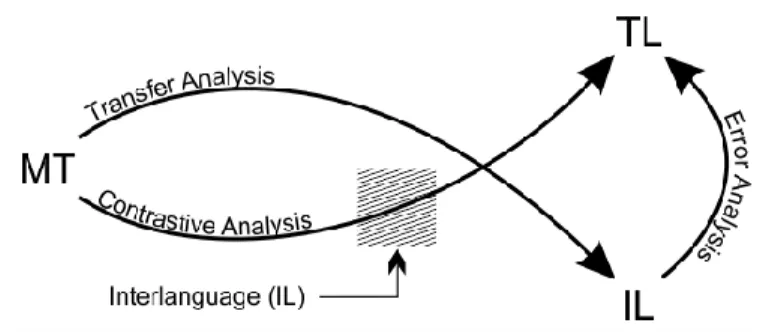
Transfer can occur from the L1 to L2, L2 to L3 and L2 to L3 and vice versa. To keep
of directionality. Figure 1 illustrates the ‘direction’of the transfer where L1 to L2 transfer is
known as ‘forward transfer’ and L2 to L1 is known as ‘reverse transfer’.
To proper illustrate the comparison between FL learning paradigms, Figure 2 represents, the
fields of study in relationship to the type of learner language production directionality. All
directionalities of the transfers mentioned are forward. The utterances made from MT to the TL
is ‘interfered’ by the learner’s IL. This does not occur in TA or EA.
Having made the distinction, this paper will analyse the mistakes from four main
perspectives: Contrastive Analysis (CA), Error Analysis (EA), Crosslinguistic Interference
(CLI), and Interlanguage (IL) fossilisation. Though CA and EA have been challenged by
linguistics with one flaw or another, both bear, to some extent, worthy virtues.
Figure 2. FL Learning Paradigms Fish and their relationships
L1
L2
L3
Contrastive Analysis
In Contrastive Analysis, analysis of errors is carried out by comparing the inaccurate
utterances of L2 output with the rules of the student’s MT. That is, L2 language production is
compared to its translation from the MT to see how their deviated utterances were ‘interfered’. In
this way, errors could be predicted a priori. Popular in the 50’s and 60’s when the eradication of
errors was the main objective of language teaching, CA was criticised by many scholars on the
assertion that it was inaccurate as not everyone’s errors could be generalised. The learning
process was considered individual. Also, CA was associated with both the Structuralism
language description as well as the Behaviourism learning theory, both of which were also
heavily criticised and outdated (James, 1998). The use of CA will benefit to understand why
students make certain mistakes that have been ‘grammar translated’. An example of this the
addition of the definite article to talk about general appreciations as in:
“I like the* (✓ the) hot dog.”
Error Analysis
In the 1970’s Error Analysis became an updated alternative to CA, which lost ground
soon after. Though the concept was not new, Pit Corder (1974) was acknowledged as playing a
fundamental role in establishing EA as part of applied linguistics. For Corder, EA is ‘the process
of determining the incidence, nature, causes and consequences of unsuccessful language’.
(James, 1998, p. 1)
The main feature of EA consisted on a systematic analysis of errors in stages where a)
learner language output data was gathered, b) errors were identifying from the texts, c) errors
toward the analysis of errors to be useful and ideal for a more accurate registration of the
mistakes, I disagree that the analysis of errors should be confined to merely to the errors arising
as a result of the lack of knowledge (Corder, 1974) since learners engaged in the academia need
be accurate when producing language.
Corder (1974) categorises errors in three types; presystematic, systematic and
postsytematic. Presystematic errors are those which are made due to the learner’s unfamiliarity
with rules in the TL. Systematic errors are those that occur when the learners use the wrong rule
and postsystematic errors are those where the learner is aware of the correct TL rule yet
inconsistently makes the mistake. This last category applies to CEMIs where transfer is also an
issue.
Crosslinguistic Interference
Crosslinguistic Interference is the “influence of a person’s knowledge of one language on
that person’s knowledge or use of another language” (Jarvis & Pavlenko, 2008, p. 1). It deals
with the phenomena of transfer, which was heavily frowned up on the 50s when it was
considered “a negative phenomenon, associated with low moral character and limited mental
abilities” (ibid).
There are distinct types of CLI, but not all of them will be discussed in this study as they
show little relevance in explaining the cause of CEMIs. Consequently, only the following types
will be included in this study: Negative transfer (Odlin, 1996), phonological transfer (Curtin,
Goad, & Pater, 1998), Syntactical Transfer, Morphological Transfer (Jarvis & Odlin, 2000) and
Negative Transfer
Transfer issues are not all bad. In fact, there is a concept known as positive transfer when
the cognate is applicable in one’s L1 and TL. An example of this is the use of true cognates
which are words that bear similarities in both spelling and meaning like these Spanish- English
comparisons: ‘abrupto – abrupt’, ‘arrogante – arrogant’ or even the words, ‘error and error’ for
that matter.
In negative transfer, at the forefront of this study, utterances in the TL are interfered by
the learner’s MT which influences the intelligibility of the utterance as it violates TL rules.
Transfer has a systematic analysis of its own called Transfer Analysis (TA). This analysis
appears as the newest of the three types of analysis of errors. It is an amalgamation of CA and
EA. First, it studies the discrepancies between the learner’s IL and their mother tongue (MT)
(James, 1990) by comparing both utterances (like in CA). The difference, however, lies on the
fact that CA compares the discrepancies between the learner’s MT with their TL. TA is not
acknowledged as a fully-fledged science of its own, rather a ‘procedure within EA’ (James,
1990: 207)
Phonological Transfer
Phonological transfer (Curtin, Goad, & Pater, 1998) has to do with “the ways in which a
person's knowledge of the sound system of one language can affect that person's perception and
production of speech sounds in another language.” (Jarvis & Pavlenko, 2008, p. 62). There are
two levels of analysis. First, the segmental level or features concerning individual sounds or
phonemes. Second, the analysis of stress, pitch or intonation are done in the suprasegmental
Both levels of phonological transfer are evidenced in CLI. Such is the case of words like
other pronounced /ˈːɔθər/ instead of /ˈʌðə/ since at the segmental level, the letter o in Spanish has no variation in its pronunciation. At the suprasegmental level, a student will sometimes use
incremental intonation for statements – which would normally be used for yes/no questions.
Syntactical Transfer
Though there are certain similarities between Spanish and English syntax (like adding the -s
inflectional morpheme for some words like cars and carros) there are also differences within the
same category of words like people and personas where the word people is a plural noun but bears
no inflectional morpheme. This type of forward syntactic transfer is prevalent in ESL and is the cause
for mistakes like ‘*childrens’ and ‘*womens’ (✓children and women). In CEMIs syntactic transfer
falls into play with the occurrence of dropping pronouns. In English, a pronoun is required when
preceding an auxiliary verb in a statement, whereas the pronoun may be dropped in Spanish. For
example:
We didn’t go to the park. (Nosotros) no fuimos al parque. He read a book last night. (Él) leyó un libro anoche.
In Spanish, the addition of the pronoun may be used to emphasize the message. Whilst these
sentences are grammatically appropriate, students may choose to generalise the rule in the TL
like:
✓It’s a beautiful day. *Is a beautiful day.
But perhaps the most perplexing syntactical difference for EFL students in grade eight, and the
second most commonly made CEMI, is the faulty omission or unnecessary inclusion of the
definite article. Whereas in Spanish articles are required to precede a noun, this may be omitted
I like chess. Me gusta el ajedrez.
The people are dancing. Las personas están bailando.
Morphological Transfer
Another issue within the CLI dimension has to do with morphological transfer (Jarvis &
Odlin, 2000). This is a useful strategy for those who stumble upon a rock on their
communication path. Rather than using another word, ask or check a dictionary, students tend to
make ‘intelligent guesses’ when trying to figure out how to write a word. Not finding the ‘exact’
word they are thinking of in L1, they force a word with L2 morphemes. Such is the case for the
word homework where students add the plural marker bound morpheme s as a suffix to produce
the local error homeworks. This may also be interpreted as an overgeneralization of the rule as most words in English add such bound morpheme in plural nouns.
Perhaps one of the most notorious influences of L1 in the TL is orthographic transfer also
known as writing system transfer (Cook and Bassetti (2005b). Since whatever is written (in L1 or
L2) has a direct influence on the way words are pronounced, there is a direct connection between
orthographic and phonological transfer. This is the case of using L1 phonemes to produce output
in the TL. Such is the case of “does* are interesting places to visit…” (✓those) which was
written by a grade 9 student which looks more like an error of competence; thus not a CEMI.
Orthographic Transfer
Perhaps the best contribution in identifying the cause of negative orthographic transfer in
mistakes for EFL learners can be attributed to the two categories for ‘phonetically motivated
at the word level. The first route is related to a spelling strategy used to produce language in L2.
The second route is one of a phonological nature where the learner produces language in his
mind before they fall into ‘written misencodings’ (James, 1998). This is the case of learners who
pronounces properly but falters when activating their “TL phonographic or sound-to-symbol
rules to present the pronunciation of each phoneme”. (James, 1998, p. 137). Here, the learner
uses L1 language conventions such a L1 phonemes which can cause orthographical mistakes.
Another issue that has to do with spelling is transliteration. There has been evidence of
transliteration in the production of some of the texts in grade eight. Transliteration is the use of
L1 graphemes to assimilate TL pronunciation. This strategy effects spelling and will confuse the
NS. For example, one student who meant to write those wrote the transliterated form does
-/ˈdəʊz/.
Fossilisation
To understand the concept of fossilisation we need to first refer to Interlanguage (IL) a term Selinker coined 1972. As an intermediate state of knowledge of language that develops
through a successive approximation of the TL, IL begins with the learner’s MT and ends in
native-like fluency. However, because many learners cease to develop beyond a certain point,
their interlanguage are said to fossilize (Selinker, 1970) at various stages. Fossilization is a stand-alone linguistic phenomenon and manifested as deviant forms of utterances from TL. I have
witnessed this in EFL learners at bilingual schools where it occurs at all levels, from a
phonological to a pragmatic layer and even, as I have noticed, at sociolinguistic level. At the
In EFL, it is not unusual for students to simply ‘learn a mistake’; however, in doing so
with no correction, they sustain fossilization over time. This happens when a learner, in the
process of rule formation and hypothesis testing, simply does not ‘see’ any errors; consequently,
he finds no need to correct himself, even if the errors are still present. If the learner receives
positive feedback i.e. he is understood, even with mistakes, he will not correct himself. This is
the case for advanced learners, who have had errors for a long time. This seems to be the case at
GCB, especially within the individual learner and its individual fossilization. Selinker (1978),
splits individual fossilization in two subcategories; error reappearance and language competence
fossilization. The case which has been diagnosed in the school for grade eight is error
reappearance which refers to “the inappropriate interlanguage structures that are thought to have
been corrected but continue to appear regularly.” (Xueping , 2008, p. 127).
The problem with fossilised mistakes is that is no learning. In other words, “fossilization
is equivalent to cessation of development” (Elder, 2001 p.279). It is particularly this frustration
of stalled learning and recurrent frustration that has led to address this issue.
At GCB, students have fossilized some words due to three main reasons: first, forward
transfer affects students when producing language in the TL; second, the student’s teachers have
failed, in earlier grades, to raise awareness or importance of local mistakes and have instead
considered them a mere slip. Though they are detected, like the confusion of its for is, they are considered isolated events whose treatment is unimportant, in comparison to the frequent global
errors that do need to be tackled. Finally, previous teachers themselves were not native teachers and the modelled utterances provided were far from faultless examples (Pawlak, 2014), causing
what Selinker (1972) calls ‘training fossilization’ where students ‘learn the mistake’ which in
Phonetic Fossilization
One of the most common types of fossilization in FL learning is phonetic fossilisation.
This has to do with phonological errors that occur due to mispronunciation of words in the TL as
a result of its L1 interference. For instance, the case of and been and being – a type of CEMI which is sometimes used interchangeably. This may be since there is an irregular phonetic
pattern between the ‘ei’ in ‘either’ and the diphthong ‘ei’ in words like seeing or being. I believe
this type of fossilization as a consequence of lack of TL exposure. Students who have never been
exposed life in a TL country have issues using articulators to pronounce alveolar sounds. That is,
they find it hard to emit sound using the tip of the tongue against the alveolar ridge - the flat part
of the palate which is located behind the teeth.
Morphological fossilization
Like other languages, the English language lexically morphs into desired parts of speech
by adding affixes – a type of morpheme. The study of these additions or modifications of root
words is known as morphology. However, morphology can be very irregular and not always
follow the same rules. An example of this, is the addition of the ‘ed’ suffix in regular past verbs,
but irregular patterns for irregular verbs. This leads to error due to the overgeneralisation of rule
application, which is rare in eighth grade. Another example of irregularity is the third-person
singular and plural morpheme –s. This former is a facet of syntactic agreement such as drinks
Characteristics of CEMIs
In order to understand the true nature of CEMIs, it is important to understand the
categories under which they fall since not all mistakes are of a careless nature. CEMIs derive from a decoding switchboard between the MT and the TL, also referred to as interlanguage. CEMIs are all words in the Longman Communication 3000 list of most commonly used words in
spoken and written forms of the English language. This, as well as an array of psycholinguistic
issues, is precisely what induces error in grade eight as students produce language in the TL
which is, at times erroneous. Performance errors are made as a result of their attempt to produce language in the TL. Here, as cited in Corder (1981), students are “compelled to hypothesize,
based upon the observed output which results from the (second language) learner's attempted
production of a target language norm” (p87). This hypothesising of rules sometimes leads to
inaccuracies in the TL which occurs whenever students are not corrected properly, consequently
becoming fossilised. I believe correction must be constant and reiterated to prevent re-occurrence
or “backsliding” which Selinker (1972) refers to as “the regular reappearance or re-emergence in
interlanguage productive performance of linguistic structures which were thought to be
eradicated”. This is typically what happens to CEMIs when basic, elementary-level mistakes
‘re-emerge’ in higher grades, even after prior instruction. Whereas students will make mistakes as
part of their learning process, it is disappointing that they be allowed to transcend from grade to
grade carrying the same make minor mistakes in their route to tertiary education.
CEMIs are not new to bilingual learners in Gimnasio Colombo Britanico, or in any other
school for that matter. I have monitored them over 10 years from various bilingual schools in
Colombia and compiled them into a corpus of CEMIs of both written and printed mistakes. One
simple mistakes are still made. The Apple iPad™ even goes a couple of steps further in making
writing ‘easier’. It features auto-capitalisation, auto-correction, spell checker and the popular
predictive text. On desktop devices meanwhile, Microsoft Word has all the previous tools except
predictive text. Regardless, one would have thought that simple language mistakes would fade
away as technology progressed. It has not.
The assistance of a word processor by students, which automatically underlines spelling
and punctuation mistakes, is not always accurate as it has been proven that not all CEMIs are
detected by a Microsoft Word® the most widely used software1. However, when the students
were asked to hand in a task by hand, the presence of CEMIs was evident. In this case, 87.4 % of
all the TIFI-type of mistakes in the corpus were handwritten which suggests that it is not a mere
case or a typo or defective spell checker, but that students wrote what they thought was right.
As students are asked to produce assignments in the TL, they learn to hypothesise when
composing a text. This is fundamental in learning a second language. This hypothesizing may be
the cause of mistakes, but what has a direct effect on the CEMIs? Sociolinguistics and
psycholinguistics. While there is only one known type of error in the former (a cross-cultural
misunderstanding, covered later on) there are multiple instances of psycholinguistics. A
characteristic of a CEMI is that they come from high-frequency words. Table 1 is an example of
how some of the CEMIs words are very frequently used in the English language.
According to the Oxford English Corpus, which has in excess of 2 billion words, these
are the 100 most common words in written English. The CEMI words will be in bold, block
capital letters.
Table 1
The 100 Most Common Words in English according to the Oxford 3000™
1 THE 2 BE 3 to 4 of 5 and 6 a 7 in 8 that 9 have 10 I 11 it 12 for 13 not 14 on 15 with 16 he 17 as 18 you 19 do 20 at 21 THIS 22 but 23 his 24 by 25 from
26 they 27 we 28 say 29 her 30 she 31 or 32 an 33 will 34 my 35 one 36 ALL 37 would 38 THERE 39 THEIR 40 what 41 so 42 up 43 out 44 if 45 about 46 who 47 get 48 which 49 go 50 me
51 when 52 make 53 can 54 like 55 time 56 no 57 just 58 him 59 know 60 take 61 PEOPLE 62 into 63 year 64 your 65 good 66 some 67 could 68 them 69 see 70 OTHER 71 than 72 then 73 now 74 look 75 only
76 come 77 ITS 78 over 79 think 80 also 81 back 82 after 83 use 84 two 85 how 86 our 87 work 88 first 89 well 90 way 91 even 92 new 93 want 94 because 95 any 96 THESE 97 give 98 day 99 most 100 us
Notice the word ‘be’ corresponds to the conjugation of the verb. That is, CEMI words
In essence, CEMIs are erroneous (Corder, 1981) local errors (Burt and Kiparsky, 1974) of high-frequency words2 made due to Crosslinguistic Interference which have become
fossilised (Selinker, 1972). At GCB, they become increasingly noticeable in grades eight and up. This may be due to the decreased frequency of English language teaching and exposure.
In fact, English is no longer the language of instruction for any subject other than the
English language itself. Although the transition to English as a first language is currently in the
works, beneficial results will not be reaped any time soon. Furthermore, students no longer have
form-focused instruction (FFI) but an international curriculum whose favours fluency and
performance at the expense of competence and accuracy. Though competence and performance
go hand in hand, accuracy can be attained through FFI of language topics like idiomatic and
rhetorical language, grammar, advanced punctuation, among others. Nowhere else, and on no
other occasion will students have the opportunity to acquire literature and language-rich content.
CHAPTER 4: RESEARCH DESIGN
Due to the nature of the research and the fact that I will personally carry out research in
order to improve teaching, I plan to do exploratory research. This type of research does not
provide definitive or conclusive answers; rather, it becomes a springboard upon which further
research can be made by identifying causes or problems. This is done by describing, explaining,
identifying key issues and validating noteworthy findings from the data.
Grade eight was chosen as they are beyond the threshold of basic level of English
language competence for this school. That is, they are fully aware of basic grammar, spelling and
punctuation rules, from which CEMIs originate. Being within an age range of 14 to 15 years, the
group is an even mix of boys and girls who are learning the second language for instrumental
reasons. Their level of English, according to the American Council on the Teaching of Foreign
Languages3 (ACTFL), could be considered Intermediate High where writers:
Are able to meet all practical writing needs of the Intermediate level. Additionally, they
can write compositions and simple summaries related to work and/or school experiences.
They can narrate and describe in different time frames when writing about everyday events
and situations. These narrations and descriptions are often but not always of paragraph
length, and they typically contain some evidence of breakdown in one or more features of
the Advanced level. For example, these writers may be inconsistent in the use of
appropriate major time markers, resulting in a loss of clarity. The vocabulary, grammar,
and style of Intermediate High writers essentially correspond to those of the spoken
language. Intermediate High writing, even with numerous and perhaps significant errors, is
generally comprehensible to natives not used to the writing of non-natives, but there are
likely to be gaps in comprehension. (p 13)
At this level, students in grade eight at GCB make local errors. This type of error allows for overall understanding of the message. This is typical in those who incur in CEMIs.
With the purpose of gathering authentic data from the students, they were asked to carry
out an assortment of writing activities like articles, letters, and one-paragraph texts (Appendix
B). The assessment criteria evaluated accuracy (Appendix D), which, according to the needs
CHAPTER 5: DATA COLLECTION AND ANALYSIS
In order to compile data through exploratory research, data was gathered through primary
research. That is, personally collecting data from a specific sample group as not all 89 students
were studied, only those with diagnosed symptoms of CEMIs. For this, a sampling method was
used to study a focus group whose criteria for sampling for the study included “all cases that
meet some predetermined criterion of importance” (Patton, 1990, p. 176). This is also known as
‘convenience or opportunity sampling’ since it is convenient for the teacher to have the
population at their fingertips where “the members of the target population are selected for the
purpose of the study if they meet certain practical criteria” (Dörnyei, 2007, p. 98).
For this study, the focus group was assigned some class-oriented tasks with specific
guidelines and language conditions. One of these task (Appendix C) consisted on a short,
handwritten text of 150 where quantitative data was gathered through clinical elicitation. During
the correction and marking, the text was scanned for CEMIs. If any of these mistakes were
present, they were added to the CEMIs corpus. This data was then classified and then analysed.
Mistakes were added including class grade, mode (printed or handwritten) and the quoted text in
which the mistake was made, to add context.
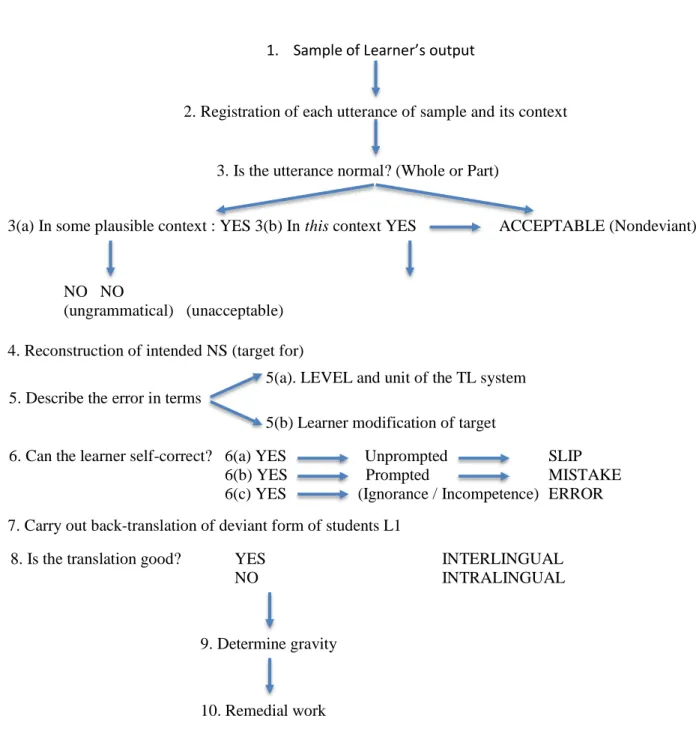
This study gathered information from the written production of students from grade eight
by following the steps which Corder (1971. 1981) calls ‘algorithms’ (Figure 3), or steps carried
Figure 3. Algorithm for Error analysis (adapted from S.P. Corder, 1981: 23)
The data has been compiled from authentic, academic-related texts of an assortment of
text types and genres and tests that include letters, stories, articles, activities, quizzes and exams.
All the texts were done with formal assessment in mind, and the students were aware of this.
Informing them of this was important as they had to make an effort to produce accurate
1. Sample of Learner’s output
2. Registration of each utterance of sample and its context
3. Is the utterance normal? (Whole or Part)
3(a) In some plausible context : YES 3(b) In this context YES ACCEPTABLE (Nondeviant)
NO NO
(ungrammatical) (unacceptable)
4. Reconstruction of intended NS (target for)
5. Describe the error in terms
5(a). LEVEL and unit of the TL system
5(b) Learner modification of target
6. Can the learner self-correct? 6(a) YES Unprompted SLIP
6(b) YES Prompted MISTAKE
6(c) YES (Ignorance / Incompetence) ERROR
7. Carry out back-translation of deviant form of students L1
8. Is the translation good? YES INTERLINGUAL
NO INTRALINGUAL
9. Determine gravity
language, from which reliable data could be collected. However, an unassessed task (Appendix
C) was assigned which offered even more reliable data as there was no pressure on the students
‘to get things right’.
Clinical Elicitation
Although natural learner language data is preferred to carry out EA, most of the data
came from its elicitation. Corder (1974) identifies two types of elicitation, both of which are
present in this study. First, Clinical Elicitation which is “getting information to produce any data
of any sort” (Ellis, 1999). Students were asked to produce texts of language where they could use
language in context for functional purposes, usually to practise previously-taught concepts. For
instance, on a discussion on whether or not downloading music from the internet is considered
unlawful, students expressed their views in writing by taking part in an open forum. This was an
ideal opportunity for them to adjust their language “in accordance with social conventions that
call for different forms of address, different pronunciations, different words, different
grammatical structures, different discourse patterns, and so forth, in different social contexts.”
(James, 1998, p. 106). A task of this type allows for a spontaneous production of text which
would yield authentic texts (as opposed to a mere filling in the blanks) from which mistakes can
be collected.
Identification of errors
Steps were taken to keep track of the mistakes students made by jotting down each
mistake and feeding an Excel spreadsheet with every high-frequency mistake in a systematic
the mistake, the whole sentence was transferred to the corpus so that one could get an idea of
both the context as well as the intention of writer. This is of essences since ‘The only way we can
reasonably determine whether a mistake is a slip or a genuine error is by reference to the writer’s
semantic and structural intentions’ (Taylor, 1986 p 154 in (James, 1998).
Students whose mistakes were recorded have retained their anonymity (for ethical and
legal reasons). Their mistakes were classified systematically in accordance to error type, student
age, intended message, and mode (whether the utterance was produced by hand or via a
computer printout). Initial findings suggest students are more CEMI-prone in their written
production when they compose by hand. Although less CEMIs were made when using a word
processor, they fact that they were made at all is a likely result of carelessness or over-spellcheck
dependency.
Description of errors
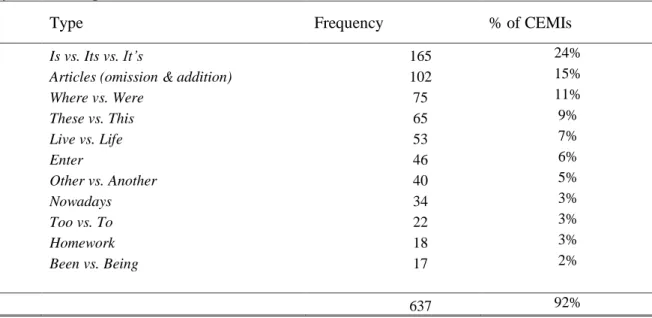
While there are other mistakes that comprise the corpus, here are the top 10. Trying to
tackle all the mistakes at the same time seemed not only impractical but also confusing to the
students, so only the first type, FITIs was studied.
The two most common mistakes made were the Faulty Interchange of Triple I’s (FITI):
It, Its, and It’s (Table 2) followed by mistakes with or the absence of the definite article the. These CEMIs have been present in all types of text types and genres. Table 3 shows the
frequency the mistakes are made, extracted from an assortment of texts and from two grades.
Table 2
List of CEMIs (Top 10)
Type Frequency % of CEMIs
Is vs. Its vs. It’s 165 24%
Articles (omission & addition) 102 15%
Where vs. Were 75 11%
These vs. This 65 9%
Live vs. Life 53 7%
Enter 46 6%
Other vs. Another 40 5%
Nowadays 34 3%
Too vs. To 22 3%
Homework 18 3%
Been vs. Being 17 2%
637 92%
Table 3 reveals ten of such fragments from the written production of eighth grade
students. This type of Careless Mistake I have named Faulty Interchange of Triple I’s (FITI),
because of the misuse of the words is, its and its believing that they are the same or
interchangeable.
Table 3
Careless English Mistakes with FITI’s
Grade 9 Handwritten Printed Total
Frequency % Frequency % Frequency %
Female 35 21.2 8 4.8 43 26.0
Male 31 18.8 2 1.2 33 20.0
Total 66 40.0 8 6.0 76 46.0
Grade 10 Handwritten Printed Total
Frequency % Frequency % Frequency %
Female 37 22.4 12 7.3 49 30.0
Male 33 20.0 7 4.2 40 24.0
DATA ANALYSIS
To analysis the occurrence of CEMIs, I extracted authentic data from a task students had
to carry out for an in-class academic task (Appendix C). Of the 89 texts (from the total number
of students in grade eight) only some of those which bore evidence of CEMIs will be analysed
below. These examples will be identified as ‘Example’ the corresponding number from
Appendix C. Other examples from the CEMIs Corpus have also been included in this analysis.
They can be identified with the word ‘Corpus’ before each example. In both cases, please note
that the texts were not corrected or marked. Additionally, notice that though there may be other
mistakes in each sentence, the focus is entirely on CEMIs.
For the analysis, I propose to analyse the mistakes in two phases: a) the description of the
mistakes using Contrastive Analysis and b) provide linguistic rationale behind their occurrence
using Error Analysis (EA). CA will play an important role in understanding the nature of the
mistakes from the perspective of the learner’s L1 interference. Here, I shall look for
commonalities between the idiosyncratic dialect (Corder, 1967) of the student to that of their
desired or intended message in the TL. Additionally, I shall explain the possible nature and cause
of the CEMIs from the point of view of the learner and based on the taxonomy discussed in
Chapter 3.
The most notorious characteristic of CEMIs is the fact that they re-occur after a while,
despite prior instruction and become fossilized. This type of fossilization is known as ‘error
reappearance’ Selinker (1972) and is the first of two types fossilization, the other being of
‘language competence’ for which CEMIs do not apply. Consequently, I have decided to divide
the analysis of CEMIs into three types of fossilization: Phonetic, Morphological and another I
omission, though there is evidence of addition. These types of fossilization will then branch into
various subcategories of CLI taxonomies i.e., phonetic transfer, syntactic transfer, orthographic
transfer and punctuation transfer, all of whose direction of transfer is forward. Reverse transfer will not be discussed as it is directly related to positive transfer, a phenomenon which assists
correctness, no hamper it.
EXPLANATION OF ERRORS
Errors of Phonetic Fossilization
Negative Phonetic transfer
The most common mistake in this category is what I have called the Faulty Interchange
of Triple I’s (FITI). To many learners, this mistake has been fossilised as they are used
interchangeably. The fact that they come from handwritten texts suggests they are not
typographical mistakes, nor mistakes due to over-spell check dependency. The are clearly slips,
as they care corrected when prompted.
As can been seen from the authentic samples (Table 4), FITIs are most commonly made
by hand and are divided into three types:
Type 1: Is replacing it’s as in “I’m grateful of what you are doing for me, *is very nice of
you…”. This by far the most common mistake. It corresponds to 56.4% of all FITI mistakes
registered in the CEMIs Corpus.
Type 3: It’s replacing is as in“I think travelling *it’s an experience you will never forget and you learn many things in a trip.” According to the CEMIs corpus, this is the least common
FITI mistake with a frequency ratio of just 18.8%.
Table 4
Mistakes and modes of FITI-induced mistakes in eighth grade
TIFI Examples Mode
1 I’m grateful of what you are doing for me, is very nice of you… HW 2 I want to learn as much as possible about English life-style, it’s nature, and it’s
literature. HW
3 …my brother told me that he did motocross and said me that is fantastic because
you have a lot of adrenaline. HW
4 Bungee jumping it’s the best decition I have ever made. HW 5 Being a king again it’s possible, so take courage and reach your kingdom. HW 6 Im crazy about football, its my favorite activity because you never know what is
going to happen. Its very unpredictable. HW
7 …but remember, the oxygen in tank is for a limit time, then is finished. PR 8 (the Sphinx)… it’s mysterious past and what even historians say about it, it’s
connection with Napoleon Bonaparte [and] about its nose. HW 9 I think is one of the sensations that every person want to fill. HW 10 …and you know that the only way to support your team its to go in front of the
goal keeper… HW
PR = Printed, HW = Handwritten.
In the case of Type 1, the pronunciation of the ts consonant cluster is partially ignored and reduced to a simple -s. The second type is caused by a punctuation error. This may be due to
the fact that though apostrophes have been accepted into ‘current Spanish usage’ by the Real
Academia de la Lengua Española, it is not used for possessives, while Type 3 mistakes are a
made in peculiar manner for which I can give no exact explanation.
To elaborate, Type 1 bears the typical traits of negative phonetic transfer i.e.,
mispronunciation and/or intonation, in this case of the consonant cluster ts. These