Short comunication
Exercise Countermeasures for the Spine in Microgravity
Contramedidas de los ejercicios para la columna vertebral en condiciones
de microgravedad
Joselito V. Sayson1*
Alan R. Hargens2
1Ola Grimsby Institute. Estados Unidos.
2University of California, Department of Orthopaedic Surgery. San Diego, Estados
Unidos.
*Corresponding author: [email protected]
ABSTRACT
Weakness and neuromuscular deconditioning of the anti-gravity spine muscles develop
after 6-month missions in space. There is also a high incidence of herniated nucleus
pulposus in cervical and lumbar discs with back pain post-flight. Prolonged microgravity
reduces the physiological loading forces needed for spine homeostasis and may alter
neuromuscular postural reflexes leading to injury upon return to 1G. Nine astronauts were
tested using the Biering-Sorensen test to measure spine isometric endurance pre- and
post-flight. The results show significant decrements in muscle isometric endurance and
correlates with atrophy of the multifidus, erector spinae, quadratus lumborum and psoas,
reduced cross-sectional area and functional cross-sectional area with MRI measurements.
Current ISS exercise countermeasures appear to be insufficient in mitigating loss of
spinal function due to lack of specifically designed exercises to address specific
antigravity muscles. Intensity of resistance loading is proposed to be specific to the
muscle isoform that needs the most optimal mechanotransduction using adjustable pulley
resistance vectors in line or parallel to the target muscle fibre orientations. Pulley
apparatus may be in the form of flywheel or pneumatic derived resistance. Since
the main functional qualities which would require higher repetitions in good form,
moderate resistance, and multiple sets. This proposal is intended to define efficient type
of spine exercises to counter the maladaptive effects from prolonged spaceflight and lead
to accepted countermeasures. Supported by NASA Grants NNXlOAM18G and
NNX13AM89G.
Key words: Biering-Sorensen Test; anti-gravity; muscle atrophy; mechanotransduction;
low back pain; HNP.
RESUMEN
La debilidad y el desacondicionamiento neuromuscular de los músculos de la columna
vertebral encargados de la anti-gravedad aparecen a partir del sexto mes de estancia en el
espacio. En la etapa posterior al vuelo también se observa una elevada incidencia de
núcleos pulposos herniados en discos cervicales y lumbares con dolor de espalda. La
microgravedad prolongada reduce las fuerzas de carga fisiológica necesarias para la
homeostasis de la columna vertebral, además de que puede alterar los reflejos posturales
neuromusculares provocando lesiones al regresar a 1G. Nueve astronautas fueron
evaluados con la prueba de Biering-Sorensen para medir la resistencia isométrica de la
columna vertebral antes y después del vuelo. Los resultados muestran decrecimientos
significativos en la resistencia isométrica muscular y correlatos con atrofia del multifidus,
erector spinae, quadratus lumborum y psoas, reducción del área transversal y área
transversal funcional con mediciones IRM. Las contramedidas actuales de la EEI para los
ejercicios parecen ser insuficientes para mitigar la pérdida de función espinal provocada
por la falta de ejercicios dirigidos a músculos antigravedad específicos. Se propone que la
intensidad de la carga de resistencia sea específica para la isoforma muscular que requiere
la mecanotransducción más óptima usando vectores de resistencia de polea ajustables
alineados o paralelos a las orientaciones de la fibra muscular a que estén dirigidos. El
dispositivo de poleas puede tomar la forma de volante o de resistencia derivada de fuerza
neumática. Como los músculos antigravedad son predominantemente isoformas
musculares Tipo I, la resistencia y la estabilidad son las principales cualidades
funcionales que requerirían mayores repeticiones en buena forma, resistencia moderada y
múltiples ciclos. La propuesta que aquí se presenta está dirigida a definir el tipo eficiente
de ejercicios para la columna vertebral para contrarrestar los efectos de adaptación
creación de contramedidas aceptables. Realizado con el apoyo de las subvenciones de la
NASA NNXlOAM18G y NNX13AM89G.
Palabras clave: prueba de Biering-Sorensen; antigravedad; atrofia muscular;
mecanotransducción; lumbalgia; HNP.
Recibido: 19/07/2019
Aprobado: 19/07/2019
INTRODUCTION
Since the advent of human spaceflight in the mid-20th century, the science of space
physiology has strived to explore answers into the deleterious effects of microgravity
especially to the musculoskeletal system among all the other physiologic systems altered.
Prolonged exposure to microgravity greatly reduces the inherent biomechanical forces
needed for health and homeostasis of the musculoskeletal system adapted to a 1G
environment. Atrophy, degeneration, and deconditioning of supportive skeletal muscles
have been largely pointed out as the cause of weakness experienced by astronauts upon
return to a 1G environment so various exercise countermeasures have been employed
during prolonged space missions. This research explores the role of par spinal muscles
with measurements of back strength pre- and post-flight in relation to muscle atrophy and
back pain reported by astronauts before and after six month missions aboard the
International Space Station (ISS) and proposed spine exercise countermeasures with
regard to the most appropriate exercise components most appropriate to address specific
spine muscle isoforms involved with atrophy, deconditioning, and reduced
neuromuscular reflexes. There had also been documented incidents of herniated nucleus
pulposus (HNP) after spaceflight and this study will attempt to correlate incidences to
back strength as well as back pain reported and paraspinal muscle atrophy.(1,2) Our project
will help define the most physiologically appropriate type of exercise components to
deter the maladaptive effects from prolonged spaceflight and FCSA of the par spinal
muscles, reduce back pain and incidences of HNPs, prevent dysfunction or injuries and to
improve astronaut performance in space and after return to a gravitational field of a
METHODS
Institutional research board approval was obtained from the National Aeronautics and
Space Administration (NASA) and the University of California, San Diego. Twelve
astronauts consented to participate as test subjects to our study from 2012-2018. All
astronauts were crewmembers for six-month missions (with one extending one year)
onboard the International Space Station. Crewmembers were subjected to a back strength
isometric endurance assessment using the Biering-Sorensen Test pre- and post-flight.(3)
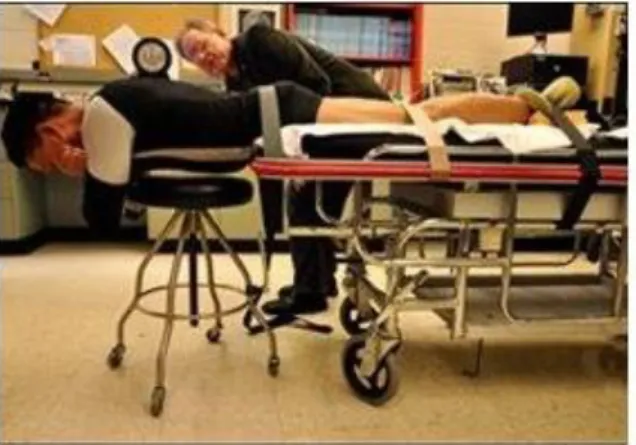
Nine data sets were collected. The Biering-Sorensen Test was utilized as the back
strength assessment tool to quantify by hold time, the ability of the paraspinal extensor
muscle group to hold the vertebral column in a static and horizontal position while the
pelvis is stabilized (Fig.).
Fig. The Biering-Sorensen Test.
RESULTS
Complete Biering-Sorensen Test comparison results pre- and post-flight were collected
from nine out of the twelve crewmembers. The other three were excluded due to
precautions on suspicion of actual or potential back pathologies. The mean hold time for
the Biering-Sorensen Test decrement for the nine data set to date approached 30 sec.
Preliminary results indicate a pre-flight to post-flight t-test score of 0.000954. There was
a reduction of the isometric hold time for the spine extensors indicating significant
DISCUSSION
The results of this study showed spine muscle weakness using the Biering-Sorensen Test
occurs concurrently with reported atrophy of the multifidus, erector spinae, quadratus
lumborum and psoas, reduced cross-sectional area (CSA) and functional cross-sectional
area (FCSA) with MRI measurements.(4,5) We propose an exercise prescription using high
repetition dosage which may be more functional based on the type of muscle fiber
isoform predominance in the spine. Physiologically efficient mechanotransduction to the
spine requires cyclical stress to spinal structures.(6) Human skeletal muscle is subdivided
based on two isoforms (a) Myosin Heavy Chain muscle isoform Type 1 (MHC I)
synonymous to red muscles/slow-twitch fibres, and (b) Myosin Heavy Chain muscle
isoform Type II (MHC IIx/d aka MHC IIb) or white muscles/fast-twitch fibres.(7) MHC I
are oxidative and fiber development results from low to moderate loads at higher
repetitions (aerobic metabolism) whereas MHC II are glycolytic and responds by higher
loads at lower repetitions (anaerobic metabolism).(8,9) Postural functioning MHC-I muscle
fibres of the lower extremities atrophy in greater proportion than MHC-II during
spaceflight(10) but the proportion of MHC-I to MHC-II atrophy in the spine is not defined.
It is most likely that atrophy of the spinal postural muscles becomes a primary
musculoskeletal response to unloading with deconditioning in-flight. To match the
exercise intensity suited to the predominant muscle isoform in the spine, exercise dosage
with lower load resistance and higher repetition increments may be the most appropriate
mechanical stress in the exercise protocol development.(1) If exercise intensity to the back
muscles becomes too high, it may cause injury. As such, even though the incidence of
in-flight musculoskeletal injuries with exercise is low, there is a relatively high number of
minor back injuries incurred while using current ISS exercise equipment. In microgravity
the resistance of the pulley may include a pneumatic mechanism or a modified flywheel
that can produce a constant load. A specially-designed adjustable bench with straps to
stabilize the pelvis and to pre-position the astronaut prior to commencement of the
designated exercises is possible. In microgravity conditions, the objective of these
exercises is to provide biomechanical compression to the spine via optimized muscle
contraction using functional spine movements in tri-planar directions [flexion or
extension combined with simultaneous side-bending and rotation] as opposed to
side-bending). Functional spine exercises will likely cause efficient mechanotransduction with
cyclical stress to spinal structures.(6)
CONCLUSIONS
Long duration spaceflight despite exercise protocols in the ISS, result in paraspinal
muscle atrophy and strength decrements. Current exercise protocols using onboard
workout equipment (Advanced Resistive Exercise Device (ARED), Treadmill Vibration
Isolation System (TVIS) Cycle Ergometer with Vibration Isolation System (CEVIS) and
currently used by astronauts do not have a spine specific regimen and not sufficient to
maintain musculoskeletal conditioning of the spine. Our study shows a need for new
exercise equipment and new exercise protocols dedicated to optimal application of
physiological mechanotransduction to the paraspinal muscles with resistance and
repetitions specific to conditioning the muscle isoform group Myosin Heavy Chain
muscle isoform Type 1 (MHC I) synonymous to red muscles/slow-twitch fibres, that
atrophy the most.
REFERENCES
1. Sayson JV, Lotz J, Parazynski S, Hargens AR. Back pain in space and post-flight spine
injury: Mechanisms and countermeasure development. Acta Astronautica.
2013;86:24-38.
2. Johnston SL, Campbell MR, Scheuring R, Feiveson A, Risk of herniated nucleus
pulposus among U.S. astronauts. Aviat. Space Environ Med. 2010;81:566–74.
3. Gruther W, Wick F, Paul B, Leitner C, Posch M, Matzner M, et al. Diagnostic
accuracy and reliability of muscle strength and endurance measurements in patients with
chronic low back pain. J Rehabil Med. 2009;41:613–9.
4. Burkhart K, Allaire B, Bouxsein M. Negative Effects of Long-Duration Spaceflight on
Paraspinal Muscle Morphology. Spine Journal; 2018.
5. Bailey JF, Miller SL, Khieu K, Conor O’Neill W, Healey RM, Coughlin DG, et al.
From the International Space Station to the clinic: how prolonged unloading may elevate
6. Burkholder TJ, Mechanotransduction in skeletal muscles. Front Biosci.
2007;12:174–191.
7. Bottinelli R, Reggiani C. Human skeletal muscle fibres: molecular and functional
diversity. rog Biophys Mol Biol. 2000;73(2-4):195-262.
8. Grimsby O. Scientific therapeutic exercise progressions. J Manu Manipulat. Ther.
1994;2:94–101.
9. Frey A. NASA Human Research Program summary: countermeasures for muscle
atrophy and strength loss caused by longduration spaceflight and bedrest. Aviat Space
Environ Med; 2010. p. 79–80.
10. Widrick JJ, Knuth SK, Norenberg KM, Romatowski JG, Bain JL, Riley DA, et al.
Fitts, Effect of a 17-day spaceflight on contractile properties of human soleus fibers. J
Physiol. 1999;516:915–30.
Conflict of interests