Universidad de Valladolid Carolina Andrea Quintero Quiñones
FACULTAD
de FILOSOFÍA Y LETRAS
DEPARTAMENTO de FILOLOGÍA INGLESA
Grado en Estudios Ingleses
TRABAJO DE FIN DE GRADO
“Linguistic elements
in the subtitling of
The Big Bang theory
: How Latin American
Spanish and Peninsular
Spanish translations differ”.
Carolina Andrea Quintero Quiñones
Universidad de Valladolid Carolina Andrea Quintero Quiñones ABSTRACT
The audiovisual translation is a specialized field that involves different types of translation. Subtitling is one of the most used types of the translation nowadays. Besides, subtitling has gained importance in last few years. In our study, we have decided first to provide some theoretical aspects which will deal different points, such as detailed information about audiovisual translation, different varieties of Spanish; Peninsular Spanish and Latin American Spanish, and even the use of translation techniques. All these points will be useful in order to analyze the different linguistic aspects in a famous series TV The Big Bang Theory. Therefore, the main aim in this dissertation is to analyze and compare some linguistic varieties such as morphological, lexical and syntax aspect and the influence of some strategies in the translation.
Keywords: Subtitling, audiovisual translation, Peninsular Spanish, Latin American Spanish, linguistic elements, The Big Bang Theory.
RESUMEN
La traducción audiovisual es una rama especializada que abarca diferentes tipos de traducción. Hoy en día, la subtitulación es uno de los tipos más usados en la traducción. Además, la subtitulación ha ganado importancia en los últimos años. En nuestro estudio, primero hemos
decidido facilitar algunos aspectos teóricos que tratarán diferentes puntos como información detallada sobre la traducción audiovisual, diferentes variedades del español, español peninsular y
español latino americano e incluso el uso de las técnicas de traducción. Todos estos puntos serían prácticos para analizar los diferentes aspectos lingüísticos en una famosa serie de televisión La
Teoría del Big Bang. Por lo tanto, el principal objetivo en este trabajo es analizar y comparar
algunas variedades lingüísticas como el aspecto morfológico, léxico y sintáctico y la influencia de algunas estrategias en la traducción.
Palabras clave: Subtitulación, traducción audiovisual, español peninsular, español latino
Universidad de Valladolid Carolina Andrea Quintero Quiñones INDEX
1.Introduction………...Page 7 2. Audiovisual translation as a type of translation………...Page 8 2.1 Subtitling as a type of AVT………..Page10 2.2.Characteristics of subtitling in American TV shows………...Page 10 3. Latin American Spanish and P Spanish: Two languages varieties in AVT………Page13 4. The translation in different Spanish varieties and the use of translation techniques…… Page16
5.Objectives………Page19
6. Methodology………...Page20
6.1The Big Bang Theory sitcom……….Page21 6.2the classification of different translations at various linguistic levels………...Page22 6.3 Techniques of translation in P Spanish and LA Spanish translations………...Page23 7. Analysis and discussion of Peninsular Spanish vs. Latin American Spanish………...Pag27
Conclusion……….Page30
Universidad de Valladolid Carolina Andrea Quintero Quiñones 1. INTRODUCTION
Translation is an important medium of communication among different cultures. More specifically, the translation in audiovisual media, which consists of transmitting messages from one language through different communication channels (e.g. cinema and television) currently determinant in the relationship between an original culture (i.e. English culture, mostly) and a target culture. For this reason, the main aim of the present study is to analyze the audiovisual translation in the subtitling of American TV series (i.e. The Big Bang Theory) into both Peninsular Spanish and Latin American Spanish, as two varieties of the Spanish language which can show differences not only in terms of linguistic characteristics but also in terms of the translation techniques used in each target variety.
This dissertation will be structured in two parts, a theoretical part and practical part. In the theoretical section, we will introduce some works conducted on audiovisual translation in general and subtitling in particular and then we will present the main characteristics of subtitling in American shows TV. The practical part includes a linguistic analysis of Peninsular Spanish and Latin American Spanish translation of season 1 of the TV series the Big Bang Theory, in order to observe the differences between both translations at both linguistic and translatology level.
This dissertation will start with a research focused on audiovisual translation, specially, the subtitling. In addition, we will introduce the characteristics of subtitling in American TV shows. Then, we will discuss varieties of language. P Spanish and LA Spanish, and we will comment about the translation of linguistic and cultural elements, and techniques translation.
The second part of the dissertation consists of a practical analysis. This part will deal with the classification of the cultural elements at different linguistic levels and techniques translation applied to Peninsular Spanish and Latin American Spanish subtitles.
Universidad de Valladolid Carolina Andrea Quintero Quiñones 2. AUDIOVISUAL TRANSLATION AS A TYPE OF TRANSLATION
Subtitling may be defined as a translation practice that consists of presenting a written text, generally on the lower part of the screen, that endeavours to recount the original dialogue of the speakers, as well as the discursive elements that appear in the image (letters, inserts, graffiti, inscriptions, placard, etc.), and the information that is contained on the soundtrack (sounds,
voices overs, etc.) (Díaz and Remael 8). According to Díaz and Remael all subtitled programmes are composed by image, spoken words and subtitles (9). These three elements allow the viewer to read the written text. Because of this, subtitles should be synchronized with the image and the dialogue. The relation of the latter of the two elements, image and sound, are constantly on debate when dealing with.
Audiovisual Translation (AVT) is considered by some experts as an adaptation (and not a real translation ) due to the fact that these two parameters of the audiovisual medium imply that in subtitling, dubbing and voice- over a synchrony with both codes must be maintained (Díaz and Remael 9). Therefore, image and sound are two essential elements for the synchronization in the subtitling, where, subtitles at the same time, should coincide with the corporal movement of the characters.
Time is another important element in AVT, since the translated text should coincide in length with the original language. In addition, in subtitling, space dimensions on the screen are limited and the written text should have a fixed number of characters. This means that a subtitle should have a maximum of 2 lines and 32 to 41 characters per line (Díaz and Remael 9). All these elements specific for AVT, are the main reasons why the audiovisual translation is considered as an adaptation of the original version rather than a translation itself. However, in the present work, although we will take into consideration some of these elements in its empirical aspect, we will
use the term “translation” "to refer to a subtitling solution that implies the translation of messages from different verbal and non - verbal acoustic codes into verbal and /or non- verbal visual codes" (Díaz and Remael 11).
Universidad de Valladolid Carolina Andrea Quintero Quiñones Remael 12). In English, the term used to refer to audiovisual translation is also “screen
translation”. This term encompasses all audiovisual medium presented on screen as television. For the translation of programmes on diverse channels and media as on internet, the common term used is “multimedia translation”(Díaz and Remael 12). However, recently, AVT is a term that has been gaining importance since it refers to different audiovisual media such as cinema or television, in which there is a transmission of messages through of the synchrony of sound and images.
The reason why AVT has been gaining popularity in the last decades is due to the fact that in some countries subtitling and dubbing are part of a huge industry. For instance, Spain is one of the countries where more dubbing is used in some genres, principally, dramatic genres such as films, sitcoms and many others. In addition, there are other audiovisual methods within dubbing, like voice-over or half dubbing that are especially used in the genre of advertising. Voice-over presupposes putting a sound track of the target text over the muffled soundtrack of the original text. This type of audiovisual translation is similar to the narration so neither of them is too restrictive in the synchronization with the body language because the main aim of this type of translation is to maintain synchronization between image and text.
These two types of audiovisual communication, i.e. dubbing and subtitling are considered important in some specific genres such as news, advertising or documental television. According
to Agost “Dubbing is a complex process characterized by the necessity of synchrony between
voices of voice actors and images of audiovisual text” (qtd. in Martínez 76). As for subtitling, the theatre plays and the operas are two areas where the synchrony, in this case between the images and the text, is important. Of course, the other main issue in subtitling and dubbing is the translation from the source language into the target language since it requires some cultural knowledge by the translator. This means that the original message should be adapted linguistically and technically to facilitate its understanding by the audience.
Universidad de Valladolid Carolina Andrea Quintero Quiñones 2.1 Subtitling as a type of AVT
Subtitling not only expresses dialogues of actors but also other secondary elements such as the name of institutions, pamphlets, slogans, or any text that may appear on-screen. Since the text must be seen on the screen. Martínez states that there are two types of subtitling in AVT depending on how much text appears on the screen: traditional subtitling, which may be complete or reduced, as in TV programmes such as news or docummentaries , and simultaneous subtitling, which is the one used when there is little time for transmiting the message, and requires joint work of an interpreter and a typist like, for instance, a live radio interview. (95, 96). Besides, there are other types of subtitling such as, those for people with hearing impairment, for language learning or even for music, such as karaoke, although it does not imply translation as such.
Therefore, depending on the purpose and format of the audiovisual product subtitling does not present a complete information in terms of the original text due to certain limitations such as space and time; so some parts of the original message may even be eliminated to facilitate comprehension. According to Martínez; the reduction is a defining feature of subtitling and it should be understood as such and not as a castrating strategy that denies validity to the process (my own translation 98).
Therefore, subtitling is a complex method because it is not only a process of reduction but also a process of comprehension by the viewer. This means that the translator should be considered as
the “master of the summary”(Martínez 99) to avoid that the viewer perceives lost information.
2.2 Characteristics of subtitling in American TV shows
The most characteristic element in AVT is the limitation in synchronization in space and time. For this reason, the translator depends on both linguistic and technical aspects in the translation. Due to these limitations in the AVT, some authors as Titford defines subtitling as
Universidad de Valladolid Carolina Andrea Quintero Quiñones complemented with other external elements of the communication such as emitter, receiver , noise and the translator ( qtd. in Díaz and Remael 9).
Likewise, other authors like Ferriol defines it as “restricted translation” (qtd. in Díaz and Remael 10) because of the same reasons.
Other important limitations in subtitling have to do with time since speech and text should be synchronized. According to Diaz and Remael “the norm of the six seconds refers to the time that the audience needs to read and assimilate the information that appears in two lines of a 35 spaces
on each one” (103). This norm is applied to all audiovisual channels but there are some that require more characters per line depending on the dimension of the screen (as in the case of the cinema).
All characteristics mentioned above can be adapted to any TV genre, especially to American TV sitcoms where humor plays an important role and so speech and text should be closely linked. However, this type of genre presents some other difficulties within the AVT area, especially in the linguistic aspect. TV sitcoms refer mainly to the American comedies of television, produced by chapters and with the same actors. When released abroad, these comedies may appear dubbed or subtitled being the main difficulty in both formats the translation of humor, which could be interpreted differently in the original and target cultures. This is specially problematic in the case of, TV sitcoms where humoristic or comic effects are produced by means of stereotyped characters whose linguistic and non- verbal behavior is usually linked to cultural elements (such as the main character of The Big Bang Theory series, Sheldon Cooper) and to linguistic elements (depending on the Spanish variety as the target language), as we will describe in section 5.
From the point of view of linguistic difficulties in the translation of sitcoms, the aim of the translator is to grasp the comical gag from the original version and to translate that information using a standard vocabulary in the target language. As stated above, the translation of comical elements depends on each culture, so there are terms which have the same meaning in both languages.
Universidad de Valladolid Carolina Andrea Quintero Quiñones
based on this assertion, argues that “In television series, certain information can be suppressed without loss in those cases in which the other semiotic systems may provoke some redundancy in
the information given by these and by the spoken dialogues” (my own translation 18). When it comes to subtitles, one of the problems when trying to maintain such effect is the characters' original voice, as some elements like thick accents cannot be wholly reflected in the text or, for instance, the translation of those elements that accompany the verbal message, like gestures.
Because of this, Agnetta argues that “subtitles cannot reproduce the original intonation of the
actors and therefore, these subtitles do not reflect possible infractions of the norm in
Universidad de Valladolid Carolina Andrea Quintero Quiñones 3. LATIN AMERICAN ESPANISH versus PENINSULAR SPANISH: TWO LANGUAGES
VARIETIES IN AVT
Latin American (LA) Spanish presents great differences compared to Peninsular (P) Spanish. These differences play an important role in the linguistic and cultural aspects in translation, more specifically in subtitling. In fact, phonetic, morphologic and lexical aspects are the most notable features that separate both varieties. Concerning phonetics, the pronunciation of
monosyllabic vowels in LA Spanish (aú or aí) as in, baúl, maíz do not present any difference with P Spanish (Malmberg 6) but, there are consonant variations as in letters s and z that are pronounced in a different manner in P Spanish while in LA Spanish the phoneme /s/ represents the same pronunciation of both the letters s and the letter z, a phenomenon called “seseo”. For instance, the word caza is pronounced with the sound s in LA Spanish.
As for the morphosyntactic contrast between both varieties, the use of certain clitic pronouns like the dative le for masculine human objects ( le amo) is not generalized in Latin America, ( lo amo). Besides,generally speaking, the use of personal pronouns is more informal in P Spanish: Malmberg argues that LA Spanish lost the plural personal pronoun of the second person vosotros and its possessive vuestro that are being substituted by usted/ustedes (122), as example in (1) shows:
(1)
# Original Version:
00:003
Oh, that`s too bad
Universidad de Valladolid Carolina Andrea Quintero Quiñones
# Latin American Spanish Version:
Ay, quémal, ustedes harían
una pareja linda.
# Peninsular Spanish Version:
¡Que pena! haríais una buena pareja
1
[ The Bing Bang Theory]
Other characteristic (inflectional) morphological feature that differs in both varieties of Spanish is the verbal inflection: the subjunctive verbal form that ends in -ara (jugara, estudiara) is used in LA Spanish while in P Spanish other inflections are used such as –ase (jugase, estudiase) and
-ais, -asteis and other verbal forms ending in for the second person in plural (jugasteis, estudiasteis) (123) is used in P Spanish and not so often in LA Spanish, as example in (2) shows:
(2)
# Latin American Spanish Version:
¿Hola chicos, recibieron mi correo?
# Peninsular Spanish Version:
Hola, chicos ¿ Recibísteis mi correo?
As for the syntactic aspect, in LA Spanish an atypical grammatical structure is used in hubieron animales where there is plural person and number concordance of the subject with the verb haber
( an impersonal verb and so only the singular form should be used hubo, habia, hay) instead of
hubo animales, the standard use of P Spanish.
On the other hand, the different use of certain vocabulary in some language varieties is a linguistic phenomenon that depends on cultural influence and adaptation of new terms. As Malmberg explains, “it is not necessary that a new word influences phonetically nor
1“Unless indicated otherwise, all the examples from now on are taken from our compilation of extracts of The Big
Bang Theory series”.
# Original Version:
00:00:46 – 00:00:48
Universidad de Valladolid Carolina Andrea Quintero Quiñones grammatically in the system; as a general rule, the word adapts with facility to the pronunciation
Universidad de Valladolid Carolina Andrea Quintero Quiñones 4. THE TRANSLATION IN DIFFERENT SPANISH VARIETIES AND THE USE OF
TRANSLATION TECHNIQUES
We consider that the translation of cultural terms is difficult since there is not a specific technique to transfer them from a language into another. For this reason, we should take into
account the meaning of “culture" since, this concept maybe different depending on the perception of this term by each country. Some authors such as Díaz and Remael think that the translation of cultural elements is not only based on the translation of words but also of the cultural background. Therefore, they define the translation of cultural elements as follows:
"Culture - bound terms are extra linguistic references to items that are tied up with a country's culture, history or geography, and tend therefore to pose serious translation challenges" (200).
It is an appropriate definition since culture in general represents an intellectual knowledge in our days and is characterized by the contact of different elements that reflect the identity of each nation. For this reason, the translation of culture - bound terms can present problems since a similar term in the original culture must be rendered in the culture that receives those terms. From this perspective, Hurtado argued that the terms "native language" and "target language" should be replaced by "culture of origin " and " target culture." And so, the translation is defined as intercultural communication. "( qtd. in Schäpers 7). This means that the translation is meant to be a “cultures exchange”. Therefore, the translator is responsible to transfer the same information and the cultural elements attached to it in the target language.
Taking into account other definitions of the term “culture”, i.e. that in the Merriam Webster Dictionary (2019), this is defined as “the integrated pattern of human knowledge, belief, and behavior that depends upon the capacity for learning and transmitting knowledge to succeeding generations.” Some other authors present a more complete definition, like that of Boas or a more recent one, that of Katan’s as the following quotes show:
Universidad de Valladolid Carolina Andrea Quintero Quiñones man as a member of the society ( my own translation Katan 1999 qtd. in Schäpers 10).
Culture includes all manifestations of social habits of a community, reactions of the
individual to the extent that they are affected by the group customs in which he/she it lives, and the products of human activity are determined by those customs ( my own
translation Boas 1930 qtd. in Schäpers 11).
The first definition (similar to that offered by the Merriam Webster Dictionary) includes a series of independent elements which make reference to different dimensions associated with a
society´s behavior, which are those that will be typically found in the AVT, more specifically in
sitcoms ( i.e. customs, habits, beliefs, etc.). However, the definition of Boas, more anthropological, makes reference to the habits that determine the individual which are less usually found as cultural elements in the AVT.
In the case of the AVT of sitcoms, Hurtado’s (2001 ) statement is especially interesting when pointing out that the subtitling of sitcoms in other language depends mainly on maintaining the communication between the source culture and the target culture. Díaz and Remael argued that "translators must then find an alternative that will allow the viewers to fill in the target culture gap as adequately as possible" (201). These alternatives are based on techniques taken by translators which are reflected, for instance, when words are not translated in the target language (e.g. names of cities, specific places, etc.) since they are usually well-known places for a general audience. Also, literal translation is a frequent strategy in the AVT to facilitate the comprehension of the message although in some cases target terms should be more explicit (and so explicitation as a technique should be used) as literal translations not always fill in the culture gap adequately.
In some other cases, other translation techniques are used such as ( the use of hypernyms (Diaz and Remael) (203), that is, when a specific term in the original language is translated into a more general target term). All these techniques (and many others) are important in subtitling although may be the technique of omission is the one used more frequently in this type of AVT because of the characteristic format already described in section 2. (e.g. time and space restrictions).
Universidad de Valladolid Carolina Andrea Quintero Quiñones 5. OBJECTIVES
The main objective of the present work is to provide a description of the English- Spanish translation performed through the subtitling of the TV sitcom The Big Bang Theory in order to find out if there is an any difference between P Spanish and LA at the level of translation.
Secondly, the translation of certain English items or expressions included in this TV series will be collected and classified according to (1) the differences in the translation product depending on the variety of Spanish (i.e. P Spanish translation in contrast in LA Spanish translation); and (2) the different techniques used by the translators in those cases were the Spanish varieties differ in their translation. This way, this will help us to comprehend different interpretations of the source text paying attention to the specificity of the cultural and linguistic elements associated with Peninsular versus Latin American Spanish varieties as well.
Universidad de Valladolid Carolina Andrea Quintero Quiñones 6. METHODOLOGY
This section is centered on how the critical and descriptive analysis of the famous American sitcom, The Big Bang Theory, was carried out in this dissertation. The methodology consists of extracting all the subtitles that appear in the two different target versions of P Spanish and LA Spanish translations of the 17 episodes of the first season of this famous TV series. Special attention was paid to the presence of linguistic elements in the original text that could imply the difference in the translation into the P and LA Spanish variety and how this would affect the translation technique used by the translators of each Spanish variety.
In the first season of the sitcom, all characters are presented to the audience as having distinctive roles and each characters experiences different situation in each episode. After compiling the cultural elements and their corresponding different translations into both varieties of Spanish, at different grammatical levels (i.e. phonological, morphological, syntactic and lexical2) we have classified the information according to the techniques used by the translator when the translation both varieties differed.
2
Since it is not the purpose of the present dissertation to analyze the differences of both varieties of Spanish at the phonological level (not really important for the subtitling in this case), this level will not be taken into
Universidad de Valladolid Carolina Andrea Quintero Quiñones 5.1 The Big Bang Theory sitcom
Universidad de Valladolid Carolina Andrea Quintero Quiñones 5.2 The classification of different translations at various linguistic levels
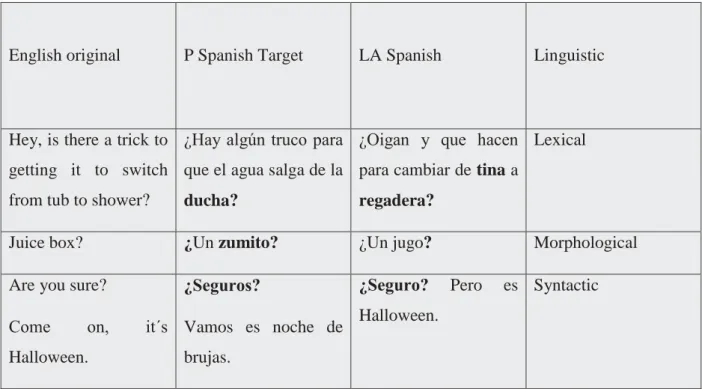
The Big Bang Theory includes various cultural references and differences between both varieties of Spanish at the linguistic level. Each one of these references and differences is localized into a target language translation. This method helps to keep the same sense of the message when it is removed from the original version. Therefore, the translation is not only focused on linguistic aspects, but also cultural elements that are analyzed in every episode of this comical series. Many lexical elements appear in the sitcom and they are also associated with different linguistic levels (as described in section 3) and so they have been classified as table 1 shows:
Table 1 Classification of lexical elements at different linguistic levels and the translation techniques used.
English original P Spanish Target LA Spanish Linguistic
Hey, is there a trick to getting it to switch from tub to shower?
¿Hay algún truco para
que el agua salga de la
ducha?
¿Oigan y que hacen
para cambiar de tina a
regadera?
Lexical
Juice box? ¿Un zumito? ¿Un jugo? Morphological
Are you sure?
Come on, it´s
Halloween.
¿Seguros?
Vamos es noche de brujas.
¿Seguro? Pero es
Halloween.
Syntactic
As can see in the classification, one of the great differences that there is in both translations is the lexical aspect. This aspect is related with the different terms used in each version. For instance;
Universidad de Valladolid Carolina Andrea Quintero Quiñones LA Spanish translation. Both terms have the same meaning although adapted to its culture and language. In the case of the morphological aspect, there are terms which are different with regard to its form. For instance, in P Spanish the translator uses the word “zumito”. However, in LA Spanish the term is translated by “jugo”. In this case, in the P Spanish version use the diminutives ( ito, ita) in substantives and adjectives.
In the syntactic aspect, the concordance in sentences, and the order of the words are part of the different translations. In this case, we have identified a clear example of the concordance of the sentences in both versions. In the original version, Penny tries to convince to her neighbors to go to a costume party and in P Spanish use the word ¿ seguros? and in LA Spanish use the word “
¿seguro?. As can see, in P Spanish the translator use the plural since it refers to many people. However, in LA Spanish the translator prefers to use the term in singular. All these cultural and linguistic terms are developed through strategies used by the translator. These strategies are methods that facilitate the process of translation, which will be explained in the following section.
.
5.3. Techniques in the P Spanish and LA Spanish translations
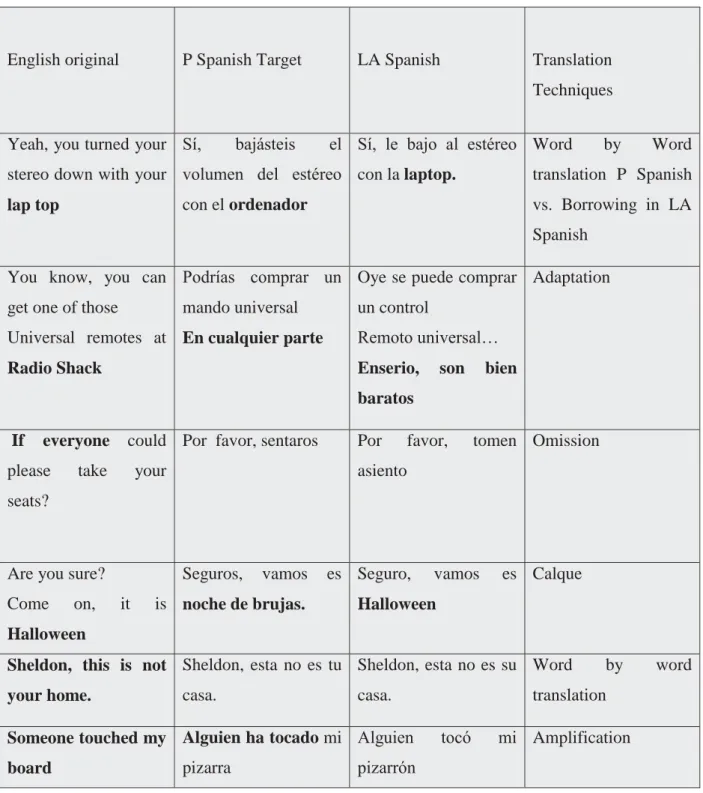
Universidad de Valladolid Carolina Andrea Quintero Quiñones Table 2. Techniques in the P Spanish and LA Spanish translations.
English original P Spanish Target LA Spanish Translation Techniques
Yeah, you turned your stereo down with your
lap top
Sí, bajásteis el volumen del estéreo
con el ordenador
Sí, le bajo al estéreo
con la laptop.
Word by Word translation P Spanish vs. Borrowing in LA Spanish
You know, you can get one of those
Universal remotes at
Radio Shack
Podrías comprar un
mando universal
En cualquier parte
Oye se puede comprar un control
Remoto universal…
Enserio, son bien
baratos
Adaptation
If everyone could please take your seats?
Por favor, sentaros Por favor, tomen asiento
Omission
Are you sure?
Come on, it is
Halloween
Seguros, vamos es
noche de brujas.
Seguro, vamos es
Halloween
Calque
Sheldon, this is not
your home.
Sheldon, esta no es tu casa.
Sheldon, esta no es su casa.
Word by word translation
Someone touched my
board
Alguien ha tocado mi pizarra
Alguien tocó mi pizarrón
Amplification
Borrowing is a linguistic process in which a word from the original version is not changed when transmitted by the target language. As demonstrated in table 2 , borrowing has been used with the
Universidad de Valladolid Carolina Andrea Quintero Quiñones into the LA Spanish translation. In P Spanish, this word is literally translated (translated word by word) as “ordenador”, although the lexical meaning has been maintained in both translated versions.
Adaptation is also a method frequently used by translators; it consists of replacing on cultural term by another. We have found other examples of this lexical element in episode 11 of season 1. For instance, the word “Radio Shack” is translated in each version as “mando universal” in P Spanish and “control remoto” in LA Spanish. In this case, the translator uses a specific word to the target culture maintaining the same lexical meaning.
Another common technique used in subtitling is Omission. Taking into account the rules of translation explained in section 2, the translator has the choice to omit some information if it isconsidered irrelevant, especially in the case of subtitling. In table 2, we have recognized the omission in both versions. In this case, the omitted element is “if everyone”. The translator omits these words, since it is included in verbal inflections such as “sentaros” in P Spanish and
“tomen” in LA Spanish. These morphological inflections allude to the word “everyone”.
Also, we have also identified calque as another important method used in the subtitling translations process. “A calque is when an expression from the source text (ST) is transferred literally into the TT” ( Umamaheshwari, 41).In the example shown in table 2 is, the word
“Halloween”, which is borrowed from the original language and placed into the target language. In this case, the translator maintains the same word in LA Spanish “Halloween” whilst in P Spanish the translator uses the phrase “noche de brujas”. The English term is used more frequently in LA Spanish than in P Spanish version since LA Spanish is closer to the source in cultural terms.
And finally, one of the main differences that we have found from examining the two Spanish varieties is that literal translation is used more often in the LA Spanish than in the P Spanish
version. This is due to Latin American´s adoption of certain terms and expressions from English vocabulary, whereas in P Spanish, the translator tends to favor an attempted translation or adaptation. In some other cases, literal translation ( word by word translation) chosen in both P Spanish and LA Spanish versions. For instance; “Sheldon, esta no es tu casa” in P Spanish and
“Sheldon, esta no es su casa” in LA Spanish as illustrated in table 2.
In some other cases, there are examples of amplifications, particularly in P Spanish, such as
Universidad de Valladolid Carolina Andrea Quintero Quiñones 6. ANALYSIS AND DISCUSSION OF PENINSULAR SPANISH VS. LATIN AMERICAN
SPANISH TRANSLATION.
In this section, we will analyze the cultural and linguistic elements communicated in the original version and how they are translated differently into LA Spanish and in P Spanish subtitles.
With this proposal in mind, we have carried out a detailed analysis of all of the lexical elements and syntactic structures that appear in one episode of The Big Bang Theory taking into account only the instances where there was a clear difference between the translation into P Spanish and that LA Spanish. Therefore, each example at different linguistic levels, providing a percentage for each translation technique used as tables 3 and 4 show.
Table3. P Spanish version: The linguistic classification and the corresponding translation techniques
Linguistic Class
Borrowing Adaptation Omission Calque Word by word
translation
Amplification
Morphological 4% 6% 13,5% 11,5%
Lexical 4% 18% 2% 31% 4%
syntax 4% 2%
Total 51 items = 100%
It can be noted from the above table that, in the P Spanish translation, the most noticeable statistic belongs to the word by word translation. This method is strongly linked to the lexical aspect of the translation. Likewise, there are other techniques that resulted in a high percentage, such as
adaptation. Regarding the morphological aspect word by word translation and amplification
show a high percentage. However, it is evident from the results that the techniques of adaptation
Universidad de Valladolid Carolina Andrea Quintero Quiñones Table4. LA Spanish version: The linguistic classification and the corresponding translation techniques
Linguistic Class
Borrowing Adaptation Omission Calque Word by word
translation
Amplification
Morphological 12% 19%
Lexical 4% 15,5% 6% 6% 23,5% 6%
Syntax 2% 2% 4%
Total 51 items = 100%
Examining the LA Spanish translations, word by word translation presents the highest percentages in both the lexical and morphological aspects. That aside, adaptation is highly used in the same two aspects. Some remaining techniques show decreased percentages, although other appear to have been used more often, such as omission, calque, and amplification lexically speaking. Finally, the table illustrates again that the syntactical aspect is the linguistic class least used by the translator.
Following the description of both tables, a developed comparison of the two translated version is required. We have noted that 31% of the P Spanish translations have been processed by word by word translation, opposing that of LA Spanish, which stands at 23,5%. Furthermore, there are of course instances where parts have been translated literally. Having considered the morphological aspect carefully, the technique of word by word translation is used frequently in LA Spanish than in P Spanish, as proved by their percentages; 19% and 13,5% respectively. This is due to the use of the verb tenses in each language. For instance, in the LA Spanish translations “pretérito
Universidad de Valladolid Carolina Andrea Quintero Quiñones pronoun usted is used more often in dialects such as Andalucía and Canary islands but here we can see that the translator decides to implement the use of tú in the P Spanish translation. Furthermore, there are terms that differ in the use of diminutives in nouns and adjectives, as well as the notable difference in the use of verb tenses in each language. Morphologically speaking, the technique of amplification is only used in P Spanish in 11,5% of the cases analyzed
.
With regard to the lexical part, we can see a slight decrease in some techniques. For instance, in P Spanish there is 2% of omission and 4% in amplification whilst in LA Spanish the same percentage of 6% is shown in omission, calque and amplification. On some occasions, the translator chooses the calque technique, since there are parts of the original text that are translated in the same manner, but without losing the meaning established in the source language. We have also identified that there is no difference when observing the technique of borrowing, as both versions adopt words from the English language. Finally, we could not bring this section to a close without highlighting the dramatic change within the syntax section in P Spanish.
Universidad de Valladolid Carolina Andrea Quintero Quiñones CONCLUSION
The main aim of this dissertation is to analyze linguistic elements within two different translations using subtitles extracted from the TV series The Big Bang theory. This study is focused on three languages: English, Peninsular and Latin American Spanish. All the information compiled is separated into distinctive on different sections that aid the understanding of different techniques used in the field of audiovisual translation, and especially subtitling.
Firstly, we have created a theoretical frame to help describe the main points researched and observed within audiovisual translation, and we have studied subtitling in particular. This modality provides a series of norms which are necessary in the process of translation.
In order to analyze the different linguistic elements, the translator firstly needs to have knowledge of both languages to be able to adapt the references used in the source language. Having arrived at a finished translation, an analysis will always provide elements that differ in morphological, lexical, and even syntactical aspects.
Regarding the practical part of this paper, we expected to find strategies that are used by the translator. We discovered that these strategies are necessary in the translation of both versions, since they help to create a fluid translation, appropriate for the target audience. For that reason, we noticed that both versions are adequately translated and adapted to the target culture. We have noted, however, that in the LA Spanish translations there are many linguistical terms that differ morphologically, such as the aforementioned use of diminutives when compared to P Spanish.
Universidad de Valladolid Carolina Andrea Quintero Quiñones BIBLIOGRAPHY
Agnetta, Marco. “Aproximaciones traductológica a lo cómico en las comedias de situación
estadounidenses”. 2015,pp. 13-21.
Cintas, Jorge and Aline, Remael. Audiovisyal Translation: Subtitling:Routledge,2014.Print.
J,Umamaheshwari, “Techniques and method´s translation”.40-41-42.web.13May.2019
http://www.iosrjournals.org/iosr-jhss/papers/Conf.TS/Volume-1/15.%2040-42.pdf
Malmberg, Bertil. La América hispanohablante: Unidad y diferenciación del castellano: Madrid. 1992. Print.
Martínez, Juan. Introducción a la traducción audiovisual:Editum,2012.Print.
Planeta TV online HD.Planeta TV online HD.2016. online.15 dic.
Schäpers, A. (2011). “La Alemania vista por Heinrich Heine en sus Reisebilder a través de las
referencias culturales y su tratamiento en las traducciones españolas”. Madrid:
Universidad Pontifica de Comillas de Madrid. Facultad de Ciencias Humanas y Sociales.
Recuperado el 24 de mayo de 2017, de
https://repositorio.comillas.edu/xmlui/bitstream/handle/11531/7160/TD00001.pdf?seque
nce=1
The Big Bnag Theory: Homepage. » HBO., n.d. Web. 15 Apr. 2018.