Epidemiological research on stress caused by road traffic noise and its
effects on health
1– Results for hypertension
43.50.QP
Maschke Christian Mueller BBM
Robert-Koch Straße 11 82152 Planegg
Germany
++49 89 85602-335 ++49 89 85602 111
ABSTRACT
A Berlin cohort study, with precisely calculated nightly and daily road noise exposure, shows a significant and relevant rise of the relative risk of medical hypertension treatment for the
increasing nightly equivalent sound level at the place of residence. However, the medical treatments did not show a significant or relevant relation with the daytime noise load as well as with the subjective disturbance by noise during the daytime or at night.
INTRODUCTION
Classical risk factors for high blood pressure (BMI, reduced motion etc.) only partly explain the frequent occurrence of hypertension (Ornish 1992, Zimmermann et al. 1990). A chronic noise exposure, connected with an endocrine reaction according to stress, may lead to adverse effects on blood pressure. Thus, noise exposure at the place of residence can contribute to the progression of high blood pressure. Until now heterogeneous results have, however, been gained in epidemiological studies. The evidence for the relation was assessed predominantly as limited.
METHOD
Under the name "Spandau health survey" (SHS) a follow-up study was started in 1982 and has been carried out by the Robert Koch-institute in close cooperation with the local health office up to now. In the study, the health status of the participants was periodically examined in steps of two years. The participants of the study were recruited by advertisements and notices.
The follow-up study should give the participants the possibility to pursue their health statuses over several years, to recognize serious changes - possibly in the early stage - and start in time with a medical treatment. When risk factors were detected (overweight, high blood pressure, disturbances of the lipometabolism etc.), prevention strategies and courses offered by the district office were given to the test persons specifically.
1
At the time of the examination the study was in the 9th repetition cycle. The minimum age of the test persons was 16 years; no maximum age limit was established. Altogether 1718 test persons were examined.
The medical data collection in the study contained:
• social economic data (age, education, profession, marital status etc.); nutrition (among others fat balance, fluid balance); alcohol and tobacco intake; health status; active health prevention; sleep experience
as well as the measurements:
• blood pressure; urine examination; size and weight; breath functional testing and blood test.
All participants got a summarizing medical assessment of the health check.
In addition to the standard inventory, the disturbances by noise were collected in the 9th repetition cycle as well as the equivalent sound level of the test persons (at their places of residence).
THE SOUND LEVEL AT THE PLACE OF RESIDENCE AND NOISE DISTURBANCE IN THE APARTMENT
The sound load by road traffic was gathered from a data base which was provided by the Berlin council. The data base contains noise levels separate for the day and the night calculated from traffic census data.
In addition, the data base offers a map part where the spatial situation of the residential building to the noisy streets was shown for every address.
Based on the spatial information of the data base, distance-corrections were calculated for each residential address. Additional location categories were formed based on the orientation of the bedroom windows (at the front, side, rear). For every category augmenters were calculated at a sub-sample from 24 hour level measurements. Finally, the data base levels were corrected by the distance and the augmenters.
With the questions “How much do you "feel" disturbed by the following noise sources in your apartment during the day (at night)?” the disturbance by noise was simultaneously questioned. Thus, it was possible to analyze the coincidence of health effect with the subjective disturbance by noise in the apartment as well as with the equivalent sound level at the residential address.
Statistics
The frequency of medical treatments for hypertension was evaluated in the 9th cycle of the SHS as well as in the course of the lifetime. Logistical regressions were used for a multiple statistical analysis. As point estimators, relative risks (Odds ratios = OR) were calculated. For category variables, the category which corresponded to the lowest load was chosen as reference category (indicator coding). The relative risks were adjusted by the effects of "age" "alcohol intake" "tobacco intake" "motion in the profession", "sporting activity", "body mass index ", "socio economic index ", "partner loss in the marriage", "hearing ability", "noise sensitivity" and "season of the medical examination".
RESULTS
Equivalent Sound Level at the Place of Residence and Hypertension
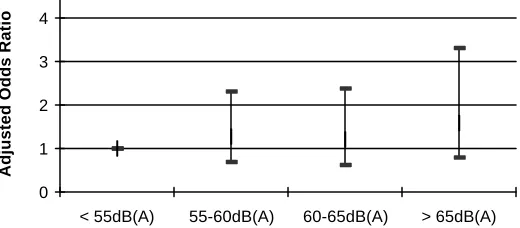
The medical treatment of hypertension shows a small but not significant relation with the equivalent sound level by road traffic during the daytime (see figure 1). A clear rise of the relative risk, however, was observed in the sample for persons who were exposed to equivalent sound levels of road traffic by 65 dB(A) or more at their places of residence (OR = 1.6).
0 1 2 3 4
< 55dB(A) 55-60dB(A) 60-65dB(A) > 65dB(A)
equivalent sound level for the day (16h)
[image:3.596.171.431.161.275.2]Adjusted Odds Ratio
Fig. 1: Statistical connection between daytime road traffic noise and hypertension in the 9th repetition cycle (N = 1351; adjusted for "age" "alcohol intake" "tobacco intake" "motion in the profession", "sporting activity", "body mass index ", "socio economic index ", "partner loss in the marriage", "hearing ability", "noise sensitivity" and "season of the medical examination").
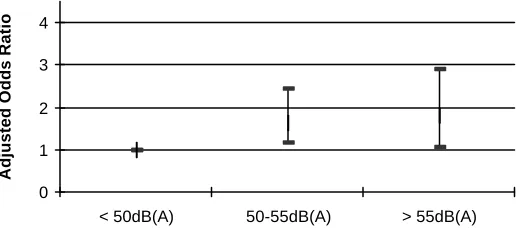
In contrast to the daytime results, a significant rise of the relative risk of hypertension was calculated for the nightly equivalent sound level. The relative risk for the nightly sound load with more than 55 dB(A) rises to 1.9 in comparison with the reference category (equivalent sound level below 50 dB(A)). If only test persons were included in the analysis which have not moved in the last two years, the relative risk increased to 2,0 (see figure 2). This result is of great importance for preventive medical action since more than 95 % of these test persons lived more than 10 years in the same apartment with a comparable traffic noise exposure.
0 1 2 3 4
< 50dB(A) 50-55dB(A) > 55dB(A)
equivalent sound level at night (8h)
Adjusted Odds Ratio
Fig. 2: Statistical connection between nightly road traffic noise and hypertension in the 9th repetition cycle (N = 1095; adjusted for "age" "alcohol intake" "tobacco intake" "motion in the profession", "sporting activity", "body mass index ", "socio economic index ", "partner loss in the marriage", "hearing ability", "noise sensitivity" and "season of the medical examination".
If the nightly sound load (at place of residence) can be regarded as causative for the increased relative risks, then it is to be expected that the risk increases for test persons which normally sleep with open window, since the noise level rises at the ear of the sleeper.
comparison to the reference category (see figure 3). This result supports the thesis that the nightly sound load is causatively responsible for the rise of medical treatments.
-1 1 3 5 7 9
< 50dB(A) 50-55dB(A) > 55dB(A)
equivalent sound level at night (8h)
[image:4.596.171.431.111.228.2]Adjusted Odds Ratio
Fig. 3: Statistical connection between nightly traffic noise and hypertension in the 9th repetition cycle by open windows (N = 279; adjusted for "age" "alcohol intake" "tobacco intake" "motion in the profession", "sporting activity", "body mass index ", "socio economic index ", "partner loss in the marriage", "hearing ability", "noise sensitivity" and "season of the medical examination".
A dose effect relation is generally demanded as a proof for a causal statement (e.g. [Hertz-Picciotto 1995]). However, no dose effect examinations which could prove a causal interpretation have been published up to now [Babisch 1998]. Therefore, the overall assessment of the scientific evidence was non-uniform for the coincidence between noise exposure and hypertension. It outweighed the verdict of a limited evidence.
The presented study permitted dose effect considerations about noise level categories of approximately 5 dB(A). The analyses yielded that with increasing nightly noise levels the relative risk rose monotonously (see figure 2 and 3). The results confirm the thesis that the nightly sound load stress is responsible for the rise of the medical treatment of hypertension, directly or indirectly by disturbed sleep.
In addition to the medical treatments in the 9th repetition cycle of the SHS, the medical treatments were evaluated in the course of the lifetime (anamnesis). The analyses showed comparable results.
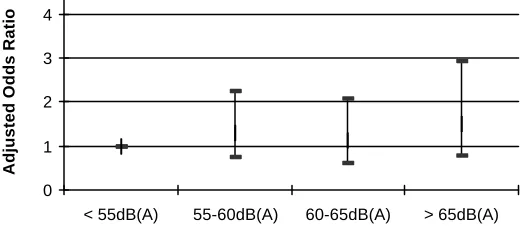
The weak relation of the sound load by road traffic during the daytime with hypertension did not reach a statistical significance (see figure 4). However, a considerable rise of the relative risk could be observed in the sample for persons who were exposed to equivalent sound levels of road traffic at 65 dB(A) or even more at their places of residence (OR = 1.5).
0 1 2 3 4
< 55dB(A) 55-60dB(A) 60-65dB(A) > 65dB(A)
equivalent sound level at daytime (16h)
Adjusted Odds Ratio
[image:4.596.169.429.564.683.2]With a nightly sound load of 50-55 dB(A) the relative risk to be treated medically in the course of the lifetime due to hypertension is increased (p = 0.006) already by 70% with respect to the reference category (below 50 dB(A)) (OR = 1.73). In the sound level category of more than 55 dB(A), the relative risk increases to about 80 % (OR = 1.79; p = 0.024). The adjusted Odds ratios show a monotonous dose effect relationship with the nightly equivalent sound level of the road traffic (see figure 5).
0 1 2 3 4
< 50dB(A) 50-55dB(A) > 55dB(A)
equivalent sound level at night (8h)
[image:5.596.171.431.164.279.2]Adjusted Odds Ratio
Fig. 5: Statistical connection between nightly road traffic noise and hypertension in the lifetime (N = 1335; adjusted for "age" "alcohol intake" "tobacco intake" "motion in the profession", "sporting activity", "body mass index ", "socio economic index ", "partner loss in the marriage", "hearing ability", and "noise sensitivity").
Subjective Disturbance by Noise in the Apartment and Hypertension
The medical treatments of hypertension did not show a significant or relevant relation with the subjective disturbance by noise during the daytime or at night for the 9th repetition cycle. The adjusted odds ratios did not provide a reference to a dose effect relationship.
For the medical treatments in the course of the lifetime due to hypertension (anamnesis) comparable results exist. The study suggests that the relative risk for a medical treatment of hypertension does not increase if persons feel disturbed during the daytime or at night by road traffic noise.
DISCUSSION
The presented study delivers as double-blind study safe indications that nightly traffic noise can trigger or stimulate hypertension. The medical data collection was gained by a trained doctor team of the Robert Koch-Institute (federal authority) and can be classified as reliable, even if an evaluation of the medical diagnoses would have had to be preferred to the medical treatments. The sound load was calculated from traffic censuses and checked by level measurements. It has to be stressed that only noise measurements or traffic censuses with detailed consideration of the location issues of the apartments (the bedroom windows) give correct sound levels at residential places. In epidemiological studies therefore special attention must be paid to the elevation of the noise exposure. Considerable deficits have to be considered for studies published up to now. Particularly important is the independent evaluation of the nightly sound exposure, shown by the presented study. The main result that a fundamentally bigger importance must be attached to the nightly sound load with respect to hypertension, than to the sound load during the daytime, is biologically highly plausible and coincides with findings to disturbed sleep (Born et al. 2000; Hecht et al. 1990; Zulley 1993). An effect chain is indicated here which must be confirmed in further epidemiological studies.
The temporal structure of the examined sound burden is probably more important than a complete consideration of confounders.
The subjective disturbance for road traffic noise in the apartment has not shown any connection with the number of medical hypertension treatments. This result does not correspond to the classic stress hypothesis which connected the extent of impairment with the ability of the individual to cope with the load. Since the study delivers highly significant connections between the subjective disturbance by road traffic noise during the daytime and psychic disturbances - not shown in this contribution – it is to be assumed that for different function systems different pathogenesis mechanisms exist. In this field, a more intensive research should be carried out.
CONCLUSIONS
Hypertension represents an independent clinical picture and is a recognized risk factor for myocardial infarction and stroke. Therefore, hypertension is of great preventive medical importance. The stress triggering nightly sound load provides a significant and relevant contribution to the genesis of hypertension as the study points out. A preventive medical reduction of nightly equivalent sound levels beneath 55 dB(A) is therefore an important objective to protect health.
The assessment of the scientific evidence concerning the connection between noise pollution and high blood pressure should be reconsidered in view of these results. The verdict of a restricted evidence did not consider the biologically highly plausible knowledge that for hypertension the nightly sound exposure is authoritative [Berglund et al. 1995, Porter et al. 1998, Babisch 2000], neither the fact that an imprecise elevation of the sound burden can blur the connections up to an unrecognizable state.
References
Babisch, W. (2000): Traffic Noise and Cardiovascular Disease: Epidemiological Review and Synthesis. Noise & Health 2000; 8, 9-32
Berglund, B., Lindvall, T. (1995): Community noise. Document prepared for the World Health Organization. Archives of the Center for Sensory Research. Stockholm University and Karolinska Institute.
Born, J.; H.L. Fehm (2000): The neuroendocrine recovery function of sleep. Noise & Health 2000; 7, 25-37
Hecht, K.; E. Wachtel; WE. Voigt; P. Oehme; MG. Airapetjanz (1990): Schlafregulierende Peptide (Sleep regulating peptides). Beitr Wirkstoff, Institut für Wirkstofforschung Berlin 37, 1-188
Hertz-Picciotto, I. (1995). Epidemiology and quantitative risk assessment. A bridge from science to policy. Am J Publ Health 85, 484-491
Hoffmeister H.; BM. Bellach (1995): Die Gesundheit der Deutschen (The health of the German). RKI-Heft 7/1995. Robert Koch-Institut, Bundesinstitut für Infektionskrankheiten und nicht übertragbare Krankheiten
Ornish, D. (1992): Revolution in der Herztherapie (Revolution in the heart therapy). In: Die neue Gesundheit. Kreuz-Verlag Stuttgart
Porter, N.D.; I.H. Flindell; B.F. Berry (1998): Health effect-based noise assessment methods: a review and feasibility study. Report CMAM 16. NPL National Physical Laboratory, Teddington, UK.
Zimmermann, RS.; ED. Fröhlich (1990): Stress and hypertension. J. Hypertension 8 suppl. 4, 103-107