
Essays in organizational economics
252
0
0
Texto completo
(2)
(3) This thesis is dedicated to Alfredo, Elva, Pedro, Mercedes, Jose, Claudia, Cynthia and Ignacio, who give me a reason to smile everyday and never stop supporting me.. iii.
(4)
(5) Acknowledgements First, I want to thank my advisors Jan Eeckhout and Stephen Hansen for their support and their time. Jan is one of the smartest scholars I have ever met. His facility to understand abstract concepts and to ask the fundamental questions every time we talked about research helped me to shape my thinking and the way how I approach to research. Stephen has been a guide and a support for me during all the time in the program. His sincere advise and the time he spent with me is one of the most valuable experiences I will remember. Our conversations and the opportunity to work with him is one of the most important learning experiences I had. Second, I want to thank to my cohort of PhD students because my interaction with them made me improve as a person. They give the opportunity to share with them ideas, experiences and some of the most important moments of my life. I want to specially thank Marc Goñi, Jorg Stahl, Francesco Amodio, Gene Ambrocio, Fernando Perez, Maria Paula Geradino and Oriol Anguera. I will also like to thank all the professors with whom I had the opportunity to share and discuss my research ideas. Thank to be available and willing to spend some of time with me. These includes Juan Jose Ganuza, Jose Apesteguia, Robin Hogarth, John Hamman, Rosa Ferrer, Rosemarie Nagel, Helena Perrone, Christian Michel and Gianmarco Leon. I also want to acknowledge the financial support from the Barcelona Graduate School of Economics and Florida State University for my experiment, and the financial support of the Catalunya Goverment and Universitat Pompeu Fabra because otherwise it would have been impossible to complete my studies. Finally, I have to mention the most important support I had during this journey, my family. I am especially grateful to my parents, Pedro and Mercedes, and grandparents, Alfredo and Elva, for guiding me and teaching me how to persevere. To my siblings, Jose and Claudia, for their continue and unconditional support and to my wife, Cynthia, for her patience, understanding and affection. I would not have been able to finish the program without them.. v.
(6)
(7) Abstract New managerial practices are not use on isolation. Managers use different organizational tools to maximize their firm’s profits and they interact with the pre-established practices of the company. This dissertation analyzes some of these interactions, evaluating their performance and their effects on worker’s behavior. The first chapter studies the allocation of decision-making rights on the firm when managers are able to choose her team composition in uncertain environments. The second chapter shows how input heterogeneity triggers productivity spillovers at the workplace and how social and monetary incentives affect the size and sign of spillovers. The third chapter studies the use of multiple performance measures on the design of incentive systems. There I study how the existence of performance threshold, the ratio of output/input prices and the workers risk aversion play an important role on the determination of the strength and the spread of the incentives.. Resumen Nuevas prácticas administrativas no son usadas de manera aislada. Administradores usan diferentes herramientas organizacionales para maximizar las ganancias de sus empresas y éstas interactúan con la prácticas establecidas previamente por la empresa. Esta disertación analiza algunas de estas interacciones, evaluando su rendimiento y sus efectos sobre el comportamiento de los trabajadores. El primer capı́tulo estudia la asignación de derechos de decisión en la firma cuando los administradores pueden elegir la composición de sus equipos en contextos inciertos. El segundo capı́tulo muestra como la heterogeneidad de insumos produce externalidades productivas en el centro de trabajo y como incentivos monetarios y sociales afectan la magnitud y la dirección de estas externalidades. El tercer capı́tulo estudia el uso de múltiples medidas de rendimiento en el diseño de sistemas de incentivos. Además se analiza como la existencia de umbrales de rendimiento mı́nimo, el ratio de precios producto/insumo y la aversión al riesgo de los trabajadores juegan un rol importante en la determinación de la fuerza y la extensión de los incentivos.. vii.
(8)
(9) Preface The main objective of firms is to increment their profits. Shareholders demand managers’ results in these terms and evaluate them accordingly. As a consequence, managers use all the tools available to pursue this goal. Those tools cover a large gamma of possibilities, e.g. organizational design, contract design, recruiting and firing policies. In the last decades have been impressive progresses on the study of each of those tools but most of the time in isolation. The theoretical analysis precedes the empirical studies given the difficulty to find appropriate data sets. The recent technological progress on the management of data sets, computing power and storage capacities facilitate the creation and access to new data bases for many researchers. At this point, researchers have realized that in real life situations, several management practices interact one with each other. It makes necessary to understand how different managerial and human resources practices affect the efficiency of firms, the communication among workers and the productive process. This dissertation is a contribution on this direction. It covers a broad range of decisions taken by firms in real life situations, including, how managers allocate decisionmaking rights within their firms, peer effects among workers and the organization of the productive process, contract design and hiring. To address these questions, I use different empirical sources as laboratory experiments and field data. Our objective is to understand the managers’ behavior, to point out any unintended effect and to identify the forces interacting with the different tools that could determine the firm’s productivity. The first chapter deals with situations where managers should jointly decide their team composition and the allocation of decision rights in the organization. We model the allocation of decision rights by a firm manager who must oversee the completion of tasks, but also must select her team composition. The optimal organizational structure is determined by the trade-off between the coordination conflict among workers and the managerial uncertainty over the nature of the tasks. Coordination conflict among workers is therefore endogenously defined by the manager’s chosen team composition. We find that a manager prefers a decentralized organization (i.e. delegating decision rights to her workers) when uncertainty is sufficiently high. Moreover, for any level of uncertainty, the optimal team composition is always more heterogeneous in a decentralized organization than in a centralized one. In the laboratory experiment, we find ix.
(10) that managers choose centralized organizations somewhat more often than predicted by the model, but correctly opt for more decentralization as uncertainty rises. Also, the experiment confirms that there are more heterogeneous teams chosen in decentralized organizations. However, the level of information does not have a direct impact on team heterogeneity, whereas it reacts to the evolution of the payoffs. Moreover, we find that managers react to negative outcomes by selecting disproportionately homogeneous teams. This chapter is a threefold contribution with the previous literature: 1) It provides empirical evidence for the relation between uncertainty and decentralization, 2) The model endogeneize the trade-off between information asymmetry and conflict of interest between workers and the manager through the selection of the team composition. 3) At the best of our knowledge, if the first paper studying a One-to-Many delegation problem in a laboratory. The second chapter shows how input heterogeneity triggers productivity spillovers at the workplace. In an egg production plant in rural Peru, workers produce output combining effort with inputs of heterogeneous quality. Exploiting quasi-random variation in the productivity of inputs assigned to workers, we find evidence of a negative causal effect of an increase in coworkers’ daily output on own output and its quality. We show both theoretically and empirically that the effect captures free riding among workers, which originates from the way the management informs its decisions on whether and who to dismiss. Evidence also suggests that the provision of monetary and social incentives can offset negative productivity spillovers. Our study and results show that production and human resource management practices interact in the generation of externalities at the workplace. Counterfactual analyses suggest productivity gains from the implementation of alternative input assignment schedules and dismissal policies to be up to 20%. In terms of contribution, we are the first to focus on the role of inputs in the literature on human resource management and productivity; we are able to identify productivity spillovers at the workplace and how different variables affect their distribution across workers; and we find evidence on how social and monetary incentives affect size and sign of spillovers. The third chapter studies the use of multiple performance measures on the design of incentive systems. I analyze the impact of a contractual change that takes place on the same egg production plant in Peru mentioned before. This firm offers me a natural multitasking environment where the manager has multiple measures of workers’ perforx.
(11) mance to use on the final contract. In particular, the level of output (egg production) and input (food distributed). The output measure is more aligned to the objective of the firm but it is a noisier signal of the effort of the workers, while the input measure is more informative of the feeding effort of the workers but it is less aligned with the objectives of the firm. In our study, the firm moves from a contract using both measures to another one just using the level of output. I develop a stylized multitasking model with heterogeneous and limited liability agents. Then, I propose a simple methodology for the identification of the level of misalignment among different performance measures that jointly with this rich data set allow me to structurally estimate the parameters of interest from the previous model. Using these parameters, I find the a contract using both performance measures outperforms a contract using just on the most aligned measure ignoring the most informative one. The result is not surprising, but there are two different channels through the first type of contract dominates the second one and it will depend on the workers risk aversion parameter and the output/input prices. When workers are no to sensitive to the amount of risk they bear, the optimal linear contract will assign a negative piece rate to the input measure to minimize the cost of food. All the incentive on this case will be concentrated on a higher piece rate in the output measure. When workers are sensitive to the amount of risk they bear, the optimal linear contract assigned a positive piece rate to the input measure while reducing the piece rate assigned to the output measure that is noisier. In this way, firms reduce the risk premium they have to pay without reducing on the same magnitude the strength of the incentive provided. We also explain on detail the role of performance threshold on this type of linear contracts. Assuming a conservative workers’ risk aversion parameter, I find a loss of efficiency of 2.5% on the daily profits produced per worker per day when the firm focus just on the most aligned measure ignoring the most informative one. This chapter provides us with one of the few empirical analysis understanding if firms and organizations use multiple performance measures appropriately.. xi.
(12)
(13) Contents Index of figures. xix. Index of tables. xxii. 1. OPTIMAL ORGANIZATIONAL STRUCTURE: AN EXPERIMENTAL STUDY. 1. 1.1. Introduction . . . . . . . . . . . . . . . . . . . . . . . . . . . . . . . .. 1. 1.2. Literature Review . . . . . . . . . . . . . . . . . . . . . . . . . . . . .. 6. 1.3. The Model . . . . . . . . . . . . . . . . . . . . . . . . . . . . . . . . .. 10. 1.3.1. Centralized organization and manager’s trade off . . . . . . . .. 12. 1.3.2. Decentralized organization and incentive conflict . . . . . . . .. 15. 1.3.3. Optimal organizational structure . . . . . . . . . . . . . . . . .. 18. 1.3.4. Theoretical predictions . . . . . . . . . . . . . . . . . . . . . .. 19. 1.4. Experimental Design . . . . . . . . . . . . . . . . . . . . . . . . . . .. 20. 1.5. Experimental Results . . . . . . . . . . . . . . . . . . . . . . . . . . .. 23. 1.5.1. Organizational Structure Decisions . . . . . . . . . . . . . . .. 24. 1.5.2. Team Composition . . . . . . . . . . . . . . . . . . . . . . . .. 31. 1.5.3. Participants’ payoffs . . . . . . . . . . . . . . . . . . . . . . .. 47. Simulation Results . . . . . . . . . . . . . . . . . . . . . . . . . . . .. 50. 1.6.1. Fixed Positions . . . . . . . . . . . . . . . . . . . . . . . . . .. 51. 1.6.2. Alternative symmetric distributions . . . . . . . . . . . . . . .. 53. 1.7. Discussion . . . . . . . . . . . . . . . . . . . . . . . . . . . . . . . . .. 54. 1.8. Conclusion . . . . . . . . . . . . . . . . . . . . . . . . . . . . . . . .. 56. 1.6. 1 xiii.
(14) 2. INPUT ALLOCATION, WORKFORCE MANAGEMENT AND PRODUCTIVITY SPILLOVERS: EVIDENCE FROM PERSONNEL DATA 61 2.1. Introduction . . . . . . . . . . . . . . . . . . . . . . . . . . . . . . . .. 61. 2.2. The Context. 68. 2.3. Data and Descriptives. . . . . . . . . . . . . . . . . . . . . . . . . . .. 71. 2.4. Empirical Analysis of Productivity Spillovers . . . . . . . . . . . . . .. 75. 2.4.1. Preliminary Evidence and Identification Strategy . . . . . . . .. 75. 2.4.2. Baseline Results . . . . . . . . . . . . . . . . . . . . . . . . .. 80. 2.4.3. Robustness Checks and Effect Heterogeneity . . . . . . . . . .. 89. 2.5. 2.6. 2.7. 2.8 3. . . . . . . . . . . . . . . . . . . . . . . . . . . . . . . .. The Mechanism. . . . . . . . . . . . . . . . . . . . . . . . . . . . . .. 92. 2.5.1. Conceptual Framework. . . . . . . . . . . . . . . . . . . . . .. 93. 2.5.2. Termination Policy: Empirics . . . . . . . . . . . . . . . . . .. 96. Monetary and Social Incentives. . . . . . . . . . . . . . . . . . . . . .. 99. 2.6.1. Extended Conceptual Framework . . . . . . . . . . . . . . . .. 99. 2.6.2. Empirics . . . . . . . . . . . . . . . . . . . . . . . . . . . . . 101. Counterfactual Policy Analysis. . . . . . . . . . . . . . . . . . . . . . 109. 2.7.1. Termination Policy . . . . . . . . . . . . . . . . . . . . . . . . 109. 2.7.2. Input Allocation . . . . . . . . . . . . . . . . . . . . . . . . . 111. Conclusion . . . . . . . . . . . . . . . . . . . . . . . . . . . . . . . . 116. MULTIPLE PERFORMANCE MEASURES IN A MULTITASKING CONTEXT: ON THE DESIGN OF INCENTIVE 123 3.1. Introduction . . . . . . . . . . . . . . . . . . . . . . . . . . . . . . . . 123. 3.2. Literature Review . . . . . . . . . . . . . . . . . . . . . . . . . . . . . 127. 3.3. Background . . . . . . . . . . . . . . . . . . . . . . . . . . . . . . . . 130. 3.4. 3.5. 3.3.1. Production Process . . . . . . . . . . . . . . . . . . . . . . . . 130. 3.3.2. Workers’ Compensation . . . . . . . . . . . . . . . . . . . . . 131. 3.3.3. Performance measures and Tasks . . . . . . . . . . . . . . . . 133. The model . . . . . . . . . . . . . . . . . . . . . . . . . . . . . . . . . 134 3.4.1. Optimal Linear Contract . . . . . . . . . . . . . . . . . . . . . 136. 3.4.2. Performance Threshold . . . . . . . . . . . . . . . . . . . . . . 140. Data analysis . . . . . . . . . . . . . . . . . . . . . . . . . . . . . . . 144 3.5.1. Sample selection . . . . . . . . . . . . . . . . . . . . . . . . . 148 xiv.
(15) . . . . . . . . . .. 152 156 158 158 161 164 165 165 167 172. . . . . . . .. 179 179 194 197 200 202 204 205. B. APPENDIX: CHAPTER 2 B.1 Working day Schedule . . . . . . . . . . . . . . . . . . . . . . . . . . B.2 Additional Results . . . . . . . . . . . . . . . . . . . . . . . . . . . . B.3 Termination Policy and Observable Input Quality . . . . . . . . . . . .. 209 210 211 215. C. APPENDIX: CHAPTER 3 C.1 Evolution of secondary variables over time . . . . . . C.2 Estimated Parameters: Regressions . . . . . . . . . . C.3 Performance measures and performance threshold . . C.4 Estimated piece rates and profits: p1 = 1 and p2 = 0 . C.5 Mathematical Appendix . . . . . . . . . . . . . . . .. 219 220 222 224 226 227. 3.6. 3.7. 3.8 A. 3.5.2 Profits, prices and wages . . . . . . . . . . . . . . . 3.5.3 Impact of the contractual change . . . . . . . . . . . Empirical Strategy . . . . . . . . . . . . . . . . . . . . . . 3.6.1 Misalignment between performance measures . . . . 3.6.2 Marginal productivities and marginal cost per worker 3.6.3 Induced profit losses . . . . . . . . . . . . . . . . . Results . . . . . . . . . . . . . . . . . . . . . . . . . . . . . 3.7.1 Estimated parameters . . . . . . . . . . . . . . . . . 3.7.2 Estimated Profits . . . . . . . . . . . . . . . . . . . Conclusion . . . . . . . . . . . . . . . . . . . . . . . . . .. . . . . . . . . . .. . . . . . . . . . .. APPENDIX: CHAPTER 1 A.1 Mathematical appendix . . . . . . . . . . . . . . . . . . . . . . A.2 Experimental design: Screenshoots . . . . . . . . . . . . . . . . A.3 Country level analysis . . . . . . . . . . . . . . . . . . . . . . . A.4 Stability on organizational structure: An alternative classification A.5 Team heterogeneity and decentralization . . . . . . . . . . . . . A.6 The analysis of the zero distance between positions . . . . . . . A.7 50-50 teams: conflict of interest and mistakes . . . . . . . . . .. xv. . . . . .. . . . . .. . . . . .. . . . . .. . . . . .. . . . . .. . . . . . . . . . .. . . . . . . .. . . . . .. . . . . . . . . . .. . . . . . . .. . . . . .. . . . . . . . . . .. . . . . . . .. . . . . .. . . . . ..
(16)
(17) List of Figures 1.1. Linear Structure . . . . . . . . . . . . . . . . . . . . . . . . . . . . . .. 11. 1.2. Centralized organization: Managers’ probability to reallocate tasks. . .. 13. 1.3. Main Incentive Problem . . . . . . . . . . . . . . . . . . . . . . . . . .. 15. 1.4. Tasks’ reallocation regions. . . . . . . . . . . . . . . . . . . . . . . . .. 16. 1.5. Single period timeline . . . . . . . . . . . . . . . . . . . . . . . . . . .. 22. 1.6. Percentage of Decentralized Rounds in the Selector Stage . . . . . . . .. 25. 1.7. Number of Decentralized Rounds by Managers . . . . . . . . . . . . .. 29. 1.8. Decentralization and distance between positions . . . . . . . . . . . . .. 32. 1.9. Decentralization and distance between positions: By treatment) . . . . .. 33. 1.10 Team Composition on the Centralized Rounds . . . . . . . . . . . . . .. 39. 1.11 Team Composition on the Decentralized Rounds . . . . . . . . . . . .. 42. 1.12 Reduced heterogeneity: Centralized stage (πA ≤ 25) . . . . . . . . . .. 44. 1.13 Reduced Heterogeneity: Decentralized Stage (πA < 25) . . . . . . . . .. 46. 1.14 Underperformance of managers relative to optimal strategy . . . . . . .. 47. 1.15 Payoffs under the optimal decentralized and centralized strategies . . .. 48. 1.16 Difference on average payoffs: Optimal strategy - participant’s strategy. 49. 1.17 Average payoff on the Centralized Organization: Fixed Positions . . . .. 52. 1.18 Average payoff on the Decentralized Organization: Fixed Positions . . .. 52. 1.19 Comparison between Centralized and Decentralized Organizations: Fixed Positions . . . . . . . . . . . . . . . . . . . . . . . . . . . . . . . . . . 53 1.20 Beta simulated distributions . . . . . . . . . . . . . . . . . . . . . . .. 54. 1.21 Threshold on the information for different symmetric distributions . . .. 55. 2.1. One Sector . . . . . . . . . . . . . . . . . . . . . . . . . . . . . . . .. 69. 2.2. Sheds . . . . . . . . . . . . . . . . . . . . . . . . . . . . . . . . . . .. 70. xvii.
(18) 2.3. Production Units . . . . . . . . . . . . . . . . . . . . . . . . . . . . .. 71. 2.4. Hens’ Age and Productivity. . . . . . . . . . . . . . . . . . . . . . . .. 76. 2.5. Residual Productivity and Age of Coworkers’ Hens . . . . . . . . . . .. 83. 2.6. Own and Coworkers’ Productivity . . . . . . . . . . . . . . . . . . . .. 84. 2.7. Survival Probability and Productivity. . . . . . . . . . . . . . . . . . .. 93. 2.8. Survival Probability and Coworkers’ Productivity . . . . . . . . . . . .. 94. 2.9. Hens’ Age and Number of Egg Boxes . . . . . . . . . . . . . . . . . . 103. 2.10 Productivity and Bonus Pay. . . . . . . . . . . . . . . . . . . . . . . . 105. 2.11 Termination Policy Counterfactual . . . . . . . . . . . . . . . . . . . . 113 2.12 Input Allocation and Productivity. . . . . . . . . . . . . . . . . . . . . 114. 2.13 Random Input Allocation and Productivity. . . . . . . . . . . . . . . . 115. 3.1. Food per hen: Mean . . . . . . . . . . . . . . . . . . . . . . . . . . . . 146. 3.2. Food per hen: Standard Deviation . . . . . . . . . . . . . . . . . . . . 147. 3.3. Hens’ productivity over time . . . . . . . . . . . . . . . . . . . . . . . 147. 3.4. Hens’ productivity and Food per hen . . . . . . . . . . . . . . . . . . . 148. 3.5. Steady States: Rolling regression . . . . . . . . . . . . . . . . . . . . . 149. 3.6. Steady States: Estimated Residuals . . . . . . . . . . . . . . . . . . . . 150. 3.7. Performance measures versus performance threshold: Pre and post contractual change . . . . . . . . . . . . . . . . . . . . . . . . . . . . . . 152. 3.8. Standard deviation on hens’ productivity by age . . . . . . . . . . . . . 152. 3.9. Evolution of Prices . . . . . . . . . . . . . . . . . . . . . . . . . . . . 154. 3.10 Evolution of Profits and Ratio of Prices . . . . . . . . . . . . . . . . . 156 3.11 Estimated truncated marginal cost distribution . . . . . . . . . . . . . . 167 3.12 Optimal piece rates and induced profit losses . . . . . . . . . . . . . . . 168 3.13 Optimal performance threshold, c̃ . . . . . . . . . . . . . . . . . . . . 170 3.14 Simulated Results . . . . . . . . . . . . . . . . . . . . . . . . . . . . . 171 A.1 Probability of Task Reallocation from the Leader’s Perspective in a CTR by Region . . . . . . . . . . . . . . . . . . . . . . . . . . . . . . . . . 181 A.2 Interval for the t02 where the worker in the position θ1 is willing to exchange tasks . . . . . . . . . . . . . . . . . . . . . . . . . . . . . . . . 185 A.3 Team Task Reallocation Region . . . . . . . . . . . . . . . . . . . . . 186 A.4 Predicted Probability to Decentralize . . . . . . . . . . . . . . . . . . . 199 xviii.
(19) A.5 Distribution of Participants by Organizational Structure Status . . . . . A.6 Distribution of the difference on average payoffs among organizational structures . . . . . . . . . . . . . . . . . . . . . . . . . . . . . . . . . A.7 Difference on average payoffs: Optimal strategy - participant’s strategy A.8 Team Composition on the Centralized Rounds . . . . . . . . . . . . . . A.9 Team Composition on the Decentralized Rounds . . . . . . . . . . . . A.10 50-50 teams: Decentralized stage (B against A) . . . . . . . . . . . . . A.11 50-50 teams: Centralized Stage (A against A) . . . . . . . . . . . . . .. 199 201 201 202 203 205 206. B.1 Distribution of Estimated Worker Fixed Effects . . . . . . . . . . . . . 214 B.2 Simulated Distribution of φ(ηi , ai ) . . . . . . . . . . . . . . . . . . . . 218 C.1 C.2 C.3 C.4 C.5. Percentage of good/total number of eggs over time . . . . . . . . Percentage of casualties/total number of hens over time . . . . . . No of workers receiving a bonus: Pre contractual change . . . . . No of workers receiving a bonus: Post contractual change . . . . . Optimal piece rates and induced profits losses: P1 = 1 and P2 = 0. xix. . . . . .. . . . . .. . . . . .. 220 221 224 225 226.
(20)
(21) List of Tables 1.1. Organizational Structure Decision: Probability to Decentralize in Selector Stage . . . . . . . . . . . . . . . . . . . . . . . . . . . . . . . . . .. 28. 1.2. Participants distribution by Stability on Organizational Structure . . . .. 30. 1.3. Team Composition: Distance between selected positions in Selector Stage 34. 1.4. Team Heterogeneity in the Selector Stage: Average distance between positions selected . . . . . . . . . . . . . . . . . . . . . . . . . . . . .. 35. 1.5. Average positions in centralized rounds . . . . . . . . . . . . . . . . .. 37. 1.6. Average positions in decentralized rounds . . . . . . . . . . . . . . . .. 40. 2.1. Summary Statistics . . . . . . . . . . . . . . . . . . . . . . . . . . . .. 73. 2.2. Coworkers’ and Own Hen’s Age: Conditional Correlation. . . . . . . .. 78. 2.3. Own and Coworkers’ Hens’ Age and Productivity. . . . . . . . . . . .. 81. 2.4. Coworkers’ and Own Productivity . . . . . . . . . . . . . . . . . . . .. 86. 2.5. Feeding Effort and Output Quality . . . . . . . . . . . . . . . . . . . .. 88. 2.6. Robustness Checks and Effect Heterogeneity . . . . . . . . . . . . . .. 90. 2.7. Termination Policy . . . . . . . . . . . . . . . . . . . . . . . . . . . .. 98. 2.8. Pay: Summary Statistics . . . . . . . . . . . . . . . . . . . . . . . . . 102. 2.9. Hens’ Age and Bonus Pay . . . . . . . . . . . . . . . . . . . . . . . . 104. 2.10 Incentive Heterogeneity. . . . . . . . . . . . . . . . . . . . . . . . . . 107. 2.11 Termination Policy Counterfactual: Results . . . . . . . . . . . . . . . 112 3.1. Summary Statistics . . . . . . . . . . . . . . . . . . . . . . . . . . . . 145. 3.2. Payment’s Statistics . . . . . . . . . . . . . . . . . . . . . . . . . . . . 155. 3.3. Contractual change impact on the whole sample . . . . . . . . . . . . . 157. 3.4. Contractual change impact by hens’ quality . . . . . . . . . . . . . . . 159. 3.5. Estimated parameters . . . . . . . . . . . . . . . . . . . . . . . . . . . 166 xxi.
(22) A.1 Organizational Structure Decision by Country . . . . . . . . . . . . . . 198 A.2 Participants distribution by Stability on Organizational Structure . . . . 200 A.3 Classification of the zero distance between positions . . . . . . . . . . . 204 B.1 B.2 B.3 B.4 B.5. Worker’s Typical Working Day . . . . . . . . . . . . . Own and Coworkers’ Hens’ Age and Productivity: . . . Batch Replacement and Further Robustness Checks . . . Incentives Heterogeneity: Estimation across Subsamples Simulated Distributions . . . . . . . . . . . . . . . . . .. . . . . .. . . . . .. . . . . .. . . . . .. . . . . .. . . . . .. . . . . .. . . . . .. 210 211 212 213 217. C.1 Distortion among performance measures . . . . . . . . . . . . . . . . . 222 C.2 Estimated Coefficients . . . . . . . . . . . . . . . . . . . . . . . . . . 223. xxii.
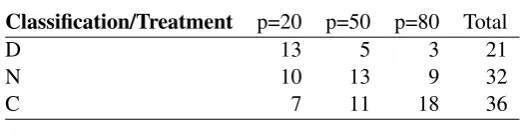
(23) Chapter 1 OPTIMAL ORGANIZATIONAL STRUCTURE: AN EXPERIMENTAL STUDY 1.1. Introduction. A primary role of managers is to ensure an efficient allocation of tasks among workers.12 This can be particularly difficult in rapidly evolving business environments, where managerial uncertainty about the nature of tasks may increase. One option for the manager is to opt for a decentralized organization that allows workers to allocate tasks among themselves, enabling rapid response to changing local conditions. However, successful coordination among workers or divisions must also be prioritized for the success of the firm. In particular, divisions with similar specializations may have a hard time deciding on how to divide tasks. For instance, the coordination problem among divisions inside Sony Corporation was a major reason behind its lost of leadership on the production of electronic devices. In 2012, intradivisional mis-coordination left Sony with a catalog of 30 different TV’s, none of which could argue that they had the most 1. This paper is coauthored with John Hamman from Florida State University. Marschak and Radner [29] underlined task allocation as an important issue in organizations and groups: “We are seldom aware how inconvenient it would be if people would have their task assigned and reassigned at random, rather than in accordance with some principle of classification.[...] To answer such questions one has to compare the organizational cost of each kind of assignment, usually simultaneously with the comparison of gross payoffs, since these may also be affected by the choice.” 2. 1.
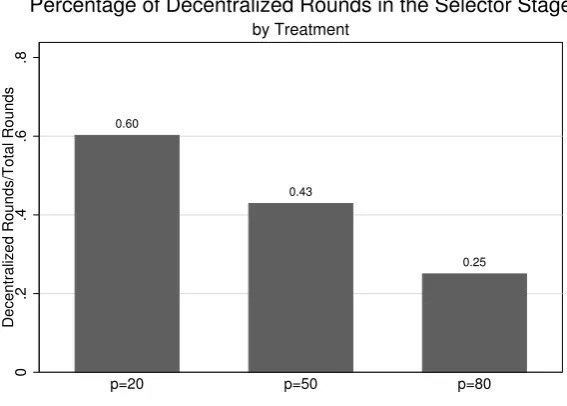
(24) cutting-edge technology.3 When coordination conflicts among workers or divisions reduce firm performance, the manager may prefer a centralized organization where she keeps control over all task allocation decisions. The trade-off between adaptability to uncertain business climates and across-division coordination, then, will play a critical role in a manager’s assignment of decision rights in her firm. Additionally, managers are often responsible for determining the makeup of their work group. Sometimes a specific skill is desired, but the added complexity in larger organizations may require a broader set of abilities. Firms spend significant resources on their hiring processes, with estimates ranging from two thousand dollars per worker (PwC 2013/2014 Human Capital Effectiveness Report) up to seventeen weeks’ worth of wages for skilled labor (Blatter, Muehlemann and Schenker [8]). These costs are in addition to actual wages paid, and so in highly competitive markets the ability to hire good workers whose skill sets closely match a firm’s need becomes paramount. The hiring decision, in determining the skill set of members of a work group, directly affects the intensity of the coordination conflict within the group. In other words, managers can reduce the coordination conflicts in a decentralized organization by choosing workers with more dissimilar specializations - more heterogeneous teams. It is natural to think that managers use both tools - decision rights allocation and team composition - to cope with the uncertainty on their environments. We develop a simple model to capture several essential features of the interaction between these variables. The interaction between allocation of decision rights and team composition is potentially critical in managerial decision making. Despite the potential benefit for firms in modeling this decision environment, the interrelatedness of worker selection and allocation of decision rights has not been directly addressed in the academic literature. 4 This model studies a general type of coordination problem faced by firms namely, the need to coordinate the efficient completion of multiple tasks. The model provides a conceptual framework to understand observed differences in organizational structures across firms in same industries or countries. We characterize the optimal combinations of team composition and allocation of decision rights under different levels of managerial uncertainty. We then test the main predictions of the model in a laboratory 3. See the New York Times column “How the Teach Parade Passed Sony By” LINK Hart and Moore [25] and Dessein, Garicano and Gertner [13] do examine the optimal hierarchical positions of specialized agents (utilizing single assets) and coordinating (multi-asset) agents, with types exogenously determined. 4. 2.
(25) experiment. The results show that while many subjects do make decisions that conform to the model’s predictions, we see behavior that illustrates how difficult these decisions may be for firm managers outside the lab. The key component in our model is the ability for the manager to select her team composition. This decision endogenously determines the degree of coordination conflict among workers in a task allocation framework.5 In our model, the manager first determines whether to make the allocation decision herself after potentially learning the tasks (centralized organization) or to allow the workers to allocate tasks themselves (decentralized organization). Second, the manager decides which types of workers to hire. We consider a scenario in which the manager chooses among horizontally differentiated workers. In other words, managers choose the skill profiles she prefers to have in her organization. We can understand these profiles as different professions (e.g. Economist, Accountant, among others) or as different specializations across divisions (e.g. an R&D division and Product Development division). In this paper, managers choose their basic organizational design in situations where immediate re-structuring in response to a realized task profile would be problematic. Firms may change their allocation of decision rights and team composition, but those processes take time, making the initial team composition and organizational structure decisions very important. In other words, we cover situations where the time to respond to tasks is short and does not allow for fundamental changes in the components of the organizational structure. We aim to capture a broad range of managerial decision-making by highlighting this connection between employee makeup and the allocation of decision rights within a firm. For instance, a research lab has to decide which types of engineers to hire before all of her projects are known or a hospital has to decide which type of doctors to staff in an emergency room without knowing what patients may arrive. But perhaps the best example is a consulting firm. In consulting firm, when a manager starts a hiring process she has already some type organizational structure well defined and she does not know the type of projects they will receive on future. Moreover, when they start a project they have to return an output to the client. The total cost of a project and the quality of the output will depend on tasks allocation among workers and how the workers 5. Our emphasis on a task allocation framework is not meant to suggest that there are not other important types of coordination conflicts among workers. Certainly, workers beliefs, language, communication skills, personnel history, among others can affect workplace coordination.. 3.
(26) capabilities fit the project requirements. Moreover, sudden changes on the workforce composition or in the organizational structure are expensive and time consuming. On these circumstances, the workers abilities the manager recruits are crucial to the firm’s efficiency. The level of specialization of the workers will be critically affected by the organizational structure and the accuracy of information available to the manager. 6 The main intuition behind the results can be captured with a simple illustration: A more heterogeneous or specialized team allows the manager to respond better to a more dissimilar task profile in a centralized organizational structure. However, if the task uncertainty is very high, the manager may not have enough information to properly allocate tasks, potentially leading to ex-post mistakes. To minimize the ex-ante impact of these mistakes, the manager prefers to choose a team around the most common task addressed by the firm. On the other hand, in a decentralized organization, workers have perfect information about tasks but a potential conflict of interest may arise between workers and manager. Workers with similar specializations may have difficulty agreeing on the efficient division of tasks. The manager can reduce the potential incentive conflict by selecting a more heterogeneous team in terms of specializations. However, the manager choosing an over-specialized team may fail to adequately address the most common tasks. Comparing the manager’s trade-off in the centralized organization and the potential conflict of interest appearing on the decentralized organization, we make clear predictions for both the type of workers hired and the allocation of decision rights as informational uncertainty changes. Two main predictions from the model are worth noting here; for high or moderate levels of informational uncertainty, decentralization is the manager’s optimal allocation of decision rights. Also, the worker types should be more heterogeneous under decentralized decision-making than under centralized decisionmaking regardless of the level of uncertainty. Worker types will converge under centralization as uncertainty grows, but will be unaffected by this uncertainty in a decentralized structure. 6. While the most direct connection deals with the type of workers hired to complete a range of unknown tasks, our model may also inform the organizational decision making process after a merger between different firms, divisions or branches. The decision of which workers to retain in the organization is closely related to the new potential projects or tasks given to the restructured firm. It is also possible that the merger process may cause the firm to change its organizational structure based on the makeup of existing divisions or employees. Some divisions may face more or less variation in task scope, suggesting a re-allocation of decision rights may be necessary for optimal function.. 4.
(27) We test these predictions in a controlled laboratory experiment. We find that managers delegate decision rights more often as information uncertainty grows. At the best of our knowledge this is the first empirical evidence supporting this well-established theoretical result. However, we also find that there is a general tendency to choose a centralized structure more than is optimal. So, while the response to uncertainty is in line with the model’s predictions, our data suggest that managers may retain allocation rights even in very low information conditions, which can be a costly decision. This is in line with recent experimental evidence that in delegation tasks, individuals exhibit preference to retain control at non-trivial costs to themselves. We also find that managers tend to select less specialized teams than those predicted by the model. However, they improve and get closer to the model predictions as they get more experienced during the game. Interestingly, we find a that team heterogeneity does not respond directly to the different levels of information but it significantly respond to the evolution of the payoffs per round. Moreover, we show that when managers observe that a worker’s decision goes against their interest in previous rounds, they overreact, choosing a disproportionally homogeneous team in subsequent rounds. As uncertainty is reduced, this effect becomes more evident. Our analysis is a first step in a broader research agenda attempting to understand the role of the team composition in relation to the allocation of decision rights. For instance, we want to analyze how the allocation of decision rights change when the manager has a given a pre-established team, when communication is allowed or when the manager has the option to pay a fixed cost to exert a veto power over her workers decision. Also, the allocation of decision rights may differ with the type of coordination problem. Empirical work examining these one-to-many delegation situations is currently lacking.7 The rest of the chapter is organized as follows: We discuss related literature more thoroughly in section 1.2 before developing our theoretical model in section 1.3. Our experimental design and specific hypotheses comprise section 1.4 and we discuss our results in section 1.5. Section 1.6 present some simulation of the model under some variants of the model and Section 1.7 concludes with general comments and discussion 7. Brandts and Cooper [10] analyze the differences in performance in a centralized and decentralized organizations but they do not allow participants to choose. Weber [34] provides evidence of managers selecting the pace of growth of their teams in order to coordinate on a minimum effort game but there is no allocation of decision rights. Many other papers related to one-to-one delegation and the control premium are discussed on the literature review.. 5.
(28) on future study.. 1.2. Literature Review. Our study is related with different strands of the economic literature. Our main contribution is the incorporation of endogenous worker selection into the problem of the allocation of decision rights. Our experimental results also add to the recent studies examining the delegation tasks in an environment involving multiple heterogeneous agents. Decision rights, coordination and adaptation: Recent theoretical literature in organizational economics studies the implications of modern property rights theory for the organizational structure within firms (e.g. Grossman and Hart [22], Hart and Moore [26]). Specifically, there has been a focus on how the allocation of decision rights affects a firm’s ability to balance the trade-offs between what Williamson [35] called “coordinated growth” (suggesting a centralized organization) and rapid adaptation to local conditions, which favors a more decentralized organization as suggested by Hayek [27]. These papers, like ours, develop models of incomplete contracts to derive predictions for when firms may benefit from centralized or decentralized decision making. For example, several related articles study the tension in multi-divisional firms between taskspecific managers and managers who coordinate multiple tasks (Dessein, Garicano and Gertner [13], Hart and Moore [25], Hart and Holmstrom [24]). These models develop conditions under which more or less autonomy between divisions is desirable, and also examine environments under which relationship-specific investment may lead to firms merging to overcome coordination failure. Another closely related set of papers by Alonso, Dessein and Matouschek [3, 4] highlight the communication technology within a firm as central to the firm’s organizational structure. Alonso, Dessein and Matouschek [3] expanded the Dessein [12] model of delegation in a cheap-talk game to include a central manager and two local managers. The central manager balances his lack of information on local conditions against the coordination conflict of the local managers when deciding between a centralized or decentralized organization. They showed that local managers will communicate better one with each other than with the central manager when coordination is very important. It leads to an optimal decentralized organization beyond the potential conflict among workers. Alonso, Dessein and Matouschek [4] analyze the opposite scenario. They 6.
(29) show that there are also situations where a centralized organization allows for a better adaptation to a changing environment beyond the lack of information of the central manager. The key component of the model is the difference between the depth and breadth of the information. When the conflict among agents is not too strong, they send good information to the central manager and she can lead a coordinated adaptation. Our model differs from those mentioned in several important ways. The primary distinction is that we endogenize the degree of coordination difficulty by allowing the central manager to select her workers. To focus on worker selection, we exogenously determine the central manager’s degree of informational uncertainty. This uncertainty is endogenous (though ambiguous) in the two Alonso, Dessein and Matouschek [3, 4] models as well as in Dessein [12]. There are differences on the information in favor to the workers, which have the possibility to report it to their manager. However, the bias on the reported information would crucially depend on the importance of coordination and adaptation on the determination of the agent’s payoffs. There is also an experimental paper that examines the performance of different allocation of decision rights in a group decision-making environment. Brandts and Cooper [10] design a game to maximize the tension between coordination and distortion of information. A core result of the model in Alonso, Dessein and Matouschek [3] is that the coordination problem may easily be solved, highlighting the importance of the adaptability problem.8 Brandts and Cooper [10] found that centralization strongly outperforms decentralization. The current study allows the degree of coordination tension to be endogenously determined by the managers’ selection of workers, while also endogenizing the allocation of decision rights.9 Team Composition: The level of specialization of the team is another tool managers have available when facing uncertainty about their environment. This idea has also been considered previously on the economic literature. Becker and Murphy [7] show that a 8. An important difference between Brandts and Cooper [10] and Alonso, Dessein and Matouschek [3] is that the former highlights the coordination problem between branches from both an ex-ante and expost perspective. In contrast, in Alonso, Dessein and Matouschek [3], the coordination problem between branches is high from an ex-ante perspective but not from an ex - post perspective. The latter makes decentralization a good option in the cases where coordination is really important. 9 The empirical literature on the allocation of decisions rights among firms is rather scarce with a few exceptions. For instance, Bloom, Sadun and Van Reenen [9] shows that high-trust regions are significantly more likely to have a decentralized organization. While new data sets appears, laboratory experiments may help us to shed some lights to understand the allocation of decision rights across countries.. 7.
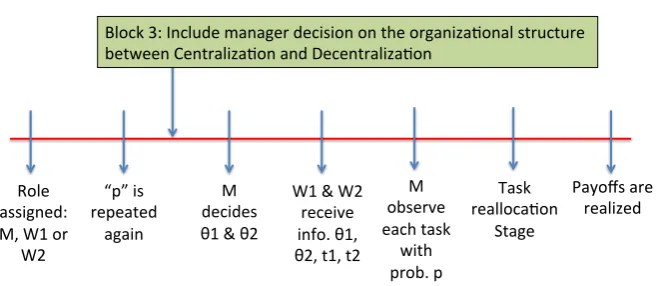
(30) more specialized team increases productivity because each worker can spend more time in a specific task (increasing expertise), but it also increases the cost of coordination in teams. Mello and Ruckes [30] analyze the composition of a team with one manager and one worker. The heterogeneity in characteristics among them increases the access to different information but affects the willingness to exert effort when the manager chooses a project workers do not like. They conclude that an uninformed leader or a complete informed leader prefers a more homogeneous team. Van den Steen [33] analyzes the cost and benefits of homogeneity and the relation with the corporate culture of an organization. He states that in a world with different priors, homogeneity in beliefs and preferences facilitates delegation and coordination. The main trade-off in our paper differs from the trade-off analyze in these studies. We focus on how the level of heterogeneity of the team facilitates the allocation of tasks among workers. Task Allocation: There are also some recent papers analyzing the relation between the organizational structure and the optimal task or resource allocation. Friebel and Raith [17] compare how centralized or decentralized organizations affect the allocation of monetary resources (capital) to different projects proposed by better informed division managers about their projects quality. However, their managers are ex-ante equal. Garicano [19] focuses on the importance of knowledge acquisition and the cost of communication as determinants of task allocation inside a firm. He proposes a hierarchical organization as the best way to assign the different tasks among workers when knowledge is an input in the production function. Unlike our model, Garicano [19] assume vertical differentiation among workers – some workers are more able than others. In a model with horizontal differentiation, Garicano and Santos [20] study how to match the tasks or projects with talent in a lawyer referral market. In this case, they focus on market solutions but not on organizational ones as those we use in this paper. Our paper is an attempt to explore the problem of the efficient matching between workers and task from another angle. We go inside the organization and avoid market solutions. We try to analyze different organizational solutions based in centralized or decentralized structures on the decision rights to exchange tasks in a horizontally differentiated team. Delegation and the “Control Premium”: Our project also fits nicely with the recent experimental and theoretical work on delegation. In the typical delegation models and experiments, delegation is studied in an environment where a principal may choose to transfer decision rights to an agent. This agent may have better information, but 8.
(31) potentially misaligned incentives as well. In our model, we extend this by examining delegation from one agent to multiple agents, which introduces coordination as a new tension in addition to the informational asymmetry and misaligned incentives problem. The rich theoretical literature on strategic delegation establishes many scenarios in which firm managers may optimize by ceding decision rights to a more well-informed agent, even in the face of incentive misalignment (Alonso and Matouschek [2], Hart and Holmstrom [24], Holmstrom [28], Aghion and Tirole [1]).Additional benefits have been revealed in recent experimental research. Hamman, Loewenstein and Weber [23] find that delegation enables principles to seek out a self-interested outcome at the expense of others without feeling responsible, taking actions via intermediaries they would never take directly. Furthermore, they find that delegation reduces the blame assigned to principals by those directly harmed by the self-interested action. Bartling and Fischbacher [6] and Coffman [11] measure responsibility in a similar environment by allowing the recipient or a third party to punish individuals for their actions. Both studies find significant reduction in punishment towards the principal when she delegates an unfair act. This result persists even if the intermediary has transparently no decision making ability (Oexl and Grossman [31], Drugov, Hamman and Serra [14]). Other recent experimental studies have demonstrated that even in the face of beneficial delegation, many principals have difficulty in transferring their decision rights. For instance, Fehr, Herz and Wilkening [15] find that principals retain decision rights far too often and over-exert effort in a delegation game, exhibiting an “endowment effect” for authority. Similar newly released studies quantify this preference for authority - the “control premium” - in hierarchical relationships. Owens, Grossman and Fackler [32] find that individuals prefer to rely on their own performance in a quiz than another subject, even when their probabilistic earnings are much lower. Controlling for ambiguity aversion and overconfidence, among other factors, they find a control premium of 8 − 15% of expected net assets. Bartling, Fehr and Herz [5] design a lottery selection game that allows them to quantify the degree to which individuals intrinsically value control of their decision rights. They find a control premium of around 16.7% that persists over a wide range of parameterizations. The current project therefore fits nicely into the broad literature on decision rights in firms. We provide a test of the trade-off between adaptation and coordination in an environment that also enables us to identify the degree to which firm managers prefer to 9.
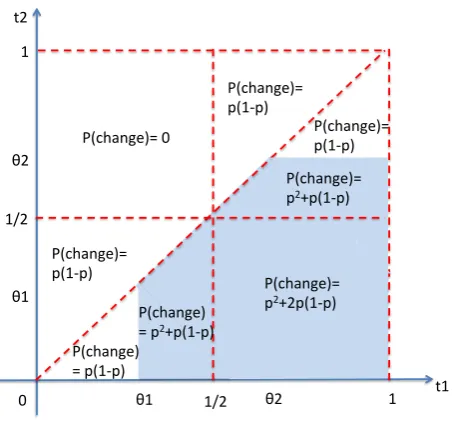
(32) retain decision rights when it is not in their material best interest. We next discuss the theoretical model in more detail.. 1.3. The Model. In this section, we adapt a Hotelling model with some key additions that enables us to make predictions regarding both the team makeup and the allocation of decision rights. We focus our attention in organizations comprised of three different members, a principal and two agents. The principal has a managerial role (manager) while agents have an operational one (workers). The workers are horizontally differentiated and we interpret those differences as diverse specializations among workers. The specialization of worker i is captured by θi and, at the beginning of the production process, each worker receives a task t0i . The specialization of the worker determines how costly it is for the worker to handle the tasks she receives. The manager is able to choose the type of workers in her team. We assume she can perfectly observe the workers’ specialization and that the labor pool covers the full range of tasks encountered in her business sector. Firms are often able to distinguish a potential employees skill set but it is more difficult to recognize ex ante a worker’s productivity (vertical differentiation among workers). We abstract away from heterogeneous productivities and simplify the model by assuming that all tasks are completed at the end of the period. Thus, the total cost to the firm increases solely as the distance between the workers’ abilities and their assigned tasks increase. The manager’s objective P is to minimize the total expected cost of the firm: E i=1,2 Ci (ti , θi ). We assume that the specialization and the tasks have the same normalized support, [0, 1]. Ex ante the manager does not know the task assigned to each worker but she knows the distribution of tasks, F (t0i ). The task realizations for each worker are independent and identically distributed. For illustration, imagine the tasks on a linear structure in which the positions of the workers (θ1 , θ2 ) have been selected by the manager and (t01 , t02 ) are the tasks originally received by workers 1 and 2 respectively as in following figure: A manager choosing the specialization of her workers under these assumptions would optimally select a homogeneous team where θ1 = θ2 = E[t0 ]. E[t0 ] will minimize the maximum distance each worker can face and then the average expected dis10.
(33) 0. t01. 1/2. θ1. t02 θ2. 1. Figure 1.1: Linear Structure tance experienced by each worker. Recall that the tasks are independent from each other and there are neither complementarities nor substituibility of the worker roles on the completion of their assigned tasks. This somewhat trivial result becomes more interesting when we allow for task reallocation between workers. The assignment of decision rights for this reallocation will determine the optimal organizational structure of the team. We consider as centralized organizations those where the manager decides how to reallocate the tasks. A decentralized organization, then, is one in which the workers decide by unanimous vote whether or not to reallocate the tasks. The organizational structure of the firm will play an important role in both team composition and firm outcome. Critically, the manager and workers have imperfectly aligned objective functions. We assume each worker receives a fixed payment that is high enough to cover her best outside option. As a consequence the worker focus on the minimization of her cost to do the task assigned. We consider t0i as the original task realization of the worker i and t1i as the final task assigned to the worker i. If the worker i has an specialization θi , then her objective is to minimize her cost function C(θi , ti ). In particular and for the rest of the paper we assume that C(θi , ti ) = |θi − t1i |. We can interpret the cost function as a measure of the difficulty that each worker has in completing a particular task given her specialization. Information quality plays a critical role in the trade-off between organizational structures. In our model, the specialization of the workers is observed by both the workers and the manager. The differences in information come trough the observations of the realized tasks. We assume workers observe both tasks with certainty. Managers observe each task independently with some probability p. The probability p is known ex-ante by all agents. By varying the probability in the model, we capture the intuition that informational accuracy may differ across sectors or geographical locations. The manager in our model will make two sequential decisions. First, she will determine the organizational structure in her team by retaining or delegating reallocation 11.
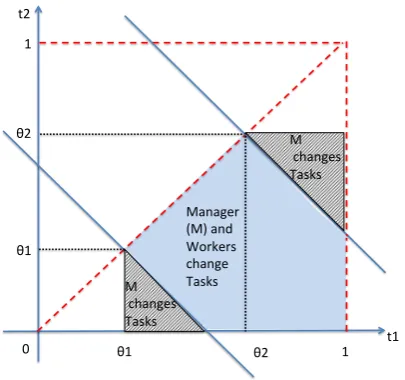
(34) rights. After this, she must select the team composition that will maximize her payoffs given the structure selected. Unlike previous literature we want to understand how the possibility to select the team composition affects how the manager allocates the decision rights in the firm. It is natural to think that a manager has the option to select her own team when determining the best way to organize it. The timing of the decisions in the complete model is divided in three stages as follows: 1. Stage 0: Organizational structure - The manager chooses either a centralized or decentralized organization. Remember that the distribution of the tasks and the probability p are known ex-ante by all the agents. 2. Stage 1: Team composition - The manager chooses the positions of her team members. Each worker receives a random task, t0i . The manager observes each task realization with an independent probability p and the workers observe both tasks with certainty. 3. Stage 2: Task Reallocation - The manager (centralized organization) or the team (decentralized organization) determines the final task assignment, t1i . We find a unique sub-game perfect Nash equilibrium (SPNE) for this game using backward induction. We refer to the SPNE as the equilibrium for the rest of the document. First, we solve the manager’s problem in a centralized organization and explain the main trade off the manager faces. Then, we solve the manager’s problem in a decentralized organization and underline the main incentive conflict between the manager and the workers. Finally, we compare the two organizational structures to determine the manager’s optimal organizational structure given the level of uncertainty.. 1.3.1. Centralized organization and manager’s trade off. Our purpose in this section is to identify the manager’s optimal team selection in a centralized organization. Recall that a manager may see one realized task, both tasks, or neither task, depending on the independent probability p. We assume managers respond to these different situations following a behavioral rule: • If the leader observes both tasks, she reallocates tasks minimizing 12. P. i=1,2. Ci (ti , θi ).
(35) • If the leader observes only one task, she would assign the task she observes to the worker with the closest position.10 • If the leader does not observe any message, she maintains the status quo (no exchange)11 .. t2 1 P(change)= p(1-‐p) P(change)= 0 θ2 . P(change)= p(1-‐p) . P(change)= p2+p(1-‐p) . 1/2 P(change)= p(1-‐p) θ1 . 0 . P(change) = p2+p(1-‐p) P(change) = p(1-‐p) θ1 . 1/2 . P(change)= p2+2p(1-‐p) . θ2 . 1 . t1 . Figure 1.2: Centralized organization: Managers’ probability to reallocate tasks Figure 1.2 considers the probability that the manager decides to reallocate tasks for each realization of the state of the world, (t01 , t02 ). The shaded area represents the region where the manager would like to exchange tasks under perfect information. Since the manager does not always observe both tasks, she is likely to make some errors ex post in task reallocation. Two types of errors appear as a consequence of the established rule. The manager may fail to exchange tasks in a region where she would have preferred to do so (Type I error), and she could exchange tasks with some probability in the region 10. This behavior is consistent with minimization of the expected cost comparing both organizational structures. At the same time this behavior is supported by the data we obtained in the experiment. 75% of the rounds where the manager observe one task, she follows this behavior. 11 If the leader decides to follow a mixed strategy where she exchanges tasks half of the time, the results would be the same.. 13.
(36) where she would prefer not to change ex post (Type II error). In Figure 1.2, we identify the manager’s reallocation of tasks as a function of p for all the possible states of the world, (t1 , t2 ) given θ1 and θ2 . This probability influences the final worker positions the manager chooses. We have already mentioned that when the manager has no chance to reallocate tasks, she will position the workers in θ1 = θ2 = E[t0 ]. However, the same is true when the manager has the possibility to reallocate tasks and p = 0. In other words, θ1∗ (p = 0) = θ2∗ (p = 0) = E[t0 ]. On the other extreme, when there are reallocation possibilities and p = 1, the manager would not choose the same positions for both workers. If the team is homogeneous, reallocation can not change the final outcome experienced by the firm. If the firm wants to take advantage of reallocation possibilities, the manager must select a more heterogeneous team. In particular, if we assume the distribution of each task is uniform, the 1 be defined optimal positions tend to θ1 ≈ 0.29 and θ2 ≈ 0.71.12 . Let δ(θ1 , θ2 ) = θ2 −θ 2 as the measure of heterogeneity of the team selected by the manager.13 Proposition 1. If tasks have a uniform distribution with support [0, 1], there exists a unique optimal decision (θ1∗ (p), θ2∗ (p)) for the cost minimization problem of the manager in a centralized organization. The solution has the following characteristics:14 1. The optimal positions are symmetric with respect to E[t0 ]. 2. The optimal positions imply team heterogeneity, δ(p) > 0 if p 6= 0. 3. δ(p) is a monotonic function of p. Intuitively, the symmetry around the expected task realization is natural since we assume a symmetric distribution and a worker’s action on one side of the mean is a mirror of a equidistant worker’s action on the other side. As expected, the manager prefers 12. Intuitively, one can expect the solution to be closer to the values 0.25 and 0.75. However, remember that the state of the world for the manager has two dimensions depending on each task. This state of the world follows a joint distribution formed by two identical and independent uniform distributions in our example. 13 Notice δ(θ1 , θ2 ) ∈ [0, 12 ]. The division by two is only for numerical tractability and it does not affect any of the results. Moreover, if we assume symmetry of the worker positions relative to the ex-ante expected task, we get: δ(θ1 , θ2 ) = E[t0 ] − θ1 = θ2 − E[t0 ]. 14 Proof in Appendix A.1.. 14.
(37) a more heterogeneous team if she expects to successfully coordinate the reallocation of tasks. A poor information environment, though, increases the probability that the manager makes bad decisions. As a consequence, the manager will choose a more homogeneous group to minimize the impact of misinformation. In any case, notice that an overly-homogeneous team reduces the benefits of task reallocation. In a firm setting, if the information environment depends on manager expertise, our proposition states that an inexpert manager would prefer a more homogeneous team than an expert one in a centralized organization.. 1.3.2. Decentralized organization and incentive conflict. The manager’s objective is unchanged in the decentralized organization. She must choose a team composition to minimize the expected distance between workers and tasks. However, the workers now decide whether to reallocate the tasks. On one side, it has the potential to improve the reallocation of tasks because the workers are better informed. On the other side, the workers’ preferences are not perfectly aligned with the manager’s preferences. Because unanimity is required to reallocate tasks, either worker can unilaterally guarantee the status quo task assignment. We can therefore identify instances where the manager would like to exchange the tasks but one of the workers do not. These are displayed in Figure 1.3.. 0. t02. t01. 1/2. θ1. θ2. 1. Figure 1.3: Main Incentive Problem Workers in positions θ1 and θ2 originally receive the tasks t01 and t02 respectively. Worker θ1 minimizes her cost with her assigned task and will vote to not switch. As a result no exchange takes place, though both other group members would have preferred reallocation. The reallocation of tasks in this case also maximizes the joint profits for the entire group. We could implement a market mechanism to correct for the inefficiency. However, we save the possibility of coasian bargaining for later study in order to focus on the organizational decisions of the manager. 15.
(38) Assumption 2. There is no monetary transfer among workers.15 In the following graph we focus on symmetric positions equidistant to the E[t0 ] and we assume without loss of generality that θ2 > θ1 . Both conditions are satisfied in equilibrium. The domain of (t01 , t02 ) represents all possible states of the world. Figure 1.4 highlights two symmetric areas where the manager would like to exchange tasks and one of the workers does not. The striped triangle on the bottom left is the area where the worker in position θ1 does not want to exchange tasks. The striped triangle in the top right is the area where the worker in position θ2 does not want to exchange tasks. Those areas are the graphical representation of the potential incentive conflict between the managers and the workers in a decentralized organization. The shaded area considers the cases in which both workers decide to reallocate tasks on the (t01 , t02 ) plane. In Appendix A.1, we explain how we identify those cases. The shaded area plus the two triangular areas pointed out previously plots the cases where a manager with perfect information (p = 1) decides to reallocate tasks. t2 1 . θ2 . M changes Tasks . θ1 M changes Tasks 0 . Manager (M) and Workers change Tasks . θ1 . θ2 . 1 . t1 . Figure 1.4: Tasks’ reallocation regions. The previous graphical exercise takes θ1 and θ2 as given. The two blue diagonals 15. In the task reallocation settings inside firms, Garicano and Santos [20] or Fuchs and Garicano [18] study market solutions in order to get the most efficient matching between workers and tasks. We want to focus in organizational solutions to that problem. We focus in cases where monetary transfers between members of the team are unlikely. For instance, when those transfers have a reputational cost.. 16.
(39) in Figure 1.4 determining the area where the workers reallocate tasks are parallel and they cross the 45 degree line exactly on the positions selected by the manager. If we assume that the manager chooses a more homogeneous team, those parallel lines get closer and the areas representing the incentive conflict grow larger. On the contrary, if the manager chooses a more heterogeneous team, those parallel lines get farther apart and the areas representing the incentive conflict get smaller. However, notice that on the extreme, with a perfectly heterogeneous or homogeneous teams there is no conflict at all. Definition 3. A measure of the incentive conflict between the manager and the workers would be: ( P r[(t1 , t2 ) ∈ T M ] − P r[(t1 , t2 ) ∈ T W ] if δ ∈ [0, 21 ) I(δ) = 0 otherwise where T M = ((t1 , t2 )|manager strictly prefers to exchange tasks when p=1 given θ1 and θ2 ) and T W (θ1 , θ2 ) = ((t1 , t2 )|workers exchange tasks given θ1 and θ2 by unanimity). The difference between the probability of exchange tasks from the manager’s perspective under perfect information and the probability to exchange tasks for the team is our measure of the incentive conflict. It is always positive since T W ⊂ T L . Then, we can state: Proposition 4. Under uniform distributions of the tasks, • I 0 (δ) ≤ 0 • limδ−>1/2 I(δ) = 0 and limδ−>0 I(δ) = 1/4 In the decentralized organization, the manager has to choose the positions of her workers minimizing the incentives conflict and maximizing the benefits of the tasks reallocation. In Appendix A.1 we prove the manager’s optimal solution in the decentralized organization: Proposition 5. If we assume that each worker’s task follows a uniform distribution on the interval [0, 1], we obtain that: • The optimal positions are symmetric with respect to E[t0 ]. 17.
(40) • The optimal positions implies the same team heterogeneity for all p. • The manager chooses a more heterogeneous team in a decentralized organization than in a centralized organization for all p. δ D (p) =. 1 1 − θ1D (p) > − θ1∗ (p) = δ ∗ (p) ∀ p ∈ [0, 1] 2 2. Since the manager wants to reduce the incentive conflict, she chooses a more heterogeneous team than in the centralized organization. As a result, the members of the team exchange tasks more often. In other words, the manager contracts less homogeneous workers when she can not reallocate the tasks between them. Also, since the manager affects the final results of the workers only through the positions selected, the optimal positions are independent of the level of information p. Our result in this way differs from the result in Van den Steen [33]. That model states that the homogeneity in beliefs and preferences of the workers inside the team facilitate the communication and coordination among them. But, it does not consider the possibility to reallocate tasks. The nature of the problem and the necessity of unanimous agreement from both workers are the sources of our proposition.. 1.3.3. Optimal organizational structure. In sections 1.3.1 and 1.3.2 we have the optimal positions selected by the manager given the actions of the workers in each organizational structure. Now, we compare both solutions in order to determine which organizational structure the manager prefers. The main parameter affecting the manager decision is the level of information: Proposition 6. When the tasks have a uniform distribution, there exists an informational accuracy p∗ such that: • If p ≥ p∗ , the manager prefers a centralized organization. • If p < p∗ , the manager prefers a decentralized organization. Proposition 6 states that the manager prefers to have the right to reallocate tasks among her workers when the level of information is good enough. On the other hand, when the manager’s information is poor, she prefers to delegate task reallocation rights 18.
(41) to the workers. Under this condition, the manager takes advantage of the workers’ superior information and reduces the incentive conflict to minimize reallocation mistakes. This result is not surprising and has been pointed out before in the literature. For instance, Dessein [12] shows that a manager would prefer to delegate the decision rights to a more informed agent as long as the incentive conflict between them is not too large with respect to the principal’s uncertainty about the environment. That model assumes an exogenous bias between the preferences of the manager and the workers which impacts in the strategic communication between them. We depart from Dessein by endogenizing the incentive conflict between agents, which is determined by the manager when she chooses team composition.. 1.3.4. Theoretical predictions. The trade-off emphasized on the model allows us to make a series of predictions that we tested using a controlled laboratory experiment. In doing so, we aim to test the model’s tension between the coordination problem among workers and the need for the team to respond effectively to tasks. The experiment is described in detail in the next section, but a basic understanding is needed for our predictions. Each subject will play three distinct blocks of several rounds each. The first two allow the manager to familiarize herself with team selection in a centralized or decentralized environment, after which she enters a third block in which she decides both the team composition and now the organizational structure as well. This provides a stronger test of the model by giving subjects experience and feedback in both organizational structures before they must choose the organizational structure themselves. In the experiment we consider a uniform distribution of the tasks over the support [0, 100]. Under these assumptions the value of p∗ predicted by the model is approximately 0.82. At this value, the participant in the role of the manager is indifferent between the two types of organization. For values above 0.82, the manager prefers a centralized organization; and for values below, the manager prefers a decentralized organization. For this reason, we chose three different treatments, each capturing a different level of information accuracy. In the experiment, the probability p took one of the following values [0.2, 0.5, 0.8]. First, we do not choose a value of 1 because it implies 19.
(42) perfect information for the manager. The decision of a manager with perfect information is always a centralized organization. This information would not reveal anything respect to the organizational preferences of the participants. We do not consider 0.9 as a relevant treatment because this value is too close to 1. Again, the body of experimental work on the control premium (among other topics) demonstrates that people are much more likely to sub optimally retain control than to sub optimally cede control. Thus, our design allows us to examine the behavior of subjects as they approach the information threshold but in environments that call for decentralization. By symmetry, we decide to have the treatment 0.2 and for completeness we include the treatment 0.5. Then, our first prediction is: Prediction 1. In all treatments, the manager will delegate decision rights to the workers. The predictions of the model with respect to the manager’s choice of the optimal team composition are the following: In a centralized organization, the manager should select the positions around (42, 58) in the 20% treatment, positions (35, 65) in the 50% treatment and positions (29, 71) in the 80% treatment. In a decentralized organization, the manager should select the position of (27, 73) in all the treatments independently of the level of information. The predictions with respect to the optimal team composition are therefore: Prediction 2. Team composition in a decentralized organization is always more heterogeneous than in a centralized organization for any level of information. Prediction 3. In a centralized organization, the heterogeneity of the team increases when the accuracy of the manager’s information increases. Prediction 4. In a decentralized organization, the team composition is independent of the accuracy of the manager’s information.. 1.4. Experimental Design. We conducted this experiment in two locations. Initial sessions were run in the LEEX lab at Universitat Pompeau Fabra, and a second round of sessions were run in the xs/fs lab at Florida State University. Subjects were recruited using ORSEE (Greiner [21]) at 20.
Figure
+7




Documento similar
As in the main results, there is an initial negative impact on development on the year immediately after the flood event, which becomes larger in the following years, reaching
Keywords: Metal mining conflicts, political ecology, politics of scale, environmental justice movement, social multi-criteria evaluation, consultations, Latin
Recent observations of the bulge display a gradient of the mean metallicity and of [Ƚ/Fe] with distance from galactic plane.. Bulge regions away from the plane are less
In the previous sections we have shown how astronomical alignments and solar hierophanies – with a common interest in the solstices − were substantiated in the
For this reason, firstly, the different processing tasks involved in the automatic people detection in video sequences have been defined, then a proper classification of the state
The Task Manager receives information about student events via the Process Manager, and decides the next set of achievable tasks depending on the active learning strategy, the
(hundreds of kHz). Resolution problems are directly related to the resulting accuracy of the computation, as it was seen in [18], so 32-bit floating point may not be appropriate
Even though the 1920s offered new employment opportunities in industries previously closed to women, often the women who took these jobs found themselves exploited.. No matter
