Instituto Tecnológico v de Estudios Superiores de Monterrey
Campus Monterrey
Monterrey, Nuevo León a
Lic. Arturo Azuara Flores:
Director de Asesoría Legal del Sistema
Por medio de la presente hago constar que soy autor y titular de la obra titulada"
en los sucesivo LA OBRA, en virtud de lo cual autorizo a el Instituto Tecnológico y de Estudios Superiores de Monterrey (EL INSTITUTO) para que efectúe la divulgación, publicación, comunicación pública, distribución y reproducción, así como la digitalización de la misma, con fines académicos o propios al objeto de EL INSTITUTO.
El Instituto se compromete a respetar en todo momento mi autoría y a otorgarme el crédito correspondiente en todas las actividades mencionadas anteriormente de la obra.
De la misma manera, desligo de toda responsabilidad a EL INSTITUTO por cualquier violación a los derechos de autor y propiedad intelectual que cometa el suscrito frente a terceros.
The Application of Inclusive Design Approach in the Conceptual
Design of Mechatronic Products and Reconfigurable
Manufacturing Systems-Edición Única
Title
The Application of Inclusive Design Approach in the
Conceptual Design of Mechatronic Products and
Reconfigurable Manufacturing Systems-Edición Única
Authors
Guízar Castrejón, Luis M.
Abstract
In the current rapidly ageing world, there is no commercial
or social sense to design, develop or attempt to market
products and services whose usability is unnecessarily,
challenging to people, whether they be young or old,
able-bodied or less able. There is the need to design and develop
products with some functional capabilities that fulfill the
needs of the widest possible population. This thesis is a
research of how the inclusive design concepts can be
applied and integrated in the process of product planning
and its conceptual design. The methodology consists of a
series of methods, considerations and activities that must
be undertaken to perform a good design focusing on
disabled people with the help of useful tools of the
inclusive design. In addition, in this thesis is given a
methodology for incorporating inclusive design concepts in
reconfigurable manufacturing systems to enhance their key
characteristics with the focus on a user centered approach,
considering fully able users. The methodology
comprehends an evaluation system for a FMS and the
proposal to improve the system oriented to users. This
thesis represents the use of wireless sensor technology to
improve the assistive characteristics of products in the first
part of mechatronic product design; and the addition of
automation characteristics to the reconfigurable
manufacturing systems to improve the system features and
provide a better customization to users. Two case studies
are developed in this thesis; the first one is the conceptual
design of three mechatronic products and their improved
capabilities with inclusive design. Then, a second case
study with the addition of inclusive design to a existing
manufacturing cell to achieve reconfigurability and
improve its characteristics with the inclusive design
approach.
Discipline
Ingeniería y Ciencias Aplicadas / Engineering & Applied
Sciences
Item type
Tesis
???pdf.cover.sheet
.thesis.degree.nam
e???
Programa de Graduados en Ingeniería
???pdf.cover.sheet
.dc.contributor.adv
???pdf.cover.sheet
.thesis.degree.disci
pline???
División de Ingeniería y Arquitectura
???pdf.cover.sheet
.thesis.degree.prog
ram???
Campus Monterrey
Rights
Open Access
Downloaded
19-Jan-2017 14:02:18
INSTITUTO TECNOLÓGICO Y DE ESTUDIOS
SUPERIORES DE MONTERREY
CAMPUS MONTERREY
DIVISIÓN DE INGENIERÍA Y ARQUITECTURA PROGRAMA DE GRADUADOS EN INGENIERÍA
TECNOLÓGICO
DE MONTERREY
THE APPLICATION OF INCLUSIVE DESIGN APPROACH IN THE
CONCEPTUAL DESIGN OF MECHATRONIC PRODUCTS AND
RECONFIGURABLE MANUFACTURING SYSTEMS
TESIS
PRESENTADA COMO REQUISITO PARCIAL PARA OBTENER EL GRADO ACADÉMICO DE
MAESTRO EN CIENCIAS
ESPECIALIDAD EN SISTEMAS DE MANUFACTURA
LUIS MANUEL GUÍZAR CASTREJÓN
INSTITUTO TECNOLÓGICO Y DE ESTUDIOS
SUPERIORES DE MONTERREY
CAMPUS MONTERREY
DIVISIÓN DE INGENIERÍA Y ARQUITECTURA
PROGRAMA DE GRADUADOS EN INGENIERÍA
Los miembros del Comité de Tesis recomendamos que la presente Tesis
del Ing. Luis Manuel Guízar Castrejon sea aceptada como requisito parcial para
obtener el grado académico de Maestro en Ciencias con especialidad en:
SISTEMAS DE MANUFACTURA
COMITÉ DE TESIS
M.C. Miguel de Jesús Ramírez Cadena M.C. Armando Céspedes Mota Sinodal Sinodal
Dr. Federico Viramontes Brown
Director del Programa de Graduados en Ingeniería
Dedicatoria
A Dios por llenarme de felicidad y permitirme ser lo que un día soñé.
A mi mamá Maricarmen que lo ha dado todo por ayudarme a
aprovechar esta gran oportunidad en mi vida con todo su amor.
A mi abuela Tula que siempre ha estado al pendiente
de mi y me ha demostrado su amor en todo momento.
Agradecimientos
A Arturo Molina por incluirme en su equipo de trabajo y guiarme
exitosamente con su gran ímpetu durante la realización de esta tesis.
en la
elaboración de esta tesis, por su dedicación y gran empeño.
A Karem Barraza por ayudarme enormemente
A Miguel Ramírez y Armando Céspedes por su tiempo y valiosa
aportación para el mejoramiento de este trabajo.
A Guillermo Jiménez por guiarme en la elaboración
de la modelación de las celdas
A Ricardo Leal por su apoyo en la elaboración de las simulaciones.
A Saúl Montes de Oca por el apoyo y tiempo dedicado al proceso de
análisis de la celda mecatrónica
A Ricardo Camacho por su apoyo con información útil y contribución en
el penúltimo capítulo.
A Roberto Delgado por proporcionarme información muy útil.
SUMMARV
SUMMARY
In the current rapidly ageing world, there is no commercial or social sense to design, develop or attempt to market products and services whose usability is unnecessarily, challenging to people, whether they be young or old, able-bodied or less able. There is the need to design and develop products with some functional capabilities that fulfill the needs of the widest possible population.
This thesis is a research of how the inclusive design concepts can be applied and integrated in the process of product planning and its conceptual design. The methodology consists of a series of methods, considerations and activities that must be undertaken to perform a good design focusing on disabled people with the help of useful tools of the inclusive design.
In addition, in this thesis is given a methodology for incorporating inclusive design concepts in reconfigurable manufacturing systems to enhance their key characteristics with the focus on a user centered approach, considering fully able users. The methodology comprehends an evaluation system for a FMS and the proposal to improve the system oriented to users.
This thesis represents the use of wireless sensor technology to improve the assistive characteristics of products in the first part of mechatronic product design; and the addition of automation characteristics to the reconfigurable manufacturing systems to improve the system features and provide a better customization to users.
CONTENTE
Chapter 2: Literatura Review 5
2.1 Inclusive Design 5 2.1.1 Inclusive Design - one among many terms 5 2.1.2 Why the interest in Inclusive Design? 6 2.1.3 In México 8 2.2 Inclusive Design Cube 9 2.3 Users Pyramid 10 2.4 Using the Inclusive Design Cube to Identify the Potential Market 11 2.5 Automation Technologies 11
2.5.1 X10 11
2.5.2 MOTES 12 2.5.3 RFID (Radio Frequency Identification Technology) 13 2.5.4 Wireless Sensor Networks 15 2.5.5 Honeywell - Hometronic 19 2.6 Usability, Accessibility and Inclusive Design 23 2.6.1 Designing for Social Acceptability 24 2.6.2 The Goal of Social Acceptability 24 2.6.3 Identífying what User Wants 25 2.6.4 The Goal of Practical Acceptability 27 2.6.5 Mainstream Products vs. Assistive Technology 30 2.7 Product Design Models With Inclusive Design Approach 30 2.7.1 Top-down Approaches 30 2.7.2 The bottom-up Approach 31 2.7.3 Designing for the Whole Population 31 2.7.4 Design Models 32 2.8 Reconfigurable Manufacturing Systems 39 2.8.1 Process and Quality Aspects of RMS 42 2.8.2 Future Trends of Manufacturing Systems 43
CONTENTS
Summary iv Contents v List of Figures ix List of Tables xi Chapter 1: Introduction 1
1.1 Background 1 1.2 Research Justification 2 1.3 Objective of the Research 2 1.4 Scope of the Research 3
1.5 Key Contributions 3
CONTENTE
Chapter 3: Research Methodology 44
3.1 Overview 44 3.2 What is Action Research? 44 3.3 About the Action Research Process 45 3.4 Action Research focused on Inclusive Design applied to Mechatronic 47
Chapter 4: Methodology for Product Design incorporating Inclusive Design 48
4.1 Methodology
4.2 Product Design Phases
4.2.1 Product Planning Activities 4.2.2 Conceptual Design Activities 4.3 Product Planning Activities
4.3.1 User Observation 4.3.2 Need Identification
4.3.3 Classification of User Ability - User Pyramid 4.3.4 Categorize the User According to Disability Grade 4.3.5 Generate Product Specifications
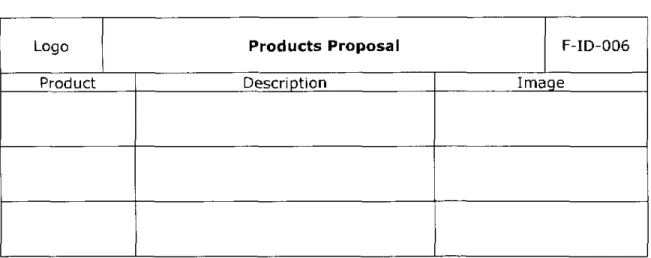
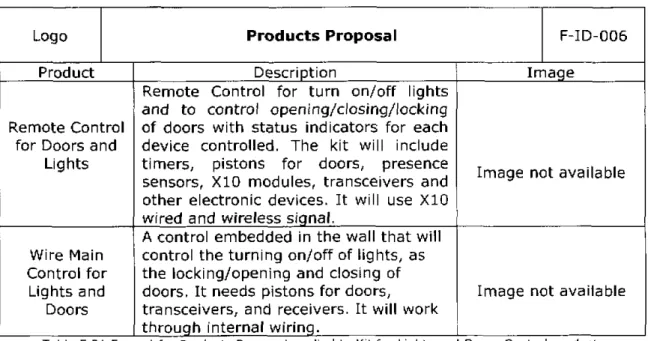
4.3.6 Products Proposal
4.4 Evaluate Products in accordance to User Capabilities 4.4.1 Product Selection
4.4.2 Product Definition 4.4.3 Project Planning
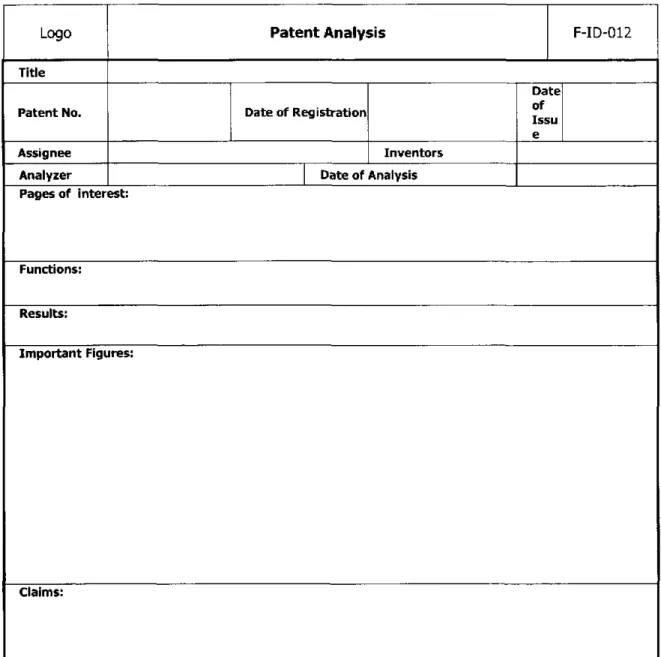
4.4.4 Market Analysis - Competitive Benchmarking 4.4.5 Patent Analysis
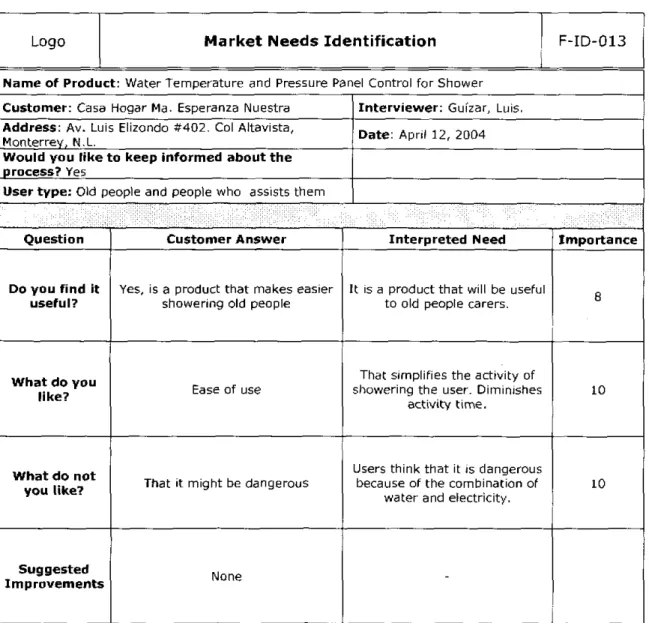
4.4.6 Identify Market Needs
4.4.7 Quality Function Deployment (QFD) 4.4.8 Technical Characteristics of the Product 4.5 Conceptual Design activities
4.5.1 Functional Decomposition 4.5.2 Concept Generation 4.5.3 Concept Selection
4.6 Product Design Models Applying Inclusive Design
48 48 50 53 54 54 55 55 56 56 57 57 58 59 60 60 62 63 64 65 65 65 66 67 67
Chapter 5: Case study for designing three producís with inclusive design 70
CONTENTE
Chapter 6: Methodology of evaluation for a flexible manufacturing system in order to achieve reconfigurability using inclusive design 129
6.1 Methodology of Inclusive Design Incorporated in a RMS 129 6.1.1 Limitations in Flexible Manufacturing Systems 129 6.1.2 Determination of RMS Characteristics 131 6.1.3 Understanding User Interaction 131 6.1.4 Reconfigurability Levels 133 6.2 Identification of Inclusive Design Cube Axis Requirements in Reconfigurability
Characteristics 134 6.2.1 Modularity 134 6.2.2 Integrability 135 6.2.3 Convertibility 136 6.2.4 Diagnosability 137 6.2.5 Customization 138 6.3 Application of the Evaluation Methodology to a FMS 139 6.3.1 Modularity 139 6.3.2 Integrability 140 6.3.3 Convertibility 142 6.3.4 Diagnosability 144
6.3.5 Customization 146
6.4 Inclusive Design Applied to a Reconfigurable Manufacturing Cell 147 6.5 Matching the Inclusive Design Cube Axes with the Characteristics of RMS 147 6.6 A Methodology of how WSN Functionality can Improve a FMS 149 6.7 Description of how WSN Improves the Operation of a RMS 149 6.7.1 WSN Supporting Modularity 149 6.7.2 WSN Supporting Integrability 149 6.7.3 WSN Supporting Convertibility 150 6.7.4 WSN Supporting Diagnosability 150 6.7.5 WSN Supporting Customization 150 6.8 Application of WSN Functions to RMS 151 6.8.1 RFID Applicability 152
Chapter 7: Case study for reconfigurable manufacturing system 153
7.1 Overview 153 7.1.1 The Mechatronic Manufacturing Cell of Mechatronics Department at
CONTENTS
7.7.3 UML Activity Diagram for Virtual Machining Configuration, Functional 165 7.7.4 UML State Diagram for Virtual Assembly Configuration, Control 166 7.7.5 UML State Diagram for Virtual Machining Configuration, Control 167 7.7.6 UML Activity Diagram for Physical Assembly Configuration, Functional 168 7.7.7 UML Activity Diagram for Physical Machining Configuration, Functional 168 7.7.8 UML State Diagram for Physical Assembly Configuration, Control 169 7.7.9 UML State Diagram for Physical Machining Configuration, Control 170 7.8 Simulation 171 7.8.1 Virtual Configuration 171 7.8.2 Physical Configurations 174 7.8.3 Assembly 175 7.8.4 Physical Machining Configuration 176 7.9 Methodology Overview 178 7.10 Action Research Cycle in RMS 179
Chapter 8: Results and Conclusions wíth further research 180
8.1 Results 180 8.2 Conclusions 180 8.3 General Conclusion 181 8.4 Further Research 182
LIST OF FIGURES
LIST OF FIGURES
Chapter 2
Figure Figure Figure Figure Figure Figure Figure Figure Figure Figure Figure Figure Figure Figure Figure
2.1 Disabled Population in Mexico 2.2 Inclusive Design Cube
2.3 Users Pyramid 2.4 MOTE Sense Table
2.5 Functional Components of a Typical Wireless Sensor 2.6 Integration of Various Technologies through a Software 2.7 Acceptability: A Combination of Practical and Social Issues 2.8 Usability and Acceptability principies
2.9 Waterfall Model: Design with a focus on evaluation, verification, validation and review
2.10 A Software V-model adapted for Inclusive Design
2.11 An Iterative Model of Design
2.12 IDEO design model
2.13 The 7-level design approach
2.14 The combination of the 7-level approach with the inclusive design model
2.15 Aspects of reconfiguration for RMSs
Chapter 3
Figure 3.1 Figure 3.2 Figure 3.3
The Spiral of Action Research Cycle Critical Reflection as a Core Process Action Reseach process
Chapter 4
Figure 4.1 Figure 4.2 Figure 4.3 Figure 4.4 Figure 4.5 Figure 4.6
User Pyramid Scheme
Inclusive Design Cube Scheme
Format for Quality Function Deployment activity Format for Functional Decomposition activity
Model for mechatronic product design with inclusive design approach - Product Planning
Model for Mechatronic Product Design with Inclusive Design Approach - Conceptual Design
Chapter 5
Figure 5.1 User Pyramid applied to Automatic Shower Control Panel product
Figure 5.2 Inclusive Design Cube evaluation applied to Automatic Shower Control Panel product
Figure 5.3 Format for Functional Decomposition applied to Automatic Shower Control Panel product
LIST OF FIGURES
Figure 5.5 Inclusive Design Cube evaluation applied to Kit for Lights and Doors Control product
Figure 5.6 Format for Functional Decomposition applied to Kit for Lights and Doors Control product
Figure 5.7 User Pyramid applied to Sensor for Lights and Doors Control product
Figure 5.8 Inclusive Design Cube evaluation applied to Sensor for Lights and Doors Control product
Figure 5.9 Relation between price and detection distance for different suppliers of electronic devices for controlling doors and lights
Figure 5.10 Relation between price and programming according luminosity for different suppliers of electronic devices for controlling doors and lights
Figure 5.11 Format for Functional Decomposition applied to Sensor for Lights and Doors Control product
Chapter 6
Figure 6.1 Figure 6.2 Figure 6.3 Figure 6.4 Figure 6.5 Figure 6.6 Figure 6.7 Figure 6.8Chapter 7
Figure 7.1 Figure 7.2 Figure 7.3 Figure 7.4 Figure 7.5 Figure Figure Figure 7.6 7.7 7.8 Figure 7.9 Figure 7.10 Figure 7.11 Figure 7.12 Figure 7.13 Figure 7.14 Figure 7.15 Figure 7.16 Figure 7.17Methodology of RMS with Inclusive Design
Flexible Manufacturing System with the addition of inclusive design concepts toward Reconfigurable Manufacturing System
Modularity fulfills the requirements of the Inclusive Design Cube Integrability fulfills the requirements of the Inclusive Design Cube Convertibility fulfills the requirements of the Inclusive Design Cube Diagnosability fulfills the requirements of the Inclusive Design Cube Customization fulfills the requirements of the Inclusive Design Cube Application of Wireless Sensor Networks functions to Reconfigurable Manufacturing Systems
Mechatronic Manufacturing Cell
Application of Inclusive Design to Manufacturing Cell Map of the controller level of the current cell
UML Activity Diagram for Virtual Assembly Configuration -Functional
UML Activity Diagram for Virtual Machining Configuration -Functional
UML State Diagram for Virtual Assembly Configuration - Control UML State Diagram for Virtual Machining Configuration - Control UML Activity Diagram for Physical Assembly Configuration -Functional
UML Activity Diagram for Physical Machining Configuration -Functional
UML State Diagram for Physical Assembly Configuration - Control UML State Diagram for Physical Machining Configuration - Control Virtual Configuration
Virtual Assembly Configuration Virtual Machining Configuration Physical Configurations
LIST OF TABLEA
LIST OF TABLES
Chapter 2
Table 2.1 Table 2.2 Table 2.3 Table 2.4 Table 2.5Proposal of Products to Respond to a Variety of Impairments Table of Relationship between IDC axis and Products Proposed
Relationship of how Wireless Technology improves the IDC Qualitative Axis
Universal Design
Comparison of the key hardware and software features of manufacturing systems
Chapter 4
Table 4.1 Table 4.2 Table 4.3 Table 4.4 Table 4.5 Table 4.6 Table Table Table Table Table Table Table Table Table 4.7 4.84.9
4.10 4.11 4.12 4.13 4.14 4.15Product Development with Inclusive Design Format for User Observation activity
Format for Need Identification activity Format for Product Specifications activity Format for Products Proposal activity
Format for Product Evaluation using the Inclusive Design Cube activity
Format for Product Selection activity Format for Product Definition activity Format for Product Definition activity
Format for Competitive Benchmarking activity Format for Patent Analysis activity
Format for Market Needs Identification activity
Format for Technical Characteristics of the Product activity Format for Concept Generation activity
Format for Concept Selection activity
Chapter 5
Table 5.1 Table 5.2 Table 5.3 Table 5.4 Table 5.5 Table 5.6 Table 5.7 Table 5.8Format that defines the activities, techniques, tools and formats stated for product planning
Format for User Observation applied to Automatic Shower Control Panel product.
Format for Need Identification applied to Automatic Shower Control Panel product
Format for Product Specification applied to Automatic Shower Control Panel product
Format for Products Proposal applied to Automatic Shower Control Panel product
Format for Product Evaluation using the Inclusive Design Cube applied to Automatic Shower Control Panel product
Format for Product Selection applied to Automatic Shower Control Panel product
LIST OF TABLES
Table 5.9 Format for Project Planning applied to Automatic Shower Control Panel product
Table 5.10 Format for Competitive Benchmarking applied to Automatic Shower Control Panel product
Table 5.11 Format for Matrix Analysis applied to Automatic Shower Control Panel product
Table 5.12 Format for Patent Analysis applied to Automatic Shower Control Panel product
Table 5.13 Format for Market Needs Identification applied to Automatic Shower Control Panel product
Table 5.14 Format for QFD applied to Automatic Shower Control Panel product
Table 5.15 Format for Technical Characteristics applied to Automatic Shower Control Panel product
Table 5.16 Format for Concept Generation applied to Automatic Shower Control Panel product
Table 5.17 Format for Concept Selection applied to Automatic Shower Control Panel product
Table 5.18 Format for User Observation applied to Kit for Lights and Doors Control product
Table 5.19 Format for Need Identification applied to Kit for Lights and Doors Control product
Table 5.20 Format for Product Specifications applied to Kit for Lights and Doors Control product
Table 5.21 Format for Products Proposal applied to Kit for Lights and Doors Control product
Table 5.22 Format for Product Evaluation using Inclusive Design Cube applied to Kit for Lights and Doors Control product
Table 5.23 Format for Product Selection applied to Kit for Lights and Doors Control product
Table 5.24 Format for Product Definition applied to Kit for Lights and Doors Control product
Table 5.25 Format for Project Planning applied to Kit for Lights and Doors Control product
Table 5.26 Format for Benchmarking applied to Kit for Lights and Doors Control product
Table 5.27 Format for Matrix Analysis applied to Kit for Lights and Doors Control product
Table 5.28 Format for Patent Analysis applied to Kit for Lights and Doors Control product
Table 5.29 Format for Market Needs Identification applied to Kit for Lights and Doors Control product
Table 5.30 Format for QFD applied to Kit for Lights and Doors Control product
Table 5.31 Format for Technical Characteristics applied to Kit for Lights and Doors Control product
Table 5.32 Format for Concept Generation applied to Kit for Lights and Doors Control product
Table 5.33 Format for Concept Selection applied to Kit for Lights and Doors Control product
Table 5.34 Format for User Observation applied to Sensor for Lights and Doors Control product
LIST OF TABLES
Table 5.36 Format for Product Specification applied to Sensor for Lights and Doors Control product
Table 5,37 Format for Products Proposal applied to Sensor for Lights and Doors Control product
Table 5.38 Format for Product evaluation with Inclusive Design Cube applied to Sensor for Lights and Doors Control product
Table 5.39 Format for Product Selection applied to Sensor for Lights and Doors Control product
Table 5.40 Format for Product Definition applied to Sensor for Lights and Doors Control product
Table 5.41 Format for Project Planning applied to Sensor for Lights and Doors Control product
Table 5.42 Format for Benchmarking applied to Sensor for Lights and Doors Control product
Table 5.43 Format for Matrrx Analysis applied to Sensor for Lights and Doors Control product
Table 5.44 Format for Patent Analysis applied to Sensor for Lights and Doors Control product
Table 5.45 Format for Market Needs Identification applied to Sensor for Lights and Doors Control product
Table 5.46 Format for QFD applied to Sensor for Lights and Doors Control product
Table 5.47 Format for Technical Characteristics applied to Sensor for Lights and Doors Control product
Table 5.48 Format for Concept Generation applied to Sensor for Lights and Doors Control product
Table 5.49 Format for Concept Selection applied to Sensor for Lights and Doors Control product
Chapter 6
Table 6.1 Table 6.2 Table 6.3
Characteristics of a representative cell
Disadvantages of flexible manufacturing cells
Reconfigurability levels to assess a system reconfigurability
Table 6.4 Match between characteristics of RMS and Inclusive Design Cube Axis
CHAPTEP 1 _ _ _ _ INTRODUCTION
Chapter I - INTRODUCTION
1.1 Background
Nowadays there are many products designed for one or many purposes. Companies always look for increased revenues and due to this aim; they develop products with an expectation of customer satisfaction by giving a varíety of functions, presentations, objectives and performances.
Most of design companies engaged to design and manufacture of products, have forgotten the user-centered approach, this is, a design to fit, a universal design that involves the widest possible population, contemplating their cleverness, acceptability and usabílity.
The preoccupation of Governments such of England, Japan and United States of America, concerning the respect for disabled and oíd people, they have created laws to protect and to promote the design of products that considers these excluded people.
However, Governments around the world are responding to the ethical arguments ¡n favor of greater social inclusión facilitated by the appropriate inclusive design of products, services and environments with new legislation.
Much of the legislation is focused on prohibiting discrimination on the grounds of functional capability. In many countries, such legislation is regarded as an extensión of comparable laws countering discrimination based on gender or ethnicity. Perhaps the most commonly known example of this is the 1990 Amerícans with Disabilities Act (ADA, 1990), which was enacted as civil rights legislation.
In the United Kingdom, the 1995 Disability Discrimination Act (DDA, 1995) provides much of the same directions on employers, manufacturers and service providers to avoid discrimínation against employees, customers and service users with functional impairments.
In México, much of the laws concerning disabled people are specifications for making buildings and facilities accessíble and usable by physically handicapped people. Although, these laws do not forbid the discrimination of disabled population, and are only focused on physical impairments and facilitating access into building and public places.
The adoption of inclusive design is not just of benefit when considering customers. Employers will find themselves having to increasingly consider making their work-places more accessible and inclusive. The concept of "work-work-places accessibility" is typically associated with building design and wheelchair access in particular. An accessible place requires not only that employees can get to and from their work-place, but also that they can interact with the equipment and tools necessary for productivity.
In most of cases, the equipment used to perform the job places additional demands on the user over and above those required for the task itself. In such cases, the user can
CHAPTR " INTRQDUCT1QN
1.2 Research Justification
Due to the lack of interest and attention of companies and government in México to the disabled people and workplace environments; it is necessary to créate a model that comprises both issues of producís and services designed to fit basic and affordable necessities of people; and in the other hand, to improve workplaces within faetones to créate producís.
In a rapidly ageing world it no longer makes commercial or social sense to design, develop or attempt to market produets and services whose usability is unnecessarily challenging to people, whether they be young or oíd, able-bodied or less able.
According to the need of inclusive design into produets and services, this research work is directed towards elabórate a methodology for designing produets with an inclusive design focus, considering the user acceptability and usability, utilizing a user-centered approach to provide a useful guideline. Develop an inclusive design guide. A lógica! first step is to créate a document that provides design teams with information about the nature of the various types of disabilities and various strategies for addressing their needs.
The development of technoiogy, and in particular new technoiogy and the produets based on ¡t, has the potential to provide solutions to many of the causes of exclusión encountered by people with functional impairments. That is the reason to take advantage of the new technoiogy available to enhance and add funetionality to produets and services. However, its potential can only be realized if the needs of the wider population have been taken into account during its application in the design of the produets based upon it.
1.3 Objective of the Research
• To develop a methodology that incorporales inclusive design eoncepts into mechatronic product design, with the purpose of improving characteristics of produets in order to adapt them to the user main dísability and needs; a key technoiogy used to improve mechatronic product design was the use of wireless sensor technoiogy.
• To demónstrate that the concept of inclusive design can be implemented in product design, covering specific needs with effective results.
• To develop a methodology for a flexible manufaeturing system in order to reconfigure it and convert it into reconfigurable manufaeturing system with the use of inclusive design eoncepts to improve the Reeonfigurable Manufaeturing Systems characteristics and to make it easy to use, understand its funetionality and reconfigure it by the user.
CHAPÍER 1 „ _ INTPQDUCTION
1.4 Scope of the Research
• Action Research Methodology has been used in this thesis to plan, to observe and to act, and reflect on the implementation of inclusive design in mechatronic product design and later in the reconfiguration of a flexible manufacturing cell.
• The use of Inclusive Design concepts to cover the user-centered approach based on the User Pyramid to denote the user requirements.
• The Inclusive Design Cube is used in this thesis to provide three functional axis of users, these are motion, cognitive and sensory to classify the user interaction.
• Three products have been planned and conceptually designed as case studies to demónstrate inclusive design concepts and accomplishment of user needs.
• Wireless Technology has been used as an underpinning technology to add functionality to products features, to satisfy the different user level requirements.
• An additional case study has been developed related to the Analysis and assessment of a Flexible Manufacturing System to achíeve reconfigurability, and the addition of Wireless Sensor Networks to improve its operation, converting this FMS rnto a Reconfigurable Manufacturing System.
1.5 Key Contributions
• Develop a conceptual mechatronic product design with the incorporation of Inclusive Design concepts.
• Develop a methodology for integrating the Inclusive Design approach in the developing of Reconfigurable Manufacturing Systems.
• Integration of Wireless Technology to conceptual design of mechatronic products and into reconfigurable manufacturing systems to add functionality.
1.6 Thesis Organization
This thesis project is organízed in eight chapters.
Chapter 1: Introduction Chapter2: Literature Review Chapter 3: Research Methodology
Chapter 4: Methodology for Product Design incorporating Inclusive Design Chapter 5: Case study for designing three products with inclusive design
Chapter 6: Methodology for integrating inclusive design in a flexible manufacturing system in order to achieve reconfigurability
:HAPTER 1 . INTRQDUCTIQN
Chapter 2 brings important literature review about Inclusive Design, describing concepts, trends, applications and state of the art. Also, this chapter presents literature of Reconfigurable Manufaeturing Systems and Wireiess Sensor Networks with descriptions of the current studies about them.
Chapter 3 describes the Action Research methodology used through the case studies to demónstrate the planning, acting, observation and refleetion of inclusive design approach implemented first on product design and later in reconfigurable manufaeturing systems.
Chapter 4, here the Methodology for product design is destribed, the methodology add the inclusive design approach to improve characteristics of mechatronic producís to assist impaired and fully-able people.
Chapter 5 contains a case study that describes the application of the methodology through several steps, and demonstrates the applicability of inclusive design in the design of producís.
Chapter 6, here is the Methodology to evalúate a FMS in order to achieve RMS characteristics, and a methodology to intégrate inclusive design into a reconfigured FMC with the use of wireiess sensor networks.
Chapter 7 the application of the methodology in a flexible manufaeturing cell to demónstrate its reconfigurability through a series of steps, the integration of inclusive design approach to add characteristics oriented to users and the application of wireiess sensor networks to add functionality and flexibility.
CHAPTER 2 . . UTERATURE REVIEW
Chapter 2 - Literature Review
2.1 Inclusive Design
Autonnation for Inclusive Design is characterized for facilitating accessibility to people who does not have normal physical and/or mental capabilities. In this way, it ¡s necessary to develop devices, sensors and design practices forward to domestic and urban automation, so people with any disability is able to interact and to get adapted to products and services with no problem.
People not included in the normal design of producís, buildings; houses, among others, are within the framework of exclusive design, an example of this are handicapped people, because of the existence of many people in conditions that disable them in some way and that makes evident the need of redesigning certain products and services so excluded people can use them normally, despite the difference in capabilities and accessibility.
When taking a look at products commonly used, immediately it is possible to detect inconveniences to use them in case of a disability. Many of these impairments are caused by design decisions made without considering users, because there are products that present unnecessary difficulties for many users. Their causes are trivial, but their solutions may also be trivial.
Solutions that are more inclusive will explicitly address the usability and accessibility needs for the widest range of users, and not necessarily require a deep review to improve products.
Many products seem to be designed for young population, excluding oíd people or people with functional impairments persisting in the view that these people are in some way undesirable customers. However, there is an urgent need of developing design methods based on a better understanding of such factors related to disabilities and aging, which will lead to minimize the impact of impairments and to improve life quality.
2.1.1 Inclusive Design - one among many terms
Inclusive design in one of many terms used nowadays in professions focused to environment, like construction industry, and in the action field of government. This term shares a similar background and also has objectives related to other terms such as universal design, design for all and, recently, "respect for people" (CEBE - Special Interest Group in Inclusive Design, 2002).
However, it is not the purpose to invest time in making distinctions among these different terms, ñor evaluating which is better; the objective is to do an effective job independently of the terminology used, to determine the factors that should be modified when analyzing products from an inclusive perspective.
CHAPTER 2 LITERATURE REVIEW
include not only age, gender and disability, but also ethnic groupr income, education, culture, etc. (Shipley, 2000)
Not all the products exelude users, just some of themr and sometimes unnecessarily. A product designed to minimize exclusión will be called inclusive or universally designed.
Research has shown that while many companies agree with the principies of designing inclusively, they consider it impractica! for them to adopt such practices. The reasons commonly cited are:
• Insufficient financial resources / time • Inadequate access to product users
• Inexperíence in dealing directly with users
• A lack of demand from commissioners of the designs
Despite these many companies could adopt inclusive design practices for many products and services as possible.
2.1.2 Why the interest in inclusive design?
There are arguments ¡n favor of doing inclusive design practices, which address both the ethical case and the business case for adopting inclusive design.
The Ethical Case
The ethical motivations for wanting to design for a wider range of user capabilities and avoid unnecessary exclusión are easily identified. The foundation of the ethical case for inclusive design is that many users are excluded from sing everyday products and services because they do not nave the necessary functional capability to interact with them. This is not the fault of the user, it is the fault of the design of the products and services for not providing enough support for the user.
The social argument reflects the changing nature of aging, disability and technological ski I Is necessary to particípate fully in rnodern society.
Inclusive design is not only about handicapped people, but also about those who due to their age have difficulties to walkf move or to chronicle ills like arthritis that disable some movements to take or use products designed outside inclusive design practices.
Nevertheless, oíd people, pregnant women, children, blind people are also important objectives who have the need, temporary o permanent, of living in an adequate environment adapted to their capabilities.
The Business Case
CHAPTER2 LITERATURE REVIEW
Much of the legislation is focused on prohibiting discrimination in the grounds of functional capability. In many countries, such legislation is regarded as an extensión of comparable laws countering discrimination based on gender or ethnicity.
In other countries, governments consider a maín fault that companies do not adequate their services to attend people with functional impairments.
As time goes, there is more population older than 50 years, retired and cióse to the third age to be considered as potential customers. Consequently, it has an economical sense to make sure they are not excluded, given that there ¡s a global market of products and services designed or oíd people.
There is also a need that industry responds with products to facilítate the independency at work and at home for many people. And also to genérate design methods based on a better understanding of age and capabilities, which should be focused to minimize the impact of disabilities and in this way, improve accessibility.
There are many products that are essential to facilítate the independency. These include, for example: household products, food containers, clothes, communication devices, formats to get information, lighting, infrastructure. These products and many others are part of an integral aspect of life for population in general.
It is indispensable to remark that the mentioned research about inclusive design has been carried out in developed countries like Japan, United States, England, etc. Also in México part of the population is handicapped or has a disability due to their age; which is considered as part of excluded groups.
CHAPTER 2 _ LiTERATURE REVIEW
2.1.3 In México
In México there are around 2 million people with some type of disability, which reveáis that there is a wide need of redesigning many products and services in order to make them inclusive.
Disabled Population in México
Disability
L a n g u a g e •':'•'• ••'i
Auditive sí?;
Visual
Motion
0 200 400 600 800 1000
Population (thousands)
Figure 2.1 Disabled population in México. Source: 1NEG1, 2000.
After analyzing the given information, it is worth to specifically emphasize that there is a need to develop knowledge and understanding about the user requirements for finished products.
Despite the national reality, normativity has focused just in the right to health; this has been recognized in the article 4th in the Constitution and regulated by the General Health Law. Physical disability is regulated by social assistance, by preventing disability and with rehabilitation of handicapped people. But the problem of handicapped people requires more than just the general health perspective.
Global trends are moving to leave the medical and social assistance model, to adopt the handicapped model as a human rights topic. And this is why the application of the Mexican legislation related to this subject is deficient, since it has been totally surpassed.
Perdomo, Gerardo. 2004, says about the legislative situation about handicapped people:
CHAPTER 2 LJIERATUREJ2EVIEW
rights and to the establishment of mechanisms that lead to equality of circumstances and opportunities within the society.
The new order must guarantee the rights of handicapped people, and it is necessary to protect and promote these rights. Among them figure the right to equality, right to not to be discriminated or excluded, and those that allow disabled people to have a full access to education, employment and trainíng, health, social services, culture and sports, media mass and transportation. It also should include laws related to architectonic, urban development and housing support for the disabled population. The effective warranty of these rights will be the main objective of the law.
To achieve the feasibility of these legislature, it is indispensable a simple constitutional modification that supports its expedition, defining the competencies of the federation, the states and the Federal Distriet, as the responsibilities of the different organisms that will apply and observe the achievement of the law.
There is much work to do yet, and it is necessary to sum efforts to apply, justify and dignify the handicapped population in México.
For a better interpretaron of functional needs of excluded people, it has been designed a tool called Inclusive Design Cube. (Clarkson & Keates, 2000)
2.2 Inclusive Design Cube
The volume af any part of the cube represente the total number of users with iherange of capabilities described by its dimensions
Increasing
motion
capability
Assisted by carer
Increasing sensory capability
#y' Increasing cognitive
capability coraprises
The lovver right front coma' of the cube represents the fully able user
Special purpose design
Modular/customisable design
User aware design
Figure 2.2 Inclusive Design Cube. {Source: Clarkson & Keatesr 2000)
Individual parts of the cube represent populations that can be assisted by a particular design.
CHAPTER ilERATUREREVIEW
At the low capability end of each scale, it is likely that many of the needs of daily living will be met by a carer. As capability increases, special purpose design will provide products to suit specific needs., for example, wheelchairs, walking frames, hearing aids and spectacles where such products are not intended for general use by the whole population. Modular or customizable design allows for variations in product user interfaces to accommodate a wider range of abilities than a standard interface. Finally, user aware design is intended to result in products which appeal to as wide a range of capability as possible.
The cube is essentially an extensión of the user pyramid proposed by Benkzton (1993), and shown in the next figure.
2.3 Users pyramid
SevfhHy
riisáblecl
pépplé.
Figure 2.3 Users Pyramid (Benkzton, 1993)
• As can be seen in the figure, the most dependent people are those which are in wheelchairs and people with very limited strength and mobility in their arms and hands, and they are found in the upper part of the pyramid.
• In the middle are the people with reduced strength and mobility caused by disease and age-related impairment.
• Finally, in the bottom of the pyramid are found the able-bodied of fully capable users together with elderly people who have minor disabilities like reduced strength and mobility, or impaired hearing or sight.
Automation for inclusive design applied in the upper part of the pyramid is considered the hardest to do because the person does not have the motion ability to access, move or control any automatic device to do a specific activity independently. In this case it is necessary to automate using sensors that interpret certain movements done by the person so after that it can be easily carried out any predetermined action by the automation technology.
CHAPTER 2 LITERATUPE REVIEW
automated system through pushing buttons, walking or just moving their hands or arms.
According to the available information related to handicapped people (visual, motion and hearing), the main difficulty they have and that makes them more dependent on others is moving through any place, it can be ín any building, when getting into a public transportaron unrty or just when going out to the street.
For these is necessary to make a detailed observation of these people movernents, their anthropometry and basic functional needs, to understand and then propose a solution in design and in technology.
2.4 Using the Inclusive Design Cube to identify the potential market
The inclusive design cube is intended to be used as a diagnostic tool to assess the potential for expanding the market for a product. It is believed that by focusing on the market benefits of inclusive design is more likely that companies will be encouraged to develop new, more accessible producís.
The inclusive design cube is initially intended to be used as a qualitative tool. However, it would be more useful as a quantitative tool coupled to recent demographic and impairment data. In addition, if it was also linked to the latest ergonomic data and guidelines it would allow the designer to understand what user interface features are required to meet the user capability targets.
2.5 Automation Technologies
According to the objective of this thesis the author is provrding useful information about wireless technology, its characteristics and functionalities that will be considered to support the producís and facilities.
There are Technologies based on sensors, actuators, computers, transmitters-receivers, radío frequency devices and more; to automate houses and buildings that are required by customers for comfort and home entertainment.
2.5.1 XIO
XIO
XIO is a communication language that allows compatible devices to talk to each other usíng an existing electrical installation at home. Many compatible producís with XIO are very accessible and the fact that they use the same electrical cables at home means that do not require additional expenses for installation.
The installation is simple: a transmitter is connected somewhere in the house and sends its control signal (on, off, bright, attenuation, etc.) to a receiver which is connected somewhere else in the house.
CHAPTER 2 _ UTERATURE REVIEW
With simple digital dialing or buttons each product is assigned to one of the 256 supported addresses in the system. If it is wanted that two products turn on or off simultaneously, is needed to set the same address in the desired devices, All compatible products with X10, can be used and configured to créate an automation network at home. The brands that work directly with X10 are: Levitón, Stanley, IBM, JDS, ACT, HomePro, etc.
It is estimated that there are approximately 10 million of American homes with compatible products with X10. This is because the system has many advantages above other systems and types of remote control products:
• Cheap
• Does not need new electric cable installations • Easy installation
• Hundreds of compatible products
• Controls up to 256 lights and electric devices
• Around 20 years of experience
It is worth to mention the benefits of automation with X10, as:
Comfort
It is possible to control the TV from the coach, or to attenuate the lights when getting ready for watching a movie. Adjust the temperature from bed or control the volume of all the home audio system from any room. Or just turn on the heating in the bathroom 5 minutes before waking up, so it is warm when taking a shower,
Safety
Have different products that make it easier to access a house, since opening the garage, getting in the house with the lights already turned on. Lock doors and Windows, putting an active alarm that detects any movement or intrusión suspicion.
2.5.2 MOTES
MOTES are wireless sensors that consist in Processor and Radio boards, connected among themselves in a network of various sensors and controlled by an operative system called TinyOs, support radio signáis from two channels.
MOTES are thin and small, autonomous, are computers that have batteries as source of power and radio termináis which enable them to communicate and exchange information with others, as auto-organize in ad hoc networks. MOTES can be used to detect objects in movement and draw their path.
Currently Intel Company is working in collaboration with researchers' community to explore the potential of new applications for MOTES and sensor networks. Potential markets in a future include transportaron and deliveries, fire fight and rescue operationS; home automation and even interactive toys.
CHAPTER 2 . ÜTERATUREBEVEW
An application for MOTES would be the Sense Table, which is a simple application of MOTES ¡n a network for their use in a tangible interface. Sixteen MOTES are wireless connected. Each MOTE uses a magnetometer for sensing metallic objects on the table. The sensors network calculates and looks for an object position once it has changed its position.
Figure 2.4 MOTE sense table
The system operates independently of any PC externally connected. In the application of the Sensors Table, a mote added to a PC gets the information from the motes that are in the Sensors Table and generates an appropriate visualization of the obtained data.
2.5.3 RFID (Radio Frequency Identification Technology)
Radio Frequency Identification (RFID) uses radio waves to communicate to the RFID reader to identify individual Ítems on which RFID tag is placed. RFID tags placed on Ítems listen to the query generated from the RFID reader and responded back by transmitting their unique code id. There are two types of RFIDr depending on the communication methodologies and power source of RFID tag. The two types of RFID are - Active RFID and Passive RFID.
• Passive RFID
Passive RFID tags does not have own power supply, but absorbs power from the radio frequency generated from the reader and transmitted back a response. Passive RFID response contains typically the unique ID number only due to low power availabílity. Lack of power supply makes the passive RFID range of transmission from inches to 20 feet.
• Active RFID
CHAPTER 2 L'TERAiURE REVIEJA
How does RFID tracking work?
A RFID based system; each item is fitted with a RFID tag. The RFID tag is basically an electronic radio transmitter comprising of a micro-chip and an antenna and a tiny battery, everything fabricated on a thin plástic sheet. It can be easily attached to a variety of ¡tems directly. Each RFID tag has a few bytes of memory built on to it which contains its unique identification number and it periodically sends out a radio signal carrying the same. A receiver device, called the RFID reader detects the signal emitted by each tag as soon as it enters into its radio range and interprets the identification number. The RFID tags that are powered with a tiny battery are known as Active RFID tags and can be read from a distance as high as 100 feet. The detection range of a RFID reader can be adjusted so that it defines an área in the enterprise. Simply put, when a RFID tag is detected by a particular RFID reader, it's known that the item where the tag is put on is present in the área where the reader is sitting.
System Arcbitecture of RFID Subsystem
The RFID based asset tracking and inventory management solution uses a simple yet scalable architecture for the RFID subsystem to suit the needs of a variety of application domains. It uses a number of individual software components that work collaboratively for smooth processing of the RFID tag information (such as Tag ID, time of detection, área where detected, etc) and feed the information to the inventory management solution.
A number of RFID readers are place within the sensing place, depending on its shape, size, number of strategic detection points and other factors. Each RFID reader defines an área in the enterprise. Data that is captured by the readers are sent to a software called Concentrator. The concentrator software can receive RFID information from several reader devices. It processes the information and buffers them for a predefined time period. There is another piece of software called Collector which collects buffered data from the Concentrators. For higher tag densities, additional Collectors can be added to the system. The Collector software performs additional processing and finally puts the data into an SQL Server datábase.
CHAFTEfí 2 UTERATURE REVIEW
Áreas of appiicat'ton of RF1D Technology
The major application área of RFID tracking is rn manufacturing, service and reta i I chains. However it can be applied in many other ways. RFID tracking can be used in any área where some kind of tracking is necessary. Some interesting applications are described here:
• In Hospitals and Health care, each patient can be tracked by a RFID tag, RFID tags in form of wrist-bands are now available in the market. Doctors and nursing staff can see detailed Information of the patient on a hand-held PC or PDA, just by standing near the patient's bed.
• In large farms, dairies, etc., RFID tags can be used to track live stock. Active RFID tags in form of ear tags have started coming to the market.
• RFID tracking can be used in any organizaron for employee/visitor tracking within its premises.
• In Airlines, RFID technology can be used for tracking baggage with 100% accuracy.
• In a city transport system, RFID tags can be used on high priority vehicles such as pólice cars, ambulances, fire trucks, etc., so that when they arrive at a crossing, the traffic signaling system can automatically switch on green lights only for that lañe and red lights for all other lañes.
As it can be seen, RFID Technology can achieve the wireless sensor network characteristics:
• Low power consumption: By only receiving energy from the radio Frequency generated from the rea de r and transmitted back.
• Wireless Sensor Network: Their architecture allows an arrangement that intercommunicate several receivers to a concéntrate in order to obtain more ínforrnation.
2.5.4 Wireless Sensor Networks
Wireless sensor networks are a sensible choíce for data acquisition frameworks as wireless sensors can be conveniently placed in non-accessible places, support mobilrty and dynamic topology and can scale better than their wired counterparts. As such, they are widely used in sensing applications like temperature, pressurer acoustics, and motion detection as well as for data acquisition in monitoring, manufacturing, biodevices etc.
A wireless sensor network is a collection of wireless sensors covering a small área, typically less than lOm. Every sensor performs independent sensing, processing and transmission of data over wireless link to a data collection node. The data collection node aggregates data from múltiple sensors and processes it.
CHAPTER 2 I.ITERATURE REVIfW
contains the valué of one or more sensed attributes. The time interval between successive data transmission by a sensor depends on the requirement of the application. For example, for a sensor for surveillance purposes, the data transmission can be quite frequent while for environment monitoring ¡t could be significantly infrequent.
Wireless network sensors are a strategic solution to acquire signáis from tool machines, like speedsr vibration, temperatures, and the very advantage of this kind of sensors is that they do not need wires for power supply and signal transmittingr since they are equipped with batteries and the signal acqulred is transmitted through radio waves.
Constituents of Wireless Sensors
A wireless sensor can have size of the order of millimeters. In thisr resides a transducer unit that converts the sensed analog signáis to digital, a control unit that receives digital input from the sensing unit and performs protocol operations, a radio unit which transmits the packet over wireless link and a battery which is the power source of the entire device. The control unit can function at micro-watts level while the radio transmissions typically require energy in miliwatts.
Uait
*
¡ 1
Annkr.nr»» |
PnH
•
CPU
i 1
Measorv Unii "
:¡
ALU
• *
Data Bu-,
•
-OEEICJ Utát
Figure 2.5: Functional components of a typical wireless sensor (Agrawal, et.al., 2003}
The network protocol is realized in the control unit which is a microcontroller. The network protocol runs through the information and configures the sensor dynamically. The data flows unidirectionally from transducer unit to the control unit. The control unit contains memory units to save data, an Anthmetic and Logic Unit (ALU) to do calculations, comparisons and other data manipulations, a timer unit to schedule data transmissions, a protocol unit to implement the network protocol functions, and finally a CPU to control all the above units. For low power consumption, the CPU should function at low speeds. The radio unit hosts the MAC protocol functionality. The MAC protocol handles data transmission over wireless link.
CHAPTER 2 LITEQATURE REVIEW
Fixed network or Ad-hoc network
The characteristics of wireless sensor networks are highiy related to their topological configuraron. A wireless sensor network can be an ad-hoc network or a fixed network. In an ad-hoc network; sensors can organize themselves in clusters of sub-networks and perform higher level functions of routing or mobility management between themselves. In the fixed network, a higher peer usually called an access point manages communication between groups of sensors. Sensors of different groups communicate via their access points. Thus, for fixed wireless sensor
networks, much of the functionality of IP layer may be redundant.
They are easily deployed and depending on the type of network they can achieve a throughput of approximately 40 Kbps that can be sufficient enough for all the recompiled data sent. They are usually organized in a multi-hop network, and each node has its own sensors, embedded processors and low-power radios, every single one running with batteries. (Ye, Heidemann and Estrin, 2002)
Actual manufacturing systems require the unconditional support that technology can offer nowadays and the integration of WSN to Reconfigurable Manufacturing Systems facilítate the monitoring, data acquisition (signal conditioning), signal processing techniques, and decisión making routine to analyze the data and classify the results. (Mehrabi and Kannatey-Asibu Jr, 2000)
The major challenges in the design of a wireless sensor network are the power, storage, processing and computing limitations of the sensor.
Wireless Sensor Networks Applications
A typical application can be an automatic guided vehicle where a wireless sensor network is used for positioning, guidance and interaction with surrounding machines and robots. In the extreme case the product itself can be equipped with a radio node, making it possible for the assembly robots to interact wit the product during the assembly. This would make it possible to conduct tests, software downloads and identification during assembly process of complex and variable products.
Wireless sensor network (WSN) is a recent research topic. This network is composed of hundreds or thousand of autonomous and compact devices called sensor nodes.
Wireless Sensor Network has the potential for many applications: e.g. for military purpose, it can be used for monitoring, tracking and surveillance of borders; in industry for factory instrumentation; in a large metrópolis to monitor traffic density and road conditions; in engineering to monitor building structures; in environment to monitor forest, oceans, precisión agriculture, etc. Others applications include managing complex physical systems like airplane wings and complex ecosystems.
CHAPTER2 . 'JTERATUREREVIEW
signáis from sensors to exterior worid or a computer network, and also a mechanism of communication to establish and maintenance of WSN, which is usually ad-hoc.
Characteristícs and Requirements of Sensor Node Energy-Efficiency
Sensor node must be energy efficient. Sensor nodes have a limit amount of energy resource that determines their lifetime. Since it is unfeasible to recharge thousands of nodes, each node should be as energy efficient as possible. Henee, energy is the
major resource, being the primary metric for analysis.
Low-cost
Sensor node should be cheap. Since this network will have hundreds or thousands of sensor nodes, these devices should be low cost.
Distríbuted Sensing
Using a wireless sensor network, many more data can be collected compared to just one sensor. Even deploying a sensor with great line of sight, it could have obstructions. Thus, distributed sensing provides robustness to environmental obstacles.
Wireless
The sensor node needs to be wireless. In many applications, the environment being monitored does not have installed infrastructure for Communications. Thus, the nodes should use wireless communication channels. A node being wireless also enable to install a network by deploying nodes and can be used in many others studies for example liquid flow of materials.
Multi-hop
A sensor node may not reach the base station. The solution is to communicate through multi-hop. Another advantage is that radio signal power is proportional to r4, where r is the distance of communication. It can be more energy economic to transmit many short-distance messages than one-long distance message.
Distributed processing
CHAPTER 2 UTERATURE REViEW
2.5.5 Honeywelt - Hometronic
Are technologies developed with the purpose of satisfying some comfort needs at home, such as:
Opening of blinds
Closing water and gas valves (safety)
Security systems like alarms and motion sensors Remote control with mobile telephony
Control panel for lights and temperature Automatic locks for opening doors
Room access with security numeric keyboard
Among other products fabricated by this company. These products receive and transmit signáis by:
• Radio frequency • Temperature, illuminatíon and • Electric cables motion sensors
• Infrared port • Computer serial port
Its objective market is homes, because nowadays they have no other application, they are directed to those people that look for comfort in their automated houses and with operations than can be executed by a central system automatically.
The integration of this technology with other mentioned above, would be easy due to the open source software they use, that can be configured to work with applications related to XIO and MOTES. Also because to their flexibility to opérate through traditional electric cables in any installation capable of receiving signáis.
Based on the needs and with the existing products that use the technologies XIO and MOTES it is proposed to automate what already has been produced and/or develop new automated products and services.
In a further description of the methodology, there will be a part of observation and interview with the user or people who assist handicapped and oíd people, whit the purpose of detecting those needs that require to be fulfilled with a product.
Once obtained the types of disability, functional need, technologies with their respective advantages, is fundamental to analyze the coupling they can have among them to offer technologic solutions.
CHAPTER 2 LiTFRATURE REVIEW
Available technologies X10
MOTES
Devices / Functions;
Movement and approxi marión sensors
Temperature and humidity sensors
Detection of vibrations and paths Switches
Dimmers Pisíons
Solenoid valves RFTransceivers
Reprograrnrnable controls Answer machines
Water and air thermostats Transistors
Modules on/off for electric devices
Electric locks Motors for blinds Motors for curtains Pneumatic actuators Remóte controls
Note: The need of moving through halls, rooms, or in public places has been the most important to handicapped people with moving impairments and oíd people.
CHAPTER2 ÜTERATURE REV1EW
Inclusive Design
Motion Wheelchairs
Access to buildings Up / down stairs
Group of Applications Open doors
Actívate ventilation Turn on /off lights
Interconnected presence sensors
Modify level of tables
Reduction of Strength Arthritis
Open door handles Open jars
Visual Impairment
Bright and flashing switches Re mote controls
Detection of paths
The operative system that controls the MOTES is open-source software called TinyOS, which can be modified to intercommunicate with the interface of the Firecracker software that controls the XIO to execute output signáis.
Firecracker
XIO
Figure 2.6 Integration of various technologies through software
This is a schematic description of the integration of various technologies using software, without modifying the principie of functionality of each one of them, but adding the efforts and advantages that each one provides with the purpose of facilitating the user interaction with his or her environment.
CHAPTER 2 LlTERATURE REVIEW
Answer with X10 and MOTES Proposed producís:
1. MOTES sensors that detect presence and turn on the lights with XI0 devices according to luminous conditions, and at the same time open the doors when passing through.
2. Detection of inside temperature and reguiation of environmental weather using air conditioner or heating as needed.
3. Detection of proximity to doors and their automatic opening for less frequented places. On the other hand, the most used doors wili be controüed by. a portable radio-control.
4. Manual .and automatic temperature control for shower, by a main hermetic control thqt regulates temperature without using handles.
5. Remóte Control with illumination functions and to open / cióse and lock doors. ó.: Self-adjustable height table for having rneals or for reading (wheelchairs).
Table 2.1 Praposal of products ta respond to a variety of ¡rnpaírments
The six proposed products are composed by X10 and MOTES Technologies, their functional characteristics must be analyzed in accordance to their achievement of the Inclusive Design Cube qualitative axis with the labels:
• IMC Incremental Motion Capability • ICC Incremental Cognitive Capability • ISC Incremental Sensory Capability
Products designed for assisted people are the ones that require sensors and on/off devices completely automated that do not irnply any interaction from the user. The type of modular / customizable design goes for those people that do not have a severe impairment and that can be designed and adjusted to specific needs. These can be also operated in a manual mode for people who assist disabled customers.
A specific purpose product is designed to fulfill those specific needs and that can not be configured for other functions, but for those that it was designed to perform.
—1
m
H MinirnumIP
I
I
1
1 Mínimum
i Only visual 1 perception
1 Assisted by 3 carer 1 _ —
P»dutt:2 .
Minimum Mínimum Only tactile perception Modular / Customizable ' Product3 Minimurn Médium High Visual Modular/ Customizable Product 5
• i •
strengtn. Médium Coordination MeOlurn Only tactile perception Modular/ Custornizabie Low Coordination High Only visual perception Modular / Customizable
mmm
Minimum Mínimum Only visual perceptian Assisteb by carerCHAPTER UTE3ATURE REVIEW
Axis MOTES X10 HOMETRONIC
Senses extremities position
Provides control for doors, windows and other devices
Provides control for blinds, Windows
and electronic devices
Not needed Médium High
Detects movement, presence and paths
Provides help with illumination and
visual signáis
Provides with illumination and control of several
devices
Table 2.3 Relationship of how wireless technology improves the IDC qualitative axis
MOTES sensors reach a higher level in the user pyramid, where people with motion, visual and auditive impairments are located, and do not require cognitive capability from the user because it is a component of active automation.
X10 devices make easy the movement, coordination, auditive and visual operations, just getting instructions from the MOTES to carry on its functions, although the control require some intellectual capability to be operated.
HOMETRONIC technology demands a wide knowledge in the control of electronic devices, weather, illumination and other devices, but also can be controlled with MOTES sensors to perform its functions.
2.6 Usability, accessibility and inclusive design
According to Jakob Nielsen (1993) system acceptability is the goal that designers should be aiming for and can be achieved by meeting the social and practical acceptability objectives for the system.
Practicai acceptability
acceptability
Figure 2.7 Acceptability: A combination of practical and social issues (Nielsen, 1993)