FACULTAD DE EDUCACIÓN DE PALENCIA UNIVERSIDAD DE VALLADOLID
Assessment for Learning
Including Assessment as a planning tool for
professional development
El reconocimiento de aprendizajes en la evaluación formativa. Su inclusión en
la planificación como herramienta del desarrollo profesional
TRABAJO FIN DE GRADO MAESTRA EN EDUCACIÓN
Author: Mº Pilar Curieses Luengo
Tutor: Mº Carmen Alario Trigueros
Grado en Educación Primaria. Mención Lengua Extranjera (Inglés).
Resumen
Este trabajo fin de grado se centra en un aspecto muy importante del aprendizaje: evaluación para el aprendizaje. El objetivo principal es conocer su significado y cómo incluir el proceso de reconocimiento de aprendizajes como parte integral del proceso de formación del profesorado. Para ello, es imprescindible tener claros algunos conceptos, como la diferencia entre evaluación del aprendizaje y evaluación para el aprendizaje, así como la base teórica sobre la que se asienta. En este proyecto se expone el plan de evaluación realizado en un colegio bilingüe CLIL, durante el periodo de prácticas. El diseño se ajusta al contexto específico de un aula de 3º curso de educación primaria, para la asignatura de science. Unido al desarrollo profesional, el resto de objetivos se han centrado en el desarrollo de técnicas de trabajo sobre la evaluación formativa que fomenten la adquisición de competencias básicas en el alumnado como “aprender a aprender” y “competencia social y ciudadana”.
Abstract
This research is focused on an important issue in the learning process: Assessment for Learning. Main goal is to know what it means and as a teacher how I can include it in my lessons. For that it is essential having some concepts quite clear, such as the differences between Assessment of Learning and Assessment for Learning as well as why is so important this topic in the learning process and the theoretical based it has. The project focused on how to develop an assessment plan in a context given through science subject in third grade of Primary Education. Following some routines and using some materials I worked with Assessment for Learning in my training period so as to develop some of my pupil skills, and achieve in them a grater grade of autonomous and learning to learn competences. Results show that this issue is either important for teachers or students, and it really have benefits in learning process.
Palabras clave
Keywords
Index
1. Introduction... 5
2. Goals ... 6
3. Justification ... 6
3.1 Why have I chosen this reseacrh? ... 6
3.2 Teacher´s competences ... 8
4. Theoretical foundation ... 11
4.1 Learning and development ... 11
4.1.1 Zone of Proximal Development ... 12
4.1.2 Learning in a social context ... 13
4.1.3 Bloom’s taxonomy ... 15
4.2 Readiness for learning... 16
4.2.1 Motivation and learning ... 18
4.3 Evaluation and Assessment... 20
4.3.1 Assessment for Learning. What does it mean? ... 22
4.3.2 Classroom Assessment for student Learning ... 23
5. Methodology and design ...27
5.1 Spanish curriculum ... 27
5.2 European portfolio of languages ... 28
5.3 Design ... 29
5.3.1 Context ... 29
5.3.2 Adapting an Assessment plan for a given setting ... 31
5.3.3 Why this research? ... 39
5.3.4 Presentation of results ... 40
6.Conclusions ...42
7. Bibliography ...46
1. INTRODUCTION
Schools are the place where students develop almost all skills. In order to provide good levels of educations teachers must achieve with their tasks. Among the different tasks assumed by a teacher, one of the most important tasks is Assessment in spite of being one of the areas with fewer works.
On one hand, Evaluation and testing have been most common tools during many years. At the end of the unit students make an exam and they receive a mark for that. Teachers only give a Feedback when it was finished, and there is no possibility to improve. Students can not follow their own process and they are not conscious about the reach. On the other hand, with the arrival of constructivist theories and bilingual setting at the schools, Assessment for Learning is beginning to be a really important tool, actually it is. This consists on developing autonomy and “learning to learn” competence in our students. They are the centre of the learning process, they need to know where they are in each moment and how can they improve. This involves a hard-work by the teachers, but it is a difficult technique to be used but worth applying. Furthermore it is a part of teacher’s competences that any teacher should develop. Assessment for Learning1 doesn’t implicate that Evaluation or testing must be removed, it is just that they can coexist and complement one each other.
This research is divided in some parts. First of all, I set my own goals and the justification of this investigation in order to connect theoretical foundation with practical part. Theoretical approach is based on constructivism theories. Some authors, such as Vygotsky, Bloom or Brunner have ideas related with Assessment for Learning. Besides, there are strong arguments that differentiate Assessment versus Evaluation. I put into practise my Assessment for Learning Plan in the school where I did my training period, in “La Salle” in Palencia. This school belongs to a CLIL settlement, so when I arrived I found an Assessment context. It was my starting point, and I introduce some tools and routines to work with them as well. The plan was applied to the subject Science. Little by little I was working with different issues and eventually I designed a completely Assessment for Learning plan connected with “Matter and Materials” topic.
1
What we do as teacher in our classroom will be very important in the future for our children, let’s doing well!
2. GOALS
Before starting this research, I laid down my own goals, in order to focus my attention and my practise in the same way. I set one general goal, which involves either a theoretical part or a practical one, and four specific goals as well.
The main goal is to research about Assessment for Learning, to know what it means, how a teacher can work with it and to use it in my internship.
As specific goals, I have established the following:
Place Assessment for Learning in the proper place in the teacher’s work.
Clearly differentiate Assessment for Learning from Evaluation.
Know several methods to work with Assessment for Learning in a primary class.
Design and implement an Assessment for Learning plan during my internship in order to improve learning awareness in my pupils learning process.
3. JUSTIFICATION
3.1 WHY HAVE I CHOSEN THIS RESEACRH?
When you think in teacher’s competences, you usually think of curriculum, unit and lesson planning, resources design, or teaching scaffolding to support children learning, but we usually leave a side Evaluation and Assessment. Our experience as students rejects any form of valuing, mainly if we have ever suffered any form of failure; therefore it is not very common for a teacher to think of Assessment as the top of the learning process.
when students have finished and they can not improve and it is reflected through marks. However Assessment for Learning is focused on the learning process. It offers formative Feedback in a continuous way. Students know what they are going to do, what they should achieve, what they reach and how can they improve.
During my school life and my teacher training experience2 I have had many different perspectives with Assessment and Evaluation. I had been trained in testing and Evaluation along my childhood in primary schools and high-school with final test or summative Feedback at the end of a unit, a term or the year. Last year I studied abroad, in The Netherlands, for five months. In that period I could attend to an internship for some weeks and observe and teach in a primary course (2º grade). The school works with Assessment of Learning3. At the end of some units, pupils would pass an exam and the results are discussed with families, besides, at the end of the term, families receive a report about the achievements of their sons and daughters. This system is not very different from what I had in my childhood, but in this case, I was the teacher not the students, so this practise made me reflect about the progress of teaching and how the Evaluation is the important in the school. I also asked myself if the Evaluation it is only and end-process or something that we should include in our routines. Finally, I wondered if it is fair that students have a mark depend on a final task. This last question I asked myself in the high-school actually.
Nevertheless, over time with my several educative experiences as a teacher, I studied other ways to assess and evaluate students. For that reason I am increasingly convinced that Assessment for Learning is an essential base in the learning process, so teachers have not to brush aside. This year I did my internship in “La Salle” school. This experience increased my attention in the topic, because I found an Assessment context in the school, I could observe their benefits and design an Assessment for Learning plan.
Nowadays, many schools have adopted a “Content and Language Integrated Learning” (CLIL) methodology. It means follow some principles and work in a determinate way. This way includes planning in a specific manner, taking to account outcomes, that is to say, what teachers want learners to be able to do and understand at the
2Along my university student life I have had the chance to work in a Spanish school and abroad in The Netherlands, (Maarssen school) so the starting point of my research is my own experience
end of the unit. Students must be more responsible with their own learning, and they have to be an active participant in this process, which has to be a continuous process, and not only a final activity.
Our Spanish curriculum highlights the importance of developing basis competences. One of these competences is “learning to learn” which involves pupils needs to create an autonomous routine to include new knowledge, skills and behaviours little by little. They need to be conscious about their own learning and what the best way is for them. Besides, teachers need to include different types of task to provide good levels of achievements for all students, attending to different types of cognition styles.
For these reasons, with this final research work (from now on TFG), I would like to show the level of importance of Assessment for Learning, considering that the development of the teacher’s functions deals directly with AfL.
3.2 TEACHER´S COMPETENCES
4I am aware of what being Primary Teacher means, and I also know what being an English teacher involves. In recent years, the role of a Foreign Language Teacher has changed, becoming essential to set the aims in School Project. Examples of these new roles are the ones assumed in Bilingual Schools, either CLIC or Integrated Curriculum British-Spanish schools. Therefore, our first task requires identifying and being aware of these new competences as a general teacher, to be able to help pupils to achieve the goals of the curriculum and established goals in a classroom proposal.
General competences
Design and develop educative projects which allow adapt the curriculum to the context. Curriculum is always starting point and teachers must be able to interpret the curriculum and adapt competences, contents and Evaluation criteria to our own student and classroom.
Plan, develop, evaluate and assess learning-teaching process in a proposal. Before starting giving lessons I planned them in a properly way (contents, outcomes, Assessment, tasks…). Planning reflects everything that we want to do. If the planning is clear, the process of learning/teaching will be clear. When I carried out my proposals I assessed and evaluate my own work and my pupils progress to know if we achieve established goals.
Use several methods to assess the learning process: foresight of what will be assess, degree of success, way of working and tools to assess, and time when the Assessment process will take place as well.
Strengthen student’s capacity and their progress; using different kinds of task develop progressively different competences and using different types of intelligences.
Be aware of how the school and my mentor work classroom guidelines. I worked attending the school features and the organization of my mentor, using some of her ideas as a starting point.
Know how to communicate with children in different ages and spaces. Communication is the based of a suitable education. I took care of my expression using always and close language to my pupils.
However in the research I focus my attention on specific teaching competences for Foreign Language Specialists. Specifically in the competences focused on Assessment. As I said before, the school where I did my practise period belongs to a CLIL context. That means that there are some specific competences as a Foreign Language Teachers that I must take into account. I consider very important for this project the following:
Specific competences as a foreign language teacher
Having a good communicative competence in, at least, other language; in this case, in English language, to be able develop a bilingual education.
To know main didactic currents in a Foreign Language and how apply them in the classroom. As the school belongs to a CLIL context, foster the integration of CLIL programme in the school and classroom life.
Use an oral language production as a tool for teaching, varying the speech, tone and volume and cadence. Use Target language to explain present new information, give instructions and time and group management.
Plan including contents, learning skills development, autonomy, critical and creative thinking and Assessment. In every unit I planned outstanding tasks nearby my pupils that support learning outcomes and involve students in several learning styles.
Select, design and create different types of learning materials. During my units I selected multimodal, visual, tangible materials to approach knowledge to my pupils.
Evaluate previous knowledge of students and their necessities. Previous knowledge can be very useful to teacher’s expectations and to develop in a good way lessons. Foster rich opportunities for linking previous knowledge and new knowledge.
Create an environment that encourages experimenting with content and language. Classroom must be a learning space in which pupils are not afraid of made mistakes. They should experiment with language, speak in the English and language, realize what mistakes they made and learn. The same with the contents, through experimenting they learn what happen around us.
Apply different ways of evaluate and assess students’ knowledge, skills and behaviours. Use Assessment of Learning and Assessment for Learning. In the planning teachers must include AoL at the end of the unit to see the final progress of pupils, and AfL during the development of the unit. Design Formative and Summative Assessment tools.
Engage students in an Assessment for Learning culture, including Self and Peer Assessment tools, using European Framework of Reference.
4. THEORETICAL FOUNDATION
4.1 LEARNING AND DEVELOPMENT
Along of educational psychology people have studied the relation between learning and personal development. It has been an open to doubt question with different answers. As a first approaching this relation can be summarizing in three big positions:
1. Child development is totally independent of learning process 2. Learning is development
3. A combination of both the former processes
What we must have a clear idea is that there is no system where we can find different general skills (memory, attention or observation), it is just that our mind is formed by specific independent skills, but at the same time, they dependent on each other. Thereby our skills can be developed on purpose. According to this, learning is not associated to the ability to think, it means to develop our skills in order to pay attention on several skills.
Bilingual projects are based on constructivism ideas, but some authors who belonged to behaviourism paradigm had interesting ideas about learning transfer. According to Thorndike, learning transfer is specific, not anything general, and works depending on stimulus and responses. Up to here, it is a behaviourism idea, but he added that learning transfer happen due to previous situations encountered. Without saying Thorndike related previous knowledge with new knowledge, so we learn new things due to our previous experiences. To work in a correct way with AfL requires connecting previous knowledge with the new information.
4.1.1 Zone of Proximal Development
Vygotsky rejected these three positions about learning and development; however he brought to think in a new relation between these two elements. For him, this question can be solving with a new issue: the Zone of Proximal Development.
In the fact of learning we should take into account two quite important levels. First is Actual Development level, which is “the level of development of a child’s mental function that has been established as a result of certain already completed cycles” (Vygotsky, 1978, p. 76). This concept involves things that children are able to do in their own, which determinate the development level. If we test our students, without teacher or peer help, result show us this Actual Development Level.
Vygotsky wondered what happen if we complicate tasks. Without an adult or peer help children are not able to reach this new task. However, if an adult lead a problem with a child and help he/she to solve it, the development level increase, and it is easier for the child deal with the problem. This concept was called Potential Development Level.
At this point, he introduced the new concept: Zone of Proximal Development, and he defined it as “the distance between the Actual Development Level as determined by independent problem solving and the Level of Potential Development as determined through problem solving under adult guidance or in collaboration with more capable peers” (Vygotsky, 1978, p.79)
Figure 1: Vygotsky´s Zone of proximal development
This Zone of Proximal Development shows us some child functions that are not matured at all, but they are in developing process with help. “What a child can do with assistance today, she will be able to do by herself tomorrow” (Vygotsky, 1978, p.79).
As a teacher, I must be conscious about children will be able to do everything that I expect of them, if they have my guidance or a partner help. We should work with three different levels of expectations due to in a group class there are different characteristics. At the end of a lesson all students must achieve something, most of them besides, should achieve extra thing, and some of them should go farther as well.
In the lessons I gave, I introduced some concepts that are far from my pupil´s, but my guidance help them to add in their mental schemas. To support that I developed a programme to help student´s independence I used different activities which you will see in the Assessment Plan.
4.1.2 Learning in a social context
omit context, because at it children associate with peers and teachers who support them, foster Feedback and enlarge language and thinking skills. Vygotsky´s theory shows us that we learn because we interact and communicate together with our environment would influence their learning. Only in a social context children can ensure and meaningful learning.
“Human learning presupposes a specific social nature and a process by which children grow into the intellectual life of those around them” (Vygotsky, 1978)
In order to accelerate learning process teachers have to include student’s experience and interest and apply them in school tasks, without forgetting relate concepts and make connections. According to CREDE research5 there are five principles for effective pedagogy that are built on Vygotsky´s ideas about context and learning.
- Teachers and students producing together
To get effectively learning, teachers and students must work together. Working together provides good communication (information exchange and different point of view). Besides it helps to create a common context in which pupils and teachers have common backgrounds and goals.
- Developing language and literacy across the curriculum
We cannot separate knowledge from language. In our daily life and in the school we are using different types of languages. As a teacher I should develop language in a contextualize way, but relating this principle with AfL, language has to be an useful tool between learners and teachers, such as, oral Feedback, asking questions, deliberate conversation to guide and provide opportunities to peer interaction.
- Connecting school to student’s life
Connect new learning with previous knowledge and nearby context it is essential. The relation between new information and previous ideas has to be clear so as to add new information to brain’s structures. A good idea is working with KWL (what I know, what I want to learn and what I have learned).
5 This five principles have been purposed by “Centre for Research on Education, Diversity and Excellent”
- Challenge our students
In our syllabus, teachers must design a clear task with clear goals and Target for students. Tasks must advance to complex levels, but always leading by teachers. As I said in principle three, Feedback has to be direct so that pupils can compare their achievements with challenge. In my lesson plan goals, outcomes, Targets, expectations and Assessment is totally well connected.
- Teaching through conversation
Share ideas and knowledge is essential to have a common context. As teachers some of ours qualities are listening, supporting and challenging are indispensable to guide our students.
4.1.3 Bloom’s taxonomy
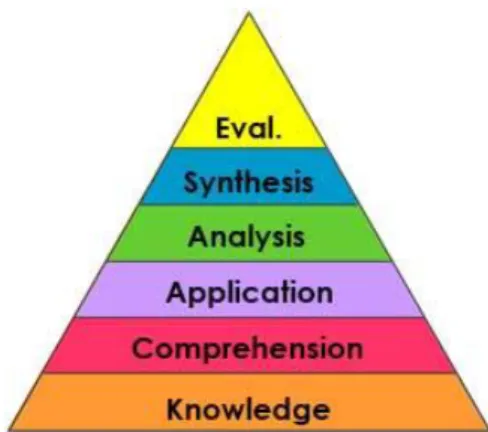
The discussion about learning process in children has had many answers. Continuing with constructivist theories, I am stopping in a taxonomy known as Bloom’s taxonomy (Bloom & Krathwohl, 1956). This taxonomy shows different levels in learning. They are organized in a pyramid, where the basis corresponds to primary learning (early work) and the top is higher-order learning.
Figure 2: Bloom’s taxonomy version
Figure 3: New version
Remembering: What our students can recall? What is his/her previous knowledge?
Understanding: Can students recognise, give examples, describe or explain concepts?
Applying: Can students use new information in their life? Can they dramatize, illustrate, and solve problems with this?
Analyzing: Can students compare, differentiate, experiment, and question themselves?
Evaluating: Can students judge and appraise their own work? And peer work? Can they justify their decisions?
Creating: Can students design or create a new product with this process?
This is a complete process through our pupils acquire new information or skills. We should not forget any step; the designed Assessment Plan and lesson plan follow all of them. Starting with previous knowledge, using the “KWL” technique: what we do Know about the topic? What do we Want to learn? What have we Learnt? Would be the beginning, continuing with different questions on the Targets adding new information, at the same time we are reflecting about our own learning process through Self-Assessment and Peer Assessment. Finally the production of the final task without help will follow, in short: creating.
4.2 READINESS FOR LEARNING
about foreign language learning. In his book “The process of education”, he examined three general ideas: Intellectual development, Act of learning and the curriculum. For this research I consider very important second idea: Act of learning.
Bruner (1960, p. 40) makes us aware of learning as a process with three simultaneous acts. Fist act is acquisition of new information. Each student has previous knowledge, but sometimes this can run against ourselves, if we don’t know how to relate it to previous concepts. Previous knowledge must be used to start new concepts or to relate new ideas. It is the starting point in our learning. Second act is transformation, that is to say, how we manipulate information, and how we are willing to do new tasks. Lastly, Bruner talks about the Evaluation. We check the way of learning; if the information is suitable, if we are operating well and how our results are. Besides, we usually use materials to help our students and to develop capacities and improve attention, as, films, audio-visuals, and other types of devises.
In the classroom activity there is an ideal level of attention. Child attention depends on many factors, but highlighting one, autonomy develops this. Educate students in self-controlled means they know where they are and what they need. Teachers must leave that students act passively and feel bored and apathy. The time for reflection and Evaluation is essential. Brunner highlighted the importance of motivation, mainly intrinsic motivation which is the motor of learning process.
“If teaching is well done and what we teach is worth learning, there are forces at work in our contemporary society that will provide the external prod that will get children more involved in the process of learning than they have been in the past” (Brunner, 1960 p. 73).
marks or grades, rather, he understood it such as the process of checking our learning. He used the word counselling, that today’s, which goes far beyond “Feedback”, as an essential moment of the AfL process.
4.2.1 Motivation and learning
We can find several definitions of motivation throughout pedagogy history. To the best of my knowledge, motivation is a process which brings us to achieve something and keep us going.
In educational issues, motivation try to explain why students prefer some activities, why they implicate more in particular tasks, why they look for teacher’s help or peer’s help. It is truth that all students in school feel motivated in some way. For example, some children really love one subject (maths, science, arts, music, p.e…), others love working in groups and feel really well in co-operative task, and others love playing together in the playground…
Motivation affects directly on our pupil’s behaviour and learning:
Motivation determines the specific goals towards which learners strive. (Maehr and Meyer, 1997; Pintrich et al., 1993)
Motivation affects what learners pay attention to and how effectively they process it .(Eccles and Wigfield, 1985; Pintrich and Schunk, 2002; Pugh and Bergin, 2006)
Students who are most motivated to learn and excl in classroom activities ten to be our highest achievers. (Gottfried, 1990; Schiefele, Krapp, and Winteler, 1992; Walberg and Uguroglu, 1980)
Motivation is something that our pupils can bring from their houses; nevertheless, teachers can originate them in classroom. At this point is when we should differentiate extrinsic motivation and intrinsic motivation:
most likely to take on students in tasks. This second kind of motivation can be defined as the individual’s own to do whatever she/he likes or feels like. It is the motivation that comes from with us. This type is greater when pupils can choose and when they have more responsibilities little by little. Intrinsic motivation develops self-determination, the ability to better yourself and self-confidence. For this, our students need to have a good autonomy, which is strengthening through “learning to learn” competence. AfL, have a clear relation in order to improve this competence, and to get an intrinsic motivation. It should be noted Self-Assessment, in which our students acquire some routines to learning to learn.
But extrinsic motivation is not always bad. At school we teachers use both types of motivation in our designs. To conclude, as a teacher I must have clear the differences between this two types, and why intrinsic benefit our student’s skills. Intrinsic allows our students benefit of their own learning towards interested attitudes developing curious. Extrinsic need a grade, so students don´t feel curious or interested in content.
4.3 EVALUATION AND ASSESSMENT
In this section I will clarify some concepts related with Evaluation, Assessment of Learning, Assessment for Learning and how to implement AfL in a classroom. First of all, it is necessary having clear what is the difference between Evaluation and Assessment.
Evaluation is focused on valuing. It measures quality at the end, namely, what pupils have learned at the end of a topic, a term or a year. It includes curriculum factors in the learning process: goals, course design, materials and methodologies.
Assessment is focused on identifying the exact students’ learning, their achievements. It gives importance to learning process, teaching and outcomes. Assessment gauges the progress of the students. It is an interactive process between pupils and how they learn what we are teaching. Teachers obtain information; they can diagnose problems, look for solutions, make changes and share it with students to improve their learning.
It is possible to assess in different ways: formal, informal, Self and Peer Assessment. Formal Assessment refers to testing. Teachers test to find out how the student is progressing, how the student has learned or compare student’s performance. Informal Assessmentis a way of collecting information in the classroom. It is more often, and it can be of linguistic factors (speaking, writing, listening, reading and grammar and vocabulary) or non-linguistic factors (attitudes, organization, responsibilities, cooperation…). Also our students can do Self-Assessment. It is the Assessment of the own performance. Pupils can express what they know, how they feel, their interests and what they think in general. The last one, but not least, is Peer Assessment. How pupils value the work of their partners and what they think about the others. Not one way of Assessment is better than other, but the exclusive use of one type won´t supply good levels of achievement in competences for children. Nevertheless as teachers we should implement the different types in our Assessment planning, in order to achieve with our competences and to develop autonomy and awareness of learning. For that reason I included different types of Assessment in the proposal.
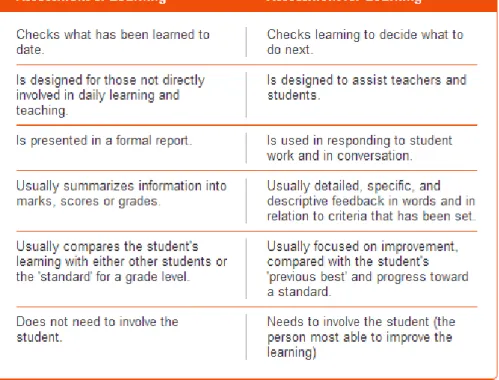
Figure 5: Assessment of Learning vs Assessment for Learning
You can see a clear evolution between of and for. Assessment of is not day to day; it gives information to students through marks or grades; it compares students learning and the learner is not the centre of the process, it gives Summative Feedback at the end of the process. Assessment for is day to day to make decisions; teachers give specific Feedback (Formative Feedback) in words; it is focused on the own improvement and the learner is the centre of the process.
Evaluation is compulsory in our education system, for that reason we should use some proofs to obtain marks. As well as evaluate, Assessment is other important face in the process of obtaining information, a day to day information which allow us understand better our pupils, create a good environment to learning and be conscious of the process. Assessment and lessons must go together, with the same goals, outcomes and expectations; while it does not work in that way, education system is not providing best opportunities to students.
to decide where the learners are in their learning, where they need to go and how to get there best.
4.3.1. Assessment for Learning. What does it mean?
Teachers spend much time and energy assuming their Assessment function (results, planning, Feedback…), so it is quite important having a clear vision about Assessment for Learning.
In the previous part I offered a simple definition of AfL, but, what does it mean? It is only a teacher’s function? Does it have any benefit? It is not only a concept or a definition, actually, it is a big an important process.
Assessment for Learning is a powerful tool of improving pupil’s learning. Through this tool, they understand the goals of the learning, so they can know where they are in each moment, how they can improve and how they can achieves the aims.
It is not only a teacher’s function; it is a process that involves the educational community.
Schools need a system to make regular and useful Assessment in order to follow the learner’s progress.
Parents know how their children are working, so they can support them and help them. Also they can back teachers.
Teachers can observe the learning process, progress, make decisions and change those things that do not work.
Children know exactly where they are, if they understand or not goals, task, how they are going to achieve the aims, and how they feel with the lesson plan.
To make a robust AfL6 it needs to be: accurate, fair, reliable, useful and focused. It has to be precise to judge pupil’s work in a correct way. Of course, it must be linked to National Curriculum (accurate). Teachers need to know if the tools they are using are effective (fair). Judgements are consistent and totally verifiable (reliable). Through
Assessment for Learning teachers can identify problems and discuss following steps in learning (useful). It is focused on different areas of a child’s learning (focused).
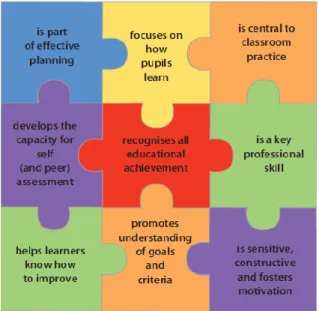
Figure 6: benefits of AfL
To summarize this section, AfL is a powerful tool to improve education; it means a formal process that is composed by more than one agent and it has many benefits, therefore it should be included in classrooms.
4.3.2 Classroom Assessment for student Learning
According to Davies and Herbst7, we need 3 conditions to include AfL:
Involve student in Assessment process. The more involve they are, the better they do.
Decrease Evaluate or Summative Feedback. Testing is based on Evaluate Feedback. Many times, in a classroom only appears Evaluation, give a mark at the end of the unit or the term. This cause either positive or negative emotions, and compare students. Pupils don’t know where they are and how they follow in a good way.
Increase Descriptive or Formative Feedback. Teachers have to talk with students about their work, their progress, their challenge, in a specific, clear and easy way.
To introduce Assessment for Learning in a class, you have to take into account five keys8: Clear purpose, Clear Targets, Assessment Design, Effective Communication and Student’s Involvement. In every key, teachers have their specific competences, so you can find classroom Assessment competences.
Figure 7: Keys to quality classroom Assessment
7 They talk about these three conditions in connect2learning.
http://www.connect2learningresources.com/assessment_for_learning_tr_gs.html
1. Clear Purpose
First step answers this question: why should we asses? Assessment is used for gathering information about our students learning. We can make decisions, think about next step, and change our planning if it is necessary. Without Assessment, the learning process has no sense, because student and teachers don’t realize about the achievements.
In a formal or informal way we can collect information or evidences for improving the learning process (Formative Assessment). Also teachers judge students competences and their progress with marks or grades. We gather information or evidences in order to follow achievements (Summative Assessment).
Competences:
Differentiate Formative and Summative Assessment.
Identify specific Assessment information related with the features of your classroom.
2. Clear Targets
As teachers we have some expectations and goals. Fist of all, we have to make it clear for us, to make good tasks. As well as, students need to know what we expect and what we are going to assess. We must take clear Targets in every lessons, or not too long time. We focus on instructions, thereby, pupils have a clear concept of task, and they would know where they are and what the challenge is in every moment.
Competences:
Identify different types of learning
Set contents into the classroom level and work with different levels of expectations
Plan lesson using learning Targets
Use a student-friendly language
3. Assessment Design
related with the goals and the way of learning/teaching. Beside we should include enough tasks, exercises and Feedback and Assessment items.
Competences:
Know and differentiate Summative and Formative Assessment
Select different task, exercises, guides and Assessment items.
Use suitable and different Assessment methods
Avoid resources that are not appropriate
4. Effective Communication
A regular communication between teachers and pupils is essential in AfL. Teachers must talk about the process, progress, strengths and weaknesses. Assessment results can be used to guide instruction, to change the planning and to assess your own work. Communication must be well organized, in a timely and understandable way.
Descriptive Feedback is the best option to exchange information. This kind of Feedback helps students to focus on what they need to improve the learning process. We can help our students with an increasingly Feedback: from teachers and peers to Self-Assessment. Thus, every student is able to set goals, know their progress and next steps.
“In giving students Descriptive Feedback, you have modelled the kind of thinking you want them to do as self-assessors.” (Chappuis 2005)
Competences:
Include Assessment in lesson planning.
Give effective Feedback during the lessons
Summarize information to reflect about learning
5. Student Involvement
Competences
Share learning Targets in a easy and clear way
Identify pupils as the most important part in Assessment.
Include teacher, Peer and Self-Assessment
5. METHODOLOGY AND DESIGN
5.1 SPANISH CURRICULUM
According to Castilla y León 9curriculum, primary education must contribute to develop and acquire some skills, habits and knowledge. To develop my AfL design I mainly took into account the followings general goals:
Develop individual and group habits, effort and responsibility in the study as well as attitudes of trusting in themselves, critic spirit, personal initiative, curiosity, interest, and creativity in the learning process that discover what having good tasks means.
Develop a responsible and respect for others attitude, a good environment to personal freedom, learning and coexistent.
Acquire, at least, a communicative competence in one Foreign Language that allows express and understand messages and be able to get on in every day situations.
Develop all aspects of our personality.
Besides, this design is completely related with basic competences which appear in the curriculum and they need to be developed.
Learning to learn competence: students reflect in their own process and achievements (Self-Assessment) and in their classmate’s process and achievements (Peer-(Self-Assessment). It is the competence to work in an autonomous way.
Linguistic competence: English language is the tool to communicate in both ways, oral and written, and do Assessment.
Autonomy and personal initiative. Through Assessment strategies students are being more responsible and they are having more autonomy habits. Besides, they reflect on their own progress and can mark their followings steps and achievements.
Social and citizenship competence. Students are tough how to develop respectful attitudes towards their partners, how to be critic in a positive way and how to value a classmate´s work.
Curriculum gives us some steps in order to evaluate student’s learning. Generally, Evaluation must be:
Global and continuous, and it will take into account the progress in the different working areas.
Teachers will evaluate students bearing in mind specific goals and acquired knowledge in each working areas according to Evaluation criteria established by the curriculum which will be essential to value the acquisition of basic competences.
All this general goals, Evaluation criteria should be following in the unit designs to achieve specific goals, and a good development of basis competences. In order to develop this Assessment Plan I also took into account specific goals and Evaluation criteria related to the unit, “Matter and Materials”
5.2 EUROPEAN PORTFOLIO OF LANGUAGES
Common European Framework fosters guidelines in order to provide good learning in a foreign language communication across Europe. It proposes some common basis for goals, contents, Assessment, and methodology to achieve desirable levels in language competence.
According to the methodological options and regarding the ability to learning to learn, (European Portfolio, p. 149) students must be responsible of their own learning. Little by little, teacher should give the more trustworthiness to pupils and encourage them to reflect on their learning and to share this experience with other learners
Assessment also called as Formative and Summative Assessment. Finally, Peer Assessment (teachers or students) and Self-Assessment.
To conclude, Portfolio offers a variety of tools so as to evaluate and assess our students. As teachers, we have the task to decide which methods and options are suitable in our context and to the student’s needs.
5.3 DESIGN
5.3.1 Context
I did the internship in the school “La Salle”. This school has some specific features that I took into account in order to develop my lessons plan. I had the chance to observe and taught in different courses (from 3rd to 5th) and different subjects (science, English and Arts). I focused my teaching and my planning in 3rd course, because I spent more time with them, and my mentor is the tutor.
My mentor is from Ireland, so she has an Irish culture and focused teaching in success and not in what students make wrong. When I arrived I found and Assessment setting, but I found some classroom routines that help me a lot to develop my plan.
To start with, pupils have their own role in the classroom, and they know what they should do and when, so introduce some Assessment routines was easy because they already had and organization. The school follows the premises of the co-operative method. Pupils follow three steps to make groups (1- change tables; 2-change chairs; 3-go to your place). In the groups, each child has their own role, so working in groups is very positive and that helped me a lot with Peer Assessment. Besides some activities has a “working mark” so they are totally integrated and interested in doing well tasks.
KWL: “What I know, what I want to know and what I have learned”. At the beginning of each unit, children fill in the KWL chart. This activity is quite good to relate previous knowledge and the new knowledge. At the same time, it is good to know what they know about the topic, what they are going to learn, what they want to learn (depend on the interested) and at the end of the unit, they will know if they know everything that they would like to.
Figure 8: KWL display in the classroom
“Two stars and a wish” at the end of the unit. Each child complete the chart writing two things that they did very well, and one thing that they would like to improve, or know more about it.
“What I think…”: At the end of the unit, each pupil fill out the chart, writing what has been their favourite part, the most difficult, who help him/her most. It is an easy way to see what they think about the unit. It is a kind of Self Assessment and at the same time of Peer Assessment because it tells us who partner helps him/her the most.
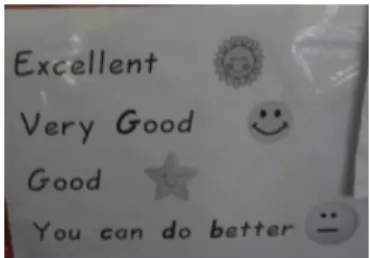
Figure 9: marking in 3rd course
Feedback with thumb: Throughout the units the teacher gives a visual Feedback with thumbs. Thumb up means very well, thumb in the middle means okay, and thumb down means it is not correct you can improve.
Clock: It is a different type of testing in which every pupil has a paper with a clock and the hours. First of all they have to arrange a meeting with different partners in the different hours. When they finish this part (social competence) teacher say an hour and students has to find the person who meets at this time. When they are together teacher asks a question and they should answer together. It is a distinct way of assess knowledge using social competences and raising the pupils motivation. It a bit difficult to 3rd course, but with 5th it works very well, and with peer help they are able to answer all questions.
5.3.2 Adapting an Assessment plan for a given setting
In order to make a lesson plan which included the Assessment Plan proposed, I followed Anne Davies´10 Assessment suggestion which follows clear steps. I summarize these steps in the following six:
1. Set contents and outcomes of the unit
2. Plan how the students can proof their learning. Think in sub-task and task 3. Organize time in the lesson: teach and assess
4. Review everyday lesson plan and think in achievements, materials and tools. Can we improve anything? Write a teacher’s report.
5. If we have missed something I should incorporate it in my teacher’s report. 6. Students evidence their new learning (final task)
I prepared some units for science in 3rd grade and little by little I introduced some AfL routines, until I was able to complete the cycle in my last unit :“Matter and Materials” where I included a completely Assessment Plan. Starting point were contents and outcomes. What had I taught? How could I evidence my students’ achievements? To answer these questions I looked for in Castilla y León curriculum, specific contents and Evaluation criteria. I found in block 6, Matter and energy the following contents:
Matter and properties. Types of materials: natural and artificial. Classify following different criteria.
Physical and chemical changes.
Planning and attainment simples experiences and make predictions about results.
Among the Evaluation criteria I selected:
Obtain relevant information, make predictions with direct and indirect data and communicate result in an oral and written way (using charts, mind-maps…).
The unit had a length of 9 lessons, so I organized different contents and outcomes in these 9 lessons. I attended to three different levels of expectations (Assessment criteria). In every lesson all students (100%) should reach some outcomes; most of the children should achieve (70%) something else and some of the children (20%) has to acquire more knowledge or skills.11 I followed the British planning method not only to develop units or leanings, but also to pay attention to pupil´s Assessment.
Next step was to think of a final task (what my students would be able to do at the end of the unit) and sub-task at the end of each lesson. For that, I planned some questions Target for each class and some sub-task to realize if they reach proposed.
Third, I organized time: In every lesson there was time to teach, to work and to asses. I included all my tools and routines for AfL and AoL.
Question Target and sub-task. At the beginning of the lesson I wrote a question in the board, and at the end they should be able to answer the question. Furthermore, they had a sub-task to check their learning
11
KWL
Traffic lights: to Self-Assessment at the end of the lesson and unit, and to Peer-Assessment in co-operative tasks. Red face means I get it, yellow face means, I’m getting there and red face means I need more help.
Figure: Traffic lighst
Record sheet to write down their achievements in every lesson.
Reference work: show examples that make clear what they needed and what they had to do.
Asking questions, such as, “what do you think about this idea”, “do you agree with your partner?”, “is this true”?
Formative Feedback during the unit to gather everyday information, using thumb routines and oral Feedback. Summative Feedback at the end of the unit to know their final achievements.
“What I think…”:
Self-marking at the end of the unit using traffic lights.
Final worksheet in order to Evaluate. Using drawing to qualify results
Final task: table quiz in group to have a common mark and to develop social skills.
During the unit I wrote a teacher’s report with formal and informal aspects about the lessons, such as, the timing, my pupil achievements, positive and negative aspects and I reflected about how I could improve and if the correlation between contents, outcomes and task was reliable and valid.
Lesson 1
-Outcomes: Make a list with words they already know about the unit and with words that they want to learn.
-Assessment criteria following different levels of expectations:
1st: All students must fill “K” (what I know) and “W” (what I want to learn) chart and participate in sharing ideas.
2nd: Explain in an oral way words that they already know. 3rd: Ask questions about new words.
-Assessment for Learning tools:
“KWL”: looking at the book they should find those words that they already know because of the past units and should words that they don’t know and want to know.
Asking questions: I asked questions such as, “Can you explain that?” “Do you agree with your classmate?”
Lesson 2
-Outcomes: Touch close examples of matter, illustrate what matter is, express different examples of matter in different states (solids, liquids and gases) and participate and respect turns.
- Assessment criteria following different levels of expectations:
1st: Participate in activities, say examples in different states, and express what matter is with body language.
2nd: Express what matter is with words and gestures
3rd: Identify characteristics in shapes (solids, liquids and gases)
-AfL tools:
Question Target: What is matter? How can we find matter?
Sub-task: from an image with different drawings they should classify the different objects.
They fill in the record sheet.
Asking questions: for example, do you agree? Do you think honey is a solid or a liquid?
Feedback with thumb: If they worked well or their answers were correct, I would show my thumb up.
Lesson 3
-Outcomes: make predictions of measurement, relate mass with height and volume with the spaces that occupies and fill in measurement chart and participate actively.
- Assessment criteria following different levels of expectations:
1st: Relate mass with the scale and volume with “water displacement” experiment. Participate in the experiment.
2nd: Make predictions about height.
3rd: Express mass and volume using some English words (mass is the amount of matter and volume the space that an object occupies).
-AfL tools:
Question Target: What are properties of matter?
Sub-task: experiment with the scale and water displacement with different objects.
Self-Assessment using traffic lights if they know how to answer question Targets.
They fill in the record sheet.
Working in pairs: with two different objects make predictions. Peer-Assessment using traffic lights.
Asking questions: for example, do you agree? Which has more matter? Which occupies more space?
Feedback with thumb: If they worked well or their answers were correct, I would show my thumb up.
Lesson 4
- Assessment criteria following different levels of expectations:
1st: Make some matter changes with paper and pencil case; identify physical and chemical changes given by teacher and flashcards.
2nd: Verbalize at least two examples of changes and identify changes in other examples. 3rd: Share orally four examples of changes.
-AfL tools:
Question Target: Can matter change?
Sub-task: complete mind map of changes in matter.
Self-Assessment using traffic lights if they know how to answer question Targets.
They fill in the record sheet.
Asking questions: do you agree with your classmate? It is a physical/chemical change?
Feedback with thumb: If they worked well or their answers were correct, I would show my thumb up.
Lesson 5
-Outcomes: express daily examples of mixtures, experiment two types of mixtures and separations.
- Assessment criteria following different levels of expectations:
1st: Express two examples of each type of mixture; participate in the experiment. 2nd: Name two methods for separation mixtures; make predictions with different components
3rd: Identify each mixture with the kind of separation without experiment.
-AfL tools:
Question Target: What happen when we mix matter?
Sub-task: exercise 2 and 3 page 115. Identify different mixtures and separations.
Self-Assessment using traffic lights if they know how to answer question Targets.
They fill in the record sheet.
Feedback with thumb: If they worked well or their answers were correct, I would show my thumb up.
Lesson 6
This was a review lesson in order to remember past concepts. All activities were in co-operative way. The outcomes and Assessment criteria were a summary of past lessons. In this lesson was very important working together, and reflect about what they have learnt, if partners were able to help them and what group mates have learnt.
I use the following AfL tools:
Self-Assessment using traffic lights at the end of the lesson depending on their achievements. If they remember everything or almost everything they showed me green face; if they have some mistakes showed me yellow face and at last, if they don’t remember many things showed me red face.
Peer Assessment in every group. The Assessment was about behavior and friendless. If they respect turns, participate in the activities, or help each other…
Feedback with thumb: if the group works well together I show up thumb to whole group, if there were any problem thumb down was for the completely group as well.
Oral and personal Feedback asking questions. I observe groups and ask different questions to my pupils, for example, do you think it is a physical/chemical change?.... depending on their answer I told them what they needed to do.
Lesson 7
-Outcomes: express what a material is, list the possible origin of materials, write different examples of materials according with their origin
- Assessment criteria following different levels of expectations:
1st: Identify natural and artificial materials; say at least, one example of each one; ask simple questions of materials: It is natural/artificial?
2nd: Identify natural, mineral and vegetable origin in natural materials. Say two examples of each group.
-AfL tools:
Question Target: Where does matter come from?
Sub-task in pairs: guess the material asking simple questions and stick the word in the suitable chart.
Self-Assessment using traffic lights if they know how to answer the question Target.
They fill in the record sheet.
Asking questions: It is natural or artificial? Do you agree?
Feedback with thumb: If they worked well or their answers were correct, I would show my thumb up.
Lesson 8
This lesson is focused on Self-Assessment and developing final task: a table quiz
-Outcomes: write what they have learned during the unit, to work in groups to demonstrate their new knowledge through table quiz.
- Assessment criteria following different levels of expectations:
1st: Write 10 words or expressions from the unit; participate in table quiz giving answers; respect writing turns.
2nd: Write 15 words or expressions from the unit; help their partners to understand questions in table quiz.
3rd: Write 20 or more words or expressions.
-AfL tools:
KWL: they fill out “L” column with words or expressions they have learned. When finish we shared our ideas aloud and they have time to compare what they know at the beginning, what they wanted to learn and actually what they have learned.
Group Assessment: at the end of the final task they should talk about how they worked on groups and one member showed me the suitable color with the traffic light.
Lesson 9
During this lesson we carried out a final worksheet, so as to see the level off knowledge acquired. This proof is a type of Evaluation and specifically testing. When I corrected I wrote (excellent selection, very good examples, good sequence or you can do it better you could add more examples...) instead of numerical marks. With this type of correction I wanted to focus on positive aspect, and not highlight what they did wrong.
When they finished final worksheet they did “what I think…” They write what they liked the most, what was the most difficult part and who helped the most. When shared ideas aloud because it was an important point for me to discover what they thin in general about the unit.
To end, they had some minutes to reflect about their learning and behavior; if they do homework, if they learned many new things, if they participate, respect rules of the class and they have to do a finally self-assessment using traffic lights.
5.3.3 Why this research?
As I expose in Justification part of the research, there are many reasons to work with Assessment. This proposal was carried our to achieve some objectives.
To star with, Evaluation and Assessment is compulsory in teacher’s function. We can’t look to other side in Assessment time. To develop a good Assessment for and of Learning needs hard work, but if we are real teachers, it needs to be include in our tasks. Besides we should heed to teacher’s competences. School works with CLIL methodology, so I followed these lines.
In children it is essential create some routines to acquire habits. Some tools such as Target questions and traffic lights allowed us create routines and are more autonomous in the learning.
5.3.4 Presentation of results
Generally speaking, the Assessment Plan was very successful. It helped children to realize if they learned according to the established. I didn’t usually say “we are going to make review exercises, or table quiz or the final worksheet”. Through Self-Assessment they were conscious if needed extra help or carry science notebooks to home. Follow up this own knowledge, I knew who needed extra help or more time and I tried to push them, using Feedback. That showed me Assessment was creating and awareness learning as well.
The association question Target-Self-Assessment fostered students a scaffolding process into AfL. Using traffic lights as a new routine in the classroom, they automatically used at the end of the lesson. Previously they thought in answering question Target finally they showed me the suitable face of traffic lights and wrote down in Self-Assessment grid.
Other important point was Peer Assessment. It was quite interesting how pupils reflected on partner’s progress and helped them in group tasks. For children it essential working in groups and try to help the others, always with a positive perspective. They can say “you should ….” But in the class it was prohibit accused the others of doing bad things. Thereby all children know they can improve and feel good.
This plan, above all, is meaningful because includes both Assessment and Evaluations and it engages to work with learning to learn and autonomy, without excluding final Evaluation and marking, that is compulsory in our education system.
5.3.5 What else we can do in our classroom?
I used some Assessment tools in my class, but you can find many resources to work with AfL. As suggestion I would like to talk about some of them.
Post-it instead of traffic light. It is a good method for elder children (5th or 6th of primary). We need post-its and three big cardboard in the classroom (one red, one yellow and one green). At the end of the lesson every pupil have a post-it, if they reach Target they stick the post-it in green card, if not, they would think in their weaknesses or what they need to improve and stick in yellow or red. It is a visual tool to see where teacher must pay more attention, and for students it is an easy way to think in their learning process and identify their improvement.
Question box: Students can write questions during the unit or write thing they would like to know on the new topic. They can drop questions, which they will be shared aloud, in a box.
Redraft: It can be used in written task. Pupils must take into account teacher Feedback and write again their task with new instructions.
Generate and answers: it is meaningful working in groups. Pupils generate their own questions about the topic and they ask one each other. If they don’t know they answer they will help to understand.
Mark-scheme: students think in their process and work and write down their own mark. In third grade I used this final Self-Assessment using traffic light. This is for older groups.
Show and tell: with mini-whiteboards and or paper (this last one is more economically) students can write or draw answers and show them to the teacher. For small children is better drawings, and for older is better writing.
Minute paper: at the end of the lesson every child has a minute to think and write the most significant think they have learned.
Why is it the best? For homework students must find their best pieces of work and think why. Next lessons they expose their opinions.
Red/green cards; every child has a red a green card. When they have problems to understand something or to do a task, they should follow some steps. Firs, ask the right partner, if she/he can’t help, ask the left partner secondly. Finally if he/she hasn’t resolved doubts they put red card in the table and teacher goes to help. It is a good Peer-Assessment and in last terms, teacher will turns to.
6.
CONCLUSIONS
When I started this project I set my own goals. The main aim was to research about Assessment for Learning at the same time I could identify what it meant for teachers and for students. On this point the research has revolved. I have acquired a great level of knowledge about Assessment and the differences with Evaluation or testing as well. Through different books, theories, web page I can understand the differences completely and located in the correct place in education issues. In addition I have some sub-goals, such as highlight the importance of Assessment in teacher’s task, know different methods to use them in the classroom with students. Throughout the different parts of the project I have developed what I had proposed, therefore I reached all my objectives.
between a theoretical approach and a practical part. In the theoretical foundation all ideas I exposed have a connection between them and between practical parts. Also this review about different authors and thinking models helped me to update myself and refresh my knowledge as a teacher.
As you can see, Assessment for Learning is a process and it develops learning awareness and scaffolding. Besides, this work highlights the importance of understanding learning process in a continuous way where students are the centre and the important issue. As teachers we have the obligation to develop the most of student’s abilities and skills always attending the different levels of expectations and the necessities of each child.
This research also shows that Assessment for Learning is real and can coexist with Evaluation. Evaluation is compulsory in education, because at the end of the term parents receive a report with a final mark. Sometimes seems that grades are the most important issue and nevertheless they aren’t. Students need to have strategies to know how their learning process is going and how can they improved. Thereby they will be conscious of their own steps and will be autonomous. I have made clear with this work that in classroom teachers must work in both ways, everyday with Assessment for Learning and at the end using Assessment of Learning (Evaluation).
In the training period I put into practise everything that I have learned about Assessment. Context was very important in this project because it has been my starting point and my reference point. I knew what they did and I knew what I wanted to do to improve and to engage Assessment routines. The designed plan was totally tough for third group thus I tried to attend group features. The choice of materials was quite properly, because they are very easy to use and allow us working with Assessment not using too much time. In fact my mentor at school still uses some of the materials designed for this research, such as, the traffic lights and in that way children could continue with some routines.
Peer Assessment has been another important step. They have worked in groups and helped one another assessing their achievements. All of this, it has been developed always using a positive perspective through everybody can do it better and improve, and never highlighting bad aspects.
The results of the practice speaks for itself. During the unit children knew what they had learned and where we were in each moment. In every lesson we made reviews of previous questions to help those who had doubts. Besides with homework they refresh all we made in the classroom. Those who thought need to review something brought their books home. All of these things showed me that Assessment was working, because they are autonomous to decide in their own learning.
As this research has been focused on AfL, and I have talked before of the importance of Self-Assessment I did in myself. To continue getting a positive attitude towards this topic I should:
Observe what are my student’s necessities and work attending to the levels of expectations.
Make Assessment Plan according to teaching plan, in which both there must have a relation between goals, outcomes, Target and expectations.
Reflect always about my practise. Asking me “does it wok?” or” how can I improve”?
Give continuous Formative Feedback to my students during the process. Use Formative Feedback at the end el units.
Mange students acquire habits and Assessment routines, above all, working through Self and Peer Assessment.
Foster in students a feeling of responsibility about their own learning.
Have enough time in lessons to think in what they have done.