The B Method as an Environment for
the Verification of Eiffel Programs:
A Case Study
Juan Oviedo and Nazareno Aguirre
Departamento de Computaci´
on, FCEFQyN,
Universidad Nacional de R´ıo Cuarto,
Enlace Rutas 8 y 36 Km. 601, R´ıo Cuarto, C´
ordoba, Argentina,
{
joviedo, naguirre
}
@dc.exa.unrc.edu.ar
Abstract
In this paper we present an attempt to represent Eiffel programs as B specifications. Our purpose is to use the B method as an environment for the verification of the correctness of Eiffel programs.
We study the difficulties associated with the representation of object oriented features (inherent to Eiffel programs) in the non object oriented B language. We use an extension to B in order to represent dynamic creation and deletion of objects, and show how object interaction can be achieved by borrowing some ideas from software architectures.
The paper is centred on a simple and well known case study, the tra-ditional object oriented implementation of generic lists.
Keywords: Object orientation, Program Verification, B Method.
1
Introduction
Object orientation is one of the most successful modern methodologies for the design and implementation of software systems. It constitutes an elegant and ef-ficacious realisation of well established programming principles such as modular-isation, information hiding and reuse. If used appropriately, object orientation can lead to the development of quality software.
Currently, there exist various object oriented development techniques, and a wide variety of object oriented programming languages. A particularly inter-esting object oriented programming language is Eiffel [9]. Eiffel was created by one of the leading researchers in object orientation, Bertrand Meyer, and relies on a well founded design concept, calleddesign by contract [10]. In the context of object orientation, a contract is a statement that regulates the interaction be-tween an object and its clients, and is expressed in terms of assertions. Typical examples of these assertions are preconditions and postconditions for methods, and class invariants, but other kinds of assertions are also possible.
the use of exceptions. One can then realise if “something went wrong” during the execution of a program, and act appropriately by catching the thrown excep-tions. However, Eiffel does not directly provide a mechanism for verifying that a program, or more precisely its constituent classes, satisfy their correspond-ing contracts. Verifycorrespond-ing that a class satisfies its contract is a very important task, since it would ensure that, if the class is employed appropriately (i.e., within the “terms and conditions” of its contract), it will provide the required functionalities (i.e., it will fulfill its contract).
In order to verify that a class satisfies its corresponding contract, Bertand Meyer proposed attaching an abstract model to each class, and translate the class into a mathematically defined version; in order to prove that the class is correct, one needs to check that the mathematical version of the class is consistent with its abstract model. As indicated in [12], this might be done by translating Eiffel classes into specifications in the B language. The B formal specification language is a model based formalism for software specification. It has an associated method, the B Method [1], and commercial tool support, including proof assistance [4][5].
In this paper, we study the difficulties associated with the representation of object oriented features (inherent to Eiffel programs) in the non object oriented B language. The B language does not directly support some object oriented con-structs, most notably dynamic creation and deletion of components, inheritance and communication through object references. We use a previously proposed extension to B in order to represent dynamic creation and deletion of objects, and show how object interaction can be achieved by borrowing some ideas from software architectures.
The paper is centred on a simple and well known case study, the traditional object oriented implementation of generic lists.
2
The B Method
The B language belongs to the class of the so called model based formal specifi-cation languages. It has been used in industry with some success, in a number of applications ranging from the development of control systems to smart cards. As all formal methods, the B method provides a formal language to describe systems, allowing for analysis and verification of certain system properties prior to implementation. An important characteristic of B is that it covers the whole development process, from specification to implementation.
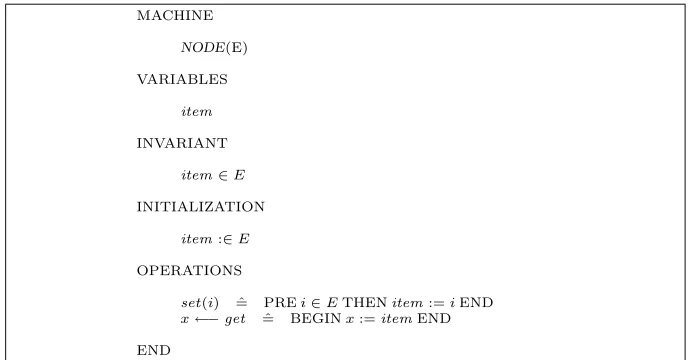
B specifications are centred on the notion of abstract machine. Abstract machines are the units of modularisation of specifications in B, and resemble modules of non object oriented imperative languages. An abstract machine encapsulates data and behaviour. Data is represented in terms ofvariables, and behaviour in terms of operations. Consider, as a simple example, the abstract machine in Fig. 1. This is a simple machine, composed of a single variable, and two operations for setting and getting the value stored in this variable. This variable is “typed” by a set which is passed as a parameter of the machine.
MACHINE
NODE(E)
VARIABLES
item
INVARIANT
item∈E INITIALIZATION
item:∈E OPERATIONS
[image:3.612.124.470.74.254.2]set(i) =ˆ PREi∈ETHENitem:=iEND x←−get =ˆ BEGINx:=itemEND END
Figure 1: A simple abstract machine
Operations are specified by means of preconditions and multiple assignments. It is required that operations preserve the machine invariant. This constraint is part of the proof obligations of abstract machines. These constraints must be
discharged in order to guarantee the consistency of the abstract machine.
2.1
Object Oriented Extensions to The B Method
Various facilities for structuring specifications are provided in B, helping to make the specification and refinement activities scalable. However, the B method has an important restriction regarding structuring mechanisms, namely, it does not provide dynamic creation and deletion of modules or components. All struc-turing mechanisms of B arestatic; they allow one to define abstract machines whose architectural structure in terms of other components is fixed, i.e., it does not change at run time [6]. Dynamic management of the population of com-ponents is a feature often associated with object oriented languages, since the replication ofobjects is intrinsic to these languages [11]. Indeed, dynamic man-agement of “objects” appears frequently and naturally when modelling software, perhaps due to the success of object oriented methodologies and programming languages. However, fully fledged object oriented extensions of B would imply a significant change to B’s (rather neat) syntax and semantics, and would ex-cessively complicate the tool support implementation (especially in relation to proof support).
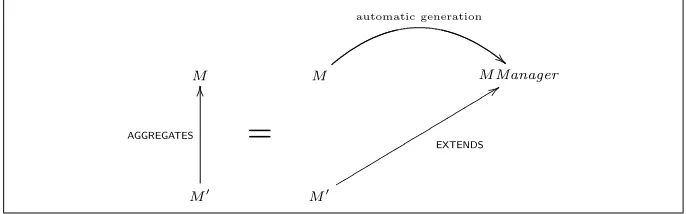
In [2], an extension of the syntax of B is proposed for supporting dynamic population management of components. This extension, in contrast with other proposed extensions to model based specification languages with this feature, such as some of the object oriented extensions to Z [14] or VDM [7], is not object oriented. Moreover, it does not imply any changes to the standard se-mantics of B, since it can be mapped into the standard language constructs [2]. The extension is essentially the provision of an extra structuring mechanism, the AGGREGATES clause, which intuitively allows us to dynamically “link” a
AG-GREGATES M relies on the generation of a population manager for M, i.e.,
a machine which represents a dynamic set of M, including operations for the creation and deletion of machine instances. A very important feature of the approach is that the generated population manager MManager forM is cor-rect by construction, provided that M is correct [2]. Moreover, if one counts on a correct implementation for M, an implementation forMManager can be systematically constructed, which is also correct by construction [3].
TheAGGREGATESM clause within a machineM′ is then simply interpreted
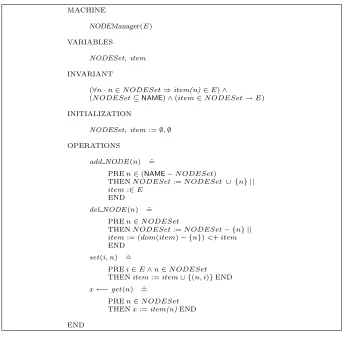
asINCLUDES M (or, more precisely, asEXTENDSM). As an example, consider
the population manager generated for machine NODE(E) is shown in Fig. 2. The meaning of AGGREGATESis graphically depicted in Fig. 3.
MACHINE
NODEManager(E)
VARIABLES
NODESet, item
INVARIANT
(∀n·n∈N ODESet⇒item(n)∈E)∧
(N ODESet⊆NAME)∧(item∈N ODESet→E) INITIALIZATION
NODESet, item:=∅,∅
OPERATIONS
add NODE(n) =ˆ
PREn∈(NAME−N ODESet)
THENN ODESet:=N ODESet ∪ {n} ||
item:∈E END
del NODE(n) =ˆ
PREn∈N ODESet
THENN ODESet:=N ODESet− {n} ||
item:= (dom(item)− {n})<+item END
set(i, n) =ˆ
PREi∈E∧n∈N ODESet THENitem:=item∪ {(n, i)}END x←−get(n) =ˆ
PREn∈N ODESet THENx:=item(n)END
[image:4.612.125.468.215.552.2]END
Figure 2: The NODEManager machine
3
Eiffel Programs
by contract; it also features a mechanism for exception handling, particularly related to contract violation, and provides automatic memory management.
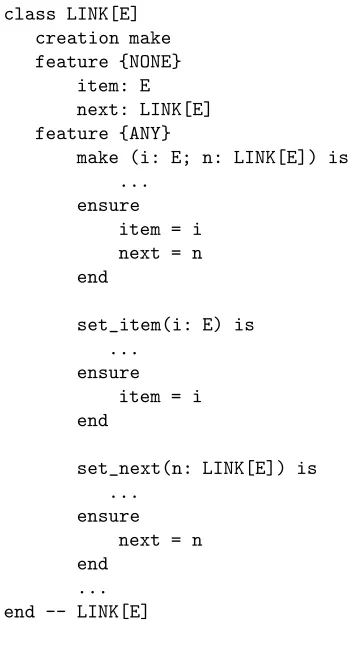
Eiffel’s syntax is based on languages such as Simula and Pascal. A simple example of the “flat form” of two Eiffel classes can be seen in Figs. 4 and 5. These two classes constitute (part of) a classical implementation of generic lists, using single linked nodes.
One can specify the state and the behaviour of objects by definingfeatures
(either attributes or routines) in their corresponding classes.
The language integrates the definition of assertions, such as preconditions and postconditions for “methods”, variants and invariants for loop statements, and class invariants, directly in the source code. These assertions are useful for specifying and documenting classes, and can optionally be checked at run time. When an assertion is violated, an exception is thrown. This exception must be managed by some object in the invocation chain or will otherwise result in an error that aborts the program execution.
As we will see later on in this paper, we are not concerned, for the moment, with the implementation of methods. So, we have intentionally omitted, in the examples, the implementations of the methods.
Eiffel provides interesting features related to information hiding. As typical in other programming languages, one can define an “interface” for a class, indi-cating which features are “exported”. But in contrast with other programming languages, in Eiffel one must specify which classes are allowed to access the exported features. The traditional public/private exporting becomes a special case of this more sophisticated notion of interface; in order to represent these, Eiffel provides two special built-in classes, ANY and NONE. A feature exported to ANY is “public”, since ANY is an abstract class that is at the top of the Eiffel class hierarchy; class NONE, on the other hand, is at the bottom of the hierarchy and no class can inherit from it, so a feature exported to NONE is “private”.
As we mentioned, Eiffel supports multiple inheritance, and the correspond-ing mechanisms to avoid problems related to it, such as repeated inheritance and name collisions. Contracts are inherited too; this is regulated by the “sub-contracting principle”, which establishes that a redefined method must preserve or weaken the precondition, and maintain or strengthen the postconditions.
Although we have been concerned with the description of Eiffel as a pro-gramming language, it is better understood if seen as a methodology for software
M′
M
=
M′
M MManager
[image:5.612.125.468.527.634.2]AGGREGATES O O automatic generation " " EXTENDS 9 9 r r r r r r r r r r r r r r r r r r r
class LINK[E] creation make feature {NONE}
item: E next: LINK[E] feature {ANY}
make (i: E; n: LINK[E]) is ...
ensure item = i next = n end
set_item(i: E) is ...
ensure item = i end
set_next(n: LINK[E]) is ...
ensure next = n end
[image:6.612.123.297.73.398.2]... end -- LINK[E]
Figure 4: Class Link
development. Eiffel, as a methodology, aims at good quality and productivity, by taking advantage of well established programming principles, and supporting them within the programming language. Eiffel also covers the entire develop-ment process; during the earliest stages, one can use Eiffel to directly specify the abstract properties of the objects by using assertions; in later stages, one can implement the software using Eiffel again, and test the programs against their specifications.
4
An Overview of the Approach
The reader might already find some similarities between Eiffel, as a method, and B. Both cover the entire development process, and share common notions such as class invariants (abstract machine invariants in B), preconditions and postconditions for methods (operations in abstract machines), etc. However, as we argue in this paper, their differences are not trivial to overcome. In particular, there exists an important “gap” when trying to map Eiffel programs into B specifications, namely the lack of object orientation in B.
class LIST[E] creation make feature {NONE}
head: LINK[E] feature {ANY}
make is ... ensure
head = Void end
insert_front(e: E) is require
e /= Void ...
ensure
head.item = e
head.next = old head end
[image:7.612.124.279.72.327.2]... end -- LINK[E]
Figure 5: Class List
of assertions and for implementation. B, on the other hand, has specialised and separated language constructs for specification and implementation. In B, one starts by specifying an abstract machine, say M. After proving that M
is consistent (operations preserve the machine invariant, etc), one can define a refinement (resp. an implementation) for M. B counts on a number of condi-tions which must be discharged in order to prove that the proposed refinement (resp. implementation) is correct with respect to M. The tool support asso-ciated with the B method provides theorem proving facilities for carrying out this verification task.
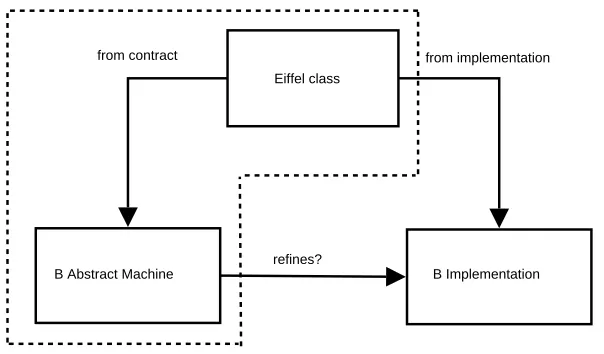
Basically, the approach we propose in order to use the B method as an environment for the verification of Eiffel programs is the following:
Given an Eiffel classP, with contracts expressed as assertions, two B specifications are synthesised:
• an abstract machine MP, which is constructed only from the
assertions of P, and captures its invariant and pre and post-conditions of its operations,
• an implementation IP, constructed only from the code of P,
and which represents the realisation of P’s methods.
Verifying the correctness of classP thus reduces to prove thatIP is
a valid implementation ofMP. One can now attempt to prove this
Graphically, this can be illustrated as in Fig. 6. The part of this diagram which is wrapped in dotted lines is what we study in this paper.
B Abstract Machine B Implementation from contract from implementation
Eiffel class
[image:8.612.147.449.108.285.2]refines?
Figure 6: Graphical view of the proposed approach to the verification of Eiffel classes
5
A Case Study
In order to study the possible difficulties in representing Eiffel programs as B specifications, we choose to develop a case study. This case study consists of a simple and widely known datatype implementation, more precisely, a tra-ditional object oriented implementation of generic lists. Since object pointers
or references are particularly useful in object oriented implementations (e.g., they are normally used to implement class associations and client-provider re-lationships), we decided to base our study on the single linked reference based implementation of lists.
Single linked reference based lists can be implemented in Eiffel by defining a LINK class, meant to hold an item of the list, and having as a feature a reference to the link holding the “next item” in the list. An Eiffel definition of such a class was already shown in Fig. 4. Again, we have omitted the actual bodies of the methods of this class, and just showed their corresponding contracts, i.e., their pre and postconditions. Their implementations are not relevant to us for the moment, since we are only concerned, at this stage, with translating the “specification” of classes, i.e., their contracts. However, the implementations of these methods are obvious. Note that class LINK is generic, since it is parameterised by a (class) type E.
With class LINK defined, a single linked reference based list can be easily constructed, in the typical way, i.e., with a “reference” to the head of the list. The corresponding Eiffel class was previously shown in Fig. 5. Again, we have omitted the bodies of the methods of this class, but most readers should be already familiar with that.
pro-gram. We would prefer to maintain the architectural structure of the program, i.e., to provide one abstract machine for LINK, and another abstract machine for LIST, based on the first one. This is so due to the fact that, in specifications, modularisation is also important: modular specifications allow us to alleviate the proof efforts (for proving consistency, for instance) and help us understand complex specifications [4].
5.1
Representing class LINK
Class LINK should then be represented by an abstract machine LINK. Our first task in representing class LINK’s constituents is the characterisation of its pa-rameter E. This does not constitute any difficulty, since it can trivially be defined as a set parameter of the corresponding abstract machine. A different case is that of the representation of LINK’s attributes (i.e., features that correspond to variables). The first of these isitem, and its type is E. The second one,nextis the problematic one, since its type is LINK, the very same class we are defining. In B, this is not allowed; abstract machines can only be hierarchically organised in terms of simpler machines, and no recursion or dynamism is permitted in this structure. This variable and its associated methods cannot be represented within LINK. LINK’s representation as a B abstract machine becomes reduced to abstract machineNODE, given in Fig. 1. Since the “link” to the next item has been lost in the translation of LINK into a B abstract machine, we prefer to call the resulting abstract machineNODE, instead of LINK.
Of course, classNODEis not a faithful representation of class LINK, since a crucial part of it was lost in the translation. We will have to find a way of representing the “lost link”; as we will see, we will do this by borrowing some ideas from software architectures, externalising object interactions, and defining connectors.
5.2
Representing References
Since references to other modules or components is not, in general, straightfor-wardly supported in B, we need to represent them outside component defini-tions. A possible approach is that of software architectures [13]. In software architectures, systems are built out of components, which interact through con-nectors. Communication between components (objects in our case) is then ex-ternalised from the component definitions.
As we explained before, a special typeNAMEis used to characterise names of instances. In order to represent the ‘next’ attribute of the LINK original class, we can employ a binary relation next on NAME, relating instances of NODE within class LIST to their right neighbour. Since each instance of NODE has at most one right neighbour, relationnext must be functional. But, of course, these elements should be defined within abstract machine LIST.
5.3
Representing class LIST
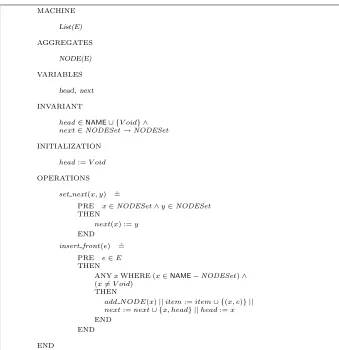
Fig. 7. We make use of theAGGREGATES clause, that allows us to have several
“dynamic instances” of theNODEabstract machine, as one expects to have in a list. Such instances are now elements of a set called NODESet, and controlled “dynamically” by a NODEManager abstract machine.
We assume the existence of a special constant Void which does not belong to NAME. Void is meant to represent, as in programming languages, a null reference. In our example, we employ Void as an initial value for attribute head.
MACHINE
List(E)
AGGREGATES
NODE(E)
VARIABLES
head,next
INVARIANT
head∈NAME∪ {V oid} ∧
next∈NODESet→NODESet
INITIALIZATION
head:=V oid
OPERATIONS
set next(x, y) =ˆ
PRE x∈NODESet∧y∈NODESet
THEN
next(x) :=y END
insert front(e) =ˆ
PRE e∈E THEN
ANYxWHERE (x∈NAME−NODESet)∧
(x6=V oid) THEN
add N ODE(x)||item:=item∪ {(x, e)} ||
next:=next∪ {x, head} ||head:=x END
END
[image:10.612.131.462.180.525.2]END
Figure 7: Abstract machineList(E).
6
Related Work
we explained before, it is in our interest to produce structured B specifications from object oriented programs/specifications, since structure in specifications helps one in dealing with the complexity of large systems, alleviates the proof efforts, etc.
Another line of work related to B and object orientation is that of B. Tat-ibouet et al. [15], who propose translating B specifications into less formal notations, such as class diagrams or statecharts. Their work is less related to ours, since the direction of the translation is the opposite, and the objectives are rather unrelated (we intend to use B to verify programs, whereas Tatibouet et al.’s main objective is to provide more familiar “front-ends” of B for software engineers without mathematical background).
There exist object oriented alternatives to some model based formal meth-ods, particularlyObject Z,Z++andVDM++. It is not our intention to provide a “fully flavoured” object oriented extension of B. Instead, we try to incorporate onlysome object oriented features into B, without destroying B’s methodology. The main advantages of our approach are the compatibility with the tool support available and existing work on B. K. Lano proposes to use these object oriented variants of model based formal methods for formal object oriented development [8].
7
Conclusions
We studied some difficulties associated with the representation of object oriented features in the non object oriented B specification language. The motivation for our work is the use of the B language (and method) as a verification framework for object oriented programs, particularly Eiffel programs.
We have chosen to use an available extension to B, presented in [2], to characterise dynamic creation and deletion of modules or components (abstract machines in B). We have shown by means of a case study that the work in [2] is insufficient, and that some simple and very common specification tasks could not be achieved using the extension ‘as is’.
Other concepts intrinsic to object orientation, such as inheritance, were not considered in this paper. As work in progress, we are trying to extend the work in [2] to deal with the problems acknowledged here, and we are already studying possible representations of inheritance and associations in B.
References
[1] J.-R. Abrial, The B-Book, Assigning Programs to Meanings, Cambridge University Press, 1996.
[2] N. Aguirre, J. Bicarregui, T. Dimitrakos and T. Maibaum, Towards Dy-namic Population Management of Components in the B Method, in Pro-ceedings of the 3rd International Conference of B and Z Users ZB2003, Turku, Finland, LNCS, Springer-Verlag, June 2003.
Proceedings of the International Conference on Formal Engineering Meth-ods ICFEM 2004, Seattle, USA, LNCS, Springer-Verlag, 2004.
[4] The B-Toolkit User’s Manual, version 3.2, B-Core (UK) Limited, 1996.
[5] Digilog, Atelier B - G´en´erateur d’Obligation de Preuve, Sp´ecifications, Technical Report, RATP SNCF INRETS, 1994.
[6] T. Dimitrakos, J. Bicarregui, B. Matthews and T. Maibaum,Compositional Structuring in the B-Method: A Logical Viewpoint of the Static Context, in Proceedings of the International Conference of B and Z Users ZB2000, York, United Kingdom, LNCS, Springer-Verlag, 2000.
[7] C. Jones,Systematic Software Development Using VDM, 2nd edition, Pren-tice Hall International,1990.
[8] K. Lano, Formal Object-Oriented Development. Formal Approaches to Computing and Information Technology, Springer, 1995.
[9] , B. Meyer,Eiffel: The Language, Second printing, Prentice-Hall, 1991.
[10] B. Meyer,Applying ‘Design by Contract’, in IEEE Computer, Vol. 25, No. 10, 1992.
[11] B. Meyer, Object-Oriented Software Construction, Second Edition, Prentice-Hall International, 2000.
[12] B. Meyer, A Fremework for Proving Contract-Equipped Classes, in Pro-ceedings of the 10th International Workshop on Abstract State Machines 2003– Advances in Theory and Applications, Taormina, Italy, Springer, 2003.
[13] M. Shaw and D. Garlan,Software Architecture: Perspectives on an Emerg-ing Discipline, Pearson Education, 1996.
[14] M. Spivey, The Z Notation: A Reference Manual, 2nd edition, Prentice Hall International, 1992.
[15] B. Tatibouet, A. Hammad, and J.-C. Voisinet, From an abstract B spec-ification to UML class diagram, in Proceedings of the 2nd IEEE Interna-tional Symposium on Signal Processing and Information Technology (IS-SPIT’2002), Marrakech, Maroc, 2002.