Alcoholic hepatitis:
How far are we and where are we going?
Verónica Prado,* Joan Caballería,†,§,|| Víctor Vargas,‡,||,¶,** Ramón Bataller,†† José Altamirano‡,§
* Intensive Care Unit and Liver Unit. Hospital Clinic; Barcelona, Spain. † Liver Unit. Hospital Clinic. Universidad de Barcelona. Barcelona, Spain. ‡ Liver Unit. Internal Medicine Department. Vall d’Hebrón Hospital and Vall d’Hebrón Institut de Recerca (VHIR). Universitat Autónoma de Barcelona; Barcelona, Spain. § Institut d’Investigacions Biomèdiques August Pi i Sunyer (IDIBAPS), Barcelona, Spain. || Centro de Investigación Biomédica en Red en el área temática de enfermedades hepáticas y digestivas (CIBERehd); Barcelona, Spain. ¶ Division of Gastroenterology and Hepatology, Department of Medicine. ** Division of Biochemistry, Department of Nutrition and University of North Carolina, Chapel Hill, NC. †† Division of Gastroenterology and Hepatology, Department of Medicine, University of North Carolina at Chapel Hill, USA.
July-August, Vol. 15 No. 4, 2016: 463-473
INTRODUCTION
Alcoholic liver disease (ALD) is a major cause of chronic liver disease worldwide, leading to fibrosis and cirrhosis.1 The burden of alcohol related morbidity is well documented in a recent report from the World Health Organization, indicating that 3.3 million deaths (6% of all global deaths) were attributable to alcohol use, and that alcohol misuse accounts for 50% of cirrhosis. In Europe, in the last decade, 38% of liver transplants for cir-rhosis were caused by ALD.2
ALD presents as a broad spectrumof disorders ranging from fatty liver, steatohepatitis (ASH), progressive fibro-sis, end-stage cirrhosis and superimposed hepatocellular
carcinoma. Alcoholic hepatitis (AH) develops in patients with excesive alcohol comsuption with healthy livers and/ or underlying advanced fibrosis or cirrhosis; the latest form can evolve into an acute-on-chronic liver failure (ACLF) syndrome.3
The heterogeneity of AH nomenclature has lead to con-fusion between physicians worlwide. Additionally, the lack of reproducible animal models has difficulted advanc-es in novel therapeutic strategiadvanc-es. Currently no major breakthroughs in AH therapy are described after 40 years of corticosteroids use.
To review the natural history, pathogesis and risk fac-tors of ALD, with a special focus the prognostic assess-ment, therapeutic advances and future directions on AH.
The Official Journal of the Mexican Association of Hepatology, the Latin-American Association for Study of the Liver and
the Canadian Association for the Study of the Liver
Manuscript received: Manuscript received:Manuscript received:
Manuscript received:Manuscript received: April 28, 2016. Manuscript accepted:Manuscript accepted:Manuscript accepted:Manuscript accepted:Manuscript accepted: May 04, 2016.
DOI:.
A B S T R A C T A B S T R A C T A B S T R A C T A B S T R A C T A B S T R A C T
The burden of alcoholic liver disease continues to be a major public health problem worldwide. The spectrum of disease ranges from fatty liver to cirrhosis and hepatocellular carcinoma. Alcoholic hepatitis (AH) is a type of acute-on-chronic liver failure and the most severe form of alcoholic liver disease. Severe AH carries a poor short-term prognosis and its management is still challenging, with scarce advances in the last decades. Corticosteroids are still the first line of therapy in severe cases. Unfortunately, many patients do not respond and novel targeted therapies are urgently needed. Liver transplantation has shown extraordinary results in non-re-sponders to corticosteroids however; its applicability is very low. This review summarizes the epidemiology, natural history, risk fac-tors and pathogenesis of alcoholic liver disease with special focus on the latest advances in prognostic stratification and therapy of patients with alcoholic hepatitis.
Key words. Key words.Key words. Key words.
ALCOHOLIC LIVER DISEASE: NATURAL HISTORY, RISK FACTORS AND PATHOGENESIS
Natural history
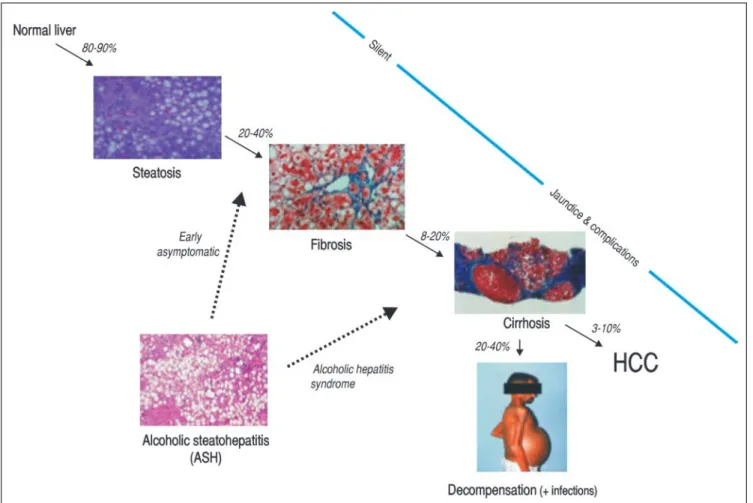
ALD comprises a broad spectrum of diseases ranging from fatty liver, ASH, progressive fibrosis, end-stage liver disease and superimposed hepatocellular carcinoma (Fig-ure 1). Nearly 90% of patients with heavy alcohol con-sumption have some degree of liver steatosis;4 alcoholic
fatty liver is the initial phase and can be considered as a mild or moderate stage in the spectrum of ALD. Histolo-gy is characterized by early-mild steatosis in zone 3 (pe-rivenular) hepatocytes; it can also affect zone 2 and even zone 1 (periportal) hepatocytes when liver injury is more severe.5 These changes are usually asymptomatic and
rap-idly reversible with alcohol abstinence.
The natural history of ALD is not homogenous for all patients. Only one third will progress to advanced forms of the spectrum. Additionally, patients with underlying ALD and continued heavy alcohol consumption may
de-velop episodes of superimposed AH and accelerate the progression to end-stage liver disease, increasing morbidi-ty and mortalimorbidi-ty.
Risk factors
Currently described risk factors for ALD development in alcoholics patients are age, drinking patterns, sex, obesi-ty, dietary factors, genetic factors and cigarrette smoking. Abusive alcohol consumption is a serious health issue worldwide. High-risk drinking is defined in sex-specific terms as drinking 20 g per day or more of pure alcohol on average for females and 40 g on average for males. Age at onset of high-risk alcohol consumption is an independent risk factor for alcoholic cirrhosis. A higher risk of alcohol-ic cirrhosis onset was observed for an older age at the be-ginning of high-risk alcohol consumption.6 Female sex is
a widely known risk factor due to lower levels of gastric alcohol dehydrogenase, higher body fat levels than men and the presence of estrogens. The prevalence of malnu-trition is high in alcoholics with clinically severe liver disease and these nutritional deficiencies may modulate
Figure 1. Figure 1. Figure 1. Figure 1.
the risk of developing alcohol-related liver damage. Ge-netic factors might also influence susceptibility to ad-vanced ALD, however little data are available especially in Caucasians. Variations in genes that encode antioxidant en-zymes, cytokines and other inflammatory mediators, and alcohol-metabolizing enzymes, could have a role. Recent-ly, the patatin-like phospholipase domain-containing 3 (PNPLA3) rs738409, a genetic variation consisting of an isoleucine to methionine substitution at position 148 (I148M), has been found to be associated with an in-creased risk of both alcohol-related cirrhosis and hepato-carcinoma. A 50% increase in the risk of cirrhosis onset was observed for each 148 M allele. Interestingly, the ef-fect of the PNPLA3 148M allele was even more pro-nounced in individuals with younger compared to older age at onset of high-risk alcohol consumption.6-9
Finally, the co-existence of other hepatic insults such as chronic hepatitis B, and hepatitis C infection, non-alco-holic fatty liver disease, autoimmune liver diseases and he-mocromatosis can also accelerate fibrosis.10
Pathogenesis
Alcoholic steatosis is a complex process manifested through several mechanisms. The main pathogenetic fac-tors underlying this process are increased fatty acid (FA) and triglyceride synthesis, enhanced hepatic influx of free fatty acids from adipose tissue and of chylomicrons from the intestinal mucosa, increased hepatic lipogenesis, in-hibited lipolysis, and damaged mitochondria and microtu-bules, all of which result in accumulation of very low-density lipoproteins.11 Recent studies suggest that al-cohol up-regulates sterol regulatory element-binding pro-tein 1c (SREBP-1c), a master transcription factor that stimulates expression of lipogenic genes and subsequently promotes fatty acid synthesis in the hepatocyte.1 In addi-tion, alcohol down-regulates adenosine monophosphate-activated protein kinase (AMPK). AMPK inactivates acetyl-CoA carboxylase 1 leading to reduced fatty acid syn-thesis and increased fatty acid oxidation, promoting steato-sis.12
Several molecular mechanisms contribute to the devel-opment of steatohepatitis. Alcohol abuse results in chang-es in the colonic microbiota and promotchang-es the translocation of bacteria from the gastrointestinal lumen to the portal vein, where they bind to the lipopolysaccha-ride-binding protein.13 In Kupffer cells, lipopolysaccharide (LPS) binds to CD14, which combines with toll-like receptor (TLR)-4 activating multiple cytokine genes with inflammatory cytokine production, decreasing the expres-sion of signal transducer and activator of transcriptions (STATs) leading to reduced liver regeneration.14,15 More recent translational studies showed that CXCL
chemok-ines, rather than TNF-α, are markedly overexpressed in AH and correlate with survival.16 Other inflammatory me-diators such as Fn14, CXC20 and osteopontin have been identified as potential targets for therapy in AH.17-19 Long-term alcohol consumption alters the intracellular balance of antioxidants with subsequent decrease in the release of mitochondrial cytochrome c and expression of Fas ligand, leading to hepatic apoptosis through the caspase-3 activa-tion pathway.20 Besides inflammation, bile stasis and liver fibrosis are major histological components of AH and are associated with a poor prognosis. Initially, the fibrotic tis-sue is typically located in pericentral and perisinusoidal areas with expansion of collagen bands and bridging fibro-sis in advanced stages, which precedes the development of regeneration nodules and liver cirrhosis.21
Although the cellular and molecular mechanisms of fi-brosis are not completely understood, alcohol metabolites (e.g. acetaldehyde) can directly activate hepatic stellate cells. Hepatic stellate cells are activated in a paracrine fashion by activated Kupffer cells, damaged hepatocytes and polymorphonuclears.22,23 Finally, Interleukin-22 (IL-22) has shown hepatoprotective and anti-fibrotic func-tions, with relatively few known side effects in animal and translational studies.24-26 IL-22 treatment has also showed protective effects on bacterial infection and kidney injury, two major complications associated with severe AH.27,28 Currently, the effects of IL-22 in AH are under investiga-tion in preclinical and clinical studies.
ALCOHOLIC HEPATITIS: CLINICAL PRESENTATION AND DIFERENTIAL DIAGNOSIS
The diagnosis of AH should be suspected in all pa-tients with excessive alcohol consumption and the co-existence of clinical and/or biological features suggestive of liver injury.
Analytical evaluation typically shows increased AST lev-els (up to 2-6 times the upper normal limit) and an AST/ ALT ratio > 2. The proposed mechanisms accounting for this feature is explained by the reduced hepatic alanine ami-notransferase activity, alcohol-induced depletion of hepatic pyridoxal 5’-phosphate, and increased hepatic mitochondri-al aspartate aminotransferase. Increased bilirubin, elevation of cholestatic enzimes (e.g. alkaline phophatase and gamma-glutamyl transpeptidase) and neutrophilia are also common-ly observed features. Liver sinthetic function is usualcommon-ly altered. Serum albumin is frequently decreased, pro-thrombin time prolonged and the international normalized ratio (INR) may be increased.
The presence of AH can be highly suspected based on clinical and analytical criteria as described above, howev-er, histological confirmation is recommended for severe cases. Liver biopsy using transjugular approach is preffered due to the presence of coagulopathy in most cases. This recommendation is supported by the European Associa-tion for the Study of the Liver (EASL) latest guidelines.30 In most cases, advanced liver fibrosis (mainly cirrhosis) and superimposed ASH is found. ASH is defined by the coexistence of steatosis, hepatocyte ballooning and/or Mallory-Denk bodies, and an inflammatory infiltrate with neutrophils. Other typical features include presence of megamitochrondria and bilirubinostasis. Of note, the presence of canalicular and/or ductular bilirubinostasis has been associated with bacterial infections (overt or cov-ert) in these patients.32
Differential diagnosis with other possible liver damage entities such as drug-induced liver disease, ischemic hepa-titis (especially in patients with concomitant cocaine con-sumption), foamy liver degeneration, septic liver, progressive ALD and malignancies, require histological sampling.
PROGNOSTIC ASSESSMENT
Prognostic scoring systems
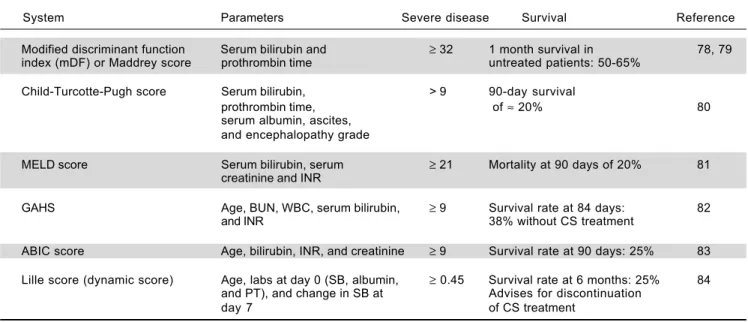
Prognostic scores are useful to assess severity of an AH episode and the need for a specific therapy to improve clinical outcomes in patients with severe disease. There are non-specific scores and disease-specific scores for this purpose. Many scoring systems have been developed for use in clinical practice (Table 1).
Histologic scoring system
Recently, we performed a large multicentre study to develop a histological scoring system capable of predict-ing short-term survival in patients with AH. The resultpredict-ing Alcoholic Hepatitis Histological Score (AHHS) includes 4 parameters that are independently associated with pa-tients’ survival: stage of fibrosis, degree of neutrophil in-filtration, type of bilirubinostasis, and presence of megamitochondria. The combination of these histological features in a semiquantitative manner, was able to stratify
Table 1. Scoring systems for severity assessment in alcoholic hepatitis.
System Parameters Severe disease Survival Reference
Modified discriminant function Serum bilirubin and ≥ 32 1 month survival in 78, 79
index (mDF) or Maddrey score prothrombin time untreated patients: 50-65%
Child-Turcotte-Pugh score Serum bilirubin, > 9 90-day survival
prothrombin time, of ≈ 20% 80
serum albumin, ascites, and encephalopathy grade
MELD score Serum bilirubin, serum ≥ 21 Mortality at 90 days of 20% 81
creatinine and INR
GAHS Age, BUN, WBC, serum bilirubin, ≥ 9 Survival rate at 84 days: 82
and INR 38% without CS treatment
ABIC score Age, bilirubin, INR, and creatinine ≥ 9 Survival rate at 90 days: 25% 83
Lille score (dynamic score) Age, labs at day 0 (SB, albumin, ≥ 0.45 Survival rate at 6 months: 25% 84
and PT), and change in SB at Advises for discontinuation
day 7 of CS treatment
patients into 3 different risk groups of death at 90 days (Figure 2).31
Which is the most accurate scoring system to predict survival in AH?
Several comparative studies have tried to answer this question. One cross-validation study in 71 biopsy-proven AH patients found that there were no significant accuracy differences in the area under the receiver characteristic curves (AUROCs) of the evaluated scoring systems rela-tive to 30-day/90-day mortality: model for end-stage liver disease (MELD) 0.79/0.84, DF 0.71/0.74, Glasgow Alco-holic Hepatitis Score (GAHS) 0.75/0.78, age, bilirubin, INR, creatinine (ABIC) score 0.71/0.78, MELD-Na 0.68/ 0.76, United Kingdom Model for End-Stage Liver Disease (UKELD) 0.56/0.68. In the same study, one-week rescor-ing yielded a trend towards improved predictive accura-cies for all scoring systems. In addition, when evaluating patients with mDF ≥ 32 (n = 31), response to corticoster-oids according to early change in bilirubin levels at 7 days (defined as a 25% fall in bilirubin levels at day 7 vs. admis-sion levels) and the Lille model yielded AUROCs of 0.73/ 0.73, 0.78/0.72 and 0.81/0.82 for a 30-day/90-day outcome, respectively. All models showed excellent negative predic-tive values (NPVs; range: 86-100%).32 A similar trend was described in a recent study including 274 patients with clinical diagnosis of AH in Denmark. The AUROCs gen-erated to predict mortality at 28/84/180 days for MELD, MELD-Na, GAHS, Lille-model, and the ABIC scoring systems yielded non significant differences between them with improved performances when re-scoring one week after admission.33
Importantly, a recent multinational multicenter study including a large cohort of patients with AH showed that combining static scoring systems (e.g.mDF; ABIC; and MELD) with dynamic models (e.g. Lille model), results in enhanced outcomes prediction when compared with ei-ther model alone.34 In this study, authors evaluated 3 joint-effect models’ capacity (Maddrey+Lille, MELD+Lille, and ABIC+Lille) to predict patient survival after 2 and 6 months. All of them, in the derivation and validation co-horts, predicted outcomes significantly better than either static or dynamic models alone (P < 0.01 for all compari-sons).34
Other key events with prognostic impact
• Acute kidney injury (AKI): Another factor associated with mortality in AH is the development of acute kid-ney injury (AKI). In a recent study AKI, defined as an absolute increase of serum creatinine of 0.3 mg/dL or a 50% increase above baseline, was associated with a
marked decrease in 90-day survival.35 Interestingly, pa-tients with systemic inflammatory response syndrome (SIRS) at admission developed AKI in much higher proportion. Moreover, a recent study associated the development of AKI in severe AH with non-selective beta-blocker therapy.36
• Systemic inflammatory response syndrome and multiple organ dysfunction. Patients with AH often show criteria of SIRS even in the absence of an infec-tion at the time of admission. Recent data correlated SIRS with increased mortality, multiple organ failure (odds ratio [OR] = 2.69, p = 0.025) and acute kidney injury development (OR 2.9, p < 0.001).37,38 Addition-ally procalcitonin, but not high-sensitivity C-reactive protein, serum levels at admission can identifiy those patients with SIRS and ongoing infection (overt or cov-ert). Finally, LPS serum levels have been associated with development of multiorgan failure (MOF) during ad-mission and the response to prednisolone at day 7.37 • Infections. A systematic screening for infections is
recommended. In patients with severe AH (SAH), in-fection prevalence at admission is about 25.6% accord-ing to a prospective study. Interestaccord-ingly, a 23.7% of infections developed after steroid treatment. Infection occurred more frequently in nonresponders than in responders (42.5 vs. 11.1%, respectively; p < 0.001) and are associated with a higher short and long-term mor-tality.39 A recent study has shown that the probability of developing infection is lower for patients with con-comitant SAH and gastrointestinal bleeding (24.1 vs. 44.7%, p = 0.04). This observation suggests a benefitial role for prophylactic antibiotics.29
Infections are the second cause of death in the first 84 days after a first episode of AH according to a recent large Danish registry analysis.40
Finally, a recent meta-analysis assessing mortality from infections in SAH did not find an increased occurrence or mortality from bacterial infections in patients with severe alcoholic hepatitis and steroid treatment.41 However these authors found an increased rate for fungal infections during admission. On this regard, a recent Belgian study has identified invasive aspergillo-sis (IA) as a frequent complication in patients with SAH and carries a very high risk of mortality,42 subse-cuently recommending systematic screening for IA in patients with SAH.
MANAGEMENT
Supportive measures
pyridoxine) and mineral (e.g., potassium, phosphate, mag-nesium) repletion. Vitamin B1 supplementation is advisa-ble due to the high risk of Wernicke encephalopathy development. Vitamin K is usually given to patients with prolonged prothrombin time, even though this regimen is often ineffective because the coagulopathy is more a re-flection of the severity of liver failure than real vitamin K deficiency. Oral intake should be started as soon as possi-ble and approximately a daily dose of 1.5 g/kg of body weight of protein is recommended. Low calorie intake was associated with mortality in a recent randomized trial, at least 21.5 kcal/kg/day should be guaranteed.43 Hepatic
encephalopathy should be treated with non-absorbable disaccharides. Rifaximin can be added if treatment with non-adbsorbable disaccharides is not effective after 24-48 h.44 Precipitating factors must be recognized and
controlled.
Intensive care unit admission is recomended in unsta-ble patients (patients with severe sepsis, septic shock, grade III-IV encephalopathy, acute variceal bleeding or withdrawal syndrome unable to be controlled with stand-ard measures). Clinical outcomes from septic shock and unstable cirrhotic patients admitted to intensive care units have improved in the latest years, which supports the ar-guments to offer intensive care and monitoring to patients with severe forms of AH.45 Airway management with
oro-tracheal intubation may be necessary in cases with high grades of hepatic encephalopathy or uncontrolled agitation (e.g. severe alcohol withdrawal syndrome). Finally, ben-zodiazepines are generally contraindicated in patients with AH, but might be necessary in the case of severe alco-hol withdrawal.
Since patients with AH are prone to develop infections that negatively impact their prognosis, a complete work-up to rule out infection is mandatory. Diagnostic paracen-tesis, blood cultures, urine and sputum cultures should be done and repeated in case of clinical deterioration. Al-though not contemplated in current guidelines, antibiotic prophylaxis might have a beneficial role in AH. A recent study showed that infection development was lower in pa-tients with AH receiving antibiotics after gastrointestinal bleeding compared to those without it.29 Trials addressing
this issue are undergoing (NCT02116556).
Specific therapies
• Corticosteroids. The rationale for use of corticos-teroids in AH is derived from their immunological and anti-inflammatory effects. Despite conflicting data,46-49 corticosteroids are still the first-line of
treatment in SAH (mDF > 32).50,51 Data from a
re-cent network meta-analysis including 22 randomized controlled trials (RCT) (2,621 patients), comparing 5 different interventions, supports the use of corticos-teroids alone (relative risk [RR], 0.54; 95% credible interval [CrI], 0.39-0.73) or in combination with pen-toxifylline (RR, 0.53; 95% CrI, 0.36-0.78) or NAC (RR, 0.15; 95% CrI, 0.05-0.39), to reduce short-term mortality in patients with AH. However, no treatment showed efficacy in reducing medium-term mortality. Moreover, in the interaction analysis, the authors found that the addition of N-acetylcysteine (NAC), but not pentoxifylline (PTX), to corticoster-oids may be superior to corticostercorticoster-oids alone to reduce short term mortality.52
Figure 2. Figure 2. Figure 2. Figure 2.
Figure 2. Three-month survival probability of patients with alcoholic hepatitis according to the alcoholic hepatitis histological score (AHHS) in the study (AAAAA) and validation (BBBBB) cohorts (from reference 31).
AHHS (points) Mild (0-3) Moderate (4-5) Severe (6-9) B.
B. B. B.
B. Validation cohort
Mild (0-3) 17 17 17 17
Moderate (4-5) 24 22 21 20
Severe (6-9) 68 57 48 44
0 30 60 90
Time (days) 100
90 80 70 60 50 40 30 20 10 0
Survival
(%
)
Log Rank test: p = 0.008 Multiple comparision correction Mild vs. Moderate: p = 0.08 Moderate vs. Severe: p = 0.007
A. A.A.
A.A. Study cohort 100
90 80 70 60 50 40 30 20 10 0
Mild (0-3) 30 29 29 29
Moderate (4-5) 80 75 68 65
Severe (6-9) 107 68 55 52
0 30 60 90 Time (days)
Survival
(%
)
Recently a large double-blind, factorial (2 X 2) de-signed multicentric trial (steroids or pentoxifylline for alcoholic hepatitis –STOPAH– trial), randomized 1,093 patients with SAH in 63 centers from the UK, to one of four groups of treatment:
° Group A. Placebo/placebo. ° Group B. Placebo/prednisolone. ° Group C. Pentoxifylline(PTX)/placebo. ° Group D. PTX/prednisolone.
The primary endpoint was mortality at 28 days, secondary endpoints being mortality at 90 days and 1 year. For PTX the OR for mortality at 28 days was 1.07 (95% confidence interval [CI] 0.77-1.49; p = 0.68) and for prednisolone 0.72 (95% CI 0.52-1.01; p = 0.056). After adjustment for baseline severity and prognostic factors (e.g., age, INR, urea, WBC, creatinine and hepatic encephalopathy) the OR in the prednisone treated group was 0.61 (95% CI 0.41-0.90; p = 0.01). No significant differences were found between treatment groups for secondary out-comes. In conclusion, pentoxifylline did not improve survival in patients with AH and prednisolone was asso-ciated with a reduction in 28-day mortality with no im-provement in outcomes at 90 days or 1 year.53.
• Pentoxifylline. Pentoxifylline is a phosphodiesterase inhibitor with modulatory effect on TNF-α transcrip-tion. Previous experimental and human data revealed increased TNF-α levels in AH suggesting a possible role in its physiopathology. The seminal study with PTX therapy in AH showed a 25% improvement on mortality rate associated to hepatorenal syndrome re-duction.54 However, data from the STOPAH trial did not reproduce this survival benefit with PTX in a large series of patients treated with this drug.53 Combination of PTX with corticosteroids has been also evaluated in a RCT with no evidence of survival improvement at 6-months when compared to corticosteroids alone.55 Fi-nally, rescue treatment with PTX in patients with AH not responding to corticosteroids has showed no ben-efit on 2-month survival.56 In conclusion pentoxifyl-line does not seem to be effective in SAH treatment according to current data.
• N-acetylcysteine. The combination of NAC, an anti-oxidant, with prednisolone has been studied for the treatment of severe AH. In this trial, 174 patients were randomized to receive prednisolone plus NAC (n = 85) or prednisolone alone (n = 89). Combination therapy with prednisolone plus NAC improved 1-month survival (p = 0.006) without differences at 6-months (p = 0.07).57 However, given the trend toward an increased survival in those treated with NAC plus corticosteroids, additional confirmatory studies using this strategy are warranted.
• Biological anti-TNF-ααααα therapies. Both infliximab (a chimeric mouse-human anti-TNF antibody) and etanercept (a competitive inhibitor of TNF-α to its cell surface receptors) have been tested in AH patients. Both molecules increased mortality due to an in-creased rate of severe infections.
In consecuense, biological anti-TNF-α therapies do not have a current role in AH treatment.58,59
Other therapies
Anabolic-androgenic steroids like oxandrolone have been tested in AH. Oxandrolone had efficacy only in those with moderate malnutrition,60 however a Cochrane sys-tematic review could not demonstrate any significant ben-eficial effects on any clinically important outcomes.61 Metadoxine, a drug with antioxidant properties, has been also evaluated. Results from a single center study have shown that additiion of metadoxine to corticosteroid treatment improves the short-term survival of patients with SAH (74.3 vs. 45.7%, P = 0.02).62 Other antioxidants such as vitamin E and silymarin have not shown any sur-vival benefit in patients with AH.63,64 Propylthiouracil also showed conflicting results in AH treatment,65,66 however a systematic review did not find any efficacy.67
Artifical and bioartificial liver support systems
Molecular adsorbent recirculating system (MARS) and Prometheus devices have been tested in patients with ACLF (some of them triggered by superimposed AH). The MARS device, but not the Prometheus device, showed a significant attenuation of hyperdynamic circula-tion in ACLF, presumably by a difference in the removal rate of certain vasoactive substances.68 In addition, treat-ment with MARS also produces an acute reduction on portal pressure and improves encephalopathy in patients with AH.69,70 Currently a novel bioartificial liver support system (ELAD) is being evaluated for the treatment of pa-tients with AH not responding to corticosteroids (ClinicalTrials.gov Identifier NCT01829347).
Liver transplantation in AH
ther-apeutic maneuver. All included patients had good family support, no severe coexisting conditions, and positive commitment to alcohol abstinence. Not surprisingly, the cumulative 6-month survival was higher among patients who received early transplantation than those who did not (77 ± 8% vs. 23 ± 8%, p < 0.001). This benefit was main-tained through 2 years of follow-up (hazard ratio, 6.08; p = 0.004). Importantly, only less than 2% of evaluated pa-tients in all participating centers with an episode of AH were listed for a LT. Although the follow-up was limited, the rate of alcohol relapse was extremely low (3 out of 26 patients).71 More recenlty, an American case-control study aimed to reproduce this strategy, including 9 (9.6% of the potential candidates) carefully selected patients with a first-epidose of severe AH refractory to corticosteroids to receive “early LT”. The 6-month survival rate was higher among those receiving early LT compared with matched controls (89 vs. 11%, p < 0.001) with 8 out of 9 recipients alive at 735 days of follow-up and 1 patient with alcohol relapse.72 Although, “early LT” for severe AH has shown excellent clinical outcomes with low impact on the donor pool and low rates of alcohol relapse in highly selected pa-tients, this “rescue treatment” needs extensive validation with larger series of patients and should be only per-formed at specialized LT centers.
ALCOHOL MISUSE INTERVENTIONS
Abstinence from alcohol is the key and most effective treatment of patients with ALD. Cessation of alcohol mis-use is of paramount importance in the management of pa-tient with AH. Data from a long term follow-up study has identified abstinence as the only independent predictor of long-term survival in patients with severe AH, with al-cohol relapse occurring in two-thirds of patients during follow-up.73 Currently, we do not have any validated tool to predict alcohol abstinence after an episode of AH.
Behavioral therapy must be a central component of al-coholism treatment. Brief motivational interventions are encouraged during hospitalization, although this approach is might be limited by poor mental status in some patients. To succesfully accomplish abstinence, a multidisciplinary team approach involving addiction specialits, social work-ers and hepatologists is required. Pharmacological thera-pies (e.g. anticraving drugs) may be used, however data in patients with liver diseases are scarce. Baclofen, an alpha-aminobutyric acid beta-receptor agonist, has been success-fully tested in patients with cirrhosis. In a RCT, cumulative abstinence duration was two-fold higher in patients allocated to baclofen than in those assigned to pla-cebo (mean 62.8 [SE 5.4] vs. 30.8 [5.5] days; p = 0.001). No liver side-effects were recorded.74 Baclofen tolerabili-ty and safetolerabili-ty for patients with AH has been also studied in
a recent retrospective study with promising results.75 Fur-ther prospective and randomized studies exploring the dose-dependent efficacy and safety of Baclofen are needed. Finally, naltrexone and acamprosate may be useful in man-taining abstinence, however such drugs have not been test-ed in patients with advanctest-ed liver disease.76,77 Disulfiram is unsafe in this setting due to its high risk of fulminant hepatitis.
CURRENT SITUATION AND FUTURE DIRECTIONS
Although there are no dramatic improvements in sur-vival rates with available pharmacological therapies for AH, much progress has been made in understanding the pathogenesis of ALD, resulting in improved prevention of complications and promising molecular targets for more effective treatments such as IL-22. Future studies targeting amelioration of liver damage with hepatoprotective and antifibrogenic molecules, alone or in combination with current treatments, are warranted. Early LT for AH has excellent clinical outcomes with low impact on the donor pool and low rates of alcohol relapse. However, this thera-peutic approach can only be offered to a small group of highly selected patients (≈ 2-% of patients with AH) in LT centers with extensive experience. Antibiotic prophylaxis for bacterial infections might be a good strategy to reduce complications and death in patients with AH and studies are undergoing (NCT02116556, NCT02326103, NCT02281929). Finally, prospective studies testing phar-macological treatments for sustained abstinence are ur-gently needed.
CONFLICT OF INTEREST
VP, JC, VV, RB and JA declare no conflic of interest.
GRANT SUPPORT
AND ACKNOWLEDGMENTS
This work was supported by the National Institute on Alcohol Abuse and Alcoholism (NIAAA)(1U01AA021908-01). JA wishes to express his gratitude to the Mexican Na-tional Council of Science and Technology (CONACyT, Mexico City, Mexico) for partially supporting his pre-doctoral stay at IDIBAPS. We thank Monica Cruz-Lemini for her assistance with final editing, reviewing and im-proving the use of English in this manuscript.
REFERENCES
1. Gao B, Bataller R. Alcoholic liver disease: pathogenesis and
2. Adam R, Karam V, Delvart V, O’Grady J, Mirza D, Klemp-nauer J, Castaing D, et al. Evolution of indications and re-sults of liver transplantation in Europe. A report from the
European Liver Transplant Registry (ELTR). J Hepatol
2012; 57: 675-88.
3. Moreau R, Jalan R, Gines P, Pavesi M, Angeli P, Cordoba J, Durand F, et al. Acute-on-chronic liver failure is a distinct syndrome that develops in patients with acute
decompensa-tion of cirrhosis. Gastroenterology 2013; 144: 1426-37.
4. Mathurin P, Beuzin F, Louvet A, Carrié-Ganne N, Balian A, Trinchet JC, Dalsoglio D, et al. Fibrosis progression occurs in a subgroup of heavy drinkers with typical histological
fea-tures.Aliment Pharmacol Ther 2007; 25: 1047-54.
5. Ramaiah SK, Jaeschke H. Role of neutrophils in the
patho-genesis of acute inflammatory liver injury. Toxicol Pathol
2007; 35: 757-66.
6. Burza MA, Molinaro A, Attilia ML, Rotondo C, Attilia F, Cec-canti M, Ferri F, et al. PNPLA3 I148M (rs738409) genetic vari-ant and age at onset of at-risk alcohol consumption are
independent risk factors for alcoholic cirrhosis. Liver Int
2014; 34: 514-20.
7. Stickel F, Buch S, Lau K, Meyer zu Schwabedissen H, Berg T, Ridinger M, Rietschel M, et al. Genetic variation in the PNP-LA3 gene is associated with alcoholic liver injury in
cauca-sians.Hepatology2011; 53: 86-95.
8. Corradini SG, Burza MA, Molinaro A, Romeo S. Patatin-like phospholipase domain containing 3 sequence variant and
hepatocellular carcinoma. Hepatology 2011; 53: 1776.
9. Trepo E, Guyot E, Ganne-Carrie N, Degre D, Gustot T, Franchimont D, Sutton A, et al. PNPLA3 (rs738409 C>G) is a common risk variant associated with hepatocellular
carcino-ma in alcoholic cirrhosis. Hepatology 2012; 55: 1307-8.
10. Altamirano J, Michelena J. Alcohol consumption as a cofac-tor for other liver diseases. Clin Liver Dis 2013; 2: 72-5. 11. Baraona E, Lieber CS. Effects of ethanol on lipid metabolism.
J Lipid Res 1979; 20: 289-315.
12. You M, Matsumoto M, Pacold CM, Cho WK, Crabb DW. The role of AMP-activated protein kinase in the action of ethanol
in the liver. Gastroenterology 2004; 127: 1798-808.
13. Gao B, Seki E, Brenner DA, Friedman S, Cohen JI, Nagy L,
Szabo G, et al. Innate immunity in alcoholic liver disease. Am
J Physiol Gastrointest Liver Physiol 2011; 300: G516-G525.
14. Szabo G. Gut-liver axis in alcoholic liver disease.
Gastroen-terology2015; 148: 30-6.
15. Altamirano J, Bataller R. Alcoholic liver disease:
pathogene-sis and new targets for therapy. Nat Rev Gastroenterol
Hepatol2011; 8: 491-501.
16. Dominguez M, Miquel R, Colmenero J, Moreno M, García-Pagán J-C, Bosch J, Arroyo V, et al. Hepatic expression of CXC chemokines predicts portal hypertension and survival in
patients with alcoholic hepatitis. Gastroenterology 2009;
136: 1639-50.
17. Morales-Ibanez O, Domínguez M, Ki SH, Marcos M, Chaves JF, Nguyen-Khac E, Houchi H, et al. Human and experimental evidence supporting a role for osteopontin in alcoholic
hepa-titis.Hepatology2013; 58: 1742-56.
18. Affò S, Dominguez M, Lozano JJ, Sancho-Bru P, Rodrigo-Torres D, Morales-Ibanez O, Moreno M, et al. Transcrip-tome analysis identifies TNF superfamily receptors as
potential therapeutic targets in alcoholic hepatitis. Gut
2013; 62: 452-60.
19. Affò S, Morales-Ibanez O, Rodrigo-Torres D, Altamirano J, Blaya D, Dapito DH, Millan C, et al. CCL20 mediates lipopoly-saccharide induced liver injury and is a potential driver of
in-flammation and fibrosis in alcoholic hepatitis. Gut 2014; 63:
1782-92.
20. Feldstein AE, Gores GJ. Apoptosis in alcoholic and
nonalco-holic steatohepatitis. Front Biosci 2005; 10: 3093-9.
21. Yip WW, Burt AD. Alcoholic liver disease. Semin Diagn
Pathol2006; 23: 149-60.
22. Wang J-H, Batey R-G, George J. Role of ethanol in the
regu-lation of hepatic stellate cell function. World J Gastroenterol
2006; 12: 6926-32.
23. Friedman SL. Stellate cell activation in alcoholic fibrosis—an
overview.Alcohol Clin Exp Res 1999; 23: 904-10.
24. Støy S, Sandahl TD, Dige AK, Agnholt J, Rasmussen TK, Grønbæk H, Deleuran B, et al. Highest frequencies of inter-leukin-22-producing T helper cells in alcoholic hepatitis
pa-tients with a favourable short-term course. PLoS One 2013;
8: e55101.
25. Radaeva S, Sun R, Pan H-N, Hong F, Gao B. Interleukin 22 (IL-22) plays a protective role in T cell-mediated murine hep-atitis: IL-22 is a survival factor for hepatocytes via STAT3
activation.Hepatology2004; 39: 1332-42.
26. Kong X, Feng D, Wang H, Hong F, Bertola A, Wang F-S, Gao B, et al. Interleukin-22 induces hepatic stellate cell
senes-cence and restricts liver fibrosis in mice. Hepatology2012;
56: 1150-9.
27. Eidenschenk C, Rutz S, Liesenfeld O, Ouyang W. Role of
IL-22 in microbial host defense. Curr Top Microbiol Immunol
2014; 380: 213-36.
28. Xu M-J, Feng D, Wang H, Guan Y, Yan X, Gao B. IL-22 amel-iorates renal ischemia-reperfusion injury by targeting
proxi-mal tubule epithelium. J Am Soc Nephrol 2014; 25: 967-77.
29. Rudler M, Mouri S, Charlotte F, Lebray P, Capocci R, Benos-man H, Poynard T, et al. Prognosis of treated severe
alcohol-ic hepatitis in patients with gastrointestinal bleeding. J
Hepatol 2015; 62: 816-21.
30. EASL clinical practical guidelines: management of alcoholic
liver disease. J Hepatol 2012; 57: 399-420.
31. Altamirano J, Miquel R, Katoonizadeh A, Abraldes JG, Du-arte-Rojo A, Louvet A, Augustin S, et al. A histologic scoring system for prognosis of patients with alcoholic hepatitis. Gastroenterology2014; 146: 1231-9.
32. Papastergiou V, Tsochatzis EA, Pieri G, Thalassinos E, Dhar A, Bruno S, Karatapanis S, et al. Nine scoring models for short-term mortality in alcoholic hepatitis: cross-validation in a
biopsy-proven cohort. Aliment Pharmacol Ther 2014; 39: 721-32.
33. Sandahl TD, Jepsen P, Ott P, Vilstrup H. Validation of prog-nostic scores for clinical use in patients with alcoholic
hepa-titis.Scand J Gastroenterol 2011; 46: 1127-32.
34. Louvet A, Labreuche J, Artru F, Boursier J, Kim DJ, O’Grady J, Trépo E, et al. Combining Data From Liver Disease Scoring Systems Better Predicts Outcomes of Patients With
Alcohol-ic Hepatitis. Gastroenterology2015; 149: 398-406.
35. Altamirano J, Fagundes C, Dominguez M, García E, Michele-na J, CárdeMichele-nas A, Guevara M, et al. Acute kidney injury is an early predictor of mortality for patients with alcoholic hepati-tis.Clin Gastroenterol Hepatol 2012; 10: 65-71.
36. Sersté T, Njimi H, Degré D, Deltenre P, Schreiber J, Lepida A, Trépo E, et al. The use of beta-blockers is associated with the occurrence of acute kidney injury in severe alcoholic hepatitis.Liver Int 2015; 35: 1974-82.
37. Michelena J, Altamirano J, Abraldes JG, Affò S, Morales-Ibanez O, Sancho-Bru P, Dominguez M, et al. Systemic in-flammatory response and serum lipopolysaccharide levels predict multiple organ failure and death in alcoholic hepatitis. Hepatology2015; 62: 762-72.
38. Maiwall R, Chandel SS, Wani Z, Kumar S, Sarin SK. SIRS at admission is a predictor of AKI development and mortality in
hospitalized patients with severe alcoholic hepatitis. Dig Dis
39. Louvet A, Wartel F, Castel H, Dharancy S, Hollebecque A, Canva-Delcambre V, Deltenre P, et al. Infection in patients with severe alcoholic hepatitis treated with steroids: early
response to therapy is the key factor. Gastroenterology
2009; 137: 541-8.
40. Orntoft NW, Sandahl TD, Jepsen P, Vilstrup H. Short-term and long-term causes of death in patients with alcoholic
hepatitis in Denmark. Clin Gastroenterol Hepatol 2014; 12:
1739-44.
41. Hmoud BS, Patel K, Bataller R, Singal AK. Corticosteroids and occurrence of and mortality from infections in severe
al-coholic hepatitis: a meta-analysis of randomized trials. Liver
Int2016; 36: 721-8.
42. Gustot T, Maillart E, Bocci M, Surin R, Trépo E, Degré D, Luci-di V, et al. Invasive aspergillosis in patients with severe
al-coholic hepatitis. J Hepatol 2014; 60: 267-74.
43. Moreno C, Deltenre P, Senterre C, Louvet A, Gustot T, Bas-tens B, Hittelet A, et al. InBas-tensive Enteral Nutrition is Ineffec-tive for Individuals with Severe Alcoholic Hepatitis Treated
with Corticosteroids. Gastroenterology 2016; 150: 903-10.
44. Sanchez-Delgado J, Miquel M. Role of rifaximin in the
treat-ment of hepatic encephalopathy. Gastroenterol Hepatol
2016; 39: 282-92.
45. Galbois A, Aegerter P, Martel-Samb P, Housset C, Thabut D, Offenstadt G, Ait-Oufella H, et al. Improved prognosis of septic shock in patients with cirrhosis: a multicenter study. Crit Care Med 2014; 42: 1666-75.
46. Porter HP, Simon FR, Pope CE, Volwiler W, Fenster LF. Cor-ticosteroid therapy in severe alcoholic hepatitis. A
double-blind drug trial. N Engl J Med 1971; 284: 1350-5.
47. Blitzer BL, Mutchnick MG, Joshi PH, Phillips MM, Fessel JM, Conn HO. Adrenocorticosteroid therapy in alcoholic hepatitis.
A prospective, double-blind randomized study. Am J Dig Dis
1977; 22: 477-84.
48. Ramond MJ, Poynard T, Rueff B, Mathurin P, Théodore C, Chaput JC, Benjamou JP, et al. A randomized trial of
pred-nisolone in patients with severe alcoholic hepatitis. N Engl J
Med1992; 326: 507-12.
49. Mathurin P, Duchatelle V, Ramond MJ, Degott C, Bedossa P, Erlinger S, Benjamou JP, et al. Survival and prognostic fac-tors in patients with severe alcoholic hepatitis treated with
prednisolone.Gastroenterology1996; 110: 1847-53.
50. Christensen E, Gluud C. Glucocorticoids are ineffective in al-coholic hepatitis: a meta-analysis adjusting for confounding
variables.Gut1995; 37: 113-8.
51. Rambaldi A, Saconato HH, Christensen E, Thorlund K, Wet-terslev J, Gluud C. Systematic review: glucocorticosteroids for alcoholic hepatitis—a Cochrane Hepato-Biliary Group systematic review with meta-analyses and trial sequential
analyses of randomized clinical trials. Aliment Pharmacol
Ther 2008; 27: 1167-78.
52. Singh S, Murad MH, Chandar AK, Bongiorno CM, Singal AK, Atkinson SR, Thursz M, et al. Comparative effectiveness of pharmacological interventions for severe alcoholic hepatitis:
A systematic review and network meta-analysis.
Gastroen-terology2015; 149: 958-70.
53. Thursz MR, Richardson P, Allison M, Austin A, Bowers M, Day CP, Downs N, et al. Prednisolone or pentoxifylline for
al-coholic hepatitis. N Engl J Med 2015; 372: 1619-28.
54. Akriviadis E, Botla R, Briggs W, Han S, Reynolds T, Shakil O. Pentoxifylline improves short-term survival in severe acute alcoholic hepatitis: a double-blind, placebo-controlled trial. Gastroenterology2000; 119: 1637-48.
55. Mathurin P, Louvet A, Duhamel A, Nahon P, Carbonell N, Boursier J, Anty R, et al. Prednisolone with vs without pentoxifylline and survival of patients with severe
alco-holic hepatitis: a randomized clinical trial. JAMA 2013;
310: 1033-41.
56. Louvet A, Diaz E, Dharancy S, Coevoet H, Texier F, Thévenot T, Deltenre P, et al. Early switch to pentoxifylline in patients with severe alcoholic hepatitis is inefficient in
non-respond-ers to corticosteroids. J Hepatol 2008; 48: 465-70.
57. Nguyen-Khac E, Thevenot T, Piquet M-A, Benferhat S, Goria O, Chatelain D, Tramier B, et al. Glucocorticoids plus
N-ace-tylcysteine in severe alcoholic hepatitis. N Engl J Med 2011;
365: 1781-9.
58. Naveau S, Chollet-Martin S, Dharancy S, Mathurin P, Jou-et P, PiquJou-et M-A, Davion T, Jou-et al. A double-blind rand-omized controlled trial of infliximab associated with
prednisolone in acute alcoholic hepatitis. Hepatology
2004; 39: 1390-7.
59. Boetticher NC, Peine CJ, Kwo P, Abrams GA, Patel T, Aqel B, Boardman L, et al. A randomized, double-blinded, placebo-controlled multicenter trial of etanercept in the treatment of
alcoholic hepatitis. Gastroenterology2008; 135: 1953-60.
60. Mendenhall C, Roselle GA, Gartside P, Moritz T. Relationship of protein calorie malnutrition to alcoholic liver disease: a re-examination of data from two Veterans Administration
Coop-erative Studies. Alcohol Clin Exp Res 1995; 19: 635-41.
61. Rambaldi A, Iaquinto G, Gluud C. Anabolic-androgenic
ster-oids for alcoholic liver disease: a Cochrane review. Am J
Gastroenterol 2002; 97: 1674-81.
62. Higuera-de la Tijera F, Servín-Caamaño AI, Cruz-Herrera J, Serralde-Zúñiga AE, Abdo-Francis JM, Gutiérrez-Reyes G, Pérez-Hernández J, et al. Treatment with metadoxine and its impact on early mortality in patients with severe alcoholic
hepatitis.Ann Hepatol 2014; 13: 343-52.
63. Mezey E, Potter JJ, Rennie-Tankersley L, Caballeria J, Pares A. A randomized placebo controlled trial of vitamin E for al-coholic hepatitis. J Hepatol 2004; 40: 40-6.
64. Parés A, Planas R, Torres M, Caballería J, Viver JM, Acero D, Panés J, et al. Effects of silymarin in alcoholic patients with cirrhosis of the liver: results of a controlled,
double-blind, randomized and multicenter trial. J Hepatol 1998; 28:
615-21.
65. Hallé P, Paré P, Kaptein E, Kanel G, Redeker AG, Reynolds TB. Double-blind, controlled trial of propylthiouracil in patients
with severe acute alcoholic hepatitis. Gastroenterology
1982; 82: 925-31.
66. Orrego H, Kalant H, Israel Y, Blake J, Medline A, Rankin JG, Armstrong A, et al. Effect of short-term therapy with
pro-pylthiouracil in patients with alcoholic liver disease.
Gastro-enterology 1979; 76: 105-15.
67. Rambaldi A, Gluud C. Propylthiouracil for alcoholic liver dis-ease. Cochrane database Syst Rev. 2005; CD002800. 68. Laleman W, Wilmer A, Evenepoel P, Elst I Vander, Zeegers
M, Zaman Z, Verslype C, et al. Effect of the molecular ad-sorbent recirculating system and Prometheus devices on systemic haemodynamics and vasoactive agents in patients
with acute-on-chronic alcoholic liver failure. Crit Care 2006;
10: R108.
69. Sen S, Mookerjee RP, Cheshire LM, Davies NA, Williams R, Jalan R. Albumin dialysis reduces portal pressure acutely in
patients with severe alcoholic hepatitis. J Hepatol 2005; 43:
142-8.
70. Jalan R, Sen S, Steiner C, Kapoor D, Alisa A, Williams R. Ex-tracorporeal liver support with molecular adsorbents recir-culating system in patients with severe acute alcoholic
hepatitis.J Hepatol 2003; 38: 24-31.
71. Mathurin P, Moreno C, Samuel D, Dumortier J, Salleron J, Du-rand F, Castel H, et al. Early liver transplantation for severe
72. Im GY, Kim-Schluger L, Shenoy A, Schubert E, Goel A, Friedman SL, Florman S, et al. Early Liver Transplantation for Severe Alcoholic Hepatitis in the United States-A
Single-Center Experience. Am J Transplant 2016; 16: 841-9.
73. Potts JR, Goubet S, Heneghan MA, Verma S. Determinants
of long-term outcome in severe alcoholic hepatitis. Aliment
Pharmacol Ther 2013; 38: 584-95.
74. Addolorato G, Leggio L, Ferrulli A, Cardone S, Vonghia L, Mirijello A, Abenavoli L, et al. Effectiveness and safety of baclofen for maintenance of alcohol abstinence in alcohol-dependent patients with liver cirrhosis: randomised,
double-blind controlled study. Lancet2007; 370: 1915-22.
75. Yamini D, Lee SH, Avanesyan A, Walter M, Runyon B. Utiliza-tion of baclofen in maintenance of alcohol abstinence in pa-tients with alcohol dependence and alcoholic hepatitis with
or without cirrhosis. Alcohol Alcohol 2014; 49: 453-6.
76. Garbutt JC, Kranzler HR, O’Malley SS, Gastfriend DR, Petti-nati HM, Silverman BL, Loewy J, et al. Efficacy and tolerabili-ty of long-acting injectable naltrexone for alcohol
dependence: a randomized controlled trial. JAMA 2005; 293:
1617-25.
77. Mason BJ. Rationale for combining acamprosate and
naltrex-one for treating alcohol dependence. J Stud Alcohol Suppl
2005; 15: 148-56.
78. Maddrey WC, Boitnott JK, Bedine MS, Weber FL, Mezey E,
White RI. Corticosteroid therapy of alcoholic hepatitis.
Gas-troenterology 1978; 75: 193-9.
79. Carithers RL, Herlong HF, Diehl AM, Shaw EW, Combes B, Fallon HJ, Maddrey W, et al. Methylprednisolone therapy in patients with severe alcoholic hepatitis. A randomized
multi-center trial. Ann Intern Med 1989; 110: 685-90.
80. Jeong JY, Sohn JH, Son BK, Paik CH, Kim SH, Han DS, Jeong YC, et al. Comparison of model for end-stage liver disease
score with discriminant function and child-Turcotte-Pugh scores for predicting short-term mortality in Korean patients
with alcoholic hepatitis. Korean J Gastroenterol 2007; 49:
93-9.
81. Dunn W, Jamil LH, Brown LS, Wiesner RH, Kim WR, Menon KVN, Malinchoc M, et al. MELD accurately predicts mortality
in patients with alcoholic hepatitis. Hepatology 2005; 41:
353-8.
82. Forrest EH, Evans CDJ, Stewart S, Phillips M, Oo YH, McA-voy NC, Fisher NC, et al. Analysis of factors predictive of mortality in alcoholic hepatitis and derivation and validation of
the Glasgow alcoholic hepatitis score. Gut2005; 54: 1174-9.
83. Dominguez M, Rincón D, Abraldes JG, Miquel R, Colmenero J, Bellot P, García-Pagán JC, et al. A new scoring system for prognostic stratification of patients with alcoholic hepatitis. Am J Gastroenterol 2008; 103: 2747-56.
84. Louvet A, Naveau S, Abdelnour M, Ramond M-J, Diaz E, Far-toux L, Dharancy S, et al. The Lille model: a new tool for therapeutic strategy in patients with severe alcoholic
hepati-tis treated with steroids. Hepatology 2007; 45: 1348-54.
Correspondence and reprint request:
Jose Altamirano, M.D. MSc. Liver Unit. Internal Medicine Department. Vall d’Hebrón Hospital and Vall d’Hebrón Institut de Recerca (VHIR). Universitat Autónoma de Barcelona; Barcelona, Spain
Tel.:+34 671920419
Mailing Address: Laboratori de Recerca i Referencia Hepatica. Modulo Azul, Planta Baja