Prevalence and resistance pattern of genotype G and H
in chronic hepatitis B and HIV co-infected patients in Mexico
José Antonio Mata Marín,* Carla Ileana Arroyo Anduiza,**Gloria María Calderón,***
Sergio Cazares Rodríguez,**** José Luis Fuentes Allen,* Rafael Arias Flores,* Jesús Gaytán Martínez*
* Hospital de Infectología, Infectious Diseases Department, La Raza National Medical Center, Mexico City, Mexico. ** Hospital General, Clinical Pathology Department La Raza National Medical Center, Mexico City, Mexico.
*** Unidad de Investigación en Inmunología en Infectología. Hospital de Infectología, La Raza National Medical Center, Mexico City, Mexico. **** Hospital de Especialidades, Gastroenterology Department La Raza National Medical Center, Mexico City, Mexico.
ABSTRACT
Objective. We estimated the prevalence and identified the resistance pattern of HBV genotypes H and G in HBV monoinfected and HIV co-infected patients. Material and methods. A cross-sectional prevalence and analytic study were performed in chronic hepatitis B patients at the Hospital de Infectología, La Raza National Medical Center in Mexico City. Chronic HBV monoinfected and HIV co-infected patients were in-cluded. HBeAg, HBV viral load and genetic analysis of mutations were collected; CD4+ cells count from HIV co-infected patients and HIV RNA were measured. We calculated the prevalence and exact 95% binomial confidence interval and the Odds ratios (OR) with 95% confidence intervals to assess the relationship bet-ween the presence of risk factors and HBV genotypes H or G. Results. We enrolled 77 patients, 67 men and 10 women with 37 HIV co-infected patients. The distribution of HBV genotypes was: HBV genotype H 55 (71% [95% CI 60% to 80%]), HBV genotype G 16 (20.7%), HBV genotype F 4 (5.1%) and HBV genotype A 2 (2.6%). The most frequent mutations presented in 8 HIV co-infected patients and one mono-infected pa-tient with antiretroviral therapy (ART) experience were rtM204V and six of them showed genotype G (6/9). Mono-infected HBV patients exposed more probability to HBV genotype H than co-infected HIV patients OR 13.0 (CI 95% 3.40-49.79), p = 0.0001. In contrast co-infected patients presented less possibility to have genotype H, 0.56 (CI 95% 0.42-0.75). Conclusions. This study confirms the high prevalence of HBV genotype H in Mexico; furthermore, our results suggest that HBV genotype G predominates in co-infected patients. As well, rtM204V and rtL180M mutations are common in HBV-HIV co-infected patients with genotype G and ART experience.
Key words. HBV genotype G. HBV genotype H. HBV-HIV co-infection.
Correspondence and reprint request: Dr. José Antonio Mata Marín Av. Jacarandas s/n
Col. La Raza, Del. Azcapotzalco
C.P. 02990, México, D.F. Tel.: 5724-5900, Ext. 23927 E-mail: [email protected]
Manuscript received: July 26, 2011. Manuscript accepted: August 20, 2011.
INTRODUCTION
An estimated 350 million persons worldwide are chronically infected with hepatitis B virus (HBV).1
Carriers [defined as persons positive for hepatitis B surface antigen (HBsAg) for more than 6 months] of HBV are at increased risk of developing cirrhosis, hepatic decompensation, and hepatocellular carcino-ma (HCC).2,3 Currently 9 HBV genotypes (A–I) with
specific geographic distributions have been identified
worldwide.4-6 These genotypes are based on a
nu-cleotide divergence in the entire genome of at least 8%.7 These nine genotypes have a characteristic
geo-graphical distribution, but most have a worldwide prevalence because of human migration. As well, several studies have suggested that genotypes may correlate with disease activity and may affect the response to antiviral treatment.8-11
Among the estimated 36 million people living with HIV worldwide, 10% are chronically infec-ted with HBV.12 Nucleosides analogues are associated
with the emergence of mutations in the YMDD motif of HBV DNA polymerase domain C and with ups-tream compensatory mutations in polymerase do-mains A and B that, collectively, reduce treatment efficacy.13 The rate of emergence of HBV resistance
(e.g., M204I for lamivudine (LAM), emtricitabine (FTC) and telbivudina (LdT)). Several changes are required to compromise the activity of others (e.g., L180M + M204V + T250V for entecavir (ETV).14
The development of resistance to one agent could lead and increase the cross-resistance and reduce or completely hamper the activity of other drugs. This is particularly true for LAM resistance mutations, which annul the activity of FTC and LdT, to a les-ser extent of ETV, and occasionally of ADV adefovir (ADV), while tenofovir (TDF) remains active in most instances.15,16
In Mexico, genotypes H and G have been reported as the most common, although genotypes prevalence in HIV co-infected patients is unknown as mutations pattern on these patients.17,18 The purpose of this
study was to estimate the prevalence and identify re-sistance pattern of HBV genotypes H and G, in HBV monoinfected and HIV co-infected patients.
MATERIAL AND METHODS
We performed a cross-sectional prevalence and analytic study. This survey was carried out on chronic hepatitis B patients from May 2007 to September 2009 at the Hospital de Infectología, La Raza Natio-nal Medical Center in Mexico City.
Participants
Adults were eligible if they had been positive for hepatitis B surface antigen (HBsAg) for at least 6 months, with anti-HBsAg (anti-HBs antibodies) ne-gative; HBV DNA levels more than 500 IU per milli-liter and increase in the aminotransferases serum levels.
During the enrollment period, 77 patients were ad-mitted for evaluation if they presented a diagnosis of chronic hepatitis B. We recruited 37 HIV/HBV infec-ted patients with fulfilled criteria of chronic hepatitis B from a total of 422 HIV patients in our cohort. Cli-nical and laboratory data were collected: general at-tributes, risk factors, family history, HIV or HCV co-infections, antiretroviral (LAM or FTC) experien-ce, blood cells count, liver function tests and HBeAg as well as HBV viral load and mutations genetic analysis. When patients presented HIV co-infection, CD4+ cells count and HIV RNA were measured.
Amplification of HBV DNA and mutations detection
Hepatitis B virus genotype and BCP/Precore mu-tations was performed by Quest Diagnostics Nichols
Institute, San Juan Capistrano, CA., USA, accord-ing its methodology. HBV DNA was detected in EDTA plasma isolates by polymerase chain reaction (PCR) with HBV-specific primers. The sequence analysis was done for mutations at codons 173, 180, 202, 204, 207, in the reverse transcriptase region of the polymerase gene; nucleotides 1858 and 1896 of the pre-C region; and nucleotides 1762 and 1764 of the BCP region. The HBV genotype was determined via computer-aided alignment and phylogenetic analysis of the amplified portion of the S gene.
Ethics
Procedures were approved by the local Ethical Committee of the hospital with register number R-2009-3506-4 (Comité Local de Investigación en Salud 3506; Instituto Mexicano del Seguro Social), in ac-cordance with the Helsinki Declaration of 1975. In-formed consent was obtained in order to take the blood samples for the analysis.
Statistical methods
The prevalence and extract 95% binomial confi-dence interval were calculated. Odds ratios and 95% confidence intervals were analyzed to assess the re-lationship between risk factors and the presence of HBV genotypes H or G.
RESULTS
Patients characteristics
We enrolled 77 Mexican patients, 67 men and 10 women. Chronic HBV was confirmed in all cases.
• The mean (± SD) age of these subjects was 34.2 ± 12.3 years.
• AST 75.2 ± 113 IU/mL. • ALT 93.6 ± 130 IU/mL.
• The mean (± SD) HBsAg was 238,400 ± 50,100 IU/mL.
• HBeAg 876.6 ± 778.2 IU/mL.
• HBV DNA 20,200,000 IU/mL (IQR 155,500-225,000,000).
Twelve (15.6 %) subjects were HBeAg negative. Thirty seven were HIV co-infected patients, with CD4+ cells count of 260.9 ± 226 cells/mm3 and HIV
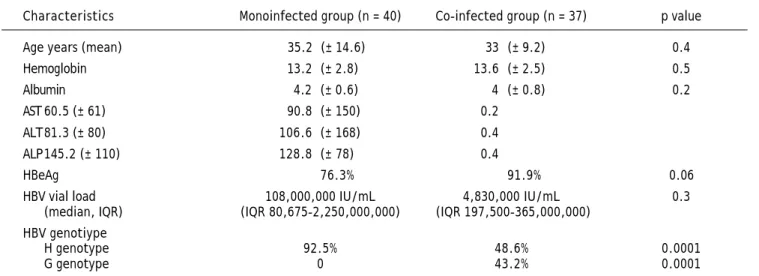
one mono-infected patient received LAM therapy for 2 years (Table 1).
The major transmission mechanism identified in mono-infected patients was hemodialysis, and sexual transmission in co-infected HIV/HBV subjects.
Finally from the 422 HIV infected patients in our hospital, 37 presented chronic hepatitis B 8.7% (95% CI 6.4% to 11.8%).
HBV genotyping
HBV genotypes from 77 patients showed a distri-bution of 55 HBV genotype H patients (71% [95% CI 60% to 80%]), 16 HBV genotype G patients (20.7% [95% CI 13% to 31%]), 4 HBV genotype F patients (5.1%) and 2 HBV genotype A patients (2.6%). We did not find mixed HBV genotypes. Mono-infected patients 37/40 (91%) vs. co-infected HIV patients 18/37 (50%) had HBV genotype H. Mono-infected HBV patients had more probability
to present HBV genotype H, OR 13.0 (CI 95% 3.40-49.79), p = 0.0001, than co-infected HBV patients with HIV.
Resistance mutations
Mutations were detected in 8 HIV co-infected pa-tients and one mono-infected patient with ART ex-perience where LAM was part of the regimen during a period between 12 to 35 months and detec-table HBV DNA. Although, not all patients had re-sistance mutations, six showed genotype G, two genotype H and one genotype A with the following mutations:
• rtL180M. • rtM204V. • rtV207V/I. • rtV173L. • ntG1896A/T.
Table 2. Characteristics of pattern mutations.*
Patients Genotype Pattern mutation
1 G rtL180M, rtM204V, rtV207V/I, rtV173V/L, ntG1896A
2 G ntG1896A
3 G ntG1896A
4 G rtL180M, rtM204V, ntG1896A
5 G rtL180M, rtM204V, rtV173L, ntG1896A/T, ntC1858A 6 G rtL180M, rtM204V, rtV173L, ntG1896A
7 H rtM204V/I, ntG1896A
8 A rtL180M, rtM204V
9† H rtL180M, rtM204V, rtM202G
Table 1. Basal characteristics.
Characteristics Monoinfected group (n = 40) Co-infected group (n = 37) p value Age years (mean) 35.2 (± 14.6) 33 (± 9.2) 0.4 Hemoglobin 13.2 (± 2.8) 13.6 (± 2.5) 0.5
Albumin 4.2 (± 0.6) 4 (± 0.8) 0.2
AST 60.5 (± 61) 90.8 (± 150) 0.2 ALT81.3 (± 80) 106.6 (± 168) 0.4 ALP145.2 (± 110) 128.8 (± 78) 0.4
HBeAg 76.3% 91.9% 0.06
HBV vial load 108,000,000 IU/mL 4,830,000 IU/mL 0.3 (median, IQR) (IQR 80,675-2,250,000,000) (IQR 197,500-365,000,000)
HBV genotiype
H genotype 92.5% 48.6% 0.0001
G genotype 0 43.2% 0.0001
IQR: intequartili range 25th-75th.
• ntG1896T, and • ntC1858A.
Most frequent mutations were (Table 2):
• ntG1896A/T (7/9). • rtM204V (7/9), and • rtL180M (6/9).
DISCUSSION
This study demonstrated the high prevalence of HBV genotype H in Mexico and the differences bet-ween HBV genotype H in mono-infected patients and HIV co-infected patients which showed a preva-lence of 8.7% of chronic HVB in a cohort of HIV pa-tients. A difference among the prevalence of HBV genotype H and G in mono-infected and co-infected patients was identified, suggesting differences in the skill transmission mechanism. As well, we observed the presence of rtM204V and rtL180M mutations in HVB/HIV co-infected patients with genotype G and lamivudine treatment experience.
We had two patients with HBV genotype A, one of them with infection acquired in Spain; the other patient referred to have sex with foreigner men.
Our findings are consistent with those of Arauz-Ruiz and Alvarado-Esquivel,16,17 who found HBV
ge-notype H in Mexican population, it was considered more an Amerindian genotype which has been rarely found in other countries,3,4,19 but more found in HBV
isolates from Nicaragua, Mexico, USA and Japan.5,9
In our study, this genotype was predominant in mono-infected patients, usually under hemodialysis.
Livingston, et al. found in Alaska, a predominan-ce genotype D, they associated too genotype F with hepatocellular carcinoma and T1762/A1764 associa-ted mutations which could not be determine in our study.10
Other associated mutations as T1762/A1764 asso-ciated with genotype F and hepatocelluar carcinoma could not be determined in our study.10
Studies of long-term treatment with lamivudine in patients with HBeAg positive chronic hepatitis B re-veal 11 and 14% with lamivudine resistance in 1 year, and 6 to 27% in HBeAg negative chronic hepati-tis B.20,21 All our patients who developed resistance
mutations had more than one year with lamivudine experience. As well, we found similar pattern muta-tions that Lai et al., with lamivudine resistance ba-sed on the signature mutations rtM204I and rtM204V which in the case of rtM204V was frequently accom-panied by the rtL180M secondary mutation.22
We found 7 patients with ntG1896A which is a hepatitis B virus precore (PC) mutation that read an open reading frame that creates a stop codon causing premature termination of the PC protein, si-milar to reported by Lin CL, et al. We found sisi-milar data that suggest a high prevalence of precore stop codon and basal core promoter mutation in Mexican patients with chronic hepatitis B genotype G. Even thought, we did not find association between this mutation and HBeAg-negative, only two of 8 pa-tients presented HBeAg-negative, maybe we did not detect mixed genotypes.23,24
Hence Chen, et al. described that during lamivu-dine treatment, drug resistance develops a similar rate in HBeAg positive and HBeAg negative, as well CHB and Lamivudine-resistant HBV mutants have been shown to replicate inefficiently in vitro in the absence of PC mutations. In addition, the PC stop codon mutation appears to increase the replication efficacy of lamivudine-resistant virus but does not affect in vitro drug sensitivity.24
In the case of rtV207V mutation that been descri-bed by Margeridon-Thermet, et al., in hepatitis B vi-rus genotype A, we found it in only one patient with G genotype.25,26
A previous study reported by Chudy, et al., showed in a reported case of an HBV infection was caused exclusively by genotype G; in fact, we found some HBV genotype G in monoinfected patients as-sociated to transfusion and hemodialysis, however, we had more HIV/HBV co-infected patients with this genotype.27
The study has a number of limitations; no conclu-sion about the course of HBV/HIV coinfection in H and G genotype could be done because the main complications of HBV infection (i.e., cirrhosis and hepatocellular carcinoma) are observed many years after infection. Importantly this is the first study that describes mutations pattern in these genotypes. These results emphasize the value of screening for hepatitis B virus in HIV co-infected and hemodialy-sis patients and confirmed the high prevalence of HBV genotype H and HBV genotype G in Mexico.
ACKNOWLEDGEMENTS
We thank the study participants, study investiga-tors, and study site staff.
We thank to Helen Elizabeth Curtis-Twomey for her contribution for copyedit the paper.
COMPETING INTERESTS
There are no financial conflicts of interest.
REFERENCES
1. Lavanchy D. Hepatitis B virus epidemiology, disease bur-den, treatment, and current and emerging prevention and control measures. J Viral Hepat 2004; 11: 97-107. 2. Thio C, Seaberg E, Skolasky R. HIV-1, hepatitis B virus,
and risk of liver-related mortality in the Multicenter AIDS Cohort Study (MACS). Lancet 2002; 360: 1921-6.
3. Orito E, Mizokami M. Hepatitis B virus genotypes and hepato-cellular carcinoma in Japan. Intervirology 2003; 46: 408-12. 4. Kao JH. Hepatitis B viral genotypes: clinical relevance and
molecular characteristics. J Gastroenterol Hepatol 2002; 17: 643–50.
5. Arauz-Ruiz P, Norder H, Robertson B, Magnius L. Genoty-pe H: a new Amerindian genotyGenoty-pe of hepatitis B virus re-vealed in Central America. J Gen Virol 2002; 83: 2059-73. 6. Olinger CM, Jutavijittum P, Hübschen JM, Yousukh A,
Samountry B, et al. Possible new hepatitis B virus genoty-pe, southeast Asia. Emerg Infect Dis 2008; 14: 1777-80. 7. Norder H, Courouce AM, Magnius LO. Complete genomes,
phylogenetic relatedness, and structural proteins of six strains of the hepatitis B virus, four of which represent two new genotypes. Virology 1994; 198: 489-503. 8. Stuyver L, De Gendt S, Van Geyt C, Zoulim F, Fried M,et al.
A new genotype of hepatitis B virus: complete genome and phylogenetic relatedness. J Gen Virol 2000; 81: 67-74. 9. Tanaka Y, Mizokami M. Genetic diversity of hepatitis B
vi-rus as an important factor associated with differences in clinical outcomes. J Infect Dis 2007; 195: 1-4.
10. Livingston SE, Simonetti JP, McMahon BJ, Bulkow LR, Hurl-burt KJ, et al. Hepatitis B virus genotypes in Alaska native people with hepatocellular carcinoma: preponderance of genotype F. J Infect Dis 2007; 195: 5-11.
11. Miyakawa Y, Mizokami M. Classifying hepatitis B virus ge-notypes. Intervirology 2003; 46: 329-38.
12. Liaw YF, Chu CM. Hepatitis B virus infection. Lancet
2009; 373: 582-92.
13. Lee CM, Chen CH, Lu SN, Tung HD, Chou WJ, et al. Preva-lence and clinical implications of hepatitis B virus genoty-pes in southern Taiwan. Scand J Gastroenterol 2003; 38: 95-101.
14. Alter M. Epidemiology of viral hepatitis and HIV co-infec-tion. J Hepatol 2006; 44: 6-9.
15. Nafa S, Ahmed S, Tavan D, Pichoud C, Berby F,et al. Early detection of viral resistance by determination of hepati-tis B virus polymerase mutations in patients treated by la-mivudine for chronic hepatitis B. Hepatology 2000; 32: 1078-88.
16. Cooley L, Ayres A, Bartholomeusz A, Lewin S, Crowe S, et al. Prevalence and characterization of lamivudine-resis-tant hepatitis B virus mutations in HIV-HBV co-infected individuals. AIDS 2003; 17: 1649-57.
17. Alvarado-Esquivel C, Sablon E, Conde-González CJ, Juarez-Figueroa L, Ruiz-Maya L, et al. Molecular analysis of hepa-titis B virus isolates in Mexico: Predominant circulation of hepatitis B virus genotype H. World J Gastroenterol 2006; 12: 6540-5.
18. Alvarado-Esquivel C, Carrera-Gracia MA, Conde-González CJ, Juárez-Figueroa L, Ruiz-Maya L, et al. Genotypic re-sistance to lamivudine among hepatitis B virus isolates in Mexico. J Antimicrob Chemother 2006; 52: 221-3. 19. Ohnuma H, Yoshikawa A, Mizoguchi H, Okamoto H.
Characterization of genotype H hepatitis B virus stra-in identified for the first time from a Japanese blood donor by nucleic acid amplification test. J Gen Virol
2005; 86: 595-9.
20. Hoofnagle JH, Doo E, Liang TJ, Fleischer R, Lok AS. Mana-gement of hepatitis B: summary of a clinical research wor-kshop. Hepatology 2007; 45: 1056-75.
21. Chang TT, Gish RG, de Man R, Gadano A, Sollano J, et al. A comparison of Entecavir and Lamivudine for HBeAg-positi-ve chronic hepatitis B. N Engl J Med 2006; 354: 1001-10. 22. Lai CL, Gane E, Liaw YF, et al. Telbivudine versus
lamivudi-ne in patients with chronic hepatitis B. N Engl J Med
2007; 357: 2576-88.
23. Lin CL, Liao LY, Liu CJ, Chen PJ, Lai MY, et al., Hepatitis B genotypes and precore/basal core promoter mutants in HBeAg-negative chronic hepatitis B. J Gastroenterol
2002; 37: 318-20.
24. Chen RY, Edwards R, Shaw T, Colledge D, Delaney WE 4th, et al. Effect of the G1896A precore mutation on drug sen-sitivity and replication yield of lamivudine-resistant HBV in vitro. Hepatology 2003; 37: 27-35.
25. Margeridon-Thermet S, Shulman NS, Ahmed A, Shahriar R, Liu T, et al. Ultra-deep pyrosequencing of hepatitis B vi-rus quasispecies from nucleoside and nucleotide reverse-transcriptase inhibitor (NRTI)-treated patients and NRTI-naive patients. J Infect Dis 2009; 199: 1275-85. 26. Mink-Park Y, Tabor E, Sung-Kim B. Mutations of precore
and proximal core regions of hepatitis B virus genome in serum of hepatocellular carcinoma patients. Hepatology Res 1999; 16: 49-58.