Outcome of early vs. deferred antiviral treatment
for recurrent hepatitis C in liver transplant recipients
Isabel Campos-Varela,*,¶ Juan Ignacio Esteban,*,¶ Marta Bes,†,¶ Cristina Dopazo,‡
Helena Allende,§ Francisco Rodríguez-Frías,||,¶ María Teresa Salcedo,§ Silvia Sauleda,†,¶ Ramón Charco,‡ Jaime Guardia,*,¶ Rafael Esteban,*,¶ Lluis Castells*,¶
* Liver Unit, Department of Internal Medicine, †Transfusion Safety Laboratory, Banc de Sang i Teixits (BST),
‡ Liver Transplant Unit, Department of HPB-Surgery and Transplant, § Pathology Department, || Biochemistry Laboratory. Hospital Universitari Vall d’Hebron,
Institut de Recerca (VHIR), Universitat Autònoma de Barcelona. Barcelona, Spain. ¶ Centro de Investigación Biomédica en Red de Enfermedades Hepáticas
y Digestivas (CIBERehd), Instituto de Salud Carlos III, Madrid, Spain. ABSTRACT
The optimal timing to treat recurrent hepatitis-C virus (HCV) after liver transplantation (LT) remains uncer-tain. We compared the outcome of early (acute phase) and deferred (chronic phase) antiviral treatment for recurrent HCV infection in this population. Consecutive HCV genotype-1 infected LT patients receiving antiviral therapy between 2001-2010 were retrospectively classified according to histology at treatment start into the early or deferred treatment group. Measured endpoints included sustained virological res-ponse (SVR) rates and long-term survival. The study cohort comprised 105 patients: 60 (57%) received early treatment (ET) and 45 (43%) deferred treatment (DT). The median interval from LT to antiviral start was 3 (1-9) and 18 months (11-74) in ET and DT respectively. The SVR rate was similar in both treatment groups (23% ET and 36% DT; p = 0.27). After a median follow-up of 5.8 years, all-cause and liver-related mortality were similar in both groups. Variables independently associated with mortality included pre-treatment bili-rubin > 2 mg/dL (HR 6.1, 95%CI: 2.8-13.7; p < 0.001), donor age > 60 (HR 3.1, 95%CI: 1.4-6.7; p = 0.01), and failure to achieve SVR (HR 10.3, 95%CI: 1.3-18.3; p = 0.03). In conclusion, early treatment of recurrent HCV is safe, but does not lead to higher SVR rates. In HCV-infected LT recipients, elevated bilirubin, older donor age, and failure to achieve SVR are independently associated with increased mortality.
Key words. Antiviral treatment. Hepatitis C recurrence. IL28B. Liver transplant. Survival.
Correspondence and reprint request to: Isabel Campos Varela, MD, PhD Liver Unit, Department of Internal Medicine,
Hospital Universitari Vall d’ Hebron
Passeig Vall d´Hebrón 119-129. 08035 Barcelona, Spain. Tel.: 34-93-274-61-40. Fax: 34-93-274-60-68
E-mail: [email protected]
Manuscript received: September 02, 2013. Manuscript accepted: December 12, 2013.
INTRODUCTION
Cirrhosis secondary to hepatitis C virus (HCV) infection has become the most common indication for liver transplantation (LT). However, graft rein-fection is almost universal,1,2 progression to cirrho-sis occurs in 10% to 30% of patients 5 to 7 years following the procedure, and there is a high risk of clinical decompensation with poor survival.3-7 Ma-nagement of recurrent HCV infection after LT has significantly improved during the past decade. Combined treatment with pegylated interferon (Peg-IFN)
and ribavirin leads to sustained viral response (SVR) in 30 to 50% of patients.8-13 The optimal time to begin antiviral therapy (AVT) after LT is uncertain. The indication for treatment is usually established based on the fibrosis stage at one year.10,14 Few stu-dies have evaluated the utility of treatment during the acute phase of recurrent HCV. Although this strategy has proven safe,15 reported SVR rates vary considerably from 19 to 35%.15,16
This retrospective study was conducted to com-pare the efficacy, safety, and long-term outcome associated with AVT given during the acute phase of recurrent HCV infection (early treatment) with that of AVT administered during established chronic hepatitis C (deferred treatment).
MATERIAL AND METHODS
The study was approved by the Ethics Committee of our institution and all patients gave written infor-med consent.
Cohort recruitment and data collection
We reviewed the medical records of all consecu-tive adult HCV-infected patients who had under-gone LT at Hospital Universitari Vall d’Hebrón, a third-level teaching hospital in Barcelona (Spain), between 2001 and 2010. The patient data was retrieved from a regularly updated database desig-ned to assess the long-term outcome of LT. For each patient, the demographic, clinical, and analytical data at baseline, and the follow-up data during and after treatment were recorded by the attending physicians at each outpatient visit. These prospectively collected data were retrospec-tively analyzed.
Study design
This is a retrospective, observational study of prospectively monitored patients receiving AVT for recurrent HCV following LT. The primary endpoint of the analysis was SVR. Secondary endpoints included safety and tolerability of AVT and long-term survival.
Antiviral treatment criteria
The diagnosis of HCV recurrence was established on persistent ALT elevation, histological features and detectable HCV-RNA.
• Early treatment group. Between April 2001
and October 2002, all LT patients with acute, recurrent HCV were given prompt treatment, re-gardless of their clinical or histological status, as participants in a prospective study.15 Subse-quently, the indication for treatment was based on clinical and histological criteria. Patients who had more severe clinical recurrence in the opinion of the attending physician during the first year post-LT underwent liver biopsy and received treatment if there was histological evi-dence of HCV recurrence.
• Deferred treatment group. Patients with
clinically mild recurrence and an Ishak fibrosis score ≥ 218 in biopsies performed per protocol at 12 months after LT and thereafter were treated.
Treatment groups
For the purposes of this study, patients who had received AVT were retrospectively classified accor-ding to liver histology at the time of treatment ini-tiation into two groups: the early treatment group (ET) included patients with evidence of acute lobu-lar hepatitis without fibrosis, and the deferred treat-ment group (DT) included patients with established chronic active hepatitis.
Patients with HIV coinfection, non-1 HCV geno-type, or fibrosing cholestatic hepatitis, and those in whom viral load data at baseline or weeks 4 or 12 were missing, were excluded from the study.
Liver histology
Biopsies were obtained percutaneously. Liver specimens were fixed in formalin and embedded in paraffin. Two-micron sections were stained with hematoxylin-eosin and Masson’s trichrome for histological assessment. A single experienced patho-logist (HA), blinded to the clinical data, examined the samples. Fibrosis stage was assessed according to Ishak’s scoring system.18
Immunosuppression
Antiviral treatment regimen and response definitions
Antiviral treatment consisted on Peg-IFN α-2b (Peg-Intron, Schering-Plough, Inc., Kenilworth, NJ) and ribavirin (Rebetol, Schering-Plough, Inc., Kenilworth, NJ) were administered for 24 weeks. If HCV-RNA tested positive at that time, treatment was stopped, and if negative, the patient completed 48 weeks of treatment except in 3 partial responders in whom treatment was extended to 72 weeks.
Peg-IFN was initiated at 1.5 μg/kg and was redu-ced to 1 μg/kg when neutrophils dropped below 1.5 x 10⁹/L or platelets dropped below 50 x 109/L. When neutrophil count was less than 1.0 x 10⁹/L, filgrastim (Neupogen 30, Amgen SA, Barcelona) was initiated. Ribavirin dose has been weight-adjusted to 800-1,200 mg/day. The initial dose was reduced if he-moglobin dropped below 9 g/dL, and weekly darbe-poetin-α (Aranesp, Amgen SA, Barcelona) was started if hemoglobin failed to increase within 2 weeks. Rapid virological response (RVR) was defined as undetectable HCV-RNA at week 4, and early virolo-gical response (EVR), as a ≥ 2 log10 viral load de-crease at 12 weeks. End-of-treatment response (ETR) was defined as undetectable serum HCV-RNA at the end of therapy. Sustained virological response (SVR) was defined as undetectable serum HCV-RNA 24 weeks after treatment completion.20
Viral load testing From 2001 to 2006, HCV-RNA was detected by a qualitative polymerase chain reac-tion (PCR) assay (Cobas Amplicor HCV Test v2.0; Roche Molecular Diagnostics, Barcelona, Spain; detection limit 50 IU/mL) and, when positive, mea-sured by a quantitative PCR assay (Cobas Amplicor HCV Monitor Test v2.0; Roche Molecular Diagnos-tics, Barcelona, Spain; detection limit 600 IU/mL). Since 2007, a real-time PCR-based test (Cobas Ampliprep/Cobas TaqMan; Roche Molecular Diag-nostics, Barcelona, Spain; detection limit 15 IU/mL) has been used for HCV quantitation. HCV genoty-ping was performed by line probe assay (Inno-LiPA II; Innogenetics, Antwerp, Belgium).
Genotyping of IL28B polymorphisms
Genomic DNA from LT recipients and their do-nors was extracted from formalin-fixed, paraffin-em-bedded biopsies of liver explants (recipients) and grafts (donors) obtained at LT, using the QIAamp DNA FFPE Tissue Kit (Qiagen, Hilden, Germany). Genotyping of rs12979860 was performed using a real-time PCR with allele-specific Taq-Man probes,
as described previously.21,22 IL28B rs12979860 was defined as CC, CT, or TT.
Statistical analysis
The patients’ descriptive statistics are reported. Data are presented as medians and range, and cate-gorical variables as frequency and percentage. Nor-mality was determined by the Shapiro-Wilk test.
Differences between categorical variables were as-sessed by the chi-square test or Fisher exact test. Continuous variables were compared using the Mann-Whitney test. The propensity score was not used because it was assumed at study design that there would be differences between the groups.
Multivariate logistic regression analysis was per-formed with variables showing a significance level of p < 0.1 and those considered clinically significant by the investigators. Results are expressed as odds ratios (OR) with 95% confidence intervals (CIs). Survival analysis was performed with a Kaplan-Meier and Cox-regression model including variables showing a significance level of p < 0.1 and those considered clinically significant by the investigators. Results are expressed as hazard ratios (HR) with 95% CIs. A two-sided p value of < 0.05 was required for statistical significance. Data were analyzed with SPSS software (19.0, SPSS Inc., Chicago IL, USA).
RESULTS
During the 9-year study period, 491 patients un-derwent LT at our institution, 222 of them had HCV infection (45%), and 151 (68%) received AVT. Of the 151 patients considered for enrollment, 46 were ex-cluded (19 HIV co-infection, 7 fibrosing cholestatic hepatitis, 12 HCV genotype other than 1, and 8 lack-ing complete data), yieldlack-ing a final cohort of 105 patients (Figure 1).
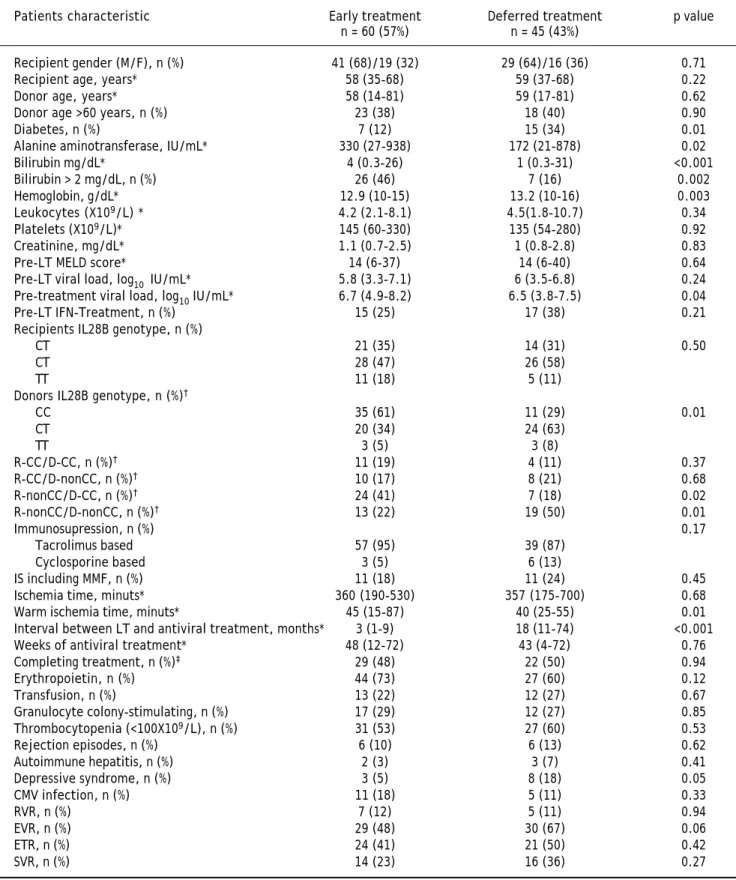
Baseline data by treatment group are summarized in table 1. There were 60 patients in the ET group and 45 in the DT group. Twenty-four (40%) of the 60 ET patients received treatment within a prospec-tive study.15 The groups were similar at baseline ex-cept for higher ALT, bilirubin and HCV RNA, lower hemoglobin levels, and smaller percentage of diabe-tic patients in the ET group. Warm ischemia time was also longer in ET patients. The interval bet-ween LT and start of AVT was significantly shorter in ET than in DT (3 vs. 18 months, respectively; p < 0.001).
respectively, whereas in donor samples, genotype CC was the most common (47%), followed by genotype CT (45%) and TT (8%) (p = 0.001).
When categorized according to treatment group, recipient rs12979860 genotypes were similarly distri-buted in the two groups (Table 1). However, signifi-cantly more patients in the ET group received livers from donors with rs12979860 CC genotype (61%), than patients in the DT group (29%) (p = 0.01).
There were no differences concerning side effects, type of immunosuppression used, haematological support, rejection, or CMV infection.
Treatment outcome
There were no differences between groups in the percentage of patients who completed treatment, or required erythropoietin, blood transfusion or granu-locyte colony-stimulating factor, or in the number of rejection episodes or de novo autoimmune hepatitis cases. The interval between LT and treatment start was longer in patients achieving SVR (Table 2).
A higher percentage of DT patients had depressive symptoms (18% DT vs. 5% ET; p = 0.05).
A similar percentage of patients in both groups achie-ved RVR and EVR (Table 1) and there were no differen-ces in the SVR rate (23% ET vs. 36% DT; p = 0.27).
For the overall cohort, univariate analysis identi-fied the following pre-treatment variables as
associa-ted with SVR: female recipient (p = 0.01), IL28B ge-notype CC (p = 0.04), and graft donor younger than 60 years (p = 0.01) (Table 2). The on-treatment va-riables associated with SVR included, the weeks of AVT (p < 0.001), completing treatment (p < 0.001), and achieving an RVR (p = 0.001), EVR (p < 0.001), and ETR (p < 0.001). On multivariate analysis, the fact of achieving an RVR (OR 13.6, CI 95% 1.7-107.5, p = 0.01) and completing treatment (OR 14.8, CI 95% 2.1-103.8, p = 0.01) were the only variables independently associated with SVR.
In the same analysis by treatment group, com-pleting treatment (p < 0.001), achieving an RVR (p = 0.01), and achieving an EVR (p < 0.001) were associated with SVR in the ET group, whereas completing treatment (p = 0.002), achieving an RVR (p = 0.04), achieving an EVR (p < 0.001), and receiving a graft from a donor younger than 60 years (p = 0.03), were associated with SVR in the DT group.
Survival analysis
The study cohort was followed up for a median of 5.8 years (range 0.4-13.5). In the overall cohort, 37 patients (35%) died during follow-up: 24 (65%) due to liver failure after a median of 2.1 years (range 0.4-9.9), 5 (13%) due to HCC recurrence after a me-dian of 1.6 years (range 0.7-7.6), and the remaining Figure 1. Flow chart of LT pa-tients in our hospital between 2001-2010 and selection of the study cohort.
491 LT-recipients (2001-2010) 222 (45%) HCV-infected
151 (58%) HCV-LT recipients treated
12 non-1 HCV-genotypes
19 HIV co-infected
7 fibrosing cholestatic hepatitis C recurrence
Total recruited 113 (75%)
8 patients lacking complete data
Study cohort. Data available for analysis:
Table 1. Baseline and on treatment characteristics of the study cohort according to the time of treatment.
Patients characteristic Early treatment Deferred treatment p value n = 60 (57%) n = 45 (43%)
Recipient gender (M/F), n (%) 41 (68)/19 (32) 29 (64)/16 (36) 0.71
Recipient age, years* 58 (35-68) 59 (37-68) 0.22
Donor age, years* 58 (14-81) 59 (17-81) 0.62
Donor age >60 years, n (%) 23 (38) 18 (40) 0.90
Diabetes, n (%) 7 (12) 15 (34) 0.01
Alanine aminotransferase, IU/mL* 330 (27-938) 172 (21-878) 0.02
Bilirubin mg/dL* 4 (0.3-26) 1 (0.3-31) <0.001
Bilirubin > 2 mg/dL, n (%) 26 (46) 7 (16) 0.002
Hemoglobin, g/dL* 12.9 (10-15) 13.2 (10-16) 0.003
Leukocytes (X109/L) * 4.2 (2.1-8.1) 4.5(1.8-10.7) 0.34 Platelets (X109/L)* 145 (60-330) 135 (54-280) 0.92
Creatinine, mg/dL* 1.1 (0.7-2.5) 1 (0.8-2.8) 0.83
Pre-LT MELD score* 14 (6-37) 14 (6-40) 0.64
Pre-LT viral load, log10 IU/mL* 5.8 (3.3-7.1) 6 (3.5-6.8) 0.24 Pre-treatment viral load, log10 IU/mL* 6.7 (4.9-8.2) 6.5 (3.8-7.5) 0.04
Pre-LT IFN-Treatment, n (%) 15 (25) 17 (38) 0.21
Recipients IL28B genotype, n (%)
CT 21 (35) 14 (31) 0.50
CT 28 (47) 26 (58)
TT 11 (18) 5 (11)
Donors IL28B genotype, n (%)†
CC 35 (61) 11 (29) 0.01
CT 20 (34) 24 (63)
TT 3 (5) 3 (8)
R-CC/D-CC, n (%)† 11 (19) 4 (11) 0.37
R-CC/D-nonCC, n (%)† 10 (17) 8 (21) 0.68
R-nonCC/D-CC, n (%)† 24 (41) 7 (18) 0.02
R-nonCC/D-nonCC, n (%)† 13 (22) 19 (50) 0.01
Immunosupression, n (%) 0.17
Tacrolimus based 57 (95) 39 (87)
Cyclosporine based 3 (5) 6 (13)
IS including MMF, n (%) 11 (18) 11 (24) 0.45
Ischemia time, minuts* 360 (190-530) 357 (175-700) 0.68 Warm ischemia time, minuts* 45 (15-87) 40 (25-55) 0.01 Interval between LT and antiviral treatment, months* 3 (1-9) 18 (11-74) <0.001 Weeks of antiviral treatment* 48 (12-72) 43 (4-72) 0.76 Completing treatment, n (%)‡ 29 (48) 22 (50) 0.94
Erythropoietin, n (%) 44 (73) 27 (60) 0.12
Transfusion, n (%) 13 (22) 12 (27) 0.67
Granulocyte colony-stimulating, n (%) 17 (29) 12 (27) 0.85 Thrombocytopenia (<100X109/L), n (%) 31 (53) 27 (60) 0.53
Rejection episodes, n (%) 6 (10) 6 (13) 0.62
Autoimmune hepatitis, n (%) 2 (3) 3 (7) 0.41
Depressive syndrome, n (%) 3 (5) 8 (18) 0.05
CMV infection, n (%) 11 (18) 5 (11) 0.33
RVR, n (%) 7 (12) 5 (11) 0.94
EVR, n (%) 29 (48) 30 (67) 0.06
ETR, n (%) 24 (41) 21 (50) 0.42
SVR, n (%) 14 (23) 16 (36) 0.27
Table 2. Baseline and on treatment characteristics of the study cohort according to sustained virological response.
Patients characteristic SVR Non SVR p value
n = 30 (29%) n = 75 (71%)
Recipient gender (M/F), n (%) 14 (47)/16 (53) 56 (75)/19 (25) 0.01
Recipient age, years* 61 (40-68) 60 (35-68) 0.97
Donor age < 60 years, n (%) 24 (80) 40 (53) 0.01
Diabetes (%) 4 (14) 18 (24) 0.32
Alanine aminotransferase, IU/mL* 204 (48-628) 262 (21-938) 0.44
Bilirubin >2 mg/dL, n (%) 9 (31) 24 (34) 0.85
Haemoglobin, g/dL* 12.9 (10-15) 12.4 (10-15.5) 0.32 Leukocytes (x 109/L)* 4.0 (2.1-8.6) 4.4 (1.8-7.8) 0.72 Platelets (x 109/L)* 142 (57-255) 129 (54-333) 0.38
Creatinine, mg/dL* 1 (0.7-1.4) 1 (0.7-2.8) 0.84
Pretransplant viral load, log IU/mL* 5.8 (3.5-7.1) 6 (4.8-6.8) 0.27 Pretreatment viral load, log IU/mL* 6.6 (3.8-7.6) 6.6 (4.9-8) 0.08
Pre-LT IFN-treatment, n(%) 7 (23) 25 (33) 0.34
Recipients IL28B genotype, n (%)
CC 13 (43) 22 (29) 0.04
CT 16 (54) 38 (51)
TT 1 (3) 15 (20)
Donors IL28B genotype,n (%)†
CC 14 (52) 32 (47) 0.31
CT 10 (37) 34 (49)
TT 3 (11) 3 (4)
R-CC/D-CC, n (%)† 5 (18) 10 (14) 0.85
R-CC/D-nonCC, n (%)† 6 (22) 12 (17) 0.63
R-nonCC/D-CC, n (%)† 9 (33) 22 (32) 0.98
R-nonCC/D-nonCC, n (%)† 7 (26) 25 (36) 0.37
Immunosuppression, n (%)
Tacrolimus based 26 (87) 70 (93) 0.35
Cyclosporine based 4 (13) 5 (7)
IS includind MMF, n (%) 8 (27) 14 (19) 0.46
Interval between LT-AVT (months)* 9 (1-53) 4 (1-74) 0.03 Ischemia time, minuts* 330 (175-490) 365 (220-700) 0.28 Warm ischemia time, minuts* 40 (15-50) 40 (20-73) 0.24
Pre-LT MELD* 14 (6-40) 14 (7-39) 0.63
Weeks of antiviral treatment 48 (12-72) 24 (4-72) < 0.001 Completing treatment, n (%)‡ 27 (90) 24 (32) < 0.001
Erythropoietin, n (%) 23 (77) 48 (64) 0.21
Transfusion, n (%) 8 (27) 17 (23) 0.74
Granulocyte colony-stimulating, n (%) 9 (30) 20 (27) 0.83 Thrombocytopenia (< 100 x 109/L), n (%) 14 (47) 44 (60) 0.25
CMV infection, n (%) 2 (7) 14 (19) 0.16
Rejection episodes, n (%) 5 (17) 7 (9) 0.36
Autoimmune hepatitis, n (%) 2 (7) 3 (4) 0.61
Depressive syndrome, n (%) 4 (13) 7 (9) 0.54
RVR, n (%) 9 (30) 3 (4) 0.001
EVR, n (%) 30 (100) 29 (39) < 0.001
ETR, n (%) 30 (100) 15 (21) < 0.001
Figure 3. Survival curves of significant variables according to a multivariate Cox regression model.
Cumulative
probability of survival
1.0
0.8
0.6
0.4
0.2
0.0
0 2 4 6 8 10 Time (years)
Bilirrubin ≤ 2
Bilirrubin > 2
P < 0.0001 HR = 6.1
Cumulative
probability of survival
1.0
0.8
0.6
0.4
0.2
0.0
0 2 4 6 8 10 Time (years)
Cumulative
probability of survival
1.0
0.8
0.6
0.4
0.2
0.0
0 2 4 6 8 10 Time (years) Donor age > 60
Donor age ≤ 60
P = 0.01 HR = 3.1
A B C
Non SVR SVR
P = 0.03 HR = 10.3
Table 3. Causes of mortality.
Early treatment, n = 26 Deferred treatment, n = 11 p value
Hepatic failure 17 7
HCC recurrence 4 1 0.82
Others 5 3
Malignancy Sepsis Malignancy Sepsis
Sepsis Sepsis
Sepsis Sepsis
8 (22%) due to liver-unrelated causes after a median of 4 years post-LT (range 0.5-6.5).
After a median follow-up of 6.9 years (range 0.4-11) in the ET group and 5.6 years (range 1.1-13.5) in the DT group (p = 0.71), Kaplan-Meier analysis showed a trend towards shorter survival in the ET group during the first years, but with similar long-term survival in both groups (Log-rank p = 0.06) (Figure 2). Importantly, liver-related mortality was similar in both groups (p = 0.82) (Table 3).
The variables associated with mortality in the overall cohort included graft donor > 60 years old (p = 0.02), recipient IL28B genotype TT (p = 0.03), pre-treatment bilirubin > 2 mg/dL, (p = 0.001), weeks of AVT (p < 0.001), premature treatment discontinuation (p = 0.001); and failure to achieve EVR (p = 0.001), ETR (p = 0.001), and SVR (p = 0.001) (Table 4).
Multivariate analysis using a Cox regression model (see variables included in table 3) identified the following mortality-related variables: pre-treatment bilirubin > 2 mg/dL (HR 6.1, CI 95% 2.7-13.7, p < 0.001), graft donor older than 60 years (HR 3.1, 95% CI 1.4-6.7, p = 0.01), and failure to achieve SVR (HR 10.3, CI 95% 1.2-18.3, p = 0.03) (Figure 3).
Cumulative probability of survival
1.0
0.8
0.6
0.4
0.2
0.0
0 2 4 6 8 10 12 14 Time (years)
Log rank = 0.06
Early treatment
Deferred treatment
Figure 2. Kaplan-Meier analysis showing patient survival according to the time of treatment. Log-rank (p = 0.06). Median follow-up time; early treatment: 6.9 years (range 0.4-11). Deferred treatment: 5.6 years (range t1.1-13.5), (p = 0.71).
1 year 3 years 5 years 10 years
Table 4. Baseline and on treatment characteristics of the study cohort of 105 patients according to mortality.
Patients characteristic Survival, n = 68 (65%) Death, n = 37 (35%) p value
Recipient gender (M/F), n (%) 44 (65)/24 (35) 26 (70)/11 (30) 0.60
Age, years * 62 (40-68) 57 (35-68) 0.17
Donor age >60 years, n (%) 21 (31) 20 (54) 0.02
Diabetes, n (%) 11 (16) 11 (30) 0.11
Alanine aminotransferase, IU/mL* 216 (21-938) 227 (87-720) 0.86
Bilirubin >2 mg/dL, n (%) 15 (22) 18 (55) 0.001
Haemoglobin, g/dL* 12.9 (10-15.5) 12.4 (10-15) 0.08 Leukocytes (x 109/L)* 4.4 (2.1-8.6) 3.8 (1.8-7.8) 0.73 Platelets (X109/L)* 140 (57-333) 120 (54-280) 0.91
Creatinine, mg/dL* 1.1 (0.7-2.8) 1 (0.7-2.5) 0.37
Pretransplant viral load, log IU/mL* 5.9 (3.5-6.5) 5.9 (4.8-7.1) 0.4 Pretreatment viral load, log IU/mL* 6.5 (3.8-7.6) 6.6 (4.9-8) 0.9
Pre-LT IFN-treatment, n (%) 19 (28) 13 (35) 0.4
Recipients IL28B genotype, n (%)
CC 25 (37) 10 (27) 0.04
CT 37 (54) 17 (46)
TT 6 (9) 10 (27)
Donors IL28B genotype, n (%)
CC 31 (48) 15 (47) 0.60
CT 28 (44) 16 (50)
TT 5 (8) 1 (3)
R-CC/D-CC, n (%)† 10 (16) 5 (16) 1
R-CC/D-nonCC, n (%)† 14 (22) 4 (12) 0.32
R-nonCC/D-CC, n (%)† 21 (33) 10 (31) 0.91
R-nonCC/D-nonCC, n (%)† 19 (30) 13 (41) 0.36
Immunosuppression, n (%)
Tacrolimus based 63 (93) 33 (89) 0.51
Cyclosporine based 5 (7) 4 (11)
IS including MMF 17 (25) 5 (13) 0.24
Interval between LT and antiviral treatment, months* 14 (1-74) 4 (1-35) 0.01 Ischemia time, minuts* 372 (175-700) 360 (220-570) 0.87 Warm ischemia time, minuts* 40 (15-74) 43 (20-87) 0.84
Pre-LT MELD* 14 (6-40) 15 (8-39) 0.91
Weeks of antiviral treatment* 48 (12-72) 24 (4-48) <0.001 Completing treatment, n (%)‡ 41 (61) 10 (27) 0.001
Erythropoietin, n (%) 47 (69) 24 (65) 0.74
Transfusion, n (%) 15 (22) 10 (27) 0.63
Granulocyte colony-stimulating, n (%) 20 (29) 9 (25) 0.62 Thrombocytopenia (< 100 x 109/L), n (%) 41 (60) 17 (49) 0.37
CMV infection, n (%) 10 (15) 6 (16) 0.84
Rejection episodes, n (%) 8 (12) 4 (11) 0.93
Autoimmune hepatitis, n (%) 4 (6) 1 (3) 0.51
Depressive syndrome, n (%) 8 (12) 3 (8) 0.74
RVR, n (%) 8 (12) 4 (11) 0.93
EVR, n (%) 46 (68) 13 (35) 0.001
ETR, n (%) 37 (56) 8 (23) 0.001
SVR, n (%) 27 (40) 3 (8) 0.001
Analysis of mortality-associated variables accor-ding to treatment group identified pre-treatment bilirubin > 2 mg/dL (HR 4.9, 95% CI 1.9-12.7, p = 0.001) and graft donor older than 60 years (HR 3.2, 95% CI 1.3-7.9, p = 0.01) in the ET group, whereas only pre-treatment bilirubin > 2 mg/dL (HR 8.7, 95% CI 1.9-39.9, p = 0.01) was independently associated with mortality in the DT group.
Subgroup analysis
In an exploratory analysis removing patients from the first study,15 the results in terms of effica-cy of therapy were similar to those found using the whole cohort, 17% SVR in ET group vs. 36% in DT group, p = 0.06. No differences regarding related va-riables were found.
Regarding IL28b genotype we obtained same re-sults; more patients in the ET group received livers from donors with rs12979860 CC genotype (65%), than patients in the DT group (29%) (p = 0.01).
Kaplan-Meier analysis showed shorter survival in the ET group (log-rank p = 0.01).
Multivariate analysis using a Cox regression model identified the following mortality-related variables: pre-treatment bilirubin > 2 mg/dL (HR 17.9, CI 95% 5.6-57.6, p < 0.001), graft donor older than 60 years (HR 3.2, 95% CI 1.1-9.5, p = 0.04), failure to achieve SVR (HR 14.5, CI 95% 1.5-141.8, p = 0.02) and diabetes (HR 3.3, CI 95% 1.0-10.5, p = 0.04).
Analysis of mortality-associated variables ac-cording to treatment group identified pre-treatment bilirubin >2 mg/dL (HR 013.0, 95% CI 2.4-69.9, p = 0.003) in ET group.
DISCUSSION
In most centers, treatment of recurrent HCV is started when chronic hepatitis is established and progressive fibrosis has been documented.23 This strategy has the advantage of treating when the patient’s clinical status after LT is stable and the immunosuppression requirement and risk of acute rejection are presumably lower. In a previous stu-dy,15 however, we found that antiviral treatment for recurrent HCV in the acute stage is safe and effec-tive, although the limited sample size and compari-son with patients who did not receive AVT precluded identification of patients who might ob-tain the most benefit from this strategy.
In the present study, our expanded experience with early treatment of recurrent HCV is compa-red with treatment of established chronic HCV
recur-rence in a large cohort of patients over a deca-de in time. Our results indicate that the two treat-ment strategies are similar with regard to tolerability and safety, except for a higher frequency of interferon-related depressive symptoms in pa-tients with established recurrent HCV. Regarding the potential risk of interferon-induced acute rejec-tion,24,25 our results do not support the notion that antiviral therapy in the early phase of recurrence in-creases the risk of rejection.
It is worthwhile to stress that therapy used in the early post-transplantation phase had similar rate of discontinuations as when used in a delayed phase, receiving similar cumulative dosage of ribavirin and Peg-IFN in both groups; moreover, we found that treatment intolerance was not an important limiting factor in the early post-LT phase. Hematological side effects were similar between groups and con-trolled with growth factors or transfusions when required.
It is well known that in the early transplant period doses of IS are higher, whether it has have an impact in the rate of achievement of SVR in our ET group cannot be establish, what we can gauge is that the type of IS and proportion of patients recei-ving MMF was similar, however we cannot reject the possibility of a negative impact of the higher IS, which could have balanced the positive impact of the absence of fibrosis.
The lower frequency of IL28B CC genotype in the LT recipients than in HCV-negative donors is consistent with the role of the CC variant in spontaneous HCV clearance and sensitivity to inter-feron; these characteristics would lead to over-repre-sentation of non-CC variants in the chronic hepatitis C population.26,27 Although the distribution of recipient IL28B genotypes was similar in both treatment groups, the finding of a higher frequency of CC genotype in grafts transplanted to ET reci-pients deserves further comment. This finding is consistent with the results of recent reports in pa-tients with post-LT recurrent HCV.28,29 These au-thors found faster disease progression in patients who had received a CC donor graft, suggesting that although donor IL28B genotype CC associates with higher SVR rates after antiviral therapy, in the ab-sence of viral eradication, it is associated with poo-rer outcome and survival. The authors concluded that these patients should be systematically offered antiviral treatment.28
higher SVR rate in recipients with genotype CC (p = 0.04), but there was no association with donor geno-type (p = 0.30). Nonetheless, recipient genogeno-type was not significantly associated with treatment response in the multivariate analysis. Similar discrepancies between recipient and donor IL28B genotype and SVR have been reported by others.30-32 Although re-cipient IL28B genotype was not independently asso-ciated with treatment response in our study, the limited number of patients and the high number of other variables influencing treatment outcome limit the interpretation of this finding. Further studies are needed to clarify this issue. There were no diffe-rences in the proportion of patients achieving SVR regarding the group of treatment; however, inclu-ding only more sick patients in the ET as the result of removing patients from the first study,15 there was a trend to a higher SVR in the DT group, despite not achieving statistical significance.
We identified a subgroup of LT recipients with a poor prognosis: patients with pre-treatment biliru-bin > 2 mg/dL who received a graft from a donor ol-der than 60 years, and failed to achieve SVR. In an attempt to select the most severe patients as accura-tely as possible we remove patients from the first study,15 this strategy added diabetes as a variable associated with mortality and showed that patients treated in the ET group had a higher mortality than patients treated in the DT, we firmly believe that this is a consequence of the severity of the recurrence and not of the timing.
Patients identified as being at higher risk of severe recurrence might benefit from early treatment with direct-acting antiviral (DAA) containing regimens.33-38 In this regard, our results and those of others28,29 suggest that donor IL28B genotype should be consi-dered a potential prognostic marker for early severe recurrence until further information is obtained.
Although data is scarce in the LT setting,35-37 DDA containing regimens have shown higher SVR (20-71%) rates in LT recipients. With these regimens side effects are high; anemia was the most common (92%), with a rate of infection of 27% with 8% of fatal outcomes, and treatment was discontinued in 43% of patients. However, it is likely that patients with more severe recurrence will benefit from DAA-contai-ning regimens. Accordingly, patients at higher risk of severe recurrence should be promptly identified since they might benefit from earlier DAA-containing anti-viral therapy and all efforts should be directed at completing treatment to increase SVR rates.
Our study has several limitations. First, because of its retrospective nature, decisions on the
indica-tion for treatment were made by clinicians on a case-by-case basis. Furthermore, except for the ET patients who had been included in the previous stu-dy,15 most patients in this group had clinically more severe recurrent HCV than those in the DT group. Therefore, we were unable to assess the utility of prompt treatment in LT recipients with mild recur-rence. Nonetheless, the fact that patients were pros-pectively monitored at a single center by the same physicians according to homogeneous management criteria would likely decrease the impact of potential biases. In addition, due to the observational nature of the study, extrapolation of the results to the liver transplant population at large is difficult. Ideally, an extensive multicenter study comparing DAA-con-taining treatment given during acute versus esta-blished recurrence would allow more accurate treatment guidelines to be developed. Finally, we mention that fibrosis was not compared between groups because this factor was absent in patients treated in the acute phase of recurrence, in accor-dance with the study design.
In conclusion, early treatment of recurrent HCV genotype 1 in LT recipients is safe and achieves si-milar rates of viral eradication as deferred treat-ment. Patients with clinically severe HCV recurrence and those who received a graft from an older donor should be considered candidates for an early, intensive therapeutic intervention to increase HCV eradication and optimize graft and patient survival.
ACKNOWLEDGMENTS
The authors thank Celine Cavallo for English language support, Anna Oliveira and Angie Rico for technical support, and Esther Delgado for secreta-rial work.
ABBREVIATIONS
• 95CI: 95% confidence interval.
• AVT: antiviral treatment.
• CMV: cytomegalovirus.
• DT: deferred treatment.
• DAA: direct acting antivirals.
• ET: early treatment.
• ETR: end of treatment response.
• EVR: early virological response. • Fk: tacrolimus.
• HCV: hepatitis C virus.
• HIV: human immunodeficiency virus.
• IL28B: interleukin 28B. • LT: liver transplantation.
• MELD: model of end-stage liver disease.
• MMF: mycophenolate mofetil.
• OR: odds ratios.
• PCR: polymerase chain reaction.
• PEG-INF: pegylated interferon.
• RVR: rapid virologic response.
• SVR: sustained virological response.
FINANCIAL SUPPORT
Isabel Campos-Varela is a recipient of a ‘Río Hor-tega’ fellowship grant from the Instituto de Salud Carlos III and a Juan Rodes grant from the Asocia-ción Española para el Estudio del Hígado. CIBERehd is supported by Instituto de Salud Carlos III. This work has been partially supported by a grant (PI10/ 01505) from the Spanish Ministry of Health.
AUTHOR PARTICIPATION
Isabel Campos-Varela, Lluis Castells, and Juan Ignacio Esteban participated in making the study design, and writing the article; and Marta Bes, Francisco Rodríguez-Frías, Silvia Sauleda partici-pated in performing the research, Cristina Dopazo, Helena Allende, María Teresa Salcedo, Ramón Charco, Jaime Guardia and Rafael Esteban reviewed the article.
CONFLICT OF INTEREST DISCLOSURE
Dr. Rafael Esteban has attended advisor meetings with Abbott, Boehringer Ingelheim, Bristol Myers-Squibb, Glaxo, Gilead, Janssen Merck, and Novar-tis; has provided lectures on behalf of Abbott, Boehringer Ingelheim, Bristol Myers-Squibb, Glaxo, Gilead, Janssen, Merck, Novartis and Roche; and has served on a Data Safety Monitoring Board for Novartis. The authors have no other potential conflicts of interest to disclose regarding the manuscript.
REFERENCES
1. Gane EJ, Portmann BC, Naoumov NV, Smith HM, Underhill JA, Donaldson PT, et al. Long-term outcome of hepatitis C infection after liver transplantation. N Engl J Med 1996; 334: 815-20.
2. Gane EJ. The natural history of recurrent hepatitis C and what influences this. Liver Transpl 2008; 14(Suppl. 2): S36-S44.
3. Forman LM, Lewis JD, Berlin JA, Feldman HI, Lucey MR. The association between hepatitis C infection and
survi-val after orthotopic liver transplantation.
Gastroentero-logy 2002; 122: 889-96.
4. Berenguer M, Ferrell L, Watson J, Prieto M, Kim M, Rayon M, Córdoba J et al. HCV-related fibrosis progression follo-wing liver transplantation: increase in recent years. J
He-patol 2000; 32: 673-84.
5. Berenguer M, Prieto M, Rayo’n JM, Mora J, Pastor M, Or-tiz V, Carrasco D, et al. Natural history of clinically com-pensated HCV-related graft cirrhosis after liver transplantation. Hepatology 2000; 32: 852-8.
6. Schluger LK, Sheiner PA, Thung SN, Lau JY, Min A, Wolf DC, Fiel I et al. Severe recurrent cholestatic hepatitis C follo-wing orthotopic liver transplantation. Hepatology 1996; 23: 971-6.
7. Neumann UP, Berg T, Bahra M, Seehofer D, Langrehr JM, Neuhaus R, Radke C, et al. Fibrosis progression after liver transplantation in patients with recurrent hepatitis C. J
Hepatol 2004; 41: 830-6.
8. Samuel D, Bizollon T, Feray C, Roche B, Ahmed SNS, Lemon-nier C, Cohard M, et al. Interferon-a 2b plus ribavirin in patients with chronic hepatitis C after liver transplanta-tion: a randomized study. Gastroenterology 2003; 124: 642-50.
9. Neff GW, Montalbano M, O’Brien CB, Nishida S, Safdar K, Bejarano PA, Khaled AS, et al. Treatment of established re-current hepatitis C in liver-transplant recipients with pe-gylated interferon-alfa-2b and ribavirin therapy.
Transplantation 2004; 78: 1303-7.
10. Berenguer M, Charco R, Pascasio JM, Herrero JI. Spanish society of liver transplantation (SETH) consensus recom-mendations on hepatitis C virus and liver transplantation.
Liver Int 2012; 32: 712-31.
11. Carrion JA, Navasa M, García-Retortillo M, García-Pagan JC, Crespo G, Bruguera M, Bosh J, et al. Efficacy of antivi-ral therapy on hepatitis C recurrence after liver trans-plantation: a randomized controlled study.
Gastroenterology 2007; 132: 1746-56.
12. Berenguer M. Systematic review of the treatment of established recurrent hepatitis C with pegylated interferon in combination with ribavirin. J Hepatol 2008; 49: 274-87.
13. Berenguer M, Palau A, Aguilera V, Rayón JM, Juan FS, Prie-to M. Clinical benefits of antiviral therapy in patients with recurrent hepatitis C following liver transplantation. Am J
Transplant 2008; 8: 679-87.
14. Berenguer M, Aguilera V, Prieto M, Ortiz C, Rodríguez M, Gentili F, Risalde B, et al. Worse recent efficacy of antivi-ral therapy in liver transplant recipients with recurrent hepatitis C: impact of donor age and baseline cirrhosis.
Liver Transpl 2009; 15: 738-46.
15. Castells L, Vargas V, Allende H, Bilbao I, Luis LJ, Margarit C, Esteban R, et al. Combined treatment with pegylated interferon (a-2b) and ribavirin in the acute phase of hepa-titis C virus recurrence after liver transplantation. J
He-patol 2005; 43: 53-9.
16. Zimmermann T, Böcher WO, Biesterfeld S, Zimmermann A, Kanzler S, Greif-Higer G, Barreiros AP, et al. Efficacy of an escalating dose regimen of pegylated interferon alpha-2a plus ribavirin in the early phase of HCV reinfection after liver transplantation. Transpl Int 2007; 20: 583-90. 17. von Elm E, Altman DG, Egger M, Pocock SJ, Gøtzsche PC,
18. Ishak K, Baptista A, Bianchi L, Callea F, De GJ, Gudat F, Denk H, et al. Histological grading and staging of chronic hepatitis. J Hepatol 1995; 22: 696-9.
19. Margarit C, Bilbao I, Castells L, Lopez I, Pou L, Allende E, Escartin A. A prospective randomized trial comparing ta-crolimus and steroids with tata-crolimus monotherapy in liver transplantation: the impact on recurrence of hepatitis C.
Transpl Int 2005; 18: 1336-45.
20. Ghany MG, Strader DB, Thomas DL, Seeff LB; American As-sociation for the Study of Liver Diseases. Diagnosis, ma-nagement, and treatment of hepatitis C: an update.
Hepatology 2009; 49: 1335-74.
21. McCarthy JJ, Li JH, Thompson A, Suchindran S, Lao XQ, Patel K, Tillmann HL, et al. Replicated association between an IL28B gene variant and a sustained response to pegyla-ted interferon and ribavirin. Gastroenterology 2010; 138: 2307-14.
22. Montes-Cano MA, García-Lozano JR, Abad-Molina C, Rome-ro-Gómez M, Barroso N, Aguilar-Reina J, Núñez-Roldán A, et al. Interleukin-28B genetic variants and hepatitis virus infection by different viral genotypes. Hepatology 2010; 52: 33-7.
23. Berenguer M, Aguilera V, Rubín A, Ortíz C, Jimenez M, Prieto M. Comparison of two non-contemporaneous HCV-liver transplant cohorts: Strategies to improve the effica-cy of antiviral therapy. J Hepatol 2012; 56: 1310-6. 24. Samuel D. Hepatitis C, interferon, and risk of rejection
af-ter liver transplantation. Liver Transpl 2004; 10: 868-71. 25. Saab S, Kalmaz D, Gajjar NA, Hiatt J, Durazo F, Han S,
Far-mer DG, et al. Outcomes of acute rejection after interfe-ron therapy in liver transplant recipients. Liver Transpl 2004; 10: 859-67.
26. Thomas DL, Thio CL, Martin MP, Qi Y, Ge D, O’Huigin C, Kidd J, et al. Genetic variation in IL28B and spontaneous clearance of hepatitis C virus. Nature 2009; 461: 798-801. 27. Bes M, Sauleda S, Campos-Varela I, Rodríguez-Frías F, Ca-samitjana N, Homs M, Piron M, et al. IL28B genetic varia-tion and hepatitis C virus specific CD4 T cell response in anti-HCV positive blood donors. J Viral Hepat 2012; 19: 867-71.
28. Duarte-Rojo A, Veldt BJ, Goldstein DD, Tillman HL, Watt KD, Heimbach JK, McHutchinson JP, et al. The course of posttransplant hepatitis c infection: comparative impact of donor and recipient source of the favorable IL28B ge-notype and other variables. Transplantation 2012; 94: 197-203.
29. Cisneros E, Baños I, Citores MJ, Duca A, Salas C, Noblejas A, Cañizares M, et al. Increased risk of severe hepatitis C virus recurrence after liver transplantation in patients with a T allele of IL28B rs12979860. Transplantation 2012; 94(3): 275-80.
30. Charlton MR, Thompson A, Veldt BJ, Watt K, Tillmann H, Po-terucha JJ, Heimbach JK, et al. Interleukin-28B polymor-phisms are associated with histological recurrence and treatment response following liver transplantation in pa-tients with hepatitis C virus infection. Hepatology 2011; 53: 317-24.
31. Coto-Llerena M, Pérez-Del-Pulgar S, Crespo G, Carrión JA, Martínez SM, Sánchez-Tapias JM, Martorell J, et al. Donor and recipient IL28B polymorphisms in HCV-infec-ted patients undergoing antiviral therapy before and after liver transplantation. Am J Transplant 2011; 11: 1051-7.
32. Lange CM, Moradpour D, Doehring A, Lehr HA, Müllhaupt B, Bibert S, Bochud PY, et al. Impact of donor and recipient IL28B rs12979860 genotypes on hepatitis C virus liver graft reinfection. J Hepatol 2011; 55: 322-7.
33. Poordad F, McCone J Jr, Bacon BR, Bruno S, Manns MP, Sulkowski MS, Jacobson IM, et al. SPRINT-2 Investigators. Boceprevir for untreated chronic HCV genotype 1 infec-tion. N Engl J Med 2011; 364: 1195-206.
34. Zeuzem S, Andreone P, Pol S, Lawitz E, Diago M, Roberts S, Focaccia R, et al; REALIZE Study Team. Telaprevir for re-treatment of HCV infection. N Engl J Med 2011; 364: 2417-28.
35. Fontana RJ, Hughes EA, Appelman H, Hindes R, Dimitrova D, Bifano M. Case report of successful peginterferon, ri-bavirin, and daclatasvir therapy for recurrent cholestatic hepatitis C after liver retransplantation. Liver Transpl 2012; 18: 1053-9.
36. Roche B, Samuel D. Hepatitis C virus treatment pre- and post-liver transplantation. Liver Int 2012; 32(Suppl. 1): 120-8.
37. Werner CR, Egetemeyr DP, Lauer UM, Nadalin S, Königsrai-ner A, Malek NP, Berg CP. Short report: Telaprevir-based triple therapy in liver transplanted HCV patients: A 12 week pilot study providing safety and efficacy. Liver
Transpl 2012; 18: 1464-70.