Inrern. J . Neuroscience, 1998, Vol 95, pp. 271-284 Reprints available directly from the publisher Photocopying permitted by license only
1998 OPA (Overseas Publishers Association) N.V. Published by license under the Gordon and Breach Science Publishers imprint Printed in India.
INDIVIDUAL DIFFERENCES IN MEMORY
AND EXECUTIVE FUNCTION ABILITIES
DURING NORMAL AGING
SI LVIA MEJIA a , DAVID PINEDA a , LINA M. ALVAREZ a
and A L F R E D 0 ARDILA b3*
a Neuropsychology Program, University of San Buenaventura, Medellin - Colombia; Miami Institute of Psychology, Miami- Florida - U S A
(Received 25 February 1998)
The purpose of this study was to analyze the effects of some individual variables on memory and executive function test performance in normal aging individuals. Sixty subjects (21 males and 39 females), with a mean age of 69.66 ( S D = 7.09) were selected. The following neuropsychological tests were selected. The following neuropsychological tests were adminis- tered: Associative Learning and Logical Memory from the Wechsler Memory Scale (WMS) (Wechsler, 1945), Associative Memory with Semantic Enhancement Test (AMSET) (Pineda, Galeano and Giraldo, 1991), Wisconsin Card Sorting Test (WSCT) (Heaton, 1981), and Verbal Fluency (phonologic and semantic). The effects of demographic (age, education, and sex) and some individual variables (academic history, working history, physical activity, and leisure activities) were measured. Age and education effects on test scores were observed, but no sex effect was found. Working history and leisure activities established significant differences in some test scores. A multiple regression analysis was performed. Not only demographic variables, but also individual variables were associated with memory, and albeit a t a lesser extend, with executive function test scores. It was emphasized that not only demographic factors, but also individual variables have a significant effect on cognitive changes observed during normal aging.
Kcyvordst Aging; memory
Normal aging is significantly associated with changes in memory abilities
(Albert, 1994; Ardila and Rosselli, 1986). Forgetfulness and the capacity to
store new information decreases. This decline is initially slow, but becomes
evident particularly after the 60’ (Ardila and Rpsselli, 1989). In abnormal aging (dementia) memory disturbances are most evident (Cummings and
* Address for Correspondence: Miami Institute of Psychology, 81 80 NW 36 Street, Miami, FL 33166.
27 1
Int J Neurosci Downloaded from informahealthcare.com by Florida International University, Medical Library on 03/14/11
212 S. MEJIA et al.
Benson, 1992). Memory, however, does not change uniformly with age. Some aspects are more impaired than others in elders. Remote memory usually remains relatively stable with age (Huppert, 1991; Kaszniak, Poone and Riege, 1986), whereas recent memory is most affected. Significant differences between young and old people are observed in long-term memory ability (Albert, 1994). Short-term memory may show only minor changes with age. In general, verbal memory is more affected than nonverbal memory (Janowsky, Carper and Kaye, 1996). This asymmetrical pattern is a feature of healthy aging.
Age-related memory decrements are greater on recall than on recognition tasks (Craik, 1987), meaning that retrieval defects may contribute to long- term memory problems also. Cuing at retrieval and encoding usually
improves the performance on memory tests in the elderly (Cummings and
Benson, 1992; Craik, 1987). Moreover, genuine memory deficit of demented subjects could be demonstrated by ineffective cued recall in a controlled
learning condition, while enhanced retrieval is not observed as it occurs in
normal aging (Grober et al., 1988; Pineda, Galeano and Giraldo, 1991).
Consequently, significant differences between free and cued recall should be expected on memory test performance in normal aging subjects.
Aging is associated with a slowing in encoding (Cerella, Poon and Fozard,
1982) and in reaction time (Ardila and Rosselli, 1986). The rate of
presentation of the to-be-retained information may affect memory performance in the elderly individuals. Arenberg (1 982) found significant differences in the performance of younger and older adults if the memory information is presented at a high rate. These differences disappeared when the rate of presentation slowed.
The impairment in recent memory has been associated with an age- dependent change in the use of metamemory strategies. Older people, for example, are less likely to use association strategies when learning a list of words (Albert, 1994) and therefore, required more trials than younger people to learn a list of words (Ardila and Rosselli, 1989).
Impairment in recent memory due to a reduction in storing ability and deficits in retrieval processes has been known as benign senile forgetfulness. Elders have difficulties in converting recently presented information as nonverbal, in long term-memory traces. Effects of proactive and retroactive interference are also increased.
Beside the purely memory defects, elders’ underperformance in memory tests may be under the influence of a significant number extra-memory factors, such as lack of motivation, absence of familiarity with the testing
procedures, sensory defects, depression, etc.
Int J Neurosci Downloaded from informahealthcare.com by Florida International University, Medical Library on 03/14/11
NORMAL AGING 213
Changes in executive function ability and general intelligence are also observed during normal aging. Fluid intelligence decreases, and defects in using current information are usually observed. These deficits are associated with slowing in information processing, and decrease in cognitive flexibility (Ardila and Rosselli, 1986). In general, tasks requiring cognitive flexibility
(e.g., Trail Making Test, Wisconsin Card Sorting Test, erc.) become difficult to perform in normal elders (La Rue, 1992). By the same token, abstract logical problems are difficult to solve, whereas the solution of practical everyday problems are easier.
The ability to generate words within a category has been associated with frontal lobe functioning (Denckla, 1996) and has been reported as
deteriorated during normal aging (Mittenberg ef al., 1989; Janowsky et
al., 1989), even though this observation remains controversial (Monti et al.,
1996).
Several studies have reported cognitive heterogeneity not only in
Alzheimer’s disease (AD) patients but also normal aging subjects.
Differences between cognitive domains, and between components within
cognitive domains have been noted (Joanette et al., 1995). Individual
differences play a significant role in different clinical A D subtypes (Rithchie and Touchon, 1992).
Educational attainment and occupation have been related with a slower
dementia progression (Mortimer and Graves, 1993). Higher prevalence of dementia in elders with lower educational attainment have been reported (Bonaiuto et ai., 1990). Stern et al. (1992) observed in A D patients an inverse relationship between parieto temporal perfusion and educational level. These authors have considered educational and occupational attainment to supply a reserve that allows an individual to cope longer before A D is clinically expressed.
In normal elders, significant differences in cognitive abilities associated with diverse variables, such as education, socioeconomic status, and health conditions have been reported (La Rue, 1992). Bornstein and Suga (1988) suggest that individuals with higher levels of education have a better ability
to compensate for the effects of aging on cognition. Sex may represent
another significant variable, even though when educational and other relevant variables are appropriately controlled, sex effects usually disappear (Benedet and Seisdedos, 1996).
Individual variables may potentially have a significant effect o n neuropsychological test performance during normal aging. Individual variables include: working history, current daily activities of the subject, way of living, type and frequency of social interactions, etc.
Int J Neurosci Downloaded from informahealthcare.com by Florida International University, Medical Library on 03/14/11
274 S. MEJIA et al.
The purpose of this study was to analyze the effects of some individual variables on memory and executive function tests in normal aging individuals. It has hipothesized that individual variables significantly affect aging pattern during normal aging.
METHOD
Participants
Sixty subjects (21 males and 39 females), with a mean age of 69.66
( S D = 7.09) were selected. Subjects with a psychiatric or neurological
history were not included in the sample. No subject reported taking any
psychotropic medication at the time of the evaluation. Mean score in the Blessed Dementia Scale (Blessed, Tomlinson and Roth, 1968) was 2.51
( S D = 2.35). Table I presents the distribution of the sample.
Subjects corresponded to different socioeconomic levels. To determine the socioeconomic status, the official city criteria were used. Medellin has been
divided by the City Administration Board into six socioeconomic areas,
going from Level 1 (lowest) to Level 6 (highest). This division is taken into
account when collecting taxes, and city service payments. People living in
Level 1 areas are usually unqualified factory workers, maids and the like,
who earn the minimal legal-salary. People living in Level 6 areas are high- income professionals, industry owners, and the like. Eight subjects corresponded to Levels I and 2; 46 subjects corresponded to Level 3; and six to Levels 4 and 5 according to the City Administration Board criteria.
Four subjects were living alone, whereas the rest were living with their families or friends. Nine subjects were working; the rest were retired. Thirty subjects attended a rural school, and 30 attended an urban school. Five subjects have worked less than 10 years; 22 between 10 and 2.5 years; 33 have worked for over 2.5 years. Thirty-six subjects had a semi skilled job, whereas the rest had a skilled job.
TABLE I Distribution of the sample. Demographic variables (n = 60)
Age
Education 55-70 years 71 - 8 5 years Total
2 - 5 years
6- 1 1 years Total
1616
2216 610
lOjl0 261 16
7/5 13/5
17/15 39/21
Note: In each group the number of females/males is presented.
Int J Neurosci Downloaded from informahealthcare.com by Florida International University, Medical Library on 03/14/11
NORMAL AGING 275
Thirty-three subjects were physically active (sports, daily walking, etc ), whereas the rest did not perform any special physical activity. Forty-seven subjects watch TV and/or listen radio on a daily basis; 33, read every day; and 29, preferred other leisure activities (cooking, sewing, etc).
All subjects were Colombians, living in Medellin (population around 1,700,000 inhabitants) and were native Spanish-speakers.
Statistical Analysis
Main age, education and sex effects on test performance were analyzed. Age
and education were correlated with tests scores. A stepwise regression
analysis was performed. The regression model used the demographic and individual variables as dependent variables, and the test scores as independent variables. The following were used as dependent variables: demographic variables (age and sex), academic history (level of education
and type of school-rural vs. urban), working history (years worked and type
of work-skilled vs. semiskilled), physical activity (active vs. nonactive) and reading habits (yes vs. no).
Instruments
The following neuropsychological tests, directed to evaluate memory and executive function, were individually administered to each subject:
1. Wechsler Memory Scale (WMS) (Wechsler, 1945). WMS has been
adapted and normalized in Colombia (Ardila, Rosselli and Puente, 1994). The following subtests were used:
1.1. Associative learning
1.2. Logical Memory.
2. Associative Memory with Semantic Enhancement Test (AMSET) (Pine-
da, Galeano and Giraldo, 1991). This is a semantically guided memory test like Grober et al. (1988) Controlled Learning Test. Sixteen pictures drawn on four cards and corresponding to four different semantic categories (animals, kitchen utensils, garments, and fruits) are used.
Below each picture, the name of the item is written (e.g., “elephant”). The
examiner presents one card at the time, and tells the name (“Here there is a card with four animals; this is an elephant, this is a duck, this is a rabbit, and this is a cat”). Twenty seconds after the presentation of the cards is over, the subject is required to recall the picture names. An interfering task is then given to the subject (to draw). And again the
Int J Neurosci Downloaded from informahealthcare.com by Florida International University, Medical Library on 03/14/11
276 S. MEJIA et a1
subject is required to recall the 16 items. Immediately, the examiner asks: “Which were the four animals (kitchen utensils, garments, fruits) that were presented?” (Cued recall). Twenty minutes later, a new recall is required (Delayed recall score). And 10 minutes later, a 60-word list (including the 16 correct words) are read and presented in written to the subject, asking to point the correct words. Five different scores were used:
2.1. Free recall: Number of items correctly recalled in the two
2.2. Cued recall (maximum score = 16).
2.3. Delayed recall (maximum score = 16).
2.4. Total recall (maximum score = 64).
2.5. Recognition (maximum score = 16).
spontaneous recall conditions (maximum score = 32).
3. Wisconsin Card Sorting Test (WSCT). Standard procedures (Heaton, 1981) were used. This test has normative scores obtained in Colombia (Rosselli and Ardila, 1993). The following scores were considered:
3. I . Categories.
3.2. Perseverative responses. 3.3. Perseverative errors. 3.4. Nonperseverative errors 3.5. Failure to maintain set.
4. Verbal Fluency. Two conditions were used:
4. I . Phonological verbal fluency: to say words in one minute, beginning with the Spanish sound
If/,
/a/ and I s / ,4.2. Semantic verbal fluency: animals and fruits produced in one minute.
For the analyses, number of correct words in the phonologic, and in
the semantic condition were used (Ardila, Rosselli and Puente, 1994).
Test 1 (WMS) and Test 2 (AMSET) are obviously memory tests, whereas
WCST is usually taken as a typical executive function task. Verbal fluency, particularly Phonologic verbal fluency, may also be interpreted as an executive function test.
Procedure
Participants were nonpaid volunteers taken from a list of retired persons from a textile industry who were in the age range and accepted to participate
Int J Neurosci Downloaded from informahealthcare.com by Florida International University, Medical Library on 03/14/11
N O R M A L AGING 277
in the study. Subjects were individually tested by graduate neuropsychology
students under the supervision of a professor.
RESULTS
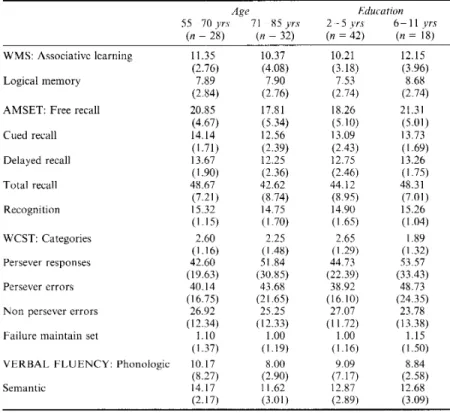
Table I1 presents the mean scores and standard deviations in the different tests, according to age and educational level. It is observed that in general scores are higher in younger subjects with a higher educational level.
Age was a significant variable in all the AMSET scores, excepting Recognition. Age was significant variable in Semantic, but not Phonologic, verbal fluency. Age did not represent a significant variable on the two WMS subtests and on the WCST scores. Education was a significant variable on several AMSET scores (Free recall, Delayed recall and Total recall) as well
TABLE 11
subtests
Age and education means and standard deviations (in brackets) in the different
A g e
55-70 yrs 71-85 yrs ( n = 28) ( n = 32)
Education
2 - 5 j r s 6-11 yrs ( n = 42) ( n = 18) WMS: Associative learning
Logical memory
AMSET: Free recall
Cued recall
Delayed recall
Total recall
Recognition
WCST: Categories
Persever responses
Persever errors
Non persever errors
Failure maintain set
VERBAL F L U E N C Y : Phonologic
Semantic
11.35 10.37
(2.76) (4.08)
7.89 7.90
(2.84) (2.76)
20.85 17.81
(4.67) (5.34)
14.14 12.56
(1.71) (2.39)
13.67 12.25
(1.90) (2.36)
48.67 42.62
(7.21) (8.74)
15.32 14.75
(1.15) (1.70)
2.60 2.25
(1.16) ( I .48)
42.60 51.84
(19.63) (30.85)
40.14 43.68
(16.75) (2 I .65)
26.92 25.25
(12.34) (12.33) 1.10 1
.oo
(1.37) (1.19)10.17 8.00
(8.27) (2.90)
14.17 11.62
(2.17) (3.01)
10.21 12.15
(3.18) (3.96)
7.53 8.68
(2.74) (2.74)
18.26 21.31
(5.10) (5.01)
13.09 13.73
(2.43) (1.69)
12.75 13.26
(2.46) (1.75)
44.12 48.31
(8.95) (7.01)
14.90 15.26
(1.65) ( I .04)
2.65 1.89
(1.29) (1.32)
44.73 53.57
38.92 48.73
(16.10) (24.3 5)
27.07 23.78
(11.72) (13.38) 1
.oo
1.15 (1.16) (1.50)9.09 8.84
(7.17) (2.58)
12.87 12.68
(2.89) (3.09) (22.39) (33.43)
Int J Neurosci Downloaded from informahealthcare.com by Florida International University, Medical Library on 03/14/11
278 S. MEJIA et al
as in the WMS Associative learning subtest. None of the test scores was significantly associated with sex. Only a few interaction were found significant. Main age, education, and sex, effects, as well as interactions are presented in Table 111.
Age and education were correlated with test scores (Tab. IV). Most of the test scores correlated negatively with age and positively correlated with education. However, only a few correlations reached a statistically significant level. Age best correlated with Semantic verbal fluency, whereas education best correlated with AMSET Free recall condition.
TABLE 111 F-values age, education and sex
Test A: Age B: Education C: Sex A x B A x C B x C
WMS: Associative learning 3.39 6.11** 0.86 0.45 1.83 1.93
Logical memory 0.51 2.90 0.43 0.23 0.56 0.74
AMSET: Free recall 10.16** 10.99** 0.44 1.83 3.02 2.99
Cued recall 6.37* 3.24 0.03 0.08 1.03 2.68
Delayed recall 8.17 4.87* 0.04 1.24 2.75 5.23*
Total recall** 12.22** 10.22* 0.24 1.54 3.37 4.72*
Recognition 0.47 0.22 0.03 0.25 0.62 0.57
WCST: Categories 1.83 0.07 0.60 2.49 0.00 1.27
Perseverat responses 0.97 1.49 1.15 0.01 0.41 0.59
Perseverat errors 0.00 1.27 0.02 0.00 2.10 0.54
Non perseverat errors 1
.oo
2.41 0.01 2.76 6.06** 3.42Failure maintain errors 1.11 0.56 0.19 6.20** 0.56 0.86
Verbal fluency: Phonologic 2.13 2.70 0.19 1.03 1.34 1.42
Semantic 9.04** 0.88 0.41 0.42 0.18 1.36
* p < 0.05; ** p < 0.01
TABLE IV Correlation between test scores with age and education
Test Axe Education
WMS: Associative learning -0.25
Logical memory -0.16
AMSET: Free recall -0.21
Cued recall -0.26
Delayed recall -0.31*
Total recall -0.28*
Recognition -0.01
WCST: Categories Perseverat responses Perseverat errors Non perseverat errors Failure maintain set
-0.04 0.06 0.04
-0.14 -
-0.12
0.12 0.23
0.29 * 0.13 0.03 0.23 0.02
0.08 0.20 0.18
-0.20 0.06
Verbal fluency: Phonologic -0.04 0.19
Semantic -0.47** 0.03
* p c 0.05; ** p c .01.
Int J Neurosci Downloaded from informahealthcare.com by Florida International University, Medical Library on 03/14/11
N O R M A L A G I N G 279
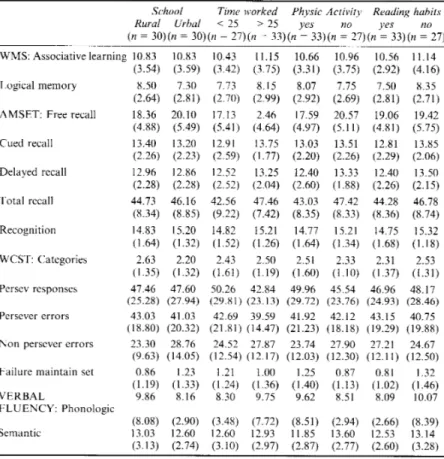
Table V presents the mean scores and standard deviations in the different tests, according to the individual variables (type school, time worked, physical activity, and reading habits). For most of the test, scores were similar across groups.
F-values and level of significance of individual variables are presented in
Table VI. Only some F-values were statistically significant. Two individual variables (time worked, and reading habits) were statistically significant on some test scores. Few interactions reached a statistical level of significance. Finally, a stepwise regression analysis was performed (Tab. VII). In the final full regression model it was observed that some selected variables could
TABLE V subtests
Individual variables. Means and standard deviations (in brackets) in the different
School Time ,corked Physic Activirji Reading habits
Rural Urbul 25 25 yes no yes no
( n = 30)(n = 30)(n = 27)(n = 33)(n = 33)(n = 27)(n = 33)(n = 27) WMS: Associativelearning 10.83 10.83 10.43 11.15 10.66 10.96 10.56 11.14
(3.54) (3.59) (3.42) (3.75) (3.31) (3.75) (2.92) (4.16) Logical memory
AMSET: Free recall
Cued recall
Delayed recall
Total recall
Recognition
WCST: Categories
Persev responses
Persever errors
Kon persever errors
Failure maintain set
VERBAL
FLUENCY: Phonologic
Semantic
8.50 7.30 7.73 8.15 8.07 7.75 7.50 8.35 (2.64) (2.81) (2.70) (2.99) (2.92) (2.69) (2.81) (2.71)
18.36 20.10 17.13 2.46 17.59 20.57 19.06 19.42 (4.88) (5.49) (5.41) (4.64) (4.97) (5.1 1) (4.81) (5.75) 13.40 13.20 12.91 13.75 13.03 13.51 12.81 13.85 (2.26) (2.23) (2.59) (1.77) (2.20) (2.26) (2.29) (2.06)
12.96 12.86 12.52 13.25 12.40 13.33 12.40 13.50 (2.28) (2.28) (2.52) (2.04) (2.60) (1.88) (2.26) (2.15)
44.73 46.16 42.56 47.46 43.03 47.42 44.28 46.78 (8.34) (8.85) (9.22) (7.42) (8.35) (8.33) (8.36) (8.74)
14.83 15.20 14.82 15.21 14.77 15.21 14.75 15.32 (1.64) (1.32) (1.52) (1.26) (1.64) (1.34) (1.68) (1.18) 2.63 2.20 2.43 2.50 2.51 2.33 2.31 2.53 (1.35) (1.32) (1.61) (1.19) (1.60) (1.10) (1.37) (1.31) 47.46 47.60 50.26 42.84 49.96 45.54 46.96 48.17 (25.28) (27.94) (29.81) (23.13) (29.72) (23.76) (24.93) (28.46) 43.03 41.03 42.69 39.59 41.92 42.12 43.15 40.75 (18.80) (20.32) (21.81) (14.47) (21.23) (18.18) (19.29) (19.88)
23.30 28.76 24.52 27.87 23.74 27.90 27.21 24.67 (9.63) (14.05) (12.54) (12.17) (12.03) (12.30) (12.1 I) (12.50)
0.86 1.23 1.21 1.00 1.25 0.87 0.81 1.32 (1.19) (1.33) (1.24) (1.36) (1.40) (1.13) (1.02) (1.46)
9.86 8.16 8.30 9.75 9.62 8.51 8.09 10.07
(8.08) (2.90) (3.48) (7.72) (8.51) (2.94) (2.66) (8.39) 13.03 12.60 12.60 12.93 11.85 13.60 12.53 13.14 (3.13) (2.74) (3.10) (2.97) (2.87) (2.77) (2.60) (3.28)
Int J Neurosci Downloaded from informahealthcare.com by Florida International University, Medical Library on 03/14/11
280 S. MEJIA et al.
TABLE V1 F-values. Individual variables
Test A: B: C: D: A x B A x C A x D B x C B x D C x D
School Time Physic Reading
WMS:
Associative learning Logical memory
AMSET: Free recall Cued recall Delayed recall Total recall Recognition
WCST: Categories Perseverat responses Perseverat errors Non perseverat errors
Failure maintain set
Verbal fluency: Phonologic Semantic
0.37 0.35
0.12 0.59
0.78 8.06** 0.38 2.84 0.85 1.37 0.02 6.11* 0.14 0.58
1.06 0.00 0.54 0.19 0.03 0.45 1.01 0.15
0.48 0.12
0.06 0.72
1.32 1.20
0.00 0.03 1.68 0.38 4.05* 10.72"
0.43 0.59 0.19 0.52 0.00 0.01
0.03 0.70 1.61 0.32 0.00 0.88 0.65 4.35* 0.61 0.00 2.41 7.79** 0.06 3.69 0.47 0.63 2.59 4.91* 0.00 2.35 1.33 0.01 0.70 3.41 0.00 2.67 2.30 0.32 0.24 2.42 0.48 0.09 0.36 7.28** 0.10 0.61 1.82 1.42 5.04* 6.52* 0.02 3.26 0.32 0.16 3.39 8.73** 0.04 1.74 3.79 2.59 2.44 0.60 0.15 0.78
1.17 0.65 1.43 0.83 0.12 1.03
0.15 0.04 0.36 0.08 0.20 0.16
0.77 0.31 0.01 0.86 2.96 10.38**
0.65 4.99*
0.00 2.36
0.07 0.23 0.48 0.42 0.03 0.62 0.02 0.06 0.22 1.19 0.16 0.24 1.38 0.00 0.49 0.13 0.00 0.21
0.05 0.21
2.15 0.68
0.90 0.66
* p < 0.05; ** p < 0.01
TABLE VII
Percentage of the variance what is accounted by different independent variables
Dependent Independent variable Percentage of variance
variable (Selected moden
Multiple regression analysis. Only significant ( p < 0.05) variables are presented.
WMS: Associative learning AMSET: Free recall
Cued recall Delayed recall Total recall
Recognition
WCST: Perseverat errors VERBAL FLUENCY: Semantic
Education Sex Time worked Sex Reading Reading School Age Age Age 7.2% 20.1 10.3 10.1 18.2 20.9 9.3 21.7
account for the observed variance in most memory test scores, but only in two executive function scores (WCST-Perseverative errors and Semantic verbal fluency). Age, sex, time worked and reading habits, were significant predictors in the AMSET variance scores. WCST perseverative errors was
associated with type of school. Education accounted for 7.2% of the WMS
Associative learning scores and age for over 21% of the Semantic verbal
fluency test. In the Free recall condition of AMSET, sex and time worked
accounted for over 20% of the variance. It means, three (time worked, reading habits, and type of school) out of the four selected individual variables were predictors of the test score variance.
Int J Neurosci Downloaded from informahealthcare.com by Florida International University, Medical Library on 03/14/11
NORMAL AGING 28 1
DISCUSSION
Current results support the hypothesis that individual variables are significantly associated with the cognitives changes observed during normal aging. In normal aging subjects significant neuropsychological heterogeneity has been established (Albert, 1994; Ostrosky, Ardila and Jaime, 1998).
Heterogeneity, however, is much more pronounced in A D patients than in normal aging individuals. Thus, Carmelli et al. (1997) found an affect of educational level on normal aging subjects only on some language and praxis tasks, while on A D patients differences were observed on all tasks. Compared with young subjects, aged subjects exhibit depressed performance in tasks that require increasing resource demands. This finding has led some
authors to argue for attention reduction on working memory (Foos, 1989;
Light and Anderson, 1985). Using a divided attention paradigm, some studies have observed a detrimental effect of normal aging (Hartley, 1992),
while others only observed just a minor resource deficiency (Belleville et al.,
1996).
Even though we found significant differences in memory tests between 55 - 70 and 71 - 85 year-old normal subjects, differences in the two executive function tests (WCST and Phonologic verbal fluency) did not reach a statistical level of significance. Differences between both age groups were particularly significant in the AMSET Free recall condition, whereas no difference was observed in the Recognition score. This observation may point to memory defects not just in storing, but very specially, in retrieving information. Interestingly, most significant differences between both age groups were observed in Free recall and Delayed recall, whereas level of significance was lower for the Cued recall condition. Evidently, cuing may be highly beneficial for information retrieval in elderly individuals (Cummings and Benson, 1992; Craik, 1987).
Education also represented a significant variable in the memory scores, but not in the WCST scores and in Verbal fluency, phonological condition. Age was best predictor for Verbal fluency, semantic condition scores. Semantic verbal fluency may be interpreted as a kind of lexical accessability task, and as expected was significantly correlated with age (Y = 0.47; that is, age accounts for about 22% of the variance). This may be due on one hand to a decrease in the active lexical repertoire; and on the other, to a decrease in information processing speed (Ayst and Das, 1993).
Using a stepwise regression analysis, it was observed that individual variables demographic could predict in some extent the memory scores, but not the executive function test scores. Reports regarding the association
Int J Neurosci Downloaded from informahealthcare.com by Florida International University, Medical Library on 03/14/11
282 S. MEJIA et a1
between executive function and aging are not conclusive. Some authors have found an age-associated decline in behavioral flexibility, self-monitoring, and problem solving ability (Parkin and Walter, 1991, 1992). Other authors have not found a significant association between age and performance in neuropsychological tests sensitive to frontal dysfunction (Salmoni, Richards
and Persinger, 1996; Willis et al., 1988). This association remains unsettled,
even though it seems reasonable to suppose that depending upon the specific age groups and subjects’ characteristics, results may differ.
Some individual variables were associated with test scores. We found that
the type of school (urban vs. rural) represented a significant variable on the
WCST perseverative errors. This may suggest that trial-and-error, instead of
planned strategy is used in problem solving tasks. Perseverative errors were higher in those subjects attending a rural school. It should be noted that a high percentage of elders attended a rural school, because when they were children, in Colombia, rural population outnumbered urban population. Rural schools usually have lower number of teaching resources, and this may influence the richness and variety of information that the child receives. Vernon (1994) has proposed an association between education and the use
of cognitive strategies. Elementary principles learned at school, may result in
a general improvement in cognitive strategies. Cognitive strategies learned at school are appropriately preserved during normal aging.
Sex and time worked accounted for 20% of the variance in the AMSET Free recall scores. Sex accounted also for some 10% of the AMSET Delayed recall score variance. A different organization of semantic information processing can be conjectured. Scores were higher in females, even though this difference was not statistically significant. A higher performance in verbal tasks has been also reported in old women (Ardila and Rosselli, 1996). Our observation supports the proposal that this sex-dependent language difference continues in elderly people.
As expected, reading habits was a significant predictor in some memory test scores. It is usually accepted that maintained intellectual activity may slow down the cognitive decline observed during normal and abnormal aging (Ardila and Rosselli, 1986).
In brief, three out of the four analyzed personal variables, could significantly predict performance in neuropsychological memory and executive function tests. Much more research, however, is required to pinpoint those individual variables capable of affecting cognitive perfor- mance during normal and abnormal aging.
Int J Neurosci Downloaded from informahealthcare.com by Florida International University, Medical Library on 03/14/11
N O R M A L A G I N G 283
References
Albert, M. S. (1994) Age-related changes in cognitive function. In: Albert, M. L. & Knoefel, J .
E. (Eds.). Clinical neurology of aging (pp. 314-328). New York: Oxford University Press, 2nd edition.
Ardila, A. & Rosselli, M . (1986) La Vejez: Neuropsicologia del Fenomeno de Envejecimiento, [Neuropsychology of aging]. Medellin (Colombia): Prensa Creativa.
Ardila, A. & Rosselli, M . (1989) Neuropsychological characteristics of normal aging.
Developmenral Neuropsychology, 5, 301- 320.
Ardila, A , , Rosselli, M . & Puente, A. (1994). Neuropsychological evaluation of the Spanish- speaker, New York: Plenum.
Ardila, A. & Rosselli, M . (1996) Spontaneous language production: Age and educational effects. International Journal of Neuroscience, 87, 71 -78.
Arenberg, D . (1982) Change with age in problem-solving. In: Craik, F. I . M . and Trehub, S . (Eds.), Aging and cognitive processes, New York: Plenum Press.
Ayst, S. & Das, J. P. (1993) Cognitive and neuropsychological profiles of the elderly.
Developmenial Neuropsychology, 9, 283 - 303.
Belleville, S., Peretz, &Malenfant, D. (1996) Examination of the working memory components in normal aging and in dementia of Alzheimer type. Neuropsychologia, 34, 195-207. Bonaiuto, S., Rocca, W . A.Lippi, A. er al. (1990) Impact of education and occupation on
prevalence of Alzheimer disease (AD) and multiinfarct dementia (MID) in Appignano, Macerata Province, Italy. Neurology, 40 (suppl. I), 346.
Benedet, M. J . & Seisdedos, N. (1996) Evaluacion clinica de las quejas de memoria en la vida cotidiana. [Clinical assessment of everyday life memory complaints]. Barcelona: Editorial Mdica Panamericana.
Blessed, G., Tomlinson, B. E. & Roth, M . (1968) The association between quantitative measures of dementia and of senile changes in the cerebral grey matter of elderly subjects.
British Journal ofPsychiatry, 114, 797-811.
Bornstein, R. A. & Suga, L. J. (1988) Educational level and neuropsychological performance in healthy elderly subjects. Developmental Neuropsychology, 4, 17 - 22.
Caramelli, P., Poissant, A., Gauthier, S., Bellavance, A,, Gauvreau. D., Lecours, A. R. & Joanette, Y. (1997) Educational level and neuropsychological heterogeneity in dementia of the Alzheimer Type. Alzheimer Disease and Associated Disorders, 11, 9 - 15.
Cerella, J., Poon, L. W. & Fozard, J . L. (1982) Age and ichonic read-out. Journal of Gerontology, 37, 191 - 202.
Craik, F. I. M. (1987) Age differences in human memory. In: Birren, J. E. and Schaie, K . W.
(Eds.). Handbook of psychology of aging, New York: Van Nostrand Reinhold. Cummings, J. L. & Benson, D . F. (1992) Dementia: A clinical approach. London: Butterworths,
2nd edition.
Denckla, M . (1996) Research o n executive function in a neurodevelopmental context: application of clinical measures. Developmental Neuropsychology, 12, 5 - 15.
Foos, P. W. (1989) Adult age differences in working memory. Psychology and Aging, 4, 500- 503.
Grober, E., Buschke, H.. Crystal, H., Bang, S. & Dresner, R. (1988) Screening for dementia by memory testing. Neurology, 38, 900 - 903.
Hartley, A. A. (1992) Attention. In: Craik, F. I . M. & Salthouse, T. A. (Eds.), The Handbook of aging and cognition, Hillsdale: Erlbaum.
Heaton, R. (198 1) Wisconsin Card Sorting Test: Manual, Odessa: Psychological Assessment Resources.
Huppert, F. A. (1991) Age-related changes in memory: Learning and remembering new information. In: Boller, F. and Grafman, J . (Eds.), Handbook of neuropsychology, Vol. 5, (pp. 123- 147). Amsterdam: Elsevier.
Janowsky, J. S., Carper, R. A. & Kaye, J. A. (1996) Asymmetrical memory decline in normal aging and dementia. Neuropsychologia, 34, 521 - 535.
Janowsky, J. S., Shimamura, A. P., Kritchevsky, M. & Squire, L. R . (1989) Cognitive impairment following frontal lobe damage and its relevance to human amnesia. Behavioral Neurosciences, 103, 548 - 560.
Int J Neurosci Downloaded from informahealthcare.com by Florida International University, Medical Library on 03/14/11
284 S . MEJIA et a1
Joanette, Y., Ska, B., Poissant, A,, Belleville, S., Lecours, A. & Peretz, Y . (1995) Development of an optimal neuropsychological battery for dementia. In: Del Ser, T. and Pena, J. (Eds.), Neuropsychological and functional assessment of dementia, Barcelona: Masson. Kaszniak, A. W., Poone, L. W. & Riege, W. (1986) Assessing memory deficits: An information
processing approach. In: Poon, L. W. (Ed.), Handbook of clinical memory assessment of older adults (pp. 168 - 188). Washington: American Psychological Association.
La Rue, A. (1992) Adult Development. In: Puente, A. E. and McCaffrey, R. J., Handbook of neuropsychological assessment: A biosychosocial perspective, New York: Plenum. Light, L. L. & Anderson, P. A. (1985) Working memory capacity, age and memory for
discourse. Journal of Gerontology, 40, 131- 747.
Mittenberg, W., Seidenberg, M., 0 Leary, D. S. & DiGiulio, D. V. (1989) Changes incerebral functioning associated with normal aging. Journal of Clinical and Experimental Neuropsychology, 11, 918-932.
Monti, L. A., Gabrieli, J. D. E., Reminger, S . L. & Rinaldi, J . A., Wilson, R. S. & Fleischman, D. A. (1996) Differential effects of aging and Alzheimer disease on conceptual implicit and explicit memory. Neuropsychology, 10, 101 - 112.
Mortimer, J. A. & Graves, A. B. (1993) Education and other socioeconomic determinants of dementia and Alzheimer’s disease. Neurology, 43 (8 Suppl. 4), 39 - 44.
Ostrosky, F., Ardila, A. & Jaime, R. M., Memory abilities during normal aging. International Journal of Neuroscience, 91, 151 - 162.
Parkin, A . J. & Walter, B. M. (1991) Aging, short-term memory and frontal dysfunction.
Psychobiology, 19, 175- 119.
Parkin, A. J. & Walter, B. M. (1992) Recollective experience, normal aging and frontal dysfunction. Psychology and aging, 7, 290-298.
Pineda, D., Galeano, L. M. & Giraldo, Y. (1991) Test de Memoria Semantica con Increment0 Asociativo. In: Pineda, D. and Ardila, A. (Eds.) Neuropsicologia: evaluacion clinica y psicometrica, Medellin (Colombia): Prensa Creativa.
Ritchie, K. & Touchon, J. (1992) Heterogeneity in senile dementia of +he alzheimer type: Individual differences, progressive deterioration or clinical subtypes? Journal of Clinical Epidemiology, 45, 1391 - 1398.
Rosselli, M. & Ardila, A. (1993) Developmental norms for the Wisconsin Card Sorting Test in 5- to 12-year-old children. The Clinical Neuropsychologist, 7, 145 - 154.
Salmoni, A. W., Richards, P. M. & Persinger, M. A. (1996) Absence of prefrontal lobe dysfunction indicators in healthy elderly participants: comparisons with verified prefrontal lobe damage. Developmental Neuropsychology, 12, 201 - 206.
Stern, Y., Andrews, H., Pittman, J. et al. (1992) Diagnosis of dementia in a heterogeneous population: development of a neuropsichological paradigm-based diagnosis of dementia and quantified correction for the effects of education. Archives of Neurology, 49,453 -460. Vernon, P. A. (1994) The neuropsychology of individual differences, New York: Academic
Press.
Wechsler, D. A. (1945) Standardized memory scale for clinical use. Journal of Psychology, 19,
87-95.
Willis, L., Yeo, R. A., Thomas, P. & Garry, P. J. (1988) Different declines in cognitive function with aging: the possible role of health status. Developmental Neuropsychology, 4, 23 -28.
Int J Neurosci Downloaded from informahealthcare.com by Florida International University, Medical Library on 03/14/11