
Promoviendo el uso de literacidades locales en docentes universitarios de inglés: recursos para conectar currículo y enseñanza
121
0
0
Texto completo
(2) Promoting the use of local literacies among EFL university teachers. 2. Promoting the Use of Local Literacies among EFL University Teachers: Sources to Connect Curriculum and Teaching. Yuly Andrea Nieto Gómez. Thesis Director: Amparo Clavijo Olarte, Ph.D. A thesis submitted as a requirement to obtain the degree of M.A. in Applied Linguistics to the Teaching of English as a Foreign Language. Universidad Distrital Francisco José de Caldas School of Science and Education The Master‘s Program in Applied Linguistics in the Teaching of English as a Foreign Language. Bogotá, D.C., Colombia 2019.
(3) Promoting the use of local literacies among EFL university teachers. Note of acceptance. Thesis Director:. __________________________ Amparo Clavijo Olarte, Ph.D.. Jury:. __________________________ Name. Jury:. __________________________ Name. 3.
(4) Promoting the use of local literacies among EFL university teachers. Acuerdo 19 de 1988 del consejo superior Universitario. Artículo 177: ―La Universidad Distrital Francisco José de Caldas no será responsable por las ideas expuestas en esta tesis‖.. 4.
(5) Promoting the use of local literacies among EFL university teachers. 5. Acknowledgement This project resembles a huge gratitude for my parents, Carlos and Juliana, this is my way to say thank you for staying by my side despite the distance. Your love makes me brave, it takes me home! And your support gave me the strength to dream on and fly. I also wish to thank the love of my life, David Roa, for always believing in me, never doubting all the extraordinary paths we can walk together, and for giving me your unconditional love every day. Finally, I dedicate this thesis to my soul mate, my brother Carlos Nieto, you have always been there for me, thank you for trusting me, and showing me I count on you! I know. I promise we will keep on working on our heart-based view of the world.. Stay hand in hand, stay with me, love is the key to believe, in our hearts, in our minds, in our souls..
(6) Promoting the use of local literacies among EFL university teachers. 6. ABSTRACT This qualitative interpretive study describes the links that four EFL university teachers establish with local resources to connect curriculum and language literacy teaching. Thus, through professional development workshops, the teachers were invited to become enquirers of students‘ realities while participating in professional group discussions, conducting asset-mapping with their students, and engaging in curriculum construction by addressing student-led inquiries from the assets identified in their context. Using a grounded theory approach, I analyzed the data that emerged from the discussions, curricular units, semi-structured interviews and class observation. Findings revealed that teachers use local literacies for curriculum and teaching when they rethink the sources of curriculum with their students (getting out of their comfort zone, and engaging in innovative pedagogical practices) to promote situated literacies, through an exploration and interaction with community resources and members. They valued students‘ voices, encouraging them to question, propose, and engage in text production using insights from their professional fields as local assets. Moreover, the teachers situated local literacies within students‘ professional fields in ELT by renovating a skill-based curriculum for one that was founded on local inquiry, including both the linguistic and social needs of the learners. The institutional standards served as the assessment criteria. Therefore, teachers viewed evaluation as reflecting the teaching and learning processes that represented students‘ reality. Finally, the teachers promoted interaction with the outside community, in order to take action from the academic community by potentiating individual capacity to work towards desired solutions to community issues..
(7) Promoting the use of local literacies among EFL university teachers. Key words: local literacies, local inquiry, teacher professional development, community-based pedagogies, context-sensitive curriculum.. 7.
(8) Promoting the use of local literacies among EFL university teachers. 8. TABLE OF CONTENT Chapter 1. INTRODUCTION ........................................................................................... 12 Justification ................................................................................................................... 14 Problem statement ......................................................................................................... 16 Research question .......................................................................................................... 18 Research objective......................................................................................................... 18 Chapter 2. THEORETICAL FRAMEWORK ................................................................ 19 Literacy as a Socially Constructed Practice .................................................................. 19 Local literacies and community-based pedagogies (CBP) ............................................ 22 Community-oriented vision in a continual process of self-development ...................... 28 Chapter 3. RESEARCH METHODOLOGY................................................................... 33 Research question .......................................................................................................... 33 Research objective......................................................................................................... 33 Type of study................................................................................................................. 33 Context of the study ...................................................................................................... 34 Participants .................................................................................................................... 35 Data collection instruments ........................................................................................... 36 Ethical issues ................................................................................................................. 38 Chapter 4. INSTRUCTIONAL DESIGN ......................................................................... 40 Vision of language ........................................................................................................ 40 Vision of curriculum ..................................................................................................... 41 Vision of teaching ......................................................................................................... 42 General objective........................................................................................................... 42 Specific objectives......................................................................................................... 42 Description of the professional development workshops ............................................. 43 Workshop #2. What’s the culture around university? How do we work with local resources? (September 26th, 2018)................................................................................ 46 Workshop # 3. What are the standards that guide our curricular units? How do we build a curricular unit? (Oct 10th) ................................................................................ 55 CHAPTER 5. DATA ANALYSIS AND FINDINGS ....................................................... 58 Data collection and management .................................................................................. 58 Data analysis approach: Grounded Theory ................................................................... 60 Data analysis procedure ................................................................................................ 61.
(9) Promoting the use of local literacies among EFL university teachers. 9. Findings ......................................................................................................................... 63 Teachers re-thinking the sources of curriculum to promote situated literacies............. 65 Situating local literacies within students‘ professional fields in ELT ........................... 70 Chapter 6. CONCLUSIONS AND IMPLICATIONS ..................................................... 80 Chapter 7. LIMITATIONS AND ISSUES FOR FURTHER RESEARCH .................. 85 REFERENCES ................................................................................................................... 87 APPENDICES..................................................................................................................... 94 APPENDIX 1. INITIAL SEMI-STRUCTURED INTERVIEW. ................................. 94 APPENDIX 2. FINAL SEMI-STRUCTURED INTERVIEW ..................................... 96 APPENDIX 3. CONSENT FORM ............................................................................... 97 APPENDIX 4. CONSENT FORM FOR TEACHERS ................................................. 99 APPENDIX 5. MATRIX TO CONSTRUCT THE CURRICULAR UNIT ............... 101 APPENDIX 6. CURRICULAR UNIT TEACHER 3 ................................................. 102 APPENDIX 7. CURRICULAR UNIT TEACHER 2 ................................................. 107 APPENDIX 8. CURRICULAR UNIT TEACHER 4 ................................................. 112 APPENDIX 9. CURRICULAR UNIT TEACHER 1 ................................................. 117.
(10) Promoting the use of local literacies among EFL university teachers 10. LIST OF TABLES Table 1. Name of workshops and time distribution .......................................................................... 43 Table 2. Inquiry topics that became the focus of the curriculum in ELT ......................................... 56 Table 3. Main category and subcategory .......................................................................................... 63.
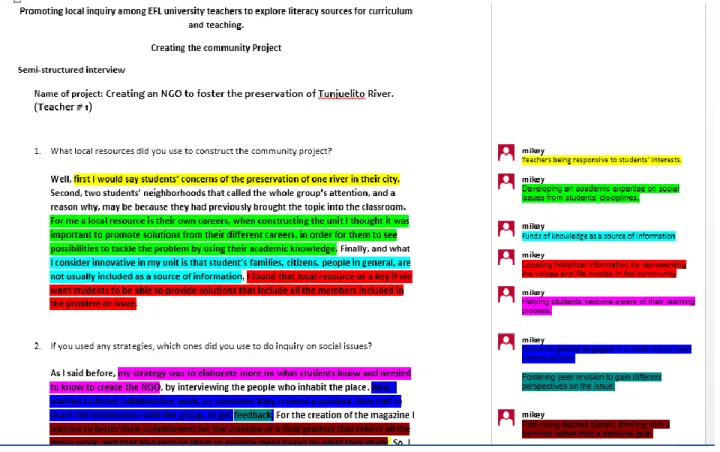
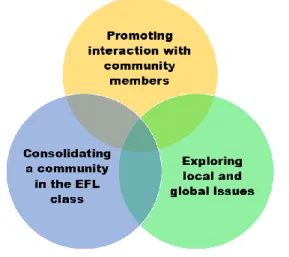
(11) Promoting the use of local literacies among EFL university teachers 11. LIST OF ILLUSTRATIONS Illustration 1. Mind-map created by the teachers to conceptualize CBP ......................................... 46 Illustration 2. Asset-mapping Kretzmann and McKnight (1993) .................................................... 47 Illustration 3. Defining the culture around university. .................................................................... 54 Illustration 4. Asset-mapping by students around the university .................................................... 55 Illustration 5. Example of color coding (Semi-structured interview-Nov 03, 2018)....................... 61 Illustration 6. Steps in the process to understand a context-embedded pedagogy ........................... 66 Illustration 7. Entwining communities from the EFL class ............................................................. 77.
(12) Promoting the use of local literacies among EFL university teachers 12. Chapter 1. INTRODUCTION. In this chapter, I present the introduction, problem statement, and justification of this research that I carried with four EFL university teachers from a private university in Bogotá. These teachers have students from different professional programs in their classes, such as social communication, industrial engineering, marketing and trade, environmental engineering, law, economy, digital marketing, psychology, and systems engineering. This qualitative interpretive study serves as a reflection on the exploration of local literacies in their teaching context to widen their understanding of socially embedded pedagogies. It focuses on the identification of the links the teachers establish with local resources to make decisions about their language literacy teaching. Then, through professional development workshops the teachers were engaged in the renovation of a skillbased curriculum, for one that considers literacy as a practice that needs to be developed critically through the interaction with local structures. The focus of my project was on the exploration of the local resources that influence the life of both teachers and students, so that the curriculum emerges from the teachers‘ enquiry of students‘ realities, and their willingness to adapt the teaching practice, for one that innovates in a contextualized way, which appreciates the knowledge students bring from their everyday context. In this study, the main finding reflects that the teachers started to awake their interest in examining of their role and practice, while looking for local realities. For this exercise to evolve, teachers re-thinking the sources of curriculum was a determinant factor that meant taking professional risks towards understanding and acting together new.
(13) Promoting the use of local literacies among EFL university teachers 13. pedagogies that require social exploration. They moved away from a static skill-based curriculum, materials and textbooks provided to teach to the construction of contextembedded opportunities for learning using students‘ realities and local resources. Building from Kreztman & Micknight (1993), assets are understood as powerful and valuable resources presented in the community, which can become visible by getting involved in a critical reading of the community, in order to inspire local investigations. Therefore, teachers‘ constant inquiry and exploration of students‘ realities allow them to connect and contextualize the EFL class. This is supported by Murrell (2001) who invites teachers to be knowledgeable of their students‘ community. In this fashion, by raising awareness on social issues, they can encourage text production from the different disciplines of study that converge in their classes. Thus, the English language is used to reflect, pose problems, and be participants of social transformations from the academic environment. The subsequent justification develops the main tenets that build the objective of this study, which allow to foresee its impact in ELT professional development, by exploring and enacting socially-situated pedagogies that connect the classroom with students‘.
(14) Promoting the use of local literacies among EFL university teachers 14. Justification. The transformation of the role of the English Language class has become a relevant discussion among teacher-researchers, since views on language have considered the social practice as a defining way to construct reality, as well as to create meaning from a contextualized and local exercise (Pennycook, 2010). Therefore, from theses perspectives, teaching a foreign language should aim at evolving from traditional concepts of literacy, and one way to do this is to include the community as a text that can be explored, through wondering and pursuing personal inquiries. It allows becoming critical of sociocultural issues, providing a context-sensitive value to the English language learning process in the classroom. Accordingly, the research objective of this study is to guide the teachers through the enquiry of different local and sociocultural literacies in their students‘ context, with the intention of designing curricular units that meet educational requirements, and portray their students‘ realities, values, and background, personal and individual needs within sociallyembedded pedagogies. Also, the project analyzes their implementation of curriculum though which teachers critically reflect on their role, reaffirming their perspective about education, language learning, and critical literacy, to continue problematizing social issues, by planning and fostering further personal inquiries with students. In terms of the impact that is expected on the participants, it contributes to the teachers‘ continual professional development, by encouraging them to explore their own views to language teaching, and using them to construct a curriculum that addresses local values. Moreover, getting involved in this exploration allows the teachers to rethink their.
(15) Promoting the use of local literacies among EFL university teachers 15. practice to makes decisions based on the dynamic interconnection of language and reality (Freire & Macedo, 1987), which represents a way out of standardized practices of language learning, since teachers are not only concerned with language acquisition, but also with its use and applications to enhance their students‘ lives outside of the classroom setting. To illustrate to previous point, the problematization, presented in the next subsection, sheds light on three concerns identified that encouraged me to carry out this project, through working the participant teachers. They involved linking social issues with the EFL content, meeting institutional standards when addressing local realities in the class, and the use of a deficit discourse when referring to what students were capable of doing in class..
(16) Promoting the use of local literacies among EFL university teachers 16. Problem statement. My motivation to conduct this study evolved from the teachers‘ self-evaluation, and co-evaluation. As the coordinator of the department where I work, I meet with the teachers to close every semester. In that meeting, we talk about their perceptions towards their practice, the materials they use, the projects, the challenges, and innovations for the semester. In this formal encounter, I found three common patterns among the four participant teachers: 1) their willingness to engage students in a way that they would no see language as a requirement. In their classes, they showed a commitment when designing activities that came from what students reported as their everyday experiences. They had worked with projects such as drug consumption at university, a campaign to improve mobility in Bogotá, a research about the diet and nutritional components in the food provided for free to the students from low-strata at university. 2) They argued that sometimes they felt restricted by the standards of the level they were teaching, and they could not fully develop their classes and group projects, because they had to be in accordance with the institutional agenda. 3) Although they were opened to working on topics of students‘ realities, they sometimes used a deficit discourse, stating that most students did not have the linguistic skills to conduct a project, that they lacked grammar structures or strategies to read or write, which made it difficult to engage all of them in a project that required them to express themselves in a different language. These three concerns allowed me to propose a project through which EFL university teachers rethink curriculum and teaching by conceptualizing socially-situated pedagogies as the social structures that guide personal beliefs (Short & Burke, 1991) The possibility to construct a context-sensitive curriculum was based on how it can raise curiosity, awareness,.
(17) Promoting the use of local literacies among EFL university teachers 17. a search for questions, and critical reflections; through making use of local texts that motivate students to enquire about their realities, so that the EFL classroom reacts to them by integrating such needs into the language content. Throughout the decades language education has been concerned with an exploration of foundations that respond critically to social and cultural challenges, in order to approach meaningful and life-long learning experiences that result from considering students‘ environments as a way to foster sense making, not only by maximizing opportunities inside the classroom, but understanding and transforming possibilities outside of it (Kumaravadivelu, 2001). Furthermore, for the practical realization of this research study I want to involve local inquiry as the educational perspective that guides the pursuit for new substantial questions, opportunities, and insights gathered along the process; through which teachers can grant value to students‘ meaning construction and engage them in an examination from different viewpoints. This stance regards learning from the need to develop problem posing, rather than just problem solving skills (Freire, 1985). In other words, teaching evolves from the problems that inquiry awakes in students, which emerge from the reality they feel committed and related to; that is why knowledge needs to be co-constructed from the social activities that occur not only within the individual, but between individuals ( Wells, 1992:8) Considering the aforementioned, one of the challenges EFL University teachers ought to critically respond to is the consideration of language as a means of discovering, describing, and transforming reality rather than a decontextualized practice that focuses on developing skills to read, write or speak. Also, they need to get involved in the critique of official models, standardized and imposed curricula, that perpetuate overgeneralizing.
(18) Promoting the use of local literacies among EFL university teachers 18. realities that do not fit in locally produced knowledge, causing the reinforcement of social inequalities (Gonzalez, 2007) which refrains the teacher from being considered a valuable member of decision-making, teaching effectively, as well as becoming agents of their development Then, by questioning dictated practices, the teachers reflect on their professional development as critical participants of their own interventions, assumptions, practice and theories. That is to say, they start to explore ways to connect the local texts with the content and institutional requirements; which stimulates a new pedagogical repertoire that takes apart deficit views and discourses of social problems, and encourages them to increase their expectations, own the curriculum, improve relationships in the classroom, and seize textual practices that eventually have an effect in successful outcomes (Comber & Kamler, 2004). Research question: How do EFL university teachers use local assets as sources for curriculum and teaching? Research objective: Identify the links EFL University teachers establish with local resources to make decisions about their language literacy teaching. The next chapter displays the theoretical constructs that supported my research project, and enabled the analysis of data..
(19) Promoting the use of local literacies among EFL university teachers 19. Chapter 2. THEORETICAL FRAMEWORK. This chapter accounts for the theoretical justification of my study of involving teachers in the exploration of students‘ realities in order to build a curriculum that helps to develop literacies from socially embedded pedagogies. To achieve so, I support my project by introducing three main constructs. Literacy as a socially constructed practice, considering as main sources the work of Freire & Macedo (1987); Luke & Woods (2009); and Comber (2013,2016). Local literacies and community-based pedagogies, conceptualizing from local studies, such as those proposed by Sharkey & Clavijo (2013) and Sharkey, et al, (2016) to broader concepts suggested by Canagarajah (2005); Greenwood (2013); and Demarest (2014). I propose a community-oriented vision as a continual process of teacher selfdevelopment, building from the view of teacher disposition towards their professional development proposed by Mills and Ballantyne (2009) Finally, I take the concept of community teacher (Murrell, 2001) to promote a contextualized EFL teaching professional development. Literacy as a Socially Constructed Practice When literacy is approached from a socially-situated perspective, the context becomes the starting point for teaching and learning as a process of interacting and negotiating with local texts. It shapes an individual‘s perception of their own reality. This occurs by teachers fostering a sense of agency in students, as they reorganize and transform their environment with the production of new texts. All uses of language are directly related to reality; therefore, literacy, as proposed by Freire & Macedo (1987) refers to ―how to.
(20) Promoting the use of local literacies among EFL university teachers 20. write and re-write reality, transforming it through a conscious work‖ (p. 23). Thus, literacy constitutes a framework to contextualize and raise awareness from the EFL classroom. Then, considering literacy as the ability to read and write or as skill development (Barton, Hamilton, & Ivanic, 2000) to acquire a target language, restrains a meaningful cultural appropriation. To illustrate this argument, I can refer to Freire‘s (1987; 1998) call for the need of a critical spirit in teachers, in order to perceive and intervene actively in reality; otherwise individuals would be submerged in the contradictions that change brings into society, without discerning the challenges that characterize such transitions. Therefore, the curriculum can invite students to be participants of social readjustments to the epoch, by integrating historical-cultural events. Valuing the historical and existential experiences of the sociocultural context is considered as an integral way for people to produce, reproduce, and transform meaning. For instance, Woods, Comber & Iyer. (2015) argue that approaching literacy as a standardized practice that focuses on repeated test preparation, challenge-free, time-filling and thoughtless activities, offers fickle literacies that do not encourage students to construct their capacity for academic learning and for achieving complex literacies. This results in reduced opportunities for innovation, creativity, and a culturally-embedded classroom experience. Thus, an EFL teacher that explores of local cultures to integrate them in the language arts curriculum can promote the development of literacies among his/her students. In this perspective, EFL students‘ learning experiences are centered on the analysis of issues which they find personally significant: their cultural context, community problems,.
(21) Promoting the use of local literacies among EFL university teachers 21. and aspirations to rename and reconstruct their own version of the world (Luke & Woods, 2009). In this sense, literacy as socially-constructed practice, accounts for an exercise that evolves from the analysis and interrogation of the historical and cultural context of places (Comber, 2016). It problematizes social and classroom textual practices, through granting teachers and students the possibility to move from awareness to action (Pandya & Ávila, 2013) while becoming researchers that use language to question and produce texts informed by their own reality. In my project, teachers explore and learn about the local resources they can use to build the curriculum. This, according to Comber, Thomson, and Wells (2001) is a way to negotiate critical literacies, since these practices represent a teachers‘ commitment with ethical and pedagogical values that respect students‘ ways of knowing, as well as cultural and political histories. That is to say that the local context in which teachers are immersed has an impact in curriculum, pedagogy, and theory. To sum up, critical literacy as a practice in the classroom encourages teachers and students to attempt to disrupt taken-for-granted normality, practices, and texts (Comber, 2001). Thus, teachers start to ask themselves how things could be done differently, as to mobilize students‘ knowledge and experiences, by engaging, researching, and analyzing local realities that allow them and their students to redesign texts with social intent and real-world use. Through my theoretical discussion, I propose local literacies and community-based pedagogies as the curricular perspectives for teachers to foster context-sensitivity and.
(22) Promoting the use of local literacies among EFL university teachers 22. awareness, in a way that the academic environment deals with the sociocultural reality. To expand on this discussion, I present the discussion below. Local literacies and community-based pedagogies (CBP) Why do I present community and local knowledge as key concepts when discussing language literacy teaching? According to Canagarajah (2005) ―local knowledge has to be veritably reconstructed—through an ongoing process of critical reinterpretation, counter discursive negotiation and imaginative application‖ (p. 12). This notion suggests that teachers are involved in the exploration of the relevance and complexity of local knowledge as to create a curriculum that integrates values, perceptions, and diversity within the community by fostering a continuous reflection that leads to a search for an alternate reality. From this perspective, the practice of teaching and learning is concerned with collective and community actions that allow their members to make their own choices to deal with social processes, to exercise their citizenship. Accordingly, the local, as political, cultural, economic and identity reality, provides the individual with the basic instruments to construct a relationship with the global. For this reason, local knowledge acts as the essence of every educational action by fostering a cultural negotiation through a constant dialogue (Mejía, 2011). Furthermore, local textual practices are resources that influence the everyday life of both students and teachers; therefore, when they are positioned in the EFL classroom, they evolve into a cross-disciplinary dialogue (Smith & Sobel, 2010) which inspires teachers to explore problems and projects beyond their area of knowledge. This view of literacy.
(23) Promoting the use of local literacies among EFL university teachers 23. upholds stronger connections, contributions, and engagement with the student‘s community. It is suitable to take into consideration the fact that a pedagogy that is founded on place and community is not detached from the national or global. In fact, as Smith & Sobel (2010) explain, through learning about what students are familiar with, they can get closer to phenomena that are invisible to them. An example of this argument can be taken from a research project, which aimed to position the place as the object of study (Comber, 2013), in which two professors from an underprivileged area engaged their students as researchers of the urban renewal process in their neighborhood. Cases included the demolition of old buildings, eviction, and new infrastructure, among others. Throughout the process, students produced multimodal artifacts and texts (reports for school assemblies, field trips, interviews with extended family, biographies, and descriptions of the places in school and neighborhood). Then, through visual photographs and diaries, they became analysts, which allowed them to share places where they belong, question the renewal, as well as to think about their desired school and neighborhood by exploring their own views and those of their peers. This critical action research presents us with an alternative classroom dynamic, one which focuses on sharing experiences, and working with a common, rather than personal, goal to create own versions of community. According to McInerney, Smyth, and Down (2011), when teachers and students examine their community and school from a critical perspective, they elicit questions about features within it, actions for betterment, monuments and heritage, invisible groups, quality of the local environment, socioeconomical distribution, as well as the achievement of a just and democratic society..
(24) Promoting the use of local literacies among EFL university teachers 24. The previous foundations present a way to evolve into critical literacy practices, which fosters a sense of possibility, agency, and transformation by recognizing the assets in the place and space of study (Comber, 2017). This idea is mirrored by Rincón & Clavijo (2016) who report on their qualitative study focused on analyzing the ways in which community inquiry provides students with opportunities to discover socio-cultural issues in their neighborhoods through a multimodal experience. These authors carried out a project in a low-socio economic public school with a socio-critical research lens. The study began by mapping the community for the identification of an issue which continued with documentation through interviews, note-taking, and questionnaires. Finally, students created multimodal texts to present their findings creatively in a blog that fostered peer discussion regarding possible solutions to the problematic situations. The findings reveal that students were intellectually and emotionally engaged when they critically reflected on their role within the community, engaging in resiliency practices to overcome social issues experienced in their barrios. Such local inquiry justifies that the EFL classroom experience can respond to students‘ world by disengaging from the view of texts as isolated from context. When teachers expose their students to challenging settings, based on a pedagogy of place, they envision the emancipatory role of language practices in their lives. This opposes the assumption that teacher, student, and school achievement can be measured by isolated, individualistic, and quantifiable classroom routines (Greenwood, 2013; Gruenewald, 2003a). With all the components mentioned above, Gruenewald invites teachers to demonstrate that places are pedagogical; that is, acknowledging that ―as centers of.
(25) Promoting the use of local literacies among EFL university teachers 25. experience, places teach us about how the world works and how our lives fit into the spaces we occupy‖ (p. 10). Thus, to understand our relationship with the world, we need to value place by exploring it through ongoing social inquiry. This, in turn, becomes the principle for and education practice that appreciates researching for cultural well-being (King, 2008). Additionally, pedagogy of place invites teachers to get immersed in a constant exploration of the following dimensions: perceptual, sociological, ideological, political, and ecological. (Gruenewald, 2003b). Perception suggests that schools have to come up with strategies for teachers and students to perceive and establish connections with their surroundings. Now, to say that places are sociological is to recognize that we have to become aware of our role as citizens and participants in the sociopolitical process that a place constitutes; leading to the ideological dimension, when finding out about the interdependent economic, political, ideological, and ecological relationship among places near and far. Teachers and students must enter the context of their regions, cities, neighborhoods, and schools to inquire about marginalization, the multiple forms of oppression, the possibilities for resistance, and transformation. As such, they may begin to move toward a concept of justice in education, perceived in a community with possibilities to the marginalized, while regarding the ecological dimension from the exploitation of people, and the exploitation of their environment. Furthermore, when place along with cultural issues acts as the core of the curriculum, teachers and students can immerse themselves in the investigation of their society with a broader view by including different disciplines. Sharkey, Clavijo, and Ramirez (2016) conducted a study of community-based literacies in language teacher.
(26) Promoting the use of local literacies among EFL university teachers 26. education which included experienced teachers from social studies, chemistry, Spanish language arts, and English from three public schools in Bogotá. They aimed at discovering how the teachers developed and implemented community-based pedagogies, after designing projects that emerged from their students‘ problem-posing of their community. This way, teachers could meet the institutional standards by valuing local knowledge as a curriculum resource. Projects such as understanding the semiotics of graffiti, the analysis of the socioeconomic reality of the students‘ neighborhood, interviewing workers and families, and finding out about Colombian history from their own and their families‘ voices, display, as described by the participants, that appreciating local knowledge as a curriculum resource increases teachers‘ autonomy and ownership, as well as students‘ motivation, engagement, and family involvement. Thus, I conclude that CBP focuses on assembling the local context of interaction outside the classroom to construct a teaching practice and curriculum that is informed by researching the community assets. Sharkey (2012) defines CBP as follows: Curriculum and practices that reflect knowledge and appreciation of the communities in which schools are located and students and their families inhabit. It is an asset-based approach that does not ignore the realities of curriculum standards that teachers must address but emphasizes local knowledge and resources as starting points for teaching and learning. (p.11) Through place-based learning, meeting the standards becomes a collaborative task of both teachers and students who involve the community as partners in the curriculum design (Demarest, 2014). For this to be accomplished, the teacher needs to envision part of.
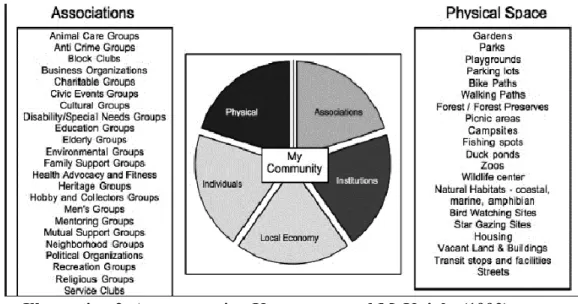
(27) Promoting the use of local literacies among EFL university teachers 27. the outcome and provide a space to create assessment tools together. The assessment criteria that he or she proposes can include literacy skills, interpretation of place, collaboration, action taking, and reflection. Accordingly, Demarest (2014) suggests that community-based experiences require the following curricular elements of local learning: ―personal connections are the foundation of all learning, local investigations deepen subject understanding, build holistic understanding of places, as well as an opportunity for civic engagement‖ (p. 43). To approach an awareness that emerges from place-based explorations, I refer to the study carried out by Sharkey and Clavijo (2012) on promoting the value of local knowledge in ESL/EFL teacher education through community-based field assignments. In this project, the authors found that through mapping, visiting, and interviewing people and places that students regularly meet (parks, cafeterias, discos, grocery stores, shopping malls), the participant teachers could later discover resources for integrating and rethinking community literacy practices that became central in the curriculum. As a result, the field experience fostered creativity and expanded teachers‘ resources about how to connect students‘ backgrounds with the curriculum, as well as to enhance the interactions between teachers, students, family, and community. Moreover, they raise awareness on identifying assets that enrich curricular content, and allow the teacher to change their deficit view on language teaching to promote student agency. In my study, teachers identified links with local resources that helped them build innovative curriculum and teaching, through which students feel that their lives are worthy the representation in the academic space. Thus, teachers become aware of their self-.
(28) Promoting the use of local literacies among EFL university teachers 28. development process by appreciating the assets they can find in the community around students‘ lives. This is exemplified in the construct below. Community-oriented vision in a continual process of self-development EFL teaching from a community-oriented vision generates possibilities to organize the curriculum collaboratively through the establishment of a bond between the classroom experiences of teachers and students, and the exploration of community resources and members. This view stimulates sympathy towards curiosity, by creating an inclusive learning environment which stands for a negotiation of experiences that value students‘ voices, encouraging them to question, propose, and imagine the path to contribute to transformations from their disciplines of study. Teaching and learning, in this sense, is understood within the different collective contexts in which students interact to construct knowledge (Schecter, Solomon, & Kittmer, 2003). Thus, teachers need to be immersed in a continual process of self-development through accepting and being aware of the sociocultural reality that influences classroom practices, while including both the linguistic and social needs of the learners (Kumaravadivelu, 2001). Accordingly, the language teacher becomes attentive to their practice as an opening not only to maximize learning opportunities in the classroom, but, at the same time to understand and transform them outside the classroom. When developing sensitivity towards a situated curriculum, the language teacher can get involved in an exploration of their roles as a community teacher (Murrell, 2011) who contextualizes the knowledge of the community, culture, and identity of the students and families they work with, in order to build a successful teaching practice in diverse settings. This standpoint questions the separation of the academic environment from the.
(29) Promoting the use of local literacies among EFL university teachers 29. everyday world of students, since the interaction of situated learning and practice allows individuals to engage in a purposeful activity. Within this perspective, teachers build knowledge and analytical capacities by: Undertaking an analysis of the population they work with, learning about students, their families, incomes, and educational histories; exploring students‘ funds of knowledge; developing linguistic knowledge; revising what they know about pedagogy; and re-thinking about literacies in this time and the new literacies teachers and students need to learn (Comber, 2001). That way, the conception of teacher development based on considering capacity only from the dimensions of knowledge, skills, and dispositions is challenged to integrate sociocultural theories and practices, as argued by Grant and Agosto (2008), given that teachers need to be ready to become informed by the particular community that will allow them to pose questions and take action from curriculum. That is, becoming conscious about their role as agents of change in the institutions the will contribute as an opportunity to become critical educators (Howard & Aleman, 2008). Teachers‘ readiness to face socially-embedded pedagogies is based on dispositional as well as experiential factors that enable them to tech being aware and sensitive of their population. Mills and Ballantyne (2009) argue that two dispositional factors lead to commitment to social justice from the classroom: Self- awareness/ Self reflectiveness, which encompass thinking critically about one‘s own beliefs and attitudes towards the teaching practice. This exercise helps move to openness, by being attentive to other‘s experiences, getting to appreciate diversity..
(30) Promoting the use of local literacies among EFL university teachers 30. In terms of the experiential factors, teachers are concerned with getting involved in experiences to interact with different cultural groups, leading to value and make sense of group experiences. By taking these actions the teacher finds ways to bring them into the class, as the starting point of every educational experience. This can be achieved by carrying out field investigations that allow understanding the dynamics in a community, through the consideration of its physical spaces, individuals, local economy, institutions and associations (Kretzman & McKnight, 1993). Such local recognition permits the teachers to critique official standardized models or imposed curricula which perpetuate overgeneralizing realities that do not fit in locally produced knowledge. On the contrary, they may lead to the reinforcement of social inequalities (Gonzalez, 2007) restraining the teacher from being considered a valuable member of decision-making, teaching effectively, as well as becoming autonomous of their development. Clavijo et al. (2004) refer to teachers adopting critical curricular perspectives in the way they think about their students‘ needs, as well as reflect on their curricular innovations and how they adjust their pedagogical practices. In their interpretive qualitative study, they identified the process of innovation, in terms of intervention, planning, and implementation, of 19 teachers from public schools in Bogotá through professional development programs on literacy. In this way, the teachers became involved in research experiences with their colleague participants from the same schools. The outcomes of this project reflect that the innovative pedagogical actions proposed by the teachers were addressed to enhance learner‘s literacy development by including students, parents, and teachers in the different practices. In addition, they planned.
(31) Promoting the use of local literacies among EFL university teachers 31. and managed their curricular innovations by working collaboratively on the adjustments to the curriculum. This professional development experience increases teachers‘ autonomy and ownership. Boyle-Biase & McIntyre (2008) propose a community-oriented setting to professional development schools (PDS), acting as reforms to the traditional models in which theory is separated from practice. In this fashion, community-oriented experiences affirm diversity, build community, and question inequity by recognizing places from an asset-based approach. Hence, local interaction provides opportunities to gain cultural insight from future students‘ values. On the other hand, PDS stand for principles that allow teachers to master content, read their students‘ needs, collaborate with peers on inquiry, gain expertise in constructed learning, and use valid forms of assessment to determine what students learned—all of which leads to the development of a culture of academic expertise. As a result, the authors introduce a framework that would help develop a practice for: teachers with heart, who consider local issues as their own; teachers with connections, who participate in community committees; and teachers with knowledge, who manage to shape local knowledge into the curriculum. The three constructs developed along this theoretical discussion oriented the process of professional development with teachers. They allowed me to position myself as a researcher that problematizes classroom practices isolated from the sociocultural awareness, and assets that make part of the everyday experience of both teachers and students. Through this study, my intention was to foster teachers‘ immersion in culturallyresponsive practices, promoting the analysis of local literacies, interrogation, and.
(32) Promoting the use of local literacies among EFL university teachers 32. transformation of students‘ realities through contextualized text production, which, in this project, became relevant aspects of the TPD. Hence, local literacies and community-based pedagogies are presented as the core of the pedagogical experience that acknowledges the assets that influence the life of teachers and students. Finally, a community-oriented vision in a continual process of self-development leads teachers to self-reflect on their profession beyond subject-matter specialists by fostering their own development form the commitment to research about local assets and issues. The next section explains the framework that supports the research methodology with a qualitative descriptive and interpretive approach..
(33) Promoting the use of local literacies among EFL university teachers 33. Chapter 3. RESEARCH METHODOLOGY. In this section, I explain my decisions in terms of the research methodology of this study. Thus, it describes the question and objectives that support this project, in terms of the identification of the relation that the teachers found in the local assets as the resources they can use to build the EFL curriculum and for the teaching practice. To accomplish the goal, the type of research that suited this study was a descriptive-interpretive approach. The context and participants are also presented, as well as the reasoning for choosing the setting. Finally, I justified the selection of the data collection instruments, such as field notes, interviews, and curricular units. Research question: How do EFL university teachers use local assets as sources for curriculum and teaching? Research objective: Identify the links EFL University teachers establish with local resources to make decisions about their language literacy teaching. Type of study This qualitative study is aligned with the descriptive and interpretive paradigm, since the aim is to analyze the phenomenon previously proposed from the participants‘ views, as well as from their lived experiences in a real setting. The aim is to understand how they experience and interact in a particular context, as a way to make sense of their everyday world (Heigham & Croker, 2009). Hence, in this research, the voices of the teachers are the most prominent as they become critical researchers of their own community, by using local resources as the foundations for their teaching practice..
(34) Promoting the use of local literacies among EFL university teachers 34. Then, the interpretation of data was based on what the teachers themselves presented as their language literacy perspective, curricula construction, and their role to get involved in a recognition and understanding of the context that surrounds students‘ realities, in order to renovate the EFL curriculum. This information was gathered from their interaction within a specific social setting (Hatch, 2002) that they explored through doing local inquiry with their students, as well as participating in professional development workshops. According to Holstein & Gubrium (2005) (in Denzin & Lincoln, 2011) an interpretive practice accounts for the hows and whats that construct social reality. Therefore, these situated interpretation required the teachers to pose questions on assets they discovered with students in their contexts, as to plan a community project that allowed them to explore such hows and whats as the starting points to think about ways to transform their pedagogical practices, and build a contextualized curriculum. Context of the study I carried out this study at the language center of a private university in Bogota, where I work as the academic coordinator. This is the place where students from all the programs that they university offers come to fulfill their English language requisite to graduate. The students are between 17 to 22 years old. The vast majority belong to a middle-class socioeconomic level, and a minority of them belong to rural areas. Students are required to take six English levels, distributed by the Common European Framework of Reference (CEFR), from A1 to B1. The levels are structured within a project-based approach, through which students are expected to work collaboratively with students from other fields. Each one is composed of 50 hours of class.
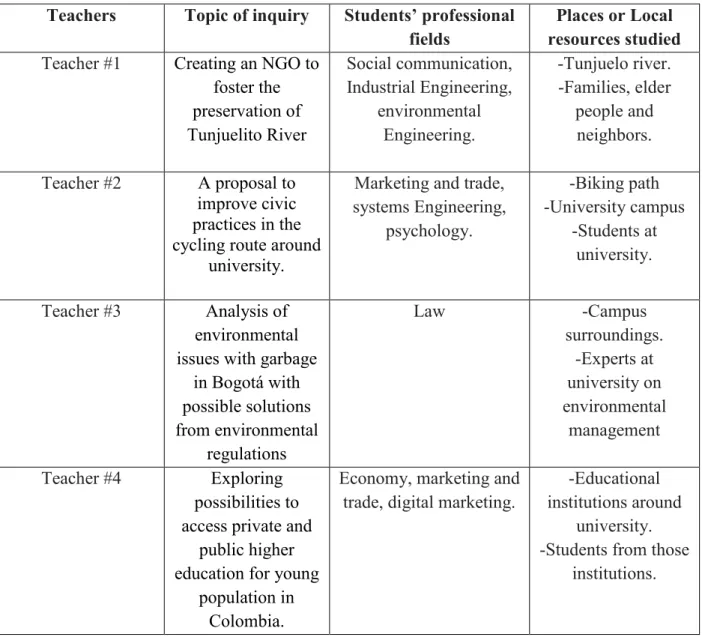
(35) Promoting the use of local literacies among EFL university teachers 35. (2 hours from Mon-Wed) and 20 hours of autonomous work. The language center provides the syllabus for each level, according to the preestablished outcomes by skill, proposed by the CEFR. In class, teachers do not follow a textbook, they are encouraged to create autonomous lessons, materials, and activities that focus on learning through a real use of the language, such as using discussions, debates, games, and interactions that evolve from students‘ interests. In terms of the evaluation, the center provides the percentages for formative and summative assessment, and the teachers create the exams and activities, framed within the competences set for the level. This context encouraged my study, since the fact that teachers were motivated to work with a project-based approach, creating innovative classes, which addressed students‘ motivations, acted as field the teachers could explore more, in order to deal with the issue of students‘ being reluctant to participate in the English class, as they seemed detached from their realities. Participants Four teachers accepted my invitation to participate in the professional development workshops. They are form 28-35 years old. The participants were 3 female and one male teacher. They all hold a B.A. in foreign language teaching and have an overall experience with university students of more than 7 years. In this project they worked with the following levels and study programs: Teacher #1: Level 5 (B1) Social communication, Industrial Engineering, environmental Engineering. Teacher #2: Level 2 (A2) Marketing and trade, systems engineering, psychology. Teacher #3: Level 6 (B1) Law. Teacher # 4: Level 4 (B1) Economy, marketing and trade, digital marketing. Along the level, teachers.
(36) Promoting the use of local literacies among EFL university teachers 36. and students are required to work on a project that is presented at the end of the semester in a project fair for the rest of the students at the center. This group was selected according to convenience sampling (Given & Saumure, 2008), considering that they belong to the English department and that I am in constant communication with them and their students. Moreover, these teachers had expressed their eagerness to learn about community-based pedagogies, and inquiry-based learning. So, before joining the project I shared different articles and studies that called their attention. These articles attracted them since they were interested about finding out ways to innovate in their classes, and were concerned about making them contextualized, this was reflected in the previous projects that had worked with other levels. Finally, in their teachers‘ evaluation they were recognized as very committed teachers. This criterion facilitated their response towards the exploration and conceptualization of the local assets that could be brought to the curriculum. Their eagerness to participate in the project was crucial to become engaged in a retrospective exercise of reflecting upon their practice, in order to re think their class, and be willing to pose and solve the challenges of including situated pedagogies in their teaching exercise. Data collection instruments This study considered four data collection instruments: Field notes of group discussions and class observations, curricular units of community projects, an initial and final semi-structured interview. Along the workshops, there were guided discussion on topics from the articles I proposed before the encounters. Then, the field notes intended to depict teachers‘ reflection of articles such as: Getting out of deficit perspectives:.
(37) Promoting the use of local literacies among EFL university teachers 37. pedagogies of reconnection (Comber, 2013); funds of knowledge for teaching (Moll, Amanti, Neff, & Gonzalez, 1992). The discussions were conducted in the first two encounters of the professional workshops, in order to provide a space for teachers to examine the role of students‘ realities in their practice, and value the contexts that surrounds the teaching and learning practices. Teachers‘ participation was encouraged by my presentation of different excerpts from the texts, which recalled their experiences in the classroom. I selected this tool, since, as Flick (2009) states, group discussion uses the dynamic of developing a conversation as the central source of knowledge. This instrument was a means to observe their perspective on literacy teaching, teachers‘ awareness of their students‘ world, and teachers being willing to transform their practice. The primary source of information to attain the research objective was gathered from the implementation of the curricular units that teachers designed during three guided workshops. They were constructed first individually with my guidance, and then reviewed collaboratively with the other participant teachers. The purpose of these units was to observe teachers‘ decision-making when organizing a project that promoted communityinteraction, local inquiry, and students‘ collaborative work, to meet the objectives proposed by the institutional standards, according to the different levels they were teaching. Regarding the first semi-structured interview (See appendix 1), it happened on the fourth workshop. The intention was to engage the participants in a purposeful conversation by allowing them to develop naturally so that they do not feel that they are simply replying to questions (Richards, 2001). The purpose was to delve into teachers‘ insights about constructing the curricular unit, and identify the links the teachers set with the local.
(38) Promoting the use of local literacies among EFL university teachers 38. resources, and the way in which they bring them to the curriculum. The interview focused on finding out about the local resources they used; their strategy to do enquiry on social issues; their views on literacy development; the relation among local knowledge, text production and institutional standards; as well as the teachers‘ role when involving local realities into the curriculum. Considering the field notes for class observation, they are powerful tools for gaining insights on a situation (Cohen, Manion, & Morrison, 2002). I attended three sessions in the three weeks per group to check the project development. The aim of this tool was to identify the way in which teachers and students were using the community knowledge, their field of expertise, and contextualization through an inquiry process, in order to construct their projects. Finally, the last semi-structured interview (see appendix 2) happened a week after students finished and presented the project. I wanted to find out about teachers´ considerations of the pedagogical experience, the connections among their role as teachers and their students‘ results, what they believed made the results possible, the extent to which they think they will use resources from students‘ context into their future teaching, as well as how students‘ texts reflect their local realities into their community products. Ethical issues Heigham & Croker (2009) establish that gaining informed consent from the participants can be achieved through informing them about the purpose and procedures of the study, which allows them to acknowledge what their participation entails, in order to make decisions to get involved in the project willingly. Therefore, before starting the professional workshops, I had a meeting with the director of the language center, in which I.
(39) Promoting the use of local literacies among EFL university teachers 39. explained all the steps of the process, the schedule for the professional workshops, and the spaces we would use from the university. She gave me her written consent (See appendix 3), the only condition was to protect the anonymity of the university, and the participants. Additionally, I ensured that participant teachers would not receive special treatment in responsibilities related to their contract at the language center. I also committed to share the outcomes of the project with the rest of the academic staff at the language center with all the teachers, once I finished the analysis and revision of the findings with my tutor, before presenting it for the defense at my master‘s program. Finally, I ensured confidentiality by using a consent form signed by the teachers (See appendix 4) in which they were notified that the information they provided was only used for research purposes, that it did not interfere with their contracts, or course assignation by the university. All their personal details, including their names remained private, and therefore, no video recordings were used in this research. Along the study, they are referred to as teacher 1, 2, 3, 4. In sum, ensuring the well-being of the participants was key for the ethical considerations of this study. The chapter that follows portrays the practical realization of the study, introducing the visions that allowed me to generate the objectives and planning of the instructional design, carried out through the professional development workshops. They aimed at involving teachers in field experiences that help them explore the local resources they could include in their curriculum, in order to carry out a community project with their students..
(40) Promoting the use of local literacies among EFL university teachers 40. Chapter 4. INSTRUCTIONAL DESIGN. This chapter presents the justification and planning of the four professional development workshops that aimed at helping teachers conceptualize socially-embedded pedagogies. They were designed with the purpose of involving teachers in group discussions about community-based pedagogies, local and funds of knowledge. Engaging teachers in local inquiry first with their colleagues, and then with their students to identify the resources they could use to create curricular units. Guiding the teacher into the construction of the contextualized curricular units. And supporting the teachers during the implementation of the community projects. I begin by illustrating the vision of language, curriculum, and teaching that shaped the professional development workshops. Afterwards, I describe the general and specific objectives. I explain the structure of each encounter, its objectives, which included professional reading discussion on concepts and projects related to socially-situated pedagogies, field exploration, the consideration of the standards to connect them to their, the construction of the curricular units. Finally, the outcomes show the different assets they encountered with their students, and the ways in which they develop them in their unit. Vision of language This study regards language as a social practice that allows to become aware of sociocultural reality in order to be able to transform it. Pennycook (2010) describes that language should no longer be perceived as a preordained system product of the brain, on the contrary, it needs to be considered a social practice that engages users, permitting them to construct reality and meanings..
(41) Promoting the use of local literacies among EFL university teachers 41. Therefore, to understand the relationship between languages and that social environment, one needs to recognize local language practices, and the way they relate to other social practices. In this view, language does not carry a fixed meaning, instead it is the contextualized, political and social practices that account for its production; therefore, by taking into consideration a notion of local practice ―we can move towards a more dynamic understanding of the constructions of place and language together‖ (p.9). Vision of curriculum In my study, the EFL curriculum is renovated, dynamic, and contextualized by the teachers who engaged in local inquiry, in order to make it place-based. Within this view, the teachers get involved in finding ways to orchestrate an authentic engagement with the people, places, and things inside and outside of the classroom (Demarest, 2014) while addressing institutional standards and being aware of students‘ backgrounds. This projects supports that to build a context-sensitive curriculum, the teachers work together with students‘ funds of knowledge, and are responsive to the sources the local contexts provides to the class, such as, community-interaction, acknowledging students‘ field of study, and at the same time addressing the linguistic needs of the groups they are in charge of. This idea of curriculum is based on Dewey‘s (1938) perception of the responsibilities of the educator: A primary responsibility of educators [is to] recognize in the concrete what surrounding are conducive to having experiences that lead to growth. Above all, they should know how to utilize the surroundings, physical and social, that exist so as to extract from them all that they have to contribute to building up of experiences that are worthwhile. (p.41).
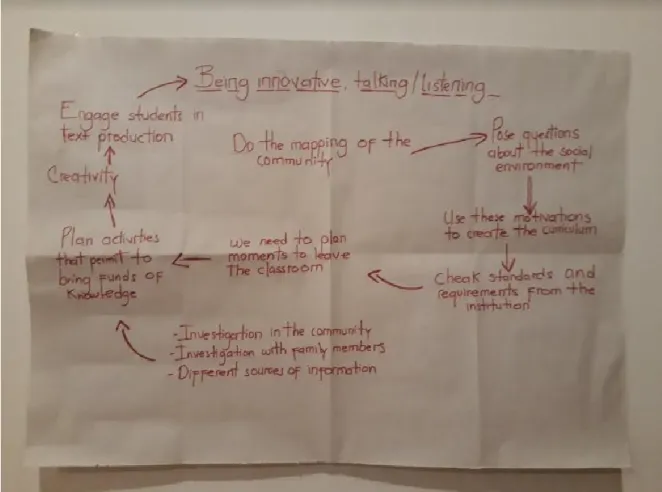
(42) Promoting the use of local literacies among EFL university teachers 42. Furthermore, a place-based curriculum perspective promotes involvement in an inquiry experience. This creates new alternatives and functional understandings that create diversity, open up creativity, thinking, and address even more complex questions; as a result, inquiry promotes appreciating confusion as a source for getting meaningful reflections that are figured out and analyze from posing new questions, which plays a crucial role to center the curriculum on the learning itself. Vision of teaching This vision is shaped within the different collective contexts in which people interact and construct knowledge (Schecter, Solomon & Kittmer, 2003). Thus, in this study, teaching means being open-minded and resourceful, in order to promote context-sensitive experiences for students to use their reality as a source for learning. A successful teaching practice occurs when teachers contextualize the knowledge of the community, culture, and identity of the students and families they work with (Murell, 2001). Having these visions in mind as the starting point of the practical realization, I established the following objectives. General objective: EFL teachers will explore, enquire and include local resources into their EFL curriculum through field experiences and professional development workshops. Specific objectives: . To reflect upon the local sources available through an exploratory field exercise in order to design a curricular unit..
(43) Promoting the use of local literacies among EFL university teachers 43. . To carry out a community-field project with their EFL university students.. Description of the professional development workshops The purpose of the workshops was to provide a space where teachers could reflect on their role, language literacy teaching, as well as the ways in which they can promote awareness on the local reality, by identifying the resources they can bring into the EFL curriculum, as to foster sensitivity on social issues from the academic culture. Thus, they were planned in a way that evolved from group discussion of professional readings, as well as conducting asset-mapping through the consideration of the physical spaces, individuals, local economy, institutions and associations (Kretzman & McKnight, 1993) around the university. Each workshop lasted four hours, they were distributed as presented in the following chart (Table 1). Workshop. Date. 1. How do we get out of deficit pedagogies?. (Sep 12th). 2. What‘s the culture around university? How do we work with local resources?. (Sep 26th). 3. What are the standards that guide our curricular units? How do we build a curricular unit?. (Oct 10th). 4. Let‘s polish up curricular units. (Oct 25th). Table 1. Name of workshops and time distribution.
(44) Promoting the use of local literacies among EFL university teachers 44. After the four workshops I supported teachers‘ implementation of the units by going to three classes and attending to the final project fair. The observations were conducted from November 12th-December 03rd. Along the observations, there were constant conferencing, informal conversations with each teacher, where we addressed key moments in their process of teaching, and professional tensions they may have experienced. Below, I proceed to specify the objective and procedure for each workshop. Workshop # 1. How do we get out of deficit pedagogies? (September 12th, 2018) This workshop aimed at providing a space for teachers to examine their role in valuing students‘ realities in their practice. Before coming to the workshop, they were assigned two texts: Getting out of deficit perspectives: pedagogies of reconnection (Comber, 2013), and funds of knowledge for teaching (Moll, Amanti, Neff, & Gonzalez, 1992). The idea was first to hear the comments on the texts, and then, I extracted passages, so that we could start a group discussion that brought their experiences working with university students. Afterwards, we did a brainstorming of questions that evolved from the discussion that related to the connection of socially-embedded pedagogies with the EFL curriculum (They will be developed in the next chapter about data analysis and findings, p.62.Illustration 6) For the second part of the encounter, I distributed them in couples, and gave them two local research articles: One by Rincón & Clavijo (2016) about Fostering EFL learners‘ literacies through local inquiry in a multimodal experience. And the second by Sharkey,.
(45) Promoting the use of local literacies among EFL university teachers 45. Clavijo, and Ramírez, (2016) on developing a deeper understanding of community-based pedagogies with teachers: Learning with and from teachers in Colombia. Finally, after reading both articles, the teachers created a mind map (see Illustration 1) to explain important moments when conducting a project using community-based pedagogies. After these activities, I wrapped up the workshop with a formal power point presentation of concepts such as, community-based pedagogies, funds of knowledge, and local knowledge..
(46) Promoting the use of local literacies among EFL university teachers 46. Illustration 1. Mind-map created by the teachers to conceptualize CBP Workshop #2. What’s the culture around university? How do we work with local resources? (September 26th, 2018) I started this workshop with a presentation of the concept of asset-mapping, previously mentioned (See Illustration 2)..
(47) Promoting the use of local literacies among EFL university teachers 47. Illustration 2. Asset-mapping Kretzmann and McKnight (1993).
(48) Promoting the use of local literacies among EFL university teachers 48. To design the workshops, I followed the professional development, as previously.
(49) Promoting the use of local literacies among EFL university teachers 49. done by Sharkey, et al (2016) . So they worked in the following manner. We went out, and.
(50) Promoting the use of local literacies among EFL university teachers 50. took pictures, with their cellphones, to everything that called their attention, surrounding.
(51) Promoting the use of local literacies among EFL university teachers 51. the university (They went around 10 blocks). Once we were back, each teacher projected.
(52) Promoting the use of local literacies among EFL university teachers 52. their pictures, and explained why that had made an impact on her/him. To finish this.
(53) Promoting the use of local literacies among EFL university teachers 53. activity, all of us created a pie as the one in figure# to describe the context around.
(54) Promoting the use of local literacies among EFL university teachers 54. Illustration 3. Defining the culture around university. university (See Illustration 3).
(55) Promoting the use of local literacies among EFL university teachers 55. Next, for the second part of the workshop, I provided an example of a short (4 weeks) implementation I had carried out the previous year about a cross-disciplinary inquiry project within a community-based pedagogy perspective in the EFL classroom, with students from Industrial Engineering program, psychology, and Marketing. In that experience, I conducted mapping with my students, and created a curricular unit that emerged from their interest to explore new shifts in cultural beliefs through low-price supermarkets in the city. By using the knowledge of their disciplines of study, they could analyze the phenomena from different perspectives. This example was used to provide guidance for the teachers on the possibilities to connect the local resources we found with the content of the level I was teaching. Finally, since their classes started on October 1st, I asked the teachers to conduct the asset-mapping with their new groups, have them present the findings in class, and decide on the asset they wanted to research about as a group. Workshop # 3. What are the standards that guide our curricular units? How do we build a curricular unit? (Oct 10th) This workshop started with the presentation of their group‘s findings, and a. Illustration 4. Asset-mapping by students around the university.
(56) Promoting the use of local literacies among EFL university teachers 56. reflection on the experience conducting the mapping. The teachers explained that students had decided on the topic they wanted to enquire about by the number of pictures taken to that specific asset. Illustration 4 is an example of the students‘ presentation.. The following chart (Table 2) summarizes the topics of inquiry the different groups decided to conduct after the exploratory field exercise. Teachers. Topic of inquiry. Teacher #1. Creating an NGO to foster the preservation of Tunjuelito River. Teacher #2. A proposal to improve civic practices in the cycling route around university.. Teacher #3. Students’ professional fields Social communication, Industrial Engineering, environmental Engineering.. Places or Local resources studied -Tunjuelo river. -Families, elder people and neighbors.. Marketing and trade, systems Engineering, psychology.. -Biking path -University campus -Students at university.. Analysis of Law -Campus environmental surroundings. issues with garbage -Experts at in Bogotá with university on possible solutions environmental from environmental management regulations Teacher #4 Exploring Economy, marketing and -Educational possibilities to trade, digital marketing. institutions around access private and university. public higher -Students from those education for young institutions. population in Colombia. Table 2. Inquiry topics that became the focus of the curriculum in ELT.
Figure

+3
Documento similar