Introduction
Mosses of the state of Hidalgo have been collected and
studied since the beginning of the XX century. Among the
early collections are those obtained by Cyrus G. Pringle
through several visits to the state (Davis, 1936). His moss
collections were sent to J. Cardot (1909, 1910, 1911) for
identification. In mid-XX century, Crum (1951) cited
specimens by various collectors, including A. J. Sharp
and his collaborators, referring to them by collector name
and number; most of these specimens were deposited in
MICH and other American herbaria. Sharp et al. (1994)
included 281 moss taxa for Hidalgo, but the Moss Flora
of Mexico did not cite specimens. In recent years, Alfaro
and Castillo (1986) listed 169 species and varieties for
Sierra de Pachuca; Cárdenas and Delgadillo (2009) cited
specimens from localities bordering the Valley of Mexico
that politically belong in Hidalgo; Delgadillo et al. (2011)
listed 129 species and varieties from Los Mármoles
National Park. The specimens derived from the last 3
contributions were deposited in the Bryophyte Collection
at the National Herbarium (MEXU).
Despite the floristic information available, it seems
that many areas in Hidalgo have not been explored for
mosses, some sites are represented by many collections,
and that a broader selection of sites should provide an
adequate representation of the state’s moss flora. Because
of its geological and geographical setting, especially at the
point of contact between the Eastern Sierra Madre (ESM)
Diversity and distribution of mosses in the state of Hidalgo, Mexico
Diversidad y distribución de musgos en el estado de Hidalgo, México
Claudio Delgadillo , José Luis Villaseñor, Ángeles Cárdenas and Enrique Ortiz
Departamento de Botánica, Instituto de Biología, Universidad Nacional Autónoma de México, Apartado postal 70-233, 04510 México, D. F., Mexico.
Abstract. Through field work, bibliographic information and herbarium collections, a preliminary list of mosses for the state of Hidalgo was compiled. Records for 355 species were supported by 3 068 herbarium specimens at MEXU; when varieties are included along with taxa unsupported by local herbarium specimens, the number of taxa reaches 420. A collecting effort analysis indicates that 74.5% of the moss flora has been surveyed, that is, 56 taxa remain to be added. Species distribution modeling using 20 climatic variables from the WorldClim database for 150 species produced a map of potential distribution using a 5-minute cell network; it shows that the species potential richness is higher in central and southeastern Hidalgo, although most collections were obtained in southern and northwestern stations. Because large portions of the state land area are underexplored for mosses, no biodiversity hotspots are recognized. The Caribbean element is best represented in the Eastern Sierra Madre, but the confluence of the latter with the Neovolcanic Belt does not seem to show other major floristic differences between them, despite their geographical proximity.
Key words: richness patterns, collecting effort, potential distribution, Maxent.
Resumen. Se presenta una lista preliminar de musgos del estado de Hidalgo basada en trabajo de campo, bibliografía y colecciones de herbario. Con base en 3 068 ejemplares en MEXU se registran 355 especies, pero esta cifra se incrementa a 420 si se incluyen las variedades y los taxa sin registros en los herbarios locales. El análisis del esfuerzo de recolecta señala que se ha registrado el 74.5% de la riqueza estatal, es decir, 56 taxa menos del valor esperado. Los modelos de distribución potencial de 150 especies, usando 20 variables climáticas de la base de datos de WorldClim y una división en celdas de 5 minutos, indica que la riqueza potencial de musgos es más alta en el centro y sureste del estado, a pesar de que la mayoría de las colecciones provienen de sitios del sur y noroeste. Como partes importantes del centro del estado todavía están poco exploradas, no se reconocen zonas de alta diversidad. No se han detectado diferencias en patrones florísticos, excepto en el elemento del Caribe que está mejor representado en la sierra Madre Oriental que en el Eje Neovolcánico, a pesar de la cercanía geográfica de las 2 áreas.
Palabras clave: patrones de riqueza, esfuerzo de colecta, distribución potencial, Maxent.
of the history of moss migration in this part of Mexico.
In this contribution we offer a preliminary assessment
of actual and potential species richness, and patterns of
distribution; these may be in order to plan future field work
in various parts of the state.
The state of Hidalgo in eastern Mexico has a surface
area of nearly 21 000 km
2(García and Falcón, 1984). Its
rugged relief is dominated by the Eastern Sierra Madre that
runs NW-SE; numerous sierras and isolated mountains
are found in southern and western areas, several of them
reaching more than 3 000 m in elevation (cf. INFDM,
2005). Because of its geographical position, the state is
also part of the Neovolcanic Belt area.
Materials and methods
Recently collected specimens and samples deposited
in MEXU were examined along with records from the
literature to produce a list of moss species from the
state of Hidalgo. Major literature sources of floristic and
geographical information were the updated electronic
version of LATMOSS 2010 (Delgadillo, 2010) and Sharp
et al. (1994) that complemented specimen data. The
information for 3 068 moss specimens was compiled in a
georreferenced database with records for 355 species that
served to calculate cell width of the area of occupancy
(AOO), according to IUCN criteria (IUCN, 2001). In this
occupancy) was calculated by using the Conservation
Assessment Tools designed for Arcview (Moat, 2007).
The species cell width was averaged to obtain the width
value applicable to all species; the value thus obtained, 8.4
km, was transformed to arc minutes (about 5 minutes). For
further analysis, the state of Hidalgo was then divided into
a network of 5-minute cells.
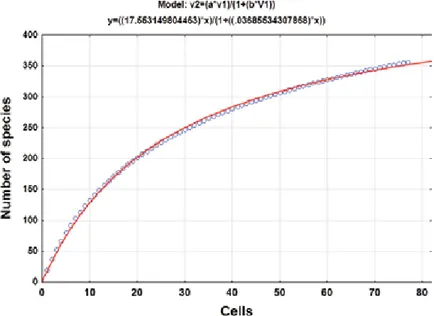
Collecting effort.
The geographical data of the collecting
records were used to produce a species accumulation
curve (Gotelli and Colwell, 2001). Seventy-seven
5-minute cells with collecting records were used for the
analysis. The asymptote of the accumulation curve (Fig. 1)
is theoretically related to the number of species expected
for the study area (Jiménez-Valverde and Hortal, 2003)
and the number of cells is a measure of the collecting
effort after randomly sorting these 50 times to produce a
soft curve with EstimateS, version 8.2.0 (Colwell, 2009).
The asymptote was estimated adjusting Clench’s equation
to the accumulation curve (Soberón and Llorente, 1993;
Colwell and Coddington, 1994) by the Simplex and
Quasi-Newton method in the STATISTICA software (StatSoft,
2011); the predicted asymptotic value was used to estimate
the precision of the inventory.
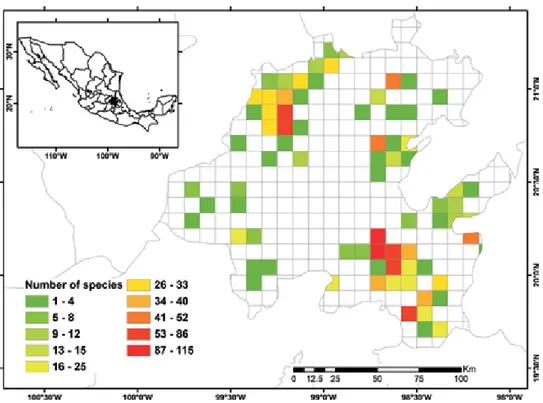
Known species richness.
The collecting data for 3 068
records were placed in the 5-minute cell network to identify
the number of species per geographic unit and to produce
a known species richness map (Fig. 2).
Species distribution modeling.
Twenty variables were
thought to have potential predictive value for the distribution
of plant species. Nineteen bioclimatic variables were
obtained from the WorldClim website (Hijmans et al.,
2005; http://www.worldclim.org/bioclim.htm) while the
values of the twentieth, altitude, were obtained from an
elevation digital model in the WorldClim website; spatial
resolution was 1 km
2for all variables.
Maxent was used to prepare models of potential
distribution of 150 species (Phillips et al., 2006; Phillips
and Dudik, 2008) each with at least five collecting records
that were considered sufficient to obtain a reliable model.
With Maxent’s predetermined configuration, 75% of the
records were used in model´s training and the remaining
25% for the validation of the model. Models generated
by Maxent show a logistic probability of 0.000 to 1.000
that may be transformed in presence-absence Boolean area
maps by applying thresholds, i.e., all pixel values higher
than the selected threshold are classified as “1” while a
“0” value is given to the remaining pixels. The optimum
threshold value has not been adequately established in
Maxent (Phillips et al., 2006), however, in this contribution
the threshold used was the logistic value equivalent to
a 10% omission error to maintain a high proportion of
correctly predicted presence records, as applied in Pearson
et al. (2007), Suarez-Seoane et al. (2008), and Kumar and
Stohlgren (2009).
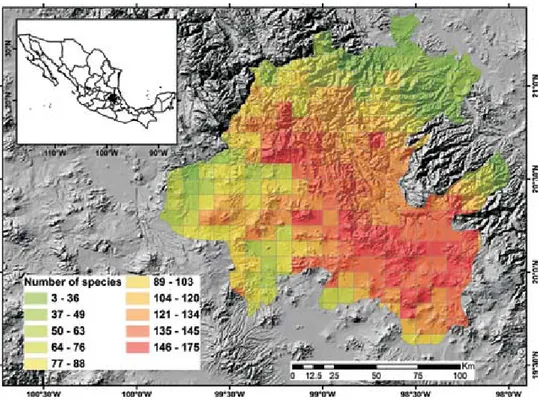
Potential richness.
Distribution models for 150 species
were placed in the 5-minute cell network to indicate the
cells occupied by each species. A new richness map was
produced with the models thus prepared and the records
for 205 species without models supplemented the richness
data for each cell. This information was used to prepare a
map of potential richness (Fig. 3).
Results
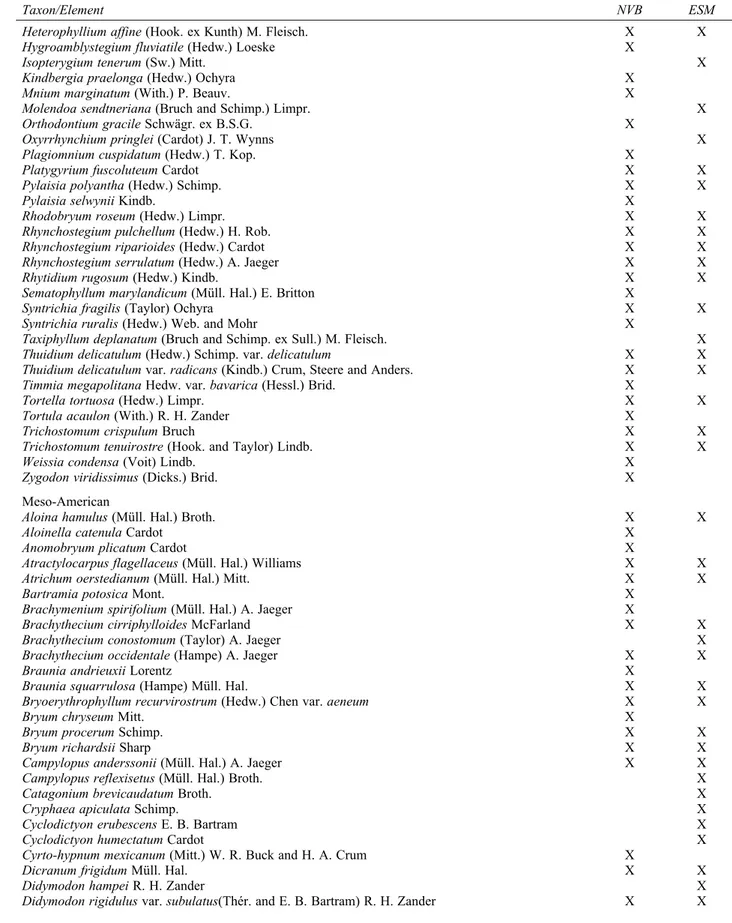
Herbarium and literature records produced a list of 420
species for the state of Hidalgo (Tables 1, 2). The species
accumulation curve suggests that the moss flora of the state
of Hidalgo should contain about 476 species, as indicated
by the asymptote (Fig. 1). Since the presence of 355
species has been documented, the level of completeness of
the flora under study is 74.5%. However, computation did
not consider the varieties recognized for several species
so that the actual number of taxa would be 371 (Table 1).
Sharp et al. (1994) recorded 49 additional taxa (Table 2)
that were represented in herbarium collections elsewhere
in the world and should be expected to complement
holdings in MEXU. This means that there are still 56
Figure 3. Patterns of richness based on potential distribution models for 150 moss species and point records for the 205 remaining species. No varieties were included. Cell size is 5-minute latitude/longitude.
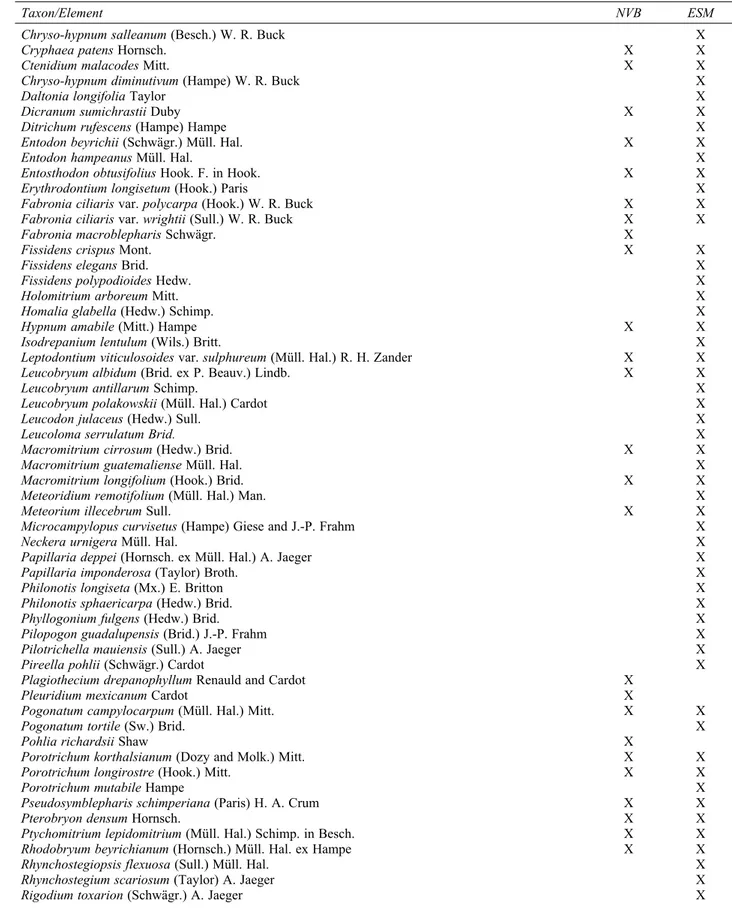
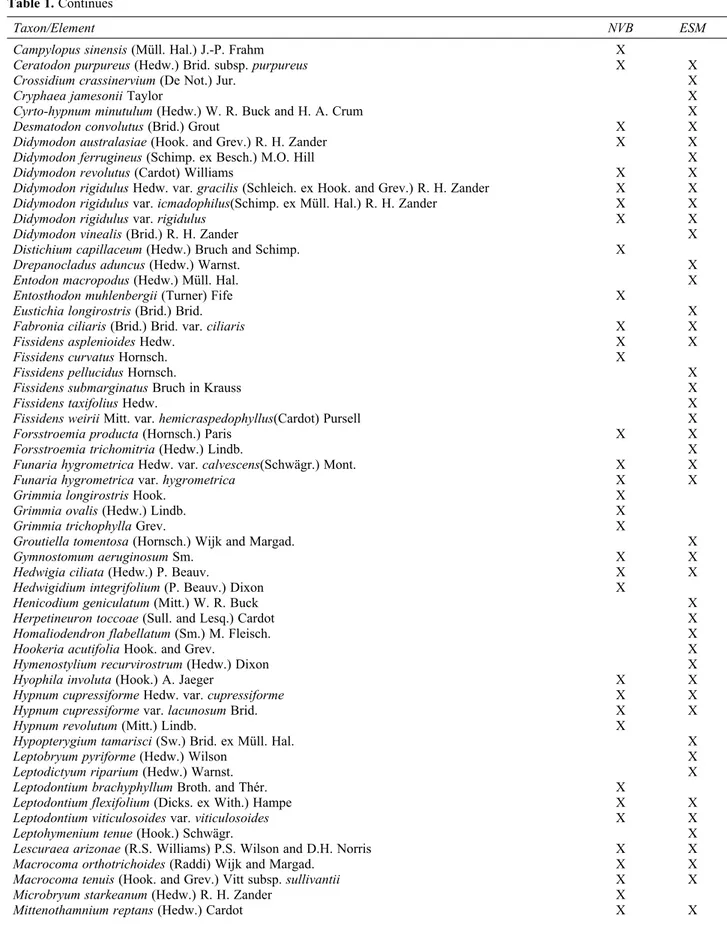
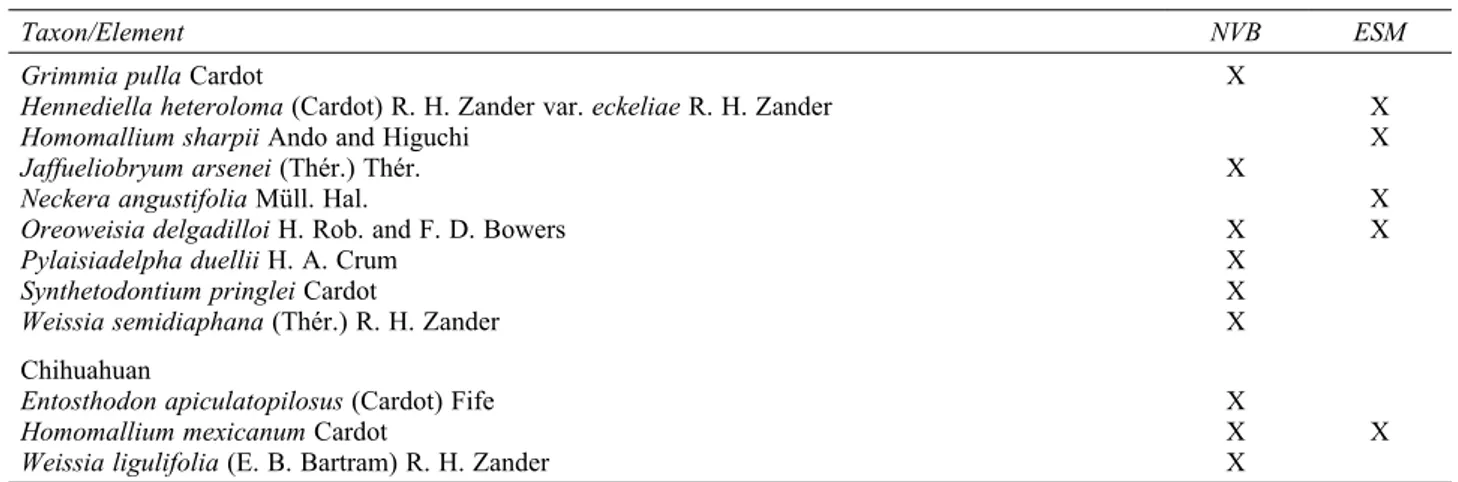
Table 1. Moss taxa (371) in the state of Hidalgo, supported by herbarium specimens at MEXU. Neovolcanic Belt (NVB) and Eastern Sierra Madre (ESM) species are indicated by an X
Taxon/Element NVB ESM
Northern
Anomobryum filiforme var. concinnatum (Spruce) Boul. X
Anomodon attenuatus (Hedw.) Huebener X
Anomodon rostratus (Hedw.) Schimp. X
Anomodon thraustus Müll. Hal. X
Atrichum angustatum (Brid.) Bruch and Schimp. X X
Barbula indica (Hook.) Spreng. X
Bryum erythroloma (Kindb.) Syed X
Campyliadelphus chrysophyllus (Brid.) Kanda X
Campylophyllum sommerfeltii (Myr.) Hedenäs X X
Campylopus fragilis (Brid.) Bruch and Schimp. X
Ceratodon purpureus subsp. stenocarpus (Bruch and Schimp.) Dixon X X
Claopodium pellucinerve (Mitt.) Best X
Dicranella varia (Hedw.) Schimp. X
Dicranoweisia cirrata (Hedw.) Lindb. X
Dicranum flagellare Hedw. X X
Diphyscium foliosum (Hedw.) Mohr X
Drepanocladus sordidus (Müll. Hal.) Hedenäs in W. R. Buck X
Encalypta ciliata Hedw. X
Entodon schleicheri (Schimp.) Demeter X
Fissidens dubius P. Beauv. X
Grimmia pilifera P. Beauv. X X
Haplocladium angustifolium (Hampe and Müll. Hal.) Broth. X X
Taxon/Element NVB ESM
Heterophyllium affine (Hook. ex Kunth) M. Fleisch. X X
Hygroamblystegium fluviatile (Hedw.) Loeske X
Isopterygium tenerum (Sw.) Mitt. X
Kindbergia praelonga (Hedw.) Ochyra X
Mnium marginatum (With.) P. Beauv. X
Molendoa sendtneriana (Bruch and Schimp.) Limpr. X
Orthodontium gracile Schwägr. ex B.S.G. X
Oxyrrhynchium pringlei (Cardot) J. T. Wynns X
Plagiomnium cuspidatum (Hedw.) T. Kop. X
Platygyrium fuscoluteum Cardot X X
Pylaisia polyantha (Hedw.) Schimp. X X
Pylaisia selwynii Kindb. X
Rhodobryum roseum (Hedw.) Limpr. X X
Rhynchostegium pulchellum (Hedw.) H. Rob. X X
Rhynchostegium riparioides (Hedw.) Cardot X X
Rhynchostegium serrulatum (Hedw.) A. Jaeger X X
Rhytidium rugosum (Hedw.) Kindb. X X
Sematophyllum marylandicum (Müll. Hal.) E. Britton X
Syntrichia fragilis (Taylor) Ochyra X X
Syntrichia ruralis (Hedw.) Web. and Mohr X
Taxiphyllum deplanatum (Bruch and Schimp. ex Sull.) M. Fleisch. X
Thuidium delicatulum (Hedw.) Schimp. var. delicatulum X X
Thuidium delicatulum var. radicans (Kindb.) Crum, Steere and Anders. X X
Timmia megapolitana Hedw. var. bavarica (Hessl.) Brid. X
Tortella tortuosa (Hedw.) Limpr. X X
Tortula acaulon (With.) R. H. Zander X
Trichostomum crispulum Bruch X X
Trichostomum tenuirostre (Hook. and Taylor) Lindb. X X
Weissia condensa (Voit) Lindb. X
Zygodon viridissimus (Dicks.) Brid. X
Meso-American
Aloina hamulus (Müll. Hal.) Broth. X X
Aloinella catenula Cardot X
Anomobryum plicatum Cardot X
Atractylocarpus flagellaceus (Müll. Hal.) Williams X X
Atrichum oerstedianum (Müll. Hal.) Mitt. X X
Bartramia potosica Mont. X
Brachymenium spirifolium (Müll. Hal.) A. Jaeger X
Brachythecium cirriphylloides McFarland X X
Brachythecium conostomum (Taylor) A. Jaeger X
Brachythecium occidentale (Hampe) A. Jaeger X X
Braunia andrieuxii Lorentz X
Braunia squarrulosa (Hampe) Müll. Hal. X X
Bryoerythrophyllum recurvirostrum (Hedw.) Chen var. aeneum X X
Bryum chryseum Mitt. X
Bryum procerum Schimp. X X
Bryum richardsii Sharp X X
Campylopus anderssonii (Müll. Hal.) A. Jaeger X X
Campylopus reflexisetus (Müll. Hal.) Broth. X
Catagonium brevicaudatum Broth. X
Cryphaea apiculata Schimp. X
Cyclodictyon erubescens E. B. Bartram X
Cyclodictyon humectatum Cardot X
Cyrto-hypnum mexicanum (Mitt.) W. R. Buck and H. A. Crum X
Dicranum frigidum Müll. Hal. X X
Didymodon hampei R. H. Zander X
Didymodon rigidulus var. subulatus(Thér. and E. B. Bartram) R. H. Zander X X
Taxon/Element NVB ESM
Entodon jamesonii (Taylor) Mitt. X X
Epipterygium immarginatum Mitt. X
Fissidens excurrentinervis Williams X
Flowersia campylopus (Schimp. ex Müll. Hal.) Griffin and W. R. Buck X X
Globulinella globifera (Hampe) Steere ex Steere and Chapm. X
Herzogiella cylindricarpa (Cardot) Iwats. X
Horridohypnum mexicanum (Thér.) W. R. Buck X X
Leptodontium viticulosoides (P. Beauv.) Wijk and Margad. var. exasperatum(Cardot) R. H. Zander X X
Leskea angustata Taylor X X
Leucodon cryptotheca Hampe X X
Leucodon curvirostris Hampe X X
Lindbergia mexicana (Besch.) Cardot X X
Macromitrium fragilicuspis Cardot X
Meteorium teres Mitt. X
Mironia ehrenbergiana (Müll. Hal.) R. H. Zander X
Mironia stenotheca (Thér.) R. H. Zander X
Neckera chlorocaulis Müll. Hal. X X
Neckera ehrenbergii Müll. Hal. X X
Orthostichella pachygastrella (Müll. Hal. ex Aongstr.) B. H. Allen and Magill X
Orthotrichum bartramii Williams X
Orthotrichum pycnophyllum Schimp. ex Müll. Hal. X X
Orthotrichum pycnophyllum var. verrucosum (Müll. Hal.) Lewinsky X X
Physcomitrium subsphaericum Schimp. X
Platygyriella pringlei (Cardot) W. R. Buck X
Pohlia oerstediana (Müll. Hal.) Shaw X
Polytrichastrum tenellum (Müll. Hal.) G. Smith X
Pterobryopsis mexicana (Renauld and Cardot) M. Fleisch. X
Ptychomitrium serratum Bruch and Schimp. X X
Rauiella lagoensis (Hampe) W. R. Buck X
Rhexophyllum subnigrum (Mitt.) Hilp. X X
Rhynchostegium semiscabrum (E. B. Bartram) H. Rob. X
Rhynchostegium subrusciforme (Müll. Hal.) A. Jaeger X
Rozea andrieuxii (Müll. Hal.) Besch. Var. andrieuxii X X
Rozea andrieuxii var. bourgeana (Besch.) W. R. Buck X X
Sagenotortula quitoensis (Taylor in Hook.) R. H. Zander X
Schizymenium landii (Cardot) Shaw X
Schizymenium serratum (Cardot and Herz.) Shaw X
Sphaerotheciella pachycarpa (Schimp. Ex Besch.) Manuel X
Sphaerotheciella pinnata (Schimp.) Manuel X X
Syntrichia amphidiacea (Müll. Hal.) R. H. Zander X X
Syntrichia obtusissima (Müll. Hal.) R. H. Zander X X
Thuidium delicatulum var. peruvianum (Mitt.) H. A. Crum X X
Zygodon ehrenbergii Müll. Hal. X X
Zygodon liebmannii Schimp. Ex Müll. Hal. X
Caribbean
Archidium donnellii Austin X
Atrichum polycarpum (Müll. Hal.) Mitt. X X
Bartramia brevifolia Brid. X
Brachymenium mexicanum Mont. X X
Breutelia brittoniae Renauld and Cardot X
Breutelia inclinata (Hampe and Lorentz) A. Jaeger X
Breutelia subarcuata (Müll. Hal.) Schimp. X
Bryum limbatum Müll. Hal. X
Bryum pseudocapillare Besch. X
Campylopus albidovirens Herz. X
Campylopus tallulensis Sull. and Lesq. X X
Taxon/Element NVB ESM
Chryso-hypnum salleanum (Besch.) W. R. Buck X
Cryphaea patens Hornsch. X X
Ctenidium malacodes Mitt. X X
Chryso-hypnum diminutivum (Hampe) W. R. Buck X
Daltonia longifolia Taylor X
Dicranum sumichrastii Duby X X
Ditrichum rufescens (Hampe) Hampe X
Entodon beyrichii (Schwägr.) Müll. Hal. X X
Entodon hampeanus Müll. Hal. X
Entosthodon obtusifolius Hook. F. in Hook. X X
Erythrodontium longisetum (Hook.) Paris X
Fabronia ciliaris var. polycarpa (Hook.) W. R. Buck X X
Fabronia ciliaris var. wrightii (Sull.) W. R. Buck X X
Fabronia macroblepharis Schwägr. X
Fissidens crispus Mont. X X
Fissidens elegans Brid. X
Fissidens polypodioides Hedw. X
Holomitrium arboreum Mitt. X
Homalia glabella (Hedw.) Schimp. X
Hypnum amabile (Mitt.) Hampe X X
Isodrepanium lentulum (Wils.) Britt. X
Leptodontium viticulosoides var. sulphureum (Müll. Hal.) R. H. Zander X X
Leucobryum albidum (Brid. ex P. Beauv.) Lindb. X X
Leucobryum antillarum Schimp. X
Leucobryum polakowskii (Müll. Hal.) Cardot X
Leucodon julaceus (Hedw.) Sull. X
Leucoloma serrulatum Brid. X
Macromitrium cirrosum (Hedw.) Brid. X X
Macromitrium guatemaliense Müll. Hal. X
Macromitrium longifolium (Hook.) Brid. X X
Meteoridium remotifolium (Müll. Hal.) Man. X
Meteorium illecebrum Sull. X X
Microcampylopus curvisetus (Hampe) Giese and J.-P. Frahm X
Neckera urnigera Müll. Hal. X
Papillaria deppei (Hornsch. ex Müll. Hal.) A. Jaeger X
Papillaria imponderosa (Taylor) Broth. X
Philonotis longiseta (Mx.) E. Britton X
Philonotis sphaericarpa (Hedw.) Brid. X
Phyllogonium fulgens (Hedw.) Brid. X
Pilopogon guadalupensis (Brid.) J.-P. Frahm X
Pilotrichella mauiensis (Sull.) A. Jaeger X
Pireella pohlii (Schwägr.) Cardot X
Plagiothecium drepanophyllum Renauld and Cardot X
Pleuridium mexicanum Cardot X
Pogonatum campylocarpum (Müll. Hal.) Mitt. X X
Pogonatum tortile (Sw.) Brid. X
Pohlia richardsii Shaw X
Porotrichum korthalsianum (Dozy and Molk.) Mitt. X X
Porotrichum longirostre (Hook.) Mitt. X X
Porotrichum mutabile Hampe X
Pseudosymblepharis schimperiana (Paris) H. A. Crum X X
Pterobryon densum Hornsch. X X
Ptychomitrium lepidomitrium (Müll. Hal.) Schimp. in Besch. X X
Rhodobryum beyrichianum (Hornsch.) Müll. Hal. ex Hampe X X
Rhynchostegiopsis flexuosa (Sull.) Müll. Hal. X
Rhynchostegium scariosum (Taylor) A. Jaeger X
Rigodium toxarion (Schwägr.) A. Jaeger X
Taxon/Element NVB ESM
Schlotheimia jamesonii (Arnott) Brid. X
Schlotheimia rugifolia (Hook.) Schwägr. X
Sematophyllum cuspidiferum Mitt. X
Sematophyllum swartzii (Schwägr.) Welch and H. A. Crum X X
Sphagnum meridense (Hampe) Müll. Hal. X
Splachnobryum obtusum (Brid.) Müll. Hal. X
Squamidium nigricans (Hook.) Broth. X
Syrrhopodon prolifer Schwägr. X
Thuidium tomentosum Schimp. X X
Weissia jamaicensis (Mitt.) Grout X
Zelometeorium patulum (Hedw.) Manuel X
Zygodon campylophyllus Müll. Hal. X X
Southern
Braunia plicata (Mitt.) A. Jaeg. X X
Bryum microimbricatum Ochi X
Bryum radiculosum Brid. X
Campylopus heterostachys (Hampe) A. Jaeger X
Erpodium beccarii Müll. Hal. ex Vent. X
Leptodontium capituligerum Müll. Hal. X X
Orthotrichum aequatoreum Mitt. X X
Rhacocarpus purpurascens (Brid.) Paris X
Wide distribution
Aloina rigida (Hedw.) Limpr. X
Amphidium tortuosum (Hornsch.) Cufodontis X
Anacolia laevisphaera (Taylor) Flowers X X
Andreaea rupestris Hedw. X
Anoectangium aestivum (Hedw.) Mitt. X X
Anomobryum filiforme (Dicks.) Solms. in Rabenh. var. filiforme X
Anomodon tristis (Ces.) Sull. and Lesq. X
Aongstroemia orientalis Mitt. X X
Barbella pendula (Sull.) M. Fleisch. X
Barbellopsis trichophora (Mont.) W. R. Buck X
Barbula arcuata Griff. X
Barbula bolleana (Müll. Hal.) Broth. X X
Barbula convoluta Hedw. X
Brachymenium exile (Dozy and Molk.) Bosch and Sande Lac. X X
Brachymenium systylium (Müll. Hal.) A. Jaeger X X
Brachymitrion jamesonii Taylor X X
Brachythecium plumosum (Hedw.) Schimp. X X
Brachythecium ruderale (Brid.) W. R. Buck X X
Braunia secunda (Hook.) Bruch and Schimp. X X
Breutelia tomentosa (Brid.) A. Jaeg. and Sauerb. X
Bryoerythrophyllum campylocarpum (Müll. Hal.) H. A. Crum X X
Bryoerythrophyllum inaequalifolium (Taylor) R. H. Zander X
Bryoerythrophyllum recurvirostrum var. recurvirostrum X
Bryum argenteum Hedw. X X
Bryum billarderi Schwägr. X X
Bryum capillare Hedw. X X
Bryum muhlenbeckii Bruch and Schimp. X
Bryum pallescens Schleich. ex Schwägr. X
Bryum pseudotriquetrum (Hedw.) Gaertn., Meyer and Scherb. X
Bryum subapiculatum Hampe X
Campylopus flexuosus (Hedw.) Brid. X
Campylopus nivalis (Brid.) Brid. X X
Campylopus pilifer Brid. X X
Taxon/Element NVB ESM
Campylopus sinensis (Müll. Hal.) J.-P. Frahm X
Ceratodon purpureus (Hedw.) Brid. subsp. purpureus X X
Crossidium crassinervium (De Not.) Jur. X
Cryphaea jamesonii Taylor X
Cyrto-hypnum minutulum (Hedw.) W. R. Buck and H. A. Crum X
Desmatodon convolutus (Brid.) Grout X X
Didymodon australasiae (Hook. and Grev.) R. H. Zander X X
Didymodon ferrugineus (Schimp. ex Besch.) M.O. Hill X
Didymodon revolutus (Cardot) Williams X X
Didymodon rigidulus Hedw. var. gracilis (Schleich. ex Hook. and Grev.) R. H. Zander X X
Didymodon rigidulus var. icmadophilus(Schimp. ex Müll. Hal.) R. H. Zander X X
Didymodon rigidulus var. rigidulus X X
Didymodon vinealis (Brid.) R. H. Zander X
Distichium capillaceum (Hedw.) Bruch and Schimp. X
Drepanocladus aduncus (Hedw.) Warnst. X
Entodon macropodus (Hedw.) Müll. Hal. X
Entosthodon muhlenbergii (Turner) Fife X
Eustichia longirostris (Brid.) Brid. X
Fabronia ciliaris (Brid.) Brid. var. ciliaris X X
Fissidens asplenioides Hedw. X X
Fissidens curvatus Hornsch. X
Fissidens pellucidus Hornsch. X
Fissidens submarginatus Bruch in Krauss X
Fissidens taxifolius Hedw. X
Fissidens weirii Mitt. var. hemicraspedophyllus(Cardot) Pursell X
Forsstroemia producta (Hornsch.) Paris X X
Forsstroemia trichomitria (Hedw.) Lindb. X
Funaria hygrometrica Hedw. var. calvescens(Schwägr.) Mont. X X
Funaria hygrometrica var. hygrometrica X X
Grimmia longirostris Hook. X
Grimmia ovalis (Hedw.) Lindb. X
Grimmia trichophylla Grev. X
Groutiella tomentosa (Hornsch.) Wijk and Margad. X
Gymnostomum aeruginosum Sm. X X
Hedwigia ciliata (Hedw.) P. Beauv. X X
Hedwigidium integrifolium (P. Beauv.) Dixon X
Henicodium geniculatum (Mitt.) W. R. Buck X
Herpetineuron toccoae (Sull. and Lesq.) Cardot X
Homaliodendron flabellatum (Sm.) M. Fleisch. X
Hookeria acutifolia Hook. and Grev. X
Hymenostylium recurvirostrum (Hedw.) Dixon X
Hyophila involuta (Hook.) A. Jaeger X X
Hypnum cupressiforme Hedw. var. cupressiforme X X
Hypnum cupressiforme var. lacunosum Brid. X X
Hypnum revolutum (Mitt.) Lindb. X
Hypopterygium tamarisci (Sw.) Brid. ex Müll. Hal. X
Leptobryum pyriforme (Hedw.) Wilson X
Leptodictyum riparium (Hedw.) Warnst. X
Leptodontium brachyphyllum Broth. and Thér. X
Leptodontium flexifolium (Dicks. ex With.) Hampe X X
Leptodontium viticulosoides var. viticulosoides X X
Leptohymenium tenue (Hook.) Schwägr. X
Lescuraea arizonae (R.S. Williams) P.S. Wilson and D.H. Norris X X
Macrocoma orthotrichoides (Raddi) Wijk and Margad. X X
Macrocoma tenuis (Hook. and Grev.) Vitt subsp. sullivantii X X
Microbryum starkeanum (Hedw.) R. H. Zander X
Mittenothamnium reptans (Hedw.) Cardot X X
Taxon/Element NVB ESM
Orthostichella rigida (Müll. Hal.) B. H. Allen and Magill X X
Orthostichella versicolor (Müll. Hal.) B. H. Allen and Magill X
Orthotrichum anomalum Hedw. X
Orthotrichum diaphanum Schrad. ex Brid. X
Palamocladium leskeoides (Hook.) E. Britton X X
Papillaria nigrescens (Sw. ex Hedw.) A. Jaeger X X
Philonotis fontana (Hedw.) Brid. X
Philonotis glaucescens (Hornsch.) Broth. X
Philonotis marchica (Hedw.) Brid. X
Pilotrichella flexilis (Hedw.) Aongstr. X X
Plagiomnium rhynchophorum (Hook.) T. Kop. X X
Platygyriella densa (Hook.) W. R. Buck X
Pleuridium acuminatum Lindb. X
Pleurochaete squarrosa (Brid.) Lindb. X X
Pogonatum oligodus (Müll. Hal.) Mitt. X
Pohlia cruda (Hedw.) Lindb. X
Pohlia elongata Hedw. X X
Polytrichum commune L. ex Hedw. X
Polytrichum juniperinum Hedw. X X
Porotrichum usagarum Mitt. X
Prionodon densus (Hedw.) Müll. Hal. X X
Pseudocrossidium crinitum (Schultz) R. H. Zander X
Pseudocrossidium replicatum (Taylor) R. H. Zander X X
Pylaisia falcata Schimp. X X
Pylaisiadelpha tenuirostris (Bruch and Schimp.) W. R. Buck X X
Pyrrhobryum spiniforme (Hedw.) Mitt. X
Racomitrium subsecundum (Hook. and Grev. ex Harv.) Mitt. X
Racopilum tomentosum (Hedw.) Brid. X X
Rhabdoweisia fugax (Hedw.) Bruch and Schimp. X X
Rhodobryum huillense (Welw. and Duby) Touw X X
Schistidium apocarpum (Hedw.) Bruch and Schimp. X
Schistidium rivulare (Brid.) Podp. X
Sematophyllum adnatum (Mx.) E. Britton X X
Sematophyllum galipense (Müll. Hal.) Mitt. X X
Sematophyllum subpinnatum (Brid.) E. Britton X X
Sematophyllum subsimplex (Hedw.) Mitt. X
Sphagnum palustre L. X X
Sphagnum strictum Sull. X
Stereophyllum radiculosum (Hook.) Mitt. X
Symblepharis vaginata (Hook.) Wijk and Margad. X
Syntrichia chisosa (Magill, Delgad. and L. R. Stark) R. H. Zander X
Syntrichia pagorum (Milde) Amann X
Syntrichia papillosa (Wilson) Jur. X
Taxiphyllum taxirameum (Mitt.) M. Fleisch. X
Timmiella anomala (Bruch and Schimp.) Limpr. X X
Tortella humilis (Hedw.) Jenn. X
Trachypus viridulus (Mitt.) Broth. X
Trematodon sp. X
Trichostomum brachydontium Bruch X X
Weissia controversa Hedw. X X
Zygodon obtusifolius Hook. X X
Zygodon reinwardtii (Hornsch.) Braun X
Endemic
Brachymenium saint-pierrei Thér. X
Didymodon incrassatolimbatus Cardot X
Entodon abbreviatus (Schimp.) A. Jaeger X X
taxa lacking to fulfill the model prediction. The 420 moss
taxa known from the state (Tables 1, 2) represent a high
floristic number for the area. To be sure, published data
indicate that such neighboring states as Guanajuato harbor
114 moss species and varieties (Delgadillo and Cárdenas,
1996), México 268 (Sharp et al., 1994), and Querétaro
212 (Herrera et al., 2008); it seems that a higher number
may be found once the central dry lands and other forested
areas are explored.
The list of species based on herbarium specimens (Table
1) also cites the taxa represented in the major mountain
systems of the state, i.e., the Neovolcanic Belt with 245
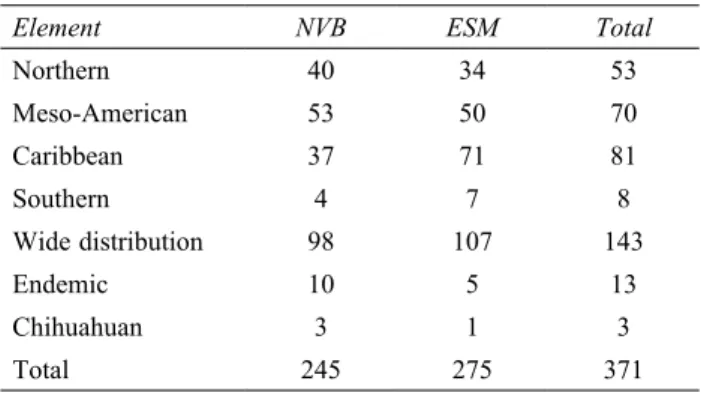
taxa, and the Eastern Sierra Madre with 275. There are no
strong differences in the number of taxa between mountain
systems, but the Caribbean taxa are distinctly higher in the
ESM (Table 3). Besides this, salient features of the moss
flora include the large group of widely distributed and the
Meso-American taxa. The endemic species, 12 in total, are
not restricted to Hidalgo or to a topographic feature of the
state and represent less than 3% of the entire moss flora.
Because of their small number, it is also remarkable the
presence of members of the Chihuahuan element.
The species listed in table 2 may follow the same
patterns of distribution as those listed in table 1, but should
be added when their state distribution is confirmed.
Figure 2 shows the number of known species per cell
in the state of Hidalgo. The distribution of cells with data
also indicate the extent of field work thus far conducted;
there are numerous collections from SE and NW areas,
followed in order of importance, by the NE and SW areas.
These were obtained along major highways and forested
areas along the way. The empty cells in the map represent
dry lands or scattered peaks, inaccessible areas, and major
cities and industrial areas. The potential distribution map
for 150 species (Fig. 3) suggests that many of the empty
cells in figure 2 may contain rich moss floras, especially
in central and southeastern parts of the state. However,
potential species richness values become smaller toward
the northeastern lowlands and, in the southwest, toward
the lower areas of the Neovolcanic Belt.
Discussion
The known moss flora of the state of Hidalgo is
comparatively larger than that of adjacent states. Part of
the size differences are undoubtedly due to insufficient
bryological exploration in various states in central Mexico.
The dry continental area north of the NVB and to the west
of the ESM may indeed contain a reduced moss flora,
but full diversity evaluations in Hidalgo require ample
exploration in its central region. The size of the moss
flora, with 420 species and varieties, is potentially more
diverse as suggested in preceding paragraphs, but not as
rich as that of Veracruz which includes more than 500 taxa
(Delgadillo, 2011).
The presence of 2, NVB and ESM, groups of species
of presumed different derivation might suggest a state flora
with higher moss diversity or with peculiar geographical
affiliation in the mountain areas. Neither hypothesis is
confirmed by the results summarized in table 3; except for
the values of the Caribbean element, the number of species
in the NVB and in ESM is similar, perhaps due to the close
proximity of the mountain ranges. The Caribbean species
are an important constituent of the tropical floras of Mexico
and these, along with the Meso-American and endemic
taxa give a neotropical character to the flora of Hidalgo.
With respect to diversity, the number of species in
Hidalgo is higher than in neighboring states, but no hotspots
are readily identified with current data, although there are
areas (e.g., between Zimapán and Jacala in the northwest,
and in Sierra de Pachuca) where actual or potential species
richness is higher (Figs. 2, 3). These areas, however, have
Taxon/Element NVB ESM
Grimmia pulla Cardot X
Hennediella heteroloma (Cardot) R. H. Zander var. eckeliae R. H. Zander X
Homomallium sharpii Ando and Higuchi X
Jaffueliobryum arsenei (Thér.) Thér. X
Neckera angustifolia Müll. Hal. X
Oreoweisia delgadilloi H. Rob. and F. D. Bowers X X
Pylaisiadelpha duellii H. A. Crum X
Synthetodontium pringlei Cardot X
Weissia semidiaphana (Thér.) R. H. Zander X
Chihuahuan
Entosthodon apiculatopilosus (Cardot) Fife X
Homomallium mexicanum Cardot X X
Weissia ligulifolia (E. B. Bartram) R. H. Zander X
Taxon
Acroporium longirostre (Brid.) W. R. Buck
Aerobryopsis martinicensis (Broth.) Spessard-Schued.
Anomobryum prostratum (Müll.Hal.) Besch.
Aulacomnium palustre (Hedw.) Schwägr.
Barbula orizabensis Müll.Hal.
Brachymenium radiculosum (Schwägr.) Hampe
Breutelia austroarcuata (Müll. Hal.) Paris
Breutelia jamaicensis (Mitt.) A. Jaeger
Bryoerythrophyllum recurvirostrum(Hedw.) Chen var. aeneum (Müll. Hal.) R. H. Zander
Bryum apiculatum Schwägr.
Bryum caespiticium Hedw.
Bryum leptotorquescens Müll.Hal.ex Broth.
Bryum microchaeton Hampe
Calyptothecium duplicatum (Schwägr.) Broth.
Chryso-hypnum salleanum (Besch.) W. R. Buck
Cryphaea filiformis (Hedw.) Brid.
Cyclodictyon albicans (Hedw.) Kuntze
Daltonia tenuifolia Mitt.
+Dicranella barnesii Cardot
Dicranella hilariana (Mont.) Mitt.
Dicranella lindigiana (Hampe) Mitt.
+Dicranum lophoneuron Müll. Hal.
Didymodon tophaceus (Brid.) Lisa
Didymodon umbrosus (Müll. Hal.) R. H. Zander
Entodon serrulatus Mitt.
Entosthodon bonplandii (Hook.) Mitt.
Epipterygium mexicanum (Besch.) Broth.
Fissidens weirii Mitt.var. weirii
Grimmia elongata Kaulf.
Helicodontium capillare (Hedw.) A. Jaeger
Heterocladium macounii Best
Hyophiladelphus agrarius (Hedw.) R. H. Zander
Luisierella barbula (Schwägr.) Steere
Macromitrium punctatum (Hook.and Grev.) Brid.
Neckeropsis undulata (Hedw.) Reichardt
Philonotis cernua (Wilson) Griffin and W. R. Buck
Philonotis uncinata (Schwägr.) Brid.
Pilotrichella nudiramulosa Müll.Hal.
Plaubelia sprengelii (Schwägr.) R. H. Zander var. stomatodonta (Cardot) R. H. Zander
Pohlia papillosa (Müll. Hal. ex Jaeger) Broth.
Pohlia pseudobarbula (Thér.) H. A. Crum ex A. J. Shaw
Porotrichodendron lindigii (Hampe) W. R. Buck
Pylaisiadelpha deplanatula (Cardot) W. R. Buck
Rhachithecium perpusillum (Thwaites and Mitt.) Broth.
Schoenobryum concavifolium (Griff.) Gangulee
Streptopogon cavifolius Mitt.
Streptopogon matudianus H. A. Crum
Syntrichia bogotensis (Hampe) Mitt.
been well collected and may not qualify for designation
as hotspots.
The potential distribution map identifies areas
of concentration of species; because of the habitat
interrelationships between mosses and vascular plants,
the map in figure 3 would be similar to the distribution
of certain vascular plant communities. At present, it is
unknown whether their distribution is comparable, but
if field observations confirm this, mosses would be an
additional criterion to justify conservation of diverse
areas.
Literature cited
Alfaro, A. P. and X. J. Castillo. 1986. Distribución por tipos de vegetación de los musgos de la Sierra de Pachuca, Hidalgo. ENEP, Plantel Zaragoza, Universidad Nacional Autónoma de México. 54 p.
Cárdenas, A. and C. Delgadillo. 2009. Musgos del Valle de México. Cuadernos 40. Instituto de Biología, Universidad Nacional Autónoma de México, México, D. F. 283 p. Cardot, J. 1909. Diagnoses préliminaires de mousses mexicaines.
Revue Bryologique 36:67-77, 81-88, 105-115.
Cardot, J. 1910. Diagnoses préliminaires de mousses mexicaines. Revue Bryologique 37:4-13, 49-59, 65-72, 117-128. Cardot, J. 1911. Diagnoses préliminaires de mousses mexicaines.
Revue Bryologique 38:1-9, 33-43.
Colwell, R. K. 2009. EstimateS, Version 8.2.0: statistical estimation of species richness and shared species from samples (Software and User's Guide). Freeware published at http://viceroy.eeb.uconn.edu/estimates. Last access: 30.IX.2012.
Colwell, R. K. and J. A. Coddington. 1994. Estimating terrestrial biodiversity through extrapolation. Philosophical Transactions of the Royal Society (Series B) 345:101-118.
Crum, H. A. 1951. The Appalachian-Ozarkian element in the moss flora of Mexico with a check-list of all known Mexican mosses. Ph.D. Dissertation. University of Michigan. Ann Arbor. 504 p.
Davis, H. B. 1936. Life and work of Cyrus Guernsey Pringle. Free Press Printing Co., Burlington, Vermont. 756 p. Delgadillo, C. 2010. LATMOSS 2010. Available on line at http://
www.ibiologia.unam.mx/briologia/www/index/consultas. html. 15.I.2013.
Delgadillo, C. 2011. Los musgos, Veracruz y el corredor florístico del golfo. In La biodiversidad en Veracruz. Estudio de estado. Vol. II, A. Cruz Angón (ed.). Conabio. México. p. 89-96. Delgadillo, C. and A. Cárdenas. 1996. A preliminary checklist of
the mosses of Guanajuato, Mexico. Flora del bajío y regiones adyacentes. Fascículo complementario XI:1-14.
Delgadillo, C., A. Cárdenas, V. M. Gálvez-Aguilar and A. Sánchez-González. 2011. Musgos del Parque Nacional Los Mármoles, Hidalgo, México. Boletín de la Sociedad Botánica de México 89:19-26.
García, E. and Z. Falcón. 1984. Nuevo atlas Porrúa de la República Mexicana. Editorial Porrúa. México, D. F. 219 p.
Gotelli, N. J. and R. K. Colwell. 2001. Quantifying biodiversity: procedures and pitfalls in the measurement and comparison of species richness. Ecological Letters 4:379-391.
Herrera-Paniagua, P., C. Delgadillo, J. L. Villaseñor and I. Luna-Vega. 2008. Floristics and biogeography of the mosses of the state of Querétaro, Mexico. Bryologist 111:41-56.
Hijmans, R. J., S. E. Cameron, J. L. Parra, P. G. Jones and A. Jarvis. 2005. Very high resolution interpolated climate surfaces for global land areas. International Journal of Climatology 25:1965-1978.
INFDM (Instituto Nacional para el Federalismo y el Desarrollo Municipal). 2005. Estado de Hidalgo-Medio Físico. Enciclopedia de los Municipios de México. Mexico.www. e-local.gob.mx/work/templates/enciclo/hidalgo/; last access: 12.IX.2012.
IUCN. 2001. IUCN Red List Categories and Criteria: Version 3.1. IUCN Species Survival Commission. IUCN, Gland, Switzerland and Cambridge, UK. 30 p.
Jiménez-Valverde, A. and J. Hortal. 2003. Las curvas de acumulación de especies y la necesidad de evaluar la calidad de los inventarios biológicos. Revista Ibérica de Aracnología 8:151-161.
Kumar, S. and T. J. Stohlgren. 2009. Maxent modeling for predicting suitable habitat for threatened and endangered tree Canacomyrica monticola in New Caledonia. Journal of Ecology and the Natural Environment 1:94-98.
Moat, J. 2007. Conservation assessment tools, extension for ArcView 3.x, version 1.2.GIS Unit, Royal Botanic Gardens, Kew, UK.
Pearson, R. G., C. J. Raxworthy, M. Nakamura and A. T. Peterson. 2007. Predicting species distribution from small numbers of occurrence records: a test case using cryptic geckos in Madagascar. Journal of Biogeography 34:102-117.
Phillips, S. J. and M. Dudik. 2008. Modeling of species distributions with Maxent: new extensions and a comprehensive evaluation. Ecography 31:161-175.
Phillips, S. J., R. P. Anderson and R. E. Schapire. 2006. Maximum entropy modeling of species geographic distributions. Ecological Modelling 190:231-259.
Table 3. Summary of number of species listed in Table 1. NVB= Neovolcanic Belt; ESM= Eastern Sierra Madre
Element NVB ESM Total
Northern 40 34 53
Meso-American 53 50 70
Caribbean 37 71 81
Southern 4 7 8
Wide distribution 98 107 143
Endemic 10 5 13
Chihuahuan 3 1 3
69:1-1113.
Soberón, J. and J. Llorente. 1993. The use of species accumulation functions for the prediction of species richness. Conservation Biology 7:480-488.
Suárez-Seoane, S., E. García-de la Morena, M. B. Morales, P. E. Osborne and E. de Juana. 2008. Maximum entropy niche-based modelling of seasonal changes in Little bustard (Tetrax