Rev Inves Clin. 2017;69:166-72 ORIGINAL ARTICLE
Received for publication: 09-02-2017 Accepted for publication: 16-03-2017
ORIGINAL ARTICLE
Corresponding author: José Alberto Ávila-Funes Department of Geriatrics
Instituto Nacional de Ciencias Médicas y Nutrición Salvador Zubirán
Vasco de Quiroga, 15
Col. Belisario Domínguez Sección XVI, Del. Tlalpan C.P. 14080, Ciudad de México, México
E-mail: [email protected]
ABSTRACT
Background: The association of cognitive impairment and type 2 diabetes has been consistently shown in several studies, yet its association with geriatric syndromes has not been fully explored. Objective: To study the correlates of cognitive impairment among community-dwelling elderly with type 2 diabetes. Methods: Cross-sectional study of 135 diabetic persons aged 70 years or older participating in the Coyoacán Cohort Study in Mexico City. Baseline data included chronic illnesses, geriatric syndromes, and diabetes-related variables. The lowest quartile in both the Mini-Mental State Examination and the Isaacs Set Test, according to age and schooling, was used to identify participants with cognitive impairment. Multivariate logistic regression analyses were used to identify the correlates of cognitive impairment. Results: Mean age of participants was 77.7 ± 5.8 years. The prevalence of cognitive impairment was 14.1%. Univariate logistic regression analyses showed that diabetic nephropathy, depression symptoms, falls, and frailty were associated with cognitive impairment. Multivariate logistic regression analyses showed that urinary incon-tinence and frailty were independently associated with cognitive impairment. Cardiovascular risk factors and diabetes-related variables did not show significant association to cognitive impairment. Conclusions: Geriatric syndromes, but not cardiovascular risk factors, were independently associated with cognitive impairment among diabetic elderlies. Intentional evaluation of these conditions may be important to improve management of the elderly patient with type 2 diabetes and cognitive impairment.
(REV INVES CLIN. 2017;69:166-72)
Key words: Geriatric syndrome. Cognitive impairment. Frailty. Urinary incontinence. Diabetes.
Geriatric Syndromes and Not
Cardiovascular Risk Factors are
Associated with Cognitive Impairment
among Mexican Community-Dwelling
Elderly with Type 2 Diabetes
Omar Yaxmehen Bello-Chavolla
1, Carlos Alberto Aguilar-Salinas
2and José Alberto Avila-Funes
3,4 1MD/PhD Programme, Facultad de Medicina, Universidad Nacional Autónoma de México; 2Department ofINTRODUCTION
Type 2 diabetes mellitus (DM) is a significant public health burden worldwide, particularly in countries un-der epidemiological transition1-3. Care and manage-ment in elderly DM patients is complicated, especially given the simultaneous presence of comorbidity and geriatric syndromes. Of special importance is cognitive impairment (CIM), which is associated with reduced self-care and monitoring of DM as well as higher hos-pitalization records, among others3. The association between DM and CIM has been persistently reported in several studies. In comparison with non-diabetic populations, those with DM have more frequent cog-nitive impairment4,5. In addition, factors such as long evolution of DM, elevated HbA1c levels, or history of insulin treatment are considered risk factors for the development of CIM. Previous work has demonstrat-ed that Mexican-American participants with DM had a greater risk of dementia and CIM in comparison with non-diabetic participants6-8. Similarly, DM patients also have a higher risk of geriatric conditions, includ-ing dementia, disability, falls, and urinary inconti-nence9. Despite the large evidence supporting these associations, the relation of geriatric conditions with the presence of CIM in DM patients is still largely unknown; furthermore, previous work suggests that cardiovascular risk factors have a more established role in association with CIM10. Therefore, this study aimed to determine the geriatric and cardiovascular correlates of CIM among community dwelling elderly diabetics.
METHODS
Study population
This is a cross-sectional analysis of a subset of partic-ipants from the Coyoacán Cohort, an observational study conducted in Mexico City. Specific details for the design of this study have been published elsewhere10. Briefly, to be eligible for recruitment, participants had to meet the following criteria: age 70 years or older, established residence in Coyoacán, not being institu-tionalized, and being registered at the Food Support, Medical Care and Free Drugs Program, which is a gov-ernment program that includes 95% of the communi-ty dwelling elderly (≥ 70 years of age) in Mexico Cicommuni-ty. The first phase was composed of a face-to-face
interview during which a wide range of information was collected, including self-reported data regarding sociodemographic characteristics, general health-re-lated information, medication use, oral health (self-re-ported and clinically evaluated), and mental health. Each participant underwent a comprehensive geriatric assessment that included physical performance tests, cognitive tests, and nutrition and medical assessment as well. The Human Research Local Ethics Committee approved all proceedings regarding this study.
Sample
Patients with type 2 DM were selected from the Coyoacán Cohort and included in this study. Diabetes was defined as the self-report of previously diagnosed DM or self-report of taking DM medications. All con-sidered participants underwent a Mini-Mental State Examination (MMSE) and a semantic verbal fluency test (Isaacs Set Test, IST). Cognitive impairment was defined as a score below the 25th percentile for this specific population, according to age and schooling in both tests, without functional impairment10. Patients who only completed either the MMSE or the IST were excluded from the study; no significant differences were found between patients included and excluded from the analysis.
Definition of potential correlates
Participants were categorized as “frail” if they fulfilled three or more frailty criteria; otherwise if they fulfilled one or two, they were considered to be pre-frail or non-frail if none11:
– Unintentional weight loss of 5 kg or more in the last 12 months;
– Exhaustion was assessed by the positive answer to two questions from the Center for Epidemiologic Studies-Depression scale (CES-D) :“I felt that every-thing I did was an effort” and “I could not get going”;
– Low physical activity was defined according to the lowest quintile (adjusted by sex) on the Physical Activity Scale for the Elderly questionnaire (PASE);
walking one block?” or alternatively, “Do you have difficulty with climbing several flights of stairs with-out resting?”; and
– Weakness was determined among participants who answered “yes” to the question, “Because of a health problem, do you have difficulty with lifting or carrying objects weighting over 5 kg, like a heavy bag of groceries?”.
These definitions have previously been validated for this population12.
Fall syndrome was defined as having > 2 fall episodes in the previous 12 months13.
Depressive symptoms were determined when partic-ipants had a Geriatric Depression Scale score > 5 (15-item version)14.
Polypharmacy was defined as taking > 3 different medications at thetime of the study15.
Urinary incontinence, visual deficit, myocardial infarc-tion, stroke, hypertension, hypercholesterolemia, hy-pertriglyceridemia, osteoporosis, and smoking were determined by the self-report of each entity and con-sidered individually as binary outcomes.
For diabetes-related variables, duration of DM from diagnosis in years as well as age at diagnosis were each individually assessed; self-report of diabetic ne-phropathy and diabetic retinopathy was assessed in-dependently and then combined under “Any microvas-cular complications” for purposes of the analysis. Previous history of insulin use was treated as a binary variable according to self-report by the patient. Mac-rovascular complications include self-report of diabet-ic foot or peripheral vascular disease.
Body mass index (BMI; weight/height2) was also cal-culated and included as a correlate.
Sociodemographic variables included age (years), sex, and schooling (education grade).
Statistical analysis
Characteristics of participants were described using arithmetic means and standard deviations (SD) or
frequencies and proportions where appropriate. The following statistical procedures were used according to analyzed variables: chi-squared test for qualitative variables, Student t-test, and the U of Mann-Whitney tests were used where applicable for quantitative variables. In order to develop an explanatory model for CIM, we fitted multivariate logistic regression models, including several variable-blocks: sociodemo-graphic variables, diabetes-related variables, cardio-vascular risk factors, and geriatric conditions. Wald tests were used to eliminate from every model those variables judged not significant at the 20% level, and then the variables considered significantly associated with CIM were retained. Secondly, a new model includ-ing the variables significantly associated with CIM from previous models was run and the cut-off level at this time was 5% in order to select a set of variables to be included in a last full model. All comparisons were evaluated using 95% confidence intervals (CI) and the Nagelkerke R2 was also reported. Statistical analyses were performed in SPSS software for Win-dows® (SPSS Inc., Chicago, IL, version 19.0).
RESULTS
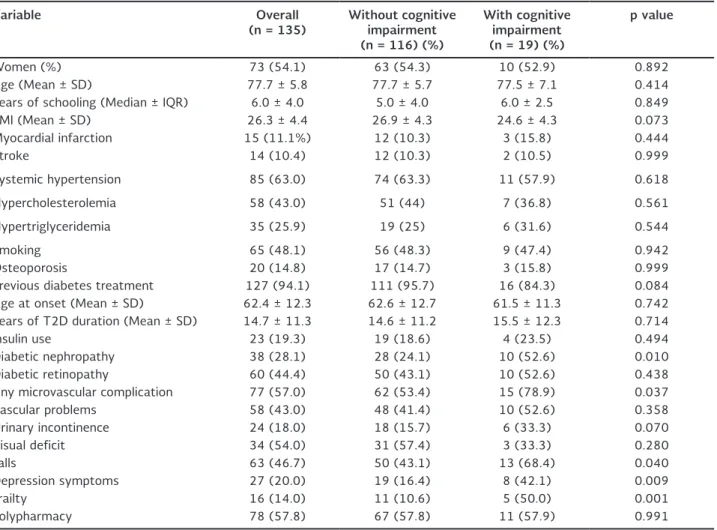
The study sample included 135 participants. Mean age was 77.7 years (SD: 5.8) and 54.1% were female. Mean age of DM onset was 62.4 years (SD: 12.5), with a mean DM duration of 14.7 years (SD: 11.3), 19.3% were using insulin treatment, and 57% report-ed having at least one microvascular complication (28.1% diabetic nephropathy and 44.1% diabetic ret-inopathy). Of the participants, 18% had urinary incon-tinence, 46.7% had at least two falls in the last year, 20% reported depressive symptoms, 14% were frail, and 57.8% reported currently taking > 3 medications. Only 19 participants (14.1%) had CIM.
Table 2 presents the univariate logistic regression anal-yses of CIM. The models found that diabetic nephrop-athy (p = 0.014), having any microvascular complica-tion (p = 0.046), previous falls (p = 0.047), depression symptoms (p = 0.013), and frailty (p = 0.011, pre-frailty was non-significant) were associated with CIM, whereas urinary incontinence did not reach statistical signifi-cance (p = 0.070). Conversely, variables such as pre-vious history of myocardial infarction or stroke, hy-percholesterolemia, hypertension, hypertriglyceridemia, or smoking were not associated with CIM.
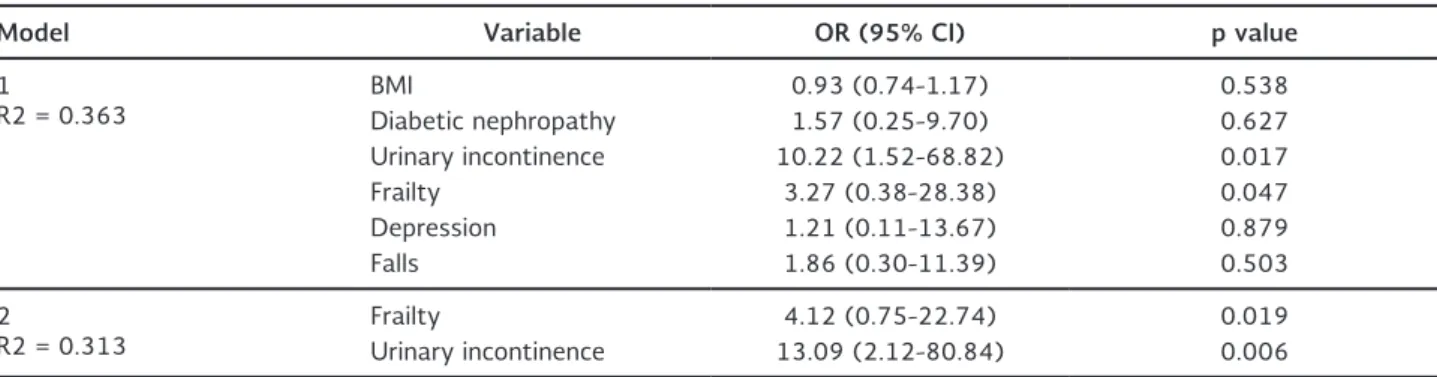
However, the multivariate logistic regression model showed that only urinary incontinence (OR: 13.9; 95% CI: 2.12-80.84; p< 0.001) and frailty (OR: 4.2; 95% CI: 0.75-22.74; p= 0.019) were independently associated with CIM among DM participants (Table 3). The model explained 31% of the variability ob-served in the composite measure of CIM (R2= 0.319).
Table 1. Comparative analysis among participants without or with cognitive impairment
Variable Overall
(n = 135) Without cognitive impairment (n = 116) (%)
With cognitive impairment (n = 19) (%)
p value
Women (%) 73 (54.1) 63 (54.3) 10 (52.9) 0.892
Age (Mean ± SD) 77.7 ± 5.8 77.7 ± 5.7 77.5 ± 7.1 0.414
Years of schooling (Median ± IQR) 6.0 ± 4.0 5.0 ± 4.0 6.0 ± 2.5 0.849
BMI (Mean ± SD) 26.3 ± 4.4 26.9 ± 4.3 24.6 ± 4.3 0.073
Myocardial infarction 15 (11.1%) 12 (10.3) 3 (15.8) 0.444
Stroke 14 (10.4) 12 (10.3) 2 (10.5) 0.999
Systemic hypertension 85 (63.0) 74 (63.3) 11 (57.9) 0.618
Hypercholesterolemia 58 (43.0) 51 (44) 7 (36.8) 0.561
Hypertriglyceridemia 35 (25.9) 19 (25) 6 (31.6) 0.544
Smoking 65 (48.1) 56 (48.3) 9 (47.4) 0.942
Osteoporosis 20 (14.8) 17 (14.7) 3 (15.8) 0.999
Previous diabetes treatment 127 (94.1) 111 (95.7) 16 (84.3) 0.084
Age at onset (Mean ± SD) 62.4 ± 12.3 62.6 ± 12.7 61.5 ± 11.3 0.742
Years of T2D duration (Mean ± SD) 14.7 ± 11.3 14.6 ± 11.2 15.5 ± 12.3 0.714
Insulin use 23 (19.3) 19 (18.6) 4 (23.5) 0.494
Diabetic nephropathy 38 (28.1) 28 (24.1) 10 (52.6) 0.010
Diabetic retinopathy 60 (44.4) 50 (43.1) 10 (52.6) 0.438
Any microvascular complication 77 (57.0) 62 (53.4) 15 (78.9) 0.037
Vascular problems 58 (43.0) 48 (41.4) 10 (52.6) 0.358
Urinary incontinence 24 (18.0) 18 (15.7) 6 (33.3) 0.070
Visual deficit 34 (54.0) 31 (57.4) 3 (33.3) 0.280
Falls 63 (46.7) 50 (43.1) 13 (68.4) 0.040
Depression symptoms 27 (20.0) 19 (16.4) 8 (42.1) 0.009
Frailty 16 (14.0) 11 (10.6) 5 (50.0) 0.001
Polypharmacy 78 (57.8) 67 (57.8) 11 (57.9) 0.991
BMI: body mass index; IQR: interquartile range; SD: standard deviation; T2D: type 2 diabetes.
Table 2. Univariate regression analysis of variables associ-ated to cognitive impairment in type 2 diabetes participants
Variable OR 95% CI pvalue
BMI 0.89 0.79-1.01 0.077
Previous myocardial
infarction 0.61 0.16-2.42 0.487
Previous stroke 0.98 0.20-4.77 0.981 Systemic
hypertension 1.28 0.48-4.44 0.622
Hypercholesterolemia 1.34 0.49-3.66 0.562 Diabetic nephropathy 3.49 1.29-9.54 0.014 Any microvascular
complication 3.27 1.02-10.44 0.046
Falls 2.86 1.02-8.05 0.047
Depression
symptoms 3.71 1.32-10.45 0.013
Frailty 4.89 1.12-21.30 0.011
Polypharmacy 1.01 0.38-2.69 0.991
Urinary incontinence 2.69 0.90-8.11 0.078
DISCUSSION
In this sample of community dwelling diabetic elderly persons, urinary incontinence and frailty were inde-pendently associated with cognitive impairment. Giv-en that the adequate managemGiv-ent of elderly DM patients is dependent on their functional status, in-vestigating the presence of cognitive decline and ad-ditional geriatric syndromes within this population is of the utmost importance.
A previous study in elderly Mexican Americans with DM reported that the prevalence of CIM, urinary in-continence, and individual components of the frailty syndrome (muscle strength, slowness) was lower, which contrasts with the data herein reported16. How-ever, its definition of cognitive impairment could po-tentially overestimate the prevalence of CIM (MMSE scores), especially considering that the scores were not adjusted for confounders such as age and school-ing in comparison to the present study.
The association of DM and CIM has been consistently shown in several studies; the reported associations sug-gest a potential role of vascular and non-vascular mechanisms for CIM in DM patients17,18. Although the mechanisms of cognitive dysfunction associated to DM are still unclear, combined neurological dysfunction, in-flammation, hyperglycemia, insulin resistance, and vas-cular dysfunction have been proposed to be either causal or contributing elements to the development of both Alzheimer’s disease and vascular dementia. Addi-tionally, DM-associated microvascular complications, especially diabetic nephropathy and retinopathy, have also been linked to brain stroke and small-vessel dis-ease associated with cognitive dysfunction19,20.
The association of frailty with CIM has been de-scribed in other studies21,22; however, the association of frailty and CIM in elderly DM patients has not previously been reported. Avila-Funes, et al. pro-posed that frailty is a major risk factor for the de-velopment of cognitive impairment and a possible prodromal stage of vascular dementia21. This sug-gests that, despite the lack of association between the traditional cardiovascular risk factors and CIM in our study, the presence of frailty may account as a mechanism for vascular-mediated cognitive decline. It is important to consider that in other studies, DM has also been associated to an increase in the risk of frailty23; moreover, frail DM patients have an in-creased risk of complications when compared to pa-tients with comorbidities24-27. These may play a role as potential confounders to the established associa-tion in our study.
Additionally, we show that urinar incontinence was also independently associated with CIM in DM pa-tients; however, a causal link cannot be established to be precise on its association, given that DM is also a known risk factor for the development of urinary incontinence and the latter may already be present before CIM onset. A recent study suggests that biochemical measures, mainly hyperglycemia, are not independent predictors of the presence of urinary incontinence in DM patients28. Hsu, et al. investigated the association of risk factors related to the presence of urinary incontinence in elderly DM subjects29. They concluded that dependence on ambulation and transferring as well as the presence of CIM is associated with the presence of urinary incontinence in patients with DM, which is consis-tent with our findings.
Table 3. Multivariate regression analysis of variables associated to cognitive impairment in type 2 diabetes participants
Model Variable OR (95% CI) p value
1
R2 = 0.363 BMIDiabetic nephropathy 0.93 (0.74-1.17)1.57 (0.25-9.70) 0.5380.627
Urinary incontinence 10.22 (1.52-68.82) 0.017
Frailty 3.27 (0.38-28.38) 0.047
Depression 1.21 (0.11-13.67) 0.879
Falls 1.86 (0.30-11.39) 0.503
2
R2 = 0.313 FrailtyUrinary incontinence 13.09 (2.12-80.84)4.12 (0.75-22.74) 0.0190.006
Among the correlates that were associated, though not independently with CIM, microvascular complica-tions are the most extensively studied. Despite evi-dence of microvascular complications leading to CIM, glucose control has not shown significant benefit on cognitive outcomes19. The ACCORD-MIND trial eval-uated the cross-sectional and longitudinal associa-tion of diabetic retinopathy on cognitive funcassocia-tion and brain volume, suggesting that retinal microvas-cular damage leads to decreased gray matter and cognitive function in diabetic patients, but is not necessarily predictive of vascular-mediated cognitive dysfunction30. Our results imply that microvascular complications, in particular diabetic nephropathy, are more frequent in patients with CIM, but their asso-ciation is not independent. Additionally, microvascu-lar complications are related to age of DM onset and years of DM exposure, both of which were not dif-ferent between the group with and without CIM. The role of diabetic nephropathy has not been extensive-ly studied and thus requires further longitudinal confirmation.
In DM patients, vascular complications are an import-ant cause of morbidity, and individuals with cardiovas-cular risk factors are traditionally at higher risk. A large recent study31 suggested that metabolic syn-drome, central obesity, diabetes mellitus, and other cardiovascular risk factors were associated to incident mild cognitive impairment and dementia; however, this observation is true for patients under the age of 75 years as those included in the population of the study. In populations older than 75 years, such as the mean age of our population, the association of car-diovascular risk factors, including metabolic syn-drome, dyslipidemia, central obesity, and hyperten-sion with incident cognitive impairment, has been inconsistent31-33. This observation is also supported by the observation that carotid stiffness is associated with cognitive impairment in individuals with diabetes, but was not the mechanism of cognitive dysfunc-tion34. In our study, we did not find a significant as-sociation of cardiovascular risk factors and cognitive impairment, as has been shown for individuals over 75 years. This suggests that CIM in DM patients is not exclusively vascular-mediated and implies that other factors, such as frailty and urinary incontinence, may contribute to the presence of CIM. Nonetheless, these associations must be confirmed in longitudinal follow-up.
Our study had some limitations. First, this study is a cross-sectional analysis, thus limiting our ability to establish causal associations because we lack the possibility to establish a temporal relation between variables. Furthermore, because only a subset of the studied population completed cognitive evaluation, our study population was reduced and the group with confirmed CIM was relatively small. However, no sig-nificant differences were found between the initial sampled group and the analyzed group. Additionally, because our model only explains 31% of the variabil-ity observed in CIM, other variables may contribute as correlates to CIM that were not included in the present model for this work. Subjects classified in the cognitive outcome were not assessed according to the standardized method for CIM. Instead, normative data for performance below the 25th percentile in both the MMSE and in IST were used to identify subjects with CIM. We consider that this global assessment is sufficient for the evaluated spectrum, but the results must be interpreted with caution. Nevertheless, the considered correlates have previously been defined or analyzed in other studies involving the Coyoacán co-hort, which makes their definition consistent.
In conclusion, in this cohort of community-dwelling elderly, frailty and incontinence, but not cardiovascu-lar risk factors, are associated with a higher frequency of CIM. Geriatric assessment is not usually sought out during a routine examination by an endocrinologist in an elderly patient with DM. Furthermore, given the strong links of DM and vascular complications, cardio-vascular risk factors are classically attributed as the cause of CIM in this population, largely overlooking the effect of geriatric comorbidities. This suggests that the contribution of geriatric conditions to the presence CIM in DM patients should be further inves-tigated. Intentional evaluation of these conditions might be of importance to improve patient care and management of the elderly patient with DM and cog-nitive decline.
ACKNOWLEDGEMENTS
REFERENCES
1. Aguilar-Salinas CA, Velazquez Monroy O, Gómez-Pérez FJ, et al. Characteristics of patients with type 2 diabetes in México: Re-sults from a large population-based nationwide survey. Diabetes Care. 2003;26:2021-6.
2. Rojas-Martínez R, Aguilar-Salinas CA, Jiménez-Corona A, Gó-mez-Pérez FJ, Barquera S, Lazcano-Ponce E. Prevalence of obe-sity and metabolic syndrome components in Mexican adults without type 2 diabetes or hypertension. Salud Publica Mex. 2012;54:7-12.
3. Wilson RS, Barnes LL, Krueger KR, Hoganson G, Bienias JL, Ben-nett DA. Early and late life cognitive activity and cognitive sys-tems in old age. J Int Neuropsychol Soc. 2005;11:400-7. 4. Arvanitakis Z, Wilson RS, Bennett DA. Diabetes mellitus,
demen-tia, and cognitive function in older persons. J Nutr Health Aging. 2006;10:287-91.
5. Mayeda ER, Haan MN, Yaffe K, Kanaya AM, Neuhaus J. Does type 2 diabetes increase rate of cognitive decline in older Mex-ican AmerMex-icans? Alzheimer Dis Assoc Disord. 2015;29:206-12. 6. Bangen KJ, Gu Y, Gross AL, et al. Relationship between type 2 diabetes mellitus and cognitive change in a multiethnic elderly cohort. J Am Geriatr Soc. 2015;63:1075-83.
7. Sadanand S, Balachandar R, Bharath S. Memory and executive functions in persons with type 2 diabetes: a meta-analysis. Dia-betes Metab Res Rev. 2016;32:132-42.
8. Rosso AL, Eaton CB, Wallace R, et al. Combined impact of geriatric syndromes and cardiometabolic diseases on measures of func-tional impairment. J Gerontol A Biol Sci Med Sci. 2011;66:349-54. 9. Lu FP, Lin KP, Kuo HK. Diabetes and the risk of multi-system
aging phenotypes: a systematic review and meta-analysis. PLoS One. 2009;4:e4144.
10. Mokri H, Avila-Funes JA, Meillon C, Gutiérrez Robledo LM, Ami-eva H. Normative data for the Mini-Mental State Examination, the Free and Cued Selective Reminding Test and the Isaacs Set Test for an older adult Mexican population: the Coyoacán Co-hort Study. Clin Neuropsychol. 2013;27:1004-18.
11. Fried LP, Tangen CM, Walston J, Newman AB, Hirsch C, Gottdie-ner J. Frailty in older adults: evidence for a phenotype. J Geron-tol A Biol Sci Med Sci. 2001;56:M146-56.
12. Avila-Funes JA, Medina-Campos RH, Tamez-Rivera O. Frailty is associated with disability and recent hospitalization in commu-nity-dwelling elderly: The Coyoacan Cohort. J Frailty Aging. 2014;3:206-10.
13. Inouye S, Studenski S, Tinetti M, Kuchel GA. Geriatric syn-dromes: Clinical, research and policy implications of a core ge-riatric concept. J Am Geriatr Soc. 2007;55:780-91.
14. Sheikh JL, Yesavage JA. Geriatric Depression Scale (GDS). Re-cent evidence and development of a shorter version. Clin Geron-tol. 1986;5:165-72.
15. Walckiers D, Van der Heyden J, Tafforeau J. Factors associated with excessive polypharmacy in older people. Arch Public Health. 2015;73:50.
16. Beard HA, Markides KS, Al Ghatrif M, Kuo YF, Raji MA. Trends in diabetes medication use and prevalence of geriatric syn-dromes in older Mexican Americans from 1993/1994 to 2004/2005. Ann Pharmacother. 2010;44:1376-83.
17. Luchsinger JA. Type 2 diabetes, related conditions, in relation and dementia: an opportunity for prevention? J Alzheimers Dis. 2010;20:723-36.
18. Abbatecola AM, Paolisso G, Sinclair AJ. Treating diabetes mellitus in older and oldest old patients. Curr Pharm Des. 2015;21:1665-71. 19. Umegaki H. Type 2 diabetes as a risk factor for cognitive
impair-ment: current insights. Clin Interv Aging. 2014;9:1011-19. 20. de Bresser J, Reijmer YD, van den Berg E. Microvascular
deter-minants of cognitive decline and brain volume change in elderly patients with type 2 diabetes. Dement Geriatr Cogn Disord. 2010;30:381-6.
21. Avila-Funes JA, Carcaillon L, Helmer C, et al. Is frailty a prodro-mal stage of vascular dementia? Results from the Three-City Study. J Am Geriatr Soc. 2012;60:1708-12.
22. Avila-Funes JA, Amieva H, Barberger-Gateau P, et al. Cognitive impairment improves the predictive validity of the phenotype of frailty for adverse health outcomes: the three-city study. J Am Geriatr Soc. 2009;57:453-61.
23. García-Esquinas E, Graciani A, Guallar-Castillón P, López-García E, Rodríguez-Mañas L, Rodríguez-Artalejo F. Diabetes and risk of frailty and its potential mechanisms: a prospective cohort study of older adults. J Am Med Dir Assoc. 2015;16:748-54. 24. Hubbard RE, Andrew MK, Fallah N, Rockwood K. Comparison of
the prognostic importance of diagnosed diabetes, co-morbidity and frailty in older people. Diabet Med. 2010;27:603-6. 25. Cobo A, Vázquez LA, Reviriego J, Rodríguez-Mañas L. Impact of
frailty in older patients with diabetes mellitus: An overview. Endocrinol Nutr. 2016;63:291-303
26. Cacciatore F, Testa G, Galizia G. Clinical frailty and long-term mortality in elderly subjects with diabetes. Acta Diabetol. 2013;50:251-60.
27. Umegaki H. Sarcopenia and frailty in older patients with diabe-tes mellitus. Geriatr Gerontol Int. 2016;16:293-9.
28. Weinberg AE, Leppert JT, Elliott CS. Biochemical measures of diabetes are not independent predictors of urinary incontinence in women. J Urol. 2015;194:1668-74.
29. Hsu A, Conell-Price J, Stijacic Cenzer I, et al. Predictors of urinary incontinence in community-dwelling frail older adults with diabe-tes mellitus in a cross-sectional study. BMC Geriatr. 2014;14:137. 30. Hugenschmidt CE, Lovato JF, Ambrosius WT, Bryan RN, Gerstein
HC, Horowitz KR, et al. The cross-sectional and longitudinal associations of diabetic retinopathy with cognitive function and brain MRI findings: the Action to Control Cardiovascular Risk in Diabetes (ACCORD) trial. Diabetes Care. 2014;37:3244-52. 31. Ng TP, Feng L, Nyunt MS, Feng L, Gao Q, Lim ML. Metabolic
syndrome and the risk of mild cognitive impairment and pro-gression to dementia: Follow-up of the Singapore Longitudinal Ageing Study Cohort. JAMA Neurol. 2016;73:456-63. 32. Solfrizzi V, Scafato E, Capurso C, et al. Metabolic syndrome, mild
cognitive impairment, and progression to dementia. The Italian Longitudinal Study on Aging. Neurobiol Aging. 2011;32:1932-41. 33. van den Berg E, Biessels GJ, de Craen AJ, Gussekloo J, Westen-dorp RG. The metabolic syndrome is associated with decelerated cognitive decline in the oldest old. Neurology. 2007;69:979-85. 34. Geijselaers SL, Sep SJ, Schram MT, van Boxtel MP, van Sloten TT,